




Abstract
The combined decentralisation of many firms and services and the increasing concentration of traditional public transport services in the main corridors of urban centres have made it more difficult for people to access jobs, in particular when residing outside these prime accessibility areas. This is the first national study within the context of Great Britain to examine whether better public transport job accessibility, modelled at the micro level of individuals, improves employment probabilities for people living in Great Britain. While previous studies have typically concentrated on US metropolitan areas, our study uses British national employment micro datasets to assess which urban and rural areas and population groups would benefit from better public transport services. In an important departure from most standard accessibility methodologies, we computed a public transport job accessibility measure applied nationwide and combined this with individual-level employment probability models for Great Britain. The models were corrected for endogeneity by applying an instrumental variable approach. The study finds that better public transport job accessibility improves individual employment probabilities, in particular in metropolitan areas and smaller cities and towns with lower car ownership rates and in low-income neighbourhoods. It further shows that mainly lower educated groups and young people would benefit from better public transport job accessibility. The findings in this study are important for policymakers in that they imply that, in particular, job seekers who rely on public transport services may benefit from more targeted public policies to improve their accessibility to employment and thereby their social mobility.
Introduction
In recent decades, the need to travel in Great Britain, 1 as in many other western countries, has increased as many firms and public services have become organised in larger units in decentralised locations, partly in response to a society that has become increasingly organised around and dependent upon privately-owned motor vehicles (Houston, 2005; Turok and Edge, 1999). Alongside the decentralisation of employment and the individualisation of the passenger transport domain, traditional public transport services have been increasingly concentrated along the main corridors of urban centres due to a combination of cost-efficiency measures to increase the profitability of their delivery and economic austerity measures that have reduced their public subsidy in many cities (Competition Commission, 2011; Lucas, 2012).
At least since the 1960s, scholars in urban economics and sociology have discussed the economic consequences of poor job accessibility for workers without access to private cars (e.g. (Kain, 1968; Wachs and Kumagai, 1973). A large body of studies in US metropolitan areas and, more recently, in some EU cities have since identified lack of car access and inadequate public transport services as an important barrier to accessibility to, and uptake of, employment, particularly in more car-dependent metropolitan areas (e.g. Cervero et al., 2002; Kawabata, 2003; Korsu and Wenglenski, 2010; Matas et al., 2010; Sanchez et al., 2004).
Since the early 2000s, various studies in Great Britain have also shown that for many job seekers who do not have access to private cars, their reliance on public transport makes it more difficult to access jobs, in particular when residing outside of the main public transport corridors and city centres (e.g. JRF, 2018; McQuaid et al., 2001; Patacchini and Zenou, 2005; SEU, 2003). Unlike most European countries, where public transport provision is organised through competitively tendered networks, outside of London, all public transport has been deregulated based on commercially operated routes. It receives only partial public subsidy for some socially necessary routes, which has resulted in large variations in public transport service delivery and ridership levels across different parts of the UK. For example, over half of London’s commuters use public transport, while this is only 10%–15% in other British metropolitan areas (DfT, 2017). Both low- and high-income groups use these public transport services, but low-income groups rely 2.5 times more on local buses (for 83% of their trips) than on rail services, which are mostly used by middle- and higher income groups. Especially in rural areas and the poorest neighbourhoods on the periphery of British towns and cities, people who rely on local public transport services are sometimes cut off from job opportunities (Curl et al., 2017; Dobbs, 2005; Rae et al., 2016).
To address these accessibility problems, between 2006 and 2011, local transport authorities were required to undertake accessibility assessments as part of their Local Transport Plans (LTPs). The UK Department for Transport (DfT) publishes annually updated indices of reachable employment centres (and other key activity destinations), by various modes and journey times, and at the small local area geographical scale (DfT, 2018). These accessibility assessments are no longer a statutory requirement for LTPs; however, our own analyses of these job accessibility indices (Lucas et al., 2019) found that only half of the employment centres could be reached within 45 minutes by public transport as compared to the same trips by car, which is likely to decrease the job prospects of those reliant on public transport services. A recent study by Johnson et al. (2017) further showed positive effects of shorter bus travel times to employment areas on aggregate employment levels in England.
To date, however, the assumed relationship between better public transport job accessibility and individual employment probabilities has not been established for Great Britain. This is the first micro-based study at the national level in Great Britain to examine whether better access to jobs by public transport helps people to secure a job, and it identifies which urban and rural areas and population groups would benefit from this.
Previous studies in US metropolitan areas and in some EU cities have found that better job accessibility improved employment outcomes, within the context of an increasing spatial mismatch between jobs and workers in areas of deprivation of large cities (see Bastiaanssen et al., 2020 for discussion). It is unclear whether the same patterns would hold in the context of British metropolitan areas or in smaller cities and towns where travel times and distances are shorter and/or where dislocation from employment areas is less pronounced (see Ihlanfeldt, 1992 for further discussion of this).
In this study, we have developed a public transport job accessibility measure based on the widely used gravity model that can be applied nationwide and at the very micro spatial level of Lower Super Output Areas (Census administrative areas), using detailed public transport timetable data and employment micro datasets. We then combined our public transport job accessibility measure with a national individual-level employment dataset, so that each individual in the dataset is allocated a unique job accessibility level from his or her area of residence. Next, we corrected for potential endogeneity between public transport job accessibility and employment outcomes by applying an instrumental variable approach (see third section). We then estimated the impact of public transport job accessibility on individual employment probabilities in a locally specific, national employment model for Great Britain and for various geographical area types and population groups. These findings add to the empirical evidence base of the linkage between public transport job accessibility and employment outcomes, which help to inform more targeted transport strategies.
Literature review: Public transport job accessibility and individual employment outcomes
Much of the early literature on the relationship between job accessibility and individual employment outcomes was linked to the Spatial Mismatch Hypothesis, which stated that poor access to job opportunities was a major factor in inner-city unemployment in US metropolitan areas (Kain, 1968). This accessibility problem emerged because of the decentralisation of jobs from these inner-city areas as a result of changing industrial structures (Wilson, 1987), combined with processes of residential segregation, partly due to discrimination in the housing markets.
While a limited supply of public transport has been found to decrease job chances in US metropolitan areas and more recently in some EU cities (Gobillon et al., 2007; Ihlanfeldt and Sjoquist, 1998), this relationship is not conclusive or consistently proven in various studies. In their meta-analysis of existing empirical studies, Bastiaanssen et al. (2020) established that these mixed empirical results mainly resulted from differences in datasets, metrics and methodologies across the different studies. It also potentially resulted from endogeneity between job accessibility and employment outcomes in the models used, whereby high levels of job accessibility are likely to increase employment probabilities, but employment may also facilitate residing in neighbourhoods with good job accessibility, which is often not controlled for in earlier studies (Aslund et al., 2009; Dujardin et al., 2008). Some recent studies have also focused on job accessibility in the Global South (e.g. Chen et al., 2017; Quintanar, 2012), but this is outside the scope of this article because of the considerable contextual differences in the public transport operating systems of these countries. As such, we consider below only the empirical evidence from research undertaken in the Global North context to inform our own study strategy.
In two US studies in the car-dominated metropolitan areas of Los Angeles and San Francisco (Kawabata, 2002, 2003), a positive association was found between higher ratios of public transport-to-car job accessibility and the individual employment probabilities of carless workers, while higher poverty rates decreased job probabilities. However, these effects were less significant in the more public transport-oriented Boston Metropolitan Area. A study in Houston, Texas (Yi, 2006) also found a positive association between better bus job accessibility and increased individual employment probabilities, especially among public transport captives, but residential segregation was not controlled for. Smart and Klein (2015), on the other hand, found that both a higher public transport job accessibility and a higher poverty rate increased the unemployment probabilities of poor and low-skilled groups across the US, while a higher number of household cars related to decreased unemployment. However, none of these studies controlled for endogeneity.
Blumenberg and Pierce (2014) sampled low-income households on housing assistance to control for endogeneity but only found a positive association between public transport job accessibility and job retention, not with employment probabilities, while the poverty rate was non-significant. A study by Thompson (2001) in Dade County, Florida, used various instrumental variables for public transport job accessibility but found non-significance for male labour force participation and even a small negative association for female labour force participation. Both studies did find a positive effect for car access on employment.
Two further US studies used longitudinal data of (involuntarily) laid-off workers, as their residential location can be considered exogenous to their employment status, and did find that better public transport job accessibility was associated with shorter unemployment durations while a higher poverty rate decreased job uptake (Andersson et al., 2018; Rogers, 1997). Other studies utilising longitudinal welfare data found that higher public transport job accessibility sometimes increased welfare-to-work transitions and decreased welfare usage (Alam, 2009; Sandoval et al., 2011), or increased job retention (Thakuriah and Metaxatos, 2000). On the other hand, some studies found no significant effect (Bania et al., 2003; Cervero and Tsai, 2003; Sanchez et al., 2004), or even showed a negative association (Blumenberg and Pierce, 2017; Cervero et al., 2002; Shen and Sanchez, 2005). However, the models often did not register job accessibility levels between baseline and follow-up surveys, or calculated them for one year only, and residential segregation was often not controlled for, which makes the employment effects uncertain.
More recently, some studies have turned their attention to the European urban context, which generally has less peripheral urbanisation and greater reliance on public transport services compared to US metropolitan areas. Three studies reduced endogeneity by sampling only long-term residents (>10 years), thereby overcoming the difficulties of finding appropriate instrumental variables. Korsu and Wenglenski (2010) found that both poor public transport job accessibility and living in poor neighbourhoods with many unemployed people increased the long-term unemployment probabilities of low-skilled workers in the Paris metropolitan area, but found no effects for residing in medium or high accessibility neighbourhoods. Two studies in the Barcelona and Madrid metropolitan areas also found that more jobs reachable per minute by public transport and a higher number of cars in the household were associated with increased employment probabilities. In particular, low-educated women (Matas et al., 2010) and young women living with their parents were most significantly affected (Di Paolo et al., 2014), while a higher degree of residential segregation tended to decrease their job probability. Other longitudinal studies in the Paris metropolitan area found that neighbourhood segregation prevented unemployed workers from finding a job, while better public transport job accessibility only yielded a small association with shorter unemployment durations (Gobillon et al., 2011), or had no association with the yearly unemployment-to-work transitions of public housing tenants (Gobillon and Selod, 2007).
While residential segregation, thus, tends to decrease job probabilities, better public transport job accessibility mainly has differential employment effects in car-dominated metropolitan areas and among non-car owners. However, studies have often not adequately controlled for endogeneity in the relationship between public transport job accessibility and individual employment probabilities, which may bias the results and/or reduce the significance of the relationship. While most studies have concentrated on mainly US metropolitan areas, it also remains unclear whether this relationship would hold in metropolitan areas in Great Britain and in smaller cities and towns. In our current study, we therefore use national individual-level employment datasets to assess the effect of public transport job accessibility in different area types and for various population groups, while controlling for endogeneity by applying an instrumental variable approach.
Data and methods
In this section of the article, we first present the calculation of our public transport job accessibility model. We then describe the combination of our job accessibility measure with a cross-sectional employment micro dataset for Great Britain, including the controls used for endogeneity.
Public transport job accessibility model
We first calculated a bespoke location-based public transport job accessibility measure for Great Britain that could be consistently applied nationwide, based on the widely used gravity model (Hansen, 1959) in order to discount jobs through an impedance function based on travel time. Although such job accessibility indices abound in the literature, our study used employment micro datasets accessed by special permission from the Office for National Statistics. We subsequently matched this dataset with public transport travel time datasets under Secure Lab conditions to calculate a detailed public transport job accessibility model for each 2011 Census Lower Super Output Area (LSOA), which are small area Census tracts of about 600 households (ONS, 2011) in England, Wales and Scotland (there are 41,729 LSOAs in total in Great Britain). We excluded Northern Ireland from our analysis, as public transport datasets were not available.
Although the DfT (2018) annually provides readily available accessibility indices for England, these are not available for Wales and Scotland. Since the DfT indices are based on reachable employment centres (ranking from 1 to 10) within certain travel time thresholds, they lack information about individual jobs outside these thresholds and neglect the decreasing attractiveness of jobs with increasing travel time and costs.
The standard gravity-based accessibility formula is implemented, which consists of three elements: the number of employment opportunities (jobs) at any location (postcode area), the travel time between every origin-destination (employment) location and the associated distance decay function for public transport by region in Great Britain and urban/rural area. The gravity-based accessibility measure is expressed as follows:

where Ai is the level of public transport job accessibility in LSOA i; Ej reflects the number of employment opportunities (jobs) in destination LSOA j reachable from LSOA i; tij is the travel time by public transport between i and j; and f(tij) represents the distance decay function of travel time between area i and area j.
Public transport job accessibility was estimated using a general transit feed specification (GTFS) dataset in the TRACC© software package to compute optimal routing algorithms for journeys between population-weighted centroids of LSOAs in the morning peak hours (6:00–9:00 am) when most people in Britain travel to work. The metric includes walking access time to a bus stop / rail station through the road network, waiting time at the stop or station, in-vehicle travel time, transfer time and walking egress time to the final destination (employment location).
The General Transit Feed Specification (GTFS) data were derived from the Traveline National Dataset (TNDS) for the first quarter of 2017, which provided a quarterly snapshot of timetable-based public transport journey times from all National Public Transport Access Nodes (NaPTANs) in Great Britain. The Edina Integrated Transport Network (ITN) and Urban Paths layer 2018 further provided a fully topologically structured link-and-node network representing the roads network and pedestrianised streets and paths of Great Britain. Since we did not have access to congestion data to represent travel times on the road network, a car job accessibility measure could not be estimated in our study.
Employment opportunities were calculated at the LSOA level based on microdata from the UK Business Structure Database (BSD) 2016 (ONS, 2019), which contains a yearly updated register of businesses in the UK covering approximately 99% of all economic activity including temporary work (Office for National Statistics, 2018). The BSD provides information on each business’ employment and postcodes, which we aggregated to LSOA level. The availability of this micro dataset for all Great Britain is essential to avoid administrative boundary effects (Grengs et al., 2010). While job vacancies by occupational classes would best reflect actual job openings available to job seekers, this data is not available for the UK. Instead, we used the number of jobs as a proxy for vacancies, since areas with a higher number of jobs also tend to generate a larger number of vacancies (Rogers, 1997).
In the accessibility literature, various distance decay functions of travel time are used, such as exponential and power specifications and inverse-potential and logistic functions (Geurs and Van Wee, 2004; Merlin, 2017). While these yield different impacts on the job accessibility measure, the generated spatial patterns can be very similar (Kwan, 1998). We applied and estimated the model fit of the negative-exponential and logistic decay functions using observed banded trip travel times of public transport commuters in Great Britain for the period 2006 to 2016 from the UK National Travel Survey (DfT, 2019). A log-normal formulation was empirically derived as the best-fit solution with the observed data, which is expressed as follows:

where tij is the travel time between i and j, ln x is the natural log of the midpoint of the banded public transport travel times and μ and σ are parameters to be estimated. We estimated the decay functions for each of the seven English regions and for Wales and Scotland. People residing in less densely populated peripheral and rural regions typically commute over longer distances due to the paucity of nearby jobs, while trips made in urban regions are relatively short. To account for this, we further distinguished the decay functions between commute times in London boroughs, urban areas (major and minor conurbations to median urban areas) and rural areas (small/medium urban to rural areas), based on the 2011 Urban Rural Classification for England and Wales (DEFRA, 2011) and for Scotland (Scottish Government, 2011).
Employment probability model
In the second stage of the methodology, and in an important departure from most standard accessibility methodologies, we combined our public transport job accessibility measure with a cross-sectional national employment micro dataset for Great Britain, to examine whether better public transport job accessibility increases individual employment probabilities, and which urban and rural areas and population groups would benefit from this. The usage of individual-level employment microdata allowed us to allocate each individual in the dataset a measure of public transport accessibility to employment opportunities from their area of residence, while controlling for personal and local characteristics that may contribute to employment differentials.
Following previous studies (e.g. Di Paolo et al., 2014; Matas et al., 2010), we employed binomial probit models to explain the relationship between public transport job accessibility and individual employment probabilities, which is expressed as follows:

where EPi represents the employment probability for individual i (1 = employed, 0 = unemployed) as a function of: Ai representing the local accessibility levels for individual i; Ii representing individual and household characteristics for individual i; and Ni representing neighbourhood characteristics for individual i.
The dependent variable and all individual and household explanatory variables were constructed from the first quarter of the UK Labour Force Survey (LFS) of 2016 (ONS, 2018), which was accessed by special permission from the Office for National Statistics. These were subsequently matched to the accessibility measures records for each local area, using STATA 15 under Secure Lab conditions (as described above). The LFS micro dataset consists of a quarterly sample survey that covers approximately 80,000 individuals aged 16 and over and provides information on current employment and detailed personal and household characteristics, including the LSOA code of residence of each individual, but exclusive of information on individual vehicle ownership. Since we are interested in the employment status of individuals, we excluded students and individuals outside the labour force (i.e. economically inactive individuals) from our dataset, resulting in a total of 44,351 individual records. This is a clear distinction from prior studies that typically used samples of employed versus not employed (as opposed to unemployed) people from Census datasets: as a large proportion of economically inactive individuals are out of employment for reasons other than employment availability, they would not be in a position to respond to changes in job accessibility, whereas those classed as unemployed are registered as willing and able to enter employment. As the LFS includes population weights, our employment model further allows estimates of employment rates for Great Britain.
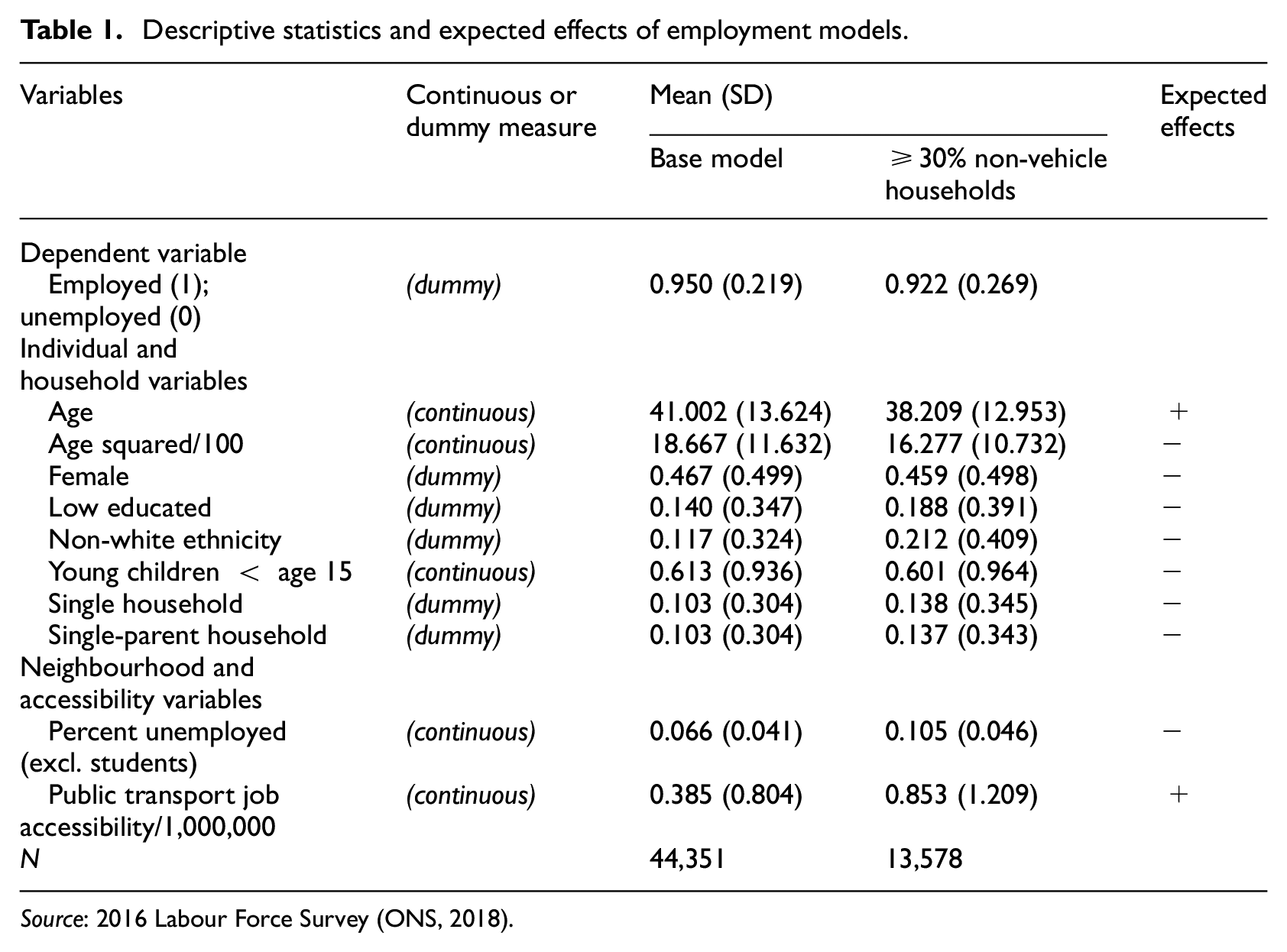
Table 1 shows the individual and household variables that were included as dummy or continuous variables in all models. Age is expected to increase individual employment probabilities, as youth unemployment is relatively high in Great Britain. This age effect is assumed to diminish with each additional year as reflected by the age-squared variable, which we divided by 100 to normalise coefficients. The employment prospects of women are typically lower than men, due to a larger share of part-time work and domestic tasks within the female population, whilst being lower educated or part of an ethnic minority is attached to less marketable employment skills and higher overall job competition. The number of dependent children (aged <15) in the household is further expected to reduce employment prospects due to increased caring responsibilities, and we assess the differential effects of being a single household or single-parent household, which are likely to increase household responsibilities and financial constraints whilst limiting the social network that can be used for job search.
Descriptive statistics and expected effects of employment models.
Source: 2016 Labour Force Survey (ONS, 2018).
As a measure of residential segregation, we further constructed a neighbourhood variable based on the percent unemployed (excluding students) in each LSOA, as adverse social effects and increased job competition are expected to decrease employment prospects, while public transport services in these areas may be limited. We further included our public transport job accessibility measure, which was matched to each individual’s LSOA code of residence and divided by 1,000,000 to normalise the coefficients. Both the neighbourhood and accessibility variables are included as continuous variables in the model.
While the LFS does not register individual vehicle ownership, which is endogenous to employment status, analysis of the UK National Travel Survey (Mackie et al., 2012) found that 70% of people with no car available use the bus or other public transport frequently, compared with 20% of those with a car. 2 We therefore also estimate models based on a sub-sample of individuals residing in neighbourhoods (LSOAs) with ≥15% and ≥30% non-vehicle households to assess the differential employment effects of public transport job accessibility.
Endogeneity and instrumental variables
As noted earlier in the literature review, we needed to ensure that we had adequately controlled for endogeneity in the model in terms of the relationship between public transport job accessibility and individual employment probabilities. The recommended ways to control for endogeneity are to use random natural shocks (Tyndall, 2017) or policy-induced ‘quasi-random’ changes in job accessibility (Blumenberg and Pierce, 2017). Since neither of these approaches are possible due to the cross-sectional nature of our datasets, we applied an instrumental variable (IV) approach.
The application of an IV approach requires the use of an instrument (i.e. another variable) that is highly correlated with the endogenous explanatory variable it is instrumenting (i.e. public transport job accessibility) but that has a very low correlation with the residual error from the second stage regression (on employment probabilities). Our instrument is thus to be correlated with employment only through its correlation with job accessibility.
Following previous studies (Hu and Giuliano, 2017; Thompson, 2001), we created an instrumental variable based on population densities (population per hectare) in all LSOAs: the Pearson correlation coefficient between population densities and public transport job accessibility levels is statistically significant and strong at 0.61, while the correlation between population densities and individual employment status is weak and insignificant. We also experimented with instruments used by Hu (2016) based on the percentage of non-vehicle owners in each LSOA, as this may be higher in urban areas with more extensive public transport systems, but these proved insignificant.
To assess the impact of public transport job accessibility on individual employment probabilities, the employment models with the IV approach were estimated in two stages (see Supplemental Appendix Table I for the base model). In the first-stage model, accessibility Ai was estimated as a function of all individual and household variables Ii and the neighbourhood variable Ni plus our instrumental variable of population density. The first-stage results demonstrate that our instrument population density was a strong and highly significant predictor of public transport job accessibility (see Supplemental Appendix Table II).
To test for weak instruments, we report the Kleibergen-Paap under-identification test, which tests the null hypothesis that our instrument has insufficient explanatory power to predict our endogenous variable (i.e. public transport job accessibility) in the model for identification of the parameters.
In the second-stage model, employment is estimated as a function of all Ii and Ni variables plus the predicted value of accessibility, Ai, from the first-stage regression. In this way, the impact of job accessibility is purged of endogeneity bias. The Wald Chi-Squared statistics for each model indicated whether we could reject the null hypothesis of exogeneity (p value <0.05) and reported the estimates from the two-stage model, which use the estimated job accessibility from the first-stage model.
For the models with insignificant Wald Chi-Squared statistics, we did not reject the null hypothesis of exogeneity for explanatory variables and thus reported the estimates from the single-stage model without instrumental variable. Since the latter does not imply that job accessibility is exogenous in these areas, but rather that there is not enough evidence in the samples against the hypothesis, we estimated all equations under the null hypothesis (single-stage model) and the alternative hypothesis (IV model) in order to compare the results (see Supplemental Appendix Table II).
Results and discussion
In this section of the article, we report and discuss the results of our models and their implications for employment probabilities. We compare the base models for Great Britain with and without the IV approach in the Supplemental Appendix (Table I), which shows that the job accessibility coefficients increased in absolute value when using the IV approach, suggesting that they are biased downwards in the single-stage probit model, i.e. that job accessibility is lower in higher areas of unemployment. In the first-stage regression, our instrument yields a significant Kleibergen-Paap F-statistic of 4552.66***, which is larger than the critical values in the Weak Identification F test, and so we reject the null hypothesis that our instrument is weak. Where the predicted values of accessibility in the second stage (i.e. our instrument) are insignificant, the Wald Chi-Squared statistics always indicated that we could not reject exogeneity, i.e. that there is enough evidence in the samples against the hypothesis. However, wherever we have a significant instrumented accessibility measure (e.g. for the base model and sub-models of urban areas, low-income neighbourhoods, young people and low educated people), we find consistent evidence of endogeneity. In the models where the predicted accessibility coefficients were not significant, the single-stage probit model coefficients on accessibility (i.e. without the instrumental variable) were also insignificant. It thus seems to be consistent that where accessibility is an important determinant of employment, it is also endogenous. It makes sense to find no evidence of endogeneity if accessibility was not significant in the single-stage model.
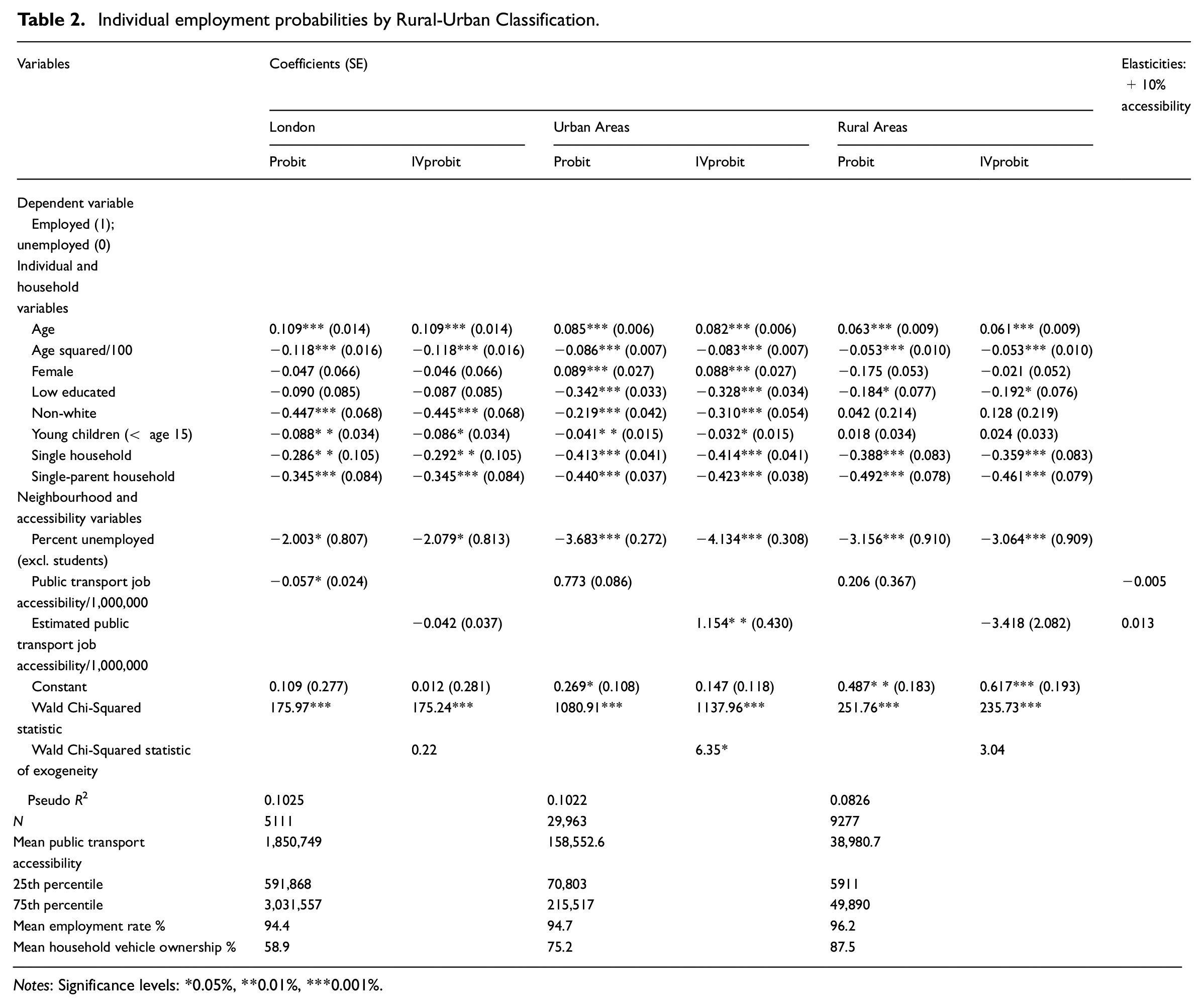
As most previous accessibility studies have focused solely on metropolitan areas, and most often in the US context, we first examine whether the same probability patterns hold for a range of different area types in Great Britain. We follow a strategy applied by Johnson et al. (2017) and present in Table 2 employment models based on the official 2011 Rural-Urban Classification for England and Wales (DEFRA, 2011) and for Scotland (Scottish Government, 2011): London; Urban Areas (
Individual employment probabilities by Rural-Urban Classification.
Notes: Significance levels: *0.05%, **0.01%, ***0.001%.
We reported all equations under the null hypothesis (probit model) and the alternative hypothesis (IV probit model) in order to compare the results, which clearly show that similar patterns between the different equations hold. From the resulting Wald Chi-Squared statistics for the model for Urban Areas, we reject the null hypothesis of exogeneity and use the estimates from the two-stage model which use the predicted value of accessibility from the first-stage model. For the models for London and Rural Areas, we did not reject the null hypothesis of exogeneity for explanatory variables and thus use the estimates from the single-stage probit model without instrumental variable. We expect smaller issues with exogeneity in London, as people there are generally more dependent on public transport (for 53% of their commutes; DfT, 2017), while job accessibility in rural areas may simply be too low to yield differential employment effects.
Among the individual variables in Table 2, a higher age improves individual employment probabilities, which may be explained by the larger share of young people that are unemployed: on average, the employed are aged well over 41 while the unemployed are aged just below 35. Their relative lack of work experience in comparison with other age groups, in combination with competition from other more experienced job seekers, may make it more difficult for young people to find employment. This age effect diminishes with each additional year of age, as indicated by the negative coefficient for age squared.
Being female is only a significant factor for Urban Areas and slightly increases employment probabilities, which seems to follow from women’s higher inclusion in the labour market (53% of unemployed are men). Being low educated decreases employment prospects, which is typically attached to less marketable employment skills and higher overall job competition, while the non-white population often have lower employment prospects due to discrimination or residential segregation.
Of the household variables, having dependent children decreases employment prospects, in which case child-caring responsibilities and/or lack of suitable childcare may constrain access to employment. A more influential variable is whether a person is single, or especially whether they are in a single-parent household, which significantly decreases employment prospects. Having a partner may relieve some household responsibilities and financial constraints, while potentially also providing a social network through which employment can be sought. The percentage unemployed in each neighbourhood (excluding students) further significantly decreases employment prospects, in particular in areas outside of London. Studies in other European cities (e.g. Gobillon and Selod, 2007) suggest that this may result from higher job competition and adverse social effects.
Public transport job accessibility yields a significant and positive coefficient for Urban Areas, while there is a negative coefficient for London. We derived employment elasticities to show changes in individual employment probabilities based on a 10% increase in public transport job accessibility levels. 3 For Urban Areas, a 10% increase in public transport job accessibility yields an employment elasticity of 0.013, which relates to a 0.13% increase in the employment rate. Whilst these employment elasticities seem relatively small, they imply that 29,000 people in Urban Areas move into employment based on this increase. The significant negative coefficient in the London model indicates that individual employment probabilities would decrease with increasing public transport job accessibility levels. While Londoners are more dependent on public transport, as also indicated by their lower neighbourhood household vehicle ownership rate (58.9%), their significantly higher mean job accessibility level in combination with the flat fare rate structure for public transport services in London may simply imply that there is no straightforward relationship between travel costs, job accessibility and employment prospects.
The higher levels of public transport job accessibility amongst the unemployed (2.1 million jobs) as compared to the employed (1.8 million jobs), resulting from the concentration of social housing in and around the centre of London, might also imply that residential heterogeneity is not adequately controlled for in these groups. In rural areas, the relatively high vehicle ownership rates (87.5%) seem to indicate that individuals are less dependent on public transport services, while job accessibility levels may be too low to yield differential effects to the relatively high employment rate of 96.2%.
While we lack information on individual vehicle ownership in this study, which is endogenous to employment status (see Bastiaanssen et al., 2020 for discussion), we may expect that people residing in neighbourhoods where many households lack access to vehicles are more sensitive to changes in public transport job accessibility. We therefore narrowed our employment models to individuals residing in neighbourhoods with
When we narrow the area type models to
The impact of public transport job accessibility by median neighbourhood income level
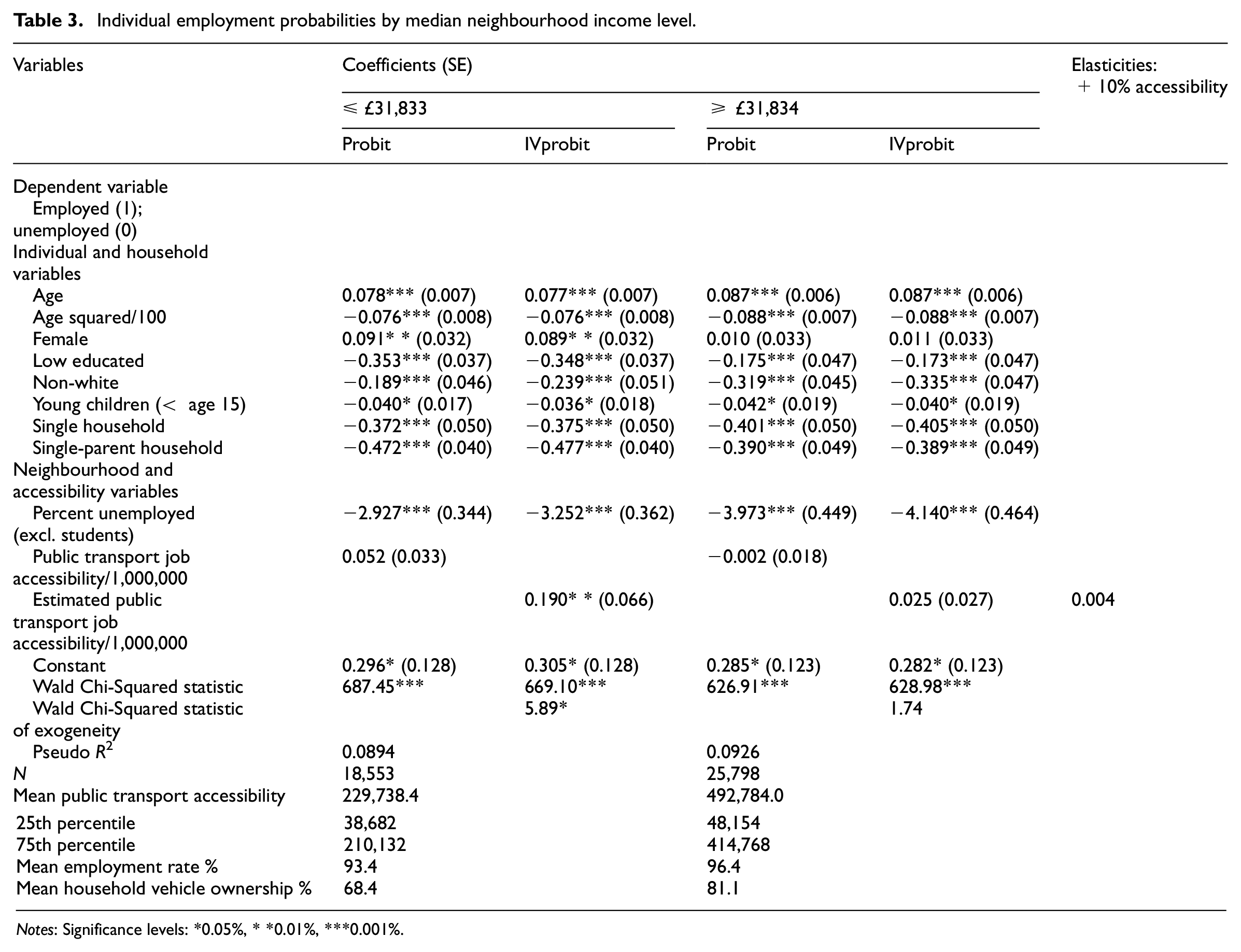
Since individuals in poor neighbourhoods are typically more dependent on public transport, while these areas are often poorly served by traditional public transport services due to a combination of profitability and economic austerity measures, we conducted separate employment models using median neighbourhood (LSOA) household income levels as reported in the 2011 UK Experian Income dataset. In Table 3, we present our employment models in which we grouped our individuals based on their median neighbourhood income levels: low income (≤£31,833) and high income (≥£31,834).
Individual employment probabilities by median neighbourhood income level.
Notes: Significance levels: *0.05%, **0.01%, ***0.001%.
From the resulting Wald Chi-Squared statistics of exogeneity, we reject the null hypothesis of exogeneity for the low-income group and report the estimates from the two-stage model which use the estimated job accessibility as an instrument from the first-stage model. For the high-income group, we were not able to reject the null hypothesis of exogeneity and thus report the estimates from the single-stage probit model. 4 Again, we find that the job accessibility coefficients increased in absolute value when using the IV approach, implying that they are biased downwards in the single-stage model.
The variables in all employment models demonstrate a significance in line with the findings in our previous models, with a positive association between increasing age and being employed, while all other variables show the expected negative impact on employment probabilities.
Public transport job accessibility levels again vary significantly for individuals residing in different neighbourhoods, with those in low-income neighbourhoods more often residing in peripheral urban areas that are under-served by public transport services and therefore having much lower job access, while the lower mean vehicle ownership rates indicate that they are more reliant on public transport.
Public transport job accessibility is only significant for the low-income group, with a 10% increase in public transport job accessibility yielding an employment elasticity of 0.004, which amounts to a 0.04% increase in the employment rate. Our accessibility measure is non-significant for individuals residing in high-income neighbourhoods, where public transport job accessibility levels and car ownership rates are much higher, while they are more often employed, so that variations in job accessibility may be less important for their employment prospects.
The impact of public transport job accessibility by age group and educational level
To further scrutinise the impact of public transport job accessibility on individual employment probabilities, we conducted subgroup analyses based on age groups (16–24, 25–34, 35–49, 50–64) and educational levels (low-, middle-, high educated), based on standard definitions in the LFS. In terms of age, public transport job accessibility is significant for young people aged 25–34 and for people aged 50–64, yielding employment elasticities of respectively 0.004 and 0.002 following a 10% increase in job accessibility (see Supplemental Appendix Table IV).
The lower employment rates of both groups seem to be more sensitive to job accessibility changes, while the relatively low car ownership rate of 70.8% amongst young people may also indicate a higher dependency on public transport services. Public transport job accessibility is not significant for youth aged 16–24, for whom other factors such as lack of work experience or skills mismatches may be more important than job accessibility, while they may also rely more on family and friends to drive them to jobs (see e.g. Chatterjee et al., 2018). Rather than travel time, the British Youth Council (2012) further found that the costs of transport had a significant effect on job uptake, in particular amongst young people. For those aged 35–49, their higher employment rates may simply be less sensitive to job accessibility changes, while other factors such as skills mismatches may be more important in their employment uptake.
When looking at education levels, public transport job accessibility only shows a significant positive impact for low-educated individuals, with a related employment elasticity of 0.006 based on a 10% increase in public transport job accessibility (see Supplemental Appendix Table V). Due to their lower employment rate of 91.5%, combined with a relatively strong negative effect of the percentage unemployed in their neighbourhood, low-educated individuals are likely to be more sensitive to changes in job accessibility levels. Public transport job accessibility is not significant for the middle- and highly educated groups, for whom the higher car ownership levels may simply make them less dependent on public transport services.
Concluding remarks: Public policy implications
In this first national British study to model public transport job accessibility at the micro level of individuals, we empirically assessed whether better public transport access helps people to get a job, as well as which urban and rural areas and population groups would benefit from this. To do this, we developed a bespoke, local-area public transport job accessibility measure using employment micro datasets, which could be applied nationwide. We combined this measure with a national individual-level employment dataset, which allowed us to allocate each individual a unique measure of public transport job accessibility from their area of residence. Our employment models were further corrected for endogeneity by applying an instrumental variable approach, which showed that wherever accessibility was a significant determinant of employment, it was also endogenous.
Previously, most of the spatial mismatch literature has been concentrated on the US and in the context of metropolitan areas. However, British cities and towns have also experienced the combined decentralisation of employment and concentration of traditional public transport services in the main corridors of urban centres over the past decades, making these employment locations increasingly difficult to access without a car. Our study supports recent evidence of the negative effect of poor job accessibility on employment outcomes in European metropolitan areas and smaller cities and towns (e.g. Di Paolo et al., 2014; Korsu and Wenglenski, 2010; Matas et al., 2010), especially among people who rely on public transport.
Our empirical findings imply that providing better public transport job accessibility increases individual employment probabilities in Great Britain, but only in certain contexts. In particular, individuals residing in urban areas with low car ownership rates are found to benefit from higher levels of public transport job accessibility. However, our study could not control for individual car ownership and is, therefore, not a straightforward relationship, particularly for London, which may relate to the very high levels of public transit provision throughout the City and the flat fare structure for public transport services. In rural areas, higher employment and vehicle ownership rates make individuals less sensitive to public transport accessibility, while average public transport job accessibility levels were too low to yield differential employment effects. Our study further shows that public transport job accessibility levels are far lower in low-income neighbourhoods, where an improvement would increase individual employment probabilities most. We further find that mainly low-educated individuals and young people benefit from better public transport job accessibility, while other factors such as lack of work experience or skills mismatches may be more important for other age groups and higher educated individuals.
Our study findings are particularly important from a public policy and service operation point of view because they underline the need for public transport delivery strategies to be better targeted towards improving public transport services and subsidies in under-served neighbourhoods, such as peripheral and deprived urban areas, and among disadvantaged population groups without access to private vehicles, such as low-income households and younger people (see also Blumenberg and Pierce, 2014; Cervero et al., 2002). From a social welfare policy perspective, our findings clearly imply that job seekers would benefit from tailored public transport services fitting with their demographic profiles and residential location, as discussed in Lucas et al. (2009). The importance of tailoring policies in this way is also highlighted by the fact that we find public transport job accessibility to be actually lower for those in low-income neighbourhoods.
When employment prospects of job seekers are influenced by public transport accessibility, as shown by the findings of this study, it can be argued that public intervention is necessary, as those who are dependent on public transport services often cannot personally increase their accessibility by purchasing cars, while ‘Wheels to Work’ programmes in the UK (Lucas et al., 2009) have been demonstrated to help people gain employment. This also relates to the costs of (public) transport that can be a significant barrier to job uptake, in particular among lower income groups (Lucas, 2012) and youth (British Youth Council, 2012).
Supplemental Material
sj-pdf-1-usj-10.1177_00420980211012635 – Supplemental material for Does better job accessibility help people gain employment? The role of public transport in Great Britain
Supplemental material, sj-pdf-1-usj-10.1177_00420980211012635 for Does better job accessibility help people gain employment? The role of public transport in Great Britain by Jeroen Bastiaanssen, Daniel Johnson and Karen Lucas in Urban Studies
Footnotes
Acknowledgements
The authors would like to thank the UK West Yorkshire Combined Authority for their support of this research and the anonymous reviewers for their useful comments and suggestions. This work was based on micro datasets produced by the UK Office for National Statistics (ONS) and the ESRC and supplied by the Secure Data Service at the UK Data Archive.
Declaration of conflicting interests
The author(s) declared no potential conflicts of interest with respect to the research, authorship, and/or publication of this article.
Funding
The author(s) received no financial support for the research, authorship, and/or publication of this article.

Supplemental material
Supplemental material for this article is available online.
Notes
References
Supplementary Material
Please find the following supplemental material available below.
For Open Access articles published under a Creative Commons License, all supplemental material carries the same license as the article it is associated with.
For non-Open Access articles published, all supplemental material carries a non-exclusive license, and permission requests for re-use of supplemental material or any part of supplemental material shall be sent directly to the copyright owner as specified in the copyright notice associated with the article.
