




Abstract
The analysis of regional convergence often stays at the level of documentation, with limited attention placed on the drivers of convergence/divergence dynamics. This article offers a systematic analysis of this, examining the role of first-nature (location, proximity, physical geography) and second-nature geography (economic structure, agglomeration, economic potential) in accounting for regional synchronicity in growth trajectories (stochastic convergence). Utilising historical data for Greece at the prefectural level and up-to-date time-series econometric techniques, we test for the presence of stochastic convergence in the country over three decades prior to the crisis; identify the pairs of regions which exhibit co-movement in their growth dynamics; and examine the covariates of this. Our results unveil a picture of limited-only and cluster-like convergence, driven predominantly by factors related to accessibility, sectoral specialisations, labour market dynamism, market potential and selected locational characteristics. This supports two propositions: (a) convergence is an endogenous process, related to shared and incongruent characteristics of regions; and, by implication, (b) regional disparities are structural (in the sense that they are linked to economic and spatial structure) and thus require targeted policies in order to be addressed.
Introduction
The analysis of regional growth has long been dominated by the neoclassical notion of beta-convergence, which postulates that low-income economies grow faster than more developed ones, owing to the nature of production technology (diminishing returns to individual factors of production). This notion of convergence, however, has received a number of critiques, both analytical and methodological. Within the field of regional research, a central critique concerns the very notion of equilibrium (for theories of cumulative causation – see Fingleton and McCombie, 1998) in general and the lack of attention to the local context (institutions, indigenous development, spatial interactions, see Martin and Sunley, 1998) in particular. 1 In the more general growth literature, critiques of the neoclassical convergence hypothesis extend to an array of issues, including its lack of attention to distributional dynamics (Quah, 1993); its empirical conflation with mean reversal (Islam, 1995); and, most importantly, its assumptions about diminishing returns (for theories of endogenous growth see Romer, 1994), a universally common steady state (for club convergence see Durlauf, 1996) and the deterministic nature of the growth process (for stochastic technological growth see Binder and Pesaran, 1999).
Besides these issues, a consequence of the dominance of beta convergence in the empirical literature is that it generates a disproportionate focus on documenting convergence, with little – if any – attention to explaining why and how (or when) convergence occurs. Indeed, only a handful of studies exist which have even cursorily touched upon this issue. Abler and Das (1998, for India) and Petrakos et al. (2011, for the EU) have both exploited cross-state variations in the speed or extent of intra-state convergence to examine the (state-level) drivers of these variations. Monastiriotis (2014) examined instead the role of national development on regional convergence, in the tradition of the Williamson Curve, finding a non-linear convergence/divergence path across stages of development (for the EU nuts3 regions). In the distributional dynamics literature, a limited number of studies (e.g. Leone and Montolio, 2004) have used regional-level variables to calculate counter-factual regional income distributions by which they infer an influence of such variables on the growth process. But only recently has the literature seen the first attempts – still, outside the field of regional research – to link the incidence of regional convergence to specific regional, and especially relational, characteristics (e.g. geographical and economic distance between pairs of regions – see Holmes et al., 2011, 2014).
Motivated by this scant literature, this article examines the drivers of convergence, focusing specifically on the influence exerted by economic geography. We are interested in two aspects: one concerning various locational and physical characteristics (first-nature geography); and one concerning structural-economic characteristics linked to industrial structure, agglomeration and economic potential (second-nature geography). For each of these characteristics, we develop two relational measures – measuring dissimilarity and congruence, respectively – which we use complementarily in our empirical analysis. To examine the incidence of convergence, we utilise the concept of stochastic convergence, which has been relatively under-explored in the regional convergence literature. 2
Stochastic convergence examines the co-movement of growth trajectories across regions, seeking to establish whether a common growth path exists and whether shocks leading to deviations from this path are transitory. Pesaran (2007a) shows that this notion of convergence has a number of advantages in relation to the beta-convergence approach. First, it accommodates the empirical observation that convergence between two economies can occur even in the absence of common steady states or initial conditions (so long as output in the two economies has the same trend and output differentials are not explosive). Second, it allows for cases of divergence even in the presence of diminishing returns (so long as the technological process is stochastic and technology shocks occur with sufficiently high frequency). Third, it allows for cumulative causation dynamics and club convergence, if applicable, to arise endogenously from the analysis without recourse to a prior model specification. Last, it is not sensitive to the choice of start and end dates, not influenced by mean reversal and utilises fully the information contained in the regional growth distributions.
Importantly, stochastic convergence can be examined not only jointly for the full population of regions, as is standard with the neoclassical convergence and distributional dynamics approaches, but also separately for each pair of regions. Our empirical analysis uses this pairwise information to examine the role of first- and second-nature geography for convergence (more specifically, for the synchronicity of regional growth trajectories). We implement our analysis using data for Greece, covering a long time period (from the country’s accession to the then European Economic Community in 1981 to the year prior to the eruption of the Eurozone crisis) at fine spatial detail. 3
We focus on Greece for two inter-related reasons. First, Greece is one of the most intensively studied cases in the empirical convergence literature, with known patterns of club convergence and polarisation, and thus is an interesting case for examining the drivers of convergence and divergence. Second, over the last three decades the country has experienced a rather remarkable secular trend of declining regional disparities (sigma convergence) but is still recognised today to be ridden with sizeable regional imbalances and structural asymmetries (Karahasan and Monastiriotis, 2017; Monastiriotis, 2011; Petrakos and Psycharis, 2014). We start our analysis by examining the incidence of stochastic convergence for the country as a whole (and against specific benchmark regions), also allowing for non-linearities in the underlying growth trajectories and testing for convergence at two distinctive sub-periods (before and after entry into the Economic and Monetary Union). We subsequently estimate pairwise measures of convergence; examine their frequency and geographical distribution; and investigate how first- and second-nature geography characteristics account for variations in this across space.
It is worth emphasising the importance of this analysis, which goes beyond the empirical case studied here. By identifying the determinants of pairwise convergence, we are able to move beyond the neoclassical notion of convergence driven by diminishing returns (or of divergence driven by increasing returns) and to obtain insights into the structural characteristics that account for regional differences in growth trajectories – thus also shedding light on the areas where policy effort may concentrate to tackle regional disparities.
Our analysis proceeds as follows. The next section reviews the recent literature on stochastic convergence and summarises the evidence of convergence in Greece. The following section explains our empirical approach. We then present and discuss our empirical findings, and the final section offers conclusions.
Literature review
Carlino and Mills (1993, 1996) were the first to apply a stochastic analysis to the study of convergence. Testing, across US regions, the stationarity of per-capita income shocks in a beta-convergence framework, they found that beta convergence is conditional on the transitory nature of exogenous shocks. The notion of stochastic convergence was more formally introduced by Bertand and Durlauf (1995), who implemented a cointegration analysis across OECD economies and provided evidence for convergence, as common long-run factors were found to jointly determine countries’ output growth. Pesaran (2007a) formalised further the notion of stochastic convergence, deriving that convergence occurs when output gap is a stationary process with constant mean, and introducing a pairwise unit-root approach to test for this. His results gave very limited evidence of convergence, which the author attributed to ‘the existence of country-specific unobserved factors that tend to be highly persistent’ (Pesaran, 2007a: 315). Mello (2011) and Heckelman (2013) tested the existence of regional convergence using the per-capita income of US states, both providing supportive evidence of stochastic convergence. Holmes et al. (2011), in an approach more akin to Pesaran (2007a) although using alternative stationarity tests, provided further evidence that nearly half of the states stochastically converge in the long run.
The issue of stochastic convergence has attracted more attention in cross-country analyses. Canarella et al. (2010) and Sondermann (2012) tested this for the case of the Euro-Area countries, introducing structural breaks into their stationarity analysis; while Próchniak and Witkowski (2015) examined stochastic convergence across EU member states, against the EU15 benchmark, introducing a Bayesian model of conditional stochastic convergence. Stengos and Yazgan (2014) applied a stochastic convergence methodology that allows for endogenous changes in the speed (and direction) of convergence, also allowing for structural breaks. More recently, Lee et al. (2017) revisited the issue of deterministic versus stochastic convergence, showing that non-transitory shocks causing permanent deviations in steady-state growth rates lead to an underestimation of (conditional) convergence in deterministic models.
There are numerous studies examining evidence of beta convergence across Greek prefectures and regions, typically finding evidence of conditional convergence and north–south club formation (see, inter alia, Alexiadis and Tomkins, 2004; Asteriou et al., 2002; Benos and Karagiannis, 2008; Christopoulos and Tsionas, 2004; Kafousias, 2009; Michelis et al., 2004; Siriopoulos and Asteriou, 1998; Tsionas et al., 2014). Outside this tradition, however, studies of convergence are limited. A few studies have examined regional convergence using stochastic non-parametric techniques (Fotopoulos, 2006; Liontakis et al., 2010; Papadas and Eustratoglou, 2004; Tsionas, 2002); however, only one study has applied the stochastic convergence approach on Greek data, finding mixed results of convergence/divergence for the period 1975–2003 (Kafousias, 2012).
Testing for stochastic convergence allows the derivation of region-specific and pairwise estimates of convergence, which can be used in order to formally examine the spatio-economic determinants of long-term patterns of convergence and divergence across space. Still, research in this direction is in its infancy and so far has concentrated on providing predominantly descriptive accounts of the identified patterns, with no attention to more analytical questions concerning the locational and spatial-economic dynamics driving cross-regional convergence (see, inter alia, Costantini and Arbia, 2006; Tyrowicz and Wojcik, 2010). In – to our knowledge – the first study to look at this issue, Holmes et al. (2011) examined how geographical proximity affects the probability of convergence between pairs of US states, finding an adverse role played by distance, thus suggesting the presence of geographically clustered convergence clubs. In an extension of this work, Holmes et al. (2014) examined additionally the role of initial income disparity, finding that (stochastic) convergence characterises mainly areas of similar initial levels of development. In this article, we take this exploration further, addressing the question of the determinants of convergence in a more rounded fashion, and examining specifically how locational (first-nature geography) and structural-economic characteristics (second-nature geography) affect the incidence of (stochastic) convergence across space.
Empirical approach
Locating convergence: Stochastic convergence analysis
Pesaran (2007a) proposed a probabilistic version of output convergence, which introduces a stochastic process in the technology and employment parameters of the neoclassical growth model. Unlike the deterministic neoclassical model, this ‘does not require the converging economies to be identical in all respects (savings rates, population growths and initial endowments)’ (Pesaran, 2007a: 314), and instead it suffices that the output gap 4 between any pair of economies be stationary, so that shocks (in technology or employment) do not lead to permanent deviations in growth paths across the two economies. Despite these differences, Pesaran (2007a) shows that the stochastic version is fully consistent with, and in fact represents a more general form of, the neoclassical and endogenous growth models. Specifically, in the stochastic model:
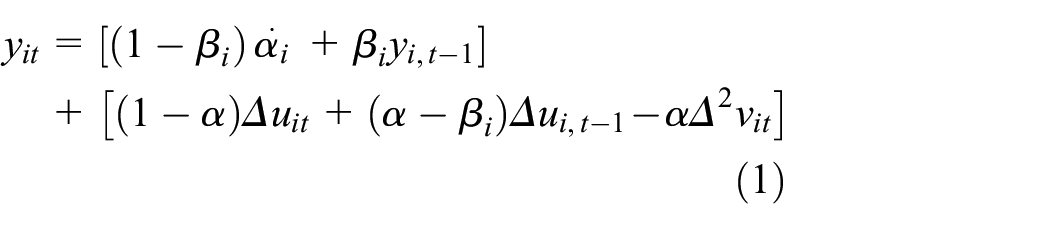
the first bracketed term is consistent with neoclassical convergence with endogenous technological growth (
In our empirical investigation we use a range of complementary unit root tests, as is explained below, and apply them in two types of analysis: against pre-selected benchmarks and in a pairwise fashion for all bilateral pairs of Greek prefectures. The benchmark analysis relies on computing regional output differentials against a benchmark region and testing for their stationarity over time. We use three such benchmarks: the country average (national), Attiki (the metropolitan region of the capital Athens) and Thessaloniki (the regional capital of northern Greece). 5 The pairwise analysis is similar, but extends to all possible bilateral pairs – 1275 pairs of regions (given by N*(N−1)/2 with N = 51) while it resolves the problem of unavoidable arbitrariness in the selection of the relevant benchmarks. 6
We start by testing the stationarity of the output gap

where the null of non-stationarity
Despite their appeal due to their simplicity, ADF and DFGLS tests have been criticised in the literature for having reduced power in rejecting the null hypothesis. Kapetanios et al. (2003) showed that in cases of highly persistent processes, an Exponential Smooth Transition Auto-regressive process (ESTAR model) is more consistent under globally stationary conditions and more powerful than the ADF tests. The resulting nonlinear specification is known as the KSS test, which can be written as follows:

where the null hypothesis is

where the null hypothesis is
To obtain an overall assessment of the extent of cross-regional convergence in Greece based on these tests, we calculate the fraction of unit root rejections out of the total number of cases. This gives the percentage of cases where the statistics offer evidence in favour of convergence. To add to this ‘aggregate’ analysis, we also apply a panel unit root test, which gives us a single statistic on which to base our decision to accept or reject the null hypothesis of non-stationarity (non-convergence). Specifically, we implement the CADF panel unit root test – a ‘second-generation’ panel unit root test which relies on ADF regressions augmented by the cross-section averages of lagged levels and first differences of the individual series (Pesaran, 2007b). The CADF test is particularly suited for the case of regional data, as it is valid under the assumptions of panel heterogeneity and cross-sectional dependence, which is common in regional datasets.
Explaining convergence: Regional dissimilarity and congruence
To examine the factors driving the observed patterns of convergence, we concentrate on the most information-wealthy set of estimates, namely the pairwise convergence test statistics ADF, DF-GLS, KSS and AESTAR. Each of these provides us with an alternative cross-section of bilateral estimates of convergence across pairs of regions, which we want to treat as our dependent variable. 11 We are aware of the possible bias that can be introduced by the use of point estimates as a dependent variable (Lewis and Linzer, 2005). Therefore, we convert our test statistics first into binary form 12 and use these as our dependent variables in a cross-sectional probit analysis estimated by maximum likelihood. In essence, our approach is to treat the pairwise statistics as latent variables reflecting the probability of rejection of non-stationarity (acceptance of convergence) that underpins the observed ‘event’ of rejection.
Thus, our empirical estimating model takes the following form:

where C is our binary measure of convergence between regions i and j (with i≠j); Φ is the cumulative normal distribution function; X is a vector of pairwise regional characteristics, as explained below; τ and φ are ‘origin’ and ‘destination’ dummies (corresponding to the two units in each pair); α and β are model parameters to be estimated; and u is a vector of iid errors. To account for the fact that for some cases the null of non-stationarity is more strongly accepted/rejected than for others, we apply importance weights in our estimation, which are approximated by the absolute value of the test statistic from the corresponding unit root test (so that both very negative and very positive values of the statistic weigh more heavily than values closer to zero).
We model the binary outcome of convergence–non-convergence (C) as a function of various locational, geographical, structural and economic-potential characteristics, which are included in vector X above. These include: (a) a series of dummies for northern, southern, metropolitan, urban, peripheral, island and port regions and an indicator of neighbourliness, 13 that is, indicators that relate to locational or first-nature geography characteristics; and (b) a series of measures that capture three distinctive aspects of second-nature geography, namely sectoral structure (shares of services and capital-intensive manufacturing and a Herfindahl index of specialisation), economic geography/agglomeration (population density, market potential and accessibility) and economic potential (levels of education, per capita income and the inactivity rate). 14 Given the pairwise nature of our data, we model these characteristics in relational terms, using two types of measures: one that defines our variables in terms of dissimilarity (calculated as the absolute difference between two local values standardised by the range of values in the series), and one that defines them as measures of congruence (calculated as the product of the two local values, again in a standardised form). For the dichotomous variables (e.g. the urban dummy), dissimilarity implies that a pair takes the value of 1 if only one in any pair of regions is defined as urban (and zero otherwise), while congruence implies that a pair takes the value of 1 if both regions are urban (and zero otherwise). For the continuous measures (e.g. population density), dissimilarity is defined as the distance between the standardised population densities of any two regions, while congruence is defined as the product of their standardised population densities.
Selection of the second-nature geography measures is intuitive, as these represent key features affecting regional growth in the literature (Breinlich et al., 2014). Selection of our first-nature geography measures is more context specific, relating to particular features of the Greek economic space. For example, as already noted, the literature identifies significant differences in growth dynamics in Greece along the north–south dimension (Alexiadis and Tomkins, 2004; Siriopoulos and Asteriou, 1998) – possibly reflecting differences in both political history (e.g. the northern regions became part of Greece only decades after the formation of the Greek State) and economic fundamentals (Coccossis and Psycharis, 2008; Petrakos and Psycharis, 2014). Also, known differences exist in economic structures between island and mainland regions (e.g. with regard to tourism –Armstrong et al., 2014), as well as between peripheral, metropolitan and urban/rural regions (Monastiriotis, 2009; Monastiriotis and Martelli, 2020).
Our main source of data is the Cambridge Econometrics regional database, which contains information on GDP per capita, population, employment and key sectoral divisions across all NUTS3 regions of Greece (prefectures). Nominal variables are measured in constant 2000 Euros. This data is complemented selectively by 2011 Census data on inactivity and education, and by travel-time data derived from Google Maps (see note 14). Supplemental Table SA1 displays the descriptive statistics of the variables used in our analysis.
Empirical results
Stochastic convergence
We start with an assessment of stochastic convergence on the aggregate, as performed by the CADF panel unit root test that pools together all 1275 bilateral pairs of regions and tests for their joint non-stationarity (non-convergence) over the 28 years of our sample. For completeness, we also implement the test separately for two sub-periods, defined by the event of Greece’s entry into the Eurozone (1981–2000 and 2001–2008). As is shown in the bottom panel of Table 1, the relevant statistic fails to pass the critical value at conventional levels of statistical significance in all cases, with the exception of a marginal rejection of non-stationarity at the 10% level for the 2001–2008 subsample. This rejects the existence of stochastic convergence in the country over the long period (and certainly prior to accession to the Eurozone). Despite the evidence of previous research, in the beta-convergence tradition (as reviewed in ‘Literature review’ section), our evidence suggests the absence of a common growth path across the regions of Greece in the period since the 1980s.
Stochastic convergence tests.
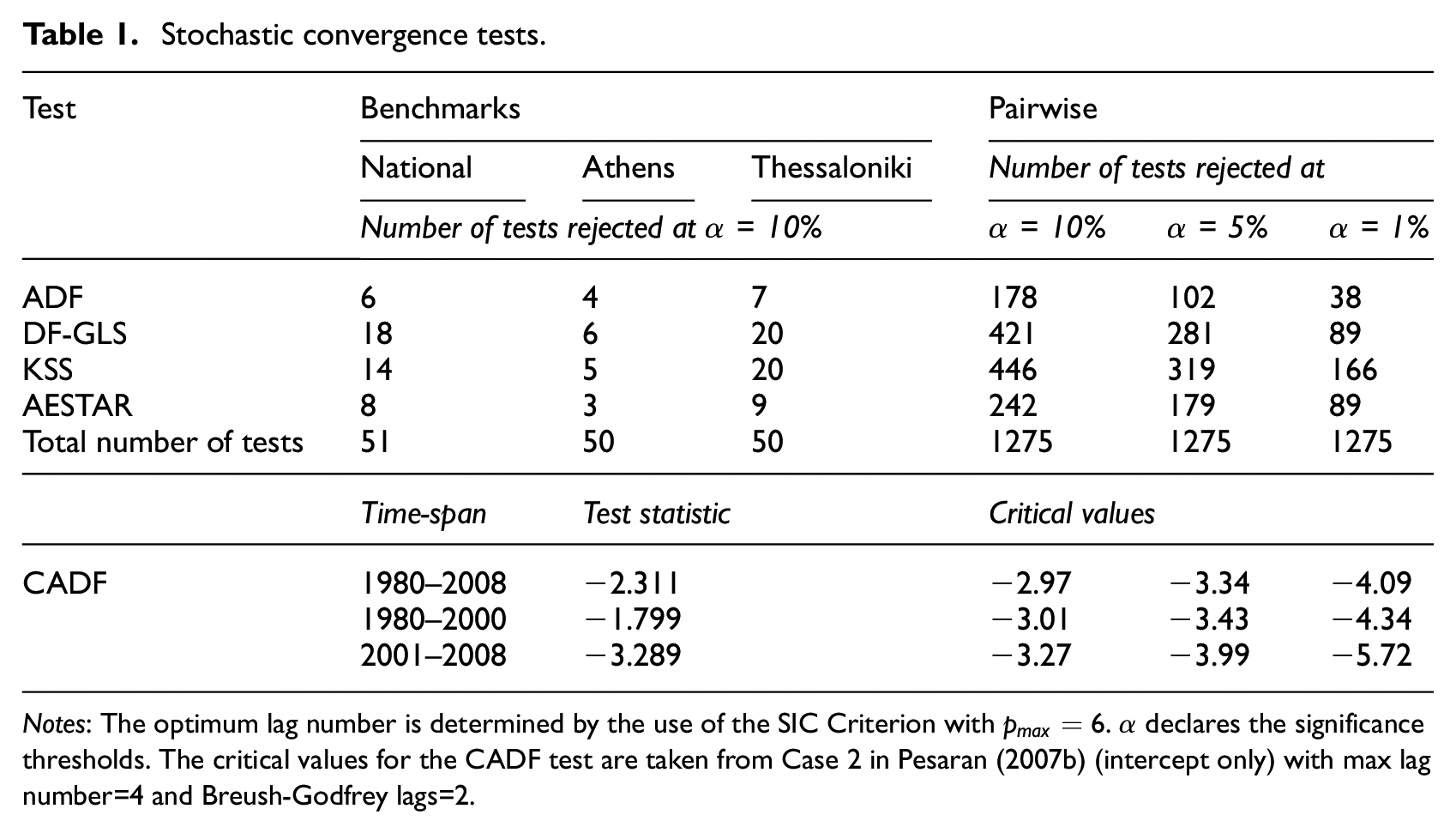
Notes: The optimum lag number is determined by the use of the SIC Criterion with
It is thus important to look beyond the aggregate picture and examine in particular the incidence of convergence for individual regions, both against our pre-defined benchmarks and on the whole (pairwise). As can be seen (top panel of Table 1), 15 the evidence of limited convergence in the country remains with the bilateral tests. 16 In all cases, the null of non-convergence is rejected on a minority of occasions: on average, less than a quarter of pairs of regions seem to be convergent, even at the 10% critical values (first four columns in the top panel of Table 1). The KSS statistic produces the highest number of rejections of the null of non-stationarity, closely followed by the DF-GLS statistic. As discussed earlier, these two statistics are generally favoured in the literature over the ADF; meanwhile, the AESTAR statistic, with its assumption about asymmetry, does not seem to fit our data particularly well. 17
Against the national benchmark (column 1 in Table 1), evidence of convergence (evaluated at the 10% confidence level) seems to characterise between 12% (in the ADF test) and 35% of regions (in the DF-GLS test) – with the most consistent evidence of convergence obtained for mainly peripheral regions (Dodecanese, Kefalonia, Lasithi, Rethymno, Xanthi and Thesprotia – see panel (a) of Figure 1). Convergence with the capital region of Athens (Attiki) is much weaker (column 2 in Table 1 and panel (b) in Figure 1), concerning only between 6% and 12% of cases (and consistently so only for the island regions of Cyclades, Zakynthos, Kefalonia and Lefkada). In contrast, evidence of convergence against the benchmark of Thessaloniki (column 3 in Table 1 and panel (c) in Figure 1) is much more plentiful, with up to 40% of regions converging to this benchmark (for the DF-GLS and KSS tests). This seems to strike some balance between our aggregate results (no convergence) and the wider literature of convergence in Greece, which has tended to show a general pattern of north–south polarisation, with stronger convergence in the north and relative divergence (with some club formation around Athens) in the south.
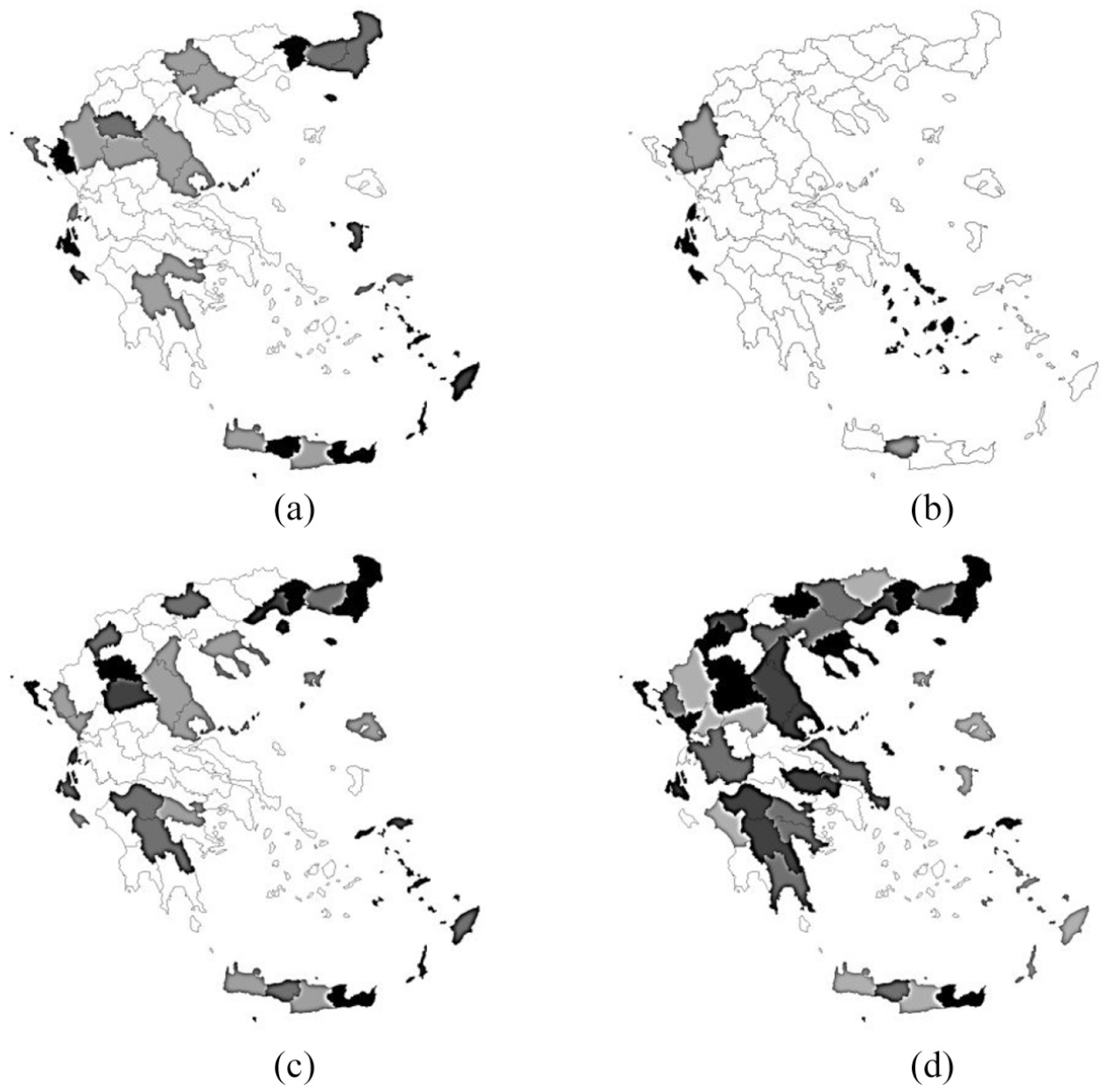
The geography of stochastic convergence in Greece: (a) national; (b) Athens; (c) Thessaloniki; (d) pairwise.
Turning to the full pairwise tests (top right panel of Table 1), we can see that again the results point to the same conclusion of only limited synchronicity of regional growth paths – with even the most accommodating tests (DF-GLS and KSS at the 10% confidence level) finding convergence in only a third of the cases; and the stricter of the tests (ADF at 1% level of confidence) finding evidence of convergence only in 3% of the cases (38 out of the 1275 pairs). Grevena (a prefecture in north-west Greece) is by far the most convergent region in these bilateral tests, 18 showing evidence of statistically significant pairwise stochastic convergence with between 24 regions (in the ADF and AESTAR tests) and 41 regions (in the DF-GLS test). Besides Grevena, the list of most convergent regions (here defined as converging with at least 33% of regions in the country) includes those of Chalkidiki, Preveza, Lasithi, Xanthi, Kastoria, Trikala, Evros, Kilkis, Achaia, Arkadia, Samos and Kefallinia. This is a broader set of regions than those appearing to converge to the national benchmark (compare panels (a) and (d) in Figure 1), suggesting that the incidence of convergence in the pairwise tests is not simply a reflection of common-across-regions dynamics of convergence to the national. Moreover, the convergent regions in the pairwise tests have a wide geographical spread, suggesting that the incidence of stochastic convergence in the country does not follow a simple geographical pattern. 19 This motivates our analysis of the role played by different facets of first- and second-nature geography, which follows.
The drivers of convergence
As we noted earlier, the only direct evidence on the potential determinants of (bilateral) patterns of convergence in the literature – for the case of the USA – is provided by Holmes et al. (2011, 2014), who identify geographical and economic distance as two factors (of first- and second-nature geography respectively) hindering convergence. Our exploration here extends this investigation to a broader set of factors.
First-nature geography
Table 2 presents the results related to first-nature geography characteristics, drawing two types of comparisons: between models that specify the pairwise regional variables in terms of dissimilarity and models that use the congruence version of these variables (e.g. column 1 versus column 5); and across models where the dependent variable is measured alternatively by each of the four different test statistics (e.g. columns 1–4). 20
The role of locational characteristics for pairwise convergence.
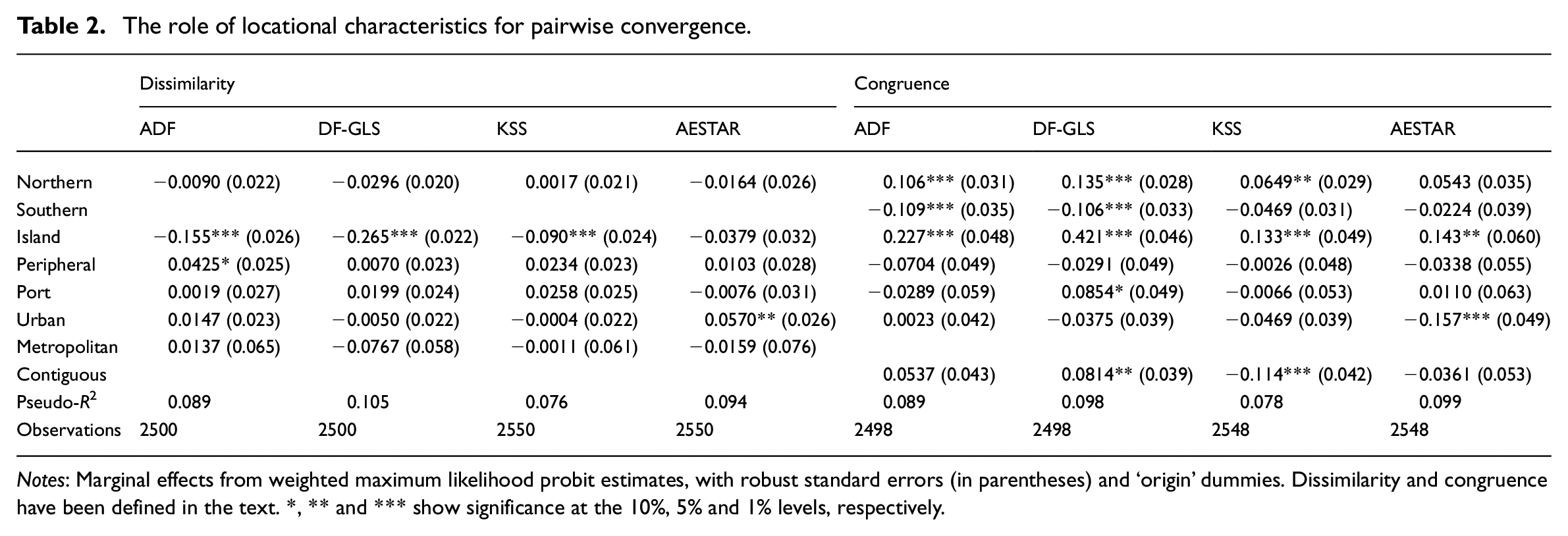
Notes: Marginal effects from weighted maximum likelihood probit estimates, with robust standard errors (in parentheses) and ‘origin’ dummies. Dissimilarity and congruence have been defined in the text. *, ** and *** show significance at the 10%, 5% and 1% levels, respectively.
Results are highly consistent across test statistics. Starting with the north–south dimension, we see that across tests dissimilarity does not play a role (no evidence of either convergence or divergence between northern and southern regions). Congruence, however, turns out to be significant in most tests, both for the south and for the north. For the north we estimate a positive effect, showing that regions in this part of the country are characterised by stochastic convergence; while for the south the estimate is negative, implying divergence. These findings are in broad agreement with previous literature (e.g. Kafousias, 2009; Siriopoulos and Asteriou, 1998), which finds significant club formation along the north–south dimension in Greece. Our evidence on congruence is indeed supportive of club formation in the north (within-club convergence), while no evidence of convergence is found along the north–south dimension, unless the latter is conditioned on the dynamics of club formation in the north (see Supplemental Table SA4).
Evidence of club formation is stronger in the islands–mainland dimension. Our results consistently show evidence of divergence between island and non-island regions (dissimilarity) and of convergence between island regions. The specific features of Greece’s small island economies (e.g. reliance on tourism and low-intensity agriculture –Armstrong et al., 2014) may well be a feature accounting for this. For the remaining locational characteristics, the evidence is either mixed or very weak. Peripheral and main-port regions show some tendency to converge with dissimilar regions and to diverge within their own group, but these effects are in virtually all cases not statistically significant (including in specifications not reported here). This tendency of inter-group convergence and intra-group divergence may be a particular feature of the Greek spatial economy, whereby upward moves along the distribution of regional incomes (convergence) occurs more idiosyncratically for specific regions within a group rather than for whole groups of regions. Anecdotally, this is for example the case of the region (prefecture) of Evros, in the far east of mainland Greece, which – unlike Florina in the north-west periphery – converged significantly to the national benchmark; or the case of the port region of Magnisia, which also converged to the national average unlike the port region of Ahaia (see also in this regard panel (a) in Figure 1).
A similar pattern is found for the case of urban regions, but only in the case of the AESTAR test. Metropolitan regions (Attiki and Thessaloniki) show instead the tendency to diverge from other regions, but again the effect is almost invariably not statistically significant. Lastly, contiguity (which is by definition exclusively a ‘congruence’ variable) has a highly ambivalent effect, being significantly positive for the DF-GLS but significantly negative for the KSS. The result from the DF-GLS is in line with the findings by Holmes et al. (2011) for the USA; but the result obtained from the KSS casts some doubt on the importance of geographical proximity for regional convergence, showing also the sensitivity of this relationship to different measures of convergence. Results from the wider literature on regional growth (see, inter alia, Annoni et al., 2019; Arbia, 2006; Dall’Erba et al., 2008) suggest that geographical proximity matters for regional growth, through both mechanisms of direct spillovers (Fingleton, 2003) and mechanisms of market potential (Breinlich et al., 2014). Our results indicate that these mechanisms may not be particularly strong in the case of Greece, in line with claims about the degree of spatial connectivity in the country (Monastiriotis, 2009).
On the whole, our results confirm the limited prior evidence of geographical patterns of convergence and divergence among the Greek regions in the literature – for example, with regard to the north–south dimension. Crucially, however, they also offer new evidence about different dimensions of the geography of convergence and divergence in the country – with the most prominent of those being the island–mainland distinction and, interestingly, with very little coming from the core–periphery dimension. That said, first-nature geography variables only go so far in explaining the observed patterns of (pairwise) convergence and divergence in the country. 21 We thus turn our attention to second-nature geography, examined next.
Second-nature geography
Given the broad consistency of results across measures of convergence (unit-root tests), to facilitate presentation we concentrate here only on the KSS statistic, which, as was shown earlier, is the one that produces the higher frequency of rejections of the null of non-convergence. 22 As before, we fit models separately for dissimilarity and congruence, but this time we also present results from a model that includes both sets of variables simultaneously (column 3 in Table 3). 23 Overall, we find evidence of the influence of second-nature geography on the incidence of pairwise convergence for all three of the dimensions that we consider.
The influence of second-nature geography on pairwise convergence.
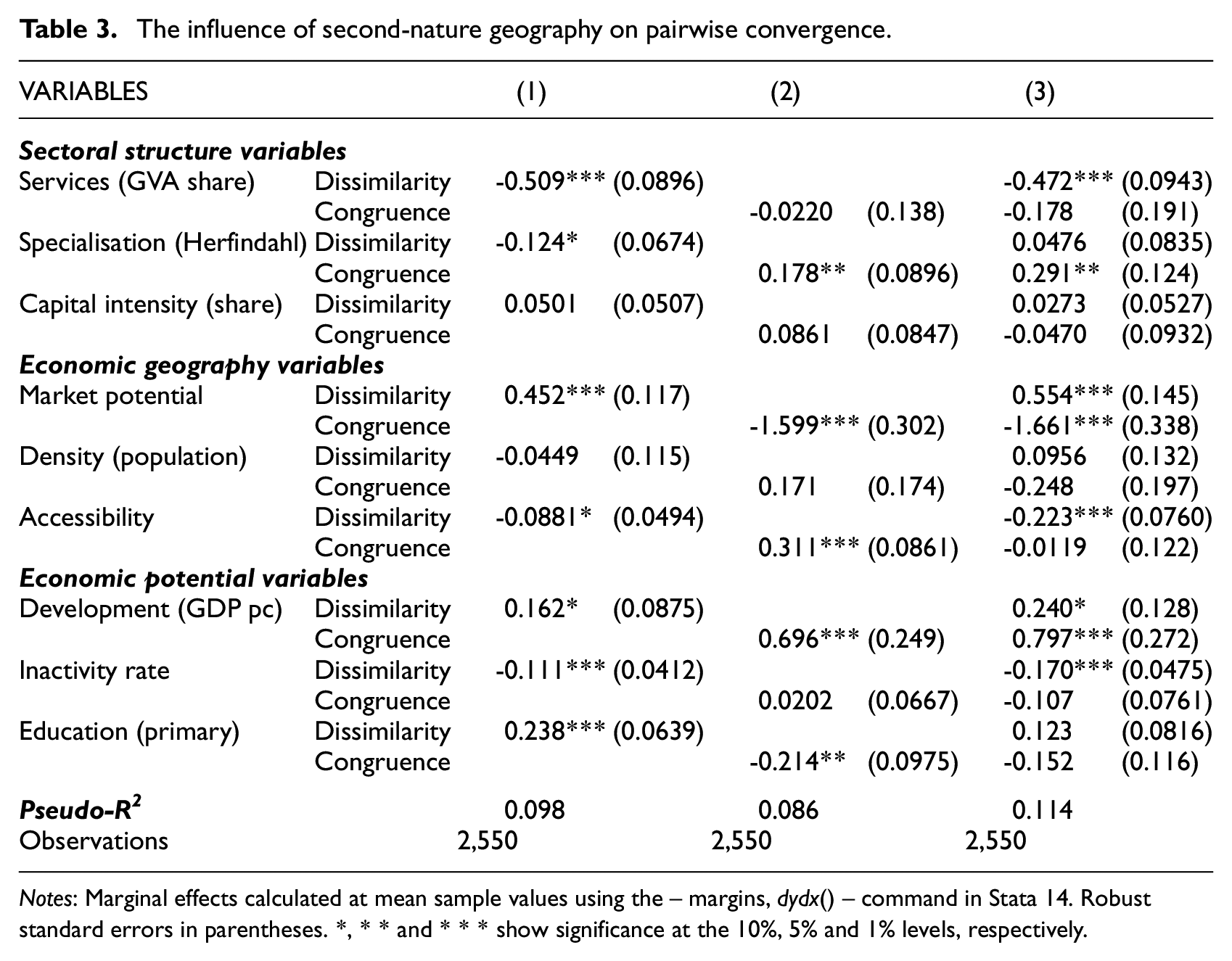
Notes: Marginal effects calculated at mean sample values using the – margins, dydx() – command in Stata 14. Robust standard errors in parentheses. *, ** and *** show significance at the 10%, 5% and 1% levels, respectively.
Among the sectoral structure variables, the share of services appears to have the stronger explanatory power: rather intuitively, regions with dissimilar degrees of specialisation in services (and, from results not shown, in any other broad sector) tend to have divergent growth paths – although congruence in the type of specialisation does not seem to play a statistically significant role. Instead, congruence in the overall degree of specialisation (Herfindahl index) seems to contribute positively to convergence. In contrast, the capital-intensity indicator is nowhere significant. These patterns are highly intuitive. As economic growth in the Greek economy over the 28-years period of our study was significantly driven by a shift towards services (including financial intermediation, real estate, retail trade and tourism) and away from manufacturing (including capital-intensive industry), patterns of growth for the Greek regions appear to have been more similar for regions that successfully made this shift (and growth dynamics diverged between them and regions that did not).
The picture obtained for the three economic geography variables is somewhat less intuitive. Market potential has a statistically strong and consistent across-models effect, but points counter-intuitively to convergence across dissimilar regions and divergence across regions with similarly high degrees of market potential (congruence). Instead, the opposite pattern (divergence between and, less strongly, convergence within) is observed for the case of accessibility, while for population density neither dissimilarity nor congruence seems to play a role. It is thus unclear how exactly these key drivers of regional growth and decline (agglomeration, market potential, accessibility –Breinlich et al., 2014) have influenced patterns of convergence and divergence in the country. One possible explanation may have to do with the increasing extroversion of the Greek economy during the period: with increased trade exposure and increased reliance on externally sourced finance, allowing more dissimilar regions in terms of market potential to converge but hindering convergence for regions with disparate degrees of accessibility.
The third set of variables tries to proxy for the economic potential of regions. Starting with the proxy for the level of development of each region, we find evidence of stochastic convergence both for regions with dissimilar levels of development (indicating also beta convergence) and for pairs of regions with similarly high levels of development (indicating club convergence at the top). As discussed previously, this is highly consistent with the evidence on conditional and club convergence found for the country in the beta-convergence literature (Alexiadis and Tomkins, 2004; Asteriou et al., 2002; Kafousias, 2009; Karahasan and Monastiriotis, 2017; Siriopoulos and Asteriou, 1998). The effect of education is in a similar direction, showing convergence between regions with different levels of human capital (catch-up convergence) but divergence within groups of regions with similarly low levels of human capital (club formation at the top). 24 These patterns of convergence and divergence along the education axis may be related to disparate regional dynamics with regard to levels of, and returns to, education (López-Bazo et al., 2017; Monastiriotis and Martelli, 2020). Instead, the inactivity indicator, which we take to proxy for (the inverse of) labour market dynamism, shows divergence across regions of different labour market dynamisms – suggesting that regions with low activity rates have been systematically left behind in the growth process of the country. This is a feature which has only scantly been examined in the literature (for an exception, see Monastiriotis, 2009), and shows that differences in labour market dynamism are not fully reflected in regional differences in levels of development (GDP per capita or levels of human capital). Albeit quite tentatively, one could assert that the specific migration dynamics characterising flows across the Greek regions (and especially the tendency for concentration of human capital in the metropolitan regions) may be playing a role in this – although the nature of our analysis does not allow us to explore this issue further here. Instead, we discuss the main messages emanating from our analysis, and their relevance for the literature on convergence dynamics, in the concluding section.
Concluding remarks
Studies on regional growth dynamics in the beta-convergence tradition often tend to provide evidence of convergence. This applies to a diverse range of cases, periods and scales, and Greece is no exception: a disproportionately (for the economic size of the country) large literature has provided evidence of conditional convergence in Greece, even if – often – with parallel evidence of north–south divergence and club formation. As an analysis of regional growth dynamics, however, the beta-convergence approach has received various forms of criticism, which have led the literature to different directions – with more recent and arguably more fruitful the one that introduces the notion of stochastic convergence in the study of regional growth. Stochastic convergence is consistent with the neoclassical growth model but also allows for the technology (and growth) process not to be necessarily deterministic, thus allowing for regions to converge to different steady states (club formation). In addition, common growth paths (convergence clubs or pairs) are identified endogenously from the data without recourse to pre-defined regional groupings.
The pairwise nature of the stochastic convergence tests allows the investigation of the common characteristics and dissimilarities of regions which may account for their – convergent or divergent – growth path trajectories. Treating the strength of convergence as a latent variable and modelling the observed incidence of convergence as a probability function of regional dissimilarity and congruence, in this article we were able to associate the incidence/strength of convergence with particular regional relational characteristics, opening a new window through which to understand the factors underpinning processes of convergence and divergence.
Our analysis focused in particular on the first- and second-nature geography characteristics of Greek regions, trying to test the relevance of location, structure, economic geography and economic potential, and to identify the specific variables that play a role for each of these. Examining first the extent of stochastic convergence, we found (similar to previous studies) that dynamics of convergence do indeed characterise selected groups/pairs of regions in Greece. Nevertheless, these dynamics were not found to generalise nationally.
Our examination of the pairwise patterns of convergence revealed that the cross-regional growth dynamics observed correlate both with exogenous forces of first-nature geography and with endogenous characteristics related to second-nature geography. Concerning the former, we found the north–south distinction to be very important, with strong evidence of convergence within the north and no evidence of convergence between north and south. Perhaps more important is the distinction between island and mainland regions, with strong patterns of convergence for the latter and strong patterns of divergence between the latter and the former. For the remaining dimensions of first-nature geography (peripheral, urban and port regions), the pattern was mainly in the opposite direction (inter-group convergence with intra-group divergence), although in these cases the results were mostly not statistically significant. Concerning the influences linked to second-nature geography, we found that all three dimensions of this (structure, agglomeration, economy) matter. Regional divergence seems to have been driven by dissimilarity in sectoral specialisations, accessibility and labour market dynamism (inactivity), while the growth paths of regions with similarly high market potential and low levels of education and accessibility also seemed to be divergent. Other results pointed to the direction of catch-up convergence, with a simultaneous presence of club formation – in line with the wider evidence on patterns of convergence in Greece. For market potential, evidence of convergence between high and low market potential regions was combined with evidence of club formation at the bottom (convergence within the low market potential group), while for the variables measuring levels of development and of human capital, the evidence pointed to club formation at the top combined with convergence between groups.
These findings are of heightened policy significance for Greece and, to the extent that they generalise across other cases, for regional policy in general. The identification that spatio-structural characteristics play a role for the concurrence of regional growth trajectories invites targeted policy interventions focusing not simply on balancing economic performance across space but also on increasing the congruence of selected structural characteristics across regions. In recent periods, much policy attention in this regard has been directed to enhancing the market potential of regions and their educational endowment. Our results seem to point to other policy priorities, relating specifically to industrial structure (diversification and specialisations), pure geographical accessibility (transport) and labour market dynamism (employment participation). It seems that bringing regions closer together with regard to these characteristics is a key condition for fostering harmonised growth across space. In contrast, differences in market potential and levels of education do not seem to have been a force of significant divergence in Greece and thus they should be perhaps of a lesser priority for policy.
After almost three decades since the seminal contributions on beta convergence, the ability to move beyond the observational and to investigate instead substantive questions about the drivers of convergence and divergence presents a new and exciting line of research that can enrich our understanding of the dynamics governing regional disparities and growth. We hope that our analysis will contribute to the further development of this line of research.
Supplemental Material
sj-docx-1-usj-10.1177_0042098020981361 – Supplemental material for Drivers of convergence: The role of first- and second-nature geography
Supplemental material, sj-docx-1-usj-10.1177_0042098020981361 for Drivers of convergence: The role of first- and second-nature geography by Theodoros Arvanitopoulos, Vassilis Monastiriotis and Theodore Panagiotidis in Urban Studies
Footnotes
Acknowledgements
We would like to thank Markus Eberhardt and Arno Hantzsche for helpful comments on previous versions of this article. We are also grateful to the editor and three anonymous referees for constructive feedback that helped us improve both the context and presentation of this article.
Declaration of conflicting interests
The authors declared no potential conflicts of interest with respect to the research, authorship and/or publication of this article.
Funding
The authors received no financial support for the research, authorship and/or publication of this article.

Supplemental material
Supplemental material for this article is available online.
Notes
References
Supplementary Material
Please find the following supplemental material available below.
For Open Access articles published under a Creative Commons License, all supplemental material carries the same license as the article it is associated with.
For non-Open Access articles published, all supplemental material carries a non-exclusive license, and permission requests for re-use of supplemental material or any part of supplemental material shall be sent directly to the copyright owner as specified in the copyright notice associated with the article.
