




Abstract
It is more than three decades since the publication of Finegold and Soskice’s (1988) influential article ‘The failure of training in Britain: Analysis and prescription’. This widely cited publication popularised the notion of the low skills equilibrium (LSEq). The LSEq described how at the national level, weakness in the education and training system, aligned with the nature of political-economic institutions, acted as both a cause, but was also a consequence, of weak economic performance. In the period since, the LSEq thesis has been developed and deployed in a range of ways, including with an increasing emphasis on localised low skills equilibria and their relationship to spatially uneven development. However, there are a number of unresolved concerns with the use of the LSEq to describe regional, urban and local outcomes. These include the limits to aggregate analysis, which obscures detailed assessment of causal mechanisms; weaknesses in approaches to measurement to test the LSEq; and insufficient attention to change over time. This article makes three central contributions. First, it assesses the important conceptual issues associated with the development of the LSEq, its application to regional and local economies and the related measurement issues. Secondly, the article outlines a set of research gaps and an agenda to help identify the ways these issues might be resolved. Thirdly, the article addresses the question of policy, and the extent to which a better understanding of the problem might facilitate interventions aimed at unlocking the local LSEq.
Introduction
The low skills equilibrium (LSEq) is a concept that has been widely used in the three decades since the publication of the influential Finegold and Soskice (1988) article ‘The failure of training in Britain: Analysis and prescription’. The LSEq described how at the national level, weakness in the education and training system, aligned with the particular nature of political-economic institutions in the UK, acted as both a cause, but was also a consequence, of weak economic performance. It detailed an economy trapped in a ‘vicious circle of low value added, low skills and low wages’ which struggled to generate skills or productivity improvements (Wilson and Hogarth, 2003: vii). A sizeable academic literature has since examined the LSEq in a diverse range of national and regional contexts (for example Chandrasiri, 2008; Martinez-Fernandez and Choi, 2012; Schwalje, 2011; Tarlea and Freyberg-Inan, 2018; Thomas, 2016). However, there remains a degree of ‘fuzziness’ about precisely what a LSEq denotes, the unit at which it should be assessed and how it might be best measured. In many respects, the LSEq now often functions more as the description of an outcome, a label to describe a predominance of comparatively low-paid work, and less as an explanatory concept. There also remains a critical gap in the understanding of what (if anything) policymakers can and should do to address a LSEq position. These ambiguities serve to limit the analytical utility of the LSEq.
The LSEq was originally developed as a national case study of employment and training in Great Britain, describing how the majority of employment was in firms producing comparatively low-quality and low value-added goods and services, the causes of this position and the implications it had for both the supply of and demand for skills. It was a concept of the aggregate situation, in which this aggregate was explained through the existence of a particular set of political-economic institutions (Finegold and Soskice, 1988). Subsequently, the LSEq has been used variously to describe the position of sectors, individual firms and regional and local economies. It is the application of the concept to regional and local economies which is the core focus of this article. The ideas of the LSEq, and better understanding the constraints of this on national, regional and local economies, are societally important. The UK has a comparatively poor long-run productivity performance when contrasted to other similar economies, although some of the gaps have closed a little over time (Mason et al., 2008); while the proportion of workers in low-paid employment in the UK is also relatively high (OECD, 2019).
The LSEq has also become an influential framing for policymakers. In the UK in 2017, Sir Mark Walport, the Chief Scientific Adviser to HM Government, identified the LSEq as one of five core policy challenges for skills in the economy. The idea of the regional and local LSEq has also become more of a concern. The OECD, through the Local Economic and Employment Development programme (LEED), focused on local and regional LSEqs and produced a set of case studies to provide examples of sector and firm positions and discuss the scope for developing more ‘high-road’ models (Froy et al., 2012; OECD/ILO, 2017). The idea of a LSEq has also begun to shape the thinking of local policymakers in the UK. For example, the Greater Manchester Skills Capital programme articulates the need to tackle the LSEq in the city region (Greater Manchester Combined Authority (2017), while the high-profile Greater Manchester Independent Prosperity Review (2018) also highlighted the LSEq as a core concern. Similar observations about the LSEq can be found in other cities such as Leeds (Leeds City Regional Enterprise Partnership, 2016) and Liverpool (Liverpool City Region Local Enterprise Partnership, 2015).
Despite the significant academic and policy attention on the LSEq, there remain important questions about the concept, including the limits to aggregate analysis which obscure detailed assessment of causal mechanisms, the weak validity of measurement to test the LSEq in practice and insufficient attention to temporal change. This article draws on an extensive review of the existing literature to provide a detailed discussion of the LSEq as a framework for spatial analysis. It also discusses underpinning issues around the measurement of the LSEq. The material was compiled through the use of search terms inputted to academic databases and through searching grey literature.
This article has three aims: (1) to assess the conceptual and measurement issues associated with the development of the LSEq and its application to regional and local economies; (2) to develop ideas for a research agenda to maximise the analytical utility of the LSEq to local and regional economies; and (3) to review the fit between the LSEq and potential policy actions. In addressing these three aims, the article advances the concept of the LSEq, contributing to a now internationally orientated literature.
The LSEq and concept critiques and development
The original Finegold and Soskice (1988: 22) article laid out the concept of the LSEq, and a particular diagnosis of its root causes in Britain, as: The best way to visualize this argument is to see Britain as trapped in a low-skills equilibrium, in which the majority of enterprises staffed by poorly trained managers and workers produce low-quality goods and services. The term ‘equilibrium’ is used to connote a self-reinforcing network of societal and state institutions which interact to stifle the demand for improvements in skill levels. This set of political-economic institutions will be shown to include: the organization of industry, firms and the work process, the industrial relations system, financial markets, the state and political structure, as well as the operation of the ET [Education and Training] system.
Within this explanation, there are three sets of arguments. The first is that Britain has a high proportion of poorly skilled managers and of workers engaged in low-quality and low-value activities. The second is that this position is ‘self-reinforcing’ and creates a circular process where demand for skills is low, so skills supply is low (reflecting a lack of incentive to invest as well as failures in publicly funded provision), which in turn inhibits the development and expansion of higher value activities. The third is that the causal explanation for this relates to the particular institutional arrangements in Britain. It has been argued by other authors that the core of Britain’s development of a LSEq in significant part reflects a historical over-arching policy focus which has been predominantly occupied with employment creation rather than productivity growth and wider economic performance; in short, a concern with job quantity but much less so with job quality (Lauder, 1999; Wilson and Hogarth, 2003).
The importance of institutional factors is also writ large on Finegold and Soskice’s suggestions for the means of exiting the LSEq. They contended that the route out of the LSEq did not rely on a single change or ‘policy lever’, but required change across a range of mutually reinforcing institutional factors: A change in any one of these factors without corresponding shifts in the other institutional variables may result in only small long-term shifts in the equilibrium position. For example, a company which decides to recruit better-educated workers and then invest more funds in training them will not realize the full potential of that investment if it does not make parallel changes in style and quality of management, work design, promotion structures and the way it implements new technologies. The same logic applies on a national scale to a state which invests in improving its ET system, while ignoring the surrounding industrial structure. (Finegold and Soskice, 1988: 22)
While the LSEq has since been widely used in academic studies, there have been a number of critiques of the idea. These include questions about the language of equilibrium and how to reconcile this with the spread of positions of individual firms and with the changing nature of the labour market.
A significant contribution to the development of thinking around the LSEq was made through the work of researchers at the Institute for Employment Research at the University of Warwick. Wilson and Hogarth (2003: 5) suggested that the concept of a ‘low-skill path’ or ‘trajectory’ better captured the dynamic nature of individual firms, who respond to opportunities and constraints and who can move along a skills trajectory. Under this reading, they view the notion of an equilibrium both as too static and as employing a false binary (between high and low skills positions), rather than viewing employer positions as being on a spectrum. This is an important distinction, although in reality it does not appear too far from the Finegold and Soskice (1988) argument. What they articulate in the article is not an absolute stasis, but is rather a set of conditions, the ‘self-reinforcing network’, which serves to limit the prospects for a significant or radical shift of positions.
These arguments do, though, have general relevance to the application of the LSEq to local and regional studies. The local LSEq has been primarily used as a relative concept – with places along a spectrum from low to high skills when benchmarked against each other. There has been less assessment of the extent to which local areas ‘break out’ of an equilibrium and how. This temporal element is a clear gap and introduces an important question of the extent to which the LSEq is best considered as an absolute or a relative concept (i.e. should the LSEq be judged by the absolute nature of low skills demand and supply, and change within a place against its own previous position? Or should it be judged relatively against other places?). This discussion is returned to in subsequent sections.
Given the length of time since the Finegold and Soskice article was published, it is also reasonable to question the extent to which the patterns they observe still exist. Crouch et al. (1999) note the sizeable growth of highly skilled work in parts of the UK economy in the early to mid-1990s, as the economy began to shift. Labour markets have changed considerably on the supply and demand sides in the past three decades. An influential body of work has suggested a process of labour market polarisation (for example, see Goos et al., 2014), with significant growth in more highly paid and highly skilled jobs, some hollowing out of the middle and a more modest growth in lower-paid work (Fernandez-Macias et al., 2012). At the same time, a number of major initiatives from the early to mid-1990s onwards were developed and targeted at the supply of skills; however, as Crouch et al. (1999) show, these were accompanied on the other hand by attempts to lower labour costs, and to reduce collective bargaining and job security (i.e. actions that moved in the opposite direction) – producing what they term a ‘disequilibrium’ (Crouch et al., 1999: 23).
A question of increasing contemporary importance, which has not been reflected in the literature, is the treatment of atypical workers in the LSEq framework. Self-employment in the UK grew from 3.3 million to 4.8 million people between 2001 and 2017 (reaching 15.1% of the labour force) (ONS, 2018); yet it is not clear where, or how, the self-employed fit within the concept of the LSEq. On one hand, self-employment might embody a set of entrepreneurial skills; on the other hand, self-employment outcomes can also be influenced by the opportunities and constraints of the local labour market and by both push and pull factors. To better understand self-employment in the context of the LSEq requires more evidence on the balance between these factors, and the influence of place on these. There is also a question about new forms of employment in the ‘gig economy’ and how these are conceptualised in relation to patterns of skills supply and demand.
There are other ambiguities to be considered as well. A further complication is the conflation of skills with qualifications, with the latter being more often measured (Heyes and Stuart, 1994; Winch, 2011). In addition, as well as longer-term structural shifts, it is likely that there is also a cyclical element to the intensity of a LSEq. When demand is deficient and jobs are lost in recessions, this can create a ‘bumping down’ of workers whereby more highly qualified workers outcompete those with fewer skills for comparatively lower skilled work (Gordon, 2003). 1 Under these circumstances the precise nature of equilibrium can shift, as shocks tend to be transferred to those people and places at greatest risk of labour market disadvantage.
Debates and critiques at the national level have generated something of a shift towards a greater focus on skills patterns at different levels – as studies have continued to find evidence for the LSEq in the actions and competitive positions of individual employers and in particular sectors (see, for example, Edwards and Ram, 2006; Edwards et al., 2009; Wilson and Hogarth, 2003). Increasingly the LSEq has been deployed as a way of understanding specific sectoral (and sub-sectoral) or geographical areas rather than with reference to the national economy (OECD, 2014), as the UK Commission for Employment and Skills described: particular sectors or geographical areas, may be ‘trapped’ in a low skills equilibrium or following a low skills trajectory, which presents a problem of relatively low demand for skills by some UK employers. This also leads to questions over the quality of work. (UKCES, 2009: 90)
In summary, while there has over time been something of a shift in how the LSEq is used and understood, the central tenets of an institutionally based explanation of the prevalence of low skills models and poor economic performance (in particular places and/or sub-sectors) remain of contemporary importance.
The development of regional and local LSEqs
As described, the LSEq has morphed from a predominantly nationally focused concept into one which pays greater attention to sectoral and local patterns. Wilson and Hogarth (2003) first identified a significant problem around the concentration of low skills models in particular geographies, typically places with weak economic prospects. Thereafter, the notion of localised LSEqs has begun to gain traction as a means of assessing the comparative position of local labour markets and a way of understanding spatially uneven development (for example, Dawley and Jones, 2009; Etherington and Jones, 2018; Jones and Etherington, 2009; Sissons and Jones, 2016; Worrall, 2007). Furthermore, the wider literature on labour market change has demonstrated important geographical dimensions to the growth of more highly-paid work, and the concentration of low-paid work, as well as to processes of labour market polarisation (Jones and Green, 2009; Lee et al., 2016).
One way to apply the LSEq at the local labour market level is as a means of describing the balance between employment at different skill levels in a particular place (Ashton et al., 2000). This has entailed using the LSEq as a framework to understand the relative positions of regional and local economies; an important focus of this has been on the relationship between supply of, and demand for, skills. The nature of this relationship is set out in Figure 1, which describes the following positions of skills demand relative to supply, whereby:
Low skills equilibrium – denotes a low supply and a low demand for skills;
Skills gaps and shortages – denotes a low supply but high demand for skills;
Skills surplus – denotes a high supply and low demand for skills; and
High skills equilibrium – denotes a high supply and high demand for skills (Green, 2012).
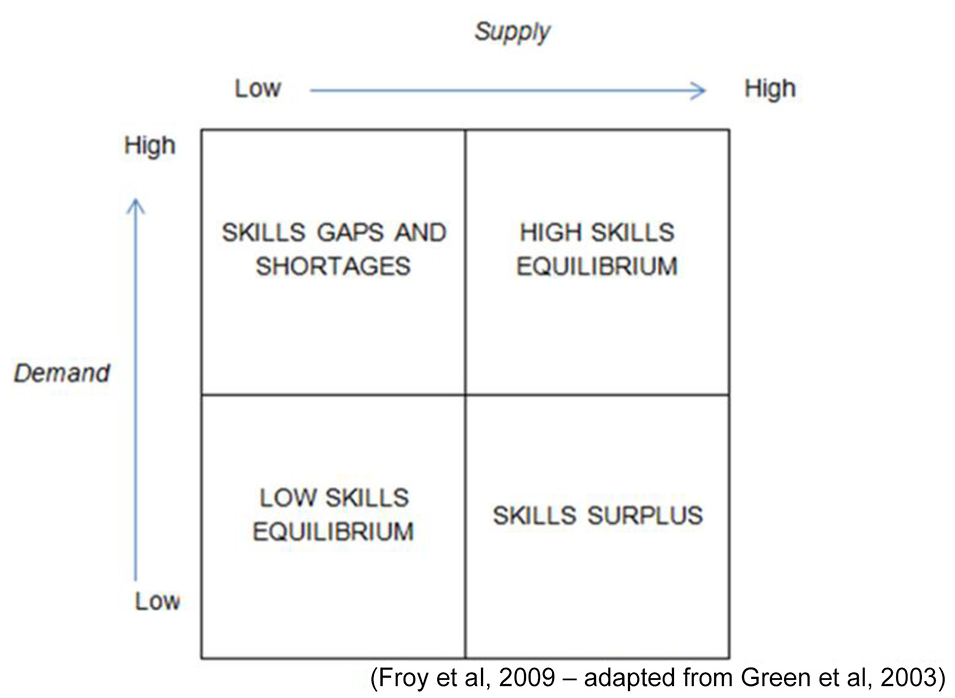
Local low- and high-skills equilibria.
The low skills equilibrium (bottom left quadrant) is the articulation of the Finegold and Soskice (1988) argument. In these local economies, the supply of skills is low (or at least by proxy through the fact that qualifications are relatively low); but so too are employer demands for skills, with occupational structures being skewed towards comparatively high employment demand in lower skilled occupations. There is a relative match between supply and demand, an equilibrium, but the position is sub-optimal as it tends to be associated with lower wages and weaker economic performance.
Figure 1 also denotes the position of a skills surplus (bottom right quadrant). In this position, the supply of skills is comparatively high, but demand is relatively weaker. In this position, there is a mismatch between the level of jobs which individuals are skilled and/or qualified to do and the skill content of jobs that they are actually doing. The concept of skills utilisation captures the extent to which skills are effectively used in the workplace. The idea of skills under-utilisation is important from a policy perspective. UK skills policy has consistently focused on the supply of skills, including a period of large-scale investment and ambitious target-setting in response to the Leitch Review (2006), but with little emphasis on the development of complementary policies focused on the demand for skills (Glynn and Gospel, 1993; Keep, 2013; Keep and Mayhew, 2014; Lauder, 1999; Lloyd and Payne, 2002; Wright and Sissons, 2012).
The top left quadrant captures the idea of skills shortages and gaps, where the required skills are not available to meet employer demand. From a policy perspective a significant emphasis, arguably a preoccupation, is given over to concerns with skills shortages and skills gaps (Keep and Mayhew, 2014).
The final quadrant (top right) denotes a high skills equilibrium in which both supply and demand for skills are strong and well-matched. There is a wide literature on the establishment of high-skill and high-value economic clusters (for critical overviews, see Asheim et al., 2006; Huggins and Izushi, 2012). Finegold (1999: 66–70), seeking to propose a route out of the LSEq, identified four factors which explain the development of ‘high-skill ecosystems’. These are: a catalyst for initial development, including the role of government demand, public and private investment and a set of key individuals driving innovation (and the interaction between these); nourishment, including ongoing provision of skilled individuals into local firms, availability and access to financial capital (with a particular emphasis on venture capital in Finegold’s account); a supportive environment of physical infrastructure, specialised infrastructure (incubators, science parks etc.), quality of life in the area for workers, and regulatory and culture aspects that support ‘risk-taking’; and interdependence – networks of collaboration and cooperation at both firm and individual levels. Buchanan et al. (2017) also use the notion of an ecosystem and discuss the co-existence of high and low skills models within place, applying the idea of a skills ecosystem to a number of sectoral examples. Looking across the existing evidence, they find that reforms aimed at shifting skills positions tend to ‘hit considerable tacit resistance … in particular sectors and regions’ where employers and governments are broadly satisfied with existing skills settlements, even where such settlements appear to be sub-optimal (Buchanan et al., 2017: 459). Scholarly research has focused for the most part on the idea of high-skills ecosystems (Buchanan et al., 2017). However, even the comparatively widespread development of high-skills ecosystems largely does not address the issues associated with the LSEq, nor tackle the long-tail of low-paid work (Finegold, 1999).
There are important reasons to think that the nature of the skills equilibrium will vary systemically across different types of places. Influential studies have demonstrated that workers can acquire knowledge more quickly in urban areas (Glaeser and Mare, 2001; Glaeser and Resseger, 2010); and can progress more rapidly in larger cities – better matching their skills to the available opportunities (Gordon et al., 2015). However, recent UK evidence also highlights the significance of long-run north–south regional inequalities in entrenching a ‘persistent gap between the most and least skilled cities’ (Sunley et al., 2019: 20). Velthuis et al. (2019) also problematise the notion of UK cities as escalators, demonstrating that for low-paid workers there is little evidence of the urban escalator, and suggesting that learning and advancement are segmented occupationally. Both these examples highlight the need to better understand the long-run drivers and co-location of high and low skills models. Green (2012) also demonstrates that place characteristics influence the likelihood of a local LSEq, finding the LSEq to be more likely in deindustrialised towns and cities as well as in some rural areas.
The cities literature shows the collective importance of the geography of highly skilled workers, and occupational and industrial changes. The combining of local and sectoral insights is demonstrated by Green’s (2012) case study of employment and skills in Blackpool. Blackpool, in the North-West of England, is a seaside town with a particularly high proportion of tourism work. It is a place which has been found to be ‘firmly rooted in a “low skills equilibrium”’ (Green, 2012: 38), with a predominance of low skills employment, a significant incidence of seasonal work and a ‘high volume, low income’ tourist market (Green, 2012: 39). As well as this, Blackpool is relatively geographically isolated from large centres of diverse employment. Studies have also identified a low skills equilibrium in parts of the Sheffield City Region, linking this in part with a misalignment of policy in focusing on skills supply and skills gaps rather than demand for skills or improving employment quality (Etherington and Jones, 2016; Sissons and Jones, 2016).
Definition and measurement issues in the place-based LSEq
The LSEq has been increasingly used in local labour market studies. However, there has been a tendency to deploy it as a description of an outcome – the local predominance of comparatively low-paid and low-skilled work – rather than as a process or an explanatory concept. In this section, the nature of a place-based LSEq is considered, alongside important conceptual and measurement issues raised by using the LSEq in this context.
The LSEq was originally established as an expression of the aggregate. This point was clear in the Finegold and Soskice (1988) article, which acknowledged areas of high performance within an overall context of a national LSEq. In the case of local labour markets, the LSEq has been applied to reflect the ‘average’ condition – either through a narrative description of activities, or less commonly through using existing secondary datasets to assign positions (Green, 2012). This aggregate position can be a helpful benchmark of the overall nature of the relationship between supply and demand, but it also hides a diversity of experiences. Within the average picture there will be firms and sectors operating in high skills models, while others are stuck in low skills traps. Yet there has been comparatively little investigation of the experiences or drivers of pockets of performance (either individual firms or particular sectors) vis-a-vis the dominant position, or of the factors which have led to the co-evolution of very different positions alongside each other, particularly at the local level. To develop a better understanding of this co-evolution, studies of the local LSEq would greatly benefit from more consideration of the LSEq as a process operating within place as well as a means of benchmarking the relative position of local areas against each other. This type of investigation of the LSEq in place offers the opportunity to examine the ‘“real interaction” between firms and institutions at the local and sectoral level’ (Gog et al., 2017: 3). However, to date, the use of the LSEq in local and regional studies has been largely under-theorised and constrained by conceptual and empirical difficulties. Gog et al. (2017), in their analysis of the private security sector in Singapore, argue for greater emphasis on ‘institutional logics’ in analysing the development of skills positions. Institutional logics, instead of assuming institutional complementarity and cooperation, analyses the behaviours of institutions and how these relate to each other. It also helps bridge the gap between factors operating at the macro level (legislation, minimum wages etc.) and those operating at the sector level, and details the relationships between and within these which shape the operating environment and the business strategies of firms.
A second critical issue in relating the LSEq to local labour markets is how the space of these is delineated. Local labour markets as defined by Travel to Work Areas (TTWAs) are widely used to analyse local labour market phenomena. TTWAs are, however, also based on an average picture; they represent an aggregate degree of labour market self-containment. Importantly, the commuting space of workers differs systematically by individual and job characteristics, with high-skilled workers in particular tending to travel further (Benito and Oswald, 2000; McQuaid and Chen, 2012). Some firms and sectors predominantly recruit from local labour markets, others are regional, while some are national or even global in nature (Weller, 2008). As such, effective TTWA sizes are more expansive for high-skilled workers. Estimates using census data suggest that when stratifying and redrawing TTWA boundaries to reflect commuting patterns by qualifications, higher qualified workers operate across around 262 TTWAs in the UK, while for lower qualified workers the number is 416 TTWAs – demonstrating the differences in effective labour market size (Coombes, n.d.). The differential commuting spaces of workers partly reflect spatial frictions such as transport time and cost and the extent to which it is worthwhile travelling longer distances (Houston, 2005; Stoll, 2005). These differences are not well reconciled with the notion of a local LSEq, which is the combined outcome of processes across occupational segments. These differential commuting spaces present both conceptual and empirical difficulties in assessing the incidence of localised LSEqs if measured through the relationship between demand (which is fixed at any given time within the boundaries of a space) and supply (which is both actually and potentially mobile across these boundaries).
A third consideration is the wider point about relativity and the benchmark against which progress is judged. The relative nature of comparison (either across nations or across local areas) which is often a feature of LSEq research means that material improvements are not necessarily well represented, but that relative improvement (whether signifying a real improvement or as a result of weaker performance in a comparator area) is more likely to be assessed. In this sense, the relative measure potentially obscures the identification of material progress, and this is another argument for more detailed study of the LSEq as a process within place, as well as for looking at comparisons across labour market areas (some ideas for how to do this are developed later in this article, including the need for more longitudinal studies).
Policy and the local LSEq
While the LSEq has been frequently invoked as a device through which to understand outcomes, there has been far less progress in developing and documenting an understanding of precisely how policy might seek to actively shape a transition away from a LSEq. Although the idea of the LSEq has concerned policymakers for some time, there is relatively little sense of what strategy might be adopted to break out of it; in particular, it has been consistently argued that focusing solely on policies to increase the supply of skills will not enable the UK to move away from a LSEq, but policy and practice have done little to reflect this (Finegold and Soskice, 1988; Keep, 2013; Keep and Mayhew, 2014; Lauder, 1999; Lloyd and Payne, 2002, 2006).
For a local LSEq, the ‘levers’ which might support an equilibrium shift lie only in part within the responsibility of local stakeholders. The interplay between the national and the local is clearly important but is only partially understood. As policymakers in the UK begin to focus more on issues such as local industrial strategies, better understanding the nature of these interplays is critical. One lever which resides at the national level (at least in the UK), and which can potentially support moving out of a LSEq, is the minimum wage, which can make reliance on low-skill/low-wage employment a less viable business model (Lauder, 1999). There is some evidence that minimum-wage rises encourage employers to look at ways of improving productivity (Green et al., 2018; Rizov et al., 2016). Other potential policy triggers for development reside across local and national levels. These include business support policy, policies aimed at triggering innovation, and skills policy, which is a patchwork of responsibility across different levels. Other factors which fundamentally shape the institutional context around the LSEq are also the result of national decisions, such as the level and type of labour market regulation. In this sense, the broader national political economy continues to shape the potential of local outcomes in powerful ways (Lloyd and Payne, 2006).
Academics have identified the importance of simultaneously addressing issues of the supply and demand side of skills (Green, 2016; Payne, 2018; Sissons and Jones, 2016) but also the need to consider skills alongside other domains such as housing, Active Labour Market Policy and business support. Meanwhile, patterns of, and policy towards, immigration can also influence the skills profile and supply and demand balance of an area (Green, 2016). As Green (2016) discusses, skills are a derived demand and, at the firm level, policy actions can seek to target companies’ product market strategy, to increase demand for skills, or competiveness strategy, to improve skills utilisation.
There is some descriptive evidence of how localities have sought to move away from the LSEq. Much of this comes from the OECD LEED programme’s publications, which provide a number of cross-country case studies. Approaches identified include the provision of guidance, technical assistance and management training, and incentivising inter-firm collaboration and networks (OECD, 2014). Specific examples focus on the role of local institutions in supporting the transition of employers to higher value-added product market strategies (PMS) (Froy et al., 2012); however, there is less evidence of the scale of impact than on the details of approaches. The LEED programme presented case studies of a number of different sub-regions working in particular sectors to support the upgrading of product market strategies through fostering collaboration among local stakeholders and with an emphasis on incremental innovation (Froy, 2013). Examples of these case studies include Niagara in Canada, an area characterised by a LSEq, where a collaborative approach was adopted to devise actions for promoting opportunities for upgrading PMS (harnessing the opportunities of proximity to Toronto), and supporting technology transfer in food processing (Froy et al., 2012). In the Riviera del Brenta in Northern Italy, the case study highlights the importance of technical research at local educational institutions in supporting the transition to higher value-added PMS in footwear manufacturing. The case also demonstrates the supportive role of unions in linking improvements in production to improvements in working conditions. Another sector-based example is work of the public sector in Flanders on social care, and the focus there on work re-design and work organisation to improve productivity and quality of care (OECD, 2014).
In concrete terms, the literature on ‘what works’ in facilitating an exit from the LSEq at the firm and local level is still limited. In part this relates to the partial understanding of the nature of the LSEq and the ways in which this might be assessed. These gaps and ways in which they might be addressed are the focus of the following section.
Research gaps, improving measurement and some new directions
The previous sections have raised a number of issues with the deployment of the LSEq in a local and regional context. These stem from both unresolved conceptual matters with the original articulation of LSEq, as well as new concerns which are the result of the shift of the LSEq from a model of understanding national development to that of regional and local outcomes. This raises two important questions. Firstly, to what extent is the LSEq a useful concept for theorising local patterns of development? And secondly, how might the various conceptual and empirical issues associated with the LSEq be resolved to allow for its analytical utility to be maximised? A third area for debate is how the LSEq can be used to inform other potentially complementary concepts. For example, how might the LSEq inform evolutionary perspectives of economic development to help explain patterns of longer-term labour market development and ‘lock-in’ to particular sets of sectoral and occupational activities (Dawley et al., 2014).
At the core of the issue is the question of the extent to which the concept of the LSEq is a useful analytical device for examining the position of local labour markets and for analysing the development of skills positions within labour markets. This question frames the following research gaps identified. Concept development needs to be underpinned by new empirical investigations which test the nature and applicability of the local LSEq. At the concept level, the LSEq is widely and frequently used, but while the outcome is relatively well understood and can be described empirically in the relationship between supply and demand for skills, the processes which underlie its development at the local level are much less well understood, and it is the process which is central to the original LSEq as articulated by Finegold and Soskice (1988). Ideas for how empirical work might help improve the conceptual development of the LSEq are now discussed.
First, there is a critical lack of clarity around how the LSEq can be best measured and assessed across and within local labour markets. There are a number of issues which underpin this. At a basic level, there has been relatively little analysis of the nature of the ‘skill problem’ in different areas. An important exception is the work of Green (2012), which developed new experimental estimates of the balance between skills supply and demand for NUTS II 2 geographic areas in the UK. However, there has been limited subsequent development. Both a conceptual and empirical concern is how heterogeneity across sectoral and occupational commuting spaces can be included in analysis of the LSEq. An often-used unit for labour market analysis is TTWAs, but, as described previously, the effective size of a TTWA tends to vary systematically by worker characteristics. More formal testing of the implications of differential commuting patterns for understanding of the local LSEq is needed. Where the LSEq is considered for administrative units (such as local authority areas), new issues associated with the mapping of commuting spaces onto units which are not functional economic areas or labour markets are also introduced. This is an important point, as policymakers have begun to consider the notion of the local LSEq but have a tendency to view space as delimited into political-administrative units. A major issue is the lack of data with the information and flexibility to consider the LSEq alongside ‘real’ commuting spaces for different types of workers.
Census data in the UK best provides the spatial detail, but with limits on relevant data fields and analysis of change over time. In addition to the census, there are a number of potential sources which could be used to develop novel local insights into the LSEq which would help support better analysis. In the UK, these include the use of secondary data from the Labour Force Survey, Employer Skills Survey and Skills and Employment Survey, although all have limits in terms of level of geographic detail and sample sizes. There is also scope to use panel data such as Understanding Society to assess the implications of the LSEq for individuals (using linked area-based data). Furthermore, there is scope for integrating and triangulating across these datasets to provide a more rounded estimate of the extent to which local LSEqs exist and are problematic (as well as potentially helping to untangle the current conflation of qualifications and skills). New forms of analysis, such as web-scraping of job adverts, also offer much promise in better understanding the skills needs of local labour markets and mismatches in supply and demand. Building on new empirical analysis, the geography and the determinants of this for the LSEq could be unpicked – addressing the question of what the characteristics are of places which are most vulnerable to LSEq.
More evidence is also needed on how the local LSEq links to employment and wider social conditions. For example, what role does a local LSEq play relating to wage outcomes and opportunities for pay progression? More broadly, this could also link to the extent to which the LSEq can help inform wider understandings of spatially uneven development.
Consideration also needs to be orientated towards the best way to measure the spatial and temporal dimensions of change and relativity. One element of this is the LSEq as a relative concept through which progress is judged in comparison with other places rather than within place development. However, places may also be developing over time against their own benchmark but not that of other areas. There is a dearth of place-based studies of the local and historical evolution of the LSEq which can help inform considerations of the evolutionary economic and social development of places. In a sense, the LSEq is inherently a path-dependent process – reflecting previous methods of organising production, approaches to competitiveness and the ‘weakness of domestic demand for higher quality goods and services’ (UKCES, 2009: 90). Yet there is a major gap in studies examining the LSEq as a process – the ‘self-reinforcing network of societal and state institutions which interact to stifle the demand for improvements in skill levels’– which Finegold and Soskice (1988: 22) so clearly articulated.
A broader, but clearly related issue, is the large evidence gaps around how local areas might break out of a LSEq. This includes the question of how place-based policy can be effectively designed to target both the supply and demand sides of the equation. In particular, greater evidence is needed on what the policy levels and levers are that might support a route out of the LSEq. The role of technological change is also of critical importance in understanding trajectories and how these might shape the future of the local LSEq.
Central to better understanding of the potential policy challenge of the LSEq is the need to better bring together national institutional characteristics and intermediate-level organisations, with sector- and place-specific factors, to provide a more detailed analysis of the nature of the LSEq and how this changes over time. Detailed case study research can provide new insights into the way these factors combine to influence firm-level outcomes. In this sense, examining the LSEq at the local level potentially allows for a consideration of the national institutional context alongside sectoral and local institutions, local policy and the historical development of the local labour market, as well as the interactions between these factors. However, to date, such detailed work in assessing the local LSEq is striking by its absence. One potential approach suggested by Gog et al. (2017) is through ‘productive systems’ mapping, to capture social and institutional relationships and their interaction in generating sector outcomes (Wilkinson, 2002). Longitudinal research would also help to provide a more dynamic assessment of the factors and processes which enable and constrain opportunities to exit the LSEq, as well as providing an opportunity to better understand the evolution of high-skilled clusters within place alongside a wider aggregate low skills picture.
Conclusions
In the three decades since the publication of Finegold and Soskice’s (1988) article, the LSEq has become an important conceptual lens. From the original conception as a national level critique of Britain’s institutional model, the idea of the LSEq has travelled and has been applied to firms, sectors and localities. However, often the concept has travelled with only limited critical reflection of its application to new sets of circumstances (for a notable exception, see Wilson and Hogarth, 2003). This has important academic and societal implications. The lack of critical reflection limits the explanatory potential of the LSEq and its potential role in informing broader theories of uneven development. Underpinning the idea of the LSEq is a set of arguments about the prevalence of low skills and low value-added activities, a self-reinforcing process which causes these, and an institutional argument which underpins this; yet often even the first of these factors is not fully considered or evidenced. From a policy perspective this is also critical, as the LSEq is a device being adopted by policymakers and influencers to describe a development problem, but with limited understanding of the precise nature of that problem, the directions of causality, the role of different factors in influencing the historical development of this position or the opportunities and constraints related to addressing this.
The original specification of the LSEq was a study of the aggregate, linking the poor economic performance of Britain to its particular institutional characteristics. Subsequently, researchers have stressed the importance of giving greater focus to firm-level factors and to the institutional logics shaping practices within firms. One area of significant development has been around the idea of local LSEqs, describing the position of local areas within a simplified matrix of the relative balance between the supply of, and demand for, skills. However, within a local area firms exist in different equilibria, with high-value clusters existing alongside weakly performing firms and sectors. The ways in which sector patterns and local economic development trends combine in place to shape the LSEq are not well understood. However, by combining local and sectoral lenses to analyses it will be possible to more fully integrate the importance and insights from each.
The LSEq as applied to place faces a number of other conceptual ambiguities which follow from the above. The spatial definition of a LSEq is likely to be sensitive to the delimitations of local labour markets. TTWAs, which have often been used in labour market studies, are subject to commuting patterns which differ systematically by qualification level. This challenges the notion of a local LSEq but also opens up opportunities for studies which are sensitive to the differential operation of skill and sector labour markets. As the LSEq has most widely been used as a relative concept, the focus has tended to be on structural changes in local economies, with less emphasis on cyclical effects. These may in situ alter the LSEq position as articulated by current quantitative measures, yet the relationship between cyclical growth and decline and the LSEq at the local level is poorly understood. A further issue relates to the difference between qualifications and skills. Qualification levels in the UK have historically grown significantly, but the extent to which these have changed skills patterns, skills supply and skills balance is less well understood (notwithstanding important wider concerns as to how to evaluate or value different skills). Technological and structural shifts in the labour market are also likely to influence the notion of a LSEq in powerful ways. The self-employed are not well integrated into existing ideas of the LSEq, while studies have had little to say about the impact of technological change in the labour market on local LSEqs.
A major blind spot in existing understandings of the LSEq is whether, and how, policymakers can seek a route out of the LSEq. While the LSEq is acknowledged as a policy challenge, the ‘levers’ to address this are not well understood. These levers are likely to include national as well as sectoral and local factors, but there is a lack of evidence on which policymakers can draw. In part, this reflects the ambiguity around the concept itself and how ‘success’ might be benchmarked. There is an important role for case studies, including longitudinal work, to identify evidence on what the policy levels and levers are that might support a route out of the LSEq. Such investigations will need to bring together national institutional characteristics and intermediate-level organisational influences, with sector- and place-specific factors, to provide a more detailed analysis of the nature of the LSEq.
A number of research gaps have been identified. These include the need to better understand the potential analytical utility of the LSEq and its relationship to other theories of spatially uneven development. Empirically there is a need to better understand the role and function of TTWAs and differential commuting patterns in determining the LSEq. Conceptually the judgement of success and the relative benchmarking of the LSEq may obscure positive progress and reproduce a historically unchanged map of the LSEq without acknowledging significant underlying change in the labour market. Critically, there is also a need to re-focus on the LSEq as a process, and to examine skills development within place as well as across places.
Implications
The LSEq has been, and remains, an important idea. In this article, it has been considered from the perspective of local placed-based LSEqs. However, it has been argued here that the development and widespread use of the idea of the LSEq have suffered from a limited critical reflection on what is trying to be measured and analysed and how; such that in some circumstances the LSEq functions as no more than a loose motif for comparatively poor economic performance. What follows from this is the need for a better conceptualisation of the LSEq and its functioning at the local and regional level to enable greater analytical clarity of how the concept can help with informing understandings of uneven development, labour market disadvantage and the role of public policy.
This article has suggested a future agenda for research focused on the LSEq. This would draw from across a plurality of quantitative and qualitative research methods to better understand the nature of both scale and process. Longitudinal case study research offers the opportunity to better understand the issues shaping the LSEq and the opportunities and constraints to alternative development paths, as well as the role of policy.
There are important scholarly reasons to seek to develop novel insights relating to the LSEq as a means to more fully examine patterns of uneven development. Societally, better understanding of the LSEq is also an important task. The ‘left behind’ places which have featured in debates about Brexit tend to be those with higher proportions of lower skilled work (Goodwin and Heath, 2016). Meanwhile, Brexit itself is likely to have important implications for both the supply of, and demand for, skills. More broadly, the development of the body of work on the LSEq in the UK highlights a critical issue of the relationship between employment quantity and employment quality. Employment quality appears to be moving up the political agenda, for example with the recent Taylor Review of Modern Working Practices (Taylor, 2017); however, there is little consensus on how to address long-run job quality concerns. One lesson from the LSEq is that it is not one factor, but the combination of institutional, organisational, sectoral and local factors, that continues to shape job quality outcomes and the potential for change.
Footnotes
Acknowledgements
I am very grateful to the reviewers for their encouragement and constructive comments.
Declaration of conflicting interests
The author(s) declared no potential conflicts of interest with respect to the research, authorship, and/or publication of this article.
Funding
The author received no financial support for the research, authorship, and/or publication of this article.
