




Abstract
Recent growth in flexible work which is detached from traditional urban workplaces, including homeworking, mobile working and forms of self-employment (gig work), has increased interest in the quality of work. This article compares job quality indicators between urban-based workers in standard (employer/business premises) and non-standard (homeworking, driving/travelling, mobile working) workplaces. Multinomial logistic regression is applied to UK panel data from four waves (2010–2011, 2012–2013, 2014–2015, 2016–2017) of the Understanding Society study. The analysis finds that urban-based employees working at home, predominantly in highly skilled occupations, have jobs which exhibit a number of characteristics of good work. Self-employed homeworkers, more often women, have lower job quality but leisure satisfaction benefits. Mobile working jobs offer greater spatial and temporal flexibility and job satisfaction, but also exhibit lower quality characteristics evident of trade-offs and divisions between forms of mobile work. Driving/travelling jobs exhibit lower job quality characteristics, especially among self-employed urban-based workers.
Introduction
From the large-scale urbanisation of the Industrial Revolution, to 20th-century growth in service-based office environments, patterns of paid work have historically been dominated by spatial rigidity centred on most workers travelling to fixed workplace locations in urban employment centres. Centralisation of workers in this way has long been considered advantageous to employers, offering agglomeration benefits including acting as a platform for communication and coordination, and facilitating monitoring and enforcement of routinised working practices by management (Shearmur, 2018; Zhu, 2013). Technological advances in information and communication technologies (ICTs) and mobile technologies, and the changing economic environment (Felstead and Henseke, 2017; Green, 2017: 1645; Hislop and Axtell, 2009), are changing working practices and decentralising workplaces (Houston and Reuschke, 2017). Urban employment centres, nevertheless, continue to gather both fixed and semi-mobile workers while acting as hubs for (hyper-)mobile workers to interact and create value (Shearmur, 2018: 74). In the UK context, there has since the early 2000s been a growth in flexibility driven by policy agendas including the Work–Life Balance Campaign and Flexible Working Regulations, which promote the benefits to workers and employers of flexibility and provide a legal framework for flexible working arrangements. Following the 2007–2009 economic crisis, a significant growth in labour market flexibility has been driven by employers seeking new ways to reduce labour costs (Raess and Burgoon, 2015: 95–96). Growth in flexibility has created tensions between improving access to and the quality of work, and employer-driven highly flexible employment and own-account self-employment such as gig work (Friedman, 2014). The observed changes in the labour market have created expanded opportunities for working flexibly in different spatial settings, such as at home or on the move, but have also generated concerns over job quality in non-standard forms of employment (Fenwick, 2012: 597; Kalleberg, 2012; Raess and Burgoon, 2015: 95–96).
Despite the recorded growth in flexibility in paid work, cities remain centres of work and labour (Zhu, 2013). This is driven both by the importance of proximity in fostering knowledge work, and by workers being motivated to cluster in these locations due to availability of amenities (Moos and Skaburskis, 2010). Recent changes to paid work have particular relevance to urban centres not only because employment is concentrated in these locations, but also because many of the changes in work have been over-represented in urban centres, including, for example, gig working involving taxi/delivery driving (Woodcock, 2016). 1 This article, therefore, explores the quality of work encountered by urban-based workers in different workplaces. The quality of work refers to the degree to which a job exhibits characteristics which generate benefits for the employee, including to physical and mental well-being (Felstead et al., 2019; Green, 2009). Researching job quality is important given the central role of work to individuals (including to their overall quality of life), organisations and society (Kalleberg, 2012). It has come to the forefront in the policy sphere, with debates focusing on factors affecting and methods for improving the quality of work, and its relationship with well-being (Findlay et al., 2017). In the UK, the Government commissioned the Taylor Review of Modern Working Practices in 2017 (Taylor et al., 2017), which focused on a number of aspects of ‘fair’ and ‘good’ work. In addition, Thriving at Work: The Stevenson/Farmer Review of Mental Health and Employers (Stevenson and Farmer, 2017) has raised the profile of workplace well-being. Existing research has generated a number of taxonomies of job quality and ‘good work’, including Bartling (2012), Connell and Burgess (2016), Eurofound (2013), Felstead et al. (2019), Gallie et al. (2014), Holman (2013), Overell et al. (2010), Vidal (2013) and Warhurst et al. (2017). However, debates remain over measures of job quality and how they are operationalised in research.
The relationship between workplace location and the quality of work encountered by urban-based workers is explored using UK panel data from waves 2 (2010–2011), 4 (2012–2013), 6 (2014–2015) and 8 (2016–2017) of Understanding Society (University of Essex, Institute for Social and Economic Research, 2018). Specifically, the article considers: (1) how workplace is distributed among urban-based UK workers, and (2) whether there are significant differences present in job quality indicators between employed and self-employed urban-based workers in standard (employer/business premises) and non-standard (homeworking, driving/travelling, mobile workers) workplace locations. Through exploring the quality of work encountered by urban-based workers, this article contributes to current debates on job quality and the changing spatial structures of paid work in urban employment centres, extending recent contributions to this evidence base (see, for example, Houston and Reuschke, 2017). Following this introduction, the next sections contain a discussion of existing literature on workplace and job quality. Details of the data and empirical methods are then provided. The findings are presented and the final section provides discussion and conclusions of the study.
Changing forms and places of work
While employer premises, or business premises in the case of self-employment, in urban centres have continued to act as the primary location for the majority of paid work (Zhu, 2013: 2441), a growing minority of workers report flexible or non-standard forms of work and workplace locations. Non-standard forms of work include reduced hours; zero hours, i.e. non-guaranteed hours; fixed-period; temporary; and certain forms of self-employment (Carré and Heintz, 2013: 62). Growth in full-time permanent jobs has been sluggish in the UK since the 2007–2009 economic crisis (Trade Union Congress, 2014a). In contrast, the Labour Force Survey reveals that between 2008 and 2017 rates of employment on zero hours contracts increased by more than six times from 0.5% to 2.8% of all workers, while temporary work (including fixed-period and agency) increased from 4.5% to 4.9%. Meanwhile, self-employment now accounts for around one in seven of all workers. Particular growth has been recorded in part-time self-employment – much of which has been among men – which increased from 3.1% in 2008 to 4.4% of all workers in 2017 (ONS, 2018). Some of the increase in self-employment and reduced hours employment reflects a lack of alternative opportunities: in 2015, 15% of part-time workers reported working part time due to a lack of full-time opportunities, an increase from 10% in 2008 (Green and Livanos, 2015; ONS, 2015). These patterns raise concerns given the documented lower quality of some part-time work, which accounts for around 40% of all employment among working women compared with around 14% for men (Wheatley, 2017). However, evidence is conflicting for the self-employed. Research has suggested that growth in self-employment in the UK in the period 2008–2014 was more strongly associated with entrepreneurial ‘pull’ factors than unemployment ‘push’ (Henley, 2017), but that some men have been ‘pushed’ into trading down from secure employment into precarious self-employment as a method of exiting low-paid employment or short-term unemployment (Trade Union Congress, 2014b).
Of particular significance is the growth in forms of highly flexible or ‘contingent’ employment, including crowdsourcing/e-lancing, in which buyers (i.e. employers, which can in some cases be the end-user) use web-based platforms to advertise tasks (jobs) which sellers (workers) bid to complete (Green, 2017: 1640–1641). In some cases, this effectively results in an ‘employer’ of this labour acting as an intermediary between workers and clients/end-users (Aloisi, 2016: 653). Much of this self-employment, sometimes referred to as ‘own-account self-employment’ (Fenwick, 2012: 596), is captured in the moniker ‘gig work’ or ‘gig economy’ (Friedman, 2014), and takes place in non-standard workplace locations including at home (e.g. freelance web design) and on the move (e.g. delivering goods/taxi driving). 2 Gig work involves workers negotiating and undertaking a number of tasks, individually often small packages of work, for multiple employers simultaneously (Fenwick, 2012: 596). The gig economy can provide benefits for workers who desire high levels of flexibility (Aloisi, 2016: 662) and/or possess higher levels of employability, for example the highly skilled (Green, 2011). However, it has created significant debate around working conditions and is directly linked to growth in precarious part-time self-employment, especially some forms of urban-centric gig work such as app-driven delivery/taxi driving (Fenwick, 2012: 597; Friedman, 2014; Kalleberg, 2012; Raess and Burgoon, 2015: 95–96). Capturing the size of employment in these non-standard forms of work is challenging given its highly flexible nature (Shearmur, 2018). UK estimates suggest that there are up to 5 million workers in these jobs. Around 12% of the working age population of Sweden and the Netherlands report having worked in the gig economy, although proportions mainly working in this way are considerably smaller at nearer 3% (Howcroft and Bergvall-Kåreborn, 2018). Broader estimates of contingent work suggest that it makes up nearly one in seven (13%) of the jobs in the US (Friedman, 2014: 175).
The observed changes in employment may have amplified the polarisation between good and bad jobs, as it has been argued that more employable, highly skilled workers benefit from greater flexibility and control over their work (Green, 2011), while other workers are subject to lower quality, insecure work (Friedman, 2014). It has, though, been suggested that even good jobs characterised by high pay, autonomy and opportunity can exhibit characteristics which are ambiguous, for example long hours/intense working patterns, which can be ‘bad’, for example creating work–family conflict, but equally which can act as a positive source of challenge and self-development (Gallie et al., 2014: 216; Kalleberg, 2012: 433). Specific concerns over non-standard highly flexible work include underemployment, job insecurity, uncertainty and insufficiency of income, lack of employment protection laws and poor (including Taylorist) working conditions (Aloisi, 2016: 658; Fenwick, 2012: 597; Green and Livanos, 2015: 1226; Kalleberg, 2012; Merkel, 2019; Raess and Burgoon, 2015: 95–96). Policy makers have made some attempts to intervene, including the prohibition of exclusivity clauses in zero hour contracts in 2014 in the UK (Department for Business, Innovation and Skills, 2014). Reservations, though, remain over job quality in flexible forms of work, especially among those classed as self-employed.
Non-standard workplace location
Changes in working practices have resulted in a growing share of paid work taking place in non-standard locations, including at home; in hotels, cafes, conference venues and coworking spaces; and on the move, including driving and travelling around (Felstead and Henseke, 2017; Hislop and Axtell, 2009; Johnson, 2003; Merkel, 2019). These forms of ‘distributed work’, or teleworking, are inherently diverse in nature, but common among them is that they take place outside of the traditional workplace, and usually involve the use of ICTs (Hislop and Axtell, 2009).
Homeworking
While some occupations have a lengthy history of taking place within the home, changes in the structure of work, including the growth of service employment and ICTs, have expanded the potential for homeworking (Moos and Skaburskis, 2007: 1781). Homeworking can involve working mainly, sometimes or occasionally at home (Zhu, 2013: 2444). In the UK, the numbers working mainly at home increased from 1.2 million in 2005 to 1.7 million by 2017 (ONS, 2018). Homeworkers can broadly be split into (1) industrial homeworkers, and (2) home-based teleworkers. Industrial homeworking has existed since before the Industrial Revolution, e.g. craftspeople living in their shop. Home-based teleworking, meanwhile, is a more recent phenomenon. This sub-type of teleworking encompasses salaried, contract and self-employed homeworking facilitated by ICTs, as well as more informal homeworking among those whose primary workplace takes a more traditional form, for example an urban office (Mokhtarian et al., 2004). Not all homeworkers use particularly advanced ICTs; however, use of them is now common in the majority of cases (Green, 2017). It might be expected that the high degree of flexibility and the location-independent nature of many homeworking occupations (Moos and Skaburskis, 2007: 1789) result in homeworkers locating in lower-cost suburban and rural areas, especially given the potential well-being benefits associated with these settings (Shields and Wheatley Price, 2005: 533). Research has shown, though, that some managerial and professional homeworkers reside in central urban locations where housing and other living costs are higher, driven by leisure preferences and client bases (Moos and Skaburskis, 2007: 1804).
Homeworking offers workers and employers a range of benefits. It provides spatial flexibility, removing the need to commute between home and work (Moos and Skaburskis, 2007: 1804), and a range of work–life balance benefits (Wheatley, 2017). It can increase control over working routines (Kelliher and Anderson, 2008: 428; Tietze et al., 2009), and offers opportunities to workers who may find employment in standard workplace environments difficult, for example due to caring responsibilities/disability (Green, 2017: 1646). Homeworking can increase job satisfaction (Felstead and Henseke, 2017). It may not have positive effects on satisfaction with leisure time, though, as decisions to homework can reflect constraints driven by household responsibilities, particularly among women (Wheatley, 2017). Homeworking requires careful management by the worker as it blurs work and home, potentially lengthening the working day and resulting in greater unpaid overtime and reduced leisure time (Nätti et al., 2011). Homeworking can also be driven primarily by employers attempting to reduce costs, and employers may engage in extensive monitoring of workers due to concerns over misuse of company time (Wight and Raley, 2009). This can, though, result in increased work-related stress, off-setting work–life balance benefits. Homeworking can have other negative implications, including limiting career progression due to lack of face-to-face contact, loss of professional networks, social isolation, reduced access to training, and invasion of privacy (Tietze et al., 2009). Teleworking, as opposed to homeworking, from a local co-working location has been suggested as a method of mediating some of these negative impacts through effectively combining the flexibility of teleworking with the social interaction of working with others (Johnson, 2003; Merkel, 2019).
Home-based self-employment is more often associated with low-paid, part-time jobs. However, evidence also suggests use of the home among urban-based micro-business owners, who benefit from greater turnover and employment growth compared with non-urban home-based micro-businesses (Houston and Reuschke, 2017). Those reporting home-based self-employment are more likely to have secondary sources of income, often from a second job (Mason et al., 2011). Secondary employment may be driven, for example, by limited client bases or more insecure and uncertain jobs (Fenwick, 2012; Kuhn and Maleki, 2017). Self-employed women are more likely to report their home as their main workplace than their male counterparts, reflecting household constraints prompting movements into self-employment among women, and in some cases lower capitalisation of women-owned businesses which limits the scope of entrepreneurial activity (Atherton et al., 2016).
Working on the move
Mobile working, alternatively referred to as mobile teleworking or multi-location working (Hislop and Axtell, 2009: 74), takes various forms, including working at client sites or at remote locations, and on the move. It acts as the primary form of paid work for an increasing minority of workers (Vartiainen and Hyrkkänen, 2010), while also encapsulating workers whose main workplace is an employer/business premises and mobile work on a less regular, often informal basis. The nature of these highly flexible mobile forms of work has implications not only for workplace, but also for residential location. Urban locations may be preferred by mobile workers and especially gig workers, due to potential employment and networking opportunities available in urban centres, although in some cases low incomes and insecurity could act as drivers for habitation in less prosperous urban locations (Moos and Skaburskis, 2007: 1782).
Evidence is mixed regarding job quality in mobile forms of work. Multi-location working offers greater flexibility and control, and higher levels of job satisfaction derived from completing tasks in secondary workplaces, for example client offices (Vartiainen and Hyrkkänen, 2010: 133). However, it also presents challenges, as workers can experience longer working hours, have to adapt to different workplace environments (Hislop and Axtell, 2009: 73), are subject to uncertainty over short-term work location and suffer from reduced social interaction (Vartiainen and Hyrkkänen, 2010: 133) as they spend a greater portion of their working time alone – although interactions with colleagues/clients can mediate negative impacts (Hislop and Axtell, 2011: 48). Globalisation and preferences of employers/clients for face-to-face contact create demand for mobile working practices, including international mobility, even where ICT-based alternatives are available. Frequent absence from home can, however, result in intense work routines and negative well-being impacts (Aguiléra, 2008).
A range of research has explored the specific case of work involving driving/travelling around, including reflecting on job quality and well-being impacts of this work on bus/coach drivers (Tse et al., 2006), short- and long-distance truck drivers (Williamson et al., 2009), taxi drivers (Nielsen et al., 2010) and delivery drivers (Woodcock, 2016). These jobs have been argued as being semi-mobile in nature as they are associated with specific physical capital, for example vehicles, and networks, for example roads (Shearmur, 2018: 71). Research highlights a number of particular challenges, including long working hours, inflexible and unsociable working patterns, low pay, work-related stress and safety concerns, but suggests that in some cases non-work factors, including personal relationships, could act to mediate some negative impacts (Nielsen et al., 2010). Significant changes have been witnessed in these occupations in recent years as a result of technological developments. The introduction of satellite navigation systems, and more recently the use of web-based apps, have reshaped taxi and delivery driving, and are responsible for a high profile, predominantly urban-centric area of the growth in gig work, which offers employers reduced transaction/fixed costs (Aloisi, 2016: 654) but raises concerns over job quality/worker well-being among these workers, who are often classed as self-employed (Woodcock, 2016).
Existing literature highlights the growth of non-standard working practices in urban centres. It is indicative of potentially important differences in the quality of work encountered in non-standard workplaces. However, evidence is mixed and incomplete. High job quality can be present in flexible forms of work and work taking place in non-standard locations, although the existing evidence suggests that this may more often be the privilege of highly skilled occupations. Evidence suggests that some forms of highly flexible work, in particular, have lower quality characteristics, and that lower quality work can have wider implications for well-being, extending beyond job satisfaction. Given the growth in non-standard forms and places of work, it is important to increase understanding of the relative quality of work in different workplaces in contemporary urban centres.
The quality of work and its measurement
Although definitions differ within the existing literature, consistent in conceptualisations of the quality of work and/or job quality is that they centre on the conditions of work encountered and the impacts, both actual and perceived, of work in enhancing or diminishing worker well-being (Felstead et al., 2019; Green, 2009). Many definitions, further, acknowledge the benefits for employers of good work, including to productivity levels, reduced absenteeism and employee retention (Preenen et al., 2017). Existing contributions provide a range of differing structures of the dimensions of job quality, although most include three common elements outlined in the Eurofound (2013) framework, specifically (1) job prospects, (2) extrinsic dimensions, and (3) intrinsic dimensions. Other taxonomies extend this list, including the Chartered Institute of Personnel and Development (CIPD) Job Quality Index, which specifies seven dimensions (see Warhurst et al., 2017). Some attempts have also been made to provide an overall score for job quality (see Piasna (2017) and Felstead et al. (2019) for a discussion). However, decisions over specific weightings given to component elements, and risk of misleading averaging out of differences in high/low component dimensions in the absence of separate scoring for each dimension, limit the usefulness of overall score measures.
This article uses the taxonomy by Connell and Burgess (2016) as a basis for the empirical analysis. It is chosen as it extends the Eurofound (2013) framework and combines job quality indicators on four dimensions to include specific consideration of flexibility in work time and place and work–life balance, which have particular relevance to the focus of this article. This framework structures job quality into the following dimensions: (1) job prospects, such as contracts, job security and opportunities for training/development; (2) extrinsic dimensions of work, such as pay and the physical work environment; (3) intrinsic characteristics, including skills and levels of autonomy, variety, work intensity, employee voice; and (4) working time quality, for example flexible working and the length of the working day/week.
While there is increasing consensus on many of the constituents of the quality of work, debates continue regarding the usefulness of certain measures, in particular with respect to objective, for example pay, versus subjective, for example satisfaction with job, indicators. Felstead et al. (2019), for example, state the limitations of subjective measures in that they can be affected by individual differences in aspirations and availability of information. However, subjective measures when combined with objective indicators do enable considerable insight into the perceptions of workers regarding their job, and are widely employed in other studies, including Connell and Burgess (2016), Gifford (2018) and Green (2009), and have been recommended, in the case of overall job satisfaction, by the UK Government (see HM Government, 2018: 22). A combination of objective and subjective measures is therefore employed in this research.
Method
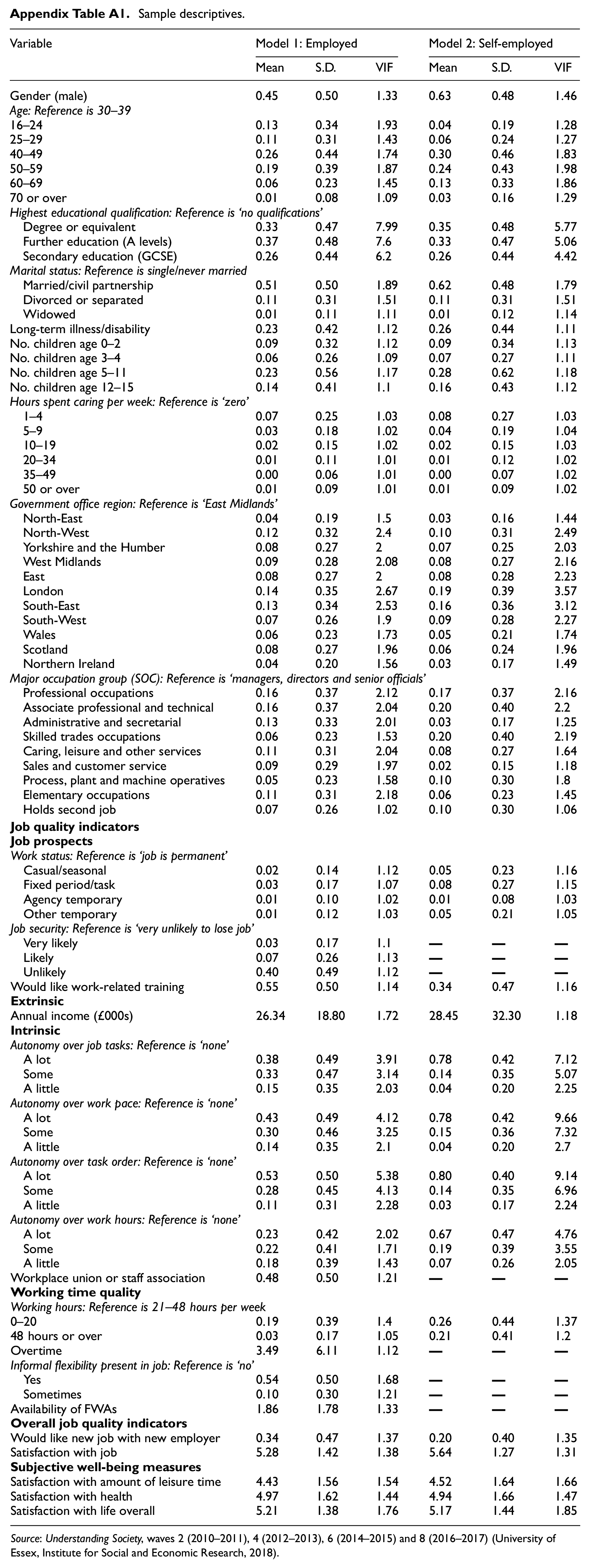
The empirical analysis in this article considers the quality of work experienced by urban-based employed and self-employed workers in different workplace locations. Data is extracted from waves 2 (2010–2011), 4 (2012–2013), 6 (2014–2015) and 8 (2016–2017) of Understanding Society (UKDS 6614, alternatively titled the United Kingdom Household Longitudinal Study – UKHLS). The aim of Understanding Society is to improve understanding of social and economic change in the UK at household and individual levels (University of Essex, Institute for Social and Economic Research, 2018). It is a stratified multi-topic longitudinal sample survey of 40,000 households (in 2009/2010), with data collected through interviews with adult members of households each year. Understanding Society is used in this research as it provides recent data on job quality from a statistically robust and representative sample of workers in the UK economy. The four waves used in this study are chosen since data on dimensions of job quality are only captured in alternate years of the survey. A sample description is provided in Appendix Table A1.
The analysis provides insight into job quality using a range of objective and subjective indicators which are categorised, as by Connell and Burgess (2016), into job prospects, extrinsic job quality, intrinsic job quality and working time quality dimensions. The dimensions explored in this article are consistent with those outlined in Connell and Burgess (2016), although some measures, for example aspects of the physical work environment, are not collected in Understanding Society and so are not available for inclusion in the analysis. The job quality measures used are summarised in Table 1. As well as individual indicators, variables are also included which act as a proxy measure for overall job quality. Job satisfaction is included as existing research has shown high job satisfaction to be equated with high job quality (Green, 2009), and a measure of turnover intention (would like new job with new employer) is included as an indicator of dissatisfaction with current employment. The latter measure is limited in that it captures subjective feelings regarding dissatisfaction with the current job, but does not necessarily reflect that individuals will quit in the near future for a range of reasons, including availability of alternative job opportunities. Nevertheless, it is a useful indicator of general discontent with work (Gifford, 2018) and is included in the analysis for this purpose. Additional subjective well-being indicators are also incorporated, including satisfaction with life overall and domains of leisure and health. Workplace location is recorded in Understanding Society with respect to the main place of work, through responses to the question, ‘Do you work mainly …’ with possible answers compressed into four alternatives: (i) at employer/business premises, (ii) at home, (iii) driving or travelling around, and (iv) in multiple locations (also referred to as mobile or multi-location work). 3
Quality of work dimensions explored in empirical estimations.
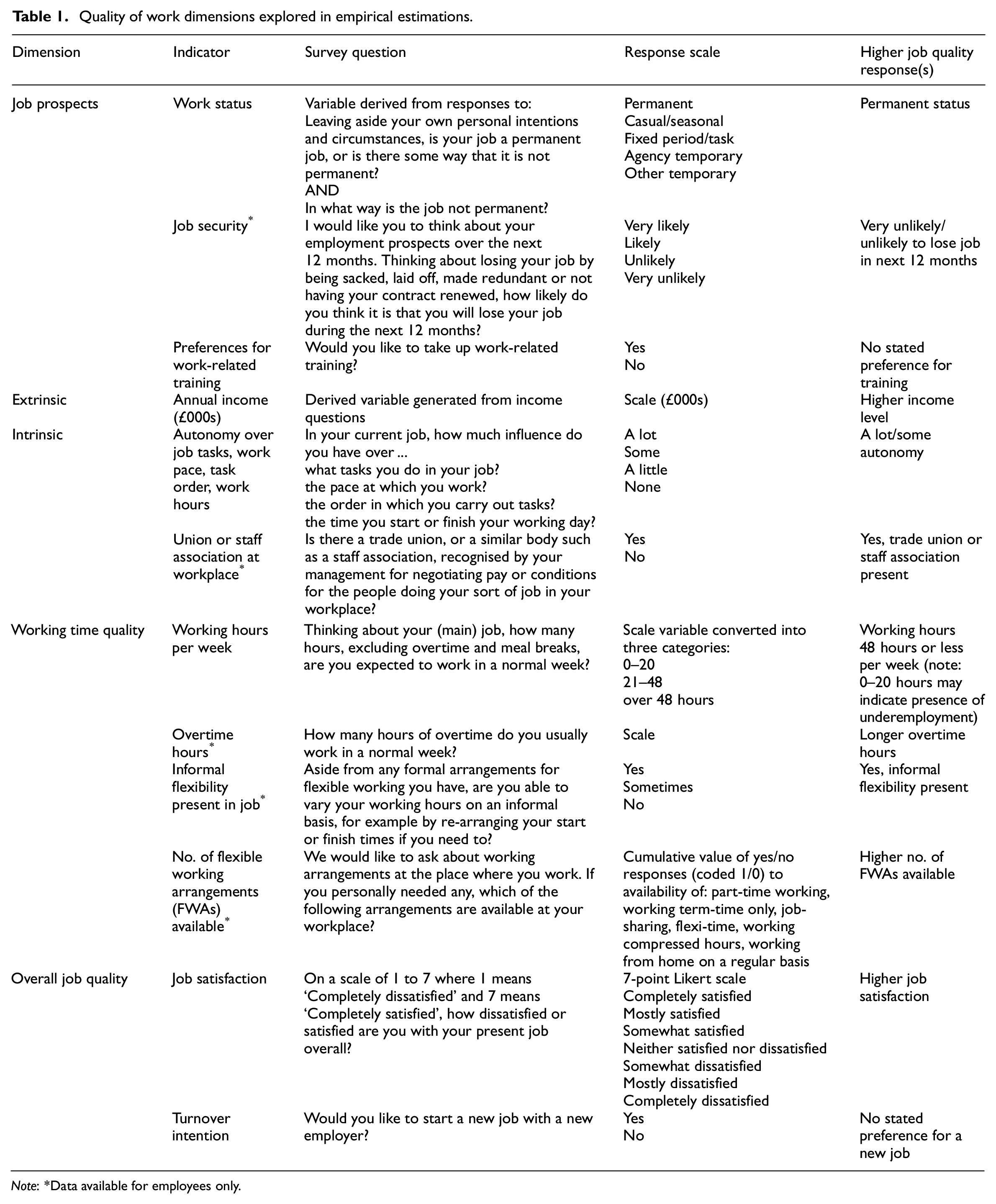
Note: *Data available for employees only.
Multinomial logistic regression is performed, enabling comparison of job quality indicators among urban-based workers reporting standard workplaces (employer/business premises) with those among workers in non-standard workplace locations (home, driving/travelling, mobile working). In line with the focus of this study, only workers reporting urban-based residential location are included in the analysis. 4 Occupational variables and demographic controls are included in the models. Separate models are produced for employed (model 1) and self-employed (model 2) workers given the observed differences in patterns of work and workplace location. Collinearity diagnostics (VIF indicators) generated concerns with a measure of autonomy over work manner. This indicator variable was, therefore, excluded from the models (see Appendix Table A1 for collinearity indicators for the final models). As the models use pooled panel data comprising a non-random sample, standard errors are corrected for clustering by multiple observations of individual sample members, as in Henley (2017).
Empirical findings
To contextualise the analysis of job quality and workplace it is necessary to understand the overall patterns of workplace location present in the Understanding Society sample. Consistent with UK labour market averages, using the 2016–2017 wave of Understanding Society we find that approximately three-quarters (76.5%) of the sample are urban-based. Around one in eight (12.2%) of urban-based workers report self-employment (15.8% of men and 8.3% of women). Most urban-based employees continue to report working at employer premises (83.6%), accounting for almost 90% of women and over three-quarters of male employees. Homeworking (2.8%), driving/travelling (7.6%) and mobile working at multiple locations (6.0%) remain relatively less common among employees. Workplace location among self-employed urban-based workers is more distributed. Around one-third report working at home (31.6%), and similarly at multiple locations (33.2%). The part-time self-employed, in particular, are likely to be home-based (44.9%). Few part-time self-employed workers report their own business premises (13.8%). This is especially the case among women, consistent with previous research (Atherton et al., 2016). Driving or travelling is a more common mode of work among self-employed urban-based workers (13.2%), and is especially common among men (17.2% compared with 5.1% of women).
Multinomial logistic regression
The multinomial models, summarised in Table 2, compare the relative quality of work encountered by urban-based workers in non-standard workplace locations (homeworkers, driving/travelling, mobile working) with that found by those working at employer or business premises.
Multinomial logistic regression: Workplace location and the quality of work.
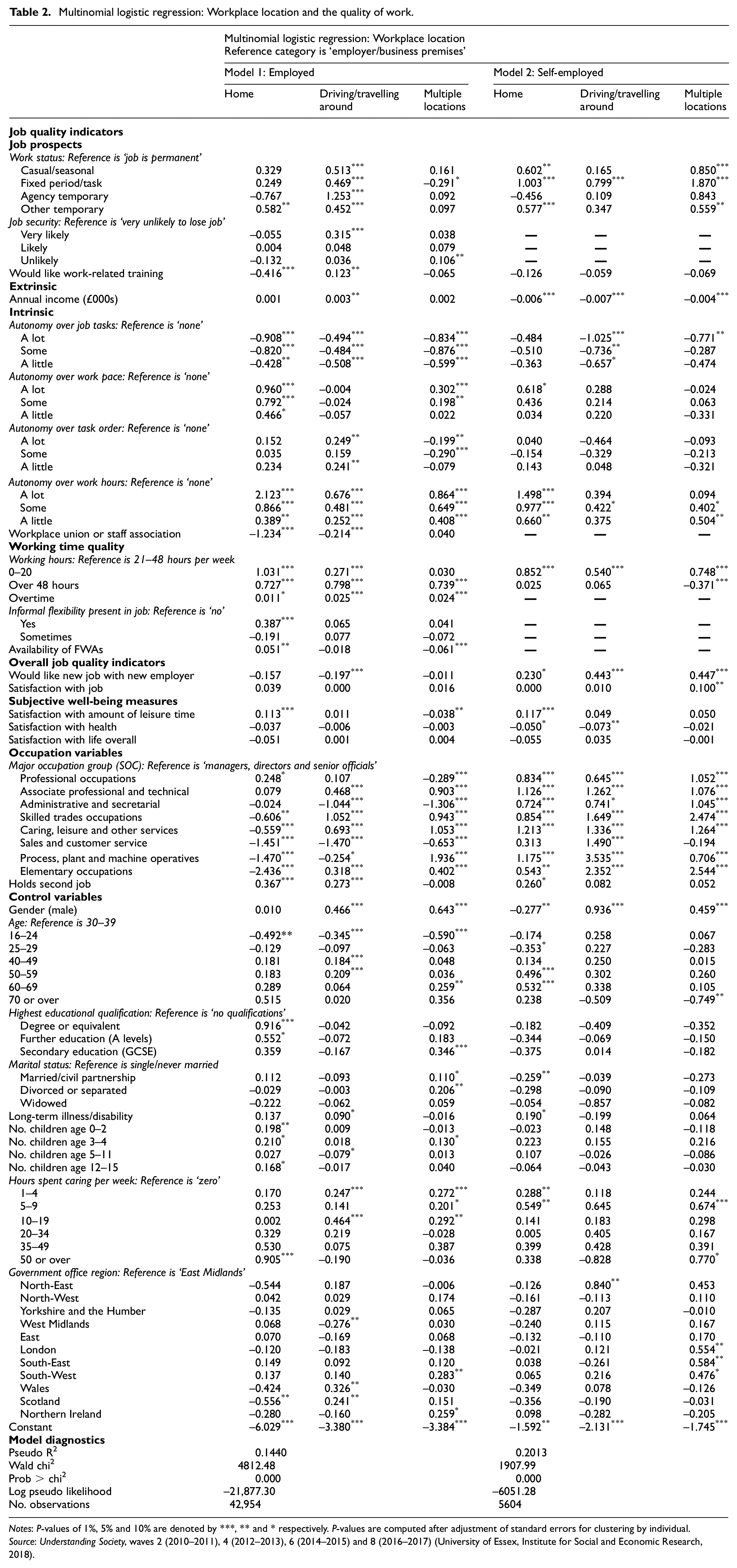
Notes: P-values of 1%, 5% and 10% are denoted by ***, ** and * respectively. P-values are computed after adjustment of standard errors for clustering by individual.
Source: Understanding Society, waves 2 (2010–2011), 4 (2012–2013), 6 (2014–2015) and 8 (2016–2017) (University of Essex, Institute for Social and Economic Research, 2018).
Homeworkers
Considering the case of homeworkers initially, model 1 reveals that in comparison with employees who work at employer premises, employed homeworkers appear to benefit from a number of characteristics of higher job quality. They are more likely to be employed in highly skilled occupations, and job prospects indicators show that they are more likely to hold a permanent position with their employer, suggesting their jobs are relatively secure. Homeworking employees are less likely to report preferences for training, perhaps led by the senior nature of the occupations reported and their older age. They have greater autonomy over pace and hours of work, consistent with the reported benefits of homeworking in enabling greater control over the timing of paid work (Kelliher and Anderson, 2008: 428; Tietze et al., 2009). They do, however, have less autonomy over work tasks than those working at employer premises. With regard to working time quality, they are more likely to work either shorter part-time hours (up to 20 hours per week) or long hours (48 or more) than workers at employer premises. This does indicate use of homeworking as a flexible working arrangement in some cases, but also the potential for lengthy work time (Nätti et al., 2011). Homeworking employees report greater informal flexibility and greater availability of formal flexible working arrangements, indicative of these employees working in organisations which have embraced flexible working. We also find positive and statistically significant relationships with satisfaction with leisure time, evidencing the wider well-being benefits to urban-based workers of working at home (Felstead and Henseke, 2017). Turning to demographics, we find that these workers are more often middle-aged and older, and more highly qualified. These age groups are often associated with incidence of homeworking, including use of homeworking as a lifestyle choice and/or due to caring responsibilities. The models also suggest that homeworkers are more likely to have dependent children than those working at employer premises, supporting household contribution as a driver of homeworking (Sullivan and Smithson, 2007).
For self-employed homeworkers (model 2), a number of important distinctions are found. Compared with the self-employed working at business premises, self-employed homeworkers are more likely to report that their current job is temporary in nature. They are also likely to work shorter hours, hold a second job and have lower incomes. Importantly, self-employed homeworkers indicate that they would like a new job with a new employer, offering some evidence of lower job quality. Self-employed homeworkers are more likely to be women, consistent with the use of home as a workplace due to household constraints and/or lower capitalisation among women-owned SMEs (Atherton et al., 2016). These workers are engaged in a range of different occupations encompassing associate professional, skilled trade and lower-skilled (caring, leisure and personal services, process, plant and machine operatives) jobs. They are more likely to perform caring acts for ill/elderly relatives or friends, and to report an existing illness or disability, the latter finding consistent with this form of work providing opportunities to individuals who may face difficulties in more standard workplaces (Green, 2017: 1646). We also find lower satisfaction with health among these workers in line with this finding.
Driving and travelling jobs
Evidence pertaining to employees who drive/travel around suggests the presence of lower job quality compared with employees working at employer premises. Returning to model 1, employees who drive/travel around are more likely to be employed in associate professional, skilled trade and lower-skilled (caring, leisure and personal services, elementary) occupations. Job prospects indicators show that these workers have precarious contracts and feel less secure in their jobs. Intrinsic measures reveal that they have less autonomy over job tasks but greater autonomy over the order of tasks and hours of work. Consistent with existing evidence, employees driving/travelling around either work shorter part-time hours or long hours, and report higher levels of overtime (Nielsen et al., 2010). They are more likely to report preferences for work-related training, perhaps indicative of unmet need. Employees who drive/travel in their job do, though, report higher incomes and are less likely to report turnover intention. Demographics indicate that these workers are more often male, are less likely to have dependent children and are usually middle-aged or older. These patterns are consistent with general patterns of employment in these types of occupation (Nielsen et al., 2010), although a younger demographic has been a feature of growth in urban-based self-employed delivery driving (Woodcock, 2016).
The self-employed who drive/travel around (model 2) share a number of demographic and job quality characteristics with their employed counterparts, but with additional findings suggesting the presence of lower job quality. The self-employed driving/travelling around are particularly likely to be in lower-skilled process, plant and machine operative occupations, which include driving occupations such as truck and taxi driving, as well as skilled trade, sales and customer services, and elementary occupations. As with other self-employed non-standard workers, these urban-based workers are engaged in casual and fixed period/task-based work synonymous with gig working (Woodcock, 2016). Self-employed driving/travelling workers report lower levels of autonomy over job tasks. They work shorter hours and have lower incomes, perhaps indicative of underemployment among some of these workers. Importantly, they also exhibit a higher degree of turnover intention. They are, additionally, likely to be less satisfied with their health.
Mobile workers
Mobile working provides quite mixed findings, which given the occupational split among these workers may suggest trade-offs between good and bad characteristics and/or divisions between higher- and lower-skilled multi-location workers (Aloisi, 2016; Fenwick, 2012: 596; Kuhn and Maleki, 2017). Mobile working is more common among older male workers, and interestingly we find it to be spatially focused around the London, South-East and South-West regions of the UK. Mobile working employees (model 1) are in a range of jobs, including highly skilled (managerial, professional, associate professional), skilled trade and lower-skilled (caring, leisure and personal services, elementary) occupations. Intrinsic characteristics of mobile working employees suggest less autonomy over job tasks and task order, but more autonomy over the pace and hours of work, suggesting control over working time aspects of work. They work long hours and overtime, and are less likely to have formal flexible working arrangements available. These employees also report lower satisfaction with leisure time consistent with the presence of intense working routines (Hislop and Axtell, 2009).
Precarious work is a feature of mobile working among the self-employed (model 2). Compared with the self-employed working at business premises, mobile workers experience shorter working hours and higher degrees of control over hours. The models suggest some characteristics of lower job quality among self-employed mobile workers, as they are likely to have less autonomy in other aspects of their work and lower incomes, while we also find strong turnover intention. Contrasting the latter finding and consistent with existing research (Vartiainen and Hyrkkänen, 2010), self-employed mobile workers exhibit greater satisfaction with their job, indicative of satisfaction being derived from the intrinsic characteristics of their work and/or potential divisions between different sub-types of mobile work.
The models provide important findings concerning the quality of work experienced by urban-based workers in different workplaces. Employed homeworkers report a number of characteristics of higher job quality compared with employees working at employer premises, in part a product of the greater freedom present in the highly skilled occupations of many homeworkers. Homeworking provides higher levels of control and flexibility and associated leisure benefits. For the self-employed, homeworking may represent a less idyllic outcome, as pay, occupation skill level and some forms of autonomy are lower, and these workers are more likely to exhibit turnover intention compared with the self-employed working in business premises. Job quality encountered in driving/travelling jobs appears lower, especially among the self-employed. Some of these workers may value the greater levels of independence evident in reported levels of autonomy; however, many are engaged in precarious, lower-skilled work including delivery, taxi and other driving occupations (Aloisi, 2016; Kuhn and Maleki, 2017), which exhibit characteristics of low job quality. Findings for mobile workers evidence the trade-offs encountered in these jobs, as well as the diversity present in highly flexible forms of work, offering some characteristics of good job quality but also lower quality characteristics compared with workers in more standard workplaces.
Discussion and conclusion
This article has explored the relationship between workplace location and the quality of work among urban-based workers, using UK data from Understanding Society. The majority of paid work continues to take place in traditional workplace locations, in employer or business premises, most of which are located in urban centres. However, much of the growth in paid work in the last decade has been in flexible forms of work, including own-account self-employment, which take place in non-standard locations, while growth has also been recorded in homeworking. When disaggregating into employees and self-employed workers, a more nuanced pattern of working practices is evident. Self-employed urban-based workers are more diverse in their workplace location, with around one-third reporting homeworking and a similar proportion for mobile working. Self-employed jobs involving driving/travelling, for example taxi/delivery driving, are more concentrated among those living in urban areas, likely reflecting residential choices providing access to employment opportunities and availability of these types of jobs.
The findings in this article evidence the changing workplaces and practices in advanced economies, with employment taking various forms. While these changes provide a range of opportunities to work at home or on the move, offering greater flexibility and control over work and associated job quality benefits, they also represent imposition of highly flexible working routines by employers, or in some instances of gig work by intermediaries, which can result in low quality, precarious work. The multinomial models provide a number of important findings. The analysis suggests that homeworking has a number of characteristics of higher job quality and wider benefits including satisfaction with leisure time. For the self-employed, homeworking may be of lower quality in some respects, but it does offer working time quality benefits evident in reported autonomy over working hours and satisfaction with leisure. These benefits may be especially important to working women, who are over-represented in this form of work, providing enhanced control over the balance between work and household responsibilities. Driving/travelling jobs are more often undertaken by older men, aligning with suggestions that some older men trade down into lower-skilled, often part-time self-employment. Some of these workers are engaged in highly flexible self-employment, which the analysis suggests is precarious and exhibits lower quality characteristics including lower incomes. Multi-location jobs offer greater flexibility and well-being benefits to job satisfaction (self-employed only), but also exhibit some lower quality characteristics associated with intense working routines. Some of these differences may reflect diversity in the jobs involving mobile work, but also reflect trade-offs associated with these forms of work.
It should be acknowledged that some of the findings presented may be specific to the UK case, influenced by both its policy and geography. The spatial dimensions of non-standard forms of work, though, and the concerns related to job quality explored in this article are of relevance to many countries where growth in these forms of work in urban centres has been observed. Policy makers face particular challenges in developing effective safeguards for workers which take account of the growing diversity of paid work. Policy continues to play catch-up with the changing temporal and spatial nature of work. Attempts to provide additional security through employment protection laws may have acted as a catalyst for growth in highly flexible work, as employers attempt to avoid the costs and potential risks of taking on permanent employees. Further strengthening of employment protection for employees without consideration of the self-employed could, therefore, accelerate growth in lower quality, highly flexible forms of work, some of which are highly urban-centric. Focusing public policy efforts on improving aspects of job quality among both employees and those classed as self-employed is essential, although the nature of many highly flexible jobs does make improvements challenging to realise.
While the quality of work encountered by workers in different workplace locations is to some degree a product of occupational characteristics, the locations in which paid work is performed clearly have significant relevance to reported job quality and worker well-being. Homeworking appears to offer particularly good job quality. Meanwhile, some forms of self-employment which are principally urban-based, including driving/travelling jobs, are of lower quality. These findings are important as they highlight the challenges faced in addressing job quality in urban centres. Changing workplaces and practices also have important spatial implications. Paid work continues to be centred in urban locations, but with greater diversity in workplace. Given the range of workplace locations present among the self-employed, should the observed growth in self-employment continue this could have potentially important implications for the future geography of paid work, including for urban planning and land use, for example through increased demand for shared workspaces. For the majority who are employed, the tension between the decentralisation and centralisation of workplace renders future development uncertain. While higher levels of flexibility are observed, there is renewed demand from some employers, including high-profile examples such as Google, for centralisation of the workplace to facilitate the pooling and sharing of knowledge/ideas.
The analysis conducted allows consideration of paid work in different workplace locations, providing insight into different modes of work without requiring analysis of sub-major occupation groups, which would require a significantly larger sample of workers, or multiple small-scale data collection exercises. The focus on main workplace location could be considered a limitation. Boundaries between formal and informal workplace locations are increasingly fluid. As such, surveys of workers need not only to focus on the main workplace but also to better capture the blurred temporal and spatial boundaries between work and non-work locations in urban settings. This is complex to capture, but essential if we are to better understand the increasingly fluid spatial structures of paid work. Measuring job quality using Understanding Society is also limited, including use of subjective indicators and uncaptured job quality constituents, such as the physical work environment. In addition, while we find important differences in job quality in different workplace locations, it is important to acknowledge that all jobs are likely to exhibit some good and bad qualities. Offering an overall indication of job quality is, therefore, highly challenging and subject to interpretation. Nevertheless, the findings contribute to understanding of job quality and the changing spatial structures of paid work in urban centres, highlighting the contrasting experiences encountered by urban-based workers in different workplace locations, including the higher job quality of those whose main workplace is their home, the diversity present in the quality of mobile work and the lower quality of work encountered by some urban-based self-employed workers in driving/travelling occupations.
Footnotes
Appendix
Sample descriptives.
| Variable | Model 1: Employed | Model 2: Self-employed | ||||
|---|---|---|---|---|---|---|
| Mean | S.D. | VIF | Mean | S.D. | VIF | |
| Gender (male) | 0.45 | 0.50 | 1.33 | 0.63 | 0.48 | 1.46 |
| Age: Reference is 30–39 | ||||||
| 16–24 | 0.13 | 0.34 | 1.93 | 0.04 | 0.19 | 1.28 |
| 25–29 | 0.11 | 0.31 | 1.43 | 0.06 | 0.24 | 1.27 |
| 40–49 | 0.26 | 0.44 | 1.74 | 0.30 | 0.46 | 1.83 |
| 50–59 | 0.19 | 0.39 | 1.87 | 0.24 | 0.43 | 1.98 |
| 60–69 | 0.06 | 0.23 | 1.45 | 0.13 | 0.33 | 1.86 |
| 70 or over | 0.01 | 0.08 | 1.09 | 0.03 | 0.16 | 1.29 |
| Highest educational qualification: Reference is ‘no qualifications’ | ||||||
| Degree or equivalent | 0.33 | 0.47 | 7.99 | 0.35 | 0.48 | 5.77 |
| Further education (A levels) | 0.37 | 0.48 | 7.6 | 0.33 | 0.47 | 5.06 |
| Secondary education (GCSE) | 0.26 | 0.44 | 6.2 | 0.26 | 0.44 | 4.42 |
| Marital status: Reference is single/never married | ||||||
| Married/civil partnership | 0.51 | 0.50 | 1.89 | 0.62 | 0.48 | 1.79 |
| Divorced or separated | 0.11 | 0.31 | 1.51 | 0.11 | 0.31 | 1.51 |
| Widowed | 0.01 | 0.11 | 1.11 | 0.01 | 0.12 | 1.14 |
| Long-term illness/disability | 0.23 | 0.42 | 1.12 | 0.26 | 0.44 | 1.11 |
| No. children age 0–2 | 0.09 | 0.32 | 1.12 | 0.09 | 0.34 | 1.13 |
| No. children age 3–4 | 0.06 | 0.26 | 1.09 | 0.07 | 0.27 | 1.11 |
| No. children age 5–11 | 0.23 | 0.56 | 1.17 | 0.28 | 0.62 | 1.18 |
| No. children age 12–15 | 0.14 | 0.41 | 1.1 | 0.16 | 0.43 | 1.12 |
| Hours spent caring per week: Reference is ‘zero’ | ||||||
| 1–4 | 0.07 | 0.25 | 1.03 | 0.08 | 0.27 | 1.03 |
| 5–9 | 0.03 | 0.18 | 1.02 | 0.04 | 0.19 | 1.04 |
| 10–19 | 0.02 | 0.15 | 1.02 | 0.02 | 0.15 | 1.03 |
| 20–34 | 0.01 | 0.11 | 1.01 | 0.01 | 0.12 | 1.02 |
| 35–49 | 0.00 | 0.06 | 1.01 | 0.00 | 0.07 | 1.02 |
| 50 or over | 0.01 | 0.09 | 1.01 | 0.01 | 0.09 | 1.02 |
| Government office region: Reference is ‘East Midlands’ | ||||||
| North-East | 0.04 | 0.19 | 1.5 | 0.03 | 0.16 | 1.44 |
| North-West | 0.12 | 0.32 | 2.4 | 0.10 | 0.31 | 2.49 |
| Yorkshire and the Humber | 0.08 | 0.27 | 2 | 0.07 | 0.25 | 2.03 |
| West Midlands | 0.09 | 0.28 | 2.08 | 0.08 | 0.27 | 2.16 |
| East | 0.08 | 0.27 | 2 | 0.08 | 0.28 | 2.23 |
| London | 0.14 | 0.35 | 2.67 | 0.19 | 0.39 | 3.57 |
| South-East | 0.13 | 0.34 | 2.53 | 0.16 | 0.36 | 3.12 |
| South-West | 0.07 | 0.26 | 1.9 | 0.09 | 0.28 | 2.27 |
| Wales | 0.06 | 0.23 | 1.73 | 0.05 | 0.21 | 1.74 |
| Scotland | 0.08 | 0.27 | 1.96 | 0.06 | 0.24 | 1.96 |
| Northern Ireland | 0.04 | 0.20 | 1.56 | 0.03 | 0.17 | 1.49 |
| Major occupation group (SOC): Reference is ‘managers, directors and senior officials’ | ||||||
| Professional occupations | 0.16 | 0.37 | 2.12 | 0.17 | 0.37 | 2.16 |
| Associate professional and technical | 0.16 | 0.37 | 2.04 | 0.20 | 0.40 | 2.2 |
| Administrative and secretarial | 0.13 | 0.33 | 2.01 | 0.03 | 0.17 | 1.25 |
| Skilled trades occupations | 0.06 | 0.23 | 1.53 | 0.20 | 0.40 | 2.19 |
| Caring, leisure and other services | 0.11 | 0.31 | 2.04 | 0.08 | 0.27 | 1.64 |
| Sales and customer service | 0.09 | 0.29 | 1.97 | 0.02 | 0.15 | 1.18 |
| Process, plant and machine operatives | 0.05 | 0.23 | 1.58 | 0.10 | 0.30 | 1.8 |
| Elementary occupations | 0.11 | 0.31 | 2.18 | 0.06 | 0.23 | 1.45 |
| Holds second job | 0.07 | 0.26 | 1.02 | 0.10 | 0.30 | 1.06 |
|
|
||||||
|
|
||||||
| Work status: Reference is ‘job is permanent’ | ||||||
| Casual/seasonal | 0.02 | 0.14 | 1.12 | 0.05 | 0.23 | 1.16 |
| Fixed period/task | 0.03 | 0.17 | 1.07 | 0.08 | 0.27 | 1.15 |
| Agency temporary | 0.01 | 0.10 | 1.02 | 0.01 | 0.08 | 1.03 |
| Other temporary | 0.01 | 0.12 | 1.03 | 0.05 | 0.21 | 1.05 |
| Job security: Reference is ‘very unlikely to lose job’ | ||||||
| Very likely | 0.03 | 0.17 | 1.1 |
|
|
|
| Likely | 0.07 | 0.26 | 1.13 |
|
|
|
| Unlikely | 0.40 | 0.49 | 1.12 |
|
|
|
| Would like work-related training | 0.55 | 0.50 | 1.14 | 0.34 | 0.47 | 1.16 |
|
|
||||||
| Annual income (£000s) | 26.34 | 18.80 | 1.72 | 28.45 | 32.30 | 1.18 |
|
|
||||||
| Autonomy over job tasks: Reference is ‘none’ | ||||||
| A lot | 0.38 | 0.49 | 3.91 | 0.78 | 0.42 | 7.12 |
| Some | 0.33 | 0.47 | 3.14 | 0.14 | 0.35 | 5.07 |
| A little | 0.15 | 0.35 | 2.03 | 0.04 | 0.20 | 2.25 |
| Autonomy over work pace: Reference is ‘none’ | ||||||
| A lot | 0.43 | 0.49 | 4.12 | 0.78 | 0.42 | 9.66 |
| Some | 0.30 | 0.46 | 3.25 | 0.15 | 0.36 | 7.32 |
| A little | 0.14 | 0.35 | 2.1 | 0.04 | 0.20 | 2.7 |
| Autonomy over task order: Reference is ‘none’ | ||||||
| A lot | 0.53 | 0.50 | 5.38 | 0.80 | 0.40 | 9.14 |
| Some | 0.28 | 0.45 | 4.13 | 0.14 | 0.35 | 6.96 |
| A little | 0.11 | 0.31 | 2.28 | 0.03 | 0.17 | 2.24 |
| Autonomy over work hours: Reference is ‘none’ | ||||||
| A lot | 0.23 | 0.42 | 2.02 | 0.67 | 0.47 | 4.76 |
| Some | 0.22 | 0.41 | 1.71 | 0.19 | 0.39 | 3.55 |
| A little | 0.18 | 0.39 | 1.43 | 0.07 | 0.26 | 2.05 |
| Workplace union or staff association | 0.48 | 0.50 | 1.21 |
|
|
|
|
|
||||||
| Working hours: Reference is 21–48 hours per week | ||||||
| 0–20 | 0.19 | 0.39 | 1.4 | 0.26 | 0.44 | 1.37 |
| 48 hours or over | 0.03 | 0.17 | 1.05 | 0.21 | 0.41 | 1.2 |
| Overtime | 3.49 | 6.11 | 1.12 |
|
|
|
| Informal flexibility present in job: Reference is ‘no’ | ||||||
| Yes | 0.54 | 0.50 | 1.68 |
|
|
|
| Sometimes | 0.10 | 0.30 | 1.21 |
|
|
|
| Availability of FWAs | 1.86 | 1.78 | 1.33 |
|
|
|
|
|
||||||
| Would like new job with new employer | 0.34 | 0.47 | 1.37 | 0.20 | 0.40 | 1.35 |
| Satisfaction with job | 5.28 | 1.42 | 1.38 | 5.64 | 1.27 | 1.31 |
|
|
||||||
| Satisfaction with amount of leisure time | 4.43 | 1.56 | 1.54 | 4.52 | 1.64 | 1.66 |
| Satisfaction with health | 4.97 | 1.62 | 1.44 | 4.94 | 1.66 | 1.47 |
| Satisfaction with life overall | 5.21 | 1.38 | 1.76 | 5.17 | 1.44 | 1.85 |
Source: Understanding Society, waves 2 (2010–2011), 4 (2012–2013), 6 (2014–2015) and 8 (2016–2017) (University of Essex, Institute for Social and Economic Research, 2018).
Declaration of conflicting interests
The author(s) declared no potential conflicts of interest with respect to the research, authorship, and/or publication of this article.
Funding
The author received no financial support for the research, authorship, and/or publication of this article.
