




Abstract
Much has been written about the ways in which recent economic reforms have changed Chinese cities. Chinese planning is often discussed as a profession in an equivalent state of flux, as urban planners struggle to develop a new concept of their role that can find a coherent middle course between conflicting priorities: the pursuit of market-driven growth; the demands of a centralised and relatively authoritarian state; and the need to maintain a participative openness to local communities. This paper questions this emphasis on coherence within professionalism, arguing that planners in modern China define their role by sliding between very different sets of values and priorities. The term ‘public interest’ acts as a pivot in this negotiation, allowing the tensions between competing rationales to be downplayed. Furthermore, the challenges of the contemporary context do not entail leaving history behind but rather using it as a creative resource for ideas of legitimacy, authority and professionalism. Inspired by Walter Benjamin’s reflections on history, we argue that earlier models of professional authority from the Confucian and socialist traditions are mined and reinvented to cope with the uncertainties of professional decision-making in a highly conflicted present.
Conflict and the historical past
Thesis XIV History is the subject of a structure whose site is not homogeneous, empty time, but time filled by the presence of the now [Jetztzeit]. Thus, to Robespierre ancient Rome was a past charged with the time of the now which he blasted out of the continuum of history. The French Revolution viewed itself as Rome reincarnate. It evoked ancient Rome the way fashion evokes costumes of the past. Fashion has a flair for the topical, no matter where it stirs in the thickets of long ago; it is a tiger’s leap into the past. This jump, however, takes place in an arena where the ruling class gives the commands. The same leap in the open air of history is the dialectical one, which is how Marx understood the revolution. (Benjamin, 1968: 261)
Much has been written about the tensions that permeate the Chinese spatial planning system in the present. Spatial planners face the seemingly impossible task of reconciling at least three contradictory imperatives: creating room for capitalist marketisation; paying heed to the dictates of a strong, centralised socialist state; and remaining attentive to alternative concepts of public good (including ecological imperatives and the desires of local communities; Nee, 1989). The practical and ideological conflicts between these three imperatives are sharp and wide-ranging, creating a host of incompatible pressures across the social, political, cultural and economic domains. 1
These inconsistencies are sometimes discussed in temporal terms, as the consequence of a process of ongoing ‘transition’ that is not yet complete. The underlying assumption is often that China’s move from a socialist, planned economy to a form of authoritarian capitalism is incomplete, placing it ‘behind’ the Global North. Such a view shatters the simultaneity of the global present into anachrony: at any given moment in chronological time, it pictures various countries at different stages of historical development, with Europe and America representing the ‘future’ of the Global South. Contradictions thus become a sign of a society that is historically interstitial, a move that tends to ‘other’ the Global South and also to underplay the deep contradictions that are in inherent between the state and market capitalism in the Global North. The unspoken premise is that capitalist modernity is consistent, and that so-called ‘progress’ represents a move towards global homogeneity and coherence (see Osborne, 2011, for a detailed discussion of this trope).
For example, Fainstein and Logan announce the backwardness of China at the very beginning of their 2008 book, Urban China in Transition: ‘We may still, at the beginning of the twenty-first century, think of China as a developing country’, they write, though they quickly add ‘Almost certainly, however, this perspective will soon seem anachronistic’ (Fainstein and Logan, 2008: 1). Subsequent statements about the impossibility of fitting the diversity of the Chinese experience into a single grand narrative do little to balance the rather colonial assumptions of phrases such as ‘late-developing countries’ (Fainstein and Logan, 2008: 2). Furthermore, all four of the paradigms the authors suggest to explain Chinese modernity (modernisation, dependency theory, the developmentalist state and the post-socialist transition to marketisation) contain an unquestioned assumption that the contradictions of the Chinese case can be interpreted in terms of a transition to a more coherent modernity that has already arrived in the Global North. As Wu has noted in a carefully argued critique, none of these theories enable China to be depicted as an example of advanced capitalism, let alone as a harbinger of new types of arrangement between the State and capital (Wu, 2007; see also Smith, 2002).
In this paper, we argue that spatial planning globally faces a series of contradictory pressures and that the modern spatial planner must develop a mode of professionalism that is capable of navigating these incommensurate rationales. However, the form this negotiation takes is geographically and culturally specific. China, in this view, functions neither as an altogether generalisable case study with findings that are globally applicable, nor as a specific example of self-enclosed particularity. Our decolonial approach is thus suspicious of the notion that there is one universal ‘advanced’ model of professionalism, with the connected assumption that the state of professionalism in the Global North represents the inevitable ‘future’ for the Global South (see Chakrabarty, 2000; Hall, 1992). Instead, we want to suggest that while there may be similarities between the contradictory rationales confronting planning professionals globally, particular histories and geographical conditions are significant in shaping the way professionals negotiate these pressures (see De Sousa Santos, 2016; Simone and Pieterse, 2017). In particular, we will draw attention to the influence of culturally specific historical paradigms as a source of legitimacy and authority in China.
We depart significantly from previous framings of professionalism, which define it as a structurally coherent combination of power and knowledge. ‘Traditional’ Western views, drawn largely from early sociology, tended to view professionalism functionally, as part of a series of socially stabilising bureaucratic tools, conflating epistemic and hierarchical (or managerial) forms of authority (e.g. Durkheim et al., 1957; and especially Weber et al., 1947). Subsequent trait-based analyses of professions sought to discover an overarching framework capable of handling both ‘traditional’ professions (such as law, medicine) and newer ‘welfare’ professions closely aligned with the state, including planning (Evans, 1993), drawing attention to the difference between ‘specialist’ knowledge and hierarchical authority, and distinguishing between ‘experts’ and ‘managers’.
By the late 1960s and 1970s, however, clear-cut distinctions between knowledge and power were problematised by approaches that drew attention to professionalism as an ideology. These suggested that the notion of altruistic public service concealed the ways in which professionalism served to control entry to certain jobs, thus protecting the hierarchical position and wages of a select group (Freidson, 2001; Johnson, 1972). Planning theorists have tended to remain ambivalent to such ideas, open to the idea that professionalism is fundamentally interested, while noting the ways in which planners have been unsuccessful in attempts to establish professional autonomy or control wages (Healey, 1985). More recently, professionalism has been increasingly viewed in pluralist and explicitly political terms, with an emphasis on the facilitation of participation over the exercise of a technocratic institutional ‘expertise’. In such a view, the ability to work across multiple disciplines and demographics becomes far more important to the contemporary planner than the deployment of epistemic authority, collapsing the boundary between managerialism and professionalism (Muzio et al., 2013).
Our alternative picture of the professional focuses on incoherence as a strategy to negotiate a relationship to power. We want to explore the idea of a ‘conflicted professionalism’, which segues between competing definitions of legitimacy in a context that is shot through with contradictory imperatives. Our argument takes inspiration from Abramson (2006, 2007), who argues that it is a mistake to attempt to resolve the sharp contradictions experienced by contemporary Chinese spatial planners into a neat picture, where individuals make decisions according to a permanent, coherent and inflexible set of ideological and practical commitments. Instead, he sees Chinese planners engaged in a dialectical negotiation of conflicting pressures, striking a shifting balance between incompatible imperatives. Contradiction is not a transient aberration, and change does not occur in a gradual, clear and frictionless manner. Instead of following a rational and internally consistent logic, planners seek multiple, contradictory resolutions.
We wish to drive this argument to its logical conclusion by stressing the ways in which professionalism in a Chinese context represents a hybrid, provisional and convenient accommodation between competing pressures. In such a view, both individual acts of spatial decision-making and the policy that shapes them exist to maintain a series of constitutive contradictions between incompatible rationales for intervention. Our view of spatial planners’ roles is akin to that of disjointed incrementalism (Lindblom, 1959), only instead of picturing planners as naively fumbling in the face of irreconcilable imperatives, we show that they are calmly crafting a hybrid model of professionalism as a creative response to immediate pressures in the present moment.
In pursuit of this hybridity, we argue, history becomes an important resource, as Chinese spatial planners deliberately use conflicting models of professionalism to segue seamlessly between competing definitions of ethical value and legitimacy. The ‘public interest’ emerges as a key term in this balancing act, precisely because it is conceptually empty and therefore endlessly redefinable in terms of a wide range of competing rationales: market-led economic growth, aesthetic beauty, the directives of an authoritarian and centralised state, and attentiveness to the specificities of a locality or a local community. Our empirical analysis shows that public interest justifications are used not to establish one set of public ‘goods’ but to hybridise between very different conceptualisations, joining them together in new, pragmatic combinations. In a cultural context where there is a significant emphasis on harmony, this allows tensions between different ideas of the ‘good’ to be spirited away. Professionalism thus renders contradictions invisible, allowing development to appear as a harmonising social influence rather than a source of conflict.
However, while this mixed concept of the ‘public interest’ will be familiar to spatial planners in the Global North, Chinese planners draw on a very specific set of historical concepts in its construction. Confucian models of the planner as a scholar-bureaucrat mix with socialist ideas of planners as rationalist technocrats, alongside more modern ideas of planners as client-oriented service providers. In our view, this use of the past is creative: inspired by Benjamin’s Theses on the Philosophy of History, we want to suggest that history does not represent dead, empty time but a resource for strategic plunder (Benjamin, 1968). Unlike the Marx of The Eighteenth Brumaire, who was disturbed by what he saw as the Roman ‘illusions’ of the French Revolutionaries (Lowy, 2005; Marx and De Leon, 1898), Benjamin follows Nietzsche in positing history, and even historical illusion, as a way of effecting change. His famous notion of a ‘tiger’s leap’ into the past rejects the idea of time as linear and sequential in favour of a creative use of past example that breaks with the temporal continuum. The ‘tiger’s leap’ allows people to seize on the past as a source of difference and thus to draw attention to new possibilities for change in the present.
However, for the purposes of this paper, we wish to draw attention to Benjamin’s distinction between the ‘fashionable’ tiger’s leap, which is largely subservient to power structures in the present, and the ‘revolutionary’ tiger’s leap, which is capable of producing change against the grain of power. We do not wish to suggest that any of the instances of borrowing from the past noted in this paper partake of the latter, revolutionary character. Instead, we will argue that Chinese spatial planners use history to negotiate the contradictions of the present, in a way that lends their decision-making position authority, while concealing the expediency and contradictions of their professional role. The overall effect is to maintain the status quo. Far from acting as an explosive release from present conditions, history is largely used to legitimate acts of pragmatism that are designed to uphold order and stability.
The next section of this paper will provide a brief introduction to a number of key sources of professional authority in China, from the Confucian and socialist traditions to more recent economic reforms. Empirical data from semi-structured interviews with Chinese planners is then used to show how these historical concepts continue to provide a resource for planners in the present, as they seek legitimacy for their professional role in a context of impossibly conflicting pressures. A final concluding section then draws out the implications of these findings for an understanding of the constitutively conflictual nature of modern planning more generally.
Historical context
The Confucian inheritance
Despite efforts to eradicate Confucianism as an ‘irrational’ and ‘pre-modern’ relic of the past in the socialist era, Chinese state institutions are still framed within a Confucian-derived cultural system which defines and legitimates political and social norms (Hoffman, 2001; Jankowiac, 1993; Ong 1997). Hierarchical in nature, Confucian thought centres on the figure of the emperor, the self-designated ‘Son of Heaven’, who was both the fount of eternal power, and the owner of all land. Imperial domains were allocated to members of the royal family and ministers loyal to the emperor, with the ruling class committed to the belief that ‘over the nation, there are only Crown lands; over the land, there are only subjects of the King’ (Chen and Thwaites, 2013: 11). Emperors tended to view the urban as a domain through which to consolidate governance and power, an attitude that filtered down to regional scholar-officials, who developed smaller centres of power. The result was a form of authoritarian government centred on the city, deprioritising the rural (Shils, 1996).
Less an official religion than a cultural-spatial-political regime, Confucianism led to a distinctive way of approaching cities. Administering this system of land were the Confucian ‘scholar-officials’, described by Madsen as ‘ministers of the state [who] were supposed to be “gentlemen”, aspiring to a higher standard of morality than common people, a standard that encapsulated the demand for strict reciprocity with the requirement of “righteousness”’ (Madsen, 1990). The role was one of very few open to the sons of the lower and middle classes, who could gain entry via civil service examinations, thus ensuring a degree of social mobility to the exceptionally clever and talented. The approach to power that emerged was a morally inflected, pragmatic response to retaining power. As Hao puts it: the ethics of social consequence involved a moral scale with a sensitivity to the pragmatic consequences and social utility of human action. It also accepted, in a relative sense, spheres of life governed by some nonmoral ends, such as wealth, heroism, and practical success. (Hao, 1996: 83)
Rule was supposed to be rational and authoritative (Chen and Thwaites, 2013: 12), but the exercise of reason did not follow a European, enlightenment model of self-expression and challenge to traditional forms of authority. Instead, it was supposed to accord with propriety, manners, obedience and deference.
Central within this autocratic regime is the Confucian concept of ‘Li’. Often translated as ‘rites’ or ‘rituals’, it also means ‘prescribed social rules’ even though these may be ‘unwritten and lacking in details’ (Ainsworth, 1996: 35–36). This culturally embedded form of rule illustrates the wider way and continuing influence of a model of China as the ‘kingdom of rituals and ceremonies’ (liyi zhibang [礼仪之邦]), rather than a state with a written series of universally oriented, invariant, rationally driven regulations. As Tan argues, Li forms a kind of standard of behaviour that is exemplary because it is authoritative, and authoritative because it is exemplary: Confucians believe that acting and governing appropriately cannot be achieved by merely applying universal rules in an exercise of reason; they also require aesthetic sensitivity to the unique circumstances of each particular situation. Rather than rules that anyone could comprehend, authoritative performances of Li by exemplary individuals provide the standards of behaviour. (Tan, 2011: 484)
The aesthetic force of Li acts as an overall framework, providing a logic of appropriateness (as opposed to a ‘logic of consequentiality’) that shapes the behaviour of political actors. Institutions play an important supporting role in enforcing these norms, enacting consequences when they are flouted.
Confucianism is not simply a spiritual faith, but also an ideology of ruling elites (Hao, 1996: 82). In this regard, the idea of ‘Jingshi’, [经世] is pivotally important. It translates literally as ‘setting the world in order’, but the English term ‘statecraft’ is probably a more meaningful approximation. It refers to the Confucian idea of an educated, bureaucratic elite who have the requisite moral qualities to govern in the public good. This idea helped to create an early notion of the professional as an individual who not only followed a set of rules and possessed the right kinds of knowledge, but who embodied and truly lived the appropriate values required for authority. Jingshi encompassed not personal and individualistic decision-making, but a process of subordinating the self in the aid of a greater good: witness the Chinese proverb ‘ke ji fu li’, which translates as ‘subdue the self and follow the rites’ (Fei et al., 1992: 25). As this suggests, the role of the bureaucrat was not ‘just a job’; instead, it was supposed to be coextensive with the bureaucrat’s social relationships: ‘In principle, no self outside of roles and relationships’ (Fei et al., 1992: 25).
It is important to distinguish between Jingshi and substantive moral rules. The scholar-official was allowed to follow a pragmatic course of leadership, which could be bent flexibly to local conditions, provided that his actions promoted political order and stability. The elevation of order to a primary good within this schema cannot be overstated: it formed ‘not only a sort of bridge between transcendence and the human world but also something indispensable to the fulfillment of our very humanity’ (Fei et al., 1992: 75). In this view, the role expectations surrounding the professional were not merely a matter of possessing the right knowledge but of living the right kind of life and having the right kind of subjectivity: one that is delicately attuned to the surrounding world. In fact, knowledge, attunement and subjectivity are linked in a circular movement, with each reinforcing the others, as the opening section of the Great Learning (also known as the ‘Gateway to Four Books’) explains: … Those who wished to rectify their minds would first make their will sincere. Those who wished to make their will sincere would first extend their knowledge. The extension of knowledge consists in the investigation of things. When things are investigated, knowledge is extended; when knowledge is extended, the will becomes sincere; when the will is sincere, the mind is rectified … (Translated by Hao, 1996: 76)
Knowledge, in such a context, becomes ‘a representation of competence and a reaffirmation of social virtue’ (March, 1989: 418): it takes on a personal and embodied dimension that is very different from Western epistemic ideas of ‘justified true belief’. In terms of professionalism, it moves beyond Western ideas that delimit professionalism to the values and practices of a ‘day job’, where the concern is to ‘fulfil … the obligations of a role in a situation’ (March and Olsen, 1989: 160–161). The demands of this form of professionalism are much more wide-ranging and deep-seated, requiring a transformation of the mind and the lifestyle of the practitioner.
The socialist reaction
Between 1949 and 1978, the socialist state of the People’s Republic of China relied on a centralised, top-down bureaucracy, in which the national state was the primary scale of decision-making (Cartier, 2005: 22). Local governments were seen as administrative units of the central government, following orders from the central state (Wu et al., 2007: 120). The older imperial model of land ownership was reworked to fit a socialist ideology, with nationalisation in 1949 ensuring that all land was owned in common by the people, and therefore notionally valueless (Tian and Ma, 2009). In the 1950s, following the Soviet model, industrialisation was strongly promoted in most major Chinese cities.
Urban planning became one of a series of tools for redistributing social products to boost the economy of the country, and proved particularly useful in coordinating spatial responses by local governments to centrally formulated plans (Zhu, 2000). Aesthetically and politically, the new planning created an architecture which emphasised the might of the central administration, through formal street patterns and grand designs for public buildings and monuments. A strong emphasis on uniformity and standardisation ensured that there was no structural distinction between different parts of the city, so that the quality of residential areas, their social composition and access to public spaces and services, reflected an aspiration to equality (Koshizawa, 1978). As Xie and Costa explain, ‘Citizens have an equal right to cheap facilities (e.g. low rent, low utility costs, free access or low cost use of public recreation/parks, and cheap public transportation)’ (Xie and Costa, 1993: 105). The rationale for planning was therefore primarily one of advancing a collectively imagined public good and serving the overall interests of the whole of society, goals that focused very much on ends rather than means (Huang et al., 2007).
Professional advancement depended to a large extent on visible interventions in public space, as well as political allegiance and aptitude for fulfilling the dictates of the national government, with little room for dissent or disagreement. No longer a Confucian bureaucrat, the planner became the ‘socialist technician’, following the rule of ‘redistributive rationality’, a technocratic form of scientific planning knowledge designed to guarantee the equitable and efficient distribution of resources between the nation and its different agencies. Planners proved their worth by negotiating intricate sets of normative spatial planning and building construction standards, covering a broad array of areas from minimum allocations of residential and green space per person, down to the types of plumbing fixtures required in housing projects. Critical thought or questioning of the system was not welcomed, as Xie and Costa argue: ‘Communist planners presume that the socialist urban setting is superior to that of the bourgeois or middle class in all aspects, thus producing a better physical and spiritual environment for urban man and a better human being as a result for that environment’ (Xie and Costa, 1993: 103).
Transition
In 1978, China began a process of economic reform, with the Dengist introduction of capitalist market principles to the centrally planned economy, including the institution of new forms of private land ownership, foreign investment and privatisation of formerly state-owned industry. To trial the effects of introducing hitherto unknown GDP-oriented market economic mechanisms, the central government used a ‘point-to-surface’ methodology, in which a number of experimental bases, or Shi-Dian, were established. Interventions and techniques that proved successful within these models were then generalised. As a consequence of this experimentation, certain cities came to be seen as pioneers of economic reform and modernity, encapsulated in new approaches to urban development. Urban planning was regarded as a useful instrument for accomplishing political, social, economic and spatial reform: it led the shift towards private investment in land, as the focus of development moved from national equality to economic productivity, and from regional coordination to regional competition (Zhu, 2004). Land finance has since become an important source of revenue for local government, who now undertake development projects by soliciting funding from a variety of sources outside the state (Wu, 2015).
The story of urban planning in China since 1978 can be summarised by saying that a certain amount of power began to be transferred from the national to the local level, empowering planning professionals working for local governments. The 1978 plenary conference required local governments to prepare master plans and detailed construction plans based on national economic development plans, while an Urban Planning Conference held by the State Planning Commission in 1980 made it clear that the mayors of municipalities should supervise the planning, construction, and management of urban developments in their local area. Between 1979 and 1991 a variety of planning institutions were set up at different levels of government, and funding from national government began to be supplemented by enterprise-oriented operations. Between 1992 and 2000 this tendency was exacerbated by the development and construction booms occurring in many cities, fuelled by investment from foreign countries.
The publication of Standards of Charge in Urban Planning in 1987 showed that perceptions of the professional had started to shift away from the idea of a socialist rational technocrat, towards a more independent, service-based view, though still with a technical emphasis (Sun, 2018). Under the 2007 Urban and Rural Planning Law, planners were given more leeway to decide which theories and methodologies to apply in the plan-formulation process, introducing flexibility into the process (Article 10, Urban and Rural Planning Law, 2007). Additionally, there has been a deliberate attempt to incorporate ideas and practices from abroad, and to introduce new techniques such as applied mathematics, computer-based mapping or design, and GIS and remote sensing. Meanwhile, there is a small but growing awareness of the need to be responsive to the views of communities affected by the planning process (Liu and Xu, 2018). The result is that contemporary planners stand at the sharp end of a series of contradictions between market-led demands, the authority of a centralised socialist state, and a series of participative and environmental goals that sought to mitigate harm to local communities and ecosystems.
Methodology
To explore the way that Chinese spatial planners picture their professional role in the face of these contradictions, a two-stage qualitative approach was used. First, policy and document analysis was used to design a series of 25 semi-structured interviews, with the aim of obtaining a general overview of conceptualisations of spatial planning professionalism. Three main types of spatial planner were interviewed over 2014, to capture notions of professionalism at a range of scales:
Spatial planners working within city governments, answering to senior local government leaders. Involved in the development of urban land use plans for broad metropolitan areas, they hold considerable power over development regulation.
Spatial planners working for private companies, acting as consultants on urban design or the technological aspects of urban planning.
Spatial planners working in planning institutes based in China’s major cities such as Beijing and Shanghai. These offer a public-sector equivalent of private consultancy, working with local governments to produce regulation-compliant spatial plans across China.
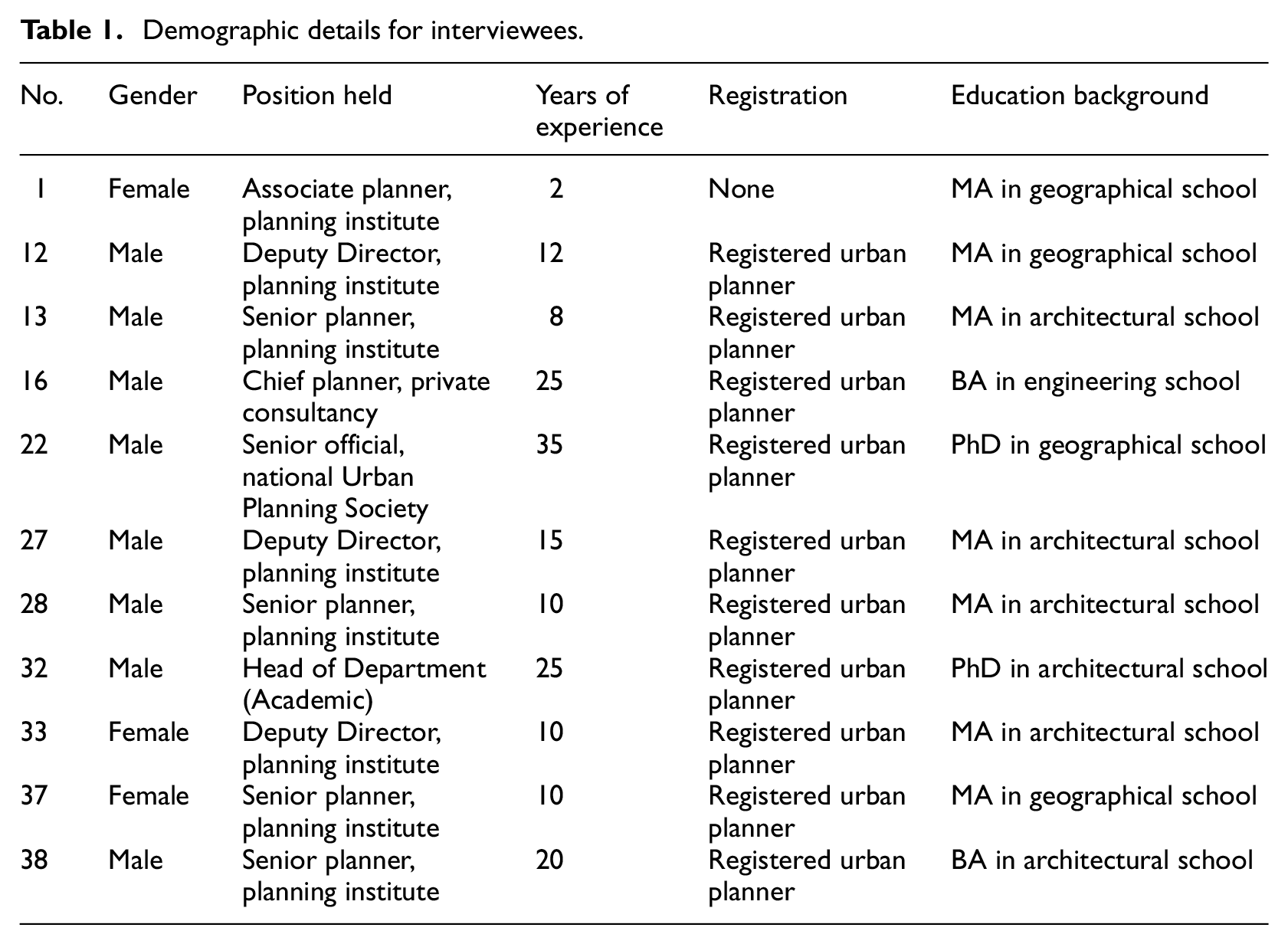
Additionally, two spatial planners from a planning department at a university and a senior official for the national Urban Planning Society were also interviewed. Table 1 provides further demographic details for each of the interviewees quoted in this paper.
Demographic details for interviewees.
The second phase of the study probed issues arising from the first in more depth using 15 semi-structured interviews, with targeted questions about how planners’ views of professionalism affected their interactions with other local officials and clients. The research focused on those working in planning institutes and carrying out projects for local governments across China, because their national-level experience, their breadth of knowledge and their vast influence over the spatial decision-making process made them a particularly important group. The collected data were analysed via a self-consciously reflective process.
Many participants were nervous or unwilling to talk about professional roles, and some engaged in self-censorship, often because they were concerned about the way that their words might be interpreted by those in power and the consequences for their career. Considerable patience and time were therefore needed to build trust.
Discussion
The research revealed that spatial planners tended to picture their professional role in a hybrid manner, drawing on different and sometimes contradictory ideas of expertise, authority and legitimacy. Historical concepts played an important role in the way that roles were framed, in particular Confucian ideas of Jingshi and socialist ideas of technocratic rationality. The survival of such ideas is not, we argue, a historical anachronism but a creative way of grounding professionalism in the face of the irreconcilable conflicts that constitute planning in modern China. This can be seen in the way that interviewees seamlessly wove historical concepts into more contemporary discourses of market-led growth and service-based professionalism, to create a distinctively Chinese model of the planning professional.
Several interviewees explicitly discussed conflicts between public participation, socialist technocratic rationality and a Confucian concept of a professional elite with deep local knowledge. For example, this interviewee registered a tension between Confucian ‘officials’, who embodied an ethos of public service and spoke from an emplaced awareness of the local, and the more technocratic concept of the socialist planning expert, for whom particularism represents a kind of ridiculous and parochial derogation from rational, universal laws: As far as I can see from the perspective of management, officials can have means if they have ascended the officialdom ladder or have known the local conditions to some extent and meanwhile have the willingness to dedicate themselves to serve the locals. Actually, most officials’ words make some sense. We are technical people and used to view things from a technical perspective. As a result, we may find what officials talk about very ridiculous or illogical. But you could find, if you take another look at them, that their understanding about the place and feasible approaches are reasonable. (Interview No. 33)
Importantly, however, the overall logic here is one of accommodation: the official’s words might initially appear illogical from a technical perspective, but a shift in viewpoint reveals them to be surprisingly ‘reasonable’ and responsive to the immediate lived context.
Another interviewee struck a different balance between a Jingshi-based idea of bureaucratic ‘advanced consciousness’, public participation and the goal of efficient delivery: Therefore, I think the good side is that many people [local residents] do have little advanced consciousness while officials, after all, in themselves have a certain quality. Their thinking and practice bring progress instead of retrogression to China. Looked at another way, their high efficiency allows construction projects to be completed in a short period, which enables people to move into new houses within a few years. Therefore, people are willing to pay. From the perspective of market returns, Chinese officials achieve recognition from the market and also macro-economic environment. (Interview No. 38)
Whereas interviewee 33 (above) emphasised the way in which the Confucian scholar-bureaucrat could represent a diverse range of local contexts, interests and preferences, interviewee 38 presented the same figure as tending to neglect the needs of actual local communities in favour of economic growth and a more general idea of the ‘good’. The latter logic is also highly amenable to the workings of the market, of course, with the achievement of urban and economic growth becoming visible signs of the ‘good official’. The difference between the two is a matter of emphasis more than substance. In interview 33, socialist rationality gives ground before the superior harmony of local interest and Confucian official power; in interview 38, local participation is excluded in favour of a confluence of market interest, economic growth and official decision-making. In both cases, however, professionals moved to define their role as one that smoothed over the potential appearance of division, rather than highlighting multiplicity, pluralism and differences of interest.
Unsurprisingly, an overall concept of a generalised public interest tended to dominate over more pluralistic or agonistic ideas of public involvement. In keeping with an idea of authoritative expert rule, the interests of local communities were rarely discussed as anything but a hindrance. One planner complained: ‘It seems that whenever it is related to the public in urban planning, a lot of trouble will be brought … In my opinion, the local government and the public are in the stage of playing a game: the government will consider the public hard to govern, while the common people will consider local governments very mean’ (Interview No. 12). Where communication was mentioned, it tended to be used to discuss methods of top-down delivery of information, as well as control and discipline of alternative viewpoints, in a manner very different from that of participative planning theory, with its emphasis on collaboration, mediation and the resolution of disagreement via Habermassian discourse ethics (Healey, 1985): ‘The capability to communicate with different types of people is basically required. Students should go to talk with residents in communities and learn to cope with the situation when people purposely make difficulties’ (Interview No. 22). The role of the professional here was to manage a vocal group whose discordancy was portrayed as a problem.
Many interviewees resisted conceptualisations of professionalism that drew attention to particular interests within the urban development process. The term ‘public interest’ was often used to suggest harmony between capital and the state, in a way that reduced the appearance of conflict between particular and private interests and public bodies. Aesthetics often became a key point in such discussions, as planners used the beauty and the sublime subjective effect of the urban to argue that the quality of the end spatial product self-evidently justified the process of its production, and the role of particular interests therein. Such a goal-focused logic tended to downplay the importance of the processual, making irregularities within the decision-making process (including even bribery and corruption) comparatively unimportant. As one planner explained: As a government official, at the very least, he wants to do something awe-inspiring even by virtue of bribery and corruption. He is trying to do a good job. It is a fact that your business [developers] provides him money yet he also wants to do a similar thing with you, but you are not the boss, we have to make our ideas connected. If officials want to get promoted, they would not want to do this thing not only for the money but also for political achievement, which, in fact, serves as making yourself [the local area] look good and benefiting the city. (Interview No. 16)
The exchange of money here becomes almost incidental, a lubricant to the virtuous connection of ideas, rather than a warping of the development process in the interests of capital. This is partly because, in spite of the economic transition, the Confucian connection between the values of officialdom and the public good remains so strong that bribery can be presented as simply a slightly unfortunate means to achieving a goal that is publicly ‘awe-inspiring’. The aesthetic point is underlined by a socialist tradition of architecture that glorifies the state in the form of monumental architecture, repurposed for a more capitalist urban environment: the production of this subjective impact in the observer justifies the official in the spatial intervention that has produced this effect, even if profits therefrom are benefiting private developers. For interviewee no. 16, the political achievement of such architecture benefits the local area and the city and ultimately leads to career advancement for the professional responsible, even if a little bribery has been necessary to achieve it along the way.
Other interviewees also emphasised the need for an aesthetically and politically powerful built environment ‘product’ to harmonise market and state forces. Planning’s beautification of the city was regarded by some as fundamentally important in creating an image that could attract both domestic and foreign investment, with the state and the market working to complement one another: ‘Planners must understand the economy because what they plan out will be put into use, add value to cities and promote the quality and depth of cities’ (Interview No. 32). The tendency, in other words, was to use a shifting concept of the ‘public good’ to smooth over a tangled web of tensions between public and private, state and market, local people and powerful officials. Relationships that could be pictured in conflictual terms, necessitating decisions between one side or another, were reimagined in terms of a more harmonious ‘and’, so that it was possible to imagine planning professionals serving the state and the locality and the market and the public good, all at once. This desire to avoid perceptions of multiplicity or plurality to focus on a unified and univocal whole could be felt in some of the political comments made by interviewees: ‘I think at least in this present time, China’s development suits the one-party system. It will be chaotic and finished soon if we adopt multi-party system. Internal fighting will explode. Disagreement among the people is always a life-and-death struggle’ (Interview No. 38).
Planners described themselves as serving a particular logic of power, though interpretations shifted between a socialist logic of technocratic rationality and the idea that planners were the subordinates of more powerful Confucian official ‘clients’. Some argued that the public interest could be defined in an objective, value-neutral, expert manner, and that ‘scientific’ planning practice could trump all other forms of authority and expertise: ‘[planners] should master authority figures and use analysis tools to coordinate and communicate with all sides to maximize the spatial profits based on professional knowledge’ (Interview No. 32). In this view, the best decision can be calculated on an almost utilitarian logic of maximal ‘spatial profits’, in a way that downplays potential disagreements over alternative concepts of the good. In such a view, a combination of expert social scientific knowledge and technology leads straightforwardly to social progress. Planners using this highly scientific idea of professionalism often emphasised urban design, describing themselves as ‘purely technical designers’ (Interview No. 28), with an apolitical role in promoting the public good.
In other interviews, however, the power of dominant political figures was emphasised, with planners pictured as the willing servants of these higher masters, and the executors of their superior vision. This is partly a response to decentralisation, which has given local non-planning officials a certain degree of autonomy in dealing with state directives. Several interviewees were open about the ways in which lower-level professionals were expected to accommodate their suggestions to the ideas of their hierarchical bosses. Far from embodying an inflexible, scientific knowledge, the planning system tended to be seen as inherently flexible and malleable to particular styles of rule: In China, land resources allotted by the country are in your [government officials’] hands. You can permit anyone you like to use the land just by changing the rules. China is a country governed by the rule of man, so rule is elastic and can be changed, which, ironically, marks China’s best example of matching ‘talents’ with jobs. The current custom in China is that rules made by the former mayor will be replaced by new rules formulated by the new mayor. (Interview No. 13)
One interviewee described planners as the ‘drawing master-hand of government officials. Your design can be called good if your leader likes it’ (Interview No. 27). Similarly, professional success was defined in terms of approbation from important senior figures: an urban plan was good if ‘the key person in government likes it’ (Interview No. 27). Others stressed the need for planners to be closely aligned with the priorities of the local authorities that they served, in a model of almost unquestioning service: ‘In fact, it is quite common for us planners to just follow the opinions of our clients and it is almost a hidden rule that [planners] formulate urban plans for the benefit of their clients [meaning local government officials or developers]’ (Interview No. 1). As one planner said: ‘You find out what he wants and present your solutions to him with a design drawing, which will definitely make his eyes light up’ (Interview No. 27).
Occasionally, interviewees openly reflec-ted on the conflict between such subordination and the scientific-rational model of objective professional expertise promoted under the socialist state: ‘I have come to realise that planning in China is a great nonsense after going through the domestic planning process. The approval system changes if your leader changes and planning also has to change accordingly’ (Interview No. 27). For others, however, the personal flavour of decision-making simply reflected a tradition of governance by influential members of an elite, reflecting ideas of Jingshi: ‘In my opinion, firstly, urban planning is actually the tool of governance; secondly, urban planning is the tool of adding value to cities, so planners should perform the role of being a tool’ (Interview No. 37). The importance of good governance takes such precedence here that there is little room for recognition of the ways in which new opportunities for capital accumulation via the manipulation of urban space confer unequal benefits, with a privileged few gaining the most.
Conclusion
This paper’s exploration of the way in which planners conceptualise their role in modern China reveals them negotiating a series of contradictions between market-led economics, an authoritarian state and the needs of local communities via a flexible and shifting model of professionalism in the public interest. A malleable series of historical paradigms provide a creative resource, allowing planners to segue smoothly from a definition of the professional that draws on Confucian ideas of the scholar-bureaucrat and Jingshi, to ideas of socialist technical rationality and aesthetic sublimity, to more recent ideas of the professional planner as the promoter of economic growth. These hybrid concepts of professionalism, drawing on both old and new ideas, tend to use a univocal idea of the ‘public interest’ to conceal potential tensions between these imperatives, presenting a view of differing interests as readily reconcilable or already compatible.
The structural contradiction between market forces, the state and alternative conceptions of the good will be familiar to planners working in other geographical regions than China, very much including the Global North, where the term ‘public interest’ is also often used to disguise or downplay potential conflicts within state-sponsored capitalism. However, while there are shared and general features of these tensions across very different contexts, the particular way in which they are negotiated is culturally variable. This paper thus follows a trend in recent decolonial scholarship that requires care to be taken with generalising comparisons, so that they are made in ways that are attentive to specificity and particularity (see Lancione and McFarlane, 2016; Robinson, 2011). Our research has therefore aimed to show how irreconcilable and inconsistent imperatives that are being felt by planners globally (and that are not, therefore, a feature of an ‘underdeveloped’ country) take a specific form, and are navigated in a particular and historically specific way, in China.
To end, a few words on the future relevance of this research. Though the Chinese planning system is currently in flux (especially following the publication of Some Opinions of the Central Committee and the State Council of the Chinese Communist Party on Establishing the Territory Spatial Planning System and Supervising its Implementation in May 2019), divergent pressures on the professional identity of spatial planners are so structurally embedded in the system that conflicts between capitalist marketisation and economic growth, the dictates of a strong and centralised socialist state, and alternative concepts of public good (including ecological imperatives and the needs of local communities) are likely to be an enduring feature of any new landscape that emerges. Historical sources of professional authority and legitimacy are therefore likely to provide a creative force to planners negotiating these challenges for some time to come.
Footnotes
Declaration of conflicting interests
The author(s) declared no potential conflicts of interest with respect to the research, authorship, and/or publication of this article.
Funding
The author(s) disclosed receipt of the following financial support for the research, authorship, and/or publication of this article: This paper is sponsored by Shanghai Pujiang Program 2019PJD053.
