




Abstract
Urban integration (UI) has emerged as the guiding maxim for enabling efficient resource flows and smart and connected cites. The last decade has led to renewed interest in exploiting interconnections to optimise city capacities in urban policy, practice and research. However, the imperative for integration across resources, infrastructures, sectors and disciplines remains largely unquestioned, and its socio-political and environmental implications receive little critical attention. This paper subjects the ideas and practices of UI to scrutiny. We argue that integration-in-practice (as opposed to integration-in-theory) is partial and selective in its objects of combination and outcomes. The key issue this raises is whether the promise of new metropolitan-wide imaginaries of horizontal integration gives way to more selective logics of vertical integration that privilege socially and spatially valued enclaves. Rather than challenge urban splintering, UI practices would therefore reinforce urban infrastructure divides. The paper argues that a subtle shift is taking place in the UI discourse that whilst promising resource sustainability and metropolitan inclusivity, re-prioritises and re-intensifies more selective infrastructural planning processes. We term this new emerging mode bifurcated urban integration (BUI).
Introduction
Urban integration (UI) is today viewed as a solution to almost every contemporary problem in urban policy (e.g. Future Cities agenda, Batty, 2013) and urban research priorities (e.g. UK Engineering and Physical Sciences Research Council’s (EPSRC) Urban Living Partnership, 2015). While the concept of UI emerged in the early 1970s, in urban research its prevalence has significantly expanded over the last decade (SCOPUS 1 ). Most noticeably following the subprime mortgage crisis and global international financial crisis in 2008, the application of the UI term has surged in research and policy. This literature highlights how development of new frameworks for integration and acceleration of their use in the urban domain is frequently viewed as a desirable and self-evident priority. An integrative approach towards urban infrastructure planning is, for example, advocated to: ‘achieve effective seamless mobility’ (Monzón et al., 2016: 1124); produce efficient urban spatial development through urban integration-compaction policies (critiqued by Seeliger and Turok, 2015) and to attempt integration of knowledge-based economies (Ananian, 2014: 193). Similarly, wide-ranging international policy and research documents ardently support integration of urban infrastructures in anticipation of efficiency gains and realisation of ‘a vision of healthy, prosperous and sustainable living’ (European Commission, 2017; EPSRC, 2015; Sustainable Development Goal 9, UN, 2017).
Despite apparent enthusiasm towards integration strategies, the urban research community lacks, with notable exceptions (Pieterse, 2004a, 2004b), systematic analysis of the conceptual origins of UI, how it has changed over time and its limits and potentials. For example, what is already ‘integrated’ in an urban context, what issues are amenable to integration, and which are not? While a full historical analysis of UI is beyond our scope, we seek to develop a more nuanced understanding of this concept and its assumed importance for urban policy, practice and research. UI is important to interrogate because frameworks associated with this concept claim to reshape operation and use of infrastructures and associated services. This reorganisation has distinct and potentially long-lasting consequences for the politics, processes and practices of everyday life. By examining two examples of how UI informs urban planning, we subject this concept and its practices to scrutiny. For each, we dissect the problem and proposed solution, and unpack the associated operational processes and implications. We debate whether application of UI supports new metropolitan-wide imaginaries of horizontally integrated cities, or whether, in addition, a new mode of UI is leading to the selective prioritisation of enclaves of vertical integration.
The paper has four sections. First, we review the disciplinary and societal origins of UI and assess attempts to organise infrastructures in accordance with an integrated urban ideal. We discuss how many assumptions of UI, and its outcomes, are deeply problematic. We also recognise, however, that for much of the Western (and post-colonial) world the cohesive metropolitan imaginary still persists. Second, we examine the landscape of contemporary urban integration frameworks. We focus upon two emblematic cases derived from ecological and computational understandings that claim that infrastructures can be dis-/re-assembled to optimise network efficiency. These UI frameworks comprise: (1) the urban nexus agenda, which encourages integration of resource flows and their infrastructures and governance structures for improved ecological sustainability; and (2) the future cities agenda, which understands UI through systems of Smart Cities technologies. Third, we suggest that ideals of the unitary networked city persist despite their manifest limitations, but that in tandem, intensified UI processes are emergent, which we term Bifurcated Urban Integration (BUI). Exemplified by our cases, we examine why and how this accentuated form of UI operates and with what implications for city politics, practices and processes. We contend that whilst visions of the metropolitan whole seek systemic cohesiveness, BUI attempts to achieve new efficiencies by selectively bringing together enclaves of hyper-integration. The resultant socio-spatially selective outcomes are intertwined with a landscape of splintered infrastructures and political and economic turbulence. We conclude with calls to subject the notion of BUI to greater scrutiny and suggest priorities for further research.
Modes of urban integration: From metropolitan to enclaves of integration?
In the 19th century and for much of the 20th century, the orderly unitary city concept formed a dominant planning ideal in the Global North and to a lesser extent the Global South (Gandy, 2006; Monstadt and Schramm, 2016). The city was to be organised through infrastructure networks, application of reason and democracy and modern planning frameworks. These approaches were intended to ‘produce a coordinated and functional urban form, organised around collective goods’ (Entrikin, 1989: 381). This emphasis on coordination led to a focus on comprehensive city plans and standardised metropolitan-wide infrastructures for energy, mobility, water and telecommunications (Graham and Marvin, 2001). The modernist project viewed the city as a ‘synthetic whole’, in which the contradictory tendencies of capitalist urban development could be resolved through a ‘unitary vision, which stressed order and coherence’ (Goodchild, 1990: 128). Governance of networked systems supported the notion of ‘monopolistic, integrated and standardised provision of network service’ (Coutard, 2008: 1815) to ensure that essential resources and amenities were delivered to (virtually) everyone at similar cost. This development approach was, in large part, mirrored by colonialist policies shaping the attempted rollout of infrastructural networks in developing cities (Graham and Marvin, 2001: 81).
‘During the twentieth century, heterogeneous, partial networks of poorly interconnected “islands” of infrastructure and uneven development in infrastructural capacities, gave way to networked and standardised road, water, waste, energy and communications grids spanning municipalities, regions and even nations’ (Graham and Marvin, 2001: 92). This drive to reconfigure infrastructures to work seamlessly together, and for the redistribution of metabolic flows, was legitimised through the politics of widening state power (Tarr, 1984). Other attempts to integrate the city included, for example; provision of green space in urban planning (Laurie, 1979), facilities to aid the incorporation of migrants into urban areas (Goodman, 2010), and amenities to help overcome racial segregation in post-apartheid South Africa (Pieterse, 2004b). Consequently, the ambition of a singular, coherent and integrated city permeated the aspirations and practices of infrastructural planning, urban governance and international development. The integrative concepts, methods and tools of this modernist project were intended to support ideas of universal rationality, progress, justice, emancipation and reason across all areas of social life (Heynen, 1999).
Visions for the modern networked and democratically accessible city brought much ‘order to the fragmented form’ of the industrial metropolis (Beauregard, 1989: 382) and to a large degree they still underpin much city infrastructural planning. However, the metropolitan-wide integrated urban ideal has proven to be multi-faceted, diverse and often challenging to implement. From the late 1960s, this vision and practice was; progressively undermined by a combination of factors: the urban infrastructure ‘crisis’, changing political economies of urban infrastructure development and governance; neoliberalism and the withdrawal of the state; economic integration, urban competition and the imperatives of global-local connectivity; the development of infrastructural consumerism; the collapse of the comprehensive ideal in urban planning; new urban landscapes; and ‘new structures of feeling’. (Graham and Marvin, 2001: 92)
Concomitantly economic liberalisation and development of digital and informational technologies led powerful actor coalitions to promote infrastructural ‘unbundling’. Through privatisation, previously monopolised functions were opened up to different forms of competition (Graham and Marvin, 2001: 141). In this context, the ‘splintering urbanism’ thesis continues, ‘bypass’ strategies took hold – seeking to connect ‘valued’ users and places, whilst overlooking those societal groups, sites and spaces deemed not to have value. These strategies contributed to the emergence of ‘premium networked spaces’ and formed archipelagos of ‘global enclaves’, contributing to urban socio-spatial segregation.
Attempted implementation of the metropolitan infrastructural ideal is bound up with: changing politics and economics of capitalist urbanisation; transformations in cultural politics; modified practices of urban planning; alterations in the structure of cities; emergent technologies; and transitions in city governance. Given this shifting context, we examine two frameworks which we contend are emblematic of a new mode of UI and which we term Bifurcated Urban Integration (BUI). We seek to understand whether, and how, these conceptualisations differ from normative approaches of cohesive metropolitanism. Is contemporary UI about new integrated citywide urban imaginaries? Is it more selective and does it operate at alternative scales? Against the fragmented urban landscape, then, we seek to understand what UI forms are dynamically operating today. How do these frameworks complement or contrast with earlier UI approaches, and what does their implementation mean for access to urban resources and infrastructures?
Contemporary urban integration
This discussion focuses upon two urban integration (UI) frameworks – ecological systems and computational systems – prevalent in contemporary urban policy and research. These conceptual frameworks have been selected because they both make claims regarding new forms of urban integration; focus on the dis- and re-assembly of cities; are rooted in systems-based thinking; and share a focus on the (re)making of connections between infrastructural networks. Recognising the array of UI concepts and how they intersect, our chosen examples relate to the particular interests of this special issue. Both frameworks present a way of understanding infrastructural organisation and argue that they should be conceptualised, (re-)organised and governed as a ‘nested system of systems’, characterised by a variety of functional, ecological, technological, economic and political inter-linkages (as examined by the Guest Editors, Jochen Monstadt and Olivier Coutard, in their proposal for this Special Issue). As such, analysis of our examples allows critical inquiry of contemporary infrastructural planning and management initiatives, and helps to appraise shifts in policy, practice and research that are intended to deliver resource-efficient, sustainable and ‘smart’ cities.
We could equally have sought to examine other UI frameworks. For instance, the Urban Bio-economy, which advocates use of natural principles, such as biomimicry and circular metabolism, as integrative techniques intended to decouple economic growth from spiraling levels of resource use (e.g. Spiegelhater, 2010; Swilling et al., 2013). Or Economic Agglomeration – developed by academic theorists (Scott, 1998, 2001; Storper, 1997) – and increasingly applied by policymakers (Cities and Local Government Devolution Act, 2016; HM Government, 2011). Theories of economic agglomeration advocate connecting valued assets in and between cities, and places a premium on mobility networks. Other spatial imaginaries, for example resilient urbanism (Davoudi, 2012) and low-carbon cities (Bulkeley et al., 2011) are similarly underpinned by powerful rationales as to how infrastructures and resources, and therefore sectors and organisations, should be selectively encouraged to work together. Furthermore, UI frameworks are not entirely distinct, for instance, the ‘metabolism concept’ of industrial ecology (Erkman, 1997) informs both principles of Urban Bio-economy and the Urban Nexus. Acknowledging such variety and influences, our chosen UI frameworks, whilst reflecting distinct techniques of contemporary urban decision-making, provide key entry points to understand the dynamic landscape of contemporary city-making. For both our UI frameworks, we highlight an emblematic case, through which we appraise how distinct resource, infrastructural and institutional connections are restructured in line with particular integration imaginaries.
First, the Urban Nexus agenda, which investigates integration of resource flows and their associated infrastructures and governance structures for improved ecological efficiency (ecological UI); and second, use of Smart Cities to address the Future Cities agenda, which is concerned with (re)designing and managing urban infrastructures and processes through systems of digital technologies and (big) data analysis (computational UI). For both we: first, examine how the existing city is problematised through a deficit of integration and analyse their respective visions for the re-integrated city; second, investigate the proposed integration processes and what they are meant to achieve; and third, assess the implications of applying such reorganisation approaches to the urban context, paying particular attention to the degree to which the chosen frameworks are spatially selective and/or metropolitan-wide modes of UI. For our exemplar UI frameworks we have selected cases that are gaining traction within policy and are increasingly being implemented at a large urban scale with the backing of municipalities and private investors in order to attempt to address ecological and/or economic contemporary challenges. These cases represent notable and analysed attempts to implement the respective UI frameworks. Our information sources were derived from a comprehensive literature review related to the chosen UI frameworks, coupled by an internet-based search of policy, third-sector and corporate documents. It is worth noting, however, that these case studies are ‘vignettes [that] are best read as provocations, rhetorical devices designed to open space for thought. They are necessarily selective’ (Braun, 2014: 60).
Urban nexus: Governing intersecting resource flows
The ‘nexus approach’ is advocated as an innovative means to tackle resource interdependencies and deliver sustainable development (Bijl et al., 2018; Leck et al., 2015). Gaining momentum in the late 2000s, ‘nexus thinking’ emerged from concern around the limitations of resources management frameworks in the face of the interlinked global challenges of population growth, threatened resource security, and climate change (Beddington, 2009). Informed by streamlined corporate production processes, this ecological UI framework highlights interconnections, synergies and overlaps between (most notably) water, food and energy systems and the resources that they harness, store and transfer. Proponents aim to reduce the tensions and trade-offs arising between these infrastructure sectors. By highlighting shared institutional goals and possible savings, nexus strategies seek to create knowledge-exchange platforms capable of informing ‘joined-up’ policy and management solutions. The concept seeks to construct a logic with which to reorganise natural resource provision and use and the management of resource-based infrastructures, premised upon improved efficiency, rationalised and non-siloed institutional processes and unlimited growth.
Problem/solution: Integrating city resource management and governance
Integrated resource management has a long history that we cannot review in detail here. The critical issue is that nexus approaches builds upon system-based principles of holistic environmental decision-making, as integral to models of integrated water resources management (IWRM) and sustainable development (Allouche et al., 2014; Stringer et al., 2014). Nexus literature has often adopted a national or regional focus (Williams et al., 2014), however the concept is increasingly being applied in the urban context to attempt to close resource, waste, and energy cycles (GIZ and ICLEI, 2014). Advocates contend that disciplinary distinctions and compartmentalised policy- and decision-making have led to resource challenges being governed in a highly fragmented manner that fails to understand the city as a complex and dynamic socio-ecological system sustained through relations between natural resources, and by rural and urban exchanges. This oversight, it is argued, leads to inconsistencies in infrastructural planning and land use exacerbated by disjointed governance mechanisms, such that ‘poorly coordinated investments, increased costs, and under-utilised infrastructures and facilities’ result (GIZ and ICLEI, 2014: 5).
To limit inefficiencies, nexus advocates propose that externalities across multiple sectors need to be addressed, by placing the focus on system-efficiency, rather than on the productivity of isolated sectors (Hoff, 2011). Implementation of a coherent vision for the reconnected city requires the identification, de-aggregation and innovative recombination of systemic resource circulations. The offered solution seeks to gain better understanding of systemic connections between resource sectors, disciplines, sites and scales (Leck et al., 2015). As well as technological development, this ecological call for UI is underpinned by the need for institutional and policy reform to improve resource governance (Allouche et al., 2014; Williams et al., 2014). To identify possible integrative solutions for infrastructural resource efficiency, knowledge-exchange platforms, cutting across different disciplines, sectors and institutions, are advocated. The tantalising promise is that bringing knowledges and expertise together will enable continued urban growth, whilst providing resource security for all, reducing costs, and supporting a resilient and productive natural environment (Hoff, 2011).
Process: Systemic resource-based organisation and knowledge exchange
Drawing on socio-ecological systems scholarship, the urban nexus is underpinned by system-wide and techno-managerial solutions to organising resource flows. To ‘translate integrated planning objectives into policies, projects, systems and places’ (GIZ and ICLEI, 2014: 6–8) the nexus framework advocates three distinct steps: (1) Identification – of desired systemic performance objectives, (2) Innovation – through design/technology, instructions, user behaviours, law and policy, and delivery modes and (3) Design & Delivery – to obtain the desired resource efficiencies. Sophisticated modelling and monitoring systems – capable of isolating, tracing and quantifying resource circulations and predicting implications of new linkages – are endorsed to re-organise interdependencies and achieve targets. This process, which is promoted in terms of the logic of efficiency and control, represents ‘a strongly [technological, calculative and] market-based approach’ to managing the tensions associated with the pursuit of sustainable urban growth (Williams et al., 2014: 14).
Urban nexus forms a global paradigm for resources management and economic efficiency (Allouche et al., 2015). To illustrate its application, we focus on the water–energy nexus, which has gained prominence because of expanding metropolitan areas and consumption levels placing severe demands on resources, and threatening the sustainability of the urban economy and environment. In urban areas, energy and water systems are ‘intricately interdependent’ for both supply and demand, and yet their infrastructures are commonly considered separately (Konadu et al., 2017: 1). Linkages between water and energy systems are greatest at the point of end-use (Abdallah and Rosenberg, 2014), although limited attention is paid to infrastructural interactions at a district or household scale (Sharp et al., 2015). Literature and policies concerned with the water–energy nexus advocate the need to understand resource coupling at multiple scales (international, regional, city, and domestic), and contend that, beyond ensuring systemic resource management, institutional dimensions, which are ‘deeply political’, are critical to urban infrastructural governance (Moss and Hüesker, 2019; Scott et al., 2011).
Our case focuses upon the largest demonstration of a resource-oriented sanitation concept in a European urban environment – the Jenfelder Au neighbourhood project, Hamburg (Germany), where development is underpinned by a water–energy–wastewater nexus logic (Augustin et al., 2014). Here, the Wandsbek District Authority, with municipality water company – Hamburg Wasser – developed an integrated approach to managing wastewater and energy recycling, through an innovative technology, ‘the Hamburg Water Cycle’ (HWC) (Augustin et al., 2014; Hamburg Wasser, 2018). The HWC differentiates between grey water (clean wastewater from baths, etc.), black water (wastewater from toilets), and stormwater (from urban drainage systems). Blackwater is diverted to a biogas plant, purified to natural gas standards, and fed into the regional energy network to produce electricity. Together with thermal insulation and photovoltaic installations, this flow of renewable gas meets the heating needs of the entire neighbourhood. Importantly, it also enables Hamburg Wasser to generate their own electricity from stored biogas when there is high demand for grid electricity, and to draw on the electricity grid at times of high power generation (Case story 24, GIZ and ICLEI, 2014; Moss and Hüesker, 2019). Such technical innovation is significant because producing renewable energy at a district scale and the ability to store surplus electricity could enable urban utilities to help balance regional energy markets.
Central to the Urban Nexus is recognition that optimising system-wide resource efficiencies requires agreement about structural change between multiple stakeholders. Nexus approaches recognise the need for disciplinary, policy, and sectoral boundary crossing as well as institutional governance across sectors, systems and scales (Allouche et al., 2014). In our case, for example, the ability for cities to generate renewable energy (from wastewater) presents the opportunity to set themselves up as flexible energy providers, and enter the energy market. However, as Moss and Hüesker (2019) describe, whilst presenting new market and sustainability opportunities, power-to-gas also poses novel regulatory challenges. To effectively navigate the sewage gas–electricity nexus as a new entrant, wastewater utilities require legal clarity. They would also benefit from greater access to existing knowledge from incumbent actors regarding profitable business models for surplus energy storage.
To aid such development, knowledge-exchange platforms are promoted as a way to share expertise and insights between sectors and institutions. Ambitions that stakeholder dialogue will make explicit different stakeholder goals and interests and offer a means to reconcile these differences leading to implementable system-wide solutions, pre-date the nexus agenda (FAO, 2014). Yet, as indicated by this case, attempts to pursue optimal solutions intended to work for all and that can be ‘mainstreamed’ when dealing with the messy problems of contemporary urban life, navigating knowledge domains and negotiating market share between new and dominant actors, will invariably encounter contestations when being implemented. As such, integrative resource management across the urban nexus will likely remain aspirational (Stein et al., 2014: 15).
Implications: Urban Nexus as situated, contested, and contradictory
A number of attempts to operationalise the Urban Nexus have mapped and calculated interactions between infrastructures with the aim of balancing resource dynamics, and have built on sectoral, technical and jurisdictional synergies, to increase institutional performance and enhance service quality (e.g. GIZ and ICLEI, 2014). However, such solutions often prove ‘out of touch with reality, lack specificity and [are] poorly grounded in a particular context’ (Stein et al., 2014: 8; Cairns and Krzywosynska, 2016). Returning to our example, whilst integration of wastewater treatment and energy production is innovative in terms of process, the HWC offers little in terms of understanding Jenfelder Au’s material, spatial, temporal and political implications (see Moss and Hüesker, 2019).
First, how pipes, pumps and storage vessels are physically dis-assembled, re-routed and configured to transfer resource flows is critical to understand the prospects for infrastructural integration. Second, our case is highly socio-spatially selective, concentrating on making infrastructural and resource-flow improvements within a particular neighbourhood. In addition, beyond making Jenfelder Au self-sufficient, such initiatives connect stored or produced energy to regional and trans-regional networks, requiring the reconfiguration of institutional alliances and inter-municipal partnerships. Third, attempts to integrate (waste)water and energy provision requires challenging temporal balancing in order to align wastewater treatment processes with power generation and household consumption in real time (acknowledging stored biogas reserves). Attempted time-based realignment also applies at larger scales, such as those of investment cycles for wastewater and energy infrastructure systems. Fourth, the Urban Nexus approach is under-politicised. Proposed routes to an idealised consensus are often determined by drawing on narrow sets of expertise, and privileging techno-managerialism coupled with market-based solutions. The reality is often far messier. For our case, in practice, the HWC at Jenfelder Au privileged certain interests over others (Moss and HÏesker, 2019). In particular, the wastewater utilities found themselves frequently squeezed out of entry to this complex energy market by the incumbent operators. In response, they formed alliances with other local utility companies and sought support of their respective cities to gain more market power (Moss and HÏesker, 2019). Such concessions, allocations and divisions invariably affect where, how, when, with whose involvement, and to whose benefit resource-based infrastructures are designed and implemented. As demonstrated then, it is vital to understand who stands to win/lose from infrastructural reorganisation, how these positions are historically, geographically, materially, temporally and institutionally created, and why wholesale integration that benefits everyone can rarely occur.
Smart Cities: Automated infrastructural disassembly and reassembly
Smart city products developed by ICT companies for the urban market, are shaping how cities are imagined and how new forms of infrastructural integration are configured (Marvin and Luque-Ayala, 2017). These technologies are positioned as ‘operating systems’: essential hardware, software and data components that sit in the background directing urban flows, and providing shared languages towards inter-operability and integration across different infrastructures (Easterling, 2014: 5). These products are computational ecosystems designed to enable functional coordination of what is currently ‘un-integrated’ and can be ‘reintegrated’ within the urban domain.
Problem/solution: A computational ‘system of systems’
Smart Cities products conceive of the city as a ‘system of systems’, a total bounded entity that renders the urban as a set of ordered relationships (Krivý, 2018). Using metaphors from technology and biology – but also cybernetics – in combining human and technology systems (Light, 2002, 2003), this calls upon imaginaries of inter-linkages, intelligence and integration. The problem of the city is constructed as one of disconnection – a multiplicity of separate infrastructural systems supporting different urban domains. The solution of the smart city is conceived as a ‘platform’ able to re-make connections between those currently separate infrastructures (Plantin et al., 2018). Framing of the city as a ‘system of systems’ is also concerned with unbundling the complex nature of the city into a series of simplified modules that match the design of the software systems.
Process: Dis- and re-assembly of the city
Reconstructing the city in socio-material terms as a ‘system of systems’ requires a three stage process: (1) disassembling the existing city (data, relationships, objects) into forms that can be incorporated into software systems; (2) processing these using computational products to remake material and informational connections between selected elements of the city; and (3) attempting to stabilise new integrative forms based on highly selective socio-spatial configurations. Each step is outlined below.
First, the city as a ‘system of systems’ operates through frameworks of dis-assembly – classification that involve the development of typologies, establishment of hierarchies and broad mapping of connections between components. This unbundling process operates through taxonomy, which establishes an ontology (as categories, attributes and sub-categories are produced), and thereby creates the very object for intervention. The technique draws inspiration from binary models that assign attributes to objects and establish differentiation through the presence or absence of particular features. These practices require a managed form of analytical fragmentation: objects (e.g. networks), which have discrete sub-categories (e.g. domestic users); until the city is broken down into its most fundamental components. The city is, in essence, subject to a form of modularisation and cataloguing according to a set of pre-defined criteria. These criteria are then reflected in the nature of the software system. Through these forms of standardisation, modularisation and classification, the software breaks down city infrastructures and processes into a multiplicity of objects and components.
Second, smart city software has a critical role in re-assembling local connections between the different objects and components of the city – the ecosystem is the platform around which wider connections are organised. Different social and material elements are selectively re-aggregated and carefully integrated to fulfill a new urban function. This suggests the assembly of data, networks and interfaces, in a new urban control system that sits across, above, and within the previously identified layers of the city. Disconnected and separate objects and entities are now potentially linked with new analytic and control functions to produce more productive and efficient city processes, infrastructural design and operation, and urban governance.
An emblematic example of how this computational UI works is iSMART a flagship project for Switzerland that examines the technical and organisational issues surrounding the introduction of residential smart electricity meters (Klauser et al., 2014). The scheme allows domestic hot water tanks to be controlled and heated automatically by software, depending on fluctuations in electricity needs and the availability of electricity. Additional complexity is involved as the project uses three warehouses to store thermal energy that can be activated as required for improved supply and demand matching. The key challenge of the project is to calculate and model the exact buffer potential of the warehouses at a given time, depending on anticipated storage volume and logistical activities. The aim is to keep the warehouses at the correct temperature whilst increasing the use of renewables and taking into account energy needs dependent on warehouse logistics. The project develops a form of governing through interrelation, as it aims to optimise the balance between energy needs in refrigerated warehouses, the availability of solar and wind energy, and overall stability of the grid. To this end, the project combines warehouse sensor data, warehouse logistics, real-time energy data and even weather forecasts.
Governing through smart technologies aims to optimise the interplay between the individual scale and energy needs of the warehouse on one hand and the collective scale and needs of the electricity grid, on the other; both are approached as flexible variables. iSmart accommodates a range of intersecting efforts that aim to manage energy consumption and production as an ensemble of increasingly integrated, interconnected, digitised and ‘technologically empowered’ (IBM, 2010) systems of connections, processes and flows (Klauser et al., 2014). This is an excellent example of how new forms of UI are finessed by forming connections between currently disconnected circulations of different infrastructures (heat/cold, electricity, logisitics), the differential dynamics of weather and variable demand, and the different scales of the individual home, warehouse and the grid. The way in which iSmart incorporates data to make decisions about which connections to form or break demonstrates the occurrence of a materially and socio-spatially selective form of UI.
Implications: Dis- and re-assembling urban circulations
Whilst incorporating diversity and the ability to develop new relationships, the need for modularity, interoperability and transferability across systems and cities – as put forward by this computational UI technique and as enabled by smart technologies – does not connect everything. Instead Smart Cities are based on the proposition that circulations and resource flows can be un- and re-bundled to achieve increased flexibility, efficiency and optimisation (cf. Graham, 2005). The process of dis-assembly is enabled by separating components and processes of the city into data blocks that can be recombined or reprocessed in various ways. Having been stripped into categorised components, the city is unproblematically selectively re-assembled into new more desirable and coherent urban flows, aggregates and assemblages. By adopting this ‘systems of systems’ conceptualisation, computational UI promises that the city can be (re)configured in a multiplicity of ways.
There are, however, distinct limitations of this systems-led UI technique, as demonstrated through the two cases. It does not necessarily occur at the metropolitan scale. Reintegration often depends upon highly spatially and socially selective processes, which dis- and re-assemble on the basis of the presuppositions of the smart city, rather than taking into account the historical, geographical and political context of the city. Whilst consultation processes may occur, such city visioning, classification and re-organisation commonly remains the sole domain of municipalities, working with utility firms and in association with private ICT companies. The neatly grouped solutions, conceptualised and modelled by the smart city systems, pay insufficient attention to political tensions inherent to urban planning and infrastructural improvement. Furthermore, the city is envisioned as a simplified and integrated space of functionality, capable of being constantly re-engineered. Urban infrastructures are characterised by their assumed agility, modularity, flexibility and configurability to incorporate resource-efficiency and achieve economic optimisation. In reality, this calculative reorganisation favours very particular urban imaginaries, configurations and processes over others, with distinct implications for access to assets, infrastructures, services and institutions.
Producing bifurcated urban integration
The unitary city ideal dominated thinking in urban planning and policy for much of the 20th century, and networked infrastructures have become ubiquitous to the fabric of modern cities. Pivotal to this modern metropolitan ideal, infrastructural ‘networks became buried underground, invisible, rendered banal and relegated to an apparently marginal, subterranean urban underworld’ (Kaika and Swyngedouw, 2000: 121). Yet in the contemporary city, ‘infrastructure networks are being re-problematised and (unevenly) brought back into view as major foci of debate, renegotiation and reconstruction’ (Graham and Marvin, 2001: 88). Against this fragmented urban infrastructural landscape, we have compared two contemporary attempts to (re)integrate infrastructures and optimise efficiencies, in and across, urban flows of resources and data. To understand the vision, processes and implications of contemporary urban infrastructural integration efforts, we adopted the emblematic UI frameworks of the Urban Nexus and Smart Cities. By analysing these frameworks we have sought to understand whether infrastructures continue to be ‘re-assembled’ in line with the ideals of the modern networked city. Our contention is that whilst normative societal goals associated with constructing the modern networked city are pervasive, a new approach to infrastructural UI, with distinct processes and implications for the city, is also emergent. We call this approach Bifurcated Urban Integration (BUI) (from Wacquant, 2015, see Table 1).
The modern integrated ideal and Bifurcated Urban Integration.
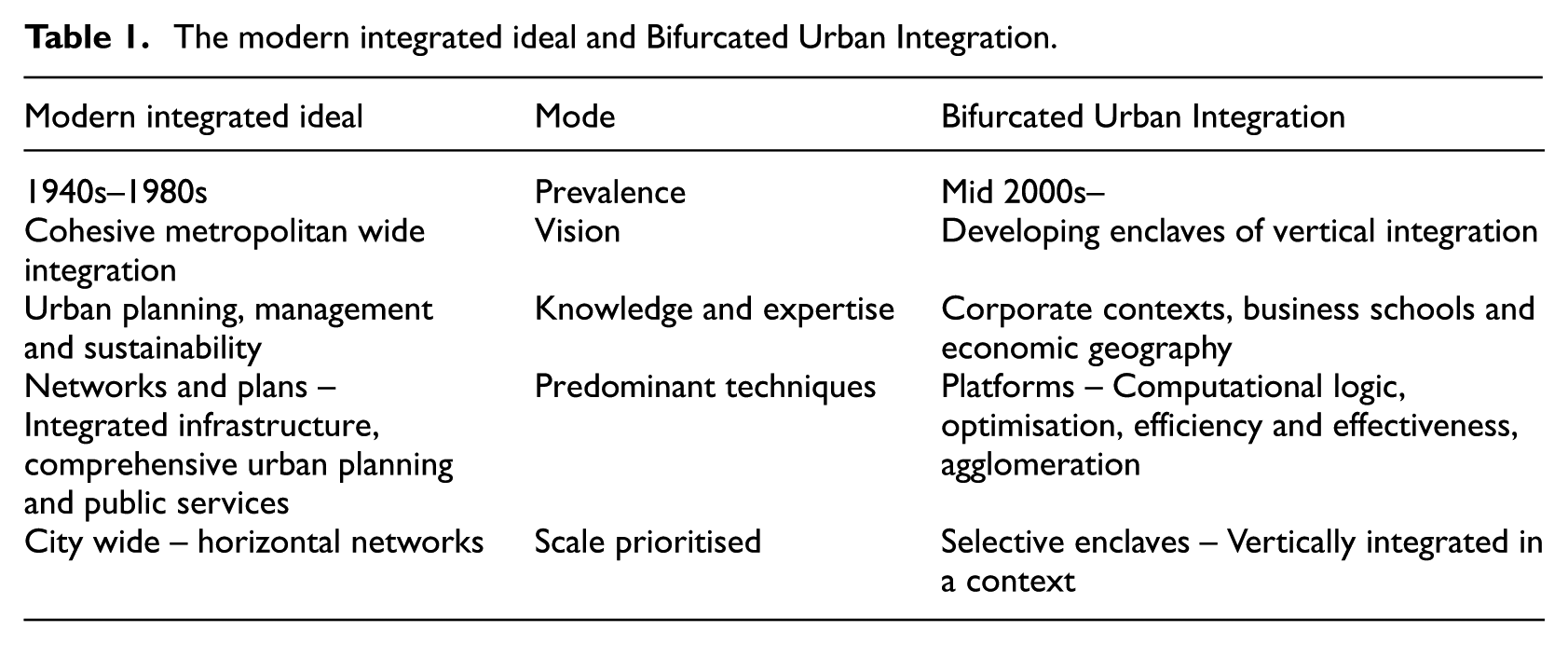
The starting point for newly emerging BUI, as illustrated by the Urban Nexus and Smart Cities examples is often similar to previous metropolitan integrative ideals; in that the city is still imagined as a system, and the potential to treat urban systems as a single entity or organism continues to be prevalent. But this incipient mode has to deal with current urban condition of highly fragmented spatial structures, and liberalised and competing infrastructure networks and institutions. Consequently, BUI tends to reflect and reinforce a model of integration that is primarily focused on the vertical integration of infrastructures within particular districts or enclaves. BUI brings together alternative forms of data, knowledges and practices that are exchanged through a networked platform model (derived from the ITC industry or consultancy rather than city planning); operates at different scales by prioritising premium spaces, populations and networks rather than the metropolitan whole; and creates new connections that are bounded/vertical, rather than networked horizontal integration.
While policy-makers, practitioners and researchers aspire for greater infrastructural coherence and control, urban governance frameworks can no longer provide the guidance, financing and vision of UI across the whole metropolis. We contend that both our reviewed emblematic frameworks subscribe to BUI, although they focus on different slices of the urban context, and employ varying integration visions – i.e. Urban Nexus conceives of the city as a resource-efficient system with joined-up governance structures, and Smart Cities imagines the city as an agile, data-generating and controllable ‘system of systems’. This twin-track BUI approach emphasises new priorities, selected scales and particular forms of connection. Whilst positively benefitting certain urban areas, people, institutions and economies, through its design, BUI also systematically overlooks and marginalises others. Critically, this mode of UI whilst (seemingly) espousing ideals of the unified city, ultimately reinforces fragmentation of the city in the following three ways.
First, new forms of knowledge, enterprise and frameworks support BUI. Urban planning and management is no longer the main source of thinking about how the city can be integrated. Instead new techniques are being transmuted from corporate contexts, business schools and economic geography, to inform how UI can be reframed as primarily a set of economic frameworks and rationalities designed to disassemble the city and rebundle valued fragments into new assemblages. Urban platforms often underpin BUI processes to enable collation, organisation and exchange of data and knowledge, and the interfacing of different city stakeholders. Such new framings and methods often overlook the inherent politics and ongoing contestations associated with integrated urban decision-making, whilst commitments to social cohesion, spatial integration and ubiquitous networks frequently no longer form the prime drivers of infrastructural integration.
The second issue relates to how the problematic and solution(s) of infrastructural organisation are conceived by this UI mode. For earlier UI frameworks, socio-spatial cohesion was developed through forms of horizontal integration across an urban space, with standardised layers of infrastructure, urban planning and public services. The aspiration behind revised BUI approaches, as exemplified by the Urban Nexus and Smart Cities, is not to deliver metropolitan-wide integration supported by cross subsidies from large to smaller users. Furthermore, the scale at which new frameworks of BUI develop is no longer the whole metropolis. Instead, the vision of BUI is much more selective in its focus, whereby economic and business rationales are enlisted to generate models of integration that function at the level of districts, large-scale developments or the aggregation of selected social and material elements of the city. Such models claim to cut through the complexity of the contemporary city and its societal challenges, enabling discrete problems to be tackled more comprehensively. As opposed to coherent metropolitan-wide integration then, these forms of BUI represent the development of premium enclaves, or collections of assemblages of circulatory networks, where new economic opportunities can be fostered and urban flows can be optimised. These alternative modes are designed to seek out value at quite different scales to conventional UI approaches, by attempting to reaggregate and repackage valued elements of the fragmented city. However, by implication this categorisation, valuation and reaggregation of city elements prioritises some city areas, functions, infrastructures and resources over and above others.
Building on this point, third, whilst conventional UI attempts often struggle to operate at the whole-city scale, and can lead to unintended divisions and disparities, BUI is based upon the deliberate selection of specific locales, resources, infrastructures and services for intended integration. Our two cases have highlighted how BUI approaches seek out premium enclaves and/or networks that can be vertically and virtually integrated by reassembling infrastructure, users, resources, data and selected urban functions. However the contextual implications of implementing such modelled visions commonly overlooks contextual implications and potential repercussions of this urban reassembly. Though the targeted processes of BUI may address specific city challenges, these infrastructural dis- and re-integration processes create and/or reinforce divisions between urban beneficiaries and people/places/services that do not gain, or that lose out. These new logics of UI, whilst privileging some, notably corporate partnerships who gain from the separation, reorganisation and reassembly of city components deemed to be of value, stand to establish, and further reinforce, social and spatial divides and socio-political tensions within cities.
Conclusion
The paper has examined a critical, and rather profound, shift in how UI is conceptualised and practiced; from the integrated urban ideal of the 20th century, to the more recent emergence of selective and segmented BUI. This represents an extension of the rationalities, knowledge and frameworks of the previous cohesive city ideal into greater selectivity through un- and re-bundled urban infrastructural and institutional configurations. The fracturing of the integrated ideal opens scope for new logics of UI that, when rolled out in the context of urban splintering and infrastructural privatisation, reinforce social and spatial divides.
With renewed interest in integration as an efficient solution to contemporary city challenges, the two emblematic UI frameworks that we have unpacked – Urban Nexus and Smart Cities – illustrate a distinct move towards this new logic of promised urban integration. Whilst system-wide aspirations still frame today’s UI attempts, BUI – often underpinned through networked urban platforms of expertise and data – primarily seeks to operationalise efficiency and markets, and applies hyper-disaggregation and selective re-aggregation processes within particular locations and/or to distinct parts of networked infrastructures. Such frameworks, whilst capable of discerning greater urban complexities, develop vertically integrated and exclusionary enclaves, as opposed to cohesive metropolitan-wide integration outcomes.
By interrogating the emergence of BUI through a focus on the emblematic ecological and computational UI frameworks of Urban Nexus and Smart Cities we have demonstrated the importance of subjecting such renewed pressures for UI to scrutiny. There are three key research and societal implications.
First, we have examined how the urban context is problematised through a deficit of integration, and the way in which each framework is translated into visions and discourses of re-integration. In this we have uncovered the gap between metropolitan-wide and bifurcated integration. We recognise that both modes probably need to co-exist as societal visions of reconfigured socio-technical networks. But it is clearly critical to understand differential UI processes and effects, it is vital to unpack who, and what, gets to frame UI aspirations, drive integration processes, and define what it is for the city to be integrated (or not). Coalitions of academics, consultants and policy elites often uncritically construct UI, whilst ignoring questions about the selectivity of different modes of integration.
Second as the project of further UI progresses, it is important to recognise that normative perspectives that promise integrated nirvana give way to co-opted practices that risk being more socio-spatially selective than metropolitan-wide in orientation and effects. We have investigated what particular UI imaginaries and processes mean for the city and its infrastructure networks, services and citizens. BUI is as much about forms of disassembly and new forms of separation in generating modified socio-technical configurations, as it is concerned with infrastructural re-assembly and integration. These un- and re-bundling processes are imbued with political tensions and contestations, which are often significantly overlooked. As new forms of integration are layered upon existing socio-spatial divides, the ‘integration’ process itself becomes even more socio-spatially selective and focused upon enclaves of vertical integration. Further work is clearly needed to unpack how other techniques urban integration may also practice a form of selective integration, and the degree to which this is contested.
Finally, we have assessed the implications of applying integration frameworks to the urban context, paying attention to how these are either spatially selective and/or metropolitan-wide modes. Whilst approaches such as Urban Nexus and Smart Cities provide entry points for tackling contemporary urban challenges in discrete and in-depth ways, rationales of technological-optimism, efficiency, and control underpinning BUI likely reinforce problems of uneven urban development and socio-spatial inequalities. Further inquiry is required to better understand alternative visions and currently absent logics of dis-assembly and re-aggregation processes, that may be informed by alternative values and priorities such as social justice and equity, living within environmental limits and fair shares that seek to use integration to achieve wider collective metropolitan visions.
Footnotes
Acknowledgements
The authors acknowledge the feedback and contributions received from the editors of the special issue, colleagues in the Urban Institute and University of Sheffield, and the discussants and participants of workshops where these ideas were presented and constructively discussed.
Declaration of conflicting interests
The author(s) declared no potential conflicts of interest with respect to the research, authorship, and/or publication of this article.
Funding
The author(s) disclosed receipt of the following financial support for the research, authorship and/or publication of this article: This research was in part funded by the Open Research Area: Knowing (Knowledge Politics of Experimenting with Smart Urbanism) project.