




Abstract
Citizen disagreement on urban policies and planning decisions is both ubiquitous and fundamental to democracy. Post-political debates debunk the ‘consensus approach’, which is grounded in Habermasian communication theory, for circumventing disagreement. This article presents a counter argument. Our analysis of the highly institutionalised and consensus-oriented Dutch planning framework shows that this system does not necessarily prevent effective voicing of disagreement. The empirical material demonstrates that consensus is not a pre-defined and static outcome but a dynamic and sensitive process in which urban planning is an instrument. We conclude that planners could facilitate consensus through accommodative roles that address disagreement by taking an adaptive, proactive and more human stance.
Introduction
Intellectuals, activists and progressive citizens are increasingly concerned about how ‘democracy’ is practised at different scales and in different contexts. Their discontent is expressed as a crisis of representative democracy in its participatory/deliberative forms, the democratic deficit, the erosion of democracy, or something similar. It comes to a head in the city, a nexus of exclusionary urban policies and practices leading to a process that Harvey calls accumulation by dispossession, which mainly affects lower-income groups.
This article enquires whether contemporary urban planning processes are deepening the democratic deficit. The literature conceptualises the crisis of representative democracy as ‘post-politics’ and the various forms of depoliticisation and exclusion it entails as ‘post-political’ (Mouffe, 1999, 2005; Rancière, 2004a, 2004b, 2010; Žižek, 1999). The consensus approach has been disparaged as a tool for taming people, accused of strengthening established agendas and giving them a pseudo-democratic look, whereby disagreements are neither heard nor accommodated but rather circumvented or ignored. Consensus-building approaches in urban policy and planning are criticised for excluding and marginalising contestation and conflict, but also for lending itself to neoliberal instrumentalisation, which leads to exclusionary practices (Bengs, 2005; Fainstein, 2000; Flyvbjerg, 1998; Gunton et al., 2006; Harris, 2002; Purcell, 2009; Swyngedouw, 2005).
There is a large body of literature on how citizens express disagreement: through urban movements (e.g. Arampatzi and Nicholls, 2012; Castells, 1977, 1983, 1996; Fainstein and Fainstein, 1985; Mayer, 2000; Miller and Nicholls, 2013; Özdemir-Ulutaş and Eraydin, 2017; Pickvance, 1976, 2003; Pruijt, 2003; Uitermark, 2004); claiming their right to the city (e.g. Harvey, 2003, 2008; Marcuse, 2009; Mayer, 2009; Nicholls and Vermeulen, 2012; Purcell, 2002, 2013); or through governance and participatory mechanisms (e.g. Beaumont and Nicholls, 2008; Pierre, 2005; Uitermark and Duyvendak, 2008). Other studies assess the roles of policy-makers, implementers and planners, particularly managerial and technical tasks in administration, coordination, facilitation, negotiation and conflict resolution (Albrechts, 1991; Breheny and Low, 1995; Clifford and Tewdwr-Jones, 2013; Forester, 1989, 2009, 2013; Fox-Rogers and Murphy, 2015; Udy, 1994). Some authors call for political engagement to put structural issues on the agenda (Albrechts, 1991, 2010) and to raise political awareness among planners (Grange, 2012).
While the scope of the discussion is widening, the post-political literature, notwithstanding its insightfulness and critical energy, remains theoretical and philosophical. It has been insufficiently infused with empirical material detailing cases in which long and cumbersome planning processes are deadlocked because of a lack of consensus. That literature often overlooks the potential of consensus-seeking and the agency of planners. Going against the grain, an emergent literature calls for a rehabilitation of the ‘political’ in urban policy and planning and more room for agency (Gualini, 2015). This could invoke ‘politics by other means’ such as direct action or civil disobedience and facilitating public dispute (Metzger, 2011). Although some studies focus on planners’ roles, few have connected consensus-building to the ‘human’ aspects of their role performance.
The article proposes a constructive approach to consensus-building, based on the precept of planning as an instrument for actual democracy. The planner is perceived as a human being, is situated in a consensus-building context and understood in terms of how s/he responds to disagreement. The research questions expand upon that proposition: How can contemporary urban planning practice accommodate citizen disagreement? What are the roles and positions of urban planners vis-à-vis disagreement? From a post-political point of view, planners would be expected to adopt a technocratic-managerial stance in the pursuit of consensus, whereby the ‘powerful’ would prevail in any dispute. But this is not necessarily so; ‘consensus-building’ is shown to be a dynamic, context-dependent process. The study presents empirical material from the Dutch planning experience to demonstrate that a consensus-building approach can accommodate disagreements. The decisive factor is agency: urban planners would have to step outside the boundaries of their technocratic role and create alternative channels for public involvement. Consensus is then an ongoing pursuit: it is sought through non-formal and non-regulated, often spontaneous and egalitarian interaction among experts and citizens.
Our qualitative research took place from February to September 2015. We conducted 14 in-depth semi-structured interviews with urban planners, most of whom were working for the Municipality of Amsterdam (MoA), and with academics and professionals. Informal discussions covering observations of the built environment and document analysis accompanied the interviews. The Dutch planning system makes a good case study in that consensus-building and mutual adjustment are built into the decision-making processes (Van der Valk, 2002). Moreover, Dutch planning has learned from experience since the 1960s by transforming itself in line with urban movements (Pruijt, 2004; Uitermark, 2009). On the other hand, local initiatives of planners pose no threat to entrenched power relations and market-driven principles. Not everyone will feel satisfied with the outcome, since decision-making and intervention are inevitably exclusionary (Hillier, 2003; Hoekveld and Needham, 2013). In Swyngedouw’s (2014: 181) words, intervention ‘enables the formation of certain socio-ecological assemblages and closes down others’. The literature foregrounds instances when planners have been disaccommodative (see Attuyer, 2015; Martínez, 2011; Rannila and Loivaranta, 2015). Our aim is to show that they can be accommodative in a consensus-based planning system.
Disagreement in the Netherlands is less about material needs than lived experiences (MacLeod and McFarlane, 2014). Among the prevailing issues are sustainable production, clean air, growing your own food, local production and communities. Since they reflect discontent rather than deprivation, disagreement rarely leads to serious conflict. Some might consider the experiences documented during our fieldwork trivial compared with planning disputes in Israel, Turkey, Brazil or elsewhere, where disagreements can lead to serious social turmoil. However, in the Dutch context they are important. Furthermore, once configured at a conceptual level, there is no reason why we cannot apply these accommodative approaches to more serious conflicts. According to current research (Tasan-Kok et al., 2016; Tasan-Kok and Oranje, 2017), this is already happening: novel mechanisms, activism and creativity are being applied by planners around the world.
Even within a very technocratic framework, planners can turn disagreements to the advantage of the community. A consensus-oriented planning system provides a convenient setting to explore that premise. The next section unravels the concept of consensus. The third section briefly describes the Dutch planning system as an example of consensus-oriented urban planning. The fourth section presents the findings of the case study, introducing alternative channels of public involvement. The fifth and sixth sections describe the accommodative roles of planners and their human dimension in light of some indicative cases, and the final section offers some concluding remarks and reflections.
A reconsideration of consensus
The literature on post-politics (Mouffe, 1999, 2005; Rancière, 2004a, 2004b, 2010; Swyngedouw, 2005, 2011; Žižek, 1999) problematises contemporary processes of negotiating, stakeholder democracy, consensus-building and good governance (Raco, 2016). It criticises consensus-building for circumventing citizen disagreements by repressing them through the enforcement of established agendas and hence, for tolerating systemic problems. Extending to the issues of environment, technology and migration (see Van Puymbroeck and Oosterlynck, 2014; Wilson and Swyngedouw, 2014), it is not only critical of representative democracy, but also of deliberative democracy and therefore of Habermasian communicative action theory (Habermas, 1984), which underpins communicative/collaborative planning (Forester, 1989, 1993; Healey, 1996; Innes, 1996; Sager, 1994, 2005, 2006, 2009). Communi-cative rationality is harshly criticised for neutralising conflict and antagonisms, which are constitutive of social relations and nourish innovation, a necessary dimension of democracy (Mouffe, 1999, 2005). Consensus is deemed undesirable, undemocratic and authoritarian in character (Mouffe, 2005; Swyngedouw, 2005). Some even consider it impossible (Laclau and Mouffe, 1985; Mouffe, 2005). They argue that non-coercive consensus is impossible, since conflictive issues cannot be reduced to a rational inclusionary argumentation. An alternative is agonistic pluralism, in which conflict is deemed productive and innovative and preferred for its transformative and emancipatory potential (Mouffe, 2005).
The post-political approach frames consensus as an expert–citizen interaction but fails to explain how to resolve the disagreements that policy-makers face daily. This paper examines the role of consensus from the standpoint of the planner, the professional who is trying to safeguard the public interest within complex and conflicting situations in the best way he/she can. Although communicative planning has some limitations, such as ignoring transformative processes to foster social change (Huxley, 2000), it is the most concrete approach to deal with disagreements.
Communicative planning has been criticised for portraying power as oppressive and for promoting planning as a search for power-free deliberations (Van Assche et al., 2014). It tends to reinforce the status quo (Bengs, 2005; Purcell, 2009) and nurture the post-political condition (Roy, 2015) by suppressing the radical and transformative edge (Harris, 2002), favouring certain groups above others (Fainstein, 2000; Flyvbjerg, 1998; Gunton et al., 2007; Swyngedouw, 2005). Actions organised within communicative planning are limited and exclusive (Blakeley, 2010; Eraydin and Tasan-Kok, 2014).
The post-political critique of communicative rationality is valuable but not convincing. The very notion of post-politics is dubious; one cannot refer to an original ‘politics’ or to a past that is simply ‘post’ (Diken, 2014). Blühdorn (2014) argued that the form of ‘political’ emphasised in the post-political literature no longer exists, so the time has come for a profound transformation in the understanding of democracy. The post-political framework is criticised for lumping all political practices together under the label of global capitalism (Van Puymbroeck and Oosterlynck, 2014: 86). Reifying the post-political in this way restricts the room to contest such practices (Bond et al., 2015). The post-political literature is also criticised for being pessimistic (Larner, 2014); for ignoring the potential of situated practices (Loftus, 2014); and for not providing guidance for practical struggle (Merrifield, 2014: 282). The following discussion of consensus highlights these weak spots by expanding on our propositions as stated in the headings.
Consensus may be possible and desirable because of its context-dependent nature
Post-political thinking posits that consensus is neither possible nor desirable (Mouffe, 2005). It is argued that Habermasian ideals and consensus cannot be real and instead an agonistic pluralism should be sought for. We choose to differ. First of all, as highlighted by Hillier (2003) and Bond (2011), Habermas is well aware that consensus is an ideal, and sees it as ‘a critical standard against which actual practice may be evaluated’. It is a guiding standard, which reminds policy makers and professionals that they need to ask people what they want. Healey (2003) also sees consensus as fragile, incomplete and contestable. Second, if we look at his ontological assumptions (see, for example, Brand and Gaffikin, 2007), we see that inter-subjectivity and ‘care for others’ are the core issues, as opposed to the atomistic individual of the liberal doctrine, which makes it a framework that can be criticised, nevertheless still deserves to be engaged with in the neoliberal era. Third, and interestingly enough, agonistic pluralism also puts forward a theoretical ideal, ‘as there is no proven design to realize’ it (Gualini, 2015: 21). In that sense, ‘both theoretical frameworks have the potential to perpetuate the status quo rather then transform inequitable power relations’ (Bond, 2011).
Furthermore, the post-political standpoint can be likened to positions on ‘equality’. The fact that it is difficult to achieve should not prevent us from striving for it, and the same can be said for consensus. Agreeing with this stance, Mouffe (2005: 31, 212) draws attention to a conflictual type of consensus on the ethico-political values of liberty and equality for all but disagrees with their interpretation. By analogy, the problem is not ‘consensus’ but the agenda itself. What we find particularly problematic is the ‘undesirability of consensus’. We disagree with this position; consensus may indeed be very desirable depending on the issue and the conditions since it is a context-dependent process. Purcell (2009: 146) concurs, stating that ‘the degree to which it will produce democratic deficits varies from place to place, depending on a range of contextual factors’. In contexts where consensus-building is embedded in the social and cultural norms and is thereby entrenched in the institutions, as in the Dutch context, it is conducive to democratic decision-making. But it will be counter-productive where consensus is not a value but a target, a procedure for settling arguments and reaching a decision ‘no matter what’.
A lack of consensus makes it impossible to proceed from conflicting ideals and views to decision and implementation, and the risk of a vicious circle arises. Examples abound at the urban level, where the agendas of different actors jeopardise spatial interventions in multi-actor governance processes (Tasan-Kok, 2009). Planners need to apply abstract ideals of diverse actors to specific planning problems in particular spaces (Campbell et al., 2014), going beyond discussions to reach agreements (Bond, 2011; Hillier, 2003).
Consensus is a dynamic and conflict-sensitive process
The critique of communicative approaches usually portrays consensus and conflict as mutually exclusive. Gualini (2015: 14), for example, draws attention to authors such as Mouffe and Rancière who treat consensus from a perspective of radical negativity, excluding the pragmatic solution of a ‘working consensus’. Some studies explore the dialogue between the communicative and agonistic approaches (Beaumont and Loopmans, 2008; Bond, 2011; Hillier, 2003). Conflict-sensitivity and consensus-orientation are not necessarily mutually exclusive in urban planning; both can be accommodated in a constructive manner. The planners play a key role in this process. Furthermore, the critique treats consensus as a pre-defined static outcome. Instead, we agree with Hillier (2003), who sees consensus as a process and a product. Our counter-argument goes on to propose that ‘consensus-building’ is a dynamic and conflict-sensitive process.
This process starts with an intensive drive for consensus, formed around alternative channels of interaction between citizens and planners. It invokes citizen’s willpower and courage to express their opinions and disagreements, and it takes steps to accommodate these. In such efforts, individuals, groups, policy-makers and implementers are given the opportunity to explore new ideas and solutions and consider the consequences of the proposed decisions. They are confronted with new dimensions of the issue and either change or persist in their position in response. Originally, Healey’s (1996) idea of communicative planning never envisaged a consensus process that is devoid of conflict but actually emphasised the right to challenge the consensus. In that sense, consensus-building can be configured as a process where people can voice their disagreements and be convinced or motivated, but not obliged, to take a step back from their own agendas for the common good. In what follows, we aim to show how this might be possible putting planners into the heart of the analysis.
Planning is an instrument for consensus-building where planners have key roles
The post-political position has been criticised for not leaving much room for forms of agency (Gualini, 2015) and for downplaying micro-politics (Larner, 2014). The agency of planners gains importance in the framework of planning as an instrument of consensus, which is the only way to move forward in the complex web of conflicting interests that characterises local planning practice, where ‘communication is political’ (Forester, 1980). The driving force behind constructive relationships is the strong belief among planners that they need to seek consensus. Although their actions are usually grounded in communicative rationality, they do not live in a vacuum; planners are enmeshed in society through their professional, personal and intellectual engagement. They are thus aware of the complex web of power relations, and it is the human aspect of their willingness and dedication to explore the disagreements that comes to the fore in those constructive relationships. By trying to avoid serving only the dominant interests, consensus-oriented planners are instrumental in resolving disagreements between decision-makers and the public. Of course, not all planners are willing and able to explore disagreements; the planning profession is not a homogenous entity. But we would refute the idea that all planners ‘seem to doubt the value of hearing the views of residents outside the official planning scheme’ and are ‘interested in these methods only “in theory”’ (Rannila and Loivaranta, 2015: 803).
The following section expands on these propositions, giving evidence from our case study of planners in Amsterdam.
An example of consensus-oriented decision-making: Dutch urban planning
Consensus-building in the Netherlands is implemented through the ‘polder model’, which is defined as harmonious patterns of interaction between social partners (Glasbergen, 2002; Needham, 2005; Terhorst and Van der Ven, 1998; Van der Valk, 2002). Interest groups are drawn into the policy-making process on the basis of a covenant between business and government (Tasan-Kok and Korthals Altes, 2012).
Urban planning is highly institutionalised and consensus-driven in the Netherlands, where ‘rule and order’ is the underlying principle (Faludi and Van der Valk, 1994). Its roots lie in the Middle Ages, when land was already a scarce commodity because of the condition of the soil in the western regions and the high population density. With 27% of the country below sea level, the Netherlands has become a world-famous brand in spatial planning and water management. To this centuries-long struggle one can add the reconstruction after the Second World War. These conditions have forced people to work together, negotiate and seek consensus. As one of our respondents pointed out, ‘this higher goal of “working together” has become a part of the “collective DNA of the society”’ (Interview 1).
In the 1960s, modernist planning took a top-down approach. Protests targeted projects that made the city look like a ‘battlefield’ (Interview 2). Dutch planners were receptive to criticism during the 1970s and 1980s (Pruijt, 2004; Uitermark, 2009; Uitermark and Nicholls, 2013). Ideas originating in the counter culture became mainstream: in Amsterdam, the ‘compact city’ became the dominant planning model, and decision-makers took a more cautious approach (Pruijt, 2004).
From the 1990s onwards globalisation has been changing the planning system, particularly its modernist-centralist character. Large-scale urban developments and public–private partnerships thrived while the sectors of social and affordable housing went into decline. Although less market-driven than planning systems elsewhere, Dutch urban planning has been seriously influenced by the neoliberal agenda. The effects have been denounced by Fainstein (2010), who once described Amsterdam as a ‘just city’, and by Uitermark (2009), who sees these new trends as signs of the ‘death of the just city’. Despite its social housing tradition, Amsterdam has become quite exclusive when it comes to access to affordable housing (Van Gent, 2013).
The Dutch planning system has also been called technocratic (Faludi and Van der Valk, 1994). A balance should be sought between consensus-building and a critical approach, considering that reaching consensus is no guarantee for being right (Faludi and Van der Valk, 1994). The post-political critique implies that the focus on consensus in Dutch planning would mean that disagreements are circumvented through governance arrangements devised for consensus-building. However, there is compelling evidence that Dutch urban planners, thanks to their efforts to reach consensus, do not circumvent, ignore or try to eradicate disagreements but instead accommodate them by carrying out ‘consensus-building’ as a dynamic process with the help of non-formal initiatives.
Planners with different roles vis-à-vis disagreements
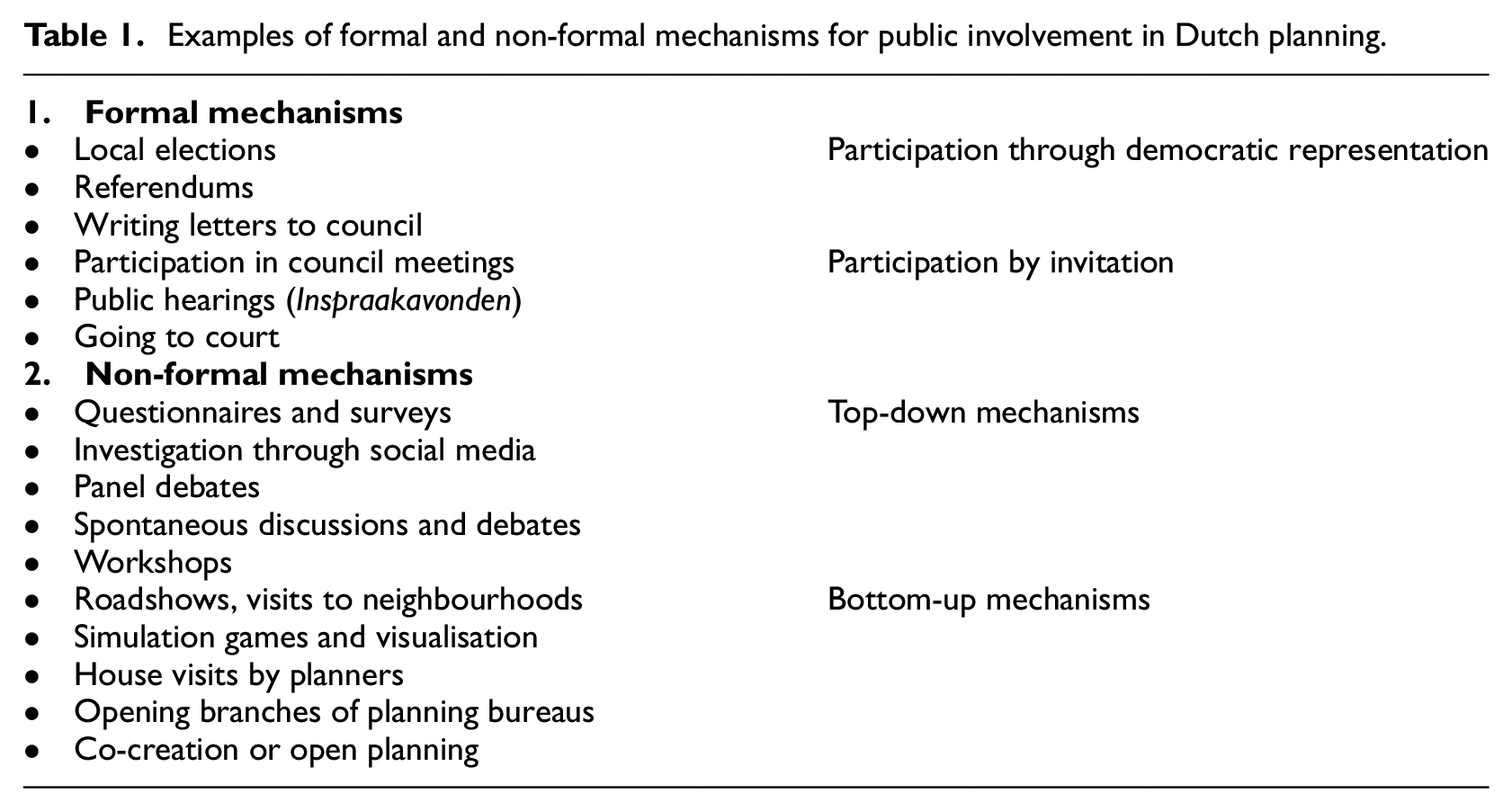
In this section, we demonstrate the accommodativeness of consensus-oriented Dutch planners based on findings from the field research. After briefly discussing alternative non-formal channels and initiatives, we will analyse the accommodative roles of planners. (See Table 1 for an indicative list of both types of mechanisms.) We aim to show that these initiatives are not only more creative and adaptive but also more human and therefore more accommodative to disagreements of citizens.
Examples of formal and non-formal mechanisms for public involvement in Dutch planning.
Formal-participatory mechanisms and a shift to non-formal alternatives
In the highly institutionalised Dutch planning system, formal mechanisms exist to deal with disagreements on decisions and proposals and to reach consensus. These mechanisms are generally mandatory and implemented by invitation. The most direct methods of influencing policy-making are attending council meetings and writing letters. However, most mechanisms are criticised for being anti-democratic by neglecting disagreement as an option, and for being biased in favour of the powerful interests underpinning the neoliberal condition. Therefore, planners along with other policy practitioners are urged ‘not only to appreciate, but also to actively facilitate, those moments when crucial policy issues are opened up to public dispute’ (Metzger, 2011).
As our field research reveals, the mechanisms are criticised by the planners themselves, who consider these as insufficiently effective to accommodate disagreements. Although Dutch planners tend to assess their system as more ‘open’ to the public than many other planning systems, they admit that powerful interests have more resources and capacity to use these mechanisms and at times even to abuse them. They are aware of the power relations at play and know that ‘the powerful will already be heard’ (Interview 3). Another issue is selective participation (Voogd and Woltjer, 1999). Planners noted an unwillingness of the public to participate, especially among deprived and less resourceful groups such as migrants:
Always the same kind people come when invited. People who have already been involved and have the capacity to do this. And people who don’t get involved are those with lower education, immigrants. (Interview 1)
In reaction to the relative ineffectiveness of formal institutional mechanisms, Dutch planners have turned to non-formal means of consensus-building over the past decade. The new mechanisms are in continuous development, and these range from applying technology and participatory processes to using simulation games (Interview 4). The alternative channels for consensus-building expanded on here include non-formal initiatives, which are much more context-sensitive and accommodative than formal ones. Urban planners take initiatives as part of their consensus-building efforts, which ultimately makes them more influential when dealing with disagreements. These initiatives are not mandatory; they are products of proactive planners, and as such they are creative solutions tailored to the public’s needs.
The following section concerns the roles that Dutch urban planners play through non-formal initiatives for consensus-building. It shows how consensus-building as a ‘dynamic and conflict-sensitive process’ can be made possible by planners through their willingness to listen to and take heed of opposing ideas.
Utilisation of disagreements: Alternative approaches
Planners try to find a balance between different standpoints. Here, we focus on the particular actions, behaviours and attitudes that develop throughout the whole planning process, including one-to-one contacts with the public. Planners engage in such initiatives not only as professionals but also as human beings with their own values and opinions.
Based on our research, we are able to highlight a few dominant roles for planners when dealing with disagreements. We can classify these roles as brainstormers, professional companions, and co-creators. In complex situations, Dutch practitioners experiment with ways to reach consensus among different parties, applying unorthodox methods instead of classic ‘participatory planning’ practices. The brainstormers pave the way for consensus by engaging in discussion and investigating needs and opinions, which may be unknown or unvoiced. The professional companions get close to the residents and try to become involved in their lived experiences so as to understand the nature of the disagreements and to seek solutions together. And the co-creators guide the public in co-decision-making. We should add that these roles are not totally new ones; there are studies highlighting non-conventional roles of planners (for e.g. ‘critical friend’ by Forester, 1989). What distinguishes our analysis is the emphasis we put on planners’ agency vis-à-vis disagreements per se, and how they perform consensus-building processes not only as experts, but as ‘humans’ trying to understand and respond to people in specific cases. In what follows we demonstrate how planners’ dynamic and case-sensitive approaches in accommodating citizen disagreements influenced the consensus-building processes through adaptive, proactive, and more human stances Dutch planners have taken.
Planner as brainstormer
Perhaps the first step toward accommodating disagreement is to brainstorm. Planners provide the public with tools to express what they do and do not want. These tools include different platforms and material/immaterial resources. Questionnaires and surveys, either online or face-to-face, are good examples. The sincerity of consensus-building is illustrated by the gradual demolition of the Bijlmermeer, a social housing estate in Amsterdam. The residents were asked to take part in face-to-face surveys before demolition and the consent of the great majority was obtained ( Wassenberg, 2011). Spontaneous debates and discussions are arranged when the topic attracts extensive publicity. These are held often, mostly in the evenings at a specific venue (such as Pakhuis de Zwijger, 1 a cultural platform).
The case we looked into as regards the role of the planner as brainstormer concerns the infrastructure to connect the northern and southern parts of Amsterdam under the IJ waterway. The motivation for the Municipality of Amsterdam (MoA) to undertake the project may be summarised as follows. The northern bank was mainly an industrial zone and home to a lower-income working-class population in the past. As industry left the city from the 1980s onwards, and the MoA turned its attention to redevelopment projects such as Overhoeks,
2
Amsterdam North started to change. It is becoming attractive to young people in particular: a new film museum opened in 2012, a cultural centre opened in 2014, new residential neighbourhoods are under construction and employment opportunities are increasing. Therefore, a better north–south connection was considered necessary. The project was called ‘Spring over the IJ’ at the time we interviewed two planners working for it. Both emphasised the importance of being interested in what people want and talking to them before making any proposal. They invited citizens to come up with ideas on how to connect the south and north banks. The ideas were communicated through the municipal website, the media, social media and in speeches by the mayor and aldermen. They collected 77 ideas during workshops. Half of the participants were residents, the other half either professionals or companies. The ideas included constructing a bridge or tunnel, adding new ferries and a new metro line or combinations of these options. As one planner said:
Sometimes people come with an idea written in a text including a number of rules to be followed, while others come with big plans. So, it is overwhelming, but also very exciting, because what we do is for the people of Amsterdam. (Interview 8)
In the next step, planners worked out these ideas in five detailed proposals, which they supported with technical documentation and research. The proposals were then presented to approximately 200 participants to discuss further steps. One of the planners emphasised: ‘In these discussions, I try to be open, transparent and precise. And I use an understandable language, not a technical one’ (Interview 9). The five proposals formed the basis for the rest of the project.
Although the plans have not been finalised, the MoA has agreed in principle to build a bridge for pedestrians and cyclists over the IJ. 3 At the time of our research, it was debated by anti-bridge lobbyists and people who appreciated the prospect of better cross-town accessibility. Not everyone will be satisfied with the final decision, and the brainstorming sessions have not altered the MoA’s growth strategies. Given the need for better accessibility, this procedure shows that the planners’ brainstorming role, which draws the residents into the ‘process of thinking’, and their openness to communication widens the channels for new ideas, disagreements, and reservations and prepares them to make changes in the plans.
Planner as professional companion
Another role is that of professional companion. It embodies the proactive stance of planners and their efforts to understand the citizens by spending time together rather than merely inviting them to events.
An example of such a proactive stance is the roadshow, a method used by planners working on the ‘Rode Loper’ (Red Carpet) project for redesigning public space. Planners visited areas that will be affected by the Red Carpet, which is to be completed in 2018. An important site of the project is the Damrak, one of the city’s busiest streets. It is traversed each day by tens of thousands of people on their way between Central Station and the city centre on foot, by bike, tram, underground metro or car. The planning process is embroiled in controversy; the project affects not only local residents, shopkeepers and people working nearby but almost the entire population of Amsterdam. Many disagreements have arisen, as expressed by one of its chief planners: ‘There are a lot of people looking over your shoulder if you are doing things right’ (Interview 5). For this reason, the planners organised roadshows to reach as many people as possible and involve them in the planning process. One of the serious disagreements was about a traffic route that included a crossroads of pedestrians, bikes, trams and cars. The original proposal suggested opening up more space for pedestrians and bikes while limiting car access. The planners held 13 roadshows to listen to people in the districts affected. As the same planner explained:
Instead of workshops, we organized roadshows. We went to the people to show what the possibilities were, what the effects would be, and to hear whether they had any ideas of how to make the plan better. The ideas resulted from the roadshows. (Interview 5)
The objections were diffuse: some people found that car traffic was insufficiently restricted and demanded more space for pedestrians and bikes, while others wanted less restriction. Furthermore, limiting car traffic within the project area meant re-routing it toward other districts, which sparked disagreement there. One group has organised opposition under the slogan ‘Rode Loper Centrum Sloper’ (Red Carpet Centre Breaker). Some people have shifted from agreement to disagreement and vice versa. Consider the standpoint of shopkeepers in the project area:
Two-and-a-half years ago they did not want us to do anything that would have a negative influence on cars. Now they have completely changed and are the driving force behind extra steps to limit car traffic. (Interview 5)
We observed that small planning decisions are actually more complex than they seem and their effects more wide-ranging. New disagreements can arise, but some can turn into agreement or even explicit support. This example reveals the importance of micro-politics and the agency of planners in the dynamic and conflict-sensitive process of consensus-building by showing how planners, acting as professional companions, can accommodate disagreement.
When the objections are serious, informal contacts between planners and citizens usually take place. On a voluntary basis, planners visit people’s homes to discuss their objections. By opening branches of planning bureaus in neighbourhoods where a project is to be implemented, planners come into close proximity of the public; people can drop in to learn about developments and express their ideas and needs. As these informal contacts are mostly couched in ad-hoc initiatives, a few examples may suffice to illustrate the range of proactive activities. The first relates to houseboats on a canal in Amsterdam. The planning proposal of the MoA called for the removal of some of them, an idea fiercely opposed by the owners. The planners visited them to explain why they wanted to remove the houseboats and to hear the objections. The chief planner involved in the process explained:
We decided at the weekend to go to the people. We asked ‘can we come and drink coffee with you?’ We spent all Saturday going from boat to boat. At the end of the day we decided to stop the proposal. The people explained their position, and we were convinced that they had the right to be there. (Interview 2)
In this case, the planner helped the community by acting as a professional companion. It shows that creative consensus-seeking initiatives taken by planners may be advantageous to the community, contradicting the assumption that consensus is a technocratic instrument of the bureaucratic and business elites.
Planner as co-creator
The role of a planner as a co-creator is still in an experimental stage. It embodies the most advanced level of accommodativeness, corresponding to co-production or co-decision, whereby the planner acts as a guiding associate of the public (Dimeglio, 2005; Zetlaoui-Léger, 2007, cited in Gardesse, 2015). The essence of this approach is that it gives people the opportunity to plan a certain area themselves under the supervision of planners and communication experts.
We illustrate this role by presenting two cases. The first dates back to the late 1990s, when co-creation was used experimentally in an ‘open planning process’ for a street (Wibautstraat) and its surroundings, which had both residential and commercial functions. In order to make the plan, the MoA organised a series of workshops for 600 people in three categories: residents – also from migrant groups such as members of a large Turkish women’s organisation; non-residents from the construction and infrastructure sectors; and chambers of commerce. The interactive ‘workshopping’ lasted more than half a year, as citizens and planners developed plans together. The main dispute among the participants was about car traffic: the residents usually wanted less traffic or none at all, whereas the non-residents were more concerned about the economic vitality of the area and were in favour of cars. When these workshops ended, each group submitted its proposals to the municipal commission, where rounds of discussions and objections went on for a few more years. The result was a compromise between supporters of more traffic and less traffic. Of key importance here is how co-creation worked in practice. The people brought in ideas, while the planners showed them the possible consequences. For example, one group insisted on a tunnel to facilitate car traffic and the planner we interviewed explained what they did:
We said ‘we will design that for you’, and made a model tunnel. It revealed that we would have to tear down almost every building to create a tunnel. They saw that it would not work. (Interview 3)
Thus, good listening and visualisation skills are critical to the role of co-creator. These skills help planners understand and respond to ideas coming from a wide range of people. Furthermore, the visualisation tool for the workshops was not used in a technocratic way but interactively to show people the down-to-earth outcomes of their ideas and wishes. It helped them achieve a mutual understanding on certain aspects and eliminate other options and to arrive at a decision, which is necessary at the end of the day. As stressed by the same planner, visualisation helped them ease the everlasting political fights and enabled a more efficient use of public resources in the planning phase.
The second case is taken from the planning process of Zuidas, the South Axis Project,
4
a large-scale scheme to create a new Central Business District on the southern edge of Amsterdam. We interviewed the person responsible for the overall planning process in the area. Since the Zuidas is large and multi-functional, the planning team worked in various smaller project groups with the residents and people working in the area. Two co-creation processes are expanded on here: a park and a public square. The park had to be reconstructed since energy pipelines were to pass through it underground, requiring the removal of trees and the relocation and redesign of other facilities. The planners and the people who lived around the park or frequented it worked together on a new plan for the park and its surroundings. During this co-creation effort, the participating residents came up with three alternative designs, which were presented to the city council for a final decision. As in the previous case, planners had direct communication with people about what kind of a park they wanted and what the concrete outcomes of their proposals would be when implemented. According to the planner, this illustrates an important shift:
In the past, we didn’t engage in any co-creation with the neighbourhoods. We just made a plan, top-down. In recent years we have been trying to co-create, and try to avoid making plans and saying ‘this is it!’ (Interview 7)
The design of the public square was approached in a similar manner, though starting with stakeholder analysis: identifying residents, workers, renters, cyclists or pedestrians. Co-creation was carried out through direct communication and supported by online consultation to reach out to a wider public. The planners also used the visualisation tool. They sketched a design based on the ideas people brought in and made an animated movie of the sketch. They posted the movie online, gathered further feedback and redesigned the square accordingly. The planner who was involved in the exercise explained it thus:
You do not only make a plan for an area, you are making a place for people where they can feel comfortable. We see them sometimes and they feel very happy because we changed the design based on what they said to us. (Interview 7)
The practices illustrated above might seem to be micro examples. However, they are all voluntary initiatives of planners to identify people’s needs and possible disagreements. Furthermore, the enthusiasm shown by the planners when telling about these experiences, but also their self-criticism regarding their past top-down initiatives, inspired us to emphasise the human dimension of the planners’ role, which we see as the main thrust of this article.
Concluding remarks
This article reconsiders consensus within urban planning in light of the roles of planners in accommodating disagreements of citizens in their overall consensus-building efforts. Our conclusions have further implications both for the post-political critique and for urban planning.
The post-political critique argues that consensus approach and the inherent expert knowledge and action tolerate systemic problems and circumvent disagreements while repressing people by enforcing established agendas. Following Rancière, they are often equated with the police, whose primary role ‘is to control disruptive political acts’ (Nicholls and Uitermark, 2016). Considering the contradictions that contribute to the neoliberalisation of urban planning, there is some truth in that critique. There are obviously situations where expertise is used as a means to neoliberal ends; however, the situation is not black and white, and based on our case study with Amsterdam’s urban planners, we think that this critique involves a flawed perception about expertise. It treats expert knowledge devoid of its human possessors. Here, we draw attention to the fact that the possessors of expertise are at the final resort human beings, who have different backgrounds, worldviews, personalities, emotions and sensitivities, and who interact with other actors and develop subjectivities. For example, some might be personally in favour of an anti-capitalist revolution and act with such sentiments in their professional life. The study Penpecioğlu and Tasan-Kok (2016) and Tasan-Kok et al. (2016) on young urban planners is helpful to show the very different orientations experts might have. Put differently, the agency of experts, including the human dimension of their functioning, matters. As we aim to show in this article, a consensus-seeking environment can mobilise this agency of experts to go out and look for possible disagreements and try to accommodate them.
Based on examples from Amsterdam on how non-formal opposition channels can be established by planners having different and more human roles; and channels that try to offer ‘the part for those who have no-part’ (Rancière, 2001: 6), we have shown that consensus may be possible and desirable, and should be considered as a context-dependent, dynamic and conflict-sensitive process, rather than a static and pre-defined outcome. Thus, we have argued that consensus-seeking is an important tool to discover disagreements that would otherwise remain unsaid or uncovered. The post-political critics could argue that our local examples are not so meaningful for they do not involve structural and systemic conflicts. However, we attach importance to local practices following Loftus’ (2014) argument, that we should avoid the theorist’s detachment from such specific practices. And following Larner (2014), we prefer not to quickly dismiss local initiatives as simply ‘more neoliberalism’, but pay closer attention to them, since they involve structural problems for those living in these specific localities.
Lastly, we go further to argue that these non-formal channels of planners enabling opposition have the potential to let the agonistic encounters between different actors actually take place, and to provide the environment for the performance of political acts and possible linkages between local problems with more systemic ones. There is need for further empirical research on different channels by which planning do not operate as the police, but enable and learn from opposition, with special attention to unveiling the above mentioned possible linkages. These ‘efforts’ do not obviously alter or challenge the by-pass mechanisms of the neoliberal urban development dynamics, but they show that the situation is not unequivocal either.
Footnotes
Appendix
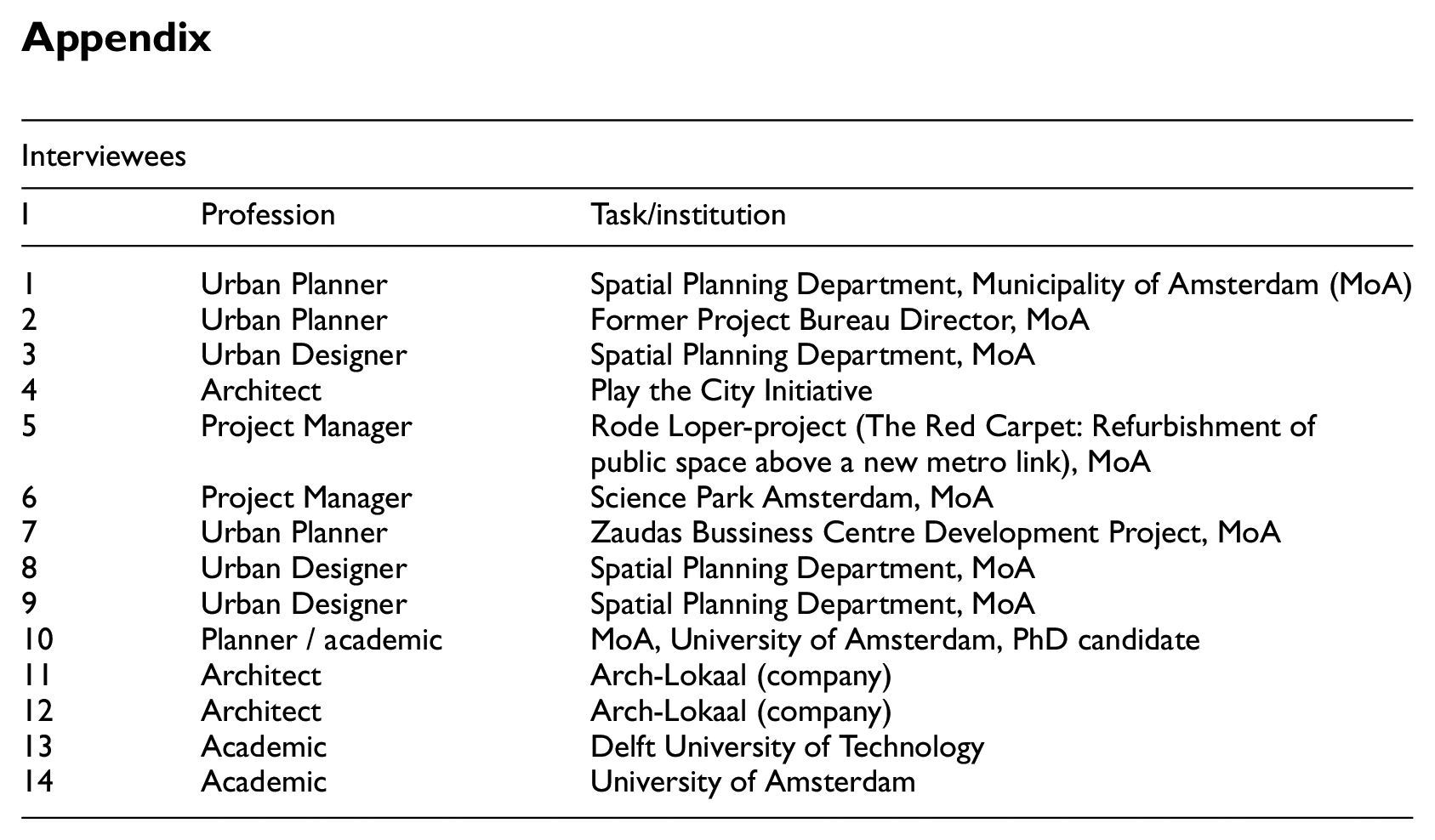
| Interviewees | ||
|---|---|---|
| I | Profession | Task/institution |
| 1 | Urban Planner | Spatial Planning Department, Municipality of Amsterdam (MoA) |
| 2 | Urban Planner | Former Project Bureau Director, MoA |
| 3 | Urban Designer | Spatial Planning Department, MoA |
| 4 | Architect | Play the City Initiative |
| 5 | Project Manager | Rode Loper-project (The Red Carpet: Refurbishment of public space above a new metro link), MoA |
| 6 | Project Manager | Science Park Amsterdam, MoA |
| 7 | Urban Planner | Zaudas Bussiness Centre Development Project, MoA |
| 8 | Urban Designer | Spatial Planning Department, MoA |
| 9 | Urban Designer | Spatial Planning Department, MoA |
| 10 | Planner / academic | MoA, University of Amsterdam, PhD candidate |
| 11 | Architect | Arch-Lokaal (company) |
| 12 | Architect | Arch-Lokaal (company) |
| 13 | Academic | Delft University of Technology |
| 14 | Academic | University of Amsterdam |
Acknowledgements
We would like to thank TU Delft, OTB - Research for the Built Environment for the resources and academic support they provided for this research.
Declaration of conflicting interests
The author(s) declared no potential conflicts of interest with respect to the research, authorship, and/or publication of this article.
Funding
The author(s) disclosed receipt of the following financial support for the research, authorship, and/or publication of this article: This research was funded by the Scientific and Technological Research Council of Turkey (TUBITAK).