




Abstract
Amid rising restrictions on race-related education, this study explores how teachers explain their sense of preparedness to engage in classroom race talk. Drawing on qualitative data from 458 U.S. teachers, the analysis examines how preparedness is shaped by school context, racialized emotions, and racial identity. Findings reveal key differences between teachers in racially diverse versus predominantly White schools, as well as between those who attribute preparedness to collective learning or personal study. Guided by Bonilla-Silva's theory of racialized emotions, this study underscores the emotional and structural dimensions of teacher preparedness and offers implications for supporting race-conscious pedagogy in restrictive times.
Across the United States, schools have become battlegrounds for racial discourse. Recent legislative efforts to restrict classroom conversations on race, structural inequality, and U.S. history have created a chilling effect in many districts (Kim, 2021; Vickery, 2021). These developments coincide with longstanding patterns of racial demographic mismatches between predominantly White teachers (nearly 80%), while racially diverse student populations make up about half of all students in U.S. schools (Economic Policy Institute, 2025). In major U.S. urban school districts with histories of racial segregation and unequal school funding (Milner, 2012; Welsh & Swain, 2020), the racial demographic divide is even greater, with some schools serving upwards of 90% students of color (Sable et al., 2010). This racial demographic divide heightens the need for teachers—particularly White teachers—to understand how race and racism shape their students’ experiences, disproportionate educational outcomes, and teachers’ own pedagogical choices. Unfortunately, many White educators enter the profession without having opportunities to develop a necessary critical lens, which often leads them to internalize color-evasive ideologies that frame race talk as inappropriate or unnecessary (DiAngelo, 2011; Sue, 2015; Taylor, 2017).
Race talk—defined here as classroom dialogue about race, racism, and systems of oppression—is especially crucial for several reasons. For one, race talk has been recognized as essential to supporting student identity development, critical consciousness, and civic learning (Adair, 2008; Jupp et al., 2016; Milner, 2015, 2020; Tatum, 1992). Race talk also sheds light on historical and contemporary patterns showing how schools can reproduce social hierarchies (Ladson-Billings & Tate, 1995). Recent research also links student racial stress and trauma to schools where students experience racism but have no classroom outlet for processing it (Saleem et al., 2024). When teachers avoid talking about race or are silenced through gag orders and legislation, they are forced to participate in an attack on marginalized people's health and wellbeing (Hannegan-Martinez, 2025). Yet, when teachers engage, even imperfectly, they can open doors for learning, healing, belonging, and justice in schools.
The reality is that teachers often feel underprepared, emotionally conflicted (Alvarez & Matias, 2026), or institutionally unsupported when attempting to engage in these conversations (Matias & Grosland, 2016; Kohli et al., 2017). Although recent scholarship has highlighted promising practices for teaching about race and racism in teacher education (Knaus & Ard, 2023; Price-Dennis & Sealey-Ruiz, 2021), teachers’ perceptions and attitudes can often be traced to deeply engrained, endemic racist ideologies rooted in White-dominant discourse (Delgado & Stefancic, 2001; Ladson-Billings, 1998; Milner, 2007). While critical race theory (CRT) is often used to analyze race and racism in education (Delgado & Stefancic, 2017; Ladson-Billings & Tate, 1995; Lynn & Dixon, 2013), this study is guided, instead, by Bonilla-Silva's (1997, 2019) structural interpretation of racism. Bonilla-Silva argues that racism is not primarily a matter of individual prejudice but is embedded in the very structures of society—its policies, practices, and cultural norms. This structural framing aligns with my focus on teachers’ preparedness for race talk because it directs attention to how seemingly neutral discourses and practices in teacher education may reinforce racial inequities. In this sense, my work is in conversation with CRT but extends the lens toward a structural analysis of how educators understand and describe their preparedness for race talk.
Ultimately, my hope is to expand the conversation about teacher preparation to account for race talk as a core competency for equitable teaching in today's schools. Yet, despite the urgency of this work, we know very little about how teachers themselves make sense of their readiness to engage in these conversations, or how their explanations are shaped by their racialized emotions, structural constraints, or political climates. To address this gap, this study asks: How do teachers explain their sense of preparedness—or unpreparedness—to engage in race talk in their classrooms? This study extends prior work on teacher race talk (Delale-O’Connor & Graham, 2018; Milner, 2017; Rand, 2021), much of which emerged from moments of heightened racial tension, such as the murders of unarmed Michael Brown in 2014 and later George Floyd in 2020 (Derek Chauvin, the White, Minneapolis officer, was convicted of murder). These events highlighted teachers’ uncertainty about how, or whether, to address race talks in their classrooms, revealing persistent gaps in preparation. While teacher education programs may deepen racial knowledge, it is unclear whether they cultivate the emotional capacities necessary for sustained, justice-oriented conversations about race.
Drawing on open-ended responses from a majority-White sample of 458 U.S. teachers, I examine how educators describe the experiences and emotional landscapes that shape their preparedness for conversations about race, racism, and systems of oppression. Their explanations reveal the influence of racialized emotions, institutional contexts, and political climates, illustrating how preparedness is produced within and constrained by broader racial structures. By situating teachers’ discourse within a framework of structural racism, I aim to push the field beyond individualized notions of preparedness and toward a deeper understanding of how racism is embedded in the conditions of teaching and classroom discourse.
Literature Review: Learning About Race and Practices in Teacher Education
To situate this study, I acknowledge that schools are embedded within broader structures of racial inequity. Bonilla-Silva's (1997) theory of structural racism clarifies that racism is not merely a matter of individual prejudice, but a set of institutional arrangements, policies, and practices that appear race-neutral yet perpetuate racial hierarchy. This means that structural racism manifests across multiple layers of education—funding disparities, curriculum decisions, school discipline, and residential segregation—that collectively shape teachers’ and students’ experiences. By focusing on racialized structures rather than isolated attitudes, I foreground the conditions that make race talk both necessary and fraught. This lens also highlights why avoidance of race talk is not neutral and silence is an enactment of structural racism itself (Pollock, 2009).
Alongside structural analyses, sociocultural, and sociological perspectives help illuminate how teachers’ preparation is shaped by broader histories and contexts. From a sociocultural standpoint, Gutiérrez and Rogoff (2003) emphasize that learning and identity are inseparable from the cultural, historical, and political communities in which they develop. Teacher education, then, is not simply about transmitting neutral pedagogical skills but about socializing teachers into particular ideologies of race, knowledge, and authority. Sociological research on segregation and stratification further underscores that schools are organized in ways that reproduce racial and class hierarchies (Orfield & Frankenberg, 2014; Lewis & Diamond, 2015). These perspectives reveal that teachers and teacher educators operate within racialized neighborhoods, segregated schooling patterns, and dominant cultural narratives that normalize Whiteness as the standard. Attending to both the sociocultural and sociological frames highlights the dual reality teachers face—they are developing as professionals within institutions that both shape and constrain their racial consciousness.
Early critiques of desegregation noted that teacher reluctance and racial illiteracy undermined integration efforts (Rabinow & Cooper, 1980). In subsequent decades, deficit-oriented frameworks shaped teacher preparation, lowering expectations for students of color and reinforcing racial tracking (Harty & Mahan, 1977; D’Amico, 2016). These patterns reflect what Ladson-Billings (1999) described as the persistence of deficit thinking in U.S. schools. More contemporary research continues to show that many teacher education programs are grounded in Whiteness, often reinforcing dominant norms and shielding White educators from discomfort (Cook, 2013; Kraehe et al., 2015; Matias et al., 2016; Sleeter, 2017). In effect, future teachers are frequently taught to address race in abstract or sanitized ways that avoid confronting systemic oppression or White privilege (Pimentel, 2010; Watson, 2012). Even when institutions claim commitments to equity, they often lack the accountability structures to ensure that faculty deliver race-conscious and justice-centered instruction (Allen et al., 2017; Ladson-Billings, 1999). While some programs may encourage general conversations about diversity, they may not provide the tools needed to challenge racialized systems (Alvarez et al., 2020; Seider & Graves, 2020).
Teacher education in the past decade has unfolded within a rapidly shifting racial and political landscape marked by protest, backlash, and intensified surveillance of classroom practice. The 2014 police murder of Michael Brown in Ferguson and the subsequent rise of the Black Lives Matter movement brought renewed attention to the racial realities students face and to the responsibility of educators to engage in critical conversations about structural racism (Dunn et al., 2019; Milner, 2017; Rand, 2021). Scholarship in this period documents teachers’ heightened uncertainty, emotional labor, and desire for guidance about how to discuss racial violence, racial inequality, and systemic oppression with students (Delale-O’Connor & Graham, 2018; Matias & Grosland, 2016). These developments highlight how teachers’ preparation for race talk intersects with broader sociopolitical contexts that shape both their agency and their constraints (Graham et al., 2019). At the same time, the post-2016 and post-2020 eras have seen an escalation of state-level mandates, book bans, and “anti-CRT” or anti-DEI (diversity, equity, and inclusion) legislation intended to restrict classroom discussions about race, racism, and U.S. history (Kim, 2021; Hannegan-Martinez, 2025). These policies have had subtractive effects in teacher education and public schools, erasing curricular possibilities and amplifying teachers’ fears of backlash from parents, communities, and administrators. Such political pressures are shown to heighten teachers’ racialized emotions—fear, anxiety, guilt, and avoidance—particularly among White educators, whose emotional responses can either sustain or disrupt racially oppressive structures (Matias & DiAngelo, 2013; Bonilla-Silva, 2019).
These studies raise an urgent question: how can teacher preparation programs meaningfully support educators in feeling prepared to discuss race in their practice? While much of the literature has focused on White teachers in racially diverse schools, there is also a need to develop race consciousness among some teachers of color and educators in predominantly White settings. The literature suggests that race talk—when practiced with depth and accountability–can serve as a critical site of growth for both students and teachers (Rogers & Mosely, 2006; Trainor, 2005). However, it is also clear that those who do engage in race talk, regardless of racial identity, often encounter resistance or backlash from parents, peers, and school leaders (Posey-Maddox, 2017). This suggests that preparedness must be understood not only as a matter of knowledge or will, but as an ongoing negotiation with political, emotional, and institutional pressures.
The literature paints a picture of teacher education as a site where race talk is acknowledged in principle but undermined in practice. That is, teachers may learn the language of “equity,” yet they are rarely prepared to enact race talk in ways that disrupt structural racism (Holtz et al., 2025). Although the scholarship I’ve reviewed here provides crucial insights, several opportunities exist. First, much of the literature examines what teacher education offers rather than how teachers themselves understand and make sense of their preparedness. Despite the advances in teacher education, we know relatively little about how teachers themselves explain the development of their racial knowledge, their emotional capacities, or their sense of safety in engaging race talk. Second, research often focuses narrowly on White teachers in racially diverse schools, leaving underexplored the experiences of teachers of color and those in predominantly White contexts who must also confront race talk. Third, the literature tends to treat race talk as an individual practice rather than as a relational and structural phenomenon shaped by policies, politics, and racialized emotions.
While prior scholarship demonstrates the persistent underpreparation of teachers for substantive engagement with race, the question of how teachers themselves make sense of their preparedness remains underexplored. Much of the existing literature highlights programmatic intentions or curricular offerings, but it often overlooks the interplay of teachers’ lived experiences, their racialized emotions, and the structural conditions that shape whether race talk feels possible or perilous. This study responds to that gap by centering teachers’ own explanations of preparedness within a framework that foregrounds structural racism and racialized emotions. Bonilla-Silva's (1997, 2019) structural interpretation of racism provides a critical lens for understanding how schools reproduce racial inequities, while the concept of racialized emotions illuminates the affective dimensions of race talk engagement. These perspectives allow me to theorize preparedness not simply as an individual competency, but as dynamic outcomes shaped by structures, opportunities, ideologies, and emotional repertoires of practice (Gutierrez & Rogoff, 2003). In the next section, I elaborate on my framework and explain how it guides the analysis.
Conceptual Framework
This study is grounded in Bonilla-Silva's (1997, 2019) structural interpretation of racism, which shifts the analysis of race from individual attitudes to the institutional, cultural, and ideological systems that organize society. Bonilla-Silva defines a racialized social system as one in which “economic, political, social, and ideological levels are partially structured by the placement of actors in racial categories” (p. 469). These categories are not biological but social, historical, legal, contextual, and physical constructions (Milner, 2015), produced through a system of racialization that distributes power, privilege, and resources along racial lines. Within this system, dominant groups establish and maintain hierarchical social relations (e.g., controlling access to employment, education, and political representation), while defining cultural norms and status markers that marginalize others.
This framework is particularly useful for understanding teacher preparedness for race talk. If racism is embedded within the structures and ideologies of schooling, then silence about race is not neutral; it is itself a mechanism that sustains structural racism (Pollock, 2009). As many critical race theorists have argued, schools are key sites where white dominant ideologies are reproduced and contested through curriculum decisions, disciplinary practices, funding inequities, and the geographic segregation of students (Delgado & Stefancic, 2017; Ladson-Billings & Tate, 1995; Lynn & Dixon, 2013). These systemic forces shape not only the ecologies in which teachers and students interact but also the emotional and cognitive resources teachers bring to conversations about race. By using Bonilla-Silva's structural framework, this study foregrounds how teacher preparedness is deeply entangled with these broader racialized structures, rather than being solely a matter of individual will or skill.
A critical component of Bonilla-Silva's theory is that structural racism gives rise to racial ideologies—sets of beliefs and interpretive “rules” that rationalize the existing racial order and shape behaviors, including those related to teaching and talking about race. These ideologies develop a level of autonomy, allowing them to rewrite the terms of racial discourse and normalize racial inequities over time. They inform how racial group members understand their social positions, construct “us/them” boundaries, and interpret acts of resistance or compliance. Thus, behaviors such as avoiding race talk, invoking “colorblindness,” or framing racism as an individual failing can be understood not as isolated choices but as patterned actions that reinforce the racial status quo.
In addition to these structural and ideological dimensions, Bonilla-Silva (2019) introduces the concept of racialized emotions—group-based, historically produced affective responses to race-related stimuli. These emotions are not simply personal feelings; they reflect and reproduce racial hierarchies (systems of dominance). Dominant groups, for example, may cultivate feelings of fear, guilt, or resentment that sustain anti-Blackness and inform policy decisions (Bonilla-Silva et al., 2006), while marginalized groups may experience anger, grief, or solidarity in response to oppression (Green, 2013; Warren, 2018). Because racialized emotions shape how people perceive and respond to racial realities, they are integral to understanding teachers’ preparedness for race talk. Feelings of fear or fragility, for instance, may lead some teachers to avoid conversations about race, while empathy or anger at injustice may propel others to engage more deeply.
This dual attention to structure and emotion is essential for conceptualizing preparedness as more than a cognitive outcome. It suggests that teachers’ capacity to engage in race talk is shaped by their knowledge and the emotional dispositions they develop in relation to racial hierarchies. Teacher preparation programs, which operate within and often reproduce these hierarchies, must therefore attend to both racial knowledge and racialized emotional development if they aim to prepare educators for meaningful racial dialogue.
This conceptual framework also helps explain why preparedness is not uniform across teachers or contexts. If racial group members develop different interests and behaviors based on their position in the racial hierarchy, as Bonilla-Silva argues, then teachers of color and White teachers may approach race talk differently. Their emotional landscapes—shaped by experiences of racism, privilege, or both—can influence how they perceive the risks and possibilities of discussing race. Similarly, school contexts, whether predominantly White or racially diverse, could mediate these dynamics, shaping the institutional pressures and emotional climates in which teachers operate.
In sum, Bonilla-Silva's structural interpretation of racism provides a powerful framework for examining teacher preparedness for race talk as a structurally situated and emotionally mediated phenomenon. This perspective moves beyond individualistic explanations to reveal how broader systems of racial inequality and the emotions they engender shape teachers’ actions and perceptions. Understanding preparedness through this lens illuminates persistent barriers to race talk and offers pathways for transforming teacher education into a site where structural awareness, emotional resilience, and racial justice commitments are cultivated in tandem.
Research Method
To examine how a sample of teachers explain their feelings of preparedness to engage in race talk in their classrooms, this study draws on a qualitative analysis of open-ended survey responses. The data come from the Teachers Race Talk Survey (TRTS; Milner et al., 2016), an exploratory instrument I co-designed in the aftermath of the 2014 police murder of unarmed Michael Brown in Ferguson, Missouri. At that time, our research center was receiving numerous calls from district administrators seeking guidance on how teachers might navigate conversations about race and racial violence with their students. Being a scholar of color and someone who has facilitated professional learning for pre- and in-service teachers on race talk informed both the development of the TRTS and my interpretation of the data. In keeping with scholars who argue that researcher positionality is not a limitation but a critical data point that shapes the research process (Milner, 2007; Milner et al., 2025), I acknowledge that my social location, lived experience, and commitments to racial justice necessarily inform how I approach the questions, analysis, and interpretations in this study.
Although the TRTS includes both closed- and open-ended items, this study focuses exclusively on teachers’ written explanations in response to the prompt: “I feel prepared to discuss race with students in my classroom.” Analyzing these open-ended responses as qualitative data allows for a deeper exploration of how teachers make sense of their preparedness, the experiences that shape their views, and the broader social and institutional contexts that inform their racialized emotions and practices. This approach aligns with Bonilla-Silva's (1997, 2019) structural interpretation of racism, which emphasizes that attitudes, beliefs, and emotions about race are not isolated individual phenomena but are shaped by historical, institutional, and ideological forces.
Data Source
The sample for this study consists of 458 pre-service and in-service teachers who voluntarily completed the TRTS. Self-administered surveys like the TRTS can be useful for eliciting candid responses on sensitive topics such as race (Groves et al., 2011). Compared to in-person interviews, participants may feel more comfortable disclosing their honest beliefs and feelings in written form. The TRTS includes 32 items, beginning with eight demographic questions (e.g., race and years of teaching experience) followed by 12 items related to teachers’ experiences and beliefs about race in educational contexts. Each close-ended item (“yes”, “no”, and “not sure”) includes an optional open-ended text box, allowing participants to explain or elaborate on their responses. Participants were recruited through multiple channels:
The University of Pittsburgh School of Education and local educational networks; Invitations sent to Deans, Directors, and Coordinators of Teacher Education Programs at Association of American Universities (AAU) institutions; and The Literacy Research Association's distribution list.
While this nonrandom, self-selected sample does not allow for statistical generalization, it provides rich qualitative data about how educators in different roles, racial groups, and school contexts understand their preparedness for race talk.
The TRTS data provide useful contextual information about teachers’ self-reported preparedness. As shown in Table 1, 49% of the total sample reported feeling prepared to engage in race talk. Preparedness varied across demographic categories. For example, in-service teachers (55%) reported higher preparedness than pre-service teachers (43%), and teachers working with predominantly Black (58%), Latinx (51%), or racially mixed (51%) student populations reported higher preparedness than those teaching primarily White students (42%). Preparedness also increased with grade level, and English Language Arts (ELA) teachers (23%) were more likely to report preparedness than those teaching other subjects. While these descriptive data help situate the sample, the focus of this study is on teachers’ qualitative explanations of their preparedness, which offer deeper insight into their readiness to engage in race talk.
Overview of Sample Characteristics (N = 458).
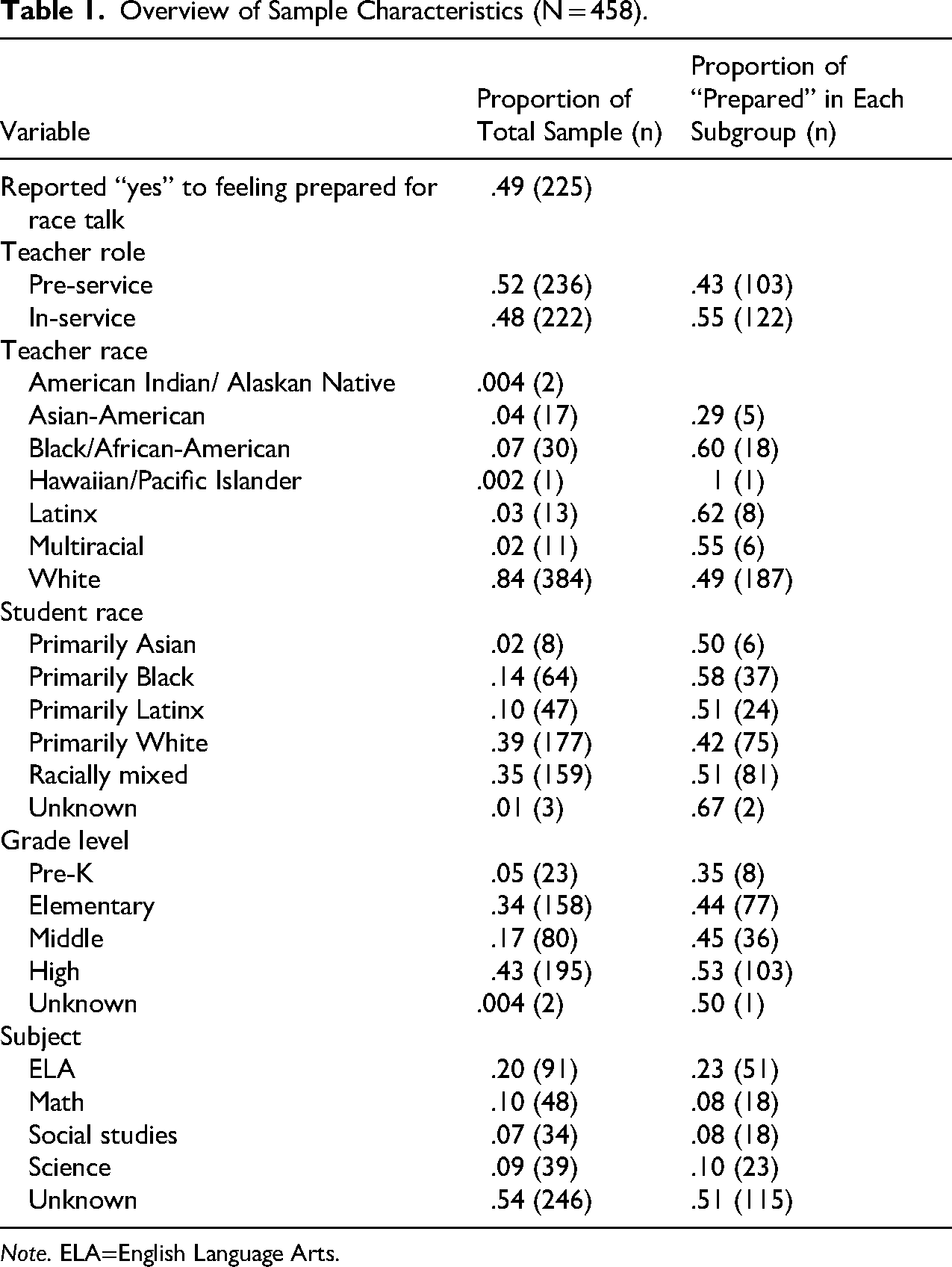
Note. ELA=English Language Arts.
Data Analysis
I used an interpretive approach to analyze participants’ open-ended survey responses to the prompt: “I feel prepared to discuss race with students in my classroom.” First, I applied inclusion criteria to screen responses: only those with at least one complete sentence and a clear explanatory mechanism were included. For instance, a response like “I have done my research on this issue” was retained because it attributes preparedness to a specific variable (“research”). This process resulted in a reduced set of codable responses for analysis. As shown in Table 2, my inclusion criteria yielded 118 codable excerpts for “yes,” 56 for “no,” and 83 for “not sure.”
Thematic Overview by Response Type.
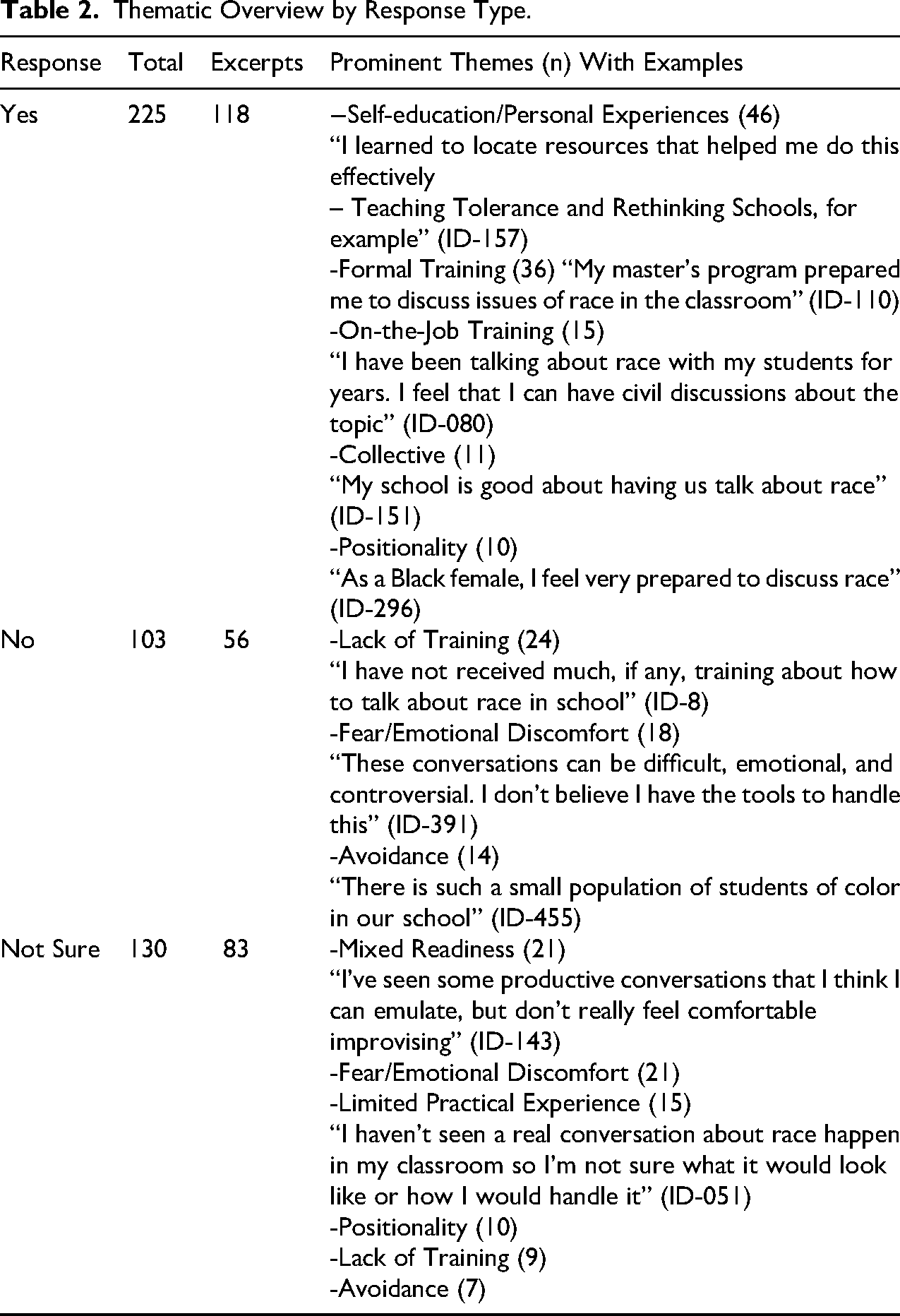
I then used a constant comparative method (Leech & Onwuegbuzie, 2011) to analyze the responses. Through multiple rounds of reading and comparison, I developed initial codes that reflected the explanatory mechanisms participants cited for their preparedness (or lack thereof). Using in vivo coding and open coding techniques (Miles, Huberman & Saldaña, 2013), I captured participants’ language while grouping related codes into broader themes. For example, I coded a “yes” response of, “I work with a team of teachers and we discuss our plans,” as student success and collective safety—which later was collapsed into the “collective supports” theme. This iterative approach allowed me to refine the coding scheme to highlight new patterns. Doing so, I identified five major themes among participants who responded “yes” to feeling prepared, including self-education/personal experiences, formal training, on-the-job experience, collective supports, and positionality. Among those who responded “no” or “not sure,” the dominant themes I noticed included lack of training, fear or emotional discomfort, avoidance, limited practical experience, and mixed readiness (see Table 2).
Analytic Focus
Using Bonilla-Silva's (1997, 2019) framework of structural racism and racialized emotions provided a lens for interpreting teachers’ explanations as products of both individual experience and broader social structures. For example, I interpreted references to fear, avoidance, or emotional discomfort not as personal shortcomings but as expressions of racialized emotions produced by historical and structural racial hierarchies. Similarly, I interpreted instances where teachers cited a lack of institutional support or inadequate training as evidence of how structural racism shapes teacher education, constraining opportunities for race-conscious practice. In this way, the themes I identified from the data were constructed in dialogue with theory. This theoretical grounding deepened my understanding of how teachers’ preparedness for race talk can be both an individual disposition and a reflection of their position within racialized educational structures and emotional economies (Bonilla-Silva, 2019).
My qualitative analysis of open-ended survey responses illuminates the ways teachers explain their preparedness (or lack thereof) to engage in race talk. By situating these explanations within a structural and emotional framework, the analysis highlights how preparedness is shaped by training, experience, racial identity, institutional context, and broader racialized structures. These insights contribute to our understanding of how some educators negotiate the complex political, emotional, and structural realities of discussing race in schools, pointing to critical areas where teacher education can better support race-conscious practice.
Findings and Interpretations
This section presents the major themes from teachers’ explanations of their feelings of preparedness to engage in race talk. Guided by the concept of racialized emotions and a structural understanding of racism, the analysis is organized around two broad groups of responses: those from teachers who reported feeling “no” or “not sure” about their preparedness, and those who reported “yes.” Among the first group, White teachers—who comprised 90% of “no” respondents and 82% of those selecting “not sure”—most often cited a lack of training, though none of the 36 teachers of color in this group mentioned this reason. Instead, across racial groups, fear, emotional discomfort, and avoidance surfaced as central explanations. Within these responses, two distinct forms of fear—fear of discomfort and fear of conflict—were especially salient in schools serving predominantly students of color, while teachers in predominantly White schools more often engaged in race-evasive rationalizations that normalized avoidance.
The second part of the analysis focuses on teachers who reported feeling prepared for race talk and examines the explanations they offered. Here, I share three prominent pathways: formal training, self-education or personal experience, and collective, race-conscious efforts within their schools. Formal coursework and structured learning experiences were cited frequently, as were teachers’ self-directed efforts to build racial knowledge and draw from lived experience. Additionally, teachers of color and some White educators working in racially diverse settings described how collaboration with colleagues and students supported their readiness to engage in race talk. Together, these findings illuminate not only the varied sources of teachers’ sense of preparedness but also how racialized structures and emotions shape the ways they interpret and enact this aspect of their practice.
Between Silence and Struggle: How Teachers Rationalize Unpreparedess for Race Talk
Many teachers in this study expressed uncertainty or outright unpreparedness when it came to facilitating classroom discussions about race. While some responses stemmed from a genuine desire to do better, others reflected patterned ways of thinking and feeling shaped by broader racial structures. As Bonilla-Silva (1997) argues, racism is not just an individual failing but an organizing logic that structures social relations, emotions, and institutional practices. In this section, I examine how teachers’ feelings of unpreparedness are situated within that racial order, focusing on three interrelated dynamics: (1) the gap between theoretical understanding and practical application, (2) the emotional costs of fear and discomfort, and (3) race-evasive reasoning used predominantly by White teachers to rationalize avoidance. Together, these patterns show that unpreparedness is not simply a lack of skill or training, but a deeply social and emotional phenomenon embedded within a racialized system of schooling.
The Space Between Knowing and Doing
A recurring theme among White teachers was the recognition of their limited preparation for race talk, often framed as a lack of training or practical experience. One White teacher working in a predominantly Black school shared, “I always feel like there is more to learn when discussing race with others. However, I also feel like the best way to learn is by engaging in those conversations from a respectful and honest lens” (ID-278). This example of uncertainty was resonant in other responses that seemed to embody a humble tone and ethic of care. This tension between knowing and doing was echoed in statements like, “White guilt weighs heavy” (ID-256) and “I grew up in an overwhelmingly white area and have minimal hands-on experience working with and having relationships with people of color” (ID-287). These expressions mirror some of the struggles described in what Matias (2016) terms White emotionalities, which are affective responses that emerge as White teachers confront the limits of their racial socialization.
Teachers’ emphasis on theoretical readiness but practical uncertainty was common. As one White teacher working in a majority White school noted, “I feel that I have enough theoretical preparation but do not have enough practical preparation. I feel that I just do not know how to actually begin or what words to actually say” (ID-323). Another White teacher wrote, “I feel prepared based on my academic learning thus far, but from a personal perspective I know I have a long way to go” (ID-11). These statements underscore an important insight from Bonilla-Silva's (1997) framework: even when individuals reject racism ideologically, structural racism persists through silence, avoidance, and institutional practices that normalize disengagement.
Others noted a readiness to initiate conversation, but a lack of confidence in handling unexpected responses or emotionally charged topics. One White high school teacher explained, “I’ve seen some productive conversations that I think I can emulate, but don’t really feel comfortable improvising” (ID-143). A number of teachers pointed to their racial or cultural identity as shaping their uncertainty—feeling both accountable and limited in what they could authentically contribute. One Latinx teacher working in a racially diverse school shared, “I feel that I can speak on behalf of myself, and as a ‘passing’ POC… I am nervous that I am not able to facilitate a conversation regarding these issues myself” (ID-398). Even amid hesitation, many respondents expressed how their affective responses to race talk are shaped by historical and sociopolitical structures (Matias & DiAngelo, 2013; Zembylas, 2012). These excerpts reveal that feelings of preparedness are rarely binary; they emerge from a tension between intent and uncertainty, confidence and humility, theoretical readiness and practical apprehension.
Navigating Fear and Emotional Costs
Although lack of training, practical experience, and mixed feelings were common responses, many teachers in this sample also cited fear and emotional discomfort as key sources of their unpreparedness for race talk. First, some teachers expressed a fear of discomfort, which often reflected anxiety about “getting it wrong” or causing harm. One White, elementary teacher noted, “I feel like I am walking on eggshells every time I approach it. Will I say the wrong word? Can my lesson be misconstrued” (ID-436)? Some White teachers may be fearful of making offensive mistakes when engaging with students of color around multicultural content in class (Brown & Brown, 2012; Gay & Howard, 2000). Like the previous example, a White, high-school ELA teacher shared that, although he fears discomfort, he attempts to incorporate race discussions in his practice, “It is difficult some days and easier other days. As a straight White male, sometimes I do not feel comfortable facilitating such a discussion amongst a group of 90% students of color” (ID-196). These responses demonstrate that racialized emotions are, in part, shaped by social positioning and power.
In contrast to discomfort, a second, more charged form of fear was the fear of conflict. I differentiate these two types of fears because unlike fear of discomfort, teachers’ fear of conflict was often more deeply rooted in racial ideology. Teachers expressed concern about being “confronted by angry students of other backgrounds” (ID-194) or “classes [erupting] with severe anger and hostility that I don’t know how to fully control” (ID-166). Such perceptions align with racialized narratives that have long been used to justify segregation, discipline disparities, and increased policing and surveillance in schools (Alvarez & Milner, 2018; Love, 2019). Whereas some teachers were fearful of verbal conflict with students, such as, “you can never be fully prepared for what might come out of your students’ mouth” (ID-368), others recalled what they believed to be more aggressive/threatening conflicts. These fears are not neutral; they reveal how racialized ideologies can shape even teachers’ emotional landscapes.
Importantly, racialized emotions are socially produced and materially consequential (Bonilla-Silva, 2019). A teacher who fears discomfort may disengage prematurely, abandoning opportunities for transformative dialogue. A teacher who fears conflict may suppress conversations altogether, reinforcing racial silence as the norm. Both responses reflect patterned ways of feeling that sustain racial hierarchies in schools, illustrating how even well-intentioned avoidance can reproduce structural racism. The nature of teachers’ fear and how they express their fear are both real and important analytic sites (DiAngelo, 2011; Matias & Grosland, 2016).
Race-Evasion as Performative Innocence
For many of these White teachers in predominantly White schools, feelings of unpreparedness were often rationalized through patterned ways of thinking that normalize avoidance and reinforce existing racial hierarchies. In this way, race-evasion is disguised as care, and emotional discomfort is reframed as virtue. These patterns align with what Bonilla-Silva (1997, 2014) describes as the ideological function of structural racism: it allows dominant groups to interpret racial issues as irrelevant, peripheral, or someone else's responsibility, thereby upholding the racial order. In this context, teachers’ explanations of their unpreparedness represent a form of performative innocence, where teachers disavow responsibility for race talk while still appearing reasonable, caring, or powerless.
One common avoidance strategy was appealing to good intentions. For example, a White middle school science teacher stated, “As a White middle-class woman, I sometimes doubt my ability to guide these discussions effectively. I try, but I don’t want to do more harm than good” (ID-167). This reasoning is significant because it positions the teacher's intent, rather than the impact of her silence, as the central consideration. As Pimentel (2010) and Watson (2012) argue, this form of moral positioning can serve to absolve White educators from deeper interrogation of their racial roles, even as it communicates to students that conversations about race are optional rather than essential. Teachers who use this rational to avoid race talk may be trying to protect their own interest in predominantly White school contexts.
A second avoidance strategy was framing ideal conditions as pre-requisites for race talk. For instance, one White middle school teacher explained, “I feel like if I had a more diverse classroom, it would be easier to talk about race” (ID-419). On the surface, this may seem like a reasonable observation. However, it reflects a deeper ideological narrative: that race is only relevant when people of color are present. This belief, rooted in color-evasive ideology, permits White educators to delay their engagement indefinitely while maintaining an image of openness and potential. It also reinforces a racialized status quo in which White students and White teachers remain unchallenged by discussions that could destabilize dominant narratives about history, identity, and power.
A third race-evasion tactic was de-racialization—framing race as irrelevant to their discipline or context. One teacher wrote, “Teaching science does not present opportunities for such conversations” (ID-193). This claim exemplifies how structural racism shapes curricular choices and professional norms. By naturalizing whiteness as neutral and unmarked, it allows teachers to see race as outside the scope of their professional responsibility. As Bonilla-Silva (2014) argues, such race-neutral discourses mask power relations and sustain systemic inequities by defining racism as an interpersonal issue rather than a structural one.
Across these responses, a pattern emerges: teachers rationalize their disengagement in ways that allow them to maintain innocence while upholding racial hierarchies. These findings resonate with Pollock's (2004) argument that silence about race is not a neutral stance but an active enactment of structural racism. The “good intentions” rationale centers White teachers’ comfort over students’ racial realities; the “ideal conditions” frame postpones action until structural inequities solve themselves; and the “de-racialization” stance denies that race and racism shape “neutral” disciplines. Each strategy is a product of the racial ideology Bonilla-Silva (1997) theorized—one that privileges White emotional comfort, maintains dominant narratives, and minimizes the urgency of racial discourse in schools. These avoidance patterns I have identified are linked to broader racial structures that shape who feels entitled to speak, whose knowledge is deemed legitimate, and which subjects are considered “neutral.” Residential segregation, unequal school funding, White-centered curricula, and hiring patterns that produce overwhelmingly White teaching forces all contribute to structural environments where teachers can view race talk as optional. Within such contexts, performative innocence is normalized and incentivized.
Prepared, But Not the Same: Divergent Paths Toward Race Talk Readiness
Teachers who reported feeling prepared for race talk often justified their readiness through three distinct pathways: formal training, collective efforts within racially diverse school settings, and self-directed learning or personal experience. While all three rationales point to a sense of confidence, they reflect notably different orientations toward race, power, and pedagogy. Some teachers, particularly those in robust teacher preparation programs, described their preparedness as a product of structured and deep theoretical engagement. Others, especially White teachers in racially diverse schools, emphasized how collaborative learning with colleagues and students shaped their approach to race talk. A third group, composed mostly of White teachers as well, pointed to their independent study or interpersonal experiences as sufficient groundwork. Examining these rationales highlights where teachers gain confidence but it also reveals the ideological assumptions and structural conditions that shape what it means to feel “ready” in a racialized education system.
Formal Learning as Foundational Preparation
For many teachers, formal learning—especially through teacher education and advanced degree programs—was cited as foundational. These educators often drew direct connections between their preparation experiences and their sense of confidence. One White pre-service teacher shared, “My master's program has given me the skills and knowledge to lead these conversations,” (ID-266) while another stated, “I’ve come to a point through my schooling that I feel comfortable addressing race because it's a hugely important topic” (ID-24). These responses suggest that structured academic environments can play a crucial role in shaping both teachers’ racial discourse and emotional readiness.
Participants described how their preparation involved sustained engagement with multicultural education, sociopolitical theory, and foundational scholarship on race. They mentioned reading the work of Paulo Freire, Gloria Ladson-Billings, Ernest Morrell, and others as grounding their understanding of how to approach race as both an academic and moral imperative. One White in-service teacher explained, “I’ve spent a lot of time reading and discussing how to pedagogically craft curriculum with a focus on racial, economic, and social justice” (ID-121). Others credited specific faculty members with modeling what race talk could look like in practice. As one pre-service teacher noted, their professor was “doing a magnificent job of teaching me new ways to go about teaching the tough stuff, which can include race” (ID-473). These experiences illustrate how effective teacher preparation is not only about knowledge transmission but also about cultivating pedagogical dispositions and practices aligned with justice-oriented teaching (Cochran-Smith, 1995; Ladson-Billings & Tate, 1995; Milner, 2017). These are not surface-level acknowledgments; they demonstrate how some teachers are deeply engaging with race talk as a scholarly endeavor that informs praxis.
Importantly, even among those who emphasized formal preparation, many framed their readiness with humility. Rather than claiming expertise, several participants described themselves as “open-minded” or “still learning,” underscoring that preparedness is an ongoing process rather than a fixed endpoint. This balance of confidence and self-awareness reflects what critical scholars argue is essential to antiracist teaching: not just the acquisition of knowledge, but the development of the emotional and relational capacities needed to sustain meaningful race talk (Matias & DiAngelo, 2013; Sleeter, 2017).
Collaborative Courage in Racially Diverse Schools
Among teachers in racially diverse schools who felt prepared for race talk, many—though not all—were White and credited their preparedness to collective, school-based efforts that reflect an emotional sense of trust. Several respondents described learning with and from both students and colleagues as critical to their growth. A White elementary teacher shared, “My school district has worked toward this goal for the past 4–5 years and has implemented programs to support teachers in doing so” (ID-385). These teachers often cited supportive school environments as key, with professional collaboration enabling them to approach race talk with greater confidence. As one multiracial elementary teacher explained, they used “literature to begin these (race) conversations” in dialogue with peers (ID-315). Similarly, a White high school ELA teacher noted, “I have worked with other educators… That said, as a middle-class White person, I always feel unprepared in some way, but I am confident in my ability to facilitate conversations” (ID-125).
Compared to their counterparts in predominantly White schools, these teachers conveyed a more dialogic and relational approach to race talk—particularly with students. One teacher explained, “I let them take the lead. I ask questions of them; they ask questions of me. I believe we have real discourse” (ID-82). Another reflected, “I’m also honest with kids that I am not the ultimate answer. All I can do is question things along with them and provide context and facts when necessary” (ID-329). These examples illustrate a pedagogical shift from teacher-as-expert to teacher-as-participant in ongoing racial inquiry, reflecting a stance grounded in humility, transparency, and shared meaning-making (Gay, 2010; Ladson-Billings, 2009).
This collaborative ethos may help explain why teachers in racially diverse schools expressed greater readiness: race talk was framed less as a risk and more as a collective responsibility embedded within a supportive community. These findings also align with Bonilla-Silva's (1997) argument that dominant group members may engage in counter-hegemonic practices when they perceive them as manageable and beneficial. White teachers in diverse contexts may feel more prepared precisely because the school environment normalizes race talk and distributes the emotional labor of it across the community. Still, the responses also reveal a complex emotional terrain, as many teachers continued to grapple with their positionality and the enduring realities of racial inequality.
Self-Taught and Certain: Individualism, Experience, and the Racial Knowledge Gap
Self-education and personal experience were prominent rationales among teachers who felt prepared for race talk—particularly among White educators. Of the 45 teachers who referenced this rationale, 43 were White. While some respondents conveyed genuine effort to expand their racial literacy, many explanations contained undertones of individualism and meritocratic thinking. One teacher wrote: I have studied, read, conversed, had trainings, attended workshops, lectures… over the past 10 years. Of course, I am still learning and growing as a teacher, woman and social justice crusader! P.S.—I am a rare case! MOST, almost ALL teachers I know are not doing this work and they need to be (ID-306).
Such responses reflect an individualized approach to racial knowledge that mirrors broader ideologies of meritocracy and self-sufficiency (Apple, 2009; Leonardo, 2002). This framing can be problematic, as it positions racial competence as a personal achievement rather than a collective responsibility tied to systemic transformation. Several respondents even described racial learning as a finite skillset they had already mastered, such as one who asserted, “I am well-read in perspectives of POC on these issues” (ID-135). As Mills (1997) and Moreton-Robinson (2015) caution, such claims reflect epistemic dominance and White possessive logics, where White educators retain the power to define what counts as legitimate knowledge and how much is “enough.”
Many teachers also pointed to lived experiences with racial diversity as key to their preparedness. One respondent wrote, “I am a White teacher. I have enough experience to see how things work in our world, and all is not fair for others” (ID-144), while another shared, “I come from a family that is multicultural. I attended racially diverse schools and I’m comfortable with all races and people from various backgrounds” (ID-139). Although these experiences may foster empathy, they do not automatically cultivate the critical consciousness necessary to disrupt systemic racism. As Bonilla-Silva (1997, 2019) notes, racial actors often interpret race through the lens of their own positionality, which shapes both their emotional responses and their understanding of racial realities. While deeply meaningful, some experiences risk being elevated as stand-ins for systemic understanding if not critically examined (DiAngelo, 2011; Matias & Zembylas, 2014). Another example of this dynamic came from a teacher who recounted: My husband and I took in an African American teenager from Memphis for his senior year of HS. […] I learned a lot about what it means to be a young African American male, and it grieves my heart where the state of race relations is in our country (ID-313).
Across these responses, we see that while individual learning and personal encounters can spark awareness, they often fall short of the structural and critical depth required to engage race talk as a tool for racial justice. Without that deeper grounding, preparedness risks becoming a self-referential stance rather than a transformative practice.
Discussion
This study set out to better understand how 458 teachers described their preparedness for race talk—an emotionally charged, pedagogically complex, and politically fraught aspect of classroom life. Grounded in a critical, race conscious framework, including the concept of racialized emotions, the analysis reveals how educators’ feelings of preparedness are shaped not only by individual learning or personal conviction, but by broader social contexts and group-based experiences. As I revisit the major contributions of this work, I focus on several theoretical, empirical, and practical implications that can help dismantle White-dominant norms in (teacher) education and support more just and honest engagements with race in schools.
Racialized Emotions and Structural Racism in Practice
One of the central contributions of this study is its affirmation that racialized emotions are deeply influenced by social context and group position (Bonilla-Silva, 1997, 2019). Teachers’ explanations reveal that feelings of preparedness are not only personal dispositions or isolated pedagogical concerns; rather, they are structured by the racial hierarchies within which schools operate and are shaped by teachers’ locations within those hierarchies. If, as Bonilla-Silva suggests, emotions are historically sedimented and group-based, then it is no surprise that many White teachers in predominantly White schools expressed reluctance, fear, or avoidance regarding race talk. These patterns align with research showing that initiating discussions about race in White-dominant contexts is often perceived as a form of resistance to prevailing norms (Cobb, 2017; Delale-O’Connor & Graham, 2018; Dunn et al., 2019; Lewis, 2001).
Teachers’ emotional responses—ranging from discomfort to fear of conflict—reflect the ways in which racialized emotions are tied to broader structural dynamics. For instance, several teachers described feeling like they were “walking on eggshells” (ID-436) or worried about being “confronted by angry students” (ID-194), revealing how stereotypes about students of color as angry or volatile circulate within teachers’ affective landscapes. Such fears are not neutral; they reflect deeply entrenched racial ideologies that position students of color as potential threats and white educators as vulnerable to disruption (Love, 2019). Even seemingly benign forms of avoidance, such as feeling underprepared due to a lack of training, must be understood in relation to these broader racial dynamics. As Bonilla-Silva (1997) shares, even when individuals disavow racism ideologically, structural racism continues through silence, avoidance, and institutional complicity.
At the same time, not all expressions of preparedness or unpreparedness were the same. White teachers in racially diverse schools often credited their sense of readiness to collective, race-conscious efforts by their schools, colleagues, and students. These findings suggest that racialized emotions are not static; they can be reshaped by institutional culture, peer collaboration, and the relational dynamics of teaching. Such distinctions underscore that teachers’ emotional orientations toward race talk (whether fear-based or rooted in confidence) are context-dependent, shaped by both the racial makeup of their schools and the broader sociopolitical structures in which they work.
Implications for Teacher Education and Professional Development
These implications are particularly salient for urban teacher education, where racialized opportunity structures, demographic mismatches between teachers and students, and heightened political scrutiny intensify the emotional and contextual dynamics teachers must navigate when engaging race talk (Milner, 2012; Milner, 2017; Welsh & Swain, 2020). Findings from this study underscore that teacher preparedness for race talk cannot be decoupled from the emotional and structural dimensions of racialization. This has profound implications for how teacher education and professional development are designed and delivered.
Teacher Education
Some participants described how their preparedness developed through sustained engagement with antiracist pedagogies in teacher education programs. They credited coursework, critical scholarship, and intentional modeling by faculty as central to their confidence. One teacher noted, “My master's program has given me the skills and knowledge to lead these conversations” (ID-266), while another highlighted how a methods professor modeled strategies for “teaching the tough stuff” (ID-473). These accounts demonstrate how structured, formal learning can provide content knowledge and the dispositions, such as humility, accountability, and critical self-reflection, that are so needed to engage in race talk responsibly (Cochran-Smith, 1995; Ladson-Billings & Tate, 1995; Leonardo, 2013; Milner, 2017; Sleeter, 2017).
Yet not all teacher preparation experiences are equally transformative. When teacher education programs sidestep or sanitize issues of race and racism, they deny teacher candidates, including White pre-service teachers, the opportunity to build the racial literacy, emotional capacity, and pedagogical skill needed to facilitate race talk. In these contexts, White students may come to see discussions of race as peripheral or “too risky,” reinforcing avoidance patterns that mirror some of the inequities they will later confront in schools. Such curricular omissions effectively punish (Milner, 2025) future teachers by leaving them underprepared for one of the most pressing demands of contemporary classrooms, thereby perpetuating cycles of silence and racial evasiveness that curriculum should instead work to disrupt.
Professional Development
For in-service teachers, professional development (PD) offers another crucial opportunity to cultivate both the intellectual and emotional capacities for race talk. However, many teachers in this study reported little or no PD focused on race or racism, signaling a significant missed opportunity. PD that prioritizes collective inquiry, engages teachers in reflection on their racialized emotions, and provides tools for navigating discomfort can help reshape group-based emotional responses and foster sustained engagement. As one teacher described, their district's multi-year effort to implement programs supporting race talk significantly bolstered their confidence (ID-385). Such sustained, systemic approaches to PD can help shift school culture away from color-evasive norms and toward race-conscious practices.
Practice-Based Recommendations for Teacher Education and Professional Learning
Aligned with the literature on race talk, racialized emotions, and antiracist pedagogy, the findings here suggest several practice-based steps that teacher education programs and school districts can implement to better prepare teachers for race talk. First, programs should embed structured opportunities to rehearse race talk facilitation within coursework and clinical experiences. Scholars have long argued that teachers need practice—not just theoretical knowledge—to lead race-conscious discussions (Sue, 2015; Price-Dennis & Sealey-Ruiz, 2021). Microteaching, role-play scenarios, and case-based rehearsals can provide candidates with opportunities to initiate conversations, respond to conflict, and navigate emotional dynamics in supportive environments.
Second, teacher educators should model race talk explicitly in their own instruction. As Sue (2015) and Tatum (1992) note, witnessing skilled facilitation helps teachers internalize the language, stance, and relational moves required for sustained dialogue. Modeling might include think-alouds during difficult moments, naming racialized emotions as they arise, or demonstrating strategies for redirecting harmful discourse. In the current political climate, where higher education faces increasing pressure to restrict critical discussions of race, teacher educators can model race talk in ways that both challenge and strategically disrupt this silencing by making transparent the pedagogical moves, rationales, and protective strategies they employ to sustain critical inquiry. This modeling is particularly consequential in urban teacher education, where race talk is not simply a pedagogical choice but a response to the lived realities of youth whose educational experiences are deeply shaped by racialized policies, neighborhood histories, and sociopolitical power (Milner, 2020).These practices demystify facilitation and normalize race talk as pedagogical work rather than personal risk-taking.
Third, both teacher preparation programs and in-service PD should provide tools for planning, structuring, and sustaining race talk. This includes discussion protocols, sentence stems, routines for establishing community agreements, and frameworks for responding to harm in real time. Teachers’ descriptions of feeling unprepared often reflected uncertainty about “where to begin” or “what to actually say,” suggesting a need for practical scaffolds that support lesson design and classroom facilitation (Gay, 2010; Sue, 2015). These structured tools also help distribute the emotional and pedagogical labor of race talk, reflecting what the findings show about the power of collective approaches in easing the burden on individual teachers. Collective approaches are especially important in urban schools, where histories of racial segregation, surveillance, and resource inequities shape both the emotional labor of race talk and the institutional conditions under which teachers work (Milner, 2015; Lewis & Diamond, 2015).
Finally, teacher educators and districts should explicitly address the policy and organizational conditions in which race talk occurs. In an era of anti-CRT and anti-DEI mandates (Kim, 2021; Hannegan-Martinez, 2025), educators benefit from concrete strategies for facilitating discussions within restrictive contexts. Practice-based approaches might include connecting race talk to standards, using historical case studies, applying district-approved texts to discuss structural inequity, or documenting pedagogical decisions in ways that align with policy expectations. Providing these supports helps teachers navigate the external pressures that often inhibit race talk and reinforces the understanding that race talk is both pedagogical and political work.
Individualism, Self-Study, and the Limits of Racial Knowledge
One of the most striking findings in this study was how many White teachers cited self-study and personal experience as their primary sources of racial knowledge. While some accounts reflected sincere efforts to deepen understanding—such as reading widely or engaging in self-reflection—others carried a tone of racialized confidence, with teachers positioning themselves as exceptional compared to their peers. One respondent described themselves as a “rare case” among teachers for engaging in racial learning (ID-306), while another claimed to be “well-read” on the perspectives of people of color (ID-135). A problem with framing racial knowledge as something that can be individually mastered and possessed is that it reflects epistemic dominance (Mills, 1997; Moreton-Robinson, 2015). Without collective accountability and critical interrogation, self-directed learning can inadvertently reinforce rather than disrupt existing power structures (Golash-Boza, 2016).
Moreover, many teachers linked their preparedness to personal experiences with diversity, such as growing up in multicultural families or forming relationships with students of color. While these experiences may foster empathy, they do not inherently produce critical consciousness or structural analysis. As DiAngelo (2011) and Matias and Zembylas (2014) note, without connecting individual experiences to systemic inequities, educators risk mistaking proximity for understanding. This finding points to the need for teacher education and PD programs to move beyond encouraging individual reflection and instead foster collective, historically grounded learning that challenges dominant racial ideologies.
Navigating Political Backlash and Future Directions
These findings take on heightened significance in the current political climate. As anti-CRT and anti-DEI legislation proliferates across states (Kim, 2021), teachers may increasingly justify their silence on race not only through internal discomfort but also by citing external constraints. Others may find their sense of preparedness eroded under social and political pressure. If unaddressed, these mandates risk crushing teachers’ willingness to engage in race talk and undermining the few school-based cultures where such talk may still be nurtured. Future research can build on this study in several ways. To mitigate potential selection bias, researchers might draw from randomized samples of teachers across diverse districts. Incorporating classroom observations could provide richer data on how race talk, or race-evasion, is enacted in practice. Semistructured interviews could offer deeper insights into how teachers understand and navigate their racialized emotions, fears, and competencies. Such approaches would enhance our understanding of how teachers come to engage—or disengage—from race talk and how they might be supported in developing the emotional and intellectual capacities to do so.
Conclusion
Ultimately, this study underscores that teacher preparedness for race talk is shaped by racialized emotions, institutional contexts, and broader sociopolitical structures. Addressing these dynamics requires more than adding content about race to curricula or encouraging teachers to read more books. It calls for teacher education and professional development to center critical racial analysis, foster collective accountability, and attend to the emotional dimensions of teaching and learning in racialized social systems (Bonilla-Silva, 1997; 2019).
By situating teacher preparedness within these broader dynamics, my hope is that educators, researchers, and policymakers can rethink what it means to be “ready” for race talk. Preparedness is not a static state but an ongoing practice of humility, critical reflection, and relational engagement. Only by acknowledging and addressing the structural forces that shape racialized emotions can schools become spaces where honest, transformative conversations about race are possible—and where both teachers and students can participate fully in the work of racial justice. I look forward to the season where teacher preparedness embodies a deeper understanding of how racism is embedded in the conditions of teaching and learning.
Footnotes

Funding
The author received no financial support for the research, authorship, and/or publication of this article.
Declaration of Conflicting Interests
The author declared no potential conflicts of interest with respect to the research, authorship, and/or publication of this article.