




Abstract
We examined how three early career teachers of color (TOC) experienced mentoring with white mentors in a university-based induction program within a large urban school district. We found cross-racial pairs privileged whiteness by pursuing “success” through standardized teaching methods (e.g., classroom management) while also avoiding discussions about race, leaving little space or reason to address the overt forms of racism mentees experienced during their first year of teaching. Our findings highlight the need to bring race and racism to the forefront of university-based mentoring to address the harm early career TOC experience in entering a profession dominated by whiteness.
Introduction
In response to increasing racial and ethnic diversity among students in public schools, scholars and policymakers alike have argued for a more diverse teacher workforce (Amos, 2020; Liu & Ball, 2019). A significant challenge, however, to joining and staying in the profession are pervasive forms of racism that teachers of color (TOC) face in K-12 schooling institutions (Bettini et al., 2022; Pizarro & Kohli, 2020). Accordingly, while turnover rates are high among all early career teachers (Sutcher et al., 2016), they are significantly higher among TOC, 30% of whom leave the profession within the first three years (Achinstein et al., 2010).
The primary solution to teacher attrition has been to provide better support to early career teachers (teachers in their first, second or their year of teaching), which typically includes “seminars, classroom assistance, time to collaborate with other teachers … and reduced workloads,” otherwise known as induction support (Carver-Thomas, 2018, para. 8; Bastian & Marks, 2017). Induction support may also include mentorship in which early career teachers are paired with more experienced educators who can offer instructional coaching, curricular resources, and emotional support. Mentoring for early career teachers tends to have a positive impact on how early career teachers experience their first years (Bettini & Park, 2021; Luet & Shealey, 2022) and on reducing attrition rates among new teachers (e.g., Ingersoll & Strong, 2011).
Recently, scholars have called for more research on how race, identity, and power influence the success of early career teacher mentorship, particularly regarding retaining teachers of color (Gist et al., 2021). Research has shown that same-race-based mentorships are especially productive when mentors of color cultivate space for first-year TOC to process and talk about racialized experiences in schools (e.g., Dingus, 2008; Kohli, 2019). However, less is known about the dynamics of cross-racial mentoring partnerships, and more specifically, whether TOC paired with white mentors have opportunities to address challenges brought on by institutionalized racism. Given that the current workforce of teachers and teacher educators is disproportionately white (NCES, 2017) and induction programs are on the rise amidst a national teacher shortage (Reed et al., 2022), TOC are likely to work with white mentors as they enter the profession. Thus, it is both imperative and urgent to examine cross-racial mentoring in induction programs, particularly from the perspective of early career TOCs.
Therefore, the purpose of our study was to examine how three first-year teachers of color—Astrid, Ava and Nayeli (all pseudonyms)—experienced mentoring with white teacher educators within a university-based induction program. The university-based induction program was designed to support recent graduates of the teacher education program (TEP) by providing them with mentors during their first year of teaching in urban schooling contexts. Across six in-depth interviews (two for each mentee) and one focus group interview, Astrid, Ava and Nayeli told more than two dozen stories about what it was like to work with their white mentors in the university-based induction program. Using Critical Race Theory (Crenshaw, 1991) and Critical Narrative Analysis (Souto-Manning, 2014), we found the mentees told overwhelmingly positive stories about their mentors and expressed gratitude for the help they received in their first year of teaching.
At the same time, however, the mentees told very different, less positive stories when describing their racialized experiences as first-year teachers. They shared that they had all experienced multiple forms of racism and discrimination from colleagues, administration, and even students. Significantly, contrary to previous studies on same-race-based mentoring partnerships in which early career teachers discussed race with their mentors and relied upon them to navigate racial harm (Kohli, 2012, 2019), Nayeli, Astrid, and Ava did not initiate race talk with their white mentors. This silence around race became the focus of our analysis in which we asked: What are the stories early career teachers of color (ECTOC) tell about their needs for mentoring? What needs are expressed and what experiences are kept silent in cross-racial mentoring partnerships?
Literature Review
Mentoring is a critical component of early career teacher support (Bettini & Park, 2021; Chu & Wang, 2022), and early career teachers are less likely to change schools or leave the profession when they have the academic, social, and emotional support of a mentor (e.g., Ingersoll & Strong, 2011). There are important nuances in these findings, however, particularly in how power is negotiated between mentor and mentee (Gist et al., 2021) and how uneven power dynamics that arise from differences in status and experience levels affect the type of mentoring early career teachers receive. For example, research has found that mentors frequently use a standard coaching practice of providing evaluative feedback to their mentees (Hoffman et al., 2015). After observing mentees teach, mentors generally dominate coaching discussions with either praise, criticism, or correction (Hunt, 2019). The problem with this approach is that it ascribes most, if not all, of the power, control, and responsibility for change in the hands of the mentor, leaving few opportunities for mentees to contribute insights, propose goals, and reflect on their practice (e.g., Crasborn et al., 2011; Gabriel, 2017). In this way, an evaluative feedback model typically reinforces a hierarchy between mentor and mentee.
An alternative approach to the evaluative feedback model is reflective coaching. Reflective coaching emphasizes dialogue, joint reflection, and a democratic exchange of ideas (e.g., Mosley Wetzel, Taylor & Vlach, 2017; Payne, 2018). Reflective coaching disrupts the conventional power hierarchy between mentors and mentees by creating a more “horizontal relationship” where each person is responsible for participating in reflection on teaching practices and beliefs (Freire, 1970, p. 91, see also Wetzel et al., 2019). Unlike evaluative feedback models, power is shared between mentor and mentee with the goal of increasing early teacher agency and self-efficacy as professionals (Flores et al., 2011; Wetzel et al., 2017).
Yet even within a more collaborative exchange of knowledge and resources in mentoring relationships, mentors and mentees tend to avoid directly discussing issues of race (Wetzel, Daly, LeeKeenan & Svrcek, 2021; Morales et al., 2022). Instead, first-year teachers and their mentors typically focus on addressing immediate problems or challenges that have historically been viewed as race-neutral, such as lesson planning (c.f., Muhammad, 2020). Research has thus begun to examine culturally responsive and critical mentoring among same-race mentor/mentee pairs that “unapologetically c[enter] issues of race, language, politics, socioeconomics, sexuality, gender identity, and ability” (Morales et al., 2022, p. 444–5; see also Walls, 2022). Across this emerging scholarship, researchers have found that mentors and mentees frequently draw upon shared identities and experiences as racially minoritized educators to navigate structural barriers brought on by systemic racism (Darwich, 2021; Kohli, 2019) and challenges related to under-resourced schools (Dingus, 2008; Glover et al., 2017). Research also illustrates that early career TOC found solidarity and support with mentors of color when navigating and confronting individual and systemic forms of oppression (Haddix, 2017; Souto-Manning & Dice, 2007).
Given the over-representation of white educators in the American schooling system, same-race-based mentoring partnerships among people of color are not always possible. While researchers have examined cultural and racial mismatch between preservice teachers and university-assigned mentors in field-based courses/experiences (e.g., Amos, 2017), far fewer studies have examined the kinds of mentoring experiences TOC experience with white mentors once they join the profession. In the field of counseling, a small number of studies have explored the characteristics of successful and trusting cross-racial mentoring relationships between Black doctoral students and white mentors (Brown & Grothaus, 2019; 2021). Brown and Grothaus (2021) found the Black doctoral students felt trust with their white mentor when the mentor took the time to get to know them beyond the professional work, took the initiative to discuss race and racism, and demonstrated congruence between their expressed beliefs and observed actions. In one of the few studies on this issue with teachers, Souto-Manning and Cheruvu (2016) found that for six early career TOC, working with white mentors in their first year exacerbated feelings of imposter syndrome. Moreover, because the mentoring they received failed to address how race, racism, and whiteness played a role in their lives, they felt “othered,” or outside of the normative culture of their early childhood classrooms and school. Maestranzi et al. (2022), for example, found that a white mentor was unable to participate in a reflective discussion with her mentee who identified as Black about how to teach students about racism because the mentor was uncomfortable talking about race. This silence limited the type of support and depth of critical reflection available to the novice teacher. The studies suggest that power dynamics in cross-racial relationships matter and specifically, that the depth and ability of white mentors to contend with personal racial biases, interrogate whiteness within schooling institutions, and navigate their own discomfort significantly and directly shapes the experiences of early career TOC (Gist et al., 2021).
University-based mentoring programs, which are the focus and context of this study, are uniquely positioned to offer support for new teachers as they transition from their TEP into their first years of teaching, which take place disproportionately in under-resourced schools (Holme et al., 2018). University-based mentors who are familiar with early career TOCs’ coursework and new, local schooling contexts can help to bridge these two worlds (Bastian & Marks, 2017; Flores et al., 2011). To date, however, little research has examined the dynamics of cross-racial mentoring when early career teachers are paired with white mentors in university-based induction programs. More research is needed to examine how white mentors can support early career TOCs in pursuing goals for socially just teaching in schools amid structural barriers brought on by inequitable funding policies and systemic racism.
Theoretical Framework
In this study, we view race as a social construct that has material and corporeal impacts on the lives of Black, Indigenous, and other people of color. Racism is ever-present and embedded within all American institutions, including schools (Ladson-Billings, 1998). Race and racism are everyday social and political realities that perpetuate injustice and inequity and require ongoing attention to confront and change (Sealey-Ruiz, 2021). We use Critical Race Theory to bring attention to racism and to examine the stories Astrid, Nayeli, and Ava told about mentoring during their first year as teachers.
To begin, we understand whiteness as an ideology of domination that is “untied to certain bodies, but an articulation of disparate elements in order to build a racial cosmology that benefits whites in absolute ways” (Leonardo & Broderick, 2011, p. 2209). Whiteness requires possession of physical attributes, knowledge, and cultural practices deemed “normal” by dominant society (Brown, 2018). In analyzing whiteness, Harris (1995) argued that being “white”—that is, being in possession of various attributes of whiteness—was akin to owning a form of property. Whiteness as property holds value because it can be enjoyed (i.e., whiteness comes with privilege) and because it can be denied to people who want access to those same privileges. Therefore, we draw on whiteness as property as an analytic tool and argue that teaching can likewise be viewed as white property. For example, teacher education programs assess teacher candidates’ dispositions as part of the mandated assessments for licensure in each state. Scholars in the field of education have traced the standards and characteristics of “professional dispositions” back to the cultural and knowledge norms of whiteness (i.e., Annamma, 2015; Vlach et al., 2022). When society mandates that all teachers must enact and embody the standardized professional dispositions of “niceness” (Vlach et al., 2022) in order to earn licensure to teach in K-12 public schools, it is in turn a direct mandate to uphold whiteness as the desired property to become a teacher in the United States. The standardized professional dispositions aim to guide teachers (from all racial backgrounds) towards becoming neutral, colorblind, apolitical, and innocent (Du Bois, 1910), which are the proclaimed properties of whiteness, as they take on the identity of teacher. That is, to be seen as a “good” teacher, early career educators must demonstrate their proficiency in particular teaching dispositions and methods, such as strong and efficacious classroom management, that largely function to perpetuate and protect whiteness at the detriment of students of color and their wellbeing (Souto-Manning, 2019).
Furthermore, when teachers can successfully enact and embody these norms of whiteness in their own dispositions and methods, they are then given the responsibility to pass this culture, knowledge, and ways of being to their students and hold them accountable for their dispositions. For example, “good” classroom management requires teachers to manage and control what students do with their bodies—where they move, when they talk, what they wear (Shalaby, 2017). These “good” practices can be historically traced to the centuries of enslavement and racial segregation that legally instituted the protection of white property through discrimination and white domestic terrorism (Harris, 1995). In schools, Black and Brown students experience classroom management differently and, in many cases, worse than their white peers, as evidenced by higher suspension rates and disproportionate punishment from school police (Adair & Colegrove, 2021). When early career TOC begin their careers and are assessed along common standards of “good teaching,” they must find ways to make teaching their property (Bettini et al., 2022). It may then come as no surprise that mentees go to their mentors for support to achieve these standards (Wetzel et al., 2019; Maloch et al., 2022). Yet rather than take this interactional dynamic for granted, we turn to Critical Narrative Analysis (CNA) to examine how mentoring is framed by whiteness through everyday language and discourse.
CNA is defined as a method that combines critical discourse analysis and narrative analysis and enables researchers to assess the strength and influence of dominant narratives through the analysis of individuals’ stories (Souto-Manning, 2014). In this study, we selected CNA as our analytical framework because it “account[s] for the linkages between micro-level narratives and macro-level institutional discourses” (Souto-Manning, 2019, p. 8). CNA allowed us to use (micro-level) narratives as the primary unit of analysis to examine how participants used language and constructed meaning through and against (macro-level) dominant discourses of “good teaching” and whiteness. We conceptualized “discourses” as socially and culturally acceptable ways of talking, being, and thinking that are ideologically informed and value-driven (Gee, 2015). For example, discourses of whiteness included forms of knowledge, beliefs, and practices that were most common and most valued in schools, such as race-evasive speech practices or post-racial beliefs that racism no longer exists (Bonilla-Silva, 2006). Noticing and naming institutional and dominant discourses of teaching is important because these discourses function to “racialize the teaching profession, keeping White [hegemony] in place in the name of quality” (Souto-Manning, 2019, p. 1). Discourses are also sense-making tools and can be taken up or resisted in mentoring relationships as new teachers of color navigate what it means to be a teacher in a profession that is mostly white. Analytically, we used CNA to identify the ideas, understandings, and beliefs about teaching that were articulated in the participants’ narratives of cross-racial mentoring partnerships, which we describe next.
Positionality and Reflexivity
We identify as former classroom teachers and current teacher educators and have worked as cooperating teachers, field supervisors, and instructors of teacher education methods courses to prepare new teachers for urban educational contexts. Annie, Susan, Jessie, and Beth identify as white ciswomen. Saba identifies as a Muslim Woman of Color who is multilingual and the daughter of immigrants. As a research team, we played various roles in both the teacher education program and mentoring program, the latter of which is the focus of our analysis. With this in mind, it is important to note that Annie served as a mentor to Nayeli during the academic year. Saba, Susan, Jessie, and Beth were faculty and/or instructors in the teacher education program that sponsored the mentoring program and interacted with participants in the study in formal ways (instructor of record) and informal ways (social events within the College of Education). We acknowledge that our relationships with the participants may have impacted data collection, potentially hindering but also possibly enhancing participants’ willingness and comfort to share their viewpoints on the mentoring program and/or their mentors.
During data analysis, we used critical reflexivity to examine our relationship to whiteness through cross-racial peer debriefing. During these discussions, we addressed the ways whiteness was normalized in the design of the program (e.g., using a coaching model that did not require mentors to attend to racism in schools), the research design (i.e., interview protocols that initially did not ask ECTOC about their racialized experiences), and in the mentoring relationship (see Finding #3). We also employed self-study as a methodological tool, particularly in the case of Nayeli and Annie, to gain insight into our own coaching and mentoring practices through ongoing written reflections (Dinkelman, 2003). Self-study was undertaken as one way to systematically develop insights that could contribute new knowledge to how white teacher educators can practice critical race reflection as a means to confront whiteness in our mentoring and research practices.
Methods
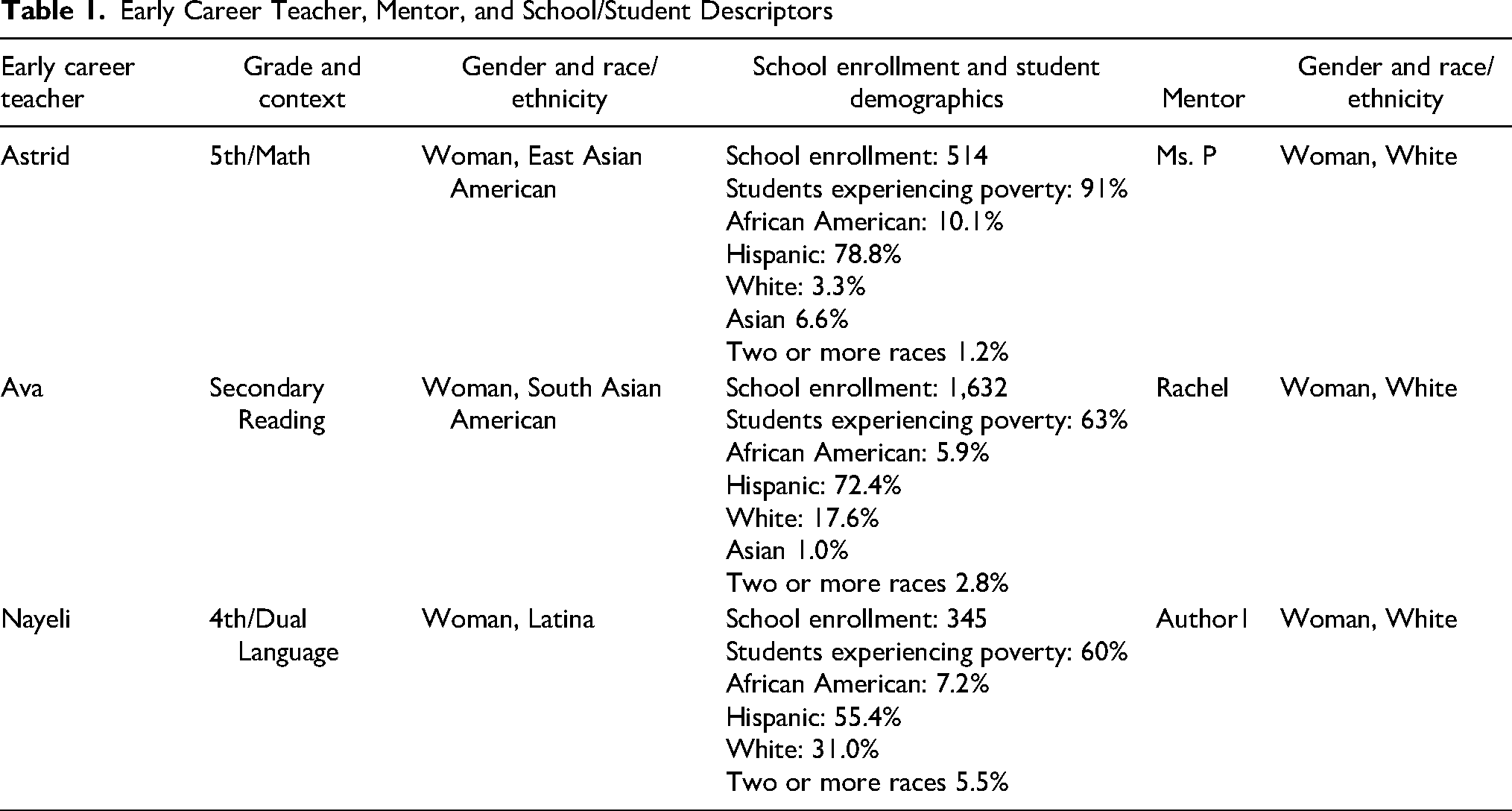
We employed qualitative case study (Thomas, 2016) and critical narrative analysis methods (Souto-Manning, 2014) to address the research questions guiding our inquiry. Case study provided a framework for organizing the data and analysis into cases of early career TOC/mentor pairs. Critical narrative analysis afforded an analytic tool to examine the research question. In this paper, the “case” includes three early career TOC (mentees) who identified as East Asian American, South Asian American, and Mexican American/Latina and their mentors who each identified as white cisgender women. The mentees taught in three different schools in a large urban school district with a racially, ethnically, and linguistically diverse student community (Table 1).
Early Career Teacher, Mentor, and School/Student Descriptors
Context
Data were collected as part of a larger study focused on university-based induction support designed to reduce teacher attrition among early career teachers in high-need schools where more than half of students were experiencing poverty. Throughout the 2019–2020 academic year, 15 graduates of the university's teacher education program (TEP) received support from teacher educators who served as mentors through a grant-funded pilot program. These mentees identified racially as Black, Latinx, Tejano, Mexican American, Asian, and white. All mentees were paired with a mentor, each of whom had at least nine years of experience as either a K-12 classroom teacher, teacher educator, or instructional coach and was trained to use a reflective model of coaching (Mosley Wetzel et al., 2017). Mentors met with mentees each week in-person and then shifted to virtual forums at the onset of the pandemic in March 2020. Apart from one person, all mentors identified as white cisgender women. While the induction program focused on general teaching practices (e.g., differentiation, navigating burnout, etc.), mentees were asked to tell their mentors the specific problems and areas for which they wanted support.
As a part of the larger study, we interviewed all mentors and conducted two in-depth semi-structured interviews with each mentee. We also collected observation logs written by mentors following their observations or meetings with their mentees. Our analysis indicated that mentoring stances of appreciation and co-learning were crucial to addressing the range of challenges experienced by early career teachers (Maloch et al., 2022). Because racial mismatch was a characteristic of more than half of the mentor/mentee pairs, we wanted to further explore how cross-racial mentoring influenced, affected, and/or alleviated those challenges. As we neared the conclusion of analysis for the larger study, we invited the mentees of color who had been assigned a white mentor to participate in a new follow-up study. The participation of the three mentees in this follow-up study was voluntary, and their narratives of cross-racial mentoring are the focus of this paper.
Data Sources
Sources of data for this analysis included the two in-depth semi-structured interviews collected as part of the larger study and a focus group interview conducted in the follow-up study. In the first round of interviews, we asked mentees about their first year of teaching and their mentoring experience. In the second round of the interviews, we returned to topics discussed in Interview 1 and asked them to tell us more about their social identities (race, ethnicity, gender). The interviewees did not talk about race in either Interview 1 or 2, a pattern we attributed to both politeness discourses that commonly evade race (e.g., Bonilla-Silva, 2006; Kohli et al., 2017), as well as our own data collection methods that did not explicitly ask about racial mismatch given our broad focus on challenges in early career teaching.
After the three participants agreed to participate in the follow-up study, we conducted an additional one-hour focus group interview to identify the support and concerns mentees of color experienced with their white mentors. To begin the conversation, we racially identified ourselves and the ways our racial identities connected with our work in teaching and the induction program. Then, we specifically asked mentees to share what it was like to work with their white mentor during their first year of teaching. We also reviewed observation logs recorded by the mentors that summarized their ongoing interactions with their mentee to situate the mentees’ stories within the larger context of the year-long induction program and to verify our observations.
Critical Narrative Analysis
We used Critical Narrative Analysis (CNA) (Souto-Manning, 2014) as an analytic tool in three distinct phases of analysis. In Phase One, we began by segmenting interview transcripts into narratives and identified 29 narratives about the experience of being mentored as a first-year teacher. While the narratives differed across participants, we identified some narratives that were structurally longer or contained multiple short stories. We tentatively labeled these “primary narratives” as they appeared to represent moments of mentoring that were important and/or memorable to the participants.
In Phase Two, we began a thematic analysis to identify the content of the primary narratives by asking, “What is the story about?” (Rogers & Mosley Wetzel, 2013). Specifically, we were interested in examining the needs or kinds of support mentees sought from their mentors. For example, Nayeli, Astrid, and Ava told stories about needing support with classroom management, lesson planning, and navigating formal evaluation observations conducted by administration—needs that are typical among many teachers who experience challenges in their first year of teaching (Podolsky et al., 2016). We knew from our focus group interview, however, that Nayeli, Astrid, and Ava also faced the additional challenges of experiencing and dealing with racism during their first year of teaching, which none shared with their mentors as areas where they needed support. Thus, thematic analysis provided us an opportunity to examine the kinds of teaching practices that were valued either by the teacher, mentor, or school community and to assess how such practices aligned with or challenged whiteness.
Finally in Phase Three, we began critical discourse analysis to analyze how macro-level institutional discourses were being reproduced or challenged in the stories participants told about their mentoring experiences. To do this, we conducted a sentence-level analysis of each narrative to determine how speakers took up or challenged institutionalized discourses of teaching by noting their pronoun selection, use of the passive or active voice, and the use of silence to unmark or exclude information (Rogers & Mosley Wetzel, 2013). For example, we viewed the use of a subject + verb construction (e.g., “I am good at building student relationships) as an indication of “grammatical agency,” or moments in a story where the speaker assumes an active stance of having control and being capable (Souto-Manning, 2014). In contrast, we viewed the passive construction of an idea (e.g., “[My mentor] helped me to get where I needed to be”) as moments of “framing agency” where participants framed or compared themselves in relation to existing standards or norms (Souto-Manning, 2014). We also identified moments of Critical Meta-awareness where the participants began to name “social construction of the realities in which they live” and speak back to discourses of whiteness (Souto-Manning, 2014, p. 164). These moments occurred almost exclusively in the focus group interview when they were asked specifically about how race was operating in their first year of teaching and in their mentoring. In the findings, we share our analysis as it relates to the primary stories that were identified in Phase One and present our findings as three cases in order to illuminate each educator's experiences and be true to the complex realities they were navigating in their individual schools and classrooms.
Results
Through analysis, we found that the mentees told overwhelmingly positive stories about their mentors and were satisfied with the help they received in their first year of teaching. We also found, however, that in seeking to enact normative teaching practices (e.g., classroom management, test preparation instruction), the mentees came to assess themselves, and at times their students, through a lens of whiteness, seeking to enact teaching as white property. Across our three cases, we illuminate specific attributes of whiteness that were sought after by the three participants: Astrid turned to her white mentor, Ms. P, for her expertise on classroom management; Ava turned to her white mentor, Rachel, for her expertise in navigating successful performance evaluation observations; and Nayeli turned to her white mentor, Annie, for her expertise in making space in her curriculum and instruction for test preparation. Across each case, we demonstrate that in seeking to enact normative, white ways of being teachers, the three early career TOCs’ own racial and cultural perspectives were silenced and the ways they experienced racism were kept out of the mentoring relationship.
Case #1 Astrid: “Ms. P Helped Me to Get to Where I Needed to Be”
Astrid met her mentor, Ms. P, at the start of the induction program. Ms. P was a veteran teacher with 31 years of experience, and Astrid referred to her mentor using the formal “Misses” title, showing deference for her mentor's authority as an experienced teacher. Astrid described Ms. P as a “great help” and shared that Ms. P “made a big impact on me in helping me through … my first year [of teaching].” One way Ms. P appeared to make such a significant impact was that she was consistently available to visit Astrid in her classroom, occasionally helped Astrid plan lessons over the weekends, and talked with Astrid on the phone when immediate questions or concerns would arise.
Astrid recalled that she and Ms. P did not explicitly discuss their racial identities, nor did they ever name race in relation to the students or the curriculum. Rather, Astrid set the agenda for the type of work she wanted help with, which in her case was mainly improving classroom management. Interestingly, the teacher education program from which Astrid graduated did not use the term “classroom management” given its close association with practices that correct student behavior through discipline. Rather, her TEP utilized a community framework that emphasized relationship-building and mutual care to teach alternative methods for creating a productive learning environment for students (e.g., Gibbs, 2006; Shalaby, 2017). Despite this training, which challenged the effectiveness of traditional classroom management strategies, Astrid embraced the concept as a first-year teacher in seeking support with her mentor. This switch from critical to more standard practices is common among first-year teachers who frequently face pressure from colleagues or administrators to demonstrate their authority and ability to maintain control of the classroom as novice teachers (Bettini et al., 2022).
Across the seven narratives that Astrid told about her mentoring experience, she repeatedly addressed the tension and stress she felt in building relationships and developing a feeling of community with her fifth-grade students. Specifically, Astrid articulated that she felt like her “classroom management was off” and turned to her mentor for support and guidance. In the following narrative excerpt, Astrid shared one moment that illustrates Ms. P's availability to support her in addressing perceived problematic student behavior. I had a problem with a student. It was really bad. I would call [Ms. P] and she would hear the situation and actually gave me advice that actually helped. She made me feel better. […] If she wasn't there … I don't know if I would still be mentally okay with my job. She's been a great help. I don't know how I would make it through the year without her. (3/16/20)
Astrid explained that one of the reasons Ms. P's help was particularly valuable was because Ms. P came to visit multiple times and helped her and the students establish routines and procedures to create a feeling of community in the classroom, like a whole-group morning meeting to start each day. Astrid described this mentoring as a gradual release of responsibility where Ms. P first modeled the classroom meeting. Next, Ms. P and Astrid co-facilitated the morning meeting. Then Ms. P observed Astrid facilitating the classroom meeting on her own. Astrid shared that Ms. P would “come in and observe my classroom and give me feedback, like on the spot.” These observations were followed by a lesson debrief where Ms. P provided Astrid with “helpful tips” she could implement immediately as well as ideas that she could try in the future. Across each narrative, Astrid emphasized her appreciation for Ms. P's physical presence in the classroom. Well, definitely like Ms. P, she was a great help. She came into my classroom to just observe what was going on. Because I felt really stressed [and] overwhelmed. I felt like my classroom management was off. I felt like my kids weren't learning anything. I just felt like nothing I was doing was getting through. (3/16/20)
Analyzing this narrative through the theoretical lens of white property, we see a less positive view of the mentoring relationship than Astrid described. “Classroom management” has been constructed by dominant (i.e., white) culture as an undisputed, race-neutral practice indicative of excellent and effective teaching (Callahan, 2016). Yet classroom management is not race-neutral. The practices of classroom management are directly tied to a history of racial violence in the U.S. where white people enslaved, controlled, and continue today to police the bodies of Black, Indigenous and other people of color (Adair & Colegrove, 2021). Yet for Astrid, achieving success as first-year teacher appeared more closely tied to accessing and incorporating traditional elements of classroom management that are associated with whiteness into her practice rather than addressing the racial injustices linked to them. By physically showing up to her classroom, Ms. P was able to show and apprentice Astrid into classroom management and by extension, whiteness.
Using Critical Narrative Analysis (CNA), we also examined what was left out or silenced in Astrid's narratives, particularly an account of why building relationships was challenging. In the stories Astrid told in her first two interviews, a description of the racialized and sociopolitical context where Astrid worked as the only East Asian American teacher in a predominantly Latinx school community was absent. In the final focus group interview, Astrid revealed that race was a factor that both she and her students were navigating. For example, at the start of the pandemic, students made racist, derogatory remarks towards her, which she was pedagogically and emotionally unprepared to handle: “The thing is, when the kids make racist remarks, it's like, I just feel shock (sic). You know, I feel shock in the moment and it takes a couple of minutes for me to process it.” Rather than discuss these experiences with her mentor, Astrid remained silent.
Although Astrid did not explicitly share why she elected not to share, she described the unfair advantage Ms. P had to help improve students’ behavior. I feel like, with Ms. P, of course she had years of experience. But I also feel like, being an older white woman, she would already have more respect from students than for me, because kids are more used to seeing old white women as teachers than seeing a young Asian teacher. So, I just feel like, already, it's like she would have more respect than I would. But she definitely helped me to get… Ms. P helped me to get where I needed to be in my first year of teaching. (3/16/20)
Case #2 Ava: “She Helped Me Plan the Perfect Lesson”
Unlike Astrid, Ava had an established relationship with her mentor, Rachel, prior to the start of the induction program. Ava first met Rachel as a teaching assistant (TA) in the university's secondary teacher preparation program, which focused explicitly on race and justice in teaching. In the courses where Rachel was the TA, Ava recalled that, “we talked about race all the time… [Rachel] definitely acknowledged her whiteness and how that affect[ed] how she view[ed] the world.” Ava also noted that Rachel did all of this “beforehand” and in the context of induction, Ava did not express a need or reason to speak further with Rachel about whiteness, her racialized experiences, or the identities of the predominantly Black and Latinx students that she taught.
In our analysis, we identified ten narratives in which Ava reflected on her mentoring experiences. Across the narratives, Ava described mentoring with Rachel as a success because Rachel was a “great resource,” her “cheerleader,” and a “designated person” she could “vent to” and “lean on” for emotional and pedagogical support. Like Astrid, Ava appreciated that Rachel visited her classroom and gave encouraging feedback on her teaching. Rachel [observed] and recorded my class and then we watched the recording together. We talked through the successes and challenges. And when she came into my class, it was a time where I wasn't feeling confident at all with my teaching. I was really, really struggling. I think she really helped point out all the good things that were happening. Because it's really easy to just go hard on yourself…I think just hearing that from anyone, but especially from a record[ed] observation where she was physically there, that just helped me feel more confident and feel better about my actual day-to-day teaching. (4/30/20)
Ava also shared in multiple narratives that Rachel provided her lesson planning support prior to the formal observations that administration conducted. Ava recalled being “freak[ed] out” and intimidated by the prospect of preparing a lesson that would be evaluated on the school district's performance rubric. She explained, “I remember one time, I was getting observed and I was really nervous and [Rachel] planned out with me the perfect lesson. The planning support was just super productive for me.” Here, Ava invokes discourses of perfection (“she helped me plan the perfect lesson”) and productivity (“The planning support was super productive”), dominant discourses that are often recycled and normalized in the teaching profession, even though both pursuits (e.g., perfection, productivity) can lead to burnout and unmanageable workloads (Nagoski & Nagoski, 2020). In concluding this narrative, Ava emphasized that working with Rachel helped her feel more “secure” and as a result, the formal observations “always went well.”
When viewed through the theoretical lens of white property, we can better understand why, as the driver of the mentoring relationship, Ava used Rachel's help to ensure compliance with standardized performance evaluations. Ava taught Secondary Reading, a required English course for students who “either failed the English (State Standardized End-of-Year assessment) [or] they were just identified as having lower reading levels” (Interview). Ava explained that her students found particular literacy assignments “overwhelming” and tended to “give up very easily.” Within this context, standardized performance evaluations from administration were especially stressful for Ava because she needed to demonstrate her proficiency on pre-set standards used by the district regardless of her students’ specific needs. The performance evaluation used by her administration, like most standardized performance evaluations, reflected teaching practices that meet the needs of students who belong to dominant white culture (e.g., standardized testing) and are created by those with power in dominant white culture (e.g., policy makers, district leaders) (Souto-Manning, 2019). Thus, to do well on her evaluations and demonstrate her proficiency as a first-year teacher, Ava needed to acquire and make the instructional practices on the evaluation her property and explained that she wanted to prepare a “perfect” lesson that would be favorably judged by her administration.
Using CNA we can examine what is unsaid or left out of Ava's narratives, which in this case would be an explanation of why she felt insecure and under pressure to have “perfect” lessons in her first year. In the final focus group interview, Ava disclosed she was the only South Asian American teacher on an all-white team of teachers in the English department at her school. In the following narrative, Ava describes the challenges of being the only teacher of color, namely that she experienced loneliness and felt isolated from her white colleagues. I only really noticed this more recently [but] I didn't explain [to Rachel] how I felt a little alienated at my school. I felt my school was very cliquey. I'm in the English department. I believe every single teacher is white, if I'm remembering correctly. I really struggled with finding close community within my teacher group and feeling weirdly alienated about that. But I never explicitly brought that up to my mentor. I think I just thought, “I'm new. Of course, I'm not going to feel close to people. I'm new.” And then another new [white] teacher came in, and she was close to people. I think I just started noticing different ways in how I felt alienated. (8/25/21)
Case #3 Nayeli: “That's Not a Normal Experience”
Nayeli and her mentor, Annie [Author], met two years prior to the start of the induction program in the university TEP. Annie served as a teaching assistant and later instructor for three of Nayeli's courses and was also Nayeli's field supervisor during her year of student teaching. Nayeli shared that she enjoyed having a mentor from the TEP because Annie had been with her throughout her “entire teaching journey.” She explained, “Annie was my mentor. We've been together for so long that, when it came down to my first year, I didn't have to re-explain everything. She kind of came in and I was like, ‘Here are the things I need help with,’ and she would sit down with me and we would work through it.” Specifically, Nayeli liked discussing with Annie how to implement her goals for teaching, which included student-centered, culturally relevant pedagogy.
In our analysis, we identified 12 narratives Nayeli shared about being mentored by Annie. Nayeli viewed having access to a mentor from her previous TEP as “vital,” particularly because she recognized that many of the ideas and pedagogies from her TEP were often at odds with the values and types of instruction required by her school, the district, and state standards. For example, Nayeli's fourth-grade students were required to take the standardized assessments in writing and reading at the end of the school year. The suggested approaches for literacy instruction included isolated skill practice, writing prompts, and the reading of test passages (Davis & Vehabovic, 2018). These practices were at odds with Nayeli's vision for literacy instruction, which included using multicultural literature, offering students choices to read and write about topics they care about and were interested in, and providing individual feedback to help students develop reading and writing skills (National Council of Teachers of English, 2022). Nayeli expressed she felt “a lot of tensions [with] balancing … all of the heavy grammar and formulaic expository writing with Writers Workshop time” and “giving the kids what they need to pass the [State] test, while still helping them grow as writers.” Nayeli used her mentor to figure out a “structure” for her instruction so things would run “more smoothly.” I didn't know how I really wanted to structure everything, but Annie really helped me with that. We sat down [and] … picked apart all the things that I thought were really important, the things that I wanted to do in my classroom… [Then] we would look at the [District Curriculum Units] and talk through like, ‘Here's the [Standards] we need to cover. Here's a way that we could order them. Here's how we could teach the different skills and strategies. (3/24/20)
Despite Nayeli's attempts to integrate student-centered teaching approaches into a curriculum that would prepare students for the state standardized assessments, she faced criticism from her administration. Nayeli described how she experienced surprise or unannounced observations from her administration who came to check on her during her first year. Nayeli was also required to submit lesson plans each week which were then reviewed and sometimes returned for revisions. While spontaneous observations and lesson planning requirements may not be uncommon for early career teachers, many TOC experience feelings of “hypervisibility” and are watched and surveilled closely by administration as compared to their white peers (Amos, 2020). Once, Nayeli was asked to rewrite a week of lesson plans after her principal determined they were insufficient because the learning activities deviated too far from test preparation. In the following narrative excerpt, Nayeli describes how her mentor supported her through this difficult time. One of the times Annie really came through though [for me] was after a really tough meeting with my principal. I wasn't in a good space to redo my lesson plans like I was supposed to. Annie was like ‘I got this’ and she helped me type out my lesson plans and it was good because I did not have the brain power or energy to do it. And she just said, ‘I got you’. (1/26/21)
In the focus group interview, Nayeli told a similar story about her administration when discussing challenges, she experienced as a first-year teacher. However, in this telling, Nayeli added that unlike the other mentors, Annie named race by suggesting that the administration's acts were racist. Annie deviated from the coaching model where mentees were supposed to drive the focus of mentoring by initiating a discussion about racism that Nayeli did not ask for or authorize. Annie would sit down with me and we would work through [things I needed help with]. I would tell her a story like, ‘This happened [and] I'm annoyed by this.’ And she [would say], ‘Hey, that's actually not a normal experience. That sounds like there's some racism going on there.’ And I would say, ‘No. I don't know, maybe.’ Then I would work through and process it, and [say], ‘Oh shit. You're right, that's not a normal experience. That's not something someone should be telling me or doing [to me]’. (Slower) But that was my norm. (8/25/21)
Repeated throughout the narrative is a debate about what is “normal.” Annie frames the problem of racism through a lens of whiteness in which unfair discrimination and harm is “not a normal experience.” Nayeli views her experiences differently. For Nayeli, negative, racist encounters with administration were the “norm.” Although Nayeli acquiesces and seems to agree with her mentor that the actions of her administration were wrong (“That's not something someone should be telling me”), the story ends in a way that contrasts with Nayeli's earlier, upbeat narratives. Here, Nayeli does not use the active voice, and her pace slows as she reaches the end of the narrative. The disruption of race-evasion initiated by her mentor creates a shift—Nayeli no longer positions herself as the protagonist in a story where she can find success as a first-year teacher because she cannot control the negativity, hate, and micromanagement she encounters with her administration. While race-evasion in the previous two cases was a problem that left mentees without a space to process their racialized experiences, this instance of race-conscious mentoring does not appear to generate a constructive or supportive dialogue. Nayeli's shift away from grammatical agency raises important questions about how white mentors can call out racism in a way that leads to a generative conversation with mentees, a question we further discuss in the upcoming implications section.
Discussion
Mentoring partnerships between new and more experienced educators have been analyzed to offer more intentional, structured support to new teachers in the beginning years of teaching (e.g., Bastian & Marks, 2017). However, very few studies have accounted for race in these mentoring partnerships and examined the specific effects of cross-racial mentoring on teacher retention. Given that most teachers and teacher educators are white women, TOC will likely encounter white mentors early in their careers, creating a need to understand how cross-racial partnerships can address challenges brought on by systemic inequalities (e.g., racism, increased administrative scrutiny, under resourced schools in high-poverty neighborhoods) that often push TOC out of the profession (Walls, 2022).
To address this gap in knowledge, we examined 29 narratives early career TOC told about being mentored by white teacher educators. Using CRT and CNA, we found that mentoring occurred through largely race-evasive discourses that privileged discussions about teaching and left little space or reason to address the overt forms of racism mentees experienced (stereotyping, hypervisibility, isolation) during their first year of teaching. The early career TOC mostly praised their mentors for providing them with quick, dependable support in the form of classroom observations and assistance with lesson planning. This finding aligns to previous studies on mentoring in the induction years where new teachers often need support with the “basics” (e.g., lesson planning) to successfully get through the first year (Podolsky et al., 2016). What our study adds to this literature is the finding that by privileging the “basics” and normed ideas of “success,” while also avoiding any discussion about race or racism, cross-racial mentoring allowed whiteness to persist. That is, notions of success were tied to whiteness in the forms of standardized teaching practices and classroom management that function to serve and benefit white teachers and students. As stated earlier, these three early career teachers graduated from a teacher education program that valued reflection and action and positioned student teachers as having agency in their field experiences. Despite these opportunities to lead their own learning then and now, these three TOC expressed a strong desire to be perceived as strong teachers in their first year of teaching, and thus they prioritized mastering the standards or basics of teaching - “good” classroom management, “good” teacher evaluation, and “good” scores on the state's standardized test.
From our interviews and interactions with Astrid, Nayeli, and Ava, we understood these desires to be recognized as “good” teachers through the perspective of critical race theory, specifically Harris’s (1995) conceptualization of whiteness as property. To be successful as first-year teachers, we found that Astrid, Ava, and Nayeli worked with their mentors to assess themselves, and at times their students, through a lens of whiteness and to enact teaching as white property. Importantly, Astrid, Ava, and Nayeli, narrated their identity as teachers separate from their identities of women of color during our interactions. It is only when we explicitly asked them to consider their racial and cultural positionalities did they open up and share about both the silence in naming race and racism in their mentoring relationships, as well as the rationale for these silences. The mentor teachers were, it seems, supporting the ECTs with what they deemed more urgent, mastering the basics, in their first year of teaching.
These findings offer empirical evidence to make a critique of reflective models of coaching. While previous literature has examined the benefits of reflective coaching, which include empowering early career teachers to set the agenda for their own growth and development (Maloch et al., 2022; Kim & Silver, 2016), we found that such a model did not equip either the mentors or mentees with knowledge or skills to disrupt dominant, colorblind discourses that ignored and/or silenced racism even when it was obvious in the lives of the early career TOC. The intention of putting mentees in the driver's seat of mentoring discussions may be to empower them with choice and agency. However, the impact of such a model was that it unfairly placed the responsibility on Astrid, Nayeli, and Ava to talk with their mentors about systemic and individual racism. As noted in Table 1, Nayeli, Ava, and Astrid all taught at schools with a large percentage of the student body identifying as students of color. As we continue to reflect on the contexts in which these TOC taught, we wonder what their concerns were in explicitly naming the racial identities of their students in their concerns about behavior and success in the test. Similarly, the mentors who were trained in this model were not prepared to disrupt dominant norms of race-evasion and foster healthy and supportive conversations about race and racism with their mentees (Sealey-Ruiz, 2021). Again, as critical race theory and the tenet of whiteness as property makes clear, racism exists in the silences and common-sense assumptions with such norms as people are people thinking. In other words, both the TOC mentees and the white mentors chose to not name race in order to avoid implicating themselves as racist. Thus, our findings suggest that simply supplying teachers of color with (white) mentors who employ standard, race-evasive coaching practices is not sufficient to support and retain teachers of color who enter a profession that is dominated by whiteness. Based on these findings, we argue that mentoring models should be revised so race-evasive discourse practices are not the norm for cross-racial pairs.
Implications
We view the outcomes of this research as a reason to support an emerging line of research on critical professional development (Kohli, 2019) and critical mentoring (Walls, 2022). While induction programs and mentoring relationships have the potential to improve teacher retention, we caution against using “race-neutral” discourses and organizational structures if the goal of universities and schools is to reduce attrition rates among teachers of color. Our findings suggest that university-based induction programs in urban settings should move toward incorporating critical mentoring that aims to “cultivate culturally situated, justice-focused mentored relationships… by using racial, cultural, and social identity as a focal point, and situating exploration of these phenomena in a critical race lens” (Walls, 2022, p. 462). In other words, rather than defaulting to institutionalized norms of whiteness, critical mentoring must begin with a focus on the cultural knowledge, assets, and professional aspirations that teachers of color bring to the profession. Critical mentoring also encourages both mentors and mentees to discuss race and racism to address the root causes of injustices in school (Weiston-Serdan, 2017).
Early career teachers of color also need opportunities to access ongoing, dedicated spaces to discuss their racialized experiences in schools, such as critical professional development and racial affinity spaces (Kohli, 2019). It was only when we racially identified ourselves to the mentees and explicitly asked Astrid, Nayeli, and Ava about race did we learn about the discrimination, exclusion, and harm they faced in their first year of teaching. Naming race was a first step, but a conversation about racism with Saba [Author], a faculty member of color, resulted in a generative discussion that moved towards addressing and healing racial harm. Thus, we see benefits of racial affinity or same-race groups for teachers of color and mentors of color to process racialized experiences without being made to feel “other” in the predominantly white profession. We also recommend racial affinity groups for white teacher educators who can benefit from discussing their racism and relationship to whiteness with other white people without relying on the intellectual and emotional labor of people of color. The goal across all groups should be to develop knowledge and skills to confront and resist racial oppression in the context of K-12 schools (Sealey-Ruiz, 2021).
Finally, we recognize that within the field of teacher education, nearly 80% of teacher education faculty are white and thus there is an urgent need for white mentors to increase their capacity as antiracist teacher educators and strengthen their cultural competence (Gist et al., 2021; Morales et al., 2022). We also recognize that even for teacher educators like Annie, who came to mentoring with critical race knowledge and had experience with critical race talk, that the work of cross-racial mentoring is complex because it is situated within racist structures and ideologies that persist in educational institutions. When Annie identified Nayeli's experiences as “not normal” and named racism, this move did not generate action or further insights that empowered or protected Nayeli from future harm. Therefore, while we do not recommend that white mentors avoid discussions about race or racism, we suggest a different approach that considers the stress that TOC experience as they navigate multiple demands and challenges in their first year of teaching. For example, mentors can ask if mentees have the capacity to discuss a racist incident (e.g., “Your administration seems to be micromanaging you, which seems unfair and racist to me. Do you have the energy, interest, or emotional bandwidth to discuss that?”). Mentors can also connect mentees with other faculty and community groups of color who may feel better equipped to discuss racialized experiences (e.g., “I also understand that as a white person, I may not be the best person to support you. Is there someone else who you would like to process this with? I can also introduce you to…”). These practices offer a more humanizing approach by attending to the emotional well-being of early career TOCs and creating multiple options to explore issues of race within and outside of cross-racial mentoring.
Conclusion
Teacher shortages, exacerbated in part by a global pandemic, are a pressing concern across the U.S. (Sutcher et al., 2016). Mentoring during the induction years continues to gain traction as a viable method to support early career teachers and reduce attrition, particularly in high-need school communities in urban contexts (Reed et al., 2022). In this study, we learned three early career teachers of color were forced to deal with racial aggression and racism alone, despite having a formal mentor. Our findings and analysis highlight the importance of bringing race and racism to the forefront in university-based mentoring practices in ways that address and challenge the racial harm that early career TOC experience as they enter a profession normed around whiteness.
Footnotes
Declaration of Conflicting Interests
The authors declared no potential conflicts of interest with respect to the research, authorship, and/or publication of this article.
Funding
The authors received no financial support for the research, authorship, and/or publication of this article.
