



Abstract
The Detroit Promise Path program combines a tuition guarantee with additional support services to help students stay in college. Using qualitative data, we explore the student experiences with the program, as well as barriers that students faced in completing college. We use geocoding software to calculate students’ drive times to their college. We find students benefit from proactive outreach messaging, success coaching, and financial incentives to participate in the program—yet they still face significant nonacademic barriers including transportation and non-tuition expenses that make it difficult for them to persist and earn their degree.
Community colleges play a critical role in expanding access to higher education, yet they report low overall graduation rates. Rather than a lack of student potential, this reflects a complex interplay of structural and institutional barriers that many students must navigate. Compared to 4-year institutions, community colleges serve more students with low incomes and who are the first in their families to pursue higher education (Fink et al., 2023; Moschetti & Hudley, 2015). Community colleges also serve a high proportion of Black students, who might encounter challenging experiences in college, including subtle and overt racism on campus (Harper & Simmons, 2019), particularly when enrolled at predominantly White institutions (Lewis et al., 2021). Prior research also shows that Black students, in part, make their college enrollment choices based on their perception of how supported they will be at the institution, but that students’ ultimate college selections may depend on their circumstances—physical residence, urbanicity, and first-generation status—rather than outright choice (Hilton & Bonner, 2017).
All students seeking college degrees must overcome a gauntlet of systemic issues, including complex financial aid paperwork, multistep enrollment processes, and disheartening remedial education referrals, among other issues (Dynarski et al., 2023). At the same time, open- and broad-access institutions, especially community colleges, are underfunded to provide students with the kinds of support services proven in research to improve persistence and graduation rates (American Association of Community Colleges, 2025; Kahlenberg, 2015).
Nationally, the on-time graduation rate for first-time, full-time students in community colleges is about 20%, a figure that rises to only 35% by the 3-year mark (National Center for Education Statistics, 2018). In many urban communities, including Detroit, MI, that rate is even lower. Detroit is considered the poorest and most segregated city in the United States (Farley et al., 1994; Logan & Stults, 2011; Menendian et al., 2021). The city has been shaped by a history of racism, deindustrialization, and population decline, which has, in turn, shaped the experience of its students (Boyle, 2001). Seventy percent of Detroit households live below the poverty line (United Way, 2021). Only 17% of Detroit's young people ages 24–34 years old hold a college credential—half the national average (National Center for Education Statistics, 2018).
Over the years, several programs have been established to broaden college access for Detroit students. This paper presents a combination of qualitative and quantitative data originating from the implementation of a randomized controlled trial (RCT) study of the Detroit Promise Path (DPP), a student success program built into a place-based scholarship serving 2-year college students in the greater Detroit metro area. We first provide context for our work in Detroit by studying the application of evidence-based student supports from other colleges across the country. We also summarize the findings of the randomized study, looking at college persistence and completion outcomes for students who received the DPP program. The main purpose of this paper is to describe aspects of the program that worked well for students and where the program might have fallen short, by elevating the voices and lived experiences of DPP students, both their successes and challenges within higher education. We quantify barriers that they faced by measuring how issues like transportation intersected with students’ postsecondary access and persistence. Finally, we discuss policy implications and areas for future research to improve outcomes for historically marginalized students in Detroit and similar contexts.
Background
Nationwide, only about 20% of first-time, full-time community college students graduate within 2 years of starting, and students of color, first-generation students, and students from low-income families graduate at even lower rates (NCES, 2022). Researchers point to income—particularly students’ ability to pay for housing, food, and transportation as some of the sources of student departure from community colleges (Hart, 2019). At the same time, community colleges, which are often open-access institutions, are historically underfunded, with limited resources to support their student population (Trainor, 2015). In Detroit, these systemic barriers are especially salient. The city's history of geographic segregation caused by White Flight from the city to the suburbs has led to vastly different life experiences and economic possibilities for the predominantly Black families living in the city's urban core compared to the predominantly White families in the surrounding suburbs (Mirel, 1998). The school district boundaries for Detroit's K-12 students fall sharply along city lines, disconnecting the city from the suburbs and further facilitating segregation, a practice that was reaffirmed in the 1974 Milliken v. Bradley decision that ended bussing across district lines as a desegregation practice (Holme et al., 2016). Modern-day educational experiences for Detroit students are still shaped by these historical structures, limiting students’ access to many schools in the suburbs (Singer & Lenhoff, 2022). Understanding education in urban areas requires an understanding of context—place, time, and the myriad out-of-school factors that impact the students experience (Welsh & Swain, 2020).
While the majority of Detroit city residents are Black, the student populations at the five community colleges in the broader metro area are predominantly White. This means that, once on a college campus, Detroit students may face additional hurdles such as self-doubt, a sense of not belonging, stereotyping from faculty or other students, and both subtle and overt racism on campus (Harper & Simmons, 2019; Lewis et al., 2021). These challenges are further amplified for students who attended predominantly Black high schools in the city and now must adjust to the environment at their predominantly White colleges in the suburbs (Owens et al., 2010). A high percentage of Black college students come from lower incomes and take on employment while attending college—many working full time or multiple jobs while enrolled (Bivens & Wood, 2023), presenting additional challenges for students pursuing a college education.
Promise Programs in Michigan
Over the last two decades, urban areas across the country have embraced College Promise initiatives—place-based scholarship programs—as a way of fostering a college-going culture and increasing college access and persistence (Miller-Adams, 2015). While the structures of Promise programs vary, most are specific to a geographic location and to select participating postsecondary institutions (Millett et al., 2020). The Kalamazoo Promise, the first program of its kind in Michigan, showed large effects on postsecondary outcomes, including college enrollment and degree attainment (Bartik et al., 2021). In 2009, 10 communities in Michigan were announced as Promise Zones—guaranteeing a tuition-free path to college for students within each zone (Billings, 2020). Most were focused on Michigan's economically distressed urban communities and seen as an economic development opportunity (Miller-Adams, 2015). While the promise of free tuition was common across all zones, individual localities had flexibility regarding residency requirements and participating colleges.
The Detroit Promise was formally launched in 2013 as the Detroit Scholarship Fund, to help more of the city's high school graduates enroll in college. The Detroit Regional Chamber administers the Detroit Promise scholarship as an educational and workforce development program. High school graduates who live in the city of Detroit are eligible to access scholarship dollars for up to 3 years if they enroll in the program and in college within 1 year of finishing high school. Students are encouraged to enroll in college full time (i.e., 12 credits or more in fall and spring semesters), though this requirement is not enforced, meaning students do not lose the scholarship if they drop below full-time status. The Detroit Regional Chamber and other community stakeholders regularly communicate to high school students citywide that the scholarship is available to alleviate their financial burden and ensure they can afford to attend community college. The Detroit Scholarship Fund operated for 3 years as a scholarship-only program. In those early years, staff members observed that while the scholarship seemed to help more high school graduates enroll in college, large numbers of recipients dropped out before their second year.
College Access, College Promise and Urban Education
Students who attend school in urban areas may find themselves in underserved educational settings, (Taines, 2010). Yosso (2005) notes that urban communities, while often described in terms of deficits, tend to place a strong cultural value on education, with students persevering despite challenges they encounter in the educational system. Building a college-going culture within urban communities is seen as an important practice, which requires strong relationships between the school, families and broader community (Person et al., 2021). Promise programs have been positioned as one method of doing so, as they boost college-going rates and support the development of a stronger culture related to postsecondary education.
On the local level, Promise programs have been linked to changes in urban mobility—making a community with a promise guarantee more desirable and, in turn, affecting the socioeconomic and demographic composition of the community (Leigh & González Canché, 2021). Studies have shown an increase in enrollment in local school districts following an introduction of a Promise program (Hershbein, 2013), as well as increases in enrollment in community colleges that enact the tuition guarantee (Monaghan & Attewell, 2023).
Ecological Framing for the Student Experience
The design of the DPP program and the associated evaluation is centered in ecological systems theory and subsequent educational research that suggests that students’ educational experiences are shaped by political and economic factors beyond the control of students and their families (Lenhoff et al., 2022; Bronfenbrenner, 1976). In higher education settings, ecological theory has been used to describe college campus environments, and student success within those environments (Renn & Arnold, 2003). It has also been used to highlight the feelings of marginalization and targeted microaggressions that students feel despite institutional commitments to inclusion (Chun & Evans, 2016). The design of the DPP program recognizes the complex institutional systems that Detroit community college students must navigate, and the important role that financial, social, and academic supports all play in helping students reach full potential in their college pursuits.
Detroit Promise Path Program
With an eye to helping more Detroit Promise students complete college, the Detroit Regional Chamber incorporated additional evidence-based program components into the Detroit Promise scholarship. To do this, the Chamber partnered with MDRC, a national nonprofit, nonpartisan research organization, to design and evaluate DPP, which added four components to the existing scholarship program. As part of their participation in the DPP, students were assigned a student success coach housed at their intended institution, received a $50 monthly incentive for meeting with their coach as required, and were provided with options and encouragement for continued summer engagement. The role of the success coach and the participation incentive were intended to reflect the fact that out-of-school realities and students’ interactions with the surrounding environment impact educational experiences and development (Renn & Arnold, 2003). Coaching positions were designed to address more than just academic challenges, while the amount of the incentive was tied to the monthly cost of a bus pass in Detroit. The final program element was a management information system (MIS) that automated appointments and text message reminders and tracked student participation and engagement for better monitoring. The program model is shown in Figure 1.
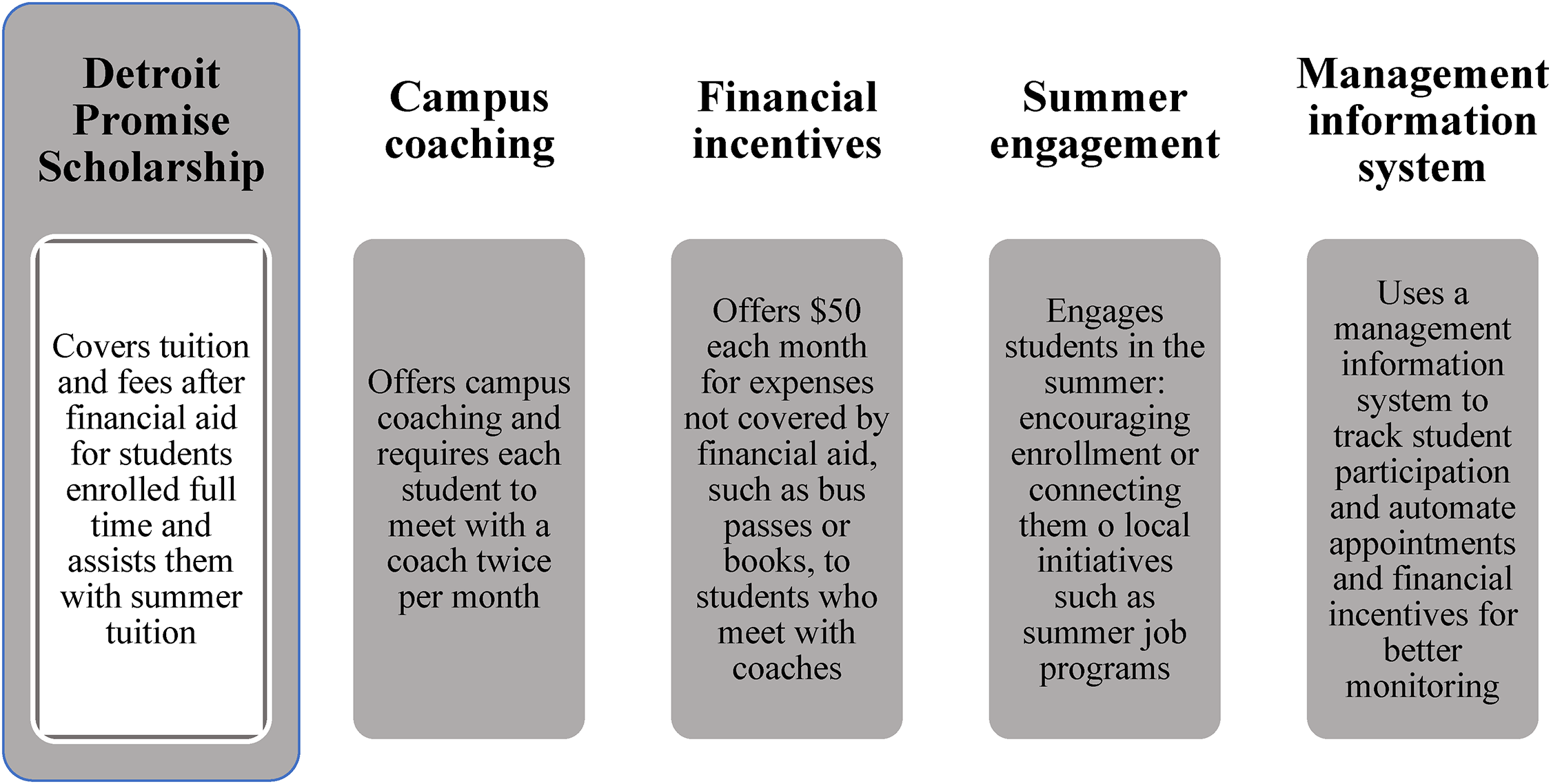
Program Model.
Prior evidence demonstrates that holistic advising can be the key in promoting student success (Dynarski et al., 2023; Vasquez & Scrivener, 2020). Frequent, proactive, and continued outreach, small caseloads, and incentives for participation in advising are key features of successful advising programs (Vasquez & Scrivener, 2020). Additionally, allowing advisors to track and access data on student participation and performance may allow them to adjust outreach and support strategies to meet specific student needs (Mayer et al., 2019).
The final results from the RCT evaluation of DPP found that the program supported students in making additional progress in college but did not impact overall rates of degree or credential attainment (Ratledge et al., 2019; Ratledge et al., 2021). This paper builds on the evaluation results, combining administrative data, survey findings, and focus group and interview data gathered during the course of the DPP evaluation in order to better understand what worked for students, what barriers remained, and what lessons learned should inform future policy and research. By equally valuing and synthesizing all three types of data we identify policy and future research goals that will help DPP and programs like it come closer to meeting the needs of urban community college students.
Data and Methods
In this mixed-methods study, we analyzed administrative, survey, and focus group and interview data collected during the DPP evaluation. Through our iterative approach, results from the qualitative analyses informed the design of subsequent quantitative analyses focused on issues such as transportation. The overall sample for this study included two cohorts of students (823 students in total) who graduated high school in 2016 and 2017 and participated in the DPP program at five community colleges in the Metro Detroit area. Approximately 97% of participating students identified as people of color, primarily as Black. About 60% were women, and 90% were identified as economically disadvantaged based on free and reduced-price lunch eligibility during high school (Brockman et al., 2025).
Administrative Education Records
Data on DPP students’ program participation were linked to Michigan Education Data Center (MEDC) data using their K-12 and postsecondary education records. The MEDC data include a rich set of student background characteristics and the characteristics of their high schools and neighborhoods in 12th grade. 1 We used students’ last recorded census block in 12th grade to calculate the distance, drive time, and public transit time from students’ high school homes to each study college using geocoding software and the Google Distance Matrix and HERE APIs (Google, 2022; HERE, 2022; Picard, 2019; Weber & Péclat, 2022). The MEDC education data include all Michigan students in public and charter schools. The statewide scope of the data also means that we can compare our study sample to their peers from Metro Detroit high schools and at all five participating community colleges. Descriptive analyses of administrative data included calculating summary statistics and cross-tabulations.
Student Survey
During students’ third semester, we fielded a student survey to the full study sample. The goals of the survey were to understand students’ experiences in college, and for the program group students, to understand their experiences in the DPP program. The survey asked 27 questions about students’ first year in college as well as whether they had enrolled in a second year. All students randomized into the program group were invited to complete the survey and were offered a $10 completion incentive. Only surveys with more than half of the questions answered were included in the analysis. The response rate among program group students was 34% for Cohort 1 and 42% for Cohort 2. Descriptive analyses of survey responses included calculating summary statistics and cross-tabulations in Stata. Open-ended responses were coded into categories and analyzed for themes.
Qualitative Data
In order to gain a richer understanding of campus-specific circumstances—i.e., microsystem, mesosystem, and exosystem-level factors identified by Bronfenbrenner (1976) and gain insights that could inform the interpretation of the survey data, additional in-person focus groups were planned on all five college campuses in the first and second years of the study. The research team invited all participating students to attend. In the first year, we held focus groups at three colleges that included a total of 14 students; at the other two colleges, no students attended. In the second year, we once again organized in-person focus groups at all five colleges, but only successfully recruited a group of students to attend the meeting on one college campus. As a result, we shifted to a series of one-on-one student interviews via phone with 11 students during year 2. We identified students to contact for phone interviews through random sampling from the full study sample. Taken all together, our qualitative data includes responses from a total of 27 students across all five colleges. Participants in this study included DPP program student and control group students who were not offered the DPP program. The study sample also includes students who were currently enrolled in college and individuals who were no longer enrolled at the time of the interview. The goals of the qualitative data collection were to learn about students’ college experiences, assess the DPP program's implementation, and assess the treatment contrast, that is, whether supports with similar features to DPP were available to students on each college campus. In addition to students, we spoke with DPP coaches and administrative leadership to learn about implementation fidelity, treatment contrast, and variation in the program over time and by campus. We interviewed the DPP program coordinator every year (3 years in total). All DPP campus coaches also participated in interviews (year 1) and focus groups (years 2 and 3). Notes from all research activities were organized and combined into MAXQDA, with two research team members independently reviewing notes and transcripts to inductively identify themes that occurred in a single interview or across a number of data sources (DeSantis & Ugarriza, 2000). This paper draws out key themes that emerged in participants’ responses, and weaves illustrative quotes throughout the findings, with a particular focus on students’ experiences.
It is worth noting that while the study period did include the onset of the COVID-19 pandemic, all of the data analyzed in this paper were collected prior to spring 2020. Moreover, the pandemic had only a minimal overlap with the delivery of impact the DPP intervention, limited to the spring semester of the second cohort's third and final academic year. In the intervening years, as enrollment in Michigan college stabilizes (Dodge, 2025) and emergency support programs are scaled back, the structural barriers described by the students in this study continue to exist for a new generation of students.
Researcher Positionality
This paper presents findings from a program that was implemented by MDRC and the Detroit Regional Chamber, with authors from Wayne State University and University of Michigan supporting the evaluation through local data collection. All authors are White cisgender women, who bring a history of commitment to identifying and scaling college access and completion strategies for community college students. The two local authors have significant ties to Detroit through their professional and personal experiences. The two authors affiliated with MDRC bring a wealth of expertise implementing programs similar to DPP around the country.
As this study shows, college access in Detroit is intertwined with the city's history of racism and exclusion, and our positions as White cisgender women affect our relationship with study participants and the issues surrounding college access more broadly. To every extent possible, we worked to ensure that our research process was rigorous and responsible to our participants. Utilizing Milner et al. (2025) guiding questions around race reflection positionality, we sought to address imbalances related to race and privilege in several ways. In the precative phase of research, we worked closely with the Detroit Promise staff to design the DPP intervention such that it was responsive to feedback gained from previous Detroit Promise participants. During the interactive phases, coaches’ reflections on students’ experience shaped our survey and interview questions. We interacted with participants during the qualitative data collection phase through recruitment and facilitation of in-person focus groups on campuses. A team of graduate student research assistants supported recruitment, focus groups facilitation, and analysis of participant data; we intentionally included several RA team members from Detroit who helped us interpret the nuances of Detroit's culture and geography in participant answers. Throughout the analysis process, we engaged Detroit Promise staff and success coaches as external reviewers; they confirmed our interpretations of the data and helped us consider the array of implications that stemmed from this work. Finally, in drafting the paper, our motivation became to provide context to the narrative from the RCT study that the intervention was less successful than ASAP programs on which the DPP program was modeled. Guided by the voices and experiences of participating students, we felt the importance of “shifting to the system,” (Milner, 2007, p. 397) drawing attention to the exosystem and macrosystem-level factors that shape college access and success for Detroit students.
Findings
The findings in this study are primarily based on qualitative data, with additional information drawn from RCT results and the implementation evaluation to better contextualize conclusions. Published reports from the RCT evaluation provide the full set of findings related to student outcomes (Brockman et al., 2025; Ratledge et al., 2021). This paper includes an overview of the RCT findings as context for the overall effects of the program. The qualitative findings in this study add depth to the quantitative results by describing the experiences and perspectives of DPP students. This study's findings illuminate several themes that have implications for improving current practice in DPP and similar programs, and that raise questions for future research as well.
Implementation Outcomes
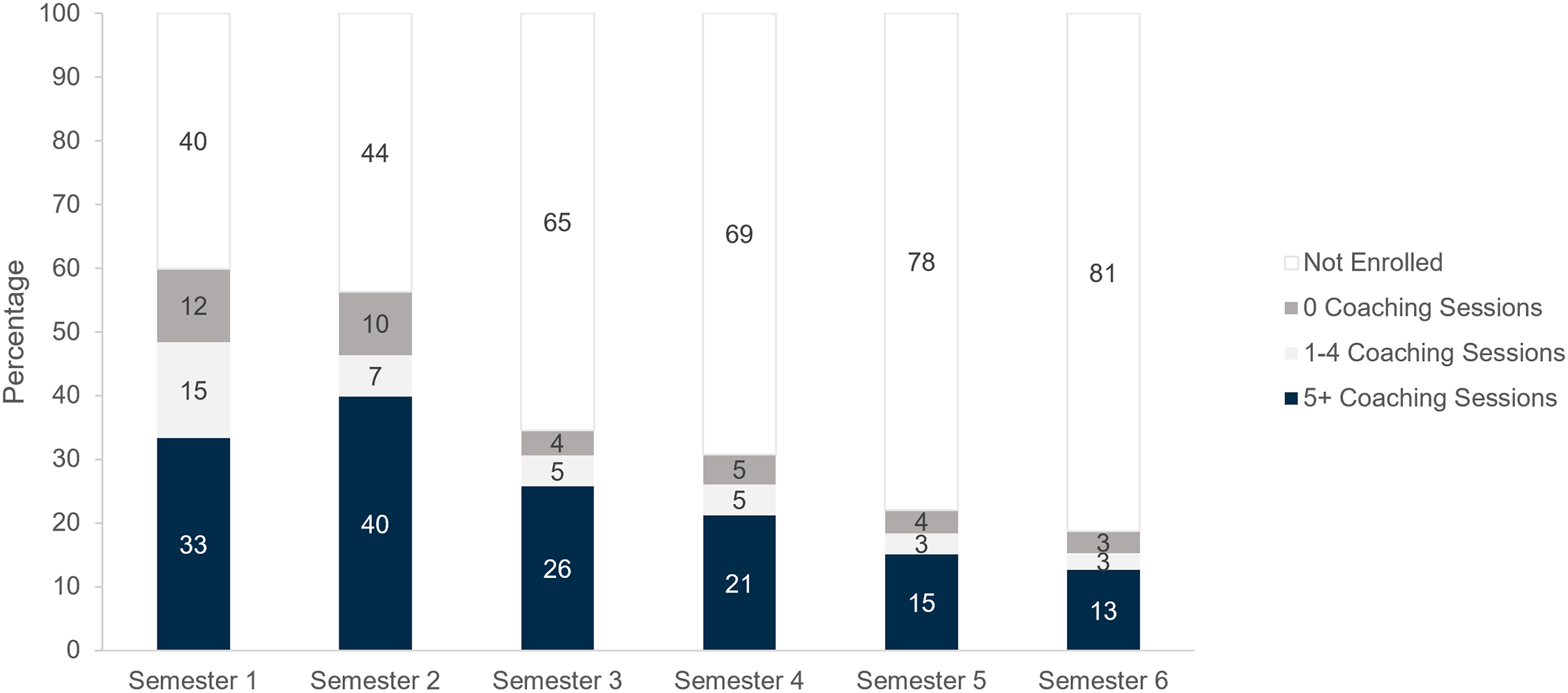
The coaching and other DPP components were implemented with fidelity at four out of five colleges, and program participation at all five colleges was high. More than 90% of program group students responded to coaches’ initial outreach, and participation in coaching meetings remained high throughout the 3-year follow-up period for students enrolled in college (see Figure 2). The program was viewed favorably by participating students at all of the colleges: the student survey found that nearly 90% of respondents rated the program as valuable or highly valuable (see Table A2).
The MIS was used to track student participation and automate appointments and financial incentives. Campus coaches reached out to students using a variety of outreach methods, including texts, emails and phone calls. Fewer students indicated that they prefer to receive communication from their coaches via official school channels, such as their email (see Table A2). By contrast, most preferred receiving information via texts or phone calls from their coaches. The majority of students also preferred in-person, on-campus meetings with coaches to other modes of interaction (see Table A2).
Students and coaches alike identified that one strength of the MIS was that it enabled targeted outreach to students. Coaches could track who was and was not attending meetings and send messages tailored to students’ situations. Coaches could also send texts to groups of students, such as those who had not yet completed a FAFSA or those in a particular major, to share relevant deadlines and information. Students often reported that the feeling of “information overload” from the college caused them to withdraw and not consistently read emails or other institutional communications. The MIS helped coaches cut through that noise to only deliver certain messages to students who needed them.
Having multiple modes of communication, coupled with repeated, proactive outreach by coaches, also allowed nonparticipating students to re-engage with the program on their own terms. One coach relayed the story of a student who responded to a text message in August before their first semester, but then didn’t respond to subsequent texts, emails, or phone calls. The coach continued to send periodic reminders about key milestones and encouragement to drop by the DPP office. It was not until the next semester, approaching midterms, that the student responded to a text message asking to meet. The student was struggling with a class, and the coach was able to help. This student told the coach that they had not thought they needed help “until they really needed it.” Because of the coach's periodic reminder texts, the student knew they had a place to turn when they were ready to accept assistance.
The downside of the MIS is that it is only as strong as the data it contains. At some colleges, staff were unable to access data on students’ financial aid status. Thus, at those colleges, coaches could not target messages about FAFSA completion or verification processes. A problem across colleges was outreach to students whose phone numbers changed; frequently, messages from coaches did not reach these students.
Student Outcomes
While the findings related to student outcomes are not the focus of this paper, understanding the effects of the DPP program provides valuable context for our findings. Drawing from the DPP RCT, (Brockman et al., 2025), about 65% of students who were offered the DPP program enrolled in courses in the fall semester after they applied for a Promise scholarship. Of these enrolled students, more than 40% did not continue to their second year. Compared with students who were offered the Promise scholarship alone, more students in DPP stayed enrolled in school and earned more credits, with DPP students earning approximately 3.3 credits more compared with students receiving only the scholarship. But after 3 years, overall credit attainment was low, and there was no evidence that DPP led to an increase in degrees earned (Brockman et al., 2025; Ratledge et al., 2021).
Student Motivation and Sense of Self-Efficacy
Students’ personal beliefs—what ecological theory identifies as individual-level factors—particularly their motivation to graduate, shaped how they described their experiences with the DPP program. Students’ drive to complete college was reflected in their survey responses. About two thirds of respondents agreed or strongly agreed that they were motivated to finish college. Most students also believed that they had the skills, support, and resources to be successful: more than 85% agreed that they had the academic resources to succeed in college; 86.7% believed that they had the necessary skills, and 84.7% believed that they had the necessary support. Although many students left college prior to earning a degree, 29% of students offered the DPP program were still enrolled at the 3-year mark. These students earned an average of 51 credits—close to the 60 that would be required to graduate with an associate degree—and were enrolled in an average of 5.2 out of 9 possible fall, spring, and summer terms over the course of 3 years. In many terms, students were enrolled part-time; this group only enrolled full-time for an average of 2.7 out of 9 possible terms (Brockman et al., 2025). Unfortunately, despite their motivation and commitment, the barriers to college completion meant that students did not ultimately earn a credential.
Benefits of Proactive and Holistic Outreach
DPP students indicated that they met with their college coaches more often than any other support staff on campus, including academic advisors, financial aid staff, and career counselors (see Table A2). About 64% of survey respondents reported meeting with their college coaches at least three times since starting college (see Figure 2).
Coaches worked to establish rapport with their students and sent regular reminders and invitations for students to schedule meetings. This proactive and holistic outreach resulted in students developing trust in their coaches and turning to them for matters that extend beyond their academic experience. One student described their appreciation for this relationship: “I love how we can talk to our coach about anything that doesn’t have to do with our education and academics. It's such a relief that we can talk about personal and academic if we need it.”
Students also said that their coaches were instrumental in helping them navigate their college experience. One student noted: “My coach took time to get to know me, then discussed the program, financial aid…He advised me on things I had no knowledge of.” This type of support was especially useful for first-generation students who may not have other sources of support for the variety of questions related to college-going. One survey respondent agreed, adding that they never expected to receive help in college: “My college campus coaches… were the help I was told I never would receive. I went into college believing no one would help me with financial aid, registration, money issues and home issues, but I had help and I am grateful for that.”
For several students, the coaches made a difference in their commitment to their college education: “I love how they help you when you feel like giving up. It touched my heart knowing someone is out there to help you when you feel like giving up.” A first-year student shared a similar story: “the Detroit Promise [Path] program has been great for me in my college experience. I believe I would have [succumbed] to the pressures of life without having my coaches to talk to during our meetings.”
Building Relationships With Coaches who Reflect the Students’ Background
Because DPP serves only students graduating from Detroit city high schools, this population differed in several ways compared to their community college peers, the majority of whom came from Detroit's surrounding suburbs (see Table A1). DPP students were more likely to be students of color, primarily Black, and more likely to be economically disadvantaged than other students attending the same institutions. In this environment, DPP students said that having coaches whose background and experience reflected their own was a very important feature of the DPP program. As one student put it, “[Coach] is the best African American educational role model I have had the pleasure to be introduced to.” Students and staff identified both race and being from the city of Detroit as valuable to their relationship-building with coaches. Because of this, students were able to build trusting personal relationships with their coaches, which extended into discussing issues beyond academics. One student said, “I deal with a lot of family issues, and I can talk to my coach about anything…He helped me figure out how to talk to my family and convince them that college is a stepping-stone to a better life. He lit the way for me in college to make something positive of myself.” Another student echoed this sentiment: “I love how we can talk to our coach about anything that doesn't have to do with our education and academics. It's such a relief that we can talk about [the] personal and academic if we need it.” Coaches also understood their unique position in building relationships with the DPP students. From the perspective of one coach, at their institution “there are no counselors of color” which meant that “students aren’t comfortable talking about their personal issues and think they don’t understand students from urban Detroit.”
Remaining Barriers for Detroit Promise Path Students
As a program, DPP was designed to provide direct support to students throughout their community college experience. While it built supports on top of the existing Detroit Promise scholarship, the program was not intended to address larger structural barriers to college attainment for Detroit students. For many students, the conditions set in place by decades of poverty and policy decisions that disadvantage Detroiters prevented them from completing college. Students indicated that financial pressures and transportation limitations were among the most pressing issues blocking their college path.
Access to Reliable Transportation and Transit Times
When asked about barriers to college enrollment, DPP students’ top two responses revolved around transportation: More than half of responding students indicated that they were not able to find reliable transportation to school (see Table A2). More than a third indicated that paying for transportation was an additional problem.
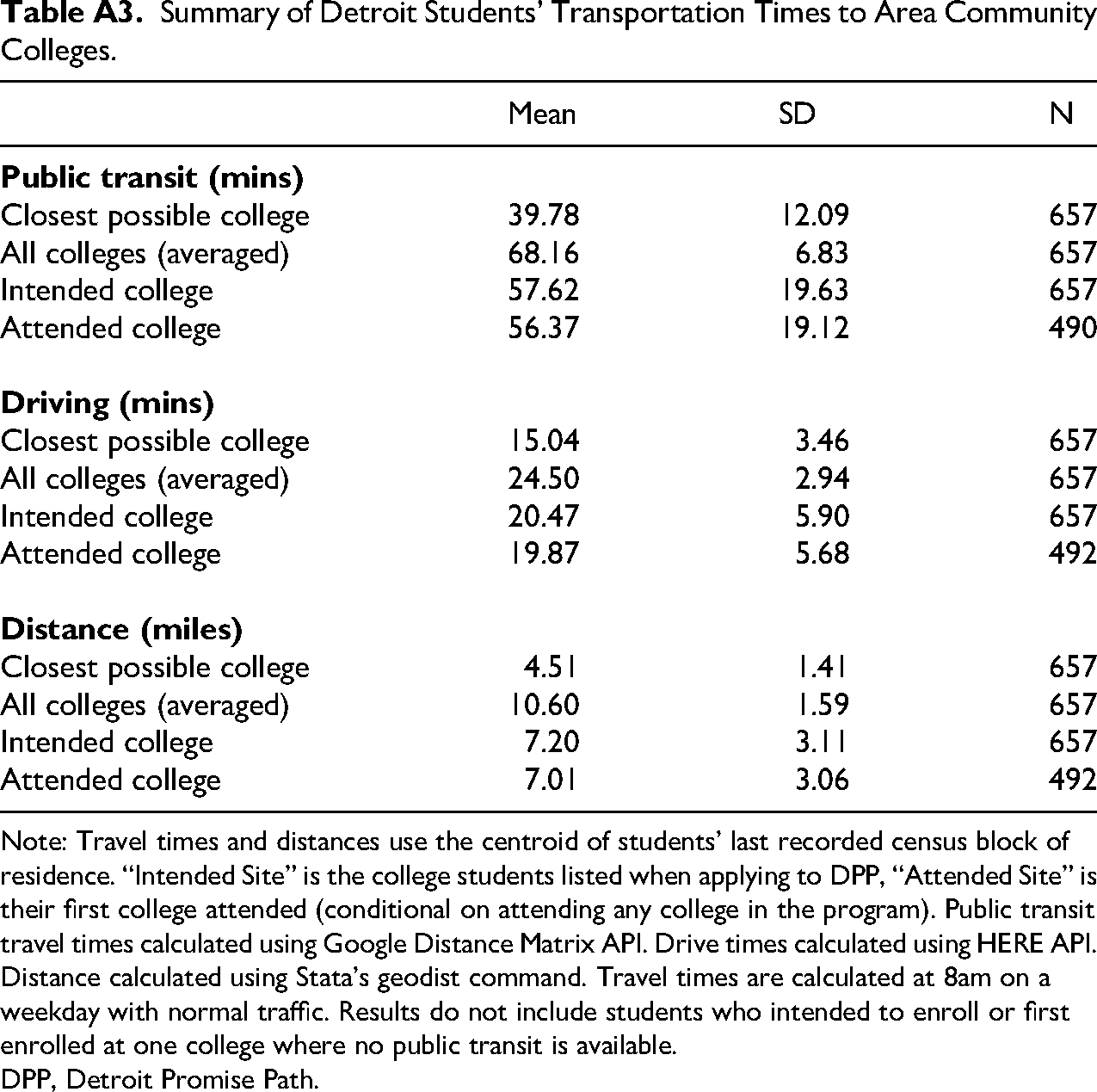
As the map in Figure 3 shows, all but one of the five Detroit area community colleges are located outside of the city. The results of our analyses (shown in Table A3) reveal that DPP students bear substantial commuting costs to attend community college. On average, they spent nearly an hour commuting to community colleges via public transit. Students’ driving times were shorter, but still non-trivial: twenty minutes, on average. Looking at the differences in students’ commutes to the colleges where they originally planned to enroll versus those that they ultimately attended shows that students were more likely to enroll at colleges located closer to their high school homes and which offered them shorter commutes. Among students who attended a college other than the one they originally intended, differences in commute time were large. Students opted for colleges that offered a 17% reduction in their driving commutes and a 9.5% reduction in their public transit commute time (full results discussed in detail in Brockman & Camo-Biogradlija, 2025). These findings make logical sense: Detroit students tend to attend colleges that are easier for them to get to physically. However, this has implications about which colleges students truly have access to, which is especially meaningful if there is variation in program offerings and supports provided at those institutions. It also has implications for credit transfer if students start at one college and transfer to another closer to home, as commonly happened in this study.
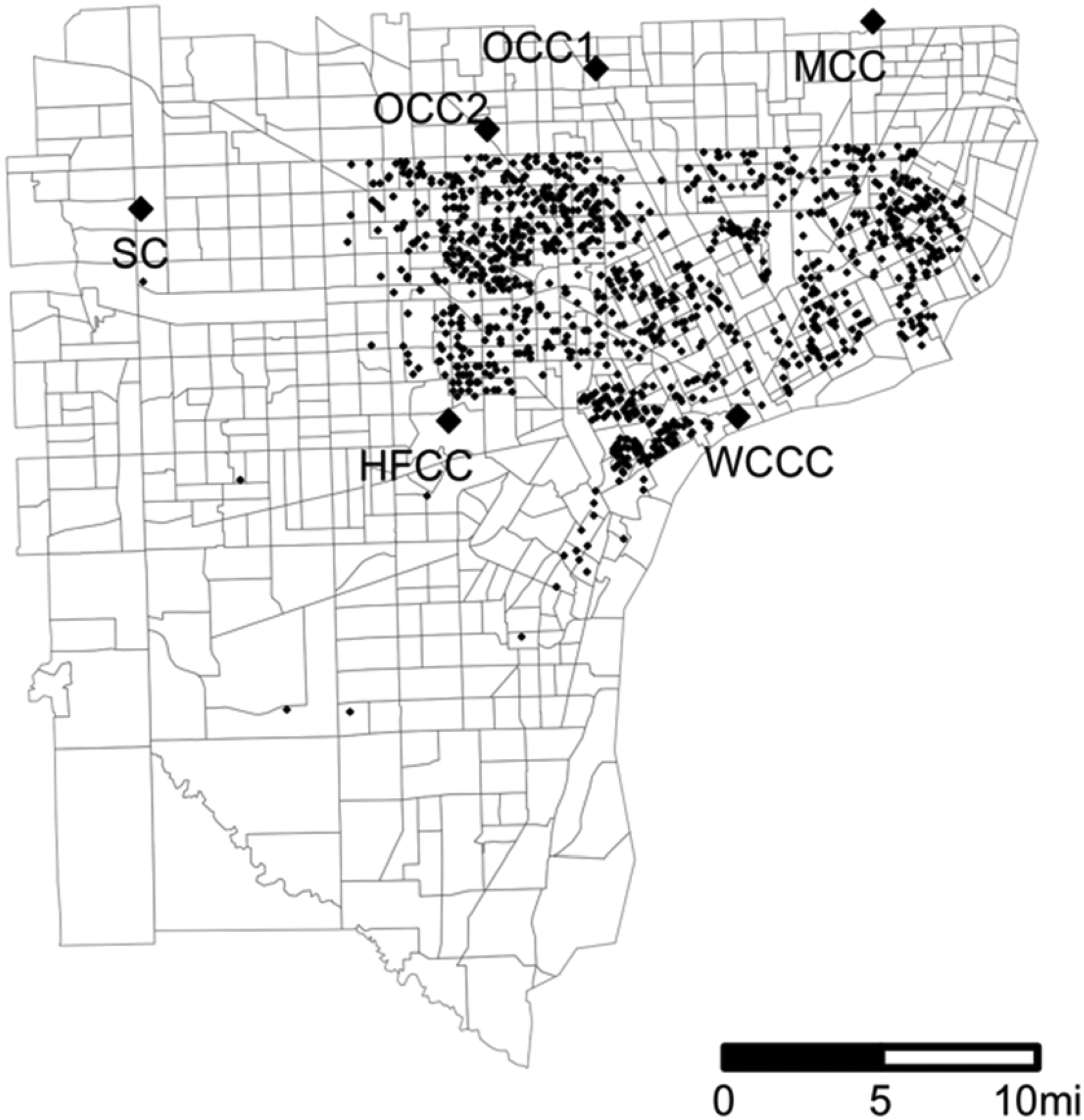
Location of Metro Detroit Community Colleges Relative to the High School Neighborhoods (Censusblocks) of DPP Study Participants. DPP, Detroit Promise Path.
Life Expenses Beyond College Tuition
Students also described how the challenges of covering the cost of expenses beyond tuition prevented them from continuing their education. One student provided an illustrative example of these unpredictable setbacks: “I had to start working more to keep up with other life situations and was going to start again this semester, but I just got into a car accident last Friday and that's just going to prolong the situation.” Students who were not enrolled in college at the time of the survey rated financial issues, specifically the cost of transportation and rent, as among the top three barriers to their college enrollment. One student explained “I didn’t want to leave but felt it was necessary” as the burden of work and dealing with “life issues” interfered with their ability to finish college. Most students used their program-provided monthly gift cards to purchase food or pay for transportation, saying that the gift card “helps me out when I need gas money or buy at least $50 worth of groceries.” More than half of all survey respondents indicated that they work more than 20 h per week, with one student describing the challenges of holding a job on top of being in college: The biggest challenge I have is having money for books, supplies, food and transportation. I tried to get a job around my classes most jobs was not flexible. I want to stay in school but find it hard to live without finances.
About half of all students responding to the survey reported that they did not believe they had the financial resources necessary to finish college. Consistent with ecological theory, many DPP participants drew on their life experiences outside of the classroom to explain some of the difference between their expressed motivations to finish college and the goals they were ultimately able to achieve. Lenhoff et al. (2022) specifically point to the interaction of “systemic cultural and environmental factors with the lived experiences of students” as being closely tied to academic outcomes for students (p.1)
Discussion and Implications
This paper points to a sharp disconnect between students’ motivation for college, sense of self-efficacy, and appreciation for the support they receive on campus and the reality that the DPP program did not lead to an increase in degrees earned, despite the fact that, on average, students were close to the credits required for graduation with an associate degree. Students’ feedback on the challenges they faced decidedly points to financial factors and lack of regional infrastructure to support college-going as the main issues driving the disconnect. Framed as part of the broader urban ecological system, the findings highlight the role of systemic and structural barriers (mesosystem and exosystem factors) that interact with students’ academic experience in college. As College Promise programs and other free tuition guarantees become a staple among college access strategies, the findings of this study raise critical details that should be considered in the design of such programs and policies. Students are often derailed on their postsecondary journey by issues outside of college itself.
Success coaches have become a more prominent fixture on college campuses. When providing support in the form of campus coaching or personnel, employing and retaining staff who reflect the students’ background and who can support them on a personal level is important to students. In contrast to other research examining the effects of remote advising models (Bettinger & Baker, 2014; Turner & Gurantz, 2024), our study found that students preferred in-person and more personalized contact with coaches to other forms of interaction. Colleges should prioritize flexibility in structuring their coaching positions, ensuring that coaches are incentivized to be available outside of a typical workday. Hiring recent graduates, and other near peers for these positions may be one way to ensure that coaches are able to relate to the students, understand their needs, and have the flexibility to respond in manners preferred by students. Additionally, using systems like the MIS would allow coaches to better target messaging and support for their students
The contextual qualitative data was vital to the research team's interpretation of the trends in administrative data. Students’ voices added depth beyond what is observable in administrative data alone. Their stories of the extent to which financial and transportation needs affected enrollment highlight the need to consider supports such as emergency financial assistance programs, expanded on-campus work opportunities, and organized carpools. Combining a more traditional approach to evaluation, such as an RCT, with methods focused on hearing student feedback will allow researchers and practitioners to better contextualize findings related to student outcomes. It helps to strengthen an anti-deficit interpretation of the findings, understanding that broader systems directly intersect with students’ educational experiences. This approach to research also allows program developers to target their interventions to the issues that are most salient to students and to develop a strategic approach to addressing the barriers to college completion. As this study shows, some challenges, such as the availability of public transit, pose a substantial barrier that for most institutions lies outside their control, whereas others, like financial aid planning and registration requirements, are within their scope. Incorporating student voice as a part of formal program evaluations can surface both types of barriers, providing program leaders with direction for new supports that can be offered within the program as well highlighting issues that may require more than a programmatic approach.
Programs administrators and policymakers must consider the many other barriers to success that students might be facing beyond access to financial aid, especially when aid programs only cover the cost of tuition. As this study shows, tuition costs are just one aspect of the financial concerns facing community college students. For College Promise programs to fulfill their mission, institutions and communities should advocate for equitable solutions to systemic issues and look for creative programs that could provide support in the interim. Because systemic issues lie far outside an individual student's or institution's control, moving the needle on college success will require long-term planning, coordinated advocacy, and solutions at institutional and regional levels.
Footnotes
Author Note
We are grateful to the Detroit Regional Chamber, Detroit Promise staff, Brian Jacob and the Youth Policy Lab, and participating colleges in the Metro Detroit area for their partnership in this work. We also thank UM research assistants Abigail Orrick, Brittany Vasquez, and Jannette Norrington for their support in collecting and analyzing survey and qualitative data.
This research used data structured and maintained by the MERI-MEDC. MEDC data is modified for analysis purposes using rules governed by MEDC and are not identical to those data collected and maintained by the Michigan Department of Education (MDE) and/or Michigan's Center for Educational Performance and Information (CEPI). Results, information and opinions solely represent the analysis, information, and opinions of the author(s) and are not endorsed by, or reflect the views or positions of, grantors, MDE and CEPI or any employee thereof.

Funding
The authors received no financial support for the research, authorship, and/or publication of this article.
Declaration of Conflicting Interests
The authors declared no potential conflicts of interest with respect to the research, authorship, and/or publication of this article.
Notes
Author Biographies
Appendix
Summary of Detroit Students’ Transportation Times to Area Community Colleges.
| Mean | SD | N | |
|---|---|---|---|
|
|
|||
| Closest possible college | 39.78 | 12.09 | 657 |
| All colleges (averaged) | 68.16 | 6.83 | 657 |
| Intended college | 57.62 | 19.63 | 657 |
| Attended college | 56.37 | 19.12 | 490 |
|
|
|||
| Closest possible college | 15.04 | 3.46 | 657 |
| All colleges (averaged) | 24.50 | 2.94 | 657 |
| Intended college | 20.47 | 5.90 | 657 |
| Attended college | 19.87 | 5.68 | 492 |
|
|
|||
| Closest possible college | 4.51 | 1.41 | 657 |
| All colleges (averaged) | 10.60 | 1.59 | 657 |
| Intended college | 7.20 | 3.11 | 657 |
| Attended college | 7.01 | 3.06 | 492 |
Note: Travel times and distances use the centroid of students’ last recorded census block of residence. “Intended Site” is the college students listed when applying to DPP, “Attended Site” is their first college attended (conditional on attending any college in the program). Public transit travel times calculated using Google Distance Matrix API. Drive times calculated using HERE API. Distance calculated using Stata's geodist command. Travel times are calculated at 8am on a weekday with normal traffic. Results do not include students who intended to enroll or first enrolled at one college where no public transit is available.
DPP, Detroit Promise Path.