




Abstract
Recent changes in Canada’s immigration patterns have intensified the tension between Cantonese and Mandarin in local Chinese communities. This longitudinal study examines 24 Cantonese-speaking parents’ language ideologies and practices in maintaining their children’s bidialectalism in Cantonese and Mandarin in relation to English and French. Findings revealed a language hierarchy and a shift in their attitudes towards Mandarin over the three years. These trends were shaped by their solidarity with their Chinese roots and transnational membership. The findings suggest that parental language ideologies toward bidialectalism are complex and must be understood in glocal contexts.
Keywords
Introduction
Recent drastic changes in Canada’s immigration patterns have significantly transformed the linguistic landscapes of Chinese communities in Vancouver and across Canada. Vancouver, which used to be nicknamed “Hongcouver” due to the large influx of Cantonese-speaking immigrants from Hong Kong in the 1980s and 1990s, is now a favorite destination of Mandarin-speaking immigrants from mainland China. In the 2011 Census, there were 133,000 Cantonese speakers and 92,000 Mandarin speakers in Metro Vancouver (Statistics Canada, 2012), while in the 2021 census, there were 183,000 Cantonese speakers and 191,000 Mandarin speakers in Metro Vancouver; Mandarin is now the most widely spoken non-official language at home not only in Vancouver and in British Columbia, but also nationally across Canada (Statistics Canada, 2022).
While some believe that Cantonese is “still thriving” despite Mandarin’s growing dominance (Chiang, 2016), others fear that Cantonese is “under threat” in Vancouver (Fong, 2015). In fact, the shift from the minority language varieties (such as Chinese dialects, including Cantonese) to a more dominant one (such as Mandarin, which has been officially designated by the authorities of China and widely used within Chinese immigrant communities) has been seen in other Chinese-bidialectal diasporic communities around the globe. For instance, British Chinese communities are found to be experiencing the gradual shift from Cantonese to Mandarin as the new lingua franca, which enjoys major support and resources in Chinese complementary schools as well as increasing popularity among diasporic parents and children (Li & Zhu, 2011).
The tensions between Mandarin and Cantonese within the Chinese diaspora overseas can have significant implications for Chinese immigrant families in the local Canadian contexts, particularly those of Cantonese backgrounds, who wish to pass on their heritage languages and cultures to their younger generation. However, little is known about how Chinese-Canadian parents navigate these dynamic linguistic and political tensions glocally, as well as how their practices regarding heritage language maintenance might be influenced by global-local factors. Enlightened by Swyngedouw and Kaïka's (2003) interpretation of urban modernity as “a collage and patchwork of…activities that are nevertheless globally connected in myriad ways” (p. 5), we take this expansive urban multiplex perspective to help capture the heterogeneity of Cantonese-speaking families’ values and experiences in preserving heritage languages and the dynamic language policies and practices within these families inscribed in both local and global spaces. Specifically, in the present longitudinal study, we investigated 24 Cantonese-speaking Chinese-Canadian parents’ language ideologies toward bidialectalism (Mandarin and Cantonese) in relation to the two Canadian official languages (English and French) and whether and how their ideologies change over time in their interconnected local (i.e., the diasporic, urban community, Vancouver city, and Canadian society) and global (i.e., the home cities and international) contexts.
Bidialectalism originally refers to a speaker’s ability to speak two language varieties and to change depending on the situation (Gold et al., 1977). Although the term is often applied to speakers who use a standard and a non-standard language variety, in this paper, the use of “dialect” (or “topolect” by Mair, 1991) does not imply such subordinate status of one variety over another. In the context of Metro Vancouver where our study was situated, neither Mandarin nor Cantonese had an official status but both held relatively dominant status in the Chinese community and used as the main language of communication depending on speakers’ regions of origin. For those coming from mainland China where Mandarin has been named as the official language, they may perceive Cantonese as a dialect or topolect. In contrast, for those who came from Hong Kong where Cantonese has been the official and dominant language while Mandarin was just recently promoted by the government (Bauer, 2016), they may consider Cantonese as their main language and Mandarin as a Chinese variety of less importance.
Researchers suggest that ideologies about the nature, value, and function of language in conveying a speaker’s identity (Gumperz, 1982) can vary across different speaker communities and contexts. Some may take on more instrumental values focusing on the practical benefits while some emphasize integrative values focusing on cultural understanding and personal growth (Dörnyei et al., 2006). In Hong Kong, for example, Lai (2011) surveyed 1265 youths and found that “Hongkongers” (youths with strong Hong Kong identity) had the weakest integrative and instrumental orientation towards Mandarin, while “Hongkong-Chinese” (those who claimed both Hong Kong and Chinese identities) and “Chinese” (youths who strongly identified with China) groups had more positive attitudes towards Mandarin as an identity marker and linguistic capital.
Recent studies in Hong Kong showed growing integrative values attached to Cantonese and some resistance to a Pan-Chinese identity due to sociopolitical tensions in the region (Hansen Edwards, 2021; Shum et al., 2023). Studies conducted with university students in Guangzhou and Macau, however, found that local students held positive attitudes toward both Mandarin and Cantonese integratively and instrumentally, although their ratings on their attitudes toward Cantonese and Mandarin varied by context (Liu et al., 2018; Ng & Zhao, 2015; Yan, 2017). Specifically, both local students (born and raised) in Guangzhou and Macau expressed highest integrative attitudes toward Cantonese; while students in Guanzhou rated higher instrumental attitudes toward Mandarin over Cantonese (Ng & Zhao, 2015), those in Macau rated to have higher instrumental attitudes toward Cantonese over Mandarin (Yan, 2017).
Language ideologies play a crucial role in determining individual speakers’ language attitudes toward the prestige and legitimacy of different languages and language varieties. As language attitudes are more fluid than language ideologies (Harrison, 2021), this study takes a dual focus on parental language ideologies to understand both the changes in attitudes toward and the persistence of the power dynamics among different languages in Chinese-Canadian families’ sociolinguistic reality.
Specifically, we set out to address the following research questions:
What are Cantonese-speaking Chinese-Canadian parents’ language ideologies toward the status of Mandarin, Cantonese, English, and French? Whether and how do these parents’ language ideologies toward the languages and language varieties change over time? What local, transnational, and global factors have contributed to the forming and changes of parents’ language ideologies?
Language Ideologies and Chinese Language Varieties in Diasporic Communities
With Chinese language varieties, researchers from various international contexts have reported a common preference for the dominance of Mandarin over other varieties. For example, by investigating language attitudes and linguistic practices of the Chinese diaspora in Britain and Australia, Li and Zhu (2010) found that both parents and youth valued the global language status of Mandarin over other heritage varieties. These transnational families viewed Mandarin and its maintenance as key to their Chinese identity, a function that other varieties could not substitute. Similar attitudes and practices were found in Chinese Hakka-speaking families in Indonesia (Sedijati, 2016) and Malaysia (Wang, 2017), and Wenzhounese-speaking youth in Italy (Paciocco, 2018) who valued Mandarin more than their heritage varieties for its economic benefits. The Pan-Chinese identity (Paciocco, 2018; Wang, 2017) and “Mandarin-as-Chinese” discourse (Leung, 2021) also pose ideological tensions which shaped their language attitudes toward Mandarin.
Li and Zhu (2011) discussed the effects of globalization on the changing hierarchies among Chinese language varieties within the British-Chinese community. Their ethnographic research in Chinese complementary schools found that Mandarin was becoming increasingly dominant over other language varieties despite that Cantonese speakers were the most dominant group within the diasporic Chinese communities. Li and Zhu (2010, 2011) argued that the changing hierarchy is closely related to the rising profile of Mandarin as politically and economically powerful on a global scale.
Curdt-Christiansen and Huang (2021) also found that the shift from Cantonese to Mandarin was reflected in Chinese-British communities’ schools, restaurants, and supermarkets’ customer base and business strategies. The authors highlighted not only the perceived socioeconomic value of Mandarin on the global scale but also the demographic changes in the local migration communities where Mandarin speakers were more noticeable. Further research is needed to understand the language ideologies of Mandarin and Cantonese speakers in other diaspora settings and how they may shift over time and space.
Vancouver is a crucial context for examining the tensions between Mandarin and Cantonese. In the early era, Hakka and Taishanese-speaking diaspora was the mainstream in British Columbia (Willmott, 1964), later joined by successive waves of Cantonese speakers in the latter half of the twentieth century. Vancouver was a major destination for Cantonese-speaking immigrants from Hong Kong in the 1980s and 1990s, and Cantonese remained dominant in Chinese diaspora (Duff & Doherty, 2019). However, in recent years, the city is witnessing a notable increase in Mandarin-speaking immigrants. Cantonese and Mandarin now both hold relatively dominant status in the Chinese communities in Vancouver.
Scholars have previously examined the language attitudes of Chinese immigrants toward heritage languages and English in Canada. For instance, Li (2006) examined three Chinese-Canadian parents’ attitudes and families’ language practices. Even among the three cases, the families presented distinctive attitudes toward their heritage languages, ranging from resistant to supportive. The divergent attitudes toward the heritage language, the tension between English and the heritage language, and the impacts on language practices were observed in other studies with Chinese-Canadian families (e.g., Curdt-Christiansen, 2009; Li et al., 2024; Li & Sun, 2017, 2019). Yet, little research has specifically addressed the language ideologies and attitudes of these immigrants toward both Mandarin and Cantonese. It is crucial to investigate Cantonese-speaking Canadian families’ language attitudes and the dynamic forming process of their attitudes.
Theoretical Framework: Language Ideologies, Post-Modern Identities, and Scales
Research on bidialectalism has been studied mostly from a language attitude perspective. Dragojevic et al. (2021) define language attitudes as evaluative reactions to or beliefs about language in relation to its status and their solidarity with it. Attitudes to the status of a language and its speakers are based on perceived socioeconomic status. Languages and language varieties within a given society can be ordered on a hierarchy of prestige, which relates to the instrumental or integrative values such as economic opportunities and social mobility they provide. Solidarity is based on in-group loyalty (Ryan et al., 1984) and perceived competition (Kervyn et al., 2015). Higher solidarity with a language or language variety is linked to a person’s sense of self and sense of attachment to in-group members (Dragjevic et al., 2021). Language attitudes can be reshaped through intergroup contact, media exposure, language policies, and institutional practices (Liang, 2015) and are prone to change across time and context (Dragjevic et al., 2018; Feng et al., 2023).
In this study, we extend the concept of attitude to “ideology” in that status is related to power relationships and solidarity is related to identity. Language ideologies concerning these two aspects undergird individuals’ language attitudes. Language attitudes have been shown to reflect covert prejudices and ideologies in society, and relate to the success of language learning and maintenance (McKenzie & McNeill, 2022).
Language ideologies are conceptualized (Piller, 2015) as socially embedded beliefs, attitudes, and conceptions that connect language and society in a mutually constitutive manner. These ideologies guide language use and choices, which in turn shape language ideologies. Dyers and Abongdia (2010) discussed the commonalities and distinctions between language attitudes and language ideologies. Both language attitudes and ideologies have the crucial potential to shape processes like language maintenance, shift, or language learning trajectories. Both are not homogeneous across a given society but can vary among individuals.
In terms of differences between language attitudes and language ideologies, language ideologies precede and shape individual language attitudes, setting the stage for how people value and react to different language varieties and language use. Language ideologies tend to be deeply ingrained and persistent across temporospatial sections, whereas language attitudes are more fluid and subject to change based on individual experiences (Harrison, 2021). By investigating language attitudes, we aim to gain insights into individual parents’ perceptions of Mandarin, Cantonese, English, and French, while examining the language ideologies underlying their language attitudes may reveal the broader societal beliefs and power structures that shape these attitudes. One set of language ideologies particularly relevant to this study is the beliefs in the relationship between language and identity, to approach which we take the lens of postmodern identity.
Postmodern Identity
From the lens of postmodern identity (Hall, 2011), identities are produced in specific historical and institutional sites and shaped by language, culture, groups, and desires. The connections among language, heritage, and identity are not assumed, and the ideological assumption of passing on heritage identities through language is negotiated and may be contested (Blackledge et al., 2008).
Advanced capitalism and accelerated globalization have intensified the severance of the assumed ideological link between language and identity, as both have become commodified and marketed products (Heller, 2003). Individuals or families may invest in language learning and the linguistic competence of those marked as skills and assets to increase employment opportunities and social mobility, and also adopt and perform identities to gain social and economic benefits.
Thus, the belief that a certain language variety signifies an ethnolinguistic identity may be accentuated or challenged by multiple ideological perspectives on language and identity (Song, 2010). For transnational families, their language attitudes closely relate to the struggles between maintaining their heritage language(s) to develop an ethnic identity and mastering language(s) with higher prestige to adopt marketable identities. Especially for Chinese diasporic families who have language varieties other than Mandarin as their first language, they are involved in the ongoing contests over which Chinese language varieties signify “true” Chineseness for themselves (Archer et al., 2010; Wong et al., 2021).
Scales
As we are contextualizing Chinese-Canadian parents’ language attitudes and ideologies in the local, transnational, and global forces, the notion of scale assists in addressing sociolinguistic phenomena in globalized social reality (Blommaert, 2007). Scales are spatiotemporal frames that interact with one another in the age of globalization. Each scale works by distinct norms and conventions that attribute values to linguistic resources in certain spaces and situations and regulate the possibilities of things to happen (Blommaert, 2010). Applying the concept of scale, language patterns are organized on different and layered scale levels, and identity construction revolves around a scalar structure of social reality rather than in the strict context of occurrence.
When transnational families consider the values of languages and language varieties (e.g., Mandarin and Cantonese), they may evaluate them within the local scale, such as the residential community, and the higher transnational and global scales where certain languages and language varieties have better access to. Also, by aligning with one way of speaking, they are adopting and performing identities that place themselves “in relation to images culled from the various levels” (Blommaert, 2010, p. 209). Acknowledging the considerable variety of scales, this study focuses on three specific ones, that is, the local community and city scale, the transnational scale involving the home and host country, and the global scale.
Method
Data Collection and Analysis
The data in the current study were derived from a government-funded, large-scale, longitudinal (2018–2023) research project on young Chinese-Canadian children’s bi/multilingual and academic development that included over 200 Chinese-immigrant families dwelling in Metro Vancouver, British Columbia, Canada. In this study, we focused on 24 Cantonese-speaking Chinese-immigrant families who participated in the study during three consecutive research years (2019–2022). We identified Cantonese-speaking families as those who reported predominantly or only using Cantonese at home during the interviews. Among the focal families, there were nine families originally from Hong Kong and 15 families from Guangdong province in mainland China. Among the latter, eight families were from Guangzhou, the capital city of Guangdong and seven were from other cities within the province. Most Hong Kong-origin families immigrated before 2000 except for one in 2015, whereas all families from mainland China immigrated after 2000.
The families in the study represented a range of socioeconomic backgrounds. Three families reported annual household incomes below 41,000 CAD, while three families had incomes exceeding 158,000 CAD. Other families had incomes distributed in between. The educational attainment of parents was relatively high, with over 21 mothers and 18 fathers holding vocational degrees or higher. Focal children in the participant families were equally represented by gender, with 12 boys and 12 girls. As of the 2019–2020 academic year, nine of the children were in kindergarten, and 15 were in first grade. The demographic information of the focal Cantonese-speaking families and details about the child participants are shown in Table 1.
Profile of 24 Focal Cantonese Families.
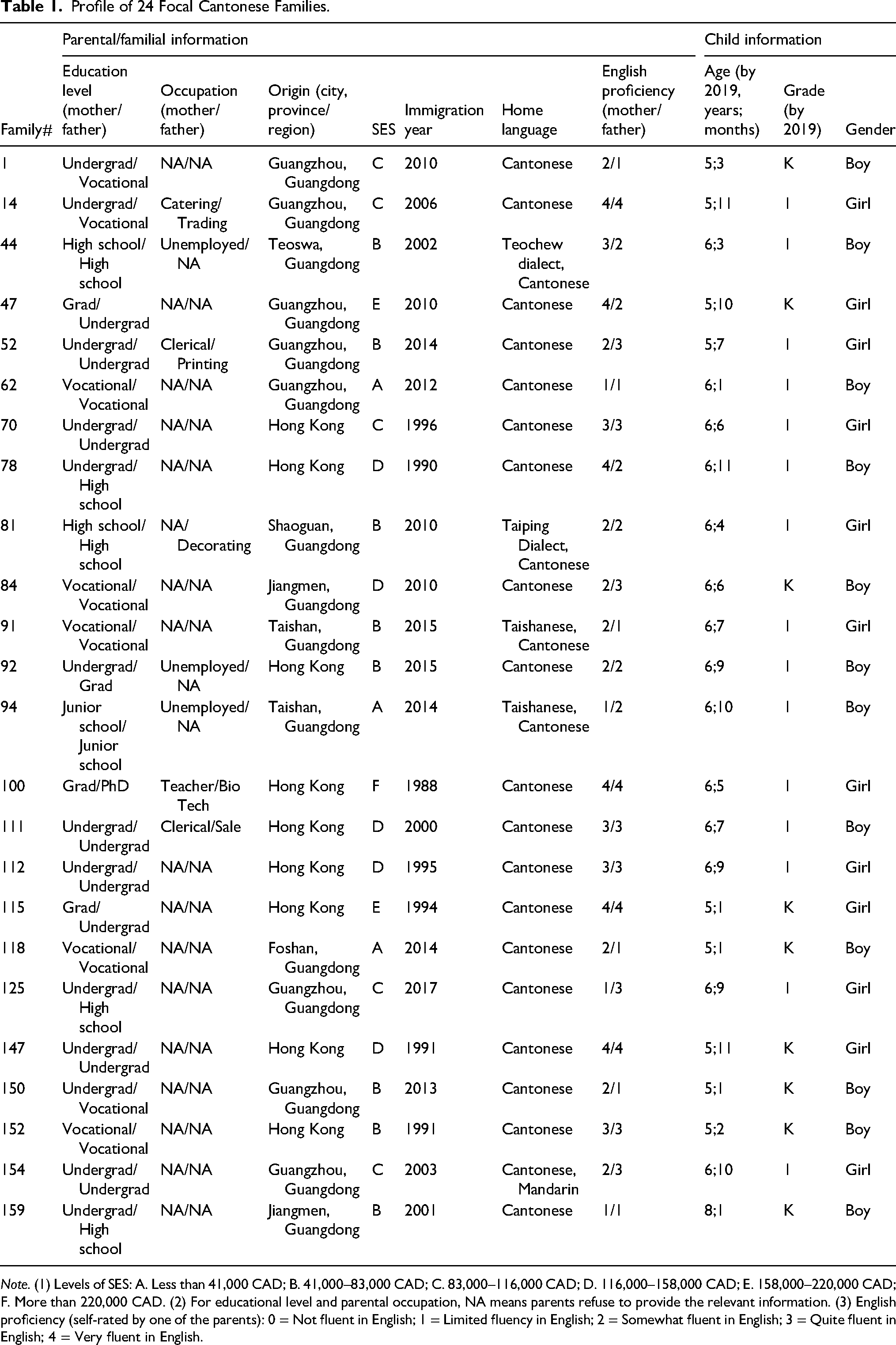
Note. (1) Levels of SES: A. Less than 41,000 CAD; B. 41,000–83,000 CAD; C. 83,000–116,000 CAD; D. 116,000–158,000 CAD; E. 158,000–220,000 CAD; F. More than 220,000 CAD. (2) For educational level and parental occupation, NA means parents refuse to provide the relevant information. (3) English proficiency (self-rated by one of the parents): 0 = Not fluent in English; 1 = Limited fluency in English; 2 = Somewhat fluent in English; 3 = Quite fluent in English; 4 = Very fluent in English.
Data regarding families’ basic demographic information above were obtained yearly from 2019 to 2022. A semi-structured interview based on the Chinese version of the Alberta Language Environment Questionnaire (ALEQ) (Paradis et al., 2011), with inquiries about parental language ideologies, attitudes, and practices, was conducted per year with each family. Parents were also invited to share details about home language choices and family language policy (FLP), especially changes in FLP as time went on, to improve clarity and depth. In the third year, we further asked parents to share the rationale behind their attitudes toward each language. Sample questions included, “What languages are your children learning currently or proficient in?” “Among these languages, which one do you think is the most important to learn?” “Have your attitudes to the importance of these languages changed as your children grow up? Why or why not?” Although both parents were invited, only one and the same parent (22 mothers and two fathers, Parent 112 and 154) from each family agreed to be interviewed, and each interview lasted for 60–90 min in the language of the parent’s choice (Mandarin, Cantonese, or English). All interviews were audio-recorded and later transcribed verbatim for further analysis.
Parental interviews were analyzed thematically by using open coding and temporal coding methods to identify persistent language ideologies as well as changes in their attitudes and practices over time (Miles et al., 2020). First, informed by the key concepts of language ideology and language attitudes theory, the open coding process was conducted with prior codes of language status, language solidarity, and language identity, to investigate different values that Cantonese-speaking parents attributed to different languages existing in their home settings. Interview transcripts related to parental statements about the status of Cantonese, Mandarin, and the two official languages of Canada in the host country (e.g., any mentions of the languages’ importance, usefulness, or uselessness, or their ideology of bi/multilingualism, or their believed hierarchy of prestige among languages) were labeled as “language status”; while any mention of languages linked with a sense of self or sense of attachment to either the host or the home countries were labeled as “language solidarity.”
In addition, any parental statements concerning ethnolinguistic or socioeconomic identities contained in different languages (e.g., maintaining Cantonese to develop children’s Chinese identity, or prioritizing English because of its marketable identities in the Canadian contexts) were identified as “language identity.” These preliminary labels were further classified as “+ language/language variety/bi/multilingualism” based on whether they were related to any one specific language or more languages. To further understand the changes in parental language attitudes over three years, an additional round of temporal coding (labeled by “+ Year 2019/2020/2021”) was also used to categorize the data by each year of the study.
In terms of scalar factors that might affect parental language ideologies and attitudes, similar coding processes were conducted to explore why parental attitudes toward different languages changed during the three years. Three prior codes generated from the notion of scale, namely, “local community and city,” “China-Canada transnational considerations,” and “global contexts,” were used to explore factors that contributed to parental language attitudes and identity construction in each year.
Interviews for each family each year were coded separately first, and then all analyses in the three years were merged together for diachronic comparisons. Subsequent thematic analysis was conducted to identify “patterns within data” on parental attitudes toward languages in general and the two Chinese varieties (Mandarin and Cantonese) specifically. This process resulted in three themes across data collected from 24 focal Cantonese-heritage families: parental ideologies toward different languages, the ever-changing language attitudes among Cantonese parents, and factors that influence the forming and change of parental language attitudes.
Researcher Positionality
We acknowledge our own positionality and its potential influence on our study. We are three multilingual and bidialectal speakers, capable of speaking or understanding our respective regional dialects in addition to Mandarin and English. We were born and raised in mainland China and now live and work in Vancouver. Growing up, we were exposed to our regional dialects, but these dialects were never valued or encouraged. One of us lost the ability to speak her regional dialect due to the Mandarin-only policy at home. These experiences have shaped our belief in the importance of valuing individuals’ full linguistic repertoire and challenging hegemonic language ideologies. In our research, we strived to respect the multilingual and bidialectal backgrounds of the Cantonese-Canadian families, using their preferred language, often being Cantonese, in our interactions. However, we recognize that our positionality may bias us in favor of language maintenance and the value of all languages and dialects. To address this potential bias, we engage in reflexivity through the research process and employ strategies such as triangulation and member checking to ensure the trustworthiness of our findings (Berger, 2015).
Findings
The 24 families displayed a spectrum of language ideologies toward different languages, as well as different changing patterns of language attitudes over the three years. Generally, differences in language attitudes among families led to distinctive language practices and use within the focal familial contexts; these divergent language attitudes, however, were collaboratively influenced by multifaceted factors at local, transnational, and global scales.
“Host vs. Home Languages? Mandarin vs. Cantonese?”: Cantonese-speaking Chinese-immigrant Parents’ Language Ideologies
When asked which language, between heritage languages (Cantonese and Mandarin) and the host language, English, was the most important for their children, Cantonese-speaking parents provided their answers with surprising consistency. All 24 families believed that English was very important, with 21 of them prioritizing English over heritage languages. “There is no argument that English ranks at the top,” as Parent 81 emphasized, “because my child is living here [Canada].” The top priority of English was subsequently embodied in the families’ language planning, as more attention from Cantonese parents was given to English language learning, even though their children were still at a very young age. For example, living in Vancouver city where English dominates social and educational activities, Parent 154 thought high English language proficiency was necessary for her daughter not only to achieve academic success but also to communicate daily with classmates and peers who mostly spoke English. Similarly, the idea of registering her son for English tutoring kept revolving in Parent 159’s mind, as she was seriously concerned about his English learning: He must learn English well in Canada, and I am so worried that he could not learn English well by himself …I hear from other Chinese-immigrant parents that many children need tutoring in English, so I am considering sending him to after-school English classes when he gets older.
Three parents thought English was essential, but so were heritage languages. Two of them weighed both Mandarin and their mother tongue, Cantonese, as equal to English: “All three languages are important because (1) the children’s grandparents can only speak Cantonese, (2) Mandarin learning is of great importance nowadays, and (3) children must learn, understand, and use English [in the Canadian society]” (Parent 70). One mother advocated the equal priority status of heritage languages as English but was irresolute about the order of importance between Mandarin and Cantonese. Later, she determined to rank Cantonese above Mandarin, although she admitted that Mandarin had gained importance in her mind.
Interestingly, compared to parents’ positive attitudes and eagerness toward English, parental attitudes toward another Canadian official language, French, could be described as indifferent—“Why do I enroll him [my child] in French classes, as French is not possible [to be used in BC, an English-speaking province]?” Parent 1 further explained, The importance of French depends on where you live…If you live in Richmond [one city of Metro Vancouver in which the top three spoken languages are English, Cantonese, and Mandarin
1
], I will only give 2 or 3 points to French [on a 5-point scale of language ranking].
This statement reflected how the parents perceived language hierarchies based on the linguistic landscapes of urban neighborhoods, where community norms could be a direct factor in shaping parents’ language ideologies.
During the interviews, parents were also asked to rank between the two heritage languages, i.e., Cantonese and Mandarin. Over half of the families (13 families, 54%) believed Mandarin was more important than Cantonese, while only four families held the opposite opinion, prioritizing Cantonese over Mandarin. For those who voted for Mandarin as more important than Cantonese, Mandarin was “the authentic and standard language of Chinese people, which was prevalent all over China,” whereas Cantonese was “more like a dialect” (Parent 150). Some parents added global insights into their Mandarin-top rank, as “nowadays learning Mandarin is a global trend…everyone learns Mandarin including people with a mother tongue other than Chinese!” (Parent 1). These comments suggested that these immigrant parents positioned themselves in both transnational urban contexts and global contexts when considering language learning decisions.
However, for those who insisted on the unshakable status of Cantonese among home languages, Mandarin tended to be not indispensable, especially along with their children growing up: “As now he is a Grade 3 student, I think Mandarin for him is not important at all, I will give it a zero point…but Cantonese deserves 4 points [because of its importance in family’s daily interactions]” (Parent 78). Parents 47 and 70 shared the same opinions with Parent 78 and supplemented, “I must keep Cantonese for my children, as I think Cantonese is our heritage language…our own language” (Parent 47).
Parental interviews revealed that instrumental values regarding “usefulness or uselessness” was one of the critical criteria that Cantonese-speaking Chinese-immigrant parents drew on in ranking different languages. For instance, most parents prioritized English and Mandarin learning in their families because they recognized the potential of the two languages in expanding academic or career opportunities for offspring in the host country. Parent 70 commented on the recently increasing importance of Mandarin: I use Mandarin in my workplace. For my kids, when they grow up, they will find that one more language they can master, [one more opportunity they will get]. But compared with other languages such as French, Mandarin undoubtedly tends to have a rosier future as it is used more widely than French in the world. I tell him Chinese people should learn and understand Chinese language…and most job positions require applicants being proficient in at least two languages. Since he cannot speak French, he must learn Mandarin and Cantonese well—just as Cantonese and Mandarin are basic job requirements for me and my husband. If he cannot speak these languages, no one will recruit him. This is the reality.
Except for the status of different languages, parental attitudes toward the solidarity of languages were also detected in interviews, which were reflected in two main aspects including ethnolinguistic identity acknowledgement and transnational/global belonging. The former was about parents’ perceptions of the Chinese language tightly linked with Chinese identities or Chineseness. As mentioned in many parental interviews, parents attributed the value of one specific Chinese language, either Cantonese or Mandarin, to its connections with and affordances for Chinese identity formation.
For example, many parents accentuated the Chinese identity of their family members when explaining the necessity of learning Chinese languages to their children: We, after all, are Chinese, right? A Chinese who cannot speak Cantonese or Mandarin hardly communicates with other people [with the same Chinese linguistic and cultural backgrounds], right? Also, we are living in Canada where Mandarin and Cantonese are increasingly used by people in different situations. [Thus, learning Mandarin and Cantonese] is fundamental. (Parent 62) I tell them [my children] that they are Chinese and they are born to be Chinese. Since they were born, I have kept speaking Chinese to them, so it would be unacceptable if they lost the Chinese language as they grow up.
“To Speak What Language at Home?”: The Ever-changing Language Attitudes Among Cantonese-speaking Families
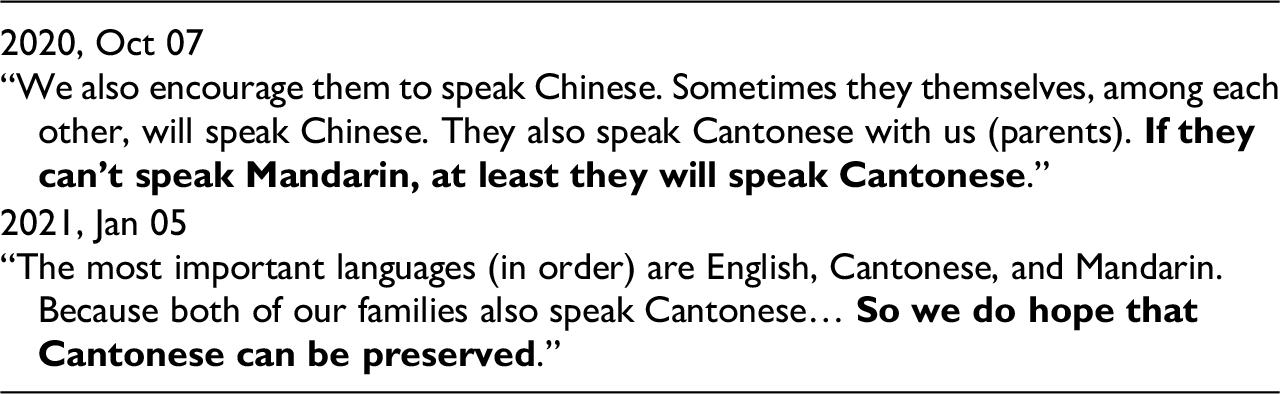
Comparisons between three-year parental interviews showed several changes in the attitudes of the focal Cantonese-speaking parents toward different languages, especially heritage languages. Among 24 parents, most of them increasingly paid more attention to Mandarin, although they were well aware of Cantonese still being the mostly spoken language at home. These Cantonese-speaking parents first believed that Cantonese, as their mother tongue or linguistic asset, should be the language that their children “must learn first” and Mandarin “could be acquired later” (Parent 52). Over the course of the three years, these parents began to attach more importance to children’s Mandarin acquisition because Mandarin “would provide more opportunities in job marketing” (Parent 47), “tended to be more and more popular if they [children] were based in Vancouver” (Parent 78), or “could be useful when [the] children go back to China in the future” (Parent 52) due to their growing awareness of Mandarin as the widely used language in mainland China and globally. The quotes below also indicate the changing trajectory of the attitudes that Parent 112 held toward Mandarin and Cantonese during the three years. This shift underscores how urban linguistic landscapes, along with transnational mobility considerations, can gradually modify family language priorities.
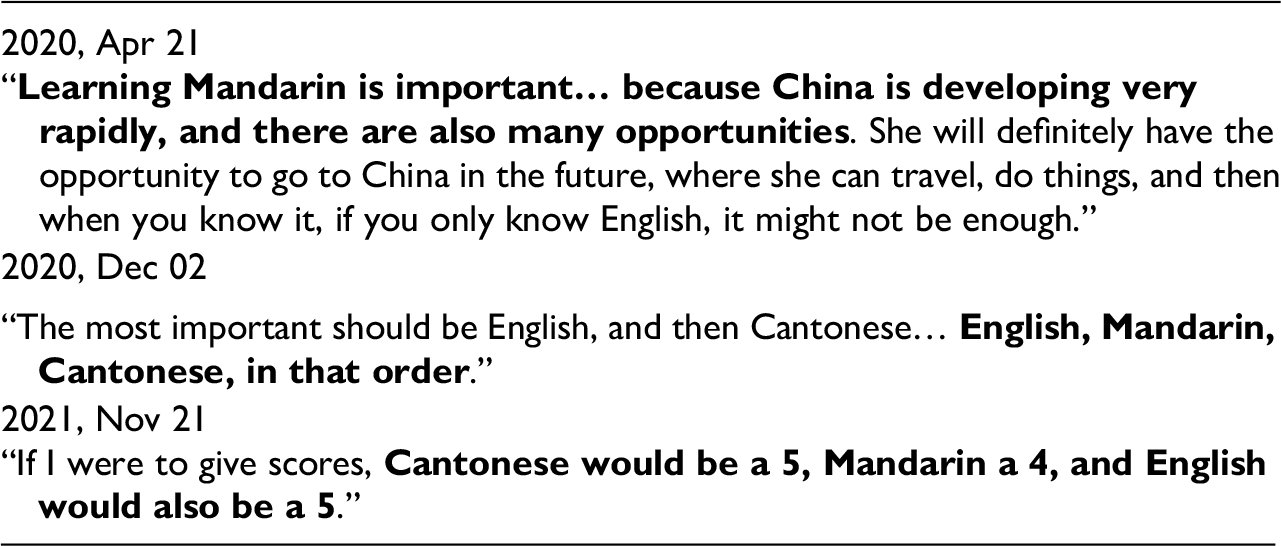
In contrast, out of the 24 parents, three parents’ (Parents 14, 47, and 92) attitudes toward Mandarin or Cantonese saw a reverse change. Instead of prioritizing children’s Cantonese learning, these Cantonese parents originally put more emphasis on spurring children’s growth in Mandarin skills, while later, they gradually recognized that Cantonese should be first maintained for their children as the children “were exposed to the Cantonese-speaking setting since they were born” (Parent 47), and “could not understand Mandarin as easily as Cantonese” (Parent 92). Cantonese, for these parents, was the principal home communicative tool that could bridge between family members of different generations, and was undoubtedly more important than Mandarin which “was mostly used by them [the children] for staying in touch with their Mandarin-speaking peers” (Parent 14). The quotes below further present a shift in Parent 14’s emphasis from Mandarin to Cantonese within three years.
Nevertheless, it is crucial to recognize that all three parents stressed the difficulty children encountered in Mandarin learning. Parent 47 shared that although they assumed “Mandarin and Cantonese were the same, just with a slight difference in tone” and that learning Mandarin would be easy, their daughter “always cannot understand” what was being said in Mandarin. Family 92 also tried sending their son to learn Mandarin, but “after two months he (the child) felt very stressed … because he could not get how to read, how to understand, or how to speak Mandarin.” The assignments from the Mandarin class were beyond the child’s ability to grasp, as they “just couldn’t understand why a character should be written like that” (Parent 92). It is probable that the three parents shifted their focus from Mandarin to Cantonese due to children’s perceived difficulties and stress-triggering experiences in learning Mandarin. Since Parent 92 further added that they “still feel he (the child) should learn some Chinese [Mandarin]” when the child reaches an older age, it is yet to discern if these changing language attitudes were a temporal rationalization of their adjustment or a long-term shift in language ideologies.
The ever-changing parental language attitudes further impacted language planning and practices within the focal Cantonese-speaking families. For Parent 112, who tended to prioritize his daughter’s Mandarin attainment rather than Cantonese, a decrease in Chinese, including both Cantonese and Mandarin, learning and use had been witnessed within his family during the past 3 years: Since I pay more attention to children’s Mandarin learning and suggest using Mandarin at home…children, particularly my daughter, began to resist using Chinese such as Cantonese…Recently, I recognized her use of Cantonese took on an evident downward trend—When I speak Chinese to her, she responds to me in English; if I demand her to use Chinese, she hesitates or rejects it.
It should be noted that not all Cantonese-speaking families attended to children’s development in one specific language; instead, they were fully cognizant of the benefits that bi/multilingualism might bring to their children so that they expanded bilingual and biliteracy practices within the home contexts whenever possible. For example, Parent 115 and her husband adopted “English-Chinese translation” activities to practice their daughter’s use of the two languages: “We first speak English to her and then repeat the same meaning in Chinese. At the same time, we make sure she understands the relationship between the two sentences.”
As for Mandarin and Cantonese, the family expected the girl to read and write in both languages. “From a global perspective, Chinese people who know Mandarin and simplified Chinese are several times more than those who know Cantonese and traditional Chinese,” said the mother. She further elaborated, Traditional Chinese character recognition and writing is like a bonus for her, and she can speak Cantonese fluently now. In this case, we do not have to pay more attention to her Cantonese speaking or traditional Chinese character writing, but her Mandarin speaking and simplified Chinese recognition.
As a result, these conflicts more or less contributed to changes or adjustments in either side’s beliefs of different languages, leaving language planning and practices within these families in an unpredictable and flexuous status. Parent 44 was in this kind of circumstances, My husband does not share my conviction of maintaining Chinese for our children, and he believes that English should be prioritized in the Canadian contexts, which makes it harder in facilitating our children’s Chinese literacy growth… Given that the disagreement on Chinese language learning and preservation worsens the relationship between my husband and me, even between my children and me, I may need to reconsider my plan and practices for my kids’ language development.
“What Will the Future Look Like? Who Knows?”: Multi-scalar Factors Affecting the Forming and Change of Parental Language Attitudes
Data analysis showed that the forming and change of Cantonese-speaking parents’ language attitudes had resulted from multi-scalar and multifaceted factors, including local, transnational, and global ones. Urban community norms, shifting demographics in the living areas, and global developmental trends all contributed to parental language attitudes, reflecting a glocal awareness that modified family language choices based on immediate urban settings and broader global contexts.
On the local level, Cantonese-speaking parents were aware of the recent language shifts in the city and community where they lived. They had subtilized the changing needs and demands of Mandarin use in their daily life, thus rapidly and strategically switching their emphasis from Cantonese to Mandarin in order to comply with the local development tendency. “You have to speak Mandarin [rather than Cantonese] everywhere, even though you go to T&T 2 for groceries,” Parent 112 said, “[Thus], they [the children] should better get used to it [Mandarin] earlier.” Migrating from Guangdong to Canada, Parent 81 had been living in Vancouver for more than ten years. She commented that being proficient in Mandarin now was an advantage for people living and working in Metro Vancouver, which was quite different from ten years ago when “English took the top place among the languages spoken here.”
Although Mandarin was playing an increasingly important role in local daily life and the job market, the lack of appropriate resources for Cantonese-speaking children to learn Mandarin was repeatedly reported by the parents in interviews over the three years. For many Cantonese-speaking families, parents long devoted themselves to seeking any simplified-traditional-Chinese bi-script resources or Mandarin-Cantonese bilingual classes which could satisfy their needs and demands of supporting children’s Cantonese-Mandarin biliteracy development. As time went by, some parents gave up finding resources in the third year of participating in this study and still hesitated to register their children in any Chinese language classes.
On the transnational level, Cantonese-speaking parents’ language attitudes might be affected by their connections with their relatives and friends living in China. Acknowledgement of the importance of strengthening intergenerational connections and family cohesion, some Cantonese parents (e.g., Parents 92, 111, and 112) thus gave priority to children’s Cantonese acquisition rather than Mandarin which was prevalently used across their community. However, they admitted that keeping Cantonese for their children in Vancouver was very difficult because of the limited Cantonese language exposure and use: The only space where we can speak Cantonese to our daughter is home… Her [my daughter’s] Cantonese knowledge and development are subsequently hindered due to the limited opportunities to use the language; when she goes back to China, she cannot understand many words that we may seldom use in home contexts. This becomes my big concern. (Parent 111)
Discussion and Conclusion
This study uncovers different language ideologies held by Cantonese-speaking Chinese-Canadian parents and the divergent changing trajectories of their ideologies toward different languages. In general, there exists a clear linguistic hierarchy with English at the top and Cantonese mostly at the bottom across the 24 focal families. With regards to two Chinese varieties, i.e., Mandarin and Cantonese, an overwhelming trend in shifting toward Mandarin has been evidenced in parental attitudes and practices within these Cantonese-speaking families, which directly or indirectly influences their children’s language growth patterns. While previous research by Li and Zhu (2010, 2011) highlighted the growing dominance of Mandarin in transnational communities, our study reveals a more nuanced picture of the tensions between Cantonese and Mandarin among the Cantonese Canadian families. These growing tensions are co-shaped by local, transnational, and global sociolinguistic forces that move toward a Mandarin-oriented trend. This multi-scalar influence underscores a dynamic struggle within families, where aspirations for social mobility and global integration—shaped by glocal language hierarchies and community norms—exist along with the desire to preserve heritage language connections.
The “English-as-priority” language ideology and linguistic hierarchy existed in the focal Cantonese-speaking families regardless of parents’ English proficiency level, echoing the findings of previous studies where immigrant parents often ranked English at the top of the language importance list (e.g., Curdt-Christiansen, 2009; Li & Shen, 2023; Li & Sun 2017; Xiang, 2016). Even though Cantonese-speaking parents well recognized the value of Cantonese in helping their children’s bi/multilingualism, bidialectalism, and even identity construction, most of them placed their mother tongue, Cantonese, at the bottom of the linguistic hierarchy as it had the least commodified value in relation to Mandarin and English in the local and global contexts. This perceived low status of Cantonese reflected that the parents held different ideologies and aspirations regarding the language compared to English and Mandarin, further dampening parents’ enthusiasm and engagement in Cantonese language activities and practices at home and leading to changes in their family language policy. This reciprocal process may continuously reinforce the marginalized status of Cantonese in either local or global contexts.
It should be noted that, along with the “Mandarin-speaking-only” policy being enforced within more and more Cantonese-speaking families (e.g., Families 44, 111, and 112), children from these families might lose not only their Cantonese linguistic and cultural assets (such as Parent 112’s daughter’s rapid decrease in Cantonese oral proficiency and her reluctance of speaking Chinese) but also the connections between language maintenance and self-identity formation (e.g., Ting, 2018; Wang & Curdt-Christiansen, 2021).
Similar to prior studies (Park, 2022; Tran et al., 2024; Wilson, 2021; Yang & Curdt-Christensen, 2021), the 24 Cantonese-speaking parents in our study exhibited fluctuating ideologies toward the host languages in Canada such as English and French, the dominant language in the local community and country of origin such as Mandarin, and their marginalized home dialect Cantonese over the three years, showing the constant tensions and compromises existing in language policies between immigrant families and the broad local/transnational/global societies.
Tangled in the competing demands between home and societal languages and policies, as well as multiple transnational identities (such as a sense of belonging in local Chinese communities and China, and Canadian-Chinese communities), Chinese immigrant parents frequently faced the predicament of having to choose between either English (the language that was explicitly normalized in mainstream schools and regarded as a prerequisite for children to achieve academic or career success in the host society), Mandarin (the official language and the common speech in China, which had potentials for the future prosperity of the family) or Cantonese (a regional dialect in mainland China, and a dominant variety in Hong Kong, but serving as the home language to help deal with daily issues in both contexts). As a result, the parents were always driven to negotiate with the complexity of societal policies, global tendencies, and transnational identities, intentionally and strategically shifting their language ideologies, management, and practices at home to better scaffold their children’s bilingualism, bidialectalism, and even academic or life success in mainstream society or global contexts.
As our findings suggest, there are multilayered forces collectively contributing to the forming and changes of parental language ideologies toward different languages, which resonate with previous research concerning the formation of immigrant parental language ideologies (e.g., Curdt-Christiansen, 2009; Hsu, 2018; Li, 2006). Interviews over three consecutive years evidenced that the Cantonese-speaking parents’ language ideologies were often and significantly influenced by different forces from macro social systems such as local Chinese communities and the transnational/global discourses, and language policies at a national scale.
One of the most shimmering examples was demonstrated in many interviews where parents well recognized China’s growing international influence and thus endowed the official language of China, Mandarin, as an “emerging global language,” believing the language contained enormous economic, social, and educational benefits (Heller, 2003; Park, 2022). The parents were eager to maintain Mandarin for their children because the language, just like English, was “useful everywhere, including both Canada and China.” However, what the families might not know was that the growing power of Mandarin and the long hegemonic status of English in local Canadian society might also contribute to marginalizing other Chinese dialects (including Cantonese) as heritage language preservation, as well as accelerating inequities and differences in access to resources (such as books with simplified-traditional-Chinese bi-scripts) and opportunities (Chinese language tutoring for both Mandarin and Cantonese) for the acquisition of English, Mandarin, and dialects locally. This could consequently alter parental language choices, aspirations, and practices and children’s linguistic development trajectories. This finding might also help explain the results presented in our previous studies on Chinese-Canadian children’s Chinese lexical skills (Li et al., 2021, 2022), where Mandarin-speaking children outperformed their Cantonese-speaking peers in Chinese receptive vocabulary tests, as well as either a Chinese-richness environment or Chinese language use within Cantonese-speaking families had no associations with Cantonese-speaking children’s Chinese receptive vocabulary development.
Additionally, it is worth noting that a small group of parents (e.g., Parents 92 and 115) in this study held the language expectations of maintaining both Mandarin and Cantonese for their children. Bidialectalism, as prevalent globally as bilingualism, juxtaposes language varieties that are closely related and often placed in competition, and yet the tensions are often masked under the competition among named languages. Given the tensions between Mandarin and Cantonese uncovered in interviews with Cantonese-speaking families, the study warned that parental attitudes toward bidialectalism are complex and must be understood in glocal contexts.
With an in-depth and detailed analysis of 24 Cantonese-speaking Chinese immigrant parents’ ideologies and attitudes toward both host and heritage languages, our study added new insights to the under-researched area of how immigrant families with non-dominant languages as heritage perceive and plan home language education for their children. The findings of this study bring several implications for all stakeholders in heritage language education.
First, for educators and policymakers, it is urgent to understand and address the challenges immigrant families face in preserving heritage languages and cultures. There is a need to enhance educational practices and policies in recognizing diverse linguistic backgrounds within the same ethnic group and providing inclusive support for each family. Policies should not only address local-specific language dynamics but also recognize the global-local interconnection in urban modernity, acknowledging immigrant families’ needs in balancing cultural heritages and transnational social mobility. Moreover, in the home domain, parents should fully recognize the importance of first language (L1) and should not reduce their involvement and investment in L1-maintaining activities, even if the L1 is not the dominant variety. Parents also need to navigate the constant tensions and dissonance between bidialectalism, as well as between their attitudes and practices by adopting a multilingual approach.
Further, the findings of this study have significant implications for postmodern identity formation in bilingual and bidialectal contexts, particularly concerning the potential shift from Cantonese to Mandarin among children in this study. Parental language ideologies not only impact family language planning but also profoundly affect children’s sense of self and cultural belonging, and may channel into their complex negotiations of identity and language beliefs (Leung et al., 2022). The linguistic tensions faced by these parents and children underscore the need for targeted strategies to support heritage language maintenance among these families. Families and educators can adopt a more fluid translanguaging approach to language use, opening up implementational and ideological spaces for children to leverage their full linguistic repertoire (e.g., García & Li, 2014; Wu & Leung, 2022). This approach not only supports bidialectal maintenance but also fosters a more inclusive and dynamic identity negotiation that helps navigate the complexities of multilingualism and multiplex glocal urbanity.
Finally, the study has implications for future research. The current study mainly relies on the verbal reports of mothers from Cantonese-speaking families; future research may conduct observations of family interactions in different languages and varieties to offer insights into families’ language use, attitudes, and ideologies. In addition, given that there might be consistencies and contradictions in language attitudes and practices among different family members, more explorations might focus on fathers’ or grandparents’ perspectives. Besides, it is also worthwhile to investigate children’s agency in complying with or resisting family bilingual/bidialectal policies, as well as sibling effects on children’s success in becoming bi-dialectal and bilingual.
Footnotes
Declaration of Conflicting Interests
The authors declared no potential conflicts of interest with respect to the research, authorship, and/or publication of this article.
Funding
The authors disclosed receipt of the following financial support for the research, authorship, and/or publication of this article: This work was supported by the Social Sciences and Humanities Research Council of Canada (grant number: 432-2018-0070).
