




Abstract
This study aims to learn from and with students of color to understand the influence of culturally relevant programming. Grounded in conceptions of counter-narrative and culturally relevant education (CRE), we center the voices and perspectives of Black and Latinx male adolescents to explore the impact of CRE-related programs and practices. Drawing on 10 focus groups with 37 students in urban schools, we illustrate how integrating community-based mentoring, critical conversations, and family-based relationships positively shaped students’ high school experiences. These findings contribute to growing empirical work on the benefits of CRE, while pushing for holistic efforts that extend beyond the classroom.
They make it seem like if you don’t wear a uniform, you’re a different person. You go down the wrong path…like you’re a criminal. One teacher told me that I was not wearing a uniform so I’m not myself. I’m like all these other hood rats. She told me that straight to my face. I said, “I’m wearing sweatpants, sneakers, and a shirt. I’m getting an 85 in your class and all the rest of the classes.
—Brandon, A&T High School
Equitable, accessible, and racially just education should be non-negotiable for all youth. Yet, Black and Latinx 1 adolescent boys continue to experience educational systems that do not support their learning, affirm their cultural and linguistic identities, or leverage their funds of knowledge (Carey, 2019; Dumas & Nelson, 2016; Ladson-Billings, 2011; Noguera, 2009). As the words from the student above demonstrate, schools can be places where they are frequently criminalized, their communities are disparaged, and their gifts and potential are overlooked or rejected. These experiences and the institutionalized racism present in classroom instruction, curricula, discipline, special education referrals, and other school policies (Fancsali, 2019; Ferguson, 2020; Howard, 2014; Rios, 2011) manifests in notable gaps in educational outcomes between Black and Latinx boys compared to their white 2 and Asian peers (National Assessment of Educational Progress, 2019). Simply put, young males of color often experience marginalizing or racially hostile schooling contexts that exclude these students from opportunities to learn and succeed (Chapman, 2013; Howard, 2014; Ladson-Billings & Tate, 1995). Further, despite empirical evidence of inequitable and invalidating educational contexts, too often Black and Latinx boys are subjected to deficit perspectives that place the responsibility solely on students for negative outcomes (Emdin, 2012; Harper & Davis, 2012; Noguera, 2003). For instance, Brown's (2017) historical analysis revealed deficit narratives that portray young males of color as endangered and in crises dating back to the 1930s. These recursive discourses fail to consider the environmental and cultural factors that impact the educational experiences of young males of color (Dumas & Nelson, 2016; Noguera, 2003), while overlooking their knowledge, skills, and achievement (Harper, 2015).
Taken together, the accumulation of school-based systematic disadvantages works against the cultural capital, assets, and aspirations of young Black and Latinx males (Carey, 2019; Dumas & Nelson, 2016; Ladson-Billings, 2011). These outcomes persist despite multiple reforms promising to mend these issues spanning from Brown v. Board to Johnson's Great Society to today's current accountability agendas (Horsford et al., 2018). In just the last two decades, multi-billion-dollar initiatives, including No Child Left Behind, Common Core, Race to the Top, and Every Student Succeeds Act, have not only failed to deliver significant gains in academic achievement for Black and Latinx boys, but also function to uphold hegemonic and deficit narratives of these youth and their communities (Chapman, 2013; Sleeter, 2012). Further, the emphasis of neoliberal, market-oriented, and target-driven accountability reforms negates the importance of identity, racism, and language, subsequently minimizing the lived experiences of these males (Carey, 2019; Chapman, 2013; Sleeter, 2012). In this historical and contemporary policy context, scholarship on addressing the educational disenfranchisement of boys of color requires radically reimagined policies that not only challenge prior assumptions, but also advance educational systems that center and cultivate the strengths, identities, and learning of Black and Latinx boys (Carey, 2019; Howard et al., 2016; Milner, 2007a).
Culturally relevant education (CRE) directly undertakes this reimagination, providing fundamental methods and paradigms to affirm and leverage students’ cultural identities to promote positive outcomes (Ladson-Billings, 1995a; Paris & Alim, 2017). Decades of research on CRE demonstrates powerful school practices that support Black and Latinx youth and bolster multiple student outcomes including, but not limited to, engagement, content interest, perceptions of ability, motivation, confidence, and academic achievement (Aronson & Laughter, 2016; Dee & Penner, 2017). However, because CRE is both ideological and methodological, transitioning from theory to practice and effectively implementing CRE remains a challenge for educators. In addition, most studies on CRE have taken place within one or a few classrooms, and thus there is a need to investigate CRE interventions that occur outside the classroom as well. In this paper, we aim to address these gaps by investigating effective practices that emerged in a district-wide CRE-based initiative. Further, we argue that understanding the effectiveness of particular CRE approaches is deepened by centering student voices (Solórzano & Yosso, 2002). This is especially important for Black and Latinx male adolescents whose voices are relatively silent in research focused on their outcomes, even while we know their lived experiences should contribute to the understanding and development of responsive interventions (Huerta et al., 2020; Noguera, 2008).
To that end, it is important to create opportunities for boys of color to share their experiences and elevate their knowledge in efforts to transform systems that have long failed to serve them (Delgado & Stefancic, 2017). Thus, we rely on critical race theory (CRT) and its tenet of counter-storytelling to explore the perspectives of Black and Latinx adolescent males
3
on CRE programming and practices, centering their voices and realities to understand how students experienced CRE in their schools. We hope to position the students’ counter-stories—to highlight their voices—as tools to communicate the unique experiences that positively shaped their daily lives in schools and stand in direct opposition to interactions like the one described above. This paper draws on data from a study of a district-wide effort in 40 urban
4
high schools in New York City to improve academic and socioemotional outcomes for Black and Latinx young men. Specifically, we rely on interview data from 10 focus groups conducted with 37 high school students who participated in CRE programming over the course of their high school careers. Drawing from this data, we were able to collect reflections from students who participated in long-term CRE programs to better understand the influence of these programs on their high school experience. Our guiding questions for this paper are:
What CRE-related programs or practices did Black and Latinx male students identify as most impactful? How did students describe the outcomes of the programs or practices they found most impactful?
Overall, we aim to contribute to existing literature in two important ways. First, through centering the voices of Black and Latinx boys, we gain valuable insight to students’ perceptions on how CRE programs and practices helped positively shape their high school experience, particularly in urban intensive contexts (Milner, 2012). Second, we build upon past research by focusing on a district-level initiative and CRE programs that were implemented outside of the classroom. This increases our understanding of holistic, scaled up-efforts that may improve the experiences and outcomes of students typically marginalized in their school communities.
Literature Review
Empirical Research on Culturally Relevant Education
CRE has been purported as a way to reimagine teaching and pedagogy to meaningfully improve the educational performances of students of color and directly buffer against forms of racism (Ladson-Billings, 1995a, 2014). CRE has also consistently demonstrated positive impacts on student outcomes, especially for historically marginalized students. In their meta-synthesis of 37 studies, Aronson and Laughter (2016) documented how CRE positively influenced student outcomes across multiple content areas. Overall, they found that CRE practices were linked to not only positive gains in test scores and academic achievement, but also to other predictors of academic outcomes, including motivation, content interest, and perceptions of academic identity. This research also drew connections between CRE and outcomes such as critical dialogue skills, cultural competence, perspective taking, and knowledge of sociopolitical issues. In another study, Howard and Terry (2011) found that when CRE was utilized by teachers, African American students’ achievement, graduation rates, and college going rates increased. Byrd (2016) further found that students’ self-reported CRE experiences were associated with greater perceptions of belonging, positive racial attitudes toward others, and academic outcomes.
For the most part, CRE studies are often small-scale studies limited to one or a few classrooms and are often focused on classroom instruction and/or curricula (Aronson & Laughter, 2016; Morrison et al., 2008; Sleeter, 2012). Additionally, a large portion of CRE-related literature that examines the impact of CRE on student outcomes relies on teacher perspectives and/or classroom artifacts/observations (Aronson & Laughter, 2016; Morrison et al., 2008). This paper aims to contribute to the body of work documenting the influence of CRE on students through their voices and lived experiences. By exploring students’ perspectives on school-wide CRE programs (versus stand-alone classrooms), this paper provides unique insights into how CRE programs can support the academic and socioemotional outcomes of Black and Latinx male adolescents.
Large-Scale Initiatives for Young Males of Color
Often motivated by data showing achievement and opportunity gaps between males of color and their female counterparts as well as their white and Asian male peers, several large-scale efforts have been implemented to specifically serve Black and Latinx male students. To date, the largest educational initiative for young men of color is My Brother's Keeper (MBK), which was established in 2014 by President Obama and focused on addressing the persistent gaps young males of color face through mentoring and community supports (My Brother's Keeper, 2014). Inspired by MBK, but designed separately, other similar initiatives have been launched across the country and some empirical evidence has emerged from these efforts. For example, in Oakland, the African American Male Achievement (AAMA) program led to significant reductions in the number of Black males who dropped out of high school (Dee & Penner, 2021). Similar results were demonstrated by the Becoming a Man (BAM) intervention in Chicago, which was designed to reduce high school dropout rates and promote more educational opportunities for adolescent males of color. In their evaluation of BAM, Heller et al. (2017) found that participation in BAM reduced crime during the intervention period, improved school engagement, and increased graduation rates. Other district-wide efforts have not yet been externally evaluated. In Minneapolis, for example, the school district established an Office of Black Male Student Achievement and partnered with the Power of People Leadership Institute to run a coaching program (i.e., Rites of Passage) based in the West African tradition of learning from history. To the authors’ knowledge, no empirical studies have captured its impact on young Black males yet. This remains true for other programs across the nation including, but not limited to, Austin's Justice Coalition, Boston's version of BAM, and the District of Columbia's Empowering Males of Color Initiative.
We should note that these efforts have received some important critique. For example, MBK has been criticized for perpetuating harmful discourses that portray young men of color, their families, and communities in crisis, and for promoting neoliberal and entrepreneurial interventions to address social inequities (Dumas, 2016). Others have examined the limitations of single-gender settings designed specifically for Black and Hispanic/Latino boys. Past empirical research demonstrates that it is difficult to identify positive or negative results from attending these schools (Fergus et al., 2020). Fergus et al. (2020) conclude that the issues related to the education and development of young Black and Latinx boys contain a complexity that simple solutions will not substantially address. They posit that single-gender schools that lack supportive and culturally conscious teachers remain a surface-level solution that will not singularly mend the systemic disenfranchisement facing young Black and Latinx males. Similarly, CRE practices within one or a few classrooms may buffer against forms of racism, but do so only within those contexts. CRE-based programs designed to extend beyond the classroom and create culturally relevant school environments are thus critical. This paper examines another large-scale initiative—the Expanded Success Initiative (ESI) in New York City (discussed further below)—through the perspective of students. In so doing, this paper builds on the limited but growing body of evidence on the benefits and limitations of large-scale efforts targeted at male students of color.
Theoretical Underpinnings
This study is guided by CRT, its tenet of counter-storytelling, and conceptualizations of CRE (Delgado & Stefancic, 2017; Ladson-Billings, 1995a, 1995b; Ladson-Billings & Tate, 1995). CRT asserts that the enduring gaps present in current systems of education are deeply situated in historical, cultural, economic, and institutional contexts designed to perpetuate racial hierarchies and inequities (Bell, 1992; Delgado & Stefancic, 2017; Ladson-Billings & Tate, 1995). As such, CRT provides us with a lens to understand how educational practice and policy fails to serve students of color and, in some ways, has actively harmed their opportunities to succeed and thrive. Though CRT has six tenets that offer different lenses to make sense of this large-scale CRE-initiative, we mainly rely on the tenet of counter-storytelling as it is the most appropriate to view experiences with CRE-related programming through students’ stories (Bernal, 2002; Delgado, 1989; Solórzano & Yosso, 2002). That is, counter-storytelling exists within and outside of CRT, but this paper capitalizes on the intersection between the two in three major ways. First, CRT scholars center the voices, stories, and perspectives of populations who are historically and systemically marginalized to elevate their experiences and recognize their experiential knowledge as pivotal to transformation (Bernal, 2002; Delgado, 1989). In education, the experiences and lived realities of students of color have often been misinterpreted, marginalized, or omitted in decisions over educational practice and policy (Bernal, 2002; Ladson-Billings & Tate, 1995). Thus, this paper elevates student voices to illuminate how schools may support their success and wellbeing. Second, CRT and counter-storytelling work to challenge dominant narratives and advance the (re)thinking of hegemonic systems (Delgado, 1989; Delgado & Stefancic, 2017). As such, we leverage students’ cultural, gendered, linguistic, and intersecting identities to co-construct a larger counter-narrative that pushes back against prevailing deficit ideologies related to boys of color and dominant perspectives of individual success (Bernal, 2002; Dumas & Nelson, 2016; Huerta et al., 2020). Third, and intricately related to the first two, CRT and counter-storytelling are rooted in commitments to social and racial justice, prioritizing the stories of marginalized groups to help create change (Bernal, 2002; Solorzano & Yosso, 2001). These theoretical constructs afforded us multiple opportunities to go beyond naming systems of racialized oppression and inequities to document approaches that utilize students’ cultural knowledge and strengths to transform educational spaces (Carey, 2019; Howard & Navarro, 2016).
In addition to CRT, we draw on conceptualizations of CRE to inform our analysis. CRE seeks to foster and sustain students’ racial, linguistic, cultural, and community diversity within educational systems and further utilize them as mechanisms for achievement (Ladson-Billings, 2014; Paris & Alim, 2017). In particular, Ladson-Billings’ theoretical framework, culturally relevant pedagogy, affords a broader analytic lens for CRE outcomes outside of teaching and classroom practices, and thus benefits our current analysis on school-level CRE programs (versus culturally responsive or sustaining pedagogy frameworks). Ladson-Billings (2009) recognized CRE as an educational environment that ensures students’ intellectual, socioemotional, cultural, and political development. Specifically, Ladson-Billings (1995a, 1995b) posited that CRE functions to: (a) guarantee students’ academic success and develop their love for learning; (b) cultivate students’ cultural competence, allowing them to understand their own and others’ cultures; and (c) obtain and expand students’ sociopolitical consciousness to “recognize, understand, and critique current and social inequalities’’ (Ladson-Billings, 1995b, p. 476). We utilize each of these components to identify and deepen our understanding of how CRE-related approaches influenced the lives and learning of students in our study. In other words, we highlight through the students’ voices how CRE supported their academic growth, cultural competence, and sociopolitical consciousness. In addition, CRE must empower a collective learning community beyond singular individual learners (Ladson-Billings, 1995a). This element becomes an important lens in understanding the influence of CRE on student's collective vision of success (beyond a focus on individual achievement).
Positionality
We acknowledge that this study's questions, methods, analyses, and interpretations are shaped by our experiences, beliefs, and knowledge (Milner, 2007b). This research originates from our collective commitment to advance racial equity in K-12 school systems. The first author is a white woman currently studying the implementation and impact of culturally relevant pedagogies, anti-racism professional development, and racial justice models in partnership with districts and schools. The second author is a Latina from a mixed-status immigrant background and former educator whose research focuses on the intersections of race, education, and K-12 policy. We utilize CRT not only as a theoretical framework, but also as our core epistemological view. We thus approached this study with awareness of the historical, societal, and interpersonal harm associated with white supremacy and deficit-based views in schools (Delgado & Stefancic, 2017; Matias et al., 2014). Because our own identities and racialization processes differ from the population at the heart of our study, we aimed to apply critical reflectivity on how our own identities intersected with this work. This involved ongoing dialogue in a multiracial research team to challenge and push our perspectives and assumptions—positioning ourselves as learners and the students as teachers. We also intentionally centered and prioritized the voices of these young men of color in our analyses (e.g., in vivo coding) and in the presentation of the findings. Through a close reading of the text (the students’ voices), ongoing processes of reflection, and situating our analyses in the work of Black and Latinx scholars, we strived to do justice to the words and experiences of the students in our study.
Methods
Study Context
The current paper draws on data collected for a mixed-method, longitudinal study of the ESI, which was implemented in 40 New York City urban high schools 5 to increase college readiness and enrollment among Black and Latino males (Villavicencio, 2021). ESI provided schools with funding ($250,000 over 3 years), professional development, and ongoing support to create or expand programming in three domains: (a) academic initiatives that promoted college readiness and rigorous learning (e.g., tutoring, expanding access to AP courses, SAT prep); (b) youth development initiatives that socially supported students’ socioemotional outcomes and reduced disproportionality in suspensions (e.g., mentoring programs, extracurricular activities, restorative justice practices); and (c) school culture initiatives that focused on college pathways and a larger ethos of school belonging (e.g., college trips, college workshops for parents, summer bridge programs for incoming 9th graders). Notably, CRE served as the underlying principle guiding the conceptualization and implementation of each of the three domains. That is, whether programs targeted academic outcomes, life skills, or school culture, they were rooted in CRE ideology and practices. Further, while schools exercised considerable autonomy to use their resources in ways that could meet the specific needs of their students, they were responsible to show how CRE was informing their work as a prerequisite for receiving the funding each year.
While beyond the scope of this paper, the broader evaluation of ESI found that while graduation and college enrollment rates rose in ESI schools among the targeted population during the study period, ESI did not seem to make a statistically significant impact on college readiness (Villavicencio et al., 2018). At the same time, Black and Latino young men in ESI schools consistently reported a stronger sense of belonging and fair treatment than those in comparison schools. They were also more likely to engage in discussions about college and careers throughout high school. These findings are notable given the alienation and deficit perspectives male students of color typically face in their schools (Dumas & Nelson, 2016; Howard, 2014). While college readiness may be an important measure of success, we believe there is much to learn from ESI about how it cultivated these socioemotional outcomes for boys of color. By drawing on data that captures students’ perspectives of and experiences in ESI, this paper aims to reveal important insights into the specific elements or approaches that were most impactful for students and that may be replicated elsewhere.
Data Sources and Participants
The broader evaluation of ESI included 10 case study schools that were identified as exemplary as an attempt to maximize what could be learned from the initiative. Case study sites were selected based on fidelity (i.e., how well their programs aligned with ESI's core tenets) and intensity (i.e., the duration, frequency, and number of offered programs). 6 Case studies of these sites were conducted during the third and fourth years of the initiative (five schools in each year). Data collection in these schools included interviews with ESI coordinators; focus groups with teachers leading ESI programs; observations of ESI programs; focus groups with students participating in ESI programs; and the collection of ESI-related documents. This paper relies specifically on student focus group data. This subset of data was ideal for the questions that guided our inquiry as these focus groups were conducted with students who had participated in ESI throughout their high school careers; thus, they were positioned to provide greater insight into how CRE programs helped shape their high school experiences. Table 1 provides more information about each case study site and the number of students interviewed at each site. While all sites share some similarities (at least 30% Black and Latino male students with similar socioeconomic backgrounds), they vary in terms of school characteristics, size, location, and programming.
Case Study School Demographics and Programs.
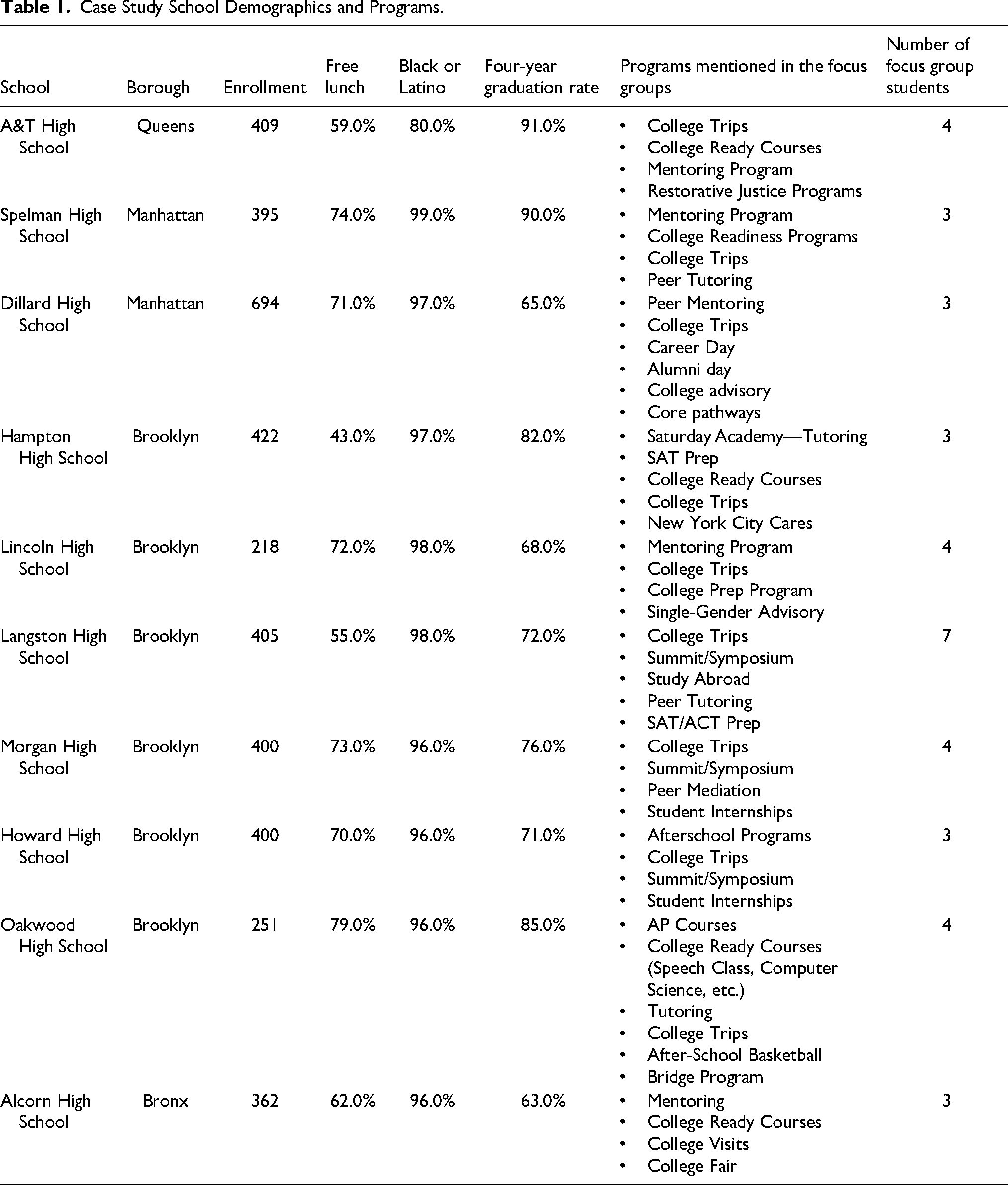
The research team invited students who had participated in their school's ESI programs to participate in a focus group through recruitment talks in their classrooms. Black and Latinx male researchers conducted these recruitment talks. They invited students to participate in interviews by describing them as opportunities to share their experiences with ESI programs, so that researchers and ESI leaders could better understand what was working and what could be improved. We purposely did not recruit through teachers or administrators to avoid a biased selection of students who might only speak favorably of ESI. While recruitment selection could not fully correct for this potential bias, interview questions were constructed to capture more comprehensive views of ESI (e.g., one question asked “What would you change about ESI in your school?”). Across these sites, a total of 37 students volunteered to participate. Most focus groups included 3 to 4 students, while one included 7 students to accommodate all of the students who volunteered in that school (see Table 1). Students across schools reported varying ranges of ESI participation. For example, some interviewees participated daily in ESI programs compared to other interviewees that only attended a few college trips. We interviewed all students who volunteered rather than selecting students based on the degree of their past ESI participation. We found that this variation elicited a more holistic perspective of ESI's impact on students’ high school experiences.
Researchers leveraged the benefits of open-ended, semi-structured interview questions to engage in follow-up discussions and remain open to conversations outside of pre-determined topics (Creswell & Poth, 2016). Questions on the interview protocol concentrated on student perceptions of their schools, successes and challenges they experienced, their post-secondary goals, influential contributors to those goals, their participation and experiences in ESI programs, and advice they would give to other students and teachers. Questions about ESI programs were open-ended, while encouraging students to highlight meaningful experiences. For example, the interviewer would list the ESI programs present in that specific school and ask students about their experiences, prompting detail through follow-up questions (i.e., “How do you think your experience would be different if that program did not exist?” “Would you recommend this program to a peer? Why or why not?”). Focus groups lasted approximately 45 minutes and were recorded and transcribed verbatim. To protect participating schools and students, pseudonyms have been used throughout this paper.
Data Analysis
This paper relies on a phenomenological approach to analyze student focus group data and capture rich descriptions of their experiences with CRE programming (Creswell & Poth, 2016). This type of analysis focuses on the lived experiences of individuals to understand the “essence” of a phenomenon and provide in-depth depictions of respondents’ shared experiences (Creswell & Poth, 2016). To that end, this paper is grounded in a close reading of students’ individual responses and an interpretation that highlights patterns in words, phrases, and observations across different focus groups. This approach aligns with CRT and the tenet of counter-storytelling as they are grounded in the voices and experiential knowledge of participants and emphasize collective perspectives and points of view (Delgado, 1989). Moreover, this analytic approach complements counter-storytelling in providing opportunities to amplify the narratives of young Black and Latinx males in what they find most supportive in systems that often do not often take their expertise into account (Solórzano & Yosso, 2002).
Data analyses for this paper were conducted in multiple phases. First, all focus group transcripts were annotated with emergent codes, questions, and statements to gain familiarity with the data (Saldaña, 2021). These annotations allowed us to create an initial codebook that was further refined as all transcripts were coded (using MAXQDA version 20.0.8). Initially, 44 codes emerged. Solidifying codes involved both bottom-up and top-down processes. That is, most codes were directly derived from students’ spoken words through in vivo coding to accurately reflect their experiences and voices (bottom-up) (Solórzano & Yosso, 2002). Examples include “Perspective,” “Growth,” and “Fun.” In addition, we utilized CRE constructs (top-down) to capture the features of CRE that appeared in student descriptions of outcomes (e.g., “critical conversations,” “identity affirming”), and two broad “ESI” codes to capture programming and outcomes outside of our in vivo codes. We engaged in four rounds of coding and debriefed after each round to clarify meanings, eliminate redundant codes, and reorganize codes. Our final codebook included 33 codes (see Appendix Table A1 for sample codes and definitions).
Next, we engaged in second-level analyses of a subset of coded data and produced data displays linking programs and practices with student-reported outcomes (Williams & Moser, 2019). Analytic memos using students’ verbatim quotes that categorized and narrated outcomes were then created and researchers met to discuss displays and memos. Through this analytic process and discussion, we identified CRE-related approaches within and across schools that were especially salient to Black and Latinx male high school students. Methods to establish analytic credibility and trustworthiness included: (a) team debriefing sessions to co-examine findings, reflect on analyses, and deconstruct subjective perspectives; (b) deliberately returning to the words of participants to represent categories and themes; (c) iteratively making sense of the findings in relation to CRE and critical perspectives; and (d) ensuring findings are representative of multiple voices and perspectives across participating schools instead of the result of a few (Miles et al., 2018; Saldaña, 2021).
Findings
In this study, we aimed to gain a deeper understanding of how Black and Latinx males experienced CRE-grounded programs, which ones they found most impactful, and why. To answer our research questions, we focused on the ways in which students described the influence of programs or practices on their lives and high school experiences. Guided by CRT, the tenet of counter-storytelling, and phenomenological methods, our analytic process allowed us to ground our findings in the voices and perspectives of the students we interviewed. While students spoke positively about a number of different programs, our analyses revealed three underlying practices or approaches students found most meaningful, including: (a) engaging with mentors of color from their communities; (b) participating in critical conversations about race and identity; and (c) establishing a family-based culture within their school communities. Although these practices were not brought up within every interview, the students who spoke of them discussed them at length and deeply connected them to perceived personal outcomes. Figure 1 displays various programs implemented as part of ESI, the CRE-based practices or approaches that students highlighted in their interviews as beneficial, and the associated outcomes they reported.
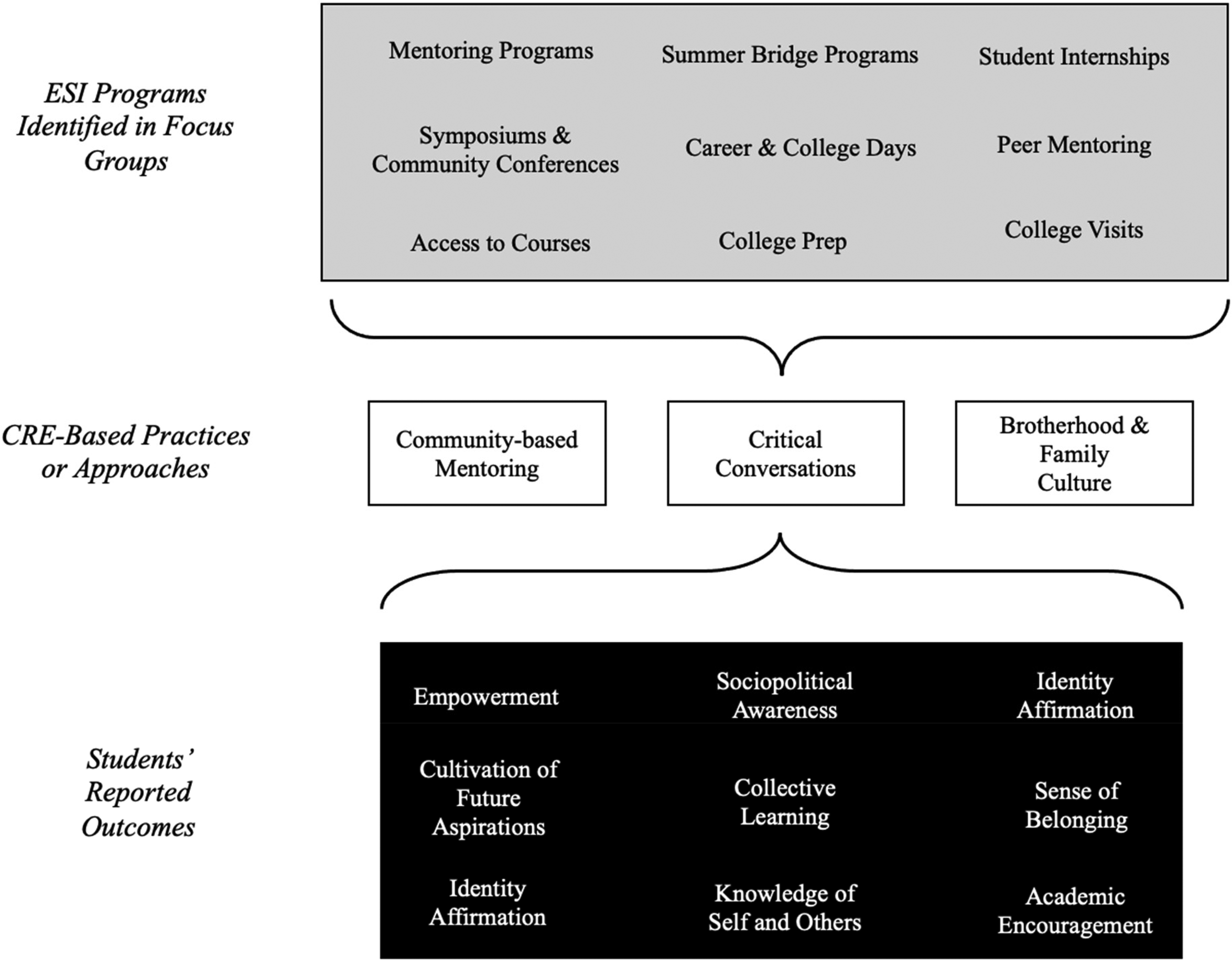
Summary of identified programmatic practices and students’ described outcomes.
Notably, these practices existed across different types of programs, even if they were more emphasized in some. Therefore, we argue that the specific form of programming is less important than the principles or set of values undergirding programmatic efforts. We also posit that while each of these may be impactful on its own, it is the integration of these approaches into the fabric of the school environment that holds the most promise for positively shaping the student experience. Finally, we do not suggest through these findings that all aspects of each of these programs or practices were exemplary; indeed, the implementation of CRE-based programming could have been strengthened across schools through more resources, wider staff engagement, and ongoing professional development (Villavicencio, 2021). However, we focus on these practices because they emerged as meaningful for students, thereby providing us insight into the areas urban schools and educators should seek to develop further in their own sites. In the sections below, we leverage the voices of Black and Latinx males to understand and spotlight how fundamental aspects of CRE positively shaped the student experience. Each section describes how the practice was employed and how students characterized the outcomes of those practices.
Community-Based Mentoring: “It Makes You Think ‘I Can Do This’”
In past research, mentoring interventions for Black and Latinx boys often originate from deficit discourses and assumptions that they do not have any role models or that they need guidance to escape their current circumstances and communities (Johnson et al., 2020; Singh, 2021). Further, they may also take approaches that are color-evasive, defined by avoiding substantive discussion or acknowledgment of race (Utt & Tochluk, 2020). Examples of color-evasive approaches include not considering the racial makeup of mentors or selecting predominantly white individuals whose lives are supposed to be aspirational yet have few authentic points of connection with their mentees (Johnson et al., 2020). One of ESI's approaches to mentoring was to ground mentoring experiences in students’ cultural, racial, and linguistic backgrounds (Paris & Alim, 2017). Mentors represented a range of professions, but especially those that were community-based, including nonprofit directors, local council members, and other local business leaders. The range of professions foregrounded imaginable futures that defined success in ways that extended beyond traditional narratives of “getting out” or leaving one's community, and further deconstructed stereotypes surrounding men of color (Carey, 2019; Dumas & Nelson, 2016). These community models mentored students by speaking about their own journeys, providing practical guidance on decisions about college and career paths, and making time to listen to the concerns and celebrate the successes of the young men they encountered.
Students described how their experience engaging with these models (as well as the models’ openness and vulnerability) impacted them in important ways. First, many young men of color described feeling empowered by these interactions—an underlying goal of CRE (Ladson-Billings, 2009). For example, one student from Langston High School described his experience attending an all-day male symposium: “It's just a whole different way of thinking and a whole different environment and it's really—it's motivational and it makes you think, ‘I can do this.’” The ability of these mentors to connect their life experiences with the journeys of these students seemed to grant them a level of confidence in their own aspirations. The community mentors not only modeled possibilities, but in many instances also offered practical advice to overcome potential barriers. One student shared, “They really advised us and helped us in a way where we can achieve our goals” (Oakwood High School). Another student mentioned how a community model explained “how he got to where he was and how he helped out a lot of other young men get to his position” (A&T High School). In this way, community models seemed to transfer critical skills to the high schoolers that reflected their cultural navigational strategies and aspirations (Ladson-Billings, 2014; Paris & Alim, 2017). As such, students elaborated that witnessing these men's journeys contributed to an optimistic outlook of achieving comparable futures. Another student expressed, “[We] got to see doctors, lawyers coming up from similar circumstances as our own. They made something of themselves, so that gave us hope” (Langston High School). From students’ interviews, this program's attention to recruiting community models was empowering in ways that were both aspirational (“that gave us hope”) and operational (“I can do this”). Their observations do not suggest an absence of these messages in other dimensions of their lives (e.g., from their homes, churches, extracurricular activities), but rather that schools can be a powerful place to feature the everyday journeys and successes of individuals in their community.
Interactions with community mentors also afforded the space for students to reflect on their own trajectories, imagine future possibilities, and share their pathways with mentors. In response, community models mentored students in ways that shifted or cultivated students’ future aspirations. For example, one student compared it to getting students “back on their feet and thinking about life” (A&T High School), while another reported shifting his goal from becoming an accountant to opening his own business. He shared, “I can open my own [accounting] firm; go to any organization I want; do anything” (Oakwood High School). Another student from A&T High School shared: I was about to drop out of school and go into the military but then Martin—he spoke to me and he said that I got so many things that I could accomplish just to give up in the beginning. I thought about it and then I started getting back on my studies.
Further, forming connections between students and community members was also a culturally meaningful and validating experience, affirming the identities of the young men in our study. Though it is not possible to compare the impact that models without similar identities or backgrounds might have had, students consistently expressed the importance of seeing mentors who looked like them. Students also believed that these men of color spoke directly to their own experiences. One student described it as finally getting to witness the “real world” and summarized, “You get to actually see success, and you get to see it look like yourself. And you get to see yourself in that place” (Langston High School). This student expanded that getting to see the “real world” was in opposition to the stereotypes he was accustomed to seeing and the societal depictions of the careers men of color have. Thus, these interactions consistently functioned to disrupt negative racial scripts and affirm students’ identities, while providing diverse illustrations of future college and career paths (Warren et al., 2022). Overall, this experience was powerful for students as they related to the backgrounds and identities of the community models and were able to connect with them through open and honest dialogue. These elements seemed to manifest multiple components of CRE in students’ lives, including empowerment, developing aspirations, and affirmation.
Spaces for Critical Conversations: “What It's Like to be a Black Man Growing Up in this Country”
The students in our focus groups also emphasized the importance of having spaces to engage in critical conversations (i.e., discourse on topics such as identity, racism, poverty, gender, adolescence, etc.). Students across eight schools described how these spaces were able to counteract some of the racist and discriminatory contexts students faced in their own schools and outside of them. That is, over the students’ adolescence in NYC, they witnessed first-hand the excessive policing of their neighborhoods and community members; the “Stop and Frisk” policies that disproportionately targeted males of color (Torres, 2015); the presence of police officers within their schools; and the murders of Eric Garner, Michael Brown, Trayvon Martin, and 80 other individuals of color during their high school careers. In 2015 to 2016, they watched as Trump's campaign explicitly and negatively portrayed their neighborhoods as dangerous and their community members as criminals. And, in their own city, they observed increasing raids and deportations conducted by Immigration and Customs Enforcement (ICE) and experienced the fear and anxiety related to their own status or that of their family members. Due to the color of their skin or the languages they spoke, these students were forced to withstand a constant level of surveillance in their communities and schools, receiving implicit and explicit messaging about how they are perceived (David et al., 2019).
In response to these oppressive environments, multiple ESI schools created dedicated spaces to bring together Black and Latinx boys to share their experiences and listen to those of their peers. Often, these were peer mentoring groups of 10 to 20 students and a few adult facilitators where students critically discussed a range of topics from experiences with racism to exploring issues of gender. Through these groups, students had a community to share achievements and celebrate their peers, while also feeling comfortable to disclose challenges. Students described how these groups provided room to not only learn more about historical and contemporary racial inequities, but also connect these dynamics to their own lived experiences. For example, one student described the focus of these conversations as “what it's like to be a black man growing up in this country” (Morgan High School). Another described it as particularly “opening” to recognize that his peers “go through the same issues I go through and have the same experiences” (Spelman High School). In these conversations, students realized they had other peers who intimately understood their realities. Within oppressive systems, having room to voice racialized and gendered issues and feel validated is both humanizing and empowering (Freire, 2013). Further, through sharing lived experiences, students described gaining more understanding of the cultural values and institutions that uphold and maintain racist structures that affect their daily lives. One student described, “We got into discussions about the struggles facing Black and Latino males and females. What are they going through at home? What are their plans for the future?” (Lincoln High School). Thus, these groups seemed to foster students’ awareness of larger sociopolitical issues and began equipping them with the skills to question or critique them (Ladson-Billings, 1995b).
In addition, engaging in these dialogues helped students realize the necessity of facing potential obstacles as a collective community and the importance of coming together. For instance, one student mentioned, “Hearing people's stories, that's how we’ve figured out that it's not gonna be easy. Because it's not easy for anyone else, [but] we can all do it, as long as we unify” (Lincoln High School). Multiple students also elaborated on how meaningful this collective was for recognizing the knowledge and contributions of their peers. One Lincoln High School student summarized, “It's one of the main ideals that we have here, ‘Each one, teach one.’ No one person knows everything, but everybody knows something. We can all share that as a community, like everything around us.” This ideal set the foundation for Lincoln students to not only recognize their own knowledge, but also learn from and leverage the skills, assets, and capital each peer brought into the group to continue growing as a whole. This aligns with Ladson-Billings’ (1995a, 1995b) emphasis that students must learn to move beyond acquiring individual success to empowering groups as a collective. Relatedly, after experiencing these spaces, students were eager to give back. For example, one Oakwood student mentioned he felt more readily able “to help others—meaning helping them to progress; being able to encourage them and share experiences.” In another school, students expressed frustration that their program was discontinued, but planned to “pass on the torch” to underclassmen and “keep the legacy alive” (Langston High School). In this way, students benefited from these collective learning communities and further aimed to ensure others did too, even if the responsibility fell on their shoulders. Their actions begin to reflect the CRE component of collective empowerment as they each individually take action to engage their fellow peers and create these spaces (Ladson-Billings, 1995b).
Overall, these dialogues spotlighted students’ cultural realities instead of silencing them, helping students make sense of their experiences with racism and come together as a collective. In addition, as evident in many of their statements, students further discovered truths about themselves and their peers. One Hampton student summarized this best: “It's important to share [your] experiences with many people…as the Black and Latino people share [their] experience with you, you know that [it is a] personal reflection of each person in their life.” Through developing knowledge of self and others, these spaces also marked initial stages of developing cultural consciousness (Ladson-Billings, 1995b). Regardless of the names of these groups—Umoja (unity in Swahili), Brothers on a New Direction, Liberators, or Rites of Passage Program—or how they differed in implementation, students shared that these spaces afforded opportunities to critically discuss societal inequities, form a collective learning community, and develop knowledge of themselves and others.
Brotherhood and Family Culture: “It's Hard to Build One, but It's Also Hard to Break One”
Overall, across all schools and numerous programs, students emphasized the importance and depth of the relationships they were able to form through ESI programming. Students consistently characterized these relationships with adults and peers in their schools in terms of family bonds. Students spoke extensively about the “brotherhood” that existed between peers, and the “second parents” they found in the adults at their school. The depth of these relationships arguably provided the foundation for multiple outcomes the students described across ESI programs. This type of family-based culture provided students a network of support in their schools grounded in authentic care and respect. Students described times they were able to rely on their peers in difficult situations and seek advice from adults without worrying about judgment. One student from Lincoln High School summarized: Sometimes in life, you meet complicated situations where you may feel like you can't talk to anybody. But we all knew each other so much that we automatically knew when something was up, and then we could open up and talk to each other about it … That's why we call each other our brothers, because we know they're always there to help us when we fall down or when life throws you a curveball. They [the teachers] never treated us like students; they always treated us like their sons in a way. They made sure that everything in our lives was okay … Those were our first original mentors to see who we were as people and what our strengths and weaknesses were when it came down to education, when it came down to talking, or opening up, or what made us close in … They are like our second fathers that we love to death. (Lincoln High School)
Both descriptions point to the experience of being seen and known by others though loving relationships. Carey (2019) asserts that communicating to young males of color that they matter and are valued is critical (see also Love, 2019). In that vein, students reported that the genuine care and support they found in their school communities contributed to the validation of their identities, feelings of belonging, and experiences of academic encouragement.
The sense of safety students found within their brotherhoods and teacher-student relationships seemed to allow students more freedom to express themselves. One student outlined this by saying, “In comin’ to this program, I could be a lot more honest with them. I could be a lot more—I could behave a lot more like myself” (Spelman High School). The student's comment not only highlights his ability to be more honest with his peers, but also suggests that other spaces do not allow him to be his full self. In this way, these relationships also functioned as counter-spaces, where youth of color found support in their experiences and validation of their identities from same-race peers with similar backgrounds (Carter, 2007). Beyond authentic friendships, students experienced an identity-affirming culture that increased their sense of belonging and provided buffering strategies to discriminatory contexts. In addition, feeling a sense of security and validation helped some students develop confidence that extended into other spaces. A student recounted: That kid that sits in your class that you think is shy, they come to one of the meetings. You hear their opinions on things. They're actually explaining themselves, stating why they feel like this. People are agreeing with them. They get to speak out more and contribute. It shows in the classroom when now they're raising their hand, now they're saying things. (Spelman High School)
Interestingly, students also reported that these family bonds helped reinforce systems of academic accountability. Students described how connecting with their peers pushed them to excel in school, seek out help more easily, and share successes with a group of peers who loved celebrating academic wins. For some, this level of support translated into academic outcomes or personal growth. One student summarized: I was aiming for 65. I was thinking, I’m not gonna strive, I’m just gonna try to make it. Now it’s like with the community, they push me and I push myself now. Like we were saying, they gave me a helping hand. They were trying to push me and now I’m pushing myself to try to get 90 and above, to try to better myself instead of just trying to get by. (Lincoln High School)
Discussion
In this study, we aimed to capture how Black and Latinx male high school students experienced multiple school-level CRE-based programming, which practices were most meaningful to them, and why. In doing so, this paper expands on prior literature to provide some insights into CRE-grounded experiences, especially those implemented at the school level, and the influence they may have on students. Throughout our focus groups, students consistently connected their participation in these programs to personal outcomes, including, but not limited to, feelings of belonging, academic and career motivation, personal growth, sociopolitical awareness, identity validation and development, and empowerment (see Figure 1). These student depictions of outcomes reflect Aronson and Laughter's (2016) meta-synthesis summarizing similar CRE impacts and aligns with the theoretical underpinnings of CRE itself (Ladson-Billings, 1995a; Paris & Alim, 2017).
Additionally, drawing on CRT, we aimed to make space for and amplify the voices and perspectives of Black and Latinx male adolescents in the body of existing CRE literature. Throughout their interviews, students indicated which programs were impactful and the aspects of these programs that were particularly meaningful. Overall, students brought attention to interacting with community role models, engaging in critical conversations, and experiencing a family-based culture at school. Moreover, by particularly centering Black and Latinx boys’ voices, we were able to gain further insight into why each of these were beneficial to their high school experiences. This is critically important considering that Black and Latinx boys face detrimental and recursive narratives that reinforce a long history of educational disenfranchisement and manifests in learning opportunity gaps (Brown, 2017; Carey, 2019). Magnifying their voices, particularly about “what works” is an essential first step in reimagining educational environments that allow students to thrive.
Finally, this study builds upon existing research on the impact of CRE, while addressing a limitation of current scholarship. While much of the extant empirical research on CRE focuses on classrooms and curricular changes, this study seeks to extend that work by focusing on school-level implementation of CRE programming. In this paper, the students’ perspectives reveal how school-wide integration of CRE programs can provide affirming and meaningful outcomes, thereby complementing ongoing work in classrooms. Further, we not only document some of the outcomes reported by students, but also provide rich descriptions of the practices and approaches that may assist in bridging theory to practice. This paper thus deepens our understanding of holistic, scaled-up CRE efforts, while informing their design and implementation.
Implications
The implications of this work are many. The implementation of the community mentor programs was intentionally rooted in bridging students’ school, home, and community lives together (Ladson-Billings, 1995b). It further functioned to provide opportunities for community models to transfer cultural and racial knowledge, skills, and strategies through their lived experiences (Paris & Alim, 2017). These programs provided both mirrors that reflected and represented students’ identities and lived experiences, and windows to possible opportunities and futures. They embodied culturally sustaining practices that leveraged community histories and values, thereby reinforcing their significance and mattering (Carey, 2019; Paris & Alim, 2017). When thinking about mentorship, schools and educators might consider recruiting males of color from surrounding communities to serve in formal and informal mentorship roles. Partnering with community-based organizations may also be an effective way to establish these school-community connections. The findings illuminate that these connections are not just important for identity development and cultivating future pathways, but also instrumental in disrupting deficit-based narratives (Warren, 2021).
Second, students voiced that participating in peer mentoring groups that engaged in critical conversations provided the foundation for the development of sociopolitical awareness, collective responsibility for each other, and greater knowledge of self and peers. Past research has called for more opportunities for young males of color to construct their intersecting identities within the larger structural and cultural contexts of schooling (Howard, 2014; Noguera, 2008). These groups provided a space that functioned to empower Black and Latinx boys as individuals and as a collective. In addition, these groups led to opportunities to engage in difficult conversations about potential societal barriers facing young men of color in particular. Carey (2019) posits that bearing witness to what society offers these young males of color is important in recognizing obstacles so they can reimagine pathways forward and radically conceive a thriving future. This finding also connects to literature on creating counter-spaces in schools for students of color that can function as safe havens, providing protection against forms of racism in their school contexts (Carter, 2007). Further, this finding is important when considering the barriers educators face in integrating sociopolitical and cultural consciousness within classrooms (Aronson & Laughter, 2016; Sleeter, 2012). Educators may consider integrating these spaces into the regular school day or as part of existing extracurricular programs. This recommendation is consistent with past literature that positions after-school programs as spaces to develop students’ knowledge of systemic injustices and build ways for students to challenge it in their communities (Murray & Milner, 2015).
Third, students remarked on how their school cultures functioned as family cultures and described how the depth of these relationships positively shaped their high school experiences. The findings highlight not only the ways students experienced this family culture at school (e.g., as supported, seen, acknowledged), but also what affordances they contributed to these bonds (e.g., validation, sense of belonging, academic support). Carey (2019) elaborated that when Black and Latinx boys are viewed through their capacities and boundless potential, they are given opportunities to explore and create fuller versions of their present and future selves. Within these family relationships, students were viewed through an asset-based lens, which allowed them to more openly and confidently express themselves. This calls for school to create structures that facilitate deeper connections between students and between students and teachers (Emdin, 2016; Shevalier & McKenzie, 2012). Thus, schools cannot stop progress on transforming their classrooms and broader culture into something that is relationship-based and centers authentic care for students (Carey, 2019; Milner, 2007a; Warren et al., 2022). From this study, we gain insight on the following family-building practices: (a) creating shared spaces and experiences for student–student interactions; (b) cultivating a collective community in which members feel responsible to and for each other; (c) initiating conversations where students can share themselves, their experiences, and stories; and (d) communicating authentic care through high expectations and consistent support.
By centering the voices of students, this paper aimed to answer the call from other researchers to continue listening to and leveraging the experiences of young males of color to understand what they need from their educational contexts (Dumas & Nelson, 2016; Huerta et al., 2020). We also argue this study is relevant for the design and implementation of other CRE-based initiatives and call for additional research on how students’ perspectives can be integrated into CRE programming from the outset. In positioning students as co-constructors, educators can, in turn, be better positioned to create and ensure culturally relevant, responsive, and sustaining school experiences.
Limitations
The findings and implications should further be considered within the limitations of this study. First, the selection of focus group students occurred through recruiting volunteers. Thus, it is possible that students who volunteered had a positive-bias toward ESI programs and findings do not represent a full spectrum of CRE-experiences. However, efforts were taken during interviews to frame questions to capture multiple perspectives on ESI programs. In addition, during the analytic process we were intentional in looking for contradictory or differing perspectives. As such, our findings reflect programs and practices that did not exist across all schools and were not meaningful to all 37 students, but rather highlight how programs supported students and the types of experiences that made a salient difference in students’ lives. Second, most case study schools were selected because they were identified as strong implementers of ESI. This promotes our understanding of what works, but limits our knowledge in holistically evaluating ESI in this paper and our understanding what might not have worked for Black and Latinx boys. Future research should continue to explore how the quality of CRE programming may influence the impact of these efforts on student outcomes. Third, we only highlighted the perspectives of male Black and Latinx students in NYC schools and the ways they experienced CRE. Future research should integrate the voices of students who represent other gender identities to more accurately inform CRE practices that are inclusive of all students. This is important considering that female students of color experience similar forms of marginalization in their educational contexts and could also benefit from CRE interventions (Lane-Steele, 2020). In this study, we did not attempt to make casual inferences, but aimed to comprehend how the male Black and Latinx students in our study experienced CRE programming and what elements were important to those experiences; however, future research should use both quantitative and qualitative data to investigate how CRE impacts students’ short-term and long-term outcomes. In particular, examining student outcomes beyond high school is critical to understanding the long-term impacts of CRE.
Conclusion
This study aimed to leverage the voices and perspectives of Black and Latinx male adolescents to understand how they experienced school-level CRE initiatives. Their voices emphasized experiences that were culturally relevant and sustaining, and further highlighted the specific components of these programs that positively influenced their high school experiences. Our analyses revealed three underlying practices/approaches that seemed to resonate deeply with these young men: (1) engaging with male mentors from their own communities; (2) developing counter-spaces that facilitated critical conversations with peers; and (3) forming in-school relationships with adults and students that ultimately felt like family. Students indicated these efforts supported their identities and their social, emotional, and academic outcomes. The findings from this study contribute to the growing literature connecting the theory and practice of CRE to student outcomes and builds upon emerging studies of more holistic race- and gender-based initiatives. Our study also answers calls from researchers to center the voices of Black and Latinx boys (Huerta et al., 2020), thereby providing first-hand accounts of meaningful CRE-based practices from students who are typically marginalized from their school communities. Through these efforts, educators can take one more step toward reimagining educational systems that prioritize the minds, hearts, and lives of young Black and Latinx males.
Supplemental Material
sj-docx-1-uex-10.1177_00420859231180138 - Supplemental material for In Their Own Words: The Experiences of Black and Latinx Youth in Culturally Relevant Programming
Supplemental material, sj-docx-1-uex-10.1177_00420859231180138 for In Their Own Words: The Experiences of Black and Latinx Youth in Culturally Relevant Programming by Dana Conlin and Adriana Villavicencio in Urban Education
Footnotes
Declaration of Conflicting Interests
The author(s) declared no potential conflicts of interest with respect to the research, authorship, and/or publication of this article.
Funding
The author(s) disclosed receipt of the following financial support for the research, authorship, and/or publication of this article: This work was supported by the Open Society Foundations, Fund for Public Schools.

Supplemental Material
Supplemental material for this article is available online.
Notes
Author Biographies
References
Supplementary Material
Please find the following supplemental material available below.
For Open Access articles published under a Creative Commons License, all supplemental material carries the same license as the article it is associated with.
For non-Open Access articles published, all supplemental material carries a non-exclusive license, and permission requests for re-use of supplemental material or any part of supplemental material shall be sent directly to the copyright owner as specified in the copyright notice associated with the article.
