




Abstract
Family-school partnerships are considered essential to the success of multiply marginalized children in urban contexts. These partnerships often, however, reinforce middle-class white normativity and subsequent oppression of families outside the dominant culture. Home visiting is one such practice spreading throughout urban centers. Is it possible for home visits to be culturally sustaining instead of perpetuating an oppressive status quo? Using qualitative participant-observation research methods, we examine what takes place during home visits at two urban elementary schools. We analyze the extent to which these home visits align with principles of culturally sustaining pedagogy. Recommendations for improving home visits are provided.
Introduction
Since its inception, schooling in the U.S. has reproduced social inequities by preserving the superiority of the dominant culture, which is based on white, middle class norms (Bourdieu & Passeron, 1977; Gay, 2013; Kirkland, 2013; Paris & Alim, 2014; Zoch, 2017). Such social reproduction has significant implications for urban educational contexts where a majority of children and families are not part of the dominant culture and thus experience erasure of their multiple identities, cultures, languages, and literacies (Boutte & Johnson, 2013; Gay, 2013; Paris & Alim, 2014). While family-school partnerships are frequently touted as the cornerstone of students’ academic success in urban contexts (Galindo & Sheldon, 2012; McAlister, 2013; Valli et al., 2016), teachers’ expectations that families will fit white middle-class standards of involvement and collaboration often lead to racialized and cultural tension (Boutte & Johnson, 2013; Miller, 2019; Posey-Maddox & Haley-Loch, 2020).
One practice that is often promoted in the family-school partnership literature yet is rooted in a troublesome history is home visits. Home visits are widely regarded as an effective practice for supporting meaningful partnerships between families and school and subsequently improving student outcomes (Epstein & Sheldon, 2002; Meyer et al., 2011; Sheldon & Jung, 2018; Stetson et al., 2012). These outcomes of interest, however, (e.g., attendance, achievement, family participation in school events, etc.) are part of the white colonial project of schooling that aims to eradicate the cultures, languages, and literacies of culturally and linguistically diverse students and force them into conformity with whiteness (Paris & Alim, 2014). The dominant narrative of home visits thus pathologizes urban communities of color, viewing them as problems that need to be fixed and devaluing their many assets (Auerbach, 2010; Boutte & Johnson, 2013; Cooper, 2009; Lareau, 2011).
Given that home visits are increasingly used nationwide as a tool for building relationships with families (Sheldon & Jung, 2018), it is critical that home visits be reimagined so that they do not perpetuate harm, but rather help to sustain families’ cultures and identities. In order for this reimagining to occur, we must first understand what takes place during home visits as they are currently enacted. The extant literature on home visits tends to include larger-scale quantitative studies focused on outcomes for students (Sheldon & Jung, 2018; Wright et al., 2018) or smaller-scale qualitative studies focused on outcomes for teachers (e.g., Johnson, 2014; Meyer et al., 2011; Stetson et al., 2012). A more detailed, nuanced perspective into the practice will elucidate limitations and possibilities for home visits. This qualitative study thus explores the following question: How do teachers at two urban elementary schools in two states implement home visits and to what extent are those visits culturally sustaining?
Literature Review
The Illusion of Partnership Between Families and Schools
The field of education is replete with books and articles on family-school partnerships. Effective family-school partnerships are said to involve families being invited to contribute to schools (Haines et al., 2015; Francis et al., 2016); shared decision-making, ownership, and expertise between teachers and families (Bryan & Henry, 2012; Francis et al., 2016; Holcomb-McCoy & Bryan, 2010; Hornby, 2011; Reschly & Christenson, 2012); and trusting relationships between school personnel and family members that are characterized by open communication, respect, and an equitable balance of power (Auerbach, 2010; Gross et al., 2015; Haines et al., 2015; Henderson & Mapp, 2002; Henderson et al., 2007; McAlister, 2013).
Although the research community agrees that families are essential to their children’s success in school (Epstein & Sheldon, 2002; Henderson & Mapp, 2002; LaRocque et al., 2011; McAlister, 2013) and mutual respect is vital to family-school partnerships (Finn, 1998), genuine partnership and mutual respect are rarities in urban schools (Olivos, 2012; Posey-Maddox & Haley-Lock, 2016; Williams & Sánchez, 2013). Teachers’ deeply troubling beliefs that low-income, families of color should behave in ways that match middle-class, white standards of interacting with schools result in fraught relationships between families and schools (Amatea et al., 2019; Auerbach, 2010; Cooper, 2009; Olivos, 2012; Posey-Maddox & Haley-Lock, 2016). For example, Posey-Maddox & Haley-Loch (2020) found in their case study of an urban elementary school that teachers perceived their students’ families as disengaged because they defined engagement based on patterns of participation most common among white middle-class families. This made it challenging for families to feel a sense of trust and relationship with the school.
Racism, classism, and power play an undeniable role in family-school relationships and how they are perceived (Mapp et al., 2013). There are myriad ways in which culturally, racially, and linguistically diverse families actively support their children’s education; their approaches may simply not match white, middle-class means (Auerbach, 2010; Lim, 2012; Wolfe & Durán, 2013). Families of color are more likely to support their children’s education behind the scenes through what has been described as “informal” or “invisible” engagement (LeFevre & Shaw, 2012); because they do not engage with schools in white normative ways, culturally, racially, and linguistically diverse families are viewed through a deficit lens (Cooper, 2009; Johnson, 2014; Posey-Maddox & Haley-Lock, 2020).
Home Visits as a Promising Approach
Home visits have been widely touted as effective because they advance outcomes that are considered favorable by the white, middle class dominant culture: increased family engagement, defined as participation in school events and involvement in children’s academics; improved outcomes for children of color in low-income urban communities such as absenteeism, behavior, work habits, and achievement; and increased teacher job satisfaction (Epstein & Sheldon, 2002; Meyer et al., 2011; Sheldon & Jung, 2018; Stetson et al., 2012). This goal of transforming low-income culturally and linguistically diverse families in urban centers has been central to home visits since their inception. In the 1800s early kindergarten movement, home visits were used to teach immigrant communities living in poverty in large cities about child rearing (Bhavnagri & Krolikowski, 2000; Roibal, 2016). The 1880s Settlement House movement utilized a community-based approach to home visiting, where wealthy women moved into impoverished urban communities to develop libraries and early childhood education centers, teach immigrants English and homemaking skills, and model “desirable” behaviors (Astuto & Allen, 2009; Bhavnagri & Krolikowski, 2000). The 1930’s through World War II saw a decline in philanthropic initiatives, but the federal government’s 1960s “War on Poverty” re-established home visiting as a central practice to teach families how to engage in school-aligned parenting (Binford & Newell, 1991; Roibal, 2016). In the last few decades, despite some research indicating only modest benefits of home visits (Astuto & Allen, 2009; Nygren et al., 2018), home visiting has expanded considerably as agencies and foundations have invested millions of dollars into home visit programs (Bhavnagri & Krolikowski, 2000).
This history of home visits reveals a practice that intended to teach low-income urban families, particularly immigrant families, how to assimilate to white America. Though well-intentioned, there was little about these early home visits that aimed to sustain families’ cultures. Moll et al. (1992) and Gonzalez et al. (1995) work on funds of knowledge was one of the first approaches to home visits that emphasized building on rather than changing families’ cultures and assets. These scholars conducted home visits with teacher-researchers as a way to learn about families’ interests, skills, and knowledges so those assets could be integrated into inquiry projects. The teachers shifted their view of families from a deficit-based orientation to one that acknowledged their multiple assets. The relationships between families and teachers also became more symmetrical, opening up lines of communication and facilitating families’ contribution to the content of children’s schooling.
Recent research also highlights how home visits can be used to shift teachers’ beliefs, attitudes, and practices. Home visits have been found to increase teachers’ empathy and cultural awareness, as well as deepen their relationships and trust with families (Epstein & Sheldon, 2002; Johnson, 2014; López et al., 2001; Lin & Bates, 2010; Stetson et al., 2012). For example, Johnson’s (2014) qualitative study of home visits conducted by pre-service and in-service teachers enrolled in a masters’-level course found that the home visits shifted the masters’ students’ perspectives on the immigrant families they visited, most of whom spoke a language other than English. The teachers saw that the families were heavily invested in their children’s education but were often intimidated by schooling in the U.S., so did not contribute as readily as might non-immigrant families. This shift in perspective led to the masters’ students establishing a more open and trusting relationship with the families.
There is thus on the one hand empirical evidence indicating that home visits have the potential to shift educators’ beliefs about families of color and immigrant families in urban contexts in ways that honor the families’ assets and help to foster relationship-building. On the other hand, home visits are deeply embedded in a harmful colonial history. Teacher training may be a critical component of whether or not the home visit practice can shed its compensatory roots and cultivate genuine partnerships between culturally and linguistically diverse families and schools (Mapp et al., 2013; Nygren et al., 2018; Saïas et al., 2016). In order to understand the gaps in training, however, it is important to first analyze home visits as they are currently enacted. Knowing what takes place in home visits will offer important information on whether and how teachers can be trained to approach home visits in ways that shift educators’ perspectives on families, sustain families’ ways of knowing and being, and cultivate meaningful and equitable relationships.
Theoretical Framework: Culturally Sustaining Pedagogy and Home Visiting Praxis
To avoid being a practice that simply reinforces hegemonic structures, home visits must align with culturally sustaining pedagogy. The concept of culturally sustaining pedagogy, coined by Paris (2012), builds on culturally relevant pedagogy (Ladson-Billings, 1995). In their “loving critique,” Paris and Alim (2014) explain how culturally relevant pedagogy was essential for moving the field of education away from deficit-based assimilationist approaches that aimed to eradicate the language, literacies, and cultures of children and families outside the dominant culture. The term “relevant,” however, may not adequately promote the valuing and sustaining of multi-racial/ethnic/lingual communities (Paris, 2012; Paris & Alim, 2014). Culturally sustaining pedagogy centers the need for an additive framework that does not simply value cultural, racial, and linguistic pluralism but sustains it. Inherent in such a vision for schooling is the development of critical consciousness (Friere & Macedo, 1998) and counter-hegemonic instructional practice in service of genuine democracy.
In order for educational practice to be culturally sustaining, it must adhere to the tenets of culturally relevant pedagogy—(1) high expectations for all students, (2) cultural competence, and (3) critical consciousness are central to culturally relevant pedagogy (Ladson-Billings, 1995) —with the express aim of resisting white, middle-class norms of schooling to sustain the multiple cultures, languages, and literacies of children and families (Paris, 2012). Extending each of the key elements of culturally relevant pedagogy, culturally sustaining pedagogy as applied to home visits would involve the following: high expectations rooted in an assets-based view of children and families, cultural competence through a valuing of families’ deep cultures, and critical consciousness in service of true pluralism.
High Expectations Rooted in an Assets-Based View of Children and Families
Ladson-Billings (2014) explains that an important impetus for her developing the culturally relevant pedagogy framework was to counteract the dominant narrative of black children as deficient. In culturally sustaining pedagogy, students of color are not only valued for their assets, but they are supported to sustain the cultural and linguistic competence of their communities. Their academic success builds on the assets that the students bring in ways that honor pluralism rather than forcing assimilation. Culturally sustaining home visits would similarly view families from an assets-based lens, counteracting deficit views of families prevalent in urban family-school partnerships (Lewis Ellison, 2019; Posey-Maddox & Haley-Loch, 2020; Suoto-Manning & Rabadi-Raol, 2018).
Cultural Competence Through a Valuing of Families’ Deep Cultures
Cultural competence includes interpersonal, pedagogical, and academic skills that enable people to understand and appreciate difference across identity groups (Wachtler & Troein, 2003). This was an important aspect of Ladson-Billings’ (1995) initial framework for culturally relevant pedagogy because of the pattern she observed of black children succeeding academically at the expense of their culture, becoming more like middle-class white children in order to achieve at high levels. In culturally sustaining pedagogy, the maintenance of cultural integrity requires understanding how children of color enact their multiple racial, ethnic, linguistic identities in both traditional and evolving ways.
Hammond (2015) argues that cultural competence requires understanding multiple dimensions of culture. She breaks down culture into surface, shallow, and deep levels. In order for family-school partnerships to be truly collaborative, educators must come to understand more than just the visible, surface level culture (e.g., food, art, music, clothing, holidays, etc.) of a family. Getting to know the family’s shallow culture (the unspoken rules) and deep culture (collective, unconscious beliefs and norms) are important for preventing stereotypical views of families and authentically engaging in culturally sustaining pedagogy. Without cultural competence between teachers and families, family-school interactions perpetuate “middle-class White-centered school culture and professional repertoire” (Yoon, 2016, p. 2).
Critical Consciousness in Service of True Pluralism
The need for culturally sustaining pedagogy is a consequence of an under-emphasis on the last tenet of culturally relevant pedagogy: support students to both understand and critique the existing social order (Freire & Macedo, 1998; Ladson-Billings, 2014; Paris & Alim, 2014). Schools fail to engage students in critical thinking about politically volatile topics impacting their own communities (Brown-Jeffy & Cooper, 2011). Subsequently, schooling for multicultural/multiracial/multilingual youth is perpetually assimilationist. In culturally sustaining pedagogy, cultivating critical consciousness is a process that involves educators and students working together to critique regressive practices and raise critical awareness (Caraballo, 2017).
Applying the tenet of critical consciousness to home visits, culturally sustaining educators would approach each visit as an opportunity to build relationships that lead to an understanding of families’ shallow and deep culture (Hammond, 2015) with a goal of empowering families. Teachers would themselves engage in a process of developing their own critical consciousness regarding how the families are oppressed by the existing structures of school. They would then engage in an ongoing, recursive process of sharing privilege and power in more equitable ways with families (Gallavan & Webster-Smith, 2012).
If home visits align with this framework for culturally sustaining pedagogy presented here, they have the potential to promote pluralism instead of assimilation, true democracy instead of white hegemony. If they do not, they run the risk of perpetuating white dominance in schooling. In this study, we critically analyze the enactment of home visits at two urban elementary schools in two states to assess the extent to which they align with culturally sustaining pedagogy. Our goal is to explore in a grounded way whether and how home visits as they are currently enacted in two contexts support or dismantle cultural and linguistic pluralism.
Methods
Study Design
Our research question, How do teachers at two urban elementary schools in two states implement home visits and to what extent are they culturally sustaining?, called for a grounded, qualitative inquiry given the exploratory nature of the question (Merriam, 2009). We employed an interpretive participant observation approach (Erickson, 1986) combining field observations of home visits and interviews with home visiting teachers at two urban schools in two states.
Setting
We recruited two urban elementary schools to participate in this study: Hill Town Elementary School in a southeastern state and Arden Elementary School in a southwestern state (all names of schools, teachers, children, and families are pseudonyms). The schools fit Boutte and Johnson’s (2013) definition of urban schools: located in cities with high population density, labeled as high-poverty, enroll large numbers of students of color, and have increasing proportions of English learners. Using Milner’s (2012) typology of urban education, Hill Town would be an “urban emergent” school located in a large city that experiences challenges with resource allocation, while Arden would be classified as an “urban intensive” school located in a large, metropolitan, dense city that is strained in terms of resource allocation and systemic inequities. The two schools were selected using purposive sampling (Marshall, 1996), as they fit our criteria of having multiple teachers who engaged in home visits.
Hill Town was a preK-fifth grade English-only school that enrolled students of a wide range of racial and ethnic identities. It was located in an urban community with a large population of immigrant and refugee families. Being the most diverse school in its urban district, there were more than 40 home languages represented at the school. At the time of the study, 78% of students identified as students of color, and 74% qualified for free- and reduced-price lunch. All of the teachers at Hill Town implemented home visits at the beginning of the school year; the school had been doing home visits for 8 years. Hill Town prided itself on its diversity and its robust family engagement plan. Their once-yearly home visits with all of the families were not part of a formal program, but rather were a grass roots, teacher-driven initiative that developed organically over time. The school had a variety of additional engagement initiatives, such as a book delivery program, social gatherings, and cultural festivals. Hill Town was the model for elementary family engagement in its district.
Arden was a preK-fifth grade school located in an urban community that was gentrifying. While some of the children attended the school from local apartment complexes and affordable housing communities, a growing number of families were driving 30 to 40 minutes to bring their children to the school. Arden housed two instructional programs: one Spanish-English bilingual program and one English-only program. The demographic breakdown of the school closely matched the demographics of the district. About 97% of students identified as Latinx or Black. Almost 100% qualified for free- and reduced-priced lunch and close to 50% were classified as English learners. Teachers had begun doing home visits 3 years ago when one teacher reached out to an agency bringing the Parent-Teacher Home Visit (PTHV) Project to the district. The PTHV model (McKnight, et al., 2017; Venkateswaran, et al., 2018) consists of two visits, one in the summer/fall and one in the winter/spring. Per the PTHV model, home visiting teachers also engaged with the families at various point throughout the year. These included hosting brunches for families and writing letters or cards to families regularly. Other than home visiting, family engagement initiatives were limited to parent-teacher conferences and curriculum nights.
Participants
Because the goal of this project was to understand how teachers approach home visits so as to identify potential strengths and areas for further training in culturally sustaining pedagogy, we focus on the teachers’ perspectives in this paper. We invited all of the teachers implementing home visits at the two study schools to participate. Seven from each school agreed, which at Arden Elementary was all of the teachers who engaged in the home visit practice. Participant information is detailed in Table 1.
Teacher Demographics.
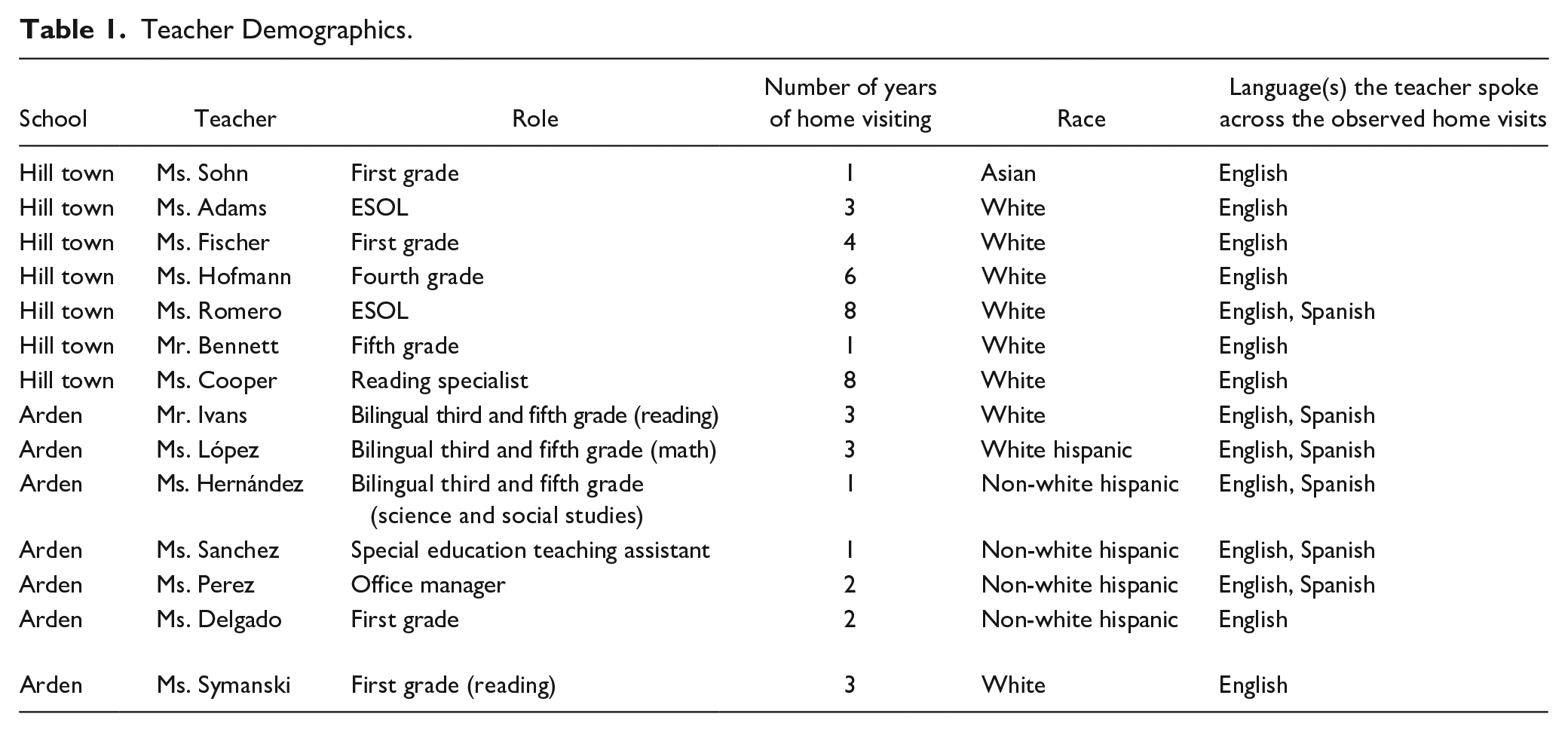
We gathered demographic information about teachers and families through formal interviews with teachers and informal conversations before and after home visit observations. With teachers, we asked for racial and linguistic background. For families, we asked about countries of origin and linguistic background, but not race as the teachers often did not have that specific information about how families racially identified. The Hill Town teachers were predominantly white and English-speaking and conducted their home visits in English, with Spanish translation available depending on the teachers present. Nine of the twelve families spoke languages other than English in the home, and 11 were families of color. These families had immigrant or refugee backgrounds. The Arden teachers were primarily non-white Hispanic and Spanish-speaking and were able to conduct their home visits in Spanish for bilingual families and English for English-only families. There was only one English-speaking Black family in the visits we observed; the rest were Latinx, Spanish-speaking, and immigrants.
The training that the teachers received related to home visits was different at the two schools. Hill Town faculty did not receive any formal training related to home visits, but rather learned about how to implement home visits mostly through years of trial and error and speaking to one another informally about their experiences. Hill Town teachers did, however, engage in school-wide conversations about culturally relevant teaching, and interviewees described these conversations as informing their home visit practice. Arden home visiting teachers attended a 4-hour summer training led by the organization bringing PTHV to the district. The training focused primarily on the procedures and content of home visits. Participants heard from the organization leaders, as well as district teachers and families with previous home visit experience. The training also touched on issues around cultural sensitivity, such as avoiding entering homes with preconceived notions about what you will see, paying attention to whether or not the family has shoes off in the house, and receiving food and beverages from the family.
Data Collection
Field observations
For each school, we observed one cycle of home visits in either the summer/fall or winter/spring semesters. The difference in timing of the observations was due to limitations in when IRB approval and access to the school sites were provided; however, as a result, we were able to observe a range of visits to understand in a more variegated way the answer to our research question. The difference in timing of the visits did not, therefore, affect the purpose of the study, but rather gave us a more expansive view of how home visits are enacted. Teachers at both schools completed home visits in teams of two (hereafter referred to as “teaching teams”). Details on what the visits entailed are presented in Table 2. While the topics discussed were different at the two schools, both sets of home visits focused on relationship-building with families. Teachers obtained consent from families to have the researchers join the home visits prior to the visits. The researchers introduced themselves and then quietly observed.
Structure and Purpose of Home Visits at Each School.
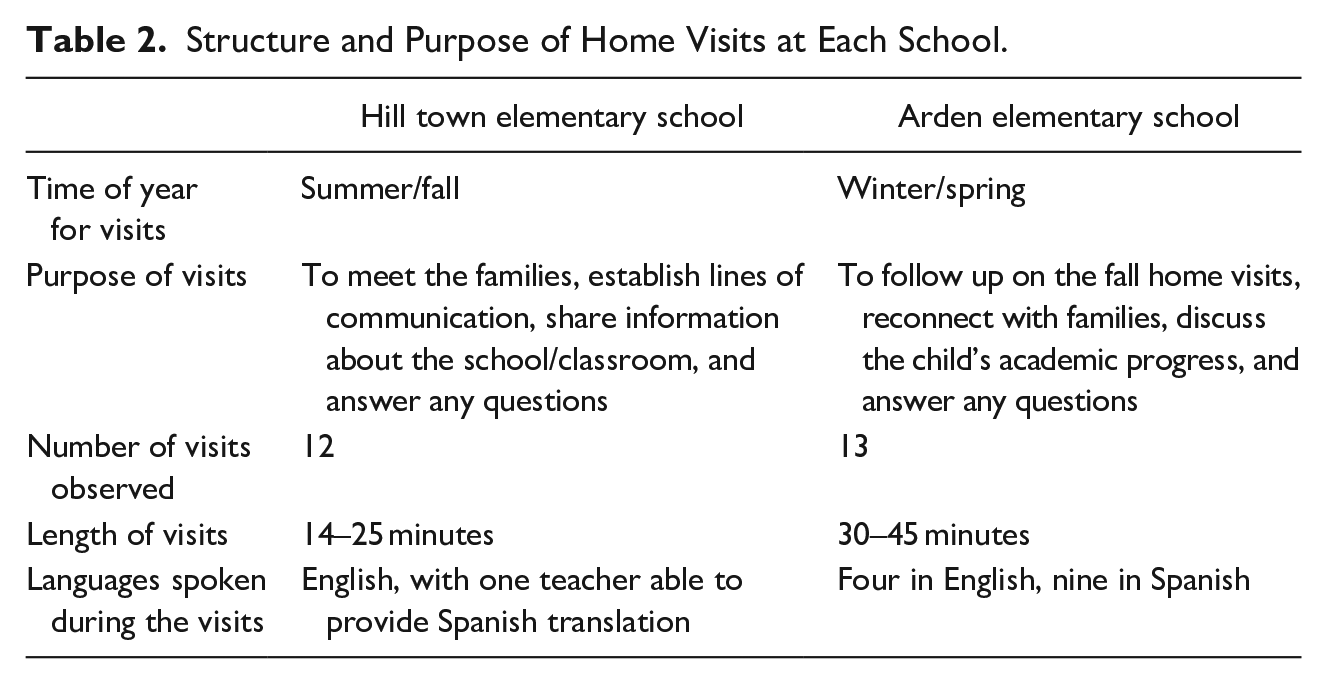
All observers participated in a 4-hour training on an observation protocol used for both schools that focused on four aspects of the visits: (1) interactions between the teachers and families, (2) the environment, ambiance, and context for the visit, (3) the content or what was discussed during the visit, and (4) physical artifacts in the home or that the teachers brought with them. They were also trained to recall memorable quotes. Researchers learned to remember key words in memorable statements that home visit participants made and then record these memorable quotes in addition to completing the observation protocol as soon as they left the home. Recorded notes were turned into thick, descriptive, typed field notes within 24 hours of the visit (Emerson et al., 2011). Each set of field notes was read by a second researcher within 24 hours of completion, and questions or clarifications were addressed immediately.
Interviews
The researchers conducted semi-structured interviews with 18 teachers across the two sites. The interviews at Hill Town lasted 20 to 30 minutes, while the interviews at Arden lasted 45 to 60 minutes. The interviews addressed the following topics: teachers’ experience/background, training, reflections on the process of home visits and changes over time, memorable home visits, perceptions of benefits and challenges, adaptations for English learners and students with disabilities, and the impact of home visits on teaching practice. All interviews were audio-recorded and later transcribed for analysis.
Analysis
Our qualitative data analysis was iterative and began concurrent with data collection (Creswell, 2014; Merriam, 2009). As we collected data, we reflected on our understanding of culturally sustaining pedagogy, adding these reflections as an addendum to the field notes we typed. Once all of the data were gathered, the principal investigators open-coded (Creswell, 2014) the field notes and interview transcripts to identify some initial categories. Deductively, while we open coded the field notes and interviews, we kept in mind Ladson-Billings’ (1995, 2017) three tenets of culturally relevant pedagogy and their extensions based on culturally sustaining pedagogy (Paris & Alim’s, 2014). Inductively, we also noted emergent ideas that repeated across field notes and interviews. The two primary investigators engaged in a process of axial coding (Emerson et al., 2011), which involved coming together bi-weekly over 3 months to discuss their initial codes, collapsing and adding until a codebook was developed.
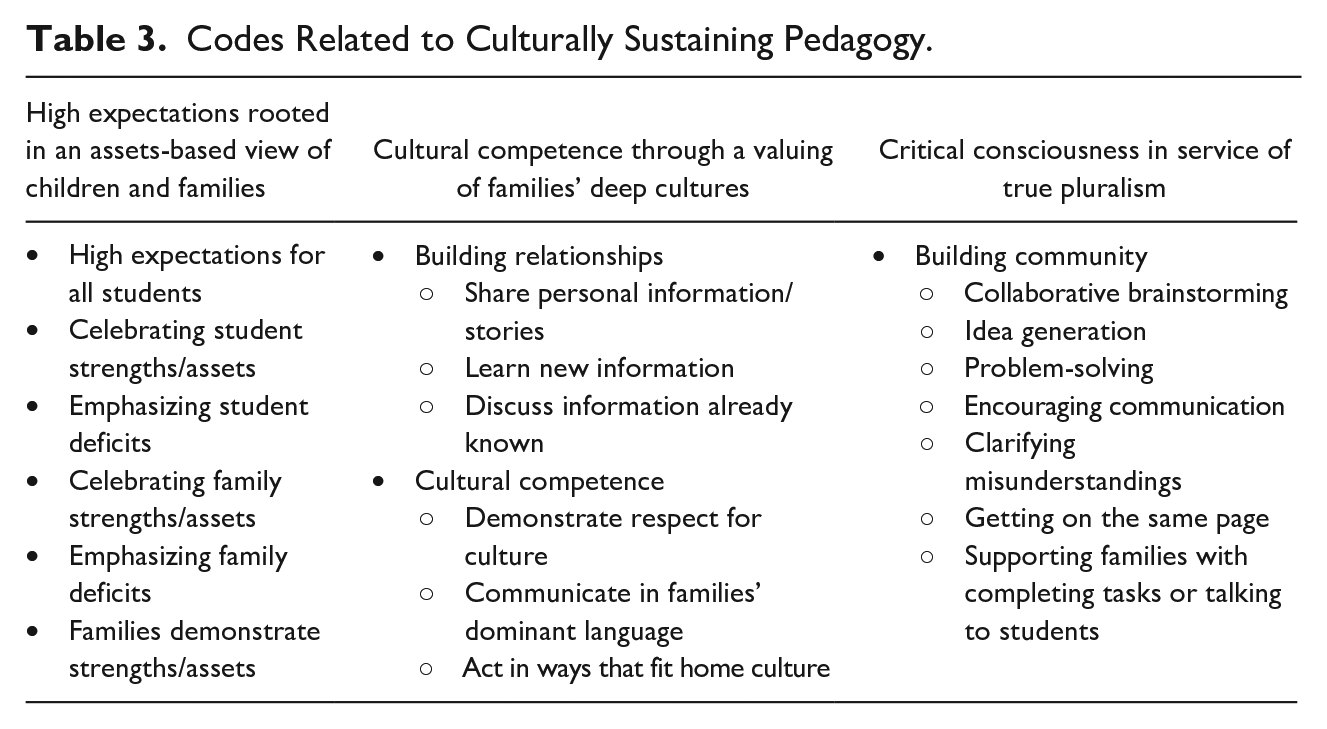
We trained one additional researcher on the codebook. The team first applied the codes to a subset of field notes and interview transcripts. We discussed questions and issues to further refine the codebook. The resultant codebook was a four-page manual consisting of 31 codes, including (a) codes related to the structure of the home visits (e.g., stated purpose, travel to home, greeting, participants, setting, how relate to each other, etc.), (b) codes focused on participants’ perspectives on home visits (e.g., perceived benefits, perceived challenges, memorable home visit, impact of home visit on teaching, etc.), and (c) codes related to the culturally relevant/sustaining pedagogy framework, which are presented in Table 3. With this revised codebook, we used the online qualitative software Dedoose to reach a 0.61 kappa value for inter-coder agreement, which is classified as “substantial agreement” (McHugh, 2012). We then coded all of the field notes and transcripts in Dedoose. We generated themes pertaining to the home visits’ procedures and culturally sustaining pedagogy. We wrote descriptive memos for each theme and reviewed one another’s memos, adding comments and feedback.
Codes Related to Culturally Sustaining Pedagogy.
Positionality of the Researchers
We agree with Milner’s (2007) assertion that “Researchers’ multiple and varied positions, roles, and identities are intricately and inextricably embedded in the process and outcomes of education research” (p. 389). We therefore acknowledge that our positionality as researchers in institutes of higher education is one of power and privilege. This positionality influenced our data collection and analysis. Given that our identities also often did not to match the racial, cultural, and linguistic backgrounds of the families—we are one Asian cis-woman and three white cis-women—our presence during the home visits could not be ignored. We recognize the potential biases we bring from our own identities and experiences, and thus offer the findings presented here as one interpretation of the home visit practice, not a definite, absolute narrative.
Results
Our analyses revealed that the home visits offered opportunities for culturally sustaining pedagogy in the two urban elementary schools, but these were not always taken up by the educators. Subsequently, the visits served as a starting point for culturally sustaining practice, but never fully attained it. There were several themes that emerged in our analysis; we will focus on two in this paper: engaging with families’ cultures but remaining at the surface level and cultivating empathy for students and families but maintaining a deficit lens. These two themes relate directly to the three tenets of culturally sustaining pedagogy. We begin with “cultural competence through a valuing of families’ deep cultures,” as this tenet speaks to the first step toward enacting culturally sustaining pedagogy—understanding who students and families are (Ladson-Billings, 1995, 2014; Paris, 2012).
Engaging with Families’ Cultures But Remaining at the Surface Level
For the teachers at both Hill Town and Arden Elementary Schools, a central objective for the home visit practice was relationship-building with families. This purpose is directly connected to the second tenet of culturally sustaining home visits: cultural competence through a valuing of families’ deep cultures. Cultural competence was critical for teachers to get to know families and build the trust necessary for respectful relationships. Home visits offered the educators opportunities to develop this cultural competence by learning about families’ cultural and linguistic backgrounds. In our observations of home visits, however, the teachers tended to remain at surface level understandings of families’ cultures. Taking off shoes and accepting food were the most common ways in which teachers engaged with families’ cultures.
When families offered food or beverages, visiting teachers almost always accepted the offer. Teachers spoke about experiencing the food of different families’ cultures as one of the most positive and memorable aspects of the home visit practice. One teacher explained, “The memorable ones do usually include food. So sometimes it is so amazing. Some of these families, particularly the ones from different cultures, will have meals or these elaborate snack trays and tea. I’ve gotten to try tea from China and tea from Iraq and different snacks” (Interview).
We observed the sharing of food during several home visits. Below is one example: On the coffee table, there are three cups of hot tea and a platter of assorted snacks (i.e., pistachios, pecans, almonds, cookies, etc.). After the ESOL teacher and the researcher sit down, the father brings each of them a cup of hot tea. All of the school staff members and researcher eat and drink throughout the entire home visit with the father. (Field Notes)
In another observation, the mother had the child slice oranges and bring them for the teachers to enjoy during their visit. In yet another one, the parents provided a spread of pan dulce. The Hill Town and Arden teachers had all learned either formally or informally that accepting families’ food was an opportunity to demonstrate cultural sensitivity. One Hill Town teacher reported learning that the food that families offered is “kind of a gift. It’s seen as a culturally acceptable thing to do for most families if they provide it. In some cultures, it’s actually considered rude to refuse” (Interview). By enjoying the provided gifts throughout the duration of the home visit, teachers intended to communicate that the families’ cultures were understood and valued.
Teachers also sometimes engaged with families’ cultures by using their home languages. Two of the three teaching teams in the Arden home visits taught in Spanish-English bilingual classrooms. As such, the teachers were fluent in Spanish and conducted their visits entirely in Spanish. The third Arden teaching team taught in English only classrooms; however, one of the two teachers was fluent in Spanish, so she was able to speak with families in Spanish when necessary. The other teacher in this pairing told us during her interview that although she was not able to speak in Spanish, the mere fact that she would try to engage in the families’ native language was looked upon favorably; the family acknowledged her effort to demonstrate respect for and value of their native language.
Another way that teachers demonstrated respect for and interest in families’ backgrounds was to make comments about cultural artifacts they noticed in the home. These artifacts included artwork, holiday decorations, photographs, and religious emblems. Teachers engaged families in conversations about the artifacts as a way to learn more about the families’ cultures. For example, in one home visit, upon entering the home, the teachers saw a nativity scene on display against the wall. They immediately began asking the family about it. An excerpt from the field note is presented below: Ms. López went straight over to a vibrant, brightly lit nativity scene against the wall. This sparked a conversation about the family’s Christmas holiday, which they just spent at home. . .The mother explained that they had the Christmas tree over where the nativity scene is, but they replaced it with the nativity scene to get ready for the three kings’ day holiday. Mr. Ivans asked some questions about the celebration of that holiday within the Catholic church, which he seemed to know some about. (Field Notes)
This conversation around the nativity scene served as a way for the teachers to learn more about the family’s religion and traditions—things that held value within this particular home. By engaging in conversation about the three kings’ day holiday, Mr. Ivans was also able to make a connection with the family, sharing his own knowledge of the holiday.
In another home visit, the teachers noticed photographs of their student and her siblings dressed in gowns both as toddlers and teenagers. One teacher, Ms. Hernández pointed to one photo and asked the mother if it was Angelica, their student. When Angelica’s mother nodded, Ms. Hernández turned to Angelica to tell her how cute she was. Then the other teacher, Ms. Figueroa, asked what the event was for which Angelica was so nicely dressed as a toddler. Angelica’s mother and Ms. Hernández explained that in Mexico, there is traditionally a celebration for young girls when they are 3 years old and again when they are 15 years old. Ms. Figueroa, who was of Puerto Rican descent rather than Mexican, listened intently as the two women explained this tradition. In this conversation, Ms. Hernández was able to share a connection with Angelica and her mother, while Ms. Figueroa demonstrated admiration for the family’s cultural background.
The examples above demonstrate how engaging with visible elements of the families’ culture—the surface culture—provided initial points of connection and demonstration of respect. These connections, however, did not lead to deeper conversations about the families’ views, values, or beliefs. As such, the home visiting teachers we observed never got to the shallow or deep levels of cultural understanding that are critical for cultural competence. This was a missed opportunity in the home visits, as surface-level connections could have opened the door to discussions about collective beliefs, norms, traditions, and values of the families. The families’ cultures were, therefore, reduced to food, language, celebrations, and routines around footwear.
Cultivating Empathy for Students and Families but Maintaining a Deficit Lens
The culturally sustaining pedagogy tenets “high expectations rooted in an assets-based view of children and families” and “critical consciousness in service of true pluralism” require seeing families as capable, knowledgeable, and skilled, as well as engaging families in critical conversations about injustice and social change. For teachers to view families in this strengths-based way, they must learn about their stories, experiences, and assets. Home visiting teachers can then maintain high expectations and also critically consider whether their own educational practices align with these strengths. All home visits that we observed involved families’ sharing of their experiences, skills, and stories in some way. Often, teachers were able to see families’ assets that were not visible to them before.
For example, teachers learned about non-academic skills and interests that children had. We observed children demonstrating a range of skills from hula hooping to doing tricks on a hover board to speaking multiple languages to preparing and serving food. Children also spoke of their extracurricular activities, such as playing sports or instruments or engaging in the arts. Teachers observed for themselves children’s interests by visiting their rooms and seeing what the students had on display. In one home visit, for example, the teachers could immediately see that the student was interested in Star Wars because of all of the Star Wars paraphernalia he had in his room (Field Notes). One of the teachers later explained that she would make connections to Star Wars in her own teaching in order to keep the child more engaged (Field Notes). Developing a fuller understanding of who their students were outside of the classroom, therefore, allowed teachers to make connections to the children’s interests in their instruction.
The same was true with regard to parents in the home visits. Teachers explained in their interviews that they gained a more holistic understanding of students and families by listening to the stories that families shared during the home visits. At Hill Town, many of the families shared that they had immigrated to the U.S. from countries experiencing war or forms of religious or political persecution. Teachers characterized these moments as opportunities to “really get to know the family” or to hear “really personal information. It just had a really big impact” (Interviews). The sharing of these personal stories facilitated teachers’ empathy toward families as well as families’ trust with the teachers.
This theme of empathy was one that teachers consistently reported in their interviews. This theme was complex, however, as teachers’ empathy was also tied to deficit views of their students. Teachers told us that the home visit practice frequently opened their eyes to students’ experiences about which they previously knew very little. Seeing and understanding their students’ homes cultivated in teachers a deeper understanding of and patience for the behaviors they observed in school. For example, one Hill Town teacher told us during her interview, And it was just interesting to kind of like, in some of the houses, it was a really humbling experience to see where kids live, what their homes are like, and it made me a lot more patient. Especially with students whose behavior was demanding. So, I would be like, “I know where this kid is coming from and I can be sensitive to the fact that you have all these brothers and sisters screaming at home. No wonder when you get to school you just want it to be quiet. You want to be left alone for a little bit.” And I probably wouldn’t have figured that out as a classroom teacher otherwise. (Interview)
For this teacher, home visits helped her to be more patient with students who demonstrated what she called “demanding” behavior. Seeing the child’s home environment gave her insight into why the child acted as they did in school. This teacher’s focus, however, was on the perceived deficiencies she observed. She assumed a connection between the child’s home environment and their desire to be left alone, but never actually heard this interpretation of the child’s behavior from the family. The intent of wanting to empathize with the child is consistent with the need for relationship-building that is central to culturally sustaining pedagogy; but the stance of pity served to perpetuate deficit views.
The theme of being slower to get frustrated because of teachers’ newfound compassion with children was one that resonated in several interviews. One Arden teacher told us, “I can’t get upset at a kid when they’re coming in late and they don’t have their homework and they don’t have all this stuff because I know from these visits that they have so many more issues and problems at home to deal with. . .So it’s definitely made me more empathetic and more aware of the community” (Interview). Another teacher said, “I’m just way more understanding of students. . .I’m giving my families a benefit of the doubt whereas back then, it was definitely more challenging to do that” (Interview).
Other teachers told us about children not having adequate workspace at home: “What you learn is you see the situation that a lot of the kids are in. And you see that there’s not a quiet place to do homework sometimes. There might not even be furniture to sit and do the homework at” (Interview) and “I can see like ‘Yeah, it’s going to be impossible for you to get your homework done. You have nowhere to do your homework’” (Interview). Yet another teacher talked about the surprise she felt upon witnessing the condition of her student’s home on the first home visit she conducted: It was a small flat, one bedroom, mattress on the dining room, the mattress was where the children slept, two of them, a big brother and a younger brother, and the kitchen was filled with dirty pots and cockroaches. And, it was like, okay, so this is not what I imagined, and this is the situation where my students live. So, how can I expect them to understand what’s a clean desk if that’s where they think that’s a clean kitchen. (Interview)
These interview excerpts highlight how understanding children’s home lives cultivated empathy in teachers that shifted how they acted toward students and families. Teachers tried to avoid irritation and replace it with compassion and a “benefit of the doubt.”
This empathetic stance, however, also perpetuated a deficit view of the culturally and linguistically families in the urban home visiting schools. What stood out to teachers in their home visits was the lack of resources, excess noise, and other problems they observed. While these were examples of structural inequity that could spark critical consciousness about systemic oppression, the teachers instead defaulted to a pitying of families and children that did make them more compassionate, but also reified biased deficit-based perspectives. Such views can lead to lowered expectations for students, as teachers see children’s academic and social-emotional development as “inevitable” given the circumstances of their home (García & Guerra, 2004; Milner, 2006). Further, these views inhibit teachers’ ability to critically examine systems of oppression and their own role in perpetuating those systems by imposing the dominant culture of school onto families.
Only one teacher we spoke with conveyed the importance of holding both high expectations and the realities of students’ life circumstances simultaneously in their work with children and families. This teacher shared, I went to one child’s home. . .this family was from Iraq. And all they were watching was the Iraqi news and [things] blowing up and car bombings. Knowing that that child’s going home in that kind of—so it’s more about understanding trauma on a real-life basis. Not going to a trauma [professional development] and hearing about kids in trauma. When you see things firsthand, it gives you an understanding, not to say that you’re not—things need to be fair. You still need to be a responsible teacher and say, “All right, these are our expectations. This is what we expect of you.” (Interview)
While this teacher may have inappropriately attributed trauma to this child and their family, her comments reveal a compassion that developed through her home visiting. She came to view her students and families as whole people, not just academic beings involved in school. At the same time, this teacher emphasized the need to maintain high expectations for students. For her, cultivating empathy did not equate to pitying students and lowering standards. This teacher’s view differed from the other interviewees who tended to focus on having more leniency with children rather than on maintaining high expectations.
Discussion
The findings from this study reveal that while the home visits facilitated opportunities for teachers to engage with families’ cultures and cultivate empathy for students and families, they fell short of meeting the tenets of culturally sustaining pedagogy. The results indicate a need for redesigning the purpose and structure of home visits. The Hill Town and Arden teachers implemented home visits as they were trained to do; but, without professional development on both culturally sustaining pedagogy and home visiting, this implementation perpetuated the practice’s colonial history. Although home visits opened the door to learning about families’ cultures, experiences, and stories, deficit-based and otherizing orientations to families were reinforced. The practice was, therefore, simultaneously a site for deeper understanding of children and families as whole people, and a locus of perpetuating systemic bias around multiply marginalized communities. The findings demonstrate the need for home visiting educators to receive training on culturally sustaining home visits to avoid the danger of reifying the status quo of white, middle class normative family-school partnership.
The Need to Go Beyond Surface Culture
At the most basic level, culturally sustaining pedagogy requires that teachers learn about and embrace families’ cultures (Ladson-Billings, 2017; Paris, 2012). This is the first step toward cultivating cultural competence (Gallavan & Webster-Smith, 2012). The teachers on the home visits we observed demonstrated a desire to connect with families’ cultures. Their actions of removing shoes, accepting families’ cultural food and beverages, discussing artifacts in their homes, and engaging with families’ native languages were ways that teachers communicated interest in and respect for families’ cultures. These approaches, however, remained at a surface level of cultural understanding and did not reflect the depth of knowledge necessary for genuine relationship-building (Duesterberg, 1998; Hammond, 2015; Ladson-Billings, 2014).
To be sure, the practice of home visits that we observed can be an important start to developing the cultural competence needed for culturally sustaining practice in urban contexts. Learning about families’ surface cultures can serve as initial points of connection between teachers and families, especially when teachers’ racial and cultural identities do not match their urban student population (Goldenberg, 2014). Furthermore, teachers stepping out of their comfort zones to learn more about families’ cultures and backgrounds is essential to demonstrating the openness necessary for coming to understand deeper levels of culture. It is, therefore, possible that these surface level encounters would later lead to more conversations that facilitate deeper cultural competence. If cultural competence remains at the surface level, however, teachers run the risk of perpetuating stereotypical notions of culturally and linguistically diverse families (Duesterberg, 1998; Ladson-Billings, 2014). Such perceptions would inflict harm, reinforcing the assimilationist underpinnings of the origins of home visits.
To avoid such outcomes from the home visits, teachers might ask families questions that get at their heritage and current community practices (Paris & Alim, 2014). They can ask questions about families’ child-rearing practices, beliefs, world view, thoughts on schooling, and other categories that fall under Hammond’s (2015) shallow and deep cultural dimensions. When families share personal stories, teachers might ask follow-up questions probing for how these experiences shape families’ views about their children and their education. Such moves might help teachers develop cultural competence that go beyond food, clothing, artifacts, and language.
The Fine Line Between Empathy and Low Expectations
The tension between empathy and deficit beliefs about children and families was evidence of how the home visits at Hill Town and Arden Elementary Schools did not align with culturally sustaining pedagogy. The visits did give teachers opportunities to learn about aspects of students’ and families’ lives that they had not known before. They acquired this knowledge by listening to families’ stories or observing circumstances in the home that ultimately made the teachers more empathetic to the needs of their students. Teachers described these experiences as making them “more understanding” or more willing to give families “the benefit of the doubt.”
Nonetheless, there was a fine line between empathy and holding low expectations of the children and families. With the exception of one teacher, all interviewees who spoke about empathy said that learning more about their students’ backgrounds made them understanding of behaviors they previously had not understood or even wanted to change. Now, they were more likely to let things go because they felt it was unreasonable to expect the children to meet the standards of the classroom. While the empathy did foster teachers’ more compassionate responses to children who, for example, did not complete their homework or did not have a clean desk, these responses were rooted in deficit views and subsequent low expectations of the children—a common consequence of the pity narrative imposed on culturally and linguistically diverse families (Suoto-Manning & Rabadi-Raol, 2018). Additionally, embedded in the teachers’ responses were deficit perspectives of families and their ability to support their children’s education. Seeing children and families as incapable contradicts culturally sustaining pedagogy (Ladson-Billings, 2014; Paris, 2012).
The home visits we observed might have been culturally sustaining if teachers looked for families’ strengths, assets, and knowledges rather than primarily seeing things that the family lacked (Zhu, 2020). Boutte and Johnson (2013) explain that looking for family assets does not mean we should “romanticize these settings and not recognize the challenges that exist. It means that the challenges have to be factored into the equation with the explicit expectation that there are also numerous strengths which have allowed families to improvise, survive, and succeed against many odds” (p. 179). In their training, teachers might learn to see families’ and communities’ strengths. To do so would require developing critical awareness of macro-level systems of oppression that influence families’ experiences and living conditions. Teachers might then learn to see families’ strengths and thereby hold high expectations of them, while also modifying what knowledge, assets, and skills are valued in the classroom.
Starting with Teachers’ Own Critical Consciousness
Training that cultivates understanding of families’ strengths and questioning of the status quo of schooling requires critical reflexivity about teachers’ own biases, assumptions, and privilege (Paris & Alim, 2014). Such critical reflexivity also involves examining teachers’ own practices to see how they do or do not reify hegemonic structures in family-school partnerships or teaching practices. In both the home visit observations and the interviews, we found minimal, if any, evidence of critical conversations about larger social systems—including schools—that contributed to the injustices teachers observed. We also saw little, if any, evidence of teachers’ critical reflection on their own racial, cultural, linguistic and socioeconomic positionalities.
Rather than focusing on deficits in the family, teachers might use the home visits as an opportunity to understand how systemic inequities in family-school partnerships impede educators’ ability to honor families’ assets and address challenges that impede relationship-building (Posey-Maddox & Haley-Loch, 2020). Teachers could also learn from families’ challenges to identify their own areas of privilege and positionality in unjust systems. Such self-reflection would require examination of teachers’ own racial, socioeconomic, and cultural identities (Sealey-Ruiz, 2011). Without training that guides teachers through this type of critical reflection, it is unreasonable to expect that educators will foster meaningful, genuine partnerships with families through home visits.
Limitations
Data collection for the two schools happened at two separate time points. While both sets of home visits had the intention of strengthening school-family partnerships through relationship-building, the topics discussed in the summer/fall visits at Hill Town and the winter/spring visits at Arden varied somewhat. As indicated in the methods above, the goal of the study was to understand the range of what might take place during home visits; therefore, the study goals were not impacted by the increased variation across the home visits. Nonetheless, our analyses may have differed somewhat if the home visits took place at the same time point for both schools. An additional limitation of the study was that none of the researchers had native-like fluency in any of the home languages that the families spoke. As such, there may have been elements of the communication between families and teachers, especially when the home visits were conducted completely in the family’s home language, that got lost. Finally, despite efforts to avoid families’ and teachers’ discomfort, the physical presence of the researchers—two of whom identify as white women and one who identifies as an Asian American woman—might have influenced the visits.
Implications
Our analysis of the home visiting practice at Hill Town and Arden Elementary Schools leads us to the conclusion that home visits as they are currently enacted can reinforce deficit-perspectives and implicit bias that may be harmful to culturally and linguistically diverse families in cities. In order to resist the colonial legacy of urban home visits, the incorporation of culturally sustaining pedagogy into home visiting policy, training, and implementation is needed. For urban education to be socially just for low-income families of color, it is not enough for teachers to simply engage in home visits; such work must be paired with ongoing training related to culturally sustaining pedagogy. Teachers must understand the dangers of remaining at the surface level of culture or viewing families with a deficit lens. They also need to learn what it means to truly value and sustain the cultures of children and families, seeing the home visits as an opportunity to engage in such practice.
Such learning would involve developing an understanding of the three tenets—high expectations, cultural competence, and critical consciousness—and how they help to sustain the cultures of families of color, immigrant families, and other families outside of the dominant culture. Gay and Kirkland (2003) explain that teacher preparation programs have traditionally neglected cultural competence and critical consciousness training in particular. Policies that inform curricula and assessment in urban teacher preparation programs should include guidelines for incorporating culturally sustaining pedagogy and, specifically, culturally sustaining family-school partnerships. Programs that include preparation around home visiting in particular should train teachers to develop their critical consciousness, examining themselves and their own cultures as well as their own biases, before engaging in home visits (Cartledge & Kourea, 2008; Ladson-Billings, 1995).
Additional research is also needed on home visits that are culturally sustaining so that educators can have models. Researchers might partner with urban schools and families that are considering implementing home visits to support training for culturally sustaining home visit practice. Future research might also include examples of urban teachers and families who engage in home visits in ways that align with the tenets of culturally sustaining pedagogy. Such research would aid urban school practitioners, teacher educators, and policymakers to better envision what it takes for home visits to be truly culturally sustaining for urban families.
Footnotes
Declaration of Conflicting Interests
The author(s) declared no potential conflicts of interest with respect to the research, authorship, and/or publication of this article.
Funding
The author(s) received no financial support for the research, authorship, and/or publication of this article.
