



Abstract
This paper shares the results of a meta-analysis on the parental-expectations component of parental –involvement and its relationship with the student outcomes of urban students. Special attention is paid to parental expectations, because in many past studies, parental expectations has been the most salient component of parental involvement. This meta-analysis includes 54 quantitative studies that examined the relationship between the parental expectations component of parental involvement and the academic achievement of students. The results indicated that statistically significant effects emerged across students of different age groups, races, genders, and nationalities. The results were also substantial in the highest quality studies.
Keywords
Introduction
Parental involvement has become one of the most debated facets of education today (Ferrara, 2009; Gibson & Jefferson, 2006). The discussion over parental support for children's studies has not been limited to educators, but has also become a salient topic among parents, social scientists, and politicians (McKenzie, 2008). Meta-analyses undertaken over the last 18 years have examined the relative contributions of parental involvement. A meta-analysis statistically combines all the relevant existing studies on a given subject, in order to determine the aggregated results of said research. Meta-analyses are among the most popular type of academic article, as measured by citations, because they enable people to grasp what the overall body of research on a given topic indicates (Cooper, Hedges & Valentine, 2019).
Previous studies suggest that concurrently high and reasonable parental expectations may be associated with high pupil scholastic outcomes. If so, it would potentially be very beneficial, because it would encourage urban students, i.e., those living in cities, and their parents who may find that their work schedules make it difficult to attend school functions. In addition, if this relationship between the parental expectations component of parental involvement and urban academic outcomes exists, it will help teachers guide families into understanding what elements of parental involvement are most important. This is particularly important for urban education, because this type of schooling takes place in densely populated areas with diverse populations. For the purposes of this meta-analysis, high parental expectations was defined as whether a child was expected to graduate at a certain level (high school diploma, college degree, master's degree, or doctorate), obtain a given grade (or GPA), or reach a certain occupational status.
A meta-analysis, in essence, statistically summarizes the existing body of research, and can be much more effective than a typical single study in determining the relationship between parental expectations and student outcomes. Until recently, there were simply not enough studies done on the vast majority of the various components of parental involvement, parental expectations and otherwise, to justify a meta-analysis. The primary exception has been examining parents who read with their children at home (Barone et al., 2019). There was also a meta-analysis done of particular training programs for parental involvement in checking homework, but this was not a meta-analysis on the overall efficacy of parental involvement in checking homework apart from these specific programs (Patall et al., 2008).
Review of the Literature
The results of certain studies suggest that high, but reasonable, expectations may be one of the most important components of parental involvement for urban students (Jeynes, 2005, 2007). However, when those studies were completed, only a small number of studies were done on parental expectations that could be included in the meta-analysis. Since then, studies examining the parental expectations component of parental involvement have surged and the results might be quite different than they were sixteen plus years ago.
Many urban students, i.e., those living in cities, especially some of those of color, face a larger number of hurdles in life than most (Milner, 2012). They often encounter a dearth of opportunities, resources, and other expressions of support (Milner, 2012). With these challenges in mind, high expectations among one's parents can be a source of strength for many youths in the classroom. Often, teachers criticize urban families for not being as engaged as the instructors think they should be (Yamamoto & Holloway, 2010). However, this criticism may be unfair, because educators have a tendency to define parental participation based largely on school-based expressions (Jeynes, 2011; Milner, 2012; Yamamoto and Holloway, 2010).
Some have hypothesized that urban parents are frequently quite involved in their children's schooling, but demonstrate a lot of that engagement at home in subtler expressions that teachers often do not see (Jeynes, 2010). Unfortunately, if instructors are unaware of salient features of parental activities, most notably parental expectations, it can lead to negative portrayals and stereotypes of urban parental involvement (Jeynes, 2011; Lopez et al., 2001).
On this basis, some researchers have argued that the definition of parental involvement that is typically utilized in schools is too narrow and often does not adequately appreciate the salience of home-based expressions such as parental expectations (Jeynes, 2010, 2011; Lopez et al., 2001). For example, Lopez and Vazquez (2006) used a qualitative research design to assert that home-based high parental expectations play a large role for Latina and Latino pupil success. Barajas-Lopez and Ishimaru (2020) agree that particularly among parents in the cities, schools underestimate the role of parental expectations and overall input and focus on school-based activities. To the degree this is true educators are going to underestimate the true level of parental participation. Mapp et al. (2008, p. 362) believe that parental expectations play a major role in raising levels of “resilience” in urban students of color. Some social scientists are sharing data that indicate that love and relationships may be the most important keys to effective parental involvement rather than attending school functions, checking homework, and other school-based expressions (Jeynes, 2011; Warren et al., 2009).
Although numerous educators have focused on the importance of parental involvement, if children are to excel in school; no meta-analysis that focuses totally on the influence of the parental expectations component of this involvement, specifically on the academic achievement and behavior of the urban youth population, has ever been published in an academic journal. This reality largely contributes to a dearth of knowledge that exists regarding how much the presence of high parental expectations, as a facet of parental involvement, can help urban students (Davis-Kean, 2005; Davalos et al., 2005; Jeynes, 2005; McKenzie, 2008).
There are a number of studies that have now been undertaken examining the relationship between the parental expectations component of parental involvement and scholastic outcomes. However, there are certain disadvantages of isolated studies that make it difficult to reach definite conclusions. First, a large number of these studies have certain shortcomings, such as having sample sizes that are too small to allow generalization to specific populations (Lee & Bowen, 2006; Fagan & Palm, 2004). Second, many studies limit themselves to a certain section of the country or to a particular demographic group. This approach also limits the degree to which one can generalize the results to apply to the overall urban population (Cowan, et al., 2009). Third, studies often have only results with or without sophisticated controls (e.g., by race, socioeconomic status, gender, and previous academic achievement) rather than with both. Both sets of data points are very valuable. Results without sophisticated controls give a sense of the stand-alone efficacy of parental expectations. Nevertheless, results with sophisticated controls are also salient, because they consider that other variables may work either through parental expectations, in conjunction with this variable, or even separately (Greenhouse & Iyengar, 1994; Jeynes, 2012). Fourth, a large number of the studies focus on only certain groups of students in particular situations (Epstein, 2001; Jeynes, 2010, 2011). Consequently, by examining the results of a single study, it may not be possible to develop principles about what aspects of parenting may be helpful to the broad spectrum of urban students (Saracho, 2008).
As delineated by the United Code of Law (USCS 7801 (32)), parental involvement is defined as “the participation of parents in regular, two-way, and meaningful communication, involving student learning and other school activities.” Parental expectations represent part of that communication. It is good for parents to attend school functions and volunteer in the classroom. However, it is also true that high and reasonable expectations can have positive effects on a child (Green et al., 2007).
Enough studies have now been done examining the parental expectations component of parental involvement, so that it is now possible to examine this issue in a meta-analysis, with reference to urban youth specifically (Rapp & Duncan, 2012). This meta-analysis tests the hypothesis of whether or not parental expectations possess a relationship with academic achievement (i.e., GPA, standardized tests scores, and other measures especially teacher ratings), an association that is often missed by teachers because most theories of parental involvement focus on school-based expressions of parental involvement such as attending school functions and volunteering at school. This meta-analysis draws its theoretical framework primarily from Urie Bronfenbrenner's Ecological Systems Theory. The Ecological Systems Theory embraces educational systems as “complex, dynamic systems with multidirectional linkages and processes” (Johnson, et al., 2011, p. 9) over time, and situates family-school partnership activities within Bronfenbrenner’s (2009) ecological systems model (e.g., microsystem, mesosystem, exosystem, macrosystem, chronosystem).
Bronfenbrenner acknowledges the importance of expressions of parental involvement, such as parental expectations, as they exist in the home, well beyond the bounds of the classroom. He also believes that the dynamics of the effects of parenting differ across countries, especially in the United States verses other countries, and also by student age.
Methods
In this project, 60 major data bases were searched (Psych Info, ERIC, Sociological Abstracts, Wilson Periodicals, and so forth) to find studies examining the effects of parental expectations on the academic and behavioral outcomes of urban children from grades K-college freshmen. I also searched journal articles on the parental expectations component of parental involvement to find additional research articles that addressed this issue for urban students. Although this comprehensive search yielded hundreds of articles and papers on this topic, nearly all of these articles were not quantitative in nature. Seventy-eight studies were found that addressed the relationship under study and 54 studies of those that had a sufficient degree of quantitative data on urban students to include in this meta-analysis. Among the fifty-four studies that possessed a sufficient degree of quantitative data to include in this meta-analysis, the total number of subjects was 447,136.
Analytical Approach
This meta-analysis examined the relationship between the parental expectations component of parental involvement in kindergarten to college freshman urban student outcomes. With this background in mind, the following research questions arise. More specifically, six issues are especially pertinent to parents and educators. This meta-analysis first (research question #1) addressed whether there is a statistically significant relationship between parental expectations and kindergarten-college urban student achievement and behavior. Second, are the effects for the parental expectations component of parental involvement about the same for U.S. urban studies versus those urban studies outside the U.S. (research question #2)? All nations that emerged as a suitable subject of study were included in the meta-analysis. This question is very important because researchers outside the United States, very understandably, believe that the United States is the only focus of a disproportionate percentage of the research. They feel that this emphasis is neither balanced nor it is helpful to discerning whether the same phenomena also exist in other countries.
Third, are the effects of the parental expectations component of parental involvement greater for certain ages of urban students (research question #3)? Given that the overall trend for parental involvement studies is that the effects of parental involvement tend to be greater for younger pupils than older ones, it is a worthy question to determine whether the same pattern holds for the parental expectations component of parental involvement. The fourth question addressed whether studies identified as being “high quality” demonstrated the same results (research question #4)? Fifth, are the effects of the parental expectations component of parental involvement approximately the same or different for minority students versus majority students in these city settings (research question #5)? For example, in the United States, this would be addressing whether the effects of parental expectations are different or similar for African American and Latino students (and others) versus white students. Sixth, are the effects of parental expectations for urban students similar across different kinds of academic measures (research question #6)?
The procedures employed to conduct the meta-analysis are outlined under this heading (Analytical Approach), and the following headings are listed below: Data Collection Method, Statistical Methods, Study Quality Rating, Effect Size Statistics, and the Defining of Variables.
Each study included in this meta-analysis met the following criteria:
It needed to examine the parental expectations component of parental involvement in a way that could be conceptually and statistically distinguished from other primary variables under consideration. For example, if a family practiced parental expectations and its influence and it could not be statistically isolated from the other features, the study was not included in the analysis. It needed to include a sufficient amount of statistical information to determine effect sizes. That is, a study needed to contain enough information so that test statistics, such as those resulting from a t-test, analysis of variance, and so forth, were either provided in the study or could be determined from the means and measures of variance listed in the study. If the study used a control group, it had to qualify as a true control group and therefore be a fair and accurate means of comparison. Moreover, if the research utilized a control group at some times but not others, only the former comparisons were included in the meta-analysis. Only urban students were included. These students are also designated as such in large data sets. The study could be a published or unpublished study. This was to reduce the likelihood of publication bias.
Due to the nature of the criteria listed above, qualitative studies were not included in the analysis. Although qualitative studies are definitely valuable, they are difficult to code for quantitative purposes and any attempt to do so might bias the results of the meta-analysis.
Data collection method (coding and rater reliability)
In order to obtain the studies used in the meta-analysis, a search was performed using every major social science research database (e.g., Psych Info, ERIC, and so forth), totaling 60 data bases, to find studies examining the relationship between parental expectations and the academic and behavioral outcomes of youth from grades kindergarten to college freshmen. The search terms included parental expectations, parental involvement, expectations, parents, schools, family, education, race, African American, Latino, international, Africa, Middle East, Asia, Europe, parental support, partnership, reading, attendance, homework, parental style, and a good number of other terms. Reference sections from journal articles on parental involvement were also examined to find additional research articles. E-mails were also sent to each of the Education department chairs of the over 100 Research 1 universities in the United States asking them if there were any faculty in their department who had either recently completed or was just about to complete a study examining the effects of parental expectations. Although this comprehensive search yielded hundreds of articles and papers on parental involvement, nearly all of these articles were not quantitative in nature.
A number of different characteristics of each study were included for use in this study. These characteristics included: (a) report characteristics, (b) sample characteristics, (c) intervention type, (d) the research design, (e) the grade level or age of the students, (f) the outcome and predictor variables, (g) the length (in weeks) that parental expectations were examined, (h) the attrition rate, and (i) the estimate of the relationship between parental expectations and student outcomes. Two coders, who had been coding for at least 10 years, coded the studies on these characteristics and had 96% agreement on their coding of the following study characteristics.
Report Characteristics- Each study entry began with the name of the author of the study. Then the year the study was recorded, followed by the type of research report.
Sample characteristics included the number of students sampled, their locations, and how they were selected, e.g., via random selection, stratified random selection, or via advertisement.
Intervention Type- The experimental or procedural manipulation used, if any, was recorded to determine the effects of parental expectations on student outcomes.
Research Design- The studies in this meta-analysis were categorized into three basic types of designs. First, it was noted the studies that employed some type of manipulations to assess the effects of parental expectations.
The second type of design included studies that took cross-sectional measures of the effect of parental expectations without utilizing any type of manipulation. The third type of design involved the calculation of a correlation coefficient between parental expectations and student educational outcomes.
For studies that employed a manipulation to measure the effects of parental expectations, the details of the length of manipulation, method of training, the outcome measures, and other relevant features were recorded.
For the cross-sectional studies and correlation studies, if it was available, the following were also recorded: (a) the socio-economic status of participants in the sample and (b) the types of behavioral and academic measures that were used.
The length (in weeks) of the parental expectations assessment, which was particularly important because secondary analyses were performed to determine if there was a relationship between the length of parental expectation programs and the effects that emerged in various studies.
The grade level or age of the students was coded, including means and standard deviations when they were available.
The outcome and predictor variables from each study were coded to include the different ways that achievement was measured.
Attrition Rate- When available, the attrition rate of each study was coded.
The estimate of the relationship between parental expectations and student achievement and behavior- The process of the effect size estimation is described in the next section.
Statistical methods and the effect size statistics-
Effect sizes were computed from data in such forms as t tests, F tests, p levels, frequencies, and r-values via conversion formulas provided by Glass and his colleagues (Glass, McGaw & Smith, 1981). When results were not significant, studies sometimes reported only a significance level. In the unusual case that the direction of these not significant results was not available, the effect sizes were calculated to be zero.
For studies with manipulations, we used the standardized mean difference to estimate the effect of parental expectations. The d-index (Cohen, 1988) is a scale-free measure of the separation between two group means. Calculating the d-index for any comparison involved dividing the difference between the two group means by either their average standard deviation or by the standard deviation of the control group. In the meta-analysis, we subtracted the experimental group mean from the control group mean and divided the difference by their average standard deviation. As a supplement to these analyses, the Hedges’ “g” measure of effect size was used (Cooper, Hedges & Valentine, 2019). Since it employed the pooled standard deviation in the denominator, it customarily provided a more conservative estimate of effect size. Hedges also provided a correction factor that helped to adjust for the impact of small samples.
Calculating average effect sizes. Two sets of statistical procedures were also used to distinguish between those analyses that included sophisticated controls (socioeconomic status, race, gender, teacher expectations, or previous achievement) and those studies that did not. The fact that sophisticated controls included previous achievement seeks to address the possibility that previous high student achievement could also affect parental expectations. Although sophisticated controls of this nature do not solve the issue of causation, it attempts to control for the possibility that student results could also affect parental expectations. The results of these procedures are listed in different columns in the Results section, with the degree of statistical significance and 95% confidence intervals listed for each. An overall effect size was then determined, combining the studies that did and did not use sophisticated controls, based on the overall mean. No analyses of statistical significance were completed on the combined effect sizes, given the different structure of the studies involved. A weighting procedure, based on the inverse of the variance, was used to calculate average effect sizes across all the comparisons.
Although it is helpful to calculate the basic effect sizes, unaffected by other variables such as socioeconomic status, teacher expectations, race, previous achievement, etc., it is also important to have effect sizes for when these controls are in place. For example, socioeconomic status could be related to parental expectations. Previous student achievement could also affect parental expectations. In examining the effects without these controls, one could argue that even though parental expectations may influence student achievement, previous achievement could also affect parental expectations.
For studies that involved cross-sectional measures of the relationship between parental expectations and achievement, the following procedures were undertaken. For those studies that attempted to statistically equate students on other variables, the preferred measure of relationship strength was the standardized beta-weight, b. These parameters were determined from the output of multiple regression analyses. If beta-weights could not be obtained from study reports, the most similar measures of effect (e.g., unstandardized regression weights) were retrieved.
Calculating average effect sizes. A weighting procedure was used to calculate average effect sizes across all the comparisons. First, each independent effect size was first multiplied by the inverse of its variance. The sum of these products was then divided by the sum of the inverses. Then, 95% confidence intervals were calculated. As Hedges and Vevea (1998) recommend, all the analyses were conducted using fixed-error assumptions in one analysis and applied random-error assumptions in the other.
If there was more than one effect size presented in the results section, the effect size that was chosen was based on that which referred to: a) the overall sample and b) the purest measure of parental expectations, as explained in the section below on study quality. In the case of results that included clear statistical outliers, the presence of these outliers was acknowledged, and then supplemental analyses were run without such an outlier in order to estimate the degree to which the presence of an outlier might have affected the results.
Tests of homogeneity were completed on the parental expectation measures to gain a sense of the consistency of specific parental expectation scales across studies.
Study quality rating
Two researchers coded the studies independently for quality, the presence of randomization, and whether both the definitional criteria for parental expectations and specific aspects of parental expectations were met. Study quality and the use of random samples were graded on a 0 (lowest) to 3 (highest) scale. Quality was determined using the following:
(1) Did it use randomization of assignment? (2) Did it avoid mono-method bias? (3) Did it avoid mono-operation bias? (4) Did it avoid selection bias? (5) Did it use a specific definition of parental expectations?
We calculated inter-rater reliability by computing percentage of agreement on the definition of the parental expectations component of parental involvement, issues of randomization, and quality of the study. Inter-rater reliability was 100% on whether a study examined parental expectations, 94% for issues of randomization in a given study, and 92% for the quality of the study. For the specific components of quality, inter-rater agreement percentages were 96% for randomization, 91% for avoiding mono-method bias, 93% for avoiding mono-operation bias, 93% for avoiding selection bias, and 96% for using a specific definition of parental expectations.
Two supplementary analyses were done to include first, only those studies with quality ratings of 3, and second, only those studies with quality ratings of 2-3.
Defining of variables
For the purposes of this study, parental involvement was defined as parental participation in the educational processes and experiences of their children. High parental expectations was defined as mothers or fathers having well above average views of how well their child is going to do academically and in life generally.
Academic achievement was defined by such measures as grade point average (GPA), standardized test scores, and other measures. Additional academic indicators, referred to as “other measures,” included assessments of whether a child had been left back a grade and teacher self-report ratings, etc.
Generally speaking, it is preferred to have academic measures that include more than one type of outcome, rather than only one such as standardized tests, GPA, or teacher ratings. The shortcoming of using just one academic measure is that it is not clear whether the results might be due to something unique about that one scholastic measure. One can have greater confidence in the results of a given study if the effects hold across multiple academic measures rather than merely one (Greenhouse & Iyengar, 1994).
Behavioral outcomes included the degree to which students got in fights, obeyed school and classroom rules, were sent to the principal's office, and teacher ratings.
Results
Summary of the Results
Overall, the results of the meta-analysis indicated that there is a relationship between parental expectations for kindergarten through college freshman youth and student outcomes, as expressed in academic and behavioral outcomes combined. The results presented here used analyses based on random-error assumptions. The rationale for presenting these results rather than those using fixed-error assumptions is to utilize analyses that yielded more conservative effect sizes. As one would expect, the analyses based on fixed-error assumptions yielded somewhat larger effect sizes.
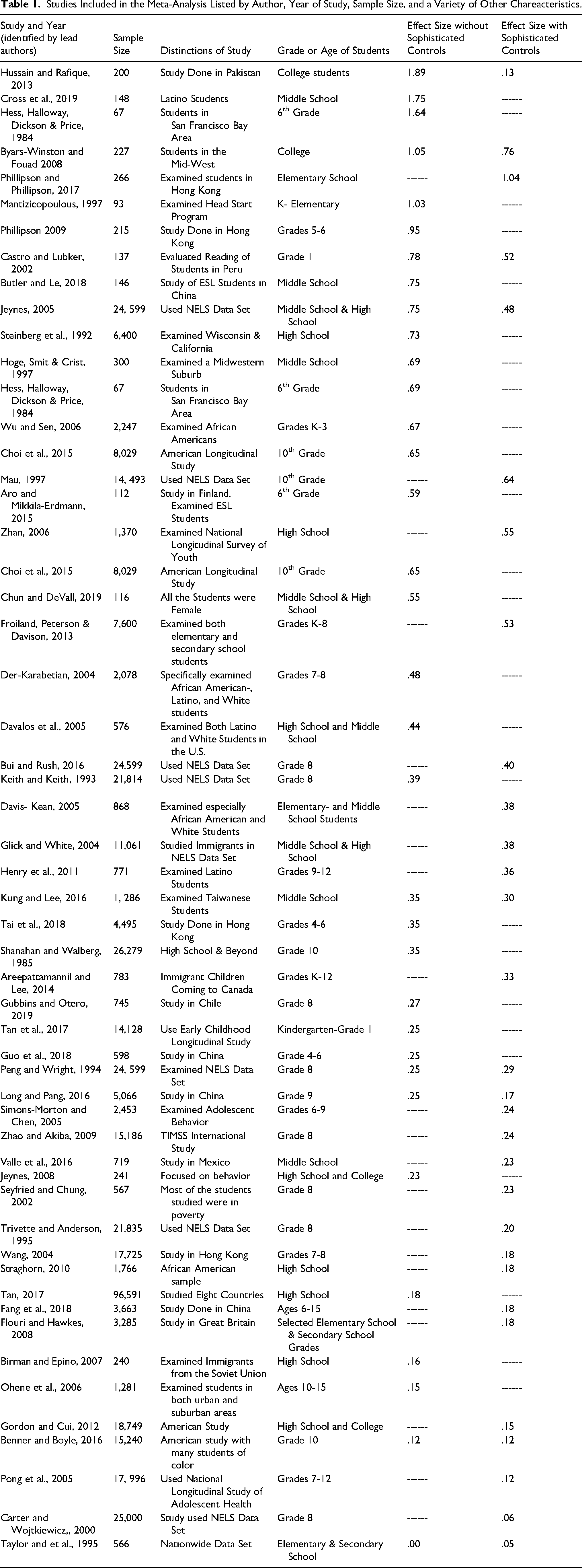
The results of this study indicate the overall parental expectations variable yielded a statistically significant outcome of 0.37 (p < 0.01), 95% CI [0.10, 0.64], of a standard deviation. Table 1 lists the effects sizes of the 54 studies in descending order. All but one of the effect sizes were in the positive direction, and that one was in a neutral direction. The range of the effects sizes was from 1.89 to 0.00. There were a considerable number of studies undertaken at the pre-elementary school and secondary school level, as well as some at the college level. The studies with the smallest samples produced the most extreme effect sizes on either end, consistent with the “funnel” pattern ideal in effect sizes (Cooper et al., 2019). Two-thirds of the studies (36 of 54) produced effect sizes between 0.20−0.80.
Studies Included in the Meta-Analysis Listed by Author, Year of Study, Sample Size, and a Variety of Other Chareacteristics.
The results of this study (see Table 2) indicate the overall parental expectations variable yielded a statistically significant outcome of 0.37 (p < 0.01), 95% CI [0.10, 0.64], of a standard deviation. The effect size was also statistically significant when sophisticated controls were used, 0.31, p <0.05), 95% CI [0.06, 0.56]. The results of the analyses both with and without sophisticated controls are important, because the latter considers the socioeconomic resources available in the family, neighborhood, or the schools, etc. The results for American studies were more robust than for those outside the United States. The effects for American studies was 0.44 (p < 0.01), 95% CI [0.18, 0.70], of a standard deviation without sophisticated controls. Statistically significant outcomes also emerged when sophisticated controls were used, 0.34, p <0.01), 95% CI [0.08, 0.60]. In contrast, the effects for areas outside the United States were smaller, but they were nevertheless statistically significant. The effects for non-American studies was 0.22 (p < 0.05), 95% CI [0.02, 0.42], of a standard deviation without sophisticated controls. Statistically significant outcomes also emerged when sophisticated controls were used, 0.20, p <0.01), 95% CI [0.01, 0.39].
Effect Sizes for the Parental Expectations Component of Parent Involvement with 95% Confidence Intervals in Parentheses.
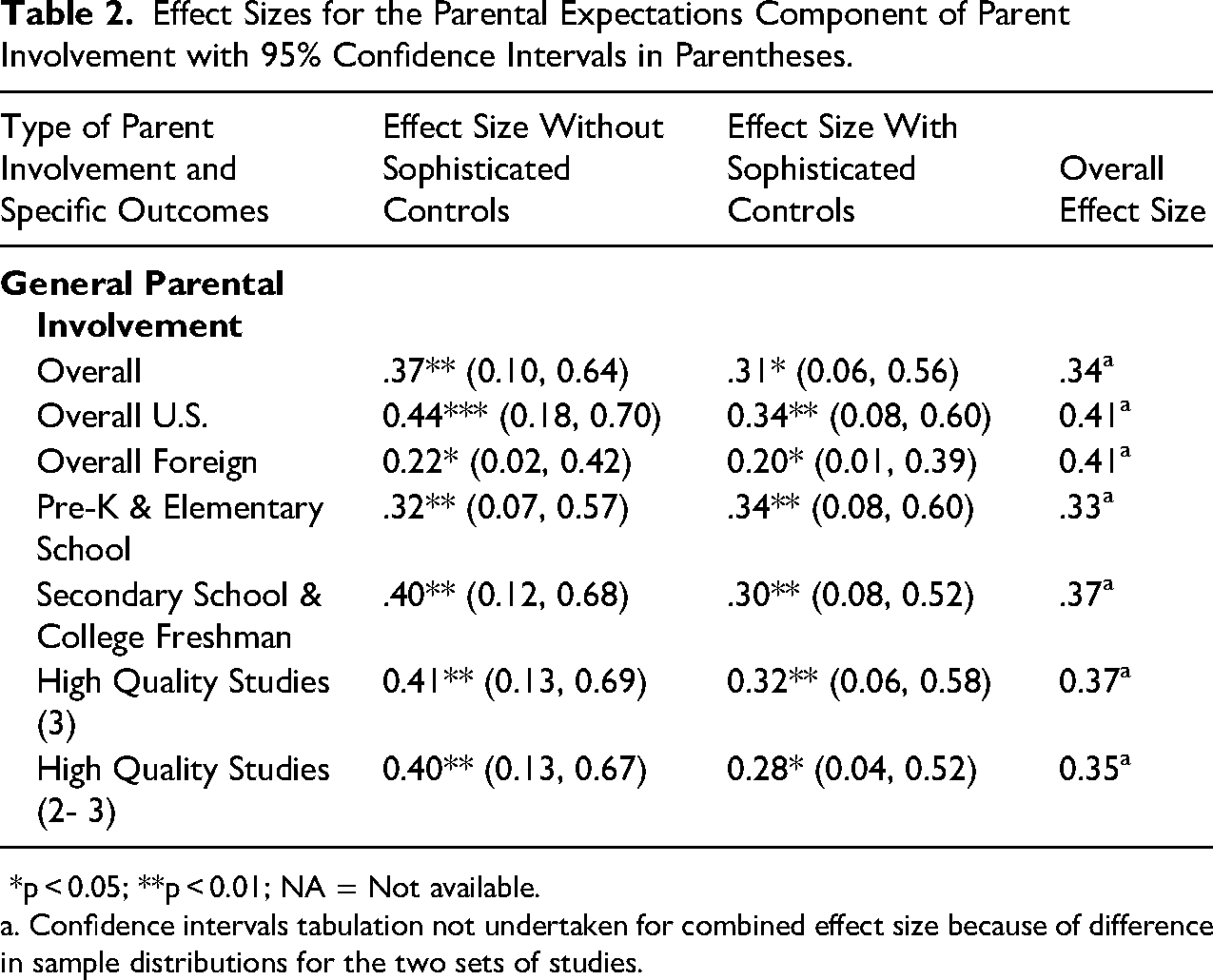
*p < 0.05; **p < 0.01; NA = Not available.
a. Confidence intervals tabulation not undertaken for combined effect size because of difference in sample distributions for the two sets of studies.
The effects for the parental expectations component of parental involvement tended to be higher for secondary school children than they were for elementary school children. The results were 0.40, (p <0.01), 95% CI [0.12, 0.68)] for secondary school students and, 0.32 (p <0.01), 95% CI [0.07, 0.57)] for elementary school pupils, without the use of sophisticated controls. When sophisticated controls were added the differences were no longer apparent. The effects of parental expectations for secondary school were, 0.30 (p <0.01), 95% CI [0.08, 0.52)], and for elementary school were, 0.34 (p <0.01), 95% CI [0.08, 0.60)], Overall, the effect sizes were 0.37 for the effects of parental expectations at the secondary school level and 0.33 for the elementary school level.
It is important to examine the results for the highest quality studies to confirm the overall findings of the meta-analysis. If high quality studies are indicating much weaker results than the overall results, the findings should be taken less seriously. The results of this study indicate that studies rated the highest in quality, i.e., 3, yielded effect sizes that were somewhat higher than for the overall set of studies combined, 0.41, (p <0.01), 95% CI [0.13, 0.69)], when no sophisticated controls were utilized. Those studies rated 2 or 3 in quality produced very similar results, 0.40, (p <0.01), 95% CI [0.13, 0.67)], also when no sophisticated controls were utilized. When sophisticated controls were used, the highest quality studies, i.e., those rated 3, yielded effects of 0.32, (p <0.01), 95% CI [0.06, 0.58)]. Among the studies rated 2 or 3, the results stood at 0.28, (p <0.05), 95% CI [0.04, 0.52)]. These latter results were almost identical to the 0.31 effects that emerged in the study, as a whole.
For minority students (see Table 3), the results were very close to those for the overall sample, i.e., 0.38, (p <0.01), 95% CI [0.14, 0.62)], when sophisticated controls were not in place. When sophisticated controls were in place, the effects were 0.26, (p <0.05), 95% CI [0.03, 0.49)]. The effects for the model that did not utilize sophisticated controls was a little bit more than those that emerged for the overall slate of students. When a model using sophisticated controls was utilized, the effects were somewhat less. The findings for minority students were in line and not statistically significant in difference than those obtained for the entire range of studies included in the analysis.
Effect Sizes for Parental Expectations with 95% Confidence Intervals in Parentheses.
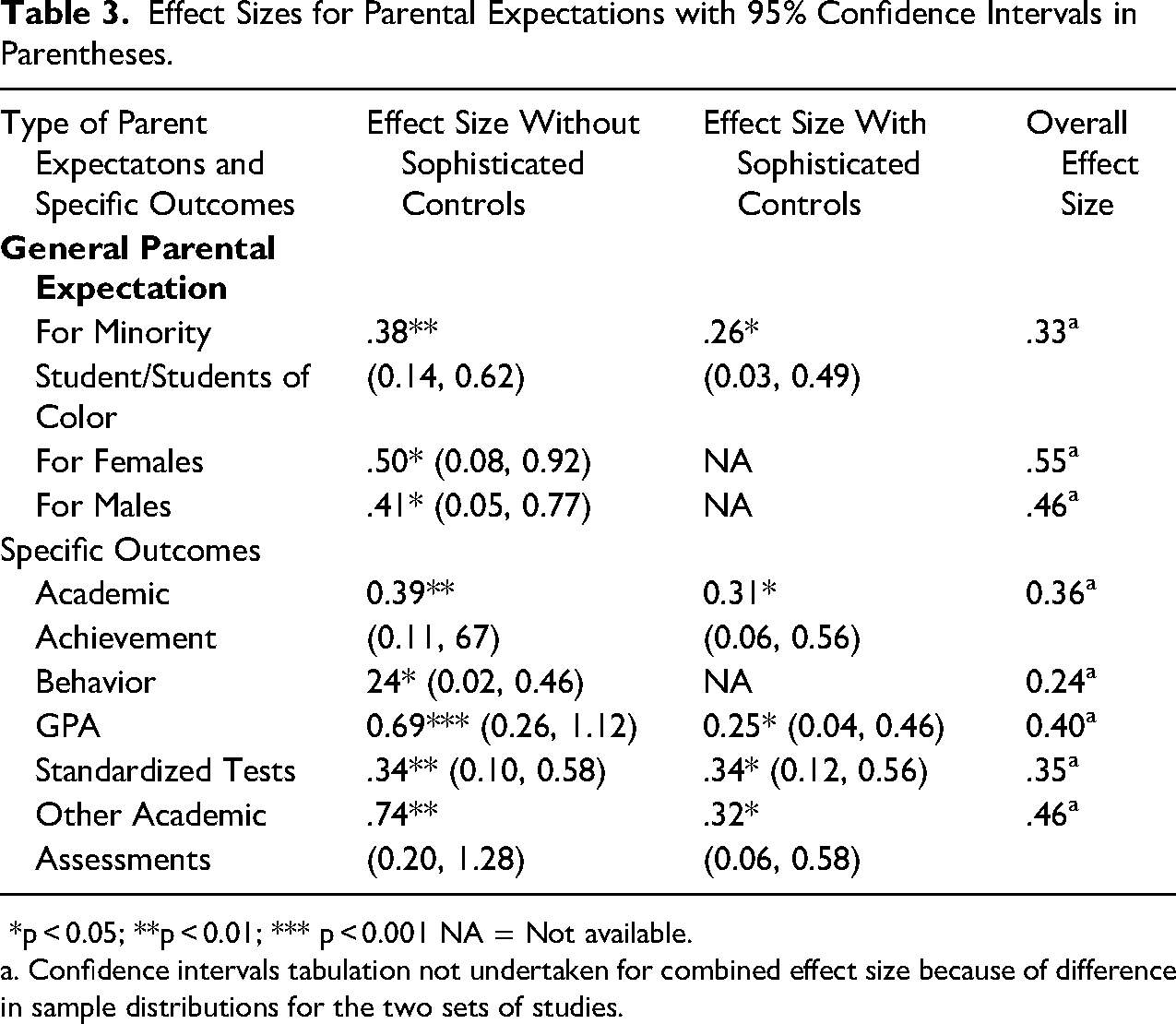
*p < 0.05; **p < 0.01; *** p < 0.001 NA = Not available.
a. Confidence intervals tabulation not undertaken for combined effect size because of difference in sample distributions for the two sets of studies.
Statistically significant results emerged for the effects of parental expectations for both females, 0.50, (p <0.05), 95% CI [0.08, 0.92)] and males 0.41, (p <0.05), 95% CI [0.05, 0.77)]. These results are with models not using sophisticated controls. There were not enough studies that examined the effects of parental expectations on males and females, as distinct categories with sophisticated controls, to be able to include in the meta-analysis.
One should note that the effects for parental expectations on children's academic was achievement was larger, 0.39, (p <0.01), 95% CI [0.11, 0.67)] than it was for the behavior of these youths, 0.24, (p <0.05), 95% CI [0.02, 0.46)], when sophisticated controls were not used. When sophisticated controls were used the effects were 0.31, (p <0.01), 95% CI [0.06, 0.56)] for academic achievement. There were not enough studies that examined the effects of parental expectations on behavior with sophisticated controls, to be able to include in the meta-analysis.
Breaking down the effects of parental expectations for different measures of scholastic outcomes yielded an interesting pattern. When sophisticated controls were not applied in the analysis, the results for GPA (Grade Point Average) and Other measures of academic achievement yielded much larger results than in the case of standardized tests. For GPA and Other Academic Assessments the results were 0.69 (p < 0.001), 95% CI [0.26, 1.28] and 0.74 (p < 0.01), 95% CI [0.20, 1.28], respectively. For standardized tests the effects were 0.34 (p < 0.01), 95% CI [0.10, 0.58]. However, when sophisticated controls were included for GPA and Other Academic Assessments, the results were 0.25 (p < 0.05), 95% CI [0.04, 46] and 0.32 (p < 0.01), 95% CI [0.06, 0.58], respectively. In contrast, the effects were identical for standardized tests 0.34 (p < 0.01), 95% CI [0.12, 0.56] that emerged using no sophisticated controls.
The results across different subjects of standardized test measures were fairly robust and consistent. The outcomes below include overall outcomes, with no distinctions made between those analyses that included sophisticated controls and those that did not, largely because the number of studies was less than for those that examined standardized tests generally. For Math standardized tests the effects were 0.49 (p < 0.01), 95% CI [0.15, 0.73], the highest of the four subjects under study. For Reading the results were 0.31 (p < 0.01), 95% CI [0.07, 0.55]. For Social Studies and Science, the outcomes were both 0.34. Specifically, they were 0.34 (p < 0.05), 95% CI [0.04, 0.64] for Social Studies and 0.34 (p < 0.05), 95% CI [0.05, 0.63] for Science.
The consistency of the effects for parental expectations across outcome measures is a notable trend apparent in the results.
Discussion
Research Question #1- Overall Effects for Parental Expectation
This meta-analysis’ first (research question #1) addressed whether there is a statistically significant relationship between parental expectations in kindergarten- freshmen college student achievement and behavior. The effects of 0.37 for student academic and behavioral outcomes combined were fairly substantial, especially when one considers that parental expectations is only one component of parental involvement. This result emerged when no sophisticated controls were in place. The numerical result, 0.31, was not that different from this figure, even when sophisticated controls were included. The findings indicate that the effects of parental expectations are a real contributing factor, whether or whether not one considers the impact of various other factors such as socioeconomic status, race, gender, previous achievement, etc.
Research Question #2- American and Foreign Parental Expectations Studies
One of the more remarkable findings of this study was the fact that the results for studies located in the United States were a good deal stronger than they were for students located in other countries. Although the effects for parental expectations was statistically significant for both studies of Americans and those outside the United States, the effects for parental expectations was twice as large (0.44) when no sophisticated controls were utilized for American samples than they were for foreign (i.e., outside the United States) samples (0.22). The difference narrowed, when sophisticated controls were included in the analysis, but the difference was still large enough to be worthy of note, i.e., 0.34 vs. 20. Once again, even when sophisticated controls were included both results were statistically significant.
The difference between the American and Foreign samples was statistically significant. Moreover, given that the numerical differences were substantial, between these two sets of results, examining possible explanations for the gap would seem advisable. One possible reason for the difference is that the effects of parental expectations is greater in the United States, because of the presence of the “American Dream” (Proefriedt, 2008). That is, it may be that the idea of achieving at a high level may be more inextricably connected to the overall culture of the United States than it is in other locales (Proefriedt, 2008). For example, there is data stemming from international comparison tests that American parents, on average, have higher levels of expectation both academically and occupationally than their counterparts in other countries (OEPD, 2017). The problem with relying too much on this notion of the “American Dream,” as the primary explanation, is that for certain aspects of the urban population, in particular, there are especially a large number of barriers that make that dream seem elusive (Yamamoto & Holloway, 2010). Among these obstacles include family factors, a slowing U.S. economy, racism, a dearth of neighborhood resources, etc. (Yamamoto & Holloway, 2010).
However, the differences could be due to a number of other factors including educational, income, and resource-availability, infrastructure, the degree of choices that parents and students have, etc. (Jeynes, 2000, 2008). It could also be a result of the fact that parental involvement research, including parental expectations in the United States, is a more developed science than one sees in much of the rest of the world. Therefore, it could be that effects for parental expectations could be greater in areas of the world where it is a more developed science. These questions cannot be answered in this study, but clearly stimulate thinking about potential future studies. Logic might suggest that a combination of all the factors just mentioned could be the most likely explanation. Further research is needed to uncover the answers.
Research Question #3-The Effects of the Parental Expectations Component of Parental Involvement by Student Age
One of the most intriguing aspects of the findings of these analyses is that the results for parental expectations at the secondary school level, 0.40, (p <0.01), 95% CI [0.12, 0.68)]. were greater, 0.32 (p <0.01), 95% CI [0.07, 0.57)], than for the elementary school level, without the use of sophisticated controls. When sophisticated controls were added the differences were no longer apparent. Nevertheless, it is important to note that in most expressions of parental involvement, as well as the effects of parental involvement overall, the results for parental involvement are often 50% greater at the elementary school level than they are at the secondary level (Kaplan-Toren, 2013). This trend is not only confirmed in quantitative research, but also in the testimonies of parents, teachers, and school leaders (Goodall, 2018). The fact that the parental expectations component of parental involvement runs contrary to this trend is quite remarkable. Moreover, it probably is notable enough that it may hold the key the unlocking more effective programs and expressions of parental involvement for adolescents in the future (Goodall, 2018).
It is indubitably true that one advance that will help both programs- and expressions of parental involvement become more efficacious in the future is to: (1) identify which manifestations of parental engagement have the greatest impact on the scholastic and behavior outcomes of youths, and (2) to distinguish what facets of parental involvement are most effective for elementary school children and which are best for pupils in secondary school (Goodall, 2018).
Research Question #4- Do Studies Identified as Being “High Quality” Demonstrate the Same Results?
The effects that emerged for the highest quality studies, rated the highest rating of 3, and the higher quality studies rated 2 or 3, generated effects that were higher than the results found for all the studies combined, when there were no sophisticated controls. The effects were 0.41and 0.40 respectively for these two sets of analyses. This was actually somewhat higher than for all of the studies combined, 0.37, which is very encouraging, in terms of taking the results of this study very seriously. When sophisticated controls were included, the effects were almost identical to those that emerged from the overall study. This again is an indication that the effects for the overall study can be embraced with confidence.
Research Question #5- Are the Effects of The Parental Expectations Components Parental Involvement Roughly the Same or Different for Students of Different Races?
One encouraging result of the study is that the effects for parental involvement for minority students was almost identical for that of majority students. This is vitally important if educators are to give the best advice to parents regarding what components of parental involvement are the most salient (Goodall, 2018). Moreover, it is also key to fathom that having high but reasonable expectations is a valuable practice not only for racial majority students, but also for minority students (Henderson & Mapp, 2002).
Research Question #6- Are the Effects of Parental Expectations Similar Across Different Kinds of Academic Measures?
An interesting finding of the study is that parental expectations had a greater association with pupil scholastic outcomes than it did with student behavior. It may be that maternal- and paternal-expectations have more of an impact on academic measures because students feel that they have more personal control over how they behave than they do over what grades and test scores they get. Therefore, these students may feel the need for the presence of the high aspirations of their parents when it comes to scholastic outcomes, an area that they have less control, more than their own personal behavior that they have a good deal of control over.
Another very interesting trend emerged in comparing the results for the three general categories for academic achievement, i.e., GPA (Grade Point Average), Standardized Tests
and Other Academic Assessments. For the analyses that did not include sophisticated controls, the effects for GPA and Other Academic Assessments were a good deal higher than those for Standardized Tests. However, when sophisticated controls were included, the effects for Standardized Tests were higher than for GPA or Other Academic Assessments. In fact, the effects for Standardized Tests was exactly 0.34 whether or not sophisticated controls were utilized.
There is some good reason to think that the primary reason the effects for this trend may be relatively plain. If one ponders over the logic, it really makes sense. High levels of parental involvement of most any type, including parental expectations, are generally recognized by teachers, but are not going identified by the makers of standardized tests. In other words, teachers have a great deal of influence in the grades that students receive (Mapp, Johnson, Strickland & Meza, 2008). Moreover, Other Additional Assessments almost always involve teacher ratings. Hence, the instructor is going to have a phenomenal degree of influence over this measure of scholastic success. Educators greatly appreciate parental involvement and the high, but reasonable, expectations that are a component of that. These school leaders are also going to be especially enthused when they see that the engaged parents are from low socioeconomic backgrounds, because given the disadvantages that these students face, parents that are more engaged than most can really make a difference. Hence, especially when Other Academic Assessments and GPA are the measures, if one does not control for the fact that teachers naturally love it and respond when low-SES parents get involved and have high expectations of their children, then the effects for GPA and Other Academic Assessments are clearly going to be large. However, when sophisticated controls are included that largely include considerations of SES, race, and gender, it is Standardized Tests that emerge with the largest effects for parental expectations.
With the above findings and discussion in mind, there are some notable conclusions that one can make. First of all, it is apparent that the relationship between parental expectations and student scholastic measures holds across all three academic measures: GPA (Grade Point Average), Standardized Tests, and Other Academic Assessments. Second, the pattern of the results suggests that teachers may respond to the expression of high, but reasonable, parental expectations in a positive way and this may partially enhance pupil achievement, particularly when non-standardized measures are examined. Third, it should probably come as no surprise that Standardized Test scores yield results where there is almost no difference between the averages of analyses done with sophisticated controls and those that were not. Standardized Tests are designed, in part, with the goal of reliability and consistency (Cooper et al., 2019).
Among the standardized test results, there was a good deal of consistency. Although there was some variation in the effects, specifically from a low of 0.31 to a high of 0.49, all the results were statistically significant. These results regarding the parental expectations component of parental involvement are quite encouraging. What these outcomes mean is that the relationship between parental expectations and standardized tests holds no matter what the subject matter, which is very encouraging. Moreover, when one adds the findings that emerged for GPA and Other Academic Measures, it is apparent that the effects for this parental expectations component of parental involvement is apparent across all scholastic measures.
Final Thoughts
Perhaps the most remarkable finding regarding the effects of the parental expectations component of parental involvement is its consistency across almost all variables. The results are consistent across age, race, gender, academic measure, and scholastic subject. Beyond the overall hopeful nature of these findings, there are some particular implications for practice and research in this area. First, these are uplifting findings regarding parental involvement overall that even isolating just one component of this involvement yielded such robust results. Second, it is clearly a worthy area of research to determine the extent to which high, but reasonable parental expectations can be taught as part of a parental involvement program. It is one thing to point out that such expectations have a major impact, but training parents to possess these expectations of their children might be more difficult. Nevertheless, the results examining just this one component of parental involvement are stronger than one would expect and therefore it seems that determining the answer to this question is of great import. Third, the findings support the vital role that parental involvement plays in student achievement. The results suggest that schools and society, in general, need to do more to encourage such mother- and father-engagement (Goodall, 2018).
Another salient aspect of the findings is that the effects of parental expectations show something of a tendency to be at least as effective at the secondary school level as they are for students in elementary school. Given that teachers, parents, and researchers have observed pretty consistently that the influence of family involvement tends to decline as students get older, this finding may be vital to maximizing pupil performance and the impact of parental involvement. Given this trend, it seems wise to take special note of those components of parental involvement that work even better for secondary students than for elementary school students. The results of this study can direct further practices in parental involvement that can help maximize its efficacy.
