



Abstract
School discipline has been a site of contention and reform. In this study, we draw from 17 interviews with traditional and charter school principals in one mid-sized urban school district to examine how principals use discipline as a tool to both maintain control and demonstrate care. Our study calls attention to different strategies principals use to establish this balance, including reducing suspensions, moderating “no-excuses” systems, and building positive student–teacher relationships. We also make a theoretical contribution by showing how schools and school leaders respond to competing institutional logics in developing practices and policies.
Over the past two decades, a wealth of research has documented the negative, long-term effects of punitive, zero-tolerance disciplinary approaches on Black and Latinx students (Gregory et al., 2010; Hines-Datiri & Carter Andrews, 2017; Losen, 2014). Punitive discipline tactics are typically seen as a way of quickly addressing misbehaviors but disciplinary consequences like suspensions and expulsions have not proven to have a long-lasting positive impact on student behavior, school culture, or school safety (Kupchik, 2016; Losen, 2014; Perry & Morris, 2014). More recently, a different form of punitive school discipline has proliferated in many high-performing “no excuses” charter schools (Golann & Torres, 2020; Golann, 2021; Goodman, 2013). Although supporters have argued that these schools’ micromanagement of student behavior is critical to their producing test score gains and high rates of college acceptance (Carter, 2000; Whitman, 2008), researchers have found that overly prescriptive controls impede students from developing important skills and perpetuate racialized forms of social control (Golann, 2015, 2021; Graham, 2020; White, 2015). In response to growing concerns over the impact of harsh school discipline across traditional and charter sectors, policymakers and school districts have initiated efforts to reduce suspensions and expulsions, and to encourage schools to adopt more progressive disciplinary approaches (see Ritter, 2018).
District, state, and federal mandates play a role in shaping school disciplinary policy but school leaders—especially principals—have significant influence on how policies and practices are translated to teachers and into schools (Coburn, 2005; Mukuria, 2002). As schools are seeking to adjust and overhaul their disciplinary practices, it is important to understand how school leaders are reflecting on and responding to these changes. In this study, we draw from 17 semistructured interviews with traditional and charter school principals in one mid-sized urban school district to identify the broader frameworks that school leaders use to make sense of school discipline. We define urban by population and location (given the implications for resource constraints) and categorize the study site as urban emergent, as it has a population of less than one million (Milner IV, 2012). Drawing from organizational theory, we ask: What are the institutional logics that shape how principals in the district understand and enact their goals for school discipline? What strategies do they use to balance competing institutional logics?
Our findings suggest that principals drew primarily from two institutional logics related to school discipline: establishing control to maintain order and demonstrating care for students’ needs. Some principals chose to emphasize control or care, but many principals sought strategies to balance control and care, including shifting school disciplinary models away from punishment, using positive reinforcement, and building relationships with students. By calling attention to the strategies school leaders use to balance competing demands, this study adds to the body of knowledge informing school leaders’ decision-making processes related to school discipline. It also makes a theoretical contribution by showing how schools and school leaders must respond to competing institutional logics in developing practices and policies.
Principal Sensemaking and Institutional Logics
Understanding how principals interpret and implement school policies and practices is important because principals shape teachers’ access to policies and create different conditions for teacher and student learning (Burkhauser, 2017; Coburn, 2005; Sebastian & Allensworth, 2012). As street-level bureaucrats (Lipsky, 1980), principals have significant discretion in their decision-making, buffering some policy messages, while intensifying others through professional development, curriculum materials purchased, and policies integrated into school activities (Coburn, 2005).
Like the more extensive literature on teacher sensemaking (Golann, 2017; Coburn, 2001; Spillane, 1999), studies of principal sensemaking have focused on how principals make sense of and mediate school policies based on their prior knowledge, beliefs, values, and identities as well as their interactions with teachers and the local context of the school (Coburn, 2005; Evans, 2007; Spillane et al., 2002). This literature, however, has attended less to how broader institutional environments provide norms, assumptions, and blueprints that constrain and enable how individuals make decisions (Meyer & Rowan, 1977). Following in the “inhabited institutions” tradition, we examine how school leaders’ actions are shaped by institutional logics and how school leaders “inhabit” and make meaning of these logics through their everyday practices (Hallett & Ventresca, 2006).
Initially conceived by Friedland and Alford (1991), institutional logics are “socially constructed, historical patterns of material practices, assumptions, values, beliefs and rules” (Thornton et al., 2012) that guide individual and organizational action. Institutional logics include those of the market, family, or profession. Earlier literature on institutional logics focused on how an organizational field or industry operated under a dominant logic, or how a dominant logic was replaced over time by the entrance of a new logic (for a review, see Lounsbury & Boxenbaum, 2013). More recent literature has recognized that organizations exist in an environment of institutional complexity; that is, one in which multiple logics coexist (Dunn & Jones, 2010; McPherson & Sauder, 2013). Multiple logics introduce conflicting demands but also provide opportunities for organizational actors to innovate by blending different organizational practices and forms (Greenwood et al., 2011).
Schools are a productive site for examining how school administrators navigate institutional complexity. Schools are unique organizations in that their goals are often ambiguous and diffuse, and they must answer to multiple stakeholders (Metz, 1978). Traditionally scholars have focused on how schools insulate themselves from external demands by making symbolic changes (e.g., adopting a new strategic plan) but not actually changing the technical work of teaching and learning happening inside classrooms (Meyer & Rowan, 1977). More recent work has demonstrated how school leaders and teachers do respond to external pressures, such as state accountability policies or district curricular reforms, by drawing from multiple logics to interpret and implement these reforms (Bridwell-Mitchell & Sherer, 2017; Glazer et al., 2019), and in some cases, creating new hybridized forms by blending logics (Diehl, 2019; Woulfin, 2016). Studies have also found that principals make sense of their roles as school leaders by invoking multiple institutional logics (Rigby, 2014; Spillane & Anderson, 2014).
Our article extends on prior work by applying an institutional logics framework to the study of school discipline. Previous studies have found that principals’ attitudes and philosophies about student behavior shape their approaches to school discipline, including their use of suspensions and expulsions (DeMatthews et al., 2017; Heilbrun et al., 2015). Principals in schools with lower rates of suspensions are more likely to respond to students’ needs, to treat students with respect, to take into account the contexts surrounding behavior, and to believe that suspensions are not necessary and should not be used (Mendez et al., 2002; Skiba et al., 2014; The Civil Rights Project, 2000). Even within the same district, school-level discipline policies often vary, likely because of decisions made at the leadership level (Mendez et al., 2002; Mukuria, 2002; Skiba et al., 2014). Although studies of principal decision-making have highlighted the importance of principal attitudes in shaping disciplinary action, these studies have not explicitly used an institutional logics framework. Such a framework can help to specify sets of assumptions that principals contend with when making decisions as well as how they balance and blend inconsistent demands.
Competing Institutional Logics: Control and Care
In this section, we provide a brief overview of the institutional logics of care and control. These two logics emerged inductively from our analysis but we preview them here to situate them in the broader literature.
A Logic of Control
Schools have long operated under an institutional logic of control in order to process students through the educational bureaucracy (McNeil, 1986). A logic of control assumes that students must be managed and controlled by teachers and administrators to ensure that they comply with school rules and norms (Ferguson, 2001; McNeil, 1986). In institutions like schools, control typically takes the form of discipline where students are transformed into “docile bodies” through the use of rules, rewards and punishments, the micromanagement of bodies through time and space, and constant monitoring and surveillance (Foucault, 1977). Although schools subject all students to discipline, those that serve working-class and poor students are more likely than schools that serve middle-class students to exert tighter social control and demand conformity to rules (Anyon, 1980; Bowles & Gintis, 1976). Black and Latinx students are also subjected to more frequent and harsher punishment than white students (Gregory et al., 2010; Skiba et al., 2002; Welch & Payne, 2010), reinforcing deficit assumptions of black and brown bodies as “out of control,” threats to safety, and in need of tight regulation and tough sanctions, beliefs that have roots in a long history of racialized and racist social control in the United States (Carter et al., 2017; Ferguson, 2001; Gregory & Weinstein, 2008; Milner IV et al., 2018).
Since the 1990s, racial disparities in discipline have been exacerbated as schools have embraced criminal justice practices like implementing zero-tolerance policies that mandate suspensions and expulsions for particular offenses, stationing uniformed police officers in schools, and installing metal detectors and video cameras in hallways (Brent, 2019; Hirschfield, 2008; Monahan & Torres, 2009). These types of practices are more likely to be found in urban schools and schools with higher proportions of Black students, seeding concerns that schools are creating a school-to-prison pipeline for students of color (Noltemeyer et al., 2015; Welch & Payne, 2010). During the 1990s and early 2000s, suspension rates soared, with Black students experiencing twice the rate of suspensions as white students (Losen, 2014). Suspensions are associated with a host of negative outcomes for students who are suspended, including high school dropout, arrest, and incarceration (Mittleman, 2018; Noltemeyer et al., 2015; Wolf & Kupchik, 2017).
A Logic of Care
Noddings (1995, 2015) defines care in the school setting as providing support for relationships of trust. A logic of care emphasizes the relational aspect of schools and the importance of students being understood, respected, and recognized. Caring for students involves knowing about students’ situations, including their home life as well as their broader social, cultural, and political contexts (Antrop-González & De Jesús, 2006; Thompson, 1998; Valenzuela, 1999). Parallel to the logic of care in the healthcare field, where doctors treat patients holistically rather than as diseases to be cured (Dunn & Jones, 2010), teachers and school leaders enacting a logic of care attend to students’ multiple needs not only their academic ones. Practices of care include showing attentiveness to students as individuals, allowing for situational variability rather than rule-bound practice, demonstrating authenticity and openness, and promoting greater cooperation between students and teachers, such as by allowing students to co-construct classroom rules (Louis et al., 2016; Noddings, 2015). A logic of care is integral to school functioning as is evidenced by the many studies that underscore the importance of positive relationships, trust, and social support among students, teachers, and leadership for learning, motivation, and classroom management (Bryk & Schneider, 2002; Osterman, 2000). Both older and more recent studies also have demonstrated the importance of care for effective educational leadership (Beck, 1992; Louis et al., 2016; Starratt, 1991).
Control and care can be viewed as competing institutional logics in that control relies on mass processing and uniform rules whereas care focuses on individual and situational needs. This tension is similar to that between equality, which privileges uniformity and standardization, and equity, which takes into account individual differences in determining fair treatment (Espinoza, 2007). Schools and teachers often must balance control and care in administering school discipline and even may conflate them (Kershen et al., 2018). In this article, we extend on prior work on school discipline by showing how principals in one urban district drew from and integrated these different logics in making sense of and constructing their disciplinary approaches.
Methods
Research Site
This project is a qualitative case study of school principals in one medium-sized urban district. The district includes both traditional and charter schools and serves a racially and socioeconomically diverse student population. About one-third of students identified as white, nearly half as Black, and 15 percent as Latinx. Approximately 40 percent of students qualified for free or reduced lunch. We chose to interview principals within one mid-sized school district to have a consistent district and state policy context while also having variation in individual school composition.
For the past several years, the school district had been involved in efforts to reduce suspensions and develop more culturally sensitive and developmentally appropriate disciplinary alternatives. As part of this effort, the district required all traditional schools 1 to choose a new disciplinary framework, either socioemotional learning (SEL), restorative practices, or Positive Behavioral Intervention and Supports (PBIS). SEL teaches students self-awareness, self-control, and interpersonal skills by developing their ability to “recognize and manage emotions, solve problems effectively, and establish positive relationships” (Zins & Elias, 2006, p. 1). Restorative practices, which derive from restorative justice, use participatory learning and teach students decision-making with the goal of strengthening and repairing relationships to build community and reduce misbehaviors (Wachtel, 2013). PBIS aims to avoid the use of punishment and instead use positive incentives and supports to address problem behavior (Sugai & Horner, 2002). Traditional school principals in the district thus were aware of and experimenting with more progressive disciplinary approaches while charter school principals were not required to implement a new disciplinary model.
Participant Selection
To recruit principals, we sent out multiple emails with a request for an interview regarding their school’s discipline policies and school culture and followed up with phone calls. Principals were compensated with a $25 gift card. We first reached out to charter school principals. Because the charter school population was small, we contacted all charter principals. Despite persistent attempts, our response rates were low and we eventually used personal contacts to introduce us to principals. Given this experience, we used a combination of maximum variation and reputational sampling to recruit traditional school principals. To maximize variation by school level, we selected principals at elementary, middle, and high schools, schools at different achievement levels (as measured by school performance on standardized state tests); and schools with different student demographics and suspension rates, making sure that we were also targeting a diverse group of principals in terms of race, gender, and experience. We then enlisted a team member who had previously worked as director of counseling at the district to recommend and reach out to school principals who fit our criteria.
A limitation to this sampling strategy is the possible selection bias of respondents who were recommended and willing to participate. These principals may be more reflective or progressive about school culture and discipline. We thus do not generalize our findings to represent the views of all principals in the district, or principals more broadly. Nonetheless, because we identified common patterns across our diverse sample of principals and schools, we argue that the institutional logics we identify and the strategies principals used to balance competing logics may be theoretically generalizable.
Data Collection
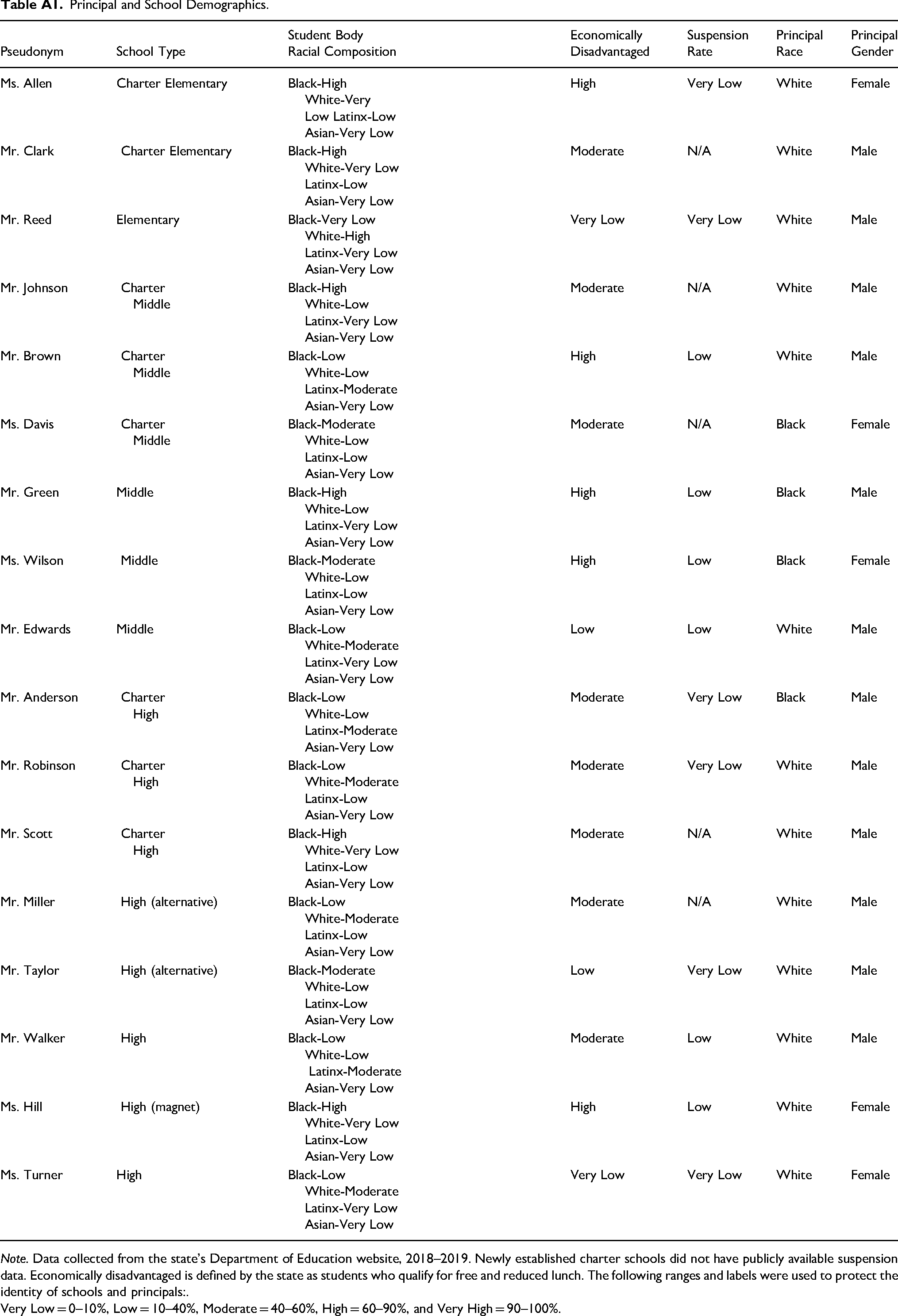
We conducted semistructured interviews to learn how principals understood and enacted school discipline. Our research team, which consisted of a mix of faculty and graduate students, interviewed a total of 17 principals (including 2 assistant principals) during the 2017–18 and 2018–19 school years (see Appendix for sample characteristics). The interviews lasted approximately one hour, typically took place at the principal’s school, and were audio-recorded and transcribed. After each interview, the researcher filled out a contact summary form (Miles et al., 2014) to outline key findings, which was shared with the group. Our research team held regular meetings to discuss our initial findings and direct future data collection.
The interview guide, which was revised several times as we conducted preliminary analysis of our data (Charmaz, 2011), covered topics including the principal’s preparation and role, school culture and expectations, challenges related to school discipline, and philosophy/approach to school discipline. Our initial interview protocol was informed by sensemaking theories; the institutional logics framework did not inform protocol development but emerged after analyzing our data.
Data Analysis
To analyze our interview data, we used a grounded theory approach (Charmaz, 2011), where we first generated an initial list of codes based on line-by-line coding. Two members of the research team then each generated a list of focused codes based on recurring initial codes and more salient codes. We met together as a team to discuss and compile these lists of focused codes and developed a final list of focused codes which were used to recode all the interviews. During the process of re-coding and analysis, we made some adjustments to this list. The findings from this paper are based on memo-writing and analysis related to the parent code, “Describing goals of school culture,” under which we had subcodes, “Setting high expectations (academic),” “Meeting student developmental needs (socioemotional),” and “Controlling/managing students.” We also analyzed data from the parent code, “Balancing academic and disciplinary goals” and “Shifting focus away from punishment.”
From these codes, we identified a “care” and “control” logic, which we then used as a lens to analyze the goals, assumptions, and practices affiliated with each logic. The code “Meeting student developmental needs” corresponded to our “care” code and the code “Controlling/managing students corresponded to our “control” code. Many of the codes under “Setting high expectations (academic)” also aligned with the “control” code. In all cases, we reread the excerpts under each original code to determine whether it fit a care or control logic. To examine how principals balanced these two logics, we re-read all our interview transcripts and created a matrix of each school along with the practices and beliefs associated with each logic. To ensure trustworthiness, we continually discussed and compared our coding and interpretation of quotations with each other.
Positionality
Our collaborative work as a research team and our close coding of data helped to mitigate individual biases that may have affected our collection and interpretation of the data. Our research team was racially diverse and included former school teachers who taught at both traditional and charter schools and a former counselor and administrator at the school district who provided invaluable context and connections throughout the research process. The first author identifies as an Asian-American female and the second author identifies as a Black female. In writing this paper, the two authors worked closely together to interpret the data and draft the findings.
To maintain confidentiality, we have blinded the school district and use pseudonyms for all principal names. We received permission from the school district and our Institutional Review Board to conduct the study.
Findings
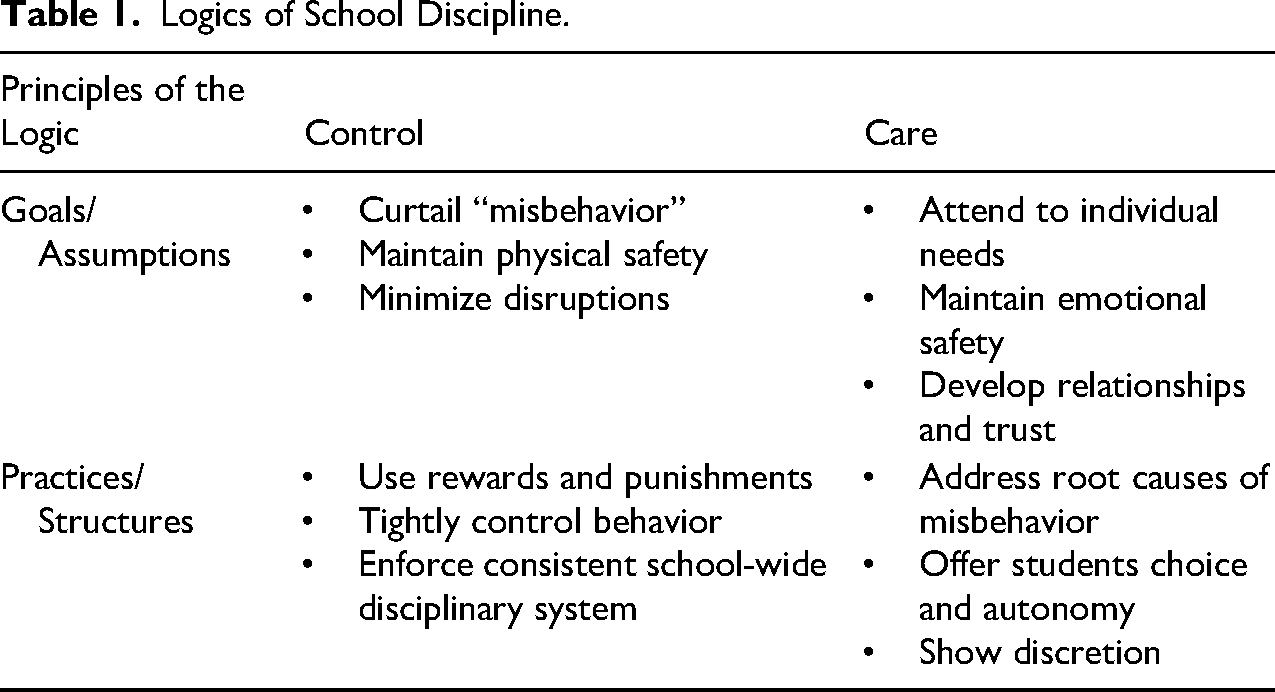
Our findings are organized as follows. First, we describe how principals conceptualized school discipline using institutional logics of control and care. These logics are based on different assumptions about the goals of school discipline and employ different practices and structures for accomplishing these goals (see Table 1). Second, we show how principals sought to balance control and care but often found these to be competing goals. Finally, we discuss how principals blended logics of control and care in experimenting with new disciplinary practices. Together, these findings illustrate how principals are constrained by widely available templates for school discipline but also find ways to innovate practices by combining logics.
Logics of School Discipline.
Control: Managing Students and Minimizing Disruptions
A dominant institutional logic that principals drew upon when describing goals of discipline was that of control. As summarized in Table 1, principals articulated goals that aligned with a logic of control including curtailing “misbehavior,” maintaining physical safety, and minimizing disruptions. Common control practices used by schools to meet these goals included issuing rewards and consequences, closely monitoring student behavior, and using consistent school-wide disciplinary systems.
An underlying assumption of a control logic, as reviewed earlier, is that teachers and administrators must manage student behavior to establish a safe and orderly environment. Drawing from this logic, Ms. Allen, a white principal at a charter elementary school, gave an example of how one student’s behavior can put other students at risk. Earlier that day, she had to intervene in a third-grade classroom where “a big kid,” was “really escalated,” and the teacher had to evacuate the rest of the class. 2 More typically, teachers and administrators manage behaviors that are disruptive not dangerous. Ms. Hill, a white assistant principal at a large, comprehensive high school, spoke about the need to ensure that the misbehaviors of a small minority of the class do not interfere with the learning process for all students. Her goal in addressing these disruptions to learning is to “preserve a positive culture for … the 85, 90 percent of kids who show up and do the right thing every day.” Her rationale for removing disruptive students from the classroom was echoed by several other principals though studies of suspensions have found that removing disruptive students does not create a better school climate for those students who remain (American Psychological Association, 2008). Moreover, studies have found that Black students are more likely than white students to be punished for being disruptive or disrespectful, evaluations that are subjective and highly racialized (Lewis & Diamond, 2015; Milner, 2020; Skiba et al., 2002).
Under a logic of control, discipline is used not only to control dangerous or disruptive misbehaviors but also to minimize what one principal termed “passive misbehavior” that can distract from learning. Charter schools that follow a no-excuses model take this to an extreme (Golann, 2015, 2021). By creating a highly structured school environment, these schools aim to not only create a safe and orderly environment conducive to learning but to maximize instructional time. For the low-income students of color these schools mostly serve, “time is the biggest enemy,” explained Mr. Johnson, a white principal of a charter middle school, because there is so much catching up to do and only eight hours in the school day to do it. “How can we create more time, how can we make more time?” Mr. Johnson asks himself. “And that’s why that student culture matters. And that’s why going above and beyond matters.” Mr. Brown, a white principal of a charter middle school where a high percentage of students are economically disadvantaged and approximately half the students are Latinx, echoed this “sense of urgency.” He explained that a lot of their students do not know basic arithmetic and can barely read first-grade level books, so creating a highly structured environment allows them to close academic gaps in ways they otherwise would not be able to. From the perspective of these school leaders, a strong emphasis on compliance—characteristic of a logic of control—keeps students on task and focused on learning at all points of the day.
The majority of the charter principals in our study described implementing school-wide behavioral systems focused on minimizing disruptions. In their schools, rules regarding language, clothing, and movements were tightly enforced and often tracked using a system of merits and demerits. For example, one charter school used a system of “points” and “strikes” where students earned points for displaying the school’s core values and strikes for breaking classroom rules and norms, such as talking during independent work time. Another school used a system of “misbehaviors and marks” where students earned and lost points towards a pretend paycheck they received at the end of each week. Points and paychecks earned students various privileges such as attending field trips or selecting an item from a treasure chest, whereas strikes and marks resulted in lunch detentions or calls home. If a student repeatedly misbehaved, the consequences often escalated to in-school and out-of-school suspensions, and in extreme cases, expulsions. School-wide consistent discipline systems, while perceived as transparent and fair, allowed little room for teacher discretion in addressing behavior (Irby & Clough, 2015).
While these charter principals tended to believe that a tightly controlled atmosphere was necessary for closing academic achievement gaps, an overly controlling environment also perpetuates negative stereotypes of the Black and Latinx students who comprise the majority of students in these schools. Ms. Turner, a principal of a majority-white magnet high school, voiced these concerns when explaining how her own philosophy of school culture differs from the “extremely police-y, monitoring” one: “We have a tendency to treat children and especially children from high poverty or challenging areas or backgrounds, out of our fear as adults, we tend to confine them because we are afraid that if we give them freedom, they will not be able to handle it.” By creating rules for students such as not being allowed to speak unless spoken to, monitoring what foot they step with in the hallway, or punishing them for not having a belt, a school “belittles [students’] spirit and treats them as though we are training them for prison.” As Milner (2020) has argued, when “discipline” turns into “punishment,” it no longer serves as a tool to push students to succeed but becomes a tool of exclusion, one that increases the distance between teachers and students and mirrors practices used in the criminal justice system. Moreover, creating new and specific rules for minor disruptions widens the school disciplinary net, placing greater numbers of students at risk of falling into the school-to-prison pipeline (Irby, 2014).
In this section, we have seen how different principals drew from the assumptions and practices of a logic of control to explain their disciplinary systems. While safety and order are critical to the functioning of a school, decisions over who gets punished, what behaviors are labeled as disruptive, and how much control is deemed appropriate are often racialized. In the next section, we turn to a different institutional logic that principals used in reflecting on their disciplinary goals and practices: a logic of care.
Care: Being Responsive to Students’ Needs and Situations
While maintaining control was a first priority, principals also discussed school discipline using a logic of care. As shown in Table 1, principals identified goals associated with a logic of care including attending to individual needs, maintaining emotional safety, and developing relationships and trust. These goals were sought by principals through addressing the root causes of misbehavior, giving students greater choice and autonomy, and showing discretion.
One common way that schools enacted a care logic was by seeking to understand and address the root causes of students’ misbehaviors. Principals recognized that their students faced multiple sources of trauma, such as poverty, illness, or death of a family member, among others, which impacted students’ behaviors and grades. Ms. Wilson, a Black principal of a middle school with a high percentage of economically disadvantaged students, stated that it is impossible to deal with discipline without being “willing to hear and understand” because simply giving demerits does not uncover what is causing the misbehavior. “It’s not black and white. It’s not cookie cutter,” she asserted, which she understands as a former special educator. For example, right before the interview, Ms. Wilson had met with a parent and son because the son was acting out. She learned that the student had recently come out about his sexuality and the mother told him, “He’s not allowed to have those thoughts until he’s 18 and out of her house,” so the student was intentionally misbehaving in hopes of being put out of school and out of his mother’s house. By showing discretion and actively communicating with the student and his family instead of immediately assigning a consequence, Ms. Wilson followed a situational logic of care rather than a universal logic of control.
Mr. Miller, a white principal at an alternative high school, also enacted a logic of care in recognizing that students’ preoccupations could distract them from learning. He described informal ways of caring for students such as “picking up on body language cues” to notice whether a student’s attitude is different on a certain day. Teachers at his school help students “reset and have those conversations” because they “know if [the student] is worried about their little one at home with a snotty nose or a fever, they’re not going to get much done.” Mr. Miller understood that only by acknowledging and addressing students’ outside-of-school factors – rather than scolding and punishing them for behavioral manifestations of them—can schools help students feel ready to learn and succeed. This emphasis on knowing students’ situations and needs is associated with a logic of care.
Whereas a logic of control focuses on ensuring students’ physical safety, a logic of care takes a holistic approach and also considers students’ emotional safety. Mr. Robinson, a white principal of a charter high school, explained how, early in his teaching career, he understood safety as “a kid didn’t get punched today.” Now he takes a more expansive definition: Kids have to feel safe and known and successful before they can open up and take risks inside of the classroom … For us, safety means – there is a question of, like, am I physically safe in this classroom, but for us, it's more about, like, does a kid feel socially-emotionally safe in the classroom. Do I feel like my teacher's got my back? Do I feel like I can share without risk? Do I feel like I can make mistakes in this classroom and not be laughed at, so I do feel emotionally safe to be my authentic self and be accepted by my peers, even if they disagree?
As Mr. Robinson described, emotional safety includes creating a classroom environment where students can actively engage in their learning, express their identities, and make mistakes without fearing ridicule or reprimand. To foster an environment where students feel emotionally safe, his charter school emphasizes to teachers the importance of building relationships with students. While his school continues to use a highly structured behavioral system, other principals have found that giving students more autonomy to make choices helps foster an environment of trust, a point we will return to in a later section.
Control and Care as Competing Logics
Control and care can be seen as competing institutional logics. To illustrate the tensions between them, we can take a look at two examples of principals who struggled with balancing care and control. Ms. Wilson, the Black principal who understood that discipline can’t be “cookie-cutter,” explained how her school transitioned from using suspensions as their primary discipline strategy towards using restorative practices. The first year of implementing restorative practices, her staff did not teach for the first two weeks of school but instead used that time to get to know students and understand where they were coming from. When they started academics in the third week, however, it was a difficult transition. She reported that teachers felt like they were “kumbaya-ing” kids and some teachers did not initially buy into the new models because they didn’t see direct consequences for students’ behaviors and thought it would make classroom management more difficult. While this initial focus on building relationships helped her school achieve a positive school culture, Ms. Wilson realized that by putting so much emphasis on care, the school had not laid the foundation of control and classroom management in a way that teachers and students understood.
Conversely, focusing on control too heavily can lead students to feel like they are not cared for. Mr. Anderson, a Black principal who previously worked at a no-excuses charter school, said that the policies at his previous school were put in place so that time would not be wasted and they could achieve high test scores. “We ran a really tight ship and I really appreciated it,” he explained. However, his students complained that they did not think teachers liked or cared about them. When he had the opportunity to become a principal of his own school, he realized they will not “lose the fight against the gap in education” just because a student is tardy or does not have his uniform correct, and controlling students too tightly can cause them to be afraid to make choices or mistakes. With this realization, he now relies more on conversations and building relationships with students as a means to shape school culture.
Balancing Control and Care
Although the balance between care and control can be difficult to achieve, principals continued to seek out ways to achieve these competing goals. This highlights the agency of individuals to innovate and blend logics (Hallett & Ventresca, 2006). Across different school contexts and student populations, principals described their goals as striking a balance between control and care, using phrases such as “trying to find the balance,” “figuring out how to provide them a structured yet forgiving atmosphere,” “it’s hard to find that happy medium but we pursue it,” “these things can coexist” and “it’s kind of just that delicate balance.” In this section, we highlight three examples of principals’ efforts to balance control and care: traditional schools seeking to reduce suspensions, charter schools seeking to adjust highly structured approaches, and alternative schools focused on building positive student–teacher relationships (see Table 2).
School Strategies for Balancing Control and Care.
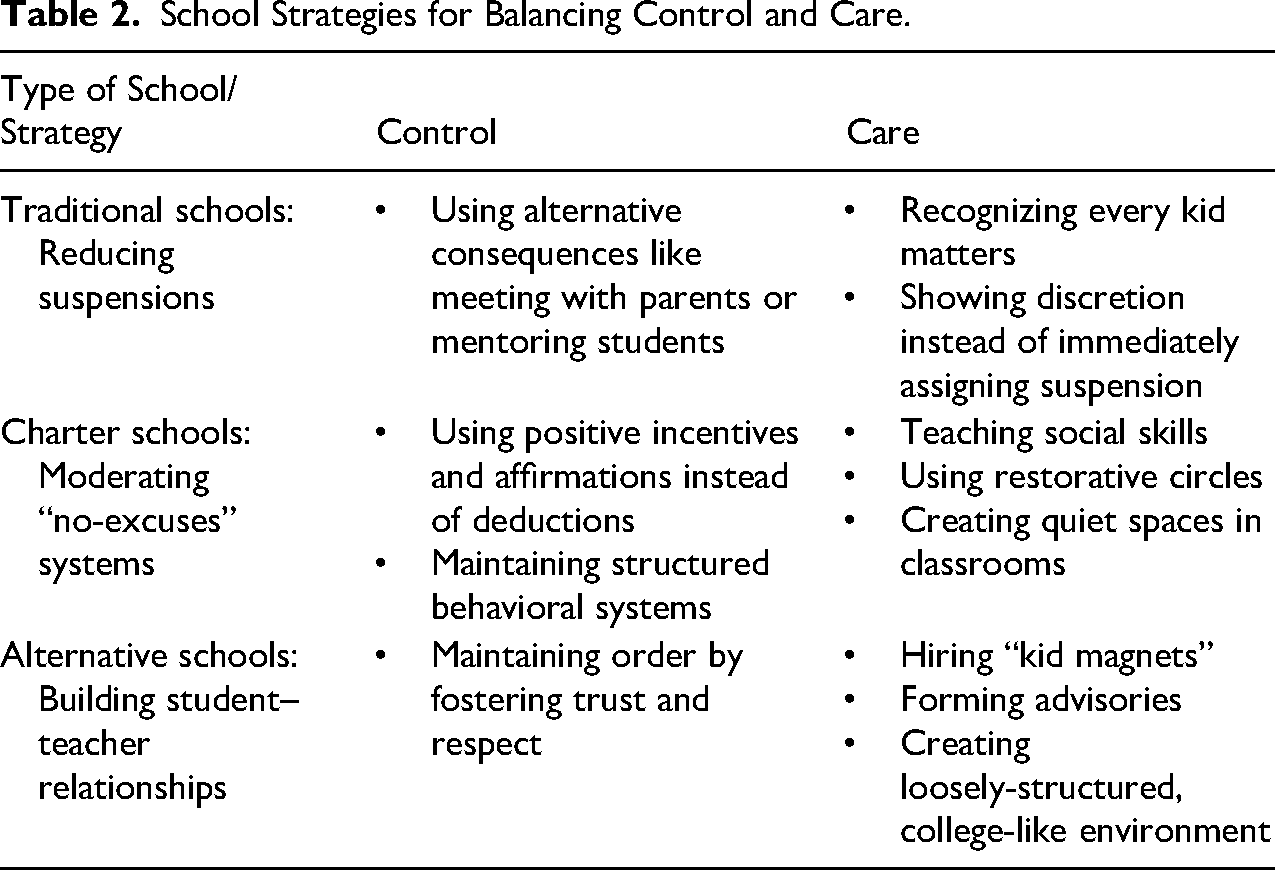
“It’s about every kid”: Traditional schools reducing suspensions. For Mr. Green, a Black principal of a predominantly Black middle school, reducing suspension rates is directly tied to closing the school-to-prison pipeline. “I’m a Black male,” he stated. “How can I not want to stop the pipeline to prison with young Black males?” From his own experiences growing up in the inner city, he knows the struggles that students face and tells students that he has three uncles who are doing 25-to-life in prison. For other principals, reducing suspensions is less personal but still viewed as critical to improving academic achievement. Although the school district pressured traditional school principals to reduce school suspensions, principals also recognized that students who were suspended repeatedly were the same ones that were not passing tests, failing classes, and dropping out because they were removed from school too frequently. In these ways, punitive discipline perpetuated a cycle of negative consequences and moved students even further away from the stated goals of academic achievement and regular attendance. Mr. Walker, a white principal of a large, diverse high school, came to the realization that his school’s low graduation rate was directly tied to students not being in school because of suspensions. This prompted a shift in his perspective around discipline. “In my career, I was all about suspending kids,” he admitted. “Get them out. Don’t let them interfere with the kids that want to learn. I really had a shift of it’s about every kid. It’s about every kid.” This year, his school has eliminated in-school suspensions and has reduced their out-of-school suspension rates by more than one-third.
In recognizing that “it’s about every kid,” Mr. Walker has shifted from a logic of control designed to maintain order and curb misbehavior to a logic of care focused on attending to students as individuals. Principals believe that relying less on suspensions sends a more positive message to the students that they are a valued part of the environment and that they are capable of behaving in a school-appropriate way. Ms. Turner, a white high school principal, explained that in her experience working with students who had the hardest time learning and meeting behavior expectations, exclusionary disciplinary practices did not impact or change students’ behavior, but instead made them angry and made their school experience negative.
As principals have tried to reduce suspensions as a response option, however, they have confronted challenges from teachers, parents, and students accustomed to what one principal called the “old-school action-consequence cycle.” Thus, in tilting their school disciplinary policies towards care, principals have also sought alternative ways to ensure that control is maintained. To meet the needs of the misbehaving student without disrupting the entire learning environment, they often come up with creative solutions such as mentoring students who are struggling, having parents come in, or having students come in during hours that other students are away. Principals are not ignoring misbehaviors but many of them are choosing to shift consequence structures away from strictly punitive responses. For example, instead of suspending a high-achieving student who had sudden attitude changes, Ms. Wilson, the Black middle school principal who emphasized the importance of being willing to hear and understand, chose to set up a restorative circle meeting with the student and his family. She explained what she learned about the student: Apparently, he was suicidal. We had no clue. I could have been throwing him out but it was like noticing, and knowing kids, and so to find out that mom was going through a divorce, it was the only father he ever knew but it wasn't his father, and his stepdad was just picking up his two sons and not [the student], so he was feeling neglected. We were able to get him some support and some counseling.
Through these conversations, Ms. Wilson was able to understand the reasons for the student’s actions and the student was able to express and process his emotions, which helped to reshape his behaviors. Ms. Wilson explained that “he never got suspended, ever, after that.” By using alternative forms of discipline, principals like Ms. Wilson have found that they can shift towards care without losing control.
“The conversation is shifting”: Charter schools moderating no-excuses systems. Unlike the traditional district schools, charter schools were not required to select a progressive disciplinary approach to implement. Yet all of the charter principals we interviewed spoke about shifting away from an over-controlling, no-excuses disciplinary structure.
When switching from a harsher discipline structure, principals have found it crucial to help teachers change their mindsets regarding discipline. One strategy that schools have adopted to do this is to reduce the use of harsh language. Mr. Robinson, a white principal of a charter high school, explained that he changed how he discussed student behavior in order to change how he and his staff approached discipline. Instead of continuing to use the word “compliance,” he and his staff began using the word “cooperation” to shift the focus from telling a student what to do towards working alongside students—emphasizing the relational aspect of a care logic. Likewise, Mr. Brown, the white principal of a charter middle school, now encourages teachers to use the language of “consequence” and “intervention” rather than “punishment.” Although he acknowledged that his school’s previous model of “absolutely no shortcuts, no-excuses, like scale of 1 to 10 on discipline, was an absolute 10” was necessary in the first years of school turnaround, he now characterizes his school culture as “much closer to a five.”
Shifting the focus away from punishment and harsh language allows students to associate behaving appropriately in school with positive outcomes. In recognizing this, Ms. Davis, a Black principal of a charter middle school, hired Kickboard to visit and flip their incentive systems from deductions for inappropriate behaviors to students earning points or dollars for doing the right thing. She explained: So what has happened in the past is, like, you didn’t have your homework: minus 2. Or you’re chewing gum, minus 5 … So, they started the week with $75 … and each day, they could keep that money or they could get money deducted based off of behaviors. This year, it’s, like, you start with zero and every day, you’re adding. So the conversation is shifting. Like, “Great job, you are getting $10 because you got × or whatever.” Or “I see 100 percent of you all doing this, so therefore, you’re going to get that.”
Instead of hearing students constantly be told, “you lost, you lost, you lost,” she felt that teachers learned how to communicate with students in a more positive way. The use of positive incentives is an approach similar to PBIS, one of the alternative approaches recommended by the district.
While replacing harsh language and flipping incentive systems can create a less punitive and more caring culture, these practices do not necessarily change underlying practices of control. That is, in most cases, these charter schools maintained strict and consistent behavioral systems that granted students and teachers little autonomy or discretion. For example, Mr. Robinson described creating what his school calls a “bell-to-bell fortified environment” during the classroom period. Each week, school leaders conducted ten-minute observations of classrooms where they had a checklist of priority items to look for. He explained: So this is specifically what we look for … We look at 100 percent moments, when a teacher asks a class to do something, did they do it within two seconds of being asked to do it or receive an intervention? Are they productive? How many kids are off-task at any given time? And then are they known, how many net affirmations are we giving kids, like, individually?
Although teachers praise individual students, they still tightly control and monitor student behavior, calculating how quickly students follow directions and how many students are off-task. Thus, the balance in most these schools, while shifting towards a grey area, still appears to lean towards control.
The same can be said about integrating alternative practices into traditional school-wide incentive systems. Mr. Clark, a white principal of a charter elementary school, explained how his school uses restorative circles where students who have committed a serious offense will apologize to their classmates and explain their actions, and their classmates will explain how their actions made them feel. In this way, “the person that did [the hurtful action] knows how it impacted everybody else and it's a deterrent for it to happen again, but it's also kind of healing, because at the end of that, the class forgives the person that did it.” These circles help students recognize their wrong-doing while simultaneously supporting students and integrating them back into the school community, thus incorporating a logic of care. At the same time, Mr. Clark twice emphasized that implementing restorative practices “doesn’t mean they don’t have consequences.” His school continues to use a paycheck system of merits and demerits as well as strict expectations for student behavior in classrooms.
The one charter school that seemed to have shifted underlying structures significantly more towards care than control was Ms. Allen’s charter elementary school. “I think, a lot of times, what you see in high-performing charter schools is like a lot of control and we’re really trying to like teach social skills and teach self-control, like have a lot of space for kids to fail and learn and not just be about control,” she reflected. With a background in special education, Ms. Allen said that she has always taken an individualized approach to student behavior. Unlike typical charter schools in her charter network that also serve predominantly low-income Black and Latinx students, her school does not have a school-wide incentive system (“there’s no flip chart, there’s no color chart”) or detention. In place of this, her school has implemented a number of structures to support students including quiet spaces in all classrooms, restorative circles, logical consequences, home visits, and a daily social skills block where students learn skills like conflict resolution. They also work with students on naming and identifying feelings, and teachers use reinforcing language, reminding language, and redirecting language. This approach takes “a lot of people, a lot of communication,” and though it has been effective, Ms. Allen still worries that the school may not be striking the right balance. “There’s the tension around, like, therapeutic, supportive, listening, empathetic … and the real world, typical response to things,” she reflected, wondering aloud whether her school was adequately preparing its students of color for a less receptive world. Thus, even as she embraced care, she still sought to find the “sweet spot” between care and control.
“Everybody knows their name”: Building student–teacher relationships at alternative schools. Relationship-building is at the core of a care logic. All principals put a high priority on building relationships between students and adults, describing it as “key,” “the most important,” and “the number one thing.” Strong relationships are defined by principals as those characterized by trust, support, care, connection, and respect. While the desire to foster positive relationships was universal, the structures of alternative schools often facilitated this process.
Mr. Miller, a white principal of a nontraditional high school that helps students complete their high school diploma, noted that the small size of the school and older age of the students made it easier to take an individualized approach. Students who have come from schools where there are 35 students in a class “are kind of weirded out about the fact that everybody knows their name” at the school. Mr. Miller takes additional efforts to foster strong student–teacher relationships by intentionally hiring teachers whom he describes as “kid magnets”—teachers who really enjoy being around young people and know how to interact and talk with them. He explained how, in urban schools, teachers often come from backgrounds different from the students they teach and thus may struggle to earn students’ respect and confidence. Because of the strong student–teacher relationships fostered at the school, they have to address few behavioral issues. As Mr. Miller described, “It’s a safe learning environment because of the culture of acceptance and recognizing your accomplishments and knowing your name and understanding your story.”
Building positive relationships can reduce student misbehavior and resistance, thus also accomplishing the goals of a logic of control. As Mr. Taylor, the white principal of a project-based high school, summarized, “When students are engaged in doing something that they enjoy or something that's fun, or they believe that you trust them, you demonstrate respect and you care about them, then you're going to have minimal discipline problems.” His school has an advisory period where small groups of students (no more than 15 per advisory) spend almost an hour each day with their advisor. Students develop “really close relationships” with their advisor, and this advisor remains the same through all four years of school. Because of this tight relationship, the school is able to call on the advisor to assist if they have to address behavioral issues with the student. In this way, the school is able to establish control through showing care for students.
At a high-performing magnet high school, Ms. Turner, a white principal, described how relationships are cultivated through creating a loosely structured, college-like environment where students are trusted to follow school norms. “We treat them like human beings,” she explained. “We demonstrate to our students on the front end that we trust them first; that helps establish this continuing relationship.” By not depending on control structures, where students are prodded “like cattle from one place to the next,” her school enables teachers to see their students through a different lens, one that is more humanizing and opens the possibility for a reciprocal relationship. This was apparent in her asset-based description of the students: “We, the teachers, find them fascinating and engaging and fun, and we laugh and share.” That her magnet school is one that is majority-white and not economically disadvantaged, however, highlights the disparities in social control found among urban schools serving students of difference races and economic statuses. If building relationships is an effective strategy to balance control and care, it is not as readily embraced in all school contexts or among all teachers.
Discussion
Principals play a central role in shaping school practices and policies, including those around discipline (DeMatthews et al., 2017; Mukuria, 2002; Skiba et al., 2014). In this study, we used an institutional logics framework to examine how principals in one mid-sized urban district understood and balanced the different goals of school discipline. We identified two prevailing logics that principals invoked in articulating their goals: control and care. While much of the literature on urban school discipline has focused on control, principals by and large articulated a desire to also care for students in administering discipline by understanding the root causes of students’ behaviors and by holistically addressing students’ needs. They had a vision for disciplinary systems that both established schoolwide order and attended to students as individuals.
This study extends on the sensemaking literature by highlighting the role that institutional logics have in shaping how individuals interpret and mediate policies and practices. Individuals do not rely only on their personal identities, school contexts, and social networks, as prior work has aptly demonstrated (Coburn, 2001, 2005; Spillane et al., 2002), but also draw from broader societal logics (that is, patterns of practices, assumptions, and values) in making decisions. A few studies of school leaders’ sensemaking have incorporated institutional logics into their analysis (Spillane & Anderson, 2014; Woulfin, 2016), but this is the first study, to our knowledge, to apply this framework to how principals understand school discipline. Across principals of different backgrounds, professional histories, and school contexts, we found that principals drew from a similar set of logics of control and care. We identified goals, assumptions, and practices associated with these logics, offering a starting point from which other researchers can build and adapt.
A second contribution of this study is in identifying the strategies that school leaders used in trying to balance the competing logics of care and control. In a few cases, principals relied primarily on care or control to guide their disciplinary practices, but most principals in our study described ways of balancing care and control through practices like minimizing punitive and exclusionary discipline, moving away from no-excuses disciplinary practices, and building supportive teacher–student relationships. Using these strategies helped school leaders and teachers maintain order without relying primarily on compliance and punishment. These strategies, while not new to the literature on school disciplinary reform (Welsh & Little, 2018), can be more closely examined for how they incorporate logics of control and care. Studies, for example, have found that progressive approaches to discipline like restorative justice still incorporate forms of punitive control (Irby, 2014).
An institutional logics framework offers a useful lens for future studies of school discipline. Researchers could investigate what other institutional logics may be available to teachers and administrators in decisions around school discipline. For example, culturally responsive classroom management draws from a social justice logic in urging teachers and administrators to attend closely to how their own biases shape their work with culturally diverse students and to gain a better understanding of how broader social, economic, and political contexts undergird institutional practices and narratives (Milner IV et al., 2018; Weinstein et al., 2004). An institutional logics framework is also valuable for understanding barriers to reform. When schools introduce a new institutional logic—such as one of care—to a school structured on a dominant logic—such as one of control—this can introduce new tensions and turmoil in schools (Hallett, 2010). As much as administrators and teachers may embrace the idea of school disciplinary reform, they may struggle to understand and integrate new logics because these go against their taken-for-granted ways of doing things. Finally, researchers could trace the prevalence of different institutional logics in school discipline throughout history or within a school over time.
Our study has several limitations. First, we only interviewed principals about their disciplinary practices and did not observe how school administrators and teachers implemented these practices on the ground. Although interviews provide insights into how principals interpret discipline, principals’ reports of how they enacted their disciplinary practices do not necessarily match the everyday practices found in their schools. Second, we did not relate principals’ personal backgrounds and beliefs, or their school composition or context, to their use of institutional logics because of our small sample size and the overall consistency in principals invoking both care and control logics. We did identify some distinct strategies between traditional, charter, and alternative school principals, as highlighted in our findings, though some of these strategies also overlapped across school type. A final limitation is that the school district we studied was in the process of disciplinary reform. Thus, the principals we interviewed may have been more likely to be cognizant of a care framework than principals in urban districts not undergoing reform. However, many principals mentioned that their schools had already been using these types of practices informally and also cited their personal experiences as important factors in shaping their views of school discipline.
As schools and policymakers become more cognizant of the high costs of harsh and punitive school discipline, especially for Black and Latinx students, more schools are looking towards alternative disciplinary frameworks and practices. Principals play a key role in moderating disciplinary outcomes. Our findings support a call for increased training for school administrators on school disciplinary reform and systemic racism. Platforms where schools can share innovative strategies for shifting away from punitive discipline can also serve as fruitful conduits of information. Finally, it is important to recognize the sets of values, assumptions, and practices that undergird school disciplinary systems to create more equitable opportunities for all children.
Footnotes
Acknowledgments
We are grateful to our terrific research team members: Anna Weiss, Nicole Cobb, Ben Fields, and Jennifer Darling-Aduana. We also thank Lauren Senesac for editorial and research assistance.
Declaration of Conflicting Interests
The author(s) declared no potential conflicts of interest with respect to the research, authorship, and/or publication of this article.
Funding
The author(s) disclosed receipt of the following financial support for the research, authorship, and/or publication of this article: This work was supported by the Peabody College Small Grants for Research (grant number N/A).

Notes
Author Biographies
Appendix
Principal and School Demographics.
| Pseudonym | School Type | Student Body |
Economically Disadvantaged | Suspension Rate | Principal Race | Principal |
|---|---|---|---|---|---|---|
| Ms. Allen | Charter Elementary | Black-High White-Very Low Latinx-Low Asian-Very Low |
High | Very Low | White | Female |
| Mr. Clark | Charter Elementary | Black-High White-Very Low Latinx-Low Asian-Very Low |
Moderate | N/A | White | Male |
| Mr. Reed | Elementary | Black-Very Low White-High Latinx-Very Low Asian-Very Low |
Very Low | Very Low | White | Male |
| Mr. Johnson | Charter Middle |
Black-High White-Low Latinx-Very Low Asian-Very Low |
Moderate | N/A | White | Male |
| Mr. Brown | Charter Middle |
Black-Low White-Low Latinx-Moderate Asian-Very Low |
High | Low | White | Male |
| Ms. Davis | Charter Middle |
Black-Moderate White-Low Latinx-Low Asian-Very Low |
Moderate | N/A | Black | Female |
| Mr. Green | Middle | Black-High White-Low Latinx-Very Low Asian-Very Low |
High | Low | Black | Male |
| Ms. Wilson | Middle | Black-Moderate White-Low Latinx-Low Asian-Very Low |
High | Low | Black | Female |
| Mr. Edwards | Middle | Black-Low White-Moderate Latinx-Very Low Asian-Very Low |
Low | Low | White | Male |
| Mr. Anderson | Charter High |
Black-Low White-Low Latinx-Moderate Asian-Very Low |
Moderate | Very Low | Black | Male |
| Mr. Robinson | Charter High |
Black-Low White-Moderate Latinx-Low Asian-Very Low |
Moderate | Very Low | White | Male |
| Mr. Scott | Charter High |
Black-High White-Very Low Latinx-Low Asian-Very Low |
Moderate | N/A | White | Male |
| Mr. Miller | High (alternative) | Black-Low White-Moderate Latinx-Low Asian-Very Low |
Moderate | N/A | White | Male |
| Mr. Taylor | High (alternative) | Black-Moderate White-Low Latinx-Low Asian-Very Low |
Low | Very Low | White | Male |
| Mr. Walker | High | Black-Low White-Low Latinx-Moderate Asian-Very Low |
Moderate | Low | White | Male |
| Ms. Hill | High (magnet) | Black-High White-Very Low Latinx-Low Asian-Very Low |
High | Low | White | Female |
| Ms. Turner | High | Black-Low White-Moderate Latinx-Very Low Asian-Very Low |
Very Low | Very Low | White | Female |
Note. Data collected from the state’s Department of Education website, 2018–2019. Newly established charter schools did not have publicly available suspension data. Economically disadvantaged is defined by the state as students who qualify for free and reduced lunch. The following ranges and labels were used to protect the identity of schools and principals:.
Very Low = 0–10%, Low = 10–40%, Moderate = 40–60%, High = 60–90%, and Very High = 90–100%.