




Abstract
I examine how three elementary-level preservice teachers of Color cultivated their asset-, equity-, and justice-oriented pedagogical learning and identities through multilayered community-engaged tasks. Systemic and structured support from multiple stakeholders played a critical role in helping the preservice teachers of Color to promote and sustain their asset-, equity-, and justice-oriented pedagogical learning and identities. This study demonstrates that giving students tasks with multiple modalities (e.g., individual and collaborative work, face-to-face meetings, online reflections) can cultivate their pedagogical learning and identity construction. This work has implications for creating asset-, equity-, and justice-oriented pedagogical spaces in both the classroom and the field.
Keywords
Introduction
One urgent issue in urban teacher education is preparing teachers to work in solidarity with intersectionally minoritized students and communities of Color. 1 Urban field experiences play a key role in this preparation (Howard & Milner, 2014). Transformative urban field experiences can help preservice teachers (PSTs) to cultivate a strong social justice orientation and develop culturally empowering pedagogical knowledge (Milner & Lomotey 2014). Field experiences in urban settings can enable PSTs to understand and respond to the ways that teacher education is “arguably implicated in the reproduction of racial inequities” (Souto-Manning & Martell, 2019, p. 4), including historical and contemporary educational inequities in public urban schools (Milner, 2015; Milner & Laughter, 2015).
The purpose of this study is to examine the possibilities and tensions that arise as PSTs of Color construct pedagogical identities while they learn to teach. Specifically, this study investigates how three PSTs’ of Color (i.e., African American, Chicanx, Filipinx) constructed pedagogical identities through engagement in a community-inquiry project (CIP) during their urban fieldwork. The ultimate goal of this work is to explore asset-, equity-, and justice-oriented pedagogical practices to improve educational equities for underserved students of Color. In this article, grounded in CRP (Ladson-Billings, 1995, 2014), asset-oriented pedagogy refers to teachers’ employment of culturally, racially, and linguistically affirmative views on their students, while equity-oriented pedagogy means teachers’ support for students to achieve their academic potential. Underpinned by racial literacy (Guinier, 2004), justice-oriented pedagogy highlights teachers’ use of critical race consciousness to name, critique, and confront systems of power alongside students (see Figure 1).
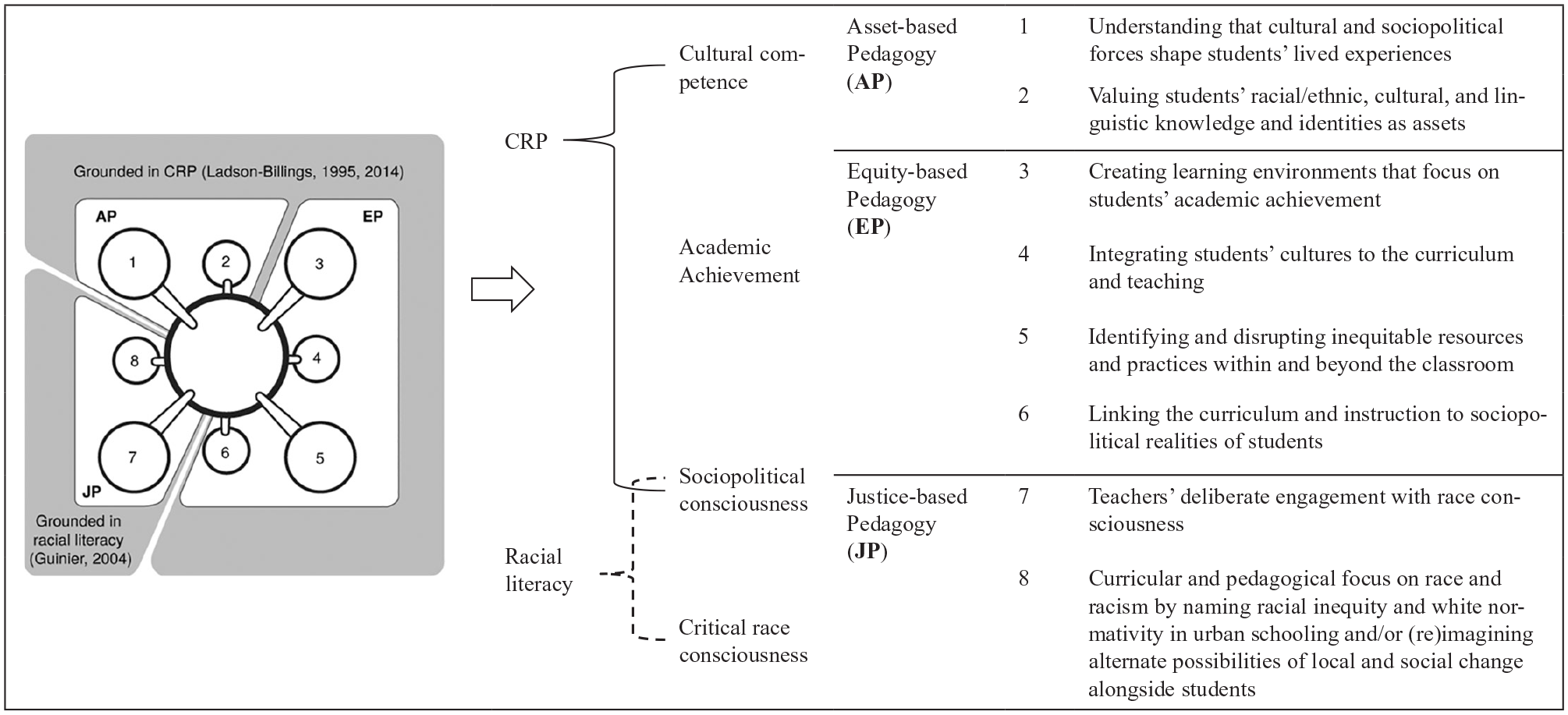
Asset-, equity-, and justice-oriented pedagogy.
A well-designed urban field experience should cultivate teachers’ asset-, equity-, and justice-oriented identities (Souto-Manning, 2019; Souto-Manning & Cheruvu, 2016). Teacher identity provides an analytic lens for examining teachers’ pedagogical knowledge, practice, and priorities (Gee, 2000). Teachers’ identity also serves as a pedagogical tool for teachers to reflect on and respond to their own racial and cultural backgrounds, to understand how their own background affects how they position their students, and to understand how students’ racial(ized) and sociocultural experiences affect how they learn (Howard & Milner, 2014; Jackson, 2018). Teachers’ asset-, equity-, and justice-oriented identities thus play a pivotal part in (re)centering minoritized students of Color needs and goals, because asset-, equity- and justice-oriented identities can help teachers to disrupt deficit thinking and to push against or tactically negotiate contextual constraints such as high-stakes accountability (Howard & Milner, 2014; Souto-Manning, 2019; Souto-Manning & Cheruvu, 2016).
Nevertheless, the role of urban field experiences in PSTs’ of Color 2 education has been neglected in the literature. This research gap has three aspects. First, much research with PSTs of Color has focused on university-based coursework or programmatic experiences (e.g., Gist, 2017a, 2017b; Jackson, 2015), and not field experiences. Second, teacher education literature is replete with studies examining how PSTs from dominant groups (e.g., white, middle-class, able-bodied, cis-gendered, heterosexual, speaking dominant English as L1, Christian) learn to understand and use culturally empowering pedagogies through their urban field experiences (Sleeter, 2001, 2017), while similar studies on PSTs of Color are scarce. Third, even when PSTs of Color are included in research on PSTs’ urban field experiences, PSTs of Color are rarely considered as key subjects for the analysis (e.g., Jacobs, 2019).
When we, as urban teacher educators, assume that PSTs of Color, as a result of their first-hand experiences, enter the urban field sites with sophisticated asset-, equity-, and justice-oriented pedagogies and identities, we are complicit in the marginalization of these teacher candidates’ pedagogical needs, perspectives, and goals. As several scholars have detailed (e.g., Achinstein & Aguirre, 2008; Brown, 2014; Carter Andrews et al., 2019; Gist, 2017b; Jackson, 2015; Sleeter & Milner, 2011), PSTs of Color do not enter teacher preparation programs or field sites with innate or identical pedagogical dispositions, knowledge, or skills to articulate and enact culturally empowering and justice-oriented practices. All too often, PSTs of Color encounter overt or covert forms of racial, linguicized, and gendered microaggressions in a hostile learning climate with peers and faculty (e.g., Maddamsetti, 2020a; Maddamsetti et al., 2018). For PSTs of Color, the notion of an asset-, equity-, and justice-oriented pedagogy may remain obscure and elusive (Gist, 2017b; Jackson, 2015).
At the same time, PSTs of Color are more likely to teach in public urban schools that are constrained by prescriptive curricula and standardized testing (Sleeter & Milner, 2011). In such a rigid context, teachers of Color often inadvertently (re)produce dominant deficit discourses (Philip et al., 2016), or continually wrestle with various constraints in the education of minoritized students of Color (Acosta, 2019; Amos, 2020; Kohli, 2018; Pizarro & Kohli, 2020). Therefore, urban teacher educators must provide systemic and sustained support for PSTs of Color to strengthen their pedagogical identities not only in their university-based coursework but also in their urban fieldwork.
I begin by reviewing existing studies on PSTs’ of Color pedagogical learning and identity construction in urban field sites. I then outline the theoretical framework for this study, which largely draws on CRP (Ladson-Billings, 1995, 2014) and racial literacy (Guinier, 2004). After discussing methodology and providing greater context, I give examples of how each participant engaged in the CIP to make sense of their urban field experiences. I discuss three important pedagogical possibilities and tensions faced by participants during their fieldwork. I conclude by noting some limitations of this study and suggest implications for urban teacher educators to promote and sustain asset-, equity-, and justice-oriented pedagogies and identities of PSTs of Color during teacher education. The research questions that guide this study are the following:
Literature Review: Preservice Teachers’ of Color Pedagogical Development and Identity Construction through Urban Field Experiences
In this study, I use the term “urban” to refer to schools that serve students with “a wide range of academic, linguistic, psychological, social, and emotional needs” (Howard & Milner, 2014, p. 202). Urban field sites are often emotionally intense places to work, due to the “size, scale, and bureaucracy that complicate the organization of curricula, instruction, assessment, and resources” (Tatum & Muhammad, 2012, p. 436). A crucial element in the discussion of urban field sites in this study is the lived experiences related to social, cultural, and educational injustice that students and their communities in urban settings have (Milner, 2012). In this regard, urban students and communities are acutely invested in teachers’ asset-, equity-, and justice-oriented pedagogical actions toward these topics (e.g., Harper, 2015).
Community engagement activities, including interactions among stakeholders in urban fieldwork, are a successful way for cultivating PSTs’ of Color pedagogical possibilities. For instance, Coffey and Farinde-Wu (2016) reported that one African American woman 3 teacher’s first-year experiences of student teaching at a public urban high school were fraught with tension. The researchers highlighted how the participant was questioned and forced to negotiate her culturally responsive pedagogical stance, standardized curricula, and power dynamics with her students in the classroom. The participant also had to handle the racial/ethnic pairing view of students and teachers of Color, which assumes that all teachers of Color are well equipped to be “agents of change.” Borrero et al. (2016) also explored how Latinx, Filipinx, and bi/multiracial teachers in urban contexts negotiated with institutional demands (e.g., prescriptive curricula) to enact culturally empowering pedagogy in their day-to-day practices during their first-year student teaching. They argued that building collaborative relationships among critically minded educators contributed to deepening participants’ culturally empowering pedagogical decision to push back against contextual constraints.
Given the significance and complexities of PSTs’ of Color asset-, equity-, and justice-oriented pedagogical development through their fieldwork, previous research has investigated how to better support PSTs’ of Color to navigate the constraints of their fieldwork. For example, Butler et al. (2021) study examined the urban field experiences of three secondary African American PSTs with previous schooling experiences in rural or suburban contexts. Their study revealed that justice-oriented course readings, critical reflection, and dialogs through interactive journal writing during their fieldwork helped them to uncover their internalized deficit thinking about students and communities in urban settings and to develop their justice-oriented dispositions. Pham (2018) showed how an African American and Filipinx PST fostered culturally empowering and academically rigorous practices during their fieldwork by analyzing the peer learning between these two participants. Her findings indicated that peer learning between like-minded PSTs of Color could be used to challenge normalized racial hierarchies in fieldwork (e.g., positioning white PSTs or mentor teachers as an expert) and empower the practice of those PSTs of Color. Similarly, Kohli (2019) underscored that the cultivation of PSTs’ of Color critically oriented pedagogies requires emotional, institutional, and social support. In supportive spaces, PSTs of Color can validate the lived realities that they share with their students.
Pedagogical identity refers to how teachers (re)negotiate who they are as pedagogues by enacting their pedagogical ideals and by drawing on their lived experiences and available resources in practice (Day et al., 2006; Jackson, 2018; Maddamsetti, 2020b). Such (re)negotiating acts can help teachers understand the nexus between their pedagogical identity and contextualized practices. For example, Jackson and Bryson (2018) explored how 21 PSTs (all women, the majority whom were white) engaged in community mapping activities in urban field sites. By excavating their biases and deficit perspectives, especially concerning racialized and socially stratified views about minoritized students and communities of Color, the PSTs showed enhanced confidence in their nascent culturally responsive pedagogical identities.
In contrast to the many studies on PSTs from dominant groups (e.g., Jackson & Bryson, 2018; Jacobs, 2019), scant attention has been paid to the nuanced link between PSTs’ of Color field experiences and pedagogical identity construction through community engagement.
One notable exception is Acosta et al. (2018), in which the author conducted action research with nine bilingual PSTs of Color on the construction of agentic identities related to advocating for emergent bilinguals’ rigorous academic learning and culturally and linguistically sustaining practices. Acosta et al. found that sharing the results of community-engaged action research with the school community and gaining support from the school administrators was important for cultivating culturally and linguistically empowering pedagogical identities for these PSTs of Color.
Critical and collaborative reflection about race and racism during teacher education can facilitate PSTs’ of Color engagement with culturally empowering and antiracist teaching practice in urban classrooms, hence fostering positive pedagogical identity development. For example, Durden et al. (2016) found that coursework structured around discussions in small and large groups and writing and lesson-planning tasks specifically focused on race and racism in teaching, helped two Black PSTs find themselves as pedagogues and learn to teach in culturally empowering ways. Farinde-Wu and Griffen (2019) conducted interviews with twelve Black women teachers and found the importance of giving teachers space to critically reflect on race, racism, and culturally responsive pedagogy, as well as sustained institutional support.
Theoretical Framework
Asset-, Equity-, and Justice-oriented Pedagogy
To clarify the pedagogical components of asset and equity, I draw on Ladson-Billings’ (1995, 2014) conceptualization of CRP. 4 First, asset-based pedagogy (AP) refers to teachers’ adoption of (1) sociopolitical consciousness (i.e., the understanding that cultural and sociopolitical forces shape students’ lived realities) and (2) affirmative perspectives on minoritized students’ racial/ethnic, cultural, and linguistic knowledge and other intersecting identities.
Second, equity-based pedagogy (EP) refers to teachers’ pedagogical knowledge and skills to ensure all students’ academic success by (1) creating academically challenging learning environments; (2) integrating students’ cultures into the curriculum and teaching; (3) identifying and disrupting inequitable practices; and (4) linking the curriculum and instruction to sociopolitical realities of students.
Third, justice-based pedagogy (JP) refers to (1) teachers’ deliberate engagement with race consciousness and (2) curricular and pedagogical focus on race and racism by naming racial inequity and white normativity in urban schooling, and (re)imagining alternate possibilities of local and social change alongside students (Kohli, 2019; Rogers & Mosley, 2008). Justice-based pedagogy is grounded in the concept of racial literacy that foregrounds institutional and structural patterns of social, institutional, and educational inequity and injustice within a racial hierarchy, in contrast to racial liberalism, which circulates the “post-racial” perspective of equity and justice (Guinier, 2004). As Milner (2017) pointed out, while CRP views culture as a nuanced notion that includes race/ethnicity, class, and gender, race remains central to social and educational injustice. Therefore, an explicit focus on race is essential and necessary to support justice-oriented teachers’ pedagogical trajectories (Brown-Jeffy & Cooper, 2011; Kohli, 2019; Milner, 2017; Milner & Laughter, 2015; Pizarro & Kohli, 2020).
Collectively, grounded in CRP (Ladson-Billings,1995, 2014), asset- and equity-oriented pedagogy share three foci on cultural competence, academic achievement, and socio-political consciousness. Likewise, asset-, equity-, and justice-oriented pedagogy overlap, as they share a common goal of interrogating and disrupting the all-too-common deficit perspective, which presupposes that minoritized students of Color lack certain knowledge and practices when they arrive at school (Ladson-Billings,1995, 2014; Milner, 2017). To this end, asset-, equity-, and justice-oriented pedagogy all highlight the importance of teachers’ ongoing development and practice of sociopolitical consciousness alongside students. What distinguishes justice-oriented pedagogy from asset- and equity-oriented pedagogy is its explicit focus on how teachers’ attention and response to racial(ized) discourses and incidents in the classroom affect students’ learning opportunities (Amos, 2020; Brown-Jeffy & Cooper, 2011; Kohli, 2019; Milner, 2017; Milner & Laughter, 2015).
There are two reasons for adopting CRP and racial literacy as an integrated framework. First, these theories investigate how relationships (e.g., student-teacher interactions) and actions (e.g., pedagogical decision-making and practice) in educational settings are embedded in power differentials between stakeholders in specific sociocultural and political contexts. Second, these conceptualizations interrogate the hegemonic sociocultural and racial values that mediate student-teacher interactions and teachers’ pedagogical practices. Therefore, these integrated perspectives both provide an analytic lens for understanding PSTs’ of Color pedagogical identity construction and serve as pedagogical tools in supporting PSTs of Color to engage in and carve out culturally responsive and anti-racist learning spaces during fieldwork (see Figure 2).
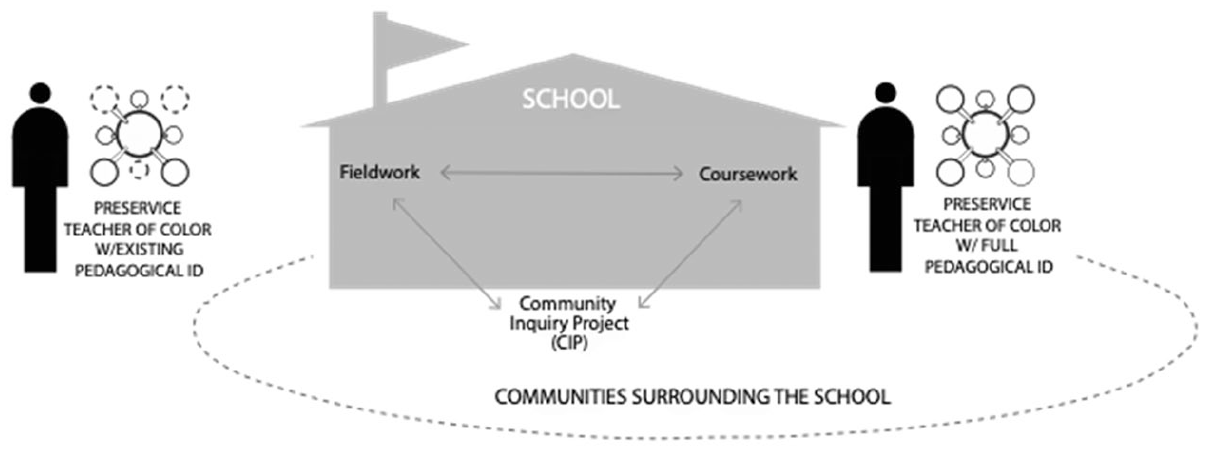
Conceptualizing asset-, equity-, and justice-oriented identities.
Method
This work was designed as a multiple-case study in which each participant is a “case,” recounting their own stories and acting the context of this study (Merriam, 1998). Merriam (1998) highlights three dimensions of a multiple-case study: particularistic, descriptive, and heuristic. A multiple-case study allows me to focus on each participant’s engagement in their urban fieldwork (particularistic), depict their cultivation of asset-, equity-, and justice-oriented pedagogical understanding and identities (descriptive), and employ the conceptual framework of this study to interpret the multiple cases (heuristic).
Contexts
This study is a part of a larger project in which I examined how PSTs develop culturally empowering and racially conscious pedagogies in student teaching (Maddamsetti, 2020c, 2020d). The participants’ teacher education program was located in a racially, culturally, and linguistically diverse region and is designated as a public Minority-Serving Institution (MSI). At the time of the study, the university’s demographics were 46% white, 29% African American or Black, 8.4% Latinx, 6% self-identified multi-racial, 5% Asian, and 5.6% other. The teacher education program serves a similar demographic as reflected by the demographics of preservice teachers involved in a larger study (i.e., six whites, two African Americans, one biracial/Latinx, one Chicanx, one Filipinx, one Nigerian). The elementary teacher education program prepares Teacher candidates to teach language, reading, and literacy (grades K-4) in a series of courses that include lesson planning, assessment, and methods courses.
This study is based on a critically oriented literacy course titled Language Acquisition and Reading for Students with Diverse Learning Needs. This literacy course was taught on-site at an urban emergent elementary school, Central Elementary (all names are pseudonyms). Central Elementary served 79% African American or Black, 8.9% white, 7.1% Latinx students at the time of the study. 99.5% of the students at Central were eligible for free or reduced lunch. Each participant in this study was placed in an elementary classroom (grades K-4) at Central for their practicum. Central Elementary was located outside the geographic heart of the city in an “urban emergent” community (Milner, 2012), where the majority of residents are African American. Residents have been fighting for equitable education, housing, and employment for decades (Morris & Morris, 2002; Suh et al., 2020).
At Central Elementary, I taught PSTs using a combination of lecture and discussions of course readings and PSTs’ field experiences. This onsite course covered practicum components (such as student teaching and observation) for a minimum of 10 hours over the semester. I met with the PSTs once per week for 3 hours at Central for one semester. As an instructor, I centralized the critical inquiry into issues of power, language, and identities to help PSTs develop culturally empowering and antiracist pedagogy. I also encouraged PSTs to employ rigorous instructional approaches in their practice.
As part of their community engagement activities, the PSTs worked in groups of four and collaboratively completed a series of community-engaged tasks associated with the CIP. In this project, PSTs collaboratively engaged in a series of activities, such as community mapping, critical reflection in a peer-led small group, pedagogy mapping, and lesson planning and teaching linked to asset-, equity-, and justice-oriented pedagogy. The CIP aimed: (a) to bring the PSTs’ attention to community knowledge and resources as an asset; (b) to provide a structure and space for PSTs to consider how surrounding communities (e.g., goals, needs, interests) shape students’ learning, school communities, and teachers’ practice; and (c) to prepare PSTs to advance educational equity and teach for social justice in urban school settings. Their individual and collaborative work consisted of five components: (1) community mapping; (2) critical reflection; (3) pedagogy mapping; (4) asset-, equity-, and justice-oriented unit plans and implementation; and (5) exit reflection. As a teacher educator of Color working in a public Minority-Serving Institution (MSI) in the southeastern US, and as an onsite coursework instructor during the participants’ fieldwork, my goal was to provide a structured space to support my PSTs’ development as teachers. The CIP aimed to encourage PSTs to contextualize their learning to teach in urban field sites, to uncover their assumptions, recognize stories and resources in their students and their students’ communities (Maddamsetti, 2020c).
Participants
Of the 12 participants and volunteers from this course, I selected three PSTs of Color, Aisha, Laura, and Mariel, as the focal participants for this study (see Table 1) through purposeful criterion sampling in which each case “meet[s] some predetermined criterion of importance” (Patton, 2002, p. 238). The criteria included (a) participants’ interest in fully participating in this project; (b) self-identification as a person of Color; (c) their view of themselves as future urban educators in the next 2 to 3 years; and (d) their description of their goals and struggles for understanding and actualizing asset-, equity-, and justice-oriented teaching in their fieldwork.
Profiles of Participants.
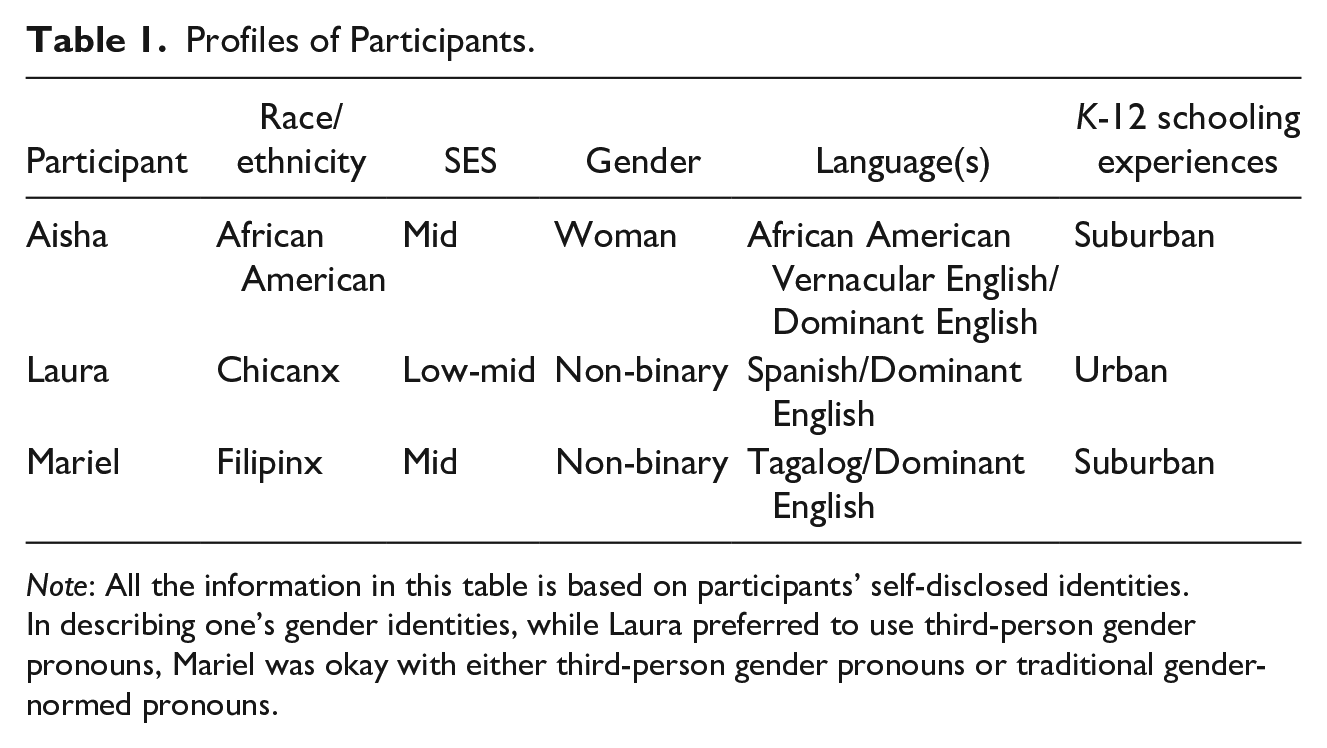
Note: All the information in this table is based on participants’ self-disclosed identities. In describing one’s gender identities, while Laura preferred to use third-person gender pronouns, Mariel was okay with either third-person gender pronouns or traditional gender-normed pronouns.
All the participants were in their early 20s at the time of the study. Aisha self-identified as African American. Her K-12 education occurred in suburban schools in the Southeastern US Aisha worked with the fourth graders and Ms. Williams, who self-identified as a middle-class Black experienced teacher with over 10 years of teaching experience, mostly in urban public schools. In her CIP, Aisha’s group members consisted of one African American and two white teacher candidates.
Laura self-identified as Chicanx and bilingual. Laura grew up in the city where this study took place and attended the same school district where this study took place. Laura worked with the third graders and Ms. Smith, who self-identified as a middle-class white woman with 13 years of teaching experience in urban public schools. In their CIP, Laura’s group members included two white and one biracial/Latinx teacher candidates.
Mariel self-identified as a 1.5 generation Filipinx who was born in the Philippines and came to the US when Mariel was 7 years old. Mariel’s K-12 education in the US took place in suburban educational settings. While Aisha self-identified as middle-class, Mariel described Mariel’s family’s dealings with poverty in the Philippines. Mariel worked with the fourth graders and Ms. Brown, who self-identified as a middle-class Haitian American with 8 years of teaching experience in urban public schools. Mariel’s CIP group members involved one Nigerian and two white teacher candidates.
Data Sources
Data collected for this study include (a) participants’ fieldwork artifacts, (b) field notes, and (c) two semi-structured interviews per participant. Specifically, in Spring 2019, I collected participants’ various artifacts from their fieldwork. I also observed and documented participants’ interactions with multiple stakeholders such as their peers, students, and mentor teachers in their coursework classroom and their student teaching classroom at Central. In Fall 2019, I conducted two semi-structured interviews per participants (approx. 160–180 minutes per interview) (see Supplemental Appendix 2). The interviews not only allowed participants to speak openly about, and critically reflect upon their field learning experiences, but also enabled me to investigate the change (or lack thereof) in their pedagogical learning and identities over time.
Data Analysis
My data analysis consists of three phases (see Supplemental Appendix 3). In the first phase, I carefully read the raw data sources. I then organized the data case by case and chronologically, which allowed me to identify salient themes within and across the participants. Next, I organized the broad themes that emerged from the data concerning my research questions.
In the second phase, I began to code the data. To examine participants’ specific pedagogical learning, I used strands of orientation, pedagogical knowledge, and skills within CRP (Ladson-Billings, 1995, 2014) and racial literacy (Guinier, 2004) as deductive codes. In this process, I paid particular attention to the dimensions of the asset-, equity-, and justice-based orientation and pedagogical knowledge and skills. To investigate participants’ pedagogical identity construction, I examined how participants’ specific contexts (e.g., onsite course, classrooms) and interactions with others (e.g., peers, students, mentor teachers) influenced whether they perceived themselves as asset-, equity-, and justice-oriented pedagogues (or not), and whether those contexts and interactions influenced how they actualized such practices in the classroom. In this phase, I sampled specific excerpts from the transcribed interviews to refine categories and themes. I then triangulated these interview sources with the field notes and their fieldwork artifacts to ensure consistency across coding and interpretation.
In the final phase of analysis, I engaged in within- and cross-case analysis (Merriam, 1998). During the individual case analysis, I carefully reviewed the multiple data sources and searched for salient themes across the data within a single case. I then conducted a cross-case analysis by comparing and contrasting the main categories and themes within and across the three cases. Finally, the preliminary findings were shared with the participants to member-check interpretations and conclusions.
Researcher Positionality
I acknowledge that my interpretations of the participants’ racial(ized) being, knowing, and doing, and pedagogical identities during their urban fieldwork should be open to further scrutiny (Milner, 2007). I am a Korean immigrant woman, who speaks English with an accent and has been summoned for deportation proceedings in US immigration court due to systemic bureaucratic errors. My own experiences at the intersection of privilege and marginalization continually inform my work with intersectionally minoritized students and communities of Color. As a teacher educator and a former classroom teacher, I continually reflect on my responsibilities in preparing candidates to enact antiracist and culturally empowering practices.
I recognize that the overarching goals and assignments of the onsite course, as well as the roles I endeavored to play at Central, reflect my personal experiences, professional background, and sociopolitical stance. I actively participated in Central’s community events, professional development of teachers, staff meetings, and briefings with the principal and PSTs.
During my data collection and analyses, I examined whether my position as both instructor and researcher affected my participants’ pedagogical identities and practices as “deficit” or “in need of improvement.” I triangulated multiple data sources to avoid over-generalizing this study’s interpretation and conclusion. Still, I acknowledge that my racial, cultural, and linguistic outsider and dual status in the field placement could have affected how the participants positioned themselves and what stories they chose to share with me. I thus recognize the incompleteness of the narrative knowledge presented in this article.
Findings
I present a case-by-case analysis of the three PSTs’ of Color pedagogical identity construction through their engagement in multilayered activities in the onsite course, CIP, and classroom at the field site.
Aisha
Aisha’s asset-, equity-, and justice-oriented identities were, at times, contested and yet fostered through her persistent engagement in various activities in the field sites and support from her mentor teacher. Specifically, while Aisha’s enactment of justice-oriented identity was challenged during the CIP due to conflicting goals and limited reflective practice among her group members, Aisha gradually undertook her justice-oriented identity through critical reflections and teaching practices supported by her mentor teacher.
A socio-politically conscious and justice-oriented future educator negotiating tensions in the CIP
Informed by her personal histories and schooling experiences, Aisha had already formed a strong sociopolitical and race consciousness, and she hoped to assert her identity as a Black woman teacher through the practicum (Guinier, 2004; Ladson-Billings, 1995, 2014). Aisha held asset- and equity-based views, that she wanted to use to build on students’ and communities’ valuable knowledge in designing and delivering lessons. From a justice-oriented perspective, Aisha also wanted to counter dehumanizing assumptions about students of Color through interactive CIP tasks: Through the [CIP] project, I wanted to explore how to push students to make connections between their cultural perspectives and school knowledge to implement culturally relevant teaching. . . As a middle-class Black woman growing up in a predominantly white suburb, I am critically aware that school racial stereotypes can make students feel inferior and confuse them. I wanted to gain a deep well of knowledge and skills on how to reject certain racial stereotypes in ways to promote students’ academic development.
Nonetheless, Aisha encountered tensions in working with her CIP members, which prevented further collaboration with her CIP group and limited her peer support for her pedagogical identity construction. Aisha recalled that her CIP members viewed the CIP activities as “time-consuming.” These students’ motives were to complete the tasks as quickly as possible to “get the assignment done and get through the practicum” (Interviews). Aisha also observed that her CIP members divided the group’s tasks instead of collectively observing and documenting the community assets. They also “did not get in touch with one another until close to the due date (Interviews).”
Furthermore, the CIP discussion’s informal nature posed challenges for Aisha’s CIP group to “get to the heart of issues of race” (Interview), thus causing her group’s limited engagement with justice-centered pedagogical learning. Reflecting on the community mapping, Aisha described that her CIP members tended to value students’ and their communities’ cultural diversity as assets, yet sidelined discussions about educational injustice based on race and school poverty in the local context. Such race-evasive conversations in the CIP both contributed to racialized microaggression that led Aisha to feel invisible and alienated her from her CIP members (Souto-Manning & Cheruvu, 2016). In keeping with her race consciousness, Aisha, however, believed that justice-based practice (i.e., directly addressing systemic racism faced by students of Color) is paramount for urban educators (Milner, 2017; Milner & Laughter, 2015): I didn’t talk that much. You know who dominated the discussion—white women. I didn’t stop them. At least, they saw diversity as an asset. . . they were talking about Black children and Black family and completely ignoring how issues of race are at play. When I raised questions about educational injustice in these students’ lives, they’re like, ‘well, being a justice-oriented teacher would be to the best of teachers’ judgment. Your [justice-oriented] idea of what’s best for students may not be the same as their parents’ idea’. It’s like, ‘I don’t value the things that you value as a teacher’. . . I believe that I have to constantly be aware of what is happening and what it means to be a Black woman and teacher in America. . . I think it is absolutely critical for urban teachers to understand and empathize with what sorts of racism many minority students and families are dealing with in this country.
Constructing an “outspoken teacher” identity through engagement in multimodal CIP activities
Presenting and sharing perspectives from multiple times and places (e.g., the CIP discussions, online blog, and the coursework) with different modalities (e.g., the spoken and written, the formal and informal, structured guidance, and peer-led negotiations) gave rise to Aisha’s identity as a justice-minded, “outspoken teacher”: My [teacher education] courses would not always talk about race and social justice issues – they were often treated like an ‘add-on’ topic. . . I began to put language to what I was experiencing and what I was feeling in the field. . . Realizing that my experience and beliefs were not in isolation, I felt like I didn’t have to write or say what my peers or professors wanted to hear.
Furthermore, in her online posting of pedagogy mapping, from equity- and justice-centered standpoints, Aisha noted that students’ academic success becomes challenging when teachers are “willing to stay on the sidelines of the discussion about racism and injustices” and “[do not] want to take action professionally and personally through teaching and community activism.” In so doing, Aisha highlighted that not only students but also teachers need to intentionally develop their sociopolitical consciousness by engaging in multimodal activities like CIP that involve a critical understanding of the local communities’ cultural composition and sociopolitical reality (Ladson-Billings, 1995, 2014).
Enacting a “teacher-advocate” identity through lesson planning and teaching practices
Unlike her previous lesson planning, which involved limited interactions with her peers for her other university-based coursework, the lesson planning activity across the coursework and CIP activities drew her CIP group members together toward a collective goal, that is, translating their asset-, equity-, and justice-based learning into their lesson design and planning. Aisha’s group discussion facilitated their reciprocated learning and changed their group dynamics into a more horizontal collaboration: We [the CIP group] did not hit it off at the beginning. But the collaborative lesson planning always had a component related to our learning as an asset-, equity-, and justice-oriented future teachers. . . All of us had to bring in cultural, racial, and language pieces of ourselves and students to design and implement the lessons.
At the same time, Aisha underscored that her implementation of the lesson planning would not have taken place without her mentor teacher’s support. Despite the curricular constraints under the high-stakes accountability pressure, Ms. Williams allowed Aisha to deviate from the standardized curricula and materials. In part, this could be attributed to Aisha’s mentor teacher’s willingness to appropriate the school mandated curricula. In this way, both Aisha and her mentor teacher shared common goals: mutual understanding and endeavors for the asset-, equity-, and justice-oriented teaching for underserved students of Color. Specifically, Aisha selected three fiction and three nonfiction books that addressed issues of poverty. Her selected books did not explicitly focus on anti-racist issues. However, during the lessons I observed, Aisha asked her students to discuss needs versus assets and asked them to draw on their experiences and the hardships related to the poverty in their communities compared to what they had read. She also asked her students how resources have been disproportionately distributed in those communities and their ideas for more equitable and just resource allocation (Field notes). In this light, Aisha raised her students’ sociopolitical awareness on poverty as the undercurrent of race-based inequities and their impacts in the local communities (Ladson-Billings, 1995, 2014).
As a result, Aisha’s implementation of equity- and justice-oriented practice facilitated her identity enactment as a teacher-advocate who is willing to appropriate institutional constraints including high-stakes assessment and highly scripted curricula: The fieldwork at Central helped me because I was in this collaborative space outside of the routinized teacher education program. The main challenge for me was learning all of the ‘standards’ and simultaneously making the content and instruction responsive to students to follow the rules of both worlds [the field site and onsite coursework]. I gradually realized that I must balance these critical pedagogies to work within the system and consistently engage with like-minded communities of teachers. Not all fieldwork would provide this sort of experience to you.
Laura
Laura had multiple opportunities to foster their asset-, equity-, and justice-oriented commitments as a future urban educator. However, a lack of collaborative engagement and conflicting goals among their CIP group members and mentor teacher negatively influenced Laura practice of asset-, equity-, and justice-oriented pedagogy.
A future urban educator feeling disconnected from justice-oriented goals
Laura began their fieldwork with high hopes to take on an active role in the school community by interacting with various community members. Informed by their sociopolitical and race consciousness (Guinier, 2004; Ladson-Billings, 1995, 2014), Laura viewed that school and teacher education curricula and media were often instrumental in maintaining racism and discrimination intersecting with gender and class in school and society. As a justice-oriented future urban educator, Laura wanted to take more assertive action against oppressive discourses with their community members: The books and articles I have read in the [teacher education] program do not always tell stories about teachers like me - bilingual, low income, non-gender conforming, born to a single-parent mother, and raised in a working-class Latinx community. Sometimes the media were telling horrible stories about students like me. . . As I decided to become a teacher, I want to work with the community that I am from and change those negative images.
However, similar to Aisha, Laura recalled that their CIP group members had different goals in participating in the CIP and described feeling disconnected from their justice-oriented goals in the CIP. For example, in the community mapping activity, Laura and some of their CIP peers sought out their intended object. Specifically, Laura wanted to be in a collective space to share struggles as a PST of Color and cultivate justice-minded teaching approaches that Laura did not always learn in other coursework. Nonetheless, Laura found that other CIP members were hesitant to spend additional time on the collaborative reflection outside of their coursework and preferred to exchange superficial comments with one another to complete the task: I thought this community inquiry project during the practicum would be the best thing that my [teacher preparation] coursework had done for me. As I progress further in the program, I wanted to get that kind of collective space to talk about struggles and do something together with my peers. . . Even though my CIP group met regularly and did the reading, we didn’t have lots of conversations. The shared goals and community-building work within the CIP were missing for me.
Constructing “just a student-teacher” identity through classroom practices detached from a community- and justice-oriented vision
In contrast to Aisha, who benefited from a channel of communication between the onsite course instructor and mentor teacher, Laura’s mentor teacher, Ms. Smith, did not want to change the norms and expectations established in her classroom ecology. Laura thus experienced conflicting norms and expectations across the onsite coursework and the context of her classroom at Central. For instance, participation in the CIP and sharing the documented resources with the school were mandatory for the successful completion of the onsite coursework. PSTs’ mentor teachers were encouraged to play a participatory and dialogic role in commenting on the CIP lesson plans. However, as Laura recalled in the interview, because many of PSTs’ mentors “did not ask for it” (Interviews), and because the administrators, who were key personnel at Central, were rarely involved in the process of sharing the CIP, Laura found that Ms. Smith was not particularly interested in the specifics of the community resources. Instead, according to Laura, Ms. Smith was more interested in the practical and immediate aspects of teaching in the classroom, such as whether Laura was able to “manage student behavior” or teach practical reading and writing skills (Interviews).
As a result, despite Laura’s growing understanding of how asset-, equity-, and justice-minded practices might be implemented (e.g., integrating the knowledge about students’ communities into the mandated curriculum), Laura enacted an identity as a “just a student-teacher” who is underprepared to navigate the power relations with their mentor teacher and resist inequitable practices in the classroom: You [the onsite course instructor] showed us the school-mandated books. Then you asked us, ‘how would you adapt the content and lesson plans to incorporate an asset, equity, and social justice goal for learners?’ Through collaborative lesson planning in the CIP, I also learned how to work together towards those goals. But Ms. Smith wanted to adhere adamantly to the [mandated] workbook curriculum. I was just a student-teacher from the university. . . That left me little room for modifying lesson planning and content.
In this way, the multilayered activities (e.g., CIP tasks, coursework, interactions with students in the classroom) in the field site were an external tool that shaped and sometimes constrained Laura’s community- and justice-oriented identity development.
(Re)imagination as an internal mediating tool for sustaining community-engaged and justice-centered identities
Laura’s critical reflection on their field experiences served as a powerful means to mediate their development as a future urban educator who asserts their community-engaged and justice-centered pedagogical commitment. On the one hand, Laura viewed the CIP as a relatively safe space of community engagement and empowerment across the different contexts (e.g., coursework and classroom) in their exit reflection. In that space, Laura engaged with a justice-oriented stance with reference to their students at Central and local communities (e.g., accounting for knowledge of students’ and their communities’ racialized experiences). On the other hand, Laura critiqued the effectiveness of CIP as a tool to enact justice-oriented instruction, particularly given a lack of joint effort by stakeholders: I liked how the CIP occurred pretty informally and organically. It felt pretty safe. We tried to support one another over the practicum. I also felt reaffirmed when I was able to see the work of other CIP groups. I am not alone in these field experiences and commitments. I can tell you why it is important to ask my students to examine discrimination and racial oppression in their lives and communities. But I can’t tell you how to gain professional [development] support to teach about them from other teachers and school administrators.
Laura desired systematic and sustained support in exploring pedagogical implications of their community-engaged and justice-oriented knowledge in consideration of local urban communities, which further prompted Laura to (re)imagine their future practice as an urban educator (e.g., collaboration with colleagues, students, and community members): I see the importance of developing a strong culture of peer learning and collegial support to move this [asset-, equity-, and justice-oriented pedagogical focus] forward. . . I wish there were more affirmative and collective spaces for both student-teachers and mentor teachers so that we can continue to do the CIP work in our communities. Teachers can be inspired and refine their practice.
Mariel
Mariel’s collaborative critical reflection in the CIP and her mentor teacher’s support promoted her asset- and equity-oriented identity. However, limited reflective and collaborative practice toward justice-oriented ends across the CIP, coursework, and classroom context made it challenging for Mariel to practice justice-oriented teaching and, thus, impeded her justice-oriented identity development.
Revealing conflicting identities as a “social justice-oriented teacher” and “uncertain educator.”
As opposed to Aisha and Laura, who showed a firm and consistent commitment to working with minoritized students and communities of Color, Mariel started her fieldwork at Central with conflicting identities between a “social justice-oriented teacher” and “uncertain educator.” For example, on the one hand, Mariel reflected how her engagement in the community mapping activity pushed them to critically reflect on her assumptions about students of Color and their own racialized experiences (Reflection notes).
By taking a critical view on racialized schooling experiences and linguicism, Mariel highlighted the importance of teachers’ critical consciousness in promoting students’ racial, linguistic, and cultural diversity as an asset and understanding students’ sociopolitical realities (Kohli, 2019; Ladson-Billings, 1995, 2014). Mariel thus recognized that the goal of the CIP tasks was well aligned with her justice-oriented commitment: I have learned that if I go to the classroom and speak Tagalog or anything other than “standard” English, I won’t be taken seriously. But I am a future urban teacher, and I am an immigrant Filipinx. I have been constantly reminded of how people think of South Asians as model minorities, forever-foreigners, and undocumented, all at the same time. This is why I want to deliberately teach my students that their heritage language and cultures are not a liability, but an asset for learning.
Mariel was often observed to talk about her schooling experiences in predominantly white suburban schools and her close friendship with students from Asian American and Latinx communities in Mariel’s young adulthood in class discussions (Field notes). Along a similar line, Mariel described feeling more motivated to teach the student population that Mariel felt more connected to and comfortable with.
Triangulating these observations, Mariel reported her feelings of uncertainty in working effectively with predominantly African American students at Central at the beginning of the fieldwork (Interview). Ms. Brown, her mentor teacher, helped Mariel to leverage students’ cultural and linguistic diversity as means to build caring relationships and delivering asset- and equity-minded lessons (e.g., viewing African American vernacular language as language variation and using it for the effective instruction; re-framing students’ academic struggles) (Ladson-Billings, 1995, 2014). Yet, Mariel’s teaching observations bolstered Mariel’s sense of uncertainty, and her assumptions about pedagogical efficiency rested on cultural and racial match: I learned from Ms. Brown referring to students’ struggles – now I say, ‘I. struggle to understand what she’s trying to do or say,’ instead of saying ‘she is struggling with this.’ Finding out what is going on in that student’s home and community is still incredibly challenging for me. Teachers like Ms. Brown know the students’ ins and outs of these students’ communities and histories because they share them with them. The challenge for me was still like making the content and instruction culturally relevant to these students [African American or Black] students at Central.
Attempting to negotiate identity conflicts through engagement in the CIP
Despite her uncertainty and self-doubt about their pedagogical effectiveness, the CIP group’s shared goals led Mariel to persistently engage in critical reflection on their field observations, practices, and pedagogical identity development. In contrast to other coursework (e.g., shying away from discussing the underlying deficit perspectives on the “high needs” of students of Color), such regular conversations with like-minded PSTs in the CIP helped Mariel to understand her conflicting desires (e.g., aspiration and uncertainty in implementing asset-, equity-, and justice-oriented practices) and reassess Mariel’s individual struggles as collective ones: I felt that it was affirmative to see that I am not isolated in the field experiences and those expectations for teachers of Color. The university says that the [teacher preparation] program attracted a fair number of preservice teachers of Color. But I often found it still a pretty white group of candidates across the sections. . . I mean, we talked about the “high needs” of students of Color. But I didn’t feel like there was enough space to talk about what it is like to be a preservice teacher of Color. Sharing these experiences, especially with Nikki [another PST of Color], has enabled me to see some commonalities in our struggles.
Reconstructing an “uncertain participant-observer” identity through limited engagement in justice-centered practice
Nevertheless, Mariel’s pedagogical understanding, particularly justice-oriented pedagogy, was mediated by contradictory norms and expectations across coursework, CIP, and classroom contexts. For instance, in the interview, Mariel reported that there were different norms governing justice-oriented pedagogical understanding and tasks. Mariel reflected on how the onsite coursework provided them with explicit opportunities to explore how teachers in the US educational system, where a majority of teachers are white, may inadvertently socialize and educate students through white-normative learning, curricula, and meaning systems (Howard & Milner, 2014; Milner, 2017; Milner & Laughter, 2015).
During the interview, Mariel also reflected on how the CIP provided Mariel and her like-minded peers with explicit opportunities to reflect on and write about the assumed normativity or legitimacy of whiteness in the curriculum and classroom management skills. However, Mariel noticed that many teachers, including Mariel’s supportive mentor teacher at Central, seemed to settle for asset- and equity-oriented pedagogy, as if keeping silent about issues of race is a tacit expectation in the racialized system of US schooling: It’s like many of us do have hesitation in saying even the word, ‘race.’ I admit that part of me thought over the practicum, ‘issues of race, even the word, race, have not explicitly come up, not even once.’ But deep down, I know that’s not true. In the class [onsite coursework], we talk about race issues – how teachers make comments on students’ work, look at students, or want to “celebrate” heroes and holidays. . . but the race has never really come up in real class. Is it [talking about race and enacting justice-oriented pedagogy] supposed to be community issues?
One possible explanation regarding how Mariel addressed issues of race-conscious and justice-oriented pedagogy is the field site’s racial demographic context. Mariela’s students were predominantly African American or Black. Mariel and Mariel’s mentor teacher, Ms. Brown, may have perceived issues of race and justice-based pedagogy to be less pertinent to a racially homogeneous context. It appears that these perceptions led Mariel and Ms. Brown to attend to overt cases of racialization instead of its subtle manifestation in the classroom and to attend to the immediate needs and goals of students from an asset- and equity-oriented perspective.
Consequently, Mariel re-enacted the identity of an “uncertain participant-observer” who understands the teachers’ role in confronting systemic racism and educational injustice with the support from a few like-minded friends and teacher educators, but who is not yet fully equipped to do so within and beyond the classroom: I feel like there is so much that I need to know to confront issues like race and educational injustices. That’s why I must continuously be part of this collaborative and collective space where all teachers learn multiple theoretical frames and have more informed views on the practice. But it doesn’t always exist in every teacher education course. . . I do have my friends to lean on to complete this program, but I still feel like an uncertain participant-observer.
Discussion
This study examines how three PSTs of Color engaged in their pedagogical learning and identity construction through community inquiry activities at an urban emergent elementary school.
As illustrated in Figure 3, Aisha developed balanced or integrated asset-, equity-, and justice-oriented identities shaped by both the CRP and racial framework through her active engagement in the CIP activities and collaboration with her peers and mentor teacher. Laura and Mariel tended to rely on some parts of CIP tasks (e.g., critical reflection, community mapping) to facilitate their asset- and equity-oriented identities. While Mariel described her learning from her mentor teacher regarding putting the ideas of equity-based pedagogy into practice, Laura did not have ample opportunities to integrate and apply equity-oriented pedagogical knowledge and skills in the classroom. Moreover, neither Mariel nor Laura was embedded in classrooms or school-wide cultures where justice-oriented pedagogy was practiced.
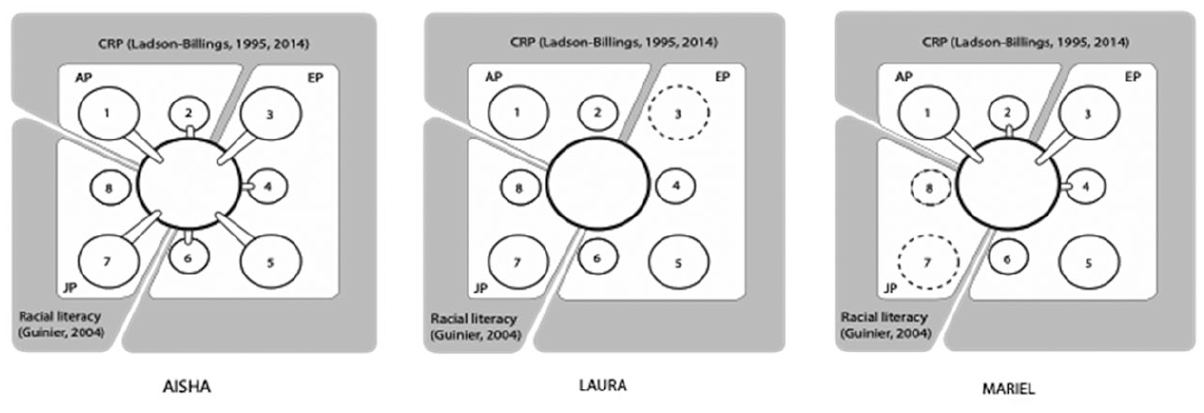
Pedagogical identities of Aisha, Laura, and Mariel.
I first discuss how participants used the tensions arising in their activities to better understand CRP, which in turn aided their asset- and equity-oriented identity development. I then discuss how participants struggled to draw concrete connections between their race consciousness and their teaching practice, due to limited community support and collaboration in their justice-oriented identity development.
Using Tensions to Cultivate Asset- and Equity-Oriented Pedagogical Identities
As shown in Figure 3, Mariel did not face many tensions related to her asset-oriented beliefs (AP-1, AP-2) and access to equity-oriented strategies (EP-3, EP-4) in her work with her fellow CIP members and her mentor teacher. By contrast, when Aisha and Laura engaged in collaborative learning and critical reflection in the CIP group, they faced resistance from their CIP groups due to conflicting goals. Both Aisha and Laura explicitly identified themselves as asset- and equity-oriented educators. Their CIP group members, on the other hand, were more interested in passing their practicum than learning to use sociocultural and sociopolitical consciousness to teach students (AP-1, AP-2, EP-6; Ladson-Billings, 1995, 2014). These findings are consistent with previous studies that have documented the contradictory purposes of teacher preparation programs and fieldwork in PSTs’ pedagogical learning (Ahmed, 2019; Anderson & Stillman, 2013; Souto-Manning, 2019).
In the face of these tensions, Aisha and Laura did not conform to the dominant goals in their CIP group. Rather, they continued to search for tools to cultivate their asset- and equity-oriented pedagogical identities. With support from her mentor teacher, Aisha actively engaged in creating asset- and equity-oriented lesson units to connect her community-engaged learning to a pedagogical product. In this way, Aisha demonstrated strong cultural competence and sociopolitical consciousness (AP-1, AP-2, EP-5, EP-6; Ladson-Billings, 1995, 2014). Lesson planning and teaching also helped Aisha to practice “talking and teaching like a teacher-advocate,” which gave rise to her identity as a future urban educator. In Laura’s case, by critiquing normalized practices (e.g., teaching for testing, limited collaboration among stakeholders) and by imagining alternative ways to enact asset- and equity-oriented praxis in her future practice, Laura demonstrated their agentive stance in resisting oppressive educational narratives (EP-4, EP-5, EP-6) and, thus, their growing pedagogical identities as an assertive future urban educator.
One could argue that such pedagogical inclination or development may not necessarily translate into practice. However, it is encouraging that these PSTs of Color exercised critical and reflexive thinking to link their asset- and equity-oriented pedagogical learning with their current and future practice, especially by leveraging the contradictions in their fieldwork as sources of “productive tensions” (Stillman, 2011).
Persistent Tensions in the Enactment of Justice-Oriented Identities and Practices
Race and justice-oriented pedagogy were not merely theoretical concerns for Aisha, Laura, and Mariel: these issues were deeply personal to all three. Nonetheless, as shown in Figure 3, justice-oriented practices were marginalized in comparison to asset- and equity-oriented practices in their classrooms. Contextual factors (e.g., sociopolitical norms and expectations) may have influenced—and in some ways normalized—the relative absence of discussion and practice toward justice-oriented goals (Brown-Jeffy & Cooper, 2011; Sleeter, 2017; Milner, 2017), and the types of tools through which participants used to address this contradiction during their fieldwork. For instance, in Aisha’s case, the pedagogy mapping activity helped to resolve underlying power dynamics among the CIP participants by providing multi-modalities of engagement (e.g., informal vs. formal, written vs. spoken). Aisha’s case highlights the importance of engaging PSTs of Color with issues of race and cultivating their racial literacy orientation (JP-7). Such discussions should not be limited to one form of modality (e.g., peer-led oral and written discussion), but needs to include structured guidance for students to discuss ideas from multiple times and spaces.
By contrast, as illustrated by aspects of JP-7 and JP-8 in Figure 3, Mariel and Laura were left on their own to define and navigate the norms of engagement in the CIP and mentor teacher’s classroom, without shared goals and explicit expectations on sensitive topics such as race and justice-based teaching. Mariel’s case, in particular, shows unresolved tensions in how she addressed race issues to enact justice-oriented pedagogy in the classroom. Such tensions may result from three contextual factors: (a) the prevalence of high-stakes accountability demands in urban public-school settings (Sleeter & Milner, 2011); (b) her mentor teacher’s perception of justice-oriented pedagogy in a racially homogeneous space (Anderson & Stillman, 2013); and (c) the dominant ideology in a broader sociopolitical context where cultural diversity and equal access of all students is recognized, and yet justice-oriented, racial literacy instruction is marginalized in schools (Brown-Jeffy & Cooper, 2011; Milner, 2017; Skerrett, 2011). Mariel perceived these contextual factors as impeding her conceptualization and enactment of justice-oriented pedagogy (JP-7, JP-8) and reinforcing her identity as an “uncertain participant-observer.”
Pedagogical learning and practice toward justice-oriented goals is a long-term process over one’s career (Acosta, 2019; Kohli, 2019), so perhaps one should not expect drastic change over one semester in how PSTs of Color understand and practice race and justice-oriented pedagogy. Still, the CIP might have been a missed opportunity for Mariel, Aisha, and Laura to strengthen their pedagogical resolve and push past their comfort zone in terms of justice-oriented, racial literacy practice (as shown by a disconnected aspect of JP-8), due to the lack of clearly defined expectations and norms in the CIP, and lack of peer-led negotiations of justice-oriented pedagogical understanding and practice. In particular, Mariel’s case suggests that unresolved tensions during their fieldwork can directly exert a negative influence on how PSTs of Color conceptualize and employ pedagogical tools in the long term, hence posing challenges for their negotiation of pedagogical identities (Jackson, 2018).
As urban teacher educators, we must interrogate ourselves about the kinds of tools and opportunities that we are actually providing for PSTs of Color to learn about an integrated asset-, equity-, and justice-oriented praxis, and how to implement them in everyday teaching practice, especially during PSTs’ of Color fieldwork.
Implications for Urban Teacher Education
Deliberately Cultivate PSTs’ of Color Racial Literacy
Many of the participants’ CIP members and mentor teachers embraced an asset- and equity-oriented pedagogical practice, while sidestepping discussions about their role in confronting systematic racism and injustice within the CIP or the classroom. One does not have to frame justice-oriented pedagogy in dichotomous terms (Rogers & Mosley, 2008). However, it remains central to foster PSTs’ of Color justice-oriented and race-conscious identities and practices through explicit discussions about issues of race. Frank discussions about educational injustice in urban settings remain critical—rather than just alluding to the experiential knowledge that PSTs of Color may have when they enter the field site (Gist, 2017a, 2017b; Jackson, 2015; Milner & Laughter, 2015).
To this end, teacher preparation programs must intentionally provide attention, time, and space for PSTs of Color, not only to collaboratively explore their pedagogical possibilities but also to account for the power dynamics of CIP groups and students’ classroom engagement within existing racial hierarchies (Maddamsetti, 2020c, 2020d; Pham, 2018). Urban teacher educators and programs may also leverage institutional and community resources as mediating means (e.g., collaborative professional development and invited talks by critically oriented in-service teachers, community activists, and scholars) to foster race-conscious and justice-oriented communities (Kohli, 2019; Skerrett, 2011). Additionally, creating a racial affinity space for PSTs of Color during their fieldwork and providing structured guidance can allow PSTs of Color to hold discussions specific to their own pedagogical needs and goals, including strategies to navigate the racial climate of their field site (Farinde-Wu et al., 2020; Pham, 2018).
Create Culturally Responsive and Anti-racist Spaces for Mentor Teachers, School Leaders, and Teacher Educators
Despite the benefits of multilayered CIP activities with multiple modalities (e.g., individual and collaborative work, face-to-face meetings, and online reflection) in developing PSTs’ of Color pedagogical identities, the goals and expectations of CIP tasks were sometimes perceived as segregated or contradictory at Central. These findings highlight that peer-led CIP activities are not sufficient to empower PSTs of Color. Rather, they can only become empowering tools through both teacher educators’ systemic guidance as well as sustained collaboration among all stakeholders (Butler et al., 2021; Carter Andrews et al., 2019; Pham, 2018; Souto-Manning, 2019).
One way to create collaborative and dialogic interactions among stakeholders toward the goal of culturally responsive and anti-racist praxis at the program level is to provide (counter-) spaces in which stakeholders disrupt deficit views about students and communities of Color and challenge oppressive and racist learning environments at school. In such (counter-) spaces, various stakeholders can collectively engage in community asset-mapping and share asset-oriented narratives, participate in book clubs or role-plays, and explore examples from their own and others’ culturally responsive and anti-racist practices (e.g., online workshops, readings, video lectures).
Give PSTs of Color Access to Culturally Responsive and Anti-Racist Theory and Practice
It is essential to consider the teacher preparation program and fieldwork sites’ activity system as a whole in creating an ecosystem where PSTs of Color can bloom into asset-, equity-, and justice-oriented pedagogues (Howard & Milner, 2014; Sleeter, 2017). At predominantly white- or minority-serving institutions, programs must tightly interweave asset-, equity-, and justice-oriented content with the curriculum and give PSTs of Color access to culturally responsive and anti-racist teaching in real classrooms. To achieve this, teacher educators need to provide not only conceptual tools but also strong examples of culturally responsive and anti-racist teaching, such as inviting model teachers or analyzing classroom video cases. Furthermore, asset-, equity-, and justice-oriented pedagogy need to be embedded in a full program sequence as an integrated whole, over a range of program spaces spanning university-based coursework to onsite field learning experiences, rather than relying on superficial gestures such as using one or two elements of course assignments to promote individual candidate’s pedagogical learning.
Limitations and Future Research Directions
This study has some limitations. This study examined the individual-level data (i.e., three PSTs of Color in one coursework and one field site) over a relatively short period, rather than exploring programmatic data concerning the field learning experiences of multiple PSTs of Color across the program in different field sites over the long run. Furthermore, the data presented in the current study did not allow me to fully explore the explicit race talk or subtle types of racialization that these PSTs of Color encountered in the context of the CIP and the field site. Additionally, the relative absence of data regarding what students or community members learned or wished to learn from their engagement in the CIP makes it difficult to explore participants’ pedagogical identity construction in real interactions and in their practice.
Future research will need to engage more stakeholders (e.g., students, school community members, administrators) at the program level and use ethnographic and longitudinal data in order to paint a fuller picture of PSTs’ of Color pedagogical learning in urban field sites. More scholarship is needed to understand PSTs’ of Color pedagogical identity construction, particularly in contexts where institutional support and pedagogical resources for an integrated asset-, equity-, and justice-oriented teaching are available. Future research is also needed to explore how critically-minded PSTs of Color navigate the pedagogical landscape from their preservice to their induction period, with attention to how schools’ power dynamics and racial climate influence their pedagogical enactment and identity construction.
Conclusion
This study makes three significant contributions for those engaging in culturally responsive and anti-racist practice and research with PSTs of Color in the urban teacher education field. First, this study privileges the perspectives and experiences of PSTs of Color in their effort to better understand and enact culturally responsive and anti-racist practices in the field. As such, this study adds to a growing body of scholarship that advocates for improving the professional experiences of teachers of Color as a crucial step to address the systemic educational injustices facing intersectionally minoritized students of Color (e.g., Carter Andrews et al., 2019; Farinde-Wu et al., 2020; Milner & Laughter, 2015).
Second, unlike previous research which primarily focused on PSTs’ of Color university-based pedagogical learning through discrete tasks, including self-reflection and group discussion (Durden et al., 2016; Gist, 2017a), this study posits PSTs’ of Color pedagogical learning and identity development as a continual process which encompasses integrated tasks with multiple modalities (e.g., individual and collaborative work, face-to-face meetings, online reflections) across coursework and fieldwork.
Third, my findings underscore the need to recognize that successful anti-racist practice and research in the field necessitates collaboration and critical reflection from all stakeholders; placing the burden of making systemic anti-racist change on PSTs of Color is merely another way to propagate systemic racism.
In conclusion, urban teacher educators and programs should actively build upon the pedagogical possibilities of teachers of Color to support asset-, equity-, and especially, justice-oriented teaching over the long-term.
Supplemental Material
sj-pdf-1-uex-10.1177_00420859211017984 – Supplemental material for Cultivating Asset-, Equity-, and Justice-Oriented Identities: Urban Field Experiences of Elementary Preservice Teachers of Color
Supplemental material, sj-pdf-1-uex-10.1177_00420859211017984 for Cultivating Asset-, Equity-, and Justice-Oriented Identities: Urban Field Experiences of Elementary Preservice Teachers of Color by Jihea Maddamsetti in Urban Education
Footnotes
Acknowledgements
I am deeply grateful to preservice teachers of Color for participating in this study and sharing their stories with me. I appreciate the editor and anonymous reviewers of Urban Education for their insightful comments. I thank Steven Valenziano for his help in making figures for this study. I also thank Dr. Rohan Maddamsetti for his support and comment on an earlier version of the manuscript.
Declaration of Conflicting Interests
The author(s) declared no potential conflicts of interest with respect to the research, authorship, and/or publication of this article.
Funding
The author(s) received no financial support for the research, authorship, and/or publication of this article.

Supplemental Material
Supplemental material for this article is available online.
Notes
Author Biography
References
Supplementary Material
Please find the following supplemental material available below.
For Open Access articles published under a Creative Commons License, all supplemental material carries the same license as the article it is associated with.
For non-Open Access articles published, all supplemental material carries a non-exclusive license, and permission requests for re-use of supplemental material or any part of supplemental material shall be sent directly to the copyright owner as specified in the copyright notice associated with the article.
