




Abstract
Multicolored Jacquard artwork reproduction has been limited by the current setting of weaving machinery. Novel weaving applications have been introduced to overcome these current restrictions. The subtractive cyan, magenta, yellow and black system used for color printing has been important in optical yarn color mixing of Jacquard color production, because a wide scope of weave color production is possible with a small number of weft yarns. Previously, cyan, magenta, and yellow channels have been modified to resolve current restrictions in reproducing saturated black and secondary colors, but these experiments have not been successful. However, the generation of secondary color ranges is possible by mixing a pair of cyan, magenta, and yellow color yarns. In addition, it is feasible to control chroma levels of primary and secondary colors by mixing with a black yarn. Therefore, the potential of using four weft yarn colors is re-examined for the reproduction of multicolored artworks in relation to cost and production efficiency. Based on a mathematical morphology theory, cyan, magenta, and yellow color channels are altered in the use of image processing tools offered by Adobe Photoshop. A pair of the three color channels is combined under mathematical functions and they are modified through four steps. As a result, new cyan, magenta, and yellow color channels are created to optimize optical yarn color mixing effects. This study introduces details of the cyan, magenta, and yellow channel modification process and experiment results that examine the significance of the newly developed cyan, magenta, and yellow color channels.
The reproduction of multicolored Jacquard artworks has been constrained by the current settings of weaving machinery. Warp is often set with one color (off-white) in continuous style and an applicable number of weft yarns is limited to apply in production.1 –3 Therefore, diverse trials have been conducted to overcome the current limitations. In previous studies, one of the prominent weaving applications is introduced with the CMYK color system that is widely used for color printing.1,4 –6 The CMYK color system is ‘a four-color process’ that separates a digital image into cyan, magenta, yellow and black color channels and uses cyan, magenta, yellow and black pigments for a wide scope of color reproduction. 7 As there are similarities between CMYK color mixing principles and optical yarn color mixing effects, the CMYK color theory has been investigated in relation to multicolor Jacquard artwork reproduction. 8
In Jacquard weaving, the capability to produce a wide scope of weave colors with a small number of weft yarns is crucial to replicate multicolored artworks in good condition.1,8 In previous studies a digital image (Figure 1) was designed based on a RGB color model and its C, M, Y, and K color channels were used to examine for the potentials in multicolor reproduction.1,9 When designing the image, it was important to present primary and secondary color regions clearly, so it was possible to capture the changes made in the color channels. In addition, the black color was applied in a gradient manner to examine the color reproduction feature of secondary color ranges realized in different chroma levels.
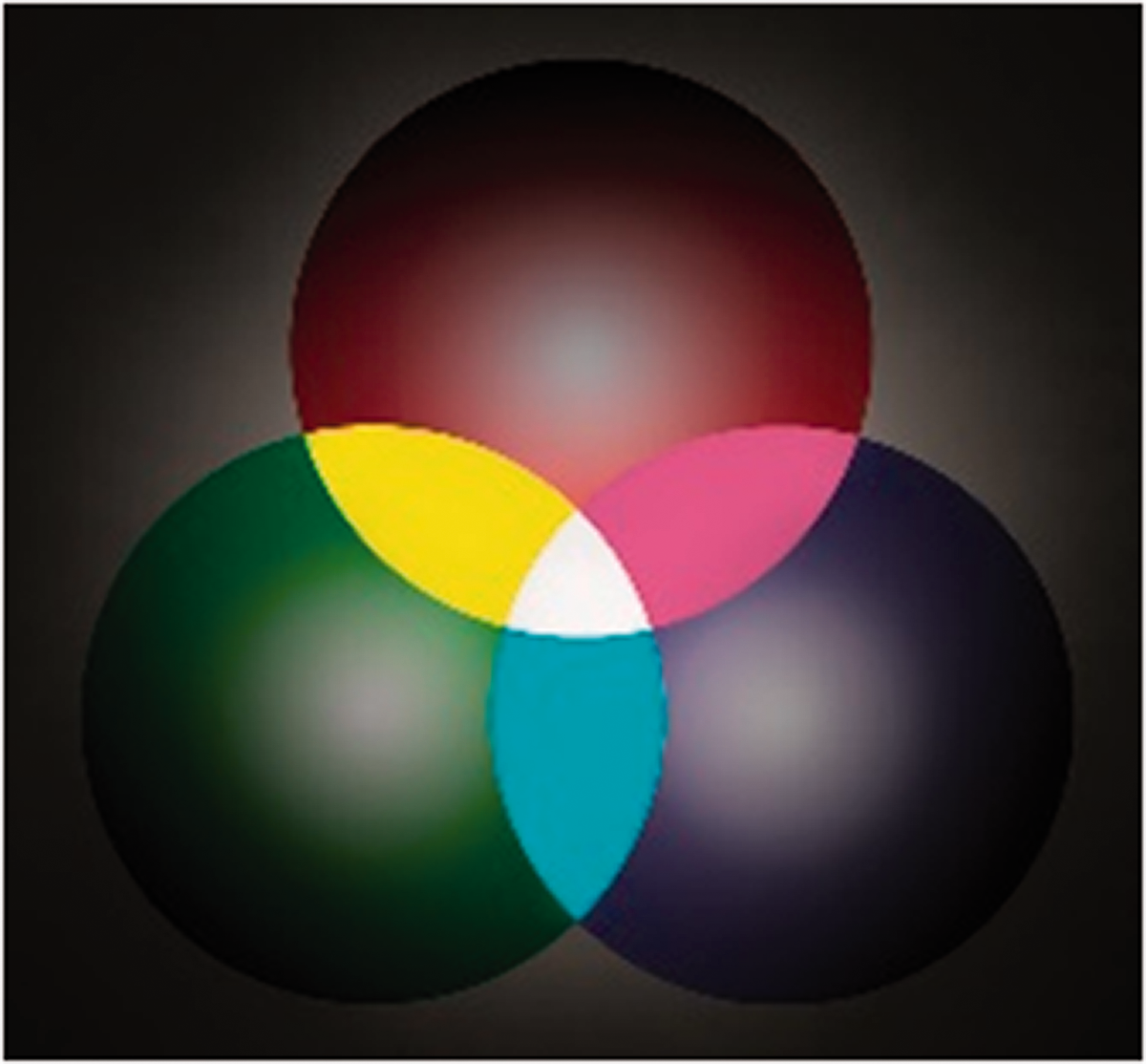
Red, green, blue (RGB) color model designed for testing cyan, magenta, yellow and black (CMYK) color channels. 1
In the weaving experiment, weft yarns were selected aligned with the four primary colors of the CMYK system. The C, M, Y, and K color channels (Figure 2(a)) of the RGB color model were used to test the color results when the CMYK pigment mixing principles were directly applied to optical yarn color mixing. The weaving experiment result is shown in Figure 2(a). 9 Using the four color channels was appropriate to generate primary and secondary color ranges. However, the limitations were shown in producing saturated black colors and presenting smooth color deviations in the secondary color regions. In pigment mixing, cyan, magenta, and yellow pigments are involved in black color generation for which the three pigments are all blended into one color and generate black. In contrast, when the mixing principle is applied to optical yarn color mixing, the three color yarns are discretely juxtaposed together and observed separately.1,9 Therefore, it was not possible to replicate saturated black colors in woven form. Therefore, eliminating black color intensity values in C, M, and Y channels is necessary for optical yarn color mixing. To resolve the problem, modifying the three channels has been attempted previously. Figure 2(b) shows the modified cyan, magenta, and yellow color channels in detail after the black intensity values were brightened to control the three yarn colors exhibition on the surface. However, the image reproduction was not effective, as the alterations made in the three color channels were severe in order to preserve the secondary color regions. Most of the red, green, and blue color regions were replaced by a black weft yarn. 9
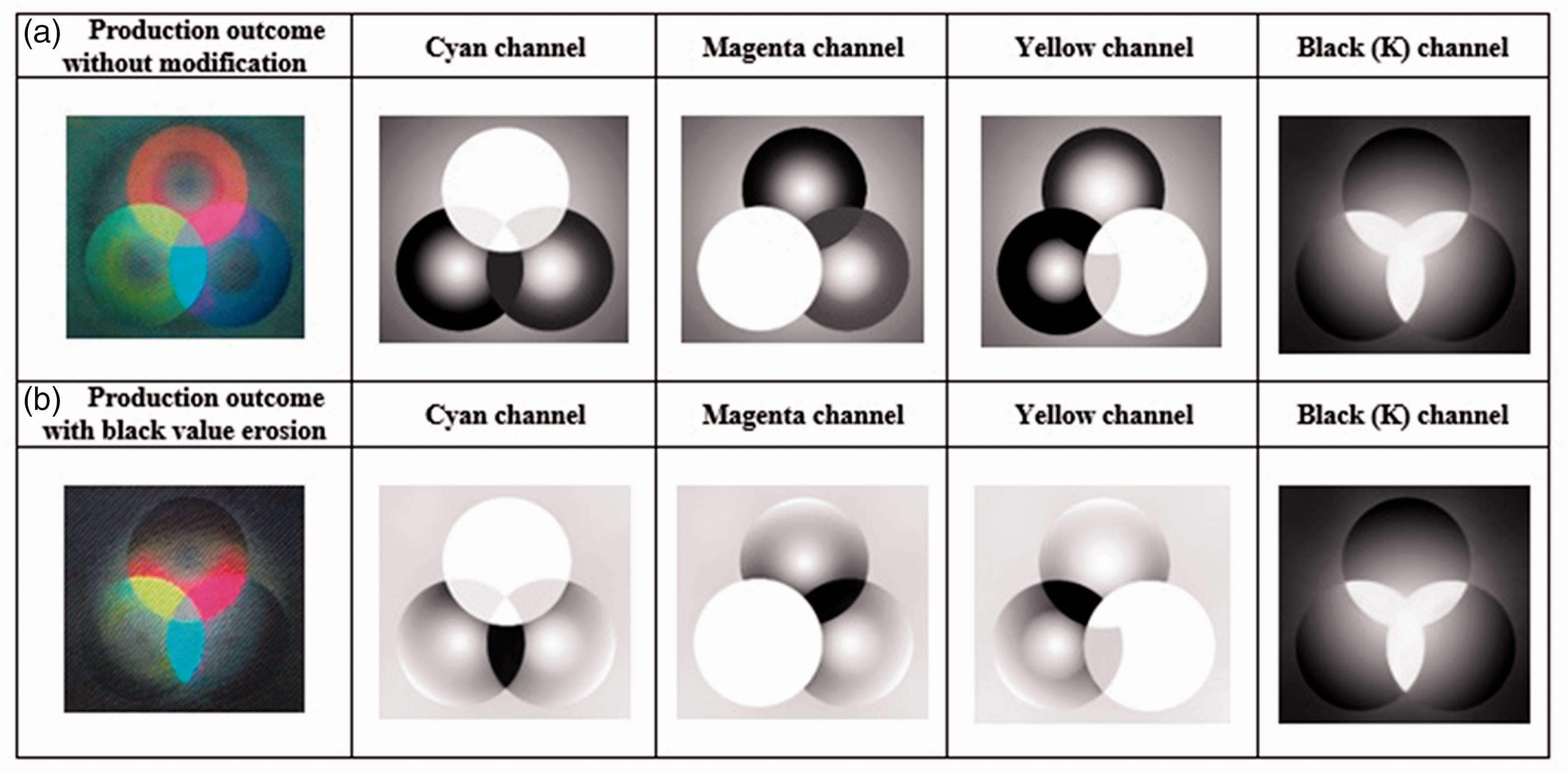
Weaving experiment results with the cyan, magenta, yellow and black (CMYK) channels and its four primary color yarns. 9
Discretely segmenting all seven colors (cyan, magenta, yellow, black (K), red, green, and blue) of the artwork (Figure 1) was examined. This approach was inspired by a spot color printing process. All the seven color regions were segmented from the C, M, Y, and K color channels that provided the seven color yarns, respectively, in production. The experiment result is shown in Figure 3(c). Compared with the fabrics produced with four weft yarns (Figure 2), using seven filling yarns was highly effective in increasing color accuracy. All colors were presented in smooth gradient deviation and a black background was reproduced without cyan, magenta, and yellow yarn intrusions.1,9 Using seven filling yarns was suggested to be ideal for multicolored Jacquard artwork reproduction but cost and production efficiency were low.
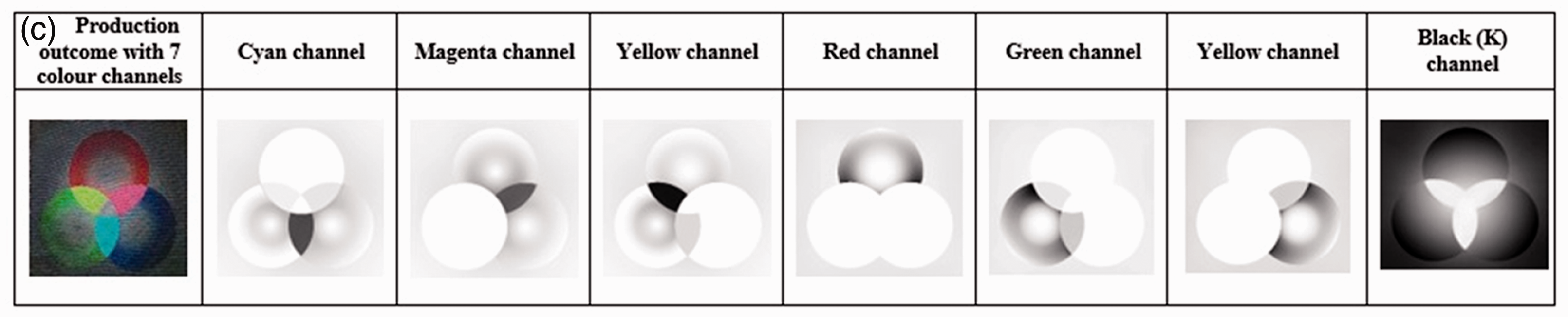
Red, green, blue (RGB) color model reproduction with seven color channels and filling yarns. 9
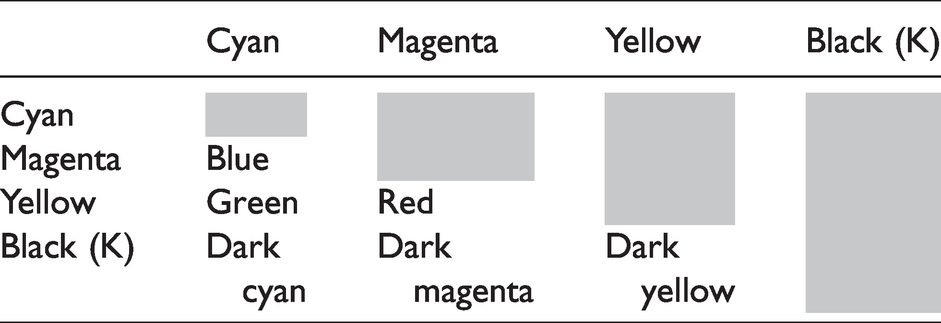
In previous studies, it has been proved that creating secondary color ranges (red, green, and blue) is possible by juxtaposing a pair of C, M, and Y color threads. In addition, controlling the chroma level of primary and secondary colors is feasible by mixing a black color yarn. Table 1 shows the details of the optical yarn color mixing effects that are achievable using cyan, magenta, yellow and black yarns. 8 Therefore, based on the weave color experiment result, this study re-examines the potential to reproduce multicolored artworks with C, M, Y, and K color channels and the four primary color yarns.
Optical yarn color mixing effects with cyan, magenta, yellow, and black (C, M, Y, and K) color yarns
To overcome the current limitations, it is proposed to modify the cyan, magenta, and yellow color channels based on a mathematical morphology theory. Image processing tools are used systematically and consistently to modify the four color channels that are offered by the Adobe Photoshop. Figure 4 shows the details of the modification process. First, a digital image is designed based on the RGB color model (Figure 1) including primary and secondary colors as well as black. Second, the image is separated into C, M, Y, and K channels. Third, by the use of image processing tools, the three color channels are modified through four stages. As a result, new cyan, magenta, and yellow channels are generated that are optimal for optical yarn color mixing effects.

Cyan, magenta, and yellow (C, M, and Y) channel modification process for multi-colored artwork reproduction.
The significance of the color channel modification is examined by conducting weaving experiments. Primarily, the RGB color model image (Figure 1) is reproduced to verify the changes made in the three color channels. After the first examination, additional weaving experiments are implemented to examine further the feasibility of the color channels for which two digital artworks are designed with highly complicated color layouts. In this study, the details of color channel modification processes and weaving experiments are explained in order to improve the current Jacquard design and reproduction capability.
Mathematical morphology for grayscale images
Mathematical morphology is a theory and technique applied to digital image processing. In principle, mathematical morphology is possibly applied to any field of digital image processing in which shape plays an important role. Mathematical morphology is a powerful apparatus for shape analysis for grayscale images and is widely used for object extraction, shape description, classification, segmentation, and so on. 10 The language of mathematical morphology is set theory and the two basic operators are dilation and erosion. Dilation entails two sets of A and B to add each pixel of image A into a pixel of image B and the outmost image is produced. The erosion operation, the opposite of dilation, transforms an image by having set B as centre points and produces the transformed image where set B is fully enclosed in set A. 11
Grayscale digital images can be represented as sets and they make it possible to treat each color component independently and represent the most straightforward approach to order each color component independently.10,12 When the mathematical morphology is applied to grayscale images, a specific characteristic is used as a measurement of consistency to segment color regions into specific parameters. Organizing pixels of an image is the basis of the decision and an image is represented as a function
In this study, an eight-bit image is used, and the range of gray values is set between 0 and 255.
10
A pair of the cyan, magenta, and yellow color channels is combined under mathematical functions to modify each color component. The four color channels are managed by a defined function
Photoshop blending modes for C, M, Y, and K channel modification
Adobe Photoshop offers a useful function for image processing tools that can treat an image under the mathematical function. The layer blend modes in Adobe Photoshop are efficient image processing algorithms, and they are straightforward and simple to use. When applying blending modes, one layer is hidden within the other and pixels of any digital image are transformed depending on what it is applied on. The blend modes are used to determine how two layers are merged into one. In addition, as each pixel has a mathematical representation, it is possible to blend two layers in many different ways.15,16
In this study, multicolored images are separated into C, M, Y, and K color channels and a pair of the four color channels are blended by the layer blend modes of Adobe Photoshop. A logical combination is applied mathematically to develop optimal cyan, magenta, and yellow color channels for optical yarn color mixing. The modification process is achieved through four stages, as shown in Figure 5. First, the black intensity values in the cyan, magenta, and yellow channels are lightened by the overlay blending mode. Second, a pair of the modified three channels is blended under the screen blending mode to segment secondary colors (red, green, and blue). Third, the red, green, and blue color channels are paired and merged into one under the darken blending mode. It is for creating secondary color channels that results in the intensity values of secondary colors being kept strong while the black intensity values are brightened. Finally, black intensity values in the modified cyan, magenta, and yellow channels are further brightened by merging with the secondary color channels for which the soft light blending mode is applied. As a result, new cyan, magenta, and yellow color channels are created that are optimum for multicolored Jacquard artwork reproduction.

Cyan, magenta, and yellow (C, M, and Y) color channel optimization process for multicolored Jacquard artwork reproduction.
Brightening black intensity values in C, M and Y channels by overlay blending mode
Overlay mode belongs to the contrast group of blend modes that combines two blending modes: multiply and screen. If grayscales are below middle gray tones, it multiplies the two values. In contrast, for the grayscales above middle gray, it brightens dark values at the same time. As a result, dark regions become darker and bright regions become brighter. However, if grayscales are the middle gray tones (50%), they become transparent in blending. The overlay function shows in equation (1) where 
Overlay mode is used to brighten black intensity values in C, M, and Y channels. When the inverted black channel is blended with each color channel, it is possible to brighten black intensity values in the three channels. The brightening process is shown in equation (2) below. Where 
Figure 6 shows the details of each color channel brightening progress. When cyan, magenta, and yellow color channels are blended with the inverted black channels, it brightens the color regions where cyan, magenta, and yellow intensity values are assigned for black color production. However, the primary and secondary color intensity values are retained.
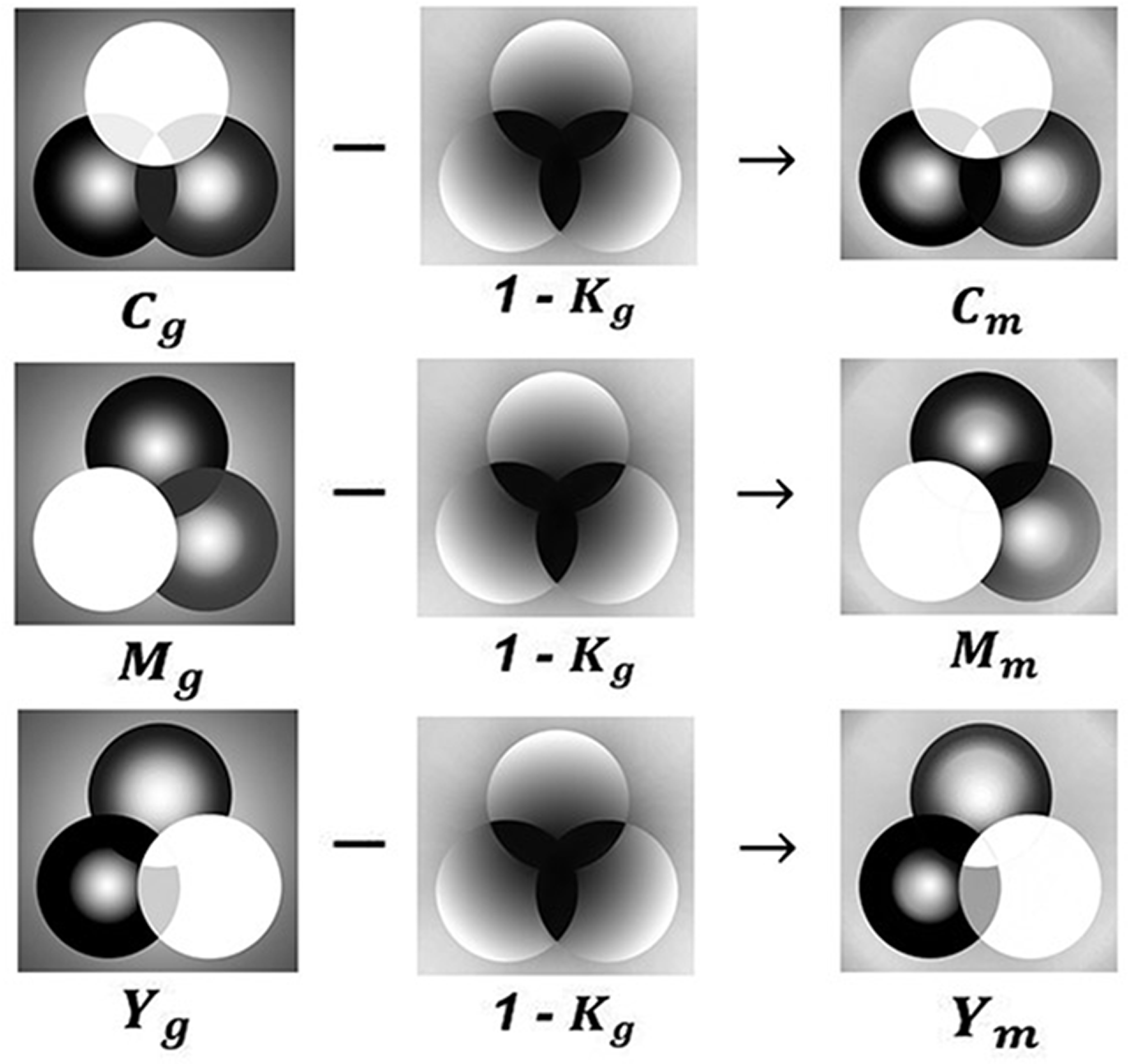
Eroding black intensity values in cyan, magenta, and yellow (C, M, and Y) channels.
Segmenting red, green and blue colors by modified C, M and Y channels
Screen blending mode is part of the lighten group. The blend mode works similarly to the multiply blend mode to some extent as it multiplies light pixels instead of dark pixels. As the function applied to screen mode shows below in equation (3), the inverted 
The details of the pair combination to segment the secondary colors (red, green, and blue) are shown in the equation (4). 
Figure 7 shows the details of the pair combinations made between
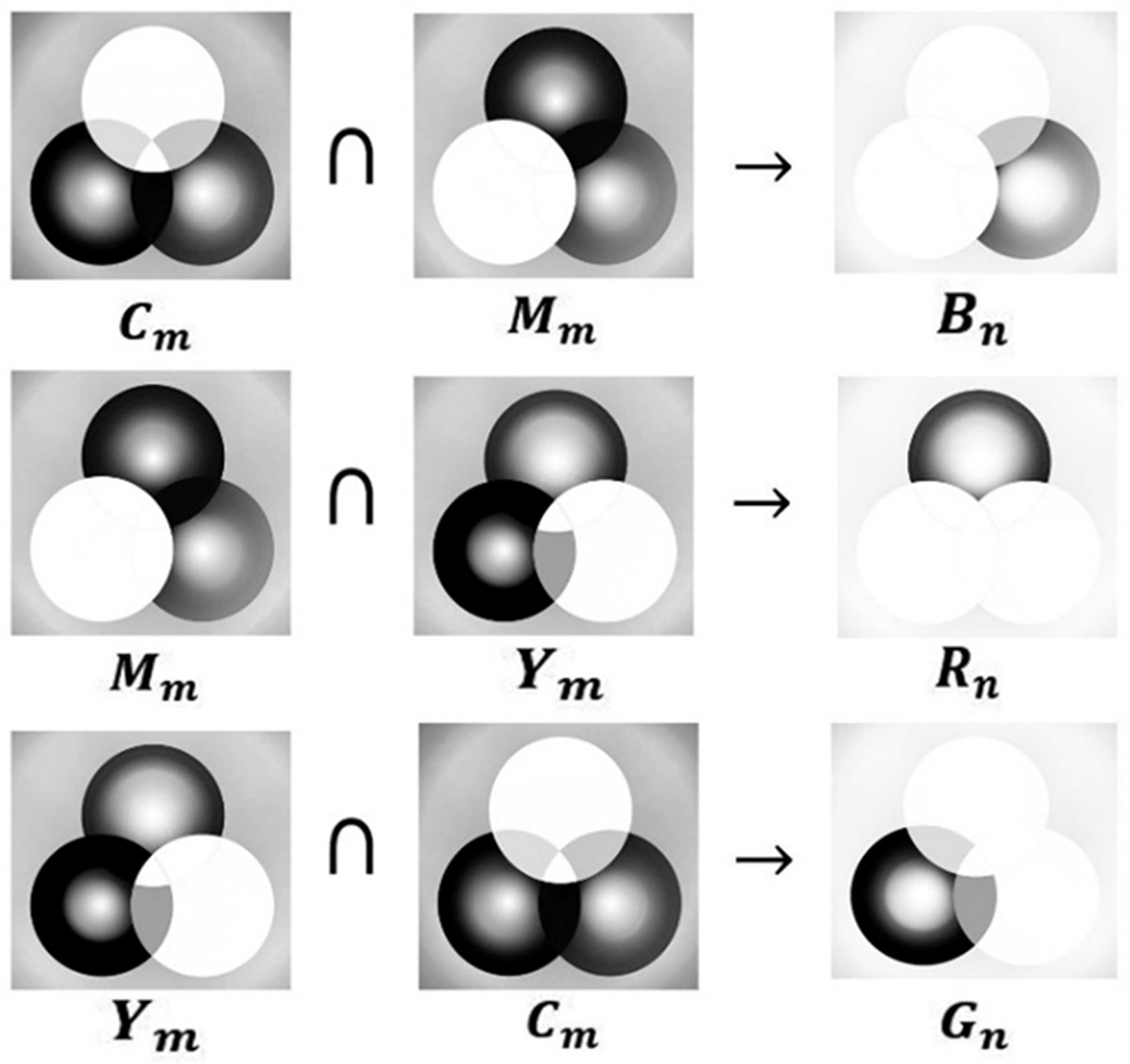
Red, green, and blue color segmentation.
Creating RB, RG and GB channels (secondary color channels)
Darken blending mode takes darker pixel values between the foreground (a) and background (b) and it retains only the darker components of pixels. For example, if the pixels of the background layer (b) are darker than those on the foreground layers (a) below, they are preserved in the image. In contrast, if the pixels in the (a) layer are lighter, they are replaced with the pixels on the (b) layers below. As a result, the darker pixels of all (a) and (b) layers are conserved. The function applied to the darken blending mode is presented in equation (5).
17

Equation (6) shows how each secondary color channel (
As Figure 8 presents the pair of red, green, and blue color combination processes, darken blending mode takes only darker pixels of the two layers. Therefore, it is possible to generate secondary color channels of C, M, and Y.
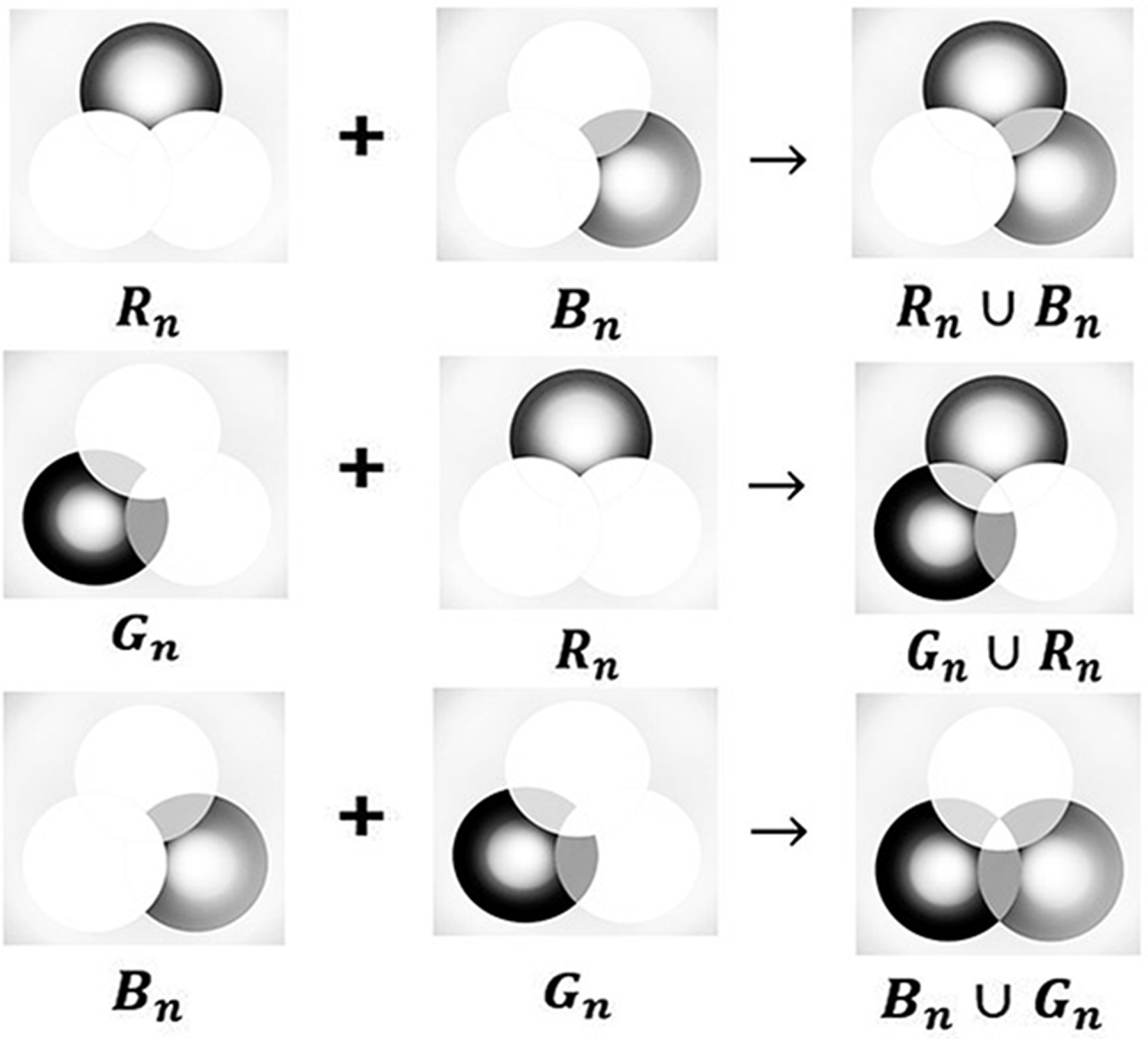
Secondary color channel creation.
Modifying
,
, and
channels by the secondary color channels
Soft light blending mode uses a combination of two different modes: screen and multiply. If the pixels are lighter than 50% gray, the screen blend mode is applied, and produces lighter pixels in blending. In contrast, if the pixels are darker than 50% gray, the multiply blend mode is applied and generates darker pixels. The function used in the soft light mode is shown in equation (7).
17

Equation (8) presents the channel modification processes applied to blend each 
Figure 9 presents the details of the modification processes when each
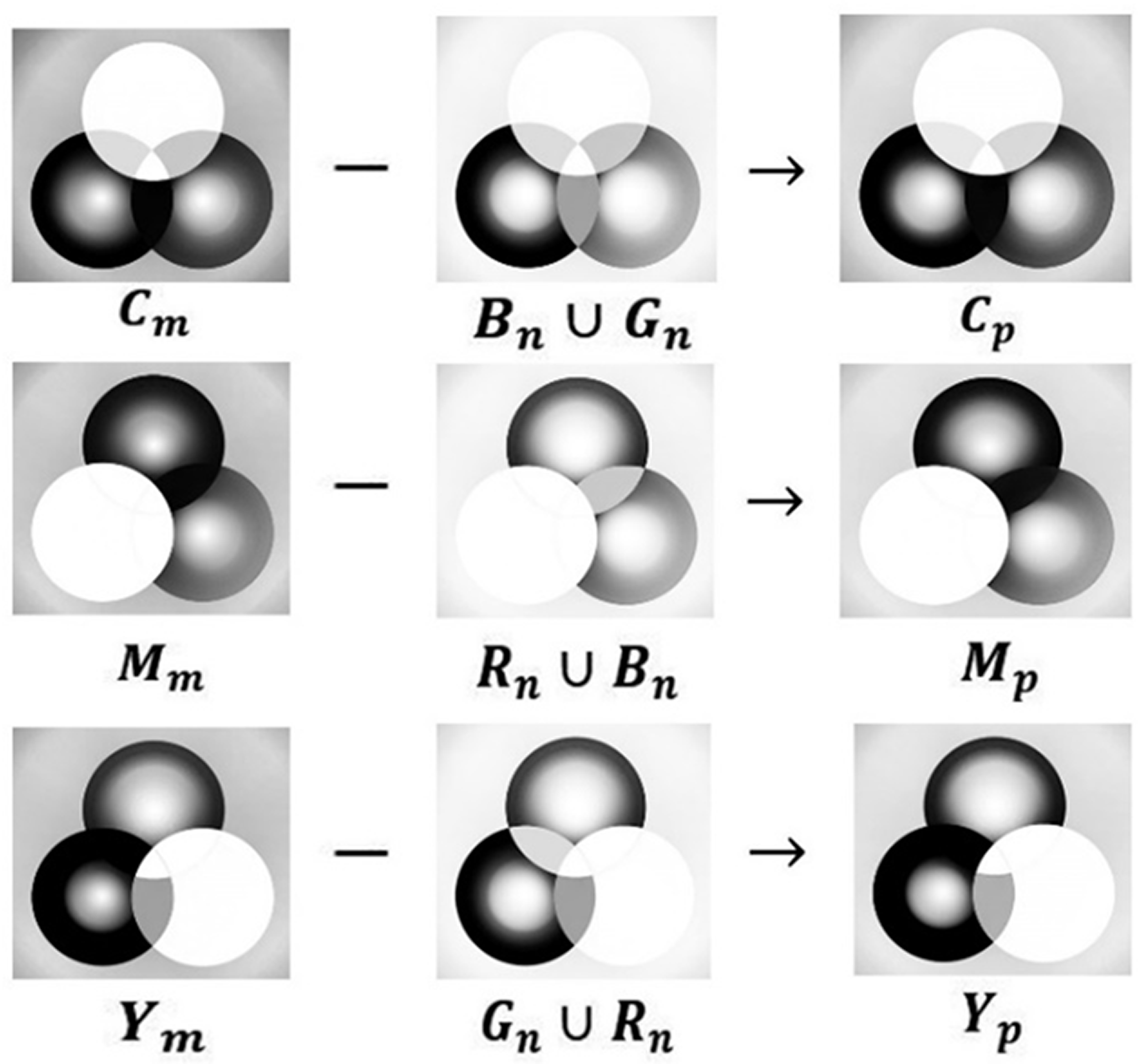
Generating new cyan, magenta, and yellow color channels for optical yarn color mixing.
Experiment and results
Conducting weaving experiments with the new color channels is crucial in this study. By the use of Adobe Photoshop blending modes, C, M, Y, and K channels are optimized to overcome the existing restrictions in multicolored Jacquard artwork reproduction. The modification process is achieved through four stages, and new cyan, magenta, and yellow color channels are created. Primarily, the RGB color model image (Figure 1) is reproduced with the
Specifications applied to weaving experiments
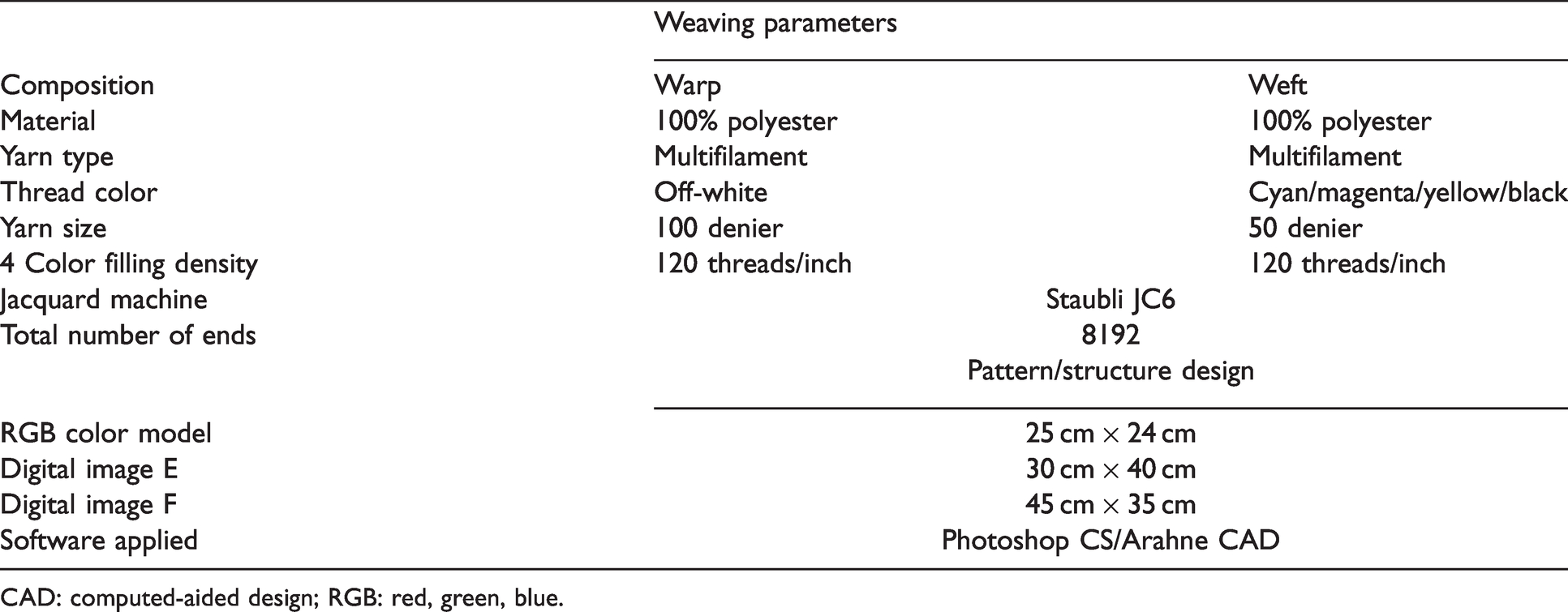
CAD: computed-aided design; RGB: red, green, blue.
The Staubli JC6 Jacquard machine is used for fabric production in which the warp is set with 100 denier multifilament polyester yarns and 120 ends are placed per inch. For the weft (50 denier) it is selected finer than the ends to cover warp yarns evenly and smoothly and the weft density is set to 120 picks per inch.
First, the RGB color model image (Figure 1) is reproduced, and Figure 10(d) shows the experiment result. Based on the four color channels, weave structures are applied to control the colors of the four yarns shown on the surface. The improvement made in black color reproduction is obvious compared with using the original C, M, Y, and K color channels (Figure 2(a)). The intensity values of the secondary colors are maintained to generate red, green, and blue color ranges that are produced by juxtaposing a pair of C, M, and Y weft yarns. In addition, the secondary color regions are sufficiently retained during the modification process. However, achieving smooth color deviation is not highly satisfactory when the intensity values of secondary colors are gradually deviated in a relatively small region. Therefore, additional examinations are suggested to validate the color channel modification process. Two more weaving experiments are implemented with the digital images shown in Figure 11. When developing the two images, primary and secondary colors are mostly applied to patterns and saturated black is used to fill the background. The color layouts are developed in a highly complex manner not only to examine the multicolor reproduction feature but also to test smooth gradient color reproduction. The scales of two images are slightly larger than the first image (Figure 1) as shown in Table 2 (digital image E and F). Both designs are developed in a seamless repeat pattern.
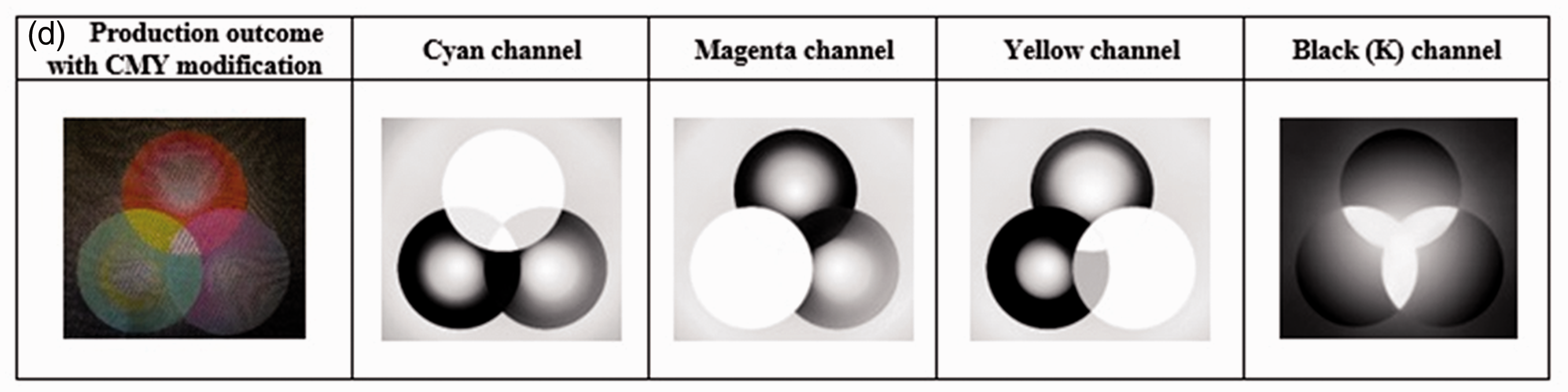
Red, green, blue (RGB) color model reproduction with new cyan, magenta, yellow, and black (C, M, Y, and K) channels.
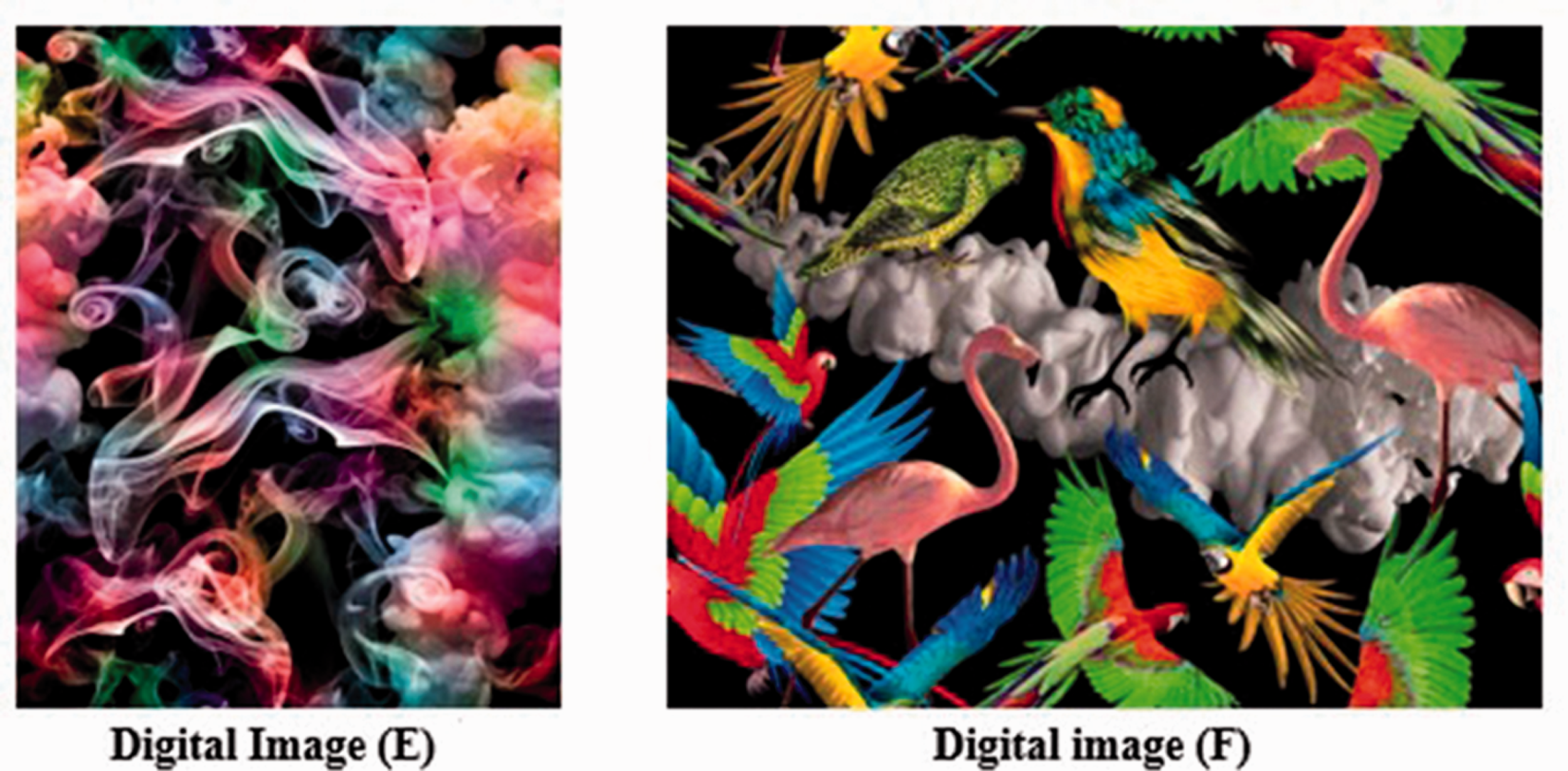
Two digital images developed to examine multicolored Jacquard artwork reproduction.
Once the two digital images are designed, they are separated into C, M, Y, and K channels and the four stages of the modification process (Figure 5) are applied to both images (E and F) of C, M, and Y channels. Figure 12 shows the two sets of the C, M, Y, and K channels of each digital image that compare the color channels before and after the modification. The alternations made in the three color channels are evident for optical yarn color mixing compared with the C, M, Y, and K channels for printing. The black intensity values in C, M, and Y channels are brightened while the primary and secondary color intensity values are kept strong after the modification. As a result, C, M, and Y yarn color exhibitions are minimized in black color regions and the three color yarns are mostly floated on primary and secondary color regions. In production, the four primary yarn colors are applied based on the color information of the new cyan, magenta, and yellow color channels.
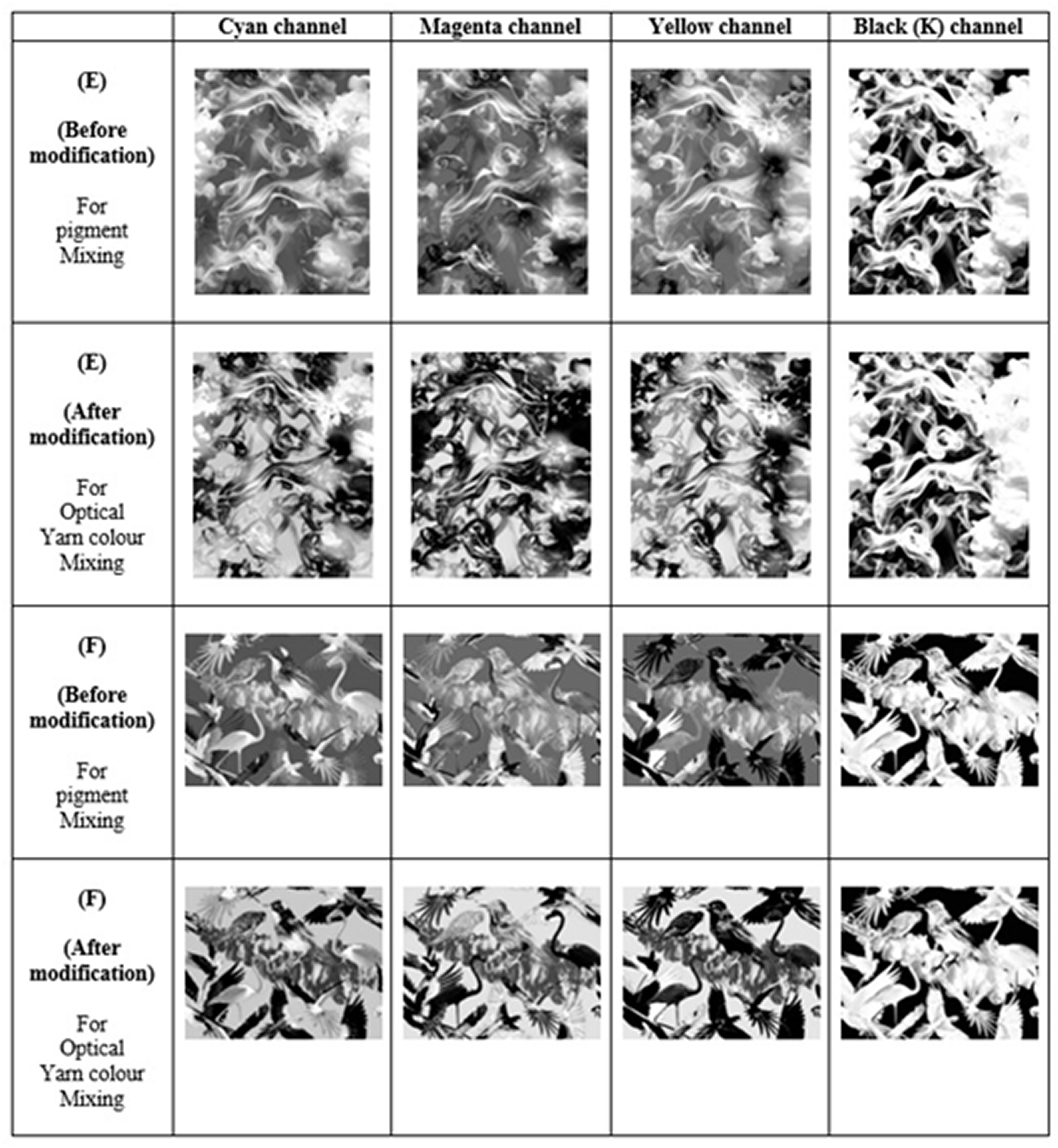
Two sets of cyan, magenta, yellow, and black (C, M, Y, and K) channels of the two digital images.
As the experiment results are shown in Figure 13, the reproductions of the two images are successful. The modified three color channels are capable of reproducing a saturated black color as well as primary and secondary colors. In addition, it is important in this experiment to examine and verify the capability to generate smooth color deviation. Both images are reproduced in delicate color deviation as per the original images, and it indicates the potential for reproducing complex color layouts using cyan, magenta, yellow and black color yarns. However, as the CMYK system can only display approximately 56% of the colors that are perceived by the human visual system, 20 there is a limitation to increase color accuracy by using only C, M, Y and K color yarns. In addition, using nontransparent polyester yarns was limited to simulate the high levels of color brightness and saturation.
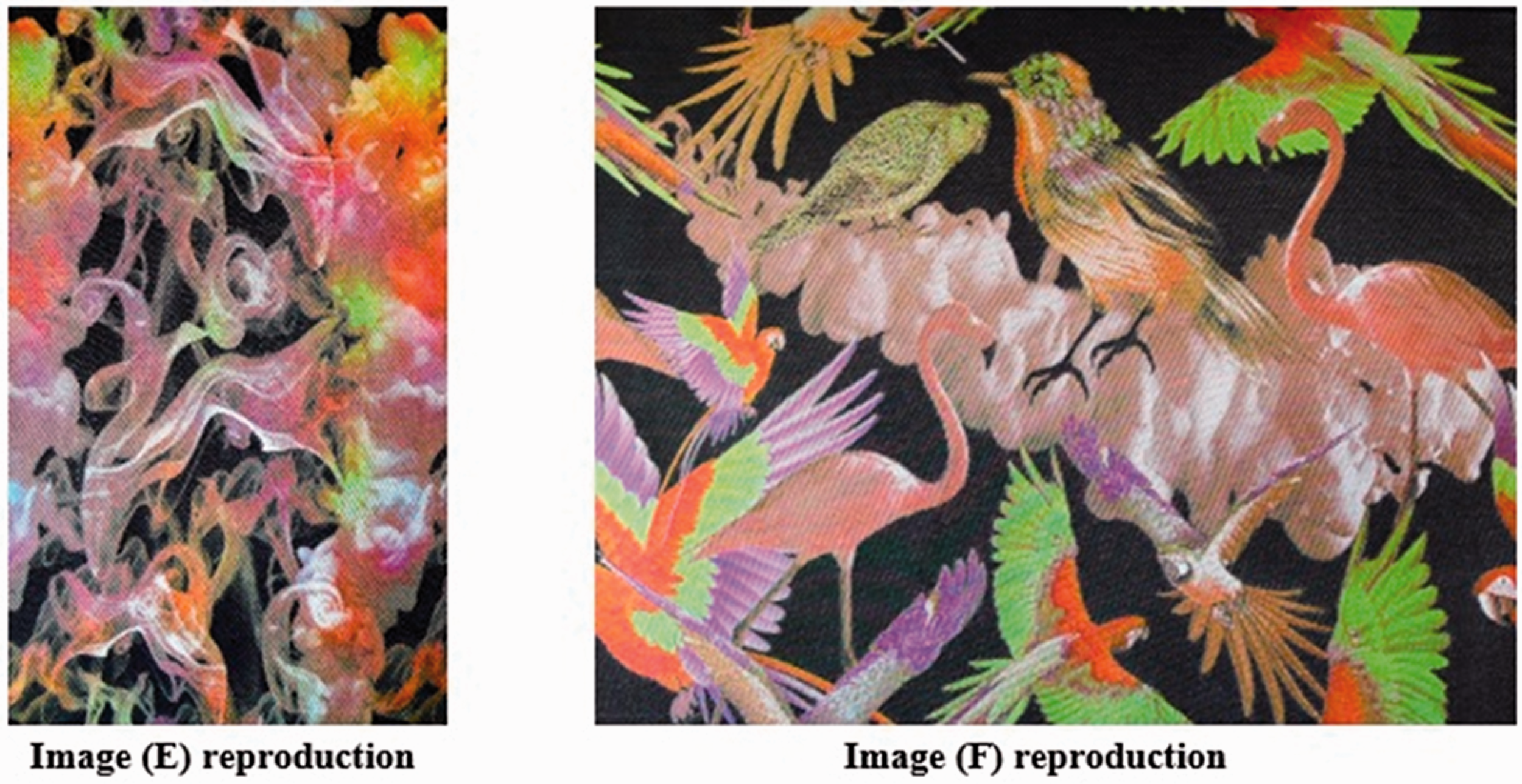
Two image fabrications with cyan, magenta, yellow and black filling yarns.
Conclusions
This study examines the possibility of using C, M, Y, and K channels for multicolored artwork reproduction as there are similarities between pigment mixing and optical yarn color mixing. When C, M, Y, and K color channels are directly applied to Jacquard weaving, reproducing primary and secondary color ranges is possible, but saturated black color production is more difficult. To overcome this limitation, the C, M, and Y channel modification is proposed by brightening black intensity values while recognizing it is crucial to preserve primary and secondary color values. The modification process is organized into four stages and new cyan, magenta, and yellow channels are created to optimize optical yarn color mixing effects for multicolor reproduction. The RGB color model image was first examined with the three modified color channels and producing saturated black color was successful as well as the primary and secondary colors. However, generating smooth color deviation was not highly satisfactory when the secondary colors were presented in a delicate gradient manner. Therefore, additional weaving experiments were conducted with two digital images designed with highly complex color layouts. The two images of cyan, magenta, and yellow color channels were modified through the four stages and both digital images were reproduced in woven form. The results of the weaving experiments clearly demonstrated that reproducing the saturated black color was successful as well as primary and secondary colors. Achieving smooth color deviation was difficult as the RGB color model experiment showed some level of limitations. However, the colors presented in smooth color deviation were successfully reproduced in good condition. Regarding cost and production efficiency, this study explored the possibility to use a minimum number of weft yarns required for the reproduction of multicolored Jacquard artworks. It was proved that there is great potential to develop systematic and effective weaving applications to correspond to multicolor reproduction. However, it was limited to reproduce artworks with a high level of color accuracy as the CMYK system only produces approximately 56% of the colors perceived by human vision and the nontransparent yarns were limited to simulate high levels of color brightness and saturation.
Footnotes
Declaration of conflicting interests
The author(s) declared no potential conflicts of interest with respect to the research, authorship, and/or publication of this article.
Funding
The author(s) disclosed receipt of the following financial support for the research, authorship, and/or publication of this article: This work was supported by the Arts and Humanities Research Council (project code AH/T006323/1), Loughborough University, and the Hong Kong Polytechnic University.
