




Abstract


Ms. Pryor is a dedicated special education teacher at Mulberry High School, where she provides specialized reading instruction to students on her caseload who are 16 and older in both small group settings and one-on-one sessions. Ms. Pryor is a well-trained and experienced special educator and knows that individuals with intellectual disabilities are capable of being competent readers. However, she has recently noticed that her students’ needs are not being met by the current academic reading program provided by the district, which is designed for much younger students. She has observed that reading difficulties influence her students’ academic performance and hinder both their social interactions and employment prospects. For example, she recently noticed that her student, Sam, has been struggling to read and comprehend text messages from his friends about making plans to meet up. Ms. Pryor is worried that without reading growth, Sam will have a difficult time communicating with friends, employers, and others in the future. Understanding the critical role that literacy plays in overall quality of life, Ms. Pryor is actively seeking age-appropriate resources designed for older students. Her goal is to find materials that will effectively enhance her students’ reading comprehension, thereby improving their independent living skills and social engagement and increasing their chances of securing meaningful employment.
Literacy is fundamental to inclusion and belonging. It is a basic human right (UNESCO, 2006). According to Keefe and Copeland (2011), there are five core principles of literacy for individuals with intellectual and developmental disabilities (IDD): (a) Everyone can be literate, (b) everyone has a basic human right to literacy, (c) everyone can build and sustain relationships through literacy, (d) everyone is expected to communicate and connect with others through literacy, and (e) everyone shares in the community responsibility for supporting literacy. Functional literacy skills are central to lifelong success. However, the United States is failing to provide literacy support to students with disabilities. Only 22% of adults with disabilities in the United States have basic literacy skills (Krenzke et al., 2018). The number is probably even lower for individuals with IDD, who in the not so distant past were thought of as not capable of becoming literate (Conners, 1992; Katims, 2000; Moni & Jobling, 2014). Research suggests that literacy is a skill that continues to grow into adulthood for individuals with IDD (Eldblom et al., 2021; Prahl, 2024; Prahl & Gilson, 2023; Prahl et al., 2025; van Wingerden et al., 2014). However, there are very few reading programs and strategies designed for teens and young adults with IDD.
To address this problem, Functional Reading Activities to Motivate and Empower (FRAME) was developed to support reading comprehension development by teaching evidence-based reading comprehension strategies in everyday contexts. A growing body of research demonstrates that when individuals with IDD are provided access to evidence-based reading comprehension approaches and strategies, they experience improved reading comprehension, oral reading fluency, word reading, vocabulary, paraphrasing, and critical thinking (Alqahtani, 2020; Delgado et al., 2018; Devine et al., 2018; Holyfield et al., 2024; Hua et al., 2019; Saletta et al., 2019). Furthermore, decades of research dating back to the 1970s show that reading comprehension strategies lead to improved reading outcomes among struggling readers more broadly, especially when focused on teaching strategies and building background knowledge (e.g., Filderman et al., 2021). Taken together, these sources of evidence informed the development of FRAME, which incorporates evidence-based reading comprehension strategies that are positively associated with stronger reading outcomes in struggling readers and tailors them to meet the needs of individuals with IDD in functional, real-world contexts (Abbeduto et al., 2016; Demetriou et al., 2018; Fidler & Philofsky, 2009).
FRAME is an age-appropriate and developmentally aligned next step for transition-aged students with IDD who have mastered basic reading skills. Because FRAME emphasizes comprehension rather than decoding, students still developing word reading skills may require additional instruction. Based on our implementation to date, we recommend that students demonstrate consistent accuracy with early grade-level texts (e.g., kindergarten to early first-grade level) as a general indicator of readiness. Currently, the program is best suited for students who primarily use speech to communicate.
Within FRAME, literacy is considered a skill for belonging, connecting, and contributing to the community—a means to empower individuals with IDD. Thus, literacy supports are provided in three core domains—employment, socialization, and independent living. These broad domains generally reflect core areas of focus in transition planning. FRAME is ideal for implementation in transition programs, inclusive postsecondary education programs, day programs, and career and on-the-job training programs and for secondary students.
Once developed, a robust and rigorous program of research has tested and demonstrated the effectiveness of FRAME for young adults with IDD (Prahl, 2024; Prahl & Gilson, 2023; Prahl et al., 2025). See Table 1 for a summary of the FRAME evidence base. Preliminary evidence of the feasibility and effectiveness of FRAME (formerly named “FLIPSS” or “WLIFT”) was established across two single-case research design studies with inclusive postsecondary education students with IDD and autistic young adults, respectively (Prahl, 2024; Prahl & Gilson, 2023). In both studies, a functional relation between the intervention and improved percentage of reading comprehension strategies implemented accurately was observed for the majority of participants, and this accuracy was maintained over time (Prahl, 2024; Prahl & Gilson, 2023). In a recent randomized clinical trial, the evidence of the effectiveness of FRAME was further strengthened (Prahl et al., 2025). Young adults with IDD in the treatment group (n = 23) made statistically significant gains in use of reading comprehension strategies (d = 1.09, p = .002) and accuracy in answering multiple-choice comprehension questions (d = 0.79, p = .038) compared with the control group (n = 21). Collectively, the findings demonstrate that (a) the strategies contained in FRAME result in improved outcomes and (b) FRAME is effective with young adults with IDD.
Summary of FRAME Evidence Base
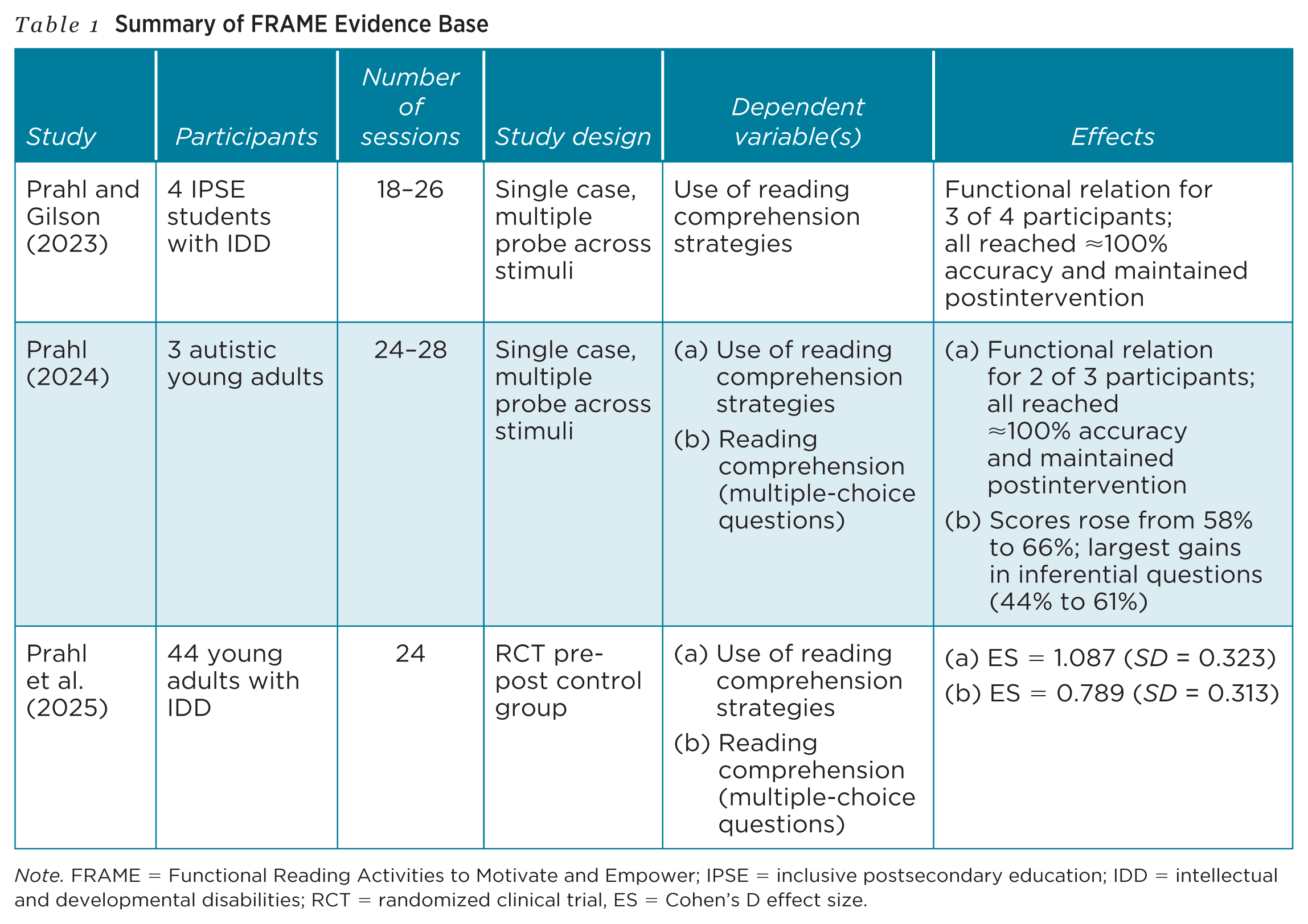
Note. FRAME = Functional Reading Activities to Motivate and Empower; IPSE = inclusive postsecondary education; IDD = intellectual and developmental disabilities; RCT = randomized clinical trial, ES = Cohen’s D effect size.
Guidelines for Implementing FRAME
FRAME helps individuals with disabilities that impact their ability to read and understand texts that are common in everyday life (e.g., text messages, emails) by using evidence-based strategies before, during, and after reading. At the beginning of FRAME, educators provide students with and orient them to the graphic organizer (see Figure 1) as visual support. The FRAME strategies (Prahl, 2026) are author-developed materials and are reproduced here with permission. The graphic organizer outlines 10 reading comprehension strategies organized across three categories and time points in the reading process—before, during, and after reading. FRAME is implemented using a teach-model-coach-review format (Roberts et al., 2014). In each session, the educator follows the procedures described here. First, the educator teaches the FRAME strategies. Second, the educator models or shows how to use the FRAME strategies using a think-aloud. Third, the educator coaches, which begins with (a) using the strategies together with the student and then (b) encouraging the student to use the strategies independently using a think-aloud. Fourth, the educator reviews everything that was taught and practiced during the session. See Table 2 for a checklist that can be used to help ensure the FRAME strategies are being used as intended. In this format, educators have the flexibility to introduce the complete set of FRAME strategies or to introduce them incrementally, starting with the strategies before reading, followed by teaching the strategies utilized during and after reading. The incremental instructional sequence is shown in Table 3.

Functional Reading Activities to Motivate and Empower (FRAME) graphic organizer
Functional Reading Activities to Motivate and Empower (FRAME) Teacher Fidelity Checklist

Functional Reading Activities to Motivate and Empower (FRAME) Incremental Instructional Sequence

Preparing to Implement FRAME: Selecting Reading Material
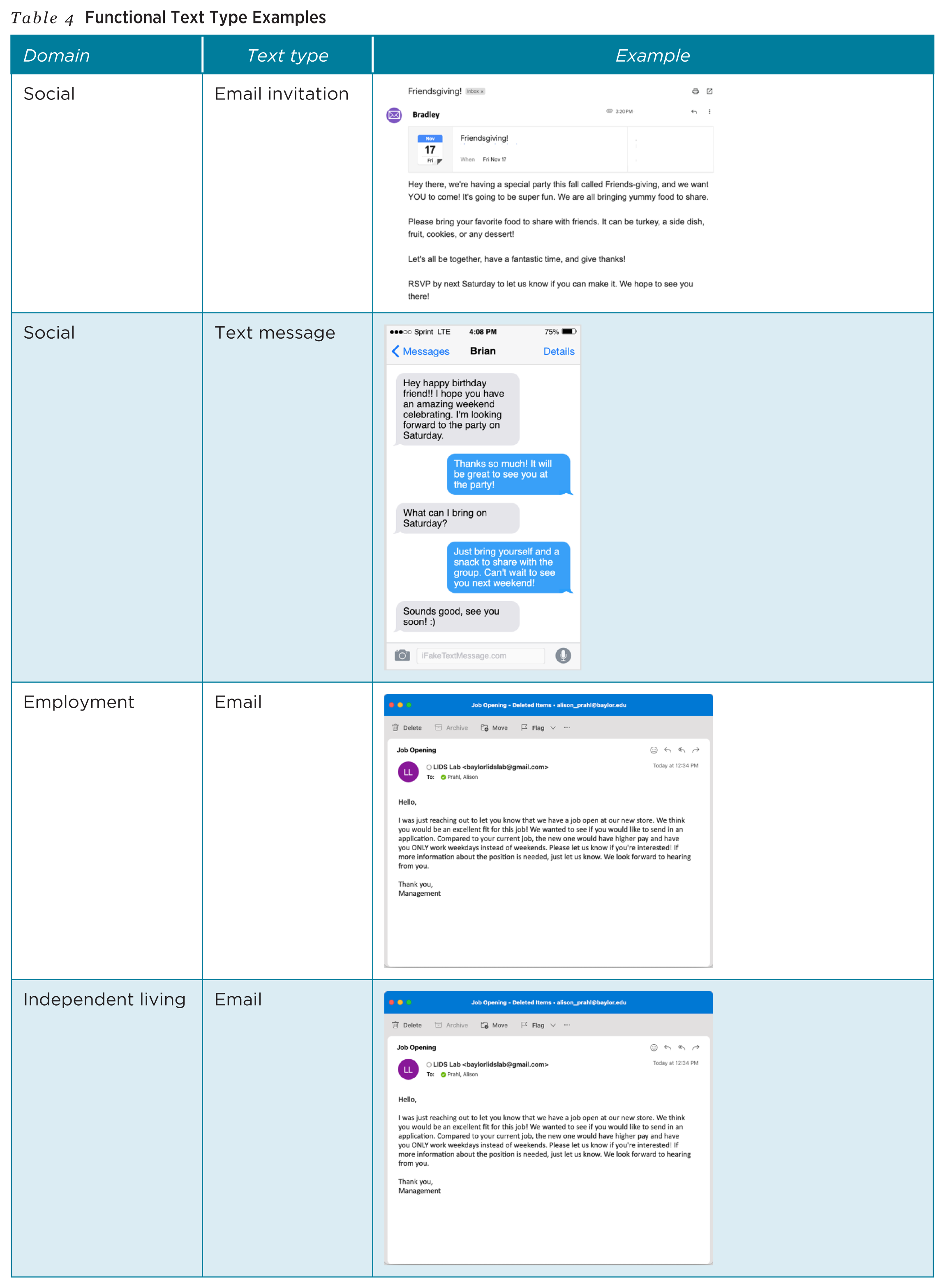
The main goal when finding or creating reading material to be utilized in FRAME is to ensure that the material is functional. In other words, the hope is that the reading material is meaningful and engaging; therefore, the functional texts utilized in FRAME would ideally be tailored based on the needs and interests of each student. To individualize the reading materials, educators can gather students’ input by taking an inventory of their daily activities that involve reading. It can be helpful to brainstorm functional text types across the three core domains: employment (e.g., written directions, emails), socialization (e.g., social media posts, electronic calendar invitations), and independent living (e.g., text messages, transportation, applications). Once individualized functional text categories have been identified, educators can choose to incorporate authentic text examples, such as actual text message exchanges, or create their own unique materials.
Regardless of whether the text samples are authentic or educator-developed, the selected text should be modified or written at or slightly above the individual’s reading level. To ensure that the text is at the ideal instructional level to support overall comprehension, the student should be able to independently read at least 95% of the words in the functional text sample. Online readability tools can serve as a helpful starting point for estimating the reading level of functional texts. However, educators should use these tools cautiously because readability formulas have limitations and may not fully capture the demands of real-world texts. Lastly, if resources enable you to do so, we recommend formatting the texts so they more authentically reflect an everyday reading context. See Table 4 for examples of text samples, some of which were formatted using screenshots of authentic text samples or online tools, such as https://ifaketextmessage.com/.
Functional Text Type Examples
FRAME Procedures
Good readers implement reading comprehension strategies before, during, and after reading to facilitate comprehension at multiple time points in the reading process (e.g., Duke et al., 2021; Lewis & Strong, 2020; Shanahan et al., 2010). Whereas proficient readers normally acquire these strategies informally, struggling readers benefit from explicit instruction in these strategies, which helps them better understand and use information from text (National Reading Panel, 2000). In FRAME, reading comprehension strategies for before, during, and after reading are explicitly taught using a graphic organizer that lists each strategy and includes icons for visual support. The FRAME strategies are introduced and used in the same sequence across sessions. As students become more proficient using the strategies, the graphic organizer can be faded by removing the strategy names and/or the icons.
Ms. Pryor is having her first FRAME lesson with Sam. Ms. Pryor has created a text sample that is at the appropriate reading level for Sam. As she sits across from Sam, she begins by setting the stage. “As you know, we’re here to talk about reading and learn some skills that make us stronger readers. Do you like to read? What are some of the things you’ve read lately?” Sam replies, “I read things on my phone.” Ms. Pryor then says, “I’m sure you do read a lot of things on your phone during the day, like texts and on apps. I know I do! It’s important for me to understand these things because they impact my job, friendships, and personal life.”
Next, Ms. Pryor introduces FRAME: “We’ll learn and practice reading strategies every time we meet, but you can also use these strategies when you’re not with me. You can practice them with anything you read to help you understand. All our lessons will have four steps: teach, model, coach, review. That means that I’ll always start our lessons by teaching you the strategies we’re learning that day. Next, I’ll show you how to use them. Then, you’ll practice the strategies with my help and again by yourself. Finally, I’ll review what we learned and answer any questions you have.” She asks Sam if he has any questions before they begin, and Sam says “no.” She then shows Sam the graphic organizer and says, “These are the reading strategies that we’re going to learn. They help us better understand what we’re reading during the day. We use them before, during, and after reading.” Because Ms. Pryor knows Sam is good at counting, she asks, “How many strategies are there?” Sam responds, “There are 10!” Ms. Pryor replies, “Yes, exactly, there are 10 strategies that we use! We’ll practice these strategies every time we meet, but you can also use them on your own outside of our sessions.”
Before Reading
Comprehension before reading involves mentally preparing for reading. Activating prior knowledge and orienting the reader to the text has been shown to have a positive effect on further concept development and assists with overall comprehension (e.g., Duke et al., 2021; Shanahan et al., 2010). In FRAME, there are three strategies that teachers introduce to help students engage in mental preparation before reading. They are:
1.
2.
3.
During Reading
Comprehension during reading involves implementing flexible strategies so that the reading process moves in a fluent and uninterrupted manner. Comprehension strategies during reading are associated with a greater focus on the main ideas in the text. As reading unfolds, working memory is also engaged to refine and modify one’s understanding of the text by relating previous ideas with new information in the text (Lewis & Strong, 2020; Pressley & Gaskins, 2006). There are also three strategies that educators will instruct students to use during reading:
4.
5.
6.
After Reading
Comprehension after reading includes expanding, sharing, and exchanging the information learned from reading (e.g., summarizing). Comprehension strategies after reading are associated with solidified comprehension of new information that becomes part of the reader’s cognitive network and extends the learning process beyond the single reading event (e.g., Duke et al., 2021; Shanahan et al., 2010). There are four strategies introduced after reading which aim to support comprehension monitoring:
7.
8.
9.
10.
Ms. Pryor carefully describes each of the before and during reading strategies. She then begins teaching the after reading strategies by explaining, “Now we have after reading strategies, so we keep going. The after reading strategies help us use the information we read and respond to it. They help us decide how well we understood, retell the most important information, see what else we need to know, and plan what to do next.” Ms. Pryor reads each strategy aloud, points out the visual icon on the graphic organizer, and explains its purpose. For example: “Strategy 10 says, ‘Decide what to do next.’ The picture is an arrow pointing forward to remind us to think about our next steps. It’s helpful to think about whether the person who sent the message asked us to do anything. It’s also helpful to think about how we could get any questions we have answered.” To model this strategy, Ms. Pryor says, “I should find out what time the party is on Saturday and where.” She then writes “Find out what time the party is and where” on the graphic organizer and checks off Strategy 10.
Ms. Pryor coaches Sam through each strategy by first working together and then having him try it independently. For example, she says, “Okay, let’s try Strategy 10 together.” Sam says, “Ten says, ‘Decide what to do next,’ and I see the arrow.” Ms. Pryor praises Sam and encourages him to continue. Sam says, “I don’t know what time the party starts.” Ms. Pryor prompts Sam to write that on the graphic organizer and expands his response to include finding out where the party is. Next, Ms. Pryor says, “Now that you’ve done it with my help, I want you to try doing the checklist yourself.” Sam uses Strategy 10 independently, completing a new graphic organizer. Ms. Pryor gives positive feedback before beginning the review. “Before we wrap up, let’s quickly review what we’ve learned today. We’ve learned how to use our checklist to help us better understand what we read.” She briefly describes each of the FRAME strategies and concludes: “These strategies help you understand and respond to what you read, and you can use them anytime—at school, at home, anywhere you read! Do you have any questions or thoughts about these strategies before we finish today?” Sam says, “It was fun to read about the party, but I think I’ll need more practice.” Ms. Pryor encourages him: “I’m so glad you enjoyed reading about the party, Sam! And it’s great that you want more practice—that’s how we keep getting better. We’ll keep working together, and you’re already making progress!”
Measuring Progress
Strong readers rely on multiple strategies to make meaning from text (e.g., Afflerbach, 2015; Zimmerman, 2008); similarly, FRAME is designed to support readers with IDD in developing comprehension through targeted, evidence-based strategies. As such, learning to accurately and independently apply the FRAME strategies represents a key short-term instructional goal. To monitor progress toward this goal, we recommend tracking the percentage of FRAME strategies used correctly during functional reading tasks over time. This serves as a proximal measure, offering insight into students’ initial use of evidence-based strategies to support comprehension.
Teachers can calculate a percentage accuracy score by tallying the number of strategies (excluding Strategy 4: read text, resulting in a maximum score of nine) that students implement correctly and independently. Additionally, up to three extra points can be awarded for using strategies at appropriate times: before, during, and after reading, yielding a maximum score of 12. See Table 5. Although this scoring system provides a structured way to assess early use of FRAME, it is only one step toward the long-term goal of supporting the use of these strategies flexibly and effectively to enhance comprehension across a variety of texts and contexts. As students become more proficient with FRAME, teachers are encouraged to complement this proximal progress monitoring measure with additional tools, such as comprehension questions or summarization, to assess broader reading comprehension and transfer of learning over time.
Example of Functional Reading Activities to Motivate and Empower (FRAME) Progress Monitoring Tool
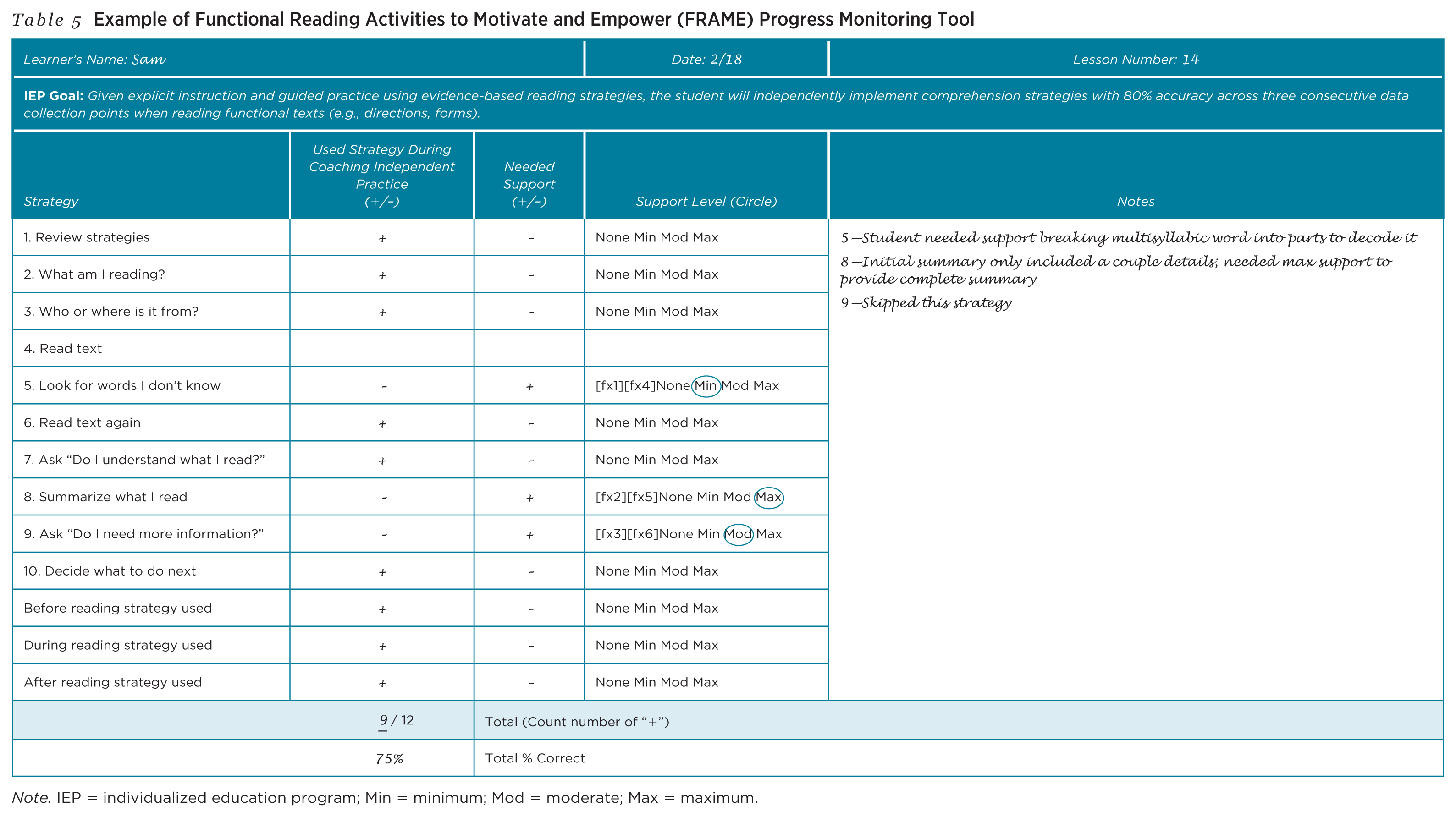
Note. IEP = individualized education program; Min = minimum; Mod = moderate; Max = maximum.
Conclusion
FRAME supports reading for secondary, transition, and postsecondary students with IDD who have foundational word reading skills yet need support with reading comprehension. In alignment with Keefe and Copeland’s (2011) core aspects of literacy, FRAME aims to empower transition-aged students with IDD to experience connection and belonging via targeted literacy instruction in the areas of employment, socialization, and independent living. FRAME was created based on real-world needs and has a growing body of rigorous research to support its effectiveness and use (Prahl, 2024; Prahl & Gilson, 2023; Prahl et al., 2025). In the program, students are taught to utilize comprehension strategies before, during, and after reading functional texts. FRAME sessions are structured using the teach-model-coach-review model and can be taught 1:1 or in small groups. During each session, educators or other practitioners will (a) teach how to use the graphic organizer and strategies, (b) model how to use the strategies with functional texts, (c) coach the student through reading a piece of functional text while utilizing the strategies, and (d) review what was taught and practiced that day. Prioritizing instruction that helps students learn and independently apply the 10 strategies during reading will support progress toward improved reading comprehension across all areas of life.
After implementing FRAME in both small group settings and one-on-one sessions, Ms. Pryor students’ reading skills progressed. The tailored approach of FRAME, which focuses on practical reading skills and real-world applications, boosted her students’ confidence and competence in reading. This improvement was not confined to the classroom; it extended to their social interactions and job prospects. Students began participating more actively in social activities, feeling more included and confident in their communication abilities. Additionally, their enhanced reading skills opened up new employment opportunities because they were better equipped to understand job-related materials and perform tasks that required literacy. Ms. Pryor’s dedication and the effective implementation of FRAME positively impacted her students, providing valuable support across multiple domains and empowering them with skills for a brighter future.
Footnotes
Declaration Of Conflicting Interests
The authors declared no potential conflicts of interest with respect to the research, authorship, and/or publication of this article.
Funding
The authors disclosed receipt of the following financial support for the research, authorship, and/or publication of this article: This project was supported by the American Speech-Language-Hearing Foundation and the National Institute on Deafness and Other Communication Disorders (R21DC0207787). Any opinions, findings, conclusions, or recommendations expressed in these materials are those of the authors and do not necessarily reflect the views of the American Speech-Language-Hearing Foundation or the National Institutes of Health.
