




Abstract


Mrs. Jackson’s kindergarten classroom included a variety of children, among them two with an identified disability (i.e., developmental disability, speech language impairment) and several others who already showed early difficulty with foundational math (i.e., math difficulties). These children struggled with counting skills (e.g., knowing number names, applying one-to-one correspondence) and early addition and subtraction. In her class, Mrs. Jackson noticed that some children had trouble understanding the math vocabulary used during instruction. This included terms such as “add,” “total,” “sum,” “equal,” and “subtract.” When children did not understand the vocabulary, Mrs. Jackson was concerned that they might not be able to engage with the instructional content and, as a result, be unable to fully participate in classroom activities.
To increase the math vocabulary knowledge of the children, Mrs. Jackson began providing specific instruction on terms before teaching math content. She would introduce a term on a word wall card and provide a child-friendly definition. But when Mrs. Jackson asked the children to use the terms, she noticed that some still did not have a complete understanding of certain terms and had trouble using them in conversation. She wondered how she could provide more meaningful math vocabulary instruction.
Early math skills are essential for later academic (Claessens et al., 2009) and everyday success (Davis-Kean et al., 2022). Although math understanding is crucial, national data indicate that children in the United States still struggle with math competency (National Center for Education Statistics, 2024). Only 39% of fourth-grade children in the United States meet math proficiency standards (National Center for Education Statistics, 2024), which suggests many children may face math difficulties (MD).
Throughout this article, we refer to children with MD as those who demonstrate below-grade-level performance in mathematics (e.g., score below a specific percentile on a mathematics achievement screener; Nelson & Powell, 2018). These data are even more concerning for children with an identified disability (16%; National Center for Education Statistics, 2024). We define children with a disability as those who have a school-identified disability and individualized education program goals in math. We continue to use the terms “children with a disability” or “MD” throughout this article to include all children who may be struggling with math.
These bleak data highlight the need for improved early math intervention efforts. Research indicates that math-focused storybook reading is a simple yet effective strategy for supporting children’s math learning (Flevares & Schiff, 2014; Op ‘t Eynde et al., 2023), including those with a disability or MD (Green et al., 2018; McGuire et al., 2021). This practice can be conducted through read-alouds. A read-aloud, also known as shared storybook reading, is an evidence-based practice where someone, typically a teacher, reads a text aloud to a group and engages them through discussion, questioning, and an emphasis on the text (What Works Clearinghouse, 2015). Read-alouds are often used to teach literacy skills (Bowers et al., 2010; Wasik et al., 2016) but can also serve as an effective way to promote math knowledge, such as math vocabulary (Flevares & Schiff, 2014; Op ‘t Eynde et al., 2023).
Read-alouds provide valuable opportunities to teach math vocabulary to children by leveraging the connection between math learning with vocabulary development through storybook texts. Research indicates that children’s understanding of math vocabulary is related to their overall math performance (Lin et al., 2021; Riccomini et al., 2015). Grasping math vocabulary helps children access math content and participate in math discussions. Therefore, a thorough understanding of math vocabulary is especially crucial for children with a disability or MD who may face particular challenges in acquiring math language (Forsyth & Powell, 2017).
Many storybooks provide opportunities to emphasize math vocabulary, which is essential for understanding math concepts and procedures. Math language can be particularly challenging because of words with multiple meanings across content areas (e.g., “round”), within math itself (e.g., “square”), homophones (e.g., “sum” and “some”), and difficult spellings (e.g., “quadrilateral”). Luckily, read-alouds allow teachers to strengthen children’s knowledge of math terms that might otherwise be underdeveloped. For example, in the storybook How Do Dinosaurs Count to Ten? (Yolen & Teague, 2004), children encounter words such as “counting,” “big,” “one,” “two,” and “three.” Teachers can define and emphasize these terms during the read-aloud.
Although math vocabulary is the most obvious instructional focus when using storybooks to teach math, read-alouds can also be used to teach math through the integration of dialogic reading questions (i.e., questions used to engage children in conversation about a book; Purpura et al., 2021), connecting story content to visuals (Aqazade, 2022), and incorporating math manipulatives and activities (Casey et al., 2008; Green et al., 2018). In the next sections, we offer five recommendations for teachers to use storybooks to support math learning based on the most common and effective strategies according to the current research (Flevares & Schiff, 2014; Op ‘t Eynde et al., 2023; see Figure 1).

Five strategies for teaching math with storybooks
Math Storybook Strategies
In this section, we highlight five key strategies for using math storybooks with children with a disability or MD. These strategies can be used in general education, intervention, or special education settings. By thoughtfully selecting storybooks, incorporating specific math vocabulary, using dialogic reading questions, connecting story content to visuals, and engaging children with materials, teachers can transform storytime into an active learning experience that extends beyond basic literacy.
“Many storybooks provide opportunities to emphasize math vocabulary, which is essential for understanding math concepts and procedures.
Strategy 1: Mindfully Select Storybooks
Choosing the right book for storytime is essential, especially when teaching math concepts to children. There are many factors to consider to effectively engage children with math through a storybook (Hunsader, 2004; McDonald, 2007). But how do teachers select the best book for their class? Here are some important considerations when choosing a storybook to introduce or teach math to young children.
Focus on key math concepts
First, choose a book that emphasizes core math ideas. To engage children and effectively support math teaching, the book should incorporate concepts and procedures into its story or illustrations. A good book might show shapes and numbers, introduce math vocabulary, or include math problems. Alternatively, it can be effective if a teacher can easily link math concepts to the story by expanding or building on it through additional lessons, materials, or activities.
“A good book might show shapes and numbers, introduce math vocabulary, or include math problems.
Align with grade-level standards
Second, when choosing a math storybook, refer to grade-level content standards to determine what is appropriate for your group of children (National Governors Association Center for Best Practices & Council of Chief State School Officers [NGA & CCSSO], 2010). Consider selecting storybooks with content that previews topics or draws from earlier standards, helping children build a foundation for future success with grade-level content. Storybooks can serve as an effective remediation or differentiation strategy when teaching children with a disability or MD. For example, one could use a math storybook to preview math concepts, such as addition or measurement with standard units, to a group of children with MD before the entire class lesson.
Assess math accuracy
Third, assess the quality of the math content. Preview the book before reading it aloud to ensure the math concepts, vocabulary, and visuals are accurate and align with state or Common Core State content standards (NGA & CCSSO, 2010). When previewing, focus on the math vocabulary (which is a topic we discuss in the next section). If a math concept is not the book’s sole focus, math vocabulary (e.g., “more than,” “less than,” “big,” “one,” “two,” “three”) can be emphasized to bring specific concepts to the forefront of the story.
See
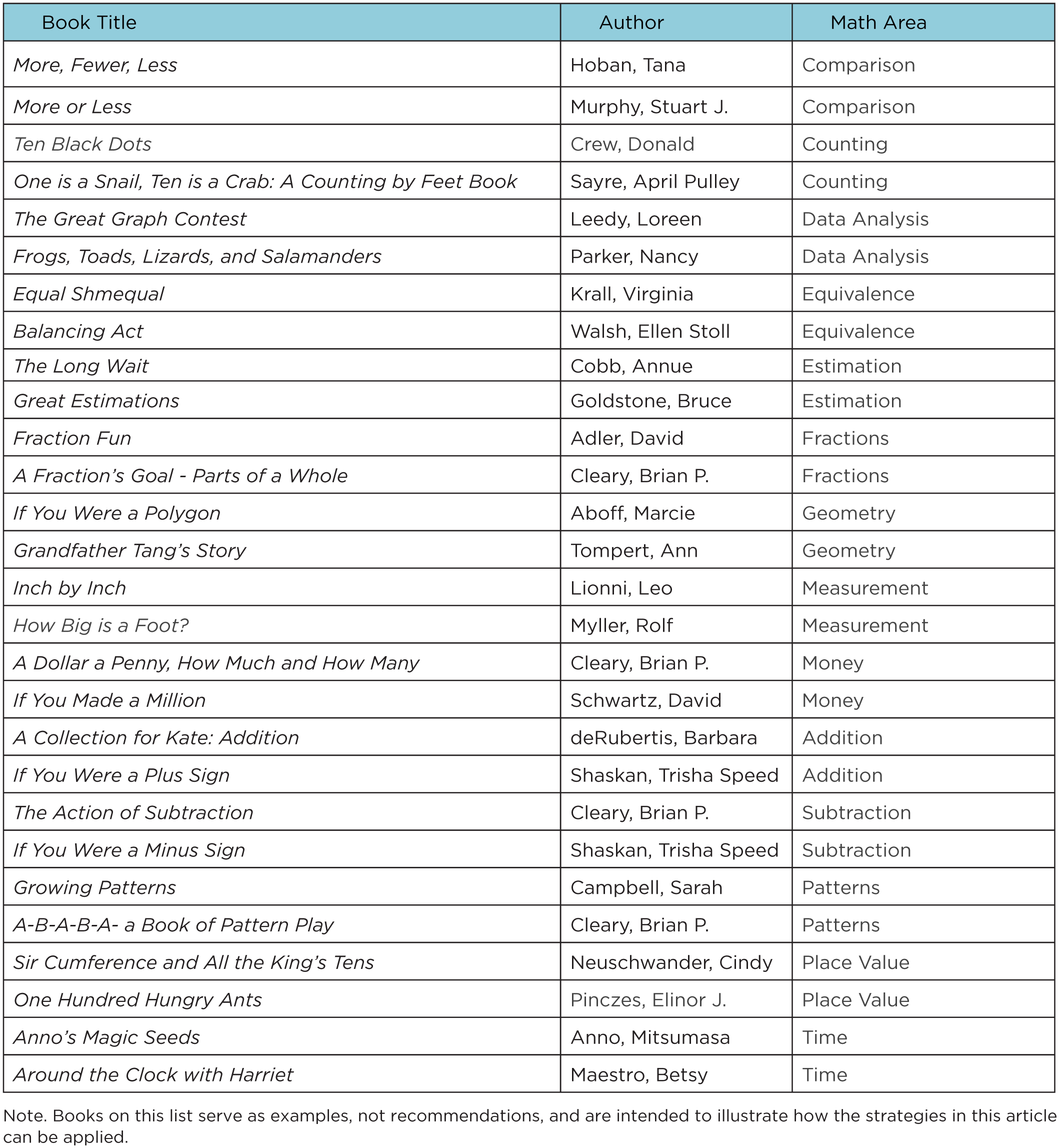
Examples of math storybooks
Mrs. Jackson wanted to focus on addition, so she talked with the school librarian, who suggested If You Were a Plus Sign (Shaskan, 2009). The librarian recommended this book because its content aligns with the Kindergarten Operations and Algebraic Thinking content standard, which emphasizes addition and subtraction (NGA & CCSSO, 2010). In looking at the book, Mrs. Jackson identified several addition terms that would be helpful for the children in her classroom: “plus,” “add,” “together,” “equals,” “total,” and “sum.” She wondered how best to teach these terms to her children.
Strategy 2: Incorporate Math Vocabulary
Storybooks serve as a vessel to boost children’s comfort with and understanding of new vocabulary. Math vocabulary includes terms with at least one meaning related to math concepts (e.g., “sum,” “addition,” “more than”; Monroe & Panchyshyn, 1995). Math vocabulary is crucial for math success because it provides access to the content needed to grasp math concepts (Lin et al., 2021). Several studies have incorporated math vocabulary into read-alouds to introduce math concepts to children. For example, Hassinger-Das et al. (2015) chose 34 math vocabulary terms to highlight during a storybook intervention through direct instruction, repeated exposure, and relevant examples. McGuire et al. (2021) designed lessons to accompany each storybook and listed key math vocabulary terms in each lesson for interventionists to emphasize. Purpura and colleagues (2021) developed storybooks for preschool children, embedding math vocabulary throughout the story and into dialogic reading questions.
An emphasis on math vocabulary is crucial for children with a disability or MD who may struggle more with understanding math terms (Forsyth & Powell, 2017). Math vocabulary knowledge acts as a gatekeeper to more advanced math skills because it predicts success in areas such as fractions and word-problem solving (Lin et al., 2021). Here are key points to consider when emphasizing math vocabulary during read-alouds.
Emphasize related math vocabulary
It is important to select math vocabulary related to the topic to highlight and define within storybooks. For example, when reading with a child who has difficulty comparing numbers, focus on terms such as “more” or “fewer.” Additionally, if math terms are not explicitly defined in the storybook, take time to introduce the term, give children an accurate and child-friendly definition, and continue to model precise math vocabulary in subsequent math lessons (Hughes et al., 2016; Powell et al., 2023). Consider creating a classroom word wall to help provide child-friendly definitions (see

Example of a math word wall
Enhance math concepts
Look for math vocabulary in the text to enhance specific math concepts and procedures for children. Book titles can be very telling of the math vocabulary used within the story. For example, The Action of Subtraction (Cleary, 2006) is likely to include terms such as “subtract,” “take away,” “difference,” and other subtraction-related terms. Other storybooks may require a prior read-through to check their math vocabulary. For example, The Very Hungry Caterpillar (Carle, 1969) does not explicitly use math vocabulary in the title, but upon further review, it uses number words, such as “one,” “two,” “three,” and size words, such as “little” and “small.”
Expose children to a wide range of terms
Make sure to introduce children to a variety of math vocabulary and concepts. When reading a story, select and incorporate vocabulary terms that cover important numeracy ideas (see
“Before starting the story, state an objective focused on a specific term and have children make a gesture when they hear or see that term in the story.

Examples of math language in storybooks
As described, Mrs. Jackson noted several addition terms she could emphasize while reading If You Were a Plus Sign (Shaskan, 2009): “plus,” “add,” “together,” “equals,” “total,” and “sum.” She decided to have the children clap when they heard one of these target terms, especially because a clap demonstrated the action of putting things together, similar to addition. To enhance the storybook, Mrs. Jackson appreciated the chance to introduce the commutative property (i.e., “you can add in any order and still get the same sum,” Shaskan, 2009, p. 16) and to focus on adding more than two addends for a sum (Shaskan, 2009, pp. 16–17). These concepts are important for the future when these children move toward solving algebraic equations or tackling more complex addition problems.
Strategy 3: Engage Children in Dialogic Reading
The next approach is to incorporate dialogic reading questions into the read-aloud process. Dialogic reading is an interactive teaching method that highlights the importance of dialogue and discussion between teachers and children (Brannon & Dauksas, 2014). It involves sharing ideas mutually, where both parties contribute to the learning process (Rojas-Drummond et al., 2013). Dialogic storybook reading in math is an interactive way to learn math through stories. This approach goes beyond just reading; it aims to improve language skills, especially for children with a disability or MD (Towson et al., 2016). By using specific dialogic reading questions about math language, it is possible to increase overall math competency (Purpura et al., 2021). During dialogic reading, teachers might pause to ask open-ended questions, such as, “How much change should the customer get?” or “How many bananas are left?” This encourages children to think critically about the math in the story, helping them understand better. Here are three suggestions for adding dialogic reading to classroom storytime.
Ask specific questions
First, ask children specific questions about objects, math concepts, and math-related plots. Offer multiple ways for children to respond based on their comfort and ability level. During the learning process, encourage and praise correct responses and provide guidance as needed. Verbal responses are important, but teachers should also prepare for a variety of nonverbal responses by having questions ready (e.g., gestures, drawing, or writing on a whiteboard). For example, “Show me with your fingers how many houses there are in this image.”
Model, repeat, and elaborate
Second, when a child makes verbal responses about the story, model, repeat, and elaborate with creative ideas to encourage children’s verbalization. This is especially important for children with limited language skills because it provides a model for children to practice their math dialogue (Gormley & Ruhl, 2005). For example, if a child says, “Many houses,” a teacher can expand and say, “Yes, many houses. Let’s count them together, one, two, three, four, five. There are five houses in the picture.”
Vary your questions
Third, vary the questions you ask children by using the CROWD principle (see

CROWD dialogic reading principle
Mrs. Jackson identified several ways to use the CROWD principle for the storybook If You Were a Plus Sign (Shaskan, 2009). For completion, Mrs. Jackson read, “One and eight equals ____,” (Shaskan, 2009, p. 9). For recall, Mrs. Jackson asked the children, “They made a sum of 12 cheerleaders. How did they make that sum?” (Shaskan, 2009, p. 11). To use an open-ended prompt, Mrs. Jackson planned to say, “What are the different ways the frog could jump across these six lily pads?” (Shaskan, 2009, p. 14). Mrs. Jackson identified wh-questions to ask throughout the book but asked “What is added on this page?” (Shaskan, 2009, p. 12) or “Where are the 12 animals?” (Shaskan, 2009, p. 17). Finally, Mrs. Jackson used several distancing prompts, including, “What’s an addition problem you’ve thought about this week and last week?”
Strategy 4: Connect Story Content to Visuals
Visuals are an effective tool for highlighting math concepts for children with a disability or MD. In storybooks, visuals can serve as pictorial representations of math concepts that enhance children’s learning (Fuchs et al., 2021). For example, in a story like Five Little Monkeys Jumping on the Bed (Christelow, 1989), the focus is on the number 5. Therefore, it is important that the images depict five monkeys to directly connect the term “five” with the pictorial representation of five monkeys. Although visuals alone are not sufficient, pictorial representations are helpful for children who are learning new math concepts or children with a disability or MD. When possible, link the text to images and choose books with visuals that encourage math conversation, such as shapes, countable sets, or comparable quantities (see

Strong versus weak math storybook visuals
Connect text to visuals
Be sure to connect important text to visuals. When reading a story, connect the text to the images, especially when numbers or quantities are involved. For example, imagine an image of a tree with two apples on it and the text says, “The tree had a couple of apples on it.” One could say to a group of children, “Hm, I see a tree with a couple of apples. One, two,” while pointing to the apples. This directly connects the terms “a couple” and “two” to the image in the book. Not only does this define the term “couple” for children, but it also introduces them to basic math language about quantities.
Choose visuals intentionally
It is also important to select intentional visuals. Consider the math concepts that are crucial to highlight and review the book in advance. For example, if children are working with geometry terms, have them find shapes in the storybook images. If a child struggles with comparing quantities, select a book that shows quantities on both sides of a spread and ask questions such as, “Which side has less/more?” Look for sets that are easy to count. For instance, a crowd of people in a picture may be hard to count if faces or bodies are not distinct, but the number of apples on a tree can often be easily counted.
In If You Were a Plus Sign (Shaskan, 2009), Mrs. Jackson noticed the book included many excellent visuals that clearly connect to the math content and selected vocabulary terms. For example, in the part of the text “How many balls does Cherry juggle in all?” (Shaskan, 2009, p. 20), children in Mrs. Jackson’s classroom could easily touch and count the red balls, green balls, and orange balls. Mrs. Jackson also planned for her learners to do some of their own drawings, such as drawing four blueberry pancakes and three plain pancakes (Shaskan, 2009, pp. 12–13). Working with representations, such as drawings within a storybook or having children create their own drawings, has been identified as an evidence-based practice for supporting learners who experience difficulty with math (Fuchs et al., 2021).
Strategy 5: Supplement With Materials and Activities
Although storybooks are a helpful engagement tool, not all are designed with rich math content or enough support for every child. Fortunately, classroom materials and activities can help supplement the math content. Consider the following recommendations.
Plan for a math game or activity
Consider planning a related game or activity to enhance a storybook’s math content. Math games and activities can promote fluency and math content knowledge (Bouck & Long, 2022). Hassinger-Das and colleagues (2015) created a math-storybook intervention for kindergarten children with early numeracy difficulties. During the storybook intervention, researchers read math storybooks, taught math vocabulary, and guided children in play activities that incorporated math language. Children participating in the intervention showed stronger math vocabulary than those who did not receive it. Hong (1996) developed an intervention where children received math storybook readings and had access to math materials throughout the day. Results showed that children who participated in the math storybook readings chose math tasks more often, spent more time in the math corner, and performed better on classification, number combination, and shape tasks than children who did not read the storybooks. Consider creating a math corner in the classroom with math games or activities, such as blocks, shapes, paper, scissors, and counters. This enables children to participate in math activities during their free time (e.g., breaks, recess, centers). For classrooms with limited space, consider building a math wall with vocabulary terms, visuals, or story-based math examples from the stories.
Embed manipulatives
When reading a math-focused storybook, try incorporating math manipulatives, such as geometric shapes, fraction strips, number lines, or two-color counters, into the story routine. Children with a disability or MD often struggle with procedural and conceptual concepts (Agrawal & Morin, 2016). Using different representations, such as physical manipulatives, helps bridge this gap and encourages children to actively engage with the math content (Agrawal & Morin, 2016; Belenky & Nokes, 2009; Stein & Bovalino, 2001). Jimenez and Kemmery (2013) implemented an early numeracy intervention for children with moderate intellectual disabilities. They intentionally embedded graphic organizers and manipulatives into the story-based math lessons following evidence-based recommendations (Browder et al., 2012). Their results showed a significant increase in early numeracy skills for children who received the intervention. This leads to greater participation and reflection, which can improve understanding and achievement (Agrawal & Morin, 2016). If the class is reading Shapes (Dahl, 2023), each child could hold a foam shape that appears in the story. When that shape is introduced, they could be responsible for holding it up. This approach encourages child engagement and practice in shape recognition. If there are math problems in the story, take time to solve them independently, in pairs, or as a group. Follow the story with a related craft or problem set. There are countless ways to use materials and activities to add more math content to any storybook.
In her class, children were excited as Mrs. Jackson reread If You Were a Plus Sign (Shaskan, 2009). With a stack of different colored fruit and animal manipulatives in hand, Mrs. Jackson grabbed her children’s attention, leading them into a world of math and wonder. As Mrs. Jackson read aloud, the children eagerly followed along, listening for key vocabulary terms and clapping when they heard a term. For each page with an addition problem, Mrs. Jackson asked the children to create the problem with their math counters. For example, for 3 + 4, one child showed 3 red apples and 4 oranges and then combined the foods to find a sum of 7. Another showed 3 penguin counters and 4 dolphins and then combined the counters to show 7.
After reading the book, Mrs. Jackson placed the storybook, math manipulatives, drawing paper, and crayons in the free-play corner. She was hoping to extend their math exploration and creativity through a child-initiated activity. Later that day, during her formal math instruction, Mrs. Jackson was doing an activity about adding. For Malia, one of her learners with a speech language impairment, and Avi, one of her learners struggling with counting, she asked them to use bear counters to put together 5 plus 5 for a total. Mrs. Jackson noticed Malia and Ava using the language of “put together” and “total” as they moved their counters around to show addition, deepening their understanding of an important math skill that they will use throughout their lives.
Conclusion
By fostering a love of math from a young age, teachers lay the foundation for more advanced analytical skills and a deeper comprehension of the world. However, math can be challenging for children with a disability or MD. Storybooks can enhance classroom content by engaging children with text (Dugan, 1997; Worthy et al., 2012) while introducing them to new knowledge, such as literacy skills (Bowers et al., 2010), vocabulary (Wasik et al., 2016), and other academic content (i.e., math; Paganelli, 2019). As demonstrated through various studies and educational practices, teachers’ choice of storybooks containing math vocabulary can significantly boost children’s understanding of math concepts (Hassinger-Das et al., 2015; Jennings et al., 1992). Planned dialogic reading questions and the analysis of visuals can foster problem-solving and critical thinking skills related to math (Lowrie et al., 2019; Purpura et al., 2016). By expanding children’s math understanding through enrichment activities and classroom materials, this approach can ultimately support a child’s overall academic success and enthusiasm for learning, making it a valuable addition to any early childhood education curriculum, especially for children with a disability or MD.
Footnotes
Declaration Of Conflicting Interests
The authors declared no potential conflicts of interest with respect to the research, authorship, and/or publication of this article.
Funding
The authors received no financial support for the research, authorship, and/or publication of this article.
