



Abstract


Autism is a neurodevelopmental disability characterized by social-communication differences and restricted, repetitive behaviors or focused interests (American Psychiatric Association, 2013). Focused interests 1 are intense or narrow passions (Grove et al., 2018). Focused interests often last longer than hobbies or curiosities, and they provide a sense of purpose in life that may turn into employable skills and lifelong passions (Bross & Travers, 2017; El Zein et al., 2016; Grove et al., 2018; Lizon et al., 2024). Although focused interests sometimes interfere with learning, they often enhance participation and promote skill development when incorporated into lessons. We use the term “lesson” to refer to a range of instructional contexts in PK–12 education (Klin et al., 2007; Lizon et al., 2024; Winter-Messiers, 2007). One such example is with an eighth-grade autistic student with a focused interest in Ancient Greece. The student may be overjoyed to speak about their passion but rarely pay attention in English class during lessons unrelated to their interest. Likewise, many autistic students demonstrate low levels of engagement in contemporary classrooms, which is associated with academic difficulties and lower developmental scores (Lindström et al., 2021; Sparapani et al., 2016). Engagement means students are actively participating in lessons and activities, which is key for learning and development. However, for many educators, promoting engagement has become more challenging post-COVID due to disruptions in routines and learning environments (Pokhrel & Chhetri, 2021).
Focused Interest-Based Instruction
One strategy to engage autistic students is to incorporate their focused interests into lessons where their participation and learning tend to be lower (Gunn & Delafield-Butt, 2016; Meindl et al., 2020). This approach has benefits beyond engagement, such as greater independence from support staff, better rapport with paraeducators, and increased engagement with peers (Wood, 2021).
Although some educators may have concerns about incorporating focused interests into lesson content, success often relies on how these approaches are designed and implemented. Educators need to work with their students’ focused interests, not against them, to support their students’ engagement. In one study, 96.2% of autistic adults believed that their focused interests positively impact their lives and should be encouraged in children (Patten Koenig & Hough Williams, 2017). Therefore, this article provides practical strategies for incorporating autistic students’ focused interests in PK–12 classrooms as a means to promote engagement, learning, and inclusion. It includes examples tailored to early childhood, middle school, and high school settings. We refer to focused interests in the singular, but educators should consider that many autistic individuals have multiple focused interests (Nowell et al., 2021). Additionally, we recognize that educators are very busy and have varying levels of experience with autistic students. Therefore, we present many different options for incorporating focused interests into instruction so educators can pick and choose what works best for them. For those seeking more information on evidence-based practices, we recommend resources such as those offered by the IRIS Center (https://iris.peabody.vanderbilt.edu/resources/iris-resource-locator), although educators should be advised that many resources may have been developed without autistic input and may not be acceptable to members of that population.
Overall, to incorporate focused interests into instruction, educators should (a) identify the student’s focused interest(s), (b) determine the target lesson in which to apply the interest, (c) select an instructional approach, (d) embed the interest into the lesson and implement the instruction, and (e) monitor and collect data. 2
Step 1: Identify the Focused Interest
When it is not already apparent, there are several ways to identify an autistic student’s focused interest. One approach is to get information directly from the student, such as by speaking with them or administering a self-assessment. Other options are to ask yes-or-no questions, give the student a list of topics to rank based on interest, present pictures to choose from, or observe how they interact with the items they enjoy. During this process, it is important to consider if the student is masking 3 their focused interest to fit in, as this can affect their response (Chapman et al., 2022). If you suspect the student is masking their focused interest, observe them playing independently without social pressures or speak with them in a private setting. Another approach is to get data indirectly, such as by speaking with a family member or giving the family member a form to fill out about the student. The chosen method will depend on feasibility and the student’s communication needs. Table 1 includes a list of sample questions that could be used for identification (adapted from Bross & Travers, 2017).
Focused Interest Assessment Questions
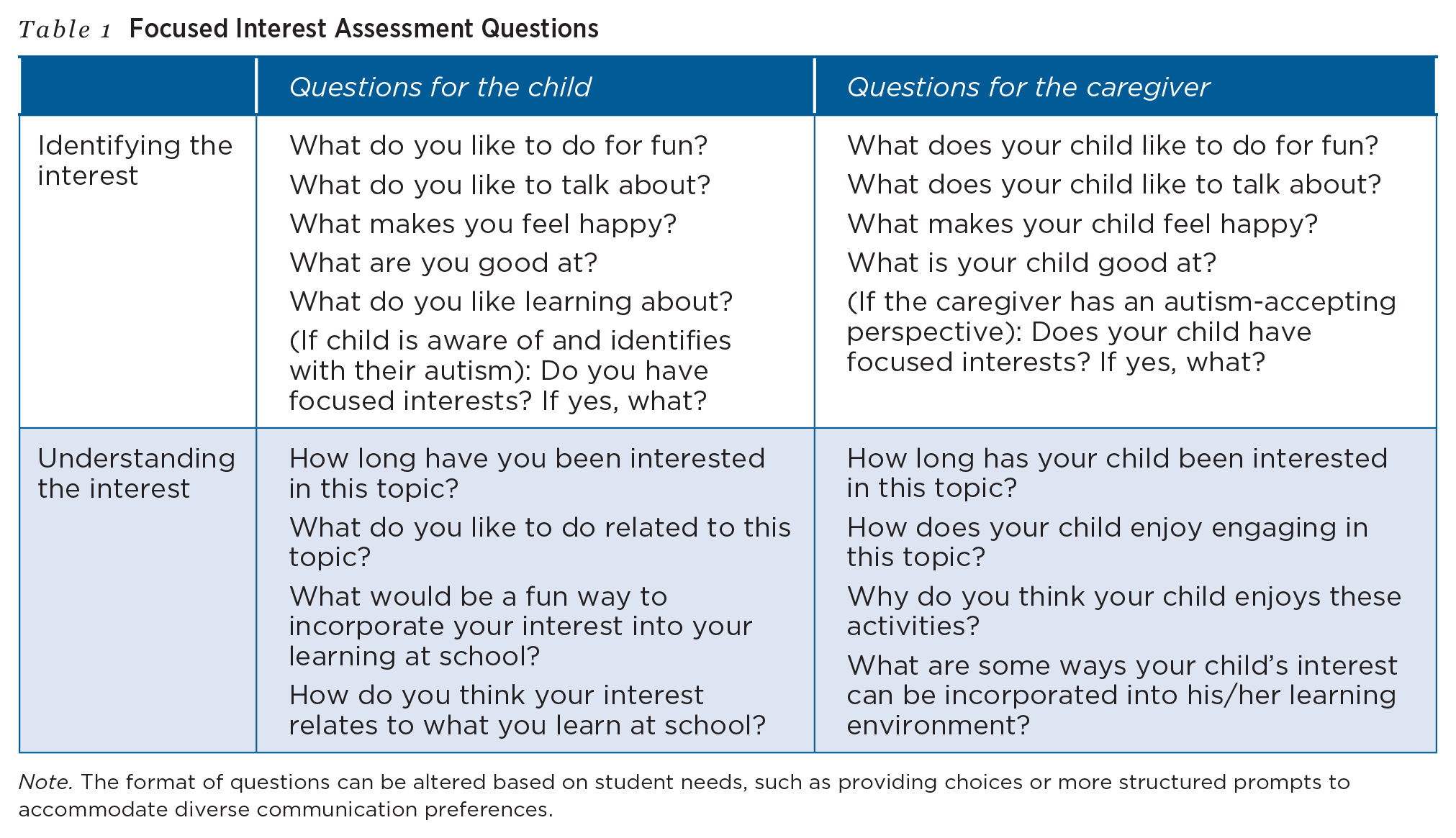
Note. The format of questions can be altered based on student needs, such as providing choices or more structured prompts to accommodate diverse communication preferences.
Important Considerations
Not all autistic students have stereotypical focused interests. Focused interests can be broad (e.g., general interest in history) or specialized (e.g., Ancient Greek mythology). Autistic girls are more likely than autistic boys to have focused interests that are socially oriented, gender-typical, and similar in topic to interests enjoyed by non-autistic same-age peers—such as people, animals, and dolls (McFayden et al., 2020). At present, little is known about focused interests outside of the male/female gender binary (Spackman et al., 2023). Socially oriented interests tend to arise at an older age than object-oriented interests like transportation (Nowell et al., 2011). Therefore, educators should consider the gender, age, and developmental level of the autistic student during the identification process. In the aforementioned eighth-grade English class example, the autistic student might rarely join conversations with peers unless the subject relates to Ancient Greece. Then, the student might share extensive knowledge about Ancient Greece and continue to talk about the topic long after the conversation changes, indicating this is a focused interest.
Identify Preferred Activities or Subtopics
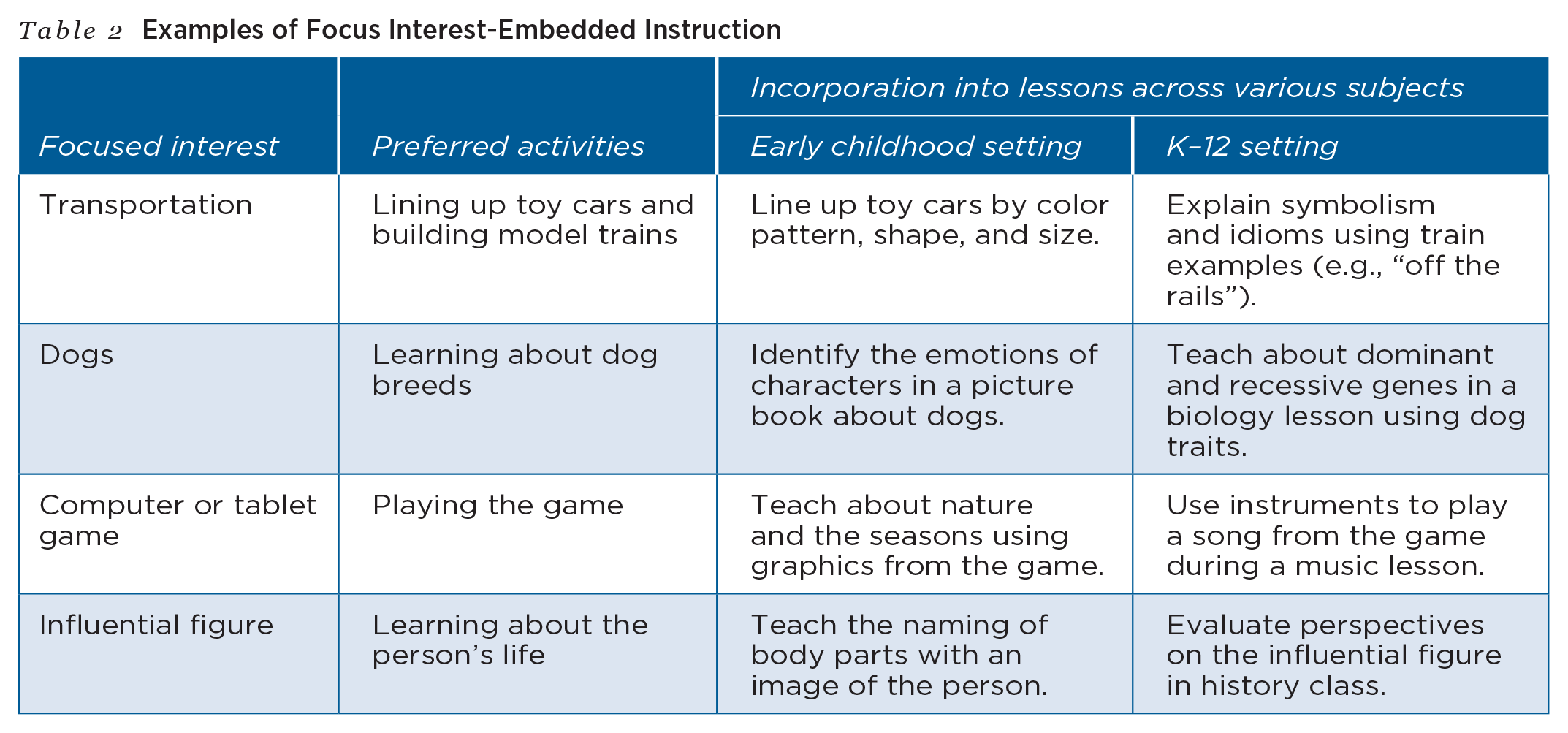
After identifying the focused interest(s), gather information on how the student prefers to engage with their interest. This will help you decide how to effectively present the interest during the lesson. Autistic students with the same interest may not engage in their passion in the same way. For example, the eighth-grade autistic student may prefer to read about Ancient Greece, while another student may prefer to watch documentaries about Ancient Greece. As such, it is important to gather information on what activities the student enjoys and whether they have any preferred subtopics. Table 2 includes examples of students’ preferred activities across early childhood and secondary school settings.
Examples of Focus Interest-Embedded Instruction
Step 2: Determine the Target Lesson
Identify periods when the student shows reduced learning and classroom engagement, thereby benefiting from additional support. This decision can be based on prior experience with the student or by collecting data on the student’s engagement throughout a typical day. Data collection can be as quick and simple as tallying the number of times the student raises their hand during a lesson. The process of collecting data establishes a baseline measurement of the student’s performance before implementation, which is then used to evaluate the impact of the focused interest embedded approach.
When feasible, educators are encouraged to collect data on engagement and achievement. Engagement considers the student’s participation and inclusion in the classroom community, and academic achievement measures the student’s progress toward their learning goals. Both outcome measures are important for a holistic understanding of the student’s support needs. For convenience, educators can use their own pre-established methods for evaluating achievement.
Defining and Measuring Engagement
For educators who choose to collect data on engagement, first decide how to measure this, given that autistic students may show engagement differently than non-autistic peers (e.g., differences in eye contact and body language; Simpson et al., 2022). Consider which behaviors are truly indicative of the student’s engagement by observing them throughout the day or seeking the firsthand experience of the student. For example, the eighth-grade autistic student interested in Ancient Greece may report that they rock side-to-side when interested in a conversation and that they focus better when not making direct eye contact with the speaker. Once engagement is clearly defined for the student, use a simple observation form to collect data on their engagement across lessons (for an example, see Figure 1). If appropriate, educators can complete the form in collaboration with the student by asking how they would self-assess their engagement in each lesson. When evaluating the data, consider external factors such as sensory input and social communication challenges that may impact engagement.
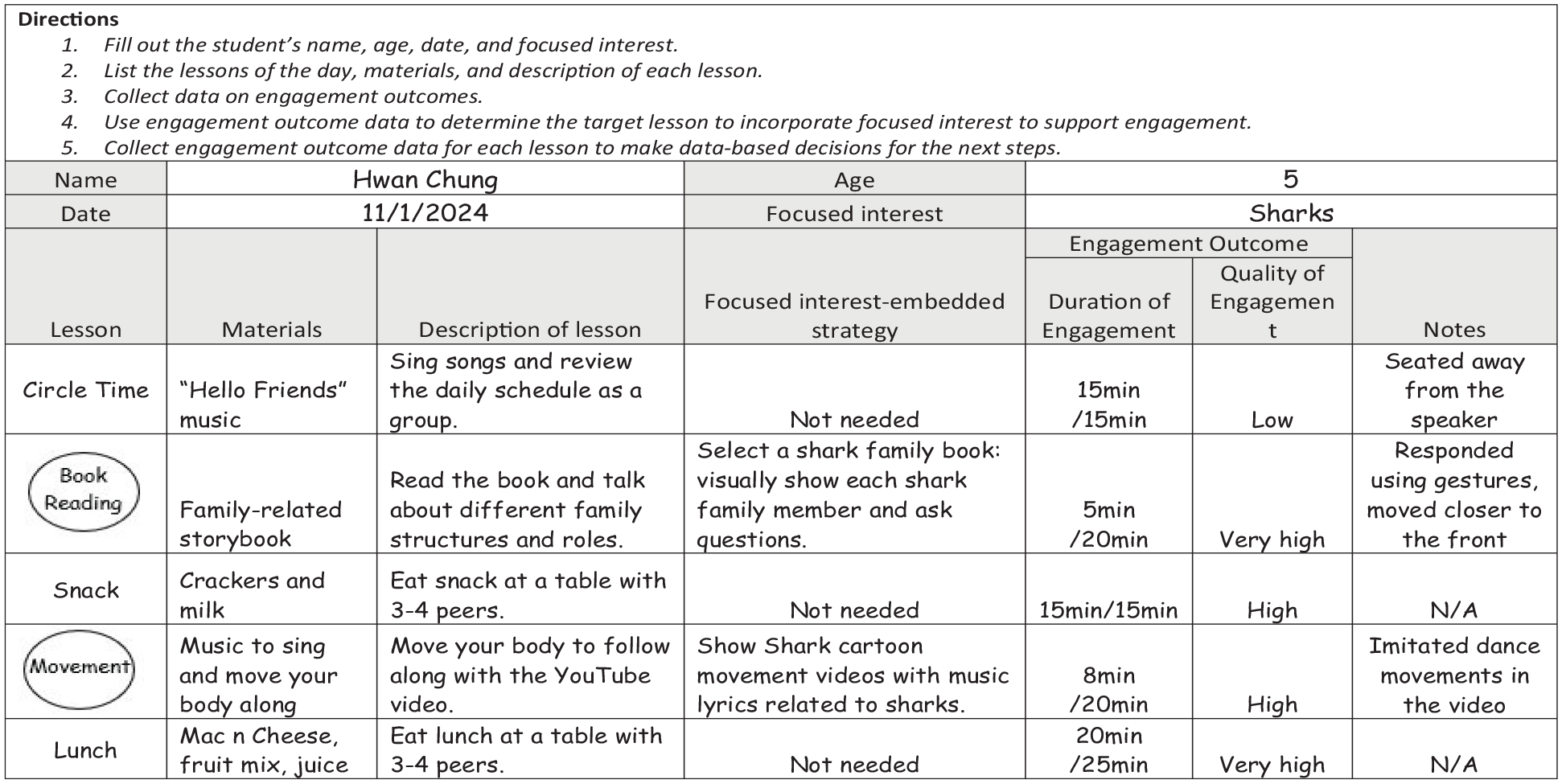
Focused interest embedded instruction planning form
Step 3: Select an Approach
Educators can either (a) embed the focused interest directly into the lesson and/or (b) present the focused interest as a reward after the lesson. The first option requires the educator to weave the interest into the lesson, while the latter does not require any changes to the instructional material. Instead, the focused interest would become a positive reinforcement strategy.
As a broader psychological principle, positive reinforcement is a well-known tool across many contexts. For example, in the employment world, salary bonuses or public recognition are forms of positive reinforcement that increase the likelihood of future performance. In classrooms, positive reinforcement can enhance engagement and academic performance. For example, an educator might say, “I see how much effort you’re putting into solving this problem, and that’s what really matters!” This encourages the student to keep working even when problems are challenging. Additionally, some educators create token economy systems where students can collect tokens for positive behaviors that they redeem for a reward at the end of the week, such as extra playtime or small toys. In this context, focused-interest-related reinforcers may be preferable to nonspecific rewards because they tap into the student’s passions and encourage learning that feels personally meaningful. Additionally, this approach aligns with the need for educators to manage time and resources effectively while still integrating a neurodiversity approach (for practical guidance, see Mathur et al. 2024). Figure 2 illustrates a flowchart with factors to consider when selecting an approach, such as student temperament, peer response, and the educator’s availability. This section further elaborates on these considerations.
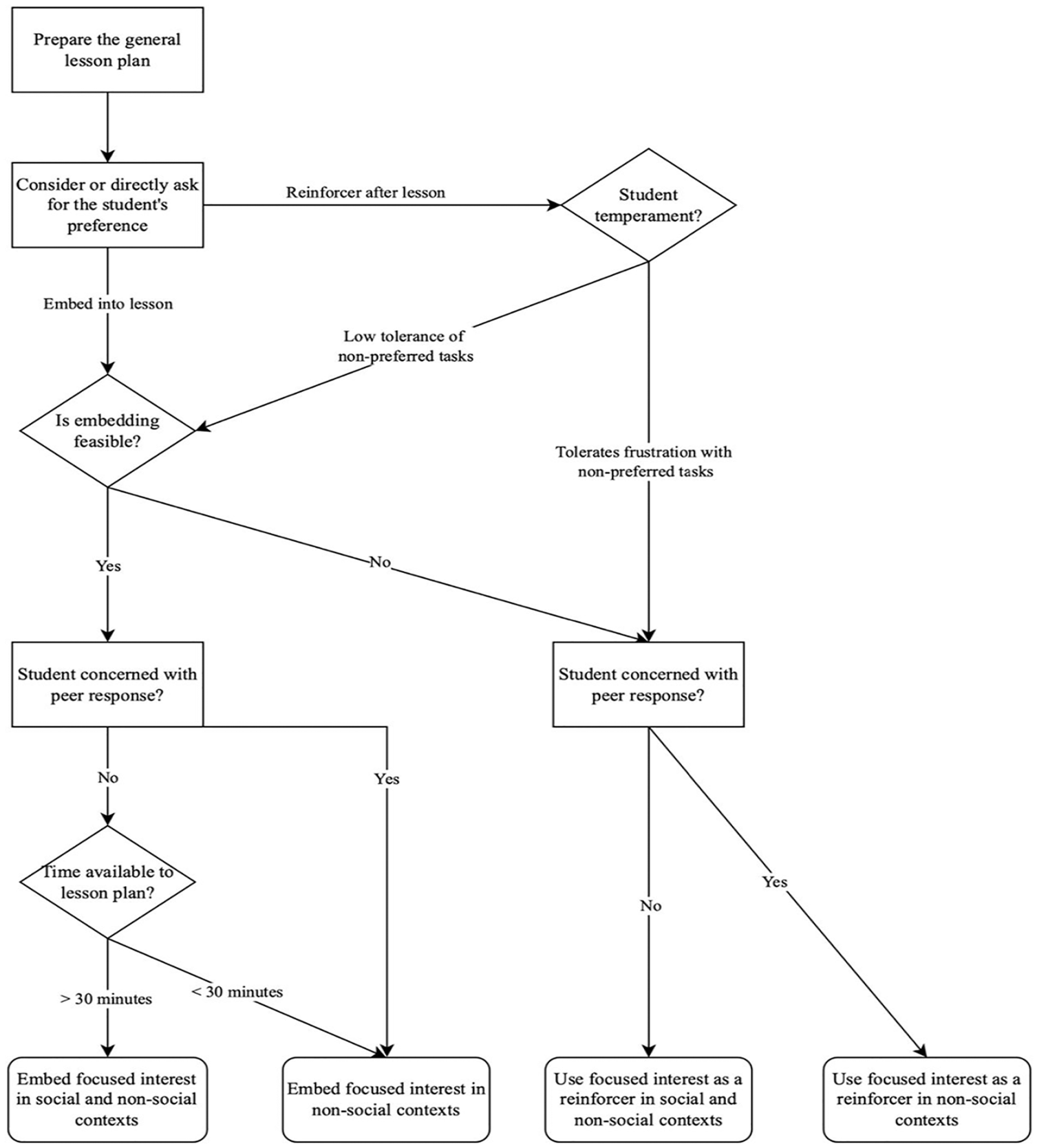
Decision-making flowchart
Honor the Student’s Preference
Consider whether the student would prefer a particular approach. Whereas a young child may be motivated by focused-interest-related items (e.g., toys, stickers), an older student may find this uninteresting or even infantilizing. Some children might also feel self-conscious if their focused interest were to be embedded in a lesson in front of classmates, but they might welcome a reinforcer delivered privately afterward. When unclear, educators can ask the student for their preference or consult with a caregiver. If the student prefers one approach but is concerned about peer reactions to it, educators can work to promote acceptance and celebration of others’ interests in the classroom (see Boutot, 2007, p. 159).
Evaluate Feasibility
Consider whether the class structure permits embedding. In our example of the eighth-grade English class, the educator could teach about rhetorical devices using references to Greek mythology. Embedding might sometimes be more difficult in an early childhood setting, but built-in time for free play could be used to provide the student with a focused-interest-related reinforcer immediately after the target lesson.
Consider the Student’s Temperament
For some students, a lesson that embeds the focused interest can help sustain engagement by capturing their curiosity to learn (Wood, 2021). However, other students with more intense interests may become distracted and pay less attention to the lesson. Those in the second group may be better suited to the reinforcer approach, in which their interests are presented after the lesson, contingent on engagement. However, if this approach is selected, some students may become distressed or frustrated when transitioning between the reinforcer and the next lesson (Cumming et al., 2020). When making this decision, educators should consider the student’s temperament, need for autonomy, tolerance of unpreferred tasks, and potential frustration with either approach.
Consider Classroom Dynamics
To maintain class cohesion, educators need to consider how the selected approach will impact interpersonal dynamics in the classroom. Some autistic students thrive socially when they share their specialized knowledge with peers. For these students, it would be beneficial to embed the focused interest into social learning contexts, such as group games and discussions. However, other autistic students prefer to mask their focused interests to fit in with peers, and that boundary must be respected: Consider embedding into nonsocial learning activities, such as independent projects or word problems. Nonsocial approaches are also ideal when there are students with competing interests and sensory needs in the same class (e.g., one student has a focused interest that another student finds overstimulating).
Step 4: Plan and Implement the Instruction
Once an approach is selected, plan how to incorporate the focused interest into instruction.
Approach 1: Directly Embed the Focused Interest Into the Lesson
Prepare the lesson content
Start by reviewing a general lesson plan developed according to relevant standards. This will serve as a reference throughout the planning process to ensure the curriculum and lesson are delivered as intended. Any changes to the lesson plan to embed the focused interest should not interfere with the original learning objectives but rather should serve as an adaptation to increase access to learning while remaining aligned with relevant standards.
Connect the lesson content to the student’s interest
Consider how the focused interest connects to the lesson material. Generate ideas by learning about the student’s topic of interest and considering how the interest can be studied through different lenses (for examples in early childhood and secondary school settings, see Table 2). Next, consider whether the lesson material relates to the student’s personal goals or future plans. For example, the student with a focused interest in Ancient Greece may become motivated to learn about symbolism after hearing that the lesson can help them understand Ancient Greek epics more deeply. If such a connection is possible, introduce the lesson by explaining why it may be personally enriching for the student to study, as this may stimulate the student’s interest in the lesson itself. Educators also need to consider the student’s preferred ways of engaging in their focused interest. Examine if any of the student’s preferred subtopics or activities can be reasonably incorporated into the lesson plan.
Use technology to generate ideas
To support the brainstorming process, educators can use free, user-friendly artificial intelligence platforms, such as ChatGPT (for a teacher-focused guide, see Oh-Young & Karlin, 2024). Simply enter a chat-based prompt to generate ideas, such as “How are these topics related: Ancient Greece and symbolism? Connect Ancient Greece into a lesson about symbolism for an eighth-grade English class.” The chatbot will quickly respond with a list of ideas to incorporate into the lesson plan.
Include thematic elements
Even when a connection cannot be made between the focused interest and lesson content, educators can still incorporate thematic elements. Take note of any names, terms, symbols, or even colors that generally represent the topic. These elements can be incorporated into learning examples or visuals to capture and maintain the student’s attention. For example, in an early childhood setting, educators could teach the alphabet using words and sounds related to the autistic student’s focused interest.
Balance multiple students
In classes with multiple autistic students, the planning and implementation process can seem complicated and overwhelming, especially in large classes with limited support. To improve feasibility, educators can incorporate shared features between students’ interests (e.g., topics, preferred activities) rather than attempting to embed each student’s interest. Tools like ChatGPT can help to find connections between multiple students’ focused interests.
Decide when to present the interest
Incorporate the interest at multiple instances or continuously throughout the lesson to sustain the student’s engagement. In didactic contexts, present the focused interest at the beginning of the lesson to promote the student’s attention and motivation, such as by explaining the connection between the lesson topic and the interest with visuals. Then, add references to the interest at varied intervals throughout the lesson.
Prepare lesson materials
Add focused-interest-related items to the instructional material. In our example of the eighth-grade autistic student, the educator could embellish a slideshow with Greek letters and incorporate references to mythology in sentence examples about symbolism.
Approach 2: Present the Focused Interest as a Reward After the Lesson
If the focused interest will be presented after instruction, no lesson materials need to be altered. The educator and student will select a focused-interest-related reinforcer, decide on an appropriate length of time the student will get to enjoy the reinforcer, and discuss the target engagement behavior. This co-creation of goals encourages learning that feels personally meaningful to the student. Importantly, the reinforcer should be something that the student does not already have regular access to, making it something to work toward. Educators should not choose safety or comfort items as reinforcers because these can serve as a coping mechanism that should be available regardless of performance (Joyce et al., 2017; Pavlopoulou et al., 2022). Once a reinforcer is chosen, the educator will implement the lesson and present it afterward, contingent on the student’s engagement. For example, in the eighth-grade English class, the student and educator might set a goal to make at least one meaningful contribution to the class discussion each week for a total of four weeks. If the student achieves this goal, they can take on the role of “ancient scribe” for a day, where they will take notes on the whiteboard for the class.
While implementing this approach, it is important to remain attuned to the student’s experience. When positive reinforcement is delivered in the context of applied behavior analysis (ABA) interventions formally tracking behaviors with the intent to produce behavior change, a common critique in the autism communities is that focusing on behavior change does not require educators and professionals to understand autistic individuals’ perspectives, emotions, and experiences (Autistic Self Advocacy Network, 2021; Mathur et al., 2024). Another concern is that the overuse of reinforcers could predispose young people toward complying with others’ suggestions, perhaps with lasting impacts (Mathur et al., 2024; Sandoval-Norton et al., 2019). Some advocates and researchers oppose ABA interventions’ use of positive reinforcement (e.g., Autistic Self Advocacy Network, 2021; Dawson, 2004), and others express serious concerns but do not entirely reject it (e.g., Mathur et al., 2024; Schuck et al., 2021). Little research has investigated these concerns, and existing evidence does not discredit them (e.g., McGill & Robinson, 2021). Educators should make sure that the focus on behavior change does not distract them from recognizing the student’s humanity and trying to understand their perspective.
Step 5: Monitor and Collect Data
To enhance the effectiveness of the instructional approach, educators will monitor and collect data on student engagement and learning throughout implementation. A particularly important and time-efficient source of data is the firsthand experience of the autistic student; seek this to evaluate impacts on well-being and feelings of inclusion and to discuss whether modifications to the instruction could be helpful. Comparing data from before and after implementation allows educators to make data-based conclusions on the student’s progress. If the student’s engagement data indicate decreased participation or frustration with the approach, educators should modify the strategy. However, improved engagement and academic achievement, contingent on the implementation of the strategy, suggests the approach was effective (for a data collection example, see Figure 1). In the eighth-grade class example, positive outcome data might prompt educators to incorporate the student’s interest in Ancient Greece during other subject-specific classes, such as science and physical education.
Conclusion
Educators can incorporate their autistic students’ focused interests into teaching to promote active engagement, access to learning, and better teacher-student relationships. This includes expressing interest in students’ passions. To more formally incorporate interests into lessons, educators should first identify the student’s interests and determine the lessons in which the student needs the most support with engagement. Once the target lesson is selected, choose an implementation approach, prepare the class materials, and implement the instruction. Monitoring and collecting data throughout the implementation process allows educators to evaluate the effectiveness of the approach.
Footnotes
Acknowledgements
We would like to thank Aubyn C. Stahmer, PhD, and Meghan Miller, PhD, for their support and guidance during the construction of this article.
Declaration of Conflicting Interests
The author(s) declared no potential conflicts of interest with respect to the research, authorship, and/or publication of this article.
Funding
The author(s) received no financial support for the research, authorship, and/or publication of this article.
