



Abstract


Ms. Cook is a Grade 4 teacher with several students in her classroom with identified disabilities. One student, Asher, has an identified specific learning disability with individualized education program (IEP) goals in both reading and mathematics. In reading, Asher shows difficulty with reading multisyllabic words accurately and fluently. This difficulty with reading has implications for his mathematics performance, particularly for word problems. Ms. Cook wonders if there are instructional approaches that could help Asher in both reading and mathematics. She visits a popular website focused on students who learn differently, and she reads about strategy instruction. It seems promising for helping Asher with his reading and his mathematics.
“ “
Students with learning disabilities (LDs) often have a limited repertoire of effective learning strategies (Reid et al., 2013). When teachers use strategy instruction, they provide students with tools to conceptualize and execute a multistep process. We define strategy instruction as instruction on how to use a research-validated plan or procedure that helps students complete a mathematics or reading task effectively and efficiently. Strategy instruction may be focused on learning strategies (e.g., rereading a mathematics word problem or paragraph), cognitive strategies (e.g., summarizing content that has just been read), metacognitive strategies (e.g., planning and monitoring learning), or management or motivational strategies (Donker et al., 2014). Often, conversations about strategy instruction revolve around self-regulated strategy development (SRSD), which combines strategy instruction in academic content with a focus on self-regulation strategies. SRSD has proven beneficial for students with LDs in both mathematics and reading (Cuenca-Carlino et al., 2016; Harris et al., 2019; Losinski et al., 2019). In this article, we focus on a general approach for strategy instruction.
As described by Pressley and Harris (1990), many students with LDs do not learn strategies automatically; therefore, explicit modeling and practice about strategy instruction is essential for students with LDs. Strategy instruction is useful across content areas, such as when solving a mathematics word problem or reading a multisyllabic word. To solve a word problem in mathematics, students need to read the problem, determine the problem type, represent the problem numerically, and solve for the unknown value (Kintsch & Greeno, 1985; Powell & Fuchs, 2018). Reading a multisyllabic word also requires multiple steps, including connecting letters and letter combinations to sounds; reading word parts, such as affixes and roots; blending multiple word parts into a whole word; and adjusting word pronunciations as needed. When students with LDs learn multistep processes like these, they can benefit from targeted support, such as strategy instruction.
Research shows that strategy instruction improves outcomes among students with LDs (Reid et al., 2013). Students who learn complex skills through strategy instruction are more likely to understand connections between steps and carry out those steps accurately. Importantly, students with LDs frequently require targeted instruction on when and how to transfer strategies to novel contexts (Fuchs et al., 2017). Across content areas, effective strategy instruction includes when and how to generalize a strategy to various scenarios (Vitalone-Raccaro, 2017). For instance, students can learn to apply a multisyllabic word reading strategy not only in a language arts class but also when solving mathematics word problems or reading a novel on their own. In this article, we share evidence and implementation approaches for strategy instruction to support students with LDs, but these approaches may be helpful for students without LDs who experience difficulty with mathematics or reading. We focus specifically on mathematics and reading in kindergarten through Grade 8.
Strategy Instruction in Mathematics
Research
First, Ms. Cook reads about strategy instruction in mathematics. This involves providing students with a strategy for approaching and working through a word problem. Ms. Cook is excited that strategy instruction is identified as a research-validated practice in mathematics.
Research indicates strategy instruction can improve mathematics outcomes for students with LDs (Jitendra et al., 2015; Peltier et al., 2018; Woodward et al., 2018). Strategy instruction is commonly used to help students break down multistep mathematical processes, such as multidigit computation and word-problem solving. For example, Flores et al. (2020) taught a strategy called “RENAME” to students in Grades 4 and 5 receiving Tier 3 intervention. RENAME was a mnemonic-based strategy rooted in using partial products to solve multiplication problems (
In addition to computation, strategy instruction is commonly used to support word-problem solving. Because word-problem solving requires both numerical and reading skills, strategy instruction in word-problem solving can be especially helpful for students with IEP goals across mathematics and reading. Several research studies have shown improved word-problem outcomes for students with disabilities who receive strategy instruction. For instance, Karabulut and Özmen (2018) used a strategy called “Understand and Solve!” in a word-problem intervention to increase performance of Grade 5 students. Combining strategy instruction with schema instruction (e.g., teaching students about word-problem types) can also improve outcomes of students. For example, Peltier and colleagues (2020) successfully combined strategy instruction and schema instruction for Grades 4 and 5 students. In the remainder of this section, we discuss strategy instruction approaches that can be used to teach students with LDs to solve word problems. We include both stand-alone strategies and ones that work well when paired with schema instruction.
Stand-Alone Mathematics Strategy Instruction
Teachers can use visual and verbal strategies to support students’ word-problem solving (Swanson et al., 2015). Visual strategies include diagrams or organizers that display relationships between the numbers in the problem (e.g., a bar model). These visual displays support students in determining what computations are needed to solve for the unknown.
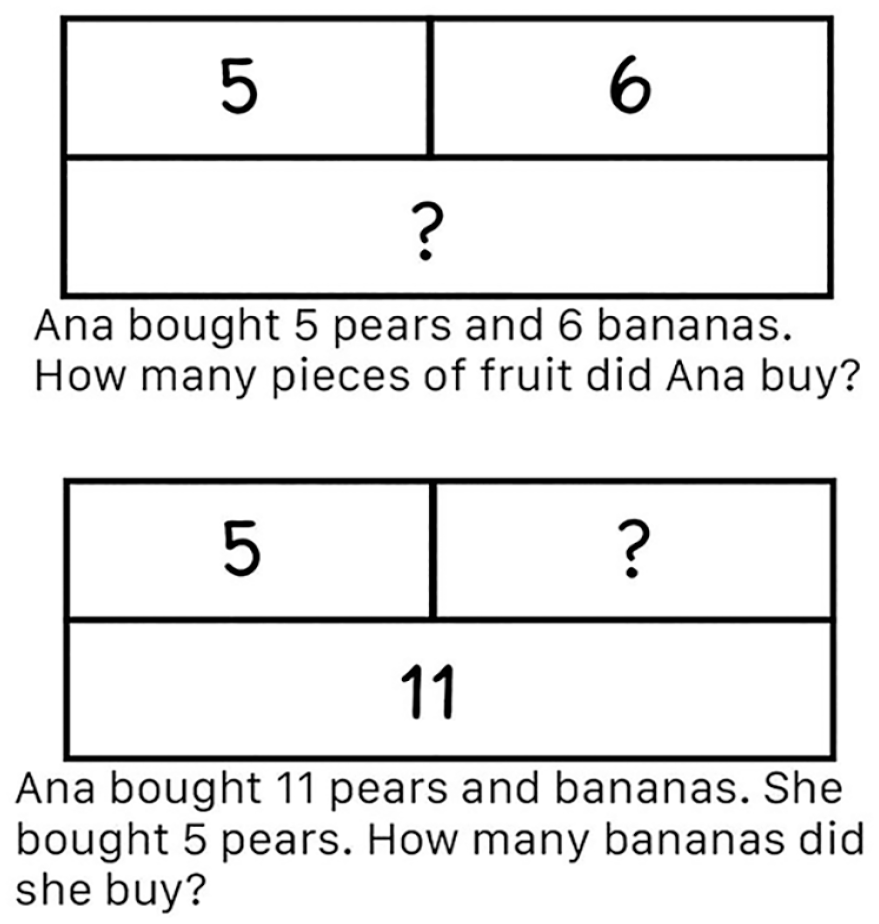
Visual organizer for word-problem solving
Verbal strategies can also be used to solve word problems. These strategies typically include a series of steps, such as underlining or circling relevant information, crossing out irrelevant information, setting up an equation, and solving for the unknown (Swanson et al., 2015). Verbal strategies can be used on their own or paired with visual aids like the aforementioned diagrams. One strategy that combines verbal and visual components is a cognitive strategy called “Solve It!” (Montague et al., 2011). With the Solve It! program, students learn seven steps for word-problem solving: Read for understanding, paraphrase in your own words, visualize a picture or diagram, hypothesize a plan to solve the problem, estimate to predict the answer, compute to do the arithmetic, and check to make sure everything is right. As described, this strategy includes a series of steps, one of which is to visualize the problem by making a drawing or diagram. Solve It! also includes a self-monitoring component in which students say statements, ask themselves questions, and check their solutions.
Pairing Mathematics Strategy Instruction and Schema Instruction
Teachers can combine strategy instruction with schema instruction to support the word-problem performance of students with LDs. Schema instruction centers on teaching students about word-problem types, such as change problems (Starting Amount ± Change Amount = End Amount) and equal groups problems (Groups × Number in Each Group = Product; Powell & Fuchs, 2018). Strategy instruction pairs well with schema instruction when the chosen strategy includes a specific step about identifying the problem type. Several strategies include this type of step, such as RUN (
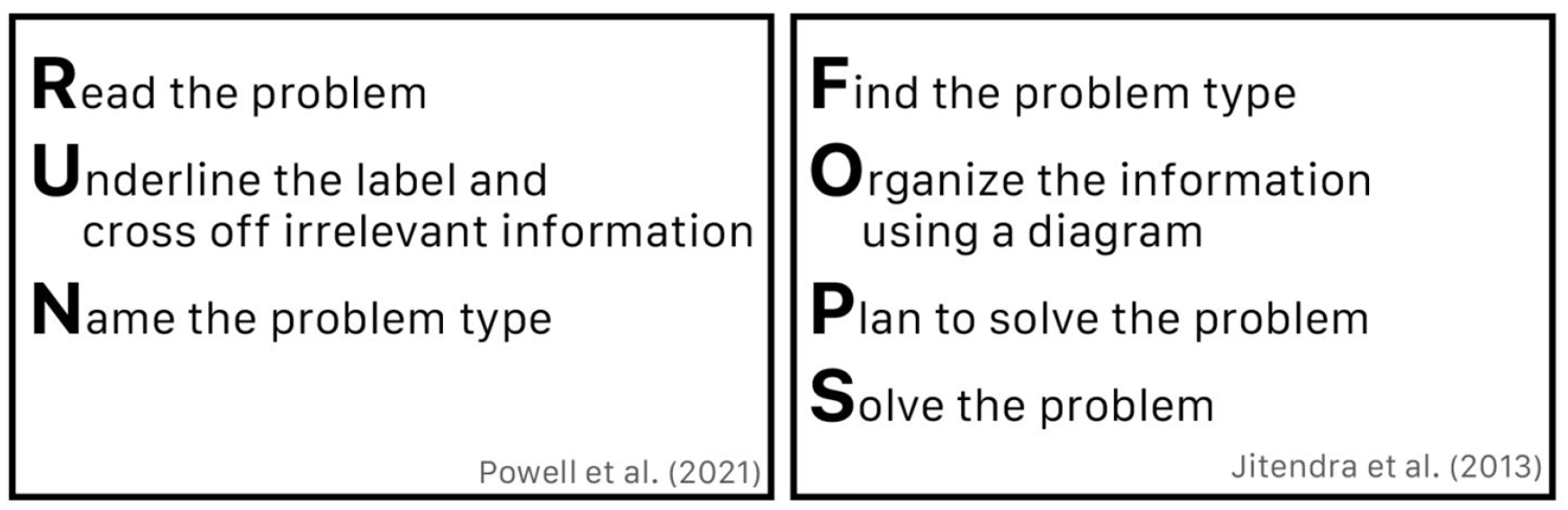
Verbal strategies for word-problem solving
In teaching students to use strategy instruction in the context of word-problem schemas, it is assumed that students have foundational skills in mathematics, such as those related to the computation in the word problems (e.g., math fact knowledge, multidigit computation skill, place value knowledge), and foundational skill in word and sentence reading and vocabulary comprehension. Using strategies such as RUN, FOPS, or other similar strategies is helpful for students with adequate skills in mathematics and reading but difficulty with the comprehensive, setting up, and solving of mathematics word problems.
Strategy Instruction in Practice
Consider the following example of strategy instruction in mathematics. In this example, the teacher uses a verbal strategy paired with a focus on the schemas of word problems to help students participating in a small-group mathematics intervention set up and solve a mathematics word problem.
Today, we’re going to learn a strategy to help us solve a word problem. What’s a word problem?
A problem with words that also has numbers in it.
Whenever you see a problem with a mix of numbers and words—a word problem—we’ll use a strategy to make it easy to work through the word problem. Here’s the strategy. It’s called UPSCheck. Say that with me.
UPSCheck.
Let’s say that again together.
UPSCheck.
This strategy—UPSCheck—should be used every time we want to solve a word problem. To help us remember to use UPSCheck, let’s write U, P, S, and C below the problem. [Write.] What’s the first letter in UPSCheck?
U.
U stands for “understand.” What does the U stand for?
Understand.
To understand a word problem, what should we do?
Read it!
Yes, we should read the problem to understand it. Let’s read it together.
“Rosie had some bracelets. Then, her friends gave her 12 more bracelets. Now, Rosie has 29 bracelets. How many bracelets did she have to start with?”
To better understand this problem, what’s this problem about?
Rosie and the bracelets.
It is about Rosie’s bracelets. Let’s underline bracelets to remember to focus on Rosie’s bracelets. What should we underline?
“Bracelets.”
So, we understand the problem and know it’s about Rosie’s bracelets. Let’s place a checkmark by the “U.” [Draw checkmark.] Now, let’s focus on the “P” of UPSCheck. That means we need to plan. What does it mean?
Plan.
We can make a plan by thinking about the schema of the word problem. Let me ask you a few questions. Is this a total problem with parts put together for a total?
No.
You’re right. It’s not a total problem. So, is this a difference problem with a greater amount and lesser amount and a difference?
No.
It isn’t a difference problem. Is this a change problem? Does an amount increase or decrease to a new amount?
Yes!
It is a change problem. How did you know?
Rosie had some bracelets, and then she got some more. That’s a change in the bracelets.
This is a change problem. Let’s use the change organizer to help set up and solve this problem. [Draw organizer.] Let’s check off the “P.” [Draw checkmark.] Now, let’s think about the “S” of UPSCheck. That means we need to solve. What does it mean?
Solve.
Let’s solve the problem by rereading the story and placing important information into the change graphic organizer. Let’s read the first sentence.
“Rosie had some bracelets.”
Do we know how many bracelets Rosie had to start with?
No!
We don’t know the start amount. We could mark that with a question mark in the start of our change organizer. [Write “?.”] Keep reading!
“Then, her friends gave her 12 more bracelets.”
12 is a number that talks about bracelets. Do you think we need that information to solve the problem?
Yes!
And what does the 12 bracelets tell us—the start, the change, or the end?
The change.
How did you know 12 talks about the change? Turn and talk to a partner, and then I’ll ask a few of you to share your ideas.
Rosie’s friends gave her bracelets. That means she got more bracelets.
Yes! Her friends gave her some bracelets, so Rosie has a change in her number of bracelets. Let’s write “12” in the change of our change organizer. [Write “12.”] Let’s check off the “12” to show we used “12” in our organizer. [Draw checkmark.] And is that change an increase or decrease?
Increase.
It is an increase, so let’s write a plus sign before the 12. [Write “+.”] Let’s keep reading!
“Now, Rosie has 29 bracelets.”
29 is a number that talks about bracelets. What does 29 tell us?
The end.
How did you know 29 is the end amount?
It says that’s how many bracelets Rosie has now.
We could write “29” in the end of the change organizer. [Write “29.”] Let’s check off the “29” to show we used “29” in our organizer. [Draw checkmark.] What information is in our organizer?
? + 12 = 29
How could we solve for the unknown?
Subtract 29 minus 12.
We could subtract 29 minus 12. What else could we do?
Figure out what to add to 12 to make 29.
Either way, what’s the value of the unknown?
17!
That’s right. Let’s write “17.” And what would be a good label for 17?
Bracelets!
Excellent. Let’s write “17 bracelets.” [Write “17 bracelets.”] What did we write?
17 bracelets.
We solved the problem. Let’s place a checkmark by the “S.” [Draw checkmark.] There’s one last step to UPSCheck. And that’s to check our work. What do we need to do?
Check.
How would we check our work? Turn and talk to a partner.
Make sure 17 plus 12 equals 29.
Yes! 17 plus 12 equals 29. But we have to make sure this calculation makes sense in the problem. How can we do that?
Reread the problem with our answer in it. “Rosie had 17 bracelets. Then, her friends gave her 12 more bracelets. Now, Rosie has 29 bracelets.”
Great. Does that make sense? If Rosie had 17 bracelets to start with and her friends gave her 12 more, how many would she have?
29 bracelets.
Yes! Our calculation was correct, and it makes sense in the problem. We checked our work! Let’s check off the “C.” [Draw checkmark.] Remind me again, what does UPSCheck stand for?
Understand, plan, solve, check.
We used that strategy of UPSCheck to help us work through a word problem.
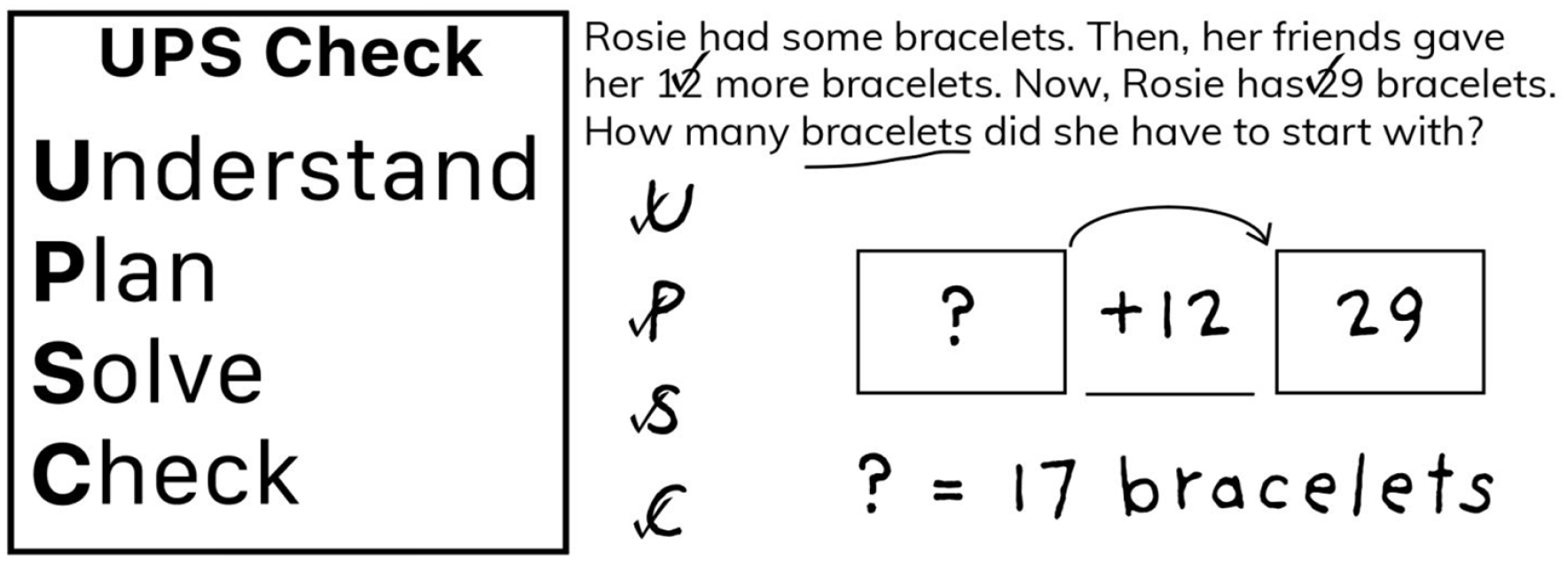
Strategy example with UPSCheck
Now that students have been introduced to UPSCheck, Ms. Cook makes a classroom poster of UPSCheck and models with her students how to set up and solve a word problem using the strategy. With many practice opportunities, she notices that Asher (and many other students) now have more confidence with approaching word problems. She also notices that with the focus on schemas, Asher and the other students understand the word problems better. They describe word problems by what happens in the story instead of thinking they need to just take two numbers from the problem and add them together. Ms. Cook is pretty happy with the strategy instruction in mathematics, so she wonders if such an approach could help Asher with reading.
Strategy Instruction in Reading
Ms. Cook has several students with LDs and with IEP goals in reading, including Asher, and all of these students experience challenges with reading words accurately and fluently. She noticed that their reading errors negatively impacted their reading comprehension, and she also noticed that reading was becoming more difficult for them as text they were assigned across subject areas became more complex and multisyllabic words occurred more often. Ms. Cook wondered if there were strategies that could help Asher and other students read more challenging texts. She came across resources that discussed strategies for reading complex and multisyllabic words.
“
Research
Strategy instruction has been applied to reading in several different ways. Perhaps the most recognizable way that it has been used is in teaching strategies for reading comprehension, such as graphic organizers, making predictions, main idea identification or summarization, text structure identification and story grammar, and comprehension monitoring. Most agree that some degree of comprehension strategy instruction is helpful to students (Elleman & Compton, 2017), and evidence indicates that teaching strategies like summarization and main idea identification are associated with improved reading comprehension (Stevens et al., 2019). However, we agree with scholars who have questioned the extent to which instructional time should be devoted to general reading comprehension strategy instruction, with concerns that this allocation of instructional time has come at the expense of time for teaching things that are arguably more important for reading comprehension, particularly, vocabulary and background knowledge (e.g., Catts, 2022; Compton et al., 2014). Additionally, numerous user-friendly resources exist for teaching reading comprehension strategies (e.g., Jitendra & Gajria, 2011; Shanahan et al., 2010), including several articles in TEACHING Exceptional Children (e.g., Brown & Pyle, 2021; Brum et al., 2019; Mason et al., 2006; Sanders et al., 2021), and there is little we could add to this topic beyond what is available.
A lesser known way in which strategy instruction has been applied to reading involves strategies for helping students read complex and multisyllabic words. Kearns and Whaley (2019), in a TEACHING Exceptional Children article, comprehensively discussed different approaches to helping students read longer words. Although many of these strategies have similar features and all have merits, we have focused the following on two interconnected approaches developed by Dr. Rolanda O’Connor (O’Connor, 2014; O’Connor, Beach, et al., 2017; O’Connor et al., 2015), BEST (
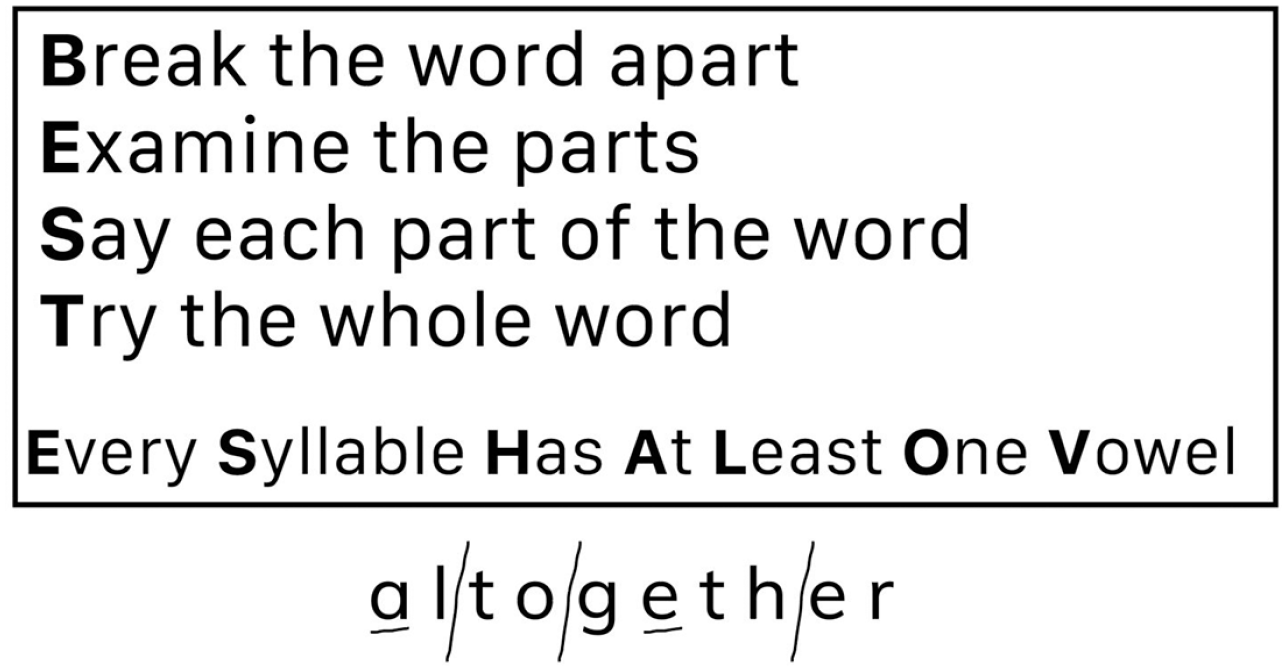
Strategy example with BEST and Every Syllable Has At Least One Vowel (ESHALOV)
Reading complex words is an important part of intervention for students with LDs beyond the initial grades. As students get older, they increasingly encounter multisyllabic words in the texts they are asked to read across subject areas. Our focus on strategies for reading complex and multisyllabic words aligns well with the strategies described earlier for solving mathematics word problems. When students encounter longer words in word problems, they must be able to decode the words to identify a schema and solve the problem. Learning to read complex words helps students build independence in solving word problems and independence in reading across subject areas. Additionally, reading and mathematics difficulties commonly co-occur for students with LDs (Peterson et al., 2017; Wilson et al., 2015); therefore, it is helpful for teachers to understand approaches to help support reading and mathematics skills simultaneously.
BEST and ESHALOV Strategies for Reading Multisyllabic Words
O’Connor’s BEST and ESHALOV strategies (O’Connor, 2014; O’Connor, Beach, et al., 2017; O’Connor et al., 2015) are approaches to reading multisyllabic words that help students break long words down into smaller parts. Long and complex words can be intimidating or confusing for students with LDs (Heggie & Wade-Woolley, 2017; Kearns & Whaley, 2019). By showing students how to break long words into more manageable chunks, such as syllables and words parts they already know, students can apply skills similar to how they “sounded out” and blended shorter words in beginning reading instruction. This can make reading longer words less daunting and more manageable for students with LDs.
BEST and ESHALOV were designed for students in middle elementary grades and beyond (e.g., Grade 3 through high school) who struggle reading words accurately and regularly encounter longer and complex words in the texts they are assigned. The strategies were employed in several studies that improved eighth-graders’ skills in reading history text (O’Connor, Beach, et al., 2017; O’Connor et al., 2015; O’Connor, Sanchez, et al., 2017). In teaching students to use BEST and ESHALOV, it is assumed that students have adequate skills in foundational letter-sound correspondence (i.e., they can associate single letters and most two-letter combinations with their most common sounds), are reasonably accurate in reading short words, have started to learn some prefixes and suffixes, and have learned high-frequency words. Said differently, BEST and ESHALOV are appropriate for students with adequate skills in foundational reading but struggle as longer and more complex words appear in the texts they are expected to read.
As Ms. Cook reads more about BEST and ESHALOV, she thinks these strategies could benefit Asher and other students with IEP goals in reading. Although her students have mastered reading most short and high-frequency words, they experience difficulty reading multisyllabic words accurately and fluently. Ms. Cook is also optimistic that if her students improve their word reading skills, they will be better equipped to solve mathematics word problems. She is excited to introduce BEST and ESHALOV to her students with LDs, but she needs to learn more about how to use these strategies before embedding them into her instruction.
Teaching BEST and ESHALOV
BEST and ESHALOV work together. BEST provides the overarching strategy for reading long words, and ESHALOV is a strategy within it that helps students learn to break words down into syllables. BEST involves the following steps. First, students break the word apart by looking for parts that they already know, such as prefixes, suffixes, and root parts of the word. To help break the word apart, students can draw slashes in the word to separate the parts they know. Next, students examine the parts. If they are unable to read some of the parts they identified in the first step, they break them down further into syllables. Then, students say each part of the word they have broken down, similar to how a beginning reader word say each letter sound in a shorter word. Finally, students try the whole word by blending the parts of the word together as a whole word.
ESHALOV is used in the second step of BEST (examine the parts), where students use it to break unknown parts of the word into smaller units. Students learn the acronym, ESHALOV (every syllable has at least one vowel), which is a very consistent rule in written English. To apply it, students first underline each of the vowels in the parts of the word they were not able to read (students should skip this step in any word parts they were able to read). Next, they join vowel pairs (i.e., “vowel teams”) together, such as joining “ea,” “oi,” “oo,” and “ee.” Students then look at the letters around the vowel or vowel pair to isolate syllables, drawing slashes to separate the syllables. These syllables can be read like smaller words. Students then proceed with the next steps of BEST, say each part and then try the whole word.
There may be several occasions in which students should be prompted to try an alternate pronunciation of a word part or the whole word. Sometimes, the pronunciation given by the most common sounds of the letters in the word will not result in a correct pronunciation of a word. Adjusting pronunciations to be correct is a necessary part of becoming a skilled reader. For example, students might use BEST and ESHALOV to read the word “numerous” but might initially pronounce it as “numb – er – us.” In this case, students can be prompted to ask if this sounds like a word they know. Some students might be able to make the adjustment. If not, the teacher can prompt students to try the long vowel sound for the “num” portion of the word, which will help them reach the correct pronunciation for “numerous.” Students’ ability to recognize when a word is pronounced correctly depends on having heard the word before; therefore, teachers can support the development of this skill by consistently providing vocabulary instruction and using important words orally in their instruction and interactions.
Strategy Instruction in Practice
Here is an example of how a teacher may support students with LDs using the BEST and ESHALOV strategies to read complex words. To demonstrate how this support can be integrated with mathematics instruction, the example represents an instance in which a challenging word, “altogether,” is encountered in a mathematics word problem.
In this word problem, we’ve come across a challenging word. Remember that we can use our BEST strategy to tackle it. What does the “B” stand for in BEST?
Break it apart.
Right! Break the word apart and look for parts you know. Are there any parts of this word that you know?
To!
Good, we can see that “to” is a part of this word. Let’s make slashes right before and after “to.” [Draw slashes.] Do you see any other parts you know? Think about the suffixes that we’ve learned. Does a suffix come at the beginning or end of a word?
The end.
Yes, a suffix comes at the end of a word. Do you see one of the suffixes we’ve learned so far?
“er.”
That’s right! This word has an “er” ending. So, that’s a word part we know. Make slashes before and after “er” to separate it from the rest of the letters in the word. [Draw slashes.] How many parts of the word do you know already?
Two!
Good, there are two word parts we know, “to” and “er.” Now, let’s move on to the next step in BEST. What letter comes next?
“E.”
Right, “E.” What does “E” stand for?
Examine the parts.
Yes! We examine the other parts of the word that we did not already know. We learned another acronym to help us do this. Who can tell us the acronym?
ESHALOV!
Which stands for—
Every Syllable Has At Least One Vowel.
Very good. Every syllable has at least one vowel. ESHALOV helps us look at the rest of the word and break it into smaller chunks, which will help us read it. When we use ESHALOV, what do we do first?
Underline the vowels.
Good, we underline the vowels. But remember, we only underline the vowels in the word parts that we did not already know. What parts do we already know?
“to” and “er.”
Right, so do we underline vowels in those parts?
No.
Very good. In the rest of the word, what is the first vowel we see?
“a.”
Yes, “a” is a vowel and occurs right at the beginning of the word. So let’s underline “a.” [Underline.] What’s the next vowel we see in the parts we don’t already know?
The “e” that comes after the “g.”
Yes! We see an “e” that occurs between a “g” and a “th.” So we underline that “e.” [Underline.] Are there any vowels left?
No.
Right, because the other vowels occur in word parts that we already know. The next step in our ESHALOV strategy is to connect vowel pairs. Who remembers what vowel pairs are?
Vowels that are right next to each other.
Very good! Do we see any vowels that occur next to each other?
No.
Excellent. Now, we know from ESHALOV that every syllable has at least one vowel, so we know that the vowels we underlined will refer to syllables in our word. The first vowel is “a.” What letter or letters occurs next to “a?”
“l.”
Right, “l” occurs right after “a.” And we can see that the “a” and “l” occur before our first known word part, “to.” So, it is possible that “al” is a syllable. Remember that we can read syllables on their own. Who has an idea of how to read “al?”
“all.”
Great! We could read “al” as “all.” Let’s remember that. Now, what was the next vowel we underlined?
“e.”
Good, what letters occur around “e?”
“g,” “t,” and “h.”
Yes! We learned some time ago that “t” and “h” together make one sound, who can tell us?
/th/.
Yes! /th/ as in “think” or “with.” So, “g” comes before the “e,” and “th” comes after. I think we are looking at a syllable here that is spelled “g-e-t-h.” Who can try to read this syllable?
“geth.”
Excellent! We could read this syllable as “geth.” Okay, we’ve done the steps of ESHALOV to examine the word parts; now, we can get back to our steps in BEST. We’ve done the “B” and “E” steps. Next is the “S” step. Who remembers what the “S” stands for?
Say the parts.
Good, “S” stands for say the word parts that we’ve identified. After we’ve done that, we do the “T” step in BEST, which stands for—
Try the whole word.
Right. So let’s do those two steps together. Let’s say the parts, I’ll say them with you—
Al – to – geth – er.
Good, again but a little faster—
Al – to – geth – er.
Yes! Now blend the parts to try it as a whole word—
Altogether.
Excellent! What word?
Altogether!
Great job. We just used our BEST and ESHALOV strategies to read a long word. Let’s read our word problem again.
Max and Zuri read 96 pages altogether. If Zuri read 65 pages, how many pages did Max read?
In this word problem, “altogether” means the total amount. What does “altogether” mean?
The total amount.
And what’s the total amount of pages that Max and Zuri read?
96.
Yes! Max and Zuri read 96 pages altogether. “Altogether” tells about the total number of pages they read.
Besides with the word “altogether,” BEST and ESHALOV can be applied to other multisyllabic words that appear in mathematics word problems, such as “centimeter,” “frequency,” “perimeter,” “proportion,” and “trapezoid.”
“
Ms. Cook continues to teach the strategies to Asher and other students with IEP goals in reading. She models how to use them across subjects, including language arts, science, social studies, and mathematics. She provides her students with plenty of opportunities to practice. After students practice BEST and ESHALOV several times with feedback, they are able to use these strategies to break down multisyllabic words as they appear in word problems.
Conclusion
For strategy instruction to be impactful for students with LDs, students require explicit instruction on the use of strategies (Pressley & Harris, 2006). Explicit instruction involves teacher modeling of the strategy (often through think-alouds) with many practice opportunities for the students (Powell et al., 2023). During both modeling and practice, the teacher needs to engage students in the strategy instruction by dialoguing, frequently asking students to share their ideas, and providing feedback to students. When introducing a new strategy, teachers should consider whether it is necessary to teach a strategy in isolation or whether the strategy instruction could occur in the content of an academic lesson. After becoming proficient with a strategy, students will likely need practice and support on knowing when to use a specific strategy or how to select the most efficient strategy to solve a specific type of problem.
In mathematics, strategy instruction can provide students with a step-by-step process for approaching a complex problem, such as multidigit computation or word problems. We provided an example of strategy instruction for word-problem solving because this is a topic in mathematics that is difficult for many students, including students with LDs (Kingsdorf & Krawec, 2014). In reading, strategies can refer to a number of things, such as reading comprehension strategies. We focused on strategies for helping students read multisyllabic words, which is a common source of difficulty for students with LDs (Heggie & Wade-Woolley, 2017). Teaching students strategies for reading long and complex words is important for helping them build independence in reading and improve their ability to learn from text across language arts, science, social studies, and mathematics, especially as texts become increasingly more difficult as grades increase. In both mathematics and reading, strategy instruction may be a viable approach for setting elementary students with LDs on the pathway to academic success.
Footnotes
Declaration of Conflicting Interests
The author(s) declared no potential conflicts of interest with respect to the research, authorship, and/or publication of this article.
Funding
The author(s) disclosed receipt of the following financial support for the research, authorship, and/or publication of this article: This research was supported in part by Grant R324A200176 from the Institute of Education Sciences in the U.S. Department of Education to the University of Texas at Austin. The content is solely the responsibility of the authors and does not necessarily represent the official views of the U.S. Department of Education.
