



Abstract
Mr. Yen, the district’s teacher of students with visual impairments (TSVI), walks into Mrs. Sanchez’s third-grade classroom. It is a couple of weeks before the start of a new school year. Mr. Yen has a student in Mrs. Sanchez’s class, Amber, who was born prematurely and is visually impaired from retinopathy of prematurity. She uses both print and braille but has been transitioning to using braille more frequently, especially when more sustained reading is required.
Mrs. Sanchez is known in the school for her dedication to inclusion and often helps other teachers think through how to design their classroom instruction to embrace all learners from the start, but she has never had students who use braille in her class before. She reached out to Mr. Yen so that they could plan how they will collaborate. Mrs. Sanchez prioritizes creating a sense of belonging for students in her classroom. Mr. Yen is excited to hear of Mrs. Sanchez’s focus on belonging. Some of the students on his caseload have expressed feeling isolated or singled out as different by the way their teachers have made accommodations. This has led some of his students to resist using tools and supports that they need. Mr. Yen and Mrs. Sanchez grab some coffee and begin their meeting by reviewing Amber’s individualized education program (IEP).
Introduction
Mrs. Sanchez embraces the concept of inclusion and is excited about having Amber in her classroom. She wants to do her best to make sure all students feel welcomed, valued, and successful, including Amber. Mrs. Sanchez, like many classroom teachers who work for the first time with a student with a low incidence disability (e.g., deaf or hard of hearing, blind or low vision, multiple disabilities), feels apprehensive about how to effectively include and guide the student in learning.
For students with visual impairments who are braille readers, a lack of understanding of the tactile writing system they use (i.e., braille) can create barriers to a fully inclusive experience where these students feel part of the learning community. Through a review of various models, Loreman (2017) identified common components of inclusive pedagogy that make up a truly inclusive classroom. These components included the creation of meaningful learning experiences for all learners, flexibility that allows modification of the curriculum, and instructional strategies that address students’ needs and maximize learning in a way that honors differences without singling out individuals. A classroom environment where the teacher is able to guide students in goal-directed learning, good communication, and collaboration are also important aspects of building community that facilitates inclusion (Loreman, 2017). The Universal Design for Learning (UDL) guidelines provided by CAST (2024), which guide teachers to consider multiple means of engagement, representation, and action and expression, was one of the models in Loreman’s critical analysis (Version 2.2).
CAST’s UDL guidelines draw from evidence-based practices and are updated as new research emerges. Engagement includes considering multiple ways to motivate students, sustain learning efforts, and support emotional capacity. The Version 3.0 guidelines (CAST, 2024) now have a more direct focus on making sure all students feel that they belong by addressing biases and understanding and welcoming the intersection of various identities students bring to the environment. Representation involves providing various avenues for accessing the learning in the classroom, considering perceptual channels (e.g., tactual, auditory, visual), language, and multiple ways to build knowledge. It includes a focus on recognizing multiple ways of knowing and the diversity of perspectives. Action and expression involve the teacher providing various means for students to demonstrate their learning. This includes providing access to a variety of tools, technologies, accessible materials, and choices and supporting strategy development and self-monitoring (CAST, 2024).
Of Loreman’s (2017) findings, the idea of supporting learners’ needs without signaling them out is an important one. In a systematic review of studies, Augestad (2017) found that having social support and friendships were some of the factors contributing to better self-concept and self-esteem of children and youth with visual impairments. In contrast, students with visual impairments interviewed after experiencing a trained peer tutor intervention to access physical education were dismissive of the strategy as not facilitating a natural feeling of belonging but, rather, being identified as needing help (Haegele et al., 2024). The importance of sense of belonging seems to span across age levels and now is explicitly mentioned in the CAST (2024) Version 3.0 UDL guidelines. Keyes (2019), from interviews with high school students, identified that students felt a higher sense of belonging when teachers could construct a positive learning environment and build relationships with students and among students. In addition, Keyes and Heath (2023) found that teacher practices such as having clear structured lessons and organization contributed to students feeling that they were part of an engaged classroom of learners. Sense of belonging, in a study of college students, was found to significantly predict the use of self-regulated strategies such as seeking help with learning (Won et al. 2021). Similarly, Slaten et al. (2019) found a strong relationship between belonging and resiliency of youth ages 9 to 14 and their self-efficacy and self-regulated learning.
As indicated in the research, students with disabilities benefit from feeling a part of their classroom community. They may also be more likely to take ownership of their learning. With this in mind, the aim of this article is twofold: to provide classroom teachers with (a) knowledge and strategies to meaningfully engage the braille reading student in classroom instruction and activities and (b) to do so in a way where a sense of belonging is authentic.
Designing an Inclusive Classroom That Includes a Braille Reader
After reviewing Amber’s IEP, Mrs. Sanchez jots down a three-step process that she and Mr. Yen decided would be helpful in getting ready to welcome Amber. First, Mrs. Sanchez wants to better understand braille and how braille students learn and engage with content. Then, she and Mr. Yen can analyze the classroom environment. Finally, using what they know about the classroom and Amber, Mr. Yen and Mrs. Sanchez will brainstorm strategies that align with the three main principles of the UDL model: designing multiple means of engagement, representation, and action and expression. Mrs. Sanchez has already begun planning her classroom using these principles, but she wants to make sure the unique needs of Amber as a braille learner are adequately included in her plan. In addition, given the importance of a classroom community, both Mr. Yen and Mrs. Sanchez agree that enacting a sense of belonging should be in the forefront of their planning and collaboration when making instructional and strategy decisions. They also note that once school starts, Amber should be consulted about their initial strategy selection and included in future decision-making as part of her own self-determination.
Step 1: Understanding the Braille Learner
Braille as a tactile writing system
In the first step of Mr. Yen’s and Mrs. Sanchez’s planning process, Mr. Yen explains some basics about braille, its unique features compared to print, and tools and adaptations a braille-using student might have or use. In addition, Mr. Yen describes to Mrs. Sanchez his collaborative role with her in the literacy development of Amber.
Unified English Braille (UEB) is not a language. Braille represents English in the same way that print represents English. Currently, braille is referred to as a “tactile writing system” (i.e., a standardized system of raised symbols that represent a language, in this case, English; Englebretson et al., 2023). Braille uses a symbol system made up of dots arranged in a six-dot cell, two horizontal and three vertical ( ), and exists in two formats, uncontracted and contracted braille (see
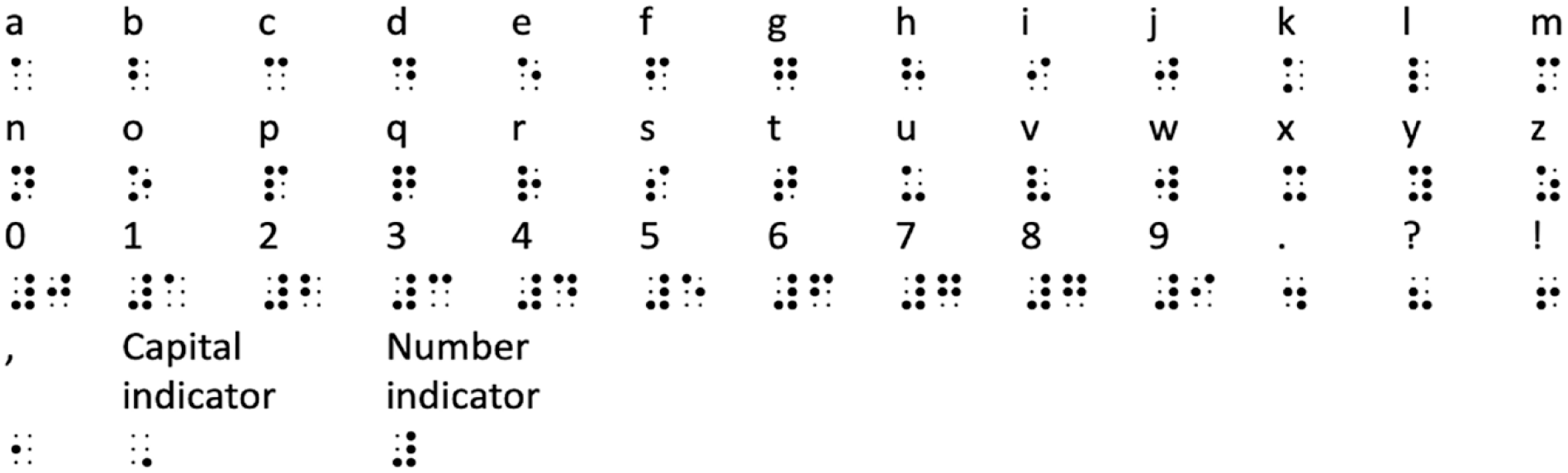
Braille alphabet, numbers, and basic punctuation
Uncontracted (sometimes called Alphabetic Braille) is written with a one-to-one letter correspondence; each cell represents one and only one letter. Uncontracted braille is not widely used in schools for reading and writing instruction (Wall Emerson et al., 2009). Contracted braille, on the other hand, consists of cells that may represent a single letter, more than one letter, or an entire word. For example, the word “still” is written as a single braille character ( ). Likewise, when the two-letter combination “ar” is contained in a word, it is written as a single braille character (
 ). There are 180 contractions in UEB grouped into nine categories with their own set of rules and exceptions to rules (governed by the International Council on English Braille). Most children begin braille reading and writing instruction with fully contracted braille. Evidence from a longitudinal study suggests that teaching fully contracted from the beginning of reading instruction results in young readers who score higher on common reading assessments, which adds to the suggestion that contractions are an integral part of the braille writing system rather than merely a representation of print letters (Wall Emerson et al., 2009). For a comparison of a contracted and uncontracted braille sentence, see
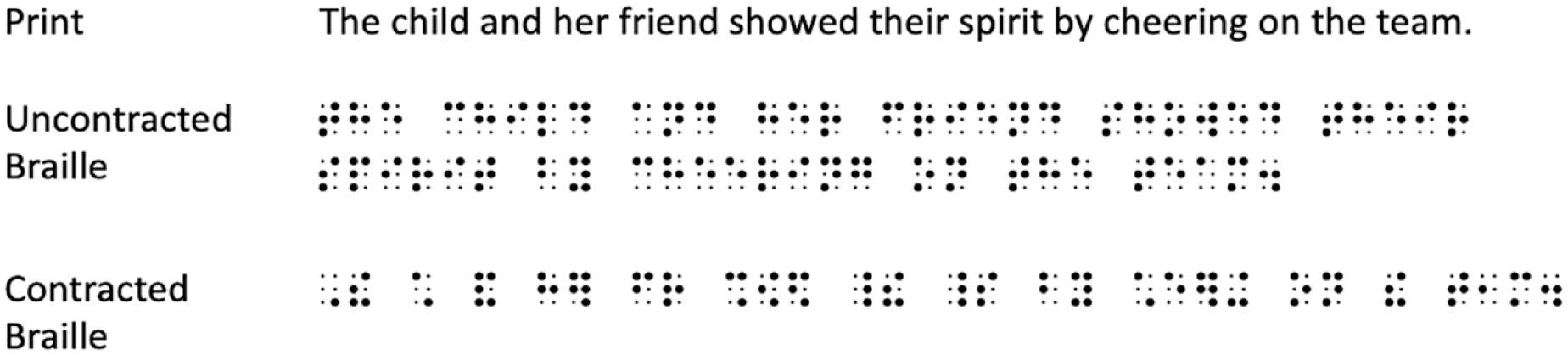
Example of sentence written in print, uncontracted braille, and contracted braille
How is braille read and taught?
In a longitudinal study of the use of contractions in reading development, braille reading students exhibited difficulty (in comparison to their print-reading peers) in fluency, vocabulary, and concept development (Wall Emerson et al., 2009). This finding is an indication that students using braille need evidence-based reading instruction as much as any other student in the classroom in addition to braille-specific skills (e.g., learning contractions, learning proper hand movements for optimal reading). Teaching braille reading and writing is a primary responsibility of the TSVI, like Mr. Yen, in collaboration with other members of the child’s educational team (e.g., general education teacher, special education teacher, literacy coach). Direct, ongoing, consistent instruction by a teacher qualified in knowledge of the tactile writing system and effective teaching strategies is critical and will be strengthened by involvement of all team members, including parents and family members. Some team members will be involved in a co-teaching partnership (e.g., classroom teacher) with the TSVI, whereas others will provide important practice and reinforcement of new skills.
In a Delphi study exploring the instructional needs of braille reading students from a qualified teacher (i.e., TSVI), consensus was reached among participants that students at the beginning level require high-consistency (daily contact) instruction lasting 1 to 2 hours per session throughout approximately 3 years (kindergarten through third grade). It is important to remember that at this level, students are learning how to read and write using braille, and these results are similar to instruction provided for students who are beginning to learn how to read and write using print (Koenig & Holbrook, 2000).
In addition to instruction in reading and writing, specific support the TSVI provides through direct instruction includes refining tactile skills (e.g., smooth movements, two hands reading the braille, light touch) and supporting background knowledge and concept development, an important part of understanding what is read (Koenig & Holbrook, 2000; Swenson, 2015; Wormsley & D’Andrea, 1997). Many concepts are learned by students incidentally through visual observation (e.g., watching a parent cook, looking at pictures in a book). Loss of information incidentally requires concepts to be built more purposefully and directly (Guerette, 2014). The classroom teacher who understands this aspect of having a visual impairment can enhance the classroom by providing such immersive experiences, which, in turn, will benefit other students as well.
Because blindness is a low incidence disability, it is likely that the student’s classroom teacher has not had experience teaching reading and writing to a child who will use braille. It is therefore important that the TSVI provide support and suggestions for the student’s inclusive literacy program in addition to specialized direct instruction.
Tips for Partnering With the TSVI to Include Braille Readers in the Classroom
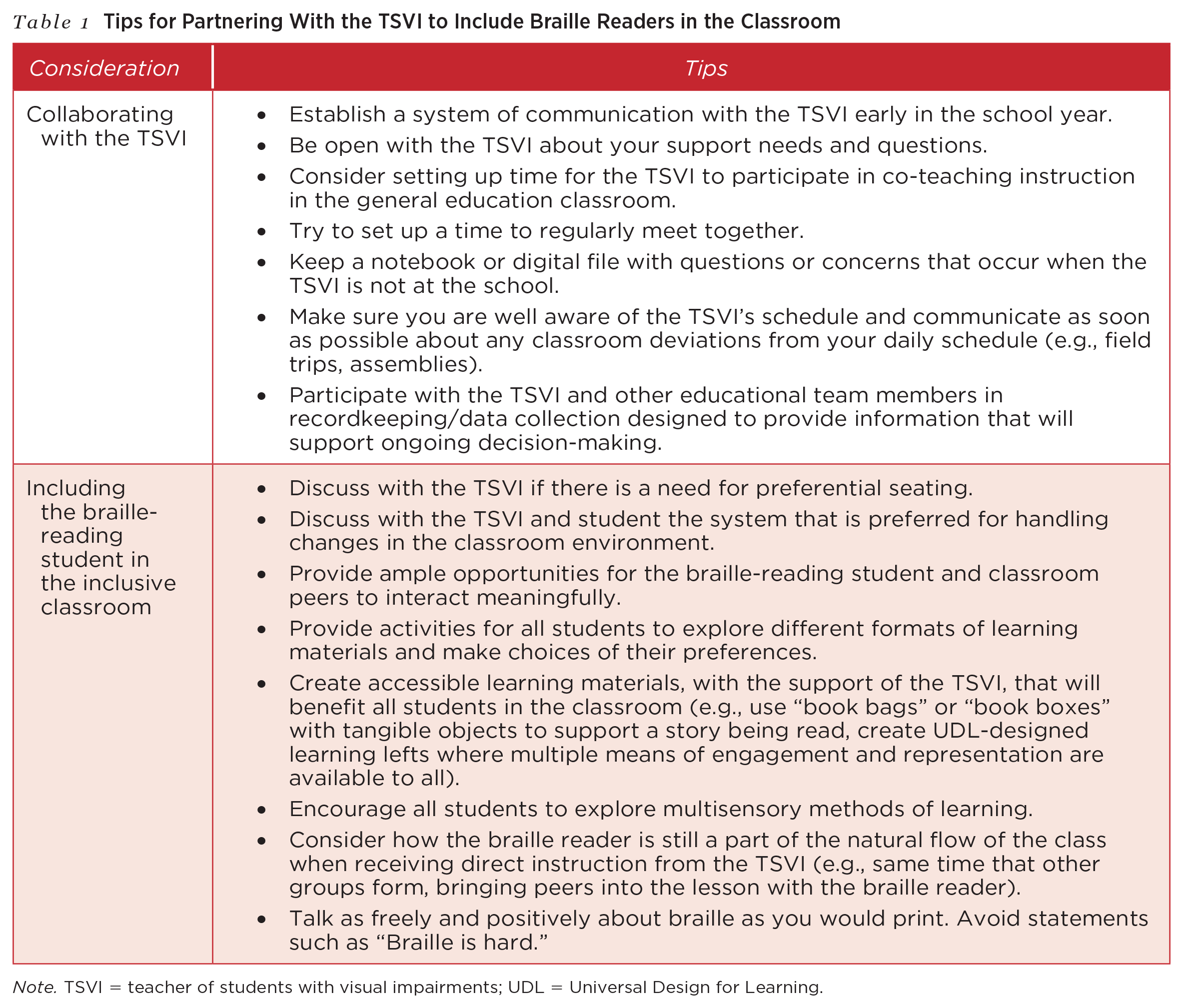
Note. TSVI = teacher of students with visual impairments; UDL = Universal Design for Learning.
Considering the braille learner holistically
After explaining some general information about braille readers and their literacy needs, Mr. Yen emphasizes that instructional strategies will vary based on other individual characteristics of the student. For example, he highlights that because Amber is a dual-media learner, using both print and braille, her needs will be different from a student who uses only braille. For example, she might use vision to understand spatial layouts of math problems but use a tactile graphic to understand a bar graph. He explains that part of their brainstorming will be how and when Amber will use braille and print and ways to encourage Amber learning to make informed decisions about her media choice based on the type of tasks in which she is engaging.
Students with blindness and low vision are a diverse and heterogeneous group. Planning for inclusion must consider individual students’ needs. Students with low vision who use braille and print are referred to as “dual-media learners.” When dual-media learners, like Amber, begin braille instruction in conjunction with print reading depends on their level of vision, print reading speed, and stamina, among other factors (Herzberg et al., 2017). One challenge for dual-media learners is getting enough practice in both media, especially in braille, to become proficient. The classroom teacher can be a great support for these students by finding ways to promote both media throughout the day for that student and in conjunction with the TSVI, helping the student learn to select the media that fits them best for efficiency with particular tasks.
Another group of students a classroom teacher may encounter are students who have established literacy skills in print but now need braille due to a change in visual status. This group differs from students who were blind from birth because they already know how to read and will be learning the writing system to replace or supplement their ability with print. These students will benefit from support during this transition time, including multiple means to engage with materials while their braille reading skills are still in development. Although each individual will be different, auditory skills with less visual input may also still be in development.
Students who are blind with multiple disabilities or significant cognitive challenges are a group that may be erroneously overlooked for literacy development. The classroom teacher in conjunction with the team can be an advocate for literacy experiences for these students. Wormsley (2011) proposed an individualized meaning-centered approach to braille literacy education that helps students learn functional braille reading skills if traditional braille literacy programs are not yet accessible to them. This method, based on starting with highly motivating words that are meaningful to the student and systematically helping them identify those words by shape/pattern, has shown success for students with cognitive challenges to begin learning braille (Erin, 2011; McMillan, 2015; Schles, 2015).
Mr. Yen is excited to brainstorm with Mrs. Sanchez about how the opportunities for braille and braille literacy instruction will be embedded in the classroom for Amber. Mrs. Sanchez’s expertise as a classroom teacher will provide important insight. He presents Mrs. Sanchez a checklist that he created to help document the individual needs of braille learners, including the different technology and adaptations they might use, which he begins to describe to Mrs. Sanchez next.
Although not an exhaustive list,
Checklist for Gathering Information About the Braille-Using Student When Designing Inclusive Classroom Experiences
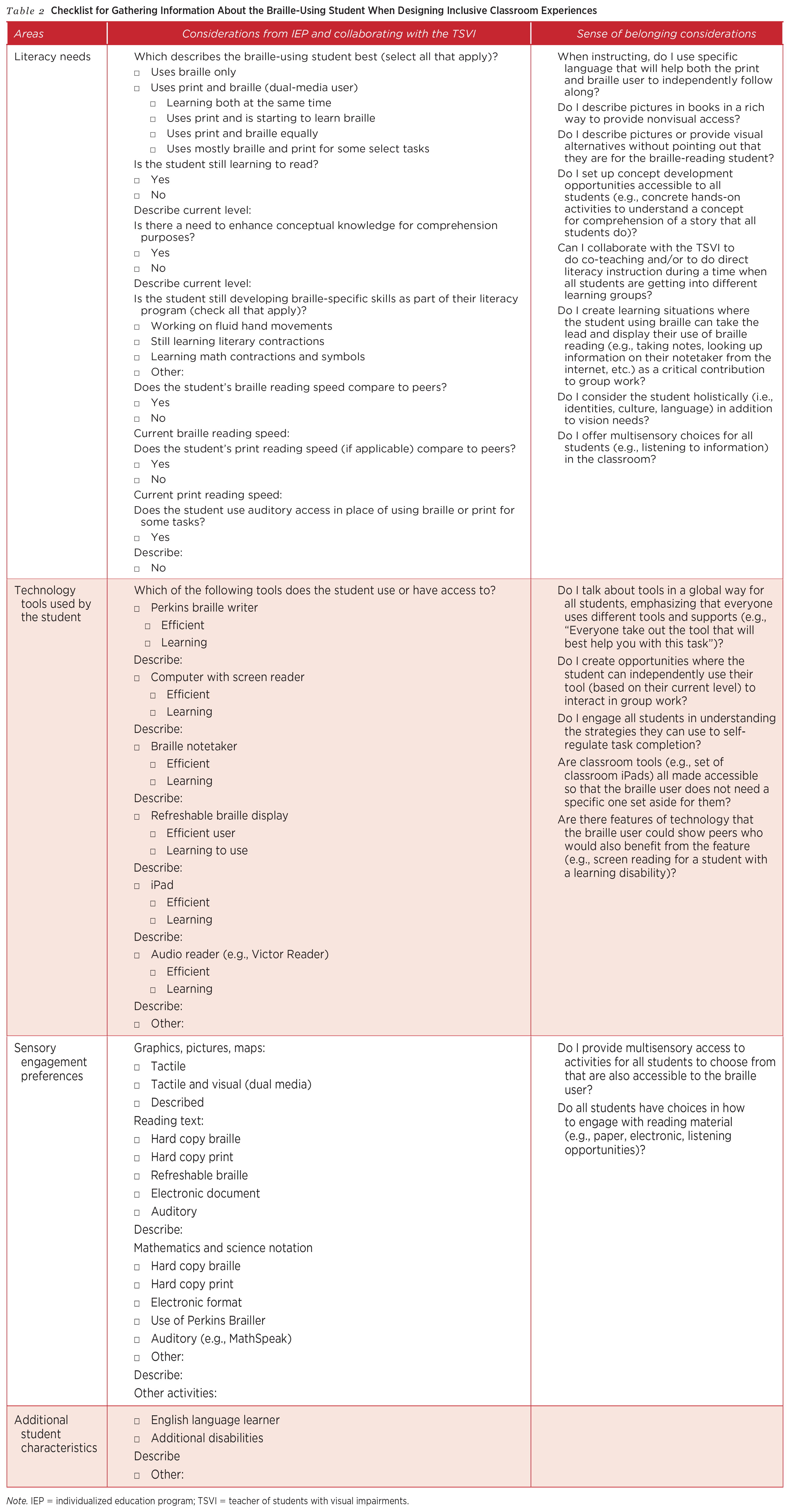
Note. IEP = individualized education program; TSVI = teacher of students with visual impairments.
Technology for braille
Technology has and continues to rapidly evolve in ways that have been beneficial to students with visual impairments. Understanding a bit about how some of these technologies are used to access classroom materials through braille can support the classroom teacher in guiding student learning. Such knowledge also helps the student to feel supported and feel that they are part of the classroom (Opie, 2018). In the area of braille reading and writing, along with hard copies embossed on a braille printer or the use of a Perkins braille writer, students may use braille notetakers and refreshable displays to access and create electronic documents.
“Refreshable braille” refers to an electronic system in which plastic pins pop up in the dot configurations that represent what is written in an electronic document at the placement of the cursor. As the reader moves through lines, the pins continually change to show what is next written. Currently available refreshable braille technology displays 14 to 80 characters at a time, depending on the model, in a single line and can be linked with tablets, computers, and phones. In addition, a new device, the Monarch, has recently launched and provides 10 lines of 32 cells for continuous braille and instant access to tactile graphics (American Print House, 2024). McCarthy et al. (2023) found that reading speeds using refreshable braille did not differ significantly from paper-based formats, indicating it is a viable option. Time spent in literacy instruction with the classroom teacher and the number of cells on the refreshable braille display, among other factors, contributed to reading speed rates.
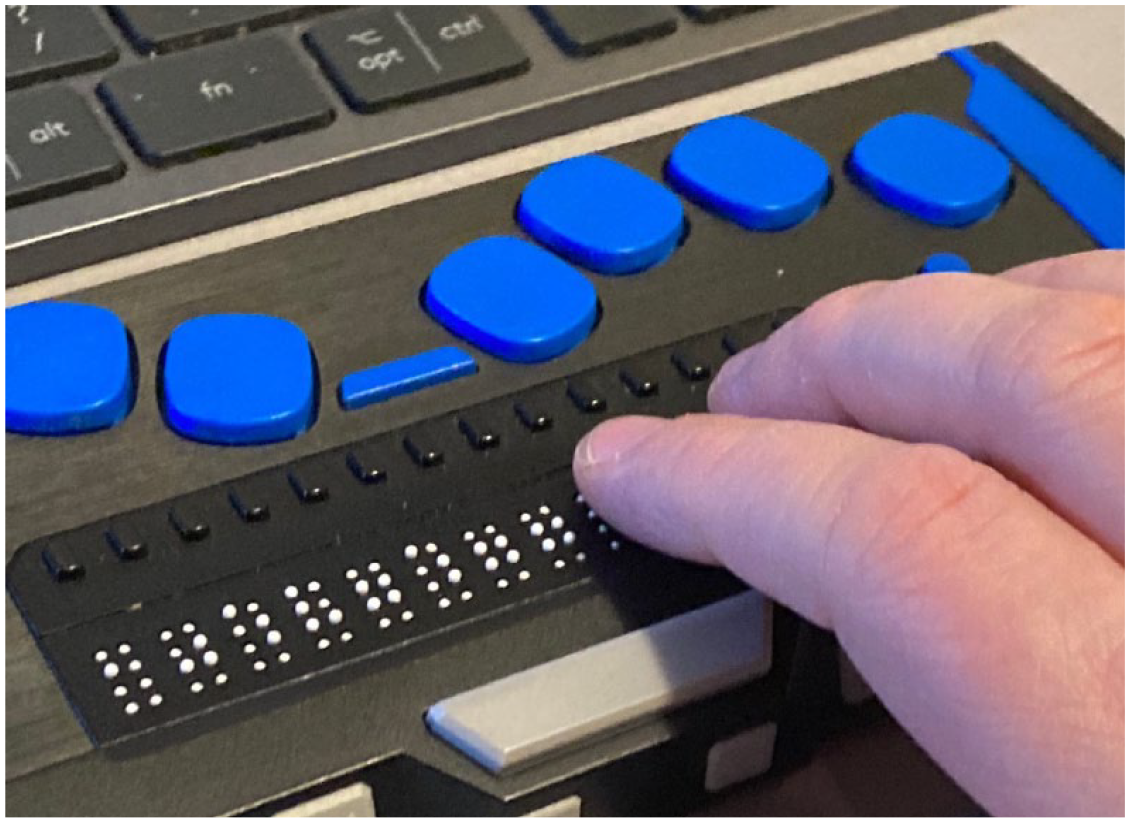
Picture of a refreshable braille display
Braille notetakers are stand-alone devices that function like a portable computer. Most have six-key entry (one key for each of the dots in a braille cell) for writing braille, but some have full QWERTY keyboards for individuals who prefer touch typing. Students can access email and the internet, organize files in folders, and use the calculator function, among other features, on braille notetakers. The features available on a braille notetaker are also available on a computer or tablet. Most notetakers, however, also contain built-in refreshable braille displays, which can be linked to other devices. Some have tablets built into them that will also display print, which can facilitate the classroom teacher giving feedback to the student.
Choice of and direct instruction in the use of various technologies is the responsibility of the TSVI. Ways that the classroom teacher can support the student using braille devices in the classroom can also support the inclusion of other students. For example, making sure that any electronic documents are made accessible will facilitate the information being displayed properly. Even the most advanced device will not compensate for inaccessible documents (for more information about accessible documents, see “Step 2: Analyzing the Environment”). Providing written feedback on assignments in an electronic format will also facilitate the student’s ability to independently access it. Although not a focus of this article, students with visual impairment also use auditory output (e.g., screen readers, book readers), and accessible materials are important for that technology as well. Classroom teachers can also encourage use of technologies in the classroom as a regular part of how all students learn and access information.
Braille readers will have a range of tools that they will use to access technology. As reading requirements increase with the grade levels, students will read some documents or books using speech output or audio books while choosing to use braille for other reading tasks. The classroom teacher can help a braille reader develop their self-regulation skills in determining when one option may be better than another given the task. For example, if the class is working on editing skills, the braille reader may benefit from using their refreshable braille display along with speech output to better find mistakes in spelling rather than just using speech. If reading fluency skills are being worked on in the context of engaging with text, refreshable braille would also be preferred over only auditory output. There will also be times when hard-copy (embossed on paper) braille will be better than using a device, such as for tasks where seeing more than one line of text at a time will facilitate understanding (e.g., comparing text between two paragraphs) or when understanding the spatial layout of a math equation is important.
Technology can be very useful to facilitate collaborative learning with other students in the class. The TSVI and the students themselves can help brainstorm the best combination of high- and low-tech tools to use to accomplish the groups’ goal in a cooperative format. For example, a student who is blind might offer to use their braille notetaker to keep track of the group’s discussion. The document could then be printed for all group members. Auditory output or screen reading could be used for the benefit of all students to listen to a passage or to alternate listening with reading for an activity.
Tactile graphics
Closely connected to braille reading and writing in the classroom is the use of tactile graphics for accessing science, technology, engineering, and mathematics (STEM) content and socials studies content. Visual representations of core content, particularly in the STEM areas, are prolific, so it is important to consider how students accessing information without vision or with low vision gather that same information while remaining part of the learning community (Zebehazy & Wilton, 2014b). Tactile graphics may be part of produced braille textbooks the student has or may be created by the TSVI when requested, or even the classroom teacher can make collage-style graphics for the student (e.g., use of Wikki sticks and other tactile materials to build the graphic) that would be accessible to everyone.
The production methods of graphics include paper-embossed graphics, capsule cell graphics (paper that puffs up when heated), thermoform graphics (plastic heated over an object or tactile graphic to create a sturdy raised graphic), among other methods.
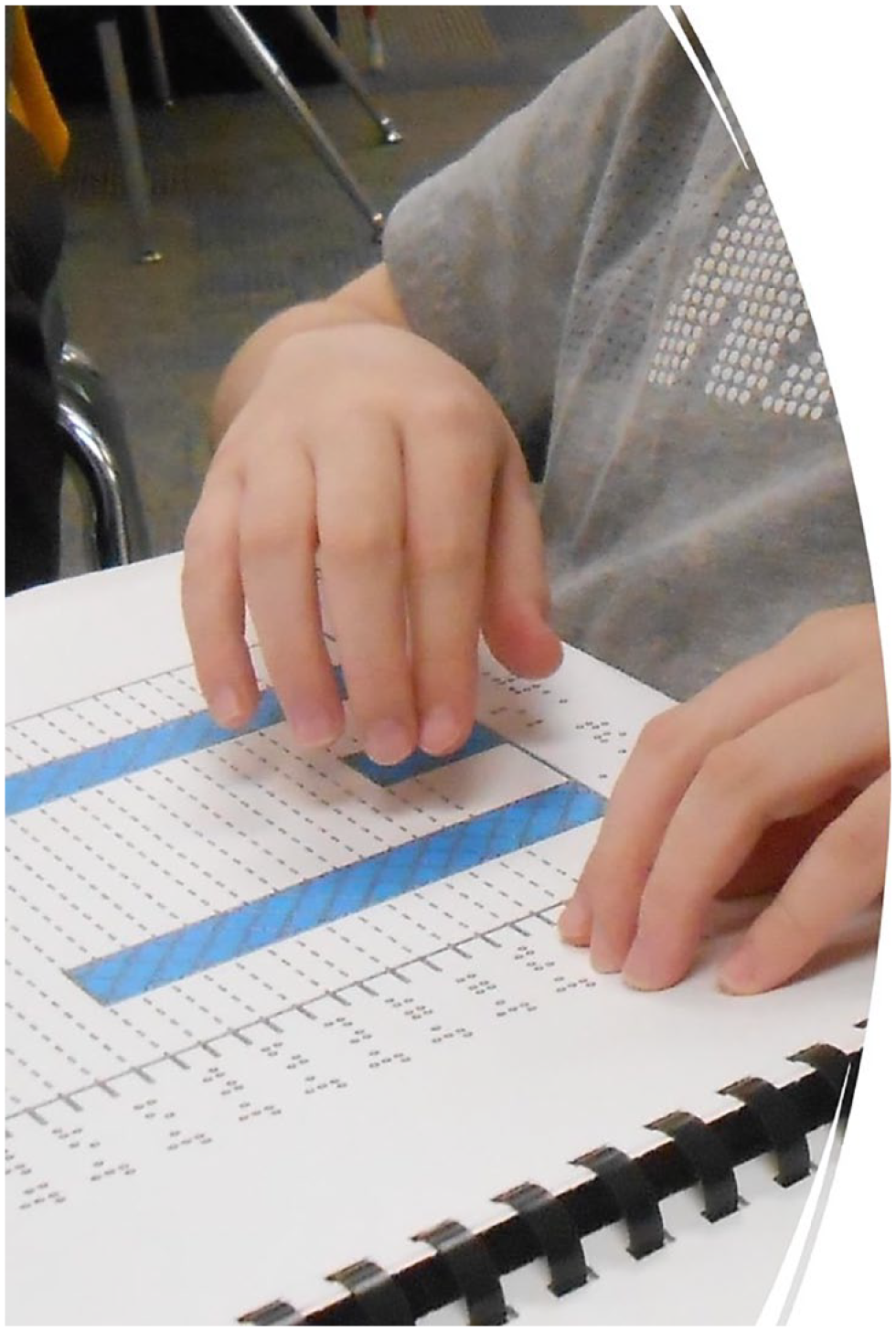
Student engaging with a graphic that is both tactile and visual
It is important for classroom teachers to understand some aspects of tactile graphics to facilitate their use during lessons. The tactile sense must work from part to whole, whereas vision takes in the whole right away. This means that students who use tactile graphics will often need some priming of the graphic to understand the layout and will need to develop systematic skills to piece together the information in a graphic (Rosenblum et al., 2021). The hand movements needed for reading a graphic are more varied than those used for reading braille text. Preteaching of graphics, helping the braille student and all students understand the similarities and differences of different graphic types (e.g., bar graphs, line graphs, Venn diagrams), and providing verbal descriptions of the graphics during the lesson can help facilitate students using graphics alongside their peers (Rosenblum et al., 2018). Opportunities to practice are important, including creating graphics. The important act of creating one’s own graphics is often overlooked for students who use tactile graphics (Zebehazy & Wilton, 2014a, 2014b). Having tactile materials available in the classroom that students can use to make graphics when their peers are making them will support inclusion and help students better understand the components of graphics and what types of information they present.
Considerations and Tips for Incorporating the Use of Tactile Graphics and Manipulatives in the Classroom
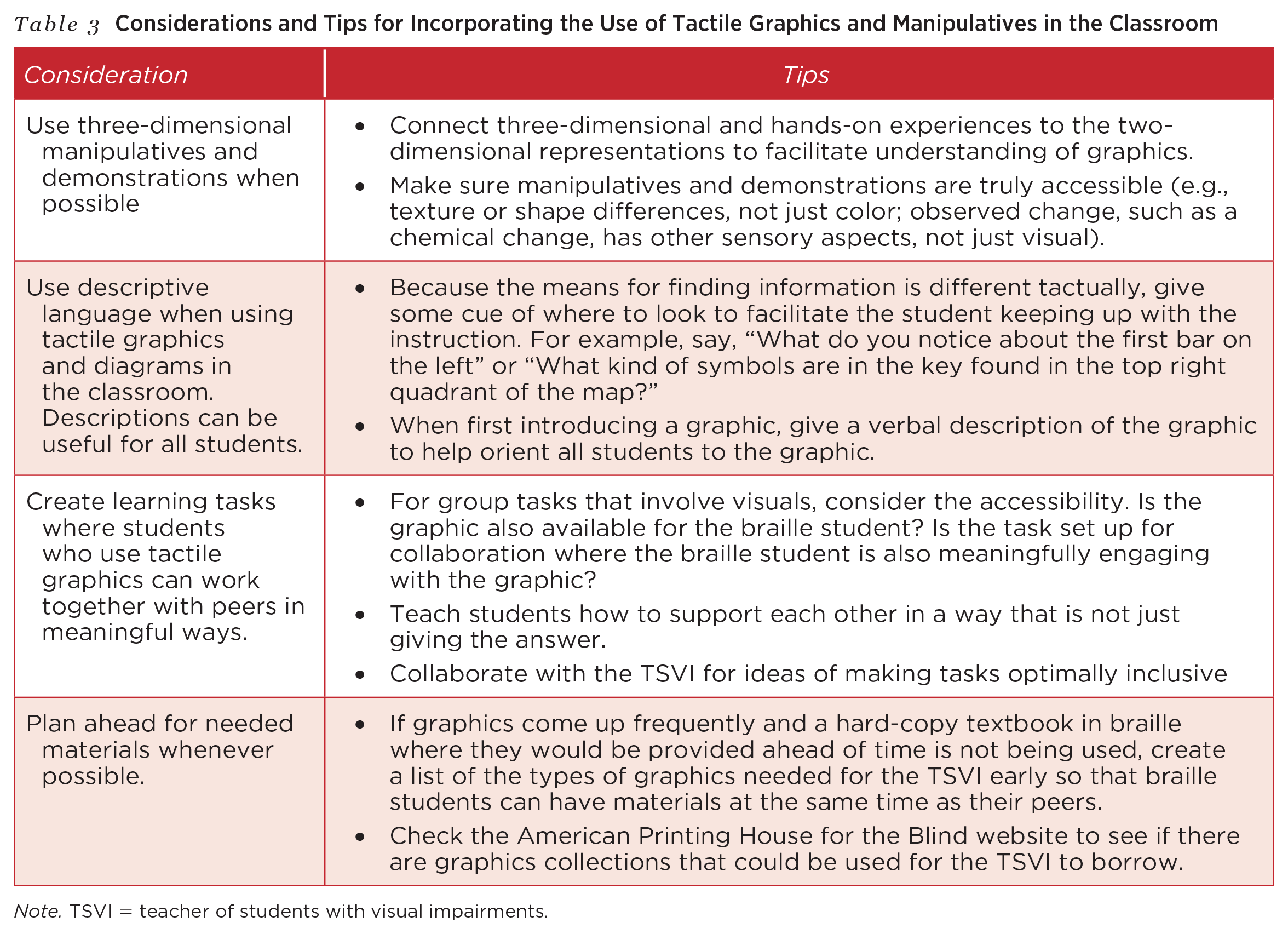
Note. TSVI = teacher of students with visual impairments.
Step 2: Analyzing the Environment
As the next step in the planning process, Mr. Yen and Mrs. Sanchez conduct a walk-through of Mrs. Sanchez’s classroom and discuss her teaching style to generate further ideas of fully including Amber in a way that is natural, UDL advised, and focused on belonging. Mr. Yen explains that an environmental analysis includes more than just the physical environment. The classroom community and how the students and teacher interact and communicate with each other is equally important. From experience with other students with disabilities in her classroom, Mrs. Sanchez knows that even small, subtle changes in the way that activities are structured and feedback is given could make a big difference in being more inclusive in a way that made students feel like they belonged.
The physical environment
For students with visual impairments, freedom to move around and engage in their classroom environment and with their peers in learning activities can be restricted in various ways, the first being physical barriers in the classroom arrangement. For students with visual impairments, particularly those who use a cane for mobility, consistent layout of the classroom with clear pathways is a good starting point to promoting a sense of belonging and agency in the classroom. The classroom teacher who makes sure that classroom areas are identifiable from the start and not as an afterthought (e.g., braille and large-print labels, use of tactually distinct features to identify needed materials or locations) sends a message of belonging.
Accessible materials in the environment are also a way to make sure the physical aspect of the classroom is inclusive. This includes having materials that allow for multimodes of engagement for all students in activities. Examples include three-dimensional models or print/braille tactile graphics that allow for sighted students and students with visual impairments to collaborate using the same material. Another important example is having electronic documents (e.g., Word, PDF, PowerPoint) created with accessibility in mind from the beginning so that searching the document with screen readers or refreshable braille displays works properly From an inclusive perspective, well-made electronic documents will support many students in the classroom and reduces the need to “retrofit” access later by the TSVI. If the goal is to support a sense of belonging, an abundance of inaccessible materials that create barriers for the student to engage in the same activities at the same time as their peers sends an opposite message of belonging.
Singleton and Neuber (2020) observed and interviewed university-level students with visual impairment and identified what were some of the most useful navigational elements in accessible documents. These included alternative text descriptions for pictures and images, use of headings, linked table of contents, use of page numbers for longer documents, search and find capabilities, clear page layout and design, and hyperlinks that stand out.
Resources for Learning How to Make Digital Documents and Media Accessible
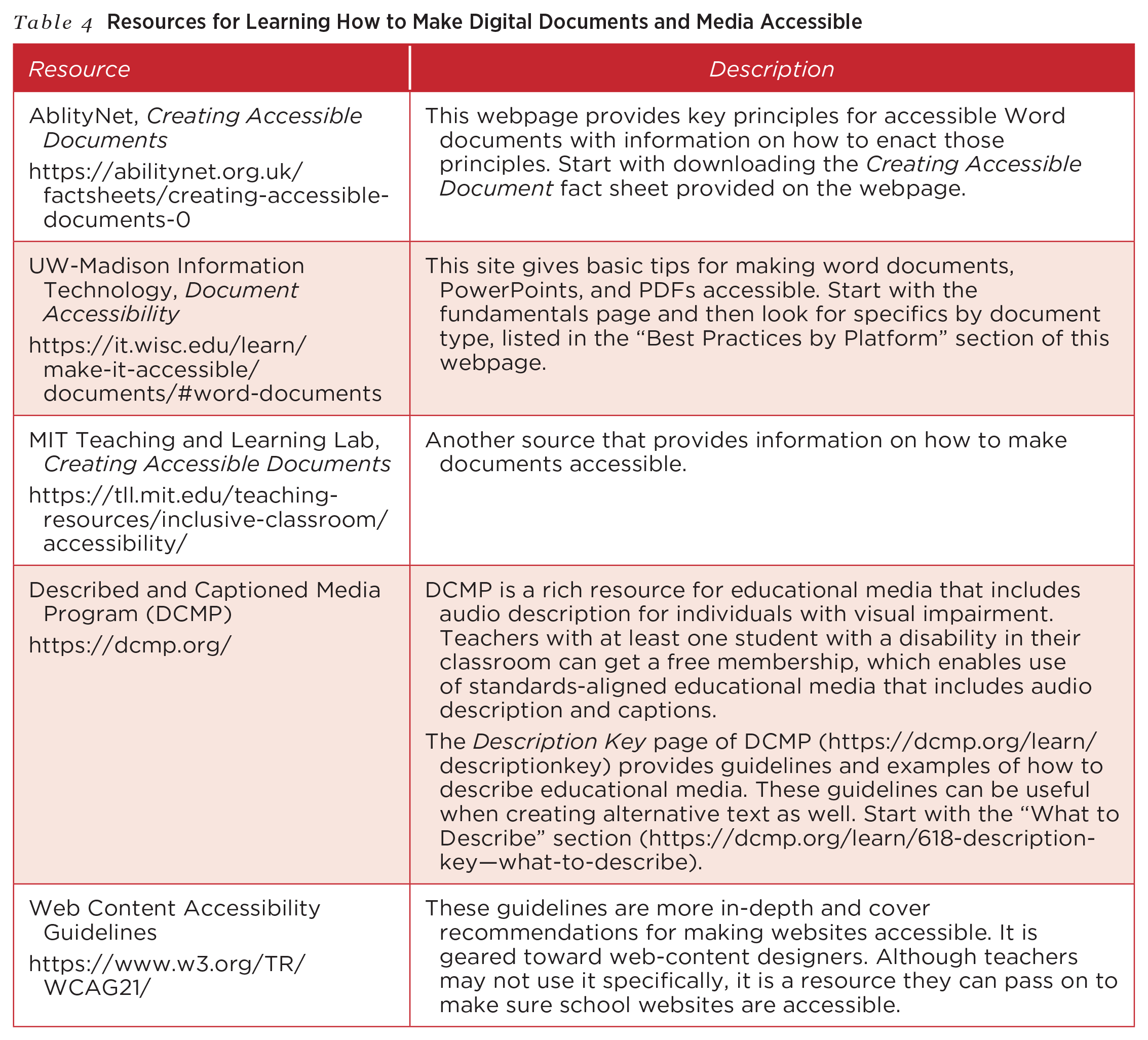
Classrooms also tend to have a lot of posters and other visual displays that are used for reference or for topical learning. These displays should have other access points (e.g., near-point print and braille copies for all students to use; a physical, touchable display). Learning apps should be functional and usable by a screen reader, and educational videos that have an audio description option should be prioritized over highly visual videos without adequate description to understand what is happening without sight.
After their walk-through and discussion of how Mrs. Sanchez organizes her classroom, she and Mr. Yen made note of enhancements to facilitate inclusion of Amber. For example, in the morning, Mrs. Sanchez greets each student at the door and the students point to a picture of how they want to be greeted that day. They then also enter the room and put a tally mark under a picture of an emotion to show how they are feeling. Mrs. Sanchez uses this emotion chart in math class to work on graphing. Mr. Yen will support Mrs. Sanchez by making high-contrast and tactual versions of the greeting pictures with print and braille labels as well. Mr. Yen suggests that the emotion chart could easily be made accessible to all by using a magnet board with tactual and labeled versions of the emotion faces. The students could then move a magnet into the box with their emotion instead of a written tally mark. Mr. Yen also volunteers to make a braille name label for all the students’ cubbies, not just Amber’s, so that braille is just another way of representing in the classroom.
Classroom interactions
Along with accessible spaces and materials from the very beginning, the manner of communicating and interacting in the classroom is equally if not more important in fostering a sense of belonging. For students with visual impairments who use braille, a concerted effort to be descriptive (e.g., describing pictures in Power Point or worksheets, cuing transition times in multimodal ways, not just visually) and to have opportunities for active, hands-on participation can make a huge difference in students feeling welcomed and engaged. These changes can have significant impact for other students in the classroom as well. For example, incorporating self-regulated learning (SRL) practices where students are engaging as agents of their own learning has been suggested by SLR researchers as a powerful strategy for inclusion and as a means to support academic development of students with learning disabilities in a nonthreatening way (e.g., Butler & Schnellert, 2015; Perry, 2015). SRL encourages students to actively engage in learning and its process, to support each other, and to allow for individual differences in abilities and interests, which could enhance sense of belonging.
Mrs. Sanchez asks if Mr. Yen can do some co-teaching at the beginning of the year with her. She wants Mr. Yen to model inclusive and descriptive language and ways to foster natural engagement between Amber and her peers. Mr. Yen, in turn, mentions that he will also learn from Mrs. Sanchez’s experience with inclusion. He wants to make sure that his scheduled direct instruction time with Amber does not make her feel singled out. Mrs. Sanchez and Mr. Yen discuss ideas of how maybe he can work on braille reading skills during a time when all students are working in targeted skill groups. They also discuss Mr. Yen pulling other peers into the instruction, such as for concept development or previewing tactile graphics. Mrs. Sanchez feels that the description and hands-on engagement will be useful for other students, too.
Environmental Analysis Checklist for an Inclusive Classroom for Braille Users, Prioritizing a Sense of Belonging
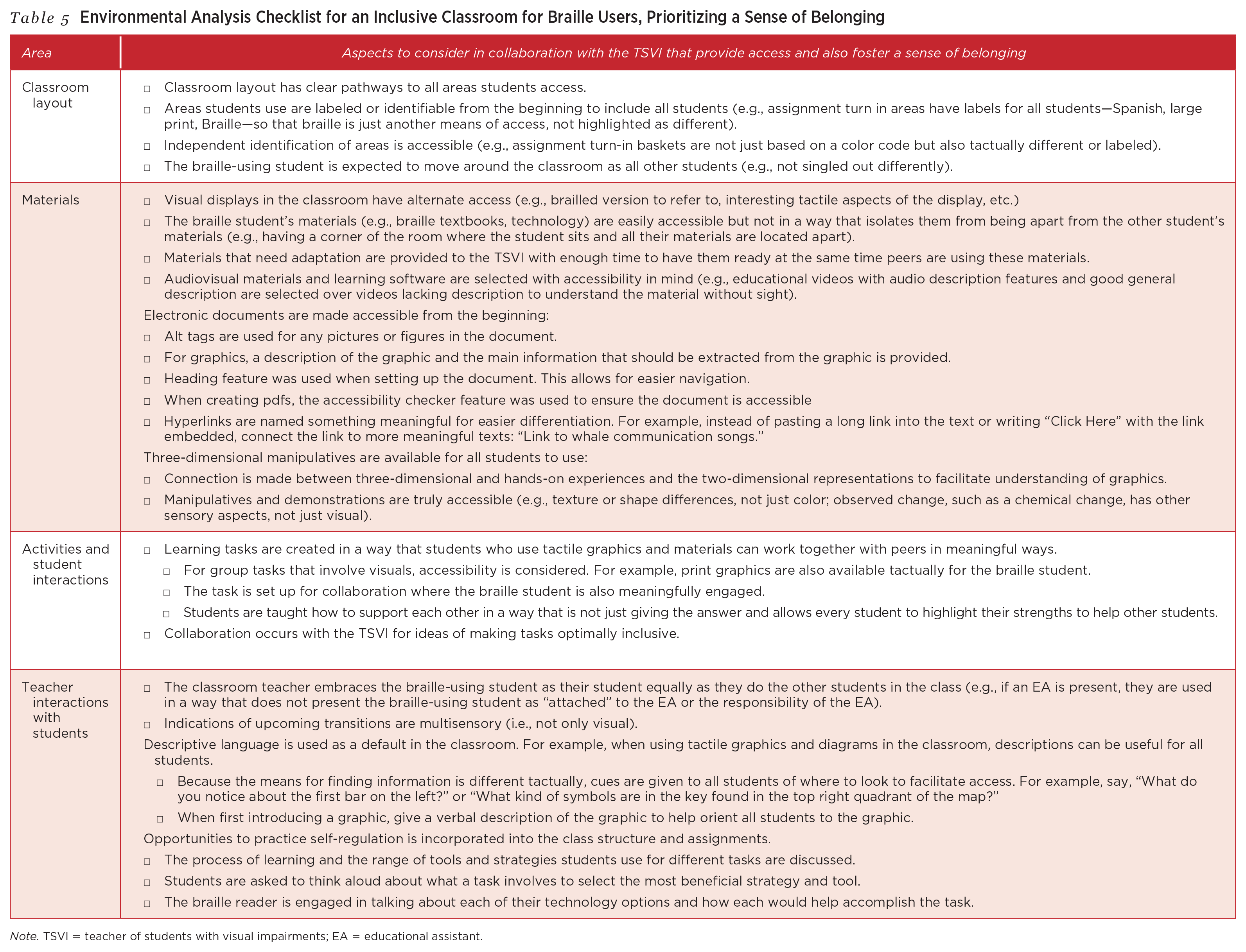
Note. TSVI = teacher of students with visual impairments; EA = educational assistant.
Step 3: Select Strategies
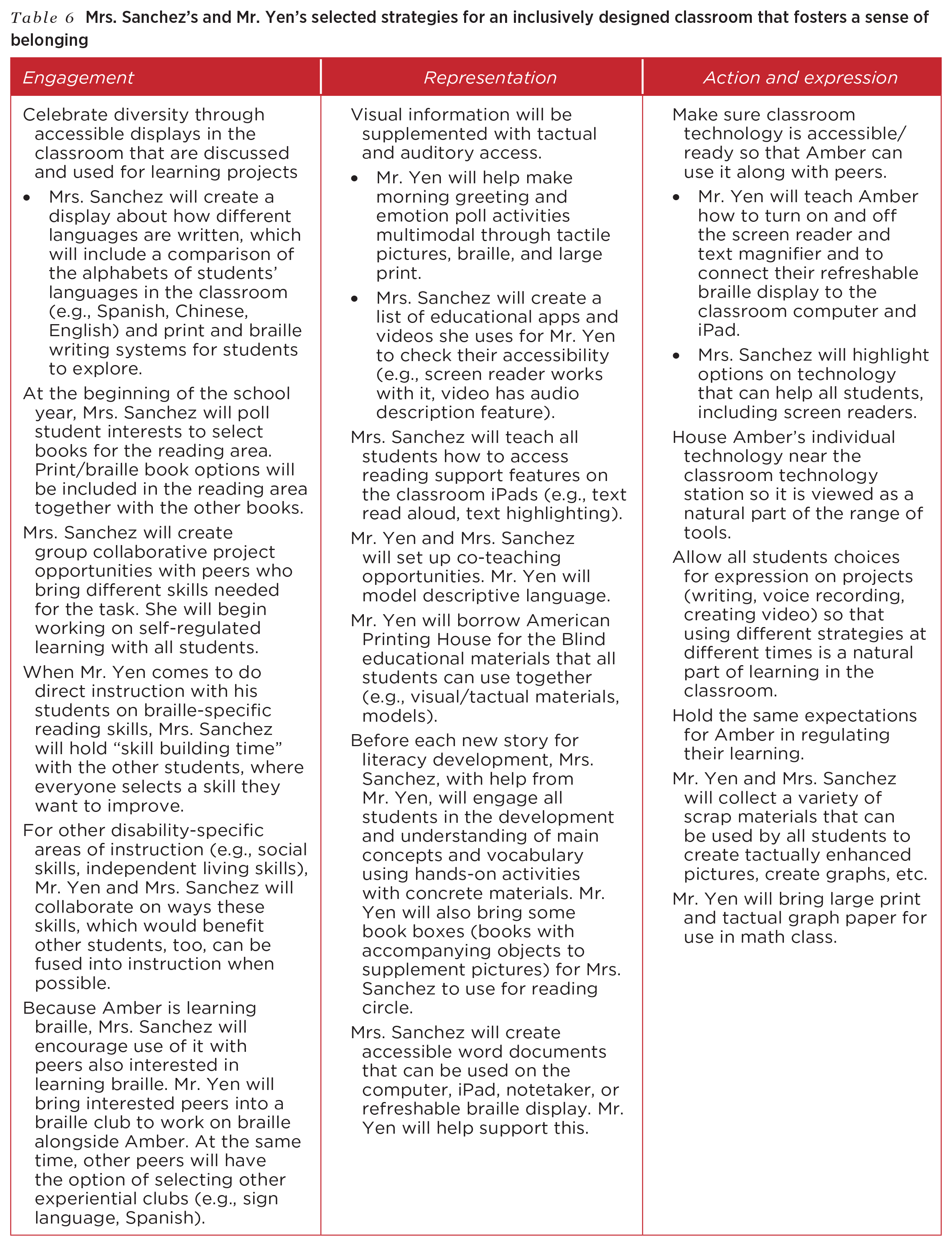
As their final step in planning, Mrs. Sanchez and Mr. Yen review all the ideas they generated specifically for including Amber and organize the main strategies using the UDL guidelines. Knowing the importance sense of belonging has on social and academic engagement, they select strategies with the goal of belonging at the forefront.
The process that Mrs. Sanchez and Mr. Yen engaged in together helped them to select strategies and materials. The TSVI will have knowledge and ideas specific to visual impairment and an understanding of the student’s functional vision to help in the selection of appropriate strategies tailored to the student’s needs. Equally important, the classroom teacher’s knowledge of the classroom tasks, routines, and overall environment will help narrow down the options that best fit the student, environment, and classroom community as a whole.
Mrs. Sanchez’s and Mr. Yen’s selected strategies for an inclusively designed classroom that fosters a sense of belonging
Summary
Helping students with visual impairments who are braille readers to feel fully included in their classroom requires a team approach. The classroom teacher who is with the student daily plays a pivotal role in ensuring success of inclusion. Of all the tips provided in this article, the most important starting point is for the team to have a positive perspective on braille and literacy using braille along with a collaborative spirit. With this perspective, braille and other tactile materials and accessible ways of communicating and engaging become something valuable that is used in the classroom and in other educational and personal environments. They are examples of many beneficial tools available to support inclusion. Keeping the goal of fostering a sense of belonging in the classroom can also provide perspective on how to structure learning activities that do not unintentionally exclude or highlight difference as a negative.
Footnotes
Declaration of Conflicting Interests
The author(s) declared no potential conflicts of interest with respect to the research, authorship, and/or publication of this article.
Funding
The author(s) received no financial support for the research, authorship, and/or publication of this article.
