




Abstract

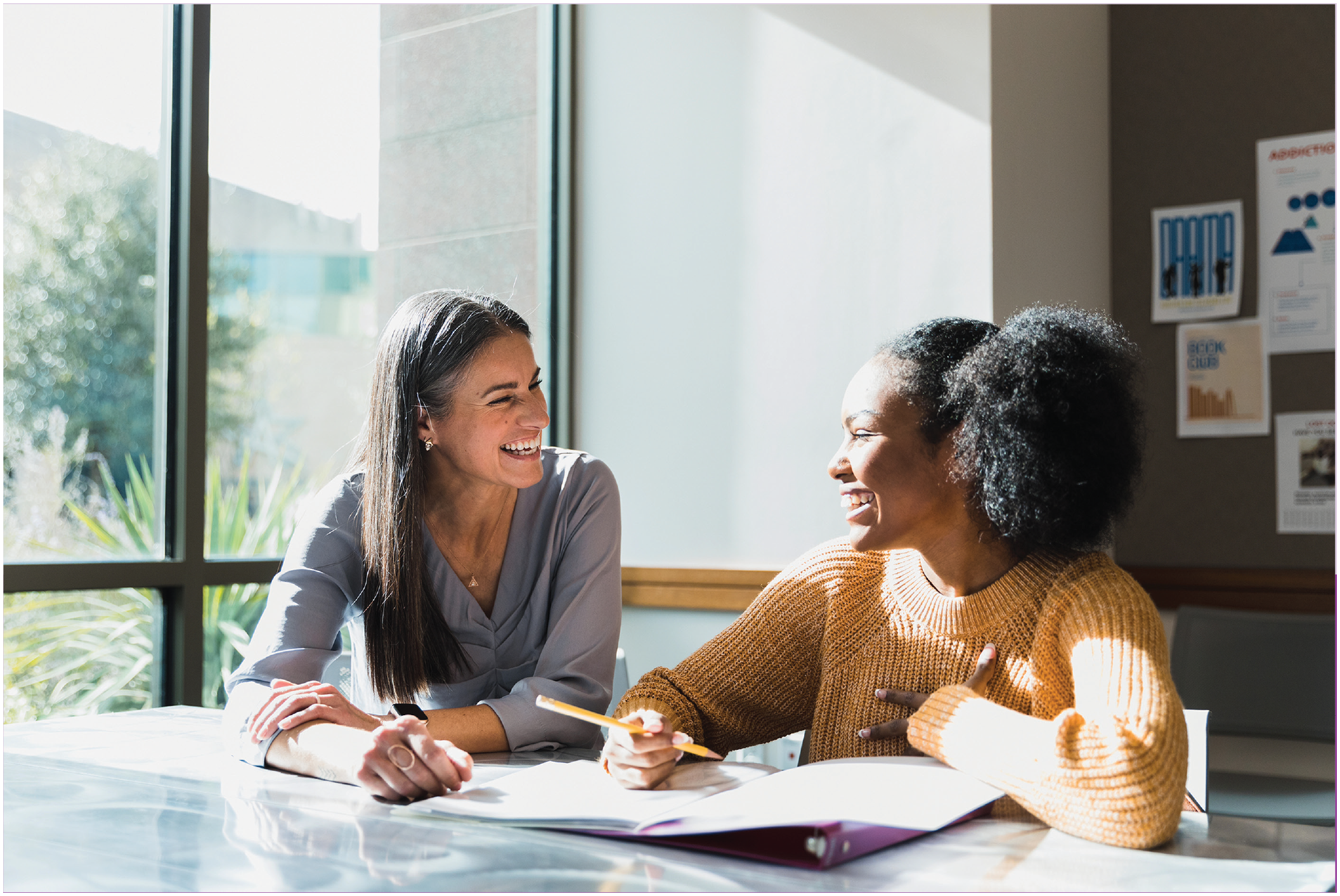
“I don’t know what to do about this,” a new teacher, Zoe, said to her induction mentor. During her teaching, the paraprofessional, Eliana, had stepped in multiple times. “She’s giving me direction, saying that with her experience—over 10 years—she can support me, and I want her to support me! But I also want to try some of the new, innovative, and inclusive strategies I learned in my teacher education program. I don’t want to hurt her feelings or damage our relationship because I know I’m really going to need her help and I want her to offer it again. I also want to acknowledge her experience and not disrespect her. I feel I’m between a rock and a hard place. What do I do?”
Collaboration is an expected responsibility of special education teachers in the United States because they coordinate their efforts with others, including paraprofessionals, service providers, administrators, and families (Pfeiffer et al., 2019). Collaboration is also an integral facet of student success. High-quality collaboration improves instructional quality, which appears to result in higher student achievement across developmental domains (Da Fonte & Barton-Arwood, 2017; Stehle Wallace et al., 2022); in particular, gains have been noted in math and reading (Goddard et al., 2015; Rondfeldt et al., 2015). For students with significant disabilities, the quality of their education is heavily impacted by the quality of instruction by the paraprofessional (Brock et al., 2021).
Collaboration is as important as pedagogical content knowledge (Hamilton-Jones & Vail, 2014). However, there is little preparation or ongoing support on how to engage professionally and respectfully in the multiple aspects of collaboration despite its complexity and necessity (Daniel et al., 2013; Frantz et al., 2022). In addition, with the many demands of teaching, teachers often overlook how collaboration will occur. As such, the authors offer guidance on how to develop and sustain positive working relationships, focusing on the relationship between teachers and paraprofessionals because these educators spend much of the school day working side-by-side. Specifically, we discuss known barriers and share initial strategies and resources for determining how the teacher and paraprofessional will collaborate, communicate, and resolve conflict.
The Three Cs for Educational Teams: Collaboration, Communication, and Conflict Resolution
As a team, the special education teacher and paraprofessional need to establish norms in relation to these three areas:
Collaboration: How are we going to work together?
Communication: How will we share information?
Conflict resolution: How will we maintain our professional relationship despite disagreements?
To attain a cohesive and effective team, all three areas—collaboration, communication, and conflict resolution—must be individually strong while being simultaneously dependent on the others (see Figure 1). Determining team function is typically accomplished at the beginning of the school year, but ongoing effort across these three areas is required throughout the school year for team and student success (Stehle Wallace et al., 2022).
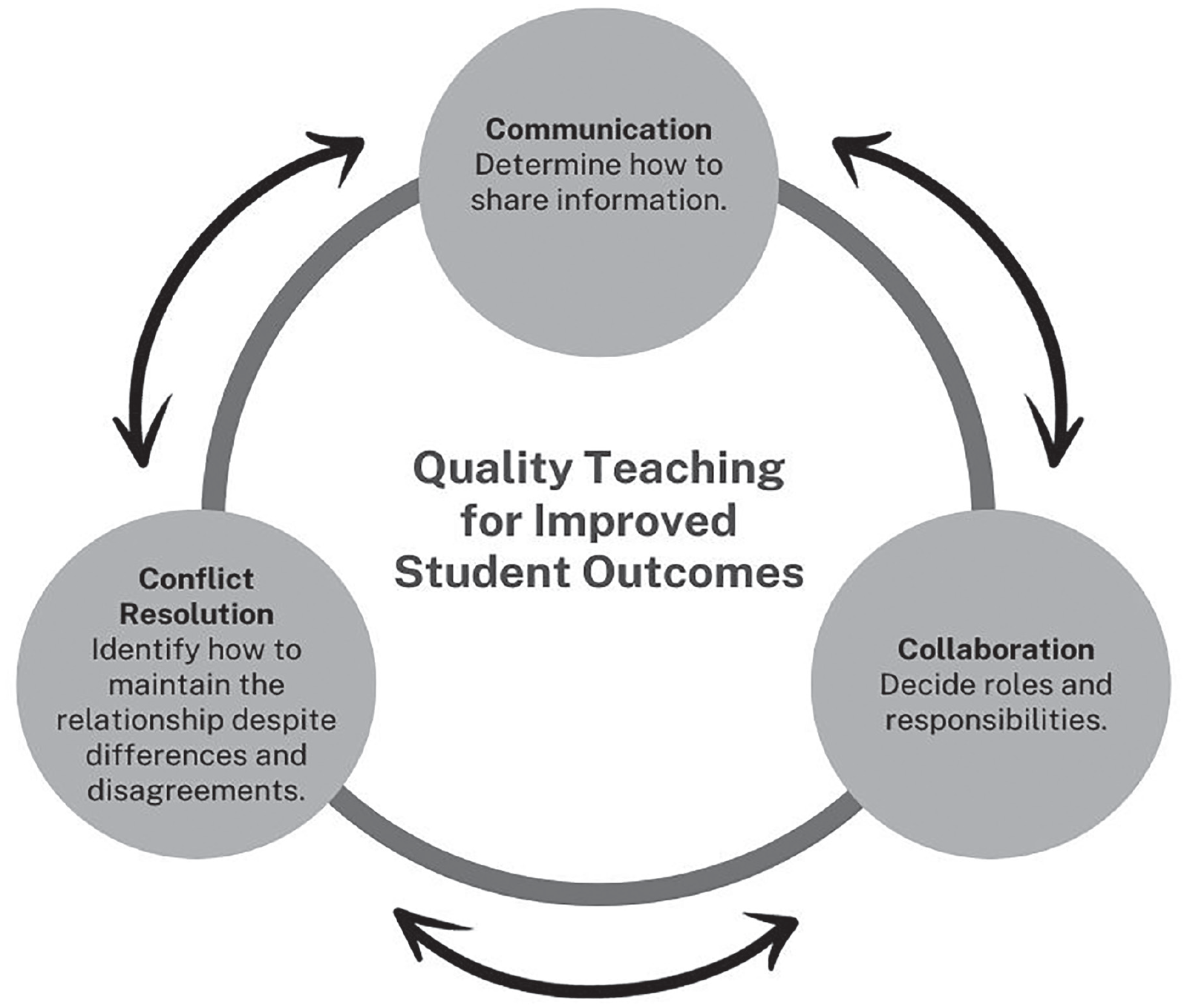
The three Cs: collaboration, communication, and conflict resolution
Collaboration: How Are We Going to Work Together?
According to research, there are three main elements that interfere with teacher-paraprofessional collaboration: power dynamics, the lack of clarity about roles and responsibilities, and the lack of professional training for paraprofessionals (Frantz et al., 2022).
Power dynamics
There is an inherent power imbalance in the relationship between special education teachers and paraprofessionals because of reasons such as knowledge, experience, and level of education. Paraprofessionals state that teachers can be controlling, which leaves them feeling disrespected (Mason et al., 2021). In one study, 84% of paraprofessionals felt they were undervalued and not seen as an active contributor (T. S. Brown & Stanton-Chapman, 2017, p. 27).
Instead of maintaining a hierarchy, it is important to engage with paraprofessionals as valuable team members and connect with them on both the personal and professional levels. Multiple researchers suggest taking time to find compatibility across values and to facilitate and sustain positive relationships on a personal level (Jardí et al., 2022; Pfeiffer et al., 2019). In addition, various tools can assist with connecting on a professional level (Capizzi & Da Fonte, 2012), including the SHARE model (Murawski & Dieker, 2004), which focuses on hopes and attitudes, and the Collaborative Teaching Introductory Worksheet, by which educators “indicate their preferences in addressing common classroom situations, such as assessment, student behavior, homework, and grading” (Da Fonte & Barton-Arwood, 2017, p. 104).
Zoe’s mentor asked her to brainstorm areas for discussion with the paraprofessional. Together, they identified the need to directly address the awkwardness of the power dynamics and express gratitude for Eliana’s support and experience, which had already been invaluable to Zoe as a new teacher. Because Eliana is a strong contributor to teaching and learning, Zoe wanted to share with her the educational and developmental reasons for different approaches to instruction. Finally, Zoe aimed to explain the need for her own independent teaching experiences and her desire for constructive feedback from Eliana after lessons.
Zoe took notes and used them to guide her conversation the next day with Eliana. She reported that the conversation was pleasant and that Eliana was both understanding and enthusiastic about seeing a different kind of instruction. Although Zoe had been nervous about starting the conversation, she was surprised by her comfort during the interaction and said the feedback and support from her mentor gave her confidence to begin a conversation she feared would be difficult.
Lack of clarity about roles and responsibilities
Learning individual preferences and strengths assists with the second area of tension, which is confusion over roles and responsibilities (Barnes et al., 2021; Douglas et al., 2016; Mason et al., 2021). With knowledge of personal and professional preferences, teachers and paraprofessionals can assume responsibilities that take advantage of their talents and interests. Through clarity on each other’s roles, the regular responsibilities of the classroom do not need to be continuously negotiated or delegated, leading to a “high-quality partnership” (Stehle Wallace et al., 2022, p. 168). Of course, these responsibilities will need to be revisited as the school year progresses and new issues arise.
Historically, paraprofessionals have been seen as assisting with more of the logistical elements necessary to run a classroom (e.g., copying papers, checking homework, and supervising recess). Instead of viewing the paraprofessional as an additional responsibility to “manage,” teachers can involve paraprofessionals in planning, decision making, reviewing student data, and developing schedules, routines, and procedures (Biggs et al., 2019; Black & Hill, 2020).
Paraprofessionals can also provide support with instructional responsibilities, including:
providing direct one-on-one or small group instruction (Brock, 2022),
increasing student engagement during instruction (Carter et al., 2015),
providing academic and social supports in general education classrooms (Mason et al., 2021),
facilitating communication through Picture Exchange Communication System or assistive technology (Frantz et al., 2022),
implementing positive behavioral intervention plans (Mason et al., 2021),
supporting students during transitions (Frantz et al., 2022),
collecting data for goal reporting and analysis of effectiveness of interventions (Brock, 2022),
increasing independence through indirect support (Scheef et al., 2023).
Once roles and responsibilities have been identified, teachers must also be willing to trust the paraprofessional to competently complete tasks (T. S. Brown & Stanton-Chapman, 2017).
Lack of professional training for paraprofessionals
The third element known to interfere with teacher-paraprofessional collaboration is the limited amount of educational training provided to and expected of paraprofessionals (Biggs et al., 2019; Douglas et al., 2016; Mason et al., 2021). Consequently, teachers find themselves mentoring paraprofessionals, as indicated by the professional standards of the Council for Exceptional Children (2020, Standard 7.4), in addition to their many other responsibilities. However, by engaging in mentoring activities at the beginning of the school year, teachers can confidently assign the paraprofessional to specific instructional activities with students throughout the school year.
Mentoring involves the following:
explaining instructional practices and serving as a model,
providing paraprofessionals opportunities to perform the instruction,
discussing the lesson/activity and offering feedback (Franz et al., 2022: Stockall, 2014).
By serving as a model, teachers demonstrate instructional strategies and interactions that support learning. Paraprofessionals can then practice lessons, based on professional plans, with in-the-moment guidance by teachers (Giangreco, 2003). An ongoing instructional dialogue between the educators ensures quality instruction (Frantz et al., 2022) because feedback provides encouragement, offers additional necessary information, and notes where specific changes are needed (Douglas et al., 2016).
As mentioned previously, these collaborative issues will need to be addressed throughout the school year (Stehle Wallace et al., 2022) because new issues, positive and negative, will influence the power dynamics, roles and responsibilities, and focal areas for mentoring.
Communication: How Will We Share Information?
Communication skills have been identified as integral for successful collaboration (Douglas et al., 2016; Prenger et al., 2017; Stockall, 2014). Within the educational system, there are multiple systemic barriers that interfere with communication, the most notable being lack of time, which is beyond the scope of this article (Hamilton-Jones & Vail, 2014; Stehle Wallace et al., 2022). However, educators can and should be strategic about how they use their time together given that the everyday pressures of teaching often interfere with consistent communication (Black & Hill, 2020).
Communication expectations
Together, teachers and paraprofessionals need to establish communication expectations for their shared work. Just as teachers engage students in developing community rules for their classroom (Responsive Classroom, 2015), adults need to create expectations for their interactions. Communication expectations provide team members a respectful and safe space to share information, analyze and investigate their teaching and/or collaborations, and solicit valuable feedback from their peers. Identified methods for successful communication include acknowledging the other’s perspective, asking clarifying questions as needed, and providing constructive feedback (Barnes et al., 2021; Stockall, 2014). In addition, it is important to approach conversations with cultural humility because various backgrounds and experiences will influence how people approach a topic (Haynes-Mendez & Engelsmeier, 2020). The following are examples of possible communication expectations between special education teachers and paraprofessionals:
Give each other our full attention (we will not use text or email when we are having a conversation).
Listen intently (we will not talk over each other and will not interrupt).
Stay focused (we will not change the topic).
Use questions to clarify what we heard.
Possess cultural humility (we have a lot to learn about each other and will honor multiple perspectives).
In addition to determining communication expectations at the beginning of the collaboration, communication expectations should be revisited in an ongoing manner to prioritize the functioning of the educational team for student success. Based on the research described previously, we suggest the following format for meetings (see Table 1):
Focus on the professional collaboration by attending to individual and team roles. How are you working together? Are you adhering to the communication and collaboration expectations set forth previously? What needs to change? Why and how? Where do team members feel they need more support? How can that be provided?
Address student needs. Is your collaboration successful? Use data to keep track of student outcomes and inform decision making. What went well and should be maintained? What might need to change, and how might that occur?
Determine appropriate interventions and next steps. How will changes be implemented? Who will be responsible for changes? Balance the work among team members.
Maintain a digital file of conversations and actionable decisions. Keep track of your decisions for assessment purposes.
Reflect on the professional learning opportunity afforded by the collaboration. What and how can you learn from others? How can your teammate’s knowledge, skill, and insights improve your work?
Expectations for Meetings

To engage in ongoing instructional discussions, teachers and paraprofessionals need to schedule regular meetings (Douglas et al., 2016). Meetings are necessary not only for discussions about students but also the functioning of the team. (Within Table 1, needs of the team are within Rows 1 and 4, and needs of students are Rows 2 and 3.) Use the notes column to document assessment of student interventions and the ongoing responsibilities of the team both collectively and individually.
It is recommended to schedule several shorter meetings within a week instead of holding one longer meeting (Black & Hill, 2020), allowing for focus on one specific issue or student. Maintain a list of items that need to be discussed and create an agenda to ensure both teacher and paraprofessional are actively involved (Murawski & Dieker, 2004).
Constructive communication
Communication among team members “refers to those conversations that encourage teachers to discuss their teaching practices and collaborate on how these practices can be improved” (Prenger et al., 2017, p. 78). Specifically, reflective communication among team members relies on questioning that leads to identification of concerns and joint problem solving (Anastasiou & Hajisoteriou, 2022). Such discussion results in implementation of appropriate strategies that lead to improvement toward both student and educator goals (Da Fonte & Barton-Arwood, 2017). Therefore, feedback—both giving and receiving it—should be seen as a necessary and expected aspect of the work of all members of educational teams.
Teachers and paraprofessionals together need to determine how to offer feedback in a manner where it can be heard and acted on for student achievement based on individual preferences and comfort levels. Research on collaboration in education, however, indicates that conversations between team members often focus on superficial and logistical topics instead of discussions on curriculum and pedagogy (Vangrieken et al., 2015). If feedback occurs, it is often taken as personal criticism instead of professional feedback (Hamilton-Jones & Vail, 2015).
Teachers may be reluctant to provide critical feedback because they want to be seen as a pleasant colleague and offering feedback does not align with that perception (Da Fonte & Barton-Arwood, 2017; Daniel et al., 2013). (The term “critical” feedback holds a negative connotation; we therefore recommend using “constructive” to denote the possibility for change and growth.) If educators can collectively focus on the mutual improvement of pedagogy (Daniel et al., 2013), they may be able to remove the negative connotation of critical feedback as personal blame and reframe it as constructive for the professional team, especially the students.
Conflict Resolution: How Will We Maintain a Professional Relationship Despite Disagreements?
The dynamics of personalities, cultural identities, and the varied composition of teams require thoughtful consideration throughout one’s career because personal and professional issues will impact interactions daily. However, whereas researchers recognize that tensions are inevitable and necessary aspects of collaboration, many educators do not perceive disagreements as a natural occurrence in teamwork (Mills, 2017; Vangrieken, et al., 2015). Indeed, classroom educators often rely on administrators to help resolve conflict instead of addressing issues on their own (Douglas et al., 2016).
In Zoe’s first year as a teacher, she noted that the teacher lounge was often full of negative gossip about both individuals (students, parents, and school personnel) and policies within the school. Distressed by this situation, Zoe discussed it with her paraprofessional, Eliana. They agreed this behavior went against the ideals they professed as educators and the expectations they set for students. Eliana stated, “If we are hurt, upset, or mad, we need to address the issue with the person involved so tension doesn’t linger and build. As we ask of students, discuss the issue, determine how to fix the problem, repair the relationship, and move forward.”
Throughout the school year, Zoe and Eliana worked to support each other with this goal. When an issue arose, they brainstormed the important concepts and concerns that needed to be addressed and how to approach and engage in a respectful manner with colleagues. Because Zoe and Eliana discussed and resolved areas of tension—between themselves and others—the energy of their professional relationship was both more positive and more productive.
Because conflict is expected within collaboration, there is a need for predetermined expectations to resolve tensions as they arise and maintain a culture of collegiality. Together, come to an agreement about how to approach conflicts. The following are steps to guide the creation of such expectations (see Table 2 for a template and Table 3 for an example from Zoe and Eliana):
1. Recognize conflict is a reality of collaboration. Acknowledge difficulties as a reality, where tensions are seen as motivators for change and constructive dialogue leads to improved personal and professional outcomes (Daniel et al., 2013; Mills, 2017).
2. Possess self-knowledge. Recognize your own strengths and weaknesses and consider how our individual life experiences, particularly those around conflict resolution, influence how we react and engage with conflict (Da Fonte & Barton-Arwood, 2017).
3. Actively listen to and integrate different perspectives. Listen to understand—not to respond or defend—and to acknowledge another’s perspective (Biggs et al., 2019; Da Fonte & Barton-Atwood, 2017).
4. Identify the area of tension and determine steps for resolution. Approach your teammate, succinctly identify the issue, and use compromise to determine solutions (Biggs et al., 2019) • Identify multiple alternative courses of action. • Describe the pros and cons of each. • Select a course of action. • Evaluate the course of action over time. • Identify necessary follow-up (see N. D. Brown et al., 2013, p. 90).
5. Move beyond moments of tension to maintain collegial relationships. Disagreements may cause stress and discomfort for adults, but more distressing is the loss of learning experiences and educational attainment for students if adults do not work past those difficulties. Only through ongoing, conscious development of communication and conflict resolution skills can “the extraordinary synergy of collaboration be realized” (Friend, 2000, p. 160).
Template for Team Agreements Toward Conflict Resolution

Example for Team Agreements Toward Conflict Resolution

Conclusion
Collaboration can be a powerful tool toward achieving positive outcomes for students with disabilities (Goddard et al., 2015; Ronfeldt et al., 2015), but collaboration presents ongoing challenges for teachers and paraprofessionals, beginning with the inherent power dynamics due to varied knowledge, experience, and level of education. In addition, personal, cultural, and professional differences can interfere with team effectiveness.
Teacher education and professional development programs spend time on instructional interventions and how to enact accommodations and modifications, but they do not provide enough support for the development and maintenance of respectful and productive partnerships (Daniel et al., 2013; Frantz et al., 2022); instead, they should explicitly teach collaboration, communication, and conflict resolution skills and provide multiple opportunities for practice and reflection (Hamilton-Jones & Vail, 2014).
Educators must commit to purposeful ways of interacting and communicating with one another that build and sustain a cohesive team, as Zoe and Eliana did in the previous vignettes. By establishing norms for collaboration, communication, and conflict resolution, teams maintain respectful and productive partnerships and focus their collective energies on the needs of students (Daniel et al., 2013; Frantz et al., 2022).
The work of collaboration is the work of teaching—because the effectiveness of collaboration directly impacts students—and should receive appropriate priority to achieve improved student outcomes across developmental domains.
Footnotes
Declaration of Conflicting Interests
The author(s) declared no potential conflicts of interest with respect to the research, authorship, and/or publication of this article.
Funding
The author(s) received no financial support for the research, authorship, and/or publication of this article.
