



Abstract
Developing and supporting understanding of the meaning of multiplication and multiplicative relationships in students with mathematics learning disabilities requires carefully designed instruction that emphasizes strategic representation use. This article discusses three ways in which teachers can incorporate multiple representations within multiplication instruction to develop a deep understanding of underlying mathematical structures. First, it is important to select concrete and semi-concrete representations (e.g., discrete objects and those that illustrate continuous quantities as length or area) that will help students most accurately model the multiplication or division concept or procedure. Next, provide students with multiple representations that are presented concurrently within the same lesson so that they can make connections among the different types of representations. Last, teachers can support students to use and connect representations through mathematical discourse that elicits student thinking by not only structuring tasks around three processes, reversibility, flexibility, and generalization, but also by posing questions to elicit different ways that students can communicate their ideas using accurate and precise vocabulary.

Mr. Juarez is a special educator in an inclusive third-grade classroom at Florentine Elementary. The class recently started the multiplication unit, and Mr. Juarez observed that several students with disabilities are having difficulty understanding the meaning of multiplication. Specifically, students are using repeated addition to solve multiplication problems, focusing on numerical values rather than the relationships among quantities to reason in a multiplicative way. Additionally, they are representing multiplication problems with visual models (e.g., diagrams) that do not show how quantities are related. During a planning meeting, Mr. Juarez and Ms. Lay, the general education teacher, decide that intervening with students with disabilities is critical to develop concepts to build multiplicative reasoning (MR). However, their mathematics program emphasizes repeated addition as the route into multiplication, provides a broad range of representations (e.g., number lines, arrays), but also emphasizes the use of single number lines to represent repeated addition and considers division as a separate topic from multiplication. Ms. Lay and Mr. Juarez believe that developing students’ understanding of the multiplicative (i.e., a multiplication- or division-based) structure will facilitate their learning of more advanced mathematics, but they are not sure where to get guidance on how to work with and across a range of representations, how to introduce the commutative property of multiplication, or how to connect the operations of multiplication and division as inverse operations. How can they ensure that the intervention presents a carefully connected and progressive sequence for building MR?
When multiplying two whole numbers (e.g., 3 × 8 = 24), children may repeatedly add one number (e.g., 8 + 8 + 8 = 24) to solve the problem. Does this help to understand the meaning of multiplication? If children only think of 3 × 8 as 8 + 8 + 8, they will find it difficult to understand why repeated addition does not work when multiplying fractions such as
MR requires more than providing answers to multiplication facts (3 × 8 = 24). It requires paying attention to different kinds of units, such as the unit and intermediate units or groups (I et al., 2015; National Council of Teachers of Mathematics [NCTM], 2000). Consider, for example, a problem situation of 3 boxes (groups) with 8 peaches in each box (unit rate) that asks children to find the total number of peaches in all boxes. One child may reason: 8 peaches + 8 peaches + 8 peaches = 24 peaches. Another child may reason: 1 box has 8 peaches; 2 boxes have 16 peaches; 3 boxes have 24 peaches. A third child may reason: The number of peaches in each box is the same, so we can combine equal-size groups by multiplying: 3 boxes (groups) of 8 peaches per box equals 24 peaches. All three students arrived at the correct answer, but they counted with different units. The first child engaged in repeated addition, operating on only one kind of unit (total number of peaches). The second child counted, simultaneously, two different kinds of units (boxes, peaches in each box) while keeping track of a third unit (total number of peaches). The third child combined equal groups by multiplying because multiplication is a way of finding how many there are altogether when there are equal groups. Considering 8 as a unit in its own right rather than merely as a collection of eight 1s is important to understanding the meaning of multiplication. That is, the quantity 1 is iterated eight times to create the intermediate unit 8, and 8 is iterated 3 times to create the quantity 24. MR requires reasoning about and coordinating different kinds of units and coordination of quantity in various forms (discrete, continuous) that focus on multiplicative relationships. For many students with mathematics learning disabilities (MLD), the transition from additive reasoning to MR represents a persistent barrier to mathematical progress in later years (Grobecker, 1997; Hunt, 2015; Tzur et al., 2010).
Importance of Multiplicative Reasoning
Using MR to think relationally about quantities is highly relevant in everyday life. For example, if each bag in a grocery store contains three apples, you may reason multiplicatively to approximate how many bags to buy if you want a total of 12 apples. MR is also valuable in developing and understanding mathematical concepts. It contributes to an understanding of place value and the ability to correctly perceive different kinds of relationships between and among numbers. When asking children the value of the digit “4” in the number “248,” we need to help them understand that each place value piece (based on the base-10 number system) is a product of the digit times a base-10 unit: 248 = (2 × 100) + (4 × 10) + (8 × 1). That is, the value of the digit “4” is not 4, but it is 40 or four 10s. MR also shows the structure and efficiency of counting in groups and highlights sequences and patterns (I et al., 2015; NCTM, 2000).
MR is the underpinning of work in number, including rational number, area, ratio and proportion, and percentages. Being able to reason in a multiplicative way enables children to develop a deeper understanding of multiplicative structures such as ratios (Nunes et al., 2008), which are key in the development of early algebra and more advanced concepts, including functions and algebraic reasoning (Moss & McNab, 2011; Russell et al., 2011), and argumentation and proof (Kosko & Singh, 2016).
MR, a key focus of mathematics instruction in Grades 3 through 5, as reflected in their presence in the Operations and Algebraic Thinking domain of the Common Core State Standards for Mathematics (National Governors Association Center for Best Practices & Council of Chief State School Officers, 2010), is embedded in the arithmetic operations of multiplication and division. For example, a Grade 3 Operations and Algebraic Thinking standard requires students to represent and solve problems involving multiplication and division. Using and connecting multiple representations is one of the eight teaching practices for effective mathematics teaching in Principles to Actions: Ensuring Mathematical Success for All (NCTM, 2014).
The Institute for Education Sciences recommends that students who struggle to learn mathematics need “focused instruction using representations to model mathematical ideas” (Fuchs et al., 2021). Like Mr. Juarez and Ms. Lay, most teachers are aware that MR is important, but they may not know the best way to use representations to teach multiplicative concepts and procedures. Consequently, instruction may consist of telling students to use only one representation rather than showing students other viable representation choices and connecting the different representations. How do teachers promote the practice of using and connecting multiple representations to support students with MLD in deepening their understanding of multiplicative concepts and procedures?
Steps to Using Mathematical Representations
In this article, we discuss three steps in which teachers can develop student understanding of multiplicative concepts and procedures using mathematical representations. Each step is discussed in the context of multiplication and is followed by a vignette to demonstrate how teachers might use the step in the classroom. We ground this work in our collaboration with third-grade teachers and students in inclusive classrooms.
Step 1: Select Concrete and Semiconcrete Representations
Understanding multiplicative concepts and procedures requires the use of representations that illustrate the value of numbers and the relationship between quantities. Representations may be categorized as concrete, semiconcrete, or abstract (Yee & Bostic, 2014). Concrete and semiconcrete (nonsymbolic) representations “are powerful ways to make mathematics visible and more accessible for students” (Fuchs et al., 2021, p. 21). They include physical materials (e.g., base-10 blocks, fraction tiles, connecting cubes), diagrams (strip diagrams, percentage bars, schematic diagrams), or pictures, graphs, tables, arrays, and number lines (Yee & Bostic, 2014).
Physical materials include objects that students can physically manipulate (touch, move, or stack) to compare relative sizes of objects that represent mathematical ideas (e.g., fractions, place value). Abstract representations (symbolic) are symbol-driven ways of expressing that may include such forms as equations, expressions, and inequalities (Yee & Bostic, 2014).
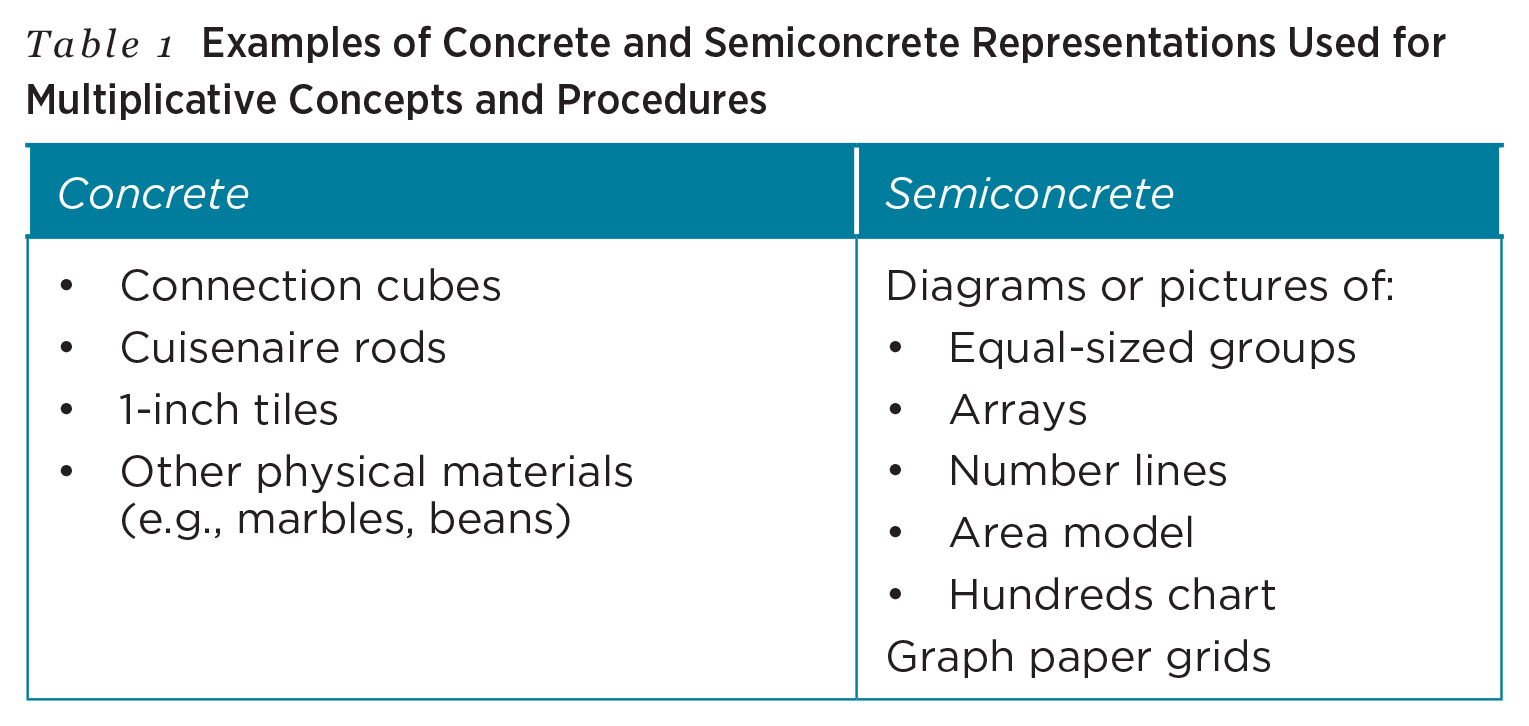
Core instructional programs and interventions often include concrete and semiconcrete representations to help understand the abstract nature of mathematics and support student learning (Jitendra et al., 2016). Given that all representations are not equally effective in developing a mathematical concept or procedure, teachers must be intentional in choosing representations that will help their students most accurately model the concept or procedure targeted (Fuchs et al., 2021; Woodward et al., 2012). To solve problems involving multiplication and division would mean having access to multiple representations that include discrete objects and those that illustrate continuous quantities as length or area. Table 1 provides examples of representations that work well with a multiplicative concept or procedure.
Examples of Concrete and Semiconcrete Representations Used for Multiplicative Concepts and Procedures
After reviewing the types of representations, Mr. Juarez and Ms. Lay choose to use 1-inch tiles and diagrams or pictures of equal-sized groups, arrays, number lines, and area to accurately model the multiplicative concept or procedure (see Figure 1). They decide to start with equal-sized groups to model multiplication because multiplication is a way of finding how many there are altogether when there are equal groups. In their planning, Mr. Juarez and Ms. Lay build opportunities to practice with equal groups as they provide a visual way of understanding basic multiplication by sorting a number of items into equal groups. The teachers then progress to having students use other representations, such as arrays, area models, and number lines, which are also important ways to model multiplication. For example, Mr. Juarez and Ms. Lay chose the number line because it illustrates continuous quantities as measurement. Figure 1 shows how the number line is used to depict 3 × 2 as three groups of 2 units. By showing that the distance from 0 to 2 represents 1 unit of 2 (the quantity 1 is iterated two times to create the intermediate unit 2), students can then find the total quantity 6 by iterating 2 three times. Mr. Juarez and Ms. Lay learn that it is not only important to illustrate “the idea of intermediate unit, but it is important . . . to emphasize how an intermediate unit exists and works in multiplication and how it differs significantly from addition” (I et al., 2015, p. 174). In short, Mr. Juarez and Ms. Lay plan to introduce each of these representations to illustrate the relationship between quantities involved in problems and provide sufficient opportunities across lessons for students to meaningfully connect the representations.
“Given that all representations are not equally effective in developing a mathematical concept or procedure, teachers must be intentional in choosing representations that will help their students most accurately model the concept or procedure targeted (Fuchs et al., 2021; Woodward et al., 2012).
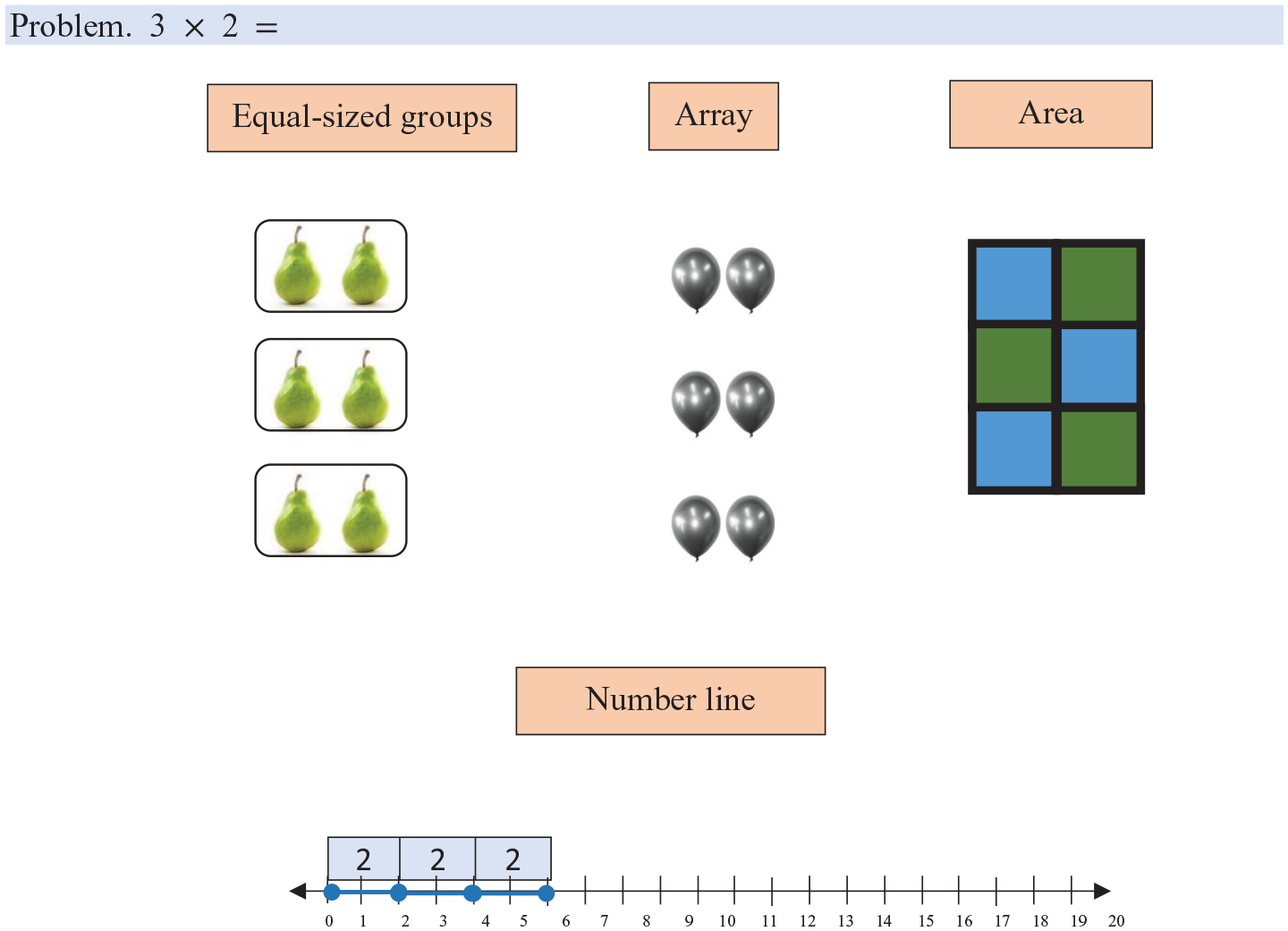
Semiconcrete representations to model multiplication
Step 2: Use Concrete, Semiconcrete, and Abstract Representations Concurrently
Multiple representations can be used to illustrate the same mathematical idea in multiple ways (NCTM, 2014). Encouraging students to use and connect multiple representations to previously learned mathematics topics can build greater conceptual understanding (NCTM, 2014; Nielsen & Bostic, 2018).
The use of multiple representations (concrete, semiconcrete, abstract) that embody mathematical concepts (e.g., meaning of multiplication) has been well documented as effective support for students with disabilities (Jitendra et al., 2016). A concrete, semiconcrete, and abstract representational approach is an evidence-based practice, in which a graduated instructional sequence involving three distinct phases has been successfully used to teach mathematical concepts (e.g., equivalent fractions) and skills (e.g., whole number and fraction computations, solving word problems, linear algebraic expressions; see Agrawal & Morin, 2016; Bouck et al., 2017, 2018; Flores et al., 2014, 2020; Mancl et al., 2012). In the initial stages of learning, students are taught to use concrete or physical materials to model and solve mathematical problems. Students then progress to the use of semiconcrete representations such as pictures, diagrams, or drawings. The concrete and semiconcrete phases are followed by the abstract phase, with students solving problems using abstract symbols only. This sequence can often cause a disconnect where students do not see the relationship(s) between the concrete materials and the abstract symbols (McNeil et al., 2009). Instead, it is important that multiple representations are presented concurrently so that students make connections among the three different types of representations (Dougherty et al., 2016; Fuchs et al., 2021; Moreno et al., 2011).
“Encouraging students to use and connect multiple representations to previously learned mathematics topics can build greater conceptual understanding (NCTM, 2014; Nielsen & Bostic, 2018).
Recent research suggests that it is not necessary for students to attain mastery in each phase before progressing to the next; instead, instruction that emphasizes using and switching among representations all within the same lesson is equally effective as the graduated instructional sequence in supporting students with disabilities (Strickland, 2016; Strickland & Maccini, 2013). See Figure 2 for the concurrent presentation of three different types of representations to promote students’ ability to link problem information to the multiple representations. When teaching multiplication and division concepts, teachers should use these representations consistently and extensively over time to help support student learning (Fuchs et al., 2021; Woodward et al., 2012).
“It is important that multiple representations are presented concurrently so that students make connections among the three different types of representations (Dougherty et al., 2016; Fuchs et al., 2021; Moreno et al., 2011).
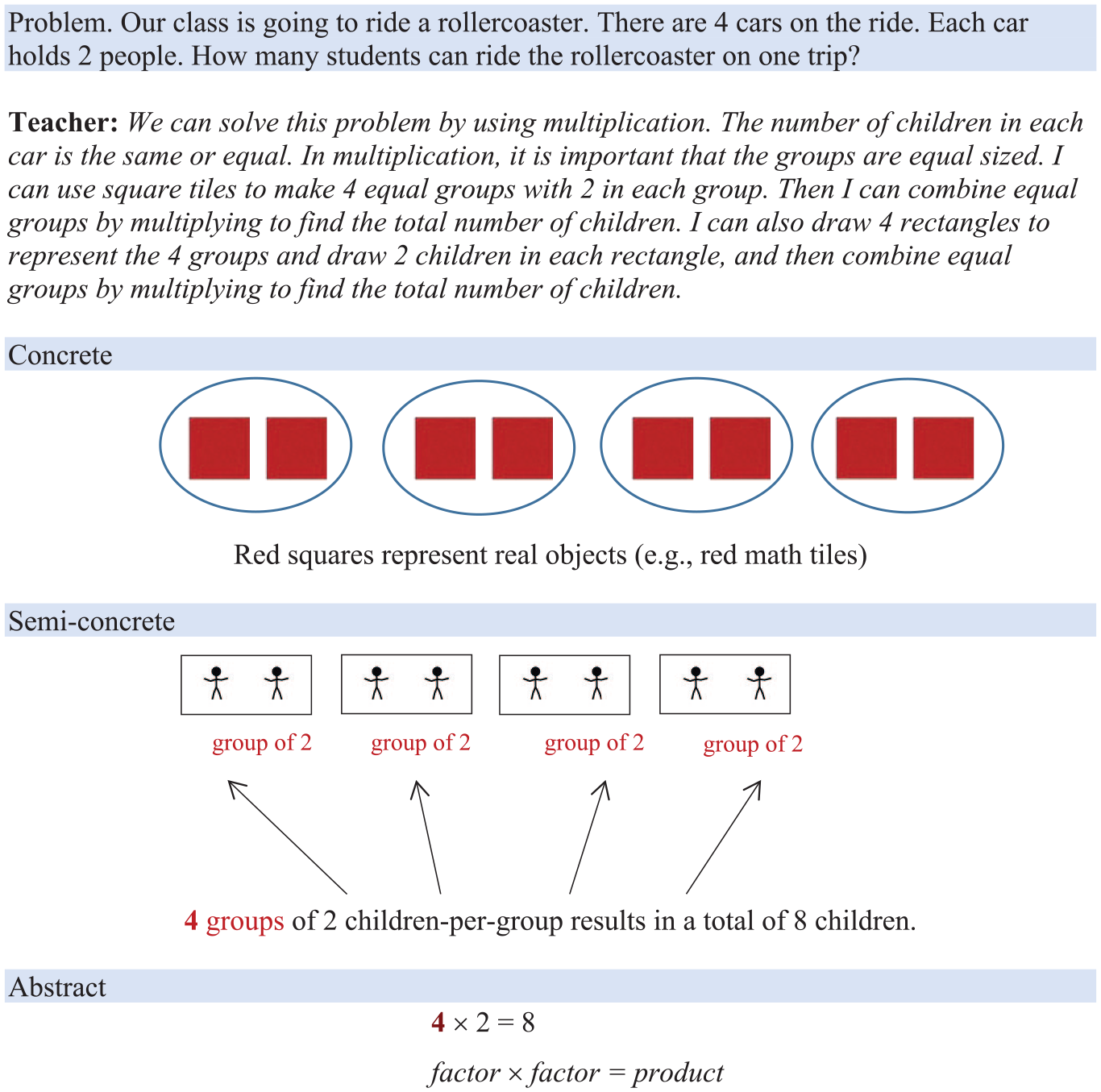
Teacher shows how the total number of students that can ride a rollercoaster on one trip relates to concrete and semiconcrete representations and to an equation
Mr. Juarez and Ms. Lay examine the lesson on developing the meaning of multiplication and start by having students work with a partner to first solve the problem and then emphasize through exploration and discussion that although both addition and multiplication can be used to solve the problem, multiplication is an effective way to solve the problem when there are equal-sized groups. In the roller coaster problem, the teachers point out that because the number of children in each car is the same or equal, it can be solved with multiplication (i.e., combine equal groups by multiplying). The teachers demonstrate how square tiles can be used to make four equal groups with two tiles in each group or use drawings of four rectangles to represent the four groups with pictures of two children in each rectangle. Using the concrete and semiconcrete representations, Mr. Juarez and Ms. Lay show four groups of two children per group as a multiplication problem, which results in a total of eight children and connect to the abstract symbols, 4 × 2 = 8. In the multiplication problem, “4” and “2” are the factors, and “8” is the product or the total amount. One factor tells how many groups there are, and the other factor tells about the number of items per group (children per group). In subsequent lessons, the teachers introduce multiplication as a way of finding how many there are altogether when items are arranged in rows and columns (arrays, area models). Mr. Juarez and Ms. Lay note that the area model for multiplication looks like the other two diagrams (equal-sized groups, arrays) in some ways, but one of the differences is that the squares in each row are connected (see Figure 1) because area describes the number of equal-sized units it takes to cover a flat surface and is measured in unit squares. Finally, the number line is used to show multiplication by having students measure to a given number (e.g., 8) by a length (e.g., 2). For example, students draw line segments, each showing a group of 2 to indicate the length of 2; iterate the line segments to measure to 8; count the number of line segments (i.e., 4); and write the multiplication equation: 4 × 2 = 8.
Step 3: Facilitate Meaningful Mathematical Discourse
Mathematical discourse is more than students telling the steps they used to solve a problem. Although it is important that students can describe a step-by-step approach they used to solve a problem, mathematical discourse should focus and build on student thinking and at the same time “provide students with opportunities to share ideas, clarify understandings, develop convincing arguments, and advance the mathematical learning of the entire class” (Smith et al., 2017, p. 123). To get to the depth of mathematical discourse, then, it is important to have good tasks and questions to stimulate the discussion.
One way to do that is to structure tasks around three processes: reversibility, flexibility, and generalization (Dougherty et al., 2020). Reversibility tasks provide ways for students to work backward and develop more flexible thinking as they identify patterns in problem structures. These tasks generally have multiple solutions and offer every student the opportunity to contribute to the discussion, as in the task of finding two numbers whose product is 24. Responses may include 24 × 1, 2 × 12, and so on, with the opportunity for some students to answer
Flexibility tasks ask students to solve problems in more than one way or to find similarities and differences across and between problems. For example, if students are asked to compare and contrast array, area, and equal-size groups models of multiplication, they may notice that each of the models utilizes equal-size groups as the foundation.
Generalization tasks focus on the big ideas of mathematics, creating conceptual understanding with connections to skill development. In the reversibility task, the generalizations of the even and odd factors’ effect on the product is a significant concept that will support students in predicting what they expect and evaluating the reasonableness of their answers. See Figure 3 for examples of each type within a MR context.
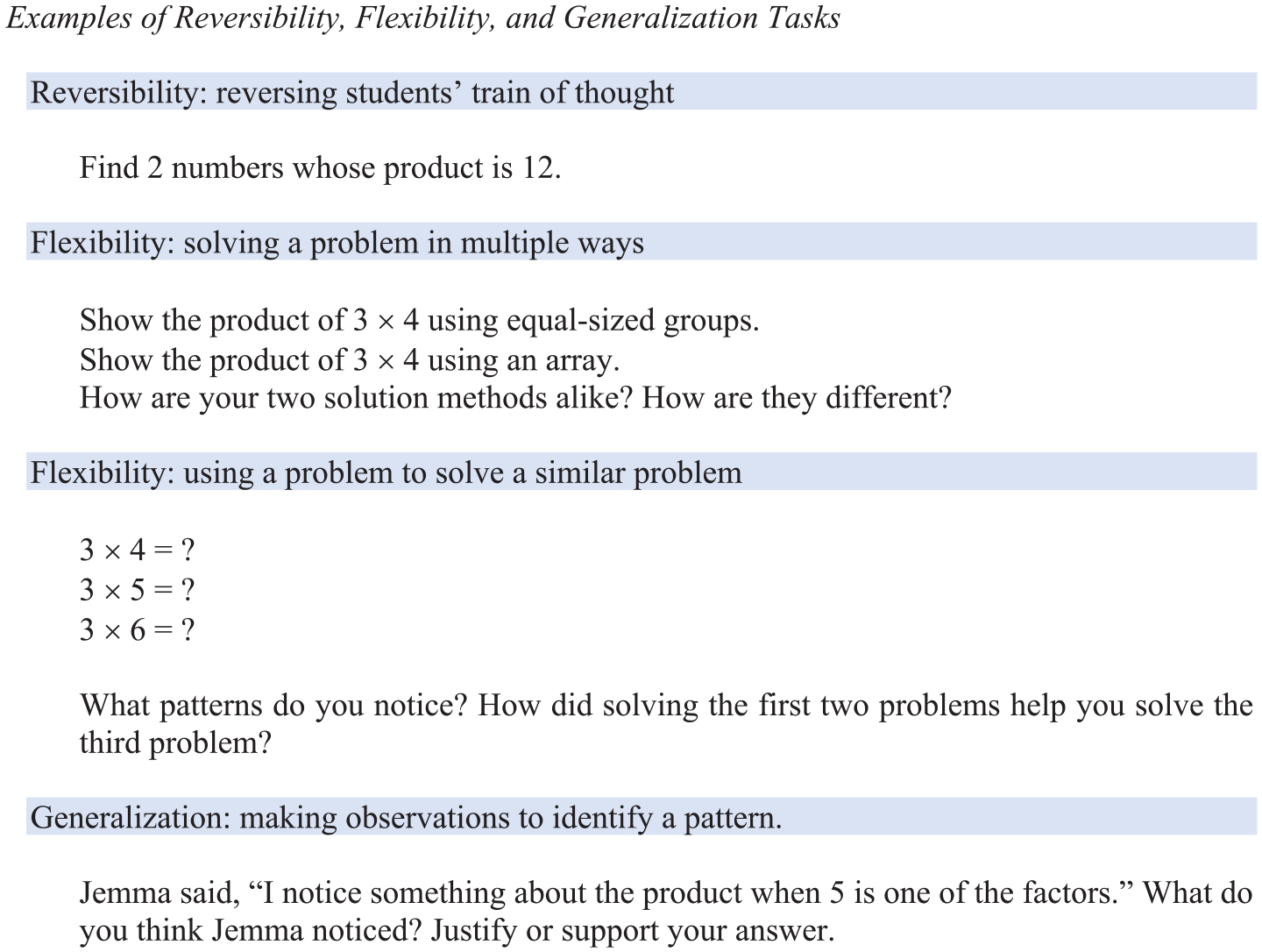
Examples of reversibility, flexibility, and generalization tasks
Questioning techniques are equally important to create a robust discussion. The discussion can be initiated by asking “How did you first think about solving the problem?” or “How did you decide what operation to use?” Students with MLD frequently have difficulty explaining their thinking, so teachers can provide sentence starters, such as, “When I first looked at the problem, I thought . . . ” or “I decided to use . . . to solve the problem because I saw or noticed . . . .” As students explain their ideas, other sentence starters can be used to support students engaging in the discussion, such as “I agree with . . . because . . . ” or “I disagree with . . . because . . . .”
In addition to good tasks and questions, students need language to help them to communicate. A critical aspect of language in a mathematics classroom is the use of accurate and precise vocabulary (Dougherty et al., 2020; Fuchs et al., 2021). Appropriate vocabulary used consistently ensures that students understand references to mathematical ideas in a discussion because there is a shared understanding. This means that vocabulary such as the commutative property of multiplication and inverse operations should be used rather than made-up terms (e.g., ring-around-the-rosy property or opposite operations).
“The use of multiple representations enhances mathematical discourse by providing different ways that students can communicate their ideas.
The use of multiple representations enhances mathematical discourse by providing different ways that students can communicate their ideas. In multiplicative contexts, the representations are diverse, but connected. For example, equal-sized groups are often illustrated with discrete objects, such as cookies, balloons, or animals. That representation looks quite different from the number line that uses a continuous model. They are related, however, in that the number line has groups of units that form an intermediate unit or group much like the equal-sized groups with discrete objects (see Figure 2).
One method that can connect the representations is to use a Frayer model (Nielsen & Bostic, 2018). The Frayer model is a tool for contextualizing vocabulary in that students are asked questions to help them think about how different types of representations can model the same multiplication or division equation. While this supports students developing that understanding, the model also provides the teacher with important information about where students are conceptually.
Mr. Juarez and Ms. Lay decided to enhance class discussion by adapting some multiplication and division problems so they were more open-ended and had multiple access points. They gave students a task using the product of 12 to create the problem “Find 2 factors whose product is 12.” Students were given an opportunity to find multiple sets of factors based on their level. Ms. Lay and Mr. Juarez organized students’ responses as they shared them so that students could detect patterns: 1 and 12, 12 and 1, 2 and 6, 6 and 2, 3 and 4, and 4 and 3. As always, they asked if students had any other answers, and some students shared 1/2 and 24. Ms. Lay and Mr. Juarez then used think-pair-share when they asked if students noticed any patterns. As the students talked, they shared that the order of the factors did not matter, which led to a discussion on the commutative property of multiplication.
Ms. Lay and Mr. Juarez wanted to expand the problem to incorporate multiple representations, so they created a Frayer model with 4 ×3 in the center. Using a think-pair-share format for the Frayer model, they had students first independently think and then pair with a partner to create array, area, and number line models as examples of representations for three of the cells in the Frayer model. For the fourth cell, students were expected to write a contextual situation that represents 4 ×3 (see Figure 4). Then, pairs of students were combined to create four groups where the students compared their representations. Ms. Lay and Mr. Juarez then had the groups share their representations with the whole class. Given that multiple responses are possible, the model allowed for discussion with the whole class where the word problem could be shared and analyzed with regard to the structure and relationship to the models.
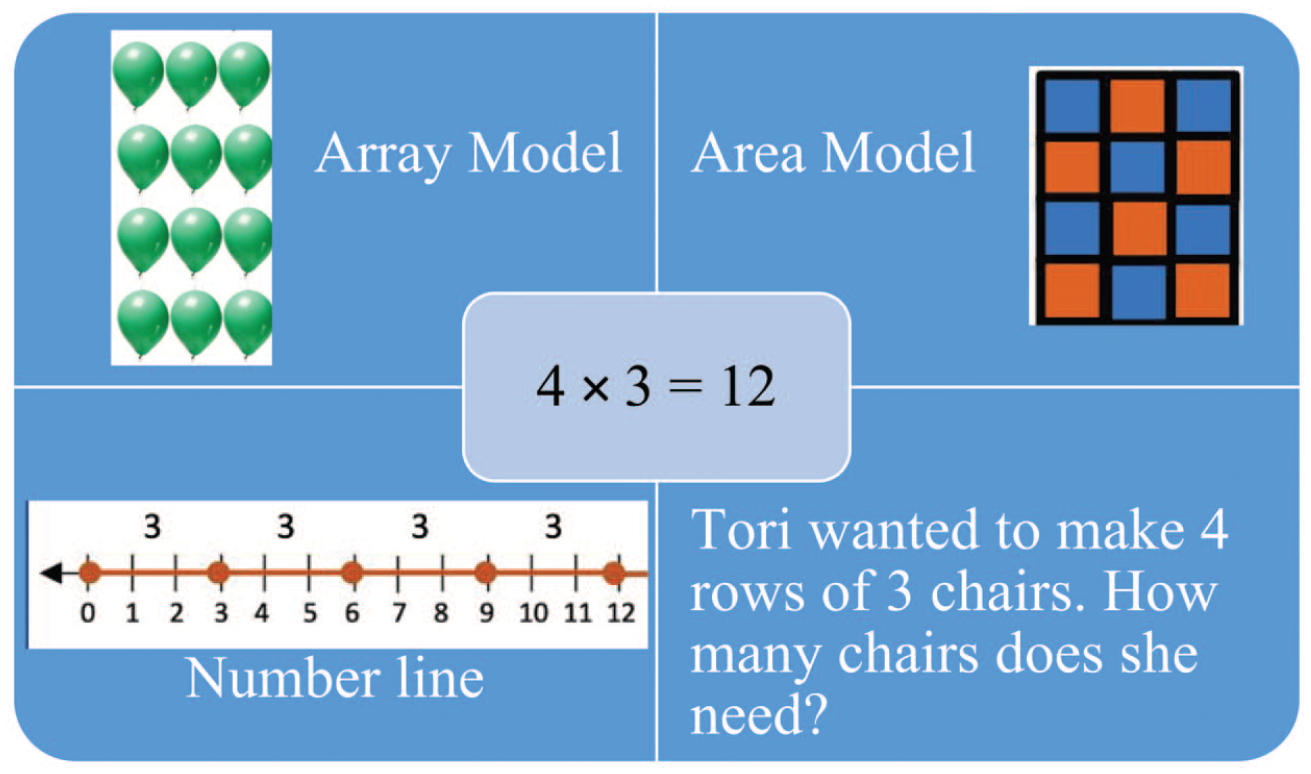
Example of a Frayer model in a multiplicative reasoning context
Conclusion
Teachers of students with MLD, like Mr. Juarez and Ms. Lay, face many challenges in supporting students’ transition from additive to MR. Teachers may not know how to design an intervention that presents a carefully connected and progressive sequence for building MR. Teaching students to develop MR using multiple representations provides teachers with a process to follow. The first step is to select representations (e.g., discrete objects and those that illustrate continuous quantities as length or area) that will help students most accurately model the multiplication or division concept or procedure. Next, teachers can support students by providing diverse and increased opportunities to make connections among different types of representations that are presented concurrently in the same lesson. When students encounter difficulty communicating mathematical ideas, teachers can support students to use and connect representations through mathematical discourse that elicits student thinking by not only structuring tasks around three processes, reversibility, flexibility, and generalization, but also by posing questions to elicit different ways that students can communicate their ideas using accurate and precise vocabulary. Students show progress in their MR when teachers provide appropriate tasks and questions to stimulate the discussion as students think about how the representations are not only diverse but also connected.
Teachers and other educators can use guidelines from this article to foster a deeper understanding of multiplication concepts and procedures for students with MLD. Effective instruction to foster MR is critical because it supports students in developing and understanding mathematical concepts, such as number and relationships among numbers, and more advanced concepts, such as ratio, proportions, and percentages.
Footnotes
Declaration of Conflicting Interests
The author(s) declared no potential conflicts of interest with respect to the research, authorship, and/or publication of this article.
Funding
The author(s) disclosed receipt of the following financial support for the research, authorship, and/or publication of this article: The research reported here was supported by the Institute of Education Sciences, U.S. Department of Education, through Grant # #R324A190101 to the University of California, Riverside. The opinions expressed are those of the authors and do not represent views of the Institute of Education Sciences or the U.S. Department of Education.
