




Abstract
A significant liturgical controversy of the COVID-19 pandemic is whether Christians should celebrate communion online. Much of the discussion of online communion has been based on theological and theoretical claims, rather than concrete observations and experiences, and much of this reflection has been directed toward specific denominational contexts. In contrast, this ethnographic study centers on participant observation of twelve worship services that included communion, or would ordinarily have included communion, that occurred between Holy Thursday and Easter Sunday of April 2020 in Free Church, mainline Protestant, Anglican, and Roman Catholic settings. It takes the approach of receptive ecumenism and asks what gifts Christians from various traditions can receive from one another in relation to online communion both during and beyond times of crisis. Rather than making a case for or against celebrating communion online, it explores the ways in which community is demonstrated and effected in online communion practices.
Keywords
1. Introduction
A significant liturgical controversy of the COVID-19 pandemic is whether and how Christian communities can or should celebrate communion online. 1 Whether profound or polemical, many perspectives on online communion have been put forward in the spring of 2020 as social distancing measures have been implemented across the globe that prevent Christians gathering physically for public worship, including during Holy Week and on Easter Sunday. 2 Much of the discussion of online communion has been based on theological and theoretical claims, rather than concrete observations and experiences of online communion, and much of this reflection has been directed toward specific denominational contexts. In this study, I ground reflection on online communion and Christian community in participant observation of online worship services across a range of Christian traditions with a focus on identifying gifts that can be received from one another ecumenically, both during and beyond this time of crisis. 3
Celebrating communion online is not a new question, although it is a question perceived to have greater urgency and importance when it is an issue for everyone, not only for those who are continually socially isolated—people who are homebound or disabled, geographically remote, or without local clergy. At the same time, new practices of online communion have emerged as Christians who usually have the privilege and ability to attend worship in person are not permitted to gather. Although it is regrettable that this situation was required to engage in a serious discussion and exploration of online communion across traditions, the implications for those for whom social distancing is an ongoing reality may reach far beyond seasons of widespread social distancing.
2. Receptive Ecumenism
Opportunities for ecumenical eucharistic learning were heightened in April 2020 due to the overlap between Holy Week and emergency measures associated with COVID-19. It is understandable that, in the past, most reflection on online communion occurred in traditions that celebrate communion frequently. However, even Christian traditions that celebrate communion only a couple of times per year often celebrate during Holy Week, which draws a broader spectrum of Christians into the conversation. 4 Furthermore, due to the pandemic, Christian communities across traditions faced the same global situation and similar practical needs and pastoral care realities on a local level, as well as the same constraints around gathering. In addition, online worship makes it possible to attend multiple services in ways that would be physically impossible.
With this context in mind, this study takes the approach of receptive ecumenism and asks, “What can we learn, or receive, with integrity from our various others in order to facilitate our own growth together into deepened communion in Christ and the Spirit?” 5 This research is not directed toward greater unity at the table but instead explores what Christians from various traditions may learn from one another that may deepen our own identities, draw us into relationship across difference, and present new possibilities for our own theology and practice. It is an invitation to consider charitably each of these examples and reflect on the gifts we may receive: What can we learn from one another about online communion?
3. Communion and Community
There are any number of theological themes that could be explored ecumenically and ethnographically in relation to online communion. To focus this discussion, I have chosen only one: community. The creation, celebration, and experience of Christian community is a facet of the practice of communion rooted in scripture and held in common across Christian traditions. The “communion of the faithful” is identified as one of five aspects of the meaning of the eucharist in the World Council of Church’s Baptism, Eucharist and Ministry:
The eucharistic communion with Christ who nourishes the life of the Church is at the same time communion within the body of Christ which is the Church. The sharing in one bread and the common cup in a given place demonstrates and effects the oneness of the sharers with Christ and with their fellow sharers in all times and places. It is in the eucharist that the community of God’s people is fully manifested.
6
There are two productive tensions to hold alongside experiences of online communion. One is the tension between the local gathering of a community “in a given place” and the gathering of the Christian community “in all times and places.” The other is a tension between the practice of communion demonstrating—or expressing—a pre-existing community on the one hand, and effecting—or bringing into being—the community on the other. During a pandemic, finding ways to worship online, as an act of care for one another and for the most vulnerable in society, may itself be an expression of the “solidarity in the eucharistic communion of the body of Christ and responsible care of Christians for one another and the world,” 7 also described in Baptism, Eucharist and Ministry. While community is the focus of this discussion, it cannot be detached from other aspects of the meaning and practice of the eucharist. 8
Whether and how community occurs online is a frequent theme in discussions about online worship. Teresa Berger’s robust engagement with this topic in a Roman Catholic context in @Worship: Liturgical Practices in Digital Worlds 9 frames and nuances the conversation. First, Christian community clearly can and does exist online. I affirm Berger’s suggestion that “we forgo arguing whether ecclesial community can exist online—everything indicates it already does.” 10 Second, Christian community exists online in a diversity of forms: “the spectrum of ecclesial community formations online is at least as extensive as the spectrum offline.” 11 Third, online worship in community “entails its own specific bodily properties.” 12 Online worshiping communities are real, material, and embodied, although differently so than communities defined by physical co-presence. 13 Fourth, neither digital mediation nor spatial proximity defines or guarantees Christian community in present practice or in the history of the Christian tradition: community “cannot be shackled solely or primarily to the physical co-presence of believers.” 14 There are possibilities and pitfalls associated with both online and physical liturgical community. With this framework in mind, the focus in this ethnographic study is not whether Christian community is “demonstrated and effected” in online communion, but rather in what ways this is the case.
4. Ethnographic Case Selection and Overview
I observed and participated in twelve services between Thursday evening and Sunday afternoon during Holy Week in 2020 (Table 1). I chose to participate in worship services associated with congregations that I have attended physically in the past at least once, and in many cases regularly. 15 Online worship is not my first contact with any of these worshiping communities. I have a sense for the “usual” practice of each community and a foundation in in-person relationship. In addition, these are all traditions that I identify with on some level and have had substantial connections with over the years. My tradition of origin and in which I serve in denominational leadership is Mennonite, part of the Free Church family that also includes The Meeting House and Hillsong Canada. I am currently engaged in a multi-year ethnographic study based in the Anglican tradition, and specifically the three congregations represented in this research. I have been involved in mainline Protestant traditions in various ways, including connecting with the United Church of Canada and the Presbyterian Church in Canada through my husband, Carl Bear, who is a liturgist and church musician. 16 I have attended Roman Catholic mass regularly for more than a decade. I have an embodied familiarity with and deep appreciation for each of these expressions of Christian worship, cultivated through frequent participation.
Participant observation, Holy Week 2020.
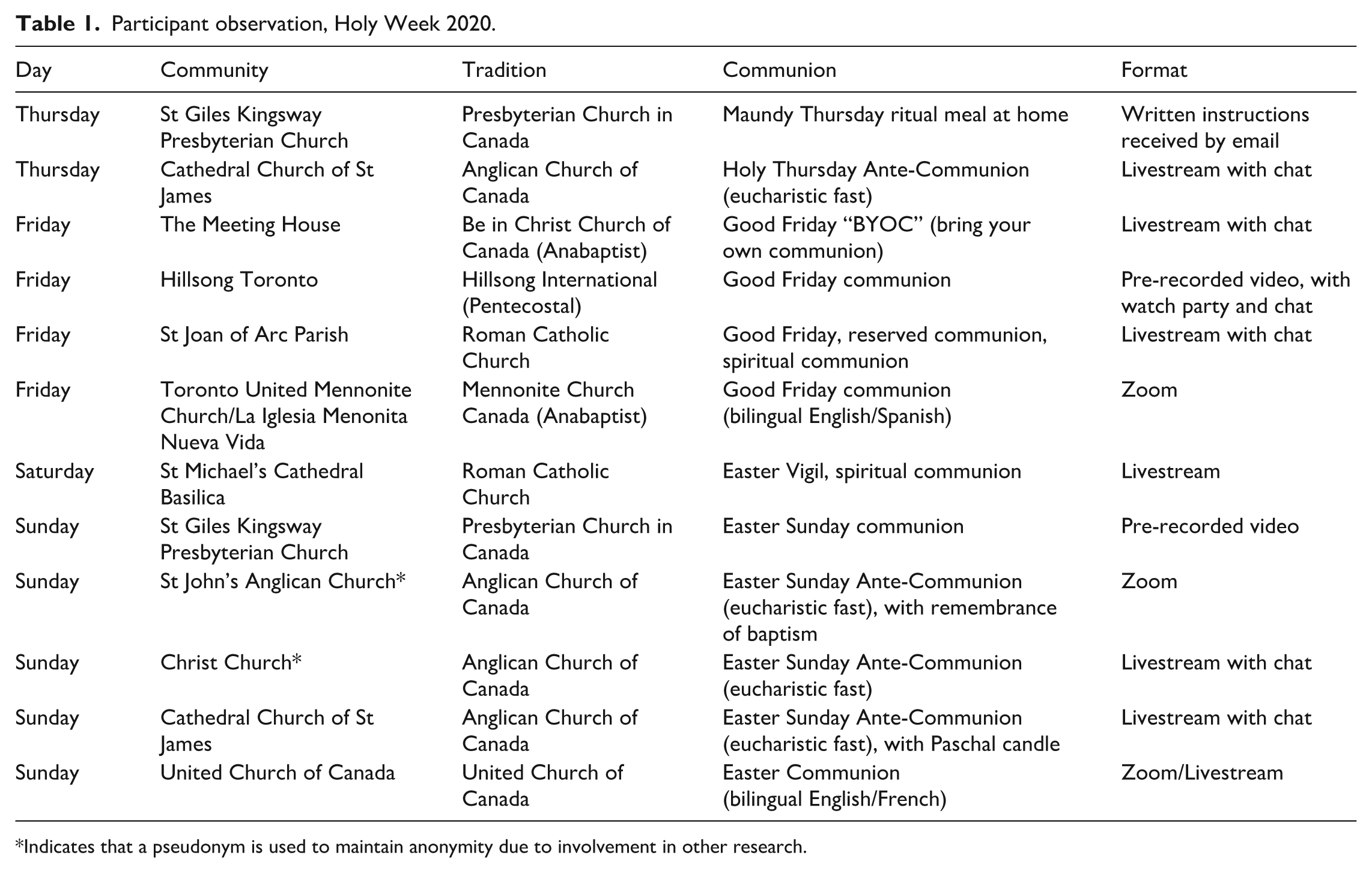
Indicates that a pseudonym is used to maintain anonymity due to involvement in other research.
Each of the congregations I observed is based in Toronto, Ontario, Canada. 17 Although geography is less clear in the context of online worship, with participants joining from across the country and around the world, anchoring the study in Toronto means that these communities faced a similar social, political, and religious climate and that local physical gatherings needed to operate within the same restrictions, which in Ontario in April 2020 included limiting gatherings to five people and requiring people from separate households to remain two meters apart. 18
Due to the focus on communion, I selected worship events that included communion rather than the numerous other possibilities for worship during Holy Week. 19 The notable exception is the Anglican services, which would undoubtedly have included communion under “normal” circumstances. However, the Anglican Church of Canada declared a “eucharistic fast” until communities can gather physically for worship and therefore communion was not being celebrated in the Diocese of Toronto at this time. This eucharistic fast is itself a significant experience of communion.
Each of these worship services took place online, 20 yet there was a lot of variation in format. Synchronous options include livestreamed video, usually by YouTube or Facebook, and online video conferencing, usually by Zoom. The primary asynchronous option is pre-recorded video. There are also hybrid options that create a synchronous experience of a pre-recorded video through a watch party or premiere (when a group of people watch an online video at the same time), or that integrate pre-recorded video into a livestream or video conference. In each of these formats, there are various ways that worshipers may participate. Worshipers may join in independently in their respective locations, including speaking responses, singing, and engaging in physical actions, potentially including receiving bread and cup. Interaction among participants may also be encouraged, whether through seeing and hearing one another in a video conference or through chat features during livestreams and watch parties.
In the following qualitative analysis, I provide thick description of each experience of online communion within a sketch of the broader liturgical context. I then consider the gifts we may receive from each ecclesial tradition—Free Church, Roman Catholic, mainline Protestant, and Anglican—in relation to community and communion online.
5. The Gifts of Online Communion
I sit at my large wooden desk in my home office. Through the window, I watch the nearly empty city buses pass by and see the occasional person or household out for an afternoon walk. The grass is getting greener and the earliest spring flowers are starting to bloom, although the branches on the maple tree are still bare. My large external monitor is dedicated to viewing worship services. A document for fieldnotes is open on my laptop screen. 21 When asked to prepare my own elements for communion, on the desk beside me is a cream cracker on a white dessert plate and a splash of white wine from the box in the fridge in a small, red pottery goblet. Otherwise, the desk is filled with books, or perhaps a glass of water or a teapot. Although my immediate surroundings remain constant, what is on the screen changes as I participate in Holy Week worship.
5.1. Free Church
It is not the first service I observe, but my first experience of receiving communion online is with The Meeting House. I arrive early for the 10am livestream and watch the pre-roll, an online video that plays before the start of worship, which includes Bruxy Cavy—the long-haired, plain-spoken teaching pastor who has grown this Anabaptist community church into a multi-site megachurch that meets in movie theaters across Ontario—talking about what it means to be a church committed to radical love in the context of the coronavirus. The chat on the website is already active with people greeting one another and saying where they are located, ranging from other countries—Australia, the United Kingdom, the United States, Peru, Trinidad and Tobago—to small towns and even specific neighborhoods in Ontario. Some greet one another by name and catch up. Worshipers are already chatting about communion and making preparations: “Good morning meeting house family. So blessed to be part of this! Just made some juice and am all ready for b.y.o.c. “I cracked up laughing when I read BYOC on the website. Strange times, these.” “Everyone have their communion supplies?” “i missed what we need to prepare for communion” @ “something to drink and something to eat. Juice and crackers, water and bread, wine and a bun, your pick!” @ “Traditionally some type of bread and grape juice or wine. But really anything. Something small to eat and something to drink.” @ “juice and bread - or any solid and liquid, really” ”
”
The service is structured as a time of worship through music and prayer followed by a time of teaching. Those leading worship are filmed in their homes. One leader stands in a suburban hallway—the white walls, white trim, and hollow white doors feel familiar and even banal. All leaders are dressed casually and wear headphones. There is a focus on Good Friday throughout, including the reading of the passion narrative from Matthew, and songs that emphasize atonement theology, such as “When I Survey the Wondrous Cross” and “In Christ Alone.” However, there is also a strong commitment to recognizing and validating the struggles of this time, especially a sense of social isolation.
Communion is introduced for the first time during the welcome when a pastor says:
We want to invite you in as a participant, not a spectator . . . We are going to enjoy a time of communion together. Go and find something that you can drink and eat as we celebrate this important time. Water, juice, crackers, bread. It does not matter so much what it is. Jesus’ invitation is what it has always been: “Come as you are. Bring what you have. There is room for everyone at my table.”
Communion is led by Karmyn, a teaching pastor, who transitions seamlessly from her message into the meal. She reads parts of the Last Supper narrative from Luke and then offers an extemporaneous introduction:
[Jesus] knows suffering is coming but tells the disciples that from this time on this tradition will remember his death and life. He points to the hope that all will be restored. They were not there yet, and neither are we. But in the meantime, we hold space, and know that Jesus is with us. We remember what he did so we never have to be alone.
Karmyn invites us to prepare our bread and cup as music plays in the background. She holds a small square cracker and a glass cup with a red liquid in it. She invites us to the meal:
As we gather back together, holding whatever elements you may find, in whatever context you find yourself, know that you are coming to the table with a community of believers.
Karmyn next speaks directly to different groups of potential participants: those sitting alone, acknowledging the “grief” that may be associated with this—“I see you” she says, with heartfelt empathy; those who “don’t know Jesus,” saying there is “no pressure to partake” although all are welcome to do so; and kids, who can “decide whether to participate as a family or watch and learn.” She reads from 1 Corinthians 11 and then invites us to “Take our bread together.” She eats her cracker, and I eat mine. She invites us to “Take our cup together.” She drinks from her cup, and I from mine. “What a beautiful moment to sit in together and to be together,” Karmyn says, before offering a closing prayer. The chat is very active throughout this time:
“Very powerful music and seamless technology. I have communion ready on my table and my son just asked if it could be for him also. It was a beautiful moment. “my dogs trying to eat my communion stuff haha” “Love BYOC - Bring Your Own Communion” “wow, communion apart but not apart is actually very emotional” “wow, I am blubbering like a baby” “Jesus. please help me to remember you every time I drink or eat!” “I have never experienced that spirituality on this level before, beautiful.” “thank you for this ingestion of life together Karmyn” “Imagining us all taking communion together and being united by the Spirit. Such a beautiful gift.” “All of us here are joined spiritually, we are all part.” “amen, Karmyn. such a connecting experience this morning. . .” “international communion. . .love it” “Yes Jesus all around the world today” “ “it is isn’t it. A new level of communion.” “very powerful and emotional communion” “best communion bread ever” “Beautiful! karmyn you did an amazing job of making us feel Not Alone” “What a Good Friday service we will never forget. So beautiful” “I am alone but I wasnt alone. Thank you all for that” “Thank you TMH for this beautiful way of drawing us together in Christ.” “This morning, for a few moments, the Holy Spirit took on the image of @ Karmyn. . . Deeply, deeply meaningful, profound service.” ”
” ”
”
This celebration of communion was clearly deeply meaningful for many participants, in both new and familiar ways. Although this is not my primary church community, I also felt connected and cared for.
Less than an hour later I settle in again at my desk to participate in the Hillsong Toronto Good Friday service. The Hillsong worship structure is similar to The Meeting House in that there is worship through music followed by a time of teaching. Both communities are very comfortable with technology and employ it seamlessly. However, in addition to distinct aesthetic sensibilities, there are several important differences in format and focus. First, the Hillsong service is a pre-recorded premiere—an identical service streamed two hours earlier. The main feature that creates a “live” experience is the chat function on YouTube. Second, the service combines videos from various sources. The primary worship set and sermon both come from Hillsong in Australia. Contributions from Hillsong Toronto include the pastors leading opening and closing prayers, communion, and a call to conversion or recommitment; the creative team producing one song in a “virtual choir” style; and other local leaders sharing announcements. Third, leaders appear in various settings: the message is shared from an empty chapel with smoky lighting; the worship team leads on a dark stage with a neon cross; the Toronto pastors stand in front of a black curtain with white boxes of light superimposed on it. In contrast to being at home or in a familiar local worship space, a concrete sense of place is absent. Fourth, apart from the message, many parts of the service could have taken place at any time. For example, I did not realize that the worship song set was specific to Good Friday until a leader says in the middle of one song, “Good Friday is a time to lift praises to Jesus.” However, the celebration of communion is something that sets the occasion apart.
Communion occurs in the middle of worship immediately following the primary song set. Damien, one of the Hillsong Toronto pastors, appears in front of the black curtain holding a Bible. He speaks extemporaneously:
In this moment right now we have the great privilege and honor to be able to receive communion together wherever you are at. Obviously, we’re doing this online. I don’t think that takes away the power of gathering together. Of course, this is Good Friday when we remember Jesus’ sacrifice going to the cross for us.
Looking at the Bible, he paraphrases the institution narrative from Luke. Although he describes the actions of the meal, he does not have bread and cup on camera. Damien offers a brief reflection with a strong emphasis on remembrance,
I love how it talks about remembrance here . . . In what is an unprecedented time at the moment, when we are all in our homes and are not necessarily able to go out and meet each other, it can be easy to forget. But even in the storm, even in the valley, we have got to remember and understand that he is faithful, that he loves you. Jesus is still right there with you and he loves you and cares for you. So we are going to receive communion together.
He then invites participants to receive:
So let’s partake together in just a few moments. Our team is going to lead a song and you can partake in your own time. Grab that cracker or that bread, or you can have that juice or maybe you have some real red wine there, I don’t know. But however you choose to receive communion today, let’s remember and reflect on what Christ has done for us.
It cuts to a video of the worship team from Australia singing “Turn Your Eyes Upon Jesus.” I am unsure if there is a specific time when I am supposed to receive so I eat and drink at some point during the song. When the Hillsong Toronto pastors reappear on the screen, they do not reference communion but move directly into prayer requests. There are only a few comments in the chat during communion:
“Love that we are doing communion together” “#weareallinthistogether” “brb. . . just crying in my corner here. . . “Such a beautiful service!” ”
”
However, the comments during the worship set are far more abundant and effusive. It is striking that worshipers who engage in this space present themselves as participating in similar ways to how they engage in person—it is as though the first few rows of worshipers at an in-person gathering have taken over the chat. Participants type in lyrics from songs, such as short phrases like “Magnify his name!” “Your grace holds me now” or even “La la la la” (actual lyrics), as well as the kinds of phrases they may call out in worship like “Amen” or “Praise Jesus.” Physical gestures are expressed in the form of emojis:
“High in surrender “‘Let it glorify, magnify Your Name. . .’” “Look where my chains are now siiiinnngggg “Your grace holds me now” “Grace holds me now “Singing away!!!” “Thank you Jesus. I love you Lord” “@_______ I miss your singing and dancing! Good to see you!” “The harmony  ”
” ”
” ”
” ”
”
Whether or not they are embodying these gestures physically, worshipers are signaling their participation to one another and, by extension, encouraging one another to join in, as they do in person. The heightened activity in the chat suggests that, for many worshipers, worship through music was the central moment of this service experientially, rather than communion, or perhaps even analogous to communion in eucharistic traditions as the primary moment of encounter and communion with God. 22
Toronto United Mennonite Church and La Iglesia Menonita Nueva Vida, two communities that share the same physical building, share a Zoom meeting room for an evening communion service on Good Friday. The service is fully bilingual with both Spanish and English options either spoken or shared on the screen throughout. Although I rarely attend Toronto United Mennonite Church on Sundays, as people join the video conference, I recognize names and faces from various events. Quite a few accounts have two or more people, or families crowded together on a couch or at a table. Being able to see others participate, and knowing others can see me, encourages me to join in more fully in singing and responding than I have during the livestreamed services. The first part of the service includes readings from scripture told in the form of stories by leaders of all ages and songs pre-recorded by families in the congregation. Worshipers are invited to join in singing using notated music shown on the screen. There are a few technical bumps along the way but, for the most part, transitions go smoothly.
Communion is led by two pastors: Peter sits at a table and wears a headset microphone to lead in English; Pablo sits on a couch beside his wife to lead in Spanish. At the outset Peter says, “Everyone is welcome to participate. Please have your elements ready.” A lot of words surround communion, including words spoken and shown on the screen in English and Spanish. The words include reading Matthew 26:1-30 in its entirety, various practical instructions, and a eucharistic prayer that incorporates some familiar responses spoken only by the leaders as well as extensive social justice infused commentary, for example:
Jesus invites us to prepare the table where he meets us in the ancient story of liberation and life. In a litany of love, God brought the world into being, creating all elements and spirits united in a harmonious whole. As sorrow and division entered Creation, as sin divided us from the loving presence of our Creator, God continued to speak words of life and creation, calling our ancestors in the faith into covenant relationship. In the words of poets and prophets we glimpsed the vision of a world made right through the coming of God’s Chosen One. Across the span of centuries, God remained faithful, and in the fullness of time Jesus came and walked amongst us, restoring and healing, speaking the truth and calling us into discipleship. We are gathered today in his name, invited once more to set the table, to tell the story, and to remember in this way.
There are four central physical actions. First, Pablo and Peter each light a candle: “We light a candle to represent the presence of Christ among us and in all places.” Later, we are all invited to stand and stretch and offer a sign of peace. I stand on my own and see those gathered in groups moving around and sharing peace. A few people extend the peace through the Zoom chat feature or with a wave at their camera; however, our microphones remain muted, so we are not able to greet one another verbally. Finally, we share the bread and cup. Peter leads the words of institution for the bread in English and when he breaks his bread on camera, I break my cracker as well. We eat together. Pablo leads the cup in Spanish and, although I do not understand the language, I am able to follow his lead and drink from my cup. Communion concludes with a simple phrase, “Scripture tells us they sang a hymn together and went out to Gethsemane to pray.” A haunting song about Jesus in the garden plays and I scroll through the Zoom gallery to see the others gathered at this meal. The service concludes with a video reading of the Passion by members of Sanctuary—a worshiping community in Toronto that includes people experiencing homelessness, a few parting words, and three instrumental Taizé songs. I am surprised that there are no opportunities to interact with one another verbally. However, there is a strong sense of being together through seeing one another that sets this apart from a livestream.
None of the Free Church denominations represented here have clear policies regarding online communion, perhaps in part due to less frequent celebration and congregational polity. This is somewhat paradoxical since one of the gifts that these churches offer is comfort with bringing communities together for worship through modern technology. The Meeting House and Hillsong Toronto in particular were employing modern technology in worship long before COVID-19 through video, social media, movie screens, and more, leading to worship practices compatible with digital media, worshipers accustomed to digital content, and a relatively smooth transition to an online space. These are communities that have consistently embraced the “ubiquity of the digital” and long blurred “the boundaries between being ‘offline’ and ‘online’” in the ways that Berger describes. 23 Perhaps as an extension of this, worshipers are provided with ways to connect directly with one another during the celebration of communion through technology, either through chat features or video conferencing, and they seize these opportunities. In these spaces, worshipers frequently describe experiencing connection with one another as a worshiping community. They also note how this community stretches beyond their local congregations to other parts of the country and world, which concretizes the concept of a local celebration of communion including Christians in all places.
Another gift from Free Church traditions is a theological emphasis on communion as a memorial in which Christ is present in the community and the meal. This theological approach, in combination with an emphasis on the priesthood of all believers that prioritizes the unmediated relationship each Christian has with God, creates space for communities to gather online while receiving the bread and cup in their respective locations. Although pastors provide central leadership for communion in each of these settings, participants are empowered to prepare their own elements and to receive physically at home, whether alone or in small groups. There appears to be little anxiety surrounding the physical proximity of elements, participants, and presiders. The theological convictions that anchor this practice are central in Baptism, Eucharist, and Ministry, and are present in other Christian traditions, although they are often eclipsed by other emphases. Perhaps in the context of widespread online communion and community, they are a gift to rediscover.
5.2. Roman Catholic
On Friday afternoon, I attend the Facebook livestream of the Celebration of the Lord’s Passion at St Joan of Arc Parish, the Roman Catholic parish I attend most often in Toronto. Rushing in from an afternoon walk, I hastily track down the poorly lit, oddly angled, grainy video on Facebook. I am immediately drawn in by the familiarity of the deep-red brick and stark modern lines of the mid-century worship space. Although the cross is shrouded, the altar bare, the candles absent, and red pillows plumped in the foreground (to later receive the cross), the sense of place is powerful. Fr Bob is already reading from Isaiah at the ambo, a red stole over his dark Franciscan habit. Fr Ken is seated and wears a white alb and red chasuble, socks in sandals poking out below the hem. The two priests lead a simplified spoken celebration of the passion. The only references to the pandemic are in the homily and an additional special intention in the Universal Prayer. The only music is a recording of “Were You There” played during the veneration of the cross.
Because it is Good Friday, the Eucharist is not celebrated and instead communion consecrated the previous day is received. During the final strains of the recorded music during the veneration of the cross, Fr Bob walks off camera to the left and brings a brass bowl to the altar. Fr Ken flips past a few pages in the book, perhaps the eucharistic prayer. He introduces the Our Father and both priests open their arms and pray together. I join in at my desk. Each priest takes a consecrated host from the bowl. Fr Ken says the invitation to communion, and both join in the response. They receive together and pause for a moment. Fr Ken hands the brass bowl to Fr Bob. Fr Bob places it again on the table, whispers to Fr Ken, and points to the ambo; Fr Ken points and nods in agreement. Fr Bob then goes to the ambo and prays, with contemporary language, the Act of Spiritual Communion prayer attributed to St Alphonsus Liguori:
My Jesus, I believe that you are present in the most holy sacrament. I love you above all things and I desire to receive you in my soul. Since I cannot at this moment receive you sacramentally, come at least spiritually into my heart. I embrace you as if you were already there and unite myself wholly to you; never permit me to be separated from you. Amen.
Fr Bob returns to the altar and removes the brass bowl. Fr Ken prays the prayer after communion and transitions into a final blessing. Both priests bow before the altar and procession off camera.
The following evening, I return to my desk for another Roman Catholic Triduum liturgy: The Great Vigil of Easter at St Michael’s Cathedral Basilica. I download the 30-page PDF of the program, open the video on YouTube, and notice that the chat has been disabled. In contrast to St Joan of Arc, the livestream video is highly professional with multiple camera angles, precise changes in lighting, and crystal-clear sound amplification. Thomas Cardinal Collins, Archbishop of Toronto, is the primary celebrant and is dressed in sumptuous red and gold vestments. He is assisted by four younger priests in matching gold and white chasubles; one of them serves as the cantor. The presence of five men in the chancel draws attention to how few women will receive the Eucharist physically in Catholic communities this Easter, even as we hear the story of the women who were the first witnesses to the resurrection. Although there are minor adaptations to the liturgy, 24 and I have never attended Easter Vigil at St Michael’s before, the familiar patterns and rhythms resonate deeply with me—light, word, water, bread and cup. “This is the night” reminds me of other nights in other parishes and makes it feel like Easter, although it is not like the Easters that came before.
The eucharist is celebrated by Cardinal Collins, with the other four priests concelebrating two meters apart from each other. None of the responses are sung which makes it especially easy to join in from home. One of the camera angles affords an excellent view of the top of the altar, a perspective not often available to worshipers. The long elevation of the consecrated host and consecrated wine are striking. However, it is the way that spiritual communion is incorporated into the rite that sets this experience apart. After the invitation to communion and the familiar words, “Lord, I am not worthy that you should enter under my roof, but only say the word and my soul shall be healed,” Cardinal Collins pauses, holding the host over the chalice and just inches from his lips. The camera angle remains tight, and he remains still, while a single voice prays the Act of Spiritual Communion. Only when the prayer is complete does he eat, along with the other priests. Instead of being an afterthought, spiritual communion is at the center of the celebration of the Eucharist. I experience a strong sense of participation rather than observation in this moment, although physically receiving is rarely part of my experience of Catholic liturgy. Cardinal Collins then drinks from an ornate chalice. In silence, each priest comes forward to the altar individually to receive from a separate large and shiny chalice before rinsing and drying it with a separate white cloth—presumably measures to prevent the spread of the virus. When the altar is cleared, Cardinal Collins rises and prays the prayer after communion.
These two experiences of community and communion in the Roman Catholic tradition point to gifts that other Christian traditions may receive. The first and most obvious is spiritual communion as a historically and theologically grounded approach to full participation in communion without physical participation.
25
In particular, I experienced the practice of spiritual communion at the Cathedral Basilica as the embodiment of the medieval metaphor of the priest as the mouth of the body of Christ—the church:
The mouth eats and receives food, and all the other members are refreshed. The same with the Sacrament of the altar. All Christendom is one body, united by faith and charity, having many members. The priest is the mouth of the body. When, therefore, the priest communicates all the members are refreshed.
26
While this theology has the potential to be used to limit lay access to the sacrament, in this case, it is employed to invite a community gathered online into the experience of communion.
A second gift is the recognition that, even in the context of tight liturgical regulations, there are options for how to shape the experience of community of those joining in online. Because of when and how the Act of Spiritual Communion was led, at St Michael’s it felt like the eucharist was being celebrated for and with the community gathered online and at St Joan of Arc it felt like the online community was an afterthought.
A third gift is the power of repetition and memorization to foster connection and community. The familiar structure of these liturgies as well as the familiar liturgical space at St Joan of Arc are ways of being in relationship with these specific communities, other Catholic communities I have participated in over the years, and the church that transcends time and space. In addition, memorization freed me to enter fully into the responses while watching the liturgy because I was not juggling a PDF worship aid or squinting at a screenshare. Knowing the responses heightened my sense of joining with others while physically apart both on Good Friday and at Easter Vigil.
5.3. Mainline Protestant
Each of the three mainline Protestant services that I attended is in some way an exceptional case. The Easter Sunday Holy Communion hosted by Moderator Richard Bott of the United Church of Canada is distinct in that it is not associated with a local congregation. The service is in the form of a Zoom video conference but, because the Zoom meeting room has a limited amount of space, there is overflow viewing on YouTube, which is where I join in. Therefore, other worshipers cannot see me, although I can sometimes see some of them. For the most part, however, those leading the service or a screenshare with lyrics and responses is shown. Those leading worship are at home. Richard sits and swivels on an office chair wearing a white alb and a white stole with a United Church of Canada crest. He begins the service by inviting us to situate ourselves in three spaces. He first encourages us to close our eyes and imagine a familiar worship space:
See the worship space you tend to be in on a regular basis. Think about who are the people sitting around you. There are some people who tend to have the same seat every Sunday. Others move around. There may be children running down the aisle. Settle yourself into this virtual sanctuary. It is important for us to realize that this is a virtual space, but the worship is real. We are together.
Richard next provides instructions for settling into the technological space specific to this worship service, including practical instructions about Zoom and an invitation to get some “bread, crackers, rice, something like that—I have got tortilla” and “some grape juice, or wine, or water.” A few worshipers respond by describing their elements in the YouTube chat:
“tea and pecan pie” “I only have a banana and milk tea. . .yeah” “hot cross bun and wine here” “homemade raisin Bread and a cup of wine”
Finally, Richard offers a land acknowledgment. He provides a link to native-land.ca and encourages us to recognize the land where we are physically located in the chat and several people name the Indigenous peoples and treaties in their region in the YouTube chat. A simple service of the word follows, including hymns, reading from scripture in French and English, and a short sermon.
Richard leads communion, turning his office chair between facing the camera on his computer and facing a small table against the wall behind him that holds a candle and the bread and cup. Using both French and English, with opportunities for worshipers to join in responses in either language, Richard leads a standard ecumenical consensus eucharistic prayer. During the words of institution for the bread, he holds the large tortilla up toward the camera and breaks it. During the words of institution for the cup he pours red wine from a carafe into a wine glass that would be at home on a dinner table. When it is time for participants to receive communion, the screen shifts from a focus on Richard to the Zoom gallery view so we can see those in the video conference. “The gifts of God for all the people of God. Thanks be to God,” Richard says. Richard eats part of the tortilla, noting that he cannot finish it all right now. I eat part of my cracker. We both take a sip of wine. Richard leads us in a corporate prayer after communion and then offers a final blessing that concludes:
Christ is risen. We are never alone. Thanks be to God. The peace of Christ holds us, the love of God enfolds us, and the wings of the Holy Spirit carry us this day and forevermore. Alleluia. Amen.
Although the Zoom service was streamed on YouTube, the video is not posted—it was a one-time, synchronous event.
In contrast, the Easter Sunday service at St Giles Kingsway Presbyterian Church, a conservative Protestant congregation, is the only fully asynchronous communion service I attend. I experience this asynchronicity more acutely because I view the components sporadically throughout the day and late into the night on Saturday as Carl edits the video, and I only watch the service in its entirety more than a week later for the purpose of this research. The video combines footage recorded in people’s homes—including Easter greetings from families in the congregation, scripture readings by children and youth, and a message for children—with footage recorded in the pristine yet empty mid-century sanctuary— including the sermon and celebration of communion by Pastor Tim and a greeting and praise song led by his family members. Music also includes hymns recorded on the organ with vocal leadership from a soloist. Words appear on the screen to introduce each act of worship and to facilitate participation in responses and singing.
Pastor Tim, wearing a Geneva gown and white stole, preaches from the center of the chancel near the white-clothed communion table and frequently gestures toward the folded pita bread and silver pitcher and cup during his message on Luke 24. At one point during the message, Tim directly addresses celebrating communion in this format:
It was not an easy decision to celebrate the Lord’s Supper in this way, far apart from one another. But, friends, we believe the mystery of faith transcends the type of bread or juice we share, or the way it is distributed. It is spiritual food for believers in Christ. The body of Christ is nourished and strengthened and equipped. Even in these days, God is at work.
A hymn written specifically for this Easter Sunday is sung following the sermon, and Tim introduces communion by quoting the text, “This Easter celebration is not like ones we’ve known . . . With sanctuaries empty, may homes become the place, we ponder resurrection and celebrate your grace.” 27 He invites us to stand, “wherever we are as a sign of our unity,” and confess our faith with the Apostles’ Creed, which is shown on the screen. He then offers a standard Presbyterian eucharistic prayer. As I look at the ordinary cracker and wine from my kitchen, a familiar phrase from the prayer takes on new meaning: “we partake of the cup and bread that we have set apart from common use for use on this day that we may be together unified with Christ.” Tim says the words of institution for the bread—we eat together. He says the words of institution for the cup—we drink together. A long congregational prayer follows communion that includes many prayers specifically related to the pandemic. The service concludes with a hymn and blessing.
The final mainline example, also associated with St Giles Kingsway Presbyterian Church, is a Maundy Thursday ritual meal intended to be celebrated by households at home. It is the only service that does not have an online component, apart from receiving the instructions by email. I include it here for two reasons: first, to provide an example of worship at home that does not depend on video technology, and second, to complicate what is considered communion. On Holy Thursday, Carl and I prepare a simple dinner, yet set the table with a tablecloth and candle. Carl has printed out the single-page service. We stand at the end of the table and he reads the following prayer:
Jesus, on the night before you died, you ate a meal with your closest friends. Be present with all of us who gather on this night in various places. May we recognize our unity with one another and with you as we remember the significance of this Last Supper you shared with your disciples.
Carl takes and blesses the bread for the meal and distributes it onto our plates. He blesses the wine and pours us each a small glass. We sit down and Carl reads the institution narrative from Luke, also printed on the page. I read aloud a short reflection Pastor Tim wrote for the occasion. Carl leads us in singing the doxology in harmony. We eat dinner. When the meal is finished, Carl prays the concluding prayer. While I acknowledge that this was not intended to be a communion service, and that members of the St Giles Kingsway community would likely not identify it as such, I experience it as very close to communion.
The question of online communion was resolved years before the emergency measures associated with COVID-19 in both the United Church of Canada and the Presbyterian Church in Canada. In 2015, after studying the matter, the United Church of Canada concluded that online communion is permissible and decisions about specific situations can be made at the local level. 28 Likewise, in 2012, the Presbyterian Church in Canada determined that, “the communion elements could be properly set aside and blessed by means of virtual media.” 29 Perhaps the license provided by these denominational decisions facilitated the exceptional nature of the mainline Protestant communion that I experienced, which offer two gifts related to online Christian community.
First, these celebrations stretch our understanding of who is part of the worshiping community. Although online services often include participants from a wide geographic area, the United Church of Canada communion service is the only event that intentionally creates a new online community instead of being anchored in a local congregation; in doing so it invites a sense of nationwide unity beyond what would be physically possible. This is amplified by participants imaginatively connecting their local congregations to the online gathering and acknowledging the specific territories where they reside.
Second, these celebrations stretch our understanding of when the community is gathered for the meal. In St Giles Kingsway’s asynchronous celebration of communion, the eucharistic prayer is prayed the first time it is spoken, and again when it is viewed at the encouraged time on Easter Sunday morning, and again each time it is engaged, even weeks later when DVDs are distributed to community members without internet access. Through online worship, a community gathers that transcends time which expands our vision of online community beyond “simultaneity without spatial proximity” 30 and may even invite us to consider broader conceptions of liturgical time. In these ways, the online celebration of communion can be received as a concrete sign of the oneness of the church in “all times and places.”
5.4. Anglican
In addition to the eight services described above that include communion or something like it, I participated in four Anglican services that would have included communion had we been able to gather physically in person. However, the Anglican Church of Canada suspended the celebration of the eucharist while physical gathering is not possible. In a letter to the Diocese of Toronto on March 25, Bishop of Toronto, Andrew Asbil, quotes the Ontario Provincial House of Bishops:
One of the realities for the Church living through this pandemic is our inability to physically gather as community for worship and mutual support. The Eucharistic Feast which we are used to celebrating week after week has been interrupted . . . Therefore, the bishops of our province have agreed together that our virtual worship through Holy Week and the season of Easter, or until such time that we can gather in community together, will not include the liturgy of the Eucharist. Sacramental celebrations are the work of the whole People of God and require a gathering of people who can be physically present to one another. That is impossible for most of us at this time. The Great Three Days of Easter, and through the 50 days of the season, we will be fasting from the Eucharist but feasting on the Word.
31
“Feasting on the Word” as the primary complement to “fasting from the Eucharist” is evident in the communities I observe.
The Anglican liturgies I attend include Holy Thursday Ante-Communion at the Cathedral Church of St James, as well as Easter Sunday morning Ante-Communion at the Cathedral, Christ Church, and St John’s Anglican Church. I have attended each of these congregations over the past months, including witnessing their transitions to online worship over the four weeks before Easter. The Cathedral livestreams services on Facebook, with clergy and musicians coming and going from the neo-Gothic chancel to ensure fewer than five people are present at any one time. An active chat accompanies the Cathedral liturgies that often includes worshipers offering prayer requests, joining in responses, and introducing themselves by either their parish in the Diocese or their location across Canada or around the world. Christ Church livestreams on their website and YouTube channel; there is little engagement in the chat beyond the occasional “good morning” or “Happy Easter.” St John’s worships by video conference, which allows us to see and hear one another, although everyone apart from leaders remains on mute except for during joyfully chaotic times of gathering, sharing the peace, and sending.
The eucharist is noticeably absent from each of these Anglican Triduum liturgies. When the eucharistic fast was first announced, some parishes moved to Morning Prayer for a week or two before shifting to Ante-Communion. However, it is noteworthy that something beyond Morning Prayer or Ante-Communion is present in each one of these Triduum services. On Holy Thursday, as prescribed, the liturgy concludes with the stripping of the altar and, thanks to the close-up video, as one participant notes in the chat, “I’ve never had that close a look.” On Easter Sunday, the Cathedral service begins with preparing the Paschal candle (since the Cathedral had canceled the Easter Vigil liturgy). At St John’s, the Zoom Easter Sunday includes the renewal of baptismal commitments. At Christ Church, a lengthy choral anthem, recorded by the church choir before the pandemic, is included. It is as if clergy or congregations feel like something needs to be done to make up for the absence of communion, especially on Easter Sunday. However, the absence of communion is not formally acknowledged at St John’s, Christ Church, or the Cathedral, either by those in leadership or by participants in the chat.
Eileen Scully, Director of Faith, Worship and Ministry for the Anglican Church of Canada, offers the following explanation of this season of eucharistic fasting:
One of the most difficult realities that we face as worshipping communities is that suspension of gatherings for worship does mean the suspension of celebrations of the Holy Eucharist. Whereas musical and theatrical performances can be moved online, the Eucharist is not about performance by one for the many and cannot move into that mode. The sacrament is made such in and through the gathering of people with a presider, in a place and time, in the physical presence of what we can touch and taste, together, as well as hear and see. Efforts to replace the community’s physical-and-spiritual gathering with practices that try to offer a eucharistic communion online, though well-intentioned, do not reflect our sacramental theology, which is deeply about the physical-and-spiritual together. This is, now, a time of eucharistic fasting, in which we join with the whole communion of saints in longing for the bread of new life and the wine of the age to come.
32
Although these comments are well-intentioned, they do not align with my experience of online communion, which has not been one of performance. In various ways, I have observed and participated in the “physical-and-spiritual together” and in connection with “the gathering of people with a presider, in a place and time, in the physical presence of what we can touch and taste, together, as well as hear and see.” Therefore, I do not share in the experience of the eucharistic fast called for by the Anglican Church of Canada. Nevertheless, I consider what gifts this fast may have to offer the wider church in relation to our conceptions of online community and communion.
First, choosing not to celebrate the eucharist clearly recognizes that things have changed during the pandemic: communities are not gathering physically, and liturgy does not and cannot remain the same. It encourages us to respond to what is happening directly instead of proceeding with “business-as-usual” to create a sense of normalcy. This includes recognizing that the ways Christian community is “demonstrated and effected” must be different.
Second, the fast summons us to awareness of other resources in the Christian tradition, notably the word of God in scripture and preaching 33 and prayer for one another and the world. If we are not united as a community in the meal, we can consider how we are instead united in word and prayer, as well as in baptism, song, and other practices, as these services model.
Third, the absence of the eucharist is itself a form of presence in the reflection it invites and the desire it cultivates to once again celebrate this feast. The absence of the meal leans into the eschatological nature of the eucharist by anchoring us squarely in the “but not yet” dimension of the feast that “already” unites us with Christ, one another, and with all the saints.
6. Conclusion: Receptive Ecumenism, Christian Community, and Online Communion
In the face of a global pandemic, what gifts can Christians receive from one another across traditions as we learn to gather for worship online and in homes, including choosing whether and how to celebrate communion? How do we think about and practice Christian community online? Despite differences in theology and practice, each of the traditions considered would join Berger and affirm that,
God is not the problem here, at least not in terms of theological reflection. The most basic of theological convictions affirm that God’s power moves freely through the cosmos and can indeed move in, with, and through all created things. Presumably, God therefore has no problems moving through cyberspace and among pixels.
34
The question is instead, “How do we think, in theologically appropriate ways, about these new forms of sacramental mediation?” 35 And, for those with the daunting privilege of shaping Christian worship, what do we do in practice regarding the celebration of communion during seasons when we cannot gather physically for worship? In addition to the distinct gifts of each tradition identified throughout, I conclude by naming four broader gifts we may receive from this study of Holy Week and Easter online communion and community during COVID-19.
The first gift is concrete examples of how online communion and community take many forms. Online communion and community are not a single reality, but a network of practices analogous to the range of practices associated with physical communion and local church communities, with a similar range of pitfalls and possibilities. Online community may be anchored in a pre-existing community, bring a new community into being, or combine these possibilities. Online community may be a digital manifestation of a specific local community, embrace the possibility of gathering across time and space, or be a hybrid of these realities. Many options are available for fostering community online, whether through encouraging participants to communicate with one another, turning to familiar repeated and memorized patterns and words, naming social isolation directly while firmly asserting that “we are never alone,” or any number of other practices. Even in highly regulated liturgical traditions, there are options. We do well to demand more nuance from arguments that assume a single form of online communion or a straightforward understanding of online community as a starting point.
A second gift is awareness of new opportunities to observe the practice of Christians from a range of traditions and join in as we are invited and are able to do so with integrity. Online worship opens new space for ecumenical encounter and dialogue. When emergency measures forced Christians to find alternative ways to worship overnight, a diverse array of responses rooted in the theology and practice of each community emerged, and these gatherings are often open to visitors. We can be in community with one another across Christian traditions and learn from one another in new ways through online worship.
A third gift is greater understanding and empathy for those who regularly experience social distance from their worshiping communities and an involuntary eucharistic fast due to illness, barriers to mobility, geographic distance, or other factors, as well as an explosion of resources for ways to include those at a distance more fully. The many gifts received here may suggest new ways of drawing those on the margins of public worship more fully into worshiping communities, beyond times of widespread social isolation.
A fourth gift is how online communion reveals that who gathers, and the ways communities gather, are incomplete at every celebration of communion. When we gather physically with our local communities, those from the nationwide or global church are not equally present with us. When we gather at a specific time, we do not welcome those who are unavailable at that time. When we focus primarily on personal physical reception, an emphasis on corporate spiritual reception becomes secondary. When we feast at the table, we are not hungry for the meal. When we gather in a dedicated worship space, we are not invited into one another’s homes. When we can see and hear others respond around us in the same room, we cannot read one another’s inner reflections and personal prayers expressed in written words and symbols. Online community and online communion are not the same as gathering physically with one another at the table, but they are gifts of God for the people of God.
Footnotes
1.
In the context of this research, “online communion” is broadly defined as any eucharistic celebration with an online component, whether a livestreamed Roman Catholic mass, a communion liturgy in which participants receive the bread and cup at home during a video conference, a pre-recorded service, or any number of other possibilities. The absence of the celebration of communion as a result of online worship is also considered.
2.
Examples are too many to enumerate.
3.
The issues involved in online communion greatly exceed what it is possible to address in this study which is not intended to be comprehensive but rather to serve as one contribution to a larger conversation.
4.
Good Friday is a common occasion for communion in Free Church traditions, which celebrate the Supper less often than the others included in this study.
5.
Paul D. Murray, ed., Receptive Ecumenism and the Call to Catholic Learning: Exploring a Way for Contemporary Ecumenism (Oxford: Oxford University Press, 2008) ix.
6.
World Council of Churches, Baptism, Eucharist and Ministry, Faith and Order Paper No. 111 (Geneva, 1982) 12 (emphasis added).
7.
World Council of Churches, Baptism, Eucharist and Ministry, 12.
8.
One could examine whether and how the five theological themes associated with the eucharist in Baptism, Eucharist and Ministry are engaged in online celebrations of communion: (1) Thanksgiving to God, (2) memorial of Christ, (3) invocation of the Spirit, (4) communion of the faithful, and (5) meal of the Reign of God.
9.
One could also examine a number of key themes in Berger’s analysis, including embodiment, active participation, community, materiality, mediation, and liturgical authority. Teresa Berger, @ Worship: Liturgical Practices in Digital Worlds (London: Routledge, 2017); Teresa Berger, “@Worship: Exploring Liturgical Practices in Cyberspace,” Questions Liturgiques 94 (2013) 266–86.
10.
Berger, @Worship: Liturgical Practices in Digital Worlds, 44.
11.
Berger, @Worship: Liturgical Practices in Digital Worlds, 34.
12.
Berger, @Worship: Liturgical Practices in Digital Worlds, 35.
13.
See Berger, @Worship: Liturgical Practices in Digital Worlds, Chapter 2, for an extended discussion of the false distinction between the real and the virtual, and of embodiment and materiality in digitally mediated worship.
14.
Berger, @Worship: Liturgical Practices in Digital Worlds, 44.
15.
One exception is the United Church of Canada Easter Communion service which is not associated with a local congregation but led by the moderator of the nationwide church body.
16.
Carl Bear currently serves as the Director of Music at St Giles Kingsway Presbyterian Church. Although he was involved in shaping the Holy Week liturgies included in this research, these services reflect a collaborative process.
17.
One exception is the United Church of Canada as it does not have a specific geographic location. The primary leader is based in British Columbia and other leaders and participants come from across the country.
18.
Office of the Premier, “News Release: Ontario Prohibits Gatherings of More than Five People with Strict Exceptions,” Government of Ontario, March 28, 2020, https://news.ontario.ca/opo/en/2020/03/ontario-prohibits-gatherings-of-five-people-or-more-with-strict-exceptions.html; Office of the Premier, “News Release: Ontario Extends Emergency Declaration to Stop the Spread of COVID019,” Government of Ontario, March 30, 2020,  .
.
19.
The Maundy Thursday at-home service provided by St Giles Kingsway is not a communion service, although it has some similarities to communion.
20.
The written instructions provided by St Giles Kingsway for celebrating Maundy Thursday are an exception.
21.
I took fieldnotes during each service. Although taking fieldnotes while participating divided my attention, it saved time and increased accuracy, especially when observing and participating in many similar services in a short time frame. I have 44 pages of single-spaced fieldnotes on these 12 services. For videos made available online, I was also able to watch certain sections multiple times.
22.
Sarah Koenig, “This Is My Daily Bread: Toward a Sacramental Theology of Evangelical Praise and Worship,” Worship 82 no. 2 (March 2008) 141–61.
23.
Berger, @Worship: Liturgical Practices in Digital Worlds, x.
24.
25.
Gary Macy, Treasures from the Storeroom: Medieval Religion and the Eucharist (Collegeville, MN: Pueblo Books, 2003).
26.
Vincent Ferrer, Sermo in Epiphania Domini, II; in Sermonum sancti Vincentij . . . de te[m]pore pars hyemalis nouiter correcta (Lyon: Jean Moylin, 1513) fol. xliii, fa. 1; translated in Anglo-Catholic Principles Vindicated, ed. John Charles Sharpe (Oxford: James Parker & Co., 1877) 310.
28.
United Church of Canada, “Online Communion in the United Church of Canada: Online Communion is Permissible,” April 6, 2020, https://www.united-church.ca/sites/default/files/resources/online_communion_in_united_church.pdf; United Church of Canada, General Council Executive Workbook, March 21, 2015, 169–73, .
30.
Berger, @Worship: Liturgical Practices in Digital Worlds, 37.
31.
33.
One could argue that preaching also holds the physical and spiritual together in the gathering of the people and the presider in a specific place and time.
34.
Berger, @Worship: Liturgical Practices in Digital Worlds, 94–95.
35.
Berger, @Worship: Liturgical Practices in Digital Worlds, 95.