




Abstract
Higher education institutions widely promote engaged scholarship, yet it remains undervalued in academic reward systems, such as hiring and promotion, and it is especially risky for early career scholars. Using a unique data set of 138,738 applications for assistant professor positions, this study links large-scale demographic hiring data with applicants’ substantive presentation of self through the language they use in their materials regarding engaged scholarship. Results show that women of color are the most likely to present themselves as engaged scholars, drawing on long-standing traditions of public-serving epistemologies among historically marginalized scholars, even as such work remains unevenly rewarded. Centering applicants rather than evaluators highlights how scholars navigate disciplinary norms and exercise agency in shaping their professional identities. These patterns reveal how inequalities, epistemic and otherwise, may be reproduced in academic evaluation and show which scholars might be taking early career risks to pursue public-oriented scholarship—a core mission of public institutions.
Keywords
Higher education institutions (HEIs) have increasingly embraced engaged scholarship—academic work that holistically integrates research, teaching, and service in collaboration with the broader public—as essential to fulfilling their core missions (Beaulieu, Breton, and Brousselle 2018; Giles, Sandmann, and Saltmarsh 2010; London et al. 2026). Even as institutional support for engaged scholarship has grown, however, traditional academic evaluation processes continue to devalue this scholarship (Colbeck and Wharton-Michael 2006; Hutchinson 2011; O’Meara 2008). Scholars describe this misalignment as the “rhetoric/application” divide, highlighting how institutional support at the policy level often fails to translate into recognition in evaluation systems (Hutchinson 2011). As a result, faculty pursuing engaged scholarship frequently encounter risks to career advancement, especially in early stages of the academic trajectory (Jaeger and Thornton 2006; O’Meara 2008).
Scholarship on evaluation in academia typically focuses on the evaluators—those reviewing grants, hiring materials, or admissions essays—and how they make sense of excellence, merit, or fit (Lamont 2009; Posselt 2016; Rivera 2017). Far less research has examined how individuals being evaluated present themselves in these gatekeeping moments; indeed, we know little about the extent to which junior scholars are pursuing engaged scholarship. Faculty application materials offer a unique window into how early career scholars present their engaged work. In Goffman’s (1959) terms, these documents serve as a presentation of self through which applicants construct and manage impressions of scholarly identity for an audience of gatekeepers. At the same time, disciplinary socialization, mentoring, and institutional pressures shape how engagement is expressed—whether framed holistically or only in the realms of research or teaching—producing both constraints and opportunities for how applicants articulate engagement.
Using a unique data set of 138,738 full-text assistant-level faculty applications, I employ supervised machine learning (SML) to identify applicants who present themselves as engaged scholars in their application cover letters, research statements, and teaching statements at nine public research universities across 1,079 recruitments and six years. This research is the first to provide a comprehensive landscape view of the use of engaged language in faculty applications across years, different application documents, and fields, highlighting broader institutional and disciplinary dynamics that shape how scholarly identities are constructed and conveyed during the high-stakes process of academic hiring. Results show a distinct increase in engaged scholarship self-presentation across all fields, particularly after the 2017–2018 academic year. However, within this trend, women of color—specifically, Black, Native American/Native Alaskan, and Hispanic/Latina women—are significantly more likely than other groups to present themselves as engaged scholars. This finding is robust across years, document types, and disciplines, and it is amplified by a measure of the amount of engaged language used by applicants.
The question of who presents themselves as an engaged scholar is theoretically significant for understanding how academic evaluation systems may reproduce inequality. Higher education's organization into disciplinary fields is maintained through constant boundary work over legitimacy, often negotiated during evaluation processes where over time, certain forms of knowledge become privileged over others (Abbott 2001; Lamont 2009; Posselt 2016). Women, scholars of color, and Indigenous scholars have long pursued forms of engaged and community-oriented scholarship—often under labels such as “activism,”“outreach,” or “public service”—that challenged dominant epistemologies but were routinely marginalized or devalued in academic reward systems (Baez 2000; Gonzales 2018, 2022; Lengermann and Niebrugge 2006). When engaged scholarship gained institutional visibility in the 1990s, catalyzed by the then-president of the Carnegie Foundation, a more formalized and “sanctioned” version of engagement tended to erase these longer histories (Gonzales 2022). Yet evaluation frameworks often systematically devalue knowledge produced by scholars from historically marginalized groups, even in the face of newer institutional support, and what appears as objective assessment embeds deeply cultural assumptions about what constitutes legitimate scholarship (Posselt et al. 2020).
But more importantly, the dominant focus in research on academic evaluation on gatekeepers’ subjectivity (Lamont 2009; Posselt 2016; Rivera 2017) obscures both the agency of the applicants in choosing how to present themselves and the different epistemic lines along which they may do so. Applicants may strategically highlight or downplay engagement in ways that both reflect disciplinary norms and contest them (Liera and Rodgers 2025). For some, foregrounding engaged work can constitute an act of critical agency: persisting in orientations that serve the public good despite the known risks (Baez 2000; Gonzales et al. 2024).
These lines of difference may be key to illuminating other patterns shaping knowledge production and inequality in academic institutions, such as epistemic exclusion and the systematic devaluation of scholarship by those perceived as outside disciplinary norms (Dotson 2014; Settles et al. 2021), which is often tied to the historically marginalized identities of the scholars pursuing such scholarship. Better understanding who the scholars are doing engaged scholarship provides leverage to further explore systemic patterns of epistemic devaluation, the reproduction of inequality in higher education, and which scholars might be taking early career risks to pursue scholarship aligned with serving communities and addressing public needs, a core function of public institutions.
Conceptualizing Engaged Scholarship
Also referred to as “publicly engaged scholarship,”“community-engaged scholarship,”“public scholarship,”“translational research,” and “service-learning,” engaged scholarship redefines academic work as an integrated process where teaching, research, and service mutually inform and enrich each other to meet societal needs (Colbeck and Wharton-Michael 2006). Its practices aim to democratize knowledge production and orient academic labor toward the public good, including collaborating with community partners on research design and dissemination (Solem, Lee, and Schlemper 2009; Urrieta and Méndez Benavídez 2007), sharing knowledge beyond universities, (Doberneck, Glass, and Schweitzer 2010), and orienting research toward social justice and activism (Cech 2013; Pratt-Clarke 2012). Through these practices, engaged scholars expand the faculty role beyond knowledge production to include catalyzing social change, functioning as scientists and engaged citizens (Checkoway 2013).
The term “engaged scholarship” gained prominence through Boyer’s (1990)Scholarship Reconsidered, which critiqued higher education for losing sight of its public mission. As president of the Carnegie Foundation, Boyer's institutional platform—and his position as a White male leader—gave engaged scholarship visibility and legitimacy that earlier advocates were often denied (Gonzales 2022). Boyer's work catalyzed a wave of initiatives in the 1990s and 2000s, including the Carnegie Foundation's Community Engagement Classification, the Kellogg Commission's recommendations for state and land-grant universities, and the Campus Compact for the Public Purpose of Higher Education, mobilizing numerous institutions to publicly commit to engaged scholarship (Alperin et al. 2019; Giles et al. 2010). Similarly, funding bodies, such as the National Institutes of Health, the National Science Foundation, and the William T. Grant Foundation, developed programs to incentivize public-focused research and teaching (London et al. 2026), and many universities established centers and offices to support this work. Yet this robust movement frequently overlooked the fact that historically marginalized and minoritized scholars had long been practicing forms of engaged scholarship, an omission (or erasure) with lasting consequences for how engaged work has been remembered and institutionalized (Baez 2000; Gonzales 2022).
Engaged Scholarship: Marginalized Traditions
Practices that link scholarship with community, social change, and public purpose long predate Boyer’s (1990) articulation and endorsement. Research on women, scholars of color, and Indigenous scholars in academia—all historically marginalized in academic spaces and narratives—shows that these groups have long oriented their research, teaching, and service toward community needs, public good, and social transformation (Baez 2000; Gonzales 2018, 2022; Smith 1999; Sumida Huaman and Mataira 2019; Turner, González, and Wood 2008). Baez (2000) describes how faculty of color embed social activism and community service into their research and teaching practices, motivated by commitments to serve marginalized communities and social justice. Similarly, Gonzales (2018, 2022) documents how women scholars prioritize linking their research and teaching to real-world change efforts even when such commitments are rendered invisible in academic reward systems. Indigenous scholars have also long advanced community-grounded and relational forms of knowledge production, emphasizing reciprocity, accountability, and collective well-being (Louis 2007; Smith 1999; Sumida Huaman and Mataira 2019).
Historical accounts illustrate this trend across multiple academic disciplines. Early women and Black sociologists, such as Jane Addams, Anna Julia Cooper, Ida B. Wells-Barnett, Sophonisba Breckenridge, and W.E.B. Du Bois, combined rigorous scholarship with public engagement—producing empirically grounded analyses of poverty, racial violence, and anti-lynching campaigns; pioneering mixed methods; and developing community-centered research—yet their contributions were excluded from the sociological disciplinary canon because they were often deemed subjective or insufficiently scientific due to their social positions as women and/or Black scholars (Go 2020; Lengermann and Niebrugge 2006; Morris 2017). Furner (2017) similarly shows how turn-of-the-century reformist scholarship in the social sciences, much of which was produced by women, was displaced by a professionalizing impulse toward objectivity and detachment as markers of legitimate knowledge, seen as the epistemic realm of men.
These dynamics underscore that the practices and orientations that make up what we currently call engaged scholarship have long been both a mode of critical resistance and a site of marginalization. Gonzales et al. (2024) describe this resistance and epistemic erasure of racially minoritized scholars’ intellectual traditions as rooted in the racialized and gendered foundations of the U.S. university, institutions that—even when established with public missions—were designed primarily to serve White, land-owning men (Gonzales 2013). As gendered and racialized institutions (Acker 1990; Bazner, Vaid, and Stanley 2021; Bird 2011; Ray 2019; Romero 1997), universities reflect dominant social hierarchies, but the work of defining legitimate knowledge production is often defined and maintained at the level of academic disciplines.
Disciplinary Boundaries and Epistemic Exclusion
Disciplines act as socially organized communities with their own epistemological assumptions, reward systems, and criteria for evaluation, which are reproduced through graduate student training (Gonzales et al. 2024), peer review (Hojat, Gonnella, and Caelleigh 2003), and gatekeeping processes, such as faculty hiring, tenure, and promotion (Abbott 2001; Becher and Trowler 2001; Lamont 2009; Posselt 2016). This evaluative boundary work positions disciplines as the primary academic unit and arbiters of legitimate knowledge, often excluding forms of inquiry that do not conform to dominant (Western) intellectual traditions (Posselt et al. 2020). Scholars theorize these dynamics as epistemic exclusion, where certain kinds of knowledge or modes of inquiry—often done by scholars from historically marginalized or excluded groups in academic spaces—are systematically devalued in academic reward structures (Dotson 2014; Go 2020; Settles et al. 2021). Unsurprisingly, engaged scholarship is consistently found to be devalued and not rewarded in formal evaluation systems (Colbeck and Wharton-Michael 2006; Hutchinson 2011; O’Meara 2008), and as detailed previously, many disciplines evolved to exclude those perspectives as legitimate forms of scholarship.
Boyer’s (1990) advocacy and subsequent institutional initiatives brought new rhetorical legitimacy to engaged scholarship (Baez 2000; Gonzales 2022), but the legacy of epistemic exclusion continues to shape evaluation practices. Scholars highlight a persistent gap between institutional commitments to engaged scholarship and actual reward structures, a mismatch Hutchinson (2011) calls the “rhetoric/application divide.” Although this gap has narrowed since the 1990s, engaged scholars frequently report that their contributions remain undervalued in formal evaluation processes, particularly in tenure and promotion (Alperin et al. 2019; Colbeck and Wharton-Michael 2006; Furco 2001; Holland 1999; Jaeger and Thornton 2006). O’Meara (2002) found that promotion and tenure committees often question the scholarly rigor of community-engaged research, and Weerts and Sandmann (2008:92) document how engaged work receives less weight in tenure decisions compared to traditional research outputs, regardless of being “rhetorically correct.” These evaluations echo studies that describe how women and scholars of color were excluded from epistemic disciplinary development in the social science fields (Furner 2017; Go 2020; Lengermann and Niebrugge 2006).
This misalignment between institutional rhetorical support for engaged scholarship and evaluative consequences creates significant career risks, particularly for junior scholars, who are often advised to delay or downplay their engaged work until securing tenure (Calice et al. 2022; Ellison and Eatman 2008). The training and advice given to junior scholars and graduate students is significant because it is the primary vehicle for socialization and training in academia, where disciplinary boundaries are drawn through “rules about how knowers should perform, rules about knowledge production (e.g., how to frame, conduct, and present scholarly work), and rules as to what constitutes legitimate and worthy scholarly inquiry in the context of their respective fields” (Gonzales et al. 2024:425).
Faculty Hiring and Critical Agency
The risks of pursuing engaged scholarship are particularly acute in the context of faculty hiring, a critical gatekeeping moment that determines access to long-term academic careers. Existing research on hiring and evaluation primarily focuses on evaluators’ perspectives and how search committees interpret applicant materials and negotiate disciplinary boundaries (Gonzales et al. 2025; Lamont 2009; Liera and Hernandez 2021; Posselt 2016; Rivera 2017). Far less is known about how individuals being evaluated navigate these dynamics and present their scholarly identities during gatekeeping moments, and this gap obscures applicants’ experiences and agency in the evaluation process.
Drawing on Goffman’s (1959) concept of front-stage performance, faculty applications function as curated presentations of self, shaped by years of disciplinary socialization and mentorship. Although not focused on engaged scholarship, Liera and Rodgers (2025) illustrate how this process unfolds for racially minoritized PhD candidates on the faculty job market in the United States during the post-2020 racial reckoning, when many candidates were advised by mentors to strategically highlight their race. Through the frame of “positioning,” Liera and Rodgers (2025:555) found that candidates are both “positioned by others, [and] also act agentically to position themselves—sometimes in new, empowering ways, sometimes in strategic alignment with societal and academic department demands and expectations.” This framework echoes Baez’s (2000) notion of critical agency, which he used to describe how faculty of color persist in engaged scholarship practices and orientations despite knowing the risks of devaluation. For Baez (2000:382–83), such persistence is not merely survival but active contestation, compelling colleagues and institutions to reconsider what counts as merit and how scholarship contributes to social change. Together, these perspectives suggest that applicants’ self-presentation is not reducible to compliance or resistance alone. Instead, this self-presentation reflects ongoing negotiation and a form of performance management that is especially consequential for early career scholars whose work foregrounds engaged scholarship.
These tensions intersect with disciplinary contexts: engaged scholarship is more prevalent in education, health, and agriculture and less common in engineering, mathematics, and the humanities, reflecting differences in disciplinary epistemological boundaries, funding structures, and professional norms (Abes, Jackson, and Jones 2002; Antonio, Astin, and Cress 2000; Vogelgesang, Denson, and Jayakumar 2010). Additionally, because historically marginalized and minoritized scholars have been shown to practice engagement, differential disciplinary integration of these groups may shape where and how engaged scholarship is valued.
The literature on engaged scholarship reveals a complex landscape characterized by increasing institutional rhetoric supporting public engagement alongside evaluation systems that continue to devalue such work. Existing research suggests that women and faculty of color (separately) are more likely to pursue engaged scholarship, potentially creating a problematic dynamic where historically marginalized groups disproportionately invest in academic work that receives less recognition in evaluation processes. However, significant gaps remain in our understanding of engaged scholarship patterns, particularly regarding intersectional identities, early career scholars, temporal trends, and disciplinary variations. Investigating who chooses to present themselves as an engaged scholar during faculty hiring thus provides a critical window into the mechanisms by which academic inequality may be reproduced even as institutions publicly commit to engaged scholarship and faculty diversity.
This study examines whether scholars use language in their application materials that presents their scholarly identity as aligned with the principles and practices of engaged scholarship. In this key moment of academic gatekeeping (tenure track applications at research universities), I not only measure the prevalence of applicants who present as engaged scholars across time and disciplines but also analyze whether there are intersectional differences in who presents themselves as an engaged scholar. Applicants who foreground their engaged work in this high-stakes context may be exercising critical agency and in doing so, contesting disciplinary and institutional boundaries (Baez 2000); other applicants may strategically align their presentations with institutional or disciplinary expectations in less critical ways. Both possibilities highlight that faculty applications are sites where broader struggles over knowledge, legitimacy, and inequality are enacted.
Data and Methods
The data for this study come from a multilevel administrative database called Evaluating Equity in Faculty Recruitment (EEFR). The EEFR data set is a compilation of six years of data from the online recruitment management system used by nine public research universities in the western United States. Institutions in the EEFR data vary by campus setting (i.e., urban, suburban, rural), undergraduate/graduate population size, and disciplinary focus. Many of the campuses contain top-ranked programs across various academic disciplines, and all are doctoral research universities. 1
The faculty recruitments used in this study occurred between 2013 and 2019 and include recruitments designated as science, technology, engineering, and math (STEM) and social science fields. The data comprise 138,738 applicants across 1,079 assistant-level faculty recruitments. There is some variation across academic years in the overall number of recruitments (see Table A1 in the online supplement), but in general, most recruitments were in either social sciences or engineering (28.7 percent and 24.6 percent, respectively). Just under 20 percent of recruitments were in biological sciences, and the fewest were in physical sciences, math/computer science, and agriculture/natural resources (14.8 percent, 9.6 percent, and 4.2 percent, respectively).
Measuring Engaged Scholarship in the EEFR Data
I identify engaged scholarship through a multistage computational text analysis process using three sources of unstructured text data: cover letters, research statements, and teaching statements. By including all three documents, I aim to capture both the breadth and potential disciplinary and intersectional distinctions in how engagement is framed. Cover letters typically articulate an overall scholarly agenda and identity, whereas research and teaching statements provide more domain-specific presentations that may reflect norms about the “right” kind of engagement in specific disciplines. This allows for some proxy analysis of how applicants may strategically tailor their self-presentation of engagement either holistically or compartmentalized.
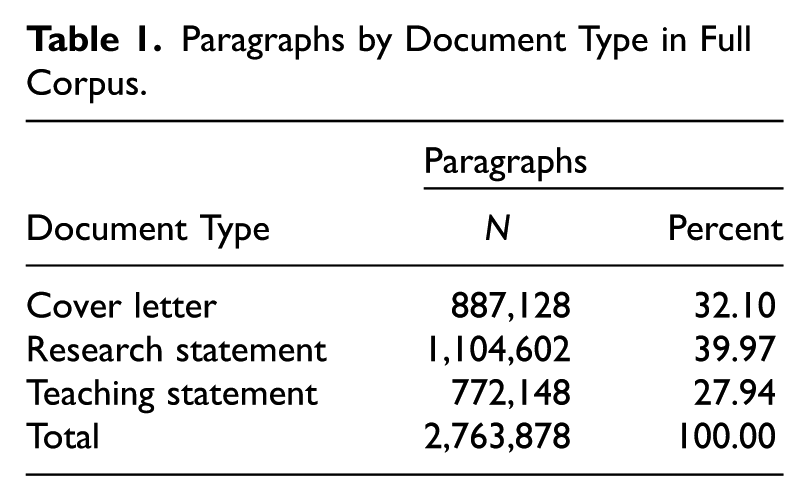
The text coding is based on the computational grounded text analysis method developed by Nelson (2020) and includes (1) pattern detection using exploratory text analysis, (2) pattern refinement through a deep reading of the texts (guided by the exploratory analysis output), and (3) pattern confirmation using an SML model (built using classifications discovered in the first two steps). All documents were parsed from PDF to plain text using Python, deconstructed to the paragraph level, and de-identified for names, locations, and organizations. I retained paragraphs that were longer than 10 words and shorter than 1,000 words and from documents with 10 or fewer paragraphs. 2 Almost 40 percent of paragraphs were from research statements (see Table 1), a little over a third were from cover letters, and a little over a quarter were from teaching statements.
Paragraphs by Document Type in Full Corpus.
For the first stage of the computational grounded approach, pattern detection, I used a targeted keywords and phrases search (see Part A of the online supplement) and hand-coding to identify paragraphs across all document types that included any language indicating engaged scholarship practices or orientations. This resulted in 302,452 paragraphs, from which I took a random sample of 2,500 paragraphs for the next stage.
For pattern refinement, I hand-coded the 2,500 paragraphs with two main goals: (1) to understand the context in which applicants discussed engaged scholarship and (2) to inductively code for different types of engaged scholarship. I noted whether there were differences in the type of document, recruitment field, and specific recruitments among paragraphs coded as engaged, and I created a variable identifying the different “types” of engaged scholarship described in each paragraph coded as engaged.
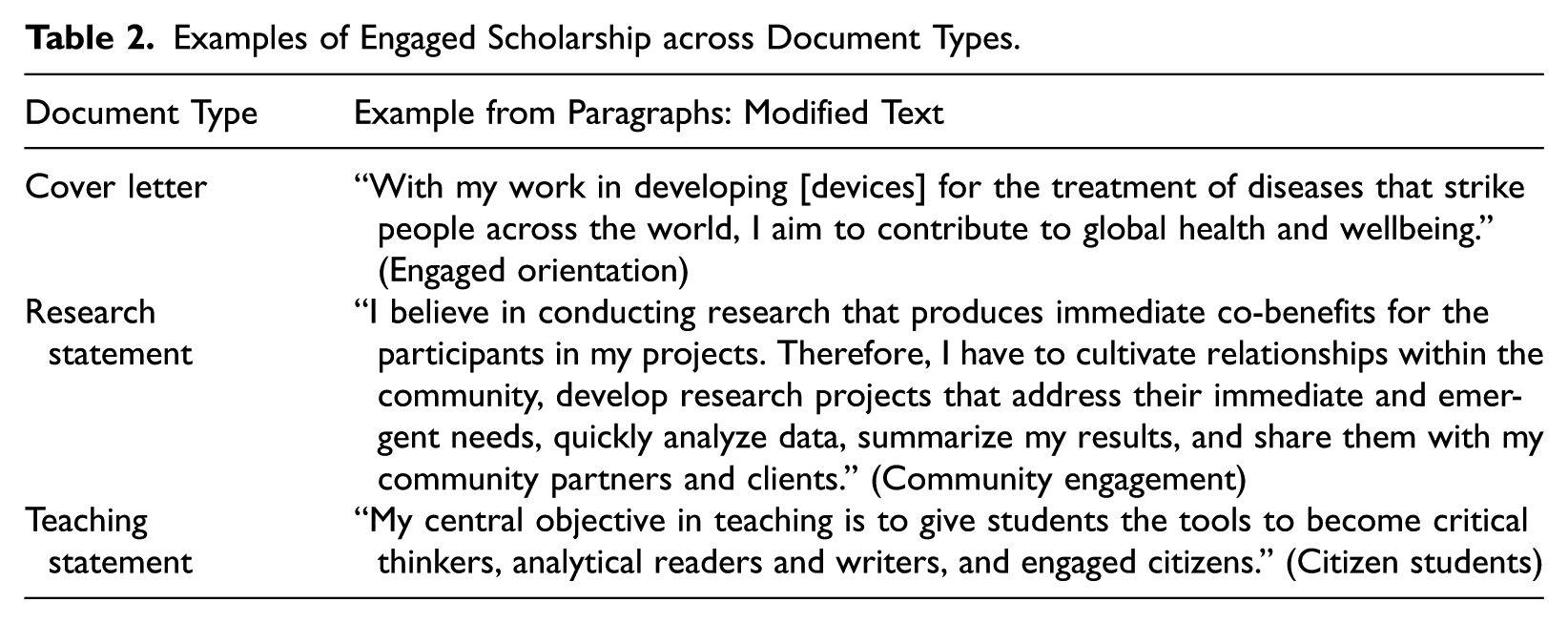
This inductive approach to types of engagement allowed me to combine categories from prior studies on engaged scholarship (i.e., nonacademic collaboration, community partners, research for the public good, and the typology developed by Doberneck et al. 2010) with new or more nuanced categories that emerged from the applications. Throughout this hand-coding process, I developed a coding scheme that broadly identified eight main types of engaged scholarship mentioned across all paragraphs: citizen students, community engagement, outreach teaching, policy, nonacademic collaboration, engaged orientation, scientific communication, and translational research. Table 2 includes illustrative examples from the application paragraphs by document type.
Examples of Engaged Scholarship across Document Types.
For the third stage, pattern confirmation, I used the engaged scholarship categories to train two research assistants to identify engaged scholarship in a random sample. The training included the provision and discussion of descriptions of engaged scholarship, several articles on the topic, and tests to assess intercoder reliability, which was achieved at 80 percent or higher. The team coded a random sample of 5,000 paragraphs for any type of engaged scholarship to serve as the base set of training paragraphs for an SML model.
Research comparing several methods of computational text classification finds that SML outperforms unsupervised models in correctly identifying both the range and prevalence of topics compared to hand-coded data (Nelson et al. 2018). SML is often used to scale up resource-intensive hand-coding (Rona-Tas et al. 2019), but most models perform better with more (as opposed to less) input data. This creates a paradox for researchers with limited hand-coding resources and large data sets. Training data may exhibit significant class imbalance, particularly in corpora where the category of interest is relatively uncommon.
With this in mind, I used SML models to classify the paragraphs with a binary indicator: engaged or not. Although the hand-coding revealed multiple categories of engaged scholarship, for this study, dividing the training data into these categories would yield too few training paragraphs for most of the categories. Future research could explore the distribution of different types of engaged scholarship among EEFR applicants, providing a deeper understanding of how applicants deploy agency in their self-presentation. Using the R package RTextTools (Jurka et al. 2013), I trained multiple SML classification models using four algorithms commonly used in text analysis: support vector machines (SVM), scaled linear discriminant analysis (SLDA), generalized linear model via penalized maximum likelihood (GLMNET), and random forests (RF). Training all four models on the same data enables comparison of model performance across multiple measures of fit.
I accepted paragraphs as engaged if at least three of the algorithms coded them as engaged or if two algorithms agreed between the SVM, RF, or GLMNET algorithms (models with the best fit). This resulted in 60,909 paragraphs (2.3 percent of all paragraphs) being coded as engaged, providing a binary indicator of engaged scholarship at the paragraph level.
To measure who presents themselves as an engaged scholar, I analyze two dimensions of engaged scholarship: the frequency with which an applicant uses engaged language (further divided into any and amount by paragraph) and the document type in which an applicant uses engaged language. To assess the use of any engaged language, a binary variable indicates whether a document contains at least one paragraph with engaged language. I assess the amount of engaged language using a variable measuring the proportion of paragraphs with engaged scholarship language in each document. For the sake of clarity, I primarily present results from the any analyses, but I address when results from the amount analyses varied significantly or gave additional insight into the findings.
Table 3 presents the distribution of applicants across these dimensions of engaged scholarship. In total, 22.88 percent of applicants (N = 31,740) used engaged language in at least one of their application documents. I broadly refer to these scholars as “engaged scholars.” Many of these applicants used engaged language across multiple documents: Roughly 10 percent of all applicants used engaged language at least once in each document type. Engaged scholars had the highest proportion of engaged paragraphs in teaching statements (on average, 12 percent of teaching statement paragraphs contain engaged language) and the lowest proportion in research statements (9.8 percent, on average).
Engaged Scholarship Language across Application Documents.
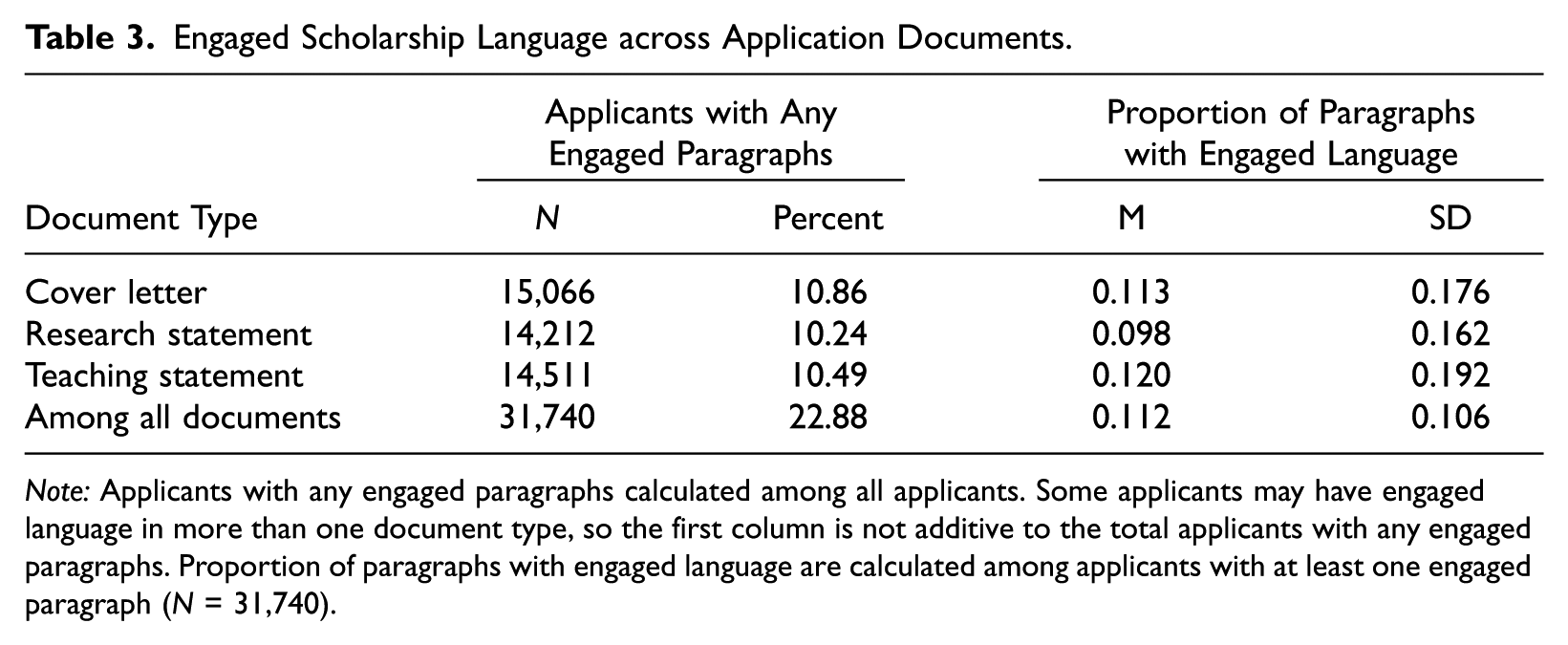
Note: Applicants with any engaged paragraphs calculated among all applicants. Some applicants may have engaged language in more than one document type, so the first column is not additive to the total applicants with any engaged paragraphs. Proportion of paragraphs with engaged language are calculated among applicants with at least one engaged paragraph (N = 31,740).
Measuring Race/Ethnicity and Gender in the EEFR Data
The EEFR data set includes a measure of race/ethnicity categorized into seven groups, shown in Table 4. In earlier sections, I referred to scholars of color as a single group to differentiate between the dominant racial group in U.S. society (White) and those who are not. Racial categories, whether binary or multifaceted, are deeply flawed and not fixed or mutually exclusive (James 2008; Waters 1990; Zuberi 2001). Rather, racial categories are “created, inhabited, transformed and destroyed” through political and sociohistorical processes, which Omi and Winant (2014:55) call “racial formation.” Although socially constructed, racial categorizations have significant, tangible effects on how social inequalities are understood (Bonilla-Silva 2006; Omi and Winant 2014). Quantitative analyses that attempt to measure the causal effects of race risk reifying these categories as essential (Stewart 2008; Zuberi 2001). Thus, I view racial categories as indicators of racial relations, reflecting how race influences status and power in individual and organizational behaviors.
Applicants by Race/Ethnicity.
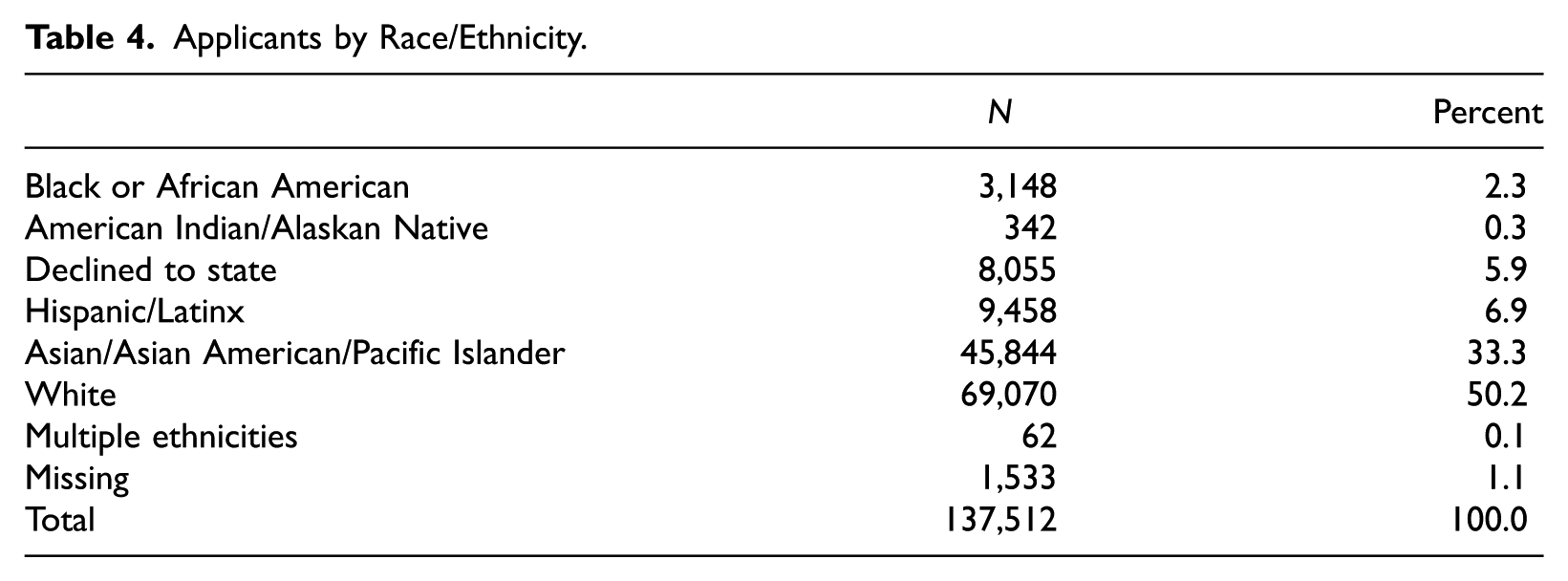
In this analysis, I use a four-category race/ethnicity variable: (1) Black/African American, Hispanic/Latinx, and Native American/Native Alaskan (BHN); (2) Asian, Asian American, and Pacific Islander (AAPI); (3) White; and (4) other/missing. I aggregate BHN not because these groups are homogeneous but due to sample size limitations and literature suggesting they face distinct barriers in academia compared to White or AAPI scholars (Astin 1982; Nelson, Brammer, and Rhodes 2007; Settles et al. 2021). BHN scholars constitute fewer than 10 percent of the analytic sample; AAPI (33.3 percent) and White scholars (50.3 percent) account for more than three-quarters of all applicants (see Table 5).
Race and Gender of Applicants by Recruitment Field.
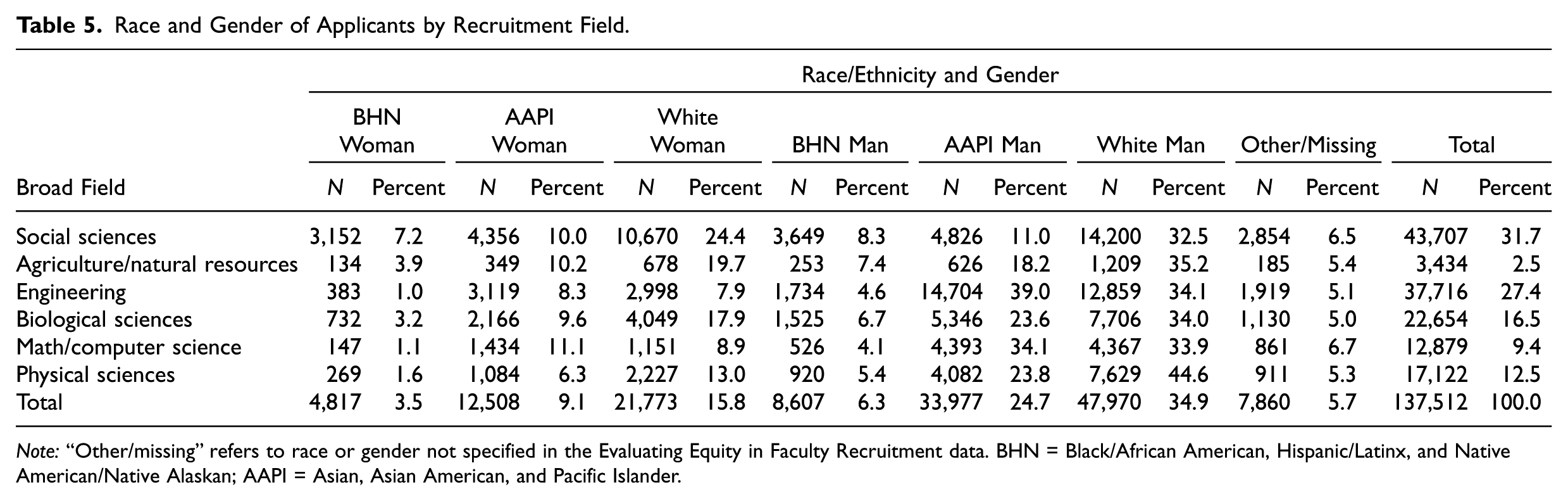
Note:“Other/missing” refers to race or gender not specified in the Evaluating Equity in Faculty Recruitment data. BHN = Black/African American, Hispanic/Latinx, and Native American/Native Alaskan; AAPI = Asian, Asian American, and Pacific Islander.
The EEFR data set also includes gender measured in three categories: men, women, and other/missing. Gender, like race/ethnicity, is socially constructed and serves as a framework for understanding social interactions and power dynamics (Ridgeway 2011). I measure gender through applicants’ self-identification when applying for faculty positions. To operationalize race/ethnicity and gender, I created a combined categorical variable called racegender, which consists of seven categories: BHN woman, AAPI woman, White woman, BHN man, AAPI man, White man, and gender and/or race missing/other (see Table 5). These intersections illuminate the complex hierarchies of status and power shaped by race/ethnicity and gender and underscore that disparities noted do not imply inherent group differences but rather reflect the inequalities experienced in the racialized and gendered structures of academia.
Control Variables
All models control for several recruitment-level variables to account for recruitment-specific differences: field, year, institution, and National Research Council (NRC) program rank of the hiring department. Field is categorized into six groups: agriculture/natural resources, biological sciences, engineering, math/computer science, physical sciences, and social sciences. The NRC program rank is coded as a five-level ordinal variable: unranked, 1st to 50th percentiles, 50th to 75th percentiles, 75th to 90th percentiles, and 90th to 100th percentiles. The representation of different race and gender groups in the EEFR data set remains relatively stable over time but varies significantly by field (see Table 5). Social sciences and agriculture/natural resources have the highest representation of BHN individuals and women; math/computer science and engineering have the highest representation of AAPI applicants. The distribution of applicants classified as “other” or with missing race and/or gender data is consistent across all fields and years.
I also include application-level controls that account for applicants’ background characteristics: institutional affiliation (U.S.-based or international), years since earning a PhD, and current job category. Institutional affiliation is binary, coded as 1 if the applicant is affiliated with a U.S. institution (76 percent of applicants). Time since degree is ordinal with five levels: 0, 1 to 2, 3 to 5, 6 to 10, and 11+ years. Current job category includes nine categories: graduate student/PhD candidate, postdoctoral researcher or fellow, assistant professor, associate/full professor, visiting professor, research/teaching fellow, researcher, lecturer, and other.
Analytic Strategy
I use logistic regression models to estimate applicants’ use of any engaged language and ordinary least squares regression models to estimate the amount of engaged language an applicant uses. The models estimating differences across document type use data structured at the document-within-application level with clustered standard errors to correct for the non-independence of multiple observations of each applicant by document type. All other models use data structured at the application level, also with clustered standard errors to correct for the no-independence of multiple observations of applicants who may have applied to multiple recruitments (i.e., multiple applications with the same applicant ID).
I address each research question in turn, beginning with models measuring any engaged language across the six years of data, academic fields, and applicant racegender, controlling for recruitment-level variables. I then test whether the aggregate race and gender disparities vary by field, year, and/or application document type using a series of nested models that add the following two-way interaction terms: racegender by field, racegender by year, and racegender by document type. Model fit statistics and predicted probabilities demonstrate whether each additional interaction term provides evidence that the race and gender disparities in engaged language vary by field, year, or document type. 3
Findings
Prevalence of Applicants Who Present as Engaged Scholars by Year and Field
Across the six academic years in the data, there is a generally increasing trend, particularly in the last two years, in the predicted probability of an applicant having any engaged language in their application materials: Eventually, over 25 percent of applicants used engaged language at least once in their application materials, compared to around 18 percent five years earlier (see Figure 1). Six years is not necessarily long enough to see significant societal shifts, but the 2016 presidential election marked a particularly polarizing time in the U.S. political landscape, especially in relation to science and higher education, and it may have affected applicants’ use of publicly engaged language in their applications to large public research institutions.
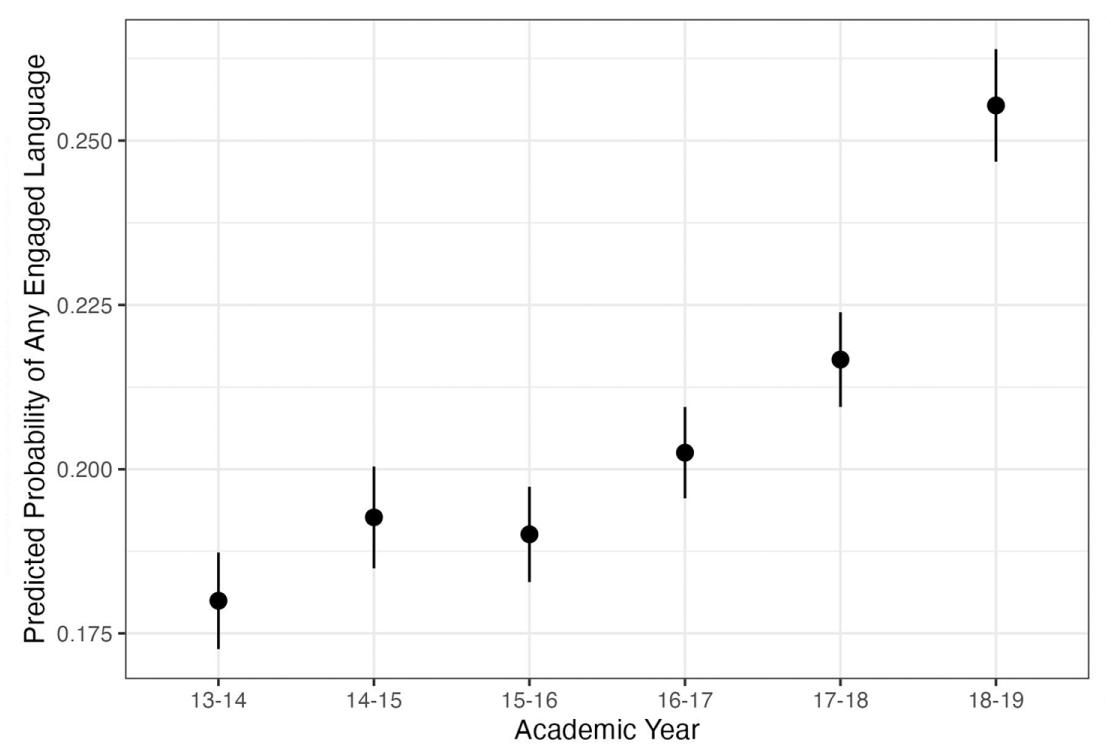
Aggregate estimated predicted probability among all applicants of having at least one engaged paragraph in their application.
Among the six broad disciplinary fields in the EEFR data, applicants in the social sciences, followed by agriculture/natural resources, are the most likely to have any engaged paragraphs in their applications (see Figure 2a). This echoes prior research that finds scholars in fields such as education (here included in social sciences) and forestry/agriculture (here included in agriculture/natural resources) have more positively incorporated certain types of engaged scholarship into evaluation frameworks. Applicants in the STEM fields of biological sciences, engineering, and physical sciences are similarly likely to have any engaged paragraphs in their applications, and those in math/computer science are the least likely.
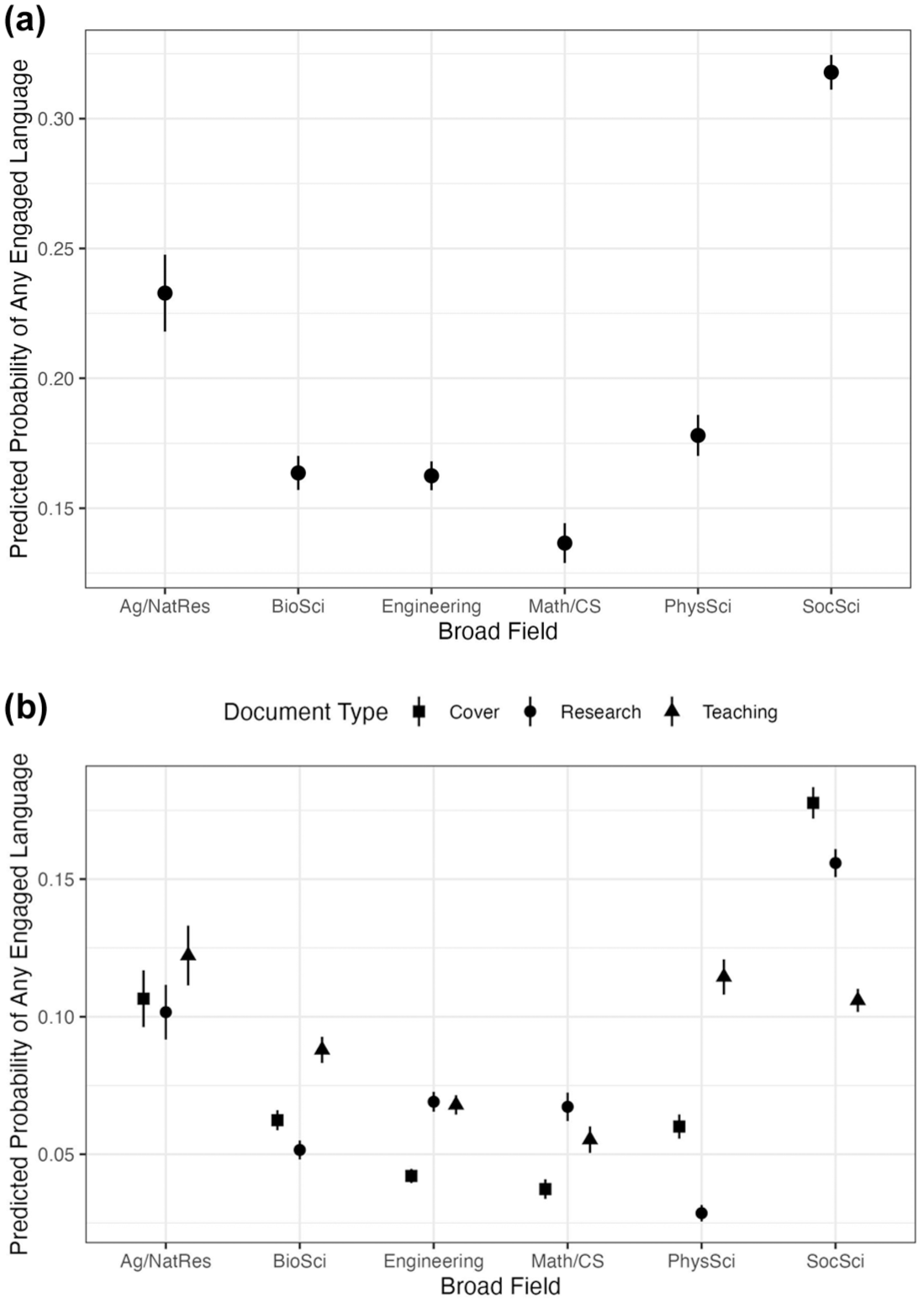
Aggregate estimated predicted probability among all applicants of (a) having at least one engaged paragraph in their application across recruitment fields and (b) having at least one engaged paragraph in each document type across recruitment fields.
To better understand how disciplinary norms surrounding engaged scholarship, accepted more holistically or in research versus teaching, might influence where applicants mention engaged scholarship, Figure 2b shows these field differences by document type. Whereas applicants in agriculture/natural resources are similarly likely to use engaged language in any application document (although most likely in teaching statements), applicants in the social sciences are much more likely to use engaged language in their cover letters, followed by research statements and then teaching statements. In biological and physical sciences, applicants are significantly more likely to use engaged language in their teaching statement than in research statements or cover letters; this is not the case in engineering and math/computer science.
Overall, these patterns establish that within the scope of these data, the prevalence of applicants who used engaged language in their application materials generally increased over time but at nearly triple the rate after the 2017–2018 academic year. The variation across fields and document types suggests that applicants’ use of engaged language reflects disciplinary norms, such as which fields may be more friendly to evaluating engaged scholarship holistically (the social sciences) and which fields may compartmentalize valuing engaged scholarship primarily in pedagogy, exemplified by nearly 12 percent of physical science applicants being likely to use engaged language in teaching documents but only around 1 percent likely to do so in research documents.
Race and Gender Disparities in Who Identifies as an Engaged Scholar
Across these trends in time and disciplines, do all applicants by race and gender present themselves as engaged scholars at the same rate? Figure 3a shows that no, they do not: there are clear race and gender disparities in the probability an applicant uses any engaged language. Most notably, BHN women candidates’ documents (40 percent) are far more likely than those of any other group to have at least one engaged paragraph. Within race/ethnicity groups, women applicants’ documents are more likely to have at least one engaged paragraph than are men's documents. The only men applicants who are as likely to have any engaged paragraph as any women are BHN men candidates (22 percent), with a similar predicted probability as AAPI women candidates (23 percent). These results indicate that both race and gender influence whether an applicant references engaged scholarship at least once in their application materials—in general, women and BHN applicants are more likely to use engaged language compared to men and White or AAPI applicants. Yet the marginal differences between all women applicants are much larger than the marginal differences between all men candidates, suggesting there is more heterogeneity among women than men regarding engagement. In fact, the difference between engaged language in documents submitted by BHN women applicants and White and AAPI women applicants is larger than the difference between White and AAPI women applicants and BHN men applicants.
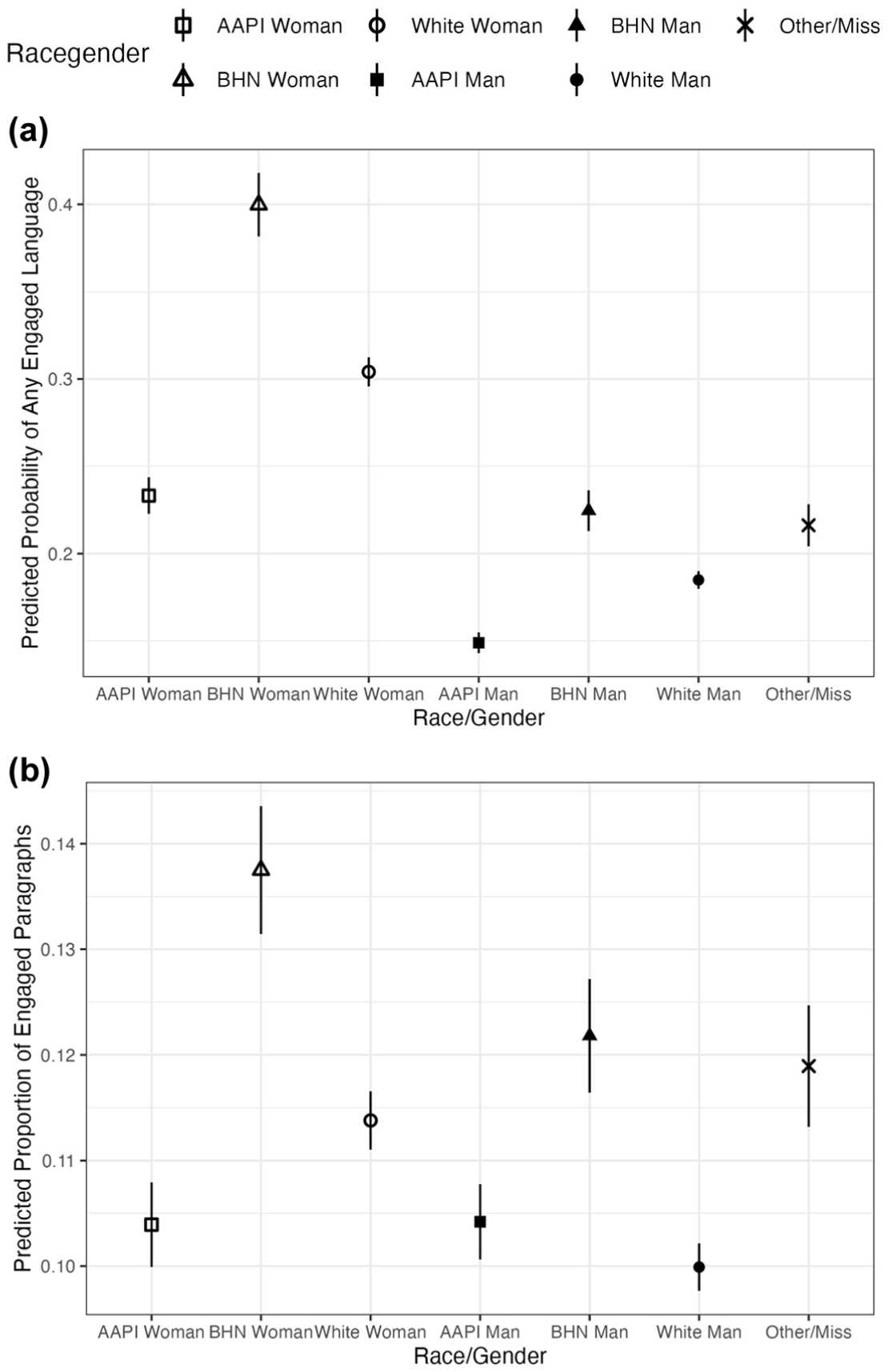
Aggregate estimated race and gender disparities in the (a) predicted probability among all applicants of having at least one engaged paragraph in their application and (b) predicted proportion of paragraphs in a document with engaged language among applicants who have at least one engaged paragraph in their application.
Among applicants who have at least one engaged paragraph, BHN women's documents also use the most engaged language. On average, 13.8 percent of paragraphs in each document of a BHN woman's application packet contain engaged language. Among engaged scholars, race is more influential than gender on the amount of engaged language used. As shown in Figure 3b, both BHN women and men use more engaged paragraphs per document (13.8 percent and 12.2 percent, respectively) than any other group. All BHN applicants have more engaged paragraphs compared to White women's documents (11.4 percent) and compared to White men and all AAPI applicants’ documents (all below 10.5 percent and not significantly different from each other).
In summary, BHN women applicants are the most likely to present themselves as engaged scholars (in both any and amount), followed by White women and BHN men. Although White women are more likely than BHN men to use engaged language at least once in their application materials, BHN men use more engaged language than do White women throughout their applications. This difference in amount could indicate that those reading the application documents (i.e., faculty hiring committees) may perceive engaged scholarship as a type of scholarship that BHN applicants demonstrate more substantively.
These findings may indicate a qualitative difference in the depth of engagement with this epistemological approach between race and gender groups. Deeper engagement could also indicate differences in how applicants use critical agency versus alignment regarding engaged scholarship: BHN scholars might engage more deeply (potentially more critically) than other applicants throughout their application materials. These differences could also be driven by race and gender differences in the use of engaged language in different application documents, differences by discipline in the use of engaged language, or changes related to the applicant pool or increased use of engaged language over time. I address each of these issues in the following section.
Race and Gender Differences in Engagement by Year, Field, and Document Type
I assess variation in the race and gender differences in engaged language by field, year, and document type using a series of nested models, first at the applicant level for field and year and then at the document-within-applicant level for field, year, and document type, in which I alternately add interaction terms to address each additional dimension of variation. Using overall model fit statistics (see Part B of the online supplement) and marginal differences in predicted probabilities, I find that race and gender differences in engaged scholarship vary by field and document type. However, the race and gender disparities in engaged scholarship remained stable across the six years of data, following the overall longitudinal trend; therefore, I do not elaborate further on this here.
The results for using any engaged language show that the race and gender disparities are most similar to the aggregate group disparities in engineering, math/computer science, and the social sciences (Figure 4). In these fields, BHN women are far more likely to use engaged language, followed by White women. In engineering and math/computer science, BHN men applicants are not significantly more likely to use any engaged language compared to other men candidates, whereas in the social sciences, they are far more likely to do so.
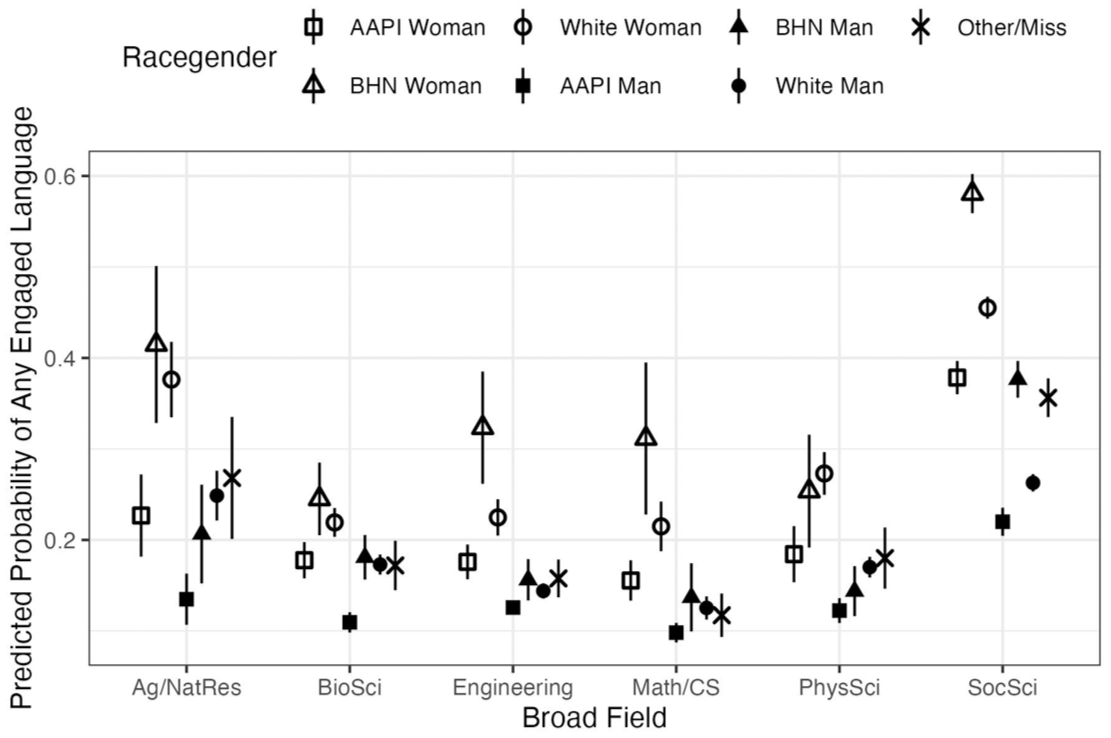
Estimated race and gender disparities across recruitment fields in the predicted probability among all applicants of having at least one engaged paragraph in their application.
In agriculture/natural resources, biological sciences, and the physical sciences, White and BHN women applicants are generally more likely to have any engaged language in their applications compared to other groups, but they are not significantly different from each other. In agriculture/natural resources and biological sciences, AAPI women, White men, and BHN men are all similarly likely to use engaged language; AAPI men are significantly less likely compared to all groups. In the physical sciences, a larger gender gap appears, where women applicants are more likely than men to use engaged language.
The base model suggested women applicants are more likely than men to use any engaged language, yet among engaged scholars, BHN applicants use more of their application document space to describe engaged scholarship activities and orientations (Figure 3b). When broken down by field, this trend is driven by BHN women applicants in agriculture/natural resources, math/computer science, and the social sciences and by BHN men candidates in agriculture/natural resources and the social sciences. Although math/computer science application documents overall have the lowest predicted proportion of engaged paragraphs, BHN women applicants in this field have one of the highest predicted proportions of engaged paragraphs out of any field. In biological science, physical science, and engineering, there do not appear to be any significant differences among race and gender groups in the amount of engaged language used in an entire application.
BHN women candidates are the most likely to present themselves as engaged scholars in their applications, although the size of this gap varies by field. I also consider whether these patterns in race and gender disparities in engagement might be driven by variation in the use of engaged language across document types. Overall, using any engaged language in research statements is less common than using engaged language in cover letters and teaching statements, but these trends clearly vary by applicant race and gender (see Figure 5).
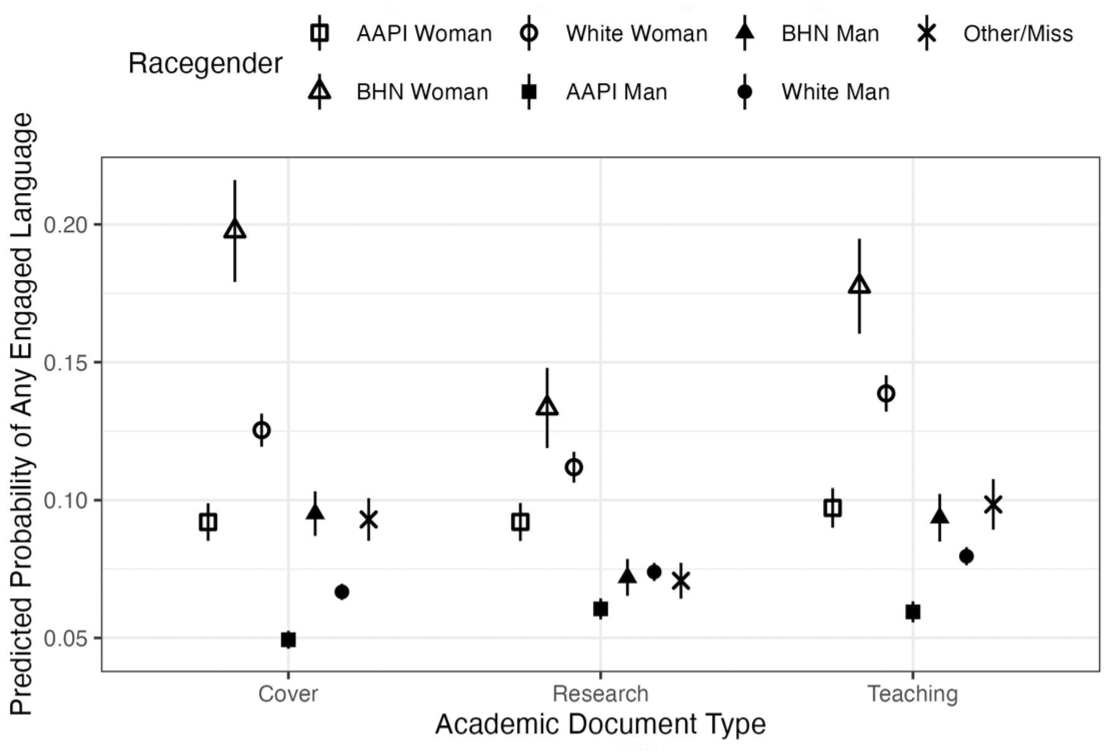
Estimated race and gender disparities in the predicted probability among all applicants of having at least one engaged paragraph in each document type.
Across all documents, BHN women applicants have the highest predicted probability of using any engaged language, followed by White women; the gap is particularly large in cover letters, where BHN women are almost twice as likely as most other groups to use engaged language. All groups except BHN applicants are most likely to use engaged language in their teaching statements (BHN women are the most likely to use engaged language in their cover letters, and BHN men are equally as likely to use engaged language in their teaching statements and cover letters). In research statements, however, we see a gender gap, where women applicants are more likely than men applicants to use engaged language. In the amount of engaged language, BHN women applicants again have the highest predicted proportion of engaged paragraphs in each document type. In cover letters and teaching statements, BHN men have the second highest proportion of engaged paragraphs. In research statements, all candidates except BHN women do not exhibit significant differences in the proportion of engaged paragraphs. Again, these results indicate that applicants may strategically use engaged language in different parts of their applications to manage their presentation of engaged scholarship. BHN scholars, in any and amount, are the most likely to present as holistically engaged by using engaged language in their cover letters. All other scholars, in contrast, may feel engaged scholarship language is the least risky to use in the realm of pedagogy.
Race and Gender Field Representation and Engaged Scholarship
So far, the analysis has revealed that fields with the most gender and race parity in the EEFR applicant pool have the most engaged scholars. Disciplinary norms around evaluation and engaged scholarship may thus be related to the uneven integration of women and scholars of color across fields, creating differential cultures in which applicants are likely to present themselves as engaged scholars. I thus test whether controlling for the relative representation of women and scholars of color in a field outside the EEFR data explains the field-level gender and race disparities in engaged scholarship using the representation of women and BHN scholars in the national availability pool 4 of each recruitment specialty area.
Controlling for the representation of women and BHN scholars in a field's availability pool (Figure 6, Model 2) had a bigger effect on field differences (Figure 6b) than did race and gender differences (Figure 6a). The predicted probability of a document containing any engaged language decreased significantly in the three fields with the highest representation of women and BHN scholars (agriculture/natural resources, biological sciences, and social sciences), and the opposite occurred for the fields with the lowest representation (engineering, math/computer science, and physical sciences). Model 2 shows that fields with a higher representation of women and BHN scholars have similar predicted probabilities of any engaged language being used in a document, and they have higher proportions of engaged documents compared to fields with lower representation of women and BHN applicants. Controlling for women and BHN representation in recruitment specialty areas lessened field differences, indicating that fields that have been more successful at including women and scholars of color may also have disciplinary climates more accepting of engaged scholarship.
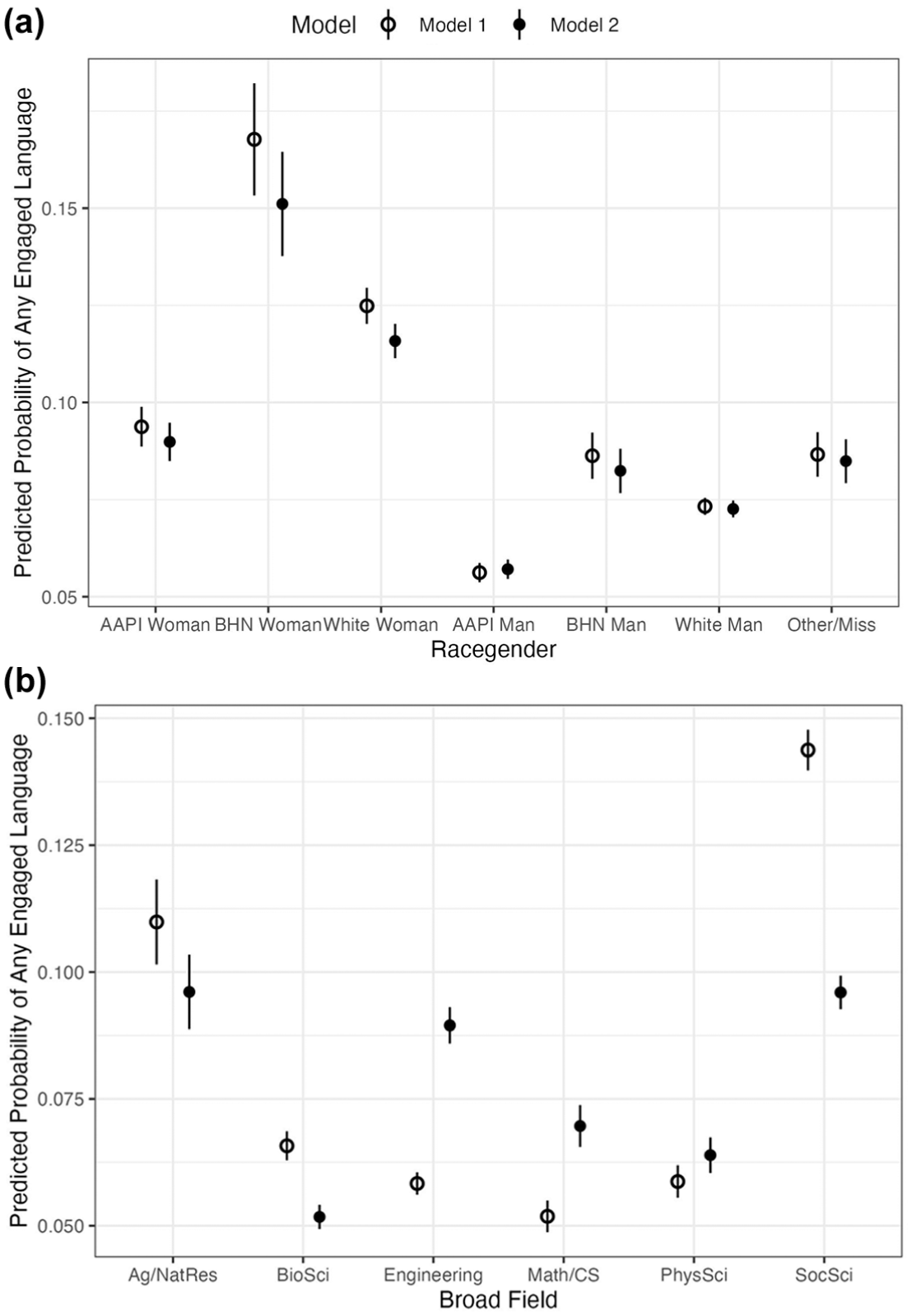
Estimated predicted probability that an applicant uses any engaged language in a document across (a) race and gender and (b) broad field for Model 1 (interaction model) and Model 2 (interaction model with control availability pool).
The field differences are smaller, but the same pattern of race and gender disparities evident in the base model (Figure 3a) remains unchanged. This suggests that overall and within fields, the relative representation of women and BHN scholars does not affect race and gender disparities in applicants’ use of any engaged language in a document.
A similar but smaller effect can be seen in the amount of engaged language used in application documents: controlling for the representation of women and BHN scholars in the availability pool explains most of the variation in field differences, but it does not significantly affect race and gender disparities. BHN applicants have a slightly lower proportion of engaged paragraphs in their application documents when controlling for the representation of women and BHN scholars in the availability pool. The estimates for all other groups are relatively stable. Despite the changes for BHN scholars, the overall pattern of race and gender disparities remains unchanged: BHN scholars have the highest proportion of engaged paragraphs in their applications compared to all other applicants.
In summary, these findings confirm that fields with greater gender and racial parity overall have more engaged scholars than do fields with less parity. However, the representation of women and BHN scholars in a field has little to no effect on gender and race disparities in who presents themselves as an engaged scholar. This bolsters the main finding: women and BHN applicants, particularly BHN women applicants, are the most likely to present themselves as engaged scholars regardless of a discipline's potential perceived acceptance or risk of engaged scholarship.
Discussion
This study provides a broad overview of engaged scholars in a new generation of potential faculty, highlighting how disciplinary norms may shape the (perceived) evaluation of engaged scholarship and the intersectional ways historically marginalized scholars exercise critical agency in asserting epistemologies that foreground service to the public good. The increase in applicants who use engaged language over time, particularly after the 2017–2018 academic year, suggests that broader sociopolitical shifts may influence how scholars position their work. The 2016 U.S. presidential election marked a period of heightened political polarization, particularly on issues related to science and higher education. This may have spurred junior scholars to more explicitly articulate how their research serves the public good or addresses public concerns. Although the data used here do not include other major socially disruptive events that may have affected how scholars relate their work to public engagement (e.g., the COVID-19 pandemic or massive disruptions to national scientific funding agencies), this study provides a baseline for understanding how new generations of scholars may position themselves in light of shifting expectations about the social role of higher education and the place of engaged scholarship within it.
Field-level differences, particularly when broken down by document type, reveal how disciplinary cultures may shape applicants’ use of engaged language. Consistent with prior research, applicants who use engaged language are most prevalent in the social sciences and agriculture/natural resources. However, document-level differences reveal deeper field dynamics: The social sciences are the only field where cover letters are the primary venue for engaged language, suggesting these applicants may perceive less risk in presenting their work more holistically as engaged. This could be because the social sciences have historically had the highest representation of women and scholars of color, which may lessen the perceived risks of epistemic exclusion for all applicants. Teaching statements are the most common venue for engaged language in almost all other disciplines, potentially indicating that engagement framed within pedagogy is more palatable (or less disruptive) in disciplinary logics than is engagement framed within research.
I found clear support that the field and year variations were not explained by demographic patterns in the applicant pool or recruitment-level variations. Namely, BHN women were consistently and substantially more likely than any other group to present themselves as engaged scholars across all years, fields, and document types. This extends prior research showing that among engaged scholars, women and scholars of color (separately) are more likely to pursue engaged scholarship, as evidenced by examining intersectional differences in who identifies as an engaged scholar and using data that can compare the relative differences between groups compared to scholars who do not identify as engaged scholars. This very clear and sizable difference where BHN women differ significantly from all other groups supports long-standing feminist critiques that analyses of either race or gender alone obscure the distinctive experiences of women of color, generally describing social experiences of White women or men of color (Collins 2002; Crenshaw 2019; Lorde 2012; Thomas, Dovidio, and West 2014). Turner (2002:76) describes women of color in academia as “hidden within studies that look at the experiences of women faculty and within studies that examine the lives of faculty of color.” The present findings illustrate that invisibility, highlighting the unique salience of engaged language in application materials among BHN women, a group simultaneously most underrepresented in most academic disciplines and most likely to articulate epistemologies rooted in serving the public good when applying to public research universities.
This pattern is particularly noteworthy given the potential risks associated with engaged scholarship that early career scholars are often cautioned about. Tenure-track positions are highly competitive, and although disciplinary norms around the evaluation of engaged scholarship may vary, BHN women consistently foregrounded engaged scholarship across all aspects of the EEFR data. Approximately 40 percent of all BHN women applicants used engaged language at least once in their application materials. Compared to other groups in this data, this number is significantly higher, indicating that nearly half of BHN women applicants (with field-level variations) presented themselves as engaged scholars in their faculty application materials. This is a striking feature for the most underrepresented group among all faculty applicants. This finding is consistent with frameworks showing that historically marginalized scholars may use critical agency in their presentation of self, choosing to present themselves as engaged scholars, both knowing the potential risks and in direct defiance of epistemic exclusion (Baez 2000; Gonzales et al. 2024; Liera and Rodgers 2025).
By contrast, AAPI applicants—particularly men—were consistently the group least likely to use engaged language. In the EEFR data, AAPI scholars were more likely than other groups to have earned their PhD from international universities. Although this is controlled for in the models, it could contribute to a broader difference in cultural perspectives on research, teaching, and the role of engaged scholarship. Additionally, this finding aligns with Settles et al.’s (2021) finding that among scholars of color, AAPI faculty are the least likely to report facing epistemic exclusion. Settles et al. (2021) do not specify whether this was because AAPI faculty do not engage in similar types of scholarship as other scholars of color or because AAPI faculty do not face the same consequences of devaluation when engaged in such scholarship. This analysis suggests that regarding engaged scholarship, the former may be the case.
Potential discipline-specific norms sharpen these broader findings. In fields with greater gender and racial parity in the national applicant pool, engaged language is more prevalent overall, yet the disparities in race and gender remain intact. Fields with more diverse applicant pools may be doing a better job of attracting and encouraging more women and scholars of color to apply (Stewart and Valian 2018), reflecting disciplinary cultures that likely shape their epistemic culture. Greater diversity, or the valuation thereof, may expand the range of scholarly values deemed legitimate, consistent with arguments that diversity of people brings diversity of thought, thereby broadening evaluative standards and reshaping disciplinary boundaries over time. Yet within these fields, BHN women remain more likely to use engaged language, underscoring the continued critical use of engaged scholarship frameworks by scholars who have historically faced systematic social and epistemic exclusion in academia.
Conclusion
This study offers new insights into the landscape of engaged scholarship by shifting the focus from how it is evaluated to who claims it, when, and in what realms of scholarship at a key moment of institutional gatekeeping. The central finding—that Black/African American, Hispanic/Latina, and Native American/Native Alaskan women are the most likely to present themselves as engaged scholars—highlights how epistemic orientations like engaged scholarship are entwined with scholars’ identities and social locations in HEIs. This central finding echoes decades of research indicating that women, scholars of color, and Indigenous scholars use engaged scholarship practices and orientations. It also shows that a new generation of scholars applying to assistant-level faculty positions is increasingly using engaged language, particularly in fields with greater gender and racial parity. These findings suggest that applicants’ presentation of self and navigation of disciplinary logics of evaluation do not operate in a vacuum but are tied to who makes up hiring committees, departments, and disciplines and applicants’ own positionalities and resistance to epistemic exclusion.
Engaged scholarship, increasingly rhetorically embraced but structurally undervalued, remains a domain where scholars from historically marginalized groups enact public-serving epistemologies and teaching practices even in the face of uncertain and uneven recognition. If academic evaluation continues to privilege narrow definitions of scholarly merit, we not only risk overlooking applicants most likely to contribute to institutional goals around public impact, community partnership, and knowledge accessibility, but we also risk contributing to systemic practices of epistemic exclusion that further exclude women of color and the knowledge they create from academic spaces. The epistemologies of historically excluded groups being devalued in the organizational logics of universities may be a major missing piece in understanding how and why achieving faculty diversity is such a challenging goal. Understanding what kinds of scholarship (and which scholars) are epistemically excluded may be key to bringing representative diversity and diversity of knowledge production to courses, students, and research.
Future research should continue to investigate how epistemic exclusion and the marginalization of engaged scholarship influence the selection of research topics and the long-term career trajectories of these scholars. Deeper qualitative work could also investigate the specific epistemological differences between engaged scholars and the language they use in their applications, potentially shedding further light on how different applicants use more or less critical forms of engagement. Future studies could also provide further insights into the challenges and opportunities that engaged scholars face in different academic fields, including how fields’ epistemic origins and histories have evolved to inform the evaluation of engaged scholarship. Ultimately, understanding engaged scholarship as a site of both epistemic exclusion and resistance highlights the stakes of rethinking evaluation: Fostering an academic environment that values and supports diverse forms of scholarship is crucial for advancing both equity and innovation in higher education.
Supplemental Material
sj-docx-1-soe-10.1177_00380407261424498 – Supplemental material for Epistemic Dynamics and Intersectionality in Faculty Hiring: Who Presents as Engaged Scholars?
Supplemental material, sj-docx-1-soe-10.1177_00380407261424498 for Epistemic Dynamics and Intersectionality in Faculty Hiring: Who Presents as Engaged Scholars? by Jessica R. Gold in Sociology of Education
Footnotes
Acknowledgements
I thank the principal investigators (Catherine Albiston, Susan Carlson, Marc Goulden, Victoria Plaut, and particularly Kimberlee Shauman) of the Evaluating Equity in Faculty Recruitment data set for their support and feedback on this research and for their work compiling this incredible database. I also thank Laura K. Nelson and Kathrin Zippel for their thoughtful comments on earlier drafts of this article.
Funding
The author disclosed receipt of the following financial support for the research, authorship, and/or publication of this article: This material is based on work supported by the National Science Foundation under ECR Grant Nos. 1535509 and 1535435. Any opinions, findings, and conclusions or recommendations expressed in this material are those of the authors and do not necessarily reflect the views of the National Science Foundation.
Research Ethics
The data used in this study are managed by the Evaluating Equity in Faculty Recruitment (EEFR) principal investigators and were used in accordance with Institutional Review Board standards and guidelines. The analytic and text data used in this study were previously compiled and de-identified by the EEFR team, and the researcher did not have access to any identifying information on study participants.

Supplemental Material
Supplemental material for this article is available online.
Notes
Author Biography
References
Supplementary Material
Please find the following supplemental material available below.
For Open Access articles published under a Creative Commons License, all supplemental material carries the same license as the article it is associated with.
For non-Open Access articles published, all supplemental material carries a non-exclusive license, and permission requests for re-use of supplemental material or any part of supplemental material shall be sent directly to the copyright owner as specified in the copyright notice associated with the article.
