




Abstract
Current research on college enrollment intentions predominantly focuses on the effects of individual and university characteristics, neglecting how specific study program features affect enrollment intentions. We examine three key elements in a study program: content, flexibility, and support. These elements shape individuals’ beliefs about costs, benefits, and their success probability, thus affecting enrollment intentions. Understanding these influences helps address disparities in access to higher education because an individual’s social background shapes information processing and thus, belief formation. Using data from a factorial survey experiment conducted with German high school students in their final year of school, we apply random-intercept regression models to investigate the causal (socially stratified) effect of study program features on enrollment intentions. Our results reveal significant effects of the investigated dimensions on enrollment intentions, suggesting that adjusting program content, flexibility, and support services enhances those intentions. However, the limited effect variation across social backgrounds implies that these adjustments will not reduce the social origin gap in higher education transitions.
Keywords
In most industrialized countries, the tertiary education sector has grown substantially since the 1960s (Schofer and Meyer 2005), which has led to highly differentiated higher education systems with a tremendous number of study programs (Clark 1996; Teichler 2008). Simultaneously, marketization processes have caused substantial changes in the structure of study programs (Clark 1996). Over this course of change and expansion, deciding what to study has become increasingly complex for many young people. To date, a rich body of research has identified key individual-level mechanisms, such as educational performance (Blau and Duncan 1967; Boudon 1974), subjective beliefs (e.g., finishing a study program; Grodsky and Jones 2007), cultural and social capital (Bourdieu and Passeron 1977), and cost-benefit considerations (Boudon 1974; Breen and Goldthorpe 1997; Ehlert et al. 2017), that affect college enrollment decisions and in particular, social inequalities in these decisions. However, less is known about how the features of study programs affect educational intentions.
Over the past two decades, sociologists have increasingly scrutinized the role of institutional factors, particularly enrollment procedures and tuition fees, in enrollment intentions (e.g., Havranek, Irsova, and Zeynalova 2018; Herbaut and Geven 2020), yet few studies have investigated the role of college characteristics. This research often focuses on broad characteristics at the college level and indicates that location, academic reputation, type of university, or information provided on the college website are relevant for students’ enrollment intentions (e.g., Finger 2016; Frenette 2006). Yet focusing on the college level neglects the fact that high school graduates choose not only a specific college but also a specific study program. We argue that the study program level is an important dimension because colleges have diverse profiles across study programs. Focusing on the broader college level may disguise decision-relevant dimensions that may influence study intentions.
Using an experimental design, we investigate how study program characteristics influence enrollment intentions and whether certain characteristics induce social inequality. Earlier work provides some evidence that within study programs, support services and teaching content relate to students’ academic success and that the relevance of these factors differs by students’ social origin (e.g., Bettinger and Long 2018; Fox et al. 2010; Goyette and Mullen 2006). However, it remains an open question whether such program characteristics causally affect enrollment intentions. This is remarkable because such information on study programs is publicly available, easy to obtain, and constitutes crucial dimensions in rankings of study programs, which are increasingly relevant for students’ application decisions (Katsumoto, Bowman, and Tennessen 2024).
To test the relevance of the substantial characteristics of study programs for enrollment intentions, we use data from a factorial survey experiment (i.e., vignette study) including over 1,000 German high school students close to graduation. The German context is ideal for testing theories of educational decisions because students choose a study program upon initial university enrollment, as in many European countries (see Teichler 2007). Although the German higher education system differs structurally from systems in Anglo-Saxon countries, both the German and Anglo-Saxon systems require students to process substantial amounts of information about study program characteristics within limited time frames when choosing a major. Furthermore, the relative uniformity in quality and prestige among German universities reduces the importance of institutional factors in the enrollment process, making the findings transferable to other educational contexts, such as the United States, where majors are chosen after enrolling in college. Throughout, we use the term “college” for universities in continental Europe and Anglo-Saxon college systems.
Using a theoretical approach that emphasizes the importance of information for college enrollment (see Morgan 2002) and prior research on study program characteristics and academic success (e.g., Bettinger and Long 2018; Fox et al. 2010), we study the influence of three program characteristics: teaching content (i.e., research- or vocational-oriented), flexibility (i.e., frequency of electives), and support (i.e., support services at the start of a study program and for studying abroad and supervision by professors). We focus on these input factors rather than their outcomes because they are more directly adjustable by policymakers and higher education institutions. In contrast, outcome factors such as completion rates, employment prospects, and future earnings are shaped by broader institutional and labor market structures and cannot be easily modified. We do not examine choice of a specific major because it is too nuanced to be effectively evaluated within the framework of a factorial survey experiment. Instead, we focus on the two overarching dimensions of program content (research and vocational orientation). Given the increasing importance of rankings and their visibility in the media, we present the results of the factorial survey as a hypothetical ranking of study programs that draws on a well-known existing ranking—the Centrum für Hochschulentwicklung (CHE) Ranking of study programs in German universities (CHE 2021), which is similar to rankings in other European countries (e.g., EHESO 2024; The Guardian 2024).
By investigating the effect of study program characteristics on college enrollment intentions, this study contributes to existing knowledge in at least three ways. First, we advance the sociological understanding of supply-side effects on individual decision-making and social inequalities. This is particularly important given the increasing differentiation of higher education systems. Second, our results enhance policymakers’ and university administrations’ understanding of how the design of study programs influences educational decision-making. This is important because the design of study programs is easier to amend compared to characteristics at the college level (e.g., reputation, location). Finally, this study contributes to the emerging sociological literature on academic rankings and the construction of quality by showing how study program rankings affect enrollment intentions, causing crowding and rich getting richer phenomena.
Theoretical Considerations and Empirical Findings
Deciding whether and what to study is a pivotal milestone that profoundly shapes the life course. Morgan’s (2002) theoretical considerations on college entry provide a valuable framework for examining educational decisions marked by uncertainty. According to Morgan (2002:392), educational aspirations (prefigurative commitment conceptualized as a cognitive attachment of a potential behavior) shape the level of effort (i.e., preparatory commitment) individuals allocate to activities to achieve a goal. Aspirations and level of effort strongly depend on individuals’ beliefs (e.g., about job requirements; see Morgan et al. 2013), which, in turn, are strongly dependent on the amount of available information (Morgan 2002:419). Thus, according to this framework, increases in available information among individuals with a study intention should, ceteris paribus, raise the likelihood of choosing college education. However, the framework also allows for predictions of unexpected effects or no effects of information because aspirations are also influenced by parents’ beliefs and peer beliefs and behavior (Morgan 2002:421). Furthermore, considerations of costs, benefits, and the likelihood of success associated with an educational choice also structure college enrollment choices (Breen and Goldthorpe 1997).
In the context of our research question on college enrollment intentions, the characteristics of study programs emerge as crucial pieces of information. In addition to information individuals receive from family members and peers, specific details about higher education institutions and particular study programs are central sources of information influencing enrollment decisions (Finger 2016; Soutar and Turner 2002). Students may perceive the attributes of colleges and specific study programs as either opportunities or barriers to their enrollment decisions and implicitly integrate such information into their beliefs about college education, leading to enrollment intentions and eventually, applications for specific study programs. Morgan’s (2002) framework thus provides a solid theoretical foundation, emphasizing the pivotal role of information about study program characteristics in shaping college enrollment intentions.
Building on this framework, which highlights the role of information in creating educational beliefs, not only study program characteristics but also expectations regarding academic success and labor market outcomes can inform enrollment decisions. Students form beliefs about their likelihood of completing a program, securing stable employment, and achieving favorable earnings based on available information, which, in turn, influences their enrollment intentions. Prior research shows that students adjust their study choices when provided with earnings information by degree program, with low socioeconomic status students in particular shifting away from low-return fields (Hastings, Neilson, and Zimmerman 2015); this highlights the role of financial considerations in major selection (see Baker et al. 2018; Wiswall and Zafar 2015). Overall labor market conditions (e.g., fluctuations in unemployment rates) can also influence students’ major choices (Blom, Cadena, and Keys 2021). Finally, van Klaveren et al. (2019) found that students are more likely to enroll when given positive signals about their likelihood of completing a study program.
Beyond their direct effect on enrollment intentions, outcome factors, such as completion rates, expected earnings, and employment prospects, can themselves be shaped by study program characteristics. For instance, institutional support structures or study program design may affect completion rates (Bettinger and Long 2018; Fox et al. 2010; Hahm and Kluve 2019), and research- and vocationally oriented programs can affect employment prospects and future earnings (Forster, Bol, and van de Werfhorst 2016; Jepsen, Troske, and Coomes 2014). This underscores that both input and output factors contribute to enrollment decisions and are interrelated: Study program characteristics not only serve as direct selection criteria but also shape expectations about educational success and labor market outcomes, reinforcing their importance in decision-making.
Which Study Program Characteristics Matter for College Enrollment Intentions?
Existing research on the effects of institutional and study program characteristics on enrollment intentions is limited. In a factorial survey experiment, Finger (2016) explored the effects of universities’ institutional dimensions on high school students’ application intentions. The findings indicate that geographic distance of a university to students’ place of residence is the most important factor and negatively affects intentions to apply. A favorable reputation and comprehensive information on the university website positively influence application intentions. Further studies confirm these findings and demonstrate that other characteristics, such as the amount colleges spend on scholarships and teaching, course suitability, and teaching quality, also matter for enrollment intentions (Drewes and Michael 2006; Parker et al. 2016; Soutar and Turner 2002).
Most existing studies focus on the college level, examining dimensions that pertain to the entire institution, such as distance, reputation, or spending for scholarships and teaching. However, there is limited research on the influence of specific dimensions at the study program level, such as the selection procedure (Finger 2016) or specific courses (Soutar and Turner 2002). It is crucial to acknowledge that colleges present diverse profiles across various study programs; focusing on the institutional level can overlook relevant information. Consequently, our study complements previous research by examining the effects of dimensions at the study program level on enrollment intentions.
A program’s content is likely a pivotal factor in deciding for or against a study program. Applying Morgan’s (2002) theoretical framework, we posit that a program’s research orientation and vocational content provide critical information that helps shape educational beliefs and influences enrollment intentions. Information about the contents of a study program contributes to beliefs regarding the probability of success and the benefits of enrolling, potentially also influencing the effort invested to achieve educational goals (see Breen and Goldthorpe 1997; Morgan 2002). Given the complexity arising from a multitude of different college majors, we do not investigate the effects of specific college majors. 1 Instead, we consider two overarching content dimensions that can be assessed for each field of study: a study program’s research orientation and vocational orientation.
We are not aware of previous studies that directly examine the influence of these two dimensions on enrollment intentions. However, existing research shows that research-oriented majors tend to result in higher earnings later in life (e.g., Jepsen et al. 2014), which should affect beliefs about the benefits of these programs. Similarly, graduating with a more vocationally oriented major should increase one’s chances of obtaining an adequate job (Forster et al. 2016). Thus, it is reasonable to expect that both these content dimensions could be relevant for enrollment intentions. Given that research and vocational orientations are not necessarily antagonistic, we investigate both aspects as distinct subdimensions of the content of a study program:
Hypotheses 1a and 1b: The better (a) the research orientation or (b) vocational orientation of a study program is, the greater the enrollment intention will be, on average.
The flexibility of a study program could also influence enrollment intentions. Programs may adopt a strict structure with many obligatory courses or a more open structure with several elective options. A program that provides a high degree of choice allows students to customize their curriculum, potentially reducing the risk of selecting an unsuitable field of study. Thus, flexibility may foster students’ belief they can tailor a program to their personal schedules and increase perceptions of success probabilities. This, in turn, should strengthen students’ efforts and increase their study intentions (Morgan 2002). On the other hand, flexibility may be perceived as allocating responsibility for success to the student, which could lead to decreases in perceptions of potential success and thus reduce study intentions.
Although no previous research has investigated the influence of a flexible curriculum on choosing one’s first study program, research in higher education underscores the significant role of elective courses in students’ occupational and personal development (Movchan and Zarishniak 2017). However, studies on the Bologna reform, which included a more structured curriculum, indicate that less flexibility in study programs could reduce dropout rates and shorten standardized study durations (e.g., Hahm and Kluve 2019). Given the theoretical ambivalence concerning the direction of the flexibility effect on intentions and the sparse and mixed empirical evidence regarding effects of curriculum flexibility on students, we propose a bidirectional hypothesis for flexibility’s effect on enrollment intention:
Hypotheses 2a and 2b: Greater flexibility in a study program could, on average, influence enrollment intentions (a) positively or (b) negatively.
Given our emphasis on the role of information in study intentions, the degree of institutionalized support that individuals anticipate during their academic pursuits might be an important factor shaping study intentions. Available support services should increase students’ level of information. Among a student population with study aspirations, more information should increase study intentions, so our framework suggests that institutionalized support should increase study intentions among high school students (Morgan 2002; Morgan et al. 2013).
Much prior research examines the influence of support from family and peers on study choices (e.g., Choi et al. 2008; Helland and Wiborg 2019), but the role of institutionalized support within a study program is comparatively underexplored. Institutionalized support may encompass official support services (e.g., peer mentoring), support services at the beginning of college, or subject-specific tutoring or assistance for going abroad during studies. Support services can also include guidance from professors or instructors within a study program (e.g., quality of supervision, student-staff ratio).
Previous research indicates the importance of support services for academic success and overall integration into the college context (e.g., Fox et al. 2010; Yomotov et al. 2017). Moreover, prior work suggests that closer supervision due to smaller class sizes can enhance performance and reduce dropout rates within a study program (Bettinger and Long 2018; De Paola, Ponzo, and Scoppa 2013). Therefore, when potential applicants receive information about such support in a study program, their beliefs regarding the likelihood of success in their studies can change, increasing enrollment intentions (Morgan 2002). Accordingly, we formulate the following hypothesis:
Hypothesis 3: The better the institutionalized support in a study program is, the greater the enrollment intention will be, on average.
We explore the effects of three fundamental aspects of study programs that have received limited attention in prior research: the content of teaching, program flexibility, and institutionalized support. Our focus on these dimensions stems from their relative moldability compared to more static factors at the college level, such as reputation and location, or less easily adaptable program-level characteristics, such as time to degree completion, number of students in a program, or outcome factors such as completion rates, employment prospects, and future earnings.
Do Effects of Study Program Characteristics Differ Based on Parents’ Educational Background?
In addition to exploring the overall importance of study program characteristics for all prospective students, we examine how the relevance of the content, flexibility, and support within a study program differs by social background. Past research consistently points to social differences in the transition to higher education. Individuals without college-educated parents are notably less inclined to pursue higher education, and if they do, their chosen fields of study often deviate from those selected by individuals whose parents hold a college degree (Grodsky and Jones 2007; van de Werfhorst, de Graaf, and Kraaykamp 2001). Thus, we examine whether the attributes of a study program exhibit varying importance across distinct social backgrounds. This analysis aims to provide additional insights into the role of these attributes as contributing factors to social disparities in the transition to higher education or conversely, as potential means of reducing the social origin gap.
Morgan’s (2002) theoretical framework provides a compelling explanation for the potential divergent effects of study program characteristics on decisions by individuals from different social backgrounds. Beliefs about higher education are tied to available information, and individuals process this information differently based on their social background, possibly due to differences in foundational knowledge about higher education (Barone et al. 2017). Moreover, individuals from different social backgrounds face distinct costs and benefits when making educational decisions (Breen and Goldthorpe 1997; Daniel and Watermann 2018) and begin their educational journeys with varying levels of economic, cultural, and social resources (Bourdieu and Passeron 1977). As a result, standardized information about study program characteristics may influence educational beliefs differently based on social background.
Concerning the content of study programs, previous research indicates that individuals from different social backgrounds tend to pursue distinct fields of study. Goyette and Mullen (2006) suggest that students from lower social backgrounds are more inclined to choose vocational majors. This social disparity has been attributed to the intergenerational transmission of resources, particularly cultural capital (Bourdieu and Passeron 1977). Accordingly, children often replicate their parents’ educational field or select an educational path closely tied to their parents’ profession (Helland and Wiborg 2019). This suggests individuals with college-educated parents are more inclined to pursue research-oriented disciplines, aligning with their parents’ profession and facilitating the utilization of family resources. Conversely, individuals without college-educated parents may lack the advantage of parental experiences within the higher education system. A vocational-oriented field would likely correspond more closely to their parents’ non-college-educated trajectory, making them more predisposed to favor such fields. Consequently, we posit the following two hypotheses regarding the social background effects of the content of a study program:
Hypothesis 4a: The effect of research-oriented content on enrollment intentions will be stronger for individuals with college-educated parents than for those without college-educated parents.
Hypothesis 4b: The effect of vocational-oriented content on enrollment intentions will be stronger for individuals without college-educated parents than for those with college-educated parents.
We are not aware of any research that addresses the differential effect of the flexibility of study programs on enrollment intentions based on social background. One might assume that a flexible curriculum may exert a stronger influence on beliefs about the likelihood of success for individuals without college-educated parents. Because these individuals may have less comprehensive information from their families about higher education in general (Grodsky and Jones 2007), the option to tailor the curriculum based on prior personal experiences could be more relevant. However, considering the influence of cultural capital, one could argue that individuals without college-educated parents may be more familiar with a fixed curriculum because their parents likely pursued less flexible educational paths. Additionally, previous research indicates that a more structured curriculum can help study durations (Hahm and Kluve 2019), which could lower the costs of studying and increase the probability of success (Morgan 2002), especially for individuals from lower social backgrounds. Therefore, it is not clear whether a program’s flexibility is more important for a specific social group. Due to these ambiguous predictions regarding the diverse effects of flexibility on enrollment intentions, we formulate a bidirectional hypothesis:
Hypotheses 5a and 5b: The effects of flexibility in a study program could be (a) stronger or (b) weaker for individuals without college-educated parents than for those with college-educated parents.
Institutionalized support (e.g., support services at the start of college or supervision by professors) can also enhance beliefs about the likelihood of academic success (Morgan 2002). However, this effect may not be uniform across social backgrounds. The support individuals receive from their social environment (family, peers) when entering a study program diminishes the value of additional institutional support. Individuals from higher social backgrounds receive notably more support in their studies from their social network than do students from lower social backgrounds (Choi et al. 2008). Furthermore, previous research shows consistent information asymmetries in higher education between adolescents with and without college-educated parents (Usher 2005). For individuals without college-educated parents, selecting a study program that ensures institutional support is particularly crucial, compensating for their parents’ lack of information and resources. Therefore, compared to individuals with college-educated parents, students without college-educated parents should weigh institutionally provided support more heavily when assessing the probability of successfully completing a study program.
In addition to these general forms of institutional support, more specific support services are also available, such as those designed for studying abroad. These support devices are only applicable if individuals plan to spend part of their studies abroad. Previous literature shows that individuals from lower social backgrounds are less likely to study abroad (Entrich, Netz, and Matsuoka 2024). Consequently, individuals with college-educated parents should exhibit a stronger interest in support services tailored to this realm when deciding on a study program. Thus, we formulate the following hypotheses:
Hypotheses 6a and 6b: The effects of (a) support services at the start of college or (b) supervision by professors on enrollment intentions will be stronger for individuals without college-educated parents than for those with college-educated parents.
Hypothesis 6c: The effects of support services for studying abroad on enrollment intentions will be stronger for individuals with college-educated parents than for those without college-educated parents.
The German Context
The structure of higher education systems varies considerably across countries, shaping how students make decisions about enrolling in colleges and study programs. The German higher education system is characterized by relatively uniform quality and prestige among institutions (Teichler 2008). Germany’s vocational training system, which includes fields such as nursing and early childhood education, which may be part of higher education in other countries, centers on job-related skills and practical training, whereas higher education emphasizes academic knowledge and broader vocational competencies (Baethge 2010).
The German school system is highly socially selective, leading to a stratified group of students who qualify for higher education (OECD 2019). This stratification persists in the transition from secondary to higher education (OECD 2019). Although access to higher education is formally open to qualified students and (public) universities generally have no tuition fees, some study programs impose enrollment restrictions based on GPA, waiting periods, or admission tests (Hachmeister and Gehlke 2024).
In recent years, internationalization and expansion efforts have led to greater differentiation to enhance the global competitiveness of German universities, and this has increased the importance of study program rankings (Hazelkorn 2011). Despite these changes, the system remains less stratified in terms of quality, prestige, and costs compared to U.S. and U.K. systems (Teichler 2008). In Germany, as in many other European countries, students simultaneously choose both an institution and a study program when applying to higher education (Teichler 2007). Consequently, the enrollment process in Germany differs from systems, such as in the United States, where students may initially select a college and later declare a major.
Nonetheless, characteristics of the German higher education system provide a valuable context for examining theoretical mechanisms relevant to various educational systems. The simultaneous choice of study program and institution in Germany introduces an additional level of complexity, but parallels can be drawn to systems where students select a major later. In both cases, individuals must process substantial amounts of information about study program characteristics within a constrained decision-making time frame. Furthermore, the relative uniformity in quality and prestige among German institutions allows researchers to isolate and analyze how students process and act on information about study program characteristics independent of strong institutional hierarchies. This makes the German context particularly well suited for identifying mechanisms that likely also play a role in the U.S. and U.K. systems, where selection of a major occurs within the context of an already chosen college, and thus institutional factors should be less relevant for the choice of major. Consequently, the focus shifts to the characteristics of study programs themselves, making our findings on study program characteristics for understanding enrollment intentions applicable across diverse international higher education systems.
Data, Measures, and Methods
Factorial Survey Experiment: Public Rankings of Study Programs
To examine the effects of study program characteristics on enrollment intentions, we use a factorial survey, which combines an experimental design with traditional survey questions in a panel study. The factorial survey experiment overcomes the problem of high correlations among study program characteristics that simple survey questions encounter by separating the influence of confounding variables (see Auspurg and Hinz 2015). Based on an experimental logic, factorial surveys involve random variation in the levels of dimensions and random assignment of vignettes to respondents. This design ensures high internal validity and allows us to draw causal conclusions by ruling out confounding factors (Auspurg and Hinz 2015).
To ensure high external validity, it is crucial that the design of the hypothetical vignettes closely approximates real-world circumstances. In the context of our research question regarding the factors influencing enrollment intentions, the primary consideration is how potential applicants acquire information about study program characteristics in the real world. One effective method of providing such information is through public rankings, such as the CHE Ranking of study programs in German universities (CHE 2021). To closely mirror the real world and ensure mundane realism, we present vignettes that simulate the hypothetical ranking of study programs while incorporating vignette dimensions as ranking categories.
Each respondent assessed six descriptions of hypothetical study programs varying in six dimensions: two dimensions related to content, one addressing the flexibility of study programs, and three concerning support. The content of a study program was evaluated based on its research and vocational orientations. The flexibility dimension considered the frequency of elective courses. For support, the vignette described supervision by professors, support services at the beginning of college, and support services for studying abroad. The six vignette dimensions thus included (1) research-oriented content of teaching, (2) vocational content of teaching, (3) frequency of elective courses, (4) supervision by professors, (5) support services at the beginning of college, and (6) support services for studying abroad. 2
Germany’s most comprehensive and well-known ranking of university study programs is the CHE University Ranking (CHE 2021), which is published by a major newspaper. 3 In addition to other sources of information about study program content, flexibility, and support (e.g., university websites, informational events, peers), a study program ranking serves as a valuable resource (Hazelkorn 2011; Katsumoto et al. 2024; Luca and Smith 2013). To enhance external validity, we modeled our vignette dimensions similarly to the CHE Ranking. We varied the vignettes by having three levels in each—“top group,” “middle group,” and “bottom group”—mirroring the categories used in the CHE Ranking. However, our factorial survey experiment does not aim to evaluate the CHE Ranking itself or map its full complexity. Instead, we derive our dimensions from theoretical considerations; presenting these dimensions as a ranking in our survey experiment simulates one way potential applicants often seek information about study programs.
The vignettes were presented in tabular format for two-thirds of respondents (see Figure A1 in the online supplement), closely resembling the appearance of actual internet rankings. For one-third of respondents, the vignettes were presented as running text (see Figure A2 in the online supplement), following the typical format of vignette studies (see e.g., Auspurg and Hinz 2015), to examine potential mode effects. We control for vignette presentation format in each of the models.
For each vignette, respondents were asked to rate how likely they were to enroll in the described study program on an 11-point scale ranging from 0 percent to 100 percent. Prior to the vignettes, we provided respondents with an introductory text to keep all other relevant dimensions constant (see Figure A3 in the online supplement). Previous studies guided us in identifying other potentially relevant factors and incorporating them into the introductory text (e.g., Drewes and Michael 2006; Finger 2016; Soutar and Turner 2002). The following factors were held constant and should not affect respondents’ evaluation of the vignettes: geographic distance, college prestige, selection procedure, tuition fees, duration of studies, field of study, and type of college. The vignette universe comprised 2,187 vignettes (Cartesian product of the levels of all seven dimensions: 3 × 3 × 3 × 3 × 3 × 3 × 3 = 37). From this vignette universe, a D-efficient fraction of 600 vignettes was drawn and blocked into 100 decks of six vignettes each, which resulted in a D-efficiency of 99.59. Such a D-efficient design maximizes the orthogonality of the dimensions (i.e., no correlation between dimensions) and level balance (i.e., all levels occurring with the same frequency), ensuring precise estimates with high statistical power in the analyses (Auspurg and Hinz 2015). The main effects and all possible two-way interactions were thus orthogonalized. Tables A1 and A2 in the online supplement show that the correlations between dimensions were negligible, and near-perfect level balance was achieved. Furthermore, the correlations between the vignette dimensions and respondents’ characteristics were minimal (see Table A3 in the online supplement), indicating successful randomization and ensuring high internal validity. With 6 vignettes per respondent, we were within the range of 5 to 7 vignettes recommended in the literature and commonly used in existing studies (Auspurg and Hinz 2015; Treischl and Wolbring 2022).
It is important to acknowledge the question of external validity, which poses a challenge for survey experiments. If a vignette scenario is unrealistic, it strongly compromises the external validity of a study. However, due to alignment with an already existing ranking and the sampling of respondents shortly before the transition to postsecondary education, we were able to minimize this concern. Additionally, we conducted a pretest with a sample of 19 individuals, ensuring that no important influencing factors were overlooked in the vignette dimensions or the introductory text and that all vignette dimensions were comprehensible. In response to the pretest, we included additional information buttons (see Table A4 in the online supplement) for three dimensions (research-oriented content, vocational content, frequency of elective courses), providing further explanations to ensure a similar understanding of these dimensions across all respondents.
Data
Our factorial survey experiment served as part of the fourth survey wave of the panel study “BerO,” which had the primary goal of evaluating a job counseling intervention in German high schools. The baseline survey was conducted in 214 schools from 42 districts (Arbeitsagenturbezirke) across 8 of 16 German federal states in fall 2019. Within this sample frame, all students within schools with an academic upper-secondary track (i.e., high schools leading to a diploma that facilitates access to the German higher education system) were invited to take part in the study, leading to a baseline sample of roughly 7,500 high school students in their final two years of high school. This comprehensive panel data study allows us to take relevant control variables surveyed in previous waves into account (e.g., gender, migration background, school performance).
The fourth wave was conducted between March 2021 and July 2021, comprising approximately 5,500 students. For theoretical reasons, the sample receiving the vignettes was limited to students who were in their final year of school (roughly half of Wave 4 respondents), thus immediately before their actual enrollment decision. A survey question was used to assess the likelihood—in terms of natural probabilities ranging from 0 percent to 100 percent—of pursuing different educational and career paths after completing school. Respondents who did not have a study aspiration of at least 10 percent were excluded from the sample because we expected them to have more difficulty empathizing with the vignette scenario. However, this exclusion criterion applied to only 3.8 percent of respondents, and they did not vary notably by family background.
Because the number of dimensions analyzed required only a smaller respondent sample and resources were limited, we chose a random selection of approximately 1,500 individuals to complete the vignettes. The final sample comprised 1,064 students and 6,362 completed vignettes. Women are overrepresented in the sample at 65 percent; 63 percent of the sample had at least one college-educated parent, and 22 percent had a migration background (at least one parent born outside Germany). These figures differ only slightly from those in the baseline sample (Table A5 in the online supplement indicates almost no selection in terms of social origins, gender, or migration background between the baseline and vignette samples). However, given that the proportions, particularly regarding gender, deviate from the general population, we do not claim to provide population-level estimates. More detailed information on the sample composition can be found in Table A6 in the online supplement.
Variables
The outcome variable measures the perceived likelihood of enrolling in the ranked study program presented in the vignette. Respondents answered on an 11-point scale, ranging from 0 percent to 100 percent, with intervals of 10 percent. In the analyses, this scale is treated as a metric variable because methodological tests indicate there are minimal differences between linear and nonlinear models such as the ordered logit model when dealing with such dependent variables (Auspurg and Hinz 2015). Figures A4 and A5 in the online supplement show the distribution of the dependent variable overall and by social background and demonstrate that all values on the 11-point scale were used and that the distribution follows nearly a normal distribution.
The explanatory variables consist of six vignette dimensions: (1) research-oriented content of teaching, (2) vocational content of teaching, (3) frequency of elective courses, (4) supervision by professors, (5) support services at the beginning of college, and (6) support services for studying abroad. Each dimension varies between three levels: top, middle, and bottom groups.
Social background is measured based on whether at least one parent has a college degree. Theoretical considerations confirm this operationalization is well suited for our research question because parents’ own experiences with higher education should assist their children in the decision-making process, making parents’ college background more relevant than other factors that define social background, such as income or occupational status. For such an exchange of experiences, it is sufficient for one parent to have a college degree. Alternative operationalizations of parents’ educational background (both parents hold a college degree, only mothers’ or fathers’ college degree is considered, and exclusion of university of applied science degrees) yield similar results (see Tables A7–A10 in the online supplement).
All models include control variables that may influence enrollment intentions: gender, migration background, general study aspirations, school performance, informedness about higher education, social networks, and layout of the vignettes. Control variables, categorized as methodological variables of the vignettes, were included as a robustness check (see Table A11 in the online supplement) and yielded similar results.
Estimation Method
The data structure of a within-subjects design requires an estimation method that considers that vignette variables are nested within respondents. The linear random-intercept regression model allows one to estimate the effects of vignette variables within respondents and variation between respondents (see Hox, Kreft, and Hermkens 1991). This model permits each respondent’s intercept to vary randomly from the average intercept across all respondents. For a robustness check, we ran the analyses with simple linear models, linear models with cluster-robust standard errors, fixed-effects models, random slopes models, ordered logit/probit models, and a three-level model accounting for school-level clustering. For all these alternative models, the results were rather similar (see Tables A12 and A13 in the online supplement).
To investigate social differences, we calculated models separately for respondents with and without at least one college-educated parent. We applied a Wald test for subgroup differences to test whether differences in the evaluation of the vignette dimensions between social backgrounds were significant.
Results: The Effect Of Study Program Characteristics On Enrollment Intentions
Results of the multivariate analyses of the factorial survey experiment reveal the causal effects of the study program characteristics on enrollment intentions. Figure 1 shows the coefficients of the linear random-intercept models for the overall sample and separately for respondents with and without at least one college-educated parent. 4 All models control for gender, migration background, GPA, study aspiration, informedness about studying, social networks, parents’ educational background, and presentation format of the vignettes (table/text). The mean value of the dependent variable enrollment intention is 47.9 percentage points, with a standard deviation of 24.7 percentage points, showing only marginal variation across social backgrounds.
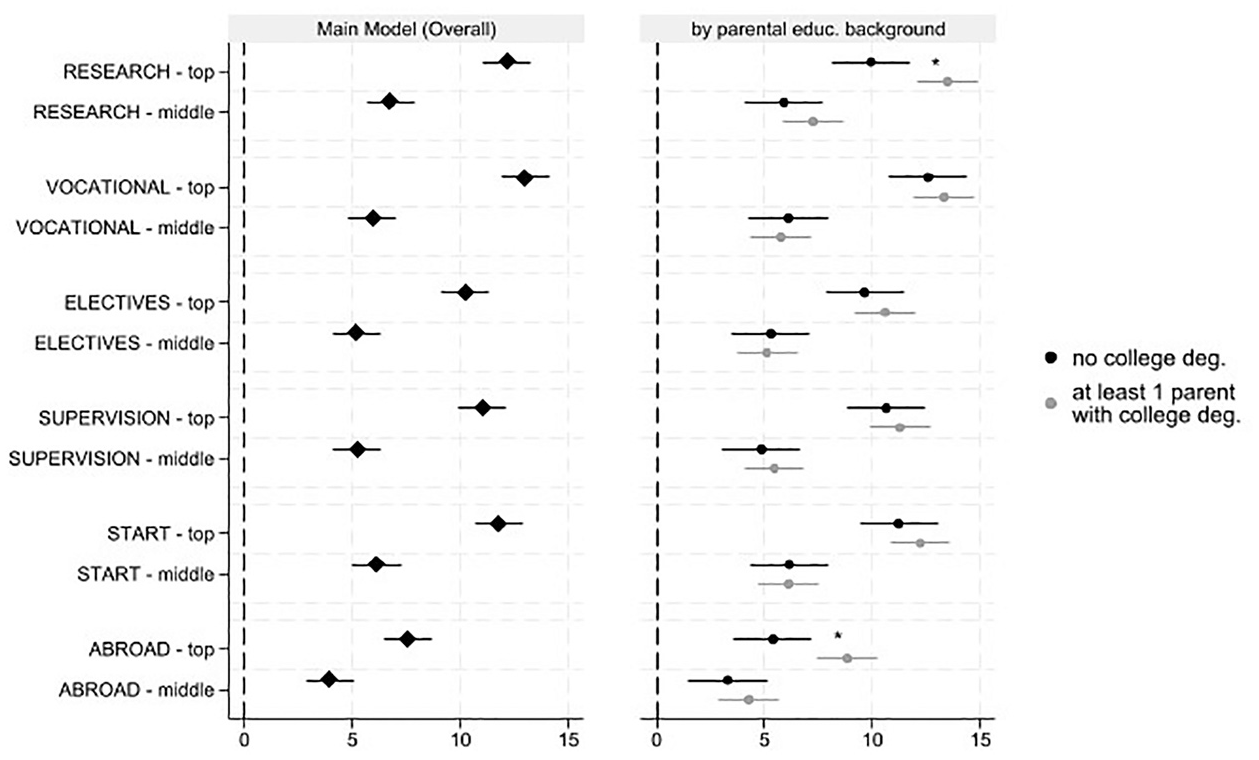
Effects of study program characteristics on college enrollment intentions overall and by parents’ educational background (linear random-intercept regression models).
Concerning the content of a study program, the analysis indicates that a research-oriented program being ranked in the top group increases enrollment intention by 12.1 percentage points compared to being ranked in the bottom group. Similarly, being ranked in the top group for vocational orientation increases enrollment intention by 13.0 percentage points compared to being ranked in the bottom group. When we compare the middle group to the bottom group, the differences are smaller but still highly significant (6.8 for research orientation and 5.9 for vocational orientation). These results indicate that the content of a study program is highly relevant to enrollment intentions, confirming Hypotheses 1a and 1b.
In terms of the frequency of elective courses, reflecting the flexibility of a study program, enrollment intention is 10.2 percentage points greater in the top group than in the bottom group. Furthermore, when comparing the middle group with the bottom group, middle-ranked flexibility of the curriculum increases enrollment intentions in a study program by 5.2 percentage points, on average. This finding supports Hypothesis 2a, suggesting the greater the flexibility in a study program is, the greater enrollment intention is. A negative influence of flexibility, as proposed in Hypothesis 2b, cannot be confirmed.
When investigating the influence of institutionalized support in a study program, the results indicate that all three support dimensions significantly affect enrollment intentions. If the vignette dimension for support services at the beginning of college is presented with the top group, enrollment intention is 11.8 percentage points higher, on average, than if it is presented with the bottom group. If the dimension on supervision by professors in the vignette is presented with the top group, respondents’ enrollment intention is 11.0 percentage points higher, on average, than if it is presented with the bottom group. And if support for studying abroad is presented with the top group, respondents’ enrollment intention is 7.6 percentage points higher, on average, than if it is presented with the bottom group. The difference between the middle group and bottom group ranking is highly significant for all three dimensions (support at the beginning = 6.1, supervision = 5.2, support for studying abroad = 3.9), indicating greater enrollment intention for the middle-ranked dimension. In summary, support within a study program increases enrollment intention, confirming Hypothesis 3.
An attractive feature of our vignette design is the use of the same levels (top, middle, bottom) for each dimension, which makes the strength of the random-intercept regression coefficients approximately comparable (see Auspurg and Hinz 2015). Hence, we can conclude that the vocational orientation of a study program tends to be the most important dimension, closely followed by research orientation. Support for studying abroad is the least important characteristic for intention to enroll in a program; this could be because the decision to study abroad usually arises after several semesters, not during the application process. Furthermore, not all students intend to study abroad, so this dimension may not be relevant for everyone. Nonetheless, this dimension, although having a smaller effect size, still significantly influences enrollment intentions.
To examine the effects of social background differences, we ran separate models for individuals with and without at least one college-educated parent. The results indicate that all the coefficients remain highly significant for both groups and go in the same direction as the coefficients in the overall model (see Figure 1). We assessed subgroup differences using the Wald test. To that end, we included an interaction term between parents’ educational background and the respective vignette dimension in the main model.
Concerning the importance of the content of a study program, the analyses show significant social differences for the importance of research orientation. When research orientation falls into the top group compared to the bottom group, enrollment intentions increase by 13.5 percentage points for individuals with at least one college-educated parent, whereas enrollment intentions increase by only 9.9 percentage points for individuals with no college-educated parents. Similarly, in the comparison between the middle group and bottom group, the influence is slightly greater for individuals with at least one college-educated parent (7.3 vs. 5.9). These findings suggest a study program’s research orientation is more influential in shaping enrollment intentions for individuals with at least one college-educated parent than for those without college-educated parents. Thus, Hypothesis 4a is supported. However, Hypothesis 4b, that a vocational-oriented study program should be particularly important for individuals without college-educated parents, is not supported by the results because no significant differences are found.
In terms of the flexibility of a study program, no significant differences emerge between individuals with at least one college-educated parent and those without. Therefore, Hypotheses 5a and 5b are not supported by the results.
Regarding support within a study program, we see a significant difference between individuals with and without at least one college-educated parent only for the support services for studying abroad dimension. When this dimension is ranked in the top group, enrollment intention for individuals with at least one college-educated parent is 8.8 percentage points greater than if the dimension is ranked in the bottom group, compared to 5.4 percentage points for individuals without college-educated parents. Similarly, when support for studying abroad is ranked in the middle group versus the bottom group, the effect tends to be more important for individuals with college-educated parents (4.3 vs. 3.3), although this difference is not significant. Overall, the effect of support for studying abroad is stronger for students with at least one parent holding a college degree. This outcome is in line with Hypothesis 6c. However, we find no evidence for Hypotheses 6a and 6b, which propose that support services at the start of college and supervision by professors have a stronger effect on the enrollment intention of individuals without college-educated parents.
To ensure the robustness and generalizability of our findings, we conducted additional analyses. These analyses show the vignette dimensions remain relevant across subgroups defined by study aspirations, preferred study distance, and aspired fields of study and are not overshadowed by other factors not explicitly examined in the survey experiment. For a comprehensive explanation and additional analyses, see Part B of the online supplement.
Conclusions and Discussion
Drawing on Morgan’s (2002) theoretical framework, which emphasizes the role of information in shaping educational beliefs, we find that study program characteristics—in terms of teaching content (research-/vocational-oriented), program flexibility (elective courses), and support (supervision by professors, support at the beginning of college, support for studying abroad)—are a crucial source of information. All six investigated dimensions show highly significant and substantially relevant effects on potential applicants’ enrollment intentions.
Vocational-oriented content emerges as the most important dimension for enrollment intentions, although the coefficients of the dimensions are quite similar. Support for studying abroad appears to be the least important. Regarding differences by parents’ educational background, the effects of support services for studying abroad and research-oriented content are greater for individuals with at least one college-educated parent. None of the dimensions has a greater influence on individuals without college-educated parents, suggesting differences in how information is integrated into beliefs across social backgrounds. Additionally, students without college-educated parents may lack sufficient information to fully evaluate the importance of study program characteristics. According to Morgan (2002), preexisting beliefs and information shape how new information is processed. Thus, for students without college-educated parents, their limited prior exposure to higher education may influence how they perceive information on study programs.
Another possible explanation for this finding could be attributed to status maintenance motives (see Breen and Goldthorpe 1997; Stocké 2007). For youth with at least one college-educated parent, higher education may be their expected path, allowing them to focus more on the specifics of what and where to study, making study program characteristics more relevant. In contrast, for individuals without college-educated parents, the decision of whether to pursue higher education represents a significant initial step, potentially overshadowing considerations regarding which study program to choose. Additionally, it is important to consider that the information provided in the survey experiment may not be equally accessed by all students in reality, further reinforcing social inequality in the transition to higher education.
Our findings highlight the importance for colleges and policymakers to consider study program characteristics to increase program enrollment. For college administrators, the provision of clear and relevant information about the flexibility, support, and content of study programs is essential. Investing in adapting these characteristics—particularly by incorporating more vocational-oriented content—appears especially promising for enhancing program attractiveness.
Yet our study indicates that adjusting these program characteristics has limited potential to reduce the social inequality in college enrollment. Interventions to close enrollment gaps across social groups may require targeted interventions (e.g., information treatments on returns to education) to reshape educational beliefs (see Barone et al. 2017; Ehlert et al. 2017). Our study contributes to the emerging sociological literature on academic rankings and the construction of quality by showing that study program rankings—irrespective of whether they mirror actual differences in quality—affect enrollment intentions and thus likely have an effect on actual college choices. In the increasingly competitive university context, rankings feed into the social construction of quality in the eyes of the central stakeholders—high school graduates—and drive their enrollment decisions in important ways.
One limitation of our study is our ability to understand the alignment of preferences expressed in vignettes with real-life decisions. Future studies are needed to explore the importance of the studied dimensions in potential applicants’ real-life decision-making processes. Future work should also examine the study program characteristics outlined here alongside broader college characteristics from previous research (e.g., distance/location, reputation) in one survey experiment. This approach could provide a comprehensive understanding of how institutional characteristics at various levels affect study intentions and how different institutional dimensions interact with each other. Additionally, although our study highlights the relevance of study program characteristics, it is important to acknowledge that enrollment decisions can also be influenced by outcome factors such as expected earnings, employment prospects, and completion rates. Future research should examine how these outcome factors, along with study program and college attributes, collectively shape enrollment choices.
Our study distinguishes between college- and non-college-educated parental backgrounds, but given data limitations, we do not capture variation in parents’ specific fields of study. Given that college-educated individuals are, on average, more likely to be exposed to research-oriented environments, our categorization provides a meaningful distinction. However, future research could explore whether differences between more research- or vocationally oriented parental fields of study shape students’ enrollment preferences.
A general limitation of vignette studies is the uncertainty of whether hypothetical actions stated in vignettes translate into actual behavior. Most existing validation studies are encouraging (Hainmueller, Hangartner, and Yamamoto 2015; Petzold and Wolbring 2019), but some studies draw a more pessimistic picture (Forster and Neugebauer 2024). Our results should thus be interpreted with caution. However, importantly, this article focuses solely on examining enrollment intentions. Consequently, we do not make claims about the exact manifestation of these stated intentions in real decisions.
Although the German higher education system differs structurally from the U.S. and U.K. systems, in all educational systems, individuals have to process substantial amounts of information about study program characteristics within a constrained decision-making time frame. Moreover, systems with relative uniformity in quality and prestige among universities put lower weight on broader institutional factors, such as reputation, in the enrollment process, thereby increasing the transferability of findings from these contexts to the United States, where majors are chosen after enrolling in college. Thus, whether students choose their institution and study program simultaneously, as in Germany, or sequentially, as in the United States, information about study program characteristics plays a crucial role in this complex decision-making process.
In summary, our study highlights the importance of considering study program characteristics when exploring factors influencing college enrollment intentions. Our results emphasize the need for colleges and policymakers to account for both institutional and study program-specific dimensions when attempting to make higher education or a particular field of study more attractive. However, adjusting for and providing information about study program characteristics is unlikely to decrease the enrollment gaps between individuals from less and more privileged family backgrounds.
Supplemental Material
sj-docx-1-soe-10.1177_00380407251356274 – Supplemental material for Study Programs, Public Rankings, and College Enrollment Intentions: Results from a Survey Experiment on Study Program Content, Flexibility, and Support
Supplemental material, sj-docx-1-soe-10.1177_00380407251356274 for Study Programs, Public Rankings, and College Enrollment Intentions: Results from a Survey Experiment on Study Program Content, Flexibility, and Support by Carina Toussaint, Alexander Patzina, Hans Dietrich and Tobias Wolbring in Sociology of Education
Footnotes
Acknowledgements
We thank participants of the ISA RC28 Spring Meeting, the ECSR Annual Conference, the Workshop on Analytical Sociology in Venice, and the Workshop on Training, Education, and the Labor Market for valuable feedback. We also thank Marc Hüsch for providing information on the CHE ranking. Data collection for this study was part of the BerO project; we gratefully acknowledge the support of the project team, including Silke Anger, Sarah Bernhard, Adrian Lerche, and Malte Sandner. Furthermore, we would like to thank the American Journal Experts for language editing.
Funding
The author(s) disclosed receipt of the following financial support for the research, authorship, and/or publication of this article: Carina Toussaint gratefully acknowledges financial support from the Graduate Program of the IAB and the University of Erlangen–Nuremberg (GradAB).
Research Ethics
The fieldwork for this study was approved by the Ethics Council of the University of Bamberg. All human subjects gave their informed consent prior to their participation in the research, and adequate steps were taken to protect participants’ confidentiality.

Supplemental Material
Supplemental material for this article is available online.
Notes
Author Biographies
References
Supplementary Material
Please find the following supplemental material available below.
For Open Access articles published under a Creative Commons License, all supplemental material carries the same license as the article it is associated with.
For non-Open Access articles published, all supplemental material carries a non-exclusive license, and permission requests for re-use of supplemental material or any part of supplemental material shall be sent directly to the copyright owner as specified in the copyright notice associated with the article.
