




Abstract
Studies of networks for educational change often focus on webs of teachers, school leaders, policymakers, and philanthropists, with little attention to staff at the middle level, who arguably have immense potential to effect change. This article explores an initiative for educational change through mid-level staff using the case of a nonprofit that places its members in large, public education bureaucracies in a developing country. I explore a mechanism for how the strategic patchwork of staff can support change through improved bureaucracy. First, staff are intentionally placed, reputationally distinct, and purposely connected. Second, these individuals influence bureaucratic effectiveness through coordinated policies, reduced organizational friction, and informal information sharing. Third, the improved coordination supports policy creation, program implementation, and candid evaluation of processes on the ground. Integrating studies of education, state bureaucracy, and civil society, I show the utility in investigating novel forms of educational change that engage rather than circumvent traditional education bureaucracies.
Keywords
Sociologists and organizational scholars have long investigated how social networks influence educational changes (Daly 2010). On one end are policy networks among school leaders, philanthropists, and nonprofit heads, which affect new education policies (Ball 2008, 2010; Kretchmar, Sondel, and Ferrare 2014), market-oriented organizations in education (Scott and Jabbar 2014), political races in school districts (DeBray et al. 2020), and jurisdictional challengers to public institutions (Quinn, Tompkins-Stange, and Meyerson 2014; Reckhow and Snyder 2014). On the other end are implementation networks among teachers and staff, which attempt to structure the diffusion of innovation (Frank, Zhao, and Borman 2004), execution of policies (Coburn and Russell 2008), and fostering of relational trust (Bryk and Schneider 2002). Empirical studies in education policy and politics have investigated how nonprofit and intermediary organizations such as Teach for America and Success for All create and support these policy and implementation networks (Honig 2004; Kretchmar et al. 2014; Peurach 2011). However, change initiatives may also be directed at a different set of actors: mid-level staff working in traditional education bureaucracies.
To contribute to the sociological literature on social networks and educational change, I ask: How does educational change happen through initiatives focused on mid-level staff working in bureaucracies? Instead of focusing on initiatives to craft policies or influence implementation circumventing these bureaucracies, I focus on an empirical case of midlevel networks attempting to affect bureaucratic effectiveness and in the process, support educational change. I focus on the bureaucratic effectiveness of mid-level staff because large bureaucracies are often criticized for constraining professional discretion (Mehta 2013), burdening staff with unnecessary red tape (Blom, Borst, and Voorn 2021), limiting individual freedoms (Humes 2022), and creating policies unresponsive to problems on the ground (Meier, Polinard, and Wrinkle 2000). I explore how effective bureaucracies can support constructive changes (Darling-Hammond 1998; Honig 2009; Peurach et al. 2021). Despite the importance of central bureaucratic agents, few studies have investigated how their networks can influence change (for exceptions, see Honig 2006, 2009). Thus, I foreground an empirical case of intentional structures to support the work of mid-level staff—government employees in a position between policymaking officials and policy-executing implementers (Cavalcante, Lotta, and Yamada 2018). Such a study on the network of technical assistants, office managers, module developers, data analysts, and other mid-level staff can highlight how initiatives influence educational changes through traditional bureaucratic structures.
To understand these networks of mid-level staff, I leveraged the experience of a nonprofit organization placing individuals into government positions in a developing country’s education bureaucracies. Many philanthropies and nonprofits focus on influencing teachers, school leaders, and policymakers, but some organizations have recently adopted the strategy of “good government organizations” focused on improving bureaucratic management through training, evaluation, and advocacy (IBM Center 2023). My study proposes the concept of “strategic patchwork” to explain how an initiative can support educational change through bureaucratic effectiveness. With my focus on a singular case in a developing country, I do not assert definitive answers but suggest potential mechanisms for change through initiatives directed at improving bureaucracies. By investigating this case, I aim to open discussion regarding a relatively new and understudied form of engaging the public education system.
I primarily contribute to a conceptualization of educational change from neither policy networks nor implementation networks but from mid-level staff aiming to improve bureaucratic processes. The study illustrates how private actors create networks in public bureaucracies to make the latter more functional and responsive to the needs of the educational system. Whereas prior work often highlights the role of private actors working around bureaucracies, I show their influence in directly inserting networks of staff into bureaucracies. In so doing, I contribute to studies of social networks, educational change, and education politics.
Theoretical Background
Social Networks and Educational Change
Sociologists studying social networks in education have examined school communities’ social capital, students’ peer influence, children’s friendship formation, teachers’ relational ties, and philanthropic and nonprofit networks influencing schools (Coburn and Russell 2008; Cox 2017; Reckhow and Snyder 2014). Daly (2010) notes that these networks are not simply characteristic of schools but are key in supporting or constraining changes at multiple levels of education. These different networks all have consequences for educational outcomes and inequalities.
Teacher implementation networks
Connections among teachers, instructional staff, and coaches support knowledge diffusion and improvement of teaching practices. Social networks, particularly among teachers, bridge individuals with differing expertise and abilities (Frank et al. 2004; Murray et al. 2020). In diffusing innovations, teachers’ access to experts and their experience of social pressures can support the implementation of new technologies (Frank et al. 2004). Networks of teachers can emerge from policies, such as a district policy on professional coaching (Coburn and Russell 2008); programs, such as networked improvement communities (Bryk, Gomez, and Grunow 2011); and platforms, such as Pinterest, where teachers share and receive information (Frank et al. 2018). These networks can contribute to educational improvement through increased collective efficacy among teachers and school leaders, which may have direct effects on student achievement (Moolenaar, Sleegers, and Daly 2012).
Policy and resource networks
Connections among policymakers, civic leaders, and philanthropists influence what policies are adopted, how resources are distributed, and why certain programs are instituted. Networks of philanthropic and nongovernmental organizations influence policy creation and implementation (Ball 2008). For example, large foundations and philanthropies can act as hubs in mobilizing specific market-based policies and initiatives (Scott and Jabbar 2014; Zeichner and Peña-Sandoval 2015). Resources from philanthropic grants influence advocacy and knowledge in federal discourse on education policies (Reckhow, Tompkins-Stange, and Galey-Horn 2021). Large philanthropies support national-level advocacy organizations that engage in policy debates that challenge traditional public institutions (Reckhow and Snyder 2014). Even smaller foundations can create complex resource networks funding charter schools, after-school programs, and college readiness organizations (Ferrare and Reynolds 2016).
Middle-level networks
Teaching professionals use networks to improve practices, and policymakers and philanthropic leaders use networks to create policy changes. However, macro-level policies and micro-level practices need to be supported by a meso-level system that builds capacity and coordinates coherent initiatives (Spillane et al. 2022). Thus, some scholars have studied how varied “middle-level networks” can support changes in education. For example, Greany and Kamp (2022) show how interschool networks are created among school leaders through incentives, capacity building, government mandates, and accountability pressures. They argue that this networked system emerged as an alternative to traditional bureaucratic oversight and market-based competition (Greany and Kamp 2022). Mid-level networks can also follow the core-periphery model, where district officials communicate and provide knowledge to site leaders or principals—highlighting how the tie between the central office and the school can help or inhibit efforts at change (Daly and Finnigan 2010).
Bureaucratic networks
Changes can also transpire through bureaucratic networks, or connections among public servants in varied levels, offices, and sectors of government (Behnke 2019). Public administration studies highlight that these informal networks can support the creation and implementation of policies, but this work cautions that they may also impede institutional change if individuals have incentives to maintain the status quo (Ali 2022; Gains 2003). Although these networks do not necessarily have the power of politicians to enact laws, their members’ expertise and influence can help in preparing, coordinating, and formulating policies (Hegele 2018). These bureaucratic networks can potentially help transform education not through grounded practices or specific policies but through efficient coordination that supports policy creation, implementation, and evaluation (Labaree 2020).
Bureaucratic Effectiveness and Organizational Change
Weber’s (1978) classic account of bureaucracy focused on hierarchical structures, clear lines of authority, defined regulations, specialization, and division of labor—all key for a supposedly efficient and rational way of organizing human activity. In a classic study of the school as a formal organization, Bidwell (1965) noted the bureaucratic aspects of schools, including the functional division of labor, definition of staff roles as offices, hierarchical ordering of these offices, and rules that limit individual discretion. However, Bidwell (1965:976) also noted that schools are not entirely bureaucratic because of their structural looseness, such as when a “teacher works alone within the classroom, relatively hidden from colleagues and superiors.” Schools pose an interesting paradox showing the coexistence of bureaucratic directives from central school districts and weak enforcement mechanisms in schools (Meyer and Rowan 1977; Weick 1976). U.S. education bureaucracy is experienced through central district offices that emphasize “top-down, command-and-control relationships” (Honig 2006:359), but schools can tightly or loosely comply with these directives (Hallett 2010).
In countries where national education is managed centrally, bureaucracies are even larger. In Japan, for example, the national Ministry of Education controls the curriculum, instruction, school administration, and educational content in textbooks (Ishikida 2005). In Nordic countries, such as Finland and Sweden, state educational bureaucracies manage the national curriculum and inspectorate (Varjo, Lundström, and Kalalahti 2018). China’s central governance has recently devolved educational financing and some content to the local county level, but the national ministry still controls the curriculum and about 80 percent of total school hours (Tao 2022). Since the 1990s, many countries have focused on the rational bureaucratic management of education, even with the rise of market-oriented policies (Bromley et al. 2023). Despite the dominance and power of large education bureaucracies, they are often viewed as inertial organizations constraining change and improvement (Mehta 2013; Meier et al. 2000). But these bureaucracies can also be crucial for change, because they provide clear communication lines, reduce role conflict, clarify responsibility, and prevent privileged families from bypassing school rules (Hoy and Sweetland 2000; Labaree 2020).
Bureaucratic effectiveness is conceived as the ability of a hierarchical organization to achieve its goals by coordinating policies, supporting implementation, matching people’s competence to their position, and having clear lines of authority and accountability (Besley et al. 2022). Applied to education, such effectiveness denotes supporting continuous improvement, building schools’ capacities, and empowering individuals to effect change on the ground (Darling-Hammond 1998; Peurach et al. 2021, 2022). In addition to conceiving educational change as arising from specific policies or practices, I suggest thinking of change as resulting from supportive meso-level systems that help with policy creation/implementation and practical adaptation/evaluation.
The potential for effective bureaucratic processes to support change is particularly important in contexts dominated by slow and rigid bureaucratic processes—contexts all too common in developing countries (Hoang 2018; Lecuna, Cohen, and Mandakovic 2020). However, rather than viewing the state as one large organization, scholars have suggested thinking about the “many hands of the state” and the distinct organizational subunits that can be effective even as larger systems are not as effective (Morgan and Orloff 2017). With this perspective, scholars suggest that pockets of bureaucratic effectiveness can emerge, and this work notes the role played by networked government officials in driving effective bureaucratic performance (Ali 2022; Hickey 2019; McDonnell 2017, 2020). The present study investigates not just the role of networks in government but also how networks are structured and supported by civic actors outside the bureaucracy.
Strategic Actions of Civic Organizations
Research on the politics of education often highlights the increasing influence and growing role of civic and nongovernmental actors (Lubienski, Yemini, and Maxwell 2022; Trinidad 2023). Scholars have referred to these actors as forming part of the school improvement industry (Rowan 2002, 2008), intermediary organizations (Honig 2004), or hidden markets for supplemental education services (Burch 2009). Many of these organizations do not just provide resources; they also attempt to initiate and influence networks (Bryk et al. 2023; Daly 2010). In schools, organizations support the creation of professional learning and networked improvement communities among teachers and leaders (Eddy-Spicer, Arce-Trigatti, and Young 2020). In policy circles, philanthropic organizations initiate webs of advocacy to support specific initiatives (DeBray et al. 2020; Reckhow and Snyder 2014; Scott 2009). In both cases, these organizations often work around rather than directly engage traditional bureaucracies to influence changes in education.
Organizations can support the creation of ties among individuals, which can have important long-term consequences (Trinidad 2025). For example, Cox (2017) illustrates how a nonprofit supports low-income students to attend elite boarding schools by creating horizontal ties among students and vertical ties between older and younger cohorts to improve their access to various social and informational resources. Corporations also take advantage of cohorts of management trainees that create networks with each other and are subsequently placed in key subunits to improve coordination, communication, and teamwork (Ravaghi et al. 2021). Military academies, such as West Point, create networks among graduates that can improve coordination across various branches of the military and government (Böhmelt, Escribà-Folch, and Pilster 2019). National and local state offices can create public service trainee and corps programs that provide career opportunities for individuals who intend to work as civil servants (Frontani and Taylor 2009). Some of these programs are supported by civic organizations that help recruit, train, and place individuals in government bureaucracies (IBM Center 2023). Figure 1 illustrates how civic organizations focused on civil service placement and training can influence the bureaucracy through mid-level staff—a critical bridge between senior bureaucrats who are often political appointees and street-level bureaucrats who are frontline workers of the state (Besley et al. 2022).
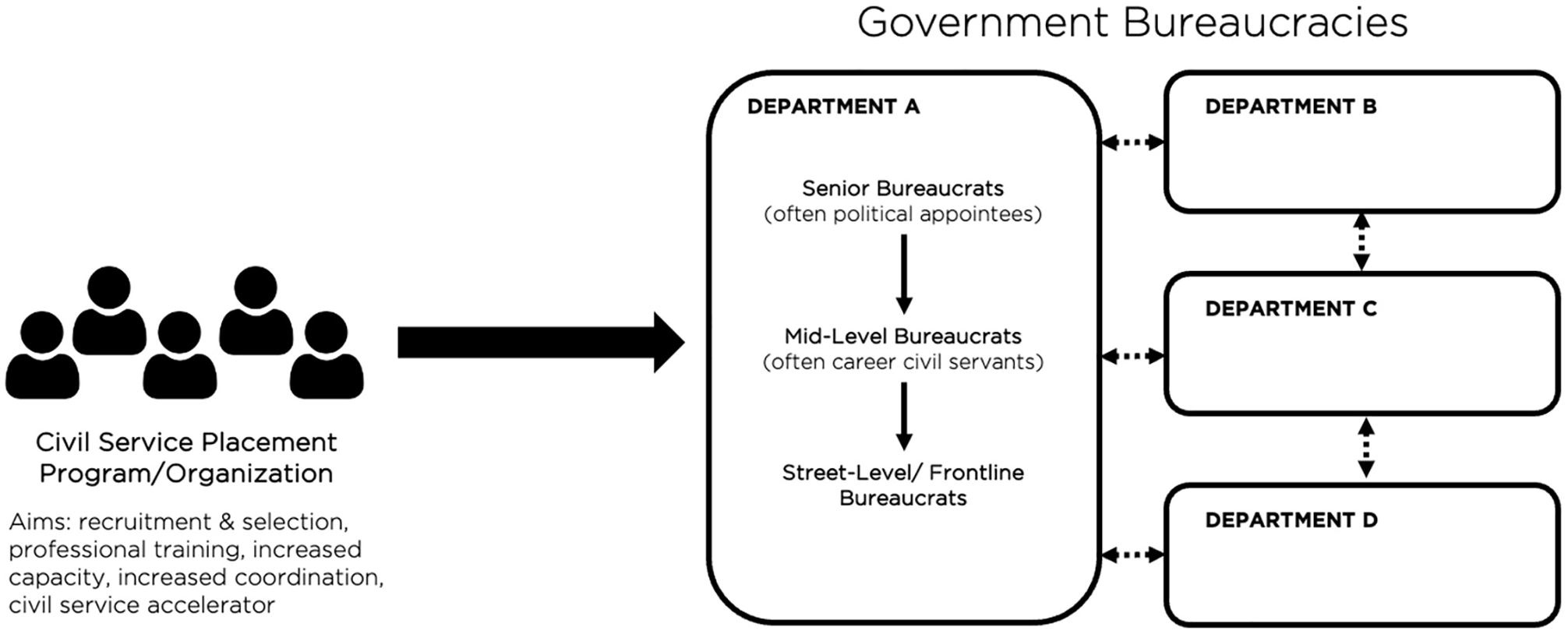
Framework for civil service placement.
In summary, the literature on social networks and educational change has focused on teacher and policy networks, spaces that civic organizations have also tried to influence. However, educational change may potentially transpire through mid-level staff supporting effective bureaucracies, a relatively new form of influence for civic organizations. Thus, this study uses a case from a developing country to examine how organizations influence change by engaging networks of mid-level staff within bureaucracies.
Research Site and Methodology
Organizational and Bureaucratic Contexts
Catalyst 1 is a Philippine nonprofit organization started in 2012 to build a movement of young professionals that will improve education and spark positive change in school communities. It started with a fellowship program in which college graduates and young professionals taught for two years in public schools around the Philippines. Initially, the placement sites were in Metro Manila, but the organization has since expanded to rural and provincial locations. Catalyst created a second program for the first batch of alumni, who graduated in 2015, placing them in government offices after two years of teaching. A third program started in 2018 and focused on public school teachers who were already in the system; Catalyst provided professional development and coaching opportunities for these teachers. All these programs worked in partnership with the central education department and local government units. Catalyst has remained nonpartisan, worked with different administrations, and does not have official positions on political issues such as education privatization.
The present study focuses on the second program, the Alumni Associates program, in which participants who finished the two-year teaching fellowship were given the option of a third year to work in government offices. Before being placed in these offices, the participants would have known their cohort of around 30 to 50 individuals because they all participated in a preservice teacher-training program, had monthly in-service training, and completed a summer training program. Thus, even though only three to five teachers are assigned to each school, participants would have had a lot of interactions with their cohort and across cohorts.
Between 2015 and 2021, Catalyst placed 142 associates as technical assistants in government offices. These individuals were not necessarily executives who made decisions, nor were they teachers or clerical staff. Many functioned as mid-level staff, taking on roles such as researchers, trainers, module developers, program specialists, and executive assistants to department leaders and undersecretaries. The majority of participants finished the one-year commitment; some were unable to finish, and others continued working as career civil servants beyond the one year. A number of these alumni have stayed in government agencies for more than five years and have since supported other associates who joined their offices.
The majority of Catalyst’s associates were placed in the Philippine Department of Education (DepEd), particularly the central office located in Metropolitan Manila; others were placed in the Commission on Higher Education (CHED; focused on postsecondary institutions), legislative offices, and local government units (see Table 1). DepEd is responsible for K–12 education in the country. It is arguably the country’s largest bureaucracy, with around 900,000 teachers and staff and an annual budget of close to PHP 850 billion, or $15.2 billion (Magsambol 2022). The department is centralized and hierarchical, with a central office, regional and division offices, and the schools. The school system is divided into K through 6th-grade elementary schools, 7th- to 10th-grade junior high schools, and 11th- and 12th-grade senior high schools (Trinidad 2020). Decisions and policies from the DepEd central office are consequential given the top-down structure of the country’s education system.
Distribution of Catalyst Associates, 2015 to 2021.
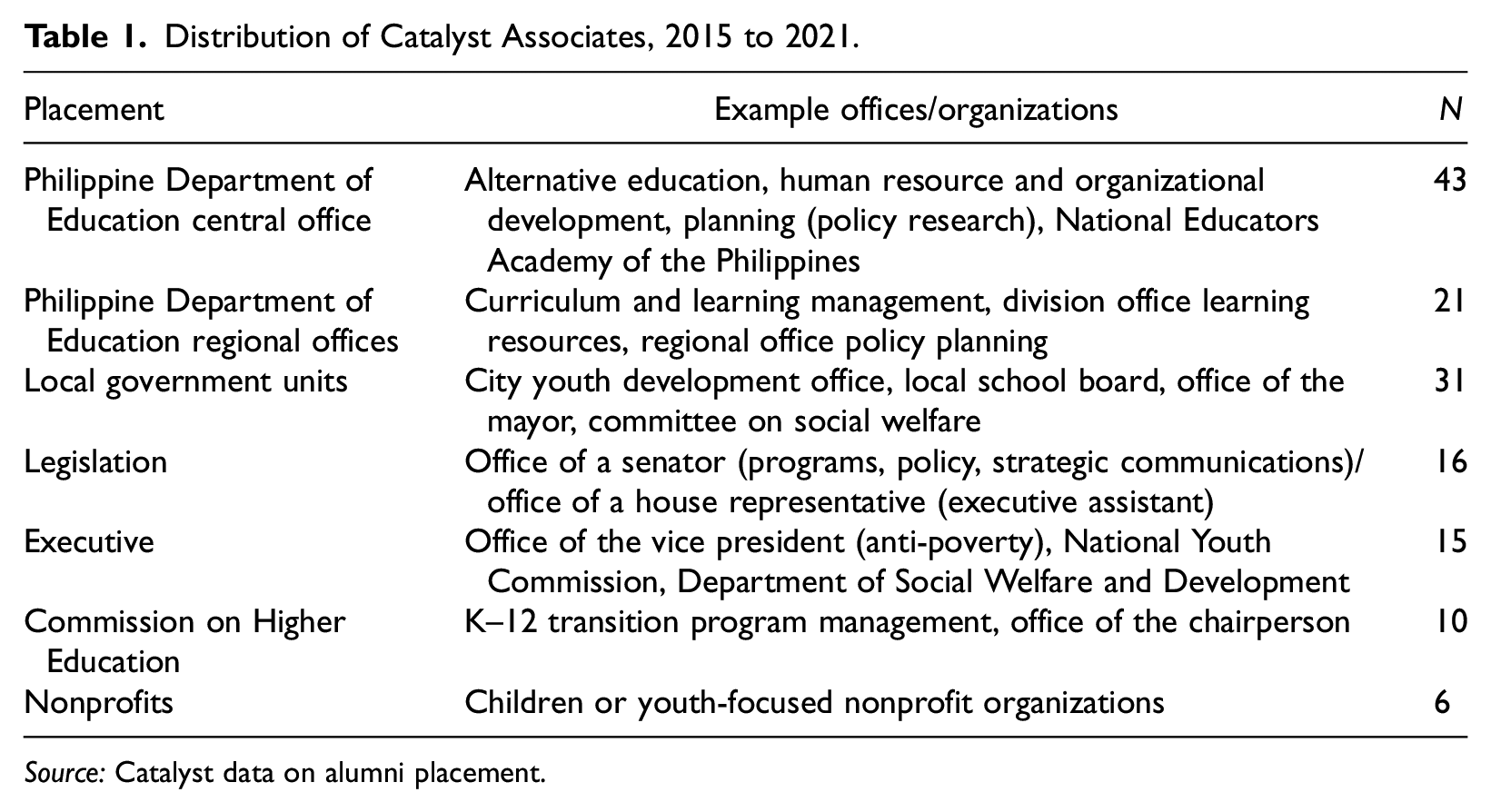
Source: Catalyst data on alumni placement.
The placement of Catalyst associates in government offices entails a tension between opportunism and agency. When the program started, associates were placed in offices that Catalyst had some connection with (e.g., a senator, congressperson, or undersecretary they worked with before). As the program grew, more government officers became aware of it and were open to taking in associates. During this time, Catalyst became more “strategic” and prioritized placement in potential levers for policymaking or decision-making.
Data Collection
The study is based on in-depth interviews with 53 alumni of the Catalyst program (median age = 28; 51 percent female, 47 percent male, 2 percent nonbinary), including three people who subsequently worked as staff at the organization. Forty-three people were individually interviewed, and 10 were interviewed in groups of 2 or 3. Interviewees were randomly chosen using a random number generator. If a person did not respond to the interview invitation, we ran the random generator to find a replacement. 2 Two members of the research team—the principal investigator (PI) and project manager (PM)—conducted interviews through Zoom between May and July 2022. Use of the Zoom platform was motivated by health protocols during the COVID-19 pandemic and the fact that alumni were spread out in different parts of the country.
The semi-structured interviews with alumni lasted between 45 and 120 minutes. Questions focused on their program experience, career trajectory after the program, professional networks and contributions, and suggestions for organizational improvement. Alumni were also asked about demographic and career details, such as their fellowship cohort, current work, age, gender, and citizenship. Informants working in key education bureaucracies, like the DepEd and the CHED, were asked about their personal experiences in these offices and the consequences and constraints of having a collection of Catalyst alumni in the office. Alumni who stayed in government careers were asked about their reasons for staying and the organizational changes they experienced in their respective government offices.
By interviewing a diverse set of program alumni, we can illustrate commonalities and differences in the experiences of participants who worked as mid-level staff in the government. In particular, we were interested in seeing the consequences of their intentional placement in government offices. We note our positionality in this research: The PI was a previous staff member of Catalyst, and the PM was a fellow and alumni associate who worked in a senator’s office. These experiences helped in providing us access to the organization and building rapport with our informants. Despite our familiarity with the organization, we have not been employed by the organization for the past eight years and found many changes and unexpected findings through our interviews.
Data Analysis
The interview transcripts were read and coded by five researchers, including the PI, PM, and three research assistants. After reading through the transcripts, the PI and PM created a codebook through emergent coding, creating codes for recurring concepts, themes, and activities (Saldana 2011). These initial codes were then grouped into “parent codes.” For example, we had codes for how alumni associates used their networks for (1) ad hoc collaborations, (2) coordination across offices, (3) job applications, (4) updates on the education sector, and (5) resource tapping. We grouped these five codes under the parent code “networks.” Our codebook included nine parent codes (e.g., networks, government bureaucracy, organizational change, contribution to change, challenges), with each parent code having 5 to 10 codes underneath it.
We trained three research assistants to systematically code the transcripts by describing the inclusion and exclusion criteria for the different codes and providing examples of interview quotes under each code (Blake 2024; Saldana 2011). Each transcript was assigned to two assistants and was coded through Taguette, an online software. Our research team met weekly for three months to discuss the interviews, create new codes when necessary, resolve differences in coding, and highlight the themes emerging from our analysis. The PI and PM independently reviewed the coded transcripts of the research assistants to ensure reliability of the thematic coding (Castleberry and Nolen 2018). Differences or problems with coding were discussed during the weekly meetings to resolve and clarify our codes.
After coding, the importance of networks of mid-level staff and how Catalyst functioned in bringing this about emerged as a crucial theme. We used interviews with alumni to illustrate how these networks functioned and why the nonprofit organization’s design was crucial for these connections. We also looked for disconfirming evidence that challenged our hypothesis regarding connections across mid-level staff. In particular, we tried to look for interviews with individuals who were not connected with others and who believed the networks carried risks for bureaucracies. Finally, we analyzed other sources of data to examine our initial ideas regarding these networks. Because we only interviewed a limited number of alumni, we requested program documents detailing the placement of associates into government offices (see Table 1); we incorporated this information into our picture of the structure of the educational bureaucracy (see Figure 2). These various sources of information provide an opportunity to understand how network initiatives for mid-level staff can influence bureaucratic effectiveness and educational changes.
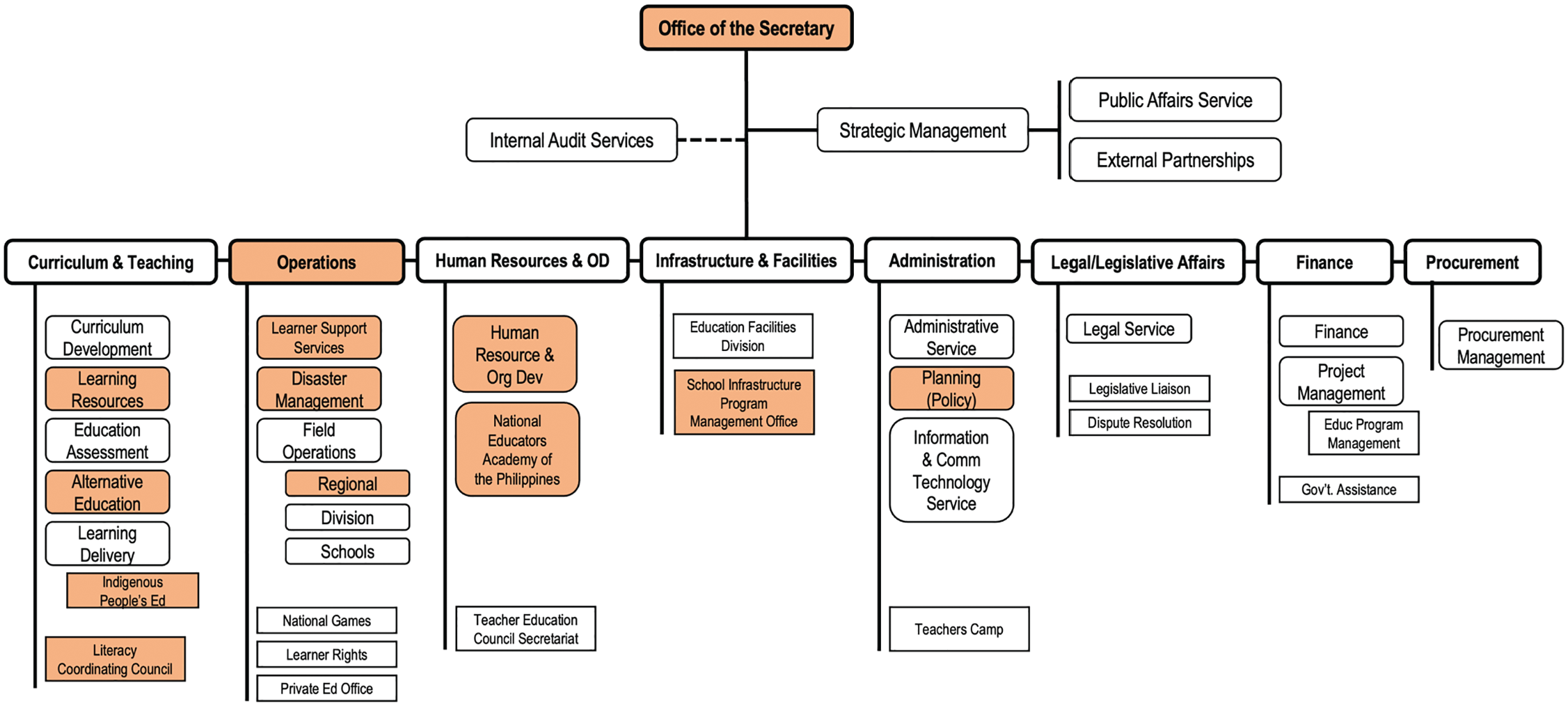
Philippine Department of Education organizational structure.
Findings
Strategic Patchwork
I suggest the concept of “strategic patchwork,” which entails purposefully connecting various offices or organizations through social networks that support coordination and collaboration in large bureaucracies or for large initiatives. Strategic patchwork contrasts with two other forms: “hegemonic” bureaucracies with hierarchical coordination along discrete jurisdictions and “pockets” of bureaucratic effectiveness where competent staff are concentrated in certain subunits (McDonnell 2017). Strategic patchwork entails lateral coordination across mid-level staff and dispersion of individuals in a bureaucracy.
This patchwork involves organizations—or outside-organizational entities like Catalyst—creating deliberate structures that support connection across the education bureaucracy. In the case of Catalyst, associates were not just randomly placed in different offices: They were placed in key offices where educational change could be affected. The aim was not just to add human resources; Catalyst aimed to connect these individuals. Placement did depend on which government offices were willing to take Catalyst associates, but the organization tried to be deliberate about placing associates in offices that could influence changes in the educational system.
Many Catalyst associates were placed in the DepEd, both the central office in Metropolitan Manila and regional offices that supported policy, curriculum, and learning resources (see Table 1). Associates also worked as youth development officers and technical assistants for education to city mayors. Some associates were assigned to be program and policy officers in the offices of Philippine senators and congressional representatives, especially offices of members who served on senate and house committees on education. Finally, a number of associates worked at CHED, and a few worked with nonprofits.
Catalyst participants were placed in various offices in the central bureaucracy of DepEd. Figure 2 is an organizational map of DepEd, with highlighted boxes denoting the presence of Catalyst associates. Some associates worked as executive assistants to the chief of staff of the Secretary of Education. Many of the large bureaus had Catalyst associates, including the bureaus of curriculum, operations, human resources, policy/administration, and infrastructure. The only bureaus that did not have associates were finance, legal services, and procurement—mostly technical offices that required specific skills Catalyst associates were not trained in. Although these offices may be key spaces in need of change, Catalyst was unable to place associates there; instead, the organization concentrated its efforts on bureaus that can influence instructional and personnel policies. Because Catalyst associates were assigned to various offices, they had connections with people in different bureaus. This proved particularly helpful in navigating the large bureaucracy of the DepEd’s central office in Metro Manila, which had around 2,000 employees in 80 offices.
Elements of Strategic Patchwork
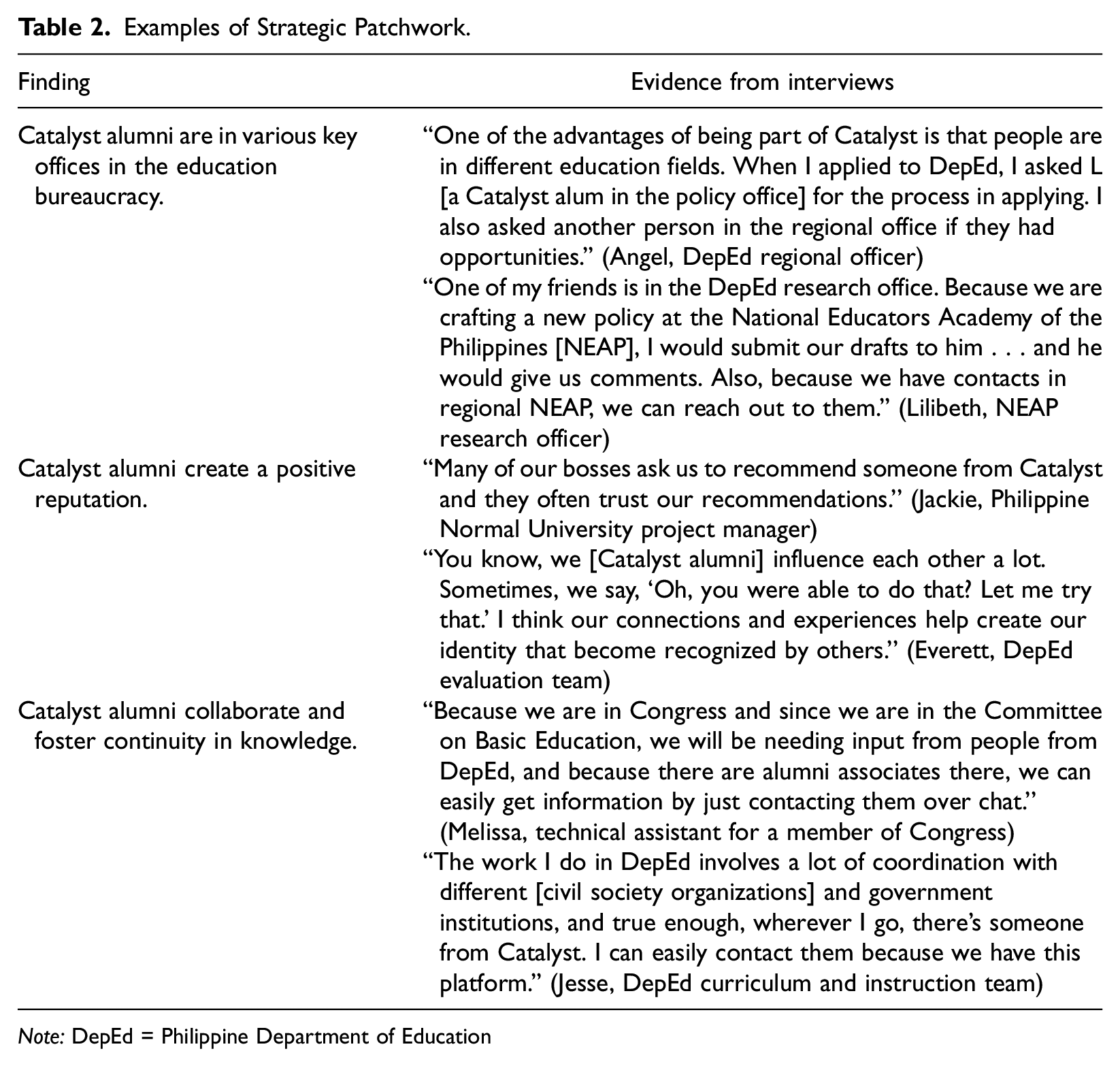
Most strategies of civil society organizations in education (e.g., in advocacy, research, and direct school support) focus on influencing policymakers, school leaders, or teachers (Reckhow and Tompkins-Stange 2018; Scott and Jabbar 2014; Trinidad 2023). Catalyst’s strategy, in contrast, focused on civil society influencing mid-level civil servants, that is, government employees who are neither politically elected nor politically appointed (Spiller and Urbiztondo 1994). Three organizational elements are crucial for the creation of this strategic patchwork: intentional placement, reputational distinction, and collaborative platforms. Figure 3 provides an overview of the elements of strategic patchwork. Table 2 includes quotes that provide evidence for these elements of strategic patchwork.
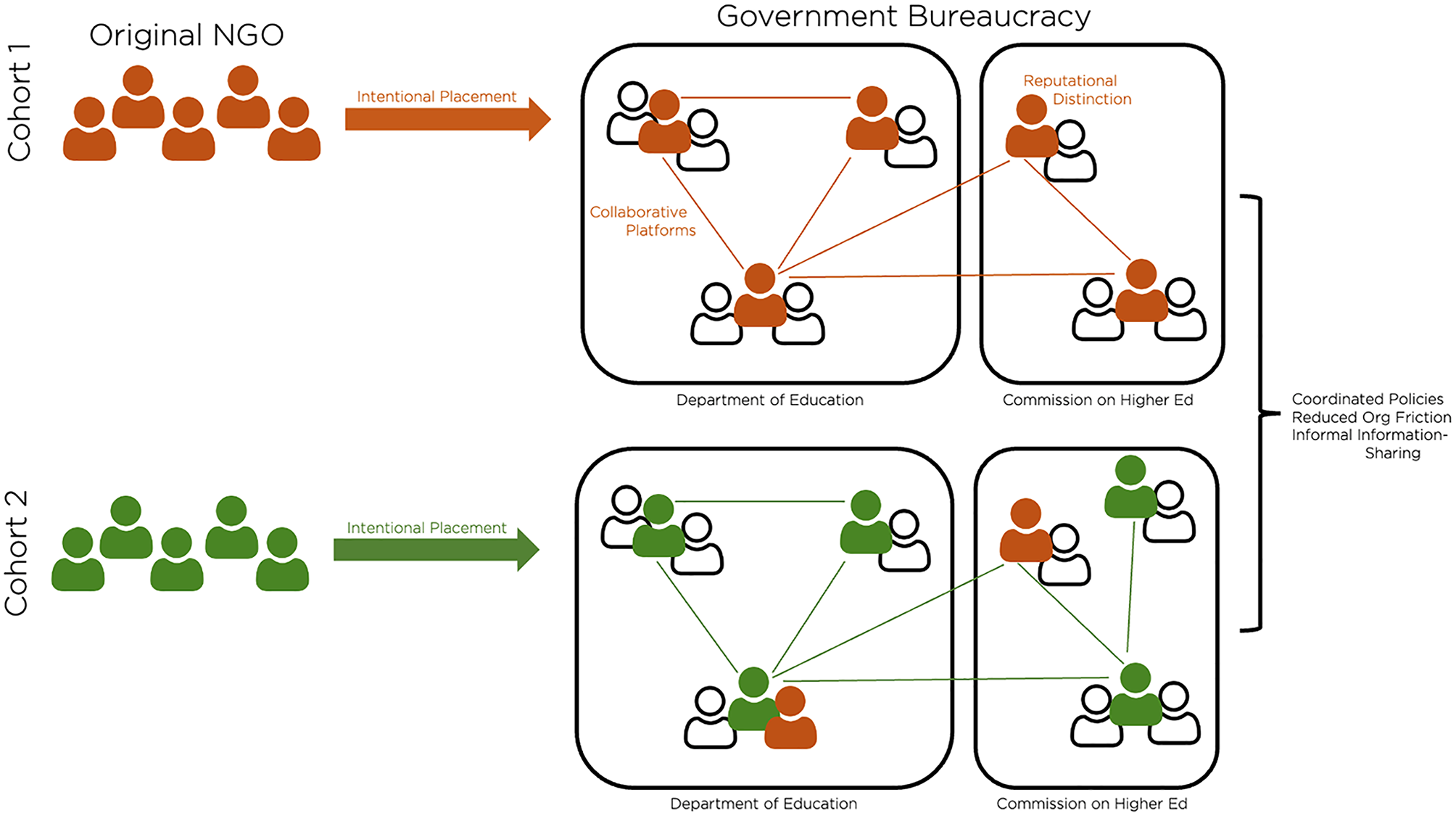
Overview of the mechanics of strategic patchwork.
Examples of Strategic Patchwork.
Note: DepEd = Philippine Department of Education
Intentional placement is the deliberate assignment of individuals to offices to maximize opportunities for collaboration and coordination. However, Catalyst’s intentionality is negotiated and limited given the few initial offices open to having technical assistants, the constraints of alumni who may not be trained for certain positions, and the organization’s ambiguity in articulating the vision for these network connections.
Catalyst did not originally intend the program to connect various parts of the education bureaucracy. Rather, the program was created as a learning experience for associates who were now exposed to “macro-level work” after spending two years in the classroom. Annie, the director of the alumni program, recalled, “In the past, we would just create partnerships with different organizations who would come up to us saying they would want associates.” After five years, the organization saw that several associates stayed in certain education bureaucracies, and they noted the potential of deeper engagement in these offices. Annie said, Since the pandemic, we’ve really intentionally set up a strategic placement map for associates to make sure they are in education governance organizations like DepEd, CHED, and possibly also [the Technical Education and Skills Development Authority] as well as in education committees in the House of Representatives and the Senate.
3
Earlier placement sites included places like the National Children’s Museum and other nonprofits, but more recent placements have focused on educational bureaus and representatives and senators who serve on education committees. The organization saw that intentional placement was key to achieving connections across potential mid-level changemakers.
Alumni associates saw that the organization’s placement in different offices was a key factor in navigating large bureaucracies. John, from DepEd’s Central Office Human Resources Bureau, said, “Catalyst is represented in almost all departments. . . . I know many people from different offices. So, if I have a question about youth programs, I contact A. If I have concerns about employee welfare, I contact M and B.” Kevin, from CHED said, “Because we have friends in DepEd, we can contact the policy research folks for updates, and also people from the Research Center for Teacher Quality.”Table 2 adds other voices regarding the diverse placement of Catalyst associates in the bureaucracy.
Reputational distinction describes how group members create a shared identity that distinguishes them from traditional workers in a bureaucracy. Intentional placement is important, but many government staff were already connected to each other through friendships and previous jobs. Catalyst associates were unique in being members of a single organization prior to being placed in government offices. Shared identity was an important marker not just to connect similar people across offices but also to distinguish Catalyst alumni from traditional bureaucrats. This shared identity among networked staff helped with organizational distinction and trust, but it had limitations as well.
On the one hand, associates were recognized for their work and service. James, a program specialist with National Educators Academy of the Philippines (NEAP), spoke about the shared reputation among Catalyst associates: What I’ve heard from others is that we have a good work ethic. In terms of performance, we do our job relatively well and fast compared to our organic DepEd counterparts. That’s the impression I hear a lot from different colleagues. They say we learn quick. If you bring us to a program, it will be fast for us to learn what needs to be done.
Comparison and distinction were important in the creation of this shared identity. A common lament from the informants has been the slow pace in the bureaus they worked in. Other alumni have also noted how their colleagues and supervisors recognize their contribution (see Table 2). Thus, this reputational distinction can be seen as a countercultural force in the organization, and others recognized it.
On the other hand, a “problem” of this reputational distinction arose when demand exceeded supply, particularly during the pandemic when fewer alumni from the program were available. Annie, the alumni program director, said, Given the continued reliance of government offices on associates coming in, it’s been difficult in terms of keeping up with the numbers that are demanded of us. . . . We received one other formal request for an associate but given our challenges with recruitment, we have given them our commitment to place next year instead.
When asked whether Catalyst was open to placing associates who had not gone through two years of teaching, Annie said, “We’ve also thought of the same . . . and one of the things that came out of this discussion was that it was difficult to embed the value system of Catalyst without having to go through the two-year program.” Thus, it was not just important for people to come from the same organization; it was crucial that these individuals went through similar experiences. The reputational distinction did not come from the organization but from its participants’ shared experiences.
Collaborative platforms are technological programs that support collaboration by facilitating communication and community building among mid-level staff. These platforms are a rather banal aspect of the patchwork given that these informal paths of communicating are already present in many organizations. Similar to other communication technologies, these platforms like Facebook group chats create ways for information to flow across various offices and cohorts in the educational bureaucracies. Luke, an associate at the Bureau of Human Resource in 2017 who then moved to the policy division of the DepEd Central Office, detailed how alumni used the collaborative platforms:
We have a group chat of Catalyst associates in DepEd, both past and present.
What happens there?
A lot! [Laughs] We receive a lot of firsthand information in the group chat, particularly about executives. We get to know what is happening in the horizon. But it’s a very professional network. For example, there was this one associate with a question, and there were many who answered.
What help do they usually need?
Information, data, clarification. . . . This is particularly important for the new associates who don’t know a lot about the bureaucracy, and who have little knowledge about offices in the department.
By creating an informal platform for individuals to connect and collaborate, Catalyst associates were able to share knowledge and sustain their networks. This platform was particularly important for new alumni coming to the bureaucracy. As many alumni noted, the platform provided them with an easy resource to learn about how to get data, how to navigate politics, and how to reach out to different offices (see Table 2).
Educational Change through Bureaucratic Effectiveness
Informants highlighted three indicators of bureaucratic effectiveness: coordinated policy, reduced organizational friction, and informal information sharing. Social networks help coordinate policies that span across large bureaucracies, and they help workers implement policies by reducing red tape and speeding up processes. Networks also provide important information for candid evaluations of policies.
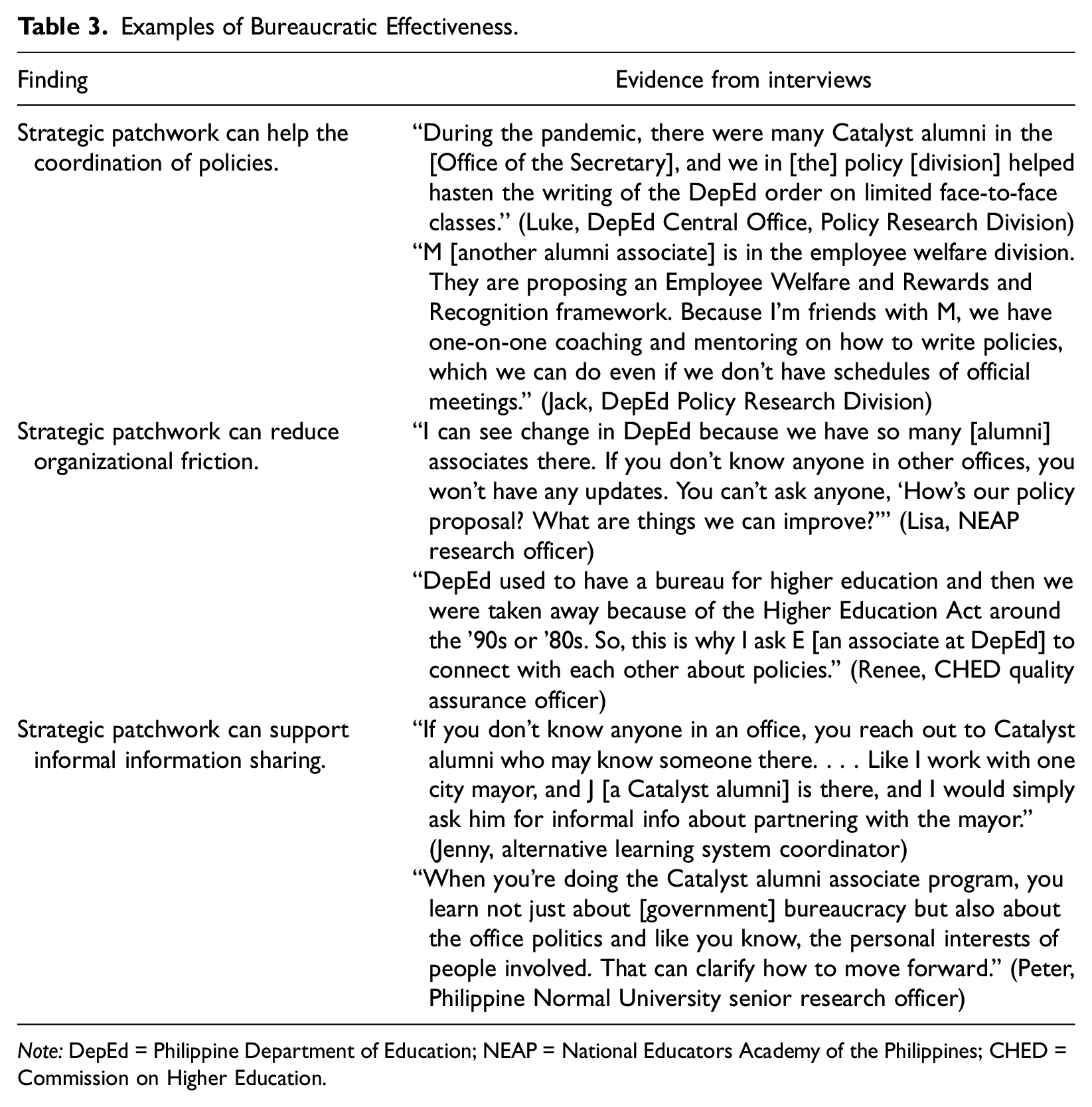
Mid-level staff can contribute to educational change by executing competent work, facilitating bureaucratic connections, and using their classroom experiences to support policies for teachers on the ground. These actions hint at bureaucratic effectiveness, or the achievement of goals through coordinated policies, strong implementation, and improved accountability. Table 3 provides additional evidence and quotes.
Examples of Bureaucratic Effectiveness.
Note: DepEd = Philippine Department of Education; NEAP = National Educators Academy of the Philippines; CHED = Commission on Higher Education.
Coordinated policy refers to the role of social networks in supporting policy creation, particularly on issues that require multiple offices and stakeholders to collaborate. Connections among mid-level staff often facilitated this policy coordination. During the COVID-19 pandemic, for example, Luke from the policy research division noted that it was easier to write policies when he knew other associates working with the education secretary’s chief of staff. Describing the creation of a policy for limited face-to-face classes in November 2020, Luke said, Sometimes, we have a direct line with the undersecretary [i.e., chief of staff] because we have A, M, and J [associates in the Office of the Secretary] who we talk to, staff-to-staff level, so that we can hasten the creation of the DepEd order. For example, we’ll ask J, “Hey, what did the undersecretary mean when he said this?” [We do this] because executives can come up with vague statements and instructions. So, because we don’t understand them, we just talk to the executive assistants.
Luke highlighted connections with three associates he could easily chat with to clarify and ask for directions in writing the policy. Luke also mentioned how associates in their office helped other associates in formulating policies. For example, they helped their counterparts in human resources as they created the Employee Welfare Framework and the Rewards and Recognition Policy and their colleagues in NEAP as they wrote their Teacher Development Program Policy (see Table 3). For urgent policies, mid-level staff’s ability to quickly coordinate with each other was an important advantage in bringing about needed change.
Reduced organizational friction refers to factors that support faster and more effective delivery of otherwise slow and difficult changes in organizations that can be weighed down by inertia. Large bureaucracies are often susceptible to slow processes because of excessive adherence to formal rules and requests. However, networks have the power to reduce friction and redundancies through interpersonal connections. Catalyst associates highlighted the advantages of knowing people in various offices. Lisa, who worked in NEAP, the teacher-training arm of the department, noted the advantages of being in a network that spanned different offices: “When we have policies that we’re working on, if you don’t know anyone in other offices, you won’t have updates on the status of your work. . . . If you don’t have a network, you need papers, and papers, and more papers.” Referring to Mary, who worked in the Office of the Secretary, Lisa said, “I could easily send her [a message] requesting for updates on our proposals.”
Similar dynamics were mentioned by Catalyst associates who worked in the Philippine Normal University and connected with colleagues at NEAP and those in CHED, who worked with colleagues at the Policy Research and Development Division of the DepEd (see Table 3). Associates saw their contacts from Catalyst as a ready resource to smooth organizational friction across offices. This helped with implementing policies that needed the support of other organizations, such as when the Philippine Normal University required the framework from the teacher-training arm of the department.
Informal information sharing refers to the role of social networks in transferring information that is not codified, which can help with understanding inconsistences between policy and practice. In a typical Weberian bureaucracy, many processes are written down and formalized (Weber 1978). In contemporary organizations, information can be easily accessed through shared drives and organizational webpages (Powell, Horvath, and Brandtner 2016). But “informal” information is key to understanding why things break down, how processes do not work as planned, and how policies can be better evaluated. Sheryl, a technical assistant assigned to a representative, was leading a House of Representatives investigation on educational materials that had significant content mistakes. She spoke about the importance of knowing people inside who had information that was not written down: Since there was an associate in the Bureau of Learning Resources and Development, we were able to ask them about processes that are not on the website. On the website, the process looks very smooth, but we can ask them internally where the bottleneck was, where the department was having difficulties, and why the learning materials had so many mistakes.
Because staff from the House of Representatives were able to connect with people who could give them “informal” information, they could identify how the actual process deviated from the published formal process. In so doing, Sheryl was able to suggest policy ideas to improve material quality and delivery. Absent these interpersonal connections, legislators may have depended on published data that were disconnected from or only loosely coupled with what happened on the ground. Table 3 presents other examples of how the strategic patchwork supported informal information sharing.
Risks with strategic patchwork
The interconnections among Catalyst associations do not always lead to positive outcomes because these networks can create bias and tensions with traditional bureaucrats. For example, James from NEAP noted, “I’m careful in how I use my networks. What I do is I tell someone, ‘I know who can be contacted.’ Then, I give them the information, and what I do is to give a heads-up that [my colleague] will be contacted.” James admitted that knowing individuals in different offices can be an advantage, but he feared such interpersonal connections could be misused and lead to bias. Other alumni mentioned how despite their reputation, some colleagues still see them as “interns” because of their short stint in these offices. Monica, from a congressperson’s office, shared, “Sometimes, they treat us like interns or [on-the-job training] since we’re not part officially of his office.” Some associates were thus not assigned tasks that could contribute to the positive potential of this strategic patchwork. In sum, not everyone saw the generative potential of this strategic patchwork; experiences often varied depending on the office an associate was placed in.
Notwithstanding the risks, the strategic patchwork of individuals coming from the same organization and dispersed across various government bureaus can help in coordinating policies, reducing organizational friction, and sharing informal information. The seemingly insignificant actions and networks can have important consequences for educational change, particularly in systems that are less coordinated and not always bureaucratically effective.
Discussion and Conclusions
Many sociologists are concerned with how networks influence behaviors, institutions, and change (Coleman 1988; Cox 2017; Frank et al. 2004). In education, policy and implementation networks are often studied because of leaders’ significant effects on programs and teachers’ proximal effect on students (Ball 2008; Lipsky 1983; Zald and Lounsbury 2010). However, mid-level staff form the meso-level structure supporting education systems and organizational effectiveness, making them important actors who can effect change (Cavalcante et al. 2018; McDonnell 2020). In this article, I showed how an initiative supporting mid-level staff to influence educational change improved bureaucratic processes. In particular, I suggested the importance of the strategic patchwork of mid-level staff who are intentionally placed in key offices, reputationally distinct, and supported by collaborative platforms. I contrasted this to (1) traditional bureaucratic systems with hierarchical roles and specific jurisdictions and (2) pockets of bureaucratic effectiveness, where talent is concentrated in specific subunits (McDonnell 2020). This article illustrates how an initiative connecting mid-level staff supported effective practices that worked with state bureaucracies rather than circumventing them. Although imperfect, this initiative contributed to changes in educational institutions in terms of policy creation, implementation, and evaluation. Figure 4 illustrates the suggested mechanism for how a strategic patchwork of mid-level staff can support bureaucratic effectiveness.
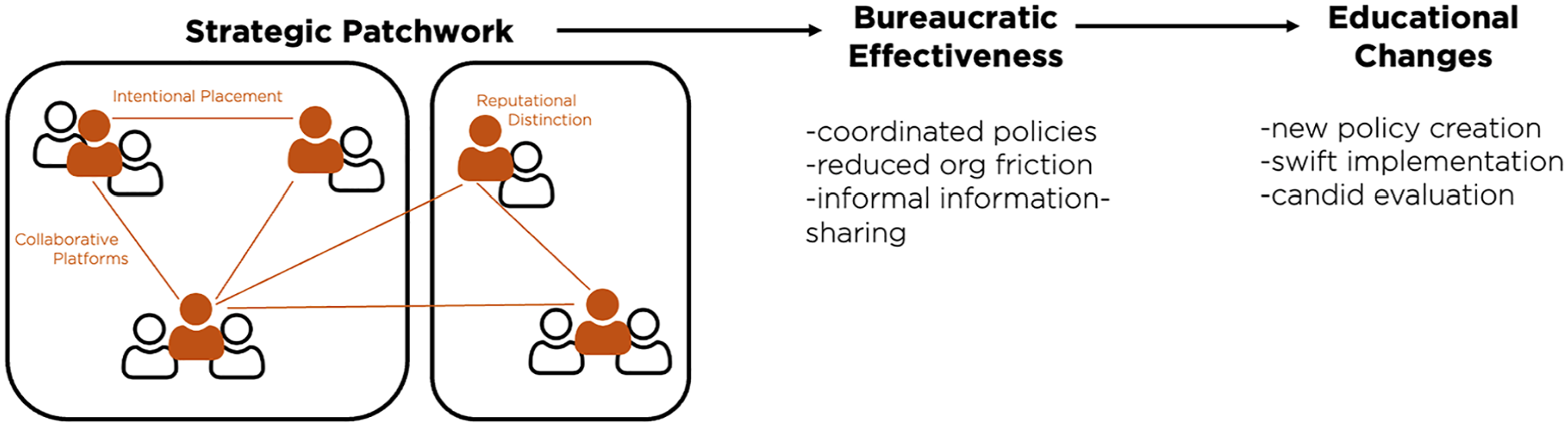
Strategic patchwork influencing educational change through bureaucratic effectiveness.
Studies of educational change often focus on people’s ability to direct policies and resources and teachers’ and school leaders’ ability to improve practices on the ground. Network studies show the importance of connections across these teacher and policy networks. The present research furthers the social network and educational change literature by showing the potential for transformations to happen through the work of purposefully placed mid-level staff. Whereas some prior work conceptualizes “middle level” networks as connections among principals or among school and district leaders, I focus on mid-level staff who often do research, write policies, create training modules, monitor implementation, and build capacity on the ground. I argue that the creation of effective bureaucratic processes can support positive educational change and that intentional bureaucratic networks can contribute to this effectiveness.
The case of Catalyst illustrates the potential for change efforts by mid-level actors who support education policies and practices. I explored how this happened through a nonprofit placing its alumni in education offices; other researchers may study how similar organizations or efforts in connecting government offices affect organizational friction and bureaucratic coordination. I also suggest future studies to uncover (1) how networks can be differently structured depending on the context and goals, (2) how these networks may have unintended negative consequences, (3) how mid-level networks differ from policy and teacher networks, and (4) how changes in a network can disrupt, support, or sustain educational changes. In summary, I highlighted the generative theoretical and empirical opportunities in studying education bureaucracies and the initiatives that engage and shape them.
The implications of my findings extend beyond the study of bureaucratic networks for policy creation and organizational effectiveness. First, this article contributes to discussions in political sociology about the intraorganizational variation in state capacity and bureaucratic effectiveness. Prior work has highlighted the many hands of the state (Morgan and Orloff 2017) and distinctive niches of bureaucratic effectiveness (McDonnell 2017, 2020). I add to this conceptualization by showing how these distinctive niches can connect with each other through individuals who share reputations, experiences, and prior training. This article also contributes to the politics of education, which often focuses on the influence of organizations on education policies, school board political races, and whole-school reform efforts (DeBray et al. 2020; Peurach 2011; Scott and Jabbar 2014). This study shows an emergent strategy for how the placement of mid-level staff in key government offices can be a potential tool for civic action in public institutions. Further research could study the implications and consequences of this closer connection between civic actors and civil servants.
This study has a number of limitations. First, the discussion concentrated on the positive potential of bureaucratic processes, networked mid-level staff, and intentional action of civic organizations. However, these factors can also pose risks given that bureaucratic processes can stifle autonomy for changes on the ground and create distinctions between program members and nonmembers. I also caution against a potential interpretation that the individuals and organizations were fully agentic given that many bureaucratic processes constrain the people working in them. Furthermore, “outside” organizations working to place staff in government offices can carry risks because certain ideologies may be privileged and certain voices inhibited. Thus, future research should look at the flipside of how bureaucratic networks and processes can themselves prevent changes or lead to regressive changes. Other limitations of this research include the focus on a single case study, emphasis on exceptional cases in a large bureaucracy, and reliance on interview data based on people’s experiences and perceptions.
Despite these limitations, the analysis provides preliminary evidence of the potential for initiatives at the mid-level to support bureaucratic effectiveness that can be consequential for educational change. This research aims not only to suggest mechanisms and elements for this strategic patchwork but also to further this agenda of studying the many ways mid-level staff can support, sustain, inhibit, and challenge changes in education, organizations, and large bureaucracies.
Footnotes
Acknowledgements
The author thanks the officers of Catalyst for providing access to the organization and the informants who generously provided their time for the interviews. This project was made possible through the expert project management of Mira Michelle Angeli de Guzman and our research assistants, Anne Madeleine Ferraz, Isid Victor Alngog, and April Jewel Domingo. The author also thanks the editors and four anonymous reviewers who provided helpful comments and feedback.
Funding
The author disclosed receipt of the following financial support for the research, authorship, and/or publication of this article: The project was funded by the Asian Development Bank’s Republic of Korea e-Asia and Knowledge Partnership Fund.
Research Ethics
This study was approved by the Research Ethics Committee of the Ateneo de Manila University. All human subjects gave their informed consent prior to their participation, and adequate steps were taken to protect their confidentiality.
