




Abstract
Does schooling equalize achievement disparities among students with and without a migrant background? This question remains largely unanswered in sociology. We hypothesized that children of migrants would benefit more from schooling, thereby making schools engines of educational integration. Our study tests this hypothesis in the context of German primary schooling using data from the National Educational Panel Study. We compared the achievements of students from native families and those with Western, non-Western (including Turkey), and former Soviet Union migrant backgrounds. Using the differential exposure approach, we decomposed learning into two causally distinct components: learning due to school exposure and learning due to being older at the time of testing. Our findings do not support the notion that schooling equalizes migrant–native achievement gaps. Instead, our results suggest that school exposure may widen the gap between the two largest groups of migrants in Germany, with students from the former Soviet Union disproportionally benefiting from school compared to other non-Western students. We conclude that German primary schools are not functioning as engines of educational integration because schooling does not reduce the migrant–native achievement gap and migrant groups with the greatest educational disadvantage benefit the least from schooling.
Keywords
Migrant families often hope for enhanced opportunities for their children, yet empirical evidence suggests these hopes are not always realized in Europe (Algan et al. 2010; Sweetman and van Ours 2015). Second-generation migrants in many Western European countries face challenges early on, often lagging behind their native-born counterparts in various cognitive domains before formal schooling begins. This early educational disadvantage has been documented in Germany, the United Kingdom, the Netherlands, and Norway (Borgna and Contini 2014; Passaretta and Skopek 2018a; Ribeiro et al. 2022), mirroring disparities observed in the United States between minority groups and White Americans from as early as kindergarten (Kuhfeld, Gershoff, and Paschall 2018).
Despite schooling being a potential vehicle for educational integration, a paucity of empirical research examines the role of schooling in reducing learning gaps between children of migrants and natives. Research has documented disparities in test-score outcomes by migrant background, notably the existence of migrant “penalties” in learning that remain after accounting for socioeconomic differences, but almost no studies have attempted to identify the causal effect that schooling has on those penalties. This lack of empirical research not only renders our understanding of schooling incomplete, but it also leaves educational and integration policy uninformed.
Our study aims to bridge this gap by identifying the effects of first-grade schooling on the learning of children from native and migrant backgrounds in Germany. The overarching question we address is: Does schooling equalize disparity in achievement between native-born and second-generation migrant children in Germany? This question is particularly relevant in wealthy societies like Germany, where education systems are seen as pivotal for promoting the educational and social integration of a growing population of migrants and their offspring (Alba, Sloan, and Sperling 2011). Using nationally representative data from the German National Educational Panel Study (NEPS) on first graders in the 2012 and 2013 school years, we compare native-born children with second-generation children from major migrant groups, including Western countries, the former Soviet Union (FSU), and other non-Western countries (including Turkey).
It may seem intuitive to ascertain the role of schooling by comparing achievement progression between children with and without a migrant background over a school year. However, such an approach can be misleading because learning during the school year is influenced by both school and nonschool factors (Condron, Downey, and Kuhfeld 2021; Downey and Condron 2016; Passaretta and Skopek 2021). Schooling stimulates learning and can influence inequality in learning trajectories, but children’s (differential) learning is also shaped by age-related maturation and home learning environments, which operate independently of school exposure. Therefore, it is essential to disentangle the contribution of schooling—learning that occurs specifically because of school exposure—from other developmental factors to better understand its role in learning inequality by migrant background.
Our study utilizes the differential exposure approach (DEA) to discern the unique contribution of schooling to learning and learning inequality across groups (Passaretta and Skopek 2021). Leveraging variations in testing dates and birth dates of children who enter school in the same academic year, the DEA enables us to compare test scores among children of the same age but with different durations of schooling up to the day of testing. This approach isolates the dosage effect of school exposure on learning outcomes by decomposing learning rates into schooling (learning because of schooling) and aging (learning because of factors other than schooling) components.
Our study adds three major contributions to the debate on the effects of schooling on learning inequality in educational sociology. First, to our knowledge, this is the first study to test whether schooling promotes the educational integration of second-generation migrants in a European country. Unlike existing research in the United States, which often centers on racial disparities (e.g., Quinn 2015), our research shifts the focus to inequality by migrant background, a distinct dimension of stratification in European societies (see e.g., Drouhot and Nee 2019). Only by decreasing the migrant–native achievement gap and supporting migrant groups with the greatest educational disadvantage can the institution of schooling fulfill its integrative role.
Second, our study holds practical implications. Educational underachievement of migrants’ children is a particular concern in Germany, which has evolved from a restrictive guest worker to a more liberalized migration regime (Consterdine and Hampshire 2020). Recently, Germany’s school system has been under unprecedented stress in the wake of Russia’s invasion of Ukraine, which caused more than 1 million refugees to enter Germany with unclear prospects of returning to their origin country (United Nations High Commissioner for Refugees 2023). If schools are currently unable to reduce achievement gaps between natives’ and migrants’ children, policymakers would need to rethink how school practices might more effectively support the learning of future second generations of migrants.
Third, our study contributes methodologically by further developing the implications of the DEA. The DEA decomposes learning progress over the school year into components caused by school exposure versus other age-related factors. This study builds on that framework by formally demonstrating how the DEA can estimate the population-average learning rate using cross-sectional data and decompose group-level differences in learning rates into differences causally attributable to schooling versus other age-related factors. This methodological refinement enhances understanding of how school and nonschool factors contribute to learning inequality during the school year and offers a valuable tool for further research on school effects.
Background
Theory on School Equalization
Does schooling help alleviate or reproduce learning inequality among children from advantaged and disadvantaged backgrounds? The reproductionist perspective posits that advantaged families exploit school differentiation to secure better learning environments and preferential treatment from teachers, reproducing learning inequality among students from advantaged and disadvantage backgrounds (Bowles and Gintis 1976; DiMaggio 1982; Gamoran and Mare 1989). Conversely, the compensatory perspective suggests that schooling can mitigate learning inequality by providing more standardized learning environments compared to the diverse conditions at home (Downey, von Hippel, and Broh, 2004; Raudenbush and Eschmann 2015).
Educational sociology increasingly acknowledges the complementarity of these perspectives (Domina, Penner, and Penner 2017; Downey and Condron 2016). The reproductionist view highlights specific mechanisms in the school system that may exacerbate achievement inequality, such as track placement and teacher bias. In contrast, the compensatory perspective emphasizes the overall equalizing effect of schooling compared to a counterfactual situation or no or less exposure. School learning environments, although they may be unequal, tend to be more equal than home environments. This means children who face significant disadvantages at home may experience a larger increase in the quality of learning inputs by attending even a poor school compared to advantaged children in excellent schools (Downey et al. 2004). Thus, despite mechanisms of inequality in school systems, schooling can still serve as a treatment that provides compensatory inputs to otherwise more unequal instructional regimes outside of school (Raudenbush and Eschmann 2015). These arguments suggest that overall, schooling may play an equalizing role for interindividual but also group-level inequality in achievement, such as inequality stemming from family socioeconomic status (SES) or migrant background. The compensatory perspective, emphasizing the effects of schooling versus no or less school exposure, aligns closely with our investigation into how schooling may aid the educational integration of children with migrant backgrounds in host societies.
Findings from the Seasonal Comparison Design
The notion that schools provide compensatory inputs for disadvantaged children has primarily been tested by examining whether schooling equalizes learning outputs. Such tests represent a “formidable methodological challenge” because they require separating the role of school and nonschool factors for achievement (Kuhfeld, Condron, and Downey 2021). The mainstream sociological approach to this challenge rests on the exploitation of school interruptions during summers. If only nonschool factors affect learning over the summer, when school is out, then contrasting learning over the school years and the summer may provide a lever to understand “how schools matter.” Seeing inequality grow faster over the summer than during the school years, for example, gave reason to speculate that schools contributed to a compensation of achievement inequality.
The seasonal comparison design (SCD) requires extensive longitudinal data, including repeated test-score measures of the same children within and across consecutive school years. Such rich longitudinal data are rarely available outside the United States. As a consequence, only a handful of studies have used the seasonal approach in Europe. Holtmann (2017) found evidence for school equalization in Finland, because learning gaps grew faster in the summer than during the school years, but this study examined achievement inequality by SES only. In Flanders (a region of Belgium), Verachtert et al. (2009) found that SES and ethnic gaps in mathematics remained stable during kindergarten and the summer after kindergarten. During first grade, SES gaps remained unchanged, but ethnic gaps shrunk. These latter findings do not allow us to speculate much on the contribution of schooling to those gaps.
Seasonal comparison studies in the United State have a long tradition due to the availability of seasonal data on children’s achievements. Yet they do not deliver consistent evidence. Earlier U.S. studies found that schools compensated for SES gaps in achievement because gaps tended to increase faster over the summer (e.g., Alexander, Entwisle, and Olson 2001; Downey et al. 2004). However, some studies found the Black-White gap increased faster either during summer (Entwisle and Alexander 1992; Heyns 1978) or during the school year (Downey and Pribesh 2004; Fryer and Levitt 2004).
von Hippel and Hamrock (2019) suggest that older SCD findings were plagued by statistical artifact due to scaling and differences in test forms across seasons. When using more reliable measures, they show that school does not equalize much SES inequality (see also von Hippel, Workman, and Downey 2018). Schools have been found to increase the Black-White gap (Kuhfeld et al. 2021; Quinn et al. 2016; von Hippel et al. 2018; von Hippel and Hamrock 2019), but findings for gaps between Hispanic and White students are inconsistent (von Hippel et al. 2018). Most recently, a comprehensive study by Workman, von Hippel, and Merry (2023) showcased how U.S. findings on seasonality in learning inequality by SES or race fail to replicate across different data sets.
Findings from the Differential Exposure Approach
Passaretta and Skopek (2021) proposed a complementary DEA design that requires only a one-point measure (one test per child over the school year), in contrast to the (minimum) four tests required by the SCD. The identification of school effects in the SCD requires comparing learning rates during the school year and the summer because learning rates over the school year are the product of both school and nonschool factors. The DEA overcomes the need for in- and out-of-school comparisons by decomposing the learning rate over the school year into two hypothetical components: one because children are exposed to school and one because children are at different ages in school.
The school component reflects the contribution of factors related to school-year exposure, including classroom instruction and indirect school effects that shape children’s learning out of the classroom (e.g., doing homework or interacting with schoolmates at home or in the neighborhood). Although some of these activities occur outside school time (e.g., homework), they are a direct consequence of school exposure and represent school-related factors as much as classroom instruction. Conversely, the age component captures the contribution of factors that are unrelated to school-year exposure, that is, all factors but school exposure that may affect children’s achievement because they are older at test time (e.g., prior knowledge, age-related intellectual maturation, parental influences at home, or exposure to institutional care settings).
Using the DEA, Passaretta and Skopek (2021) showed that exposure to first-grade schooling, although promoting learning, did not alter SES gaps in Germany. This finding contrasts with school equalization results found by earlier SCD studies in the United States but accords with recent replications showing how earlier studies overestimated schools’ equalizing role due to methodological shortcomings (von Hippel et al. 2018; von Hippel and Hamrock 2019). However, Passaretta and Skopek’s analysis was limited to the effects of schooling on SES gaps.
All in all, the previous literature leaves very few clues about the role of schooling for achievement inequality between children of native-born and migrant parents. Research in Europe is almost nonexistent, and the limited studies available mainly focus on SES inequality. The only study that examines the role of schools on migrant gaps (more precisely ethnic gaps) in learning was conducted in a region of Belgium and leaves us with inconclusive findings (see Verachtert et al. 2009). Our study takes advantage of the DEA and directly addresses this gap by examining the effect of exposure to first-grade schooling on achievement inequality by migrant background in Germany, one of the largest countries of immigration in Europe.
The Case of Germany
Inequality in Learning Inputs in School and outside of School
Migrant background is associated with children’s educational development in European societies (Drouhot and Nee 2019; Heath and Brinbaum 2014; Van De Werfhorst and Heath 2019). In Germany, educational disadvantage has been repeatedly found among offspring of the two largest migrant groups: migrants from the FSU and from Turkey (Becker, Klein, and Biedinger 2013; Passaretta and Skopek 2018b). Children of Turkish origin—a traditional immigrant group from Germany’s former guestworker model—are particularly disadvantaged, both in school achievement and transition rates to the academic track in secondary education (Relikowski 2012).
With respect to test-score achievement, research has frequently detected “residual” migrant penalties (and “premia” for some groups) that persist even after accounting for SES differences between native and migrant families in many countries (Heath and Brinbaum 2014; Heath, Rothon, and Kilpi 2008; Schnell and Azzolini 2015). Germany is no exception. Borgna and Contini (2014) found that SES differences account for less than half of the migrant-native achievement gap among adolescents. Similar findings are observed at school starting age, where children of migrants from the FSU perform worse in vocabulary tests and children from other non-Western countries perfom worse in math and science tests compared to native-born peers (Passaretta and Skopek 2018b). These residual differences suggest that inequality mechanisms directly linked to migrant background are at play rather than being solely mediated through SES-related factors.
The early underperformance of children of migrants in Germany may be partly rooted in more disadvantageous out-of-school learning environments, including use of a foreign language at home, limited access to social networks, and inadequate institutional support (Strobel 2016). Non-Western immigrant families, particularly Turkish families, often reside in enclosed ethnic communities, use their native language at home, and maintain strong ethnic identities that contrast with mainstream German culture (Hans 2010; Strobel and Kristen 2015). In contrast, Western migrants and some non-Western groups, like those from the FSU, have more contact with natives, often speak German, and are closer to mainstream German culture (Dietz 2006; Schacht, Kristen, and Tucci 2014). Thus, children of Western and FSU migrants, although disadvantaged compared to native-born peers, may enjoy more favorable out-of-school learning inputs than children from other non-Western backgrounds.
Children of immigrants may also face lower-quality instructional inputs in school. For example, ethnic-residential segregation indirectly creates ethnic segregation across schools (Frankenberg 2013), and ethno-lingual classroom composition is negatively associated with German language and reading achievement of ethnic-minority students (Seuring, Rjosk, and Stanat 2020). Migrants may also lack strategic knowledge of the host country’s educational system (Kristen 2008). Consequently, they may systematically attend schools with poorer learning inputs compared to their native-born peers with similar SES backgrounds. Ethnic discrimination in the education system may also play a role through stereotyping, teacher expectations, lack of cultural diversity among teachers and teaching material, or insufficient targeted measures for immigrant groups (Diehl and Fick 2016). Such discrimination may reduce the quality of school learning inputs for children of migrants compared to their native peers even within the same school or classroom.
Expectations
Despite mechanisms of inequality, both indirect via school segregation and direct within schools, compensatory input theory would suggest that exposure to schooling decreases inequality between children of migrants and natives. This prediction arises from the understanding that children with migrant backgrounds often face even larger disadvantages in their home learning environments compared to the comparatively less unequal school environments (see Figure 1, Scenario I). Schooling should particularly benefit non-Western migrants, such as children from Turkey, who face the most significant disadvantages at home. However, it is also possible that inequality in school learning inputs mirrors inequality outside of school, hindering equalization (Figure 1, Scenario II). Or an unlikely but possible scenario is that in-school inequality exceeds inequality in learning inputs outside of school, potentially resulting in schooling further increasing inequality (Figure 1, Scenario III).
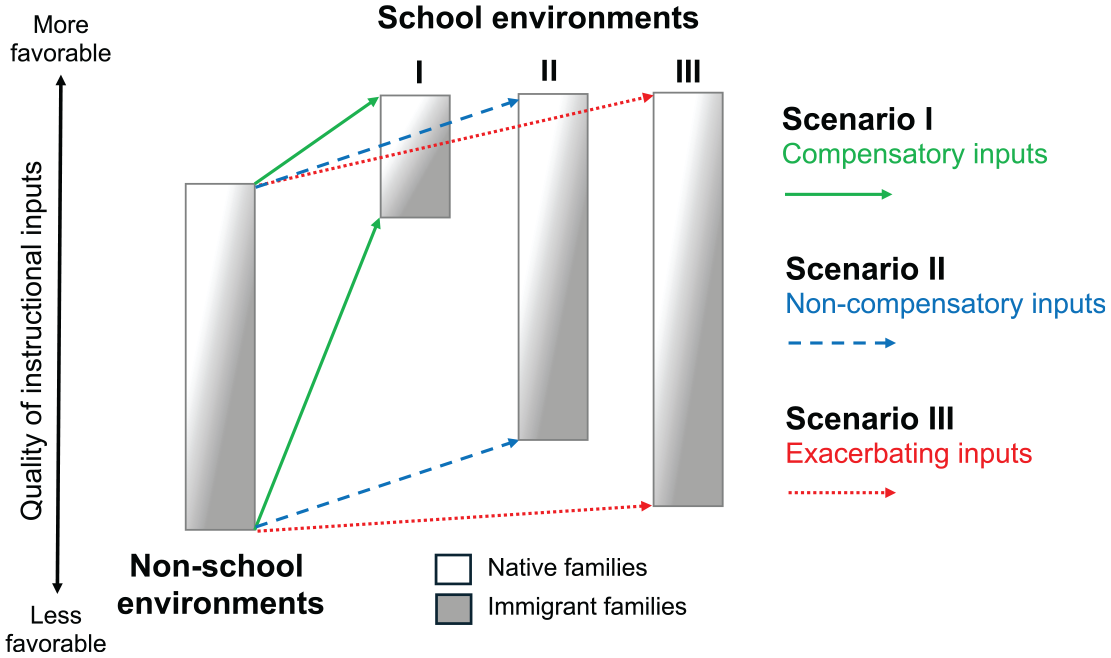
Illustration of compensatory input theory.
These scenarios derive logically from compensatory input theory, assuming children of native-born and immigrant parents gain equally from the same instructional inputs. However, a final possibility is that children with migrant backgrounds gain less from the same instructional inputs because they start school with lower achievement levels, and future learning gains are influenced by previous achievement (Raudenbush and Eschmann 2015). In such a scenario of differential gains from input, equalization of learning inputs through schooling (Figure 1, Scenario I) may not translate to equalization of learning outputs.
The DEA and Second-Generation Gaps in Learning
We define the learning rate as the gain in achievement students experience as they progress through the school year. Figure 2 illustrates the concept by showing a student who is tested at two different dates in the same grade,
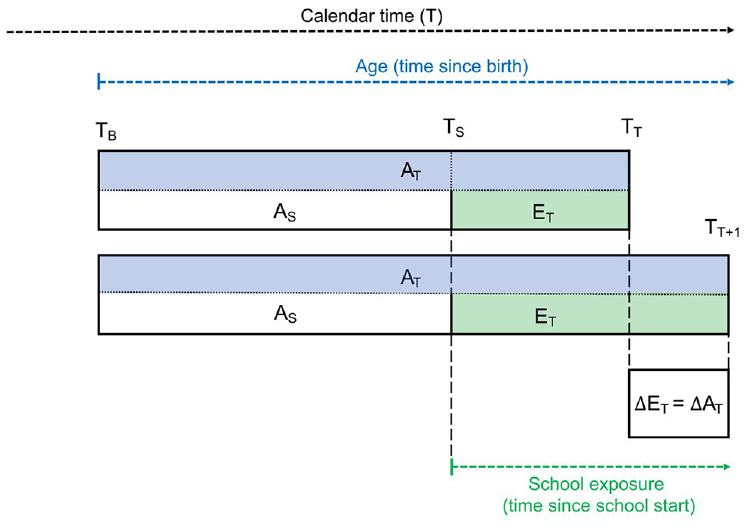
Time in school, age at testing, and learning.
The DEA aims to disentangle the separate effects of two “clocks” on cognitive achievement: exposure to the school year (schooling,

Parameter
Learning Rate over the School Year
Age and schooling effects in the DEA add up to the average rate of learning over the school year. To formalize the intuition, we start with a simple growth model that describes individual achievement during first grade as a function of initial achievement and time in school for a population of children that enter first grade on the same calendar day:

where

Panel data would allow us to estimate both the individual and the average rates of growth in the population. Problems arise because most practical applications lack repeated measurements and can only rely on cross-sectional data with one test per student over the school year. In this context, we cannot estimate individual-specific rates of learning. However, we can estimate the average learning rate in the population if test dates vary randomly, that is, if they are independent of any student heterogeneity (as in our case). Thus, we can estimate a cross-sectional model:

with
Decomposing the Learning Rate
To understand why the learning rate


Next, we expand the right side of Equation 6:

and after rearranging terms, we have

which equates the DEA model in Equation 1 when we set

In Equation 9, the marginal effect of time during the school year is

The DEA model (Equation 1), and thus the decomposition terms in Equation 10, are empirically identified if we have sufficient variation in test dates
Decomposing Migrant Differences in Learning Rates
Our aim here is to examine if schooling is more beneficial for the achievement of second-generation migrant (
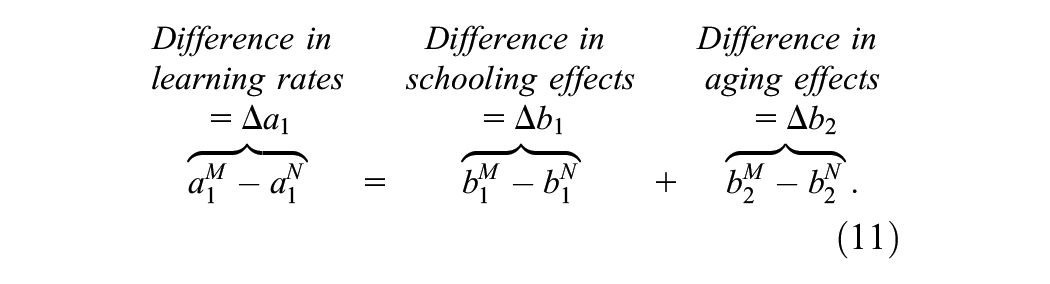
The average learning rate is likely positive. At the same time, existing research points toward a migrant disadvantage in educational achievement at school starting age in Germany, although this varies by origin group. Equation 11 shows that migrant gaps would shrink over the school year if migrants’ average learning rate is steeper than nonmigrants’, that is,
Data and Methods
Data and Sample
Data for our study came from the German NEPS (Blossfeld, Roßbach, and von Maurice 2011), a nationally representative study that tracks educational and competence development throughout the life course. The NEPS collects longitudinal data on children and adults from six cohort samples. The kindergarten cohort implemented a comprehensive test program following children who entered kindergarten in 2010–2011 until the end of primary schooling (fourth grade). However, children were tested only once per year, usually in the spring, thus making a seasonal approach infeasible. The kindergarten sample was augmented with a refreshment sample (N = 6,341) in Wave 3, corresponding to the first year of primary schooling in 2012–2013 (first grade). We only use data on the refreshment sample because the original sample experienced strong attrition due to the school-based design of the NEPS. Also, we only select data from first grade because our study emphasizes the first instance of formal school exposure, which is first grade in Germany; kindergarten in Germany is part of the welfare system and does not involve formal teaching. The refreshment sample in first grade did not suffer from any attrition because it was sampled exactly in first grade. We used design weights provided by the NEPS through the analyses to ensure the sample’s representativeness at the national level.
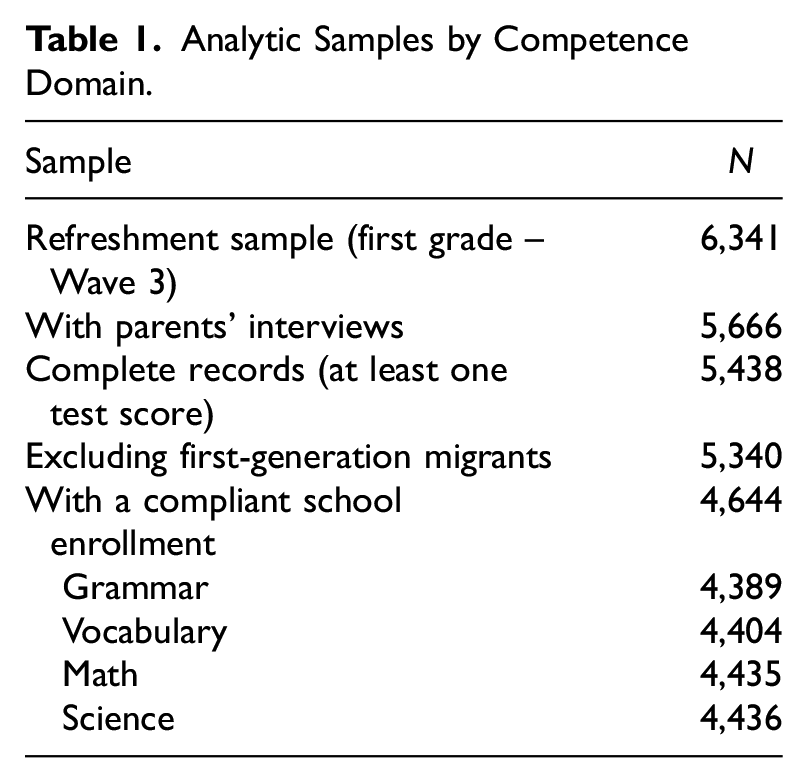
Only 5,666 of the 6,341 children sampled in first grade had parental interviews, which provide crucial information on parents’ country of birth, education, and occupational status. Around 96 percent of the 5,666 children with parental interviews were nonmissing on the main covariates and had at least one test score available, which leaves us with 5,438 children with complete records. We additionally removed 98 children not born in Germany, because our focus is on children born in Germany, which left us with 5,340 cases. Finally, we selected the 4,644 children with compliant school enrollment in academic year 2012–2013. Table 1 shows the steps for sample selection and the detailed sample size for each outcome.
Analytic Samples by Competence Domain.
Compliant enrollment means that children entered first grade in the school year dictated by German law. In Germany, children must enroll in school if they turn 6 before a specified cutoff date that year. School start dates and cutoff dates vary by federal state but are fixed in each state. These rules create random variation in the birth dates of children entering school on the same calendar day in each state. Children who are exactly age 6 at the cutoff will be the youngest in the classroom; those who are 6 and 11 months at the cutoff will be the oldest. Depending on the cutoff date and school start date in each federal state, age at school entry may span below 6 years and above 6 years and 11 months. Table 2 shows the legal cutoff date, school start dates, and age range (at cutoff and school start) corresponding to compliant enrollment in 2012–2013 in each of the 16 federal states.
Cutoff Dates, School Start Dates, and Age Ranges (at Cutoff and School Start) Corresponding to Compliant Enrollment in 2012–2013.

Note: y = year; m = month.
Date by which children had to turn 6 for school enrollment in 2012–2013. Source: state-specific texts of school legislation.
First day of the school year 2012–2013. Source: http://schulferien.org.
We treat August 1 as July 31 to define the age ranges because our data are precise on the month level only.
Children with compliant school enrollment are the only children for whom we can expect birth dates to be mostly random. This is a crucial aspect of our design because any selection bias in birth dates would spill over to age at testing (because
Selecting compliers means that our analytic sample of 4,644 children is only representative of children with regular school enrollment. This amounts to approximately 87 percent of the 5,340 children born in Germany and who have complete records (see Table 1). External administrative sources confirm that compliers make up the vast majority (around 90 percent) of children who entered first grade in 2012–2013 in Germany. Hence, our analyses on the compliers’ sample are externally valid for almost the entire cohort of children that entered school in 2012–2013. This seems an exceptionally high level of external validity for a study focused on causal identification.
Cognitive Tests
Tests were administered to each child individually in a group setting (n < 15) at school, supervised by qualified test instructors (see NEPS 2013). Tests results were inconsequential for children because neither teachers nor parents had access to them. Testing in first grade took place after the winter break (spring 2013). Crucially, for organizational reasons, not all schools tested on the same day. Schools were randomized into two testing periods: from February to April (60 percent of children) and from May to June (40 percent of children). Schools had some discretion in selecting test dates within these periods, but they could not choose the testing period itself. In each school, children were tested on two different days, with one day dedicated to math and science tests and the other to grammar and vocabulary tests. The variation in testing dates within schools was minor; nearly all variation was across schools. Detailed analyses provided elsewhere show testing dates in the NEPS were not predicted by any school characteristics, including school SES or migrant-group composition, students’ achievement and noncognitive skills, or the quality of the physical environment (Passaretta and Skopek 2021). Therefore, we exploit the full variation in testing dates, both between and within periods, which spans approximately 5.5 months, from February to mid-June.
Children were tested in a variety of competence domains, including grammar, vocabulary, mathematics, and scientific literacy. Receptive grammar measures morphological-syntactical abilities, and receptive vocabulary captures lexical knowledge of words (Berendes et al. 2013). Mathematical literacy entails knowledge of mathematical ideas and cognitive processes involved in solving math problems (Neumann et al. 2013). Scientific literacy entails knowledge of scientific ideas and understanding of scientific processes (Hahn et al. 2013). Tests for math, grammar, and scientific literacy were administered in German, but the answer format was picture-based to address the young age of children. All tests were scaled based on item response theory and provided by the NEPS in the form of weighted likelihood estimates representing the best guess of children’s underlying ability (Pohl and Carstensen 2012). The reliability of the test-score measures was acceptable to good, ranging between 0.7 and 0.9 (see Fischer and Durda 2020; Kahler 2020; Schnittjer and Fischer 2018). However, reliability was not available for the grammar test.
We standardized test scores separately by domain to have a mean of zero and a unit standard deviation in each of the domain-specific samples (see Table 3). Whenever possible (vocabulary, math, and science), we provide the analyses for both the z-standardized original scores and the z scores adjusted for reliability to allow for comparisons across domains. The reliability adjustment consisted in dividing the z-standardized scores by the square root of their reliability, as suggested in Reardon (2011).
Distribution of Analytic Variables in the Complier Sample (N = 4,644).
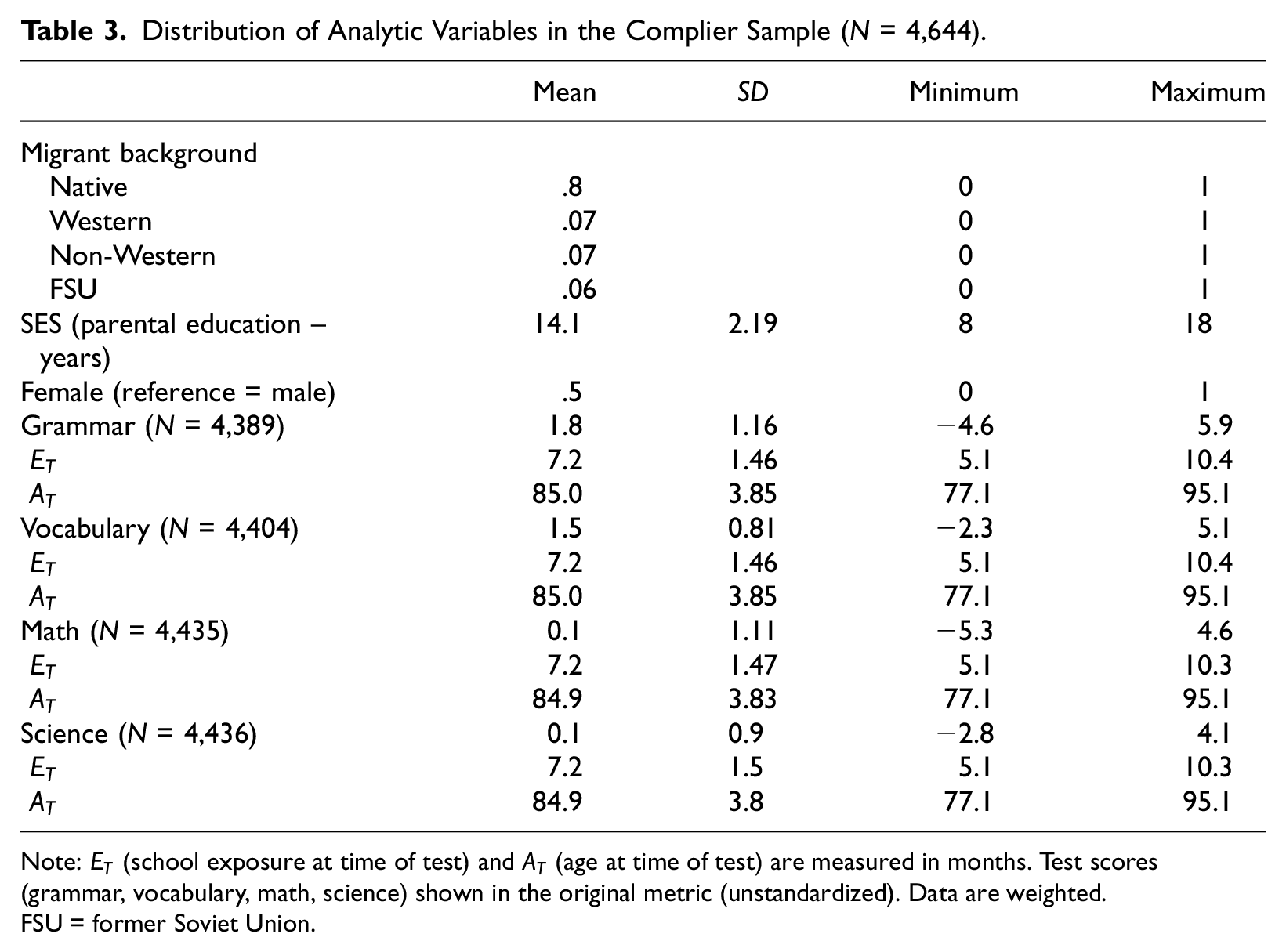
Note:
School Exposure and Age at Testing
School exposure is the difference between test dates and school start dates (
Age at testing is the difference between test dates and birth dates (
Migrant and Family Background
Information on children’s migrant background and family SES come from parental questionnaires administered in first grade. We define children as “natives” if both their parents were born in Germany. We define children as “second-generation migrants” if at least one parent was not born in Germany. We categorized three migrant groups based on parental country of birth: migrants from Western countries, migrants from Russia and the FSU, and migrants from other non-Western countries. Unfortunately, the sample is too small to further differentiate other non-Western migrants by specific country of origin (see Table 3). 3 This group mostly includes migrants from Turkey, which together with migrants from the FSU, represent two of the biggest migrant groups in Germany. The small sample sizes should be considered when interpreting the uncertainty around the point estimates.
Migrants in many European countries are overrepresented at the lower end of the SES distribution (Heath and Cheung 2007). This pattern is apparent in the SES background of second-generation migrants in our sample. Western migrants’ children are somewhat more comparable to native children, whereas FSU and especially other non-Western migrants have lower parental SES (see Appendix Table A3). We seek to isolate genuine migration-related disadvantages, distinct from disadvantages arising from unequal socioeconomic resources at home. Therefore, we focus on achievement differences between children of natives and children of migrants that are conditioned on family SES. SES is measured using two indicators: parents’ highest years of education and highest occupational status (measured by the International Socio-Economic Index of Occupational; see Ganzeboom and Treiman 1996). We report our main findings based on parental education, but results for parental occupation are very similar.
Kindergarten attendance was almost universal in our complier sample and did not change by migrant background, although children of non-Westerners were slightly older at kindergarten entry (see Appendix Table A4). Conditional on parental SES, children of non-Westerners were less likely to attend early center-based care, which may contribute to inequality in out-of-school learning environments (i.e., before school). Table 3 reports summary statistics for all analytic variables.
Modeling
Our baseline model regresses the z-standardized test score of children i in federal state f on school exposure (
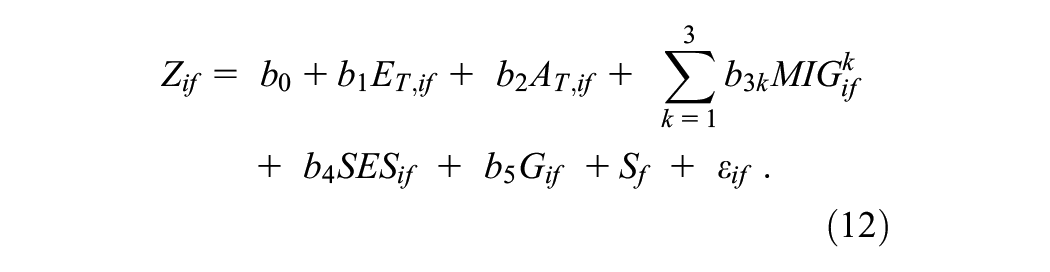
Parameters
Because we are interested in differences in learning rates and their schooling and aging components by migrant groups, we augmented Equation 12 with interaction terms between school exposure, age at test, and migrant background (and SES):
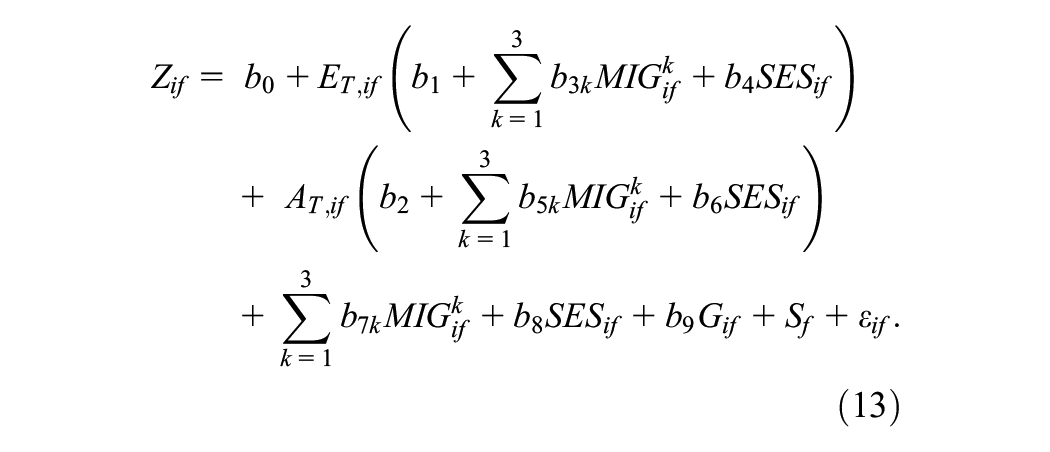
This model reflects theoretical ideas in Equation 11, which expresses differences in learning rates by migrant groups as the sum of differences in schooling and aging effects. Coefficients
Results
Learning because of School?
Table 4 presents results from the ordinary least squares model specified in Equation 12. Panel A shows parameter estimates of the learning rate as children progress through first grade. Children undoubtedly learn while in first grade, but there is variation by competence domain. Learning gains (Table 4, Panel A) amount to 6 percent to 8 percent of a standard deviation per month in grammar and vocabulary and almost double, 13 to 16 percent of a standard deviation, in science and math (unadjusted). These are quite substantial (and statistically significant) gains. For example, the estimated learning rate for math (unadjusted) implies that children’s proficiency increases by approximately 70 percent of a standard deviation over half a year (4.5 months) of first-grade schooling (
Learning Rates over First Grade and the Contribution of Schooling and Aging Components.
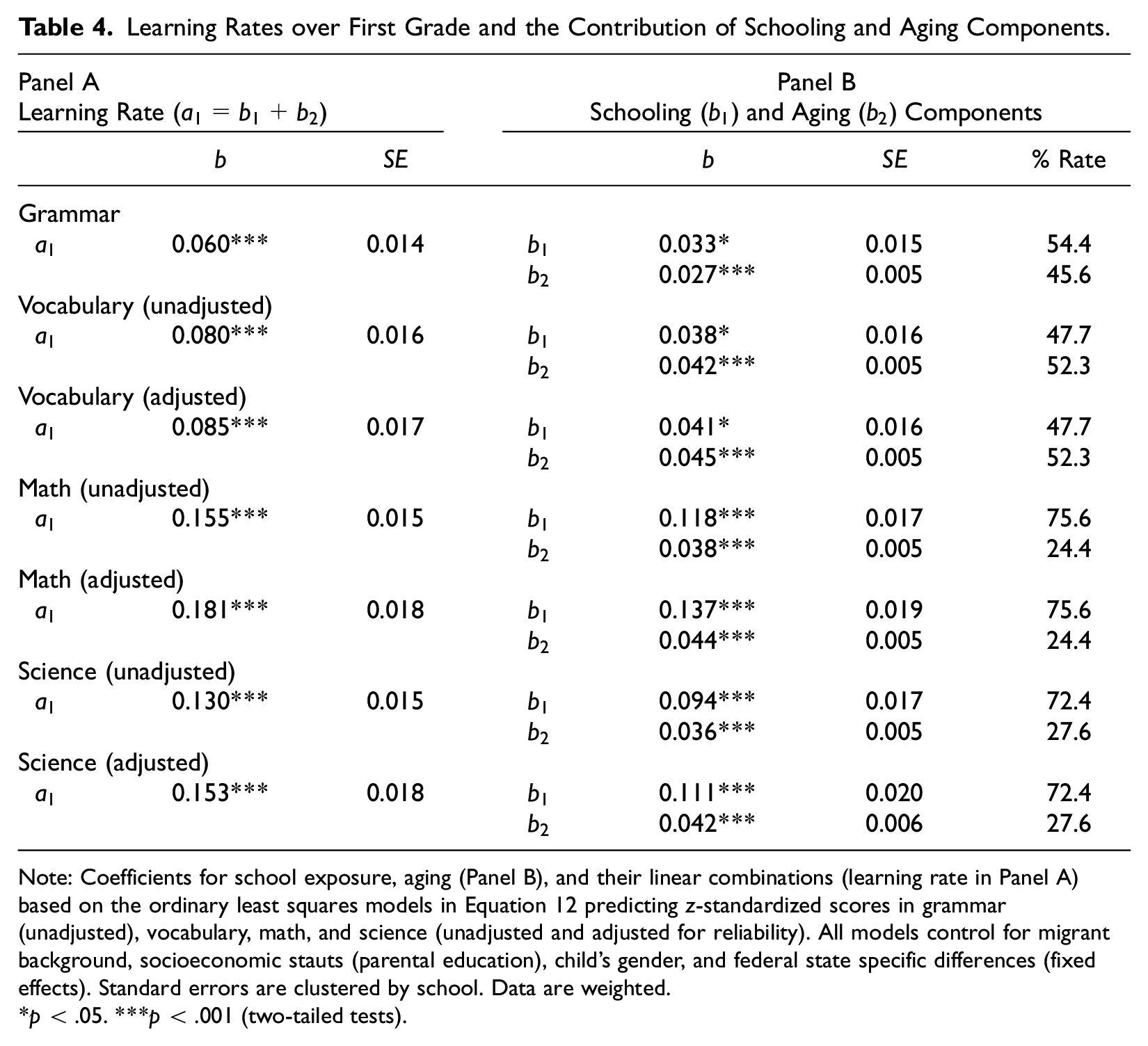
Note: Coefficients for school exposure, aging (Panel B), and their linear combinations (learning rate in Panel A) based on the ordinary least squares models in Equation 12 predicting z-standardized scores in grammar (unadjusted), vocabulary, math, and science (unadjusted and adjusted for reliability). All models control for migrant background, socioeconomic stauts (parental education), child’s gender, and federal state specific differences (fixed effects). Standard errors are clustered by school. Data are weighted.
p < .05. ***p < .001 (two-tailed tests).
To what extent is children’s learning attributable to school exposure? Panel B in Table 4 breaks down the learning rate into schooling and aging components, which together sum to the learning rate reported in Panel A. Figure 3 portrays the overall learning rates and their schooling and aging components across domains to help comparison. Both schooling and aging have independent and statistically significant effects on achievement. Age effects are similar across domains. One additional month of age among children with the same school exposure corresponds to 3 percent to 5 percent of a standard deviation increase in achievement. Yet there are stark differences in school-exposure effects across domains. One extra month of school exposure among same-age children leads to a 3 percent to 5 percent of a standard deviation increase in grammar and vocabulary scores, and the effect more than doubles in math and science, resulting in a 9 percent to 12 percent of a standard deviation increase per month; this effect is even higher when considering adjusted scores (11 percent to 14 percent).
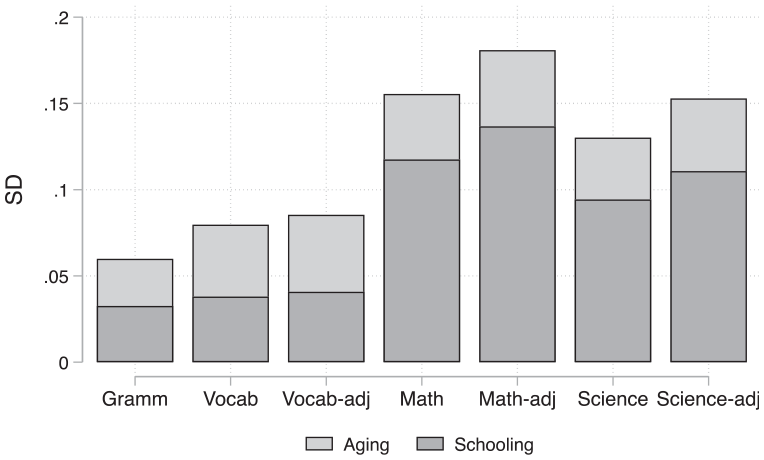
Monthly learning rates over first-grade schooling: schooling and aging components.
Figure 3 makes apparent that factors related to school-year exposure and age-related factors are equally important in grammar and vocabulary. Around half of the achievement gains in those domains are attributable to schooling; the remaining half is attributable to aging. The scenario is very different for math and science, where around three-fourths of the learning rate is explained by school exposure. Adjusted scores return the same figure.
All in all, learning gains are undoubtedly larger in math and science compared to vocabulary and grammar. The decomposition of the learning rate demonstrates that these larger gains are mainly due to factors related to school-year exposure, which are more effective in boosting achievement in math and science compared to grammar and vocabulary.
Migrant Gaps over First Grade
Figure 4 shows the migrant–native achievement gaps across domains as estimated by Equation 12. The estimates represent average differences in z scores of children with and without a migrant background, controlling for parental SES, school exposure, and age at test.
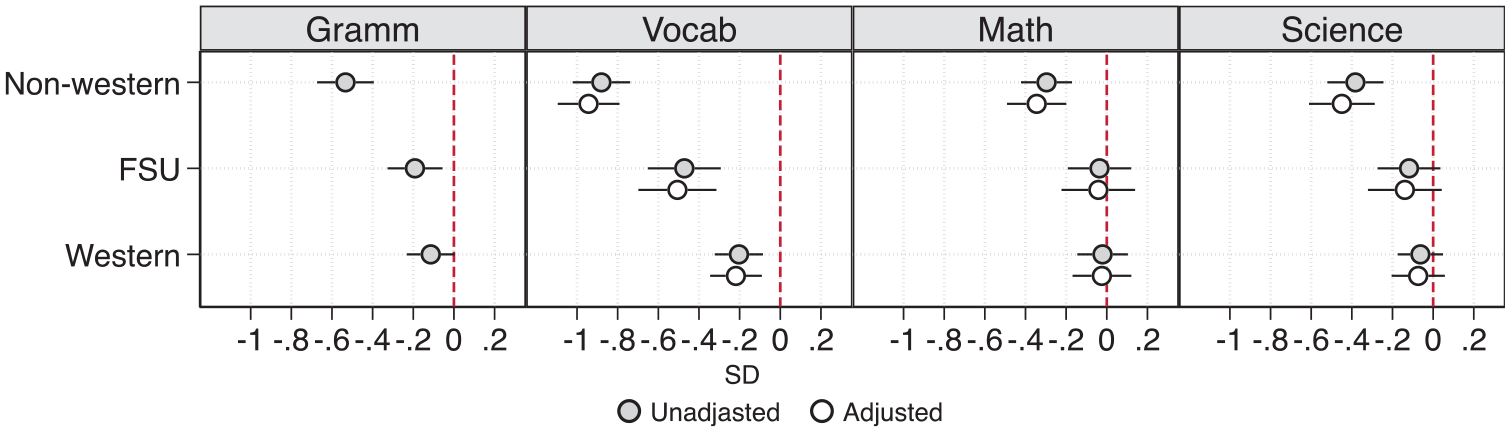
Migrant gaps in first-grade achievement by domain.
Migrants’ penalties concentrate in language-related skills and are less apparent in math and science. This finding is not surprising given that much previous research documents the considerable language gaps for immigrants’ children in Germany, especially for children from a Turkish (non-Western) origin (e.g., Becker et al. 2013). However, there is considerable variation across migrant groups. Children of FSU and Western immigrants lag behind natives only in language skills, where the gaps amount to 20 percent to 50 percent of a standard deviation in vocabulary and 10 percent to 20 percent of a standard deviation in grammar. Non-Western groups perform worse than natives in all domains. Achievement penalties of non-Westerners are substantial in vocabulary and grammar (88 percent and 53 percent of a standard deviation looking at unadjusted scores, respectively) and much lower in math and science (around 30 percent to 40 percent of a standard deviation). We can utilize our previous estimates for the average learning rates in Table 4 (unadjusted) to better understand those gaps: non-Western migrants lag behind natives by approximately 11 months of learning in vocabulary (0.88€/€0.080€=€~11 months) and by approximately 9 months in grammar. Learning gaps for math and science, however, sit at a much more surmountable 2 and 3 months of learning approximately. Note that non-Western migrant children not only perform worse than native children but also seem to perform worse than FSU and Western migrants in all competence domains and particularly so in vocabulary and grammar. Differences by migrant background seem remarkable if we consider that we are conditioning on parental education and looking at second-generation migrants who are themselves born in Germany. However, these findings are in line with previous literature showing that achievement disadvantages are largest among children of Turkish immigrants (a big chunk of our non-Western group) even after accounting for socioeconomic factors in Germany (e.g., Segeritz, Walter, and Stanat 2010).
Do migrant gaps change over first-grade schooling? If the learning rates of migrants’ children surpass those of native children, the migrant penalty would decrease during first grade and might even turn into an advantage as the school year progresses, particularly if the initial gap is reduced or absent. If the learning rates of migrants’ children are lower than native children’s, migrant gaps will widen during first grade and may even emerge when none initially existed. If learning rates are equal, the gaps will remain constant.
Table 5 (Panel A) shows the predicted learning rates for children of natives and the three migrant groups estimated from models specified in Equation 13, regressing children’s achievement on school exposure, age at test, migrant background, and the multiplicative terms between school exposure and age at test with migrant background. Additionally, Column 1 in Table 6 displays pairwise statistical comparisons between the learning rates of the different groups. Hereafter, we present results based on the more reliable adjusted scores for vocabulary, math, and science. For grammar, we rely on unadjusted scores because information on reliability was not available.
Learning over First Grade by Migrant Status, Decomposed into Schooling and Aging Components.
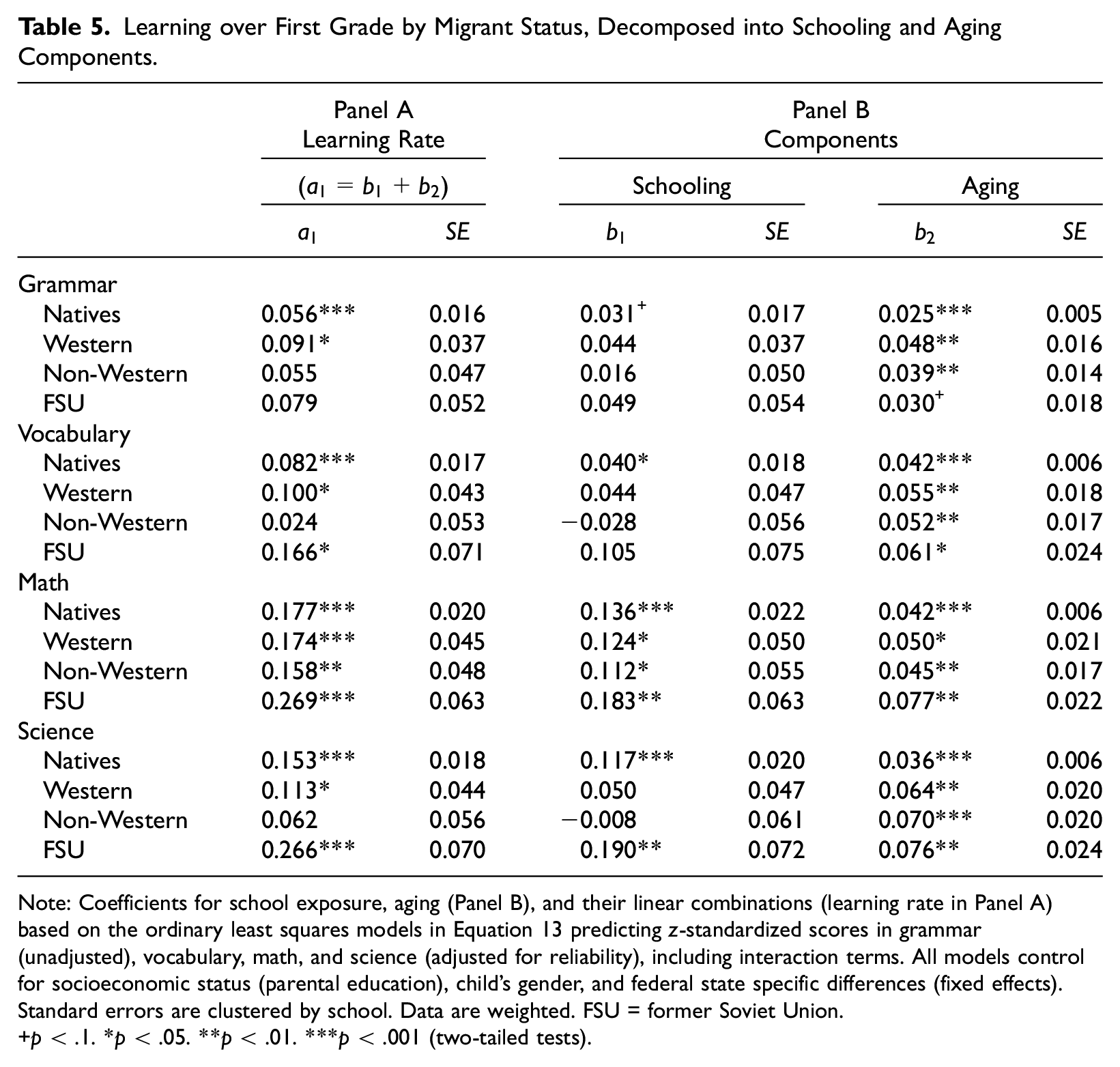
Note: Coefficients for school exposure, aging (Panel B), and their linear combinations (learning rate in Panel A) based on the ordinary least squares models in Equation 13 predicting z-standardized scores in grammar (unadjusted), vocabulary, math, and science (adjusted for reliability), including interaction terms. All models control for socioeconomic status (parental education), child’s gender, and federal state specific differences (fixed effects). Standard errors are clustered by school. Data are weighted. FSU = former Soviet Union.
p < .1. *p < .05. **p < .01. ***p < .001 (two-tailed tests).
Decomposition of the Differences in Learning Rates across Migrant Groups: Schooling and Aging Components.
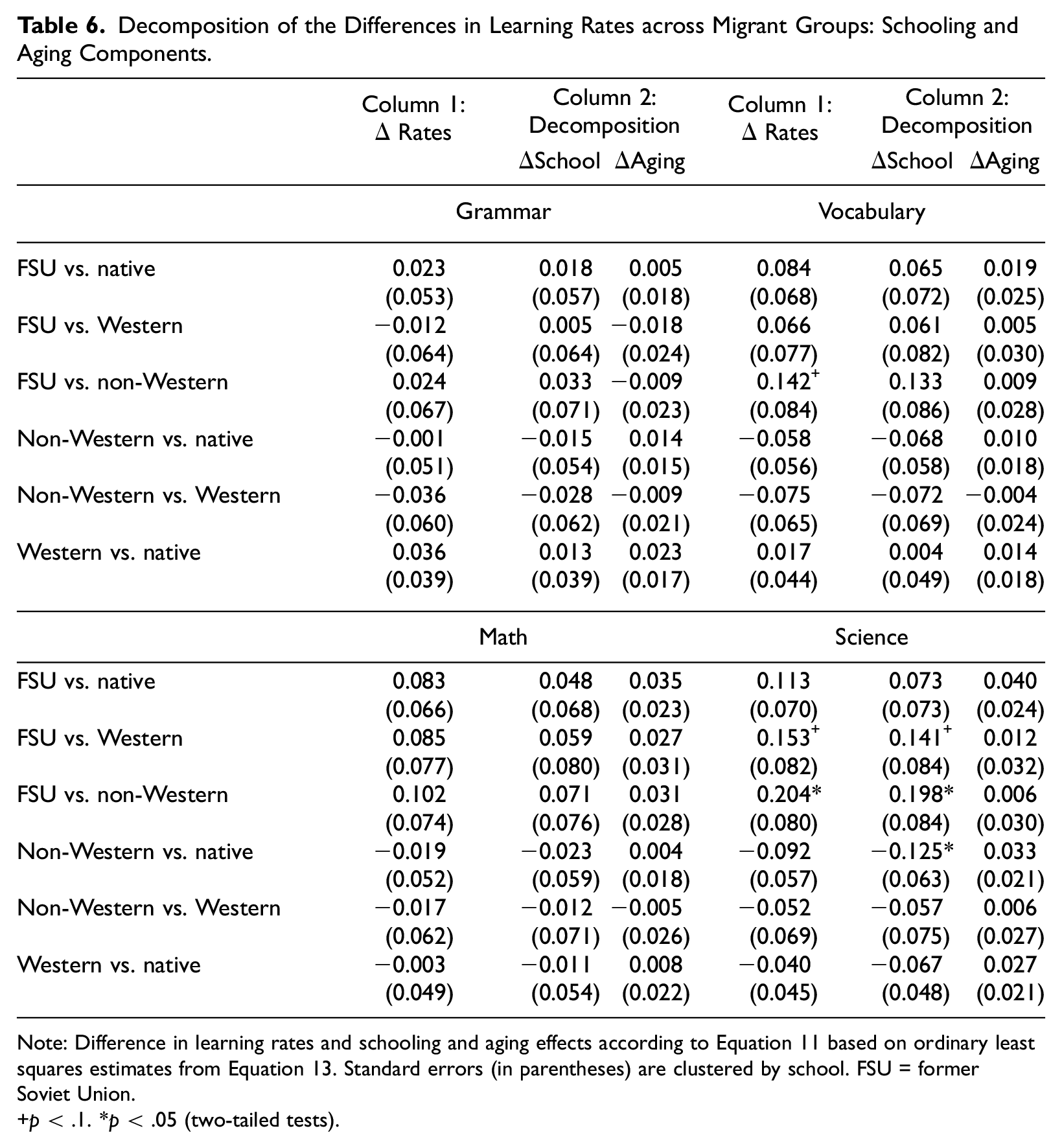
Note: Difference in learning rates and schooling and aging effects according to Equation 11 based on ordinary least squares estimates from Equation 13. Standard errors (in parentheses) are clustered by school. FSU = former Soviet Union.
p < .1. *p < .05 (two-tailed tests).
The point estimates in Table 5 (Panel A) suggest idiosyncratic patterns of variation in the learning rate across groups and domains. Children of FSU migrants seem to learn at much faster rates compared to children of natives and other migrant groups in vocabulary, math, and science. Other non-Westerners seem to learn almost nothing in vocabulary and little in grammar and science, with learning rates being statistically not significant. Finally, Western migrants seem to learn faster than all others in grammar, and they have similar learning rates as natives in vocabulary and math but are slower in science. However, these differences are within the range of estimation error and in most instances are not generalizable beyond our sample (see Column 1 in Table 6). Hence, there is not enough evidence from the data that migrant gaps presented in Figure 4 change during first grade; rather, these gaps may remain constant. There are some exceptions, however. Differences in the learning rates between children of FSU and other non-Western migrants in vocabulary (14 percent of a standard deviation) and science (20 percent of a standard deviation) suggest the penalty of non-Westerners compared to FSU migrants (see Figure 4) strongly increases over first grade, although differences for vocabulary are statistically significant at the 90 percent level only. The differences in learning rates imply that between February and June, the FSU advantage over other non-Westerners would increase by 57 percent of a standard deviation in vocabulary (0.
Children of FSU immigrants also seem to learn at a faster rate in science compared to children of Western migrants (0.266 SD vs. 0.113 SD), although this difference is significant at the 90 percent level only. Even though there is no average gap between children of Western and FSU migrants (see Figure 4), children of FSU migrants develop an advantage at a rate of 15 percent of a standard deviation per month during first grade. Finally, children of FSU migrants also seem to develop an advantage in science compared to native children (11 percent of a standard deviation per month), but this difference cannot be generalized beyond our sample. Although some of the differences we highlight are only significant at the 10 percent level, we should bear in mind the comparably small sample sizes at hand.
Do Schools Increase or Reduce Migrant Gaps?
The evolution of migrant gaps during first grade does not say anything about the role of schools in achievement inequality by migrant background. Constant achievement gaps may arise from similar effects of school exposure and aging between migrants and natives or, for instance, from some groups benefiting less from school exposure but more from aging, resulting in the same overall learning rate. The same reasoning applies to the rising advantage of children of FSU migrants compared to other non-Western (in vocabulary and science) and Western (in science) migrants. To what extent does the advantage of children of FSU migrants rise because of schooling?
Tables 5 and 6 answer this question by presenting schooling and aging effects for the migrant groups (Table 5, Panel B) and the decomposition of pairwise differences in learning rates across the groups in their schooling and aging components (Table 6, Column 2). Note that schooling and aging effects for a group sum to the learning rate of that group (see Table 5). Similarly, differences in schooling and aging effects between two groups sum to the difference in the learning rates between the two groups (see Table 6).
Table 5 (Panel B) shows that age coefficients are statistically significant across the board and more similar across migrant groups compared to coefficients for schooling. Estimates for schooling effects in grammar and vocabulary are numerically similar for children of native and Western migrant parents and comparatively larger for vocabulary among children of FSU migrants. However, schooling effects in language domains among migrant groups are not statistically significant due to the smaller sample size, which leads to larger standard errors. For non-Westerners, estimates of schooling effects are close to zero and not statistically significant for grammar, vocabulary, and science. In contrast, school exposure coefficients tend to be largest for children of FSU migrants, yet they reach statistical significance only for math and science. Overall, estimates for schooling effects tend to be most consistent and largest for math.
We have little statistical evidence that schooling and aging effects differ beyond our sample for most pairwise comparisons (see Column 2 in Table 6), which is most likely due to the small size of migrant groups. We have shown that most of the achievement gaps among children of native and migrant parents remain constant during first grade (see Panel A in Table 5 and Column 1 in Table 6). The decomposition results suggest that constant gaps are mostly attributable to schooling and aging affecting achievement equally across different groups. Yet children of FSU migrants develop an advantage over children of Western migrants in science and increase their advantage over non-Westerners in both science and vocabulary during first grade (see Panel A in Table 5 and Column 1 in Table 6). The decomposition results reveal that around 92 percent to 97 percent of this gap growth is attributable to factors related to school-year exposure (0.141 / 0.153 = 92 percent; 0.198 / 0.204 = 97 percent; 0.133 / 0.142 = 94 percent). Children of FSU migrants benefit more from schooling than do children of Western migrants in science, and they benefit more than other non-Western migrants in both science and vocabulary, leading to the emerging FSU advantage over Western migrants and their widening advantage over non-Western migrants.
When looking at science scores, non-Westerners seem to benefit less from school exposure not only compared to children of FSU migrants but also compared to children of native parents (see Column 2 in Table 6). However, non-Westerners seem to benefit from age-related factors twice as much as natives (0.07 vs. 0.036; see Panel B in Table 5), although this difference is not statistically significant (0.033, p = 0.11; see Column 2 in Table 6). Non-Western migrants’ stronger benefits from aging counteract their lower gains from school exposure and mitigate unequal learning over first grade. In absence of “mitigation by aging,” the gap of non-Westerners compared to natives in science would increase at a faster rate during first grade than we observed. These counteracting dynamics are concealed when looking at the differences in learning rates and the evolution of migrant gaps only.
In summary, our data suggest two major patterns across migrant groups in Germany. First, during first grade, children of FSU migrants tend to learn the fastest, and children of non-Western migrants tend to learn the slowest. Second, comparably strong schooling effects for FSU children and comparably weak schooling effects for children of non-Western migrants seem to explain diverging learning rates during first grade. However, among the many comparisons, only a few reach levels of statistical significance. For example, the data provide clear evidence for substantially widening achievement gaps in science between FSU children and other non-Western groups due to FSU children’s comparably larger benefit from school exposure.
Conclusions
Migrants and their descendants represent a large and growing share of the population in many Western countries, including Germany. Since reunification in 1990, over 35 million migrants have settled in Germany (Statistisches Bundesamt 2022). The children of these immigrants are or will be educated in German schools. But do they benefit from schooling in the same way as children of natives? Research across Europe consistently highlights differential educational outcomes for children of migrants, often finding achievement gaps compared to native-born children from similar socioeconomic backgrounds. Despite this, little research has focused on the specific role schools play in the emergence, the exacerbation, or the compensation of these migrant–native achievement gaps.
Does the German school system fulfill its integrative role by aiding the educational integration of children with migrant backgrounds? Simply examining the evolution of learning gaps by migrant background is insufficient to answer this question because diverging trajectories in school can result from both school-related factors and age-related factors unrelated to school exposure. The key issue is determining how much of students’ learning progress occurs because of their exposure to school. By isolating the contribution of schooling to learning, we can assess whether schooling contributes to or mitigates learning inequalities between children of migrants and natives. We built on a novel differential exposure approach to estimate and decompose differences in learning rates over a school year into schooling and aging components. This approach allowed us to analyze the potentially differing effects of first-grade exposure on learning in language, math, and science among children of immigrants compared to children of native families.
Our findings demonstrate that both school exposure and to a lesser extent, age-related factors influence children’s learning. Schooling effects were stronger in math and science and weaker in language. Consistent with previous research in Germany (e.g., Teltemann and Rauch 2018), we found the largest achievement gaps in language-related domains and for children from non-Western families. At the same time, our study is the first to reveal that children from non-Western backgrounds benefit the least from schooling and that those from FSU backgrounds benefit the most.
Overall, our findings do not support the notion that schooling equalizes educational disadvantages by migrant background. Instead, we found that schooling may exacerbate the disadvantage of certain groups. For example, the disadvantage of non-Western migrants compared to FSU migrants in scientific literacy and vocabulary grew substantially during first grade, almost entirely due to school-related factors, not age. This indicates that schooling has contributed to a widening learning gap between the two largest immigrant groups in Germany. The evidence points to the limitations of German primary schools in fulfilling their integrative role. Schooling does reduce the migrant–native achievement gap, yet the groups likely facing the greatest disadvantages at home, such as non-Western migrants, benefit the least from school exposure.
Our research warrants several caveats. First, our analysis is limited to the initial stages of formal schooling. Although it is reasonable to expect that schooling’s effect is most pronounced early in life, future research should investigate its effects throughout later educational phases. Second, although our study utilizes some of the most comprehensive data available in Germany, the sample size imposes clear limitations, particularly in detecting subtle effects and distinguishing genuine trends from statistical noise. Third, the DEA relies on comparison of randomly selected students with different levels of school exposure. Hence, it estimates population-level effects without examining individual-level heterogeneity.
Finally, our findings are specific to the German context, so generalizations to other settings should be made cautiously. There is a pressing need for cross-national research to understand schooling’s role in different immigration contexts across Europe and beyond. Our approach could be valuable in other national contexts where seasonal comparisons are not feasible. Additionally, the DEA could be applied to revisit cases previously analyzed with the seasonal comparison design. For example, the DEA may clarify contradictory findings on the role of schools in racial learning gaps in the United States. Given the variation in school starting age in the United States and the variation in testing dates implied by seasonal data, the DEA may offer a viable alternative or complement to the traditional seasonal comparison design used with U.S. data.
Footnotes
Appendix
Funding
The author(s) disclosed receipt of the following financial support for the research, authorship, and/or publication of this article: Giampiero Passaretta gratefully acknowledges funding from the Spanish Research Agency (Agencia Estatal de Investigación [AEI]) under Grant Agreement No. AEI-PID2022-139412NA-I00.
Resarch Ethics
Our research follows the ethical guidelines set by the data provider, the German National Educational Panel Study, ensuring compliance with all established rules for the use of secondary data.
Authors’ Note
Replication files are available on the authors’ websites: Giampiero Passaretta, https://gpassaretta.github.io; Jan Skopek,  .
.