




Abstract
Based on sociological, economic, and social-psychological theories of discrimination and bias, this study addresses non-native accents among ethnic minority students as they begin school and explores effects of such accents on their teachers’ achievement expectations. Using a unique data set of first graders in Germany, the analysis reveals that a non-native accent is relevant to teachers’ expectations net of student skills, abilities, and other background variables. Associations are stronger in the language domain than in mathematics, indicating that teachers perceive accent-free speech as a language-learning requirement. However, residual influences of non-native accents on teacher expectations also exist in the math domain and persist even after prolonged periods of teacher-student interaction. Mechanisms of statistical discrimination and stereotype-based discrimination can partially explain these effects. However, the overall pattern of results suggests a stigmatization of non-native accents, potentially resulting from the activation of negative associations related to foreignness and disfluency.
Keywords
Accurate teacher assessments of students’ abilities and skills are essential for children's educational achievement and attainment and, thus, for their later life chances (Farkas 2003; Ferguson 2003; Hallinan 2008). Yet ethnic minority students often face biased teacher assessments, which can have long-lasting consequences and contribute to inequality in educational outcomes (Alexander, Entwisle, and Thompson 1987; Gentrup et al. 2020; McGrady and Reynolds 2013). Bias in teacher perceptions and evaluations has been documented in a range of modern societies, such as Australia, the United States, and several European countries (e.g., Lorenz et al. 2016; Meissel et al. 2017; Ready and Wright 2011). Earlier studies have confirmed that prejudice and stereotypes are among the sources of such biases (Kisfalusi, Janky, and Takács 2021; Lorenz 2021), but we know little about what triggers these processes.
In addition to names (Bonefeld and Dickhäuser 2018) and physiognomy (Zebrowitz 1996), language is an important social cue that provokes ingroup and outgroup distinctions (Lamont and Molnár 2002). This might affect ethnic minority members, especially first-generation immigrants, because many of them speak with a non-native accent (Moyer 2004). More specifically, immigrants often apply phonology and intonation of their origin language to the target language (Lippi-Green 2011:165) even if they are fluent and effective speakers of the target language (Dovidio and Gluszek 2012). Accent is a key feature of phonology or pronunciation and is among the most salient features of speech (Derwing and Munro 2009; Moyer 2004). Speakers with a non-native accent are thus easily recognized as being of foreign descent (Rakić, Steffens, and Mummendey 2011; Rödin and Özcan 2011).
The signaling effect of non-native accents entails an increasing likelihood that such speakers will be perceived in stereotypical or even prejudiced ways. Existing evidence indicates that individuals who speak with a non-native accent are perceived to be less credible (Lev-Ari and Keysar 2010), are more often sanctioned for norm violations (Lippi-Green 2011), have a lower probability of getting an apartment (Horr, Hunkler, and Kroneberg 2018), and are treated less positively in the service sector (Klink and Wagner 1999). Non-native accents also restrict the establishment of intergroup friendships and partnerships (Kogan, Dollmann, and Weißmann 2021), resulting in disadvantages in the labor market (Schmaus 2020; Schmaus and Kristen 2022). In the educational context, however, non-native accents have thus far received little attention.
This study aims to identify the role of non-native accents in teachers’ achievement expectations for children starting primary school. We synthesize theoretical arguments from the sociology of education, economics, and social psychology and address different mechanisms that might underlie accurate and biased teacher assessments of students speaking with an accent. Utilizing data from a unique empirical setting of first graders in Germany, we examine whether non-native accents matter for teachers’ achievement expectations depending on the teaching domain (mathematics and language), the time point of observation, and the stereotypes about ethnic minority members that teachers (may) hold. The study design allows us to explore different mechanisms of bias and identify whether associations between non-native student accents and teacher expectations reflect accurate or biased evaluations.
Our results reveal that a non-native accent is negatively associated with teachers’ expectations net of student skills, abilities, and other individual-level and classroom-level background variables. Differences in the strength of the accent effect between the language and math domains indicate that teachers perceive accent-free speech as a language-learning requirement. However, the negative association between non-native accent and teacher expectations persists irrespective of the teaching domain (i.e., language or mathematics), timing of observation (i.e., the beginning or end of the first school year), the negativity of teachers’ stereotypes about ethnic minority students, and students’ ethnic origin. With this unique evidence on how students’ non-native accents are related to teacher evaluations in Germany, our study contributes to the general debate on the role of non-native accents in the emergence of bias (see Roessel, Schoel, and Stahlberg 2018). Our findings suggest that accented speech might activate basic negative associations that do not hinge on group-specific stereotypes but lead to negatively biased student evaluations even in the absence of negative attitudes toward immigrants and ethnic minority groups.
Non-native accent as a trigger of stigmatization?
Strong non-native accents can deviate from standard speech patterns and inhibit comprehension (Deprez-Sims and Morris 2013; Floccia et al. 2009; Schmaus and Kristen 2022; Van Wijngaarden 2001). Empirical evidence suggests this is reflected in delayed word identification (Floccia et al. 2009) and misidentification of syllables, words, and sentences (Van Wijngaarden 2001). A listener may also need more time to process accented speech (Munro and Derwing 1995). Linguists have used economists’ terminology, considering such difficulties to be “costs” associated with a non-native accent (Adank et al. 2009). In psychology, challenges in understanding accented speakers are viewed in terms of metacognitive processes. In this perspective, comprehension is conceived as a mental task between the poles of effortless and highly effortful (Dovidio and Gluszek 2012). The perceived effort of a task, such as understanding an accented speaker, activates corresponding metacognitions that reflect the subjective ease with which a person can process information. Disfluency, a key metacognition, can be activated when a non-native accent complicates information processing and understandability (Deprez-Sims and Morris 2013).
The fluency with which people perceive and interact with others affects interpersonal evaluations (Lick and Johnson 2015). Hence, given its role in metacognition, accent-induced disfluency must be considered not only as a factor influencing understandability of a speaker but also as a source of bias on the listener's side. Disfluency can activate ingroup-outgroup distinctions (Dovidio and Gluszek 2012; Massey and Lundy 2001), which can trigger negative associations and emotions related to foreignness and outgroup membership (Alter and Oppenheimer 2009; Roessel et al. 2018). This is supported by evidence of how speakers with a non-native accent are misinterpreted and judged differently—often more negatively (see Fuertes et al. 2012)—than persons who speak with a standard accent (Dovidio and Gluszek 2012). In the school context, stigmatization of non-native accents might occur when disfluency triggers negative emotions (and thus prejudice) and a general devaluation of accent-speaking students (Link and Phelan 2001), thus distorting teachers’ achievement expectations.
However, stigmatization may not be the only mechanism underlying bias in teacher assessments of students who speak with a non-native accent. Building on theoretical arguments from the sociology of education, economics, and social psychology, we test three possible explanations for the association between students’ non-native accents and teachers’ expectations: (1) standard pronunciation as a part of scholastic requirements, (2) statistical discrimination, and (3) stereotype-based discrimination.
Standard Pronunciation as a Scholastic Requirement
A high level of language proficiency is usually characterized by a rich vocabulary, correct grammar and syntax, and native-like pronunciation (i.e., accent-free or nearly accent-free speech; Foley and Thompson 2003). When teachers assess students’ language proficiency, they may take the full range of these dimensions into account. Additionally, standards set by the German educational authorities regarding achievement in the subject German specify that children ought to adopt standard German and learn how to speak articulately, with the goal of being able to “tell, inform, argue, and appeal to others” (KMK 2004a:9f.). Although these requirements do not mention pronunciation, they suggest the spoken word is expected to be comprehensible to others.
These educational standards might affect how teachers assess the academic potential of students who speak with a non-native accent. Less pronounced non-native accents should not lead to lower expectations for student achievement in language-focused areas, but teachers may consider stronger accents a legitimate reason for negative student evaluations, particularly when the accent impedes comprehension. Teachers might not necessarily stigmatize students whose non-native accents produce disfluency, but they may consider these students less proficient, lowering expectations for their achievement in the language domain. As a result, we hypothesize the following:
Hypothesis 1: A strong non-native accent should decrease expected language achievement (after controlling for actual skills and abilities), and a less pronounced non-native accent should be unrelated to teacher expectations in this domain.
For the same reasons, a non-native accent should play a more important role in forming teacher expectations in language-related domains than in the mathematical domain. Performance in math is less dependent on language than is performance in a language-focused subject. Additionally, the educational standards for mathematics in Germany do not mention correct language as a requirement (KMK 2004b). Therefore we hypothesize the following,
Hypothesis 2: Student accents should be less important for the formation of teacher expectations in the mathematical domain than in the language domain.
Statistical Discrimination
Theories of statistical discrimination were originally introduced in labor market research. These theories assume that when employers have limited information about applicants’ productivity, they rely on easily accessible signals to formulate productivity estimates (Spence 1973). These signals can include indicators of group membership. For instance, employers might use the assumed average productivity of the social group to which an applicant is presumed to belong as an estimate of individual productivity (Phelps 1972). Similarly, when teachers enter a new class, they usually have limited knowledge of each student's skills. In these instances, teachers may base their initial expectations on the knowledge they have about the social groups to which they think individual students belong. After prolonged teacher-student interactions, these group-level perceptions should gradually be replaced by information acquired about each student. Accordingly, statistical discrimination in the school context most likely occurs when teachers do not yet know their students very well. Following this reasoning, we argue the following:
Hypothesis 3: Potential bias in teacher expectations related to a non-native accent should be more prevalent at the start of first grade (when student-teacher interaction has been minimal) than at later points in time.
If the group-specific achievement estimate a teacher relies on (in cases of missing student information) is accurate (e.g., if the estimated average language skills of a group correspond to the actual average language skills among this group), statistical discrimination will lead to inaccurate teacher expectations only for students whose actual achievements are below or above the expected group mean. Bias at the group level occurs only when the group-specific achievement estimate is inaccurate (i.e., if it over- or underestimates the actual group mean), a scenario known as error discrimination (England 1992). The literature on stereotypes provides insight into how and under what conditions such inaccuracy might occur.
Stereotype-Based Discrimination
In social psychology, a non-native accent is a salient social cue that signals the speaker's outgroup membership and ethnic minority group status (Deaux 2006; Kinzler, Dupoux, and Spelke 2007). As a particularly blatant cue, a non-native accent can trigger activation of stereotypes, that is, generalized beliefs about the average characteristics and attributes of categories of people (Kunda and Spencer 2003). Scholars assume that non-native accents activate stereotypes related to ethnicity (Macrae, Bodenhausen, and Milne 1995) and inhibit the activation of competing stereotypes, such as those associated with appearance, gender, or socioeconomic background (Hansen, Rakić, and Steffens 2017; Rakić et al. 2011). Similar to statistical discrimination, perceiving individuals based on stereotypes means attributes associated with certain category labels (e.g., “ethnic minority child” or “child from a Turkish minority family”) are ascribed to individuals who have been identified as members of the respective category (Fiske et al. 1987).
According to dual-process theories, humans process information and form impressions of other people along a continuum (see the continuum model of impression formation by Fiske, Lin, and Neuberg 1999). At one end of the continuum, impression formation is based on the automatic activation of stereotypes. At the other end of the continuum, people do not rely on stereotypes but process individual information about the target person, with group membership merely one among various individual characteristics taken into account. Changes from stereotypic modes of impression formation to individuating modes depend on the availability of rich and unambiguous information on the target person and the cognitive resources available for processing such information (Gawronski, Geschke, and Banse 2003). However, even when information and cognitive resources are available, a non-native accent can hamper the processing of individual information and its integration into multifaceted judgments. This is because accented speech constitutes a salient ethnic cue that entails an increased likelihood of categorizations and thus stereotype application (Fiske et al. 1999; Smith and DeCoster 2000). Because stereotypes about ethnic minority members are often negative and tend to emphasize undesirable attributes (Garg et al. 2018; Glock, Krolak-Schwerdt, and Pit-ten Cate 2015; Pettigrew and Meertens 1995), they are likely to produce negative bias, which may result in unfavorable expectations. 1
Following the continuum model of impression formation, we expect a non-native student accent to moderate first, the relationship between achievement information on individual students and the degree of accuracy (or bias) in teacher expectations and second, the relationship between ethnic stereotypes and the degree of accuracy (or bias) in teacher expectations. More specifically, our next hypothesis is as follows:
Hypothesis 4: Knowledge of students’ abilities and skills (that is available to teachers from their everyday interactions with students) should be more likely to contribute to the formation of expectations for ethnic minority students who speak with a standard accent than for students who speak with a non-native accent.
Conversely, non-native student accents should moderate the relationship between (negative) teacher stereotypes (about ethnic minority students) and teacher expectations. We thus hypothosize the following:
Hypothesis 5: The effects of stereotypes on teacher expectations should be more pronounced for students who speak with a non-native accent than for students with native-like pronunciation.
We assume comparable moderating effects of a non-native accent for the language and mathematical domains.
In addition to holding stereotypes about immigrant or ethnic minority students in general, teachers might hold group-specific stereotypes (Wenz, Olczyk, and Lorenz 2016). Non-native accents, especially when combined with other signals indicating ethnic group membership (e.g., a foreign-sounding name, certain looks, or information on parents’ country of birth), may trigger stereotypes about particular origin groups. Muslims face negative stereotypes on both sides of the Atlantic (Foner and Alba 2008), and throughout Germany and Western Europe, unfavorable stereotypes about Turks and Muslims are pronounced (Froehlich and Schulte 2019; Kahraman and Knoblich 2000; Strabac and Listhaug 2008). East Europeans, another numerically important group in Germany, are perceived less negatively, and they report and experience less discrimination (Diehl, Fischer-Neumann, and Mühlau 2016; Koopmans, Veit, and Yemane 2019).
Consequently, although a non-native accent spoken by children of East European origin might indicate a lack of human capital, non-native accents spoken by children from families descending from Turkey, North Africa, and the Middle East (the MENA region) might additionally signal membership in an unfavorable group (for evidence on this assumption in the labor market, see Schmaus 2020). In the education system, this process would be reflected in differential associations between non-native student accents and teacher expectations for students of MENA and Eastern European origins. According to this reasoning, we hypothesize the following:
Hypothesis 6: A non-native accent among students of ethnic origins who are the target of unfavorable stereotypes (i.e., descendants of immigrants from the MENA region) should lead to more negative teacher expectations than would a non-native accent among students of ethnic origins who are less exposed to negative stereotypes (i.e., descendants of immigrants from Eastern Europe).
Data And Methodology
Data
We use data from the research project Kompetenzerwerb und Lernvoraussetzungen (English translation: Competence Acquisition and Learning Preconditions; Kristen et al. 2018). The total sample included 1,065 first graders from 67 classrooms in 39 primary schools in Germany. The schools were sampled in a large polycentric urban area located in the federal state of North-Rhine Westphalia. The area is characterized by high ethnic diversity and was chosen to cover everyday school life in diverse contexts.
Data collection started shortly after the beginning of the 2013–2014 school year (T1) and included standardized achievement tests and interviews with first-grade students (taking place between September and November 2013, during the third to ninth school weeks), a questionnaire for teachers (dispatched by the research team between September and November 2013, during the third to seventh school weeks), and telephone interviews with parents (conducted between October and December 2013). Due to minimal teacher-student contact before the first wave, the problem of unobserved heterogeneity should be less of an issue. The second round of data collection occurred at the end of the same school year (T2). Students were tested and interviewed again (between May and June 2014), and their teachers completed another questionnaire (dispatched by the research team at the beginning of May 2014). Implementation of the different tests and surveys in the field and the various instruments used in this study were pretested in two schools in the year preceding the main data collection.
For the analyses, we kept only cases of ethnic minority students for whom information on teacher expectations was available for both T1 and T2 and whose teachers did not change between the two survey waves. The analyzed sample comprised 344 ethnic minority students and their 60 classroom teachers. Of these 60 teachers, 57 taught German and mathematics, and 3 taught only German. Consequently, analyses of the mathematical domain are restricted to a slightly smaller sample consisting of 322 students and 57 teachers.
The 60 teachers were, on average, 42 years old (SD = 9.2) and had average work experience of 12 years (SD = 9.3). The teachers were predominantly female (93 percent) and belonged to the German majority population (93 percent). Two teachers had a Polish ethnic minority background; information on ethnic origin was missing for one teacher. 2
Variables
Our outcome variable is teacher expectations. Teachers rated each participating student in their class regarding their expected achievement on five items (e.g., “Compared to his or her fellow students, how well do you expect the child to perform at the end of the upcoming school year? . . . in German language / . . . in mathematics”; for an English translation of the wording of all items, see Part A of the online Supplemental; for the original German version, see Gentrup et al. 2018). These questions were presented to teachers at T1 and T2 using the same wording. This procedure ensured that in the first wave, teachers formulated their expectations for each student's achievement development during the first school year. The second wave recorded teacher expectations for each student's achievement development during the second school year. Answers were given on a 5-point scale. We calculated two mean scores out of the five items, one for each domain. We used three items to build a variable referring to the expectations for each child's achievement in the language domain (α = .94), and two items measure teacher expectations in the math domain (α = .94). We constructed the variables capturing teacher expectations in the same way for both the T1 and T2 observations.
The key independent variable in this study is the strength of students’ non-native accent. To this end, teachers were asked to assess to what extent their students speak with a non-native accent on a 9-point scale from “no accent at all” (= 1) to “strong non-German accent” (= 9). Student accent was measured in this way at both T1 and T2. In addition to using this continuous variable as a predictor of teacher expectations, we created a categorical version of the accent variable differentiating between the categories “no non-native accent” (value 1 on the interval accent scale), “moderate non-native accent” (values 2–5), and “strong non-native accent” (values 6–9). This approach reflects our assumption that stronger accents have stronger effects on teacher expectations than do weaker accents (for a similar application, see Kogan et al. 2021). Categorization of the accent variable followed the logic of using the lowest value as an indicator of accent-free speech and splitting the remaining answer categories in the middle. This procedure corresponds to how student accent is empirically related to teacher expectations in our data (see the “Descriptive Results” section and Figure 3). Analyses using different thresholds yield results substantially similar to our main findings (results available on request).
Our analyses account for various ability and skills measures to examine the extent to which non-native student accents correlate with student achievement and to determine if teacher expectations vary between students with non-native accents and native-like pronunciation given the same achievement. To measure language skills, we use the subscales phonological awareness (α = .82) and reading (α = .96) of the German version of the computer-based Performance Indicators in Primary Schools (FIPS; Bäuerlein et al. 2012), a test each participating child took at the beginning (T1) and end (T2) of the school year. We measure mathematical skills with the mathematics subscale of the FIPS assessment (α = .92) at T1 and T2. The FIPS instrument is specifically designed to measure language and math skills of children just beginning school. It captures a variety of skills, such as repeating fantasy words and separating words into syllables (subscale phonological awareness) and reading numbers and calculating based on pictures with numbers up to 10 (subscale mathematics). Finally, we use two scales to measure students’cognitive abilities at T1, namely, a deductive reasoning test (CFT1; Weiß and Osterland 1997) and the working memory subscale implemented in the FIPS assessment (Bäuerlein et al. 2012; α = .76).
We further control for a set of variables likely to influence teachers’ expectations. Teachers rely on indicators of student motivation when forming their expectations (Gentrup et al. 2018). Therefore, we consider students’ enjoyment of learning (a scale comprising 13 items; α = .78) and effort (13 items; α = .70) as measured by personal interviews with the children in the middle of the school year. For this purpose, we use an adapted form of a questionnaire by Rauer and Schuck (2004).
We measure teacher stereotypes about ethnic minority students at T2 with five items (α = .88) capturing teachers’ agreement with negative statements on school-relevant characteristics of ethnic minority students. The items refer to immigrant students’ attentiveness, eagerness to learn, effort, preknowledge, and interest (for the full wording of all items, see Part A of the online Supplemental). We use the mean of teachers’ responses to these items (5-point scale) as the indicator of teachers’ stereotypes.
To examine whether the effect of a non-native accent on teacher expectations varies depending on students’origin, we use information from telephone interviews with parents, whom we asked about the birth countries of the student, the parents, and the grandparents. Based on this information, we distinguish among the following three origin groups: students with a MENA background (n = 116), students with an Eastern European background (n = 125), and students with other ethnic minority backgrounds (n = 103). The MENA category includes children whose families immigrated from Turkey, North Africa, or the Middle East. The Eastern European category includes children whose families originated from countries that once belonged to the Soviet Union and families from the Czech Republic, Bulgaria, Hungary, Poland, Romania, Slovakia, and Slovenia. The remaining ethnic minority group represents a diverse mix of origin continents and regions: Middle and South Africa (22 students), Asia (14 students), North and South America and Western Europe (32 students), and various other countries (35 students). Students are identified as members of an origin group if they, at least one of their parents, or all grandparents were born in one of the listed countries. Additionally, we control for students’immigrant status. Here, we distinguish between first-generation (student foreign-born), second-generation (parents foreign-born), 2.5-generation (one parent foreign-born), and third-generation (grandparents foreign-born) immigrant students.
To consider students’ social backgrounds, we use the highest values of parents’ International Socio-Economic Index of occupational status (Ganzeboom, De Graaf, and Treiman 1992). We gathered this information in telephone interviews with the parents. Additionally, we consider students’gender in all analyses. We further control for the socioeconomic and ethnic composition of the classroom to take into account that teacher expectation bias varies with classroom composition (Timmermans, Kuyper, and van der Werf 2015). To this end, we use teachers’ statements regarding the share of students in their classes who had at least one parent with tertiary education and the share of students from immigrant families.
Method of Analysis
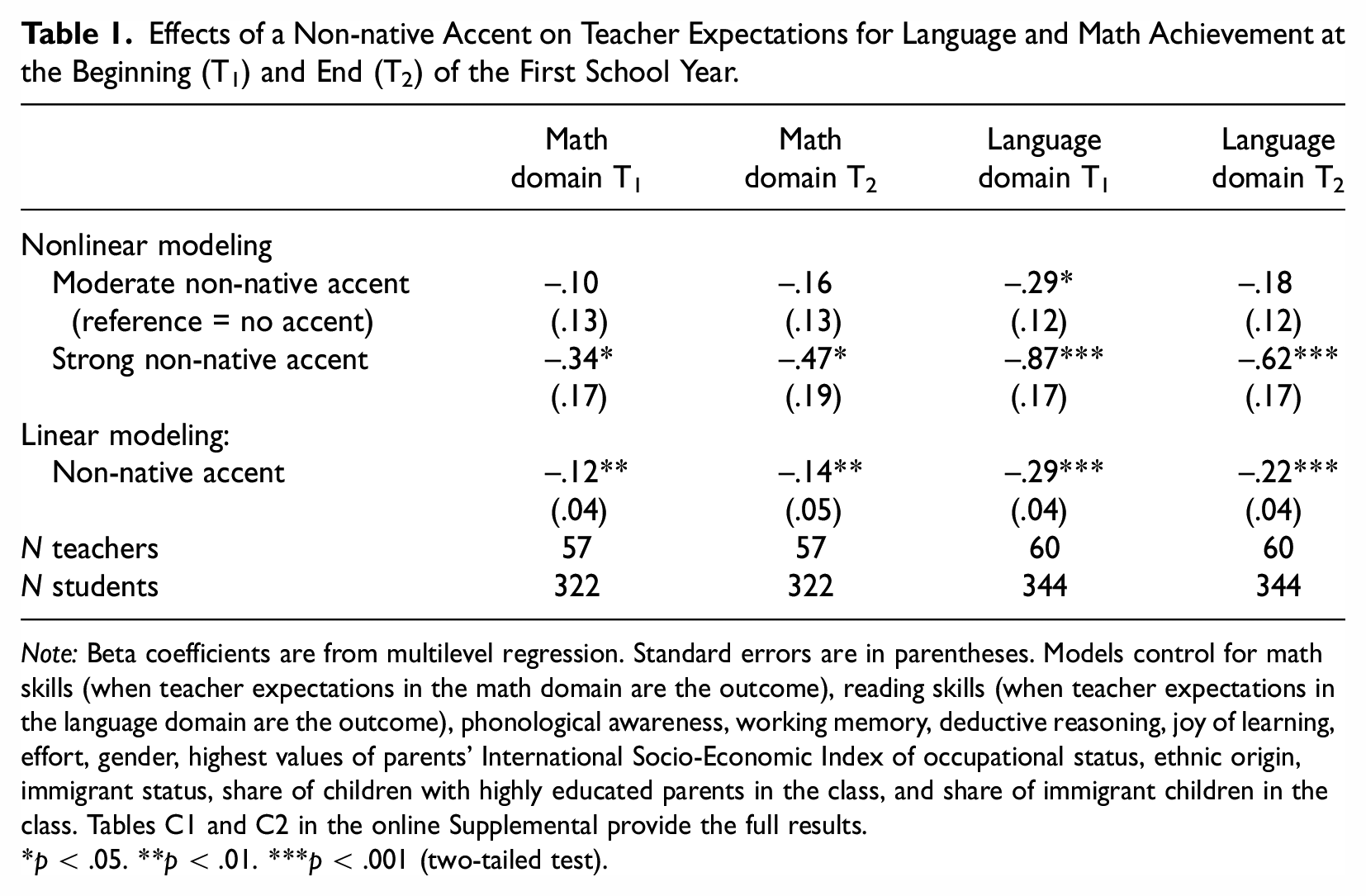
To identify the effects of a non-native accent on teacher expectations, we carry out multilevel linear regressions (Allison 2009) with teacher expectations in the language and mathematics domains at T1 and T2 as four separate dependent variables. In all multivariate models, student achievement, motivation, socioeconomic status, gender, and classroom composition serve as controls. In the first step, we assess whether the strength of a non-native accent is related to teacher expectations for student achievement at T1 and T2 in the math and language domains net of our control variables. In analyses at T1, we use the student accent measure from T1 as an independent variable. In analyses at T2, we use the accent measure from T2 as an independent variable. The results are displayed in Table 1 and include nonlinear modeling in which the categorical accent variable is used as a predictor (see upper part of Table 1) and linear modeling in which the continuous accent variable enters the models as a predictor (see lower part of Table 1). This procedure enables us to test Hypothesis 1, and comparisons across the two domains and the time points allow testing for Hypotheses 2 and 3.
Effects of a Non-native Accent on Teacher Expectations for Language and Math Achievement at the Beginning (T1) and End (T2) of the First School Year.
Note: Beta coefficients are from multilevel regression. Standard errors are in parentheses. Models control for math skills (when teacher expectations in the math domain are the outcome), reading skills (when teacher expectations in the language domain are the outcome), phonological awareness, working memory, deductive reasoning, joy of learning, effort, gender, highest values of parents’ International Socio-Economic Index of occupational status, ethnic origin, immigrant status, share of children with highly educated parents in the class, and share of immigrant children in the class. Tables C1 and C2 in the online Supplemental provide the full results.
p < .05. **p < .01. ***p < .001 (two-tailed test).
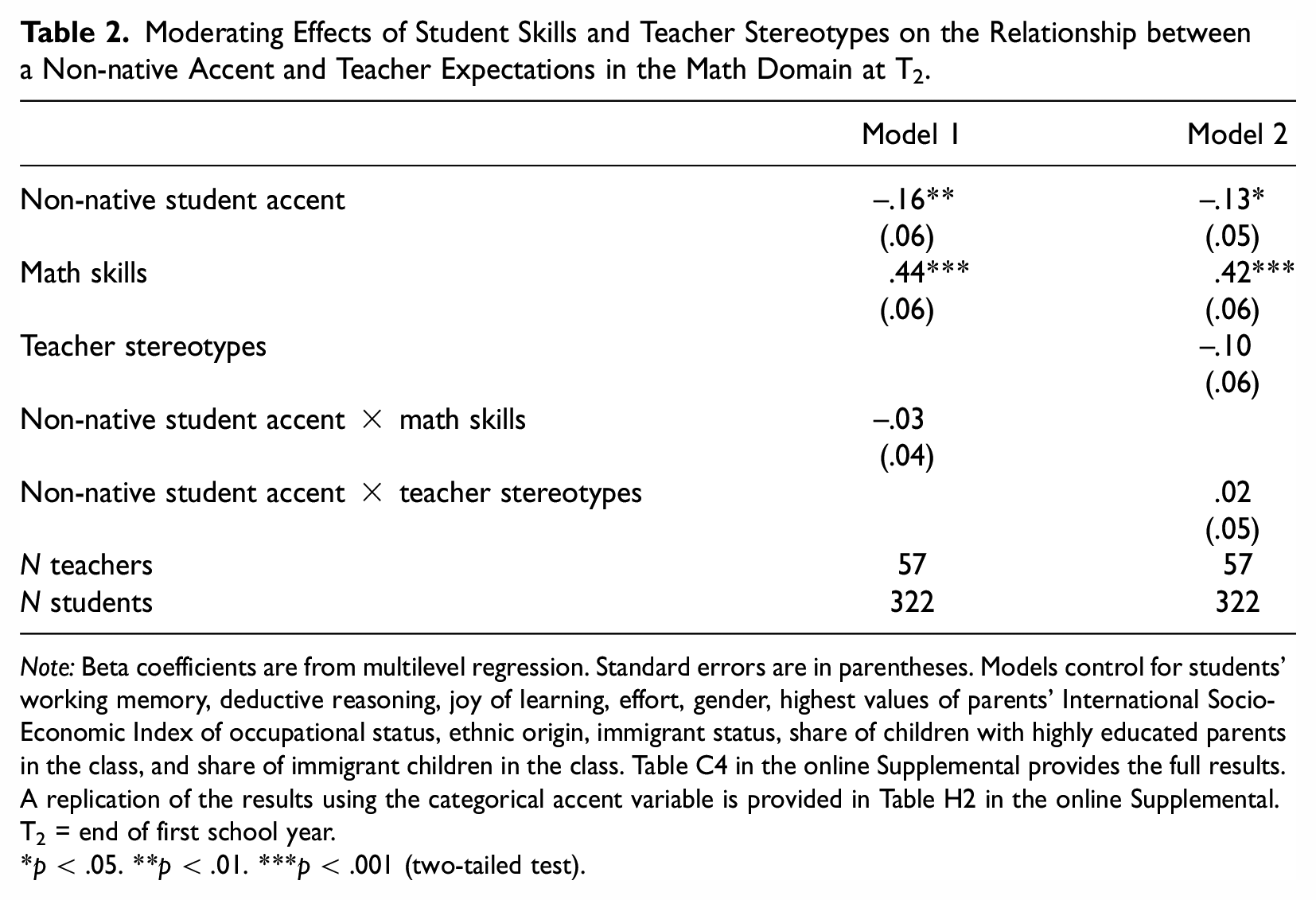
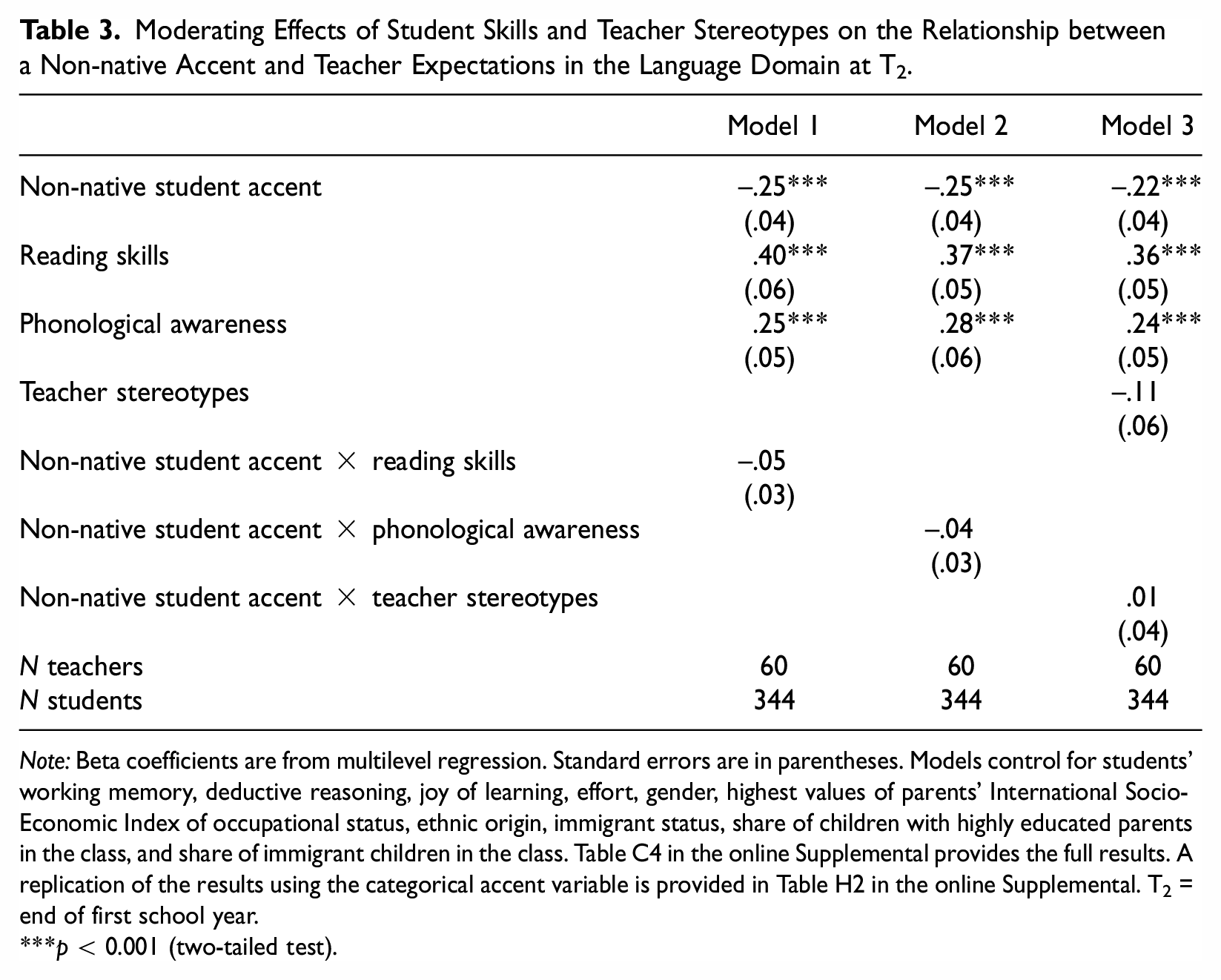
We next investigate whether non-native accents trigger ethnic stereotypes among teachers (see Tables 2 and 3). To do this, we estimate interaction effects between accent and students’ math, language, and phonological skills. Significant negative interactions between any of these skill variables and the foreign accent's strength would support Hypothesis 4, that is, stereotypic modes of impression formation triggered by a non-native accent hinder the processing of actual student information. In further models, we estimate cross-level interaction effects between the accent variable and the strength of teachers’ negative stereotypes about ethnic minority students. A significant positive interaction between our measures of negative teacher stereotypes and student accent would support Hypothesis 5, that is, non-native accents trigger the application of negative ethnic stereotypes during impression formation. In these analyses, which test Hypotheses 4 and 5, we use teacher expectations measured at T2 (end of the school year) as the dependent variable and student accent measured at T2 as an independent variable.
Moderating Effects of Student Skills and Teacher Stereotypes on the Relationship between a Non-native Accent and Teacher Expectations in the Math Domain at T2.
Note: Beta coefficients are from multilevel regression. Standard errors are in parentheses. Models control for students’ working memory, deductive reasoning, joy of learning, effort, gender, highest values of parents’ International Socio-Economic Index of occupational status, ethnic origin, immigrant status, share of children with highly educated parents in the class, and share of immigrant children in the class. Table C4 in the online Supplemental provides the full results. A replication of the results using the categorical accent variable is provided in Table H2 in the online Supplemental. T2 = end of first school year.
p < .05. **p < .01. ***p < .001 (two-tailed test).
Moderating Effects of Student Skills and Teacher Stereotypes on the Relationship between a Non-native Accent and Teacher Expectations in the Language Domain at T2.
Note: Beta coefficients are from multilevel regression. Standard errors are in parentheses. Models control for students’ working memory, deductive reasoning, joy of learning, effort, gender, highest values of parents’ International Socio-Economic Index of occupational status, ethnic origin, immigrant status, share of children with highly educated parents in the class, and share of immigrant children in the class. Table C4 in the online Supplemental provides the full results. A replication of the results using the categorical accent variable is provided in Table H2 in the online Supplemental. T2 = end of first school year.
p < 0.001 (two-tailed test).
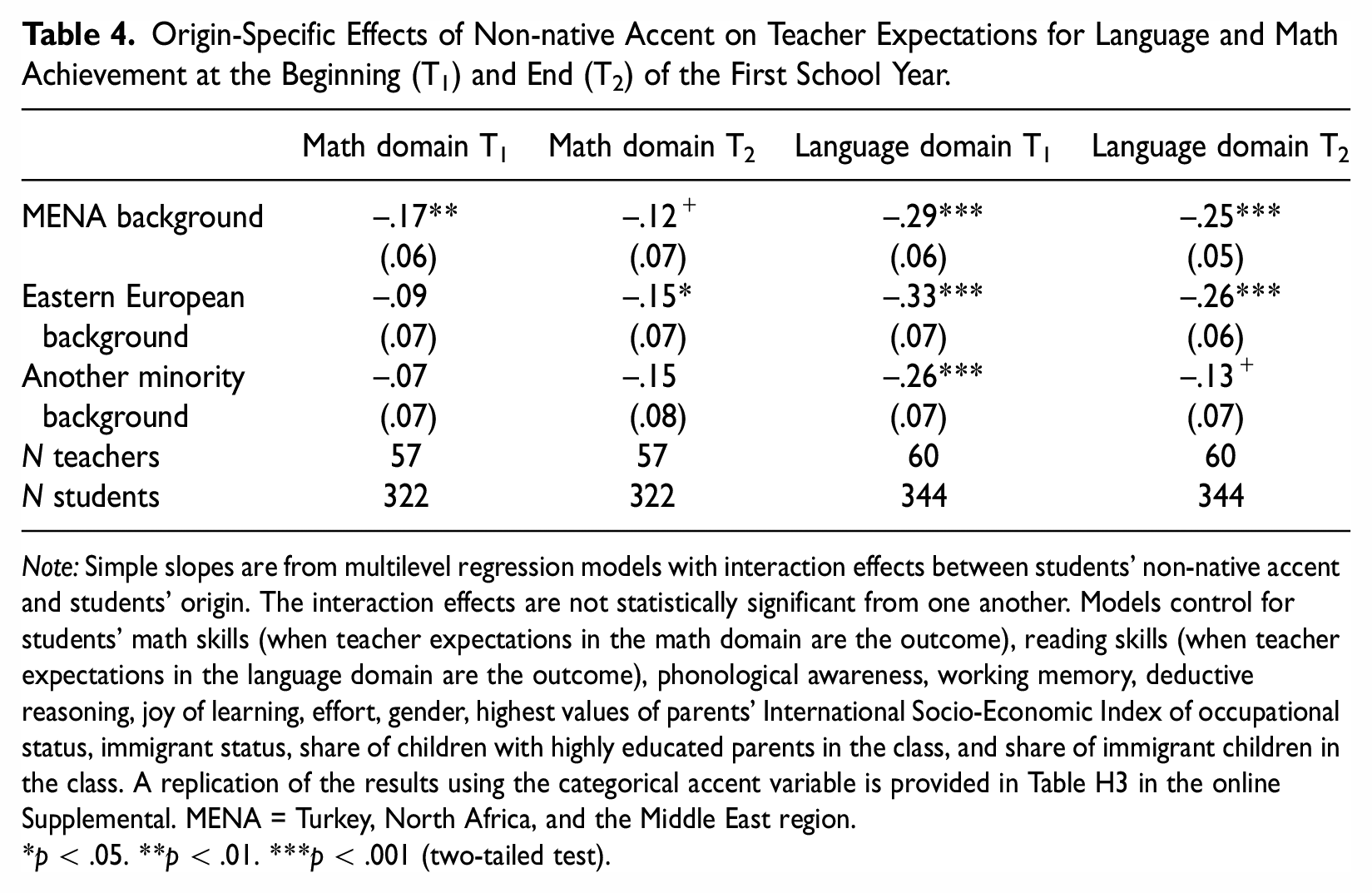
To test Hypothesis 6, we interact the accent variable with students’ ethnic origins. Table 4 provides information about possible origin-specific accent effects by presenting the main effects of non-native accents for each ethnic group (i.e., simple slopes).
Origin-Specific Effects of Non-native Accent on Teacher Expectations for Language and Math Achievement at the Beginning (T1) and End (T2) of the First School Year.
Note: Simple slopes are from multilevel regression models with interaction effects between students’ non-native accent and students’ origin. The interaction effects are not statistically significant from one another. Models control for students’ math skills (when teacher expectations in the math domain are the outcome), reading skills (when teacher expectations in the language domain are the outcome), phonological awareness, working memory, deductive reasoning, joy of learning, effort, gender, highest values of parents’ International Socio-Economic Index of occupational status, immigrant status, share of children with highly educated parents in the class, and share of immigrant children in the class. A replication of the results using the categorical accent variable is provided in Table H3 in the online Supplemental. MENA = Turkey, North Africa, and the Middle East region.
p < .05. **p < .01. ***p < .001 (two-tailed test).
All models account for the nested structure of the data (e.g., teacher expectations for students are nested in teachers) and can be expressed as follows:

Here,
Results
Descriptive Results
Figure 1 shows the distribution of the accent variable in the sample (top left panel) and for the three groups of students of different origins (remaining panels). Teachers judged that over one-third of the ethnic minority children spoke without a non-native accent (37 percent at T1 and 39 percent at T2). Additionally, the prevalence of a (perceived) non-native accent seems to decrease during the first year of schooling. The share of children that teachers perceived to speak with a strong non-native accent was highest in the MENA group and smaller in the Eastern European and other ethnic minority groups.
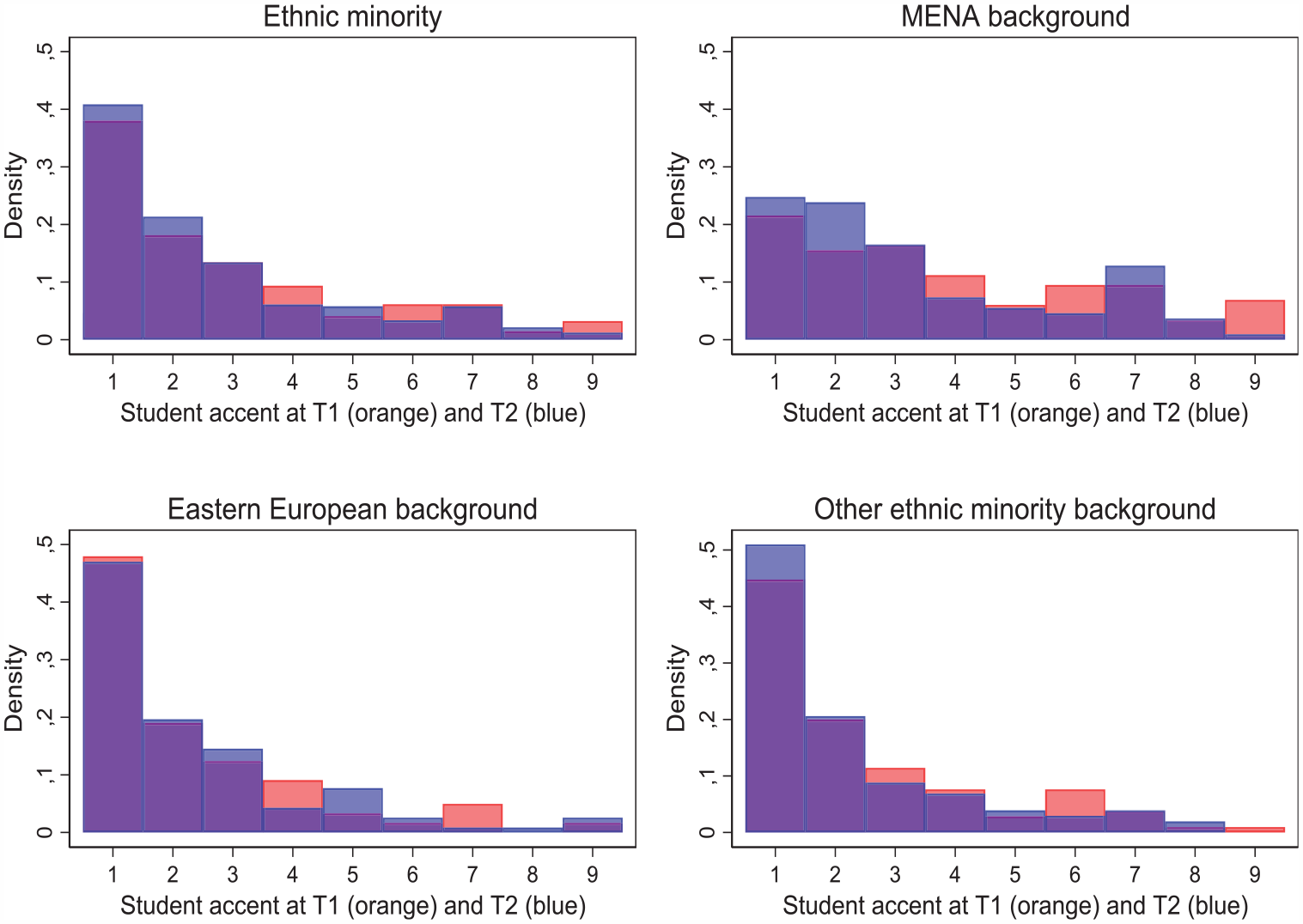
Distribution of non-native accents in the analyzed sample and within the three ethnic groups.
As Figure 2 indicates, the relationships between the strength of students’ non-native accents and their test scores in mathematics and phonological awareness are negative at the beginning and end of the school year. That is, the (teacher-perceived) strength of the non-native accent is negatively correlated with students’ math skills (r = –.25 at T1 and r = –.31 at T2) and phonological awareness (r = –.22 at T1 and r = –.39 at T2). The association between the strength of the non-native accent and reading skills is small at T1 (r = –.07) and more pronounced but still weak at T2 (r = –.30).
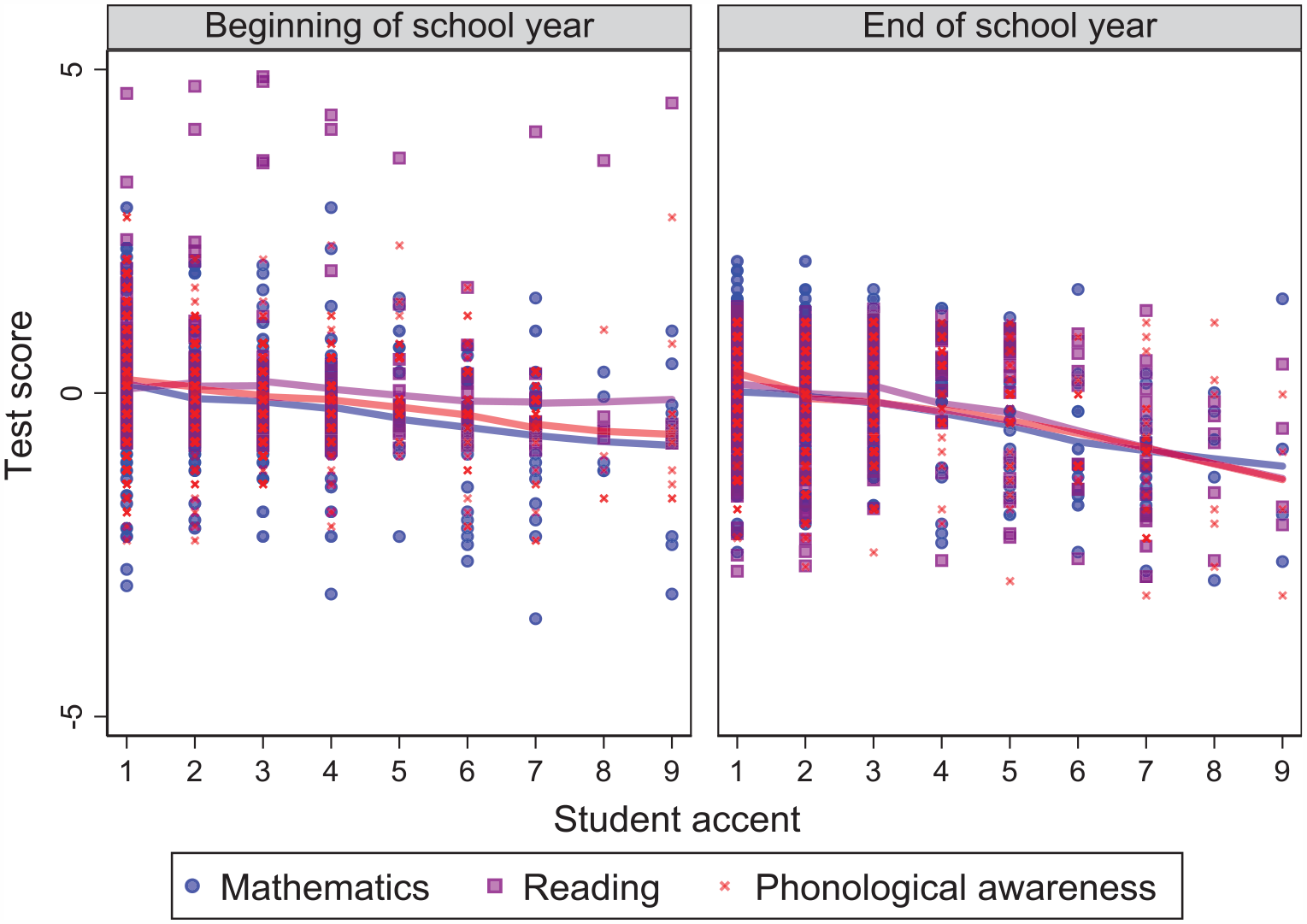
Relationships between student accent and test scores.
According to Figure 3, the associations between the strength of the student accent and teacher expectations do not vary considerably across the two observed time points. At the beginning and end of the first school year, teachers had lower expectations for the future achievements of students speaking with a strong non-native accent. Notably, the correlations are more pronounced for teacher expectations in the language domain (r = –.37 at T1 and r = –.43 at T2) than in the math domain (r = –.28 at T1 and r = –.32 at T2). Moreover, a non-native accent seems to be related to teacher expectations in the language domain in an almost linear manner. Nevertheless, in mathematics, we observe slight bends in the relationship between the accent values of 1 and 2 and between the values of 5 and 6. This corresponds to our theoretically grounded split of the scale to generate a categorical accent variable. Part B of the online Supplemental provides descriptive statistics of the dependent variables and the predictor and control variables in the analytic sample.
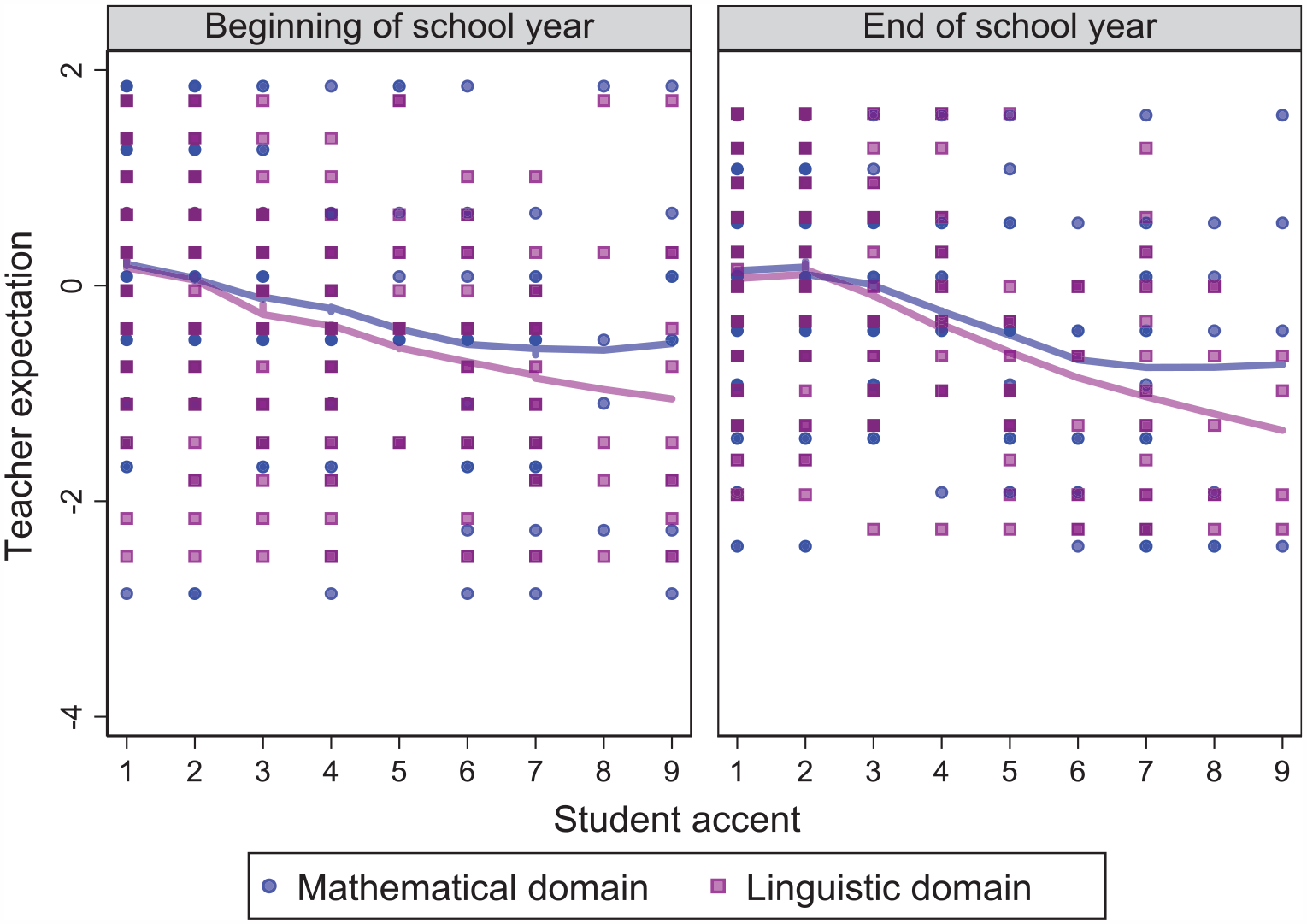
Relationships between student accent and teacher expectations.
Relationships between Non-native Accents and Teacher Expectations
Table 1 shows the beta coefficients for a non-native accent on teacher expectations in the math and language domains at the beginning (T1) and end (T2) of the first school year (Part C of the online Supplemental provides the full results). According to nonlinear modeling (categorical accent variable), a strong non-native accent is, in both domains and at both time points, a stronger predictor of teacher expectations than is a moderate accent. This is in line with Hypothesis 1. Additionally, we find significant negative coefficients of the continuous accent variable (linear modeling).
At both time points, the effects of a strong accent (nonlinear modeling) are smaller in the math domain than in the language domain, although the differences are statistically significant only at T1 (Δß = .53, p < .01 at T1 and Δß = .17, p ≥ .1 at T2). 3 Mirroring these results, the coefficient of the continuous accent variable (linear modeling) at T1 is also significantly smaller in the math domain than in the language domain (Δß = .12, p < .01 at T1 and Δß = .08, p ≥ .1 at T2). This partially supports Hypothesis 2, which states that non-native accents are more closely related to achievement expectations in the language domain than in the math domain because teachers may view accent-free pronunciation as a language-learning requirement.
The assumption, based on theories of statistical and error discrimination, that a non-native accent becomes less relevant for teacher expectations over time (Hypothesis 3) cannot be confirmed. Although the coefficient of the strong accent variable is larger at T1 than at T2 in the case of expectations for children's language proficiency, the difference is not statistically significant (Δß = .18, p ≥ .1). Similarly, we find no significant differences between the time points in the nonlinear modeling of possible accent effects on teacher expectations in the math domain (Δß = .18, p ≥ .1) or in the effects of the continuous accent variable in both domains (language domain: Δß = .02, p ≥ .1; math domain: Δß = .20, p ≥ .1).
The Role of Teacher Stereotypes
Tables 2 and 3 provide evidence on the questions of whether non-native accents reduce the effects of student skills on teacher expectations (Hypothesis 4) and trigger negative stereotypes among teachers toward ethnic minority students (Hypothesis 5). We start by interpreting the effects on teacher expectations in the math domain (see Table 2). Although we find a negative interaction effect between student accent and math achievement, indicating the role of students’ actual math skills in the formation of teacher expectations decreased with an increasingly strong non-native accent, this interaction is not statistically significant (Model 1). Negative teacher stereotypes about ethnic minority students do not significantly predict teacher expectations for minority students’ achievement, 4 and the effect of teachers’ negative stereotypes is not moderated by student accent (Model 2). These results contradict Hypotheses 4 and 5 in the math domain.
The results are somewhat different for teacher expectations in the language domain (see Table 3). Model 1 supports the assumption that reading skills play a decreasing role in teacher expectations with increasing student accents (Hypothesis 4). However, the coefficient is only significant at the 10 percent level. Similarly, the interaction effect between students’ phonological awareness and the strength of their non-native accents is negative, albeit at the 10 percent level of statistical significance (Model 2). Negative teacher stereotypes about ethnic minority students are associated with reduced teacher expectations, but also only at the 10 percent level of statistical significance (Model 3). However, similar to results in the math domain, this effect does not vary as a function of students’ non-native accents. This evidence contradicts Hypothesis 5.
Next, we examine whether a non-native accent has a differential effect on students of different ethnic origins (Hypothesis 6). Accordingly, we ran several regressions, each with one of the ethnic groups as the reference category, and estimated interaction effects between the strength of students’ non-native accents and their ethnic origins. Table 4 reports simple slopes, that is, the main effects of student accent for each reference category (i.e., for each ethnic group). At T2, the coefficients for non-native accent were ß = −.12 for the MENA group, ß = −.15 for the East European group, and ß = −.15 for the other-minority group. The similar sizes of these effects imply that non-native student accent predicts teacher expectations similarly across all origin groups, which contradicts Hypothesis 6. In fact, the interaction effects between student accent and ethnic origin (which are not displayed in Table 4) are not statistically significant in both domains and at both time points.
If one additionally considers the results presented in Tables 2 and 3, statistical relationships between non-native student accents and teacher expectations appear to emerge independent of student origin and teacher stereotypes about ethnic minority students. This interpretation is supported by additional analyses that replicate the results presented in Tables 2 and 3 separately for each ethnic origin group and reveal no group differences (results are shown in Part D of the online Supplemental).
Another set of analyses considers that our teacher expectation measure for the language domain encompasses teachers’ predictions of students’ linguistic skills (i.e., vocabulary and syntax), literacy skills (i.e., reading and writing words), and achievement in the school subject German, yet only some of these skills are captured with our standardized assessments (i.e., reading and phonological awareness). Therefore, we also conduct analyses focusing on teachers’ expectations for students’ literacy skills and test whether non-native accents significantly predict this specific outcome. Results are provided in Part E of the online Supplemental and confirm the robustness of our results.
Is the Effect of Accented Speech on Teacher Expectations Causal?
So far, we have established that a non-native accent is associated with less positive teacher expectations in primary school. The association is somewhat stronger in the language domain than in mathematics. The question is whether this association is causal (i.e., whether accented speech influences teacher expectations). Alternatively, as often happens in nonexperimental social science research, our findings could be subject to reverse causality (e.g., teachers with lower expectations for immigrant students may also report that these students speak with a stronger non-native accent). The problem of reverse causality could be present in our study because both variables—students’ accent and their expected future achievements—are not exogenous and were reported by the same teacher. At the beginning of the school year (T1), the teachers in our sample knew the students only for a short time and thus did not yet have comprehensive opportunities to learn about students’ actual performance. Therefore, it is unlikely that teachers’ achievement expectations determined their ratings of students’ accents. The situation is different at the end of the school year (T2), where reverse causality might have introduced bias. Between T1 and T2, teachers had ample opportunities to observe students’ actual performance, and their expectations should have become increasingly influenced by students’ achievements. These expectations, in turn, may have affected how teachers assessed children's accents at T2. Specifically, teachers might have reported non-native accents more frequently for students for whom they had lower achievement expectations.
To consider such endogeneity, we instrument our accent variable from T2 using (1) parental age at immigration 5 and (2) a dummy indicating whether or not a student is of immigrant origin. 6 Both instruments are relevant for whether a child speaks with a non-native accent, and they should be uncorrelated with the error terms of the outcome variables. 7 As a result, the instruments should isolate exogenous variation in the accent variable and affect teacher expectations only through their effects on students’ non-native accents (see Felton and Stewart 2022). Unfortunately, the instrumental variable (IV) regressions run into issues of reduced statistical power. The IV regression analyses rely on the variation across 177 students to predict accent effects on teacher expectations because parental age at immigration had a value of 0 in 46 percent of cases in the analysis sample. This could explain why the accent effects in these models do not reach statistical significance. However, the direction of the effects is the same as in Table 1, although effect sizes are smaller than those reported in Table 1, especially in the language domain (see Table F1 Part F of the online Supplemental). The results indicate confounding, which partly might have driven the accent associations with teacher expectations at T2. The confounding seems more substantial in the language domain than in the math domain, supporting our assumption that teachers perceive accent-free speech as a learning requirement in the school subject of German (which is in line with educational standards in Germany) and consider accents in their achievement evaluations.
We also estimate longitudinal fixed-effects models with student accent as the outcome variable and teacher expectations as a predictor. All time-invariant variation is canceled out in these models. The findings in Table F2 in the online Supplemental show that changes in teacher expectations in the math domain are unrelated to teachers’ accent evaluations. However, we find a significant effect of (changes in) teacher expectations on (changes in) student accents in the language domain. This suggests confounding of the teacher expectation and student accent measures at T2. In line with the IV analysis, this confounding occurs only in the language domain. That is, in the language domain, non-native accents not only affected teachers’ achievement expectations (as the IV analysis suggests), but teachers evaluated a non-native accent as being stronger when they expected lower achievement from a student—a pattern that was not found in the math domain.
Discussion
In this study, we investigated associations between non-native student accents and teacher expectations for the academic achievement of students starting school. One key finding is that a non-native accent is more strongly associated with teachers’ expectations in the language domain than in the math domain. This underlines the importance of native-sounding language in teachers’ perceptions of language proficiency, particularly in the early phase of teacher-student interactions in first grade. The finding that accent is a predictor of teachers’ expectations at the beginning of first grade, when reliable skill indicators are unavailable, suggests teachers might use a non-native accent as a signal of students’ language abilities. This would be in line with the basic prepositions of statistical discrimination theories.
At the same time, however, non-native student accents seem to have rather uniform negative effects on teacher expectations net of the results from ability assessments and measures of motivation, cognitive skills, socioeconomic status, ethnic origin, gender, and socioeconomic and ethnic classroom composition. That is, we observed persistent residual effects of non-native accent also at a later time point (i.e., at the end of first grade) and not only in the language domain, where teachers might perceive accent as a valid indicator of students’ skills, but also in the math domain. Although the associations between non-native student accent and teacher expectations differed significantly across the domains at the beginning of the school year, this was not the case at the end of the school year. Furthermore, the effect of non-native accent on teacher expectations at the end of the school year was not significantly smaller than the effect at the beginning of the school year. Finally, associations between non-native student accents and teacher expectations were found independently of teachers’ stereotypes about ethnic minority students and independently of students’ ethnic origins.
These findings suggest that either our measures of student abilities and skills suffer from major measurement error, and the residual accent effects we observed are a result of this error (Oaxaca 1973), or our results point to the stigmatization of speakers with non-native accents, potentially resulting from outgroup bias and negative associations with foreignness and disfluency. The latter conclusion aligns with experimental and nonexperimental findings in noneducational contexts (Atagi and Bent 2017; Dovidio and Gluszek 2012; Lev-Ari and Keysar 2010; Schmaus 2020). Specifically, the biasing effects of non-native accents might result from general negative cognitive associations and metacognitive processes that are triggered independently of cognitive associations with particular ethnic minority groups. According to this argument, bias among listeners is not necessarily caused by ethnic or racial stereotypes activated by non-native accents but may involve processing disfluency, which can undermine the perceived credibility of the accented speaker (Lev-Ari and Keysar 2010) and provoke prejudice toward them (Roessel et al. 2018). This matches with experimental evidence indicating that the stigmatizing effects of non-native accents can overshadow the negative effects of non-native appearance and perceived ethnic group membership on interpersonal impressions (Hansen et al. 2017; Rakić et al. 2011; Schmaus and Kristen 2022).
Limitations and Future Directions
Although we present the first evidence on the role of non-native accents in the context of education, our study is not without limitations. Most importantly, bias and discrimination cannot be directly measured in observational studies but are often investigated based on residual estimates (Oaxaca 1973). These measures rest on the assumption that all factors related to ability are validly accounted for and that any remaining effect of group membership on outcomes such as teacher evaluations or expectations reflects bias (Holzer and Ludwig 2003; Wenz and Hoenig 2020). This may be the case for our estimates of the effects of a non-native accent on teacher expectations. More specifically, student accents may be related to unobserved student characteristics that are associated with both learning progress and teachers’ expectations. However, the large number of controls in our analyses, including immigrant status but also test scores in math and reading, general cognitive abilities, parental socioeconomic status, student motivation, and classroom composition, leaves little room for unaccounted unobservables. By controlling for students’ phonological awareness, we even account for individual differences in an important prerequisite of reading proficiency, which is essentially determined by linguistic skills (Bäuerlein et al. 2012; Lippi-Green 2011). Nevertheless, we cannot rule out that unobserved student differences that correlate with accented speech may have driven (part of) our results. Examining the consequences of non-native accents within schools in experimental settings may provide further insights into the validity of our results.
Another possible criticism concerns the measurement of non-native student accents. This variable is based on teacher judgments, which might have been biased (see section “Is the Effect of Accented Speech on Teacher Expectations Causal?”). Fixed-effects regressions confirmed confounding of teachers’ expectations and their evaluations of student accents at T2, but only in the linguistic domain. At the same time, the IV analysis indicates that non-native accents negatively affected teacher expectations in the linguistic domain, although these effects were not statistically significant (probably due to reduced statistical power). Because we cannot determine the extent to which reverse causality biased our results, replications of our results using objective measures of students’ non-native accents are critical for assessing the robustness of our findings. Such measures might be obtained from coding video recordings of lessons or from interviewer ratings.
Another possible concern that might arise from our use of a teacher-based accent measure is that an objectively weak non-native accent might have been rated as stronger for students of MENA origins than for students of East European origins. Indeed, descriptive analyses show that teachers reported stronger accents for students from the MENA group than for students from the East European group and for other ethnic minorities (see Table B1 in the online Supplemental). However, given that in our sample children in the MENA group had a significantly lower level of German language proficiency, these group-specific teacher ratings might reflect actual group differences in accented speech. Our group-specific analysis of accent effects (see section “The Role of Teacher Stereotypes”) supports this interpretation.
Our study captured stereotypes in a general manner, asking teachers about their evaluations of school-success-related attributes of students of immigrant origin. Some teachers might have rejected these general items due to social desirability but might be (implicitly or explicitly) prejudiced toward students from certain origins, particularly toward children from negatively stereotyped groups, such as those with a MENA background (Peterson et al. 2016). An alternative specification of the analyses presented in Tables 2 and 3 is consistent with the main findings (see Part G of the online Supplemental). In this specification, teacher stereotypes referred to teachers’ beliefs about the average reading and math achievement of Turkish, Polish, and majority-group students (for details, see Lorenz 2021:Appendix 1). In line with (social-)psychological research on accent effects (see Lev-Ari and Keysar 2010; Roessel et al. 2018), stereotypes about the math and reading achievement of Turkish minority students did not moderate the accent effects among Turkish minority students, and stereotypes about the achievement of Polish minority students did not moderate the accent effects among East European students. Nevertheless, future studies should use more nuanced measures of stereotypes and prejudice.
The motivation and achievement variables from the end of the school year that we analyzed as predictors of teacher expectations might have been affected by earlier teacher expectations measured at the beginning of the school year through a self-fulfilling prophecy (Gentrup et al. 2020). In these instances, the relevance of motivation and academic achievement for end-of-year teacher expectations might have been overestimated, and accent effects might have been underestimated. Additional analyses, in which we excluded the motivation measures from the calculations, confirm the robustness of our results (results available on request). Nevertheless, alignment between teacher expectations and student achievement at the end of the first school year, possibly resulting from self-fulfilling prophecies, might have biased our results at T2.
Our findings provide tentative evidence for the stigmatization of students with a non-native accent. At the same time, we cannot rule out that implicit and explicit stereotypes and prejudice toward specific groups influence accent effects on teacher judgments. Although our results point to generally negative effects of accented speech, future work should use exogenous measures of student accent and adequately test for mediating processes to answer the question of whether and how non-native accents induce teacher biases.
Conclusion
Our study contributes to recent sociological research highlighting that non-native accent must be considered a meaningful social cue, potentially creating social boundaries and affecting interpersonal perceptions and behavior (Kogan et al. 2021; Schmaus 2020; Schmaus and Kristen 2022). Our results demonstrate that non-native accents within schools are negatively associated with teacher expectations for future student achievement. This evidence is of vital importance for the sociology of education because inaccurate teacher judgments of ethnic minority students’ achievement can result in biased evaluations and recommendations, such as in grading or ability grouping (Bonefeld and Dickhäuser 2018; Downey and Pribesh 2004; Glock 2016), which may influence students’ eventual attainment. Biased teacher expectations for ethnic minority students’ achievement may also contribute to ethnic achievement gaps by affecting teachers’ classroom behaviors and, thus, students’ learning progress, potentially resulting in a self-fulfilling prophecy (Gentrup et al. 2020; Wang, Rubie-Davies, and Meissel 2018). These processes might give rise to educational inequalities between ethnic minority and majority students net of their initial skills and abilities. We hope our research inspires future studies to increase awareness among scholars and practitioners of the subtle processes contributing to the inequality of constraints (Jackson 2021).
Supplemental Material
sj-docx-1-soe-10.1177_00380407231202978 – Supplemental material for Non-native Accents among School Beginners and Teacher Expectations for Future Student Achievements
Supplemental material, sj-docx-1-soe-10.1177_00380407231202978 for Non-native Accents among School Beginners and Teacher Expectations for Future Student Achievements by Georg Lorenz, Irena Kogan, Sarah Gentrup and Cornelia Kristen in Sociology of Education
Footnotes
Acknowledgements
We thank Petra Stanat for her enormously helpful feedback on an earlier version of this article. Thanks also to the editors and anonymous reviewers, whose comments greatly improved the article. The responsibility for the content of this publication lies with the authors.
Authors’ Note
Georg Lorenz is currently affiliated to Leipzig University, Leipzig, Germany and University of Potsdam, Potsdam, Germany.
Funding
The author(s) disclosed receipt of the following financial support for the research, authorship, and/or publication of this article: We acknowledge financial support from the Federal Ministry of Education and Research of Germany (Project No. 01JC1117).
Research Ethics
Herewith, we affirm that all research on human subjects has been approved by the ethics committee of the University of Mannheim and has therefore been performed in a way that is consistent with the ethical standards articulated in the 1964 Declaration of Helsinki and its subsequent amendments and Section 12 (“Informed Consent”) of the ASA's Code of Ethics. All human subjects gave their informed consent prior to their participation in the research, and adequate steps were taken to protect participants’ confidentiality. The data analyzed in this study can be accessed through the Research Data Centre at the Institute for Educational Quality Improvement:  . The authors will provide Stata code for recreating the analyzed subsample and replicating the results on request.
Supplemental Material
Supplemental material for this article is available online.
Notes
Author Biographies
References
Supplementary Material
Please find the following supplemental material available below.
For Open Access articles published under a Creative Commons License, all supplemental material carries the same license as the article it is associated with.
For non-Open Access articles published, all supplemental material carries a non-exclusive license, and permission requests for re-use of supplemental material or any part of supplemental material shall be sent directly to the copyright owner as specified in the copyright notice associated with the article.
