



Abstract
Stratification in selective college admissions persists even as colleges’ criteria for evaluating merit have multiplied in efforts to increase socioeconomic and racial diversity. Middle-class and affluent families increasingly turn to privatized services, such as private college consulting, to navigate what they perceive to be a complicated and opaque application process. How independent educational consultants (IECs) advise students can thus serve as a lens for understanding how the rules of college admissions are interpreted and taught to students. Through 50 in-depth interviews with IECs, I find that IECs encourage students to be authentic by being true to themselves but that demonstrating authenticity requires attention to how one’s authentic self will be perceived. Translating an authentic self into an authentic application also involves class-based and racialized considerations, particularly for Asian American students who are susceptible to being stereotyped as inauthentic. These findings suggest that efforts to improve diversity must be carefully implemented, or they risk reproducing inequality.
Research has long demonstrated that higher education reflects and reproduces social stratification (Lareau and Weininger 2008). Stratification has persisted even as colleges’ definitions of merit have evolved, from the post-World War II growth of standardized testing, intended to find talented students regardless of class (Lemann 2000), to a renewed focus on holistic review, intended to identify more diverse college classes by evaluating students’ personal characteristics and contextual factors (Bastedo et al. 2018; Jaschik 2020). Yet research suggests that class and race remain encoded in evaluation criteria (e.g., Alvero et al. 2021; Dixon-Roman, Everson, and McArdle 2013; Rosinger, Ford, and Choi 2021). Most recently, Asian Americans have become highly visible in conversations about defining merit, with debates about whether their high levels of educational achievement have prompted colleges to apply different standards to this group.
Theories of cultural capital can illuminate how stratification persists in admissions despite efforts to mitigate it. Students enter the college application process with varying degrees of resources and information, and family class status plays an important role in students’ abilities to understand and meet colleges’ standards for qualifications and cultural fit (Lamont and Lareau 1988; Lareau and Weininger 2008; Silva, Snellman, and Frederick 2014). As colleges’ criteria for evaluating merit multiply, to include assessments of students’ character and authenticity, so too do families’ strategies for navigating admissions. Privatized services, such as standardized test prep and tutoring, have become prominent features of the so-called “admission industrial complex” (Liu 2011).
A fast-growing part of this sector is college consulting. These private consultants, also known as independent educational consultants (IECs), guide students and families through the application process, which now incorporates not only standardized tests but also the presentation (Beljean 2019) of an applicant’s qualifications via personal statements, short essays, letters of recommendation, and interviews. Although research on IECs is relatively nascent, IECs’ numbers quintupled between 2005 and 2015, to approximately 7,500 consultants in the United States (Sklarow 2016). The growing engagement of IECs reflects families’ strategic responses to what they perceive as an increasingly complicated and opaque (Bastedo et al. 2018) college application process and perceived deficits in school-based counseling (McDonough 2004). As a result, the ways IECs advise students can serve as a lens for understanding how colleges’ stated interest in subjective criteria are interpreted and taught to students and how class and race remain embedded in the process.
Through 50 qualitative interviews with IECs, I find that IECs echo colleges in promoting the importance of being authentic in one’s applications; they thus understand their role as helping students demonstrate authenticity. However, the persistent need to present an attractive application reveals the inherently evaluative nature of authenticity. Moreover, the demonstration of authenticity is subject to class-based and racialized considerations, showing how class remains encoded in the evaluation process and how cultural capital differs across racial groups (Cartwright 2022).
Navigating College Admissions AMID A “Shifting Meritocracy”
Class-Based and Racialized Cultural Capital in College Admissions
For decades, scholars have drawn on various definitions (Davies and Rizk 2018) of cultural capital (Bourdieu 1979) to study the role of culture in reproducing inequality via educational and other institutions (Lareau and Weininger 2008). In the case of college admissions, cultural capital’s role in the reproduction of inequality can perhaps best be understood as the “institutionalized, i.e., widely shared, high status cultural signals (attitudes, preferences, formal knowledge, behaviors, goods and credentials) used for social and cultural exclusion” (Lamont and Lareau 1988:156). That is, colleges apply institutionalized standards, such as high school GPA, class rank, and standardized test scores, to evaluate students’ qualifications. From students’ perspectives, applying to college requires “savvy,” or “the tools, skills, knowledge, behaviors, and resources that must be mobilized, more or less consciously, in order to apply, get in, decide where to go, choose a major,” and so on (Silva et al. 2014:40).
Class fundamentally affects access to these resources. Middle-class parents are more likely than working-class and poor parents to mobilize cultural resources, such as their own knowledge of the higher education system, to aid in their children’s transition to a college-going adulthood (Lareau and Weininger 2008) and to circulate admissions savvy in their networks (Silva et al. 2014). These admissions-related behaviors are a form of habitus for privileged families (Weis 2016), enabling students to accrue the credentials and send the high-status signals that colleges seek. Class has remained relevant even as institutional definitions of merit have evolved over time. For example, standardized tests became prominent in the post-World War II era—dubbed “the shifting meritocracy” (Alon and Tienda 2007)—with the goal of helping schools identify “intelligent” students regardless of class background (Lemann 2000). However, fulfilling the adage, “what gets measured gets managed,” the growing use of standardized tests spurred the development of services oriented to helping students improve their scores, such as prep courses and private tutors (Alon and Tienda 2007). Many observers now note that standardized test scores reflect not aptitude but, rather, socioeconomic status and other indicators of inequality (Dixon-Roman et al. 2013).
Literature on cultural capital is often race-blind (Richards 2020), which can lead scholars to construct it as equivalent to “Whiteness” (Wallace 2018). However, questions about race are fundamental to understanding the strategies used to succeed in admissions. Standardized tests have long been criticized for being racially and culturally biased against Black, Latinx, and Indigenous students (Rosales and Walker 2021). Debates about whether Asian Americans are held to higher standards on SAT scores have also persisted for decades (Takagi 1990), in light of Asian American students outperforming White students (Espenshade and Radford 2009; Hsin and Xie 2014). Although some see Asian American students’ educational achievement as a sign of successful assimilation, others view this assimilation as fundamentally racialized (Lee and Kye 2016). Indeed, Asian American families’ emphasis on academics has been criticized as “weird” (Jiménez 2017), damaging to non-Asian students’ educational opportunities (Dhingra 2020), and obsessive (Warikoo 2022). Moreover, the “model minority” stereotype of Asian Americans obscures heterogeneity within the category and casts other racial minority groups as responsible for their own challenges (Ngo and Lee 2007).
The Promises and Challenges of Holistic Review
Partially in response to these concerns about inequality, the use of “holistic review” in admissions has increased, particularly at selective universities. Holistic approaches, which can include the consideration of applicants’ characteristics, circumstances, and environments (Bastedo et al. 2018), have become widespread; in a 2019 survey of admissions officers, more than half responded that “positive character attributes,” writing samples, and recommendations were of “considerable” or “moderate” importance (National Association for College Admission Counseling [NACAC] 2020). Even the College Board, maker of the SAT, has produced a dashboard aimed at contextualizing scores within students’ school and neighborhood environments. Importantly, unlike early practices in which colleges evaluated nonacademic factors in order to exclude groups that scored well on entrance exams (Karabel 2005), contemporary use of holistic review is often a strategy for expanding colleges’ conceptions of “merit” and enrolling more diverse classes (Gebre-Medhin et al. 2022; Jaschik 2020). Moreover, cognizant that socioeconomically privileged students may be engaged in an arms race of extracurricular and volunteer activities designed to impress admissions, recent initiatives have encouraged colleges to prioritize “authentic” engagement (Weissbourd 2019). Indeed, “authenticity” has become an admissions buzzword, with colleges appearing to prefer applicants who are imperfect but genuine (Feeney 2021).
Yet one recent analysis revealed that considering subjective factors (i.e., information from interviews, essays, and character evaluations) had no effect on enrollment outcomes for low-income or racially marginalized students at selective universities (Rosinger et al. 2021). Furthermore, a computational analysis of 240,000 University of California admissions essays found that essay content and style were correlated with self-reported household income, suggesting that subjective factors are not immune to socioeconomic biases (Alvero et al. 2021). 1 More recently, Harvard has faced accusations that its “personal rating” metric discriminates against Asian American students, who are expected to be academically successful (Lee and Zhou 2015) but also face stereotypes about their lack of warmth and leadership capabilities (Fiske et al. 2002; Lin et al. 2005). From a theoretical perspective, even “authenticity” is not value, class, or race neutral; rather, it is subject to audiences’ expectations and moral judgment (Grazian 2018; Peterson 2005).
These prior studies serve as cautionary tales for the use of holistic review, raising the following questions: How do class and race remain encoded in the college application process, particularly for subjective components of college applications? Moreover, are there racial differences in what constitutes cultural capital in applying to college? Answering these questions can lead to a better understanding of how stratification persists in admissions, even as universities’ standards of evaluation shift over time. To do so, I draw on an emerging strategy for navigating college admissions: the engagement of private college counselors.
Independent Educational Consulting in the College Admissions Process
Just as test prep services emerged in response to the growing use of standardized tests, additional services have sprung up to provide resources to families seeking to prepare their children for the college admissions process (Liu 2011). These evolving strategies reflect how “the terms of interaction and competition . . . are constantly being redefined” (McDonough, Korn, and Yamasaki 1997:301) as actors within a social field (Bourdieu 1979) gain cultural capital and subsequently alter the rules of the game.
One increasingly common strategy is hiring a college consultant, also known as an independent educational consultant (IEC). Private college consulting has existed since at least the 1990s, but the profession has grown exponentially in the past two decades, now comprising more than one-third of a $1.9 billion educational consulting industry (Hiner 2020). IECs’ services vary but can include assistance on all components of the application, such as essay coaching, interview preparation, and deciding which schools to apply to.
Prior research has examined IECs using a field analysis approach, situating IECs among applicants, high schools, and colleges (McDonough et al. 1997). IECs often have relationships with all these actors, and many have backgrounds in education, whether as admissions officers, school-based counselors, or teachers (Sklarow 2018). Another trajectory is that of a parent, typically a middle-class mother, who works with her own children through the application process and then parlays that experience into a business while seeking formal training and credentialing. IECs may also visit campuses and attend professional development and networking events, thus engaging with admissions as well. IECs are thus uniquely situated within the admissions field, not defining the terms of competition but, rather, interpreting them.
There is limited up-to-date research on who hires IECs. One exception is the nationally representative High School Longitudinal Study, which found that 12 percent of juniors surveyed in 2012 reported having consulted a hired counselor (Ho, Park, and Kao 2019). IECs are typically engaged by higher-income families (Ho et al. 2019), with the majority describing their typical client as “upper class/wealthy” or “professionals/upper middle class” (Independent Educational Counsultants Associations 2015); however, many IECs also engage in pro bono work. 2 Early work found that students who consulted an IEC were disproportionately more likely to be White (McDonough et al. 1997); more recent data suggest students with immigrant parents are more likely to report having consulted a hired counselor compared to students with nonimmigrant parents (Ho et al. 2019). 3
Although there is limited research on whether IECs affect admissions outcomes, some work suggests that IECs provide strategic value. For example, receiving advice from a private counselor can increase the likelihood that students will enroll via early decision, which is often considered an advantage because colleges typically accept more students in early admissions pools (Park and Eagan 2011). Some IECs are also involved in other college-going strategies, such as helping clients obtain internships and advising on course enrollment and extracurriculars (Gardner 2001; Kirp 2004). Families also seek IECs’ assistance with organization and discipline, managing expectations, alleviating stress, and mediating between parents and children (McDonough 1994; McDonough et al. 1997; Smith 2014; Smith and Sun 2016; Sun and Smith 2017).
The growth of the IEC profession therefore reflects families’ strategic responses to what they perceive as an increasingly complicated college application process. As a result, the ways they advise students can serve as a lens for understanding (1) how colleges’ stated criteria are interpreted and taught to applicants, (2) how applicants might think about sending the desired signals, and (3) the class and racial dimensions of doing so.
Methods
Recruitment
I draw on 50 semistructured qualitative interviews with IECs, conducted between fall of 2019 and summer of 2020. Recruitment was limited to California and New York for two main reasons: First, early work on IECs found high concentrations in these states (McDonough et al. 1997). Second, interviews were part of a larger project examining perceptions of racial identity and diversity in the context of recent controversies about affirmative action, and both states have large non-White populations.
The majority of participants (n = 39) were recruited using membership lists of national professional organizations that include IECs. 4 I initially randomly sampled IECs from these organizations. As data collection proceeded, I sought geographic and racial diversity, using cities and last names 5 to refine recruitment. Thus, the final sample should not be construed as randomly selected but as maximizing variation within these states. This method tended to yield IECs who worked as solo or small-group practices. However, IECs are not required to hold professional certifications or affiliations, and some work for larger firms. I therefore identified firms cited in news articles about IECs or listed on LinkedIn, and I reached out to employees at those firms, yielding seven interviews. Finally, I recruited a small number of interviewees through personal networks and snowball sampling, yielding four interviews.
Sample Characteristics
Many respondents expressed that preserving their students’ anonymity and their own reputations was critical. I therefore use pseudonyms for all respondents and include demographic descriptors only when relevant. Because demographic information could potentially be triangulated to identify individuals, I provide summary demographics in lieu of individual details (see Table 1).
Demographic Characteristics of Independent Educational Consultant Respondents.
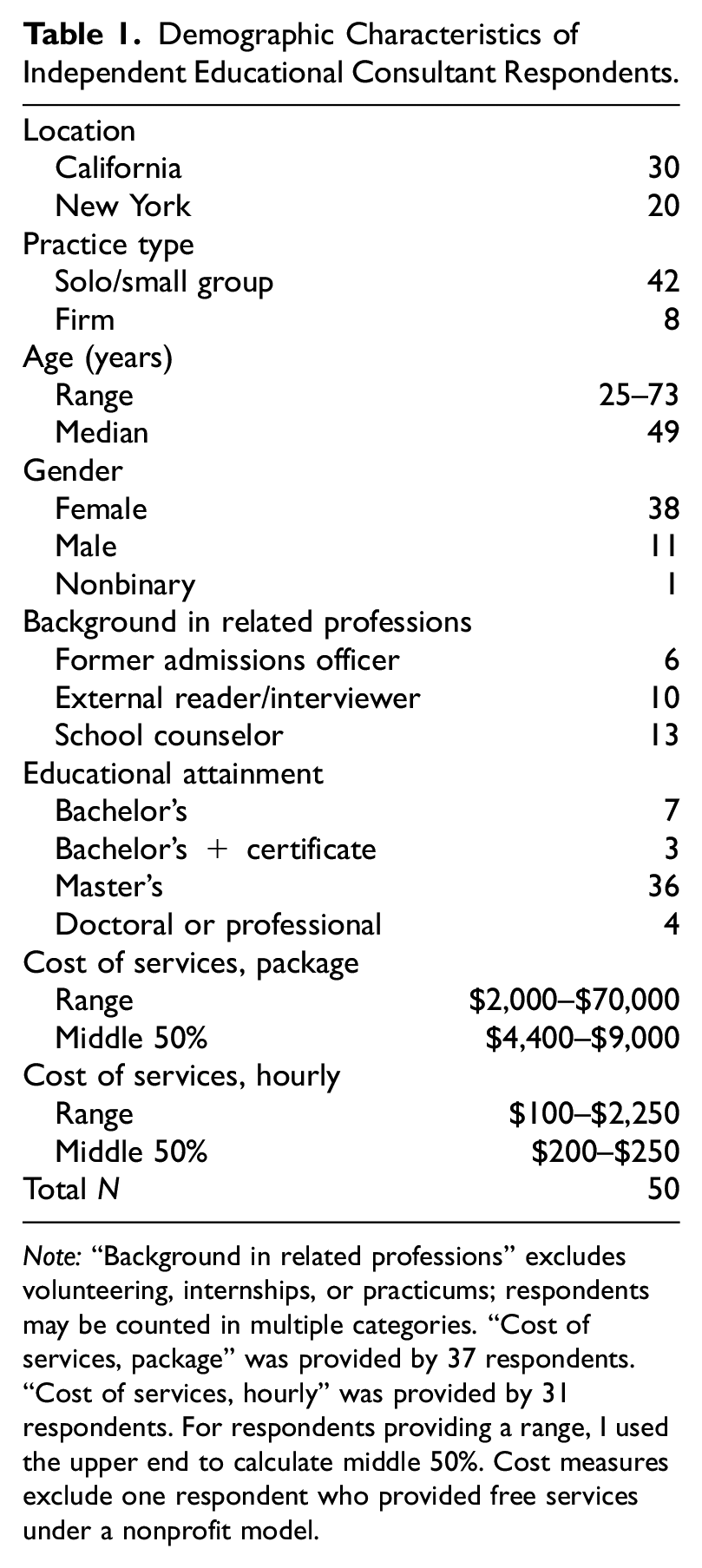
Note: “Background in related professions” excludes volunteering, internships, or practicums; respondents may be counted in multiple categories. “Cost of services, package” was provided by 37 respondents. “Cost of services, hourly” was provided by 31 respondents. For respondents providing a range, I used the upper end to calculate middle 50%. Cost measures exclude one respondent who provided free services under a nonprofit model.
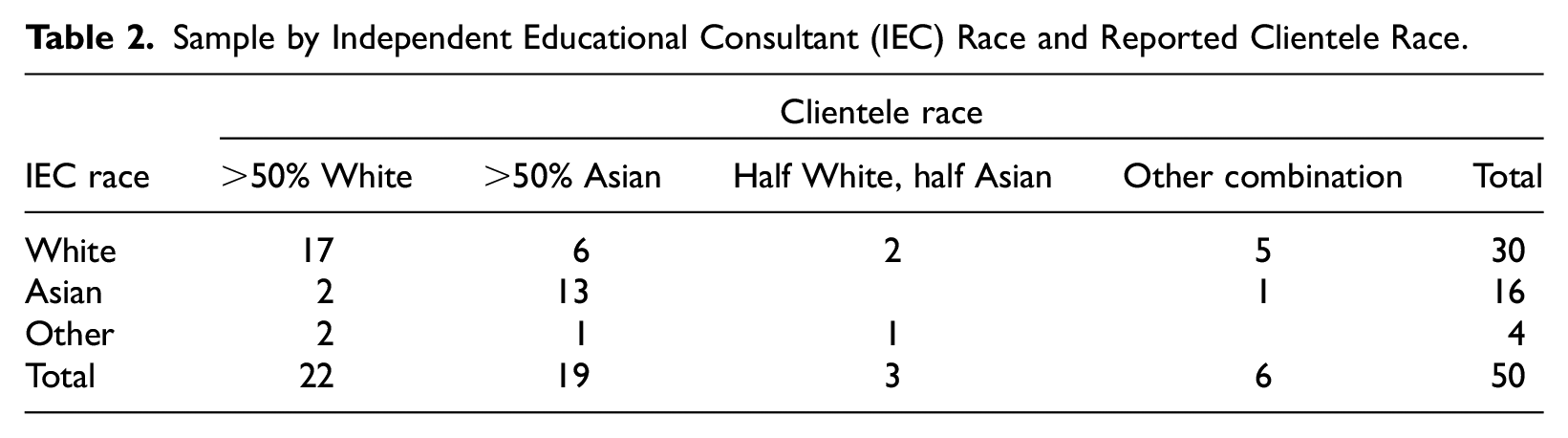
As mentioned previously, I sought racial diversity in my sample. Table 2 summarizes IECs’ descriptions of their own and their clients’ racial and ethnic identities. Among my 50 respondents, 30 self-identified as White, and 16 identified as Asian; this sample likely overrepresents non-White IECs, according to the limited available data. 6 The majority of White interviewees worked primarily with White clients, and the majority of Asian interviewees worked primarily with Asian clients. Most worked with very few, if any, Black, Latinx, or Indigenous clients. This is likely due to a combination of neighborhood segregation and racial homophily in the referral networks that provide IECs with their clientele.
Sample by Independent Educational Consultant (IEC) Race and Reported Clientele Race.
Interviews
The typical interview lasted between 60 and 90 minutes. Interviews probed IECs’ processes for working with students; the advice they tended to give about elements of the process, including deciding where to apply, writing essays, and obtaining letters of recommendation; their perceptions on issues relating to diversity, stereotyping, discrimination, and affirmative action; and their overall perceptions of their work and the profession. Interviewees were not compensated.
My status as a graduate student researcher at Columbia University was salient during interviews. Respondents inserted “Columbia” into hypothetical scenarios and asked about my experiences there. In addition, nearly all participants had earned a postbaccalaureate degree or certificate, often in college counseling; were often familiar with scholarly work on college admissions; and expressed interest in my findings. I was therefore granted access to a population that was both interested in my background and willing to participate and with whom I shared a common language.
Because interview topics included the consideration of race in admissions, I was keenly aware that my presence as an Asian American woman could influence participants’ responses. My analysis on this front is informed by the idea that although respondents may have been performing, that performance itself is analytically useful insofar as it reveals respondents’ values and priorities (Monahan and Fisher 2010; Pugh 2013). How IECs presented themselves to me provided useful information on how IECs present themselves to clients and, in turn, on how they advise clients to present themselves to admissions officers.
Data Analysis
With respondents’ permission and Institutional Review Board approval, interviews were audio-recorded and transcribed verbatim. For respondents who declined to be recorded, I took detailed notes during the interview. I analyzed transcripts using a combination of deductive and open coding in Atlas.ti. I created attribute and index codes (Deterding and Waters 2021) based on the interview schedule, and I developed additional analytical codes as new themes emerged, regarding topics such as competition, mental health concerns, inequality, and authenticity (for examples of codes, see Table S1 in the online Supplemental Material). After coding, I used visual displays to organize data and look for patterns and relationships (Miles, Huberman, and Saldana 2014), for example, sorting responses according to respondents’ client demographics. Finally, I wrote analytic memos throughout the data collection, coding, and analysis processes as a means of reflecting on and exploring preliminary themes and findings.
Translating Authentic Selves Into Authentic Applications
Most consultants typically encouraged students to apply to a “balanced” list of schools, including ones with higher acceptance rates (e.g., above 50 percent), where they were likely to be admitted. Nevertheless, they characterized their clients as primarily being interested in more selective, often extremely selective, universities. These more competitive schools comprise a minority of institutions: Only 19 percent of four-year institutions accept fewer than 50 percent of applicants, and only about 7 percent of schools accept fewer than 30 percent of applicants (Desilver 2019). Yet students’ interests meant IECs’ time was likewise concentrated on these schools, particularly on the subjective components that are more likely to be valued by private and selective universities compared to public and less selective universities (NACAC 2020).
Often, interviewees worked most intensely with students on personal essays. Here, they emphasized that regardless of students’ résumés and activities, students should seek to portray their true selves and values—reflecting colleges’ interests in authenticity (Feeney 2021). Interviewees’ responses thus revealed how IECs transmitted knowledge about the perceived value of authenticity when it came to subjective factors and how IECs helped students translate their experiences into applications they believed would be both authentic and attractive to admissions. Interviews also revealed class and racial constraints on authenticity.
Transmitting Knowledge about the Importance of Being Authentic
According to IECs, some families approached them with the expectation that IECs would help “package” their children. However, interviewees generally disavowed this idea; as Margaret, a White IEC, said, “‘Packaging’ is a word that makes my skin crawl.” Contrary to this expectation, interviewees were clear that students should care about whatever they wanted, pursue their genuine interests, and be true to themselves in their essays. They were largely opposed to what another IEC, Nancy (White), called “résumé-building for résumé-building’s sake.” In other words, students should be authentic. For example, Sam (White) told me, [U]sually parents want to know, what are the activities that my kids should be doing? What are the right activities? . . . The answer is, the colleges want to see the kid really excelling in their extracurricular and that’s only going to happen if the kid is really into it. So it’s whatever the kid wants to do. The parents are like, that can’t be the answer.
According to Sam’s and similar respondents’ logic, students who pursued their true interests would be happier and healthier. Their passions would be readily apparent in their applications—which would ultimately be more successful.
Being Authentic versus Demonstrating Authenticity
However, whereas being authentic was the product of students’ natural interests, demonstrating authenticity was another matter, one that was imbued with contradictions. On the one hand, authenticity, by definition, cannot be faked. As Anna, a White IEC, said, I think it’s very apparent and obvious when they know it looks good so they’re just writing about it, versus a kid who’s actually genuinely passionate and can write about it authentically.
Other interviewees described being able to tell if an essay had been written or overly coached by an adult or if the student tried too hard to impress. As another IEC, Caitlin (White), said, “It’s one of those things that’s really hard to describe, but you know it when you feel it.” Yet IECs also acknowledged that honing an authentic voice took work. Anna added: And so I’ll help them add, you know, I’ll coach them on how to bring that voice authentically into the essay. Instead of it reading kind of like a stiff essay where they’re just listing out what they did.
Anna’s response suggests that students all inherently have authentic voices, but expressing that voice was not always easy. In fact, IECs interpreted their ability to help students reveal their authentic selves as a function of getting to know students over long periods of time. As Cherie, a White IEC, described, [T]he beauty is knowing the kids for a longer period of time and spending quality time with them, talking about their preferences and knowing who they are. . . . I can hear if they’ve given it to a friend or something else like that in their writing, and just saying, “This doesn’t sound like you.”
With only a few exceptions, interviewees suggested that the earlier a student hired them, the better. If IECs could encourage students to pursue their true interests early on, those interests could eventually translate into an authentic essay. Building long-term relationships was critical to learning more about students and thus helping them demonstrate their authenticity. This example also demonstrates how claims of authenticity are subject to evaluation (Peterson 2005). That is, the work of portraying oneself authentically involves considering whether one will be perceived as authentic.
Constructing an Authentic Application
Interviewees encouraged being authentic, but applicants are ultimately presenting themselves for evaluation. IECs’ advice thus included caveats about how to meet what they perceived to be universities’ expectations. First, demonstrating authenticity required internal consistency. As Deborah, a White IEC, said, The authenticity will come through. . . . It will tell that student’s story, when the pieces go together, when what they’re writing in their essays and their short answers are matching the classes that they’re taking and the extracurriculars that they do and the community service they do. . . . It’s when the pieces just don’t go together. Like, this is weird. Yes you could do musical theater, but you want to go to a seven year [BS/MD] program, but you didn’t become an ambulance rider.
Deborah, like others, emphasized that authenticity was first and foremost the result of passionate interest. However, she also implied that demonstrating authenticity entailed consistency, or “all the pieces go[ing] together,” including extracurriculars and coursework. If not, an applicant’s stated goals could be perceived as inauthentic.
Indeed, over the course of data collection, I encountered a common refrain: Selective colleges seek well-rounded classes, not well-rounded individuals. Students who failed to realize this and whose applications therefore lacked internal consistency risked being dismissed (Toor 2001). Thus, a student’s interests, or at least how they presented their interests, would ideally coalesce around a theme, creating a coherent narrative for an admissions officer. IECs sought to help students identify that theme and ensure it translated onto their applications.
A second expectation was the avoidance of clichéd essay topics; per interviewees, these included sports-related injuries, divorce, or the deaths of pets or extended family members. IECs typically added that students could write about these topics as long as they approached them from a unique perspective. Myra, an Asian American IEC, told me that in her previous role as an admissions officer, I probably read 7,000 applications, which translates to 35,000 essays. And so you do see some common themes arise . . . but I think it’s not that you write about it or don’t, it’s that you write about it in sort of a deep and probing way . . . expressing your unique voice and your unique story.
Advice on avoiding clichés is readily available online, but the individualized advising IECs provided and their experience reading hundreds, if not thousands, of essays enabled students to understand what could constitute a unique and therefore more authentic angle on these otherwise tired topics.
Finally, IECs relayed an expectation of crafting personal growth narratives, or stories in which students demonstrated how they grew or learned as they overcame a challenge. Andrew, an Asian American IEC, cited the following example: There was a girl [who] had a killer résumé and we said, let’s not talk about that. Let’s talk about who you are as a person, or maybe what kind of an obstacle or challenge you had and it’s centered on, let’s say, forgiving her parent for something she did. And that shows maturity, that shows the ability to grow.
Like Andrew, most interviewees broadly recommended against rehashing one’s achievements in favor of stories about personal or emotional growth.
This advice was particularly important for students who wanted to write about topics that IECs were sometimes wary of, such as personal difficulties, trauma, and mental health challenges. As Heidi, a White IEC, told me, I think there are topics that may appear sensitive, but if they’re handled the right way—disappointment, a failure, something that they’re not—might be ashamed of or not proud of, that somehow they turned around and turned it in, and can actually present it as a learning experience and something positive . . . those can be dealt with.
Again, IECs encouraged students to write what was true to them but advised students that framing these topics in terms of personal growth could avoid setting off red flags. Likewise, for students who wanted to write about mental health challenges—often, depression or eating disorders—IECs said they would encourage them to consider whether they had overcome (or were in the process of overcoming) it. Kristen, a White IEC, made the following suggestion: If they just got diagnosed, maybe it’s not the right topic, but if they’ve been treated for anxiety and depression for two years and they have a therapist they see twice a week and they’re going to stay with that person and they feel like they need to talk about it, then, okay.
In other words, students who wanted to write about mental health challenges should do so in a way that would assure admissions readers that they could manage them.
In summary, interviews with IECs revealed that when they encourage applicants to be authentic, what is actually required is the demonstration of authenticity. To be clear, engaging in the work of demonstrating authenticity does not imply that students are not still being authentic; as authenticity scholars point out, the performance of authenticity can still be sincere (Grazian 2018). Nevertheless, it does involve considering how one’s authentic self will be perceived.
Class Advantage and Disadvantage in the Demonstration of Authenticity
Like most IECs, my respondents primarily worked with families they described as middle class or affluent. These students possessed many of the expected advantages, including the time and resources to engage in the extracurricular and volunteer activities they thought colleges would value. Moreover, many of the highly selective colleges they targeted are more likely to enroll students from wealthier socioeconomic backgrounds (Chetty et al. 2017). Likewise, prior analyses of college application essays have found that applicants’ choice of essay topic and the content of their responses are correlated with socioeconomic status (Gebre-Medhin et al. 2022; Jones 2013).
Nevertheless, interviews revealed that advantaged students still had to consider how to translate their ample social and economic capital into attractive applications. For example, several respondents mentioned that students should be careful in their essays when writing about experiences of privilege. These experiences might include community service trips or extensive travel, especially if they included travel to developing nations or wealthy students’ encounters with poverty. As Vivian, an Asian American IEC who described her clientele as primarily upper-middle and upper class, said: The other essay that I try to avoid [is] kind of talking about, “Oh I visited this country that was like a third-world country and I’m so blessed that my life is so great.” Ugh. Please don’t do that. But if you want to write about your experience traveling, and you have a perspective that really shows who you are as a person . . . you can write it, but I’m nervous that you’re gonna write about this topic.
In other words, IECs advised students to avoid signaling economic privilege—or again, to write about these experiences in a way that showcased a unique perspective. Interviewees also said they encouraged families to be thoughtful about community service, especially for wealthy families who might engage in “pay-to-play” opportunities—as Meredith (White) put it, “the ‘pay $10,000 to paint a wall in Costa Rica’ approach.” Such forms of community service could be perceived by admissions officers merely as attempts to check a box. Instead, IECs talked about encouraging students to pursue more meaningful and longer-term community service projects closer to home. This advice is echoed elsewhere in the admissions world. For example, one recent report endorsed by more than 100 college admissions deans recommends that high schools provide “opportunities for authentic student service” rather than engaging in a “community service Olympics” in which students compete to perform the most impressive service activities (Weissbourd 2019).
On the other end of the socioeconomic spectrum, most interviewees did not work with substantial numbers of lower-income students, but many occasionally took on pro bono clients or volunteer work. Prior work has found that advisors in similar roles can expose students from underrepresented and low-income backgrounds to the cultural capital that can help them navigate admissions (Bernhardt 2013; Rosenbaum and Naffziger 2011). Among interviewees, one theme that arose was the value of providing context about these students’ backgrounds. For example, some interviewees emphasized that a lack of expensive extracurricular activities did not disqualify them from selective schools. Rather, caretaking and outside work also count as extracurriculars. As Connie (Asian American), who said she worked with one to three reduced-rate or pro bono students per year, said: [I]f a student comes in that really has been struggling financially, then I will encourage them to talk about, not necessarily just, “I’m poor,” but more about the kinds of family responsibilities or maybe their personal experience that then reflects what their socioeconomic background is. . . .I’m always encouraging students to value what they do with their time, even if it’s not in the typical expected kind of organized way.
The Common App itself includes “family responsibilities” as an example category of activities and explains that knowing an applicant’s family responsibilities helps admissions officers understand the applicant and their academic context. Nevertheless, students who lack admissions savvy may not be aware of this information’s value.
More strikingly, IEC interviews revealed how the desire for authenticity can upend traditional status structures (Fine 2003). Not only did caretaking and nonacademic work responsibilities “count” as extracurriculars, they could be translated into assets. As Tammy (White), who spoke about providing free workshops and some volunteer services, said: If I get a student that doesn’t have a lot of extracurricular ’cause they have to take care of their siblings, that’s gold to me, right? I hate to say that. You have a job at CVS. I’ll take that any day over anything else you did, because you’re working.
That is, service-sector employment could provide a signal that colleges might value more than expensive extracurriculars. Although such activities may not typically be considered high status, they take on new meaning within the admissions context—particularly at the very wealthy, very competitive institutions that tend to enroll relatively fewer low-income students (Chetty et al. 2017) but that promise to meet the full financial need of those they do enroll (Selingo 2020). In part, this could be because students undertake these activities due to family needs rather than as a response to colleges’ expectations—thus making their engagement totally authentic.
However, IECs still considered how students went about sending these kinds of signals. Specifically, interviewees mentioned that students who wrote about caretaking or work should emphasize traits like grit and resilience. For example, Allison (White) volunteered for a college access organization in addition to working as a private consultant. When I asked whether lower-income applicants should address their socioeconomic status in their applications, she responded, If students don’t have as many bright and shiny things to put on their application, it’s much more understandable if you had to stay home and take care of a younger sibling or your parents didn’t have a car or you were working a job in the summer . . .those are all critical to discuss, in the right context and in the right way. So as long as it’s not like a victimization, showing more how a student has grown through those experiences, then it’s definitely appropriate.
Like IECs’ more general advice, to consider framing essays as personal growth narratives, Allison encouraged lower-income students to discuss their experiences in similar terms. This advice suggests that including caretaking and work responsibilities as activities is not solely about providing context for admissions officers (i.e., as suggested by the Common App’s instructions). Rather, associating such activities with personal development and positive character traits helped translate them into the signals that colleges sought. Again, most respondents did not work with significant numbers of low-income students, but when they did, they aimed to help such students translate their experiences into narratives that they believed would resonate with an admissions officer.
Racial Differences in the Demonstration of Authenticity
Due to purposive sampling, about one-third of interviewees worked predominantly with Asian American clients. Very few had substantial numbers of paying clients who they identified as Black or Hispanic, but about half occasionally worked with Black, Hispanic, and American Indian students, primarily pro bono. Interviews revealed that for these groups, the demonstration of authenticity carried additional racialized considerations above and beyond the usual advice given to White students. In contrast, race rarely emerged as a consideration when discussing White students’ authenticity.
Forestalling Stereotypes about Asian American Students
When it came to being authentic, respondents overwhelmingly told me that they advised all students to be honest. For example, some respondents said they occasionally received questions from Asian American students about whether they should leave racial demographic questions blank to avoid potential penalties. These IECs said they advised students not to try to hide their identity—admittedly in part because having ethnic surnames would give them away regardless. The demonstration of authenticity, however, was less straightforward, particularly for Asian American students.
First, unique to Asian American students was the inclusion of immigration as a potentially cliché essay topic. For example, Vivian, an Asian American woman who described her clientele as predominantly Asian American, relayed that she recommended avoiding immigrant stories. When asked why, she responded, It’s cliché. So a lot of kids talk about having parents who are immigrants and now they’re here and you know—there’s just so many of those that we try to avoid them. . . . But if you can write an amazing essay about it, and you feel strongly, let me see what you have.
As with sports injuries or dead pets, interviewees did not ban writing about immigration but, rather, advised that students should approach the topic creatively and connect such stories to their own personal growth. Laura, a White woman who described her clientele as primarily Asian American, said: When you get someone who writes an essay that they want to go to college because they want to pay their parents back for all the struggle and pain that their parents went through for immigrating, the admissions office doesn’t want to hear that, and they’re very blunt about it. “We don’t want to hear that. Yeah, Grandma’s great. Grandma suffered and did everything for you, but Grandma’s not applying for college. We want to hear about you.”
Even if being from an immigrant family is an important part of a student’s journey or identity, Laura believed admissions officers were only interested in such journeys as they related to students as individuals. Laura opined that colleges’ preferences for personal growth narratives suggested “some ignorance” or “some intolerance” of alternative cultural norms, prizing individualist cultures over family-oriented ones. Indeed, this orientation reflects a common interpretation of authenticity as valorizing individualism (Peterson 2005; Williams 2006), suggesting that in this context, the notion of authenticity itself may preclude collectivist norms.
Interviews did reveal some variation. Some IECs disagreed that immigrant stories needed to be treated with caution. Jason, a White male who described his clientele as predominantly Indian American, summed up his approach: I certainly encourage kids to consider whether they want to discuss ethnicity. . . .I want [them] to think about, okay, I’m Indian American. What aspects of Indian culture do I relate to or not relate to? I’m Chinese American, but what aspects of Chinese culture do I relate to or not relate to, and so forth. Sometimes even the kids who haven’t thought about that much can end up writing interesting things about it once they’re given half a chance to think about it.
Unlike Vivian, who called immigrant stories “cliché,” Jason stated that the immigrant story was “interesting” to him. Notably, Asian American interviewees were more likely than White interviewees to caution against writing about immigration. This pattern suggests a few possibilities: Perhaps Asian American consultants are more attuned to potential stereotyping, Asian American consultants may hear immigration stories more often because of their own identities, or immigration stories become cliché only when associated with Asian Americans.
The second way that demonstrated authenticity was racialized for Asian American students was that racial stereotypes affected how their interests were perceived. As with all students, interviewees were adamant about encouraging Asian American students to be authentic by pursuing their genuine interests, even if they evoked stereotypes. Nevertheless, both White and Asian IECs also said that such students could stand out from other Asian Americans in two ways—suggesting that Asian American students would be compared to other Asian American students rather than with the pool of applicants as a whole. The first strategy was to emphasize interests that were less stereotypical. As Myra, an Asian American IEC who said that about half her clientele was Asian, told me: If you really love robotics, then you should do robotics. I don’t care if you’re an Asian male, it doesn’t matter. . . . I will say in the case where a student is—let’s say for that South Asian male who’s equally interested in history and robotics, then I say, let’s make sure the history part of your interests are coming out loud and clear. [But] you can never manufacture that kind of interest, it has to be genuine.
No interviewee talked about actively dissuading Asian American students from pursuing stereotypical activities. However, Asian American students who happened to be genuinely interested in activities or fields that were seen as less stereotypical, like Myra’s hypothetical South Asian male, were nudged to emphasize those aspects on their applications.
A second strategy for making “stereotypical” interests stand out was by framing them differently—specifically, to demonstrate the sincerity of their interest. Laura, a White woman who described her clientele as predominantly Chinese and Indian, spoke about feeling that stereotypes about Asian American students were unfair. In the face of this unfairness, she tried to help students put together the best possible applications: What I try to do is help them focus on the part of the piano that’s different. ’Cause there’s that negative stereotype of Asians being grade-grubbing, award-grubbing. . . . You’re not in it because you love piano, it’s, you want the certificate type thing. So I try to help them show how much they love the piano. We’re not going to talk about what it was like during your examination for the level 10. We’re going to talk about why you really love Mozart’s Rondo Alla Turca. . . . We try to concentrate on something that might be a little more appealing to the admissions office.
The advice to focus more on passion and less on awards was not limited to Asian American students. However, whereas IECs did not perceive that the authenticity of White students’ interests would be scrutinized in racial terms, they did suggest that Asian American students in stereotypical activities needed to demonstrate that they engaged in them out of genuine interest and not merely due to parental or cultural expectations.
Another framing for these activities involved emphasizing community service. Amy, an Asian American who said she worked predominantly with Chinese international and Chinese American students, talked about encouraging students to pursue what they “really care about” rather than activities their parents started them in. When I asked whether an activity that a student “really cared about” couldn’t also be an activity that a parent had started them in, she responded: I’m not saying you have to stop doing [piano] if you love it. And if you do, that’s great. But I’m telling them it’s important for a lot of these top colleges—like you’re using your talent to help others, right? You’re not just saying, I’m a great piano player and I’m going to get all these awards, but say, maybe go, I teach piano, right? Or maybe go start a nonprofit and go play at nursing homes, or go play at hospitals, you know what I mean? Like do something with your talent that actually gives back.
In other words, students could demonstrate that they were truly passionate about an activity if they used that activity as a way to “give back.” Again, advice to engage in community service, much like advice to avoid focusing on awards, was not limited to Asian American students. However, tying their interests to community service seemed particularly important for students whose activities might otherwise be perceived as inauthentic. This strategy is consistent with research showing that suspicions of inauthenticity can be offset by evidence of prosocial motivations (Hahl and Zuckerman 2014). In this case, Asian American students—stereotyped as academically successful and engaged in high-status extracurriculars—could alleviate suspicions about the authenticity of their interests by connecting them to community service.
Thus, IECs gave Asian American students much of the same advice they gave to White students but couched in racialized terms. Asian American students were encouraged to pursue their interests, whether stereotypical or not, but were nudged to frame their interests in ways that could alleviate concerns about their inauthenticity. They were also advised to avoid racialized clichés.
Foregrounding Black and Hispanic Identity
Finally, although these cases were rarer due to respondents’ typical clientele, some interviewees encouraged students from underrepresented racial or ethnic groups to consider incorporating their identities into their applications. These IECs generally stated that they were not trying to use race merely as an inauthentic “hook.” Instead, they portrayed it as just one possible essay topic—although one with the potential added benefit of demonstrating the student’s contribution to campus diversity. Carol, one of few respondents who said her clientele was neither predominantly White nor Asian, gave the following example of a biracial student: So Mom is Anglo, is White, and Dad is Black. And boy, I could not get him to write about that at all. I think he finally just put like one sentence in there. . . . And he wanted to write about other things, which is fine.
Carol felt that some of her demographically diverse clientele were aware that their racial identity could help them stand out, but others were not. She therefore sometimes encouraged them to consider writing essays about such topics—although ultimately, as in the example she gave, she deferred to students’ preferences. Authenticity remained important, as Pamela, a White woman, told me: [For] institutional priorities, diversity plays a big part. I may gently nudge a kid to try to explore things about their identity or their—that I think would help them in that way, but I don’t want it to feel manufactured, that they’re just doing it simply to check off a box.
Here, Pamela alluded to universities’ interest in recruiting diverse student bodies, often as a marker of prestige (Holland and Ford 2021), and suggested that students could appeal to this interest in their essays. Nevertheless, she also expressed deference to students’ being authentic to their own interests.
In other instances, writing about racial or ethnic identity was a means of authenticating students’ self-classification on close-ended demographic questions. Peter, who had previously worked in admissions, said he felt that applicants who self-classified as “Hispanic” were particularly and unfairly prone to scrutiny at highly selective schools: “There’s kind of this internal Hispanicity test, like, is this kid really Hispanic enough?” According to Peter, who identified as Asian, some schools differentiated between students who merely checked the Hispanic box and those who could “really bring Hispanic culture” to their campuses.
7
When I asked how students might address this, he responded: It might be like thinking about their summer plans. Like, are you going to go back to Peru? Are you going to go back to Honduras? Are you going to work with students tutoring Spanish or something like that. . . .And, I don’t want to speak from both sides of my mouth, ’cause I’ll say like, “Hey, we want you to do the things that you want to say, that you enjoy to do. But I also want you to know how it could be perceived.”
Like most respondents, Peter encouraged students to pursue whatever extracurricular activities they wanted, but he also felt responsible for helping clients understand how their claim to Hispanic identity would be perceived. Notably, although other IECs suggested that Asian American students could frame their stereotypical interests in ways that avoided negative associations with parental or cultural expectations, Peter suggested that Hispanic students could emphasize the cultural relevance of their activities.
In summary, IECs emphasized the importance of authenticity regardless of their students’ racial identities. However, the expression of that authenticity varied according to race. The most prevalent advice addressed how Asian American students could anticipate and forestall potential stereotyping about their families’ immigration stories and their own interests. For Black and Latinx students, IECs suggested that demonstrating authenticity could emphasize or buttress their racial and ethnic self-classification. In contrast, neither of these considerations were relevant for White students.
Discussion
Interviews with IECs echo colleges’ refrains that they simply want to get to know students’ authentic selves. Indeed, “the search for authenticity has become a distinctive marker of contemporary life” (Anteby and Occhiuto 2020:1290), perceived as being rewarded by educational institutions (Lamont, Kaufman, and Moody 2000), the workplace (Chin 2020), and beyond.
Yet I find that for college applicants, being authentic is not necessarily the same as demonstrating authenticity. Demonstrating authenticity requires balancing being true to oneself with knowing what colleges are looking for—and having the skills to express it. This balance harkens to other ways individuals turn to professionals to manage their emotional lives. For example, Hochschild (2012:25), in her work on “the outsourced self,” cites a “love coach” who advised online daters to “be ‘real’ but not ‘too real,’ distinguishing between off-putting and enticing real stories.” Likewise, students can be real about their experiences but in a way that remains enticing. Thus, the signal of authenticity functions in some ways like ease, or “the true mark of privilege” (Khan 2011:112). Both ease and authenticity should appear effortless, but in reality, they are produced through hard work. That said, the effort of performing authenticity (Grazian 2018) does not necessarily make it any less sincere.
Interviews also demonstrate how class and race remain embedded in applicants’ understanding of and ability to respond to the types of signals institutions value, even as those signals shift over time. Prior work from admission officers’ standpoint suggests that socioeconomic privilege enables applicants to deliver the fine-grained information sought by universities (Stevens 2007). Here, I show one mechanism by which this relationship occurs, as one’s ability to demonstrate “merit” continues to be moderated by access to resources like the customized advice and attention provided by IECs. Of course, applicants can learn how to demonstrate authenticity from sources other than IECs, like books, online resources, school-based counselors, or college-going peers. Yet it is precisely the students who already possess cultural and social capital who are more likely to know that such resources exist and to make use of them. 8 Nevertheless, interviews also show that less resourced students, too, can accumulate the kind of cultural capital valued by colleges when exposed to knowledge about the appropriate signals to send (see also Jack 2019).
IECs’ advice for students of color also demonstrates the extent to which White cultural capital continues to dominate higher education. For example, encouraging Asian American students to frame immigrant stories to be about themselves rather than about their families reinforces the devaluation of certain kinds of cultural capital—specifically, capital that may be valuable in communities of color—in White-centered contexts (Richards 2020; Yosso 2005). In addition, concerns about how Asian Americans might be stereotyped influenced IECs’ advice on how these students could demonstrate the authenticity of their interests 9 in a way that was not necessary for White students—thus reifying those stereotypes. IECs wanted to help Asian American students by nudging them to “smash” stereotypes (in one respondent’s words) precisely because they believed that admissions officers did see too many Asian American applicants engaged in stereotypical activities. Interviewees believed this was more likely to be true at extremely selective universities where Asian Americans are overrepresented (Tran, Lee, and Huang 2019). How this approach to stereotyping may affect Asian American students’ sense of racial identity is an open question.
My findings reveal some patterns in how IECs advise Black, Hispanic, and Indigenous students, but because most respondents worked with only a few of these students, they provided less detail about these groups. For example, some IECs considered immigration to be a cliché topic for Asian American students, but they did not describe racialized constraints on how Black students might write about Black identity. However, prior work suggests that Black students are also subject to controlling images, with expectations that they present as racially apolitical (i.e., instead of racial justice oriented; Thornhill 2019), that they share painful and traumatic stories to gain admissions (Waller-Bey 2020), and that they present stories of racism as learning experiences (Anon 2002). Future work can examine nuances in how consultants advise these groups, particularly for IECs who are also from underrepresented racial backgrounds, and the extent to which “merit” is associated with adherence to these controlling images (Cartwright 2022).
The study sample involves additional limitations. Most respondents were members of at least one professional association, but one estimate suggests that only about 20 percent of IECs have these affiliations (Sklarow 2018). The profession’s persistent lack of regulatory or certification requirements has resulted in an absence of comprehensive data about IECs not affiliated with professional associations, making it difficult to draw conclusions about the field as a whole. Nevertheless, using a sample composed predominantly of association members has the benefit of being more likely to reflect institutionalized norms. In addition, most respondents worked as consultants full-time, meaning they were also more likely to interact with larger numbers of students.
Colleges and universities that attempt to overcome the potential biases of “objective” (i.e., quantifiable) criteria by incorporating subjective criteria into their admissions processes often do so with the intention of promoting diversity and equity. Although the present study does not assess success in terms of admissions outcomes, it does show how changes in institutions’ definitions of merit are met with changes in applicants’ strategies, which, in turn, reflect long-standing class and racial disparities. My findings suggest that to truly level the playing field, colleges need to ensure that they do not simply trade in one imperfect measure (standardized tests) for another (essays and recommendations). Class and racial inequality can be embedded in students’ varying abilities to leverage subjective application components as a means of sending the “correct” signals to colleges. Policies on the use of subjective criteria must therefore be implemented and evaluated carefully.
Supplemental Material
sj-docx-1-soe-10.1177_00380407231202975 – Supplemental material for Translating Authentic Selves into Authentic Applications: Private College Consulting and Selective College Admissions
Supplemental material, sj-docx-1-soe-10.1177_00380407231202975 for Translating Authentic Selves into Authentic Applications: Private College Consulting and Selective College Admissions by Tiffany J. Huang in Sociology of Education
Footnotes
Acknowledgements
I gratefully acknowledge Maria Abascal, Tom DiPrete, Jennifer Lee, and Van Tran for their guidance, support, and critical feedback. Estela Diaz, Berenike Firestone, Kate Khanna, Daphne Penn, and Bonnie Siegler provided helpful comments on earlier drafts.
Research Ethics
The research protocol was approved by the Columbia University Institutional Review Board. Participants gave their informed consent prior to participation, and adequate steps were taken to protect participants’ confidentiality.

Supplemental Material
Supplemental material for this article is available online.
Notes
Author Biography
References
Supplementary Material
Please find the following supplemental material available below.
For Open Access articles published under a Creative Commons License, all supplemental material carries the same license as the article it is associated with.
For non-Open Access articles published, all supplemental material carries a non-exclusive license, and permission requests for re-use of supplemental material or any part of supplemental material shall be sent directly to the copyright owner as specified in the copyright notice associated with the article.
