




Abstract
In recent years, research has brought attention to the heterogeneity of resources that first-generation students bring with them to higher education and the factors that assist in these students’ social and academic adjustment to university life. However, few studies have focused on how these students’ early socialization and experiences over the life course influence their adjustment experiences to university. Drawing on Bourdieu’s habitus concept to explore the life histories of first-generation students at a midranked Swedish university, we identify three types of adjustment profiles—Adjusters, Strangers, and Outsiders—and highlight five key factors over the life course that explain why they differ: family resources, early social environment, educational experiences and opportunities, peers, and partners. Our findings suggest that class-related adjustment challenges in college can be traced to different levels of cultural capital acquired during first-generation students’ early socialization but also to capital acquired through sustained contact with cultural capital–abundant social environments throughout their life course, resulting in subtle but consequential habitus adaptations. This study extends previous research in the field by exploring a broader set of social contexts that can spur first-generation students’ cultural capital acquisition before college and facilitate their adjustment to higher education.
Keywords
Studies on working-class and first-generation university students repeatedly show how the limited cultural capital these students inherit from their family environment can make their adjustment experiences to higher education more challenging than for other students (e.g., Aries and Seider 2005; Armstrong and Hamilton 2013; Reay, Crozier, and Clayton 2009). In recent years, however, a growing body of research has provided nuance to these findings by exploring the variation in how these students adjust to college and the heterogeneous resources they carry with them into higher education. For instance, these studies show how students from disadvantaged backgrounds whose older siblings attended college (Roksa et al. 2020; Smith 2020) or who attended more privileged secondary schools (Bueker 2019; Jack 2015, 2019; Johnson 2018) experience less sociocultural strain in college than do other students from similar social backgrounds. While these studies highlight the importance of some precollege experiences for college adjustment, research remains limited on the variety of life course experiences through which FG students can acquire cultural capital that facilitates their adaptation to the dominant social norms at university.
Drawing on Bourdieu’s habitus concept, we analyze the life histories and college experiences of 34 FG students (henceforth, FG students) at a mid-ranked Swedish university. We find that only a minority of respondents are affected by class-related adjustment challenges, and this primarily occurs among older students and students enrolled in programs with large proportions of FG students. The social background of the majority of our respondents has less relevance for their adjustment experiences, even when enrolled in programs where FG students are less widely represented. Our analysis shows that students’ sociocultural adjustment experiences at university depend on cultural capital acquired in early childhood environments as well as capital acquired through contact with middle-class social environments over the life course, eliciting subtle but palpable habitus adaptations. We argue that these resources allow FG students to adapt more rapidly and successfully to the middle-class norms of university life and reduce the risk of developing what Bourdieu called a “cleft” or divided habitus, which has been identified in many students from disadvantaged backgrounds. We claim that the earlier these habitus adaptations occur, the less difficult adjustment to university life tends to be for FG students.
The following research questions guide the study: What variation in patterns of adaptation to university life can be observed among FG students? What key factors in the family of origin and over the life course predispose students for more favorable adjustment outcomes at university?
FG Students in Higher Education
Despite long-standing efforts to equalize access to higher education through free tuition and generous student aid provisions, Swedish college attendance remains sharply stratified by educational background. In 2019, only about a quarter of 25-year-olds whose parents had at most a middle school education had enrolled in higher education, compared to nearly 80 percent of those with at least one parent who had a three-year college degree or more (UKÄ 2020). 1 Some of this disparity in enrollment derives from disparities in school grades (Rudolphi 2013), but social selection to higher education remains strong at similar levels of achievement in high school, especially among students with moderate-to-moderately-high grades (UKÄ 2018). 2 Social disparities in completion of university degrees is less pronounced in short professionalizing programs but far sharper in longer programs with higher academic admission criteria, such as law and medicine (UKÄ 2013). Differences in sociocultural adjustment might contribute to these disparate outcomes, but existing Swedish research has not explored this issue specifically.
There is a long tradition of studying class inequality in educational attainment in Sweden (see, e.g., Erikson and Jonsson 1996; Härnqvist 2003), but few qualitative studies have explored the experiences of working-class students in higher education (but see, e.g., Thunborg, Bron, and Edström 2013). In a study of upwardly mobile working-class students, Trondman (1994) found that early estrangement from the sociocultural milieu of the family gradually fostered an aspiration to higher education. Despite feeling inadequate at many levels when later attending university, these students adjusted by developing new interests and tastes but ultimately felt estranged from both their environment of origin and the social spheres that higher education gave them access to (cf. Sohl 2014; Wennerström 2003).
Studies in the United States and the United Kingdom suggest high educational aspirations can be difficult to reconcile with a working-class background in primary and secondary school (Reay 2001). Ingram (2011) shows how working-class boys who attend grammar schools often have to choose between what they see as loyalty to their local community or becoming academically successful. Some students manage to accommodate both sets of cultural expectations, albeit with varying degrees of internal tension (Carter 2007; Ingram 2018). Reay, Crozier, and Clayton (2010), for instance, show how high-achieving working-class students at an elite university largely achieved this accommodation at an early stage in their schooling. Abrahams and Ingram (2013) also stress the advantages these students have in college when they can seamlessly shift between cultural repertoires (see also Ingram and Abrahams 2015).
Several studies have emphasized the adaptation challenges working-class students face in their experiences at university, primarily revolving around their lack of cultural capital and facing a “competence crisis” (Granfield 1991; Reay et al. 2009). These students often have to negotiate between the working-class culture of their home community and the largely middle-class norms that prevail in higher education (Aries and Berman 2012). Students who attend more prestigious universities tend to have a larger cultural gap to overcome (Aries and Seider 2005). Kaufman (2003) found that working-class students engage in an “associational embracement” of behaviors and norms pertaining to the middle class and an “associational distancing” from those associated with the working class. As a result, FG students often experience changes in their lifestyles, tastes, interests, and politics during their time at university (Lehmann 2013). These changes can complicate how these upwardly mobile individuals relate to their families and home community (Lee and Kramer 2013), sometimes resulting in feelings of guilt or betrayal (Friedman 2016; Granfield 1991; Reay 2005). Nevertheless, Reay and colleagues (2009) stress the importance many of these students place on maintaining a working-class identity and close ties to their families.
A few studies have delved into how specific characteristics in working-class students’ family environments can help explain the different ways they adjust to university (see, e.g., Hurst 2010; Roksa et al. 2020; Smith 2020), but the significance of life experiences after early socialization has received less attention in the literature. Among the few exceptions, Jack (2015, 2019) shows that low-income FG students who attend privileged prep schools acquire valuable social and cultural resources that make their social adjustment to an elite higher-education context far smoother, compared with peers from similar backgrounds who attend disadvantaged local high schools, for whom the university is a wholly novel and largely alien social context. Johnson (2018) similarly shows how ethnic-minority FG students’ comfort in engaging majority-white peer networks at an elite university largely derives from the ethnic composition of their high school environment.
These studies underscore the need to explore students’ early socialization as well as their experiences over the life course in greater depth to understand the resources they are able to draw on in adjusting to higher education. Previous research points to multiple factors in the social environment that can influence the educational outcomes of children and youth, most notably, family stability (Bernardi and Boertien 2016; Bernardi and Radl 2014; McLanahan, Tach, and Schneider 2013), neighborhood and school context (Carlson and Cowen 2015; Nieuwenhuis and Hooimeijer 2016; Owens 2010), and peer groups (Bifulco, Fletcher, and Ross 2011; Chung 2020; Patacchini, Rainone, and Zenou 2017; Sacerdote 2011; see also Siraj and Mayo 2015). Our findings suggest these social contexts can also shape social dispositions among FG students that facilitate their adjustment to higher education. We conceptualize the resource acquisition that occurs within these social contexts as a process of habitus adaptation.
Habitus Adaptation
In Bourdieu’s social theory, agents inherit given quantities of economic, cultural, and social capital from their family environment that position them at different locations in social space. When entering a new social field, the volume and form of agents’ capital determines not only their chances of success within that field but also the extent to which they experience a subjective sense of “fit.” This experience of “fitting in” will largely depend on individuals’habitus— that is, the socially structured system of dispositions embodied within social agents that organizes and generates their perception, judgment, and action at a largely instinctive level.
Although primarily acquired under early socialization, Bourdieu argued that the habitus is typically reinforced by experiences over time, first, because people are more likely to be exposed to social environments that resemble those in which they were brought up (Bourdieu 2000:150) but also because the habitus seeks protection from “crises and critical challenges by providing itself with a milieu to which it is as pre-adapted as possible” (Bourdieu 1990:61). The habitus thus derives a psychological stability and an adaptive fit by remaining in a social world where the rules and stakes of games are largely familiar and where “it is like a ‘fish in the water’” (Bourdieu and Wacquant 1992:127).
Bourdieu empirically examined many forms of crises and challenges that could result from the disjunction between habitus and fields, which he called hysteresis (for an overview, see Hardy 2014). Hysteresis typically results from large-scale structural changes where the habitus of whole populations struggles to adapt, but Bourdieu also examined experiences of disjuncture that follow from exposure to new fields through individual-level social mobility (Friedman 2016). Bourdieu (1993) argued that such disjunctures result in a “time lag” where maladapted but obdurate habitus have to gradually change to adapt to the new circumstances. Consequently, when drastic shifts occur in agents’ position in social space over the life course, dispositions in the habitus can gradually adjust to these new circumstances, but it may result in a cleft habitus, “divided against itself” (Bourdieu 1999).
Bourdieu used the term cleft habitus sparsely in his own work, but some empirical research has focused on the conditions in which such a habitus outcome occurs. Friedman (2016) shows that agents adapt quite well to slow upward mobility across short distances in social space, whereas individuals with more long-range trajectories of upward mobility have more difficulty adjusting and demonstrate many of the emotional injuries that Bourdieu diagnosed in a cleft habitus. Ingram (2011) shows how being exposed at early ages to social contexts and fields that differ starkly from the social conditions in which the habitus was initially shaped can result in tastes, practices, and dispositions competing for supremacy but can also result in successful accommodation outcomes (Ingram 2018). These findings suggest the magnitude of adaptation demanded of the habitus and the age at which adaptation occurs are important factors that explain internal conflict within the habitus.
Following calls for more empirical research into “the precise conditions under which the habitus is likely to be altered, adjusted and/or disrupted” (Friedman 2016:144), our analysis explores which salient factors are likely to expose FG students to new fields and dispositions throughout the life course, requiring the “powerfully generative” habitus to adapt. The sum of these life course experiences results in different adjustment outcomes at university, especially regarding the degree to which the habitus is cleft.
Data and Method
Data for this article are primarily drawn from a substudy of a larger mixed-methods research project focusing on the modalities of access to higher education among secondary school students from lower-educational family backgrounds. As a complement to the wide range of qualitative and quantitative data collected for the project, this substudy consisted of in-depth interviews with FG students at a midranked Swedish university to assess their educational trajectories and their experiences of university life.
The university where the study was conducted is relatively young, but it is one of the fastest-growing universities in Sweden and provides a broad range of undergraduate and graduate degrees, with highly ranked programs in law and medicine. In 2020, Times Higher Education ranked it among the top 400 universities worldwide and among the top 100 universities established in the past 50 years. The easily accessible main campus—with its university library, sports grounds, restaurants, cafés, and student accommodations—is located in the outskirts of a midsized Swedish city that serves as an important hub for transport and logistics. More than a third of students have at least one parent with a higher-education degree; this is within the lower range among Swedish universities that confer doctoral degrees, but it is higher than at most “university-colleges” that lack this habilitation. However, the university has seen its share of students from more educated backgrounds increase by over 60 percent in the past 20 years, which is a far steeper increase than at most other higher-education institutions in the country. 3
Among the interview sample, 59 percent were women, and 38 percent had a family background in another country. 4 Participants’ mothers were more likely than their fathers to have a higher secondary degree (72 vs. 45 percent, respectively). The most common occupations among mothers were nurse’s aide, childminder, and low-level office worker. Three mothers were homemakers and seven were long-term unemployed. Fathers’ occupations included factory workers, welders, bus drivers, and small business owners, and a small minority were long-term unemployed.
Because we had no age criterion for recruitment of participants, the sample includes younger students who transitioned to college directly from high school and older students who had spent several years in the labor market. We expect this will provide the broadest possible range of adjustment experiences. Nearly two-thirds of our respondents had begun their university studies directly or within a year or two after finishing high school, which is similar to patterns of transition to higher education among recent high school graduates (Statistics Sweden 2018).
We did not use any measures of family income or class location when recruiting respondents. There was some variation in the economic capital respondents had access to in their family environment, but none were unusually advantaged in this regard. Additional recruitment criteria could have resulted in a more homogeneous set of experiences, but parental education is one of the primary vectors of cultural capital acquisition and sociocultural proximity to the field of higher education. Parental education is also one of the most common criteria for inclusion in widening participation initiatives in Sweden. This sampling criteria allowed us to explore the spectrum of resources available to FG students.
The 34 students whose experiences we draw on were primarily recruited through advertisements placed around campus and spread in social media, which targeted students who were the first in their family to attend university and were enrolled in specific degree programs. Advertisements were also sent to various program administrators for dissemination within the information channels available to their students. We obtained a few additional respondents through referrals, especially when we had low response rates within specific programs.
We selected the targeted degree programs based on their enrolling either the highest or lowest proportion of FG students at the university. Official statistics show that in medicine, psychology, law, and civil engineering, 52 to 68 percent of students have at least one parent with a three-year university degree, whereas this was the case for only 17 to 35 percent of students in nursing, teaching, social work, and occupational therapy. We chose to sample students from these programs in part to assess whether underrepresentation in the social milieu of student peers could result in greater adjustment difficulties. Given that the programs with fewer FG students also had more stringent academic admission criteria, this sampling choice likely resulted in a greater variety of educational trajectories and provided us with a broad spectrum of academic environments within the same educational institution. We also recruited a small subset of interviewees through referrals from a widening participation initiative at the university. This allowed us to reach an even wider spectrum of FG student profiles—including some who had left university and entered the labor market—but also resulted in the addition of a few students from other programs, such as biochemistry, media studies, and political science.
Interviews were conducted in person either at the university, in another public setting, or in some cases, in respondents’ homes. Interviews were tape-recorded, lasted between 60 and 160 minutes, and covered a wide range of questions about family background, neighborhood characteristics, schooling trajectory, and social and academic experiences in higher education. Of particular interest were the ways participants’ university experience changed how they perceived themselves and how it affected their experience within their home communities.
To increase interviewer consistency and refine initial drafts of the interview guide, both authors conducted the first interviews in tandem before interviewing later respondents separately. Both authors also coded the first set of transcribed interviews jointly using the qualitative data analysis software NVivo to develop a shared list of descriptive codes. The remaining transcripts were coded separately, but they were systematically reviewed by the other author to increase intercoder reliability (Miles and Huberman 1994). Emerging patterns in adjustment outcomes and life trajectories gave rise to a second round of coding focused on mapping out variation in social and academic adjustment experiences as well as the specific cultural capital acquired from the family environment and in later contexts throughout the life course. This wave of coding led to the development of an adjustment typology consisting of Adjusters, Strangers, and Outsiders (described in the next section) based on the extent to which students experienced sociocultural strain in adjusting to college. We conceptualize this strain as students’ negative emotions resulting from their subjective experience of feeling distinct from their student peers as a result of their social background (see, e.g., Reay 2005). This second coding phase also identified five factors throughout students’ life course that could enhance their cultural capital before attending university. After tabulating the findings for all respondents, distinct patterns in salient life course factors emerged within each adjustment category. Additional data on the family environment, schooling experiences, and the age at which respondents transitioned to university highlighted further differences between the adjustment categories. These patterns in the data led us to develop suitable theoretical explanations. Table 1 summarizes respondents’ key demographic characteristics and the adjustment typology to which they most closely correspond.
Respondents’ Background Characteristics and Adjustment Typology.
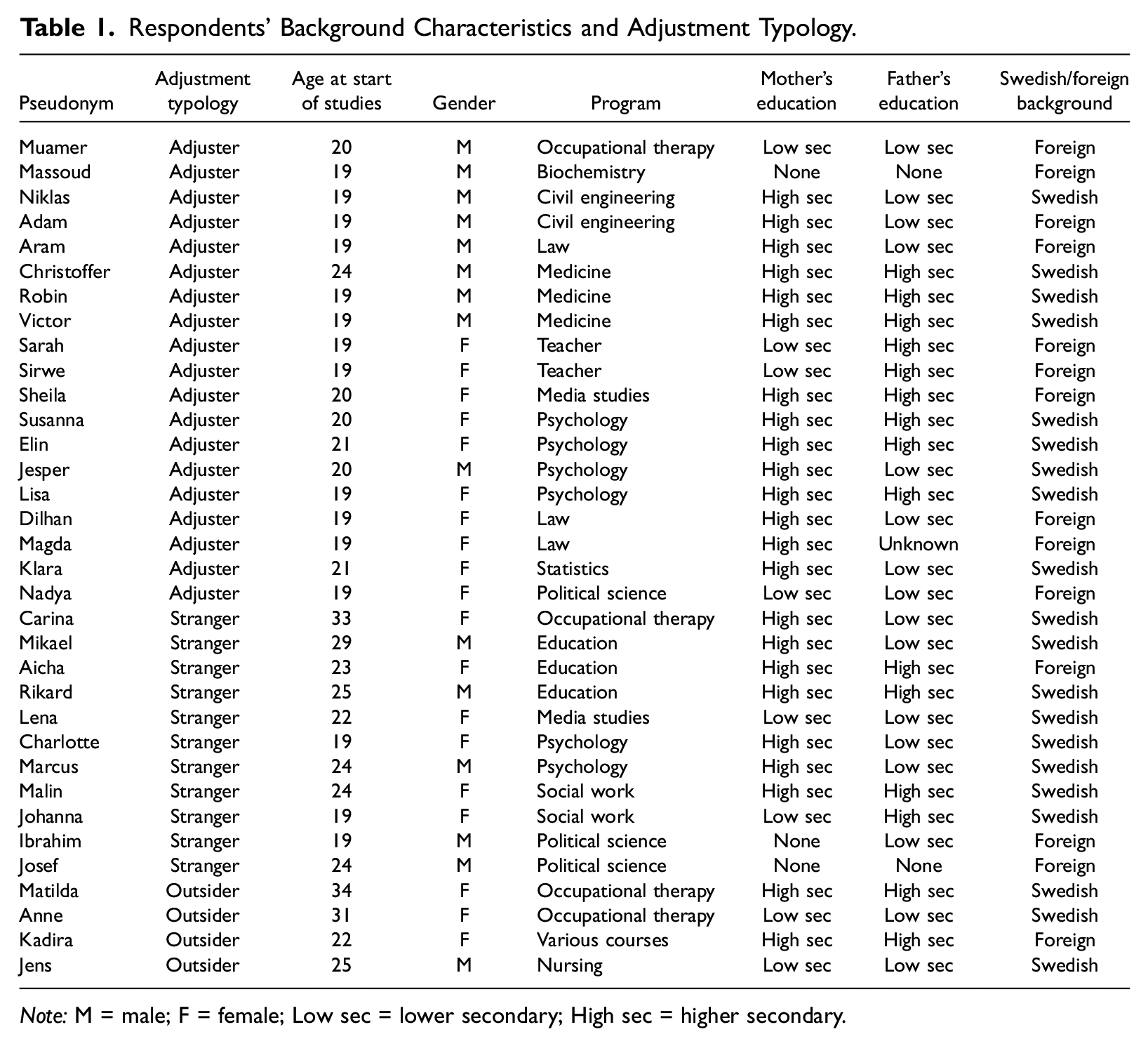
Note: M = male; F = female; Low sec = lower secondary; High sec = higher secondary.
Although some interesting variation among our respondents can be attributed to gender and ethnic background, we decided to bracket these off from our analysis to allow for a fuller account of respondents’ class-related experiences and avoid unnecessary complexity. Some of these aspects of our analysis will be the object of separate papers.
Adjustment Experiences
At the beginning of their university studies, most respondents remembered being nervous, stressed, and confused, but this tends to be the case for many students regardless of social background (Bathmaker et al. 2016). As much previous research suggests, however, more enduring social and academic adaptation difficulties are commonplace for working-class and FG students. In their examination of adaptation experiences in four different types of U.K. higher-education institutions, Reay and colleagues (2010) found working-class students in “elite” institutions were more prone to social rather than academic adaptation difficulties, whereas those who attended less prestigious institutions faced more academic than social challenges. The extent to which FG students claimed they “fit in” academically and socioculturally at university also varied greatly in our study.
Drawing on respondents’ descriptions of their adjustment experiences at university, we identified three different adaptation outcomes. We call the first category of students Outsiders, given their poor adjustment experiences and their feelings of being radically different from their student peers, suggesting a mismatched habitus. Students in the second category, Strangers, claimed to have adjusted to university life despite it being a drawn-out process. They often struggled with feeling both similar to and different from their student peers as well as their social environment of origin, which is indicative of a cleft habitus. Finally, the students we describe as Adjusters had the smoothest transition to university life. They did not feel they stood out from other students, did not struggle with feelings of being different from their peers, and even claimed to maintain a sense of belonging to their social environment of origin. We therefore conceptualize these students as having a largely preadapted habitus when they transition to university.
Outsiders: Mismatched Habitus
Outsiders experience the dominant values, manners, cultural codes, language, and even sense of humor they encounter at university as foreign and at times intimidating. This suggests the dominant dispositions in the field of higher education they find themselves in are profoundly mismatched with their habitus. Matilda, who was studying to become an occupational therapist, explained the differences she sees between herself and other students: You can tell by the attitudes, it’s like . . . they’ve had it a little too easy. . . . They have had both parents in their life. . . . They’ve been brought up feeling secure, brought up by parents who are professionals with a little higher salary as it were. And you can tell by the attitude I’d say. . . . They don’t mix with ordinary people . . . that’s how it feels.
Anne, also an occupational therapy student, experienced university life as very alienating and had panic attacks as a result. She described her difficulties adjusting socially and felt very much an outsider among her peers. She drew a sharp moral boundary toward them and emphasized her attachment to a distinct set of values: There are those who are very locked into having a group where they don’t let anybody in. . . . You don’t feel welcome there, and you don’t, like, fit in there. And you maybe don’t really want to be there either after a while, because those aren’t the values I’m standing for. . . . I never want to become the sort of person that is like that. I try to be inviting and happy and so on . . . but they are that way, [and] don’t want to be with me.
Outsiders had distinct difficulties adapting to university life, both socially and academically, but they represent a minority of our respondents. All of these students started their studies at a later stage in life and were older than our sample average. Furthermore, they all unambiguously labeled themselves as working class or “lower than working class” and mentioned dysfunctional family environments that were often unsupportive of academic studies. Their habitus was mismatched with the sociocultural life at university, as they belonged to “the social strata that are furthest away from academic culture and who are condemned to experience that culture as unreal” (Bourdieu and Passeron 1977, cited in Reay 2005:922). Interestingly, all the Outsiders were enrolled in study programs that had the highest proportion of students from nonacademic family backgrounds. There are too few students to draw any strong conclusions from this, but it seems a higher proportion of FG students in a program does not preclude them from having social adjustment difficulties.
Strangers: Cleft Habitus
Another subset of our respondents comprise what we describe as Strangers. They have one foot in the environment of origin and one in the social environment of the university, thus resembling the social form identified by Simmel (1971:148; emphasis in original) that is “near and far at the same time.” Their adjustment experiences were positive overall, but they were also characterized by an ambivalence toward the social environment of the university, their community of origin, or both. Marcus, a psychology student who spent many years working small jobs before attending university, explained, Now . . . I feel like part of the gang here, you know, but at the same time . . . the longer I am here, and the more I socialize with academics, the more contempt I also have for academics. And naturally, [there is] self-contempt within that. . . . [T]here is so much damn academic nonsense. I really want to make a point of saying that. And I tell it to people. And when we talk about what one should study, or what one should do afterward . . . then some sort of working-class pride comes back.
These students’ experiences fit the characteristics of a cleft habitus, as some of their social dispositions align with the university’s sociocultural environment while other dispositions do not. This often results from habitus adaptations that occur shortly before enrolling in college and generate conflict with established dispositions, possibly because of the characteristic “lag” of these adaptations. Strangers also faced difficulties in their academic adjustment, particularly in terms of expectations, how to study for exams, and understanding how university studies “work.” Like the Outsiders, they tended to be acutely aware of not having anybody in their family to turn to for help in these matters. Although more mixed in age than the Outsiders, they had often been in the labor market for several years before enrolling at university. They all described themselves as working class, but they lacked the dysfunctional aspects that most Outsiders highlighted in their family environments. Family attitudes to school and higher education were more heterogeneous among Strangers. Some had support from their families in their schoolwork and even had parents who wished they would experience social mobility. Others had families who were more ambivalent about higher education, seeing it as something “not for people like them”—a factor that led some Strangers to be on the defensive and feel they needed to justify themselves regarding their decision to go to college.
Adjusters: Preadapted Habitus
The third and largest subset of our sample, the Adjusters, adapted more smoothly to the university context. These students also claimed to have kept strong and unproblematic ties to their home communities. They were aware their social background differed from many other students, but this awareness did not affect their studies or their social life. Their habitus was thus highly adapted despite having entered a field for which their family background would not necessarily have seemed to predestinate them. Jesper, a psychology student who described himself as working class, did not see any tension between his background and his university experience:
Would you say you feel like a fish in the water here, in a way?
Yes, definitely.
Don’t you ever feel that there is some sort of dissonance between your experience here and your home environment?
No, not really. There’s nothing I can think of. Sometimes you miss, like, you know [the hometown] and the friends there. But I think that’s probably natural. But again, I really enjoy myself here.
Adjusters might have had some initial challenges in their academic adaptation, but they often overcame them quickly thanks to high levels of academic self-efficacy developed by autonomously working hard throughout their schooling (cf. Calarco 2018). These students were typically younger when they started their university studies. They all came from stable family backgrounds that were supportive with regard to their educational choices; some had parents who encouraged them to study at university, despite not having any higher education themselves. Some of these students described themselves, their family of origin, or the social environment in which they grew up as closer to middle class. Overall, they described their early educational experiences and schooling trajectories as highly positive.
Habitus Adaptation over the Life Course
We identified five key factors in the life course of our respondents that can expose them to various forms of cultural capital, which can, in turn, enhance their adaptation outcomes when they attend university. These five factors are family resources, the early social environment, educational experiences and opportunities, peers, and partners. The more factors respondents are exposed to, especially at early life stages, the more likely they are to develop a habitus that is preadapted for higher education, whereas individuals who have not been exposed to any of these resources—or merely one—will have a stronger experience of habitus mismatch when they enter higher education.
Family Resources
Adjusters and some Strangers stand out by having slightly more cultural capital to draw from in their home environment. Cultural capital may take various forms, such as having parents who read and encourage their children to read, value educational achievement and ambition, or implicitly inculcate the importance of social mobility into their children at an early age.
Malin, who was studying to become a social worker, explained that her father never expected she would study at university, but he always insisted school was important. In addition to repairing old cars, they had regular reading activities together: We’ve read a lot of books together, had . . . like a small reading group . . . where we read the same books and then discussed them. We have both been very interested in reading. [E]ven though [Dad] doesn’t have . . . any higher education . . . he’s very . . . cultured.
Malin’s experience at university fit the adjustment pattern of the Stranger, but her reading activities with her father are reminiscent of the “concerted cultivation” characteristic of middle-class families (Lareau 2003; but see Siraj and Mayo 2015), and they played an important part in shaping her dispositions toward school work and education more broadly.
Victor, a medical student who followed the Adjuster pattern, had parents who were supportive of school and his college aspirations. Victor’s father had to abandon his educational ambitions when he came to Sweden as a refugee, and Victor believed these unfulfilled ambitions may have influenced his own decision to study medicine: Dad had a . . . childhood dream . . . of becoming a pediatrician. But his family couldn’t afford to . . . send their children to high school at that time. . . . So Dad thought . . . when we have the circumstances that . . . I had as a child in Sweden . . . if you want to [study] it’s a waste not to try.
Robin, another medical student who fit the Adjuster pattern, had similar underlying ambitions in the family. His grandfather wanted to study to become a doctor but had to provide for his family. Robin’s father also wanted to study, but he was expected to take over the family business, which he eventually did. Both Robin and Victor had unproblematic transitions to university, perhaps in part because the aspiration and underlying resources for undertaking higher education were already present in earlier generations (cf. Møllegaard and Jæger 2015).
Among the Adjusters and some Strangers, there is a pattern of slightly higher levels of cultural capital within the family. This suggests parents’ cultural resources, their support and expectations, and their unfulfilled dreams and ambitions for social mobility are important for children’s educational aspirations (Siraj and Mayo 2015). Whereas the Adjusters and most of the Strangers had some form of priming for educational mobility within the family, Outsiders were typically the most capital deprived in this regard. For the Outsiders and some Strangers, their families held clear expectations that they would find employment after high school, and some family members expressed skepticism toward the value of higher education.
Early Social Environment
The habitus is largely a product of socialization within the family, but it can also be shaped in significant ways by the proximate social environment at an early age. As a result of more economic or cultural capital in the home, we found Adjusters were often exposed to social environments with higher levels of cultural capital (e.g., the neighborhood and local schools) that led them to incorporate middle-class dispositions, values, and norms as children.
Adam, who was studying to become a civil engineer, described the importance of meeting new friends in the neighborhood his family moved to when he was about to start school. His parents were born outside Sweden and lived in a disadvantaged area with high concentrations of immigrants during Adam’s early childhood. When he was six years old, his family moved to what he described as a “Swedish middle-class area” outside the city, where he went to school and met new friends: It was a lot calmer. There were people outdoors, we had fun in the forest. . . . We went over to each other’s houses, we played a lot with our neighbors. We really got along well in that neighborhood. A lot of older people . . . it was really different.
Adam went on to study at a high-performing English-language middle school, as did almost half of his friends from the local school. Although he knows little about his parents’ motivation to move neighborhoods, their decision provided him with a new social context and schooling environment that shaped his habitus from an early age.
Jesper described himself as working class, but he grew up in what he described as “a middle-class area” or even maybe “a little more than middle class.” Local schools in such areas have taken-for-granted assumptions about who the students are, including that their educational trajectories will likely involve higher education (Ingram 2009). Jesper’s school experiences were overwhelmingly positive, and he did not feel different in any way from his peers in the psychology program. Niklas provides a similar example. An engineering student, Niklas also grew up in a middle-class area and attended a school where several of his peers came from more affluent social backgrounds. Niklas believed his early school friends were the primary reason why he became the first in his family to study at university: My parents weren’t university educated. So it has nothing to do with that. . . . I know my friend always said . . . “I will become a solicitor or a lawyer.” . . . And [I remember thinking] “Oh, alright, maybe I also should become something. Not a lawyer, but something.”
Unsurprisingly, Adam, Jesper, and Niklas all unambiguously fit the Adjuster pattern. Their upbringing in middle-class areas and schools where their family environment was not the norm led their habitus to gradually adapt to a new set of social dispositions and expectations for their future.
Educational Experiences and Opportunities
Experiences in school play an important role in the development of children’s self-image as learning subjects and shape their educational aspirations. Strangers’ schooling experiences were not characterized by any major difficulties, but nor did they experience any particular engagement. For the smaller group of Outsiders, earlier school experiences tended to be more difficult—if not always academically, at least behaviorally or socially. By contrast, the Adjusters tended to do well in school from an early age, and they described themselves to varying degrees as “good students,”“easy learners,” or “top of the class” and typically claimed school was “fun” and teachers were “nice” and “helpful.” Robin, a medical student who grew up in a rural working-class area, had fond memories of school, where he discovered at an early age that he was a good student: I thought it was great; we had good teachers for the most part. . . . I thought math was fun from the start, and my teacher gave me extra math assignments and such that I thought was fun, and when I was in second grade I did math with the third graders.
Adjusters’ accounts did not reflect any of the parental coaching that scholars have found to be common in middle-class homes (Calarco 2018), but their early positive schooling experiences tended to make them secure more attention and resources from teachers (cf. Siraj and Mayo 2015).
High-achieving students like Robin also have access to more prestigious tracking opportunities in upper-secondary school, and given the social stratification within the education system, these track choices often provide access to new social milieus. Attending a school where there is a strong emphasis on progressing to higher education can prime individuals to aspire to university studies and lead them to develop dispositions that facilitate their later adjustment (Bueker 2019; Jack 2019). Robin applied to an academic track in a high school with the most stringent entry requirements in the nearest city. He found this environment to be strikingly different from what he was used to, as most of the students came from university-educated backgrounds—“It was a whole new life,” he claimed. He thought this new social environment affected his aspirations: Pretty much everybody in our class had plans to pursue their studies after high school. . . . We all encouraged each other as well. . . . So it wasn’t like my lower-secondary school . . . [where] there were some who probably didn’t even want to go to high school; they just wanted to start working. . . . [S]o it was quite different [in high school]. . . . All were set on pursuing their studies afterward; it wasn’t really up for discussion.
Whereas many Adjusters were exposed to early social contexts that provided them with useful resources, Robin was first exposed to such an environment when he started upper-secondary school. The psychology student Jesper also talked about why he wanted to attend a specific high-status upper-secondary school:
It was hardest to get in there. That’s where I wanted to get in. . . . I [now] have a lot of friends from high school that I’m still in touch with today . . . closer friends than I had in lower-secondary school.
And what are they doing now?
All of them are studying.
Both Jesper and Robin were shaped by their experience in high school, which they noted starkly contrasted with the environment they were brought up in and put them in contact with new kinds of friends with different dispositions, aspirations, and shared assumptions.
The early social environment, positive schooling experiences, and academically oriented high school environments discussed so far are factors primarily present among Adjusters. The influence of peers and partners later in life, however, can be particularly important for Strangers, who lack exposure to many of the social contexts discussed so far.
Peers
Individual friendships can serve as a socializing force by structuring perceptions and practices (Ingram 2009). The social context of a neighborhood or an educational institution can provide a very general form of peer influence, but some respondents acquired cultural capital and other resources from their social ties with friends.
Elin, a psychology student, fit the Adjuster pattern. She did well in school, always liked reading, and described her family as belonging to an “economic middle class” but a “cultural underclass.” Befriending the daughter of a neighboring family had a central effect on Elin’s educational outlook and her habitus: Most of my friends . . . had an ordinary working-class background, but the parents of one of my friends . . . her dad was a doctor, her mother was some sort of environmental engineer . . . so a very educated family. Very quick learners, smart kids, all of them. And she was very oriented toward studying, which I think she got from her family. So I think I may have emulated all that a bit, where it was like “Tina’s parents’ say you should study this.” I liked that family very much. . . . There were a lot of . . . discussions, you know, things we didn’t have at home. . . . There was an expectation that you were supposed to think.
Meeting Tina had a strong influence on Elin’s view of herself and her family’s habitus. Her story shows how interaction with socially valued peers who are different from the rest of one’s social environment can foster a desire to emulate them, reminiscent of the “associational embracement” toward middle-class individuals and behaviors that Kaufman (2003) observed among working-class university students.
Peers can also have a stabilizing effect on respondents from more dysfunctional family environments and channel them in more constructive directions. Within the subset of Strangers, Mikael, a former cook who was studying to become a teacher, grew up in very difficult circumstances with an alcoholic father and a long-term-unemployed mother. When his parents separated, he moved with his mother to a less disadvantaged area where he eventually met a group of friends in lower-secondary school that he thinks were decisive for his life trajectory: Even though we drank alcohol and used tobacco . . . I see it a bit of a turning point because those friends gave me a stable ground [to stand on] . . . and I’ve seen what functional families look like as well. . . . I think I bacame a calmer person, I felt a sense of security that I maybe didn’t get from home. I had a very strong faith in them and trusted them, I knew they would be there for me. Even their parents were of great help. . . . It became a home outside the home in a way. . . . I could have become a whole other person today if I had met other people that were more into . . . adrenalin seeking.
These friends and their families—whom Mikael lived with during troubled periods in his own family life—decisively shaped his social dispositions. His friends went on to pusue higher education and are all successful professionals today, which influenced him in a variety of ways despite his very different educational and career choices. His mother’s change of neighborhood and school district gave him the opportunity to meet this group of friends, but it was his firm mooring in their social environment that led to a gradual habitus adaptation.
Although always a gradual and self-reinforcing process, these key encounters represent, from a life course perspective, clear biographical disruptions that are decisive in restructuring the habitus and making it more receptive to new social norms.
Partners
One’s choice of partner can shape a person’s disposition at later life stages. This factor was primarily salient among some Strangers and Outsiders who did not have any other habitus-changing experiences over their life course. Carina, a former nurse’s aid who was studying to become an occupational therapist, never thought higher education was for her until she met her husband—an information technology programmer—and started to talk about higher education with his family: I think [my parents] thought . . . it’s better if you stop your education in high school, because then you avoid student loan debt. . . . That’s something I’ve had to relearn . . . because . . . my husband’s family is the complete opposite of mine. Pretty much all of them have a higher education. . . . My mother-in-law has asked me a few times . . . “Aren’t you interested in getting a higher education?” . . . But then I’ve had this mental block, sort of, that I just can’t . . . so my answer has been “No, it doesn’t interest me.”
Carina struggled for a long time with assumptions deeply embedded in her habitus pertaining to whom higher education is for and the legitimacy of aspiring to it. The habitus of her partner and his family played a key role in chipping away at this over time.
Marcus, a psychology student, fit the Stranger pattern. His partner had a higher education, and Marcus had undergone a habitus adaptation as a result of their relationship. He explained his difficult adjustment around his partner’s family, who have much higher economic and cultural capital than his own:
Now in adulthood, I’ve thought so much about [my class background]. Especially since gaining access to a new family through Katja. . . . When you visit Katja’s family, it’s blue mussel soup and . . . you see it in everything. You see it in what’s in the bookshelves. . . . It’s very much about what media you consume.
How do you feel when you’re there?
Now it feels okay. I fit in now.
What about in the beginning?
No, it was really hard . . . it was really like . . . [I was] some kind of alien, really. As if I didn’t understand things.
Marcus was very self-conscious about his class background. Although he had incorporated new dispositions over time throughout his relationship, he was full of ambivalence about this newly acquired cultural capital, and he had a cleft habitus typical of the Stranger.
The habitus adaptations set in motion by partners take place later in life, but partners have a continuous influence over time that can shake deeply ingrained socially inherited assumptions or beliefs as well as implant new ones. Yet this does not seem to affect the habitus to the same extent as habitus adaptations earlier in life. The respondents for whom partners were a key factor often had few earlier life events that elicited habitus adaptations, typically fit the Strangers pattern, and had a more difficult adjustment at university than did Adjusters.
Discussion and Conclusion
Some of our findings on FG students’ adjustment outcomes are in line with previous research (cf. Stuber 2011), yet they go beyond many similar studies by showing how these outcomes hinge on variation in FG students’ cultural capital levels and by exploring the various contexts throughout the life course where this capital can be acquired.
All our respondents had similar parental levels of education, but some were raised in more stable family environments, were exposed to more advantageous socioeconomic circumstances, and had more successful schooling trajectories. This pattern was typical for the Adjusters in our study, who tended to enroll in higher education at a younger age and experienced the fewest adjustment challenges within the typology (see Table 2). These findings echo previous research showing that upper sections of the working class have access to hidden resources that can open up a broader range of life trajectories compared with less advantaged members of the working-class (Atkinson 2015). Our findings also show that some respondents may have ambiguous class locations, where there is a mismatch between their parents’ educational level and other aspects of their social background. Sampling students with variables other than parental education would likely have resulted in a more socially homogeneous sample with a much narrower set of outcomes. This heterogeneity in resources and adjustment experiences among FG students raises concerns about the sociological pertinence of using educational background as a shorthand proxy for class disadvantage and underscores the need of combining it with socioeconomic variables (cf. Reay 2016). It is important to emphasize, however, that although the students who grew up in the most favorable socioeconomic circumstances were all Adjusters, not all Adjusters grew up in such circumstances, suggesting relative socioeconomic advantage may be an important, but not necessary, criterion for this adjustment category.
Summary of Key Characteristics of Adjusters, Strangers, and Outsiders.
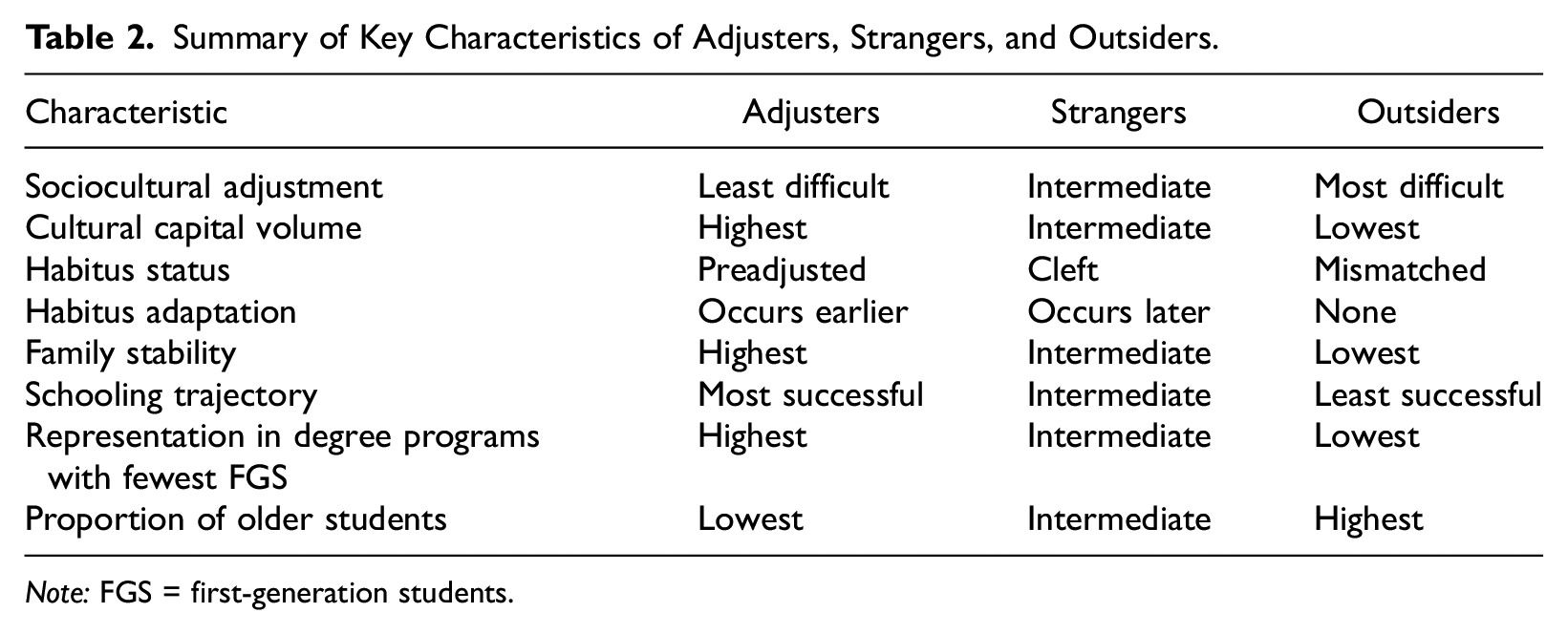
Note: FGS = first-generation students.
The more socioeconomically advantaged FG students were also more likely to be exposed to social environments with higher levels of cultural capital from an early age. Habitus adaptations in such environments were typical of the Adjusters. Strangers’ early socialization tended to reproduce a more traditional set of working-class dispositions, but socially significant peers and partners with higher levels of cultural capital could influence these individuals at a later age, typically resulting in a cleft habitus. Outsiders did not experience any comparable habitus adaptations during their life course, nor were they particularly primed for change when attending university, so they experienced the greatest sense of discrepancy between their habitus and the sociocultural environment in college. In summary, our findings suggest the more access FG students have to middle-class dispositions throughout their life course, especially in early life, the more the Adjuster pattern we identified becomes likely. When exposure to such dispositions is more limited during early socialization but occurs through close friendships or romance in adolescence or early adulthood, the adjustment patterns are likely to fit that of the Stranger.
These results echo Anthony Jack’s (2015) research on the importance of exposure to cultural capital beyond early socialization. Following Jack’s (2015:13) call to “explore the circumstances that mediate the effects of class origins on youth’s cultural endowments,” we extend his research beyond the high school setting by examining a variety of social contexts where such exposure can lead to habitus adaptations. However, access to these settings partly results from more or less subtle material or cultural advantages within some FG students’ family environments. Even if this access can also come from social and romantic ties that are more independent from these circumstances, our findings strongly suggest that a careful exploration of early socialization is necessary to reliably assess the extent to which the early family environment influences the modalities of access to cultural capital–abundant social environments. Future research should determine to what extent habitus adaptations can occur independently from childhood socialization and evaluate in which specific circumstances they result in a cleft habitus.
The significance of the age at which contact with cultural capital–enhancing social contexts occurs also merits closer consideration in future studies on disadvantaged students’ adjustment to higher education, given the effect we find it to have on adjustment outcomes. One might argue that FG students who fit the Stranger category could simply be undergoing the early stages of a habitus adaptation triggered by their college experience (cf. Lehmann 2013; Stuber 2011), where the conflicted nature of their habitus is a transitory stage resulting from the characteristic “lag” of new dispositions competing with established ones. While this may be the case for some students, the presence of Strangers among students who were several years into their degree—including some who had graduated and left university— seems to suggest the opposite. This furthermore echoes Bourdieu’s view on the increasing obduracy of the habitus throughout the life course, where dispositions “harden” and make the incorporation of new dispositions more unlikely and challenging. The implications of this habitus obduracy for degree completion and labor market outcomes merit further investigation.
With regard to the distribution of adjustment types in different degree tracks, students who fit the Adjuster pattern were most commonly found in the most FG-sparse programs, Outsiders clustered in the most FG-heavy programs, and Strangers fell somewhere in between (see Table 2). The findings thus seem to invalidate our hypothesis that adjustment would be more difficult in a social environment with fewer FG students, despite the fact that several prior studies would support this (e.g., Aries and Seider 2005; Billings 2021). This pattern can partly be explained by Adjusters’ higher levels of inherited and acquired cultural capital, which lessens the gap between their dispositions and those they encounter in their study programs. As a rule, Adjusters had developed higher levels of academic self-efficacy throughout their schooling compared with other adjustment types, which most likely contributed to their subjective sense of “fitting in.” By contrast, Outsiders faced more hardship growing up and struggled more in school, which explains why they would tend to be found in FG-heavy degree tracks, where entry requirements are typically lower. The Outsiders in our sample were all enrolled in FG-heavy programs, but it is important to keep in mind that they represent only a minority of the students we interviewed in these programs, where Adjusters and Strangers were also enrolled.
The Adjusters’ experiences are echoed by Reay and colleagues’ (2010) findings on the greater prevalence of confident and well-developed learner identities among FG students in elite higher-education contexts. However, in contrast to Reay and colleagues, we did not find evidence of the study program exerting any comparable influence to that of the “institutional habitus” at the different educational institutions they examined. Instead, students’ backgrounds and trajectories seemed to have a far greater bearing on their adjustment prospects than did the social characteristics of a program’s peer environment.
Some methodological limitations may have affected our findings. We did not conduct a preliminary survey among a broader set of FG students at the university, so it is difficult to assess how representative our respondents’ experiences are of those of other FG students within the same program or at the university as a whole. We provided no incentive for participating in the study, other than students’ personal interest in sharing their experiences, which may have resulted in a selection bias favoring certain experiences over others. Respondents were also at different stages of their studies at the time of the interviews, which could have coincided with different adjustment experiences. Furthermore, our sampling procedure did not allow us to examine the experiences of students who adjusted particularly poorly and dropped out at an early stage of their studies. A longitudinal research design could help address this issue. The study may also have benefited from measuring respondents’ family income and subjective class position more rigorously.
Previous qualitative studies that explore the significance of FG students’ precollege experiences for adjustment have primarily examined elite higher-education institutions in the English-speaking world that attract motivated, high-achieving students from all over the globe. The unusual middle-range university setting in which our study was conducted may have resulted in outcomes that differ from those of elite institutions or colleges with more working-class students (cf. Stich 2012). The cultural context may also have had a bearing on our results. Class distinctions, comparatively speaking, are often perceived to be more culturally downplayed in Sweden than in many other western countries, so habitus adaptations may be easier to achieve. Although educational disparities have increased in the country, these cultural idiosyncrasies could play a role in lessening this class-cultural gap. Further research in other academic institutions in Sweden would be necessary to confirm this hypothesis. This could also be beneficial for understanding the unequal distribution of FG students within and between universities as well as the high underrepresentation of FG students at Swedish universities despite the very favorable material conditions provided for partaking in higher education.
Footnotes
Acknowledgements
We are grateful to the students who took the time to share their life stories and experiences of academic life. We also wish to thank Nicola Ingram, Mats Trondman, Garth Stahl, Emma Arneback, and Jan Jämte as well as three anonymous reviewers for many valuable comments that have helped improve the paper at various stages. Any remaining shortcomings are nevertheless our own.
The project the data was collected for has been reviewed and approved by the Swedish Ethical Review Authority (no. 2019-00519). All respondents gave their informed consent prior to participating, and adequate steps were taken to protect their confidentiality.
