




Abstract
In this article, we study the relationship between intergenerational networks in classrooms (i.e., relationships among parents in classrooms, and between parents and their children’s classmates) and students’ grades. Using panel data on complete classroom networks of approximately 3,000 adolescents and their parents in approximately 200 classes in both Germany and the Netherlands, we compare estimates based on between-student differences in intergenerational networks (i.e., between-individual estimates) to estimates based on changes students experience in their intergenerational networks over time (i.e., within-individual estimates). We also examine how the relationship between intergenerational networks and grades is contingent on students’ location in the educational system (i.e., their ability track). When considering between-individual estimates, we find some support for a positive relationship between intergenerational networks and grades. However, we find no robust support when considering within-individual estimates. The findings suggest that between-individual estimates, which most previous research has relied on, may be confounded by unobserved differences across individuals. We find little support for variations in these estimates across ability tracks. We discuss the implications for Coleman’s social capital theory on intergenerational closure.
Keywords
The idea that social capital embedded in the structure of relationships contributes to educational outcomes is widespread in the sociological and educational literature (Dika and Singh 2002). According to Coleman and colleagues’ (Coleman 1988; Coleman and Hoffer 1987) influential work, students’ level of social capital is dependent on “intergenerational closure,” that is, the extent to which parents are connected to each other and each other’s children in school (Coleman and Hoffer 1987). Schools with a high level of intergenerational closure are sometimes called “norm-enforcing” schools, as it is assumed to be easier to enforce proschool norms when networks around school are denser (Morgan and Sørensen 1999).
The role of intergenerational networks in educational outcomes has been extensively examined in the United States (Dika and Singh 2002; Schneider 2006), yet findings are inconclusive (Carolan and Lardier 2018; Fasang, Mangino, and Brückner 2014). Some studies show that when parents are tied to the parents of their children’s friends, their children reach higher achievement levels (Bankston and Zhou 2002; Carolan and Lardier 2018; Glanville, Sikkink, and Hernandez 2008; Kao and Rutherford 2007; Pong, Hao, and Gardner 2005), whereas others find no or limited support for a positive relationship between intergenerational networks and school achievement (Carbonaro 1998; Carolan 2010, 2012; Hallinan 2009).
These discrepant findings might be related to data issues that most existing studies suffer from. Much previous research relies on data in which only a small number of students at the school or classroom level were sampled (Carolan 2012; Engberg and Wolniak 2010; Morgan and Sørensen 1999; Morgan and Todd 2009). Consequently, these studies use the intergenerational ties of a few parents as a proxy for the intergenerational network in an entire school or classroom, possibly leading to an unreliable measure of intergenerational closure (Carbonaro 1999; Hallinan and Kubitschek 1999). Moreover, intergenerational closure at the school or classroom level is often measured by the average number of school-based relationships of parents in a school or class, thereby disregarding the possible number of relationships parents are able to make (Hallinan and Kubitschek 1999).
Another problem is that most data sets only contain cross-sectional information on intergenerational networks. Previous studies have used longitudinal information on students’ school achievement or extensively accounted for observed characteristics of students (Carolan 2010; Carolan and Lardier 2018; Fasang et al. 2014; Morgan and Todd 2009), but their findings may be biased by unobserved heterogeneity across students. For example, it is possible that intergenerational closure does not affect academic performance but that parents who value education more (and thus their children’s academic performance progresses faster) are also more involved in school, and therefore they know more of the parents of their children’s classmates.
Besides data issues, previous findings could be inconclusive because the achievement gains associated with intergenerational networks are confined to school contexts in which proschool norms and educational resources are already in place (Fasang et al. 2014). In line with this idea, research suggests that intergenerational closure is related to higher school performance (1) in Catholic but not in public schools (Morgan and Sørensen 1999; Morgan and Todd 2009) and (2) in low-poverty but not in high-poverty schools (Fasang et al. 2014). However, existing studies on school variation in the relationship between intergenerational closure and school performance have all been conducted in the United States, and this may obscure important differences between school settings in the effectiveness of intergenerational networks. The differential effects of intergenerational networks might be clearer in educational systems where students are sorted into separate schools for multiple years and for their full curriculum on the basis of their academic performance. These systems, also known as between-school tracking systems (Chmielewski 2014), track similarly aged students into different school types that prepare them for different educational careers. These school types structure classroom networks: classes tend to be relatively homogeneous with respect to academic performance level and socioeconomic status. Opportunities for school-based contacts that cut across performance levels and social classes are limited. Educational systems without between-school tracking are also segregated, but segregation is typically higher in between-school tracking systems (Le Donné 2014; Jenkins, Micklewright, and Schnepf 2008). In systems that stratify their students so explicitly, school careers may differentiate further because the performance-conducive social networks are more effective in the higher-track schools.
This article contributes to past research in two important ways. First, we try to overcome important data issues of past studies by using panel data on complete networks in classrooms. These panel data allow us to study the within-individual relationship between intergenerational networks and student achievement. In other words, we examine how changes in the intergenerational networks to which students are exposed are associated with changes in their achievement. Although the data cover only two time periods and we cannot study long-term trends in students’ intergenerational networks and achievement, this is one of the first studies to account for all unobserved time-constant characteristics of individuals that could make the relationship between intergenerational networks and student performance spurious. 1 The complete network data mean we have information on the relationships among (almost) all parents and students in a classroom. Hence, we do not have to rely on the intergenerational ties of only a few parents, and we can measure the concept of social closure more adequately by accounting for the possible number of relationships that parents are able to make (Borgatti, Jones, and Everett 1998; Van Rossem et al. 2015). This study responds to Carolan’s (2010) call for the use of complete network data in research on intergenerational closure to better capture the dynamic and static characteristics of networks.
Second, we contribute to past research by focusing on two European countries with extensive between-school tracking policies (i.e., Germany and the Netherlands). We examine how the relationship between intergenerational networks in classrooms and students’ grades is contingent on students’ ability track. Exploring these track differences is important from a policy perspective, as the explicit segregation of students into tracks is a direct consequence of educational policies and institutions.
Theory
Intergenerational Closure and School Performance
The hypothesis that intergenerational closure in school is related to educational success is derived from social capital theory (Coleman 1988). According to Coleman, the level of social capital is dependent on the level of social closure, which implies that more people in a network are connected with each other (Coleman 1988; Coleman and Hoffer 1987). Intergenerational closure is a specific type of social closure that is often defined by the relationships among parents in a school (e.g., Coleman 1988; Fasang et al. 2014; Morgan and Sørensen 1999; Morgan and Todd 2009), but it sometimes also includes the relationships between parents and their children’s schoolmates (Bankston and Zhou 2002; Carolan 2012; Coleman and Hoffer 1987; Dijkstra, Veenstra, and Peschar 2004). Here, we use this broader definition, such that intergenerational closure is higher when parents and children are better connected to one another in school.
Through the connections parents have with (the parents of) their children’s schoolmates, parents can monitor their children’s behavior outside the home more efficiently. Parents will know the children their children interact with, can discuss their children’s behavior with other parents, and can obtain information about their children’s behavior from (the parents of) these children. Moreover, parents can align their standards and punishments (Coleman 1988). In summary, intergenerational closure makes parental intervention easier and will foster the development and enforcement of (presumably) proschool norms. Finally, intergenerational closure promotes the flow of information available within the classroom or school network, such as information about school practices and affairs (Van Rossem et al. 2015). For example, if children do not inform their parents about upcoming exams, parents may still receive this information via (parents of) their children’s classmates. Consequently, parents are able to motivate their children to study at crucial moments.
Most previous studies on intergenerational closure focus on the extent to which parents are related to (the parents of) their children’s friends in school (e.g., Fasang et al. 2015; Morgan and Sorensen 1999; Morgan and Todd 2009). However, relationships with (the parents of) nonbefriended schoolmates may promote proschool behavior and school performance in a similar vein (Hallinan and Kubitschek 1999; Dijkstra et al. 2004). Intergenerational closure may be underestimated when these ties are not taken into account. Hence, we define the intergenerational network as parental ties to the (parents of) their children’s befriended as well as nonbefriended peers.
In Coleman and Hoffer’s (1987) early work, social capital is considered a collective good, and intergenerational closure is thus related to collective benefits. When one parent decides to withdraw from the parental network, this can disrupt the entire network and thus have consequences for other parents in the network. In addition, even when a student’s parents are not well connected to other parents in school, the student may still profit from the relationships other parents and children have with each other. For example, when classmates—whose parents are well connected to other children and parents in school—start adhering to proschool norms, a student whose parents are not well connected may eventually follow their lead. The idea that intergenerational closure has collective benefits also implies it is not an individual but a collective property. Intergenerational closure thus refers to the extent to which people are connected to each other at the collective level, for example, the level of intergenerational network density in a classroom or school (e.g., Coleman 1988; Hallinan and Kubitschek 1999; Lin 1999).
Social capital can also be possessed by an individual (Bankston and Zhou 2002; Borgatti et al. 1998; Lin 1999), as there may be individual benefits related to the structure of an individual’s network. Hence, some scholars define intergenerational closure as an individual property that is positively related to the educational outcomes of individual students (e.g., Carbonaro 1998; Carolan and Lardier 2018; Kao and Rutherford 2007). For example, students whose parents are connected to more parents in school are expected to perform better in school, because their parents can better monitor their behavior outside of school. The concept of intergenerational closure may be slightly confusing in this respect, as it mostly refers to the size of a person’s intergenerational network.
In summary, the structure of the intergenerational school network can be an individual and a collective property associated with individual and collective educational benefits. Hence, we derive hypotheses on both the individual and the collective level:
Variations by Educational Context
Individuals with larger intergenerational networks, or who attend schools in which the intergenerational network is denser, may not all perform better in school. Indeed, these relationships are likely contingent on the available resources and the prevalent norms in a school or classroom (Fasang et al. 2014; Lin 1999). Dense networks are effective in preserving resources and norms that are already in place (Lin 1999). They enable groups that possess educational resources and knowledge to reproduce and maintain these resources, but they offer little advantage to groups that do not possess such resources and knowledge. For example, in affluent communities in which parents know how to navigate educational institutions, and how to use opportunities in school to obtain advantages for their children (Calarco 2014; Lareau 2015; Lewis and Diamond 2015; Sattin-Bajaj and Roda 2018), dense networks can offer additional benefits. Affluent (e.g., white, middle-class) parents may, for instance, tell each other about opportunities in the school (see Sattin-Bajaj and Roda 2018), collaborate to maintain school structures that are in their children’s best interest (see Lewis and Diamond 2015), or prompt each other’s children to enact behaviors that are rewarded in school (see Calarco 2014).
Conversely, dense intergenerational networks could impede students’ school achievement in contexts in which norms (unintentionally) hinder school success (Fasang et al. 2014). For example, in some working-class communities, parents may expect or push their children to opt for a paid job right after compulsory school rather than continue into higher education (Archer, Pratt, and Phillips 2001). Moreover, working-class parents are generally less well equipped with the type of cultural knowledge that would help them navigate educational institutions; they may therefore encourage behaviors that could inadvertently hamper educational performance (Davies and Rizk 2018; Lareau 2015). Whereas middle-class parents tend to teach their children to be verbal and to actively ask teachers for help, working-class parents are more likely to tell their children not to “annoy” the teacher, thereby inhibiting their children from asking for help (Calarco 2014; Lareau 2015).
Just as dense intergenerational networks will promote educational success only in contexts in which proschool norms and resources are available, parents’ personal intergenerational school ties will foster their children’s educational performance only in contexts in which norms and resources are conducive to educational success. Previous U.S.-based studies suggest the relationship between intergenerational networks and student achievement is more pronounced in contexts that are more conducive to school success. For example, Fasang and colleagues (2014) show that in low-poverty schools, there is a positive relationship between a student’s (individual) intergenerational network size and school achievement. In these schools, children receive higher grades when their parents talk with more parents of their friends. In high-poverty schools, this relationship is negative. Moreover, research has found that the average number of ties among parents at the school level is positively related to children’s achievement in Catholic schools but not in public schools (Morgan and Sorensen 1999; Morgan and Todd 2009). However, these studies did not find a statistically significant difference between Catholic and public schools, possibly due to a lack of statistical power.
Relationships between intergenerational networks in schools and student achievement may depend even more on the school context in various European countries. In the United States, students of different ability levels attend the same classes for at least some of their courses. In many European countries, students of different ability levels are tracked into entirely different classes or schools for their full curriculum right after primary school. In these between-school tracking countries, like Germany and the Netherlands, children from socioeconomically disadvantaged backgrounds tend to be placed into lower-ability tracks (Dustmann 2004; Dutch Inspectorate of Education 2016). Hence, school segregation by academic ability level and socioeconomic background tends to be high. In the lower-ability tracks, there are thus fewer opportunities to interact with parents from more affluent backgrounds, who tend to possess more (cultural) resources conducive to educational success.
Socioeconomic school segregation certainly exists in the United States, but this segregation is typically higher in countries with between-school tracking. For example, a study of 27 Organisation for Economic Co-operation and Development countries showed that socioeconomic school segregation was highest in Germany, Belgium, Austria, and Hungary (Jenkins et al. 2008). In the United States, socioeconomic segregation across schools was lower than the median. Moreover, Chmielewski (2014) finds that socioeconomic status is a better predictor of a student’s track in between-school tracking systems than in Anglo-Saxon countries with course-by-course tracking. We thus hypothesize the following:
Data
We use the first two waves of the Children of Immigrants Longitudinal Survey in Four European Countries (CILS4EU; Kalter et al. 2016a, 2016b) that were gathered in England, Germany, the Netherlands, and Sweden. We use only the Dutch and German data, as the Swedish and English data do not contain longitudinal information on students’ school performance.
The first wave was collected among ninth-grade students in the 2010–2011 school year. A three-stage sampling procedure was applied. First, schools were sampled. In the Netherlands and Germany, the sampling frame was stratified on the basis of the share of students in the school with a migration background, school size, and the ability track. 2 In Germany, the school sampling frame was also stratified by region. The stratification scheme was set up to select schools from all ability tracks and from different regions. Larger schools and schools with a higher share of immigrants had a greater chance of being selected. 3 When a sampled school refused to participate, a replacement school was approached that was similar to the initially sampled school with respect to the stratification criteria. Before replacement, the response rate was 52.7 percent in Germany and 34.9 percent in the Netherlands; after replacement, it was 98.6 and 91.7 percent, respectively.
In the second sampling stage, two ninth-grade classes were randomly selected in each school (response rates at the class level were 99.6 [Germany] and 94.5 [the Netherlands] percent). In the third stage, all students in each class were invited to participate (response rates at the student level were 80.9 percent [n = 5,023] in Germany and 91.1 percent [n = 4,406] in the Netherlands). One year later, students were approached again, primarily via school. We include all students who participated in both waves of the study (3,421 Dutch and 4,154 German students).
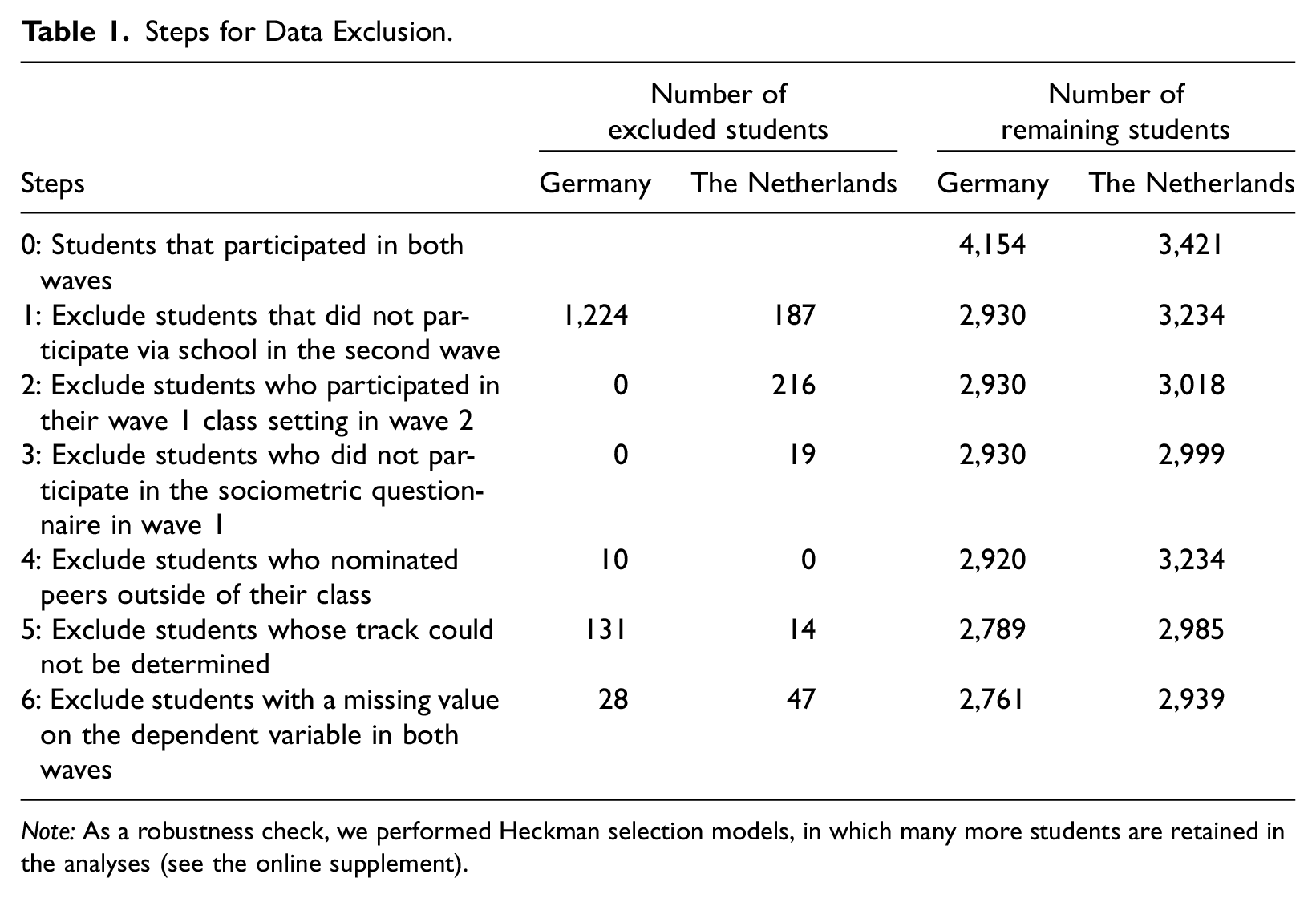
We exclude several students from the analyses. First, we drop students who did not participate via school in the second wave, as their intergenerational classroom network in the second wave is unknown (i.e., n = 1,224 for Germany, n = 187 in the Netherlands; step 1 in Table 1). 4 In Germany, some respondents simply could not be approached via school in the second wave, as their school did not offer a 10th grade (18 percent). Moreover, 2 percent of the Dutch and 7 percent of the German schools refused to participate in the second wave.
Steps for Data Exclusion.
Note: As a robustness check, we performed Heckman selection models, in which many more students are retained in the analyses (see the online supplement).
Second, we exclude students who did not participate in their actual school class in the second wave (step 2 in Table 1). In the second wave, many Dutch students attended a new classroom in the same school. These students were typically surveyed in this new class, implying that all their new classmates—including those who were not part of the initial sample—were asked to participate. Hence, we could map their class networks in the second wave. However, some students could not be surveyed in their new class and were asked to participate in their wave 1 class, even if they factually did not attend this class. These students are excluded from the analyses (n = 216), as their class networks in wave 2 are unknown.
Third, we exclude one Dutch class that did not participate in the sociometric questionnaire in wave 1 (step 3 in Table 1), as their class network in wave 1 cannot be mapped (n = 19). Fourth, we drop German students who made erroneous nominations, that is, who nominated students who were not part of their class (n = 10; step 4 in Table 1).
Fifth, we drop students whose school track could not be determined (step 5 in Table 1). Some students in the Netherlands attend a “bridging class” (i.e., brugklas), which is a transition phase from comprehensive primary school to a tracked secondary school, and it combines multiple tracks. Our sample included two bridging classes: one combined multiple vocational tracks and was therefore included as a vocational track class; the other was deleted from the analyses (n = 14). For Germany, we exclude children who attend a school with multiple tracks (i.e., Schulen mit mehreren Bildungsgängen) (n = 107) or who attend a Rudolf Steiner school (n = 24). Students who attend a Rudolf Steiner school are officially not tracked, but they are usually able to enter university.
Finally, we drop students who have a missing value on the dependent variable in both waves (28 students in Germany, 47 in the Netherlands; see step 6 in Table 1). We retain students who miss one of the two observations on the dependent variable, but the missing observations are dropped (n = 74 observations in Germany; n = 374 observations in the Netherlands).
Missing values on the predictor variables are imputed by means of multiple imputation by chained equations in Stata 15. This imputation strategy takes into account the uncertainty of the imputed missing value (Allison 2009b; Johnson and Young 2011). We impute 10 data sets. The imputation model is set up so that information on a variable in one wave is used to impute a missing value for the same variable in another wave (i.e., imputed in a wide format; see Young and Johnson 2015). The model includes all the predictor variables, the dependent variable, school dummies to account for the nesting of students in schools, and auxiliary variables, such as parental educational level and occupational status as reported by the students. Although the imputation model includes the dependent variable, we do not use imputed values for the dependent variable, as this may introduce random error and reduce efficiency (Young and Johnson 2015). The final sample includes 5,504 observations from 2,939 Dutch students in 197 classes and 5,448 observations from 2,761 German students in 192 classes. Hence, we analyze about 15 students per class.
Measures
Dependent Variable
We measure school performance by a student’s English grades. 5 In both waves, students were asked to report the grade they received in English in their last school report card. In Germany, grades range from 1 to 6, and higher grades represent poorer performance. In the Netherlands, grades range from 1 to 10, and higher grades represent better performance. We recode the German grades (from 0 to 5), so that in both countries higher scores refer to better performance.
The data contain only longitudinal measures for grades, not test scores. The advantage of grades is that they are relatively malleable and influenced by a student’s behavior and effort in school. Moreover, U.S.-based research shows grades are a stronger predictor of future educational attainment than test scores (Hoffman and Lowitzki 2005). A disadvantage of grades is that they can vary across schools partially unrelated to achievement levels (Carbonaro 1998), and they are determined within, rather than between, school tracks. Fortunately, our within-individual estimates will not suffer from this drawback, as they account for all time-constant unobserved differences across individuals (including school differences). Moreover, we account for school tracks in the analyses.
Individual-Level Intergenerational Network
The survey contained a sociometric part in which students were asked to report about social relationships in their classrooms. Class rosters with the names of all classmates were provided to students. Two questions tapped into students’ intergenerational class network: “Which classmates do your parents know?” and “With the parents of which classmates do your parents get together with once in a while or call on the phone?” To measure intergenerational network size, we add the number of nominations a student makes on these two questions. 6 Subsequently, we divide the intergenerational network size by the number of nominations a student could have made, 7 so we measure the share of intergenerational ties parents realized in the class. In the Netherlands, students were allowed to nominate all their classmates on both questions, including classmates who did not participate in the survey. Hence, the number of possible nominations is 2(n– 1), where n is the size of the class. In some German schools, students were allowed to nominate only classmates who participated in the survey, and n refers to the number of participating students in a class. The student response rate was above 80 percent for both waves in Germany.
By dividing the intergenerational network size by the number of possible nominations, we account for the fact that students in larger classes are able to nominate more people. For example, parents may know all of their child’s classmates and the parents of these classmates in both waves, yet the sheer size of their intergenerational network may be smaller in one wave because there are fewer students in class in this wave.
Class-Level Intergenerational Network
Intergenerational closure at the class level is measured by the density of the intergenerational class network. 8 This is calculated by dividing the total number of intergenerational ties that are realized in a class by the number of possible ties in the class (Wasserman and Faust 1994). The number of realized ties in a class is measured by the total number of nominations on the two intergenerational network items (see previous section). The number of possible ties is calculated by multiplying the number of students who participated in the survey by the number of people that could have been nominated by them. Note that we calculate network density before dropping any students from the data set; the relationships of almost all students in a class are thus taken into account.
In theory, network density can range from 0 to 1. A score of 0 implies that none of the possible intergenerational relationships in a class are realized, and a score of 1 implies that all the possible intergenerational relationships are realized. Figure 1 shows the average intergenerational network density by school track. In both countries, the level of intergenerational density is higher in the academic track than in the vocational or intermediate tracks (differences are statistically significant).
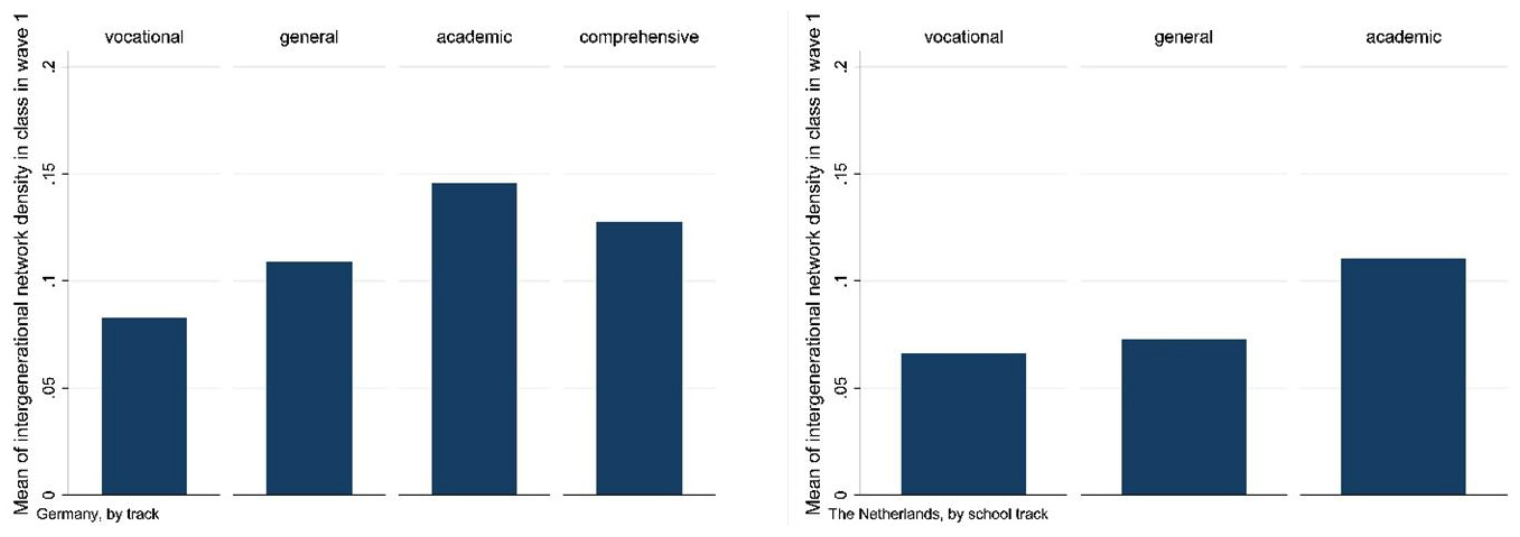
Mean of intergenerational network density in class in wave 1 by track in Germany (left; n = 192 classes) and the Netherlands (right; n = 197 classes).
School Track
Dutch and German students tend to be sorted into different ability tracks for their full secondary school curriculum. In the Netherlands, track placement is based on a standardized test and a track recommendation by the teacher in the final year of primary school (at age 12). Parents cannot directly influence their children’s track placement, yet they may influence it indirectly (e.g., by putting pressure on teachers; Dronkers and Korthals 2016). In Germany, students tend to be placed in tracks when they are 10 years old; in a few federal states, tracking occurs at age 12. Track placement in Germany is also based on a teacher’s recommendation, yet this recommendation is not binding in all federal states, implying that parents may ignore the teacher’s recommendation (Dollmann 2015).
We distinguish between four school tracks: vocational, intermediate, academic, and comprehensive schools. Vocational schools are the reference category and include: (1) Dutch or German children who attend a track that prepares them for vocational education and (2) German children who attend a school for special educational needs (i.e., VMBO-b, VMBO-k, VMBO-g, or VMBO-t in the Netherlands; Hauptschule or Förderschule in Germany). Students attend a vocational track up to grade 9 or 10.
Intermediate schools include children who attend Realschule in Germany or Havo in the Netherlands. Dutch students attend this track up to grade 11; German students attend this track up to grade 10.
Academic schools include children who attend a track that prepares them for university (i.e., Gymnasium in Germany and VWO or Gymnasium in the Netherlands). Dutch students attend this track up to grade 12; German students attend this track up to grade 12 or 13.
In some German federal states, students can attend a comprehensive school (i.e., Gesamtschule). These schools offer various tracks in one school and thus house students of different ability levels.
Controls
We include the following control variables: gender, parental education, parental occupational status, cognitive and language test scores, effort in school, immigrant background, number of best friends in class, friendship network density in class, number of siblings at home, parental divorce, parental school support, teacher support, and school stratum. Table 2 provides an overview of these control variables, how they are constructed, and whether they vary over time. The inclusion of control variables that do not vary over time affects the estimates of variables that are constant within individuals over time but not the estimates of variables that change within individuals over time. We include these time-constant control variables to ensure our time-constant estimates are comparable to the ones obtained in previous studies on intergenerational closure. We aim to control for variables that are similar to the variables accounted for in previous studies.
Control Variable Construction.
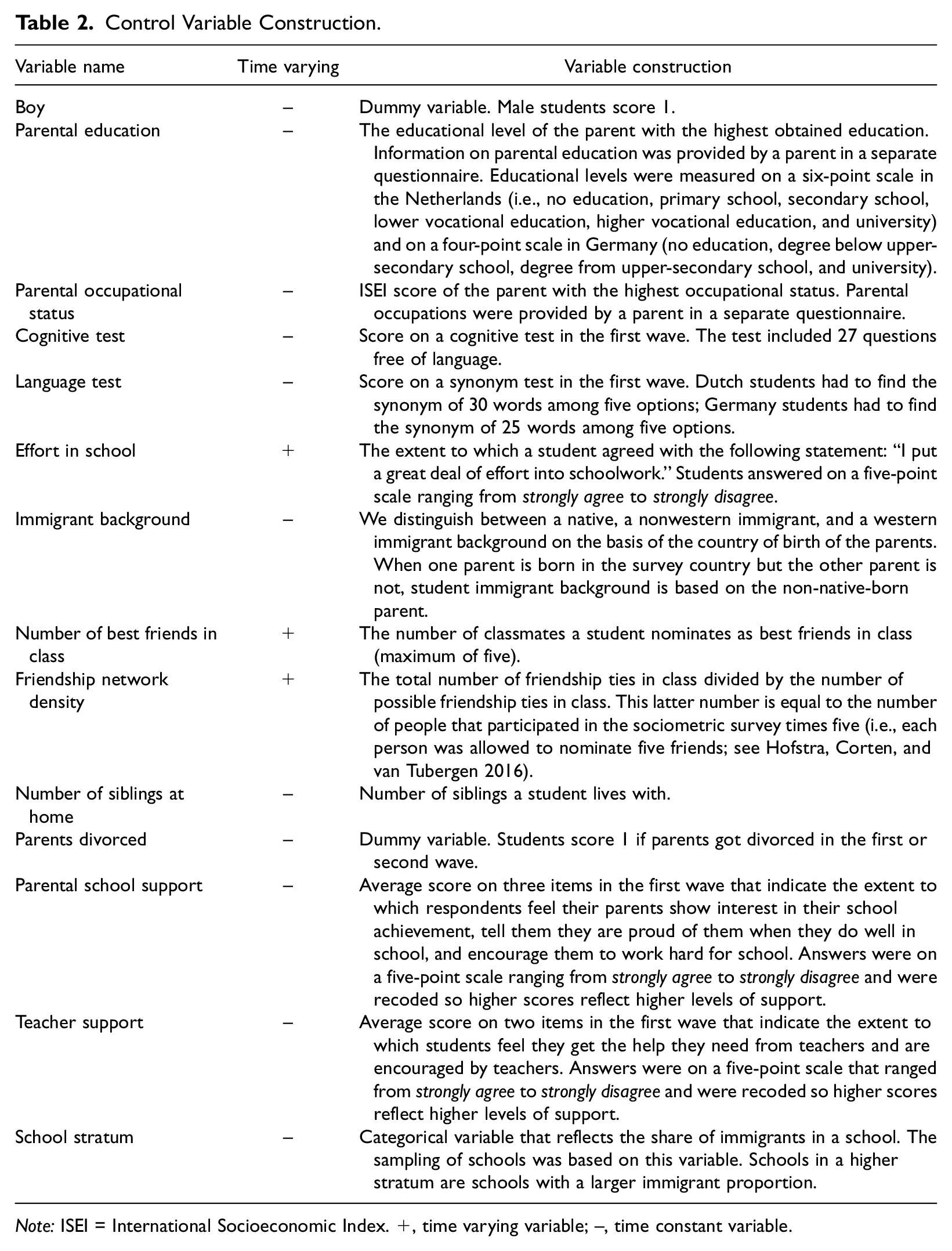
Note: ISEI = International Socioeconomic Index. +, time varying variable; –, time constant variable.
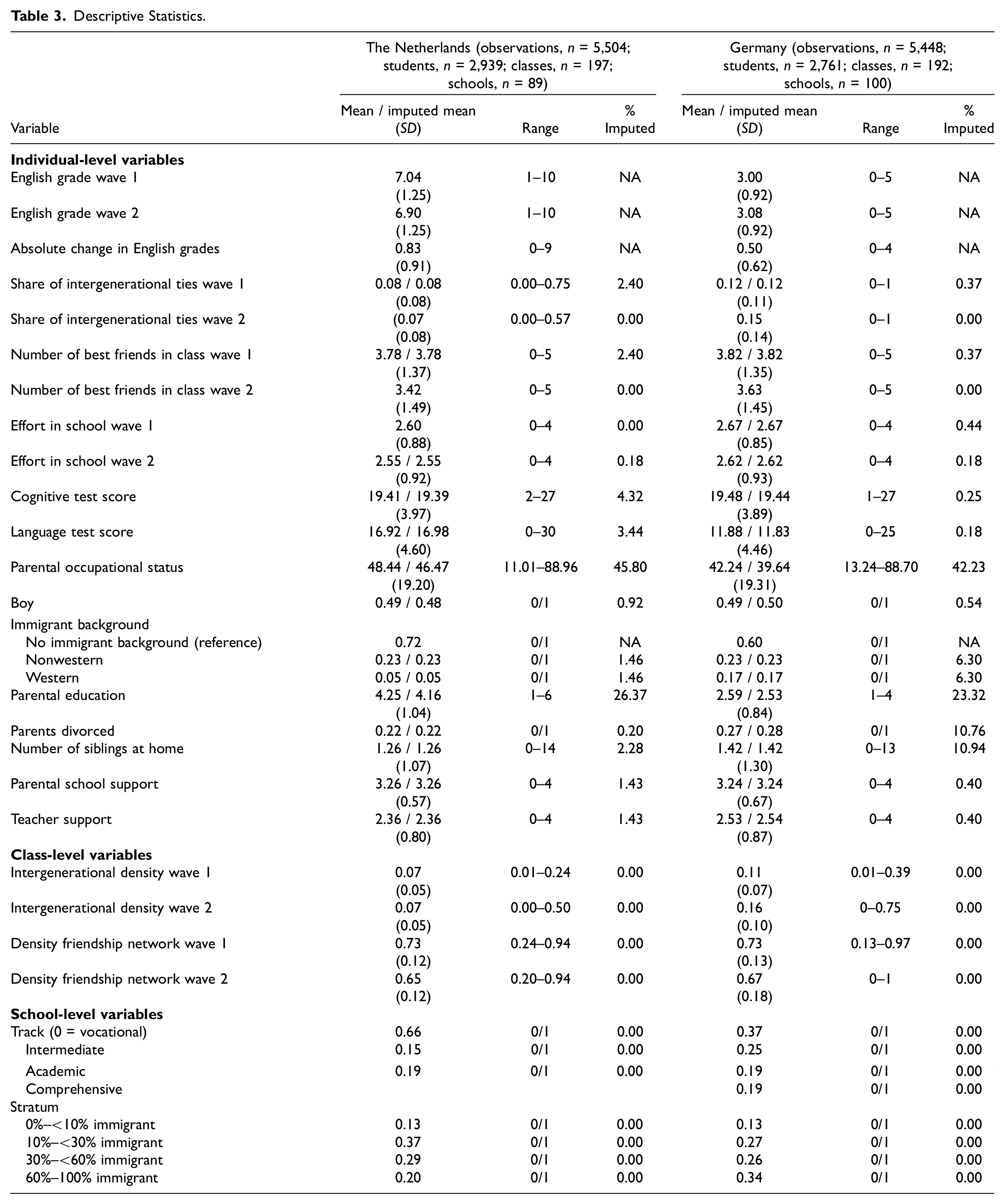
Table 3 provides an overview of the descriptive statistics of all the dependent, independent, and control variables. It also shows the absolute change in students’ English grades between the first and second waves.
Descriptive Statistics.
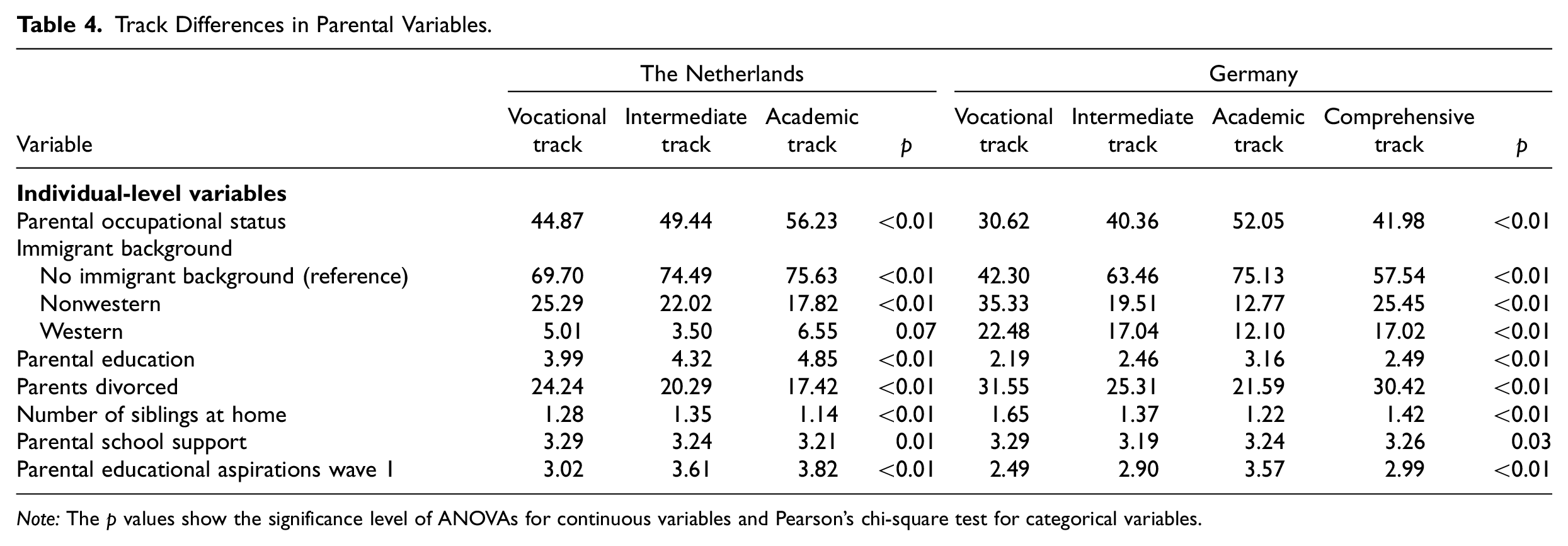
In the Theory section, we posited that German and Dutch school tracks are segregated by students’ socioeconomic background and that (consequently) resources and norms conducive to school success are more prevalent in the higher-ability tracks. Table 4 shows socioeconomic segregation across school tracks: parents of students in higher-ability tracks tend to work in professions associated with higher social status and have obtained higher educational degrees. Moreover, they are less likely to have a (nonwestern) migration background. Parents born in the survey country, and who have (successfully) made their way through the (survey country’s) educational system themselves, will probably have more (cultural) knowledge about the survey country’s educational institutions.
Track Differences in Parental Variables.
Note: The p values show the significance level of ANOVAs for continuous variables and Pearson’s chi-square test for categorical variables.
Students in the academic track also tend to come from families with fewer siblings and without divorced parents, compared to students in the vocational and intermediate tracks (see Table 4). Although this may imply that their parents have more time to help with school (Coleman 1988), Table 4 shows that students in the higher-ability tracks do not perceive their parents as more supportive with respect to school matters. However, we do see track differences in parents’ educational norms: students in the higher-ability tracks think their parents hold higher educational aspirations for them.
Analytic Strategy
We analyze the data with hybrid models (Allison 2009a). For all time-varying characteristics, hybrid models provide a within- and a between-individual estimate. The within-individual estimates are based on changes within individuals over time: they show how changes in the independent variable are associated with changes in the dependent variable. These estimates account for all unobserved time-constant characteristics of individuals and are similar to the ones obtained in a fixed-effects model (Allison 2009a). The between-individual estimates show the extent to which an individual with a higher score on the independent variable also scores higher on the dependent variable, while accounting for all other variables in the model (i.e., these estimates rely on between-individual differences, as all cross-sectional analyses do). The hybrid model can be represented by the following formula:

where i represents an individual and t a time point. β
b
is the between-individual or the time-constant estimate of a characteristic that varies over time. This estimate is obtained by including respondents’ mean on the time-varying characteristic in the model (
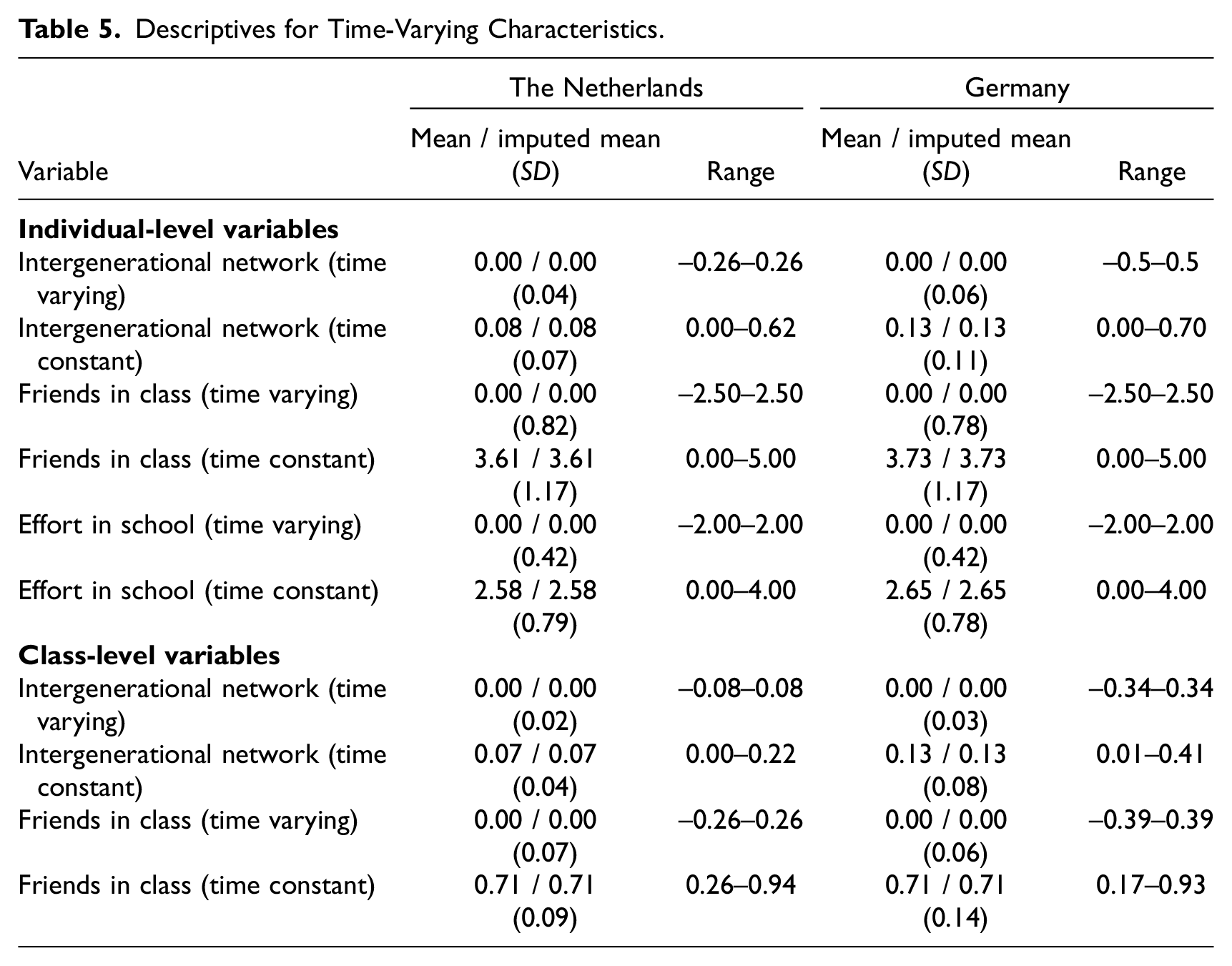
Descriptives for Time-Varying Characteristics.
We use hybrid models, as they allow us to compare between-individual estimates (which have been estimated in most prior research on intergenerational closure) to within-individual estimates. Within-individual estimates can also be obtained in a fixed-effects model, but the hybrid model is more flexible and allows us to account for the nested structure of the data (Allison 2009a). More specifically, we account for the nesting of time points in individuals, the nesting of individuals in classes, and the nesting of classes in schools. 9 The hybrid model also allows us to estimate random slopes, which is necessary to obtain unbiased estimates and standard errors for cross-level interactions (Barr 2013). To test Hypotheses 2a and 2b, we need to estimate cross-level interactions.
The within-individual estimates account for all unobserved time-constant factors but not for unobserved time-variant ones. Hence, the within-individual relationships may still be confounded by unmeasured changes that affect students’ networks as well as their school grades. Moreover, with two waves of data, we are unable to shed light on the extent to which the “parallel trends” assumption holds (i.e., the assumption that trends in the dependent variable would be the same for the treatment and control groups if there had been no treatment).
Nevertheless, the within-individual estimates of the relationship between intergenerational networks and school performance are an important step forward in filtering out confounders. In this respect, we are less certain about the extent to which tracking causes differences in the relationship between intergenerational networks and school performance across school tracks, as school tracks may also structure preexisting tendencies to interact with others of similar ability levels and socioeconomic backgrounds.
Results
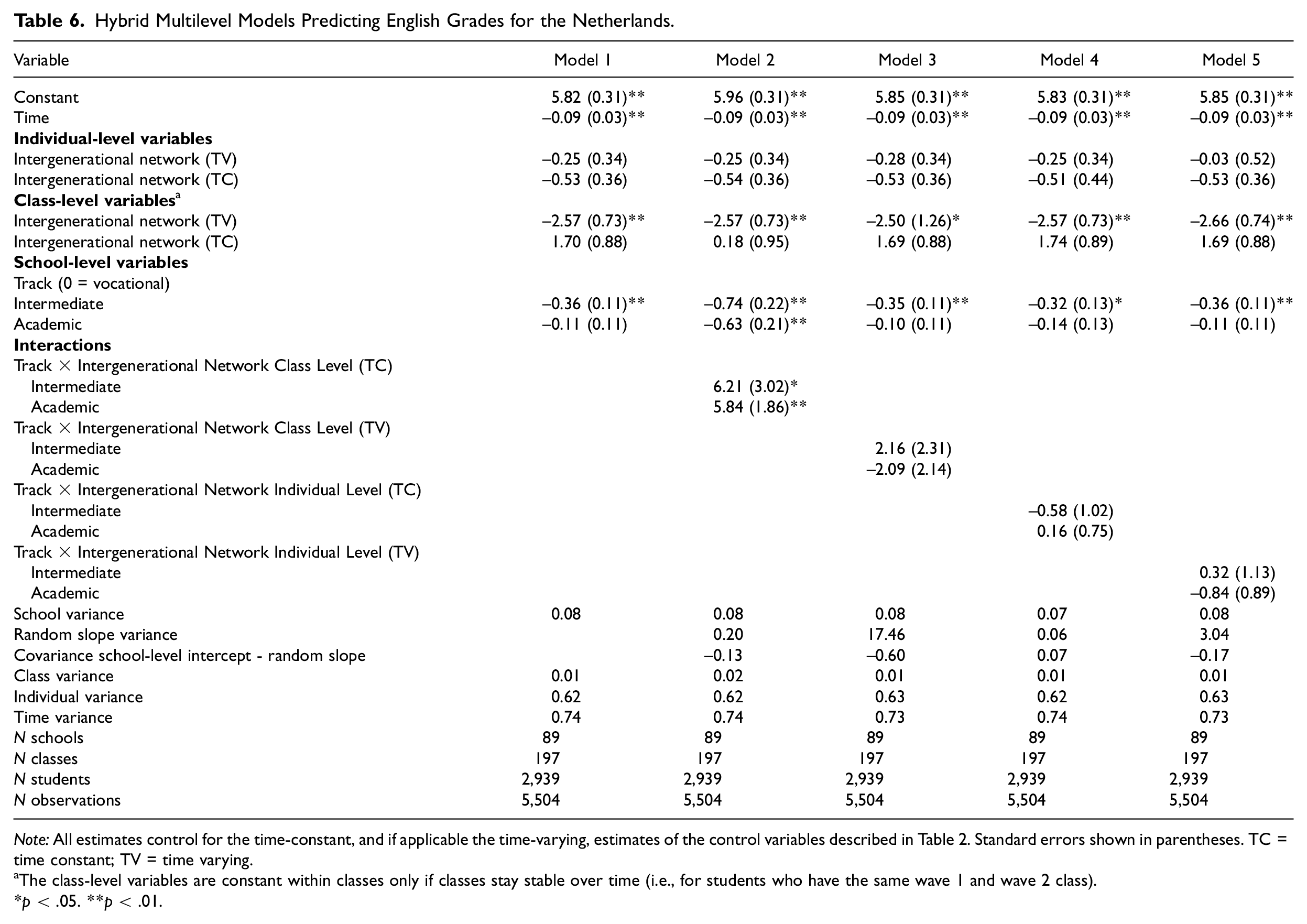
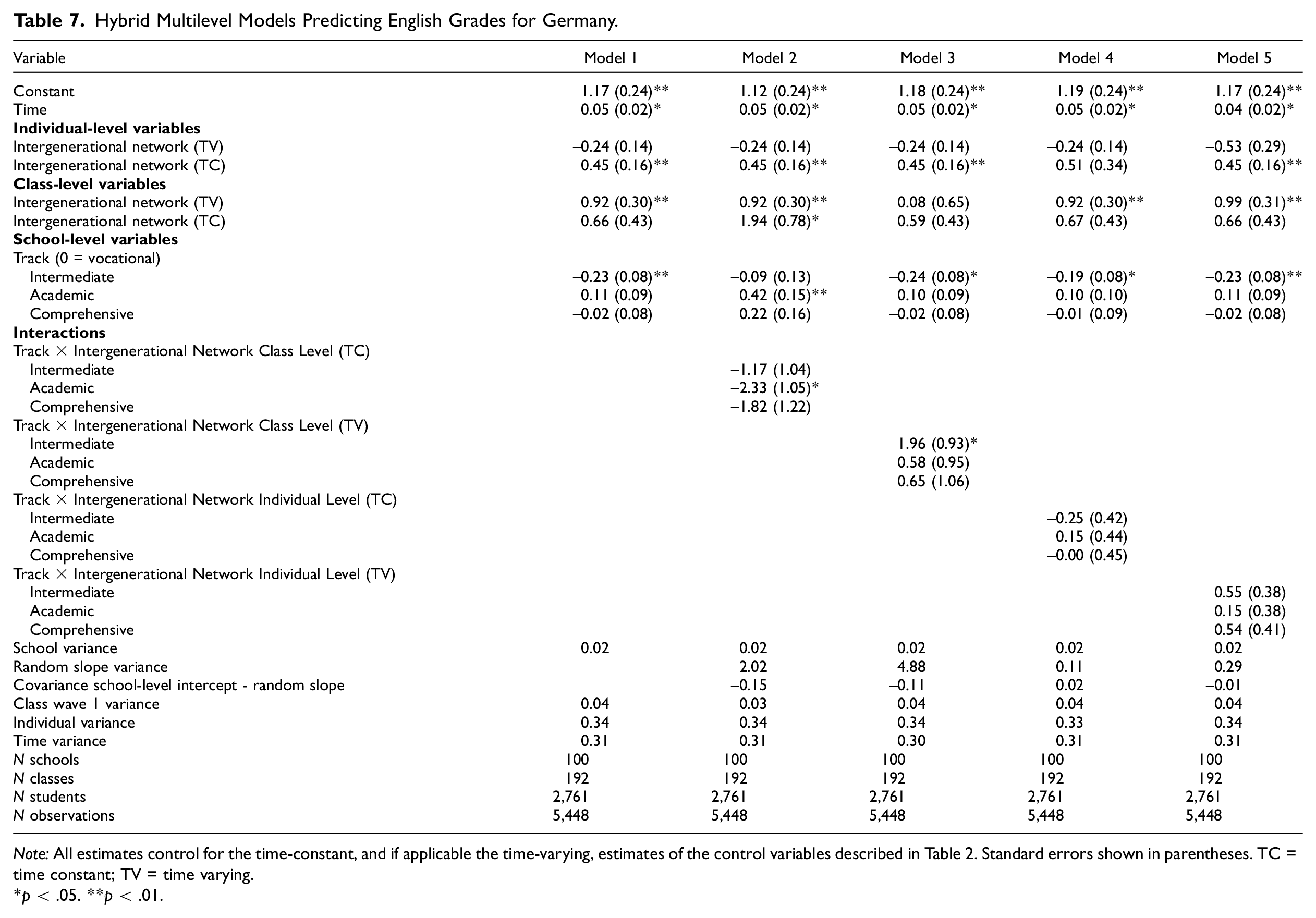
Tables 6 and 7 show results for the Netherlands and Germany, respectively. The tables present time-constant and time-varying estimates of the intergenerational network at the individual and class levels. The time-constant estimates are based on differences between individuals; the time-varying estimates are based on differences within individuals.
Hybrid Multilevel Models Predicting English Grades for the Netherlands.
Note: All estimates control for the time-constant, and if applicable the time-varying, estimates of the control variables described in Table 2. Standard errors shown in parentheses. TC = time constant; TV = time varying.
The class-level variables are constant within classes only if classes stay stable over time (i.e., for students who have the same wave 1 and wave 2 class).
p < .05. **p < .01.
Hybrid Multilevel Models Predicting English Grades for Germany.
Note: All estimates control for the time-constant, and if applicable the time-varying, estimates of the control variables described in Table 2. Standard errors shown in parentheses. TC = time constant; TV = time varying.
p < .05. **p < .01.
Intergenerational Networks and English Grades
The first model contains all variables but no interaction effects. In the Netherlands, neither the time-constant nor the time-varying estimates provide support for Hypothesis 1a. More specifically, Dutch students who attend a class with a dense intergenerational network do not obtain higher English grades than their peers who attend a class with a sparse intergenerational network. Moreover, and in contrast to Hypothesis 1a, students who experience an increase in their class-level intergenerational network density tend to decrease their English grades. A 1-standard-deviation increase in class-level intergenerational network density is related to a 0.04-standard-deviation decrease in English grades (i.e., [–2.57 × 0.02] / 1.25). Although the size of this relationship is very small, it significantly differs from the nonsignificant time-constant relationship, F(1, 0) = 9.35, p < .01.
In Germany, we do find some support for Hypothesis 1a. Students who attend a class with a dense intergenerational network do not obtain higher English grades than students who attend a class with a sparse intergenerational network, but students who experience an increase in intergenerational network density in class also increase their English grades. A 1-standard-deviation increase in class-level intergenerational network density is related to a 0.03-standard-deviation increase in English grades ([0.92 × 0.03] / 0.92). This time-varying estimate does not differ from the nonsignificant time-constant one, F(1, 0) = 0.23, p = .63.
We find no support for Hypothesis 1b in the Netherlands: students whose parents have a larger intergenerational network do not obtain higher English grades. In Germany, we find support for this hypothesis only when considering the time-constant estimate: students whose parents have a large intergenerational network receive higher English grades than students whose parents have a small intergenerational network. A 1-standard-deviation difference in the size of parents’ intergenerational networks is related to a 0.04-standard-deviation difference in their children’s English grades ([0.45 × 0.08] / 0.92). This positive time-constant (or between-individual) relationship significantly differs from the nonsignificant time-varying (or within-individual) relationship, F(1, 0) = 10.74, p < .01.
In summary, neither class- nor individual-level intergenerational networks are positively related to students’ English grades in the Netherlands. In Germany, we find some support for these relationships, yet findings depend on whether we consider differences between or within individuals.
Variations by School Tracks
In Models 2 and 3, we test whether the relationship between the density of classroom intergenerational networks and student performance varies across school tracks (Hypothesis 2a). Model 2 includes interactions between the tracks and the time-constant estimate of intergenerational network density; Model 3 includes interactions between the tracks and the time-varying estimate of intergenerational network density. 10 The interactions indicate whether the estimate for students in the vocational track (i.e., the reference group) statistically differs from estimates for students in the other tracks. Based on these estimates, we obtain average marginal effects of the class-level intergenerational network variables for each track. These are shown in the left image of Figure 2.
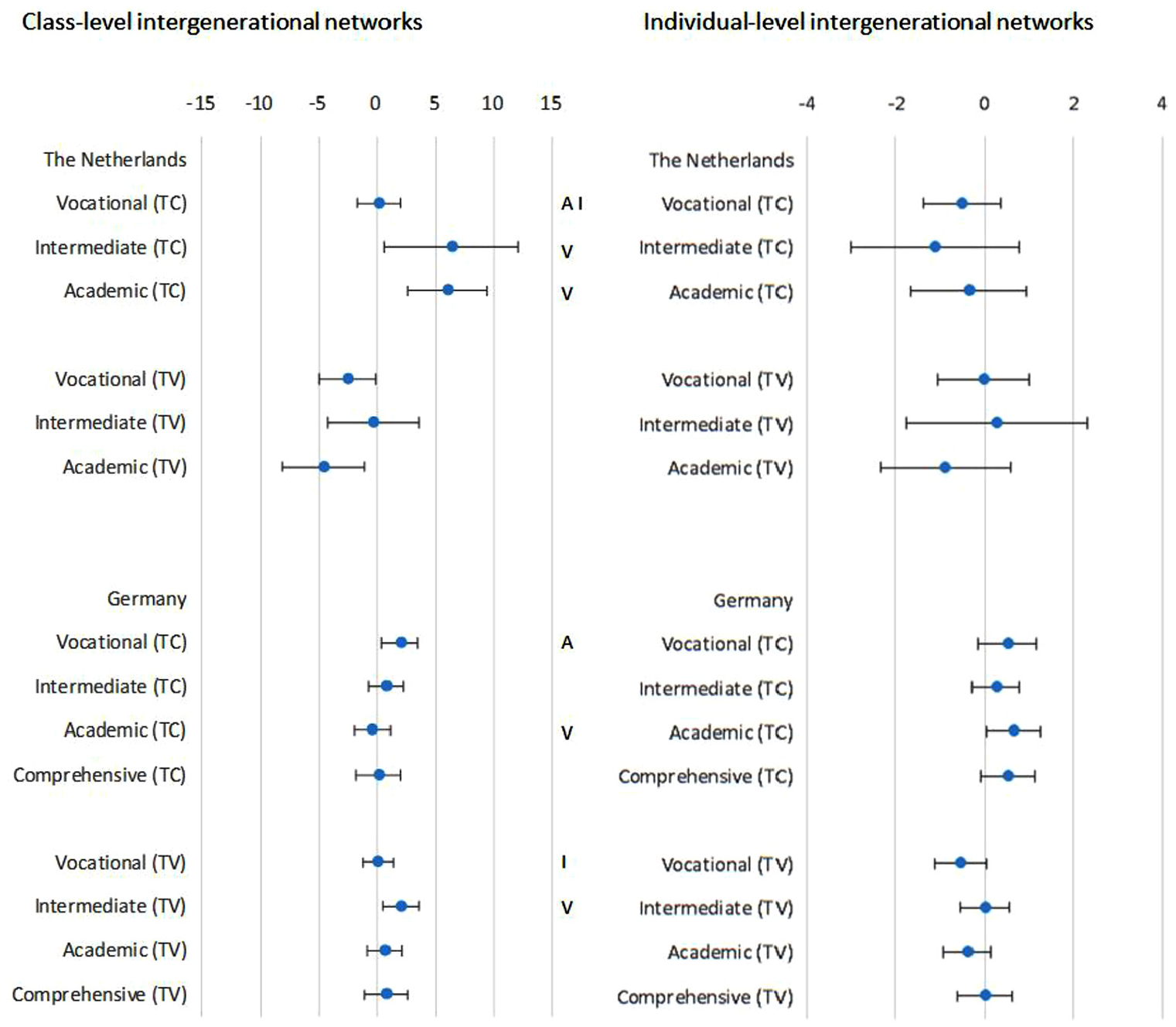
Average marginal effects by track (95 percent confidence intervals).
In line with Hypothesis 2a, we find positive and statistically significant track differences for the time-constant estimate of intergenerational network density in the Netherlands (Model 2, Table 6). More specifically, Dutch students in the vocational track do not obtain higher English grades when they attend a class with a denser intergenerational network, yet Dutch students in the intermediate and academic tracks who attend a class in which the intergenerational network is one standard deviation denser obtain English grades 0.20 and 0.19 standard deviations higher, respectively (see Figure 2; [6.39 × 0.04] / 1.25 and [6.02 × 0.04] / 1.25).
However, and in contrast to Hypothesis 2a, we find no statistically significant track differences when considering the time-varying estimates of class-level intergenerational network density in the Netherlands (Model 3, Table 6; Figure 2). An increase in the density of the classroom intergenerational network is related to a decrease in students’ English grades in the vocational and academic tracks (see Figure 2). For the academic track, the negative time-varying estimate significantly differs from the positive time-constant one (i.e., the confidence intervals of these estimates do not overlap).
In Germany, we find no support for Hypothesis 2a when considering the time-constant estimate of intergenerational network density (Model 2, Table 7). In contrast to Hypothesis 2a, attending a class with a denser intergenerational network is less positively related to students’ English grades in the academic track than in the vocational track. Students in the vocational track whose intergenerational classroom network is one standard deviation denser obtain English grades 0.17 standard deviations higher. We do not find this positive relationship in the other tracks (see Figure 2).
When considering the time-varying estimates of intergenerational network density in German classrooms, we find, in line with Hypothesis 2a, that an increase in classroom-level density is related to a stronger increase in English grades for intermediate-track than for vocational-track students. However, in contrast to Hypothesis 2a, there are no statistically significant differences between students in the academic versus vocational or intermediate tracks. Figure 2 indicates that an increase in the density of the intergenerational classroom network to which students are exposed is related to an increase in English grades for German students in the intermediate track. For these students, a one-standard-deviation increase in intergenerational network density is related to a 0.07-standard-deviation increase in their English grade (i.e., [2.04 × 0.03] / 0.92).
In Models 4 and 5, we examine track differences in the relationship between the size of a parent’s intergenerational network and a student’s English grades (Hypothesis 2b). The right-side image of Figure 2 shows the average marginal effects of parents’ intergenerational network size for each track.
We find no support for Hypothesis 2b in either the Netherlands or Germany: track differences in the relationship between the size of parents’ intergenerational network and students’ English grades are not statistically significant. In the Netherlands, parents’ intergenerational network size is not related to students’ English grades in any track (Figure 2). In Germany, we find a positive relationship only when considering the time-constant estimate for students in the academic track. Students in the academic track whose parents have a large intergenerational network obtain higher English grades than their peers whose parents have a small intergenerational network (see Figure 2). This relationship is not statistically significant in any other track.
All in all, we find no clear support for the hypothesized track differences in the relationship between intergenerational network density in classrooms and student performance in Germany (Hypothesis 2a). In the Netherlands, we find some support for these track differences when comparing different students to each other but not when comparing the grades of the same students over time. In neither Germany nor the Netherlands do we find statistically significant track differences in the relationship between the size of parents’ intergenerational network and their children’s English grades (Hypothesis 2b).
Robustness Checks
We perform three types of checks to assess the robustness of our findings. First, we estimate models in which we analyze alternative dependent variables, that is, Dutch grades in the Netherlands and German and mathematics grades in Germany (see online Supplement S1). Second, we estimate models in which we use different measurements for the intergenerational network. We use measures that (1) include only parents’ relationships to (the parents of) their child’s friends in class and (2) distinguish between the ties parents have with other parents and those they have with their child’s classmates (online Supplement S2). Third, we perform Heckman selection models on a larger sample of the data in which we also weight for the survey’s design (online Supplement S3). These models thus account for the selective response on the dependent variable and the oversampling of schools with a higher share of students with a migration background.
In the main models, we found that German students who experience an increase in intergenerational classroom network density also experience an increase in their English grades (Hypothesis 1a). This finding is not robust against all the different model specifications. Specifically, changes in classroom-level intergenerational network density are not related to changes in students’ self-reported mathematics or German grades. Moreover, the relationship does not reach statistical significance in the Heckman selection models or in the models in which we distinguish between the ties parents have to other parents and those they have to their child’s classmates.
The time-constant estimates that were positive and statistically significant in the main models are seemingly more robust against different model specifications, especially for Germany. In all models, German students whose parents have a large intergenerational network obtain higher grades than students whose parents have a small intergenerational network (Hypothesis 1b). This relationship seems mainly due to the ties parents have to a child’s classmates, not the ties parents have to the parents of these classmates (see Table S4 in the online supplement). In most of the models, we also find that Dutch students in the higher-ability tracks obtain higher grades when they attend a class in which the intergenerational network is denser (Hypothesis 2a). This relationship does not reach statistical significance when considering students’ Dutch grades, but the patterns are similar to the ones observed in the main models (i.e., the relationships are positive and are stronger in the higher-ability tracks, and the estimate for students in the academic track is close to statistical significance [two-sided p value = .072]).
In summary, we find some small (but largely consistent) positive relationships between intergenerational networks and students’ performance when considering between-individual estimates but not when considering within-individual estimates. In the Netherlands, we mainly observe the positive relationships in the higher-ability tracks. However, we find no systematic support for the hypothesized track differences, as they are not observed in Germany and observed only for the time-constant class-level estimates in the Netherlands.
Conclusions
The concept of “intergenerational closure” first appeared in Coleman and colleagues’ (Coleman 1988; Coleman and Hoffer 1987) influential work in the late 1980s. Ten years later, empirical research on this concept and its relationship to educational performance took off, after data became available that allowed researchers to measure intergenerational networks (Morgan and Sørensen [1999] were one of the first to empirically test Coleman’s hypothesis). Nevertheless, up to now, researchers have not been able to use complete network data to measure intergenerational networks (Carolan 2010); instead, they often relied on the answers of a few parents to map the entire intergenerational network in a school or classroom (Carbonaro 1999; Hallinan and Kubitschek 1999). Moreover, panel data on intergenerational networks were missing, so researchers could study only how differences between students’ intergenerational networks were related to differences in their school performance. These studies’ findings may therefore be biased by unobserved heterogeneity across students. This study contributes to past research by analyzing panel information on complete intergenerational networks in Dutch and German classrooms. We examined how changes in the intergenerational classroom networks to which students are exposed are related to changes in students’ grades. Moreover, we addressed how these within-individual estimates differ from the frequently studied between-individual estimates.
In line with several previous studies (e.g., Pong et al. 2005; Thorlindsson, Bjarnason, and Sigfusdottir 2007), we found some small and positive relationships between parents’ intergenerational networks and students’ self-reported grades when considering between-individual estimates. However, when considering within-individual estimates, we found no (robust) support. One might think this is due to a lack of statistical power, as the variation within individuals is typically smaller than the variations between them. However, we found statistically significant differences between positive between-individual estimates and nonsignificant or negative within-individual estimates. If we lacked statistical power to find within-individual estimates, we would not expect to observe such differences. Moreover, the within-individual variance in students’ grades was relatively large, and in the Netherlands, it was even larger than the between-individual variance. All in all, the present findings suggest the between-individual estimates of intergenerational networks on students’ grades may be confounded by unobserved differences between individuals. This finding highlights the importance of accounting for unobserved heterogeneity, and it may have important implications for U.S. findings that are generally based on between-individual estimates.
This article also contributes to research on school differences in the relationship between intergenerational networks and student performance. Previous studies have suggested that students reap educational benefits from intergenerational networks only when they attend schools in which proschool norms and resources are already in place. So far, these studies have been confined to the United States. We argue that this is a missed opportunity, as school differences may be more pronounced in countries where students are explicitly tracked into different schools on the basis of their academic ability (e.g., the Netherlands and Germany). We examined ability-track differences in the relationship between students’ intergenerational networks and their grades, and we found no systematic track differences. Proschool resources might be more prevalent in higher-ability tracks, but they are also more redundant for the students attending these tracks. Perhaps intergenerational networks only positively influence the school performance of students with relatively few resources (e.g., higher-track students from minority or disadvantaged socioeconomic backgrounds). Alternatively, intergenerational networks might simply not promote educational performance.
This study has some limitations. First, like any panel study with individual fixed effects, we cannot account for unobserved time-varying characteristics of individuals or classrooms. Other changes, such as transitions to new classrooms, might affect students’ networks as well as their grades. Second, changes in students’ grades may also lead to changes in intergenerational networks. For example, parents may become more active in school networks when their children’s performance deteriorates. Hence, positive relationships between intergenerational networks and grades may have been suppressed by this negative reverse effect. Future research should replicate our findings with more data points to account for this reverse effect.
Third, we used students’ self-reported grades. Although the correlation between self-reported grades and transcript grades tends to be high, the self-reported grade point average of students with lower performance or cognitive ability levels is generally more biased (Kuncel, Credé, and Thomas 2005). Such systematic biases will mainly affect our between-individual estimates, as the within-individual estimates account for time-constant confounders, such as students’ ability level.
Our findings lead to some doubts about how effective intergenerational networks really are in promoting educational performance. This has implications for our conception of social capital. Is social capital embedded in the closure of social networks (Coleman 1988), as we assumed, or is it, as Burt (2001) posited, embedded in “structural holes”? According to Burt, people will receive higher returns when their networks bridge two otherwise separated groups, because this enhances access to new information and resources. Based on this idea, Morgan and Sorensen (1999) introduced the concept of horizon-expanding networks, that is, parents’ contacts to adults outside of school that can provide access to nonredundant educational information and resources. Such horizon-expanding networks may be especially beneficial for the school performance of students with otherwise limited access to educational resources. These networks may thus play an important role in reducing educational inequality. Yet few studies explicitly focus on the role of horizon-expanding networks, as they are difficult to measure (Fasang et al. 2014).
The fact that we find little support for Coleman’s theory on intergenerational closure is important not only from a scientific point of view but also from a societal one. In some countries, efforts are already underway to promote intergenerational school networks. For example, in 2010, the Dutch educational council advised the Parliament to invest in parental communities in schools (Onderwijsraad 2010). Given the ambiguity of existing research findings, and especially the outcomes of the present study, such investments are questionable. This study showed that an increase in intergenerational school ties is not related to an increase in students’ grades, at least not for Dutch or German secondary-school students. Our findings suggest that previous studies that did find positive relationships may have been biased by unobserved heterogeneity across students. Before spending valuable resources on intergenerational school networks, we should at least conduct more research in which we account for unobserved differences across students.
Supplemental Material
OnlineSupplement_SOE_RR6_MG_edits_SG_inclTables – Supplemental material for The Role of Intergenerational Networks in Students’ School Performance in Two Differentiated Educational Systems: A Comparison of Between- and Within-Individual Estimates
Supplemental material, OnlineSupplement_SOE_RR6_MG_edits_SG_inclTables for The Role of Intergenerational Networks in Students’ School Performance in Two Differentiated Educational Systems: A Comparison of Between- and Within-Individual Estimates by Sara Geven and Herman G. van de Werfhorst in Sociology of Education
Footnotes
Acknowledgements
We thank the anonymous reviewers, the editor, and the copy editor for their valuable feedback and comments that greatly improved the paper. This study was supported by the Netherlands Organization for Scientific Research (NWO) through a Vici grant awarded to Herman van de Werfhorst (no. 453-14-017) and a Veni grant awarded to Sara Geven (no. 016.Veni.195.125). We want to thank the participants of the Interuniversitaire Werkgroep Sociale Ongelijkheid en Levensloop (ISOL) and the RC28 Conference in New York (2017) for their valuable feedback.
Research Ethics
In Germany, ethical approval was obtained for the CILS4EU project from the Research Ethics Committee of the University of Mannheim. In the Netherlands, official ethical approval was not required at the time of data collection, yet the same ethical guidelines were followed as in Germany, Sweden, and England (where the project was approved by appropriate ethics committees). Research was performed in accordance with ethical standards and regulations, including those from the 1964 Declaration of Helsinki and its subsequent amendments. All participants and their parents could refuse to take part in the study; and confidentiality of the participants and their parents was protected.

Supplemental Material
Supplemental material is available in the online version of this journal.
Notes
Author Biographies
References
Supplementary Material
Please find the following supplemental material available below.
For Open Access articles published under a Creative Commons License, all supplemental material carries the same license as the article it is associated with.
For non-Open Access articles published, all supplemental material carries a non-exclusive license, and permission requests for re-use of supplemental material or any part of supplemental material shall be sent directly to the copyright owner as specified in the copyright notice associated with the article.
