




Abstract
This study examines everyday fashion sharing through the lens of Erving Goffman’s concept of the sheath. Drawing upon 40 qualitative interviews, we extend the concept generatively, beyond its egocentric function as a personal bodily territory encasing the body, by establishing its social, utilitarian and hedonic functions in the social order of everyday fashion sharing. These functions enable consumers to express, strengthen, explore and perform the self in daily social situations. We thereby contribute the novel concept of the porous sheath for shared fashion items, characterised by additional functions, other-orientation and permeable co-territorialisation. We also contribute the concept of self-blending, which occurs when the porous sheath enables fashion sharers to assimilate perceived aspects of another’s self into their own. These concepts are significant in that they expand fashion sharing vocabularies and imaginaries beyond the sharing economy through a return to the dynamics of fashion sharing in everyday life.
Keywords
Introduction
This study empirically examines everyday fashion sharing through the lens of the sheath, a concept drawn from Goffman’s (1971) territories of the self, but extends it into what we conceptualise as the porous sheath. Historically, fashion sharing was an essential social practice rooted in community living, resource optimisation and cultural traditions (Schneider and Weiner, 1986). Over time, the emergence of industrialised production made many forms of sharing less necessary, including fashion sharing (Jin and Shin, 2021). More recently, the decline in sharing has been accelerated by the rise of consumerism and fast fashion (Joy et al., 2012).
Nonetheless, fashion sharing has re-emerged as part of the sharing economy (Schor and Vallas, 2021), as it meets a socio-cultural desire for self-expression, represents an economic pragmatism in an age of financial constraints and promotes environmental sustainability (Pang et al., 2022). Additionally, it alleviates concerns about poor labour conditions in the fashion industry as well as unsustainable production practices (Henninger et al., 2016). Increasingly, scholars and industry experts champion alternative modes of fashion consumption, such as temporary clothes swaps (Karpova et al., 2022) and fashion rental (Mukendi and Henninger, 2020), as potential remedies for the fashion industry’s unrestrained growth and, thus, its negative environmental impacts (Savelli et al., 2024). However, existing literature lacks a comprehensive examination of the functions of the sharing of fashion items in the dynamics of everyday social interactions beyond the sharing economy. This is the knowledge gap our work addresses.
To progress current theoretical conversations on everyday fashion sharing, we draw upon Goffman’s (1971: 29) territories of the self as a theoretical lens. According to Goffman (1971), those territories buffer and defend the self in social interactions, in line with specific spoken or unspoken norms, rules and procedures. One such ‘territory’ is ‘the sheath’, an egocentric bodily ‘preserve’, which he defines as ‘the skin that covers the body and, at a little remove, the clothes that cover the skin’ (Goffman, 1971: 38). We generatively extend the original concept to fashion items within the context of everyday fashion sharing. This results in a novel theorisation, which we conceptualise as the porous sheath, with several functions beyond simply covering the body and skin. It involves permeable territorial boundaries that are other-oriented rather than solely egocentric and is co-territorialised by sharers according to the rules and norms of their social interactions. This enables us to advance a deeper understanding of the various functions and boundaries of ‘mundane’ fashion sharing, including how it helps consumers perform the self in everyday social situations (both face-to-face and online). Here, ‘mundane’ fashion sharing is distinguished from commercial fashion sharing in the sharing economy, where fashion is shared or rented from unknown others, generally online, through for-profit platforms.
Fashion and fashion sharing encompass more than just clothing and individual garment consumption; they reflect social relationships, socio-cultural norms, values and aesthetic preferences. While previous studies have extensively explored ownership-based fashion consumption (Davis, 1994; Mukendi and Henninger, 2020; Ulrich et al., 2024), research on everyday fashion sharing is still nascent (Loussaïef et al., 2019). As consumers increasingly engage in fashion sharing, a better understanding of its functions and boundaries is crucial. We conceptualise the fashion items that are shared as an extension of Goffman’s sheath, and this illuminates how fashion sharing enables people to perform the self in a range of everyday social interactions. Accordingly, we advance these important theoretical discussions by addressing the following research question: what are the functions and territorial boundaries of the sheath in everyday fashion sharing, and how do they enable consumers to perform the self in daily life?
Using qualitative research with 40 interviewees, we find that shared fashion items form a multifaceted and porous sheath with social, utilitarian and hedonic functions. Embedded within everyday shared fashion activities, the porous sheath enables consumers to express, strengthen, explore and perform the self in daily social situations both face-to-face and online, with minimal or no financial or environmental costs and with other advantages over the original, egocentric sheath. Our novel theorisation of the porous sheath emphasises its permeability, its self and other-oriented nature and the ways that sharers co-territorialise fashion items according to their social rules and norms. We also contribute the concept of self-blending, which occurs when the porous sheath enables fashion sharers to assimilate perceived aspects of another’s performed self into their own. The significance of these concepts lies in their expansion of fashion sharing vocabularies and imaginaries beyond the sharing economy through a return to the dynamics of fashion sharing in everyday life, that is, in non-economic daily social interactions.
From the Sharing Economy to Everyday Fashion Sharing
The sharing economy has transformed fashion sharing into a significant industry, given its potential to create new economic opportunities and its capacity to drive socio-cultural transformation (Deka, 2018; Ladegaard, 2018; Schor and Vallas, 2021). As ‘a closed socio-economic system facilitated by digital platforms’, the sharing economy matches peer-to-peer offer and demand according to the culture and rules of the online platform (Miguel et al., 2022: 34–35), usually at a profit for the platform. This kind of ‘sharing out’ (Belk, 2010: 715) involves commodities being accessed for a fee (Arcidiacono et al., 2018); it blends the logic of market exchange with the virtues of social relationships (Arvidsson, 2018).
In the context of fashion, the sharing economy has evolved to include online business-to-consumer (B2C) rentals, online peer-to-peer (P2P) sharing, online B2C and P2P hybrid sharing and subscription-based rentals. Thus, online platforms have enabled complex and diverse models of fashion sharing to develop (Iran and Schrader, 2017), which have enhanced user experience and resource utilisation while promoting sustainability (Frenken and Schor, 2017). They have helped to meet concerns with sustainability, community and the value of non-individuated ownership (Biehl-Missal, 2013).
It is argued that consumer engagement with fashion sharing through the sharing economy is mostly driven by economic benefits, such as being able to explore fashion choices at relatively low cost and with low perceived risk, as well as by fashion involvement, the search for hedonic experiences, social projection and past sustainability behaviours (Jain and Mishra, 2020). Additionally, a desire to forge and strengthen social relationships and the aspiration to contribute to a common cause can also play a role (Arvidsson, 2018; Schor and Vallas, 2021).
Nevertheless, platform-based fashion sharing models have been criticised as pseudo-sharing due to their profit-making orientation (Frenken and Schor, 2017). Also, the sharing that takes place through the sharing economy is distinct from the sharing practices that occur without monetary exchange, in everyday social interactions, for example among family or in local communities. While the sharing economy is part of the current predominant economic system, everyday, ‘mundane’ fashion sharing offers a genuine alternative to it (Katrini, 2018).
Everyday forms of fashion sharing include lending and borrowing, co-owning and temporary swapping within circles of friends, family and/or the community more widely. There is an expectation that the items will be returned or co-utilised, reflecting the concept of ‘sharing in’ (Belk, 2010: 715), with temporary access to fashion items. It is more inclusive than the fashion sharing economy or access-based fashion consumption because it does not require commercial transactions (Bardhi and Eckhardt, 2017) or platform mediation (Botsman, 2013). However, items are often discussed and displayed online, as social media are increasingly used for everyday social interactions. The crucial distinction is that everyday fashion sharing is ‘based on exchange of knowledge, resources, information and support rather than on monetary exchanges’ (Katrini, 2018: 430). Since it supports common benefits for the social group and, more broadly, the community, it creates a way for individuals to address their fashion needs in a more sustainable, resourceful and socially engaging manner (Katrini, 2018). These characteristics highlight the embeddedness of shared fashion items in everyday life, which is what we attend to in this work by conceptualising shared fashion items as porous sheaths.
Conceptualising the Shared Fashion Item as a Porous Sheath
An extensive body of literature exists on the symbolic roles of personal possessions in enabling consumers to construct and convey their sense of identity (Bardhi and Eckhardt, 2017; Belk, 1988; Loussaïef et al., 2019; Mason, 2018), including their ‘extended self’ (Belk, 1988: 140), their connection to specific social groups (Elliott and Wattanasuwan, 2015) and their distancing of undesired selves (Banister and Hogg, 2004). Nevertheless, research on temporary or shared material possessions is scarce (Fritze et al., 2020), particularly in the context of fashion (Loussaïef et al., 2019).
Here, we turn to Goffman’s (1971) work as a theoretical lens, as it can illuminate the micro-sociological aspects of everyday situations (Goffman, 1964) that structure social interactions (Kerr et al., 2018). Goffman’s work provides conceptual tools for analysing the regulation of social life, both face-to-face and online (Brownlie and Shaw, 2019). His theorisations have been applied to ‘the management of threats to social order across a wide range of historical contexts’ (Hancock and Garner, 2021: 568). We argue that they can also be applied to the functions of shared fashion items.
Goffman (1971) focuses on the order of social interactions, foregrounding the ‘theatrical, ritual, strategic elements [. . .] in everyday life’ (Jacobsen and Kristiansen, 2014: 67). His analysis is underpinned by concepts including the interaction order, presentation of self, frame analysis and the sheath as a ‘territory of the self’ (Goffman’s 1971: 29; Hancock and Garner, 2021). Goffman’s (1971) work unpacks the shared presuppositions and implicit collective norms, rules and procedures that shape the order of social interactions. It also clarifies the criteria by which such interactions are judged and performed (Harris and Karimshah, 2019; Khan, 2024).
Specifically, we draw upon Goffman’s (1971: 29) notion of ‘territories of the self’; that is, the personal preserves or the ‘field of things’ that individuals seek to maintain in social interactions. These territories include (but are not limited to) personal and use space (defined as ‘the territory immediately around or in front of an individual’), information, the body and ‘the sheath’ (Goffman, 1971: 34-38); as noted above, the latter Goffman defines as ‘the skin . . . and the clothes that cover the skin’, and is therefore of particular interest in the context of fashion. Goffman (1971: 29) explains that the boundaries of these territories are ‘patrolled and defended’ by interacting individuals in particular ways, which function to buffer and defend the self in social situations according to specific spoken or unspoken norms, rules and procedures. Building upon and extending these ideas, we argue that everyday fashion sharing is a process that reimagines the ways that these boundaries are maintained, negotiated and expanded.
Goffman’s notion of territories of the self suggests that the self is performed not only through words and gestures but also through the physical management of bodies, spaces and the ‘preserves’ that individuals seek to maintain in specific social situations (Jacobsen and Kristiansen, 2014). The integrity of these territories is tied to ‘face’ and dignity; thus, when they are violated, remedial work (apologies, accounts) is often needed to restore the social order (Dawe, 1973).
In the context of fashion sharing, we argue that sharers reimagine territories of the self through a shared field of fashion ‘things’ (i.e. shared clothes) by co-patrolling, co-defending, co-maintaining and co-creating a territory with porous boundaries that respects mutually agreed fashion sharing norms, rules and procedures within a relationally bound social interaction.
Goffman (1971: 38) used ‘the sheath’ to describe an egocentric bodily territory (bounded by the individual’s skin and clothing). The sheath’s function is that of a boundary that others are typically expected to respect in everyday interactions, acting as a bridge between personal and public space (Hancock and Garner, 2021). Touching someone’s skin or clothes without permission generally breaches this territory and can be experienced as an affront.
Goffman’s (1971) territories of the self can, though, be reimagined in ways that also account for the potential tensions, inequalities and power dynamics in sharing situations. We argue that shared fashion items as sheaths are multifaceted and other-oriented rather than just egocentric, with more than just the original boundary-asserting function discussed in Gofman’s (1971) work. Together, these characteristics encompass what we conceptualise as a porous sheath, a more permeable kind of territory of the self, which sharers co-territorialise according to the rules and norms of their fashion sharing interactions. The porous sheath also enables what we term self-blending, which occurs when the porous sheath enables fashion sharers to assimilate perceived aspects of another’s self into their own self in everyday life.
Methods
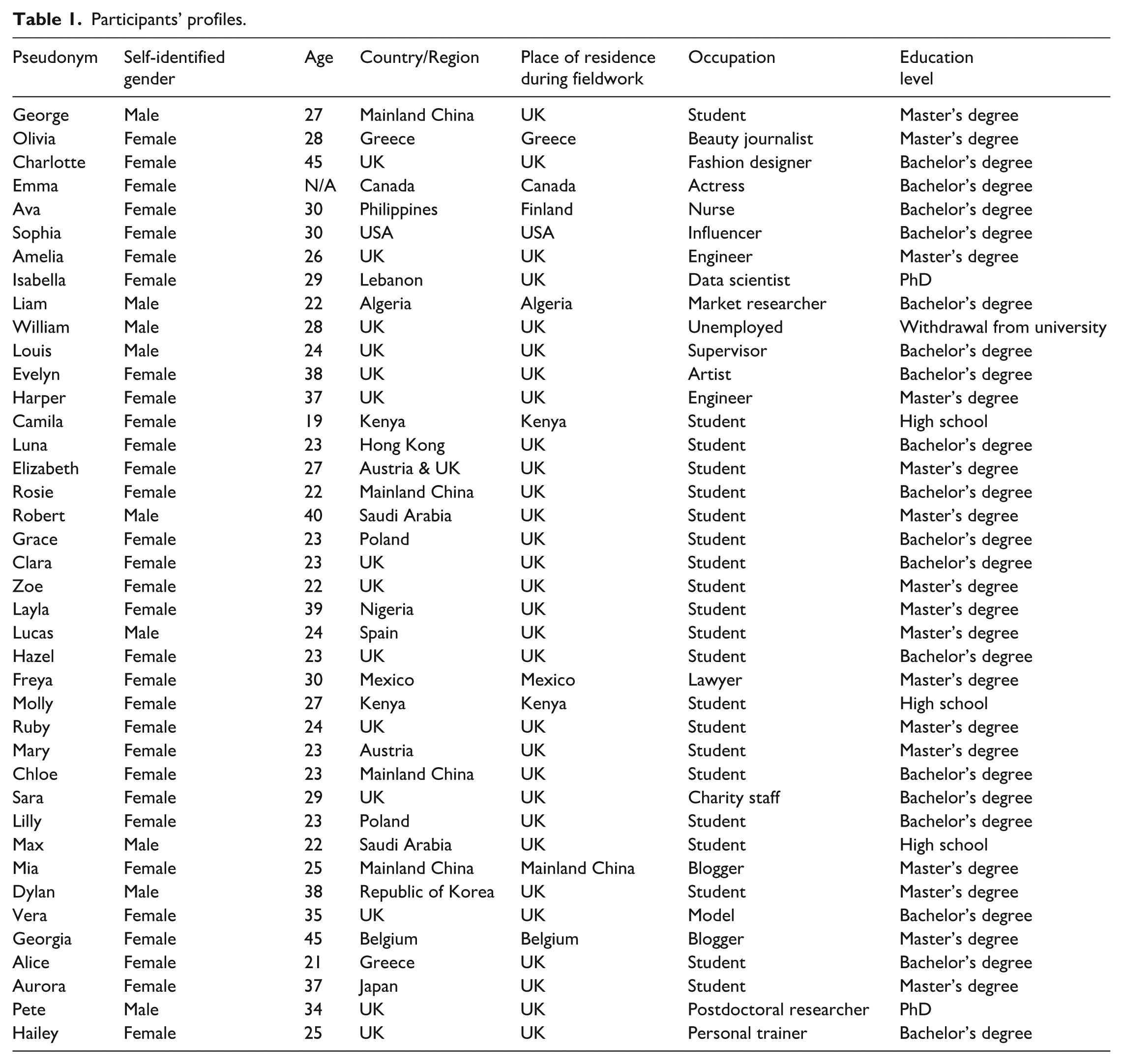
We used an interpretive approach to qualitative research because it enables theory development. Upon receiving institutional research ethics approval, we purposively recruited participants who were 18 or older, had fashion sharing experience and were willing to share pictures of the fashion items they shared. Instagram was chosen as the sample recruitment platform because it is a prominent ‘stage’ for people’s daily lives, including for showing and discussing shared fashion items. It also offers flexibility and rich data. Nevertheless, we acknowledge that the limited response rate and the relative youth of Instagram’s userbase resulted in a sample with an overrepresentation of highly educated younger people, and students in particular (see Table 1).
Participants’ profiles.
Participants were recruited in three stages. First, the lead author developed a Python-based semi-automatic tool (which included optical character recognition technology) to sample Instagram posts systematically. From the 191 public Instagram posts extracted, over 160 Instagram users were identified as potential participants, seven of whom agreed to take part in the research. Second, adverts with research recruitment information were posted on Instagram, resulting in the recruitment of 23 additional participants. Third, we used snowball sampling, which resulted in the recruitment of 10 more participants.
Thus, the sample comprised 40 participants. Their demographic characteristics are reported in Table 1. Participants had an age range of 19 to 45 (mean: 28.5 years). All participants were selected on the basis that they were engaging in everyday fashion sharing, yet how they practised that sharing varied widely. This gives a wide diversity to the perspectives in this study, allowing insights into different aspects of fashion sharing and the functions of the porous sheath in this social interaction.
The interviews were conducted online, by the first author, via Zoom, MS Teams, Tencent Meeting or WhatsApp. They took place between July and October 2021. Each lasted between 50 and 75 minutes. Participants were asked to use their fashion sharing photos to prompt their discussions of their shared items and fashion sharing experiences. The interview guide included questions about participants’ backgrounds, their fashion perceptions, how and to what extent they shared fashion items, the items they shared and with whom they shared items. We also asked participants about their reasons for sharing, the functions of sharing, any concerns they had about fashion sharing and perceived differences between accessing and owning fashion items.
All interviews were video-recorded and transcribed verbatim. Thematic analysis with NVivo 12 software was used to generate an initial coding template based on our theoretical concerns and the first 10 interview transcripts (King and Brooks, 2017). That template was then applied to the remaining interview data and further modified before a final coding framework was developed. It included the three core themes identified regarding the functions of fashion sharing as a sheath, namely social, utilitarian and hedonic.
Fashion Sharing and the Porous Sheath
Participants reported that they engaged in different types of fashion sharing interactions, from sharing through an app that connects people with strangers who then become friends in daily life to romantic partners borrowing each other’s clothes. Some participants engaged in sharing practices that were more deliberate, pronounced and frequent (e.g. the romantic partners sharing each other’s clothes), while others engaged in practices that were more ad hoc and one-off (e.g. borrowing shorts and sandals for a visit to a beach with friends). Thus, the findings reflect the wide range of fashion sharing interactions in people’s everyday lives.
Our findings provide empirical support for our theorisation of everyday fashion sharing as a field where sharers reimagine their territories by co-patrolling, co-defending and co-maintaining these territories’ permeable boundaries. We show these reimagined, permeable territories of the self through the sharing interactions that take place around the porous sheath, a sheath that is both self and other-oriented. We do so by focusing on emic examples of the porous sheath’s social, utilitarian and hedonic functions (beyond covering one’s body) as they relate to sharing interactions. In practice, these functions frequently blur and co-exist, but for analytical clarity we position each example below under the function that was most salient for the participant. In this way, our findings foreground the distinctive purposes of the sheath without denying or eliding their fluid and intersecting nature.
We start by demonstrating the porous sheath’s social function, where the field of fashion sharing items helps people interact in order to expand and strengthen social networks and the groups in which the self circulates. A particular social function of the porous sheath is to facilitate self-blending, where it enables fashion sharers to assimilate perceived aspects of another’s performed self into their own, as a part of their reimagined territories of the self in fashion sharing situations. We then discuss the utilitarian function of the porous sheath. In particular, some participants engage in fashion sharing because of the need to ‘preserve’ money, in a self-oriented way and not through choice alone. In contrast, for other participants, sharing interactions involving the porous sheath are choice-based rather than necessary, chosen because they put idle fashion items into reuse (by others) and reduce the need for storage space. The utilitarian function of the porous sheath, thus, illuminates social inequalities relating to reimagined territories of the self. Finally, we then examine the hedonic function of the porous sheath, highlighting how shared items can preserve enjoyment and freedom from individuated ownership obligations in sharing interactions where fashion sharing is by choice rather than a necessity.
Underpinning all these themes is how individuals use these functions and co-territorialisation to explore, express and perform the self in social situations. Throughout the three sections, we demonstrate the mutually (and at times tacitly) agreed fashion sharing norms, rules and procedures within relationally bound fashion sharing interactions, and the tensions and power dynamics that emerge through the porous sheath.
Social Function
The social function of the porous sheath refers to the relational, interactional and responsive purposes of the sharing of fashion items.
The porous sheath facilitates the preservation and expansion of participants’ social networks and builds long-lasting connections through its co-territorialisation. For example, Isabella made a close friend after borrowing a hijab upon arriving in the UK. She and her sharer have maintained a strong bond and continue to share (or co-territorialise) their porous sheaths. The function of their fashion sharing thus shifted from the largely utilitarian (co-usage) to the predominantly social (friendship): I’m no longer in that need [of borrowing a hijab], but it continued as a hobby and part of the friendship. So, every time I buy something I’m like, Look! I got this. And I think it’s good for both of our sizes. (Isabella, female, 29)
Chloe and Evelyn similarly explained that the sharing of fashion items contributes to strengthening friendships. Again, co-territorialisation (of the porous sheath) allows people to socialise and bond through similar fashion or other interests: ‘If you are familiar with each other, you will be more willing to borrow things. And then if you borrow more things, you will communicate more, and then you will be closer’ (Chloe, female, 23). This account shows how the porous sheath functions socially as a relational mechanism, enabling boundaries of the self to become permeable and co-negotiated in order to sustain closeness and reciprocity.
Beyond facilitating social interaction, the porous sheath can help build trust through co-territorialisation itself and, thus, strengthen people’s connections: I think it [fashion sharing] has helped me to connect with my friends more. I think it’s built up trust. [. . .] You give someone your clothes, and you know, you have an expectation of how it will be looked after [. . .] Like, that’s a way of connecting more with your friends. (Evelyn, female, 38)
Here, Evelyn highlights a norm governing the porous sheath’s co-territorialisation (specifically, sharers expect an item to ‘be looked after’). Further, participants find groups of individuals who share the same interests and beliefs through fashion sharing interactions facilitated by the co-territorialised, porous sheath. For example, through her peer-to-peer fashion sharing interactions, Olivia (female, 28) met a group of people online who shared similar interests in sustainability: ‘Everyone is interested in sustainability, in one way or another. So, you already have something in common. And then it’s nice being able to access so many different wardrobes that you wouldn’t be able to otherwise.’
In other cases, the porous sheath shapes how participants perform the self. The porous sheath carries visual signifiers and becomes a medium through which the self is expressed, reinforced and/or reconfigured in social situations involving fashion sharing. By engaging with the symbolic aspects of the porous sheath, participants preserve and perform the self. For example, Camila frequently borrowed her sister’s hoodie because it featured a printed sentence that she adopted as a personal reminder not to judge others by their appearance, in turn helping her to perform her sense of self as non-judgemental in social interactions: I found the message on it [the hoodie] to be very cool: ‘Not judging people based only on their appearance.’ That’s the whole aspect of you that you couldn’t judge colour and couldn’t tell by people’s faces, whether they’re good or bad. (Camila, female, 19)
Beyond reinforcing the self, some participants described how the porous sheath enables them to assimilate or co-territorialise perceived aspects of another’s self into their own, which we term self-blending: When you see your friends wear something a lot and then you try it on, or you swap something, you can have a laugh about how it looks different on you. [. . .] And then it’s like, it becomes part of what you see when you see them. [. . .] So, when you swap, it’s like, you’re taking on something of that person. (Evelyn, female, 38)
For Evelyn, this is not just about wearing her friends’ clothes but about strengthening their bond and deriving joy, which illustrates a hedonic function of the porous sheath. Yet beneath this lies a more fundamental social function: the porous sheath enables relational permeability, where sharers incorporate elements of others’ selves into their own, thereby co-creating, maintaining or enhancing sharers’ social connection. Similarly, Isabella shared a coat with her mother and sister as a means of connection but also as a way for Isabella to incorporate a part of these important family members’ selves when she wore it: When I wear it [the shared coat], I feel like I’m taking a part of them with me. If I wear it to work, it feels like I’m bringing my mum along, or if I wear it shopping, it’s like my sister is with me. It makes me feel as if they’re around and not far away. (Isabella, female, 29)
Isabella’s account demonstrates how the porous sheath allows others’ emotions and their imagined presences to be absorbed into her own self, making the self relationally bound and co-territorialised. Together, Evelyn’s and Isabella’s accounts highlight that the porous sheath is both a vessel for maintaining reciprocity and intimacy and a relational vehicle for the intermingling of diverse selves. This underpins our conceptualisation of the sheath as porous: it facilitates the blending of selves through fashion sharing interactions, allowing participants to symbolically embody and ‘carry’ one another in everyday life.
The porous sheath allows participants to co-territorialise relational, emotional and practical boundaries in their social interactions, affirming and preserving intimacy and mutual recognition and avoiding disorder. For example, George (male, 27) described how his girlfriend’s borrowing of his clothes to go to the gym or to work – in other words, her porous co-territorialisation of the fashion items that George shares – preserved his perception of affection: ‘It [sharing fashion items] is like a message to enhance our relationship. Every time I see my girlfriend wearing my stuff and feeling happy wearing my T-shirt, I’m quite happy because I think I’m accepted and loved by her.’ In George’s case, the porous sheath transforms intimate objects into shared territories of the self, reinforcing affective bonds and mutual recognition. The enjoyment accompanying acts of sharing was secondary to the deep relational and emotional significance of their fashion sharing interactions.
Some participants highlighted that cultural norms also play a role in the co-territorialisation of the sheath. For example, Robert foregrounded the importance of other (rather than just self) orientation in his culture, and how the porous sheath can facilitate this: Well, because I think this is a lovely thing to do. ‘Share is care.’ [. . .] It’s good to make someone happy by sharing. So, if someone asks you to do something, this is actually part of our culture, part of where I come from, you have to help people who need help. (Robert, male, 40)
Similarly, Alice and her community engaged in fashion sharing interactions through an other-orientation that demanded a frequent loosening up of ownership boundaries. This was seen in an ongoing co-territorialisation of sheaths initially shaped by need during a financial crisis: In my town in Greece, [it] has been like every Friday [. . .] where you can borrow and lend clothes. And the first time I participated was when I was 15, 16 years old. I really liked it. So, I went there almost every week until I came here. . . So, every person can take some clothes from his or her farm, and then they can put them on some benches outdoors. And then every other person can go to them and borrow them or buy them for a very small amount of money. But usually, it’s free. . . It started when, I think it was a crisis. Yeah, it was a time when we had like, a financial crisis. So, some people couldn’t like, have clothes, like new clothes. (Alice, female, 21)
Here, Alice explains the unwritten rules and process of fashion sharing interactions in her community, and the importance of the co-territorialised, porous sheath for those who may not have new or sufficient clothes to wear.
In summary, the social function of the porous sheath foregrounds the relational, interactional purposes of shared fashion items. It reflects how individuals co-territorialise shared fashion items, expanding or creating a permeability around the boundaries of their sheaths and facilitating the performance of the self in social situations. The examples in this section demonstrate how the porous sheath enables participants to continually redefine and share the boundaries of the self, including through what we term self-blending. These observations reinforce our theorisation of the sheath as porous rather than fixed or impermeable. For some participants, engagement with the porous sheath through fashion sharing was voluntary. For others, it was done out of necessity, where the porous sheath enabled dignity during difficult times. Thus, the porous sheath addresses choice and want but also need and is a conduit for deepening social and emotional connections in social interactions. This reflects the importance of the porous sheath in everyday relationships and community interactions.
Utilitarian Function
The utilitarian function of the porous sheath relates to how useful participants’ porous sheaths are in enabling and maintaining fashion sharing interactions for specific purposes. Here, the porous sheath retains the original, egocentric functions of Goffman’s sheath, such as providing warmth, covering for parts of the body or managing physical territory. For instance, Ava borrowed a pair of sandals and shorts from her friends, which ensured her comfort on her joining their impromptu trip to the beach: I was attending a traditional Catholic mass at a church when I met my friend[s], who mentioned they’re going to the beach. They told me it was a sandy beach, so I borrowed sandals, and one of them offered me her shorts since I was wearing jeans and rubber shoes. (Ava, female, 30)
As can be seen in Ava’s quote, beyond the original functions of the sheath, the porous sheath also encompasses a practical usage function for a specific purpose (in this case, going to the beach), and helps participants manage resources and practical needs within specific social interactions. For example, some participants shared fashion items for usage in special situations such as job interviews or graduation ceremonies, requiring specific types and styles of garments.
The porous, shared sheath also enables monetary savings and thriftiness for sustainability purposes. Through the porous sheath, some participants interact to preserve their monetary resources and reduce the storage space needed for fashion items, reorienting idle items into shared use and creating a reimagined, shared territorialisation of these items. For instance, some participants managed their fashion items – and thereby their porous sheaths – efficiently by minimising the need for individual ownership. This was usually done out of choice rather than necessity, as Sophia explains: For me, borrowing or sharing with friends is a way of teaching us a different kind of new. Society always says new is better, but it doesn’t mean you have to go out and buy something new. You can just borrow and create brand-new outfits in a more sustainable way. (Sophia, female, 30)
Here, Sophia shows that one utilitarian function of the porous sheath is to operate as a sustainability device, enabling participants to reconfigure ownership boundaries and resource use in ways that avoid fashion overconsumption. By redefining what counts as ‘new’ through sharing, participants such as Sophia highlight how fashion sharing can be compatible with the fashion logics of novelty, but in a more environmentally sustainable way. Many other participants likewise mentioned the importance of maintaining the shared boundaries of the porous sheath for environmental sustainability and opposing fashion overconsumption reasons.
Further, Ava mentioned how fashion items were passed down across generations in her family, whereby porous sheaths allow people to share territorial boundaries across time, while again preventing waste and saving money: My stepsisters use things [fashion items] that my grandmother or mother saved, and then I use them, too. I’ve even seen my nieces use them, making it three generations. I think it [sharing] saves some money and [saves] the resources [going] to waste by not throwing away items if they’re still usable. (Ava, female, 30)
It is important to note that the utilitarian function of the porous sheath in fashion sharing interactions that related to thrift was not always a matter of choice: the economic circumstances of some of the participants necessitated ‘mundane’ fashion sharing. This reveals social inequalities in this reimagined territorialisation of the self.
For example, due to a lack of access to goods when some participants were children, they had no choice but to share with siblings and relatives. This negatively shaped their early experiences of fashion sharing, given their inability to preserve the boundaries of their own sheaths, including the egocentric function normally associated with it as a territory of the self, due to economic constraints. Evelyn, for instance, did not enjoy her early fashion sharing interactions because she could not maintain the egocentric boundaries of her own, non-shared sheath: I’d been really poor and I knew that when you’re in that situation, you have to share. It’s not a nice thing. It’s just a reminder that you haven’t got money. [. . .] Whenever I’d shared as a necessity, it’s not been a nice thing, because you don’t really have a choice. (Evelyn, female, 38)
Evelyn’s account clearly illustrates the tensions that arise when the porous sheath is driven by necessity rather than choice. While the social function of the porous sheath often involves co-patrolling and co-managing the sheath in ways that foster trust, intimacy and mutual recognition, Evelyn’s experience reveals the affective strain that can accompany fashion sharing for utilitarian purposes under conditions of precarity. Here, co-patrolling and co-managing the sheath’s boundaries do not feel relationally rewarding. Instead, they sit in tension with the social function of the porous sheath, underscoring lack of autonomy and reinforcing economic vulnerability. This shows that the utilitarian function of the porous sheath is marked by ambivalence: it can enable practical benefits and resource preservation, but can also highlight inequalities and affective discomfort in this reimagined territorialisation of the self when participants cannot maintain the egocentric boundaries of their sheath due to economic constraints.
In summary, the utilitarian function of the porous sheath helps participants co-preserve, co-defend and co-manage the shared territories of the self. It often relates to monetary savings and thrift, but also to the demands of specific social situations as well as to sustainability practices. However, fashion sharing is not always done by choice, highlighting inequalities and tensions in interactions involving the porous sheath. In this way, the utilitarian function demonstrates that the porous sheath is both enabling and constraining: it affords practical benefits but also reveals the inequalities and affective discomfort that emerge under circumstances of economic constraint.
Hedonic Function
The hedonic function of the porous sheath regards the ways that the sheath brings joy and pleasure to participants as they preserve and co-maintain their shared territories in fashion sharing interactions. For example, Amelia wore a costume borrowed from her aunt to attend an immersive play, The Great Gatsby. She reported that her costume was admired by many, which significantly enhanced her pleasure in attending and participating in the performance: It made me feel that I was actually one of the [characters of] Great Gatsby because it was an immersive play. So, if I had not worn the costume, I would not feel too involved in the play, but because of wearing it, I felt involved in it. (Amelia, female, 26)
The porous sheath not only enhanced Amelia’s enjoyment of the play but also enabled her to interact within the play in a personally gratifying and meaningful way. This experience was not only about the aesthetic appeal of the porous sheath but also about the fulfilment it provided.
Participants also described the joy and gratification they derive from sharing itself, whether through helping others, receiving validation or experimenting with new styles. For example, both Robert (male, 40) and Layla (female, 39) explained that fashion sharing (and therefore implicitly the porous sheath) was not only a way of helping others but also a source of personal gratification. This act of sharing the sheath’s territory aligned with their collectivist cultures, enhancing their sense of connection with the community while giving them a deeply satisfying and enjoyable experience. Additionally, participants also highlighted that the porous sheath enables the sharing of joyful experiences with their friends and family. By co-territorialising the sheath, people can engage in conversations about their fashion choices, exchange style tips and celebrate each other’s unique fashion tastes.
The porous sheath serves to facilitate hedonic pleasure through validation, admiration and delight. Amelia experienced not only a sense of style validation but also pride in knowing that family and friends were eager to co-territorialise her porous sheath: Well, I think if anybody wants something or doesn’t have something, it’s always me that [says], ‘Okay oh, you can wear mine.’ [. . .] It’s like I’ve got a better piece, a better dress, or a better thing than what they have. Hmm, [. . .] that’s one of the reasons why I lend. (Amelia, female, 26)
The repeated borrowing of Amelia’s garments by family and friends not only confirmed her aesthetic choices but also fulfilled her desire to be perceived as stylish and fashionable (a hedonic function of the porous sheath).
The porous sheath also enables pleasure through experimentation and discovery in fashion sharing interactions, as sharers can access, try and co-appropriate various clothing items and styles: When you borrow, you can experiment with colour and with the shapes of clothing. And I think that once you decide what colour really goes with you and which styles really go with you, then you can also help improve your own fashion sense and style sense. (Emma, female, N/A)
For Emma, the ability to experiment freely through the porous sheath contributed to an enhanced understanding of her personal style preferences, ultimately leading to enjoyment and satisfaction. The porous sheath engenders hedonic pleasure through style discovery and affirmation of personal taste. It serves as a conduit for both creative expression and emotional gratification. Although experimenting with borrowed clothes could be read as being utilitarian in function (as a form of testing before purchase), for Emma it is the hedonic function that matters, given the pleasure she derives from the porous sheath.
The porous sheath similarly enabled some participants to try out and experiment with bold fashion ideas. For example, Charlotte (female, 45) and her friend Louis (male, 24)both liked extravagant fashion styles. Usually, Louis was not confident about how to wear these pieces. Nevertheless, Charlotte encouraged him to experiment with porous sheaths by engaging in fashion sharing. Consequently, ‘He [Louis] is becoming more confident as a result of borrowing things and going out and wearing them and just taking more risks, I think’ (Charlotte, female, 45). This ability to experiment with daring fashion sheaths offered a pleasurable and enjoyable experience to Louis.
The porous sheath also enables pleasure through the co-territorialisation of fashion items for participants who cannot afford to access fashion in other ways due to their economic circumstances. It enables enjoyment through commitment-free fashion interactions, where participants do not have to bear the costs of owning, storing, maintaining and disposing of individually owned sheaths irrespective of their economic means. For example, Harper explained that the porous sheath enabled access to a broader pool of fashion items with less responsibility: It means you have access to a wider variety of different items, sometimes different styles. And you get the opportunity to try something on and decide whether you like it or not without having to either try it on in an awkward spot in the shop or at home and then send it back or take it back. You have less responsibility and pressure to like it. (Harper, female, 37)
Further, the porous sheath also functions as a hedonic device by enabling participants to experience the pleasures of fashion access without the burdens of ownership. Shared care and maintenance responsibilities contribute to a sense of ease and freedom from ownership, enhancing the overall gratification derived from the porous sheath and fashion sharing interactions. For example, Hailey highlighted that the porous sheath is advantageous because of the shared responsibilities that come with co-territorialisation of the sheath out of choice, particularly in relation to maintaining and managing fashion items that are shared: [When we own a massive wardrobe] It becomes your responsibility to look after it. And if something gets damaged, it’s on you to fix it whereas, like, stuff shared, or you have access to a wide variety of stuff. There are a lot more choices and it’s like a shared responsibility. (Hailey, female, 25)
In this context, the porous sheath enables hedonic pleasure by offering a wide array of stylistic options while diffusing the accountability for maintenance. This arrangement allows participants to enjoy the aesthetic and expressive benefits of fashion without the constraints of ownership, thereby enhancing their sense of autonomy and satisfaction.
Thus, for those with means who share fashion out of choice, the porous sheath functions as a hedonic device that enables them to escape the burdens of ownership (Schaefers et al., 2016).
Conclusion
In this work, we examine individuals’ everyday fashion sharing interactions through the lens of Goffman’s (1971) territories of the self and particularly his concept of the sheath. Using an interpretive approach and 40 semi-structured interviews, we extend Goffman’s conceptualisation of the sheath as the skin that covers the body and the clothes that cover the skin, that is, as an egocentric bodily territory, a zone to be protected from both social and physical intrusion.
We do so through what we conceptualise as the porous sheath. The porous sheath performs three interrelated functions that order fashion sharing interactions: social, utilitarian and hedonic. First, the social function of the porous sheath is relational and interactional, enabling individuals to co-territorialise fashion items and, thus, expanding or creating a permeability around the boundaries of the self in everyday social situations. This function facilitates dignity, connection and recognition within a shared field of fashion ‘things’. Second, the utilitarian function of the porous sheath highlights the practical functions of this sheath for monetary savings, as well as for specific social situations and sustainability. In relation to the financial aspects of the utilitarian function, it reflects broader social inequalities and tensions, given that some of those who share fashion items do so through need, rather than purely by choice. Third, the porous sheath can function as a hedonic object, offering pleasure and joy, ample style experimentation possibilities and freedom from the burdens of ownership.
Together, our conceptualisation of the porous sheath and the empirical data supporting its functions capture how shared fashion items become relational territories that are co-preserved, co-defended and co-maintained by individuals engaged in fashion sharing interactions, allowing people to express, strengthen, explore and perform the self in daily life. This is in contrast to serving solely as a buffer for the self, as in Goffman’s (1971) conceptualisation.
In fashion sharing interactions, participants negotiate norms of relational proximity, contact and dignity and what is acceptable in the co-territorialisation of the porous sheath. This territorial permeability not only allows shared fashion items to traverse bodily boundaries but also enables what we term self-blending; that is, the assimilation of perceived aspects of another’s self into one’s own. In this way, the porous sheath softens personal boundaries, bridges private and social space, and facilitates the performance of the self and mutual recognition through everyday fashion sharing encounters.
We make two main contributions to sociological and consumer research on the self and everyday sharing interactions. First, by extending Goffman’s (1971) concept of the sheath, we determine what we term the porous sheath, capturing the functions of shared fashion items as relational territories that are co-preserved, co-defended and co-maintained. This extended conceptualisation foregrounds the permeable, relational and performative dimensions of self-boundary work in contemporary consumption contexts. Second, we establish the concept of self-blending to explain how individuals come to experience and assimilate perceived aspects of another’s self into their own through shared material practices. Together, these concepts enrich understandings of the functions of shared fashion items and how the self is socially negotiated, and porously and territorially co-maintained, as consumers engage in everyday fashion sharing interactions.
These concepts are significant in that they expand fashion sharing vocabularies and imaginaries beyond the dominant logics of the sharing economy, and direct scholarly attention back to the dynamics of fashion sharing in daily life. Rather than positioning fashion sharing solely as platform-mediated exchange or functional access (Miguel et al., 2022), we offer a nuanced perspective on how the self is preserved, negotiated and performed in social, material and interactional ways through the co-territorialisation of shared fashion items.
Here, it is important to acknowledge that the porous sheath and everyday fashion sharing interactions are situated within our see-now-buy-now society, where fast fashion predominates, despite its negative social and environmental impacts (Mukendi and Henninger, 2020). Rather than opposing fast fashion, however, our findings suggest that fashion sharing can co-exist with fast fashion. Further, it can redefine fast fashion logics in more environmentally sustainable and economical ways. Our participants (who represent a highly educated demographic) described fashion sharing as a smart way to explore ‘new’ styles and assemble ‘new’ outfits without making new purchases, reframing fast fashion and fashion more broadly through access, reuse and co-territorialisation.
Our findings open up several avenues for future research. First, the porous sheath concept can be examined in other socio-material contexts beyond fashion, for example home sharing, shared digital possessions and libraries of things. Second, future research can investigate how the porous sheath unfolds in digitally mediated everyday fashion sharing (though still necessarily without a commercial orientation, given the concept’s application to ‘mundane’ interactions), where bodily absence complicates the co-preserving and co-management of shared territorialities. Third, longitudinal research can offer insights into how the boundaries, meanings and rituals surrounding porous sheaths evolve over time, especially in relation to changing material conditions or shifting social norms. More broadly, our work invites renewed attention to the relational and territorial dynamics of everyday sharing, including its inequalities and tensions, not as parts of the sharing economy, but rather as socially situated dynamics that shape how the self is protected, preserved, extended and blended in relation to others within mundane sharing interactions.
Footnotes
Acknowledgements
We are grateful to the editor and anonymous reviewers for their time and valuable feedback.
Author Note
In memory of, and with gratitude to, Professor Isabelle Szmigin, Emerita Professor of Marketing, Birmingham Business School, University of Birmingham. Sadly, Professor Isabelle Szmigin passed away in December 2024, after the initial submission of this article. Isabelle nurtured our ideas, challenged our thinking and celebrated our growth. This article is dedicated to Isabelle, with love and respect.
Funding
The authors received no financial support for the research, authorship and/or publication of this article.
Ethics Statement
This research received research ethics approval from the University of Birmingham’s Humanities and Social Sciences (HASS) Ethics Committee, reference number ERN_20-0901.
