



Abstract
This article explores how everyday inherited or purchased old objects facilitate material affinities within and beyond familial settings. Drawing on ethnographic research incorporating in-depth object interviews, we highlight how care and curation are intertwined and shaped by the intersections of individuals’ perceptions of objects’ value and their personal values. Our findings offer insight into how objects function as mediators through which to demonstrate care and values, highlighting three ways this is manifested: kinship ties, surrogate objects and the preservation of societal histories. In doing so, we contribute to wider understandings of material affinities, emphasising how care and curatorial practices inform and charge objects’ abilities to connect people to meaningful (hi)stories.
Introduction
The term ‘material affinities’ refers to objects’ ability to carry potent connections with people, places and times (Holmes, 2019, 2024). Prior research identifies how objects facilitate affinities with kin and imaginaries of the family past, through usage/passing on practices (Finch and Mason, 2013; Holmes, 2019). Research also notes how the display and documentation of objects enables the maintenance of familial narratives and connections (Finch, 2007; Zadeh et al., 2022). However, it is not fully clear what informs and fuels these practices, particularly when connections extend beyond the family setting and involve purchased as well as inherited objects. We seek to uncover more about this topic to reach understanding of when and how people feel a sense of responsibility towards old objects, including those without specific personal or familial ties.
We draw on the notion of curation, with its links to preservation and storytelling, and explore curatorial practices in an everyday, rather than institutional/arts, setting, and incorporate a focus on the acquisition, interpretation, usage/display and preservation of objects. The term curation originates from the Latin ‘curare’, meaning to ‘take care of’ (Kreps, 2008: 195), yet while care is embedded in curatorial practices, the two strands of academic literature have developed independently. Interest in care as an ethical approach acknowledges its applicability to objects (Tronto, 1993), yet a focus on objects as care recipients remains undeveloped. Therefore, our specific interest is to unpack the role of care in shaping the meanings surrounding both inherited and purchased old objects, exploring how these meanings come to be interpreted and shared in the form of (hi)stories. To explore the interplay of care and curation, we ask: how does care shape the everyday curation of old objects and associated meanings?
We report on an ethnographic study in UK second-hand markets, consisting of observation, ethnographic interviews and longer object interviews, with both consumers and sellers of old objects. Our findings emphasise how objects function as mediators through which individuals reflect their values and proclaim their care about/for their families, others and broader societal issues. Curatorial practices, fuelled by care, thus inscribe objects with symbolic value and meanings that inform how people perceive and interact with objects. We illustrate three means through which people project and demonstrate such care. First, objects are found to be crucial components for maintaining kinship ties and caring narratives; second, objects facilitate and are embedded within collective caring practices to preserve societal histories; third, individuals express care (whether familial or societal) through surrogate objects, illustrating the role of objects’ materialities in projecting values onto items and eliciting caring practices. Through extending consideration beyond the family setting, we illustrate how circulated objects embody notions of collective (and collaborative) care. This continuous caring process reflects individuals’ values, is dependent on shared assessments of objects’ value and enables us to highlight how objects connect people to meaningful (hi)stories.
Material Affinities: Finding Value in Old Objects
Material affinities refer to the way ‘objects can reproduce, imagine and memorialise kin and kin-like connections in and through time’ (Holmes, 2024: 3). It draws on and develops Mason’s (2018: 1) concept of ‘affinities’, those ‘personal connections that have potency’. For objects to have material affinities, they need to have this affective potency over individuals. Such affective power can be incorporated into objects that would otherwise be considered mundane (Woodward, 2021) or items that are lost yet still remembered because of their ability to conjure up memories of relationships (Holmes, 2024). Material affinities have been studied within family settings (Holmes, 2019) and are key for understanding practices related to the ‘material means of doing family’ (Zadeh et al., 2022: 871). These include acquiring, using and passing on inherited items (Finch and Mason, 2013; Holmes, 2019), displaying/documenting items that communicate being a family to others (Finch, 2007; Zadeh et al., 2022) and researching family histories (Bottero, 2015). Of particular interest to this study, ‘passing on’ refers to the ‘range of ways in which objects move between kin’ and can provide a means to maintain kin relations, with objects operating as ‘receptacles for memories, reminders of family traditions and imaginaries of family past, present and future’ (Holmes, 2019: 175).
The sense that objects hold memories and histories, and the practices involved, encourage us to consider such engagement as a form of curation, a dynamic process involving the acquisition, interpretation, usage/display and preservation of items and collections (Lubar, 2017). Through identifying which historical remnants are worth acquiring and preserving in the first place, professional curators make a political judgement that can result in selective (and sometimes inaccurate) accounts of the past (Lubar, 2017). These decisions speak to notions of value and values, wherein value refers to the outcome of an assessment and values connect to more abstract ideals around what ‘matters’ to individuals and wider institutions: ‘the way our actions take on meaning or importance by becoming incorporated into something larger than ourselves’ (Graeber, 2005: 451). Such understandings ‘are always dialogic, dependent and co-constituting’(Skeggs, 2014: 1) and can be particularly complex in the case of old objects given how value (whether monetary or symbolic) is interlinked with objects’ assigned meanings and how meanings alter over time and within socio-cultural contexts (Thompson, 2017).
It is important to acknowledge that old objects’ value and meanings are not inherent or fixed but, rather, ‘are socially imposed’ by people (Thompson, 2017: 10) who interact with objects throughout their biographies (Kopytoff, 1986). This is consistent with the heritage sector’s curatorial practices associated with conveying an object’s history and meanings in written form, and recent moves to make this process more dialectical and co-produced given concerns about the sourcing of such narratives (Lubar, 2017; Pearce, 1993). These developments recognise that objects’ materialities shape the narratives that develop around them because the feelings and reactions elicited enable ‘the chance to bring out what is in the object and what is in ourselves’ (Pearce, 1993: 220). Within more everyday contexts, where many objects decrease in value as time passes, transforming into ‘rubbish’ to be discarded, others can be re-discovered and re-interpreted several times throughout their lifespan (Thompson, 2017), reflecting wider trends and contexts. Parsons (2008) identifies meaning-making practices (e.g. finding, displaying, transforming, reusing) that inscribe old items with (sometimes new) value. Similarly, Abdelrahman et al. (2020) highlight how storytelling inscribes old objects with value and meanings within second-hand markets.
The above studies illustrate the importance of recognising the intersection of value and values, and how individuals’ actions shape these perceptions and assessments. Value emerges from practices that demonstrate what matters to people (i.e. their values) and seemingly mundane objects become valued alongside the practices themselves. Such understandings can help shed light on how everyday practices can be embedded with meaning and used by individuals to express their understanding of what is important, which might differ from dominant values within society (Parsons et al., 2024). This illustrates the subjective nature of value and values and their embeddedness in curatorial practices within cultural institutions and marketplace settings (e.g. second-hand markets).
Materialities of Care: Caring for and through Objects
We now consider how everyday objects and curatorial practices can support individuals’ needs for connections with the past, and look to theorisations of care as an organising principle (ethic) and practice. Tronto (1993: 103) positions care as the set of activities ‘that includes everything that we do to maintain, continue, and repair the world so that we can live as well as possible’. This all-encompassing framing includes the potential for care to reach beyond human relationships and can be contrasted with other, narrower understandings that prioritise the caregiving/care-receiving relationship (e.g. Noddings, 2013). However, Noddings’ (2013) distinction between natural caring, which includes caring for our families, and ethical caring, meaning caring for unfamiliar others and often requiring more effort, attests to the political nature of care. Such considerations of who or what we care for (Tronto, 1993) connects to what people value and why (i.e. their values), and how these practices may variously manifest, depending on the context. For example, Parsons et al. (2021) highlight how the values underpinning not-for-profits shape their caring practices and, in turn, the value offered by those organisations.
An important element of Tronto’s (1993, 2013) approach is to view care as a complex, multifaceted process that combines both thought and action. Tronto (2013: 34) breaks this process down into five phases, each interlinked with ‘ethical qualities’ that shape how one approaches and performs care. Caring about recognises unmet needs, and links to the ethical quality of attentiveness, which incorporates benevolence towards others (or something). Caring for is linked to the ethical quality of responsibility and involves accepting the responsibility alongside the burden of responding to caring needs. Caregiving refers to the actions taken in response to an identified need and requires competence and the ability to meet these needs. Care-receiving relates to responses by recipients of care and links to responsiveness in the way that this response is observed alongside assessments of ‘what we might do next’ (Tronto, 2015: 8) in terms of the continuation of the caring process. Lastly, caring with refers to ongoing engagement and a sense of solidarity or common purpose with those who can be trusted ‘as partners in our own caregiving and receiving’ (Tronto, 2015: 14). These phases could be carried out by one or several individual(s) (Tronto, 1993, 2013); good care requires that these phases fit together as part of an intertwined or circular process.
The importance of individual and societal values is implicit throughout Tronto’s (1993, 2013) discussion of caring phases, in terms of views regarding what matters, is worth preserving and should be prioritised. However, there is an important contextual omission in these interconnected phases. Although Tronto (1993: 103) refers to ‘the possibility that caring occurs for objects’, this application remains underdeveloped. There have been previous attempts that touched on ‘objects’ in relation to care. For instance, Barnes (2012) refers to older people caring about maintaining their autonomy, which is reflected in their interactions with objects at home; however, the focus was on people’s experiences rather than on their caring about or for the objects themselves. Elsewhere, Buse et al. (2018) coin the term ‘materialities of care’ within healthcare settings to refer to how materials (e.g. gloves) are embedded within, yet also shape, caring practices. Such a conception moves beyond acknowledgements of objects’ roles in maintaining relations (Holmes, 2019) to more fully recognise objects as mediators of relationships and facilitators of people’s interactions and experiences (Verbeek, 2005). This mediation ‘shapes the mutual relation in which both subject and object are concretely constituted’ (Verbeek, 2005: 130) and could be used to explore how objects can enable people to care through them in everyday life. Considering care in this way, alongside the value(s) emerging from person–object interactions and practices, could facilitate a deeper understanding of material affinities.
Our interest in how care shapes people’s relations with inherited and purchased old objects, and the role of value(s) in associated curatorial practices, informs the following research question: how does care shape the curation of old objects and associated meanings? We now turn to discuss the study’s methodology.
Methods
This article draws on a two-year multi-sited ethnography of second-hand markets in northern England. The first author engaged in participant observation at various vintage selling events: a monthly fair, two annual events and three permanent markets (frequented every three weeks). Data collection involved the use of fieldnotes, photography and videos to capture hundreds of informal ethnographic encounters within these markets (Pink, 2009). In addition, impromptu ethnographic interviews were conducted at fairs, ranging from two to 30 minutes, with fair attendees. These unstructured conversations involved people visiting these events in consuming roles, and traders. Discussions mainly focused on participants’ experiences at second-hand markets and, in some cases, discussing the objects individuals had in their possession at the time of the conversation. Some of these ethnographic interviews were recorded and transcribed, while the content of others was instead captured within fieldnotes, which were used to support the data analysis and interpretation process.
During this ethnography, 28 vintage enthusiasts were also recruited for in-depth object interviews. There were approximately equal numbers of ‘traders’ and ‘consumers’ interviewed. These two classifications indicated individuals’ main roles in the market, yet we recognise inherent fluidity, given that most consumers tended to also re-sell items, and all the traders we spoke to purchased items for personal use. Most interviewees who volunteered for in-depth interviews were women (20), and participants were between the ages of 28 and 80. The average length of recorded interviews was 1.5 hours. Interviewees came from diverse backgrounds. Those classified as consumers included individuals employed in a range of occupations as well as those who were self-employed and retired. Interviews took place in a variety of places reflecting convenience and where participants felt most comfortable (e.g. on-site, homes). All gave informed consent before participating and were given pseudonyms to ensure their confidentiality.
In-depth interviews followed an object interview approach to explore the meanings and narratives assigned to items (Woodward, 2019). Interviews started with introductory questions to build rapport and gain general insights into participants’ experiences with old objects, followed by a more detailed discussion focused on possessions and associated (hi)stories. When arranging the interviews, participants were asked to select old items that were (sometimes temporarily) in their possession that they perceived as interesting or meaningful. Participants referred to a range of items – both purchased and inherited – and, where participants gave permission, items were photographed and formed part of the wider data set. The interview location sometimes influenced the initial choice of the discussed objects. For example, on-site interviews with traders tended to discuss specific items of merchandise, and then developed to include other objects (both personal possessions and merchandise). The data were analysed thematically, which involved looking for common patterns and themes, going back and forth between the data and prior literature (Miles et al., 2013). During the analysis, we also paid attention to the items’ materiality and participants’ emotions and actions to develop an understanding of person–object relations (Miles et al., 2013; Woodward, 2019).
Findings
Our findings highlight how old purchased/inherited objects operate as mediators, providing relational means through which individuals and collectives (whether familial or otherwise) affirm their values and what they value. Through identifying how objects mediate care and values, and the curatorial practices needed to bind them, we illuminate how objects facilitate material affinities and (hi)stories circulate and stay alive. Our findings are presented in relation to three means through which people project/demonstrate their care and values. First, objects are found to be vital components for maintaining kinship ties and caring narratives; second, objects facilitate and are embedded within collective caring practices to preserve societal histories; third, individuals can express care (whether familial or societal) through purchased (surrogate) objects, illustrating the role of objects’ materialities in preserving meaningful histories. We note that when objects are the care recipients, care manifests through engagement in curation, and highlight how Tronto’s phases and ethical qualities are embedded and shape this process (Table 1).
Phases of care and curation.
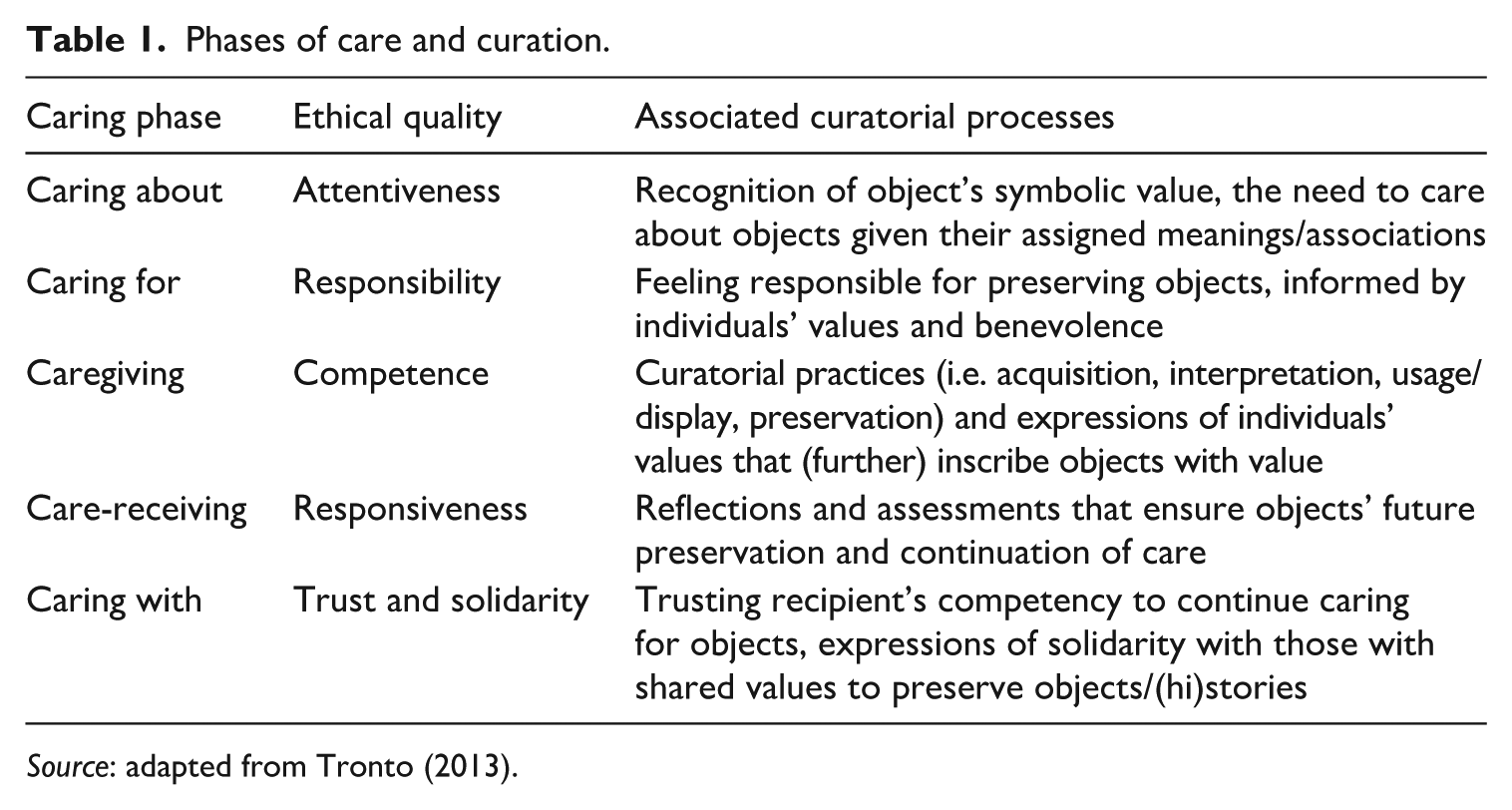
Source: adapted from Tronto (2013).
Kinship Ties and Caring Narratives
We first focus on the curatorial practices that individuals use to demonstrate ‘caring for’ kin, particularly through the development, maintenance and sharing of familial (hi)stories in connection with valued objects. We then consider instances where these stories or narratives are either missing or deemed unhelpful/negative and explore how such complexities affect both the value ascribed to objects and individuals’ actions towards them. Here, Clare tells a story about her great-grandfather: My great-grandfather was gassed in the trenches and then taken prisoner of war . . . The family thought that he was dead, and they got written to . . . and then he popped back up after the war. So, it’s all [there] . . . that documentation that my grandfather kept . . . there’s a letter that got written to the family to tell them that he died, and the letter written when they found him . . . Every now and then, we like to get it out and have a good look through it . . . going through the photos and remembering him as a person and telling stories and remembering all the stories he used to tell us. (Clare, 30, Female, Consumer)
Clare refers to a collection of objects – letters, documentation, photographs – that supports family reminiscing and storytelling. The extract reveals the interplay of Tronto’s (2013) caring phases and ethical qualities, as caring for the dead grandfather(s) is embedded in various rituals involving the curated items. Caring for the items includes taking responsibility for ensuring their safe storage and maintenance as a collection (making sense as a whole). Various rituals illustrate how Clare cares about the items and her family’s past. Such practices – getting the items out, sharing (hi)stories –require attentiveness. In ensuring the longevity of curatorial practices initiated by her ancestor, these also provide important relational practices for the doing of family (Morgan, 2011). Clare’s usage of ‘we’ and ‘us’ demonstrates the relational importance of these curatorial practices initiated by her grandfather and further inscribes items with symbolic value. Curating items and (re)telling stories facilitate material affinities, allowing her ancestors’ memories to live on.
Similarly, participants often interlinked ‘caring for’ the family past with ‘caring about’ preserving a set of items. Here, such items provide insights into an ancestor’s life as an entertainer: My great, great-grandad was a[n] . . . entertainer, and we’ve got a folder full of material related to his act . . . We’ve taken posters from the 1850s, and they’re all presented in a folder collected and annotated. It’s going to be passed on to the next generation definitely. (Dominic, 58, Male, Trader)
Dominic emphasises these items as a collection, with importance placed on continuing cycles of within-family care. His approach to ‘caring for’ includes practices beyond maintaining and displaying inherited posters. Supplementary materials (e.g. annotations) are created, and these inform additional value and meanings, shaping how future generations perceive their ancestors; both the items and care practices become ‘incorporated into something larger’ (Graeber, 2005: 451). These actions highlight Dominic’s care and attention towards preserving the objects and his family’s past, but also his competence, a quality that develops as he expands his curatorial responsibilities to involve documenting/interpretation practices. A care lens sheds light on how distinct ‘doing family’ practices – such as using/displaying items (Finch, 2007; Holmes, 2019), documenting (Zadeh et al., 2022) and developing interpretations of family history (Bottero, 2015) – can be understood as interconnected caregiving and curatorial practices and are crucial for shaping objects’ value. Dominic’s posters might be understood as valueless items, but, as a collection with clear family connections and accompanied by annotations and the articulation of (hi)stories, they accumulate symbolic value. Curatorial practices inform objects’ functions as conduits through which family members demonstrate caring for deceased relations.
Although we have emphasised elements of ‘caring for’ deceased relatives through the curated items, notions of ‘caring with’ others to achieve ‘collective and self-interests in the long run’ (Tronto, 2013: xii) are also inherent in the above examples. Inherited items are often collectively owned, and families work together to preserve their family past through the passage of items and caretaking responsibilities to kin, who are then trusted to care about and continue the maintenance of family (hi)stories. When objects are the care recipients, a competent caretaker assesses how caregiving practices will continue in the future and takes on the responsibility to identify those to ‘care with’, illustrated by Dominic’s intention to pass items ‘to the next generation’ implying reciprocal obligations to preserve associated family (hi)stories.
We now turn to considering where (hi)stories associated with objects could negatively affect or complicate their value. Margret is Irish-born and owns a range of objects, including her grandmother’s Jesus statue (Figure 1). Although these items are clearly meaningful to Margret, and their value is bolstered by wider religious associations, there is concern that these connotations will negatively affect her son’s willingness to continue this caring cycle: These were my rosary beads when I was six. My grandfather got me this when I made my first communion . . . I keep all those things because they mean something, you know, they were important . . . I’m a practising Catholic, which is unusual these days in England . . . I like them because my grandfather bought them for me . . . and I also have a medal. Funny I have all my son’s medals, and my mother had all of ours, but those are big things in your faith, so you keep them. Hopefully . . . they will mean something to my son, and if not, they will mean something to my . . . younger cousins they all like old [things] and collect them, and they like it even better if it’s got a history and if it’s connected to the family . . . It’s nice to keep things and pass them on from generation to generation. (Margret, 56, Female, Consumer)
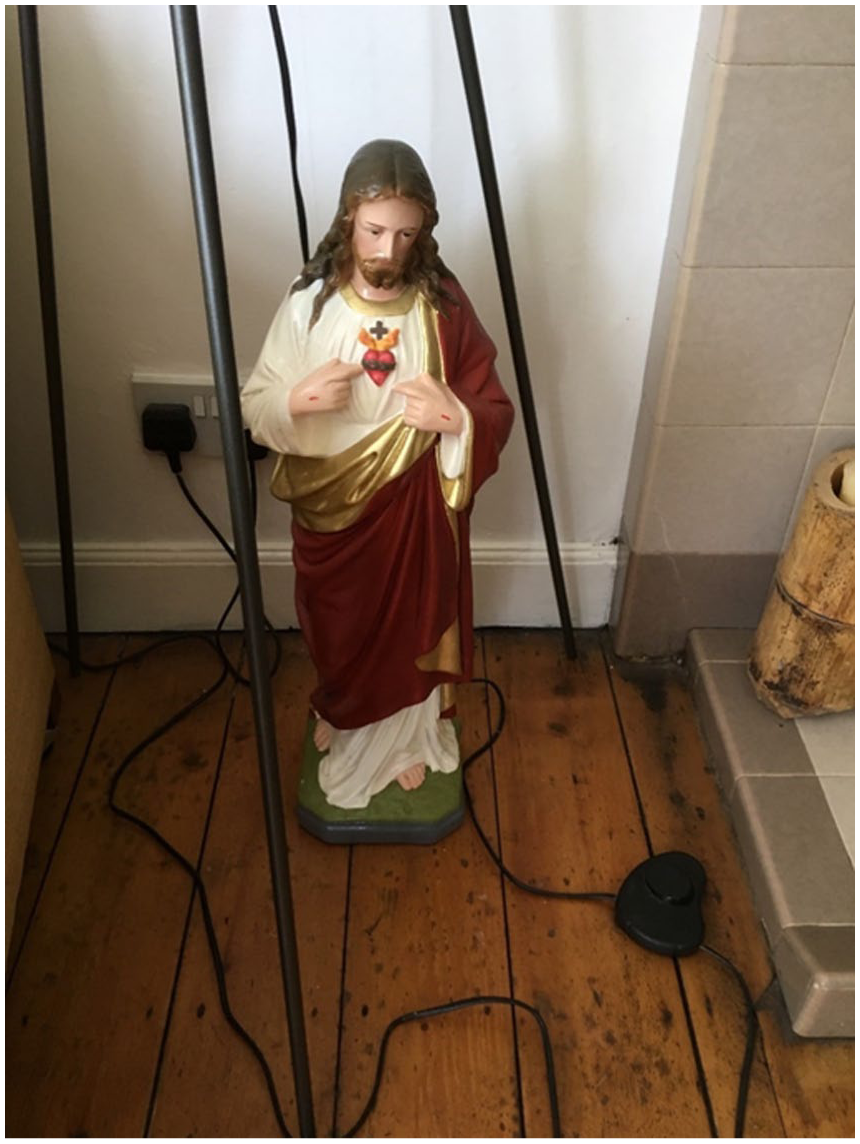
Margret’s statue.
For Margret, these items are valued as personal/familial artefacts. Important memories of holy communions (her own and her son’s) and other rituals are embedded in various objects (e.g. rosary beads, communion medals). This emplaced element to (hi)stories is further emphasised when she reflects on her son’s disinterest given his lack of faith. Margret’s concerns about passing on these objects to an uncaring recipient highlight concerns about whether her son has the necessary competency to act as caretaker, demonstrating the potential for contamination whereby the sacred becomes profane. Objects risk being devalued and uncared for, not because of their familial associations but because of more powerful religious/cultural narratives that surpass, and potentially undermine, kinship ties. Margret carefully considers who might ‘care with’ her and preserve this element of her family’s past, demonstrating an awareness of the relevance of personal values and their influence on assessments of items’ value – familial connections may be insufficient for those who do not share wider (e.g. religious) values.
The examples discussed thus far concern the passing on of items with compelling familial narratives. However, sometimes objects are inherited without such (hi)stories. Even when objects are commercially valuable, without familial narratives, they can become perceived as valueless from a material affinities perspective. During the fieldwork, an interview with Mark, a trader, was paused while he spoke to a couple who had approached him with an old hand-carved mirror (Figure 2): The couple asked if he would be interested in purchasing it. They were clearing the house of a recently deceased family member who ‘used to go to antique fairs and buy these things’. They seemed detached from the item and confessed not knowing anything about the mirror. They were very relieved when Mark expressed an interest; he bought the mirror for £50. (Fieldnotes)
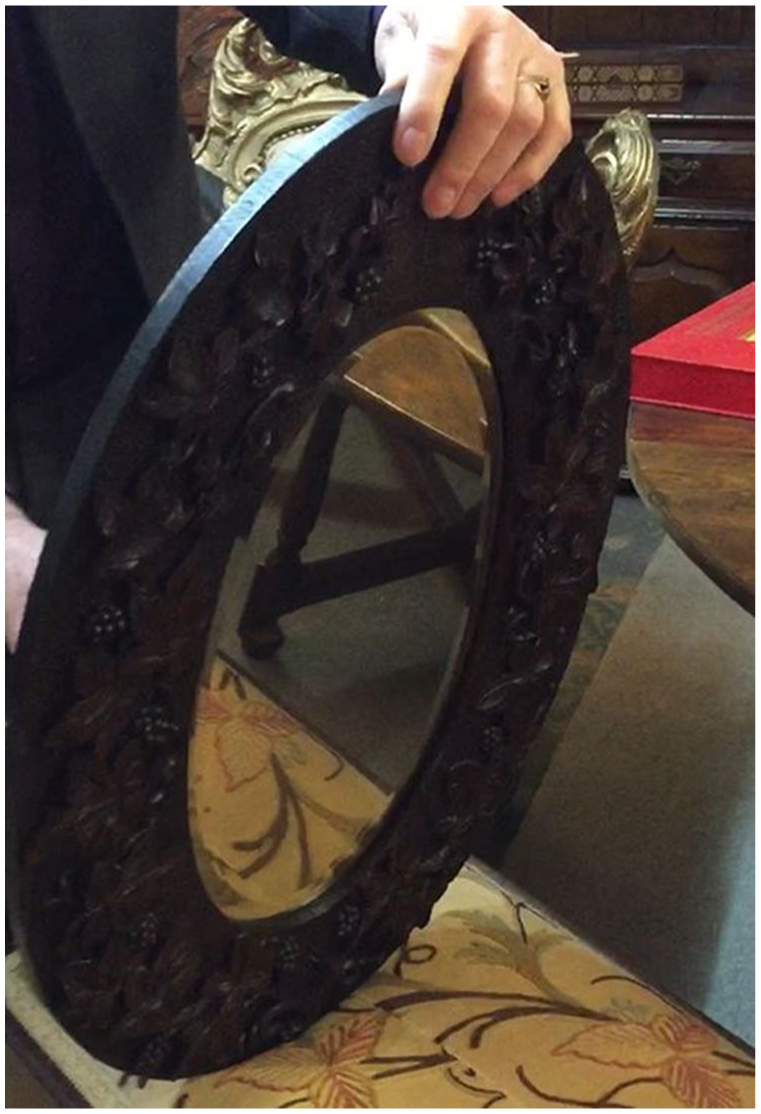
Mark’s mirror.
The sale of inherited items is a common way in which objects are acquired by vintage traders. Although this mirror belonged to a family member, it did not have the embedded memories and narratives that inscribe it with the necessary symbolic value to elicit care. The sense of relief referred to in the fieldnotes could link with the potential burden of caring and associated feelings of guilt. The couple frame the object as just a ‘thing’ picked up at an antiques fair, and the monetary value may provide them with permission to pass on the object, relieving them of the associated caring/curatorial burden.
Collective Caring and Preserving Societal Histories
We now turn to the interplay of value(s) in shaping curation outside the family setting in situations where individuals care for items without familial links. We highlight how objects embedded with societal (hi)stories support individuals’ expressions of wider values; in this case, ‘care’ involves collaborations with non-kin and institutions.
Joan, a trader, demonstrates how the value she ascribes to particular objects (given their associated histories) goes beyond any monetary gain she could realise through their sale. Her decision to acquire and preserve items related to women’s history (e.g. what she terms ‘Florence Nightingale memorabilia’) reflects her values: I’m very interested in women’s history, so I wouldn’t sell stuff that was to do with women’s history because I want to leave that to the Glasgow Women’s Library or something like that . . . I would never sell that because it’s a really neglected area. It’s only just now that . . . we’re being slotted back into history . . . there’s a big movement now to get equal representation of women in history in general. (Joan, 63, Female, Trader)
Feelings of compassion and benevolence are implicit in Joan’s extract. These stem from her recognition of the injustices faced by women and the inequalities of curatorial practices, which lead to gaps in historical knowledge. Such concerns help shape her need to care, with the ethical quality of responsibility fuelling caregiving practices (e.g. collecting items), and her assessment of how best to ensure their continuation. She positions her curation and donations as means ‘to balance things out’ and is unwilling to gain financially from items. Such actions allow her to contribute to ‘something larger than’ herself (Graeber, 2005: 451). Particularly given her role as a trader, Joan’s sacrifice of potential monetary value demonstrates her values and commitment to women’s histories; she maintains items’ symbolic value and illustrates how caring is both a disposition and action-oriented (Tronto, 1993).
Echoing our findings in a familial context, a competent caretaker exhibits responsibility for ensuring the object’s future preservation, which involves trusting that the recipient will continue to appreciate the object and possess the necessary competence for ongoing care. These themes are also present for Jason, a reenactor, who brought his ‘original’ Second World War items to display at a fair: Don’t forget people died . . . so we could have the future we have . . . my uncle was in a prison war camp . . . If it survived the war, we look after it. We’re like the keeper of the items for the next generation to keep. This will be sold to somebody else in the future . . . I mean, if I die today, my daughter will get it all, but she won’t keep it. She would sell it to someone else who does want to do the same thing. This is how we’ve got it . . . we’ve bought it from somebody else . . . or they might be throwing it out in a rubbish tip. We managed to keep it and then look after it . . . for other people to look after and keep. Some of those things could just go into recycling, and they don’t really look at the history behind it . . . we are saving history . . . for the future. (Jason, 50, Male, Consumer, Ethnographic interview)
Jason’s account captures the subjectivities of objects’ value and their links to values and historical narratives of collective suffering. Such values promote the need to care, and attentiveness to commemorating the sacrifices of ancestors and veterans through curated items. Jason positions his caring practices as ‘saving history’ from the ‘rubbish tip’, recognising objects’ vulnerabilities given potentially differing assessments of their worth. Yet he acknowledges his own fragility compared with objects’ potentially longer biographies and considers the competency and willingness of others to act as their future caretakers. Jason envisages the future sale of objects (by his daughter seeking monetary value) will support the continuing care cycle.
Joan’s and Jason’s accounts demonstrate the role of benevolence when caring about/for old objects for the benefit of others. They highlight felt responsibility and attentiveness towards preserving items and the importance of identifying appropriate others to ‘care with’ to ensure continuation of the care process. In contrast to Joan, who puts her trust in the competency of professional curatorial institutions (with shared values), Jason envisages the marketplace’s role as a medium for identifying suitable caretakers who share his interests. This is also seen within Dominic’s reflection on a box-lot he purchased: I realised that some of it had a commercial value, some of it had historical value to enthusiasts or collectors, but most of it was just pages torn out of toy soldier magazines for reference and this is not the sort of stuff people are going to buy . . . I found he was a member of a model soldier society, so I just got in touch with them and said, ‘Do you want this stuff to be redistributed . . . maybe you’ve got younger members who would benefit?’ I just passed the box . . . back to them, and they said, ‘Oh yes, we knew this chap . . . he’d died recently, and somebody had obviously just cleared out his attic and put it all to auction’ . . . I’d rather somebody take that . . . and pass it on to somebody else . . . I can’t sell it, I don’t particularly want to sell it, it’s personal to him. (Dominic, 58, Male, Trader)
Dominic captures the subjectivities of objects’ value assessments. He recognises the ‘commercial’ and ‘historical’ value of certain items, implying that items’ historicity is mainly valued by niche collectors rather than mainstream consumers. The torn pages might be perceived as ‘rubbish’ – items of no value to be discarded – and such objects often linger in ‘a valueless and timeless limbo’ waiting to be re-discovered and re-valuated (Thompson, 2017: 10). Although not personally valuing the pages, Dominic recognises their subjective value and demonstrates benevolence towards, and solidarity with, strangers, facilitating re-discovery and re-valuation by passing them to enthusiasts who would care for them. He balances his own goals (e.g. monetary/preserving historical value) with empathy and care for strangers and these subjective variations in value.
Our findings identified a range of situations where consumption facilitated individuals’ caring with and for others. This could also happen in cases where there are no direct links or surrounding knowledge. Clare collects pre-1970s wedding images, which she often finds ‘in dusty little boxes’ that are ‘always a bit bashed up and unloved and a bit uncared for’. The photographs’ fragility and their links to weddings inform Clare’s feelings and care practices: I just . . . look after them and . . . preserve them . . . share them. It’s like preserving history, preserving family memories, preserving people’s [weddings]. I feel like more as a custodian than a collector because this isn’t my family history. This is somebody else’s, but it’s important to keep hold of it because otherwise it just gets lost forever, which I think is really sad. (Clare, 30, Female, Consumer)
The threat of images and associated memories being lost elicits a range of emotions in Clare. She exhibits benevolence and solidarity with others, and her caring practices are ‘grounded in a sense of loss, or potential loss’ (Rhys and Baveystock, 2014: 15) reflecting personal values and heightened by her experience as a caretaker of her own family’s past. Despite owning the objects, she portrays herself as ‘a custodian’, which she hopes is a temporary role: ‘I’m a caretaker of them . . . until the rightful people can be found to give them back to.’ While Clare’s values and caregiving practices (i.e. purchasing, preserving, sharing/displaying) assign previously ‘unloved’ and ‘uncared for’ images with new value and meaning, for her, familial ties indicate competence and the potential for renewed caring cycles. Clare’s caregiving extends to creating a social media page to display and share her collection alongside any historical details she can identify to accompany her displayed items, which again illustrates the importance of documentation practices. Occasionally, her efforts result in photographs being reunited with their ‘rightful’ owners (Figure 3).
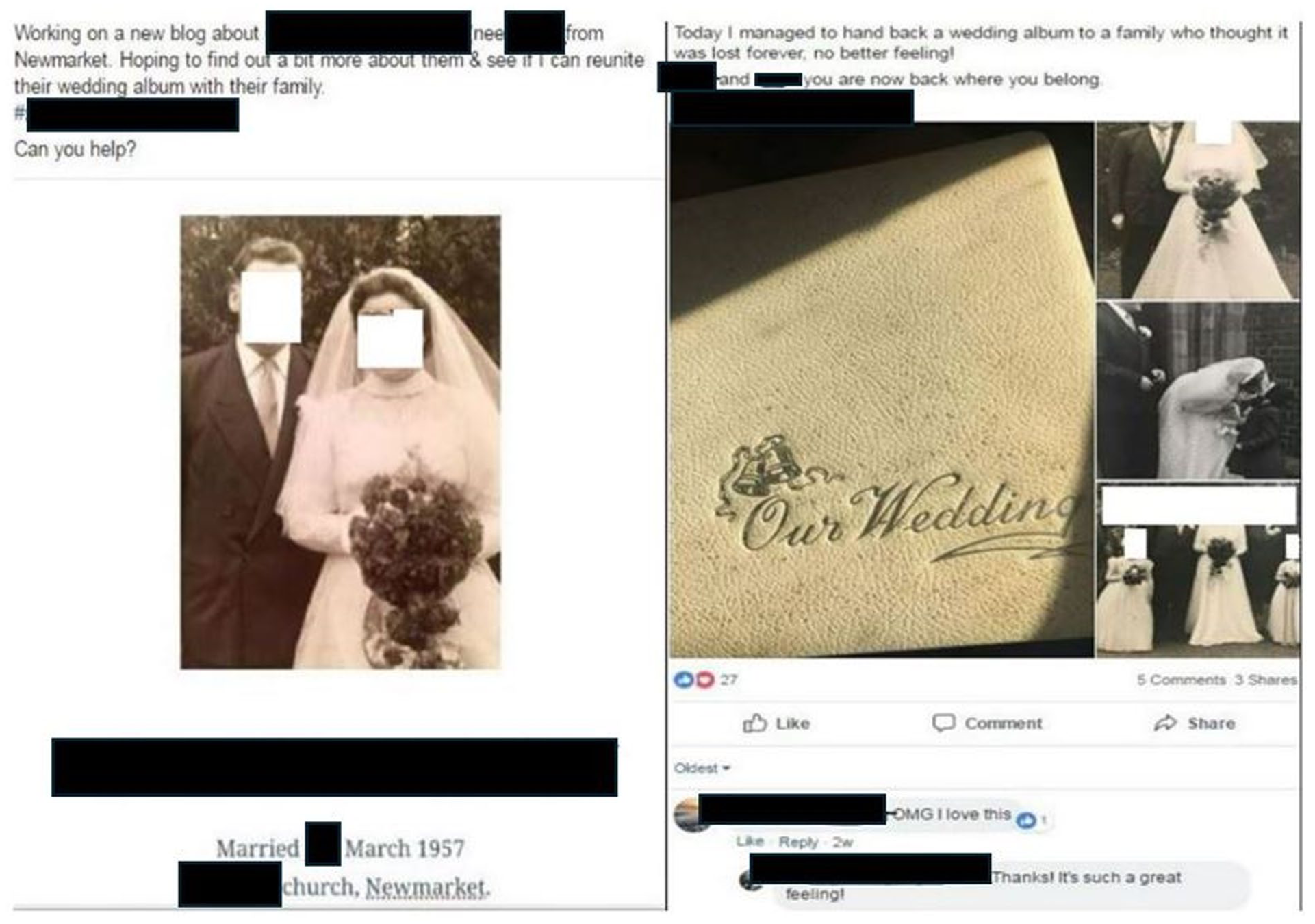
Clare reuniting images with ‘rightful’ owners.
In addition to breathing new life into these photographs through display, Clare has developed a community where followers contribute their ancestors’ images. Here, she reflects on this process of creating shared (hi)stories: Quite a lot of people send me photos of their families . . . Some people look really miserable, some people look really happy . . . and it’s those stories behind the photos that I think people are always really interested in . . . They will send me a picture and a little paragraph about who it is . . . they got married on [date] they’re dead now, but they had a really happy life together and that kind of thing . . . People that are following my page . . . they are interested in social history . . . so they always want to know a bit more about the life behind the photos. (Clare, 30, Female, Consumer)
Technology digitises the past, making it accessible to wider audiences and broadening the scope for individuals to take on active preservation roles, developing and conveying their own interpretations and narratives (Giaccardi, 2012). Some of Clare’s followers entrust her with preserving their own family images and (hi)stories, thus recognising her benevolence and competence as a ‘custodian’. Technology can mediate solidarity and caring collaborations with others, facilitating the development of affinities among kin and non-kin with shared values and interests. This kind of collective caring includes collaborations with non-kin to memorialise ancestors and provides an important means to safeguard broader (hi)stories of ordinary people and marginalised groups.
Caring through Surrogate Objects
The above sections establish that objects act as mediators for people to demonstrate their values through caring for and with others. We now consider situations when objects are purchased according to their resemblance to other items; these objects then serve as surrogates (or replacements) through which individuals express their values and need to care. In these cases, consumption and associated caring practices provide an alternative route to maintaining affinities with ancestors and other important (hi)stories: When people are walking around here, you hear them say: ‘Oh, my grandma had one of those . . . my auntie had one of those’, and it’s a trip down memory lane for them if they don’t possess anything like that. There’s kind of a nostalgic feel about it, and quite often . . . they recognise it as being a throwback to their family and what their family possessed. So, it becomes part of the psyche . . . say your grandmother had a mirror like that on her dressing table and . . . you saw that mirror. You’d be instantly reminded of the fact that your grandma owned a mirror like that, and you might look at it and think, ‘I might buy that, as a memoir of my grandmother’s life.’ (Kathy, 69, Female, Trader)
Kathy highlights everyday objects’ materialities and their potential to elicit associations, fond memories and care. This ‘material’ effect is fuelled by the item’s resemblance to past objects or memories, and individuals then inscribe purchased items with symbolic value to memorialise family connections. Such value assessments may reflect individuals’ nostalgia, a ‘longing for what is lacking’ in the present (Pickering and Keightley, 2006: 920), and also individuals’ values and what they care about. This suggests the value of old objects does not necessarily reside in their previous ownership or ‘authentic’ materiality, but rather in the stories and meanings developed around them. This is further illustrated by John: Because all these films have been brought out now about the World War II [like] . . . Dunkirk. That brings back a lot of nostalgia for people, and then they start tracing up the family history and perhaps their grandfather served in Dunkirk, but he never left the family his hat behind, [a] beret. So, people start searching around for that . . . to keep in the family, you know, with a picture of their grandad . . . It all ties [them] in together . . . nostalgia. (John, 60, Male, Trader)
John demonstrates how wider historical understandings, such as media narratives, can inform objects’ interpretations and spark individuals’ nostalgic reflections and care. These prompts inform individuals’ needs to care about their family’s past and further curatorial practices, such as researching family history. The extract also draws attention to preserving such familial history through finding and caring for surrogate items. Emergent narratives about the past are utilised to construct an identity (Bottero, 2015), and acquiring and displaying surrogate artefacts provide important supplements for this identity-formation process. Displaying the purchased item alongside the ancestor’s image inscribes the object with new value and meanings, and a purchased historical artefact is transformed into a meaningful possession ‘to keep in the family’. Through curatorial practices, objects with certain material characteristics become plausible mediums for the development and conveying of narratives and nostalgic imaginaries of the past, promoting the maintenance of familial connections.
The appropriation and transformation of purchased items into surrogates is further illustrated in the following example, referring to a lost inherited item: They’re always looking around saying, ‘Oh, my grandad had a beret with a badge on it, but we lost it when we moved house.’ So, they ask you if you’ve got a beret with a certain badge on it . . . just to hang near the medals really, just like a showpiece in the house. (John, 60, Male, Trader)
A cherished object is lost yet continues to carry affinities, remaining ‘connected to their previous owners through acts of remembrance and memorialisation’ (Holmes, 2024: 19). Finding and purchasing a replica speaks to the sense of responsibility associated with caring and helps salve feelings of loss, potentially helping to overcome guilt over one’s incompetence that led to an object’s loss. The purchase allows individuals or families to re-materialise affinities, illustrating how objects’ ‘authenticity is both culturally situated and firmly connected to their materiality’ (Holtorf, 2013: 440). Heidi’s example illustrates, even replicas for everyday objects can channel material affinities (Figure 4): My nan died in 2012, and the last time I saw her, she was eating a piece of cake off this plate, but not this one. I said to my auntie when my nan died . . . please, will you save that plate for me . . . but then the plate got put in the skip when they were clearing the house, so I never got the actual plate that my nan had, but to kind of compensate for that, I bought myself one that somebody was selling online . . . It was exactly the same design because these were mass-produced for Woolworths . . . So, in a way, that isn’t the proper object, but it sort of reminds me of that. I just wanted it around . . . I literally have it as a display thing in the kitchen . . . but it definitely holds a really sentimental value for me, even though it’s not anything to do with me or my nan. (Heidi, 28, Female, Consumer)
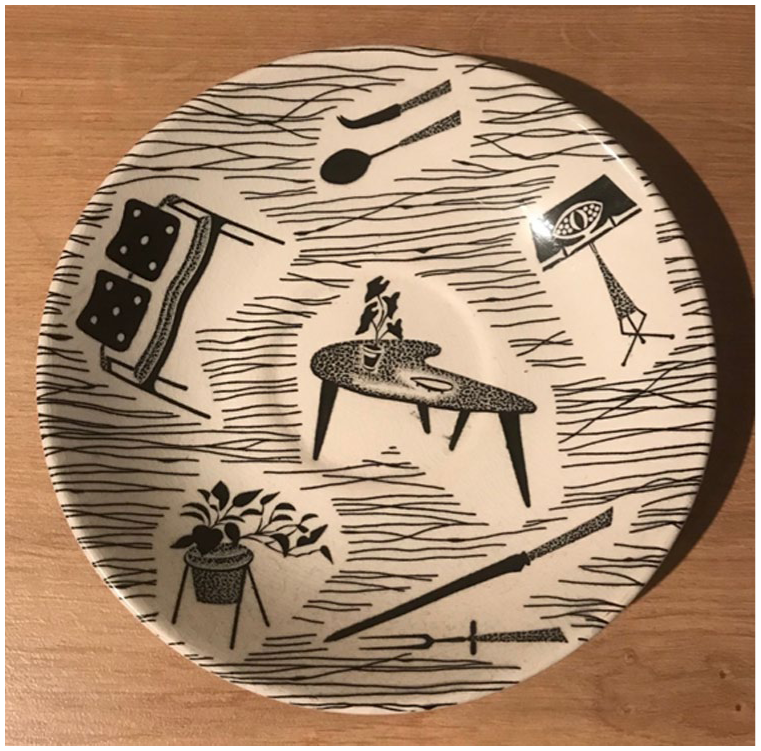
Heidi’s plate.
For Heidi, the disposal of a plate initially deprived her of the opportunity to express care for her grandmother and memorialise certain familial practices. Heidi purchases an identical item to compensate for the loss of the original object and the resulting emotional effects. This ‘surrogate’ plate’s materiality enables Heidi to transfer original familial meanings, and curatorial practices strengthen the plate’s assigned sentimental value and (hi)stories, allowing her to initiate the care process. Such examples highlight that inherited items are not necessarily valued ‘in their own right’ but rather as conduits through which people exhibit what they care about (i.e. values). In the event of object loss, purchased items’ material qualities and iconic and indexical associations (e.g. a beret with a certain badge; a plate with a particular design) can enable the continuation of care for and about familial pasts. Curatorial practices (e.g. acquisition, displaying) further inscribe the purchased objects with new meanings and value, enabling consumers to use objects as supporting material evidence for the maintenance of narratives and resumption of the care process.
Surrogate objects were also sought by reenactors. In these situations, objects function as props to support the reenactment of historical events. Here, Kevin outlines inherent challenges: We’ve got to remember in 1940, the average man was about 5’7 and probably weighed about 10 stone . . . they were a lot smaller people . . . For me and people . . . who are 6’2 and over average weight, you’re never going to get an original uniform to fit you, it won’t exist. (Kevin, 43, Male, Consumer)
Here, it is the object’s materiality (e.g. sizing issues) that presents a challenge. Another participant (Devon) refers to further issues: ‘to find an original pair of trousers that aren’t worn out is a trick in itself’. He further states: ‘you try and set as high a standard as you can. It’s never going to be perfect . . . you’ve got to accept that . . . [but] they made them [trousers] out of a very similar material.’ In this case, surrogate objects are deemed ‘good enough’ when they at least resemble original uniforms and are sufficient for carrying out caring (reenactment) practices. Kevin reflects on why he engages in reenactment, foregrounding elements of ethical caring (Noddings, 2013): It’s something that we enjoy doing . . . and we’re doing something good as well. A lot of people forget about the World War II period, it’s something that’s going out of schools . . . we get to keep that alive. And some of the stuff we do for veterans as well, and there are not many of them left now. So, for us, it’s a bit of a laugh but also there’s a serious side to it. (Kevin, 43, Male, Consumer)
Surrogate objects, therefore, enable people to convey their care about societal issues and convey broader (hi)stories. Purchased objects’ materiality, alongside associated curatorial practices (e.g. usage/display), allow reenactors to have fun while attaining value from their actions (i.e. ‘doing something good’). Kevin positions reenactment as benevolently contributing to society, honouring the few living veterans and keeping the memory of the period ‘alive’, exhibiting a need to care and a responsibility to act. Surrogate objects are crucial components for the development and conveying of this broader narrative, as well as facilitators of care and values. Although curated objects are vital for the caring process, it is the (hi)stories – whether family or wider histories – that are cared about and preserved. Objects’ materialities can be valued not necessarily because of their ‘real’ associations or authenticity, but rather their ability to bind and mediate affinities, narratives and caring practices.
Discussion and Conclusion
This article has explored how care shapes the curation of old objects and associated meanings. Focusing on the role of care and value(s) in shaping curatorial practices, we develop a deeper understanding of material affinities, identifying how objects facilitate potent connections both within and outside familial settings. We conclude by summarising the three ways in which we develop and depart from prior understandings of material affinities, before outlining our overall contribution and suggestions for future research.
First, we clarify how care and curation are intertwined through the interplay of value and values and their impact on material affinities. Curatorial practices (i.e. acquiring/preserving, using, displaying/documenting items and interpreting history) can be understood as manifestations of care, allowing people to express their values as they inscribe items with value and meaning. Like Holmes (2019), we start by emphasising objects’ roles in maintaining connections and meanings. For Holmes (2019: 174), usage practices reveal ‘how materiality and kinship are woven together’. Our work extends this by exploring a wider range of objects and highlighting the interconnection of (curatorial) practices with ‘care’, which forges and informs these connections and practices.
Our second point of departure concerns the concept of passing on. Hitherto, ‘passing on’ has been used to refer to how kinship ties are maintained through circulated items (Finch and Mason, 2013; Holmes, 2019); we extend this beyond the family context and identify how the passage of objects can be a key instrument of curation, ensuring items’ preservation and continuation of the care process. Prioritising understandings based on the importance of care and value(s) allows us to see how the latter influence such decisions, as well as how considerations of ‘caring for’ and ‘caring with’ can extend beyond kinship ties. In various situations, individuals identify others (e.g. non-kin or institutions) who will/can care more, thus demonstrating the primacy of values alongside the ethical qualities of responsibility and competence in decisions both to pass on and receive items (Table 1). Understandings of ‘passing on’ should, therefore, incorporate a caring lens and extend beyond the familial context. It is through objects’ circulation to those who do ‘care’ that potent connections and (hi)stories, whether familial or societal, live on.
Our final point of departure from prior work concerns the centrality and authenticity of the focal object itself. Although prior work has emphasised inherited objects’ mnemonic value (Finch and Mason, 2013) and how materialities facilitate the remembrance of familial connections (Holmes, 2019), we add to these understandings of care and curation by demonstrating how objects’ materialities can be appropriated and transformed into what we term surrogates. Objects’ materialities enable individuals to project their care and values onto purchased surrogate items. Curatorial practices underpin these objects’ roles as conduits for people to express and safeguard what matters to them, whether ‘what matters’ concerns familial or societal (hi)stories. Therefore, we introduce complexity to understandings of materiality, whereby objects are not necessarily required to be original or authentic; rather, they need to be perceived as plausible material mediums on/by which to project ‘care’. In eliciting the need to care, such surrogate objects can bind and mediate (hi)stories and values.
Altogether, these departures contribute towards a wider understanding of material affinities, whereby care charges objects’ abilities to connect us to meaningful relationships and times and informs curatorial practices that strengthen and convey those meanings. The curatorial practices that surround objects are crucial and, without understanding the dynamic and relational nature of care, meanings can become lost (e.g. our data include inheritances perceived as a burden). We also highlight how second-hand markets can facilitate the disposal and passing on of inherited items perceived as ‘meaningless’, while simultaneously functioning as a channel for objects to reach new owners with the necessary attentiveness and responsibility to care about/for them. We thus contribute to recent research, shedding light on the role of consumption and markets in facilitating or hindering caring relations (Chatzidakis et al., 2025; Kastarinen et al., 2023; Koskinen, 2023) and integrating a wider understanding of consumption, which includes object disposal and items’ ongoing life cycles.
We call for future research to explore how understandings of care can influence person–object relations and interactions in other contexts. For instance, studies might explore more in-depth caregiving/curatorial practices in the digital age and how modern technologies facilitate the preservation of family and wider (hi)stories, also potentially integrating the use of digital surrogates. We have emphasised the importance and the fragility of the ordinary, and future work should further explore how understandings of everyday practice can be more effectively harnessed to ensure that society is equipped to collaboratively care for everyday (hi)stories. We primarily focused on the positive aspects of these materialities of the past, where objects are perceived as meaningful and worthy recipients of caring practices. However, future studies could also explore how value and values shape more negative interactions; for example, where objects are perceived as meaningless or contaminated by negative or darker (hi)stories.
Footnotes
Funding
The authors received no financial support for the research, authorship and/or publication of this article.
