




Abstract
This article engages Douglas caution against an ‘unsociological view of cognition’ that fails to recognise classification as an epistemological issue. In so doing, it offers a conceptual framework for addressing this linkage in relation to British attempts to define asylum all-but out of existence. Taking Zetter’s account of the fragmentation of refugee status as a starting point, and outlining the relevance of civic stratification for his argument, the article addresses the shift from viewing asylum primarily as forced migration to a focus on irregular entry. This shift is considered with respect to the role of classification as a mode of control, Mary Douglas treatment of ‘purity and danger’, Britain’s deployment of deterrent policy and the significance of a supporting ‘moral’ frame.
Introduction
There has been growing attention to the politics of classification in academic debate, especially as related to the increasing numbers seeking asylum. Commentators have variously noted a mismatch between the legal and the normative (Zetter, 2015), expressed scepticism about ‘categorical fetishism’ (Apostolova, 2015) and issued warnings against fixed categories that fail to capture the chequered experience of flight (Crawley and Skleparis, 2017). The present article contributes to this debate from a theoretical perspective, building on Douglas (2002 [1966]: ix) caution against an ‘unsociological view of cognition’ that fails to recognise classification as an epistemological issue. It therefore outlines a conceptual framework for addressing this matter, in light of recent attempts in British legislation to define asylum all-but out of existence.
Conceptual Framework
In 2007, Roger Zetter advanced an argument based on the concept of labelling, whereby bureaucratic interests and procedures become crucial determinants of designations such as refugee. He sees labelling as an explanatory tool that can elucidate the impact of humanitarian interventions on the refugee experience, noting that words do not simply describe the world but also construct it. In this process, he argues, refugees and migrants are reduced to an ostensibly apolitical set of bureaucratic categories, fractioning the label refugee in attempts to manage global processes. Hence, while Zetter (2007: 180) states that ‘refugee status has remained the only systematic and relatively accessible entry route for large scale, globalized migration’, he argues that the response to increasing numbers has been to transform the label. By the time of Britain’s 2023 Illegal Migration Act (IMA), this process had been extended to a point at which the ‘relatively accessible entry route’ had in effect been closed down.
The labelling process in Britain (and elsewhere) has seen the traditional distinction between voluntary and forced migration replaced by regular and irregular entry, amounting to a paradigm shift (Johnson, 2018 [2014]) in the treatment of asylum seeking. Zetter (2007: 182) notes that the phrase ‘irregular migration’ carries a sense of uncertainty and confusion, and this has been exploited to the maximum in relation to how and by whom the status of refugee is determined. Meanwhile ‘a battery of legislative instruments and policies’ (2007: 181) deter arrival, restrict access and limit the rights of those seeking protection, producing what Zetter terms a proliferation of labels that offer differing degrees of protection. Hence, in Britain the recent definition of ‘inadmissible’ claims has been grafted onto an array of possible outcomes that include Convention 1 status, resettled refugees, Humanitarian Protection, Discretionary Leave, asylum seekers and failed asylum seekers, in an increasingly unreliable system, cross cut by recourse to appeal. But as Zetter (2007: 184) also notes, pejorative labels are a further feature of attempts at control; informal terms that permeate political language and/or popular thought, such as illegal migrants, bogus asylum seekers, economic migrants, illegal asylum seekers, designed ‘to convey an image of marginality, dishonesty and threat’ (2007: 184). He also observes a growing criminalisation of those seeking asylum, and the deployment of apparently legitimate but increasingly pernicious tools for subverting the label of refugee in a quest for control.
Zetter’s argument, especially its concluding emphasis on the label of irregularity and the process of criminalisation, maps closely onto recent developments in Britain, but also brings to mind the notion of civic stratification (Lockwood, 1996; Morris, 2002), as related to the differential granting or denial of rights. Full accounts are available elsewhere (Morris, 2025) but in effect, Lockwood offers a corrective to Marshall’s (1950) model of citizenship as securing ‘full membership’ in society and signalling equal social worth. Lockwood’s approach operates along two axes, the presence or absence of rights and the possession of moral and material resources. These axes highlight the scope for inequality in both the formal allocation or denial of rights to specified categories, and informal influences of prestige or stigma in the granting or realisation of a right. An elaboration of this framework by Morris (2002) extends its application to deal not only with citizenship per se but also with the position of those outside of this status. The combined argument goes further than Zetter in theorizing the dynamic element in a regime of rights, and one interesting aspect of Lockwood’s (1996) model is the way ‘civic expansion’ (enhanced access to rights) is built into his framework through the possession of ‘moral resources’, or moral standing in society. Hence, the perceived legitimacy of a claim to rights will be enhanced by the accrual of moral resources, while conversely, the absence or erosion of such resources may be a forerunner to their denial or diminution. This perspective can provide critical purchase on the formalised classifications entailed in a system of rights, which may seek stability by establishing a dominant view of social categories that carries a distinct moral content. However, its fixity and legitimacy will always be open to question.
The role of moral resources in this process can be informed by Douglas (2002 [1996]) conceptual distinction between purity and danger – a distinction deployed to address ritual cleanliness as a process of separation and classification. The implications of her argument reach beyond the operations of primitive religion that were her main concern, and suggest that any set of organising symbols must be understood alongside the total structure of classification in a given society (Douglas, 2002 [1966]: ix). Within this structure, the distinctions she addresses have the purpose of inducing conformity and in her view will often support a particular vision of morality or propriety that underpins a seemingly ‘spontaneous coding practice’ (2002 [1966]: xiii). While Lockwood’s concept of civic stratification provides some dynamic understanding of both the emergence and operation of such a practice, Douglas work points to the underlying impact of societal rules governing what might be construed as ‘social worth’, thus highlighting their epistemological significance. Douglas views classification as a human universal, a dimension of epistemology designed to re-order our environment to conform to an idea, or we might say as a means of representation and control. She offers this argument to ‘amend the current unsociological view of human cognition’ (2002 [1966]: ix) and within this practice notes that all margins are dangerous, so it is no surprise that rules about pollution may closely correspond to moral rules. Douglas therefore suggests that we consider the relationship between conscience and social structure, in which public and private codes continually influence each other. She argues that pollution rules and their allied judgements serve to marshal moral disapproval where it falters, and can be part of a long-term strategy harnessing perceived attacks from the outside to foster solidarity within. However, while one response is for polluting objects to be ‘vigorously brushed away’ (2002 [1966]: 197), she notes a dangerous stage when their ‘half identity’, some recognisably inclusive element, clings to them and yields a threatening ambiguity that could disrupt the order under construction.
We return to this ‘dangerous half identity’ later, but its powerful potential is clearly why the political intent behind policy making is as much geared to the management of perception as to the actual phenomena being addressed – in the present case the number and status of asylum applicants. This awareness links the salient points from Purity and Danger to another work by Douglas (1986), How Institutions Think, which also draws attention to the nature of human cognition and ‘the hold that institutions have on our processes of classifying and recognizing’ (1986: 3). In Douglas argument, this hold is achieved by some ‘naturalizing principle’ (1986: 52) that gives legitimacy to the social classifications at issue, and offers a means to harness the ‘moral energy’ of the population.
But as Douglas also observes, institutions have unseen ‘shadowed places’ that inform their practices, and ‘systematically direct individual memory and channel perceptions into forms that are compatible with the relations they authorize’ (1986: 92). The triumph of institutions therefore lies in making themselves invisible, while their classifications nevertheless permeate the thinking of individual members of society, for ‘how can we think of our place in society without using the classifications established by our institutions’ (1986: 99). According to Douglas, these classifications ‘stabilize the flux of social life’ and even ‘create the realities to which they apply’ (1986: 100). It follows that there are logical difficulties to making value-free assessments from within a social structure, as ideas about morality are prepared by society’s own institutions following sometimes hidden agendas. As Douglas points out (1986: 125), pre-ordained victims may then bear the brunt of crises, but she also recognises that institutional endeavours to ‘stabilize the flux of social life’ are inherently unstable, with a constant need to establish, maintain or renew legitimacy.
The perspectives set out above can, in combination, throw analytical light on how deterrent policies in Britain based on stratified access to rights, as in Lockwood’s model, eventually culminated in a bifurcated distinction between admissible and inadmissible claims, in a manner illustrative of Douglas ‘purity and danger’.
Methods
The present article applies this conceptual framework to Britain’s evolving asylum regime over the last 35 years, and is based on an examination of the content and purpose of policies through this lens. Working from a timeline of measures covering the relevant period, 2 instances of deterrent intent were accessed via government policy papers, parliamentary sources, relevant legal cases and official public statements. Key measures are listed in Table 1, citing indicative sources on the explicit purpose of each policy.
Key deterrent measures with stated purpose (sources as footnoted).
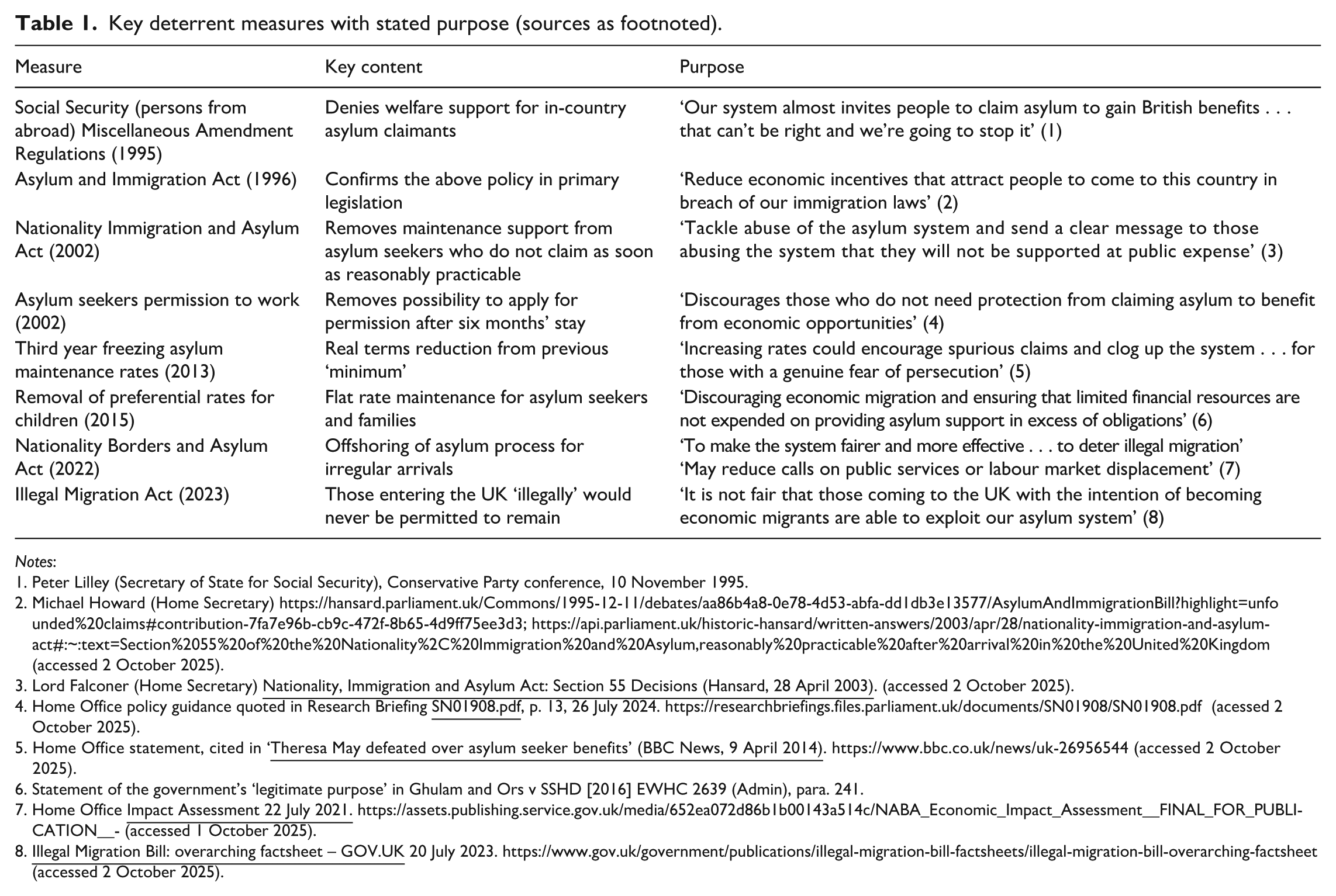
Notes:
Peter Lilley (Secretary of State for Social Security), Conservative Party conference, 10 November 1995.
Michael Howard (Home Secretary) https://hansard.parliament.uk/Commons/1995-12-11/debates/aa86b4a8-0e78-4d53-abfa-dd1db3e13577/AsylumAndImmigrationBill?highlight=unfounded%20claims#contribution-7fa7e96b-cb9c-472f-8b65-4d9ff75ee3d3; https://api.parliament.uk/historic-hansard/written-answers/2003/apr/28/nationality-immigration-and-asylum-act#:~:text=Section%2055%20of%20the%20Nationality%2C%20Immigration%20and%20Asylum,reasonably%20practicable%20after%20arrival%20in%20the%20United%20Kingdom (accessed 2 October 2025).
Lord Falconer (Home Secretary)
Home Office policy guidance quoted in Research Briefing
Home Office statement, cited in ‘
Statement of the government’s ‘legitimate purpose’ in Ghulam and Ors v SSHD [2016] EWHC 2639 (Admin), para. 241.
Home Office
The analytical purpose of the article is to read policy design alongside its justificatory rationale and practical outcomes, in terms of the conceptual frame detailed above. Particular attention is paid to classificatory principles and their stratifying effects, which are elaborated in the sections to follow.
Evolution of Deterrent Fragmentation in Britain
A step change in applications for asylum in Britain occurred in 1989, when the number rose from 3998 to 11,640, and again in 1990 to 26,205. Levels then fluctuated but with an upward trend to reach the 2002 peak of 84,425 and after a relative low of 17,916 in 2010, rose again in 2022 to 81,130 (Sturge, 2024). 3 So the contemporary asylum regime can be viewed as a period of roughly 35 years, characterised by repeated attempts to limit the number of applications and eventually to render a large majority ‘inadmissible’.
The difference between immigration and asylum has traditionally been understood through the distinction between voluntary and forced migration, which in policy terms translates into managed versus spontaneous arrival. Hence the political quest for ever greater control, manifest in part by ‘resettlement’ schemes, whereby refugees recognised by the United Nations High Commission for Refugees (UNHCR) are selectively resettled in a host country. However, it is the spontaneous arrival of asylum seekers that politicians have increasingly presented as requiring ‘urgent’ attention, being less amenable to control than other forms of migration.
The British asylum regime over the last 35 years features fragmentation in close association with stratified rights, deployed as an assumed means of deterrence that turns on formal classificatory distinctions and informal exclusionary portrayals of distinctive groups (see Table 1). An early instance in 1995 distinguished asylum seekers who declared their presence at the port of arrival from those who delayed until after entry, and hence claimed ‘in country’. The latter group were denied entitlement to support on the grounds that a large majority were economic migrants attracted by the benefits system (Cracknell, 1996). There was no attempt to verify this claim, and the policy was not designed to do so, but rather sought to designate a specific group whose legitimacy was placed in questioned.
The policy was launched on three successive occasions, twice by a Conservative government and once by Labour, framed as addressing a ‘massive level of abuse’ (Mr Howard, SSHD, HC Hansard, vol. 268, col. 711, 11 December 1995) or as ‘dealing with widespread abuse . . . and reducing unfounded claims’. 4 However, the policy was three times defeated in legal challenges (Morris, 2010), which variously turned on ‘the law of humanity’ (R v SSSS ex parte JCWI [1996] 4 All ER 385), and protection against inhuman and degrading treatment (R v SSHD ex parte Adam, Limbuela and Tesema [2005] UKHL 66). Following this conclusive defeat for the government, we saw a cumulative erosion of maintenance support, justified by the assertion that increased rates would ‘clog up the system’ with spurious claims (Grice, 2015), and that cuts would discourage ‘economic migration’ (Ghulam and Ors v SSHD [2016] EWHC 2639 (Admin), para. 241).
Alongside deterrence, we also find a growing use of selective ‘resettlement schemes’ (Sturge, 2024), as with Britain’s Syrian Vulnerable Persons Resettlement, which favoured ‘vulnerable’ candidates against those claiming asylum after ‘abusing the system’ (May, 2015) – the ‘wealthiest, luckiest and strongest’, whose ‘false’ claims were allegedly depriving others in genuine need. Echoing earlier policy, we find a distinction based on worth as established via mode of arrival, and a classification that creates its own reality when visa regimes and carrier sanctions render lawful entry all-but impossible.
Returning to Lockwood and Douglas, we see how a policy rationale aimed at deterrence has provided the basis for more elaborate classifications that seek to justify lesser rights for particular groups. The whole process then feeds into an exercise for managing perceptions in what amounts to an implicit framing of ‘purity and danger’, established and conveyed by ‘how institutions think’, and taking more extreme form in later legislation.
Constructing (In)admissiblity
The Nationality and Borders Act (NABA) 2022 brought a more complex form of fragmentation and classification, again determined by mode of arrival and driven by a political drive to ‘stop the boats’. 5 Insofar as there is a numbers problem in relation to asylum in Britain it stems from the tens of thousands who have been waiting, sometimes years, for a decision; 175,000 undecided cases as of August 2023, down to 85,839 by mid-2024, due in part to a questionable number of assumed ‘withdrawn’ applications (Smith, 2024; Walker, 2023). However, the focus of popular and political attention has been on Channel crossing via small boats, though 74% of those arriving from January to October 2023 would warrant full recognition (Refugee Council, 2023). Although NABA was largely superseded by the IMA, its design is of interest here as it rested upon a new element of classification, distinguishing between those who arrive with a visa and those without, the latter category being subject to the ultimate deterrent of criminalisation.
One classificatory issue concerned precisely which act was being criminalised and turned on a distinction between ‘entry’ into the UK and ‘arrival’. Prior to NABA, two rulings had quashed the conviction of asylum seekers who steered dinghies across the Channel, as they were intercepted and thus deemed not to have ‘entered’ the UK (R v Kakaei [2021] EWCA Crim 503; R v Bani [2021] EWCA Crim 1958). In NABA the relevant offence was expanded from illegal entry to arrival, making it almost impossible to claim asylum in Britain without first committing a criminal offence. Although article 31 of the Refugee Convention (1951) protects asylum seekers from being penalised for unlawful entry, a judicial ruling (R v Mohamed and Ors [2023] EWCA Crim 211) confirmed the validity of this criminalisation of arrival, and its applicability in the case of asylum seekers.
The core purpose of NABA, however, was an ‘offshoring’ of the determination process and subsequent settlement (if recognised) in a designated ‘safe’ third country, but a further classificatory issue again turned on mode of arrival. The first step on this convoluted pathway was the distinction between Group 1 and Group 2 (Gov.uk, 2023) refugees in processing asylum claims. The first group referred to asylum seekers coming to Britain directly from a country where their life or freedom was threatened, and presenting themselves without delay to the authorities. Those recognised received permission to stay for a minimum of five years, and could apply for settlement thereafter, with family unification rights, access to public funds and a right to work from the point of recognition. The second group were those whose arrival was considered unlawful and if recognised they were granted only temporary refugee permission for a minimum of 30 months, renewable but with no defined route to settlement and eligible only after meeting the 10 years’ long residence requirement. Family unification was restricted to insurmountable obstacles to family life elsewhere, no recourse to public funds could be imposed, but there was a right to work. Humanitarian Protection was downgraded to align with the treatment of Group 2 refugees.
One more distinction was introduced to the processing of asylum claims, governed by further rules on inadmissibility and setting out circumstances under which an asylum claim could be delayed for possible transfer of status determination to another country. A decision on admissibility would not be taken unless and until removal to a safe third country proved possible, and failing this the claim would be considered in Britain, for the possible grant of Group 2 status. Thus, despite the powerful impact of an inadmissibility decision, determination of this category was dependent on external circumstances as much as on the claimant concerned, the practicability of a third country option being decisive. Furthermore, such a decision would apply if someone had travelled through a safe third country where they could have claimed asylum, which meant the vast majority of asylum seekers arriving in Britain.
Despite assertions to the contrary (Gov.uk, 2023), there was no legal obligation on asylum seekers to claim in the first safe country of arrival. A landmark case in Britain (R v Uxbridge Magistrates Court ex parte Adimi [1999] Imm AR 560), ruled that refugees were not required to seek asylum in countries through which they pass to reach safety and that they retained ‘some element of choice’ as to where they could claim. Nevertheless, the government fact sheet on NABA (Gov.uk, 2023) declares such cases to be inadmissible, and the legislation thus yielded the following possible outcomes of a claim: ‘unlawful’ entrant removed to be processed elsewhere; inadmissible but non-removable asylum seeker whose claim was processed in Britain as Group 2 refugees; a grant of humanitarian protection and hence Group 2 status; admissible asylum seeker granted full Convention status; and claim rejected. In addition, there are those protected under a resettlement scheme.
Rwanda and the Illegal Migration Act
The rationale of NABA was closely allied to the UK–Rwanda economic development partnership announced on 14 April 2022 – a bilateral agreement that ‘illegal’ entrants could be removed to Rwanda for processing and (where relevant) subsequent settlement, despite formal recognition that ‘evidence of a deterrent effect was highly uncertain’. 6 The immigration rules prior to this agreement already meant that an asylum seeker who travelled through a safe third country could have their claim deemed inadmissible and face removal to any safe country willing to accept them. The Rwanda partnership was distinct, however, in guaranteeing a removal destination by virtue of an advantageous financial arrangement for the receiving country (National Audit Office, 2024). Though early announcements suggested the scheme would be used mostly for single men, 7 this was not written into the formal agreement.
The viability of the Rwanda partnership was central to full implementation of NABA, but after differing opinions in the High Court and the Court of Appeal, the Supreme Court (AAA (Syria) v SSHD [2023] UKSC 42) found sufficient grounds for believing that removal to Rwanda would mean a real risk of refoulement.
8
However, it left open the possibility of removals in the future if deficiencies in the system were addressed. By this point, much of NABA had been superseded by the IMA, with the distinct pathways to differential protection outcomes simplified by the abolition of Group 2 status and the alignment of those already on this route with Group 1 refugees. This change paved the way for the ultimate deterrent: To make it unambiguously clear that if you enter the UK illegally, you should not be able to remain here. Instead you will be detained and promptly removed . . . the only way to come to the UK for asylum will be through safe and legal routes. (Gov.uk, 2023)
There was a commitment to close down the ‘endless-merry-go-round of spurious, last minute legal challenges’ 9 and a further promise that protection would be offered to ‘the most vulnerable’, albeit with an annual cap on numbers.
The key measures of the Act (see Cantor, 2023; NRPF, 2023; Refugee Council, 2023a) apply from 20 July 2023 to those who arrived or entered irregularly without leave (including by deception), and who did not travel directly from the country they were fleeing. The act places a duty on the Secretary of State to remove them to a ‘safe third country’ and there were widened powers of detention to this end, requiring a vast increase in detention places pending removal, and overriding protections for children and victims of trafficking. If such arrivals could not be removed, there was a bar on granting them leave to remain.
In sum, this amounts to a refusal to determine refugee status on the grounds of ‘illegal’ arrival or entry, arguably a dereliction of the core Convention obligation of status determination (Cantor, 2023). The government’s claim was to deliver ‘significant new measures to increase the fairness of our system’, though their most striking effect would be an irresolvable state of legal limbo when the duty to remove could not be fulfilled. The subjects would remain present but barred from having their protection claims considered, with insufficient detention capacity to contain them, and amid official reports of people held unlawfully under ‘horrific conditions’ (Taylor, 2024a). Many would be released on bail, with no right to work, no route to refugee status, but entitled to basic maintenance.
The functioning of the IMA therefore rested very heavily on the practical possibility of removing claimants to a safe third country and to this end the outgoing Conservative government passed the Safety of Rwanda Act (effective April 2024), intended to secure the agreement against legal challenge. They also added a retroactive amendment to cover the removal of failed asylum seekers and others with no right to remain (Thompson, 2024), thus encompassing a vast swathe of people including those with undecided claims, refused claims or simply ‘unlawfully’ present. The outcome was a complex edifice of prohibitions and requirements, described by the then shadow immigration minister as ‘utterly unworkable’, ‘extortionately expensive’ and ‘deeply unethical’ (Lenegen, 2024). The Act is the conclusion of a sequence of attempts at ever more restrictive classifications to ultimately define asylum in Britain all-but out of existence.
Purity and Danger as Classification and Control
This review of Britain’s treatment of asylum seekers in terms of classification and control reveals a repeated and intensifying strategy that divides and condemns, and operates by means of shifting structures that stratify access to rights. Returning to the work of Mary Douglas, we can now consider the nature of the divisions being constructed. In her argument classification underlies an attempt to relate form to function, to make the world conform to an idea, with institutional procedure locked into an epistemological exercise to construct and disseminate a way of seeing, and hence to define and defend the moral boundaries of a socio-cultural system. Keeping in mind the definition of dirt as ‘matter out of place’ (Douglas, 2002 [1966]: 48), with only slight adjustment we can apply her arguments to a history of the deterrent treatment of asylum seekers in Britain, as part of an attempt to shore up the notion of a self-determining sovereign state in the face of trans-national realities.
According to Douglas (2002 [1966]: 141), the idea of society is a powerful image that has ‘energy in its margins and unstructured areas’, but she also observes that ‘all boundaries are dangerous’. The classifications they rely on divide groups in terms of their supposed threat to the social body, in a manner that translates into a moral divide. Transposing this argument onto the classifications in play in the British asylum system we have seen an incremental process that began with the removal of a specific group from maintenance guarantees and ended with attempts to impose a more far-reaching division between regular and irregular arrivals, the latter group being criminalised. The distinction has been shown to be both questionable and unworkable, not least in targeting a group whose claims had a very high probability of being recognised, but also resting on their removal to a country where non-refoulement could not be guaranteed.
While the classifications underpinning control measures can be construed in terms of ‘purity and danger’, purity referring to claims to protection of the social body and danger referring to the threat, we also see that the boundaries at issue are dangerous by virtue of their contestable nature, which warrants some further attention, beginning with the efficacy of the strategy.
Does Deterrence Work?
It is notoriously difficult to trace any certain influence on asylum destinations, and there has for some time been a consensus that deterrent policies are ineffective; that asylum seekers are not sufficiently informed on the detail of such policies, that choice over ultimate destinations lies in the hands of traffickers, that networks of support and the location of family members are stronger influences and/or that those in flight are too desperate to be deflected from their journey (Walsh and Sumption, 2024).
Past withdrawals of support from in-country claimants were followed by significant falls in applications (Home Office, 1998: 39; Sturge, 2024), but perhaps too soon and too sudden for attribution to the measure itself. Notably there was no corresponding rise when in 2005 the House of Lords ruled enforced destitution to be in breach of article 3 of the European Convention on Human Rights (1950). Furthermore, suggestions of any direct impact from measures specific to Britain are undermined by close correspondence to the pattern of flow for the EU as a whole. 10 Indeed, a more plausible explanation for peaks and troughs in asylum applications is the timing of a variety of global crises, which have been convincingly plotted against the ebb and flow of UK asylum applications (see Sturge, 2024).
A significant rise in applications came in 2021–2022, with the escalation of small boat arrivals, and despite a preceding history of deterrent policy. The main source countries have been Afghanistan, Iran, Iraq, Eritrea, Syria – all associated with very high recognition rates (Refugee Council, 2023). The uncertain nature of claims to deterrence has been recognised in research commissioned by the Home Office itself (Robinson and Segrott, 2002), while the official impact assessment for NABA acknowledged the lack of any objective evidence on their efficacy. NABA alone, without further system reform, was officially estimated to yield only 800 fewer irregular entries per year (Ciubus et al., 2024), while both NABA and the IMA were in effect targeting people who were very likely to qualify for Convention status.
The rise in applications for asylum, coming after a relatively low and stable picture (the Syrian crisis aside), has been largely attributed to the increasing number of Channel crossings, with 56.4% (45,774) of the 2022 peak made up of small boat arrivals. However, the fall in small boat arrivals (to 29,437) for 2023 (the year following NABA) is partly explained by a new returns deal with Albania (Migration Watch UK, 2024), alongside other factors including weather inimical to crossing, more effective efforts to prevent departures from France and a shift to routes with less visible setting off points (Yeo, 2023). Furthermore, despite the announcement in February 2023 and the passing of the IMA the following July, the small boat arrivals for 2024 show rather less shrinkage (at 36,816) (BBC News, 2024; Panons, 2024) – though by early July there had been a change of government. The incoming Labour government resumed processing asylum claims that had been on hold, made clear that they would not be implementing the Rwanda policy and that neither would they enforce the duty to remove (Seddon, 2024), though further restrictions were soon signalled (see later).
In sum, and as commonly argued (see Walsh and Sumption, 2024), it would still seem that there is no reliable way to disentangle or measure the respective effects of the varied factors that influence asylum seeking journeys, and even a fall in small boat arrivals could mean a deflection to other routes or methods. This is explicitly acknowledged in the Impact Assessment of the IMA in that: ‘There is a risk of unintended behavioural changes . . . Rather than being deterred migrants might instead be displaced into other UK inbound routes’ (Home Office, 2023: para. 61). Other sources also note a danger of absconding, as people with no prospect of recognition, or indeed of any legal status, would have no interest in retaining contact with the Home Office and instead would feed a growing underground population (Refugee Council, 2023a).
However, the most forceful practical critique of the policy lies in its reliance on removals to a safe third country, and that even with a well-functioning scheme, removals to Rwanda could nowhere near approximate the numbers required (Full Fact, 2023). Without guaranteed removals the policy would create a large and costly population in legal limbo, but add to this the questionable ‘value for money’ from the scheme, and the judicial decisions that to date have prohibited removals to Rwanda, and we are left to wonder why the outgoing government persisted with the policy.
Moral Messaging
We can look to Douglas (2002 [1966]: 3) for a clue. She suggests that ‘pollution ideas work in the life of society at two levels, one largely instrumental, one expressive’. At the instrumental level they seek to organise the environment to correspond to a pre-determined model, while at the expressive level they represent the ‘ideal order of society’, which is then guarded by threats against transgressors. Though Channel crossing was not in her mind when making this argument, the words are eerily appropriate, and as the ‘irregular’ arrivals threaten the sovereign state, then so are they treated as ‘matter out of place’ in entering national space; danger as opposed to purity in Douglas (2002 [1966]) terms, and painted as such in the public eye.
Given her related focus on the hold that institutions have on our processes of classification and evaluation, Douglas (1986: 52) recognises that they require a degree of stability to achieve this effect, hence the need for a ‘naturalizing principle to confer the spark of legitimacy’. In the case of Britain’s asylum policy, an ostensible defence of national sovereignty plays this role. The context was set by a very high rate of net migration in recent years (906,000 for the year ending June 2023; Maddox, 2024), due in part to labour shortages following Brexit, and largely managed by government policy on entry requirements. Given repeated promises to reduce the numbers (Atkins, 2024), the focus of politics and policy turned to the most visible and least controllable element, the spontaneous arrival of asylum seekers, especially those crossing the Channel on small boats (only 6.1% of total inward migration in 2022, and 4.3% in 2023).
This sets the scene for what have been termed (Sumption, 2022) ‘symbolic policies’, with government parlance stressing the need to reduce migration even as numbers boomed, especially given that this had been the second most important concern for Conservative voters in the 2019 election (Barber, 2023). When the European Court of Human Rights gave a temporary reprieve to asylum seekers who had been placed on a plane for Rwanda, informed opinion was that ‘They never expected the flight to take off. The point of the exercise was to create dividing lines ahead of the next election’ (Lambert, 2022). We see an example of this in Prime Minister Rishi Sunak’s subsequent claim that a Labour government would make Britain ‘the soft-touch illegal migration capital of the world’ (Syal, 2024).
Following Zetter (2007), we can see how the labelling of asylum seekers has moved from a contraction of their rights based on assumptions of abuse, as with the various maintenance cuts, to outright criminalisation of ‘irregular’ arrivals. Then in Douglas terms, victims were made to bear the brunt of the ‘crisis’; so spurious boundary drawing was used to validate questionable policies, shape public perceptions and distract from other administrative failures, most notably the huge backlog of claims requiring attention and failure to reduce inward migration. Thus, practices that are directed to immediate, practical ends are viewed by Douglas (1986: 70) as highlighting some kinds of events but obscuring others, shaping what she terms ‘public memory (as) the storage system for the social order’. Within this scenario, classification itself becomes the end rather than the means, and the creation of fresh dividing lines the ultimate objective.
The supporting rationale rests on assumptions of abuse that draw boundaries of desert and distinctions of worth based on mode of arrival, as with the then Home Secretary, Priti Patel’s announcement to Parliament that: ‘70 percent of the individuals who have come to our country via small boats are single men who are effectively economic migrants’, when we have seen that three-quarters of small boat arrivals would be recognised as Convention refugees (Refugee Council, 2023). 11 In similar vein, a subsequent Home Secretary, Suella Braverman, stated: ‘By some counts there are 100 million people around the world who could qualify for protection under our current laws. Let’s be clear: they are coming here’ (Gov.uk, 2023a). Yet Britain receives only the fifth highest absolute number of asylum applications in the EU, and only 13 applications per 10,000 of the population, as compared with an EU average of 22 (Sturge, 2024).
Moral Critique
In considering policy imbued with a form of naturalised, moral legitimacy, we come to the haunting concept of ‘half identity’ referred to by Douglas (2002 [1966]), which also speaks to the question of how this process may be undermined. If dirt is ‘matter out of place’, then it follows that ‘each culture must have its own notions of dirt and defilement . . . contrasted with its notions of the positive structure which must not be negated’ (2002 [1966]: 196). While those things that are recognisably out of place will be ‘vigorously brushed away’ (2002 [1966]: 197), Douglas also sees that the ‘danger’ they carry amounts to a threat to destabilise the established order. In her schema, this will occur when their ‘half-identity clings to them’ in a manner that questions the validity of the classifications in play; or in her words ‘when the clarity of the scene in which they obtrude is impaired by their presence’ (2002 [1966]: 197).
This argument can be applied to the challenges that asylum poses for the nation state, embodying a ‘danger’ that threatens our established concepts and boundaries, especially when the ‘half identity’ that clings is evoked by recognition of a common humanity. Legal argument has halted some of the deterrent measures of Britain’s contemporary asylum regime, as for example the Supreme Court ruling (in November 2005) that enforced destitution amounted to inhuman and degrading treatment. The pivotal finding in more recent judgments on the Rwanda plan was the real risk of refoulement, but we see some signs of the human implications in the Court of Appeal (AAA (Syria) and Ors v SSHD [2023] EWCA Civ 745) observation that ‘Rwanda is still, as the UK government acknowledges, a one party state which reacts unfavourably to dissent’ (para. 104). That state had used ‘excessive force’ against unarmed refugees protesting against a 25 percent cut in food rations (para. 103).
The punitive dimension of ‘inadmissibility’ has been further revealed in the many commentaries that evoke the presence of a common humanity, the ‘half-identity’ that clings, and begin to show how the moral messaging embedded in the policy might be disrupted. Among the publicly available accounts are reports of an Iraqi man ‘who was hit and restrained as he was dragged to the flight (for Rwanda) before his last minute reprieve’ (Walter, 2022); or a man in flight from Sudan arrested for facilitation by steering a boat to land, who says ‘I laugh when people say about justice in UK, about human rights. There are none here’ (Taylor, 2024: 33). Other authoritative voices summon an alternative morality, the UNHCR stating: ‘We are deeply concerned that the UK is outsourcing its obligations to people and penalising for the simple act of seeking safety’ (Wallace and Croft, 2022). The Archbishop of Canterbury has condemned the ‘harmful rhetoric’ and language of ‘invaders’, and the ‘shrill narrative that all who come to us for help should be treated as liars, scroungers or less than fully human’ (Sherwood, 2022).
If, as Douglas (1986) argues, institutions shape the way we think and their classificatory schema assume the force of reality in the minds of the public, then resultant policy will only be displaced by an active alternative. However, a morality of compassion based on recognition of a shared humanity requires cultivation to supplant a formula of ‘purity and danger’ that paints asylum seekers as enemies intent on breaching the vulnerable borders of Britain’s sovereign state. In announcing the IMA, the then Home Secretary, Suella Braverman, promised to stop the small boats ‘that are bringing tens of thousands to our shore in flagrant breach of both the laws and the will of the British people’ (Gov.uk, 2023). However, the ‘will of the people’ is not so clear, and there have been signs that an alternative approach could meet a willing reception among a significant number, but immigration has once more emerged as a political battleground.
A general shift had recently been reported, showing the shrinking salience of immigration among voters, such that ‘[s]ince 2019 the Tories have veered sharply to the right while the electorate has become increasingly liberal’ (Burn-Murdoch, 2023). A poll in April 2022 found only 10% agreeing that deportation to Rwanda was the best response to small boat arrivals, while 39% favoured making it easier for people to apply to Britain for asylum from overseas (Malik, 2023). Further evidence is apparent in the counter-protest to asylum-fuelled riots, which was applauded by the Chair of the National Police Chief’s Council for ‘[t]he strong message that communities sent . . . that they don’t tolerate hate and racism and violence’ (Dodd, 2024).
However, the electoral success of Reform’s campaign for tighter immigration control has encouraged retrenchment by the new Labour government. While the Border Security, Immigration and Asylum Bill (2025) will repeal the whole of the Safety of Rwanda Act (2024) along with parts of the IMA – most significantly the duty to remove asylum seekers who arrive irregularly – it retains the expanded detention powers and adds to the white list of countries inadmissible for asylum claims. The bill also permits a cap on entry under safe and legal routes, grants new powers to immigration officials and creates additional offences for assisting an immigration crime. A stratifying measure that denies a route to citizenship for recognised refugees who entered by irregular means has been written into the ‘good character’ requirements, and plans to send refused asylum seekers to ‘return hubs’ have also been announced. Alongside these and wider measures to reduce net migration, the Prime Minister has joined a war of words in speaking of insecure borders as a strain on public services, and the risk of Britain becoming ‘an island of strangers’.
It is unsurprising that the Home Office records 10 assaults a day on asylum seekers in its care (Dinenage, 2025), and faith leaders have written to the Prime Minister to express concern that ‘the current narrative . . . will drive public anxiety and entrench polarisation’ (Taylor, 2025). Refugee groups correspondingly call for language that focusses on ‘unity, community resilience and . . . rights and justice’ (Calabro, 2025). If the implied moral critique should acquire ascendency, the configuration of purity and danger as sovereignty versus invasion could then be reversed – purity would stand as adherence to universal rights and protections, with danger represented by policy priorities that overrule such standards. However, without active cultivation it is unlikely to succeed.
Conclusion
The battle over asylum to date has left a muddled residue in which an estimated 50,000 have so far been denied the almost certain grant of refugee status (Seddon, 2024). They make up only one element of the waiting applicants who must now be processed and they join the huge backlog of other unprocessed asylum seekers, all of whom are entitled to support from the state. This disparate population has been formally stratified in terms of legal status and informally stratified in terms of their constructed ‘moral standing’.
The pejorative implications of a paradigm shift from ‘forced migration’ to ‘irregularity’ are readily apparent and can be captured by the dynamics of civic stratification. First, comes the fact that the complex of rights is open to manipulation by the state, then second, that there is scope for a link between formal entitlement and informal status, or moral standing. These elements combine to yield the possibility that improved moral standing can lead to an enhancement of rights, or correspondingly that the possession of a right itself confers a degree of moral standing. However, the reverse also applies, such that an attack on moral standing serves as a prelude to the diminution of rights. We see this dynamic at play in relation to Zetter’s (2007: 174) argument on politicized labels, or in Yeo’s (2020) reference to the role of deterrence in reassuring the public. It is this dynamic that is captured by Douglas notion of purity and danger and the role that institutions play in shaping our understanding of the world, while the concept of civic stratification offers a tool for understanding how this process operates in practice.
Footnotes
Acronyms
IMA: Illegal Migration Act.
NABA: Nationality and Borders Act.
NRPF: No Recourse to Public Funds.
UNHCR: United Nations High Commission for Refugees.
Funding
The author received no financial support for the research, authorship and/or publication of this article.
