




Abstract
Forced migration to Europe is growing in numbers and salience. In response, EU asylum services have been increasingly securitised, externalised and privatised. We investigate the functioning of marketised asylum regimes through the perspective of street-level bureaucrats (workers, civil servants and volunteers) working in the Irish asylum system, the only completely privatised asylum system in the EU. Interviews show that street-level bureaucrats’ experiences are negatively affected by the same systemic flaws previously found to be violating migrants’ rights. Furthermore, unlike civil servants and volunteers, staff of private reception centres detach their work and professional identity from the idea of belonging to an institutionalised asylum system, implicitly rejecting their role in perpetuating the system and their categorisation as street-level bureaucrats. We posit that this disconnection both influences and is caused by the marketised nature of the system, impeding the traditional role of street-level bureaucrats as bottom-up ‘policymakers’.
Keywords
Introduction
From the early 2010s, an unprecedented number of forced migrants sought asylum in Europe. EU countries treated this ‘refugee crisis’ as a short-term emergency, adopting a security-oriented approach, introducing new forms of filtering, surveillance and confinement (Campesi, 2018). Many countries established ‘emergency’ reception centres, which became permanent fixtures in their asylum systems (AIDA, 2019). This practice increased the pre-existing tendency of asylum systems to segregate and institutionalise migrants, creating a ‘policy-imposed liminality’ (Hynes, 2011) with detrimental effects on their wellbeing and integration. Asylum regimes also typically mainstream asylum policy into general immigration and welfare policy, instead of adopting an approach tailored to the specific needs of forced migrants (Alink et al., 2001). The securitising response to the ‘refugee crisis’ is reflected in worsening public attitudes and discourses around forced migration (Triandafyllidou, 2017).
In this context, asylum services are increasingly subcontracted or privatised. This nascent ‘asylum industry’ (Darling, 2016) follows imperatives of cost-effectiveness and procedural standardisation, without benefitting migrants, workers or local communities (Humphris and Sigona, 2017). Neoliberalisation does not simply shift service provision from public to private, but creates new arrangements, practices and mutual expectations (Darling, 2016): workers become ‘private state workers’ (Maron, 2021) balancing the constraints and practices of both public service delivery and market-oriented managerialism. It is, however, still unclear how this emerging institutional setup impacts asylum workers’ identities, experiences and practices.
This paper explores the experiences and perspectives of stakeholders managing asylum in Ireland, where the number of forced migrants has grown exponentially in the last decade and especially since the 2022 war in Ukraine. This rapid increase has polarised discourse around immigration and brought the Irish asylum system, Direct Provision (DP), under the spotlight. DP is the only completely privatised asylum system in the EU and has been widely criticised by scholars and civil society for promoting the physical and social segregation of migrants, undermining their access to fundamental rights and their social and economic integration.
We ask how asylum street-level bureaucrats (SLBs), including staff, civil servants and volunteers, conceptualise their work and professional identity within DP, and specifically how the privatised nature of the system influences their experience. The paper makes three contributions. It adds to the critical literature about how European asylum regimes are responding to the ongoing ‘refugee crisis’ by complementing migrant-focused research with SLBs’ understanding of their action in context (Belabas and Gerrits, 2017). It focuses specifically on the worker-centred analysis of a privatised system, due to the comparative dearth of research on how privatisation impacts asylum workers. Finally, it contributes to the sociological literature on SLBs by addressing the diversity of SLBs in the Irish asylum system, including private employees, civil servants and volunteers, and analysing whether and how the differences in their motivation, background and involvement influence how they perceive and relate to DP. Incorporating this plurality of actors is important given that fragmentation and loss of professionalism is another consequence of the privatisation of public services (Brodkin, 2007; Ellis, 2011). Examining how ‘complementary’ stakeholders differ from ‘standard’ SLBs in delivering services allows a more nuanced understanding of fragmented policy implementation, which is already the norm in other policy areas.
Asylum Regimes in Europe
An abundant literature on forced migration focuses on the macro-level design and functioning of asylum regimes (for example Boucher and Gest, 2015), and on the micro-level consequences of asylum regimes on the lives of forced migrants (Hynes, 2011; O’Reilly, 2018). Research has also focused more on borders and detention centres, as sites where asylum is denied and contained (Campesi, 2018; Tazzioli, 2018), than on sites where asylum policy is implemented in full. Subsequently, despite the key importance of locality in asylum policy implementation, the relationship between asylum systems and their context of implementation is still understudied (Hinger et al., 2016). A vital component of this context are the workers responsible for the ordinary management of reception centres. Given the decentralised nature of asylum policy, they are the ultimate locus of asylum policy implementation, where asylum regimes come to fruition most tangibly. While research has studied mainstream social workers occasionally interacting with migrants, workers adjudicating asylum applications or assisting with voluntary returns (Eggebø, 2013; McGhee et al., 2016; Shiff, 2021), few studies examine the experience of frontline workers: how their practices are embedded within a larger asylum regime, how they conceptualise and situate themselves professionally in this regime and how their professional identity interacts with their context – for example, local communities hosting asylum centres (partial exceptions are Giudici, 2020; Peroni, 2025). This lack of attention to the interaction between asylum SLBs, their organisation and their context obscures the key role these interconnections play in shaping asylum policy implementation (Hinger et al., 2016).
Research on the privatisation of asylum and its consequences is relatively new and it too focuses predominantly on border management and detention rather than daily asylum policy implementation, and on migrants’ rather than workers’ perspectives. Privatisation fragments the chain of responsibility, causing uneven provision of services and a lack of accountability, which enables the violation of migrants’ rights (Yin, 2023). It creates further obstacles to accessing services and support due to cost-cutting imperatives (Humphris and Sigona, 2017); redefines asylum as an economic problem rather than a political one, discouraging contestation and cementing the image of migrants as a ‘burden’; and disperses institutional expertise (Darling, 2016). The mechanisms linking privatisation and policy outcomes via the action of SLBs are not entirely known. Our analysis of workers’ perspectives, subjectivities and experiences aims to elucidate exactly how privatisation impacts the system. By adopting this perspective, we add perspective to the study of asylum regimes implementation, shedding further light on how policy is experienced by policymakers, practitioners, outside observers and direct beneficiaries, and on how these different perspectives are interrelated.
Theoretical Framework
This research understands asylum policy as a policy regime. Policy regimes are ‘the governing arrangements for addressing policy problems’ (May and Jochim, 2013: 428), including multiple subsystems, sets of norms, institutional arrangements and actors operating to address a specific policy issue. This analytical lens considers policymaking and implementation as highly diverse processes, characterised by the interrelation between norms, institutions, scales of policy design and implementation (transnational, national, local) and individuals (May and Jochim, 2013).
Within the asylum regime, we focus specifically on SLBs (Lipsky, 2010), or the diverse frontline workers delivering and managing asylum policy. SLBs enjoy a unique position in policy regimes. They are in direct contact with service users, and due to their position and the ambiguity of rules, they can use varying levels of individual discretion, flexibility and creativity in their work, depending on institutional culture, personal values and interactions with users (Tummers et al., 2015). They operate in complex environments, grappling with time or resource constraints and with multiple sets of interrelated norms. This applies particularly to asylum regimes, which are inherently complex and contradictory due to the ethical contentiousness of asylum policy, the many actors involved and their cross-cutting nature across policy subsystems such as healthcare, education and welfare (Alink et al., 2001; Eggebø, 2013).
Professionalism plays a key part in how SLBs see themselves and their actions (Evans, 2011; Hupe and Hill, 2007). The concept of professionalism is strictly linked to the identification of certain occupations as ‘professions’. Exactly what constitutes a profession is disputed by scholars. Evetts (2014) compiled a list of traits composing a socially constructed ‘image’ of professions: closed membership based on specific training and knowledge, autonomy and self-regulation, collegiality, a guiding ethos, a degree of social authority, and a trust-based and service-based relationship with society.
Professionalism is then a set of behaviours, values and attitudes towards one’s job which characterises professionals. Professionalism has an internal normative value (Freidson, 2001): it defines expectations and offers tools for group self-governance which allow professionals to preserve their autonomy. However, it is also a discourse and thus an instrument of control, which is imposed from outside but reproduced and maintained from within the professional group (Fournier, 1999). These two broad interpretations on the ‘external’ versus ‘internal’ origins of professionalism have fuelled a long-standing debate (see Saks, 2016) on who controls its definition and for what purposes, especially considering the changes affecting professionals in increasingly managerial, globalised and diverse organisational contexts. Some suggest a holistic interpretation building on previous functionalist and critical approaches to professions and incorporating insights on institutional theory (Evetts, 2014; Muzio et al., 2013; Saks, 2016). In this interpretation, conceptualisations of professions and professionalism are shaped both by professionals’ practices and identities and by logics of co-optation and control promoted by other actors, including states, organisations and managers.
Commonality is a key element of professionalism and the very characteristics that define professionals, such as self-regulation and a sense of common ethos, encourage and strengthen the development of shared identities (Evetts, 2014; Muzio et al., 2013). Professional identity, or individuals’ self-understanding of their role as professionals, is created and strengthened through processes of workplace socialisation based on shared norms, practices and patterns of interaction. However, it can also be shaped by personal attributes or membership of other social groups (Ashforth et al., 2008). A strong, positive professional identity provides context and meaning to one’s life and work, positive psychological effects and societal benefits (Dutton et al., 2010); it influences values and behaviours both at work and outside, as individuals embody their ‘professional self’ (Ashforth et al., 2008).
In SLBs, professionalism influences group identity, action and use of discretion (Belabas and Gerrits, 2017; Evans, 2011). Professionalism enables critical reflection and resistance when the shared ethos conflicts with goals and tasks imposed by organisations, policymakers or subcontracting entities (Belabas and Gerrits, 2017; Giudici, 2020; McGhee et al., 2016). SLBs adapt ideas of professionalism to face complexity and interactions with actors driven by different logics. For example, ‘informal SLBs’ (Witcher, 2021) such as grassroots activists and volunteers may rationalise the policy regime differently due to their different position within it and their relationship with formal institutions and bureaucrats. This may translate into different forms of action and self-conceptualisation, including different ideas of professionalism. SLBs are reflexive actors, constantly engaging, adapting and reinterpreting their professional identity based on multiple features and experiences.
The importance of autonomy and expertise makes horizontal accountability and peer judgement particularly important for SLBs (Lipsky, 2010). Group self-governance and horizontal accountability are a regulation mechanism and a source of meaning, both based on and justifying autonomy and expertise (Ellis, 2011; Evans, 2011); they inform group norms and values and can promote change and resistance (Thomann et al., 2023). Collective governance and accountability are constructed by shared beliefs on which tasks and values are important, and by shared perceptions on the boundaries of SLBs’ role (Hupe and Hill, 2007). However, regulation and accountability also operate towards superiors, service users and the public, and so it is more appropriate to speak of multiple overlapping ‘accountability regimes’ (Hupe and Hill, 2007). Accountability regimes illustrate how SLBs are embedded in a complex web of horizontal and vertical relations, with other SLBs, systems and institutions in the policy regime (Hupe and Hill, 2007), which influences their identity, norms and practices. Asylum workers interact with national institutions, public services and local communities, although these interactions have not been thoroughly explored by research (Hinger et al., 2016). The actions of SLBs result from the interaction of their individual discretion with the context they operate in; such actions constitute bottom-up policy outcomes and provide feedback to other actors in the policy regime. SLBs are thus not only policy implementers, but also policymakers (Lipsky, 2010).
Following institutionalist theories of professionalism (Saks, 2016), SLBs are also influenced by the nature and structure of their organisation (Hill and Hupe, 2009; McGhee et al., 2016). The privatisation of public services does not necessarily negate the identity of workers as SLBs: in fact, scholars theorise the emergence of a new, hybrid category of ‘private state workers’ (Maron, 2021), private employees providing state-mandated services. This hybrid category, more common as public services adopt the logics and structures of business corporations, must balance neoliberal imperatives with the demands and obstacles of public service provision. Privatisation generally reduces the quality of both services provided and working conditions (Kirton and Guillaume, 2019), while managerialism disperses accountability and discretion (Brodkin, 2007). For SLBs, privatisation and marketisation cause a ‘dismantling of bureau-professionalism’, which is redefined around new managerial values, and generate new ‘differing micro environments of frontline practice’ (Ellis, 2011: 221). Privatisation may change how bureaucrats relate to their role and organisation, since private sector workers generally differ from public or non-profit workers in organisational commitment and motivational structures (Maron, 2021). Privatisation could increase the importance of informal SLBs through the retrenchment of services and introduce further diversity in how policy is implemented by actors with similar tasks, but different positionalities (McGhee et al., 2016; Witcher, 2021). Despite the burgeoning literature about SLBs, their intersection with privatisation has not been extensively explored, especially in asylum policy. More work is needed on the impact of privatisation on SLBs’ identity, positionality and practices, and on how the emerging categories of ‘private state workers’ or ‘informal SLBs’ relate to their organisation.
Methodology
Case Selection
Ireland is a particularly interesting case as the only EU country with a completely privatised asylum system, making it ideal for observing how privatisation impacts the experiences of asylum workers. Ireland received limited numbers of forced migrants for years; between 2012 and 2022, asylum applications increased steadily, with a temporary decrease in 2020 due to the Covid pandemic; after the onset of the Ukrainian war in 2022, arrivals spiked by 400% (Eurostat, 2024).
DP is supervised by the Department of Children, Equality, Disability, Integration and Youth (DCEDIY) through its International Protection Accommodation Service (IPAS). While IPAS assigns migrants to places, inspects centres and assists with queries, executive responsibility and daily management are entirely entrusted to private, for-profit firms with backgrounds in prison management, event organisation, hospitality or real estate development. Some centres are family-run hotels. IPAS (2016) contracts only cover contractors’ basic duties to provide food, shelter, basic safety measures and cleaning services. DP does not provide for dedicated assistance for forced migrants, besides a weekly allowance of approximately 38 euros per person; residents are not entitled to mainstream welfare support and are expected to follow mainstream channels to access healthcare and education. Contractors are not required to offer integration or orientation services. Provisions concerning the number, expertise and role of staff are scarce and vague. DP has been at full capacity since 2018 (AIDA, 2019) and several emergency accommodation centres with similar contracts have been created since. A comprehensive reform was approved in 2021 but never implemented due to sudden increases in numbers.
Literature describes DP as a site of physical and social segregation, preoccupied with security and surveillance rather than migrants’ access to services and successful integration. Long delays in asylum decisions (Irish Refugee Council, 2021) result in people being stuck in DP for several years, typically spent in shared rooms in large collective structures, where conditions are generally inadequate, cramped, unhygienic and occasionally unsafe (Murphy et al., 2019; O’Brien, 2013). One of the most pressing issues is the inadequate supply of food: the residents of most centres cannot cook or eat what or when they want, and management often overlooks dietary restrictions (O’Brien, 2013; O’Reilly, 2018). The lack of privacy and personal autonomy (Ní Raghallaigh et al., 2021), the many restrictions and repressive disciplinary practices imposed on residents and the emphasis on surveillance and control (O’Reilly, 2018) are deeply harmful for migrants. DP deprives individuals of self-esteem, the sense of purpose and belonging (Murphy et al., 2019) and particularly harms families and children (Ní Raghallaigh et al., 2021). The lack of integration services ignores the complex needs of forced migrants and hinders their ability to integrate even after leaving the system (Foreman and Ní Raghallaigh, 2020). Staff are often perceived by migrants as lacking adequate skills (Ní Raghallaigh et al., 2021) and exercising disciplinary power and discretion arbitrarily (O’Reilly, 2018). This sometimes results in migrants not being able to access support or resources (Office of the Ombudsman, 2018). While researchers have interviewed forced migrants and policymakers, no studies examine the Irish asylum system through the perspectives of its workers or attempt a deeper analysis of how privatisation impacts policy implementation through their actions.
Ireland is generally categorised as a liberal market economy and the marketisation of state services has increased after the 2008 financial crisis (Dukelow and Kennett, 2018).The privatised and underregulated design of DP reflects this tradition. However, attitudes towards immigration have been comparatively positive (Laurence et al., 2024) and Ireland ranks well overall in migrant integration (Migrant Integration Policy Index [MIPEX], 2020). In recent years, nevertheless, anti-migrant protests and attacks on sites earmarked for reception centres have become more frequent (Carroll, 2023), while several independent candidates ran on a heavily anti-migrant platform in the 2024 elections. Ireland thus presents a peculiar combination of a highly criticised, rigid asylum system, traditionally positive but with shifting social attitudes on immigration, and good integration outcomes.
Sampling, Data Collection and Analysis
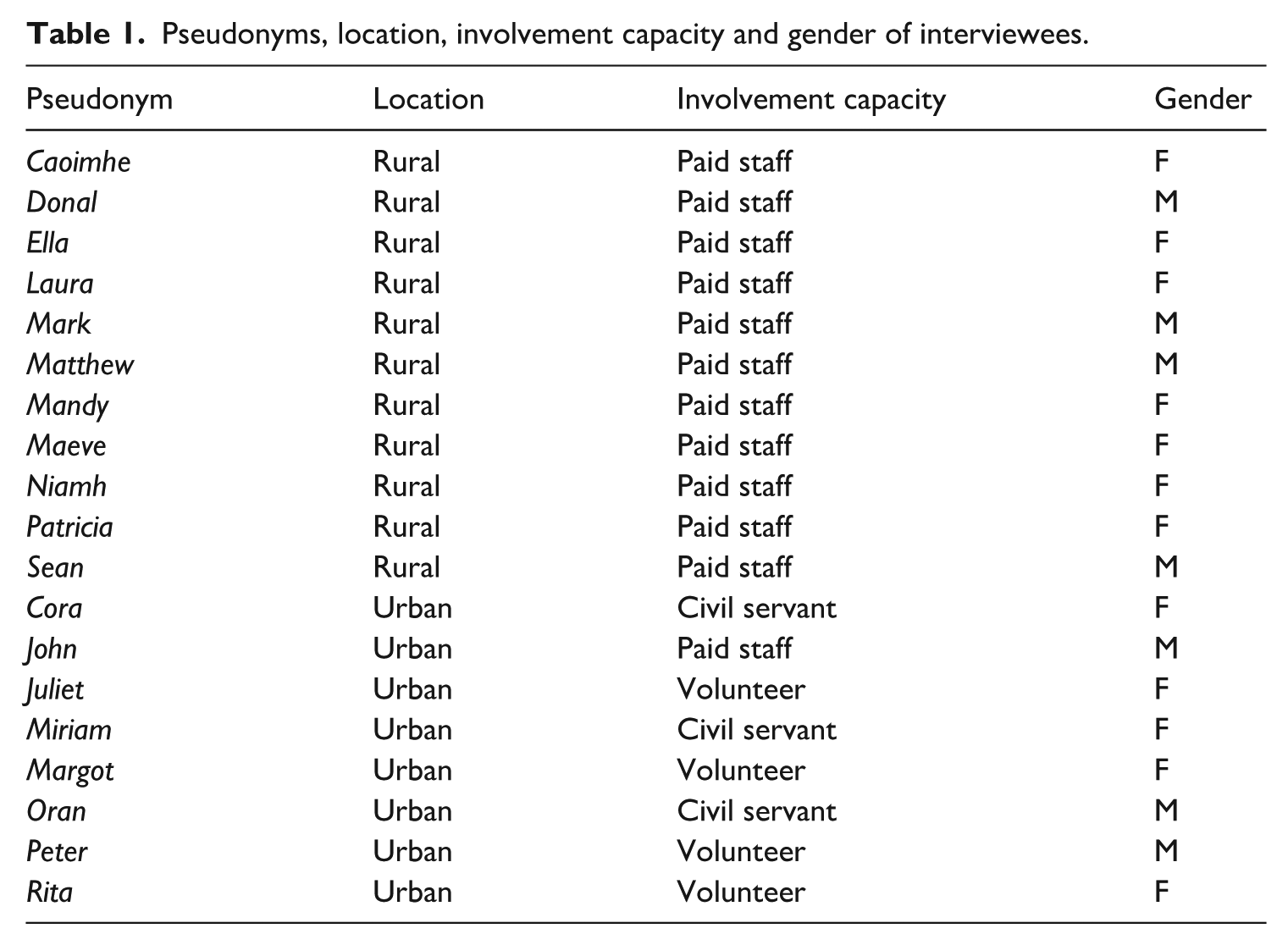
We selected stakeholders involved in the daily operations of DP as an understudied group which is nonetheless centrally involved in asylum policy implementation. Semi-structured interviews were held with 19 interviewees including staff of reception centres, civil servants and community volunteers across six locations in Ireland. Both urban and rural locations were sampled to detect differences attributable to different local contexts (for example, in rural centres, a lack of public transport may cause more difficulties in migrants accessing services). Our focus was originally only on the staff of reception centres, as the figures officially tasked with daily policy implementation. However, it soon became clear that civil servants and/or community volunteers were also often involved in daily activities, and we included them in the sample. These groups are affiliated with different organisations (private contractors, city/county councils and grassroots organisations; Table 1), but perform similar tasks: providing material goods, assisting with bureaucracy, linking migrants with existing services such as healthcare or leisure clubs. Civil servants and volunteers typically intervene when staff cannot or will not adequately provide services, and thus also have to liaise and mediate with staff; furthermore, they organise social events and initiatives such as English classes, art labs and activities for children.
Pseudonyms, location, involvement capacity and gender of interviewees.
DP centres were contacted using a list published by IPAS. Most centres refused to be interviewed, citing scheduling conflicts or an unwillingness to attract attention in a charged social climate. This makes self-selection a limitation of this study: DP staff who agreed to be interviewed are likely to be less targeted by (real or perceived) hostility and less worried about potential backlash. Access to civil servants and volunteers was achieved through the interviewer’s personal contacts and subsequent snowball sampling.
Interviews took place between February and April 2023. Table 1 details pseudonyms, location, involvement capacity and the gender of interviewees.
A review of the literature on SLBs and European and Irish asylum policy guided the selection of key themes for the interview guide. This included questions on daily routines, perceived challenges, interactions with other bureaucrats, institutions and local communities, public discourse on forced migration, professionalism and professional identity. Interviews were recorded and transcribed verbatim. Identifying information was removed from transcripts whenever possible. This was particularly important due to the increased hostility to and public attention on forced migration in Ireland. The small size of the DP ‘industry’, which only counts a few hundred employees, increases vulnerability and makes protecting the identity of interviewees even more crucial.
Transcripts were analysed through thematic analysis (Braun and Clarke, 2019) to identify common themes and more complex underlying patterns, possibly pointing to notions of identity and relations of power. Thematic analysis is a flexible, exploratory and iterative method that allows deep engagement with the data and its context. This method is particularly suited to analysing data from individuals operating within a complex system of norms, constraints and interrelations, which is also perceived as socially and politically salient. Simple thematic categories were identified and systematically coded in NVivo; then, categories were analysed in-depth and assessed against each other for shared patterns and interconnections, following Braun and Clarke (2019). This resulted in the identification of three main thematic clusters, illustrated below.
The nature of this research increased the importance of reflecting on researcher positionality throughout the process. The interviewer acknowledged that her nationality, social class, academic background, personal beliefs and previous experience in the asylum system of another EU country could bring assumptions into her work. Some of these elements also helped interviewees feel more comfortable and open: for example, the interviewer’s past work in the asylum system provided a shared experience. During data collection and analysis, all efforts were made to maintain openness and flexibility while rigorously engaging with the data.
Main Findings
The main findings clustered around three themes: challenges in SLBs’ daily work; SLBs’ conceptualisation of their identity and professional role; and interactions with the context, including communities and the broader public discourse on forced migration.
Challenges
SLBs reported similar challenges across locations and echoed previous research on migrants’ perspectives (Foreman and Ní Raghallaigh, 2020; Irish Refugee Council, 2021; Murphy et al., 2019). These include long delays in asylum decisions; unsuitable living conditions, especially for families and children; the inability to cook and eat autonomously; a lack of basic goods such as heating and bedsheets in newly opened centres; a systemic lack of housing and public services such as GPs and public transport, which affect communities at large but especially migrants, due to language barriers and a lack of orientation services. SLBs noted the sense of apathy, despair and lack of meaning this caused in residents, sometimes leading to problematic behaviours: ‘It is hard to get them to show up for meetings or show up on time [. . .] but I can understand that’ (Cora).
Owing to these diverse issues, workers spend most of their time performing tasks that are not in their job description, like filling out forms or booking appointments on behalf of residents: ‘everyone just comes to me for anything’ (Laura). DP staff effectively gatekeep services and support (Ellis, 2011) as migrants can only access them with their assistance. Indeed, despite what IPAS (2016) contracts prescribe, in practice DP staff need to be available and able to do much more than merely providing food, board, cleaning and security. DP staff are thus constantly shifting the acceptable boundaries of their position, in a common pattern for SLBs (Belabas and Gerrits, 2017). However, because this is not explicitly provided for, they can feel undertrained and underprepared for what they are called to do, especially when dealing with residents’ ‘mental health and personal issues’ (Caoimhe). The use of discretion, the feeling of underpreparedness and the perception that such assistance is an ‘extra’ and not a contractual duty may pose obstacles to access, as indeed proven by interviews with migrants (Office of the Ombudsman, 2018; O’Reilly, 2018).
Interviewees respond to these challenges creatively. Some have introduced policies and practices beyond IPAS requirements to fill perceived gaps (John, Niamh): for example, one centre introduced an internal debit card system for managing food purchases. Some mobilise skills acquired in previous jobs such as intercultural communication or conflict de-escalation (Donal, Matthew). Others mobilise their personal experiences of migration and hardship (Maeve, Niamh) or of motherhood (Patricia, Juliet) to bridge emotional distances with residents and foster empathy and mutual understanding. This is evidence of the personalised coping strategies commonly adopted by SLBs when faced with complex, unique challenges (Lipsky, 2010; Tummers et al., 2015). Here, this necessity is compounded by the lack of significant formal training, relevant qualifications or experience that may provide a well-tested repertoire of tools or solutions.
The need to constantly improvise and learn on the job reflects the complex, challenging nature of working in asylum policy implementation, which requires appropriately qualified and trained professionals (Alink et al., 2001). It is also the result of a ‘permanent emergency’ approach to the entire DP system, which was originally supposed to be a temporary fix rather than a long-term institution employing qualified staff. Finally, the ‘improvisation’ approach exemplifies the Irish centre-right government tendency to marketise public services and limit state intervention (Dukelow and Kennett, 2018): DP contracts are simply awarded to the lowest bidder and the diversity of firms involved proves that relevant expertise is not a consideration (Ní Raghallaigh et al., 2021). Contractors in turn are not required or motivated to hire employees with relevant experience or qualifications. With the exception of civil servants, SLBs in DP cannot draw upon a pre-existing body of specialised knowledge, and although they build it on the job, there is no official repository, knowledge exchange or training system.
Professional Identity and System Problematisation
The staff of DP centres see state institutions like IPAS as implicitly or explicitly responsible for most of their issues. IPAS is seen as the designer and enforcer of rules and punishments, oftentimes with no connection to staff. For example, IPAS informs migrants rather than centres when they are no longer entitled to accommodation in DP: many residents thus stay for longer, while IPAS urges centres to free beds for incoming migrants (Matthew). Poor communication with centres is a recurring theme: for example, when a migrant is transferred to a centre, IPAS fails to communicate the reasons for the transfer or the person’s specific circumstances and needs. This further complicates the job of staff members trying to liaise with public services to address the migrants’ needs (Niamh, Laura), and in at least one case has led to a serious medical emergency (Caoimhe). Staff also criticised IPAS using transfers as punishment for violent or unruly residents, which circumvents problem-solving and may incentivise rule-breaking among residents who want to move (Patricia, Caoimhe). One manager ascribed these issues to a lack of political will to plan a functioning system: Nothing is thought through. It’s kick the can down the road, let somebody else worry about it. [. . .] So I don’t see a political will a lot of the time. I see people working on the ground here [. . .] working, working, working all the time. But it’s like that guy pushing the stone up the hill [. . .] and then, every time, it rolls back down. (John)
However, DP staff generally have a pragmatic approach to their job, and do not reflect on the system’s for-profit nature and its implications for their work. In fact, there is an interesting disconnect in how staff experience the widespread lack of planning, expertise and established norms: they do not necessarily believe that the absence of detailed guidelines and their lack of specialised skills and experience betrays a flaw in system design, but they complain of the same lack of planning and guidelines when discussing interactions with IPAS and other services (Matthew, Niamh, Laura).
Unlike typical SLBs (including asylum SLBs in other countries; see Belabas and Gerrits, 2017; Giudici, 2020; Peroni, 2025), they also do not reflect on the fairness or appropriateness of the policies they implement (Belabas and Gerrits, 2017). This question was not explicitly posed to avoid leading interviewees, but the interview guide was designed to stimulate reflection in this area. Staff do not experience their own professional role as contributing to the malfunctioning of the system, even though they recognise that they are often unprepared to face issues that arise. Following Hupe and Hill’s (2007) proposition that differing perceptions of task importance result in different self-accountability criteria, DP staff believe their only official duty and the only measure of their performance is providing migrants with food and board. Any other task is voluntary, and despite being readily taken up, escapes the accepted boundaries of the accountability regime. The disconnect is thus between the system and the workers as units of that system: IPAS and other public institutions are seen as separate from the working lives of employees (and indeed on paper they are, since employees work for private companies). This disconnect causes staff to compartmentalise issues as stemming exclusively from the government side and prevents organic understanding of the connections between their daily tasks and the system at large. This distance is evident in the staff’s language: They’re not moving them along [. . .] they’re not really helping the people [. . .] to me, that’s a huge issue with them [. . .] A lot of residents think we work for the government directly, and we try and explain, no, we’re just here, we’re independent. (Patricia; emphasis added)
Any possibility of resolving issues ‘is not about us’ and it is IPAS that should change things ‘to make it better for the proprietors’ (Matthew). Workers do not see themselves as part of a continuous policy regime, but as receptionists or hotel managers who occasionally have to interact with the regime due to the nature of their clientele. This is reflected in many statements (Laura, Donal, John, Sean, Maeve) describing the job as ‘just a job’, taken because of practical needs and not because of a value-based calling or sense of professionalism. The notion of belonging to a distinct professional category with shared values, goals, skills and practices is absent, and this absence impacts workers’ performance and perceptions, including where issues come from (Evans, 2011). In this sense, DP staff do not see themselves as SLBs.
This disconnect starkly contrasts with the view of civil servants and volunteers. These actors criticise several aspects of DP, including the ‘permanent emergency’ framework (Oran), the practice of subcontracting management to diverse actors with no expertise (Rita), the lack of transparency and accountability (Margot), the excessive institutionalisation and surveillance (Miriam), the low bar for living standards and the lack of comprehensive support services (Juliet). These groups experience the same challenges as DP staff, but their problematisation of DP includes the staff of centres as integral parts of the system: they are hired ‘haphazardly’ and deliver services ‘superficially’ (Margot, Miriam, Oran). Volunteers and civil servants provide an informed ‘semi-outsider’ perspective (McGhee et al., 2016) which more accurately and exhaustively draws connections between different levels of the asylum regime. This perspective supports existing critiques of privatised public services, highlighting how privatisation disperses accountability and lowers the quality of services (Brodkin, 2007; Kirton and Guillaume, 2019), and echoes reports problematising the privatised nature of DP (Office of the Ombudsman, 2018).
Civil servants and volunteers reported that some DP staff would engage with them and with residents earnestly despite being untrained, but others would be uncooperative or hostile. One civil servant (Miriam) had to plead with a centre manager after a resident who clashed with a staff member was expelled with no alternative accommodation. Another (Cora) had to mediate when staff refused to allow residents in the common areas of the centre outside of mealtimes. Newly opened centres are particularly challenging: ‘Some of the newer centres still have a hotel mentality [. . .] and it’s been really, really, really difficult getting our foot in the door’ (Miriam). Even when staff are open to dialogue, poor planning and regulation create issues. One volunteer (Juliet) described how female residents were supplied the wrong period products and were embarrassed to raise the issue with predominantly male staff. Another recounted a manager showing her around the same centre: [The manager] was like, ‘Come, I’ll give you a tour’. And he was like, ‘What we’re going to do is put up pictures of the West of Ireland’. And I was like, okay, but maybe heating before we do that. Like, you know, maybe start with basic [things]. (Margot)
Civil servants and volunteers go deeper in their critical appraisal of the system, reflecting on how ‘in so many ways it strips migrants from their humanity’ (Juliet). They recognise that having untrained staff who are constantly improvising increases inconsistency and inequality in service provision and call for more specialised professionals delivering a wider variety of structured services. Both groups are very conscious of their separation from DP staff: while civil servants cultivate this separation as part of their distinct professional identity, volunteers ascribe an ethical value to it and explicitly ‘don’t want to be in bed with management’ (Margot). This attitude echoes common concerns in the voluntary sector of losing independence, reputation and organisational values when partnering with other organisations in the policy regime (McGhee et al., 2016). Both groups are also conscious that a better system would not need volunteers at all: ‘I think the state should be doing it. [. . .] I think it’s very convenient for the state that volunteers step up’ (Rita). Finally, civil servants and volunteers understand DP as embedded in the Irish institutional tradition: When you see in Ireland the government making [. . .] formal apologies on behalf of the state about mother-and-baby homes, about industrial schools, about the role of the Catholic Church, I used to always say, someday we’ll be making those apologies for Direct Provision. (Peter)
The different nature of stakeholders’ involvement and motivations explains the different degrees of critical reflection in their conceptualisation of the system. First, it is arguably easier to appraise the interconnections between policy design and street-level implementation from an ancillary but external position. Civil servants are of course SLBs and see themselves as such by virtue of their training and experience, which they often recall in interviews (Miriam, Oran); they display a conscious professionalism, or the idea of belonging to a distinct group characterised by shared salient practices, underlying principles, ideas about one’s professional role and ways to relate to service users and colleagues (Evans, 2011; Hupe and Hill, 2007). Volunteers are informal SLBs, getting involved in DP for altruistic reasons (Rita, Margot) but remaining independent for both practical and ethical reasons. Conversely, DP staff see themselves as ordinary workers, and not necessarily as SLBs with a specific vocation, group identity or sense of professionalism. The more superficial level of involvement caused by the system’s design results in a more unreflective, uncritical analysis of the broader work environment (Belabas and Gerrits, 2017). This example illustrates how privatisation dismantles or impedes the formation of a structured form of bureaucratic professionalism (Ellis, 2011) which helps workers make sense of their positionality and ethos as part of a policy regime. It also prevents workers from sending feedback up the policy cycle, precluding them from the possibility of being bottom-up ‘policymakers’ (Lipsky, 2010).
Community and Public Discourse
Staff and civil servants sensed mixed attitudes on DP from local communities. They were aware of the anti-immigrant protests and attacks happening in Ireland at the time of the interviews, but did not report hostility directly involving their centres, with one exception. This may reflect self-selection: centres which have not directly experienced hostility may be more willing to participate in interviews. Some interviewees reported that community members’ complaints about DP residents getting free housing or not undergoing background checks can be misinformed, but ‘understandable’ (Laura, Sean) and contain a legitimate element of grievance.
All interviewees agreed that it had taken time for the local community to adjust to the DP centre. Furthermore, they believed timing and media exposure were crucial in determining community response: long-established centres mostly had no issues, whereas new openings were more likely to have encountered opposition (Matthew). This acknowledges the increasing salience of the issue and the growth of polarised reactions in the community. John, a manager working in DP for 20 years and the only worker who reported discrimination targeting his centre, stated that ‘Ireland was more welcoming back then’ and cited ‘[people getting] fooled by social media’ and ‘the actions of the far right’ as reasons for the deterioration of attitudes. Nonetheless, most centres reported examples of positive community involvement, including volunteers coming to teach English or residents enrolling in local sports teams.
Volunteers from a city marked by frequent anti-immigration protests reported being ‘on eggshells’ (Juliet) about anti-immigration attitudes in their community and experiencing hostility while canvassing the neighbourhood to recruit new volunteers. Firsthand experience of increasing visibility of asylum and related hostility increased their motivation to get involved: ‘Our area kept being used [to showcase anti-migrant sentiment] even though this was happening kind of all over Ireland [. . .] I was, like, mortified that people would think that that was representative of everybody’ (Juliet). Negative neighbourhood reactions and unprecedented public attention thus determined at least partly the intervention of a new group of stakeholders, motivated by a desire to change and ‘clean up’ the narrative about their own community, and by extension themselves.
Interestingly, volunteers believed that greater media and public attention also had positive effects, raising awareness and allowing them a platform to counter the anti-migrant narrative. DP staff, conversely, generally believed increased attention only led to more tension and an unjust stigmatisation of DP workers by uninformed outsiders (Caoimhe, Patricia). Again, different groups see the broader playing field differently: external stakeholders are more conscious of the interrelation of forces and discourses at play and of how they can leverage it, while DP staff mostly believe that media and public discourse represent undue, unnecessary external interference. These findings demonstrate how the perceptions and behaviour of SLBs are influenced by factors that go beyond individual and organisational traits to include the broader context of policy regime implementation (Belabas and Gerrits, 2017; Hill and Hupe, 2009). These factors interact with bureaucrats’ self-constructed identity and role and produce complex patterns of action.
Discussion and Conclusions
A crucial element emerges from this research, which has implications not only for the system’s daily functioning, but also for how it is internally and externally perceived: workers in the Irish asylum regime do not see themselves as part of the system. Staff locate all problems in the clearly separate, antagonistic realm of state institutions and public policy. Accordingly, they do not reflect on the broader significance of the asylum regime: they perceive themselves as ordinary people doing ordinary jobs, and not part of a policy regime. DP workers fit the classic description of SLBs (Lipsky, 2010) but do not perceive themselves as such. Conversely, civil servants and volunteers, who have different motivational structures and ideas of bureaucratic professionalism, are able to critically examine the system and their own distinct position within it, and can even maintain a vocal stance against the system without experiencing ambivalence (Giudici, 2020; McGhee et al., 2016). The ability to critically situate and examine one’s own professional identity within a broader regime appears a key element enabling the use of professionalism in SLBs’ work.
We argue that the disconnect between high-level policy design and governance systems and lower-level implementation units and practices is a two-way disconnect: a lack of top-down coordination and accountability (Hupe and Hill, 2007) built into the privatised design of the system, and a lack of bottom-up professional identity acting as a horizontal binding agent (Evans, 2011). From a top-down perspective, DP as a combination of poor services, high institutionalisation and poor connections with other public services stems from the Irish state tradition of economic liberalism (Dukelow and Kennett, 2018) and a short-sighted ‘permanent emergency’ approach to asylum. In this approach, contractors and their employees do not need specialised skills, a sense of shared professional ethic or service to deliver these basic services; they can interpret contracts differently; they can work untrained and largely unsupervised. From a bottom-up perspective, being an asylum SLB can easily be perceived as ‘just a job’ if skill-based entry barriers are low; any work beyond the bare minimum prescribed by contracts is left to the goodwill of staff, in a distorted form of discretion which escapes the norms of bureaucratic professionalism and group accountability (Ellis, 2011; Hupe and Hill, 2007). The lack of training and professional identity exacerbates systemic flaws already embedded in the policy regime and removes another foundational element of professionalism (Belabas and Gerrits, 2017). Furthermore, if SLBs do not see themselves as part of a system, there is no effective feedback mechanism that could spur change from below (Thomann et al., 2023), and little to no horizontal accountability (Hupe and Hill, 2007). The action of SLBs is curtailed by their failure to see themselves as such.
Our findings reaffirm the key importance of professionalism as a group-constructed concept strictly linked to reflexivity, relationality and group identity (Evans, 2011): without a shared notion of professionalism, frontline practices lose their defining characteristics (Tummers et al., 2015). They also contrast other studies exploring the subjectivities of SLBs in non-privatised asylum regimes and providing evidence of critical reflection on their role (Eggebø, 2013; Giudici, 2020; McGhee et al., 2016; Peroni, 2025; Shiff, 2021), suggesting that a privatised asylum system does not provide the conditions for SLBs to engage in such reflection and therefore to enact professionalism.
We argue that conceptualising and treating asylum policy implementation as an ordinary job, disconnected from policy and power regimes, removes the possibility for SLB critical insight by removing their sense of belonging to an organic system proceeding from high-level policymakers to their daily tasks. With no insight informed by SLBs’ privileged position, no bottom-up feedback or change is possible, and SLBs’ defining capacity to exercise discretion and flexibility is impaired (Lipsky, 2010; Tummers et al., 2015). Policy implementation and the delivery of public services are thus deprived of important adaptability mechanisms that permit the realisation of policy outcomes in underresourced and constraining environments (Thomann et al., 2023). This insight is particularly important considering the growing tendency to privatise asylum and to establish ‘emergency’ reception centres (Darling, 2016; Humphris and Sigona, 2017). The Irish case offers a compelling account of what can malfunction in a privatised asylum system, which in the name of cost-effectiveness fails to deliver for all stakeholders due to a lack of planning and adequate investment, resulting in inaction at the street level. Our analysis can be applied to more cases where asylum services are being subcontracted or privatised, to examine whether the same or other context-specific factors are relevant.
Our findings confirm that the perspective of SLBs is crucial in a comprehensive analysis of policy regimes, especially in asylum regimes, where bureaucrats’ role intersects with forced migrants’ wide-ranging needs and vulnerabilities and with the regime’s broader societal and political implications (Alink et al., 2001). Indeed, the features of a policy regime shape policy outcomes precisely through the skills, identities and perceptions of its SLBs (Hill and Hupe, 2009). Examining the bureaucrats’ perceptions and experiences illuminates street-level practices and dynamics which may explain systemic flaws, but are typically overlooked by higher-level analyses (Darling, 2016; Yin, 2023). These practices and dynamics shaped by the private nature of the system have tangible repercussions on the way SLBs perform their job, and therefore on the living conditions and outcomes for migrants living in DP. Our study points to an underexplored way in which privatisation changes public service delivery, through its influence on workers’ professionalism and sense of identity, building on a relatively underdeveloped body of work focusing on SLBs’ identity and professionalism in privatised regimes (Ellis, 2011; Maron, 2021). Comparing and contrasting the perceptions and critical assessments of staff with those of parallel stakeholders with different backgrounds and levels of involvement, such as civil servants and volunteers, further highlights how the design and features of an asylum regime determine what kind of workers it will have, and consequently the experiences of forced migrants. Incidentally, the shortcomings of DP emphasised by SLBs confirm existing findings based on interviews with migrants. There is a specular correspondence between the experiences of migrants and workers, which points to the importance of workers’ perspective not only per se, but also as a sounding board and a fundamental link in the bottom-up feedback chain that goes from service users to policymakers (Lipsky, 2010). One final suggestion is therefore for research and policy not to overlook the experiences and subjectivities of ‘ordinary’ frontline workers in asylum regimes in favour of SLBs who manage asylum policy far from forced migrants (Shiff, 2021) or only occasionally (Eggebø, 2013).
Footnotes
Funding
The authors disclosed receipt of the following financial support for the research, authorship, and/or publication of this article: This research was partly funded by Research Ireland (Government of Ireland Postgraduate Scholarship, award GOIPG/23/4654).
Ethics Statement
This research was conducted in compliance with Trinity College Dublin’s ethical guidelines. Ethical approval was obtained from the Director of Research, School of Social Sciences and Philosophy, Trinity College Dublin on 20 September 2022.
