




Abstract
Electronic employee monitoring has strongly increased over the last decades. This article investigates to what extent electronic and non-electronic monitoring practices affect feelings of (mis)recognition both at the workplace and more widely in society. To better comprehend the effects of electronic monitoring, we use Noorda’s conception of ‘imprisonment’. Building on the argument that electronic monitoring resembles a situation of imprisonment, limiting workers’ liberty, the study proposes that it violates the human dignity of workers, triggering feelings of misrecognition not only in the workplace but also by society at large. Analyzing survey data on 3089 employees in the Netherlands the study finds that the more strongly employees are monitored by electronic devices, the stronger their feelings of workplace misrecognition. Moreover, electronic monitoring also affects broader feelings of societal recognition, both indirectly via workplace misrecognition, and directly. Human monitoring practices (by one’s supervisor or colleagues etc.) are not associated with feelings of workplace misrecognition.
Keywords
Introduction
With the rise of new technologies in the workplace, the possibilities for organizations to monitor their employees’ behavior have strongly increased in recent years. While monitoring and surveillance have long been part of the relationship between employees and management, recent innovations in artificial intelligence, the Internet-of-Things (IoT) and algorithmic management have increased both the availability and intensity of monitoring in the modern workplace (Aloisi and De Stefano, 2022; Ball, 2021; Holland et al., 2015). Unlike monitoring (solely) by a human actor – often a supervisor or manager – electronic monitoring involves the ‘use of electronic instruments or devices like audio, video, and computer systems to collect, store, analyze, and report actions or performance of individuals or groups’ (Nebeker and Tatum, 1993: 509). According to recent reports in the North American context, ‘eight of the ten largest private U.S. employers’ (Kantor and Sundaram, 2022) and two-thirds of employers with 500 or more employees (Ziegler, 2022) use some form of employee monitoring software. In the European Union, a large-scale company survey reported 51% of the companies use data analytics for employee monitoring (Eurofound, 2020). The rise of electronic monitoring was boosted by the start of the COVID-19 pandemic when employers pursued new ways to monitor their employees working from home (Jeske, 2022).
The trend of rapidly growing employee surveillance is not uncontested: while ensuring employee performance and productivity is typically the main justification for workplace surveillance (Mahaney and Lederer, 2011), the empirical evidence for a positive relationship between electronic monitoring and performance and productivity is mixed at best (Siegel et al., 2022). If anything, previous studies established that electronic monitoring has many unintended and adverse consequences for both individual workers and organizations, such as reduced job satisfaction, increased stress, weakened autonomy, waning trust, deteriorating social support and increases in counterproductive work behavior (Alge and Hansen, 2013; Ball, 2021; Holland et al., 2015; Ravid et al., 2020; Stanton, 2000; Thiel et al., 2023). Taken together, concerns about electronic surveillance often include a critique of ‘instrumentalist’ approaches to human resource management where workers are mainly perceived in terms of their economic value, and where productivity and performance outweigh well-being (Manley and Williams, 2022; Tweedie et al., 2019).
This critique on instrumentalism resonates with research on ‘dignity at work’ (Bal, 2017; Gibson et al., 2023; Hodson, 2001; Pirson et al., 2016), emphasizing that employees have an inherent value, separate from their economic value (Bolton, 2007; Hodson, 2001; Sayer, 2007). In this strand of literature, worker dignity is defined as the ability to establish self-worth and self-respect. Intensive monitoring and measurement practices, because they frame workers in terms of their economic value, would negatively affect their dignity. In this study, we focus on recognition as a source of dignity (Lamont, 2018; Sayer, 2007). Recognition theory entails that people’s self-views as respectable and worthy of dignity derive from social recognition (Honneth, 2008; Islam, 2013), that is, respectful treatment and social relationships with others, including management and peers. Although social recognition can be derived from other sources than work, recognition theorists typically assume that paid work is the most important social basis of recognition (Jütten, 2022; Trovik, 2021). Social recognition scholars such as Islam (2013: 238) have argued that modern working life is ‘dominated by processes of watching other people, and in particular, watching with regards to monitoring, measuring, and evaluating’. Such a culture of workplace monitoring would obstruct the processes of recognition giving and receiving when it becomes ‘so much an end in itself that any consciousness of an antecedent social relationship disappears’ (Honneth, 2008: 79).
Recognition theory adds several key insights to the study of employee monitoring. First, recognition-based approaches to electronic employee monitoring naturally extend beyond the ‘performative’ focus, emphasizing the importance of social and human aspects of work, particularly those that may be invisible or overlooked in specific workplace settings (Islam, 2013; Tweedie et al., 2019). Our study aims to investigate to what extent employees under surveillance feel misrecognized or unrecognized at work.
Second, recognition theory draws attention to how monitoring may impact workers not just within the workplace but also outside of it. Recognition is important for people’s sense of self-worth, cultural membership and place in society (Lamont, 2018). Workers’ identities and social relationships may be subverted when social recognition is withheld in their workplaces. While the literature on employee monitoring almost exclusively focused on workplace outcomes (Kalischko and Riedl, 2021), recognition theory puts forward that feelings of misrecognition at work have an effect on individuals’ social lives. Our study aims to investigate to what extent employees under surveillance feel misrecognized by society at large, and to what extent misrecognition at work contributes to a sense of societal exclusion.
To better understand how electronic employee monitoring affects the processes of recognition giving and receiving, we use Noorda’s (2023b) ‘imprisonment perspective’. By decoupling imprisonment from physical confinement and instead adopting the broader, impact-based approach developed by Noorda, we can draw parallels between employee monitoring and imprisonment, particularly regarding their impact on feelings of recognition. Surveillance in prisons is characterized by strong limitations of prisoners’ physical liberty and autonomy, controlling prisoners’ behavior and daily lives. In a strict prison regime, inmates experience scarce resources and opportunities for self-improvement, and degrading staff–prisoner relationships, leaving prisoners ‘un-recognized’ as individual human beings by the institution (e.g. Sykes, 1958). The key argument is that in extreme situations employee monitoring can be seen as a form of imprisonment at work (Hariharan and Noorda, 2025). When employees’ liberty is restricted or deprived, as occurs with intense monitoring, it can, as we will argue below, constitute a violation of their ‘worker dignity’. The same is true for the dehumanizing aspect of severe monitoring. When worker dignity is violated, workers are likely to feel that their inherent value as human being is not recognized, resulting in feelings of misrecognition. When at work one has the feeling of being seen as ‘a number’ (Manley and Williams, 2022) or ‘a means to end’ (Bal and De Jong, 2017: 3), it may be more difficult to maintain a positive relation-to-self or one’s merits as a contribution to a society (Honneth, 1995). In what follows we argue that akin to prisoners, restrictions on liberty among employees are the essential element linking surveillance practices to feelings of misrecognition. Resembling the imprisonment of inmates, we consider electronic monitoring to be a potential dignity violation, that may trigger feelings of misrecognition at work and with respect to a person’s place in society at large. We propose that the limitations on individual liberty are more severe with respect to electronic versus human monitoring. Ultimately, our research questions are twofold: To what extent do electronic and non-electronic workplace surveillance affect perceptions of (RQ1) recognition at the workplace and (RQ2) societal recognition (beyond the workplace)?
Empirically, we study our research questions utilizing large-scale survey data that is representative of the general workforce in the Netherlands in pre-Covid period of 2018–2020. The field of employee surveillance studies has a well-established history (cf. Ravid et al., 2020), drawing on a broad spectrum of research methods, including many lab experiments (Claypoole and Szalma, 2019; Stanton and Barnes-Farrell, 1996), student samples (Douthitt and Aiello, 2001; Jeske and Santuzzi, 2015) and a host of qualitative and quantitative studies in a diverse range of occupational settings, such as jobs in calls centers and telecommunication (Story and Castanheira, 2021), police officers (Adams and Mastracci, 2019) and more recently platform work (Newlands, 2021). To these rich and valuable studies we add a study in which monitoring is examined in a more diverse, workforce sample, of which only few exist yet (e.g. Glavin et al., 2022; Martin et al., 2016). Moreover, to the best of our knowledge, survey data including both information on monitoring as well as perceived recognition in and outside the workplace is non-existent. Doing so, we also make valuable contributions to the recognition literature, which holds prominence in social philosophy and social theory but has received limited attention in the empirical social sciences and even less so in the study of work (Gibson et al., 2023, Newlands, 2022; Sebrechts et al., 2019; Wood and Lehdonvirta, 2023).
Theory: Electronic Monitoring and Social Recognition
Employee Monitoring as Imprisonment
We use the notion of ‘imprisonment’ to identify the reasons why employee monitoring may lead to misrecognition in the workplace and beyond. Imprisonment is characterized by two key elements: (1) it infringes on the free life of individuals, in the sense of the absence of constraints from action, by restricting their physical liberty, and (2) it disrespects individuals’ autonomy, in the sense of the capacity to control one’s own behavior, by subjecting the organization of their lives – including control over their daily rhythm, property and work (Noorda, 2015, 2023b).
This framework includes a broad range of practices, such as travel bans and electronic tagging (Mantouvalou and Noorda, 2024; Noorda, 2015, 2023a). By employing this framework, scholars have argued that monitoring in the employment context can similarly impose significant restrictions on individual liberty (Hariharan and Noorda, 2025). The similarity between imprisonment and employee monitoring is particularly stark in cases where employees are constantly monitored by their employer, for example through the use of company-mandated facial recognition systems and keystrokes monitoring software. One illustration comes from the working-from-home context. Employees at Teleperformance, one of the world’s largest call center companies, face webcams that scan their remote working spaces for working infractions, using facial recognition and location tracking technology (Hariharan and Noorda, 2025; Walker, 2021). If employees are not at their desk, use their mobile phone or the system detects no keyboard strokes or mouse-clicks, the system will immediately capture and send a photo to the employee’s manager. Individuals subject to these monitoring practices are restricted in their freedom to move to a high degree. In some cases of intense monitoring, they are literally deprived of their liberty to move from their desk for a period of time (Hariharan and Noorda, 2025).
Monitored employees may experience further negative impacts on their lives, not only in their physical liberty but, as the aforementioned example shows, continuous monitoring disrespects their autonomy. In the literature on workplace surveillance, it is widely held that electronic monitoring can restrict autonomy and job control (Alge and Hansen, 2013; Kensbock and Stöckmann, 2021; Ravid et al., 2020). As Hariharan and Noorda (2025) have argued, the analogy to imprisonment becomes clear when monitoring becomes so invasive that it not simply restricts one’s freedom to organize work, but also more elemental daily routines including choices with respect to when they eat, drink or use the bathroom. At Teleperformance, eating is not permitted on a shift and if any breach is detected, the system will immediately capture and send a photo to the employee’s manager (Hariharan and Noorda, 2025).
A further way in which employee monitoring is on a continuum alongside imprisonment is evident if we consider the implications of monitoring for an employee’s sense of being recognized as a human with agency and rights to self-expression. Anteby and Chan (2018: 253–255), for example, suggest that workers under surveillance can feel constantly observed and watched, but they can also feel largely unnoticed as individuals by management. Somewhat paradoxically, they argue, employees feel that their managers use digital monitoring to overlook them as unique individuals, which makes them feel ‘invisible’. Also, in a strict prison regime, inmates experience scarce resources and opportunities for self-improvement, and degrading staff–prisoner relationships, leaving prisoners ‘un-recognized’ as individual human beings by the institution (e.g. Sykes, 1958) and society at large.
Indeed, incarcerated work is often seen as a form of ‘invisible work’ (Daniels, 1987; Hatton, 2017; Mantouvalou, 2023) because it takes place physically out of sight of society in segregated institutions. Similarly, electronic monitoring is assumed to involve new patterns of invisibility and visibility of employees – in particular in workplaces that are segregated from traditional worksites, such as home-based work and digital work (Crain et al., 2016). For example, this idea has also recently garnered attention in research on the gig economy, where workers are often monitored by algorithmic management systems (De Stefano, 2020; Lamers et al., 2022; Wood and Lehdonvirta, 2023). Gig workers have little face-to-face contact with managers or supervisors. As most communication is digitally mediated, gig workers are often uncertain whether they are communicating with a human or an automated system. Newlands (2022: 833) suggests that such ‘technological devices can only provide ‘pseudo-recognition’, and that ‘automated forms of communication can disrupt the development of individual subjectivities and lead to feelings of mechanistic dehumanization’.
As such, employee monitoring, especially severe forms of employee monitoring resemble a form of imprisonment because of the restrictions on individual liberty these pose. These restrictions to individual liberty, as well as the dehumanizing fact of not being seen as an individual when being monitored, can be considered worker dignity violations, since such practices emphasize the economic value of employees at the cost of their inherent value as human beings.
Electronic versus Non-Electronic Monitoring and Feelings of Misrecognition
Above we established a theoretical link between imprisonment at work and worker dignity violations. In what follows we argue that this will impact feelings of misrecognition, hypothesizing that electronic monitoring carries more severe implications in comparison with human oversight. To explain this argument, we first elaborate on the key distinctions between electronic and non-electronic employee monitoring.
Historical records of workplace monitoring typically trace back to the advent of modern capitalism, where the demand for efficient resource allocation and profit maximization intensified the need for employee monitoring and performance appraisal systems (Mettler, 2023). Under small-scale preindustrial production systems work surveillance took place by means of human oversight. Yet, the emergence of factory production methods stimulated mechanized timekeeping and piece-rate systems, as employers had to more rapidly process larger quantities of information (Ball, 2010; Beniger, 1989). With each subsequent change in work – first a shift from manufacturing to service work, and more recently a development toward location independent work – it became increasingly difficult for employers to monitor their employees by simply watching them (Mettler, 2023). Enabled by electronic technologies, surveillance methods have evolved from visual surveillance, such as observing workers via CCTV, and computerized surveillance, which involves monitoring phone calls, emails or internet use, to the latest generation of surveillance techniques. The latter include tracking software (Elmholdt et al., 2021) that records employee activity or tasks, such as keystrokes, mouse movements or screen monitoring; GPS tools and sensor technology (Schall et al., 2018) that record employee location and movement; and biometric technologies and wearables (Hoffmann and Mariniello, 2021) that record physical and physiological data on employees.
While a certain degree of monitoring is an inherent part of the employment relation, exceeding reasonable or necessary surveillance would jeopardize workers’ fundamental rights and dignity (Ball, 2010; Mettler, 2023). In the ‘worker dignity’ literature (Bolton, 2007; Hodson, 2001; Sayer, 2007), dignity is defined as the ability to establish self-worth and self-respect. As explained before, when employees are deprived of their liberty – such as through monitoring practices – it can result in a violation of their worker dignity. In this respect, we argue that electronic and non-electronic monitoring practices differ on four crucial points: the first three involve stronger infringements on individual liberties. First, compared with human oversight, electronic surveillance technologies, and in particular the latest generation, are potentially more invasive and personalized, as they more often move beyond traditional performance monitoring, into other aspects of employee activity and behavior such as GPS-based location and movement tracking, or AI-driven data analytics collecting personality traits. Second, electronic surveillance technologies can more easily place an employee under continuous surveillance, based on real-time observations, sometimes done covertly (e.g. via keystrokes logging, mouse movements or screen capturing). Third, more often than before, new modes of electronic surveillance intrude into people’s private lives beyond the workplace (Ball, 2021; Felstead and Henseke, 2017). As remote work becomes prevalent, surveillance practices – including working-from-home monitoring software – have extended into the home environment. Moreover, monitoring increasingly crosses public–private boundaries (Frantziou, 2020), with employers monitoring not only on-duty work communications but also off-duty social media interactions (Bales and Stone, 2020). And fourth, in addition to restricting liberties, electronic monitoring practices are potentially more dehumanizing. Outsourcing employee supervision to technology and removing human interaction may intentionally or unintentionally give a signal to employees that their work is not worthy for the personal attention of their manager to invest their time and effort in. Furthermore, it may give employees the feeling that they are not trustworthy (Holland et al., 2015). Also, electronically monitored employees have less agency (Thiel et al., 2023) to give meaning to the data collected about them. More often than not the system itself will draw conclusions about the employee’s work behavior and performance, leaving less room for subjective interpretations of these. For these reasons, we expect that the consequences for individual liberty, as detailed in the previous section, are more pronounced in electronic surveillance than in practices relying on human oversight:
Hypothesis 1a: The more intensely employees are monitored electronically, the stronger their feelings of misrecognition at work.
Hypothesis 1b: Electronic monitoring is more strongly associated with feelings of misrecognition at work than non-electronic monitoring.
In addition, electronic monitoring may also affect feelings of societal recognition. While it has been suggested that feelings of misrecognition in prison spill over to a sense of being neglected by society at large (Irwin, 2005), research on societal recognition and the effects of monitoring beyond the workplace are in its infancy (Tweedie et al., 2019). Thus, it is unclear whether the analogy with imprisonment and its relationship with feelings of misrecognition also holds outside the workplace. In what follows, we argue that electronic monitoring as individual liberty violation can affect feelings of societal recognition both directly and indirectly.
Starting with the latter, recognition theory postulates that receiving or being withheld recognition at work has implications also beyond work. Work has meaning ‘not only because it provides workers with an income but also because it provides them with an identity that is related to their contribution to society’ (Jütten, 2022: 8). As such, misrecognition at work can be understood more broadly as a failure in acknowledging or affirming a person’s existence, identity, rights or achievement (Jütten, 2022: 1). The key expectation that can be derived from recognition theory is thus that the workplace is the principal domain where recognition can be gained or withheld (Gibson et al., 2023; Jütten, 2022). As work is a crucial part of life in the modern society, a sense of being misrecognized at work resulting from monitoring may potentially extend to feelings of misrecognition in society. Hence, this expectation is reflected in the following hypothesis:
Hypothesis 2: Feelings of workplace misrecognition are positively associated with feelings of societal misrecognition.
Furthermore, feelings of societal misrecognition may arise directly from the detrimental effect of monitoring on one’s physical liberty and personal autonomy. Emerging surveillance scholarship has argued that with work moving beyond traditional workplaces and with the use of personal equipment and property (e.g. home offices and personally owned devices), monitoring increasingly crosses into employees’ private domain (Ball, 2021) and thereby blurs the boundaries between personal lives and the work environment (Manley and Williams, 2022). By doing so, monitoring may induce work–life conflicts and social isolation through the pressure to be ‘always on’ (Ball, 2021: 51).
Moreover, wider social relations may be affected as electronic monitoring curtails individuals’ freedom to move, exercise personal choices regarding their daily routines and communicate with family and friends. Work interruptions for personal communication and social interaction become less private and therefore more difficult not only when workers are confined to a single location, but also when tracking software records employees’ activities (e.g. via capturing keystrokes, mouse movements or screen captures). For example, taking time for social interaction is more difficult when private internet or smartphone use are being recorded, watched and sanctioned. This may have a self-reinforcing effect: Anteby and Chan (2018), for example, find that employees under strong surveillance refrained from socializing with co-workers in order also to keep their private life unknown to management. Otis and Zhao (2016: 163) argue that workers may even seek invisibility to evade management and the public, even if they may be sacrificing some possibility for recognition of their efforts. Paradoxically, it may be argued that through this form of ‘self-surveillance’ of everyday habits and personal life choices the workplace becomes even more present in the personal lives of employees (Manley and Williams, 2022). While recognition theory can provide a basis for these arguments, there is a current dearth of empirical support for the effects of electronic monitoring on feelings of societal misrecognition. Hence, we formulate:
Hypothesis 3a: The more intensely employees are monitored electronically, the stronger their feelings of societal misrecognition.
Hypothesis 3b: Electronic monitoring is more strongly associated with feelings of societal misrecognition than non-electronic monitoring.
Figure 1 summarizes our theoretical model.
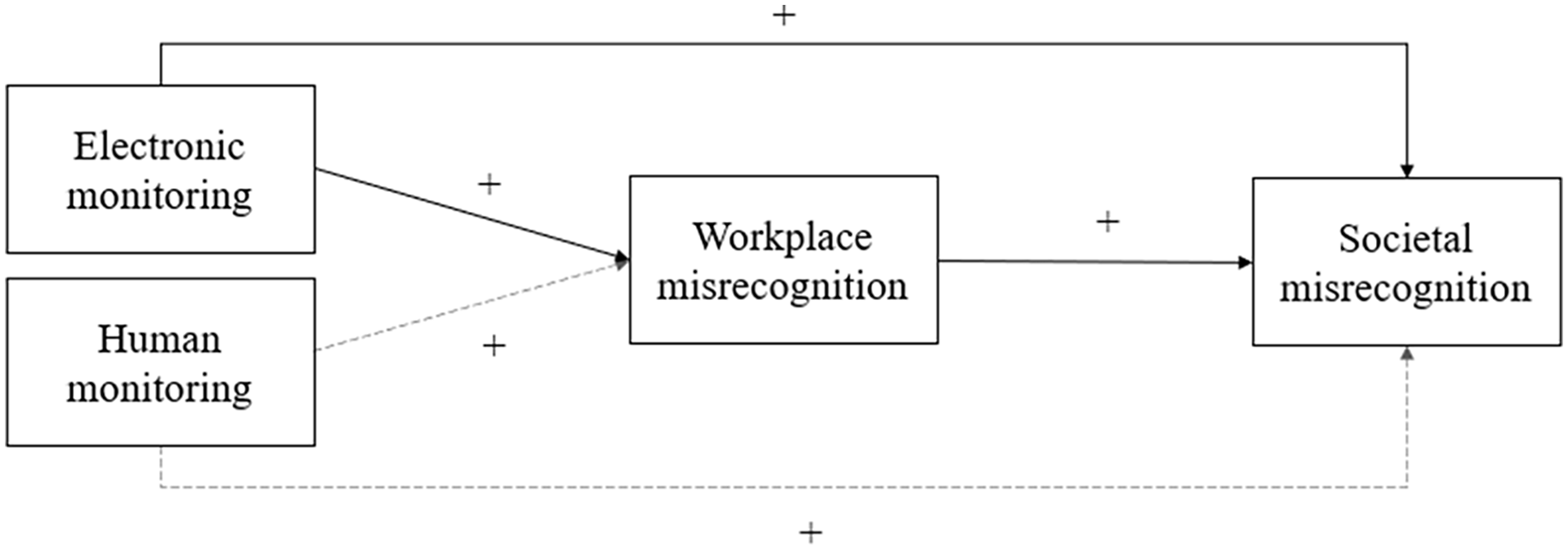
Theoretical model.
Data and Measures
Data: Work and Politics Panel Survey
To test our hypotheses, we use the Work and Politics Panel Survey, a general workforce survey containing questions on employees’ digital and non-digital monitoring experiences, workplace and social recognition, and wider characteristics of the work environment and employees’ socio-political values. The data was collected by administering a web-based questionnaire to 3089 Dutch citizens in 2018 and 2020. Utilizing this data enables us to make valuable contributions to both literature on electronic monitoring as well as on social recognition.
For this study, data is used from the second and third wave of the Work and Politics Panel Survey. The fieldwork, carried out by Kantar Public, for the two waves took place in 2018 and 2020 respectively. The samples were limited to the Dutch labor force aged between 16 and 67 years, and are representative for the Dutch population with respect to gender, education and region within the Netherlands. Following an initial first wave in 2017 (N = 7599) among a random sample of 12,013 (initial response rate 64%) from an online panel consisting of approximately 235,000 respondents in the Netherlands, 6008 participated in the second wave, and 4855 also participated in the third wave. Hence, panel attrition rates amount to 21% in the second, and 36% in the third wave. For our analyses we selected respondents who were employed during the time of the surveys and without missing information on relevant variables (N = 3089).
Measurements
To measure workplace monitoring we used items on various forms of electronic and non-electronic surveillance practices of employee behavior. A self-reported question on monitoring was used in which respondents were presented with a checklist to indicate the presence or absence of certain monitoring practices (similar to for example Kensbock and Stöckmann, 2021; Stanton, 2000). The checklist was introduced by stating, ‘Employees can be monitored in various ways, for example by a supervisor, colleagues, customers or through devices (such as a time clock, a camera or by software on computers [emphasis added]. Can you indicate below whether the following aspects at your work are monitored and how?’ Respondents were presented with four aspects of their work, that is, their presence (where they are), activity/timekeeping, performance and compliance with procedures and agreements. For each aspect respondents could indicate whether this was monitored (a) directly by a manager/supervisor, (b) by colleagues, (c) via devices, (d) by clients/customers or (e) in some other way. Respondents could also indicate in case each aspect (f) is not frequently monitored. For each monitoring practice, including electronically through devices, we calculated a count variable indicating how many work-related aspects were monitored this way, ranging from 0 to 4.
The ultimate outcome variable, feelings of societal misrecognition is based on four items: ‘I feel excluded from society’, ‘I feel that others do not recognize the value of what I do’, ‘I feel that others look down on me’ and ‘I feel I am not seen in society’. The first two items were previously utilized by Van Noord et al. (2021) as a measure of feelings of misrecognition. To create a more comprehensive measurement of the concept, two items were added that respectively capture feeling looked down upon and not feeling seen in society. The response categories were based on a five-point Likert-type scale ranging from 1 ‘does not apply at all’ to 5 ‘completely applicable’. Together the items constitute a reliable scale (Cronbach’s alpha = 0.87). The scale score for feelings of misrecognition was computed as the average score on all four items while allowing one missing value, and a higher score indicates more feelings of misrecognition.
For the other outcome variable, feelings of workplace misrecognition the data lacked identically worded items as above. Yet, similarly we include an item measuring feelings of workplace inclusion/exclusion, that is, ‘I feel like I really belong to this organization’ (reverse coded). To capture a respondent’s feeling about the extent to which others misrecognize the value of what they do, we include two items: ‘My supervisor generally pays too little attention to my interests’, and ‘My supervisor is only interested in the performance of work, and not in the opinions of employees like me’. Additional items related to the feeling of being looked down upon in the work environment are not available in the dataset. The response categories for all items were based on a five-point Likert scale ranging from 1 ‘fully disagree’ to 5 ‘fully agree’. A scale was constructed taking the mean over the three items (Cronbach’s alpha = 0.67), while allowing one missing value. The higher the value of this scale, the stronger the feeling of misrecognition at the workplace.
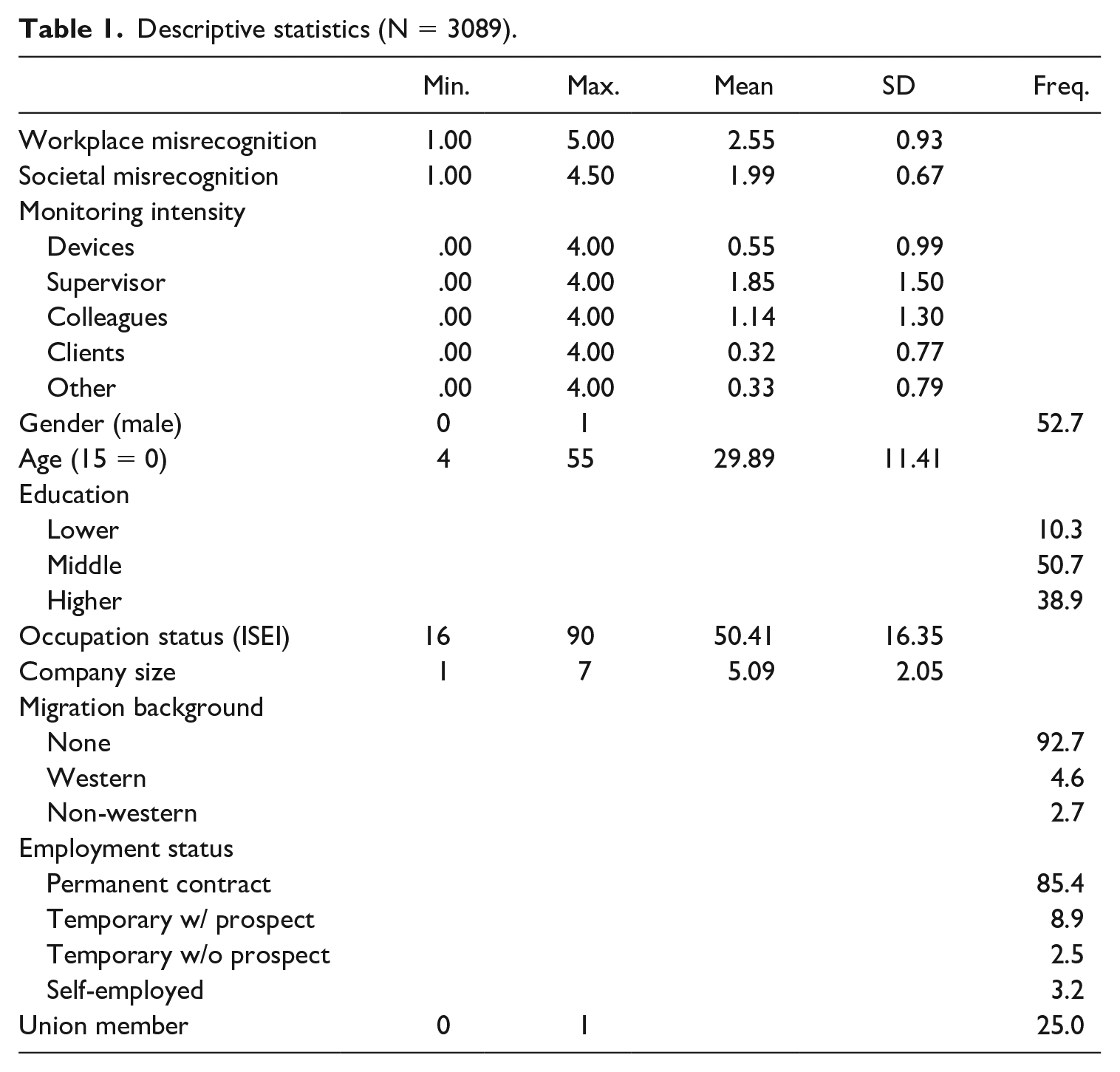
To account for other differences between employees and their experience of recognition, we controlled for age, gender, education, company size, occupational status, employment relationship, migration background and union membership. These controls are selected because specific socio-demographic groups might be disproportionally subjected to monitoring practices and experience less recognition. By including these control variables we can interpret the monitoring effects ‘ceteris paribus’, that is, with all other included factors being equal. We include Age of the respondent which was measured in years (15 = 0). For gender, a dummy variable for ‘male’ (1) with the reference category ‘female’ (0) was created. Education of the respondents was classified as ‘low’ (no education, primary education), ‘middle’ (secondary education or vocational education) or ‘high’ (tertiary education) and a dummy variable was created for ‘middle’ and ‘high’, using ‘low’ as the reference category. Company size indicated the number of employees working in a respondent’s organization in seven intervals, running from 1 ‘1–10 people’ to 7 ‘500 or more people’. Occupational status is measured on the basis of the ISEI-08 index (ranging from 16–90) adapted from the ISCO-08 occupational codes (Ganzeboom, 2010), where a higher score indicates higher status occupations. For employment relationship, the reference category is employees with permanent contracts, and two dummy variables were created for those in temporary employment, distinguishing between those with prospect and without prospect on a permanent contract. A separate dummy was added for those in self-employment. Migration background was measured in three categories: native Dutch (reference); western migrant; non-western migrant. Finally, union membership is a dummy variable for those who are a member (1) with those who are not are the reference (0). The descriptive statistics for all variables are reported in Table 1 and a correlation matrix in Table 2 reports the bivariate associations for workplace recognition, societal recognition and variables for monitoring intensity.
Descriptive statistics (N = 3089).
Correlation matrix (Pearson’s r) monitoring practices and recognition in and outside work (N = 3089).
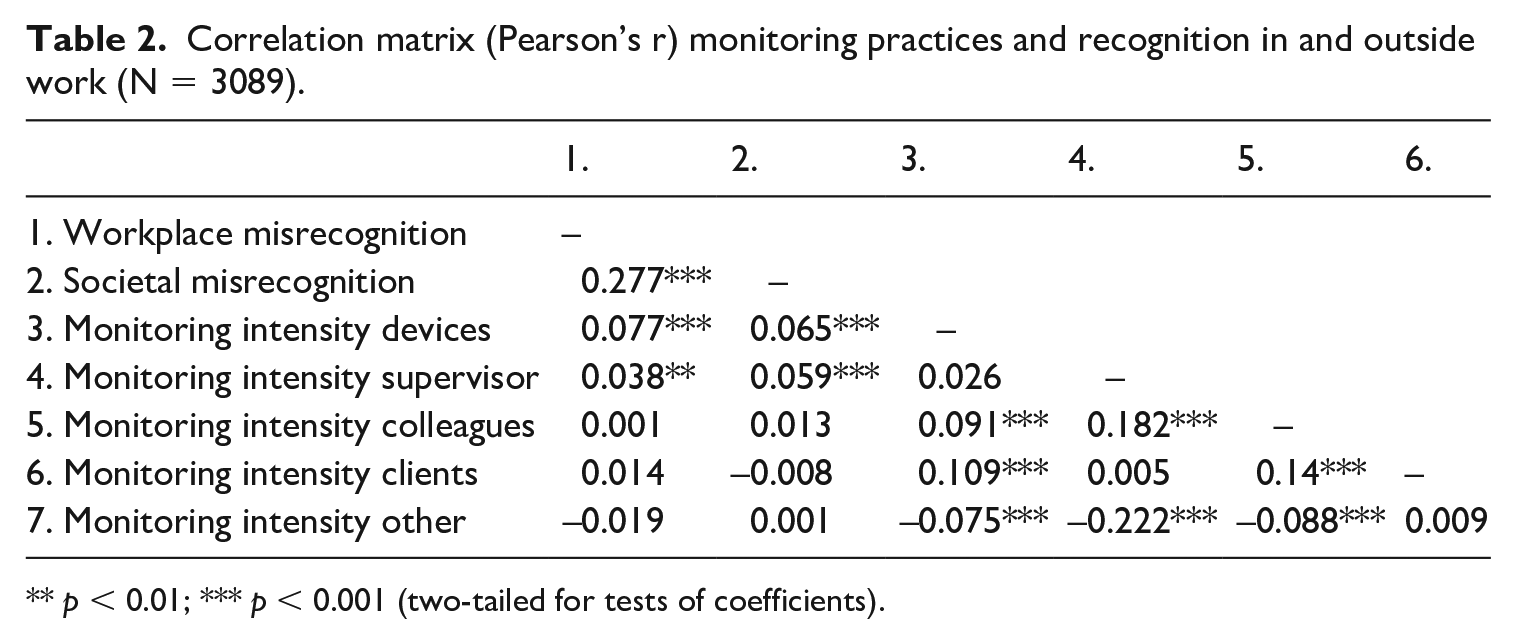
** p < 0.01; *** p < 0.001 (two-tailed for tests of coefficients).
Analysis and Results: The Effect of Employee Monitoring on Recognition
To test the hypotheses, two sets of regression analyses are presented in Table 3. First, an ordinary least squares regression model is shown with respect to workplace misrecognition. Model 1 shows the unstandardized regression coefficients of monitoring intensity on feelings of workplace misrecognition, while holding constant for various controls. Second, regression models are shown with societal misrecognition as the dependent variable. Model 2A shows the unstandardized regression effects of monitoring intensity on feelings of societal misrecognition. In Model 2B, feelings of workplace misrecognition are added as a determinant of feelings of societal misrecognition.
Linear regression estimates for workplace and societal misrecognition (N = 3089).
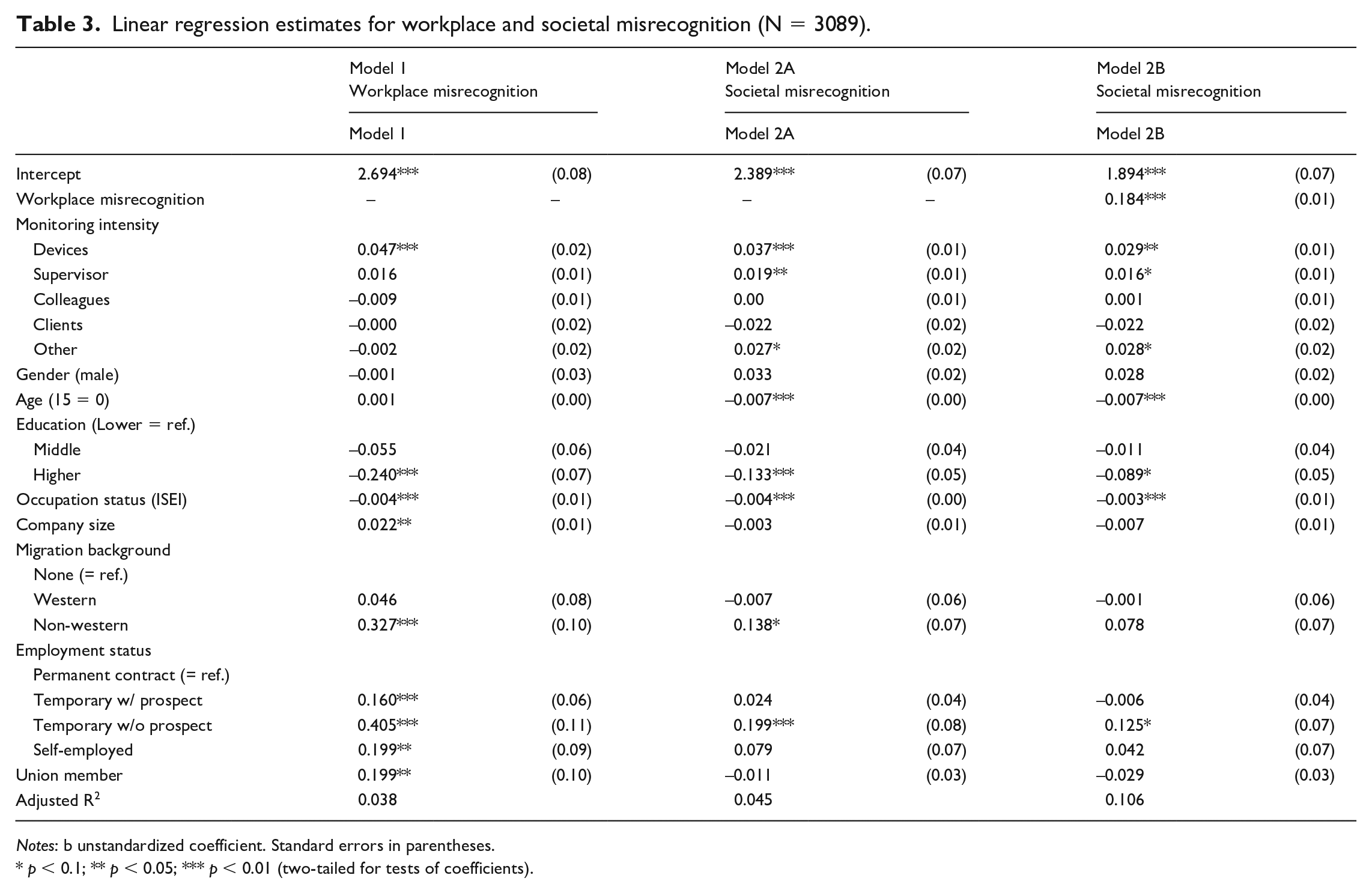
Notes: b unstandardized coefficient. Standard errors in parentheses.
p < 0.1; ** p < 0.05; *** p < 0.01 (two-tailed for tests of coefficients).
Hypothesis 1a stated that the more intensely employees are monitored electronically, the stronger their feelings of misrecognition at work. For the hypothesis to hold the estimates in Model 1 should indicate a positive effect of monitoring intensity by devices on workplace misrecognition. As expected, the results show monitoring intensity by devices is positively (0.047) associated with feelings of workplace misrecognition (supporting Hypothesis 1a). The more employees are monitored by devices, the higher their experience of workplace misrecognition. Non-electronic monitoring practices (by supervisor, colleagues, clients and others) are not associated with feelings of workplace misrecognition. The absence of significant effects of non-electronic monitoring practices is in line with the expectation that electronic monitoring is more strongly associated with feelings of misrecognition at work than non-electronic monitoring (supporting Hypothesis 1b). Regarding the control variables, Model 1 shows that feelings of workplace misrecognition are generally lower for higher educated employees and those with higher occupational status. That is, unsurprisingly, employees in more advantaged positions typically experience more recognition at the workplace. On the other hand, misrecognition is higher for those working in larger companies, and among non-western immigrants, temporary workers and union members.
The model specifications of Model 2A are identical to those of Model 1, except that societal misrecognition is used as the dependent variable. Also, feelings of societal misrecognition are generally lower for higher educated employees, those with higher occupational status and older employees, and higher for non-western immigrants and temporary workers. Model 2B adds the effect of workplace misrecognition. This allows us to test Hypothesis 2 stating that feeling misrecognized at work may affect feelings of misrecognition in society. The results are in line with this expectation showing that workplace misrecognition is positively associated (0.184) with feelings of societal misrecognition (supporting Hypothesis 2): that is, employees who experience misrecognition at work are also more likely to experience misrecognition in society.
Hypothesis 3a stated that the more intensely employees are monitored electronically, the stronger their feelings of societal misrecognition. As expected, the results show monitoring intensity by devices is positively (0.029) associated with feelings of societal misrecognition (supporting Hypothesis 3a). The more employees are monitored by devices, the higher their experience of misrecognition in society. For the variables measuring non-electronic monitoring the effects are mixed, that is: positive effects are found for the intensity of supervisor monitoring (0.016) and the residual category of ‘other’ monitoring practices (0.028, albeit with borderline significance), but no significant effects are found regarding monitoring by colleagues or clients. The results indicate that also those who are more closely watched by their supervisors may experience less societal recognition. Looking at the standardized coefficients (not reported in the table), the effect of electronic monitoring by devices (β = 0.42) is (somewhat) stronger than the effect of supervisor monitoring (β = 0.35), which is in line with the expectation that electronic monitoring is more strongly associated with feelings of societal misrecognition than non-electronic monitoring (supporting Hypothesis 3b).
Conclusion and Discussion
This article aimed to investigate to what extent electronic and non-electronic workplace surveillance practices affect feelings of (mis)recognition both at the workplace and more widely in society. This is an important question because in modern working life new technologies enable employers to monitor more and more aspects of their employees’ work-related behavior in increasingly intensive ways. By connecting employee surveillance practices to feelings of societal misrecognition we allude to the increasing concerns that these and other new management practices potentially conflict with the dignity of workers (Gibson et al., 2023; Hodson, 2001).
We built on the argument that electronic employee monitoring – much like imprisonment – potentially infringes on the abilities of employees to lead a free and autonomous (working) life. The analogy with imprisonment alludes to the more extreme cases of employee surveillance but, as Hariharan and Noorda (2025) have argued, analyses of employee monitoring in extreme cases tells us something about less extreme cases of monitoring as well; namely, that the practices in question are in some key respects on a spectrum with imprisonment. Electronic monitoring is likely to restrict workers’ physical liberty by limiting their freedom to move, and disrespects workers’ autonomy, including their control not just over working processes, but also over their daily rhythm. We argue that such limitations on individual liberty can be considered workplace dignity violations, and therefore trigger feelings of misrecognition at work.
The first conclusion based on our analyses of Dutch survey data is that the more strongly employees are monitored by electronic devices, the stronger their feelings of workplace misrecognition. Moreover, we argued that compared with human oversight, electronic monitoring is potentially more intrusive and more strongly jeopardizes workers’ fundamental rights and dignity. Indeed, the empirical results show that the intensity of human monitoring practices (by one’s supervisor or colleagues etc.) is not associated with workplace misrecognition. This finding may imply that employees generally accept monitoring as an inherent aspect of the employment relationship. Human interaction may even be considered a prerequisite for developing a positive recognition relationship in an organization (Newlands, 2022). Our findings may indicate that electronic surveillance is more prone to surpassing boundaries perceived as reasonable, fair or necessary in comparison with non-electronic monitoring practices.
The second conclusion to draw from this study is that electronic monitoring also affects broader feelings of societal recognition. This effect occurs both directly and indirectly. The indirect path runs via the effect of electronic monitoring on workplace recognition. As work stands as one of the primary domains in society where recognition can either be gained or denied, electronic monitoring, as discussed above, leads to a sense of being misrecognized in the workplace. Moreover, feelings of societal misrecognition also arise directly from the detrimental effect of electronic monitoring. As the imprisonment perspective suggests, electronic monitoring – potentially capable of intruding in an employee’s private life and behavior – may directly weaken social relations by curtailing individuals’ freedom to move, exercise personal choices regarding their daily routines. This study indicates that the more intensely employees are monitored, the stronger their feelings of societal misrecognition, and this effect is found to be stronger for electronic monitoring compared with human monitoring.
This study contributes to our understanding of how technological changes at the workplace impact receiving recognition through work. Despite the novelty and insights delivered by this study, a few reservations apply. While this study is among the first large-scale surveys to include measures of monitoring practices, we relied on a relatively simple count measure for the operationalization of monitoring intensity. More detailed measurements are needed to investigate various characteristics of monitoring practices, such as variation in purpose, personalization, timing and scope (Ball, 2021), such as whether monitoring occurs on a continuous or intermittent basis. Also, our operationalization of workplace misrecognitions was limited by the available data. We lacked items that were identically phrased as those used in the operationalization of societal misrecognition inspired by Van Noord et al. (2021). Future research may employ a more precise measure of workplace misrecognition, incorporating items such as, ‘I feel my supervisors do not recognize the value of what I do’, ‘I feel that my supervisors look down on me’ and ‘I feel I am not seen by my supervisors’. Additionally, future studies may differentiate between misrecognition by one’s supervisor and misrecognition by one’s co-workers (e.g. ‘I feel my co-workers look down on me’).
A second limitation is that we collected data in the pre-Covid period, and in a specific context: since the start of the pandemic, remote working increased, leading to widespread and advanced monitoring practices. Our present study is unable to capture these dynamics, and we invite future research to study the outcomes of digital monitoring practices with more recent, preferably cross-national comparative data. Like all country case studies, the findings may have been influenced by the Dutch institutional context, such as its labor law, workplace norms and other cultural aspects. Therefore, the external validity of our study is only to be assessed by future country case studies, and comparative studies.
A third limitation is that the empirical analyses lack a direct measure on job autonomy. One of the key arguments is that monitoring leads to feelings of misrecognition by restricting employees’ ability to shape their (working) lives. Future studies on the relationship between monitoring practices and feelings of recognition should investigate the mediating effect of job autonomy. Similarly, the analyses presented here do not allow us to investigate those who (regularly) work from home. One of the reasons why modern surveillance practices may be particularly intrusive is that they may cross into people’s private domains. The effects found in this study may potentially be stronger when monitoring takes place in a working-from-home context. We encourage future studies to compare the effects of employee surveillance between location-based workplaces, working from home and other forms of remote working.
Finally, our study opens theoretical avenues for wider social implications of monitoring. For example, new monitoring practices as shown by gig economy research expanded to involve other actors, including observations by co-workers, customers and clients via rating systems (Ball, 2021, Gandini, 2019; Lamers et al., 2022). In doing so, monitoring is increasingly directed at the workers’ social connections and reputation (Wood and Lehdonvirta, 2023). Hence, our study adds to the literature on how digital managerialism affects social trust and identity both in and beyond the workplace. Moreover, companies can use new surveillance technologies to resist and suppress workers’ organizing efforts (Cini, 2023), and potentially lead to union avoidance (Rogers, 2023). In this sense, the approach and methodology of the current study can be applied in future studies on monitoring practices and be expanded to other nonwork-related political and social activities outside the workplace.
Footnotes
Acknowledgements
The authors thank Rohini Gokoellal for editing and formatting this manuscript as a student assistant. The authors are also grateful to the attendees of the session on worker surveillance during the International Labour Process Conference (ILPC 2023) in Glasgow, for providing feedback on an earlier version of this study, and to the anonymous reviewers for their valuable suggestions.
Funding
The authors disclosed receipt of the following financial support for the research, authorship and/or publication of this article: data for this study were collected based on funding from the Dutch Research Council (NWO), grant number 453-15-001, Agnes Akkerman.
 ). She has recently published her interdisciplinary research in Economic and Industrial Democracy, Socio-Economic Review and Political Psychology.