




Abstract
This conceptual article adopts a life course perspective to reframe edgework as ‘edgeworking’: an ongoing negotiation of risks that reflects developmental, socio-ecological and temporal-historical adjustments throughout human life. In contrast to static and universalistic conceptualisations of edgework that characterise voluntary risk-taking as siloed, rarefied and self-edifying practices, we draw attention to the myriad transitions, turning points, structural changes and timing of life events that put individuals on or close to various ‘edges’ as they skilfully cope, regain a sense of control and help themselves or others. Drawing upon illustrative observations from the broader sociological literature, we identify several novel dimensions of edgeworking: porosity, surrogacy & proxy, and legacy. Using these dimensions, we complicate the assumption of voluntarism that sits at the heart of edgework theory and argue that volition as it pertains to risk-taking is rarely clear-cut but is more often a highly contingent outcome of human development and vicissitude.
Introduction
The epistemic features of risk and its externalities including the potential to reconfigure our cultural, economic and political relations remain abiding areas for critical sociological inquiry (Beck, 1992; Shilling and Mellor, 2021). Among sociologists, the specific features and dimensions of voluntary risk-taking behaviours have undergone perhaps the most expansive yet still nascent exploration in the last three decades (Allen-Collinson et al., 2018; Ladegaard, 2024; Laurendeau, 2006; Lupton and Tulloch, 2002; Zinn, 2024). Central to this research stream is Stephen Lyng’s (1990, 2005, 2014) theory of edgework, which conceptualises voluntary risk-taking as a boundary negotiation that is phenomenologically rewarding for individuals and groups.
Lyng’s theory of boundary-pushing – or ‘working’ an ‘edge’ – offers an intuitive framework for understanding risk, agency and self-realisation, yet it faces notable critique (Bunn, 2017, 2022; Cronin et al., 2014; Kidder, 2022). One of the regular criticisms levelled at edgework is its assumed functioning as a situational ‘agent of identity’ (Gamlin, 2022: 518), which has led to the concept’s disproportionate application to dramatic leisure pursuits undertaken by young, white, mostly male thrill-seekers with access to the market. Examples include extreme sports such as alpine climbing (Bunn, 2022), skydiving (Laurendeau, 2006) and BMX riding (Scott and Austin, 2016), and carnivalesque consumption-oriented activities including chemsex parties (Hickson, 2018), recreational torture (Balfe, 2020) and cruising for sex in public (Richardson, 2024). The value of Lyng’s concept has thus mostly been, as Kidder (2022: 190) suggests, ‘its ability to help scholars better conceptualize why consequential and skillful risks are so integral to the self-identities of some individuals, especially young white men of economic means’.
In this conceptual article, we propose a new perspective on edgework. Rather than tying the management of boundary states solely to extreme, enclaved and market-driven identity pursuits (Bunn, 2017), we view boundary negotiation as a flexible, varying inclination, which is sensitive to timing in lives and influenced by environments, demographics and relationships. To do so, we reontologise edgework in terms of propensity, meaning we approach it as a common but inconsistent trait that vacillates in terms of strength and articulation from person to person and context to context. By thinking of edgework this way, we reimagine the act of pushing boundaries as interwoven with the relational temporalities and improvisational practices of all people’s lives rather than as an exclusive category available only to self-selecting habitues (i.e. ‘edgeworkers’ versus ‘non-edgeworkers’; see Balfe, 2022). By doing this, we also complicate the level of volition that is assumed to underpin edgework arguing that the ‘voluntary’ nature of risk-taking is not always clear-cut for everyone and, in many cases of everyday life, can be ambivalent at best (see also Zinn, 2024).
While there is little denying that identity plays a role in risk-taking, we argue that viewing edgework as a fixed category with explicitly closed symbolic boundaries must be avoided if we intend to fully realise its explanatory potential. To prompt theorists to reconsider the concept’s ontological structure as less explicitly tied to identity projects and visualise instead how people can find themselves on or close to ‘the edge’ throughout the course of their lives, we propose several questions. First, can edgework be applied to the experiences of individuals who seek out, confront and skilfully handle hazardous situations pragmatically, modestly and without allegiance to any single identity? Second, how might changing life events influence what individuals perceive to be risky, which risks are worthwhile taking and what they get out of them? Third, can individuals perceive more than one ‘edge’ over their lifetimes and what conditions are conducive to approaching the edge(s)?
Our questions aim to dissolve the symbolic boundaries that have confined edgework to identity projects, social status and exclusive cliques. Instead, we explore how Lyng’s concept might apply more broadly, varying across diverse groups and shifting with human development. To scaffold our ontological adjustments to edgework, we revaluate voluntary risk-taking from a life course perspective (LCP), which allows ‘studying phenomena at the nexus of social pathways, developmental trajectories, and social change’ (Elder et al., 2003: 10). Through the LCP, we decouple edgework from any one fixed form of self-presentation and consider instead how edgework practices are flexible, dynamic, multiphasic and shaped by changing individual and structural circumstances. People may engage in, adapt, substitute or even abandon high-stakes action depending on factors such as age and life stage, social context and current state of health. We reframe edgework as ‘edgeworking’: an ongoing and fluid process by which individuals navigate unfolding relationships with risks, continuously moving from one ‘edge’ to the next based on vicissitude and experience.
By making our ontological adjustments, we respond to Bunn’s (2017: 1319) suggestion that ‘a greater phenomenology of risk and risk-taking is required; one that explores voluntary risk in its relationship with the safetys, dangers, and distinctions of day-to-day life’. Using life course thinking to inform our understanding of risk-taking also dovetails with calls made within sociology to soften our focus on ‘social-symbolic outcomes’ and show greater ‘regard for the trajectories of individual lives’ when thinking through and conceptualising self-reflexive actions (Gilleard and Higgs, 2016: 309–310).
To facilitate our ontological adjustments to edgework, we begin by providing a brief overview of Lyng’s original concept, followed by an outline of its key limitations. We then present the LCP’s main principles, using them to frame edgeworking as a life-long dynamic process. Finally, we discuss theoretical contributions and directions for future research, showing how the LCP enhances not only understanding of the sociology of risk, but also broader philosophical perspectives on the chaotic dasein of human existence (see Morin, 1992).
Theoretical Underpinnings
Core Principles of Edgework
Edgework is characterised by the deliberate pursuit of boundary states wherein a subject conceives of and tries to avoid traversing some real or imagined ‘edge’ between safety and danger, success or failure, order or disorder (Lyng, 1990). In terms of motivating conditions, boundary states are understood to be entered into as emancipatory ‘identity-affirming breaks’ (Mellor and Shilling, 2021: 960, emphasis is in original) from the alienating, overdetermined and bureaucratised circumstances in which many of today’s bored and despondent subjects of late modernity find themselves enmeshed (Garot, 2015). Achieving self-expression through voluntarily pushing physical, psychological or social boundaries derives from ‘controlling the seemingly uncontrollable’ (Lyng, 1990: 872), which is operationalised by three distinctive features.
First, the activity needs to include some recognisable and identifiable risk, with all edgework activities involving ‘a clearly observable threat to one’s physical or mental well-being or one’s sense of an ordered existence’ (Lyng, 1990: 857). Some edgework activities, depending on where the risk-taker perceives the edge to be, may present a significant chance of injury or death whereas others may carry more abstract penalties such as incarceration, destitution, madness, embarrassment or depression (Lyng, 2005).
Second, it is important to distinguish edgework activities from nihilistic self-destruction. Edgework requires possessing and exercising specific skills, competencies, instincts or doxa for maintaining control. Lyng (1990: 859) speaks here of the opportunity for those who engage in voluntary risk-taking to hone innate abilities or exercise a kind of ‘mental toughness’ or ‘survival capacity’. Fasting, for example, is not simply a mechanical abstention from food, but rather an improvisational, technical and carefully managed set of practices for those navigating anorexia as a form of edgework (Gailey, 2009). The appellation ‘crowding the edge’ (Lyng, 1990: 860) is typically used in reference to the deployment of skills to get as close to the edge without going over it.
Third, through boundary-pushing – often amid like-minded others – people experience intense biosocial sensations of aliveness, omnipotence and self-determination. These experiences sharply contrast with the feelings of alienation, complacency and ennui associated with the waged labour and rigid comforts of late modernity (Lyng, 1990). Through courting high-stakes action, participants detach from the artificial safety nets of rationalisation and surrender to the visceral rhythms of their bodies, emotions and environments (Kidder, 2022). The flurry of sensory immediacy that they encounter offers a reprieve or, as Lyng (2005: 5) describes it, a ‘radical form of escape from the institutional routines of contemporary life’.
Owing to the coalescence of the above three features – risk, skills and sensations – edgework is often assumed to be conducive to the affirmation of collective identity positions among those who share similar encounters with the edge: ‘risk takers almost always recognize one another as brothers and sisters genetically linked by their desire to experience the uncertainties of the edge’ (Lyng, 2005: 4). This imagined bond that like-minded risk-takers feel towards one another and their collective feelings of difference from others is crystallised by the diametrically opposed categories of ‘edgeworkers’ and ‘non-edgeworkers’ (Balfe, 2022).
While we acknowledge that risk-taking may yield benefits for individuals’ sense of self and foster communal ‘anchorage points for identity’ (Mellor and Shilling, 2021: 967), it is important to question the value of rigid categories such as edgeworker and non-edgeworker. These labels risk oversimplifying the complex ways people engage with risk. Balfe (2022: 939) highlights how such diametrical thinking tends to entrench edgework as the exclusive domain of an elite few: Edgeworkers [survive] situations that would kill or hurt lesser men and women. Edgeworkers place a strong emphasis on [. . .] instrumental rationality and ‘in-between’ strategies (trust, intuition), and much less on non-rational strategies such as hope or faith, than those of non-Edgeworkers [. . .] Edgeworkers tend to be, and to see themselves as part of, a skilled elite.
This identitarian perspective, rooted in cliquish supremacy, exceptionalism and ‘powerful solidarity’ (Lyng, 1990: 860) risks inculcating a theoretical and empirical blindness to individuals who engage in edgework practices irregularly, in a more private and pragmatic manner, and perhaps without strong identification or emotional connection with others. To take the identitarian basis of theorisation to its natural limits, we must first turn to a more in-depth problematisation of edgework.
Edgework’s Pitfalls and Asking New Questions
Ontologising edgework within the realm of identity projects leads to several pitfalls. First, while Lyng’s (1990) focus on elective and self-edifying interest in risky situations has shaped theories of edgework, it often reflects the experiences of those with privileged backgrounds who have the resources and freedom to embrace unnecessary risks as explorations and expressions of personal distinctiveness. This perspective can oversimplify the motivations for risk-taking, particularly for marginalised groups including racial or ethnic minorities, who may encounter risks as a matter of survival rather than self-discovery. Garot (2015: 151) argues that ‘“[a]t risk” youth are seemingly excluded from consideration as edgeworkers, as their risks are apparently foisted upon them, rather than voluntary.’ Although edgework does not readily explain voluntary risk-taking from positions of precarity, economic necessity or coercion, Garot’s insights allow us to entertain the possibility that edgework is, for some risk-takers, cynically and pragmatically motivated rather than in the service of chasing identities and personal fulfilment (also Zinn, 2024).
Second, Lyng’s concept has been critiqued for its focus on physical danger among predominantly young, male groups, which may overlook older adults’ unique experiences of risk (Lyng, 1990). Even when edgework has been explored among female groups, such as women who participate in pro-anorexia communities (Gailey, 2009) and women bodybuilders (Worthen and Baker, 2016), these studies still tend to privilege the perspectives of younger adults. Edgework research has generally neglected older adults’ – especially retirees’ – unique conceptions and experiences of risk and risk-taking in later life. Regardless of its relative absence in the edgework literature, retirement is a period of regrowth, renewal and experimentation when lifestyle practices and pastimes are revisited, broadened and revived (Schau et al., 2009) and emergent risks endemic to later life, such as managing chronic illness or reconnecting with estranged family must be navigated. Nevertheless, the identity narratives of high-stakes, high-adrenaline boundary states most associated with early adulthood have been emphasised in edgework theorisation.
Third, existing accounts of edgework often assume a singular and equalising ‘edge’ for all risk-takers based on a collective imaginary (Kidder, 2022). However, the nature of the edge may vary significantly among participants, influenced by personal values and structural circumstances. For example, some male sex tourists approach the risk of contracting HIV with varying seriousness (Bishop and Limmer, 2018). There may also be social, legal and emotional edges that accompany obvious physical or psychological risks or even more distant, long-term edges that are ‘crept’ towards over time such as cumulative health effects (Cronin et al., 2014). Furthermore, many documented forms of edgework, such as extreme sports or substance experimentation, are commodified within liberal capitalist economies, which tend to prioritise certain risk-taking activities while neglecting less marketable ones (Mellor and Shilling, 2021).
In summary, many pitfalls in edgework theorisation arise from an ontological emphasis on agency, which limits the concept to fixed identity parameters while neglecting the pragmatic motivations and structural influences of economic and social systems. While identitarian accounts may illuminate the rarefied and communal experiences of specific cohorts of adventurers, they fail to capture the widespread, everyday risk-taking that occurs across the life span for most. In today’s ‘risk societies’, where risk-taking is more diverse and frequent (Beck, 1992), the exceptionalism of so-called ‘edgeworkers’ is less tenable, making in-group/out-group boundaries less applicable (Simon, 2005). By moving away from identity as the primary framework for edgework, we can better understand people’s variable propensity for embracing and managing uncertainty. This shift allows for a recognition of the plural meanings of edgework (Mellor and Shilling, 2021), the purposes it serves across different social and historic contexts (Zinn, 2024) and the willingness to take risks as skilful responsiveness to life circumstances rather than solely as identity-seeking and self-edifying behaviour.
The Life Course Perspective
Life course thinking acknowledges that individuals lead dynamic lives shaped by a continuous accumulation of experiences, relationships, structures and environments, with meanings and objectives that are contingent and nuanced (Elder, 1994; Settersten et al., 2024). Rather than presenting a standalone concept, the LCP serves as an organising framework that expands and refines other theories by highlighting the influence of life events and social, historical and institutional contexts on human behaviour, which may be challenging for individuals to introspect upon and self-articulate.
The first principle of the LCP relates to habitus: a person’s choices, preferences and tendency to act in particular ways carry the imprint of the norms, expectations, constraints and opportunities attached to the course and substance of human lives (Elder, 1994). This perspective enables understanding behaviours, dispositions and perceptions as dynamically shaped by the (in)stability and (dis)continuity of social worlds (Elder et al., 2003). The LCP frames individual behaviour as responsive to evolving and tacitly understood values, adaptations to life events and relationships with built and social environments. Early life experiences and the timing, sequence and dynamics of transitions or turning points can have lasting effects on an individual’s development and health outcomes (Elder, 1994).
The second principle focuses on how individual lives intersect with those of others, transforming personal experiences into shared ones through the concept of ‘linked lives’ (Settersten et al., 2024). This principle highlights the impact of relationships, dependencies and densely woven networks on individual behaviours, roles and lifestyles. For example, low parental education and having only one parent in the home can initiate a sequence of ‘non-normative events’ for young adults including behavioural problems and truncated educational attainment, which can cascade into adverse consequences for their well-being and relationships with risk (Wickrama et al., 2003).
The third principle recognises the influence of historical context, acknowledging that economic, political, cultural and ecological conditions affect life experiences and morbidity gradients across different cohorts. Differences in birth year can expose individuals to radically different social worlds with unique risks, constraints and possibilities. Childhoods spent during the Great Depression were marked by hardship, family disruption and educational setbacks influencing material expectations, values and careers into adulthood (Elder et al., 2003), illustrating how historical events shape developmental pathways.
As a ‘multilevel phenomenon’ (Elder, 1994: 5), the LCP allows us to contextualise behaviours – including voluntary risk-taking – against the backdrop of personal and structural change. The LCP recognises that horizons of conceivable action cannot be explained away as the result of discrete meaning-making; instead, they must be understood as a product of interconnected biographical, socio-ecological and temporal-historical factors that may not necessarily be stable, controllable or discursively explicable by individual subjects and groups. Core concepts within life course theory include trajectories, transitions, turning points, cultural and contextual influences, timing in lives, linked (and unlinked) lives and adaptive strategies (Elder, 1994; Settersten et al., 2024; Wethington, 2005). A full account of each concept is provided in Table 1.
Life course perspective concepts.
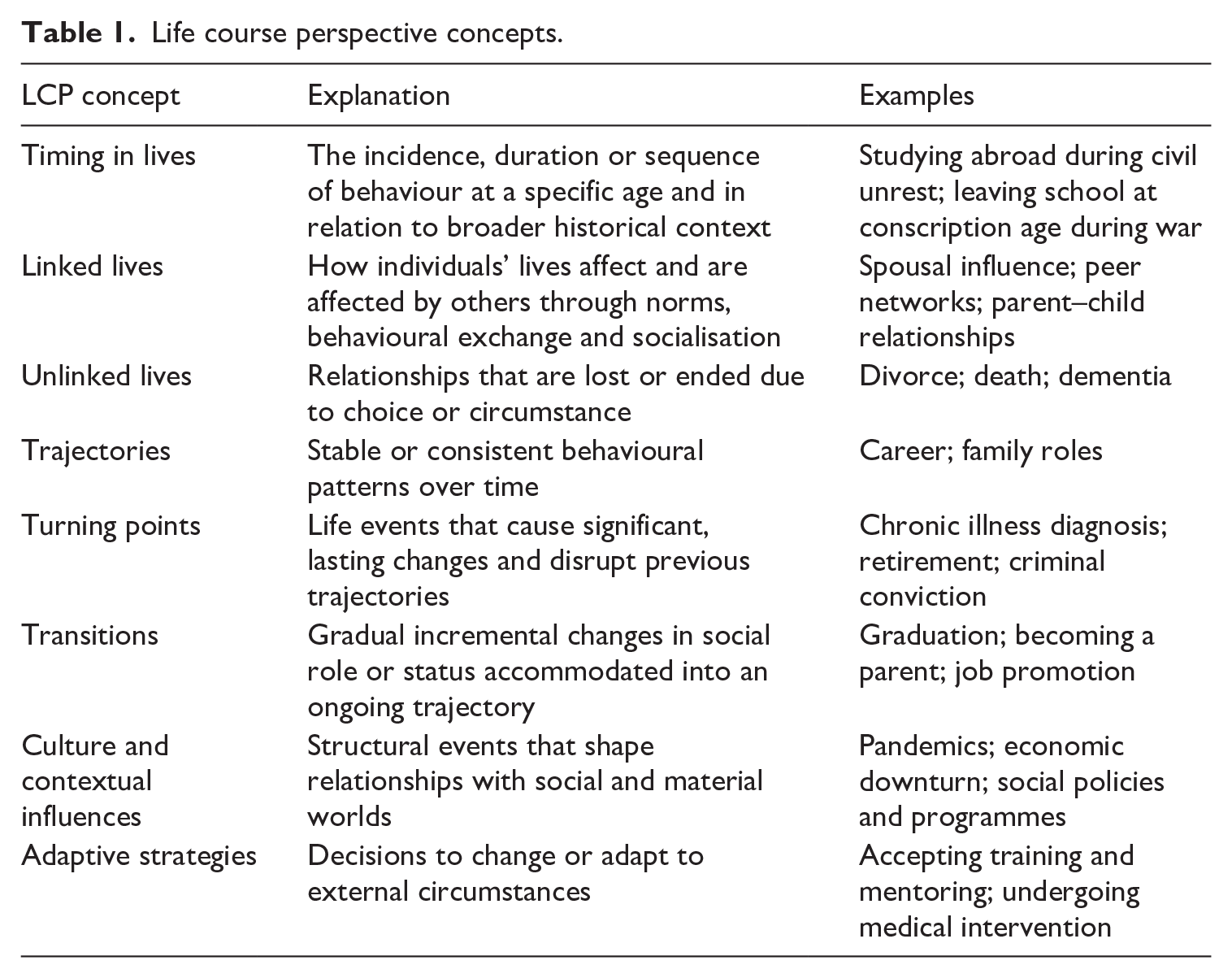
Drawing upon these principles and concepts of the LCP may allow sociologists of risk to more effectively contextualise their analyses of edgework.
Situating Edgework within the Life Course
By considering people’s relationships with risk through the LCP, we propose several novel dimensions of edgeworking: porosity, surrogacy & proxy and legacy. First, we highlight the porous boundaries between the risky activities that individuals pursue and their situational and structural circumstances. We explore how consequential ‘edges’ are not only shaped by adaptations to chronic changes in a person’s life, but also ‘transformed’, ‘extremified’ or ‘obviated’ by altered environments and the timing of roles, statuses and imperatives.
Second, we consider the possibility that people elect to deputise themselves in the risk-taking of those around them, navigating edges for – and on behalf of – loved ones, dependants, peers and subordinates in kinds of ‘surrogate’ and ‘proxy’ edgework over the life span. This reflects the social complexities and networks involved in edgework, as people coordinate and insulate others from danger.
Finally, we call for deeper exploration of the aftermath of skilful risk-taking, including its cessation or relapse: what we term the legacy effects of edgework. The conditions that typify risk cannot be reduced to an aggregation of meanings and values specific to a person’s background but also include future consequences of ‘going over the edge’ on one’s self, quality of life and capacity to uphold responsibilities.
In the sections that follow, we draw upon illustrative excerpts and empirical touchpoints from the literature to ground and contextualise each of the three dimensions. To ensure that the dimensions are not developed in isolation and emerge through dialogue with wider sociological accounts of risk, we connect with incidents and contexts beyond those explored in previous analyses of edgework. Rather than relying on edgework studies alone, we pragmatically seek examples from broader literatures where life course events and circumstances appear to intersect with risk.
Porosity
Edgework is best understood through its voluntarism, which confines it to self-selected situations where individuals willingly confront clear and imminent threats (Kidder, 2022). However, the permeable nature – porosity – of the boundaries between a person’s biographical circumstances and the edges they are drawn to offers a critical opportunity to rethink the volitional character of edgework. We identify three sub-dimensions of this porosity: transformation, extremification and obviation.
Transformation refers to how significant turning points in people’s lives, such as a chronic illness diagnosis, can exacerbate the perceived risks of certain activities, transforming what were once relatively benign, or less instantaneously consequential, behaviours into emergent forms of edgework. Smoking cigarettes, for example, while hardly classifiable as edgework for most healthy individuals (see Kidder, 2022), can nonetheless become a lethal gamble for an individual in the terminal stages of lung cancer or recovering from renal transplantation. Similarly, social outings during the COVID-19 pandemic transformed from mundane activities into unpredictable and sometimes covert undertakings fraught with health risks and moral dilemmas (Harris, 2022). Flouting lockdown rules – particularly for immunocompromised individuals – constituted a highly contextualised form of edgework that has yet to be explored in detail, transforming routine social excursions into deviant acts requiring careful means of neutralising feelings of guilt.
Transformative life events such as chronic or critical illness often increase mortality salience, fuelling a death drive marked by accelerated risk-taking, nihilism and self-destructive behaviours (Gibson et al., 2009). As background risk levels rise, the volitional nature of risk-taking during illness becomes much more ambiguous, problematising the ‘voluntary’ nature of edgework. For example, self-medication, where individuals search for alternative forms of control through experimenting with substances (Richardson et al., 2016), transforms the ‘sick role’ into an opportunity for boundary management, introducing risks of addiction, illness progression and even death. A cancer patient in Richardson et al.’s (2016) discussion on drug use pathways describes how her diagnosis led her to use heroin, seeking to push the limits of her mortality: And that’s when I found out that I ended up with cancer. Stomach cancer. And the doctor had given me the actual date that I’m supposed to die. That shouldn’t be allowed, and that’s what made me begin to use heroin, was because of that. (‘Participant 14’ in Richardson et al., 2016: 145)
Such narratives reflect how life-altering events shape one’s actions and may lead to a desire to approach mortality more directly, blurring the lines between autonomous experimentation with risk and external or uncontrollable pressures. This suggests that rather than being entirely and unambiguously voluntary, edgework often emerges from a balancing act between facing emergent threats and attempting to escape or cope with them (Zinn, 2024). Unlike the unequivocal voluntarism that is so readily attached to edgework activities (Mellor and Shilling, 2021), sensitivity to the life course and how it is disrupted by lasting shifts or detours in health, security or status suggests there can be motivations to crowd the edge other than the desire to signal one’s identity or seek self-edifying meaning through successful risk-taking.
Additionally, for those whose lives are already marked by high levels of risk due to environmental or occupational factors, the boundaries of conventional edgework (such as extreme sports) may become devalued, delegitimised and even trivialised. For example, white-water kayaking may seem like a risky outlet for those from safe, privileged backgrounds (Bunn, 2017); however, such activities can hardly be considered the riskiest pursuits for those who habitually find themselves pushing physical, psychic or corporeal limits, such as veteran logging workers, drug traffickers, criminal gangs and enlisted combatants.
Second, voluntary risk-taking can be amplified – becoming more consequential or extremified – by contextual factors including historical time and social location. Extremification is especially evident when risky activities are exacerbated by needing to adapt to threatening, stochastic environments. For example, managing substance use becomes more consequential – and thus extremified – in settings where violence and assault are common. In Walmsley’s (2022) study of male prison experiences, one participant describes how opioid withdrawal (‘clucking’) is altered by the carceral setting: If someone sees you walking around half clucking you’re a target basically a victim and you know from previous from going prison from a young age before I even got onto heroin and stuff if you are a victim on day one you are a victim forever . . . don’t get me wrong, I aint no victim that’s not what I am saying. When you’re clucking you aint doing shit to anyone . . . people will take advantage of that . . . I can’t be fucked with that shit just wanna keep me head down and get on with me sentence. (‘Matt’ in Walmsley, 2022: 249)
In this case, the risks associated with drug-related edgework intensify in prison, and the experience of withdrawal there becomes an added challenge, requiring skills not only to cope with physical symptoms (insomnia, pain, nausea) but also to avoid being targeted, attacked or drawn into the prison’s black market (Walmsley, 2022). Furthermore, to minimise unwanted attention, individuals undergoing withdrawal in prison might refuse medical support, necessitating further improvisational, unpremeditated efforts to militate against ‘a disordered self and environment’ (Lyng, 1990: 857).
Lastly, life events can lead to the obviation of edgework, where biographical and situational conditions diminish or even eliminate a person’s desire to spend time at the edge. Over the course of pregnancy, for example, women may experience an altered self-perception, becoming acutely aware of their bodies as vessels for their unborn children. This heightened consciousness can place them at a crossroads between maternal responsibilities and the allure of edgework. Pregnancy serves as a ‘pivotal point’ (Syvertsen et al., 2021: 3) for women who use drugs, prompting some to seek prenatal care, detoxification and rehabilitation. In Taborelli et al.’s (2016) study of eating disorders and pregnancy, one of their participants describes pregnancy as a life event that disrupts her willingness to pursue her journey with anorexia nervosa: I spent all my life being severely anorexic, I didn’t know how to cope [. . .] I knew if I had got pregnant again I would escape that hole, I would manage. So I did. And I repeated it for the following 10 years. (‘Participant 12’ in Taborelli et al., 2016: 316)
Anorexia, previously conceptualised as a form of edgework (Gailey, 2009), involves a regime of self-starvation aimed at imposing order while avoiding hospitalisation, therapy or death. For an individual with anorexia, crowding the edge involves a conscious acceptance of intense pain and suffering. However, for Taborelli and colleagues’ participant, this willingness is fractured and reassessed during pregnancy, enabling temporary relief from her disciplined pursuit of thinness.
Overall, the fluidity of individuals’ trajectories means that their relationships with risk are context-dependent and changeable rather than static or universal. Understanding this porosity between life events and risk engagement is vital for developing a nuanced sociology of edgeworking.
Surrogacy & Proxy
The basic goal of edgework is ‘to survive’, and as Lyng (1990: 881) emphasises, ‘most people feel no ambivalence about the value of this goal’. However, an important life course-related aspect of edgeworking can sometimes be the survival of others, where individuals assume the role of surrogate who decides, controls and negotiates risks on behalf of someone else. The linked lives aspect of the LCP allows us to appreciate how individuals become the primary decision-makers for others’ relationships with risk in several contexts, as when parents moderate children’s play activities, sports managers regulate team pressures or college fraternities set the severity of hazing rituals for their peers. Hazing, in particular, represents a type of edgework that transfers risk socially, demonstrating a form of custodial control over others’ engagements with danger. In their capacity as gatekeepers, experienced members of a group (e.g. varsity athletes, fraternity brothers) curate ‘edges’ for new members – such as heavy alcohol binges, engaging in sexual acts, sleep deprivation and humiliation – as means of demonstrating their commitment (Alexander and Opsal, 2021). The linked lives principle suggests that the edges chosen for others are informed by what one has experienced oneself. This is reflected in Alexander and Opsal’s (2021) accounts of college hazing where a fraternity member draws upon the risky behaviours that had been curated for him previously as a yardstick for what he thinks new members can endure: I and the five or six other guys who I pledged with, we were in charge of a night [during the last week of new members pledging]. We texted each other like, ‘What do we want to do to ’em?’ And the president, he didn’t give us any direction on this, so it was like, kinda a free-for-all. We only knew what we had to go through, so three or four nights of drinking, some yelling, so I just texted back, ‘We’ll make them drink.’ So, I went and got some boxes of beer, someone brought a handle, but we weren’t like, strict about it, and we didn’t yell. We didn’t want to push it but we also were in charge. (‘Roderick’ in Alexander and Opsal, 2021: 1306)
The linked lives principle allows us to appreciate how surrogates, such as fraternities, strongly influence an individual’s willingness to ‘crowd the edge’, as rejection by one’s peer network can adversely impact one’s sense of identity and security. The concept of surrogate edgework is also evidenced by partner-assisted injection within recreational drug scene milieus, where male users manage female partners’ relationships with the edge, often manipulating when, how and with whom their partners inject, sometimes even prohibiting self-injection under threat of violence (Bourgois et al., 2004). Here, the surrogate’s role involves not only controlling physical risks (e.g. overdose, infections) faced by others but also the power dynamics within intimate partnerships. An excerpt from a participant in Bourgois and colleagues’ (2004) accounts of female heroin and speed injectors allows us to consider how control over these power dynamics can play into the social diffusion of edgework: For three years, I didn’t even watch my boyfriend prepare the drugs. He would just present me with a loaded syringe and fix [inject] me every time. It’s the same with everyone out here. The guys like it this way. They like the feeling of having all that control over somebody. I mean it’s a really big amount of control. You are controlling how high someone gets; how sick someone gets. It makes the guys feel that the girl won’t leave. (‘Cat’ in Bourgois et al., 2004: 258)
In terms of other linked lives, family caregiving presents an important context for surrogate edgework. Informal caregivers display high levels of ‘mental toughness’ (Lyng, 1990: 859) often facing moral dilemmas while attempting to balance safety and dignity for their dependants. Safeguarding the welfare of dependants can come with sensations grounded in pride and omnipotence, but as Ma et al.’s (2022) accounts of using physical restraint on loved ones with dementia reveal, also involves treading the line between care and abuse. One of Ma and colleagues’ (2022) family caregivers describes ensuring a delicate balance to protect one’s mother: [. . .] The use of physical restraint has a certain character that is difficult to grasp. I have to do it for the time being. The balance of minimising the psychological blow to her and protecting her outweighs the disadvantages. (‘Family caregiver 12’ in Ma et al., 2022: 6)
In pursuing respite from the hard work of caring – what Lyng (1990: 864) might classify as the ‘impulsive anchorages’ of the act – this individual describes using physical restraints to impair a dependant’s autonomy, a strategy that requires care is given to preventing trauma, circulatory problems, strangulation and even death. Doing so without exceeding some decided-upon level of harm or indignity mirrors the base principle of edgework: of getting as close as possible to a perceived edge without crossing it. In taking on the responsibility of managing the risks to which a dependant is exposed, significant skills and precision are required that involve sacrifice, training and self-discipline while learning to neutralise one’s own guilt. Recognising linked lives allows us to appreciate how the individual who enters the caregiving role finds oneself embroiled in acts of surrogate edgework, not only in terms of making vital decisions for others, but in subordinating one’s own psychological well-being to the needs of dependants while avoiding burnout.
Besides negotiating, coordinating and limiting the risks of others, life course events can push individuals to put themselves at risk for others’ benefit, creating proxy forms of edgework. People may engage in high-risk activities like sex work or drug dealing to support loved ones and protect them from poverty (Bourgois et al., 2004). Sex workers, for example, might justify the risks of consenting to unprotected sex for higher pay to ensure a better future for their children, framing risk-taking as an act of duty and resourcefulness. Individuals who take risks on behalf of others see themselves as managers and survivors, establishing clear goals at consequential boundaries and framing their time spent at the edge as duty-bound (Zinn, 2024).
Maintaining sensitivity to the social ecology of linked lives enables a fuller appreciation of the interdependencies of edgeworking allowing us to recognise the activities of ‘proxies’ who expose themselves to edges on behalf of others and ‘surrogates’ who coordinate and intervene in the risks of others. The interdependence of human lives and the multitude of ways in which bodies and subjectivities become reciprocally connected underscores the social and relational aspects of voluntary risk-taking and calls attention to how edges are never negotiated in a vacuum.
Legacy
Edgework studies often focus narrowly on the immediate acts of risk-taking, paying little attention to ‘post-risk state[s]’ (Bunn, 2022: 790) or the longer-term consequences that unfold in their aftermath. Traditionally, the edge is framed as a clear boundary: once crossed, it leads to irreversible change, such as death or permanent injury (Kidder, 2022; Lyng, 1990, 2014). However, this focus overlooks how edgework experiences evolve over time, including the ways individuals adapt, reassess or even outgrow risky behaviours over months, years or decades. There has been little attention given to those who feel that they have ‘won’ or ‘failed’ at edgework, how they may have been changed by it, felt punished for it or have simply abandoned it, and what effects this has on those around them. We also know little about how discontinued edgework activities may be recovered, readjusted or replaced later in one’s life. The legacy of edgework has not been theorised in great detail, and it is here that the trajectorial aspects of life course thinking may inform future analyses.
As individuals age and accrue more experience at the edge, it is likely that their risk perceptions, thresholds and limits will change (Cronin et al., 2014). Lyng (1990: 862, emphasis is in original) proposes that successful edgework practices can propel individuals towards escalation, pushing them to take greater risks: ‘edgeworkers tend to search for more purified forms of edgework. Some achieve this goal by artificially increasing the risks, as when sky divers jump under the influence of drugs or when mountain climbers make an ascent without oxygen tanks.’ However, insights from the broader sociological literature suggest that individuals may also scale back their risk-taking, reining in their appetites as they age, acquire injuries, face punishments or adopt new values. Ageing skateboarders, for example, may modify or taper back the performative and high-risk aspects of their tricks while still showcasing enough skills and precision to maintain attachment to the action sport (Willing et al., 2019). Comparably, we see evidence of modified edgeworking in post-risk years and decades reflected by an informant quoted in Bardhi and colleagues’ (2007) study on prescription pills misuse: I got into everything. I did every single drug you can imagine: E (ecstasy), nitrous, coke, K (ketamine), heroin, all sorts of pills, GHB, roofies (Rohypnol), acid (LSD), and I even tried crack. I am sure I am forgetting to name a few drugs, but trust me, I was a garbage can when I was young. I put any and every drug into my body. The thing about it, though, was that I did all of these drugs at such a young age that I got it out of my system. These days, I like to smoke a good joint, have a couple of drinks, and take a couple of Vicodin here and there. I don’t mess around the way I used to. (‘Jada’ in Bardhi et al., 2007: 75–76)
‘Jada’, who recalls indiscriminately consuming various drugs in her teens, now, at 25, has settled into a more selective and stable routine with milder substances. Bardhi et al. (2007) note that Jada’s initial encounter with prescription pills, prompted by an injury, quickly escalated to higher-risk poly-drug use. However, Jada’s statement indicates that this trajectory has since levelled off, with a preference for moderation and a focus on distance from rather than closeness to the edge in her current risk-taking choices.
Such incidents are important because they allude to the possibility that edgework activities can be ‘matured’ alongside individuals’ development, resulting in voluntary risk-taking behaviours becoming more stable and subtle rather than exacerbated or abandoned, what we might call ‘the space beyond risk’ (Bunn, 2022: 802, emphasis is in original).
Another legacy of edgework might be its dormancy where the propensity to take risks can be suppressed and remain dormant but resurface under specific life conditions. This is illustrated by ‘Lindsay’, a 28-year-old mother, quoted in Measham et al.’s (2011) longitudinal study of recreational drug use, who describes moving back in with her parents as providing an opportunity to ‘go out’ and resume her journey with drugs: [I] went back to my parents and then it was while I was at my parents [that I started taking cocaine again], you see, they used to go, ‘You know, Linds, you go out luvvie’, Lloyd would be in bed for half past six, ‘You go out’. (‘Lindsay’ in Measham et al., 2011: 424)
Lindsay’s experience illustrates how having acquired the freedom to pass childminding responsibilities on to her parents, a gateway becomes opened to rediscover and re-enter spaces of edgework she had not visited since earlier in life.
Recognising the legacy effects of edgework highlights how an individual’s engagement with risk can leave a lasting imprint on their own and others’ lives. The LCP’s emphasis on interconnectedness, timings in life and cumulative experiences enriches edgework theory by spotlighting how risky practices are deeply entangled in temporal and developmental contexts.
Discussion
The aim of this conceptual article has been to create a space for exploring how the LCP can enrich and expand the concept of edgework. Drawing upon illustrative observations from the broader sociological literature, we have mapped out novel dimensions – porosity, surrogacy & proxy and legacy – that situate risk-taking within intersecting biographical patterns, life events, social roles and transitions influenced by cumulative experiences, structural forces and pragmatic consequences. By applying the LCP, we respond to Bunn’s (2017) call for an inclusive edgework framework that encompasses diverse experiences of risk across gender, ethnicity and social class.
Unlike early edgework research, which framed voluntary risk-taking as self-actualising acts for inner-directed identity-seekers (Lyng, 1990), we suggest a broader view where more people navigate boundaries in response to shifting life events and pressures. Moving beyond a narrow focus on identity projects, we consider edgeworking to be an implicit part of human development and applicable to a range of life trajectories from those that involve continuity in risky behaviour to those that reflect significant change. In these respects, an LCP-grounded approach to voluntary risk-taking aligns with speculation from Lyng himself who in more recent times suggested that edgework can serve varied purposes and ‘exhibit varying degrees of intensity’ (Lyng, 2014: 457) depending on the individual.
Our approach contrasts with views such as Kidder’s (2022) who cautions against expanding edgework beyond self-actualisation, warning that it could dilute its analytical power. While Kidder (2022: 189) acknowledges that limiting edgework to elite, thrill-seeking identity-makers would confine it to ‘pursuits disproportionately of interest to young, middle class, white men’, he argues that expanding edgework to others may overstretch its ontological claims, as it ‘was not intended to explain the entire universe of contemporary risk taking’ (2022: 190). We have argued for the opposite, suggesting that it would be shortsighted to limit edgework to the consequential boundaries encountered only by exclusionary milieux who are primarily motivated by self-expression and ideals of authenticity. Life events such as illness, trauma and career shifts serve as turning points that place humans on various edges as they seek control, support others or adapt. This broader view complicates the issue of voluntarism central to edgework. While Kidder (2022: 187, emphases in original) insists that edgework applies only to ‘voluntary, skillful risk taking in which the practitioner faces a threat to the self that is clear and imminent’, the LCP encourages critical and reflexive appraisal of what voluntaristic action means from person to person within time and place and the conditions that shape and constrain it. Recognising the ambiguity of volition allows us to include those ‘anarchic human experiences’ (Lyng, 1990: 855) where the choice to crowd the edge might be determined by unstable vicissitudes including people’s everyday struggles patterned by historic shocks, health issues or social inequality.
Our arguments dovetail partially with proposals to reconsider edgework as a kind of ‘center work’ (Simon, 2005: 206). For Simon (2005: 206), testing one’s limits at consequential boundaries is not some contrarian act on the periphery but has been pushed to the centre of social life because of today’s neoliberal-capitalist hegemony that values entrepreneurialism, adventurousness and audacious self-expression, all of which involve some degree of voluntary risk-taking: ‘The opposition between institutional life and edgework collapses. Edgework is increasingly what institutions expect of many people.’ While we agree with the ethos of ‘center work’ in principle, we are hesitant to attribute the phenomenon solely to the institutional demands of our current moment. The LCP suggests edgework stems from complex intersections of biographical, biosocial, temporal and ecological factors. If we appreciate that transitions and turning points occur in every life trajectory based on a variety of reasons, perpetually encountering and crowding edges is perhaps better understood as central to humans’ development rather than to institutional forces alone.
In terms of situating these arguments within a grander philosophical project, the proposition that edgeworking is more existential than Simon’s ‘center work’ requires placing risk at the core of the life course. Such a move would elevate boundary-pushing to a form of dasein – a condition of being-in-the-world that suffuses the very fabric of human life. Assuming that our dasein is characterised by the crowding of consequential boundaries aligns with the critical framing of human subjects as homo demens, a view that perpetual disorder is a constitutive feature of human existence (Morin, 1992). Edgar Morin’s homo demens complements an LCP approach to edgework by acknowledging that risk-taking is neither a purposeful attempt at building meaning nor solely a response to societal or environmental pressures but is rooted in the chaotic, emotional and irrational dimensions of humanity, thus presenting a valuable avenue for future research. At the heart of Morinian thinking is the assumption that while humans are capable of rational thought and purpose, their lives are typified by unpredictability, unexpected events, random crises, unplanned decisions and irrational behaviour.
Applying a Morinian perspective to edgeworking would help sociologists to explore risk-taking as a propensity shaped by even more complex existential factors than the standard LCP. While the LCP emphasises material transitions (e.g. illness, family dissolution) and structures (e.g. economy, social policy), integrating Morin’s homo demens concept reveals how intangible forces such as anomie, negative affective landscapes or mindlessness chaotically shape individuals’ life trajectories and influence their relationships with risk. Understanding how chaos is perceived and navigated in experientially diverse contexts could offer a more enriched view of what people ‘do’ when life puts them on the edge.
Finally, by further assessing how intersectionality – the entanglement of interconnected categories of oppression (e.g. gender, race, class, sexuality, colonial history) – influences experiences of edgeworking, sociologists can better identify how relationships with risk unfold not just in relation to timings in life, turning points, the (un)linking of lives and so on, but as interconnected and imbricated with interlocking structures of power. By deepening the intersectional aspects of the LCP, sociologists can avoid overly deterministic interpretations of developmental trajectories and thus unpack with greater precision the diversity of ways that edges are approached by individuals and groups over time.
Footnotes
Funding
The authors disclosed receipt of the following financial support for the research, authorship and/or publication of this article: this research is funded by the Economic and Social Research Council as part of an NWSSDTP PhD CASE studentship, grant reference ES/P000665/1.
