




Abstract
Drawing on ethnographic research with six migrant families, this article explores how they reconfigure meal practices to stabilise family identity. The findings investigate three facets of the reconfiguration process: the reconfiguration of material arrangements; the reconfiguration of rhythms and spatial arrangements; and practitioners’ changing enrolments across practice bundles such as parenting and working. We argue that there is a set of macro general understandings of family meals reflecting family hierarchy, affiliation, care and unity that hold in both pre- and post-migration contexts. By exploring the continuities and discontinuities in how general understandings shape reconfiguration of the mealtime, we demonstrate that doing family meals offers terrain for migrant families to find themselves anew, foster a sense of continuity and instil a sense of stability to family members. In conclusion, our study contributes to the theorisation of the practical dynamics (or doing) of family identity in times of change and disruption.
Introduction
This article investigates how migrants reconfigure their family meals upon migration and the implications of such a reconfiguration for their family identity. Unsettling events like migration change family life and its daily practices (Ryan and Mulholland, 2014), including meals (Bailey, 2017). Migrants often face challenges in reconfiguring family meals in a new context, including novel spatial arrangements and a lack of material equipment (Rabikowska, 2010). Studies show how meals take on renewed meanings post-migration, helping families to settle into new cultural contexts (Rabikowska and Burrell, 2016) and strengthen familial bonds and identity (Darmon and Warde, 2019; Jamal, 1998; Srinivas, 2006). Inspired by these studies, we look at the process of reconfiguration and its implications for family identity.
Family identity is theoretically understood through the concept of doing family (Morgan, 2011), which posits that family is not an abstract entity disconnected from everyday life, but emerges through practices that are often mundane, taken for granted and routinised. As Morgan (2011 :10) says: ‘in carrying out these everyday practicalities, social actors are reproducing the sets of relationships (structures, collectivities) within which these activities are carried out and from which they derive their meaning’. It is through the doing and re-doing of mundane practices that roles and responsibilities are negotiated, norms and conventions are established, and individual and collective family identities emerge (Edirisingha et al., 2022). Also, practices are not static entities, but adapt to space, time and disruptions (Molander and Hartmann, 2018; Schatzki, 2013) and hence doing family is never fully fixed but encompasses a ‘sense of fluidity or fuzziness’ as well as a ‘sense of the regular’ (Morgan, 2011: 6). Thus, considering the importance of the ‘doing’ to understand family identity and its changes, our questions are: what is the process of re-doing family meals through significant disruptions? What are the implications of this process of re-doing for family identity?
To answer these questions, we adopt a practice theory approach to investigate the re-doing of family through meals. Specifically, we engage with the concept of general understanding and its role in affectively steering practices (Schatzki, 2013) through disruptions. As we will discuss further, general understandings are a set of ‘ideational elements’ that are common to multiple practices and articulate and connect teleology and affect across those practices (Welch and Warde, 2016: 196). In our specific case, general understandings consist of values, categories and concepts that condition the end goals and emotions (Schatzki, 2002, 2015) of the meals but also other practices including parenting and working. As we investigate the reconfiguration process of the meal after its disruption, we are interested in looking at the role of ‘ideational elements’ that shape family meals and life, which are used to recreate a ‘sense of regular’ in a time of fuzziness, to use Morgan’s own terms.
Empirically, the article is based on a longitudinal ethnographic project involving six UK-based families from three South Asian countries, including Sri Lanka, India and Nepal. Findings are organised around three facets of the reconfiguration process: the reconfiguration of acquisition and preparation of material arrangements; the relocation of time and space for the family meal within bundles of other family practices; and the changing enrolment of individuals in such practices. Theoretically, the article demonstrates how general understandings, such as authenticity, unity, membership and care, steer the reconfiguration of doing family in migrant families, acting as both a catalyst and conduit of change. We demonstrate how the transformative and sense-making capacity of general understandings transcends existing family practices, such as family meals, parenting and professional work, bringing continuity and stability to family identity.
Doing Family Meals through Disruptions and Reconfiguring Family Identity
The seminal concept of doing family (Morgan, 2011) provides a theoretical tool for understanding family identity as a dynamic nexus of meanings, relationships, interactions, norms and structures that emerge through everyday practices. Doing family offers a grounded approach to fully grasp Smart’s (2007: 4) well-known expression: ‘family is what families do’. It demonstrates that family meanings are contested or reinforced, bonds are strengthened and relationships are reshaped through practices. Indeed, individuals reproduce ‘sets of relationships (structures, collectivities) within which these activities are carried out and from which they derive their meaning’ (Morgan, 2011: 10). Moreover, the concept has been pivotal in advancing our understanding of changes in family life. Since family is continually re-done, the fluidity of meanings, relationships and structures emerges over time. As Warde (2005: 146) noted in his discussion of everyday practices, individuals in ‘different situations perform the same activity differently’, leading to shifts in both practices and their associated meanings, relationships and structures.
Empirical research shows that migration disrupts everyday family meals, with families often struggling to source essential material resources and configure spatial arrangements to maintain familiar meal practices in a new country (Rabikowska, 2010). They also face diminished financial and social status (Kofman, 2018), disrupted familial relationships (Antman, 2013) and shifting roles and responsibilities within the family (Ryan and Mulholland, 2014). The struggle to maintain family meals prompts migrants to reconsider them (Bailey, 2017). Some may develop a sense of food neophobia (Edwards et al., 2010) and hesitate to embrace the alternatives due to unfamiliarity, lack of knowledge and confidence (Terragni et al., 2014). While families may begin to consume new products upon migration (Burns, 2004; Terragni et al., 2014), they may also resist changes to meal practices that are deeply rooted in their sense of family life (Jamal, 1998). Other studies show how migrant meals blend different cuisines, ingredients and equipment (Brown and Paszkiewicz, 2017), serving as a performance of ‘gastro-nostalgia’ and ‘narratives of affiliative desire’ that help families create a utopian connection to home (Srinivas, 2006).
Adapting to a new cultural and family life leads to the reshuffling of meal practices, as they intersect with new work schedules, care responsibilities and availability of ingredients (Darmon and Warde, 2019). Such reshuffling unsettles the established family obligations, values, ideals and relationships that scaffold the doing of family (Pirani et al., 2022). Migration transforms key aspects of family identity (Brown and Paszkiewicz, 2017; Darmon and Warde, 2019), particularly family character, membership and intergenerational relationships (Edirisingha et al., 2015) and prompts reconfiguration of roles, responsibilities, shared values and relationships (Harris et al., 2020). The separation from extended family leads to psychological consequences, disrupting family relationships (Haagsman and Mazzucato, 2020), shifting normative power dynamics and challenging the continuity of family relationships across generations (Bailey, 2017; Bucher-Maluschke et al., 2017). This disruption may lead to shifts or loss of family traditions, with once-defined roles changing (Harris et al., 2020), challenging hierarchies and redistributing power among family members (Bucher-Maluschke et al., 2017; Harris et al., 2020).
The well-documented sense of stability – which in this article is framed as the ‘sense of the regular’ (Morgan, 2011: 6) – is challenged during migration since the material and symbolic aspects of doing family through meals are disrupted (Jamal, 1996, 1998). Previous research shows that family meal practices are closely linked to other family practices such as caregiving, offering a window to the dynamics of family life (Pirani et al., 2022). Adapting meals during disruptions plays a key role in maintaining family continuity and stability (Edirisingha et al., 2015, 2022). However, little is known about how families restore stability by reconfiguring mealtime practices. Research insists that family disruptions can reshape family identity, fostering learning, individual and collective growth, empathy and stronger bonds (Jamal, 1998; Ryan and Mulholland, 2014; Srinivas, 2006). However, little research explores how meal reconfiguration helps migrant families to navigate changing relationships, identity and stability amid disruptions.
Reconfiguring Migrant Meals and Family Identity: A Practice Theory Perspective
According to Schatzki (2013), practices consist of practical understandings, rules, teleological structures and general understandings (Shove et al., 2012). In explaining these various elements, he uses the example of car repair practices, which, alongside material arrangements, include:
1) practical understanding of what bodily actions to perform in carrying out such actions as rotating tyres, timing engines, replacing tie rods, finding parts on-line, and the like, 2) rules about such matters as cleaning up, dealing with automobile dealer parts departments, and informing customers of impending problems, 3) prescribed and acceptable ends such as making money, satisfying customers, and staying in business, tied to projects and actions that are prescribed or can acceptably be carried out in pursuit of these ends, and 4) general understanding, among other things, the beauty of a well-tuned automobile. (Schatzki, 2013: 34–35)
According to this definition, the first three elements are specific to a practice, while general understandings transcend it (Schatzki, 2002, 2015). Teleological structures (the third element – also often expressed as teleoaffective structures) shape how a practice is carried out by providing goals and affective aspirations to a practice (Schatzki, 2001, 2002, 2013), while general understandings are ‘senses of general matters’ (Schatzki, 2013: 34) that cut across practices. As Welch and Warde (2016: 198) observe, general understandings suppress the teleoaffective structures of specific practices and articulate, ‘teleology and affect across practices, conditioning the teleoaffective structures of the practices they govern, and subsequently becoming instantiated in situated activity through their performance’. As they steer performances, they give the practice its identity and practical intelligibility, serving as ‘reflexive understandings of the overall project in which people are involved’ (Nicolini, 2012: 167). It is through general understandings that a focal practice makes sense to practitioners as part of a wider project (Schatzki, 2002). Considered as the ‘ideational elements’ that are common to multiple practices, general understandings are not ‘anterior’ motivations for all social action (Schatzki, 2002), but they serve an organisation, justification and enabling functions that coordinate and operationalise key elements of a bundle of practices (Welch and Warde, 2016).
We consider general understanding a useful, although overlooked, tool in unpicking ‘broad cultural conceptions which transcend the boundaries between “integrated practices”’ (Welch and Ward, 2016: 198), which in our case are the practice of the meal with its integration with working or parenting. Studies show how the performance of food-related practices in new settings involves accommodation, integration or rejection of new ways of sourcing, preparing and eating food (Khanijou et al., 2021). Maller and Strenger’s (2013) study finds that some practices are transferred relatively intact, some disintegrate as the links between their elements break and some elements of previous practices are re-integrated into new practices (see also Wertheim-Heck and Raneri, 2020). In addition, as practices move between contexts, some material elements remain essential to the reproduction of the practice while others serve to anchor practices (Scheurenbrand et al., 2024; Shove et al., 2012). These studies represent a promising attempt to look at bundles and their reconfiguring process, yet to fully understand this process, it is necessary to foreground the role of general understandings that work across practices serving to order and align them. To do so, we explore how the general understandings of family steer reconfigurations of meal elements, including material arrangements (e.g. key spices and cooking equipment), skills and embodied competencies (how to use cooking equipment effectively), teleoaffective structures (e.g. projects and ends) and practical intelligibility (what it makes sense to do at a particular point in time).
Methods
This three-year ethnographic study involved six South Asian families in the UK, recruited via a snowballing process. Initially, the inclusion criteria required two parent households with at least one child who had migrated from Sri Lanka to the UK within 18 months. South Asian families from India, Bangladesh and Nepal were included to overcome recruitment challenges. This inclusion was based on similar food cultures, extended families and gendered domestic roles in these countries and Sri Lanka (Bailey, 2017; Edirisingha et al., 2015, 2022). Thus, the selected families shared common food and family cultures and faced similar challenges in the UK (see Table 1).
Changes upon migration in participant families.
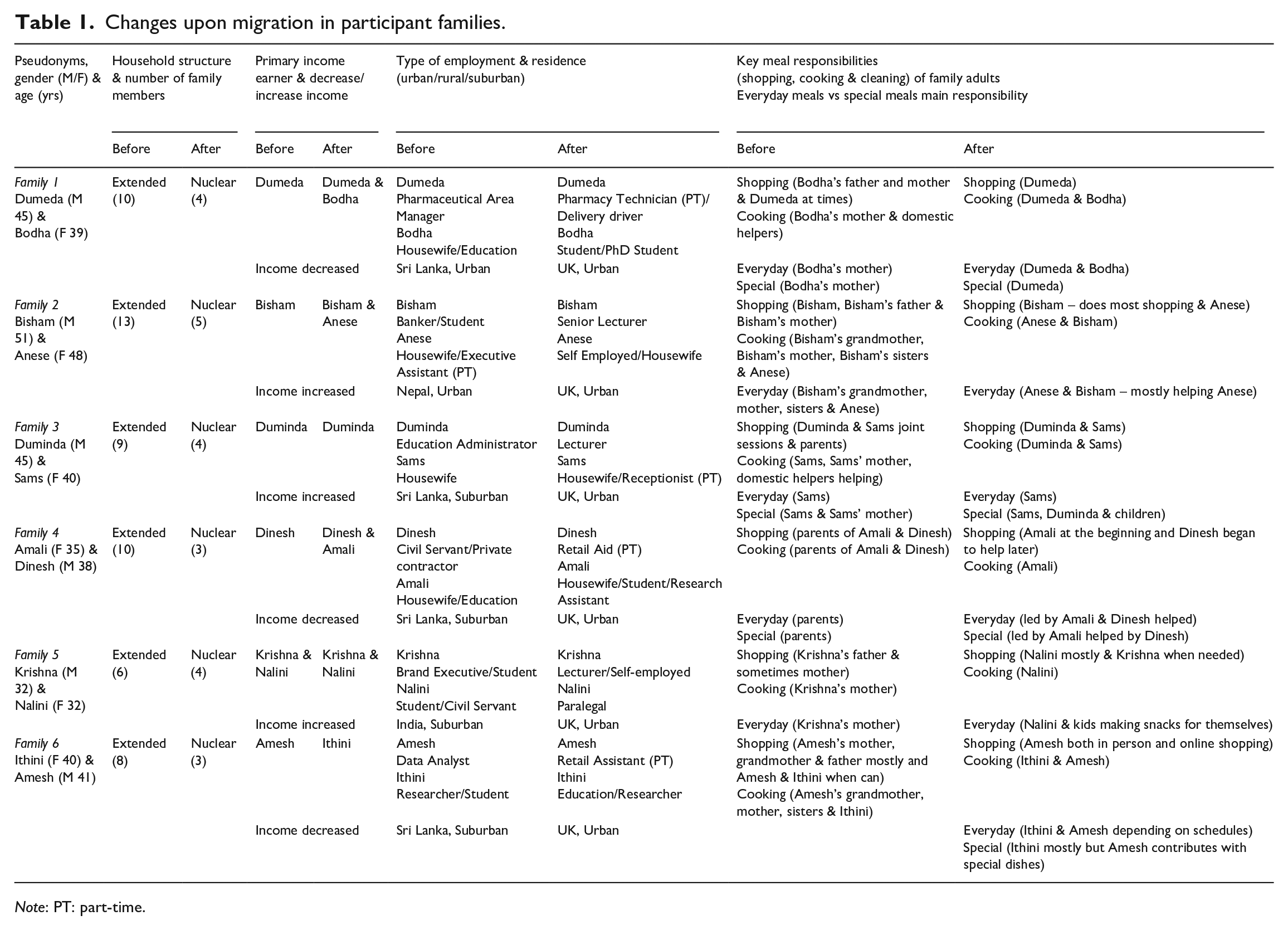
Note: PT: part-time.
After ethical approval, the first author recruited participants through his personal and professional network. During the first visit, he discussed consent forms with parents, informing them of their right to withdraw at any point. Children were not interviewed or involved in the research. Parental permission was required for photographs, with parents reviewing images to provide consent for publication and participants’ faces were blurred for anonymity. Six families participated in the project (see Table 1): three from Sri Lanka, and one each from India and Nepal. Households consisted of two heterosexual parents (aged 32–51) and one to three children (aged 3–16). The families migrated for work and education and were all well resourced socio-economically and self-identified as middle-class. While not representative of all South Asian migrants in the UK, this is less of a concern given the study’s focus on the changing meal practices and family identity.
The fieldwork involved two phases: in-depth interviews and participant observation with photographs (see Table 2). The three-year ethnographic process spanned two UK lockdowns due to the COVID-19 pandemic. During the lockdowns, the first author kept in touch with families by phone and messaging, making it easy to resume fieldwork after the second lockdown. In phase one, the first author visited the families in their homes and conducted interviews with both parents together and separately. Interviews explored meal practices, roles, meanings and wider parenting activities before and after migration. Twelve interviews were conducted (see Table 2), recorded and transcribed.
Ethnographic research process.
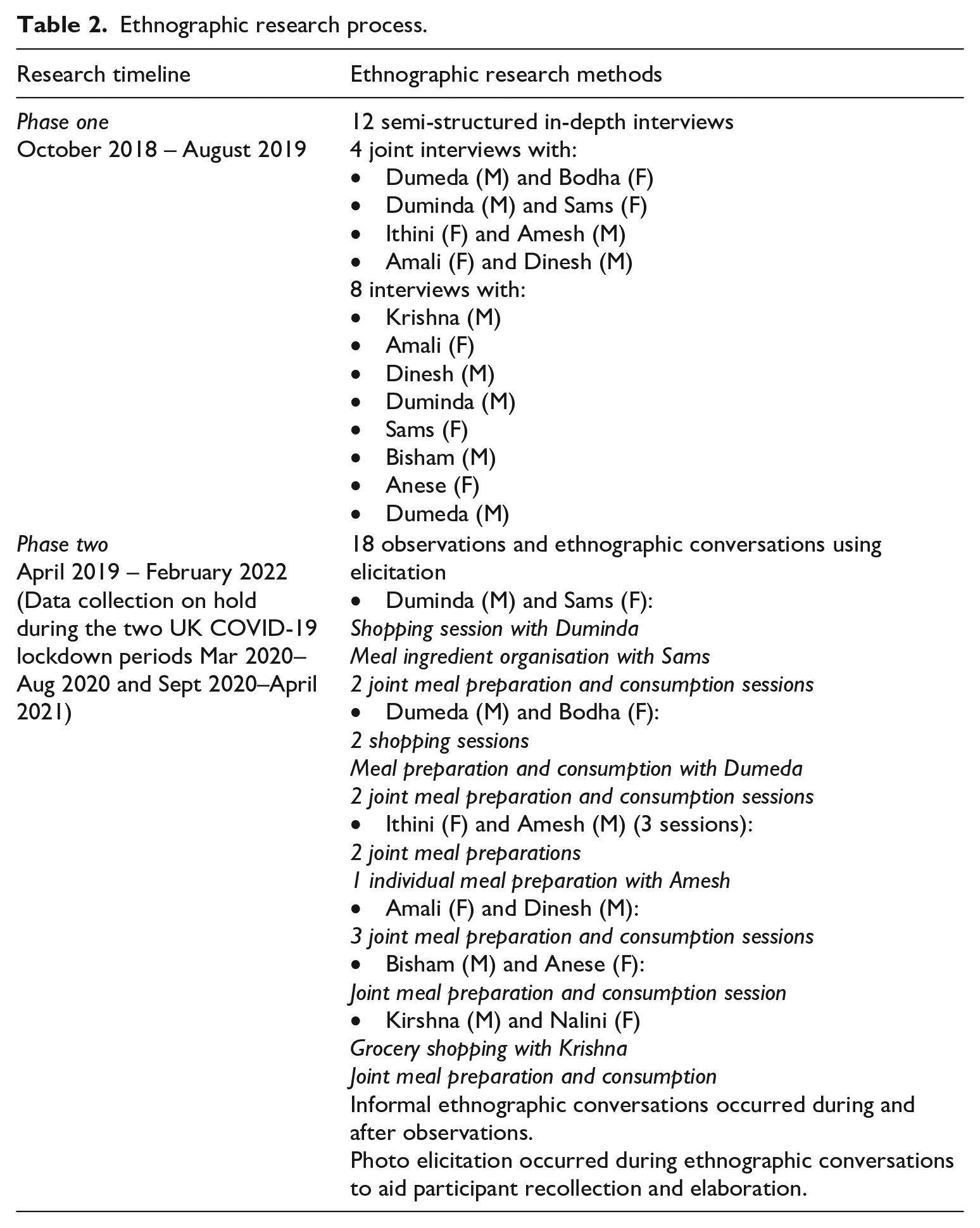
In phase two, the first author re-visited the families, joining grocery shopping, meal preparation and consumption. In total 18 sessions were carried out over 20 months, each lasting 30 to 180 minutes. As a participant observer, he helped with tasks such as carrying groceries or washing up, but in general tried not to interrupt to ensure the natural unfolding of practices during observations. Unstructured ethnographic conversations followed observations to explore specific activities and to understand their conduct, meanings, and importance. During these conversations, the first author used photo elicitation (Heisley and Levy, 1991), showing participants pictures of their actions during observations to help with recollection and elaboration.
The data set includes 12 interview transcripts, 43 photographs and over 85 pages of fieldwork notes resulting from observations and ethnographic conversations. Interviews and observation data were thematically analysed by the three authors using open and axial coding to identify themes. The first author thematically systematised images and fieldnotes to validate and refine the emerging themes and participants played a key role by providing feedback and additional insight. The final themes were determined through constant comparison, integrating and delimiting procedures (Glaser, 1965) until thematic theoretical saturation was reached. Interpretation building used thematic and constant comparative processes (Braun and Clarke, 2006) that occurred iteratively through deliberation within the research team.
Findings
Reconfiguring Meal Material Arrangements: Sustaining Family Continuity and Stability
A common disruption to family meals was the absence of key ingredients and cooking equipment once essential before migration. For example, Bodha’s struggle to prepare Sri Lankan meals in the UK due to missing spices:
Sri Lankan food is important because that is what we are used to [. . .] It is who we are [. . .] We need spices when we cook, we must do that to make food our way. Without those we cannot make Sri Lankan food [. . .] That is why we try to bring spices from back home, everything from five-spice is made at home, made with ingredients from the garden, even the black pepper. (Bodha (F))
Carrying out family meals ‘our way’, to use Bodha’s own words, is essential to provide a ‘sense of the regular’ (Morgan, 2011: 6) and familiar in the new context. Recreating authentic Sri Lankan meals relies on home-cooked food made with combinations of natural spices, which are also seen as healthy. Homemade spices have a unique smell, taste and appearance, resulting from traditional extraction and preparation methods passed down through generations. Such general understandings of spices and extraction methods are significant in the teleology of family meals as ‘home-cooked’, bringing a sense of comfort, continuity and stability. The lack of ‘trustworthy alternatives’ to ingredients like turmeric and curry powder makes cooking familiar meals difficult in the UK. Consequently, new methods are introduced to address the missing material aspects of meals:
We didn’t have a string hopper maker [. . .] Then we asked my mother to bring a normal one, the kind of one that we used to have back home [. . .] When I used it, it hurt my elbow and it was difficult to make nice string hoppers of the correct size and texture, so I bought this one (one with a trigger). (Sams (F))
Making ‘nice string hoppers’ of the ‘correct size and texture’ requires experimentation with equipment (Figure 1). It also depends on knowledge and skills gained by living with the extended family and observing or using such devices. Maller and Strengers (2013) observe this role of practice memories as important in the generational transfer of practice competence. Sams (F) found the familiar string hopper maker hard to use due to weakening joints; the new device with the trigger was much easier to handle. Similarly, Sams (F) explained that the long stem of the ‘pittu’ maker, brought from Sri Lanka, enhances flavour by allowing the pittu to absorb curries better (Figure 2).
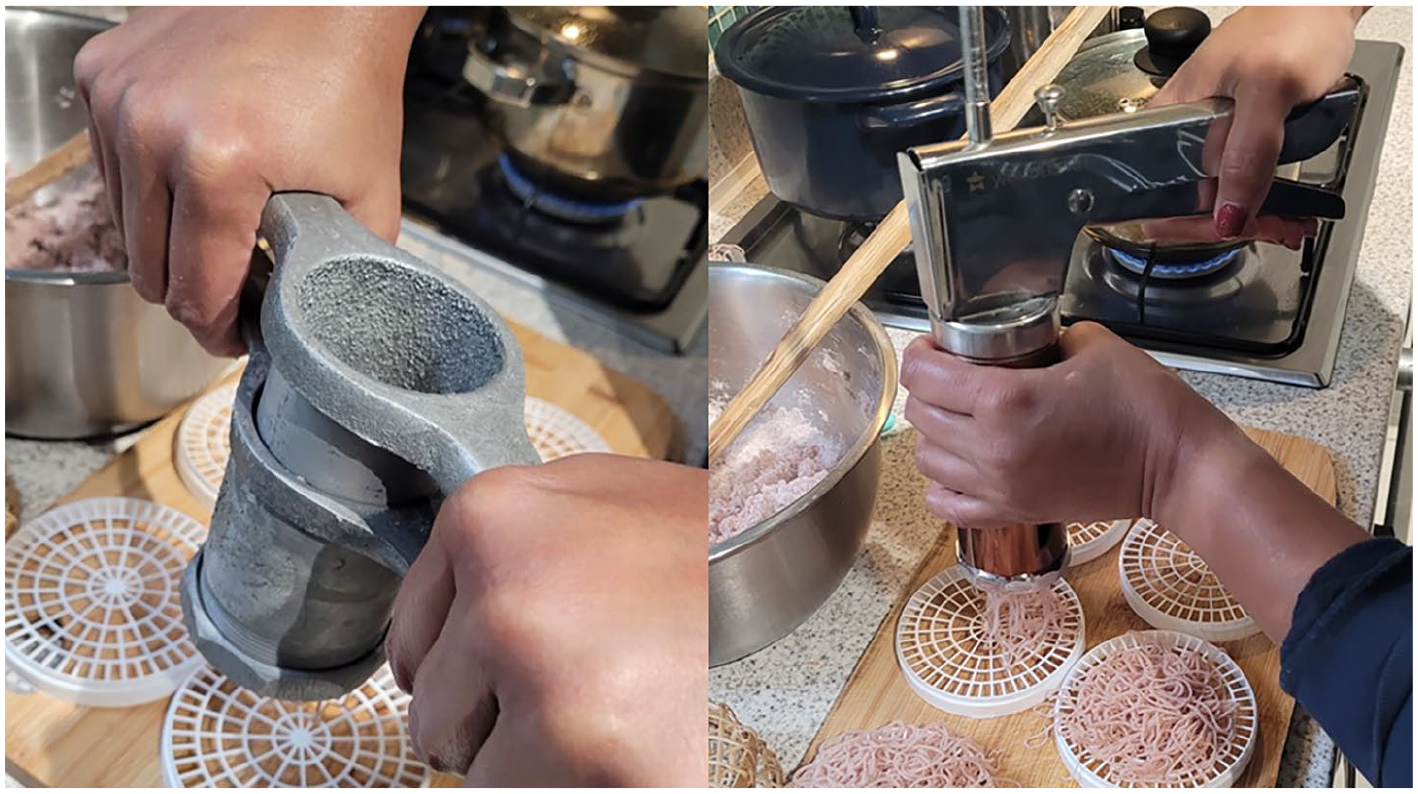
Sams’ string hopper makers and string hoppers.
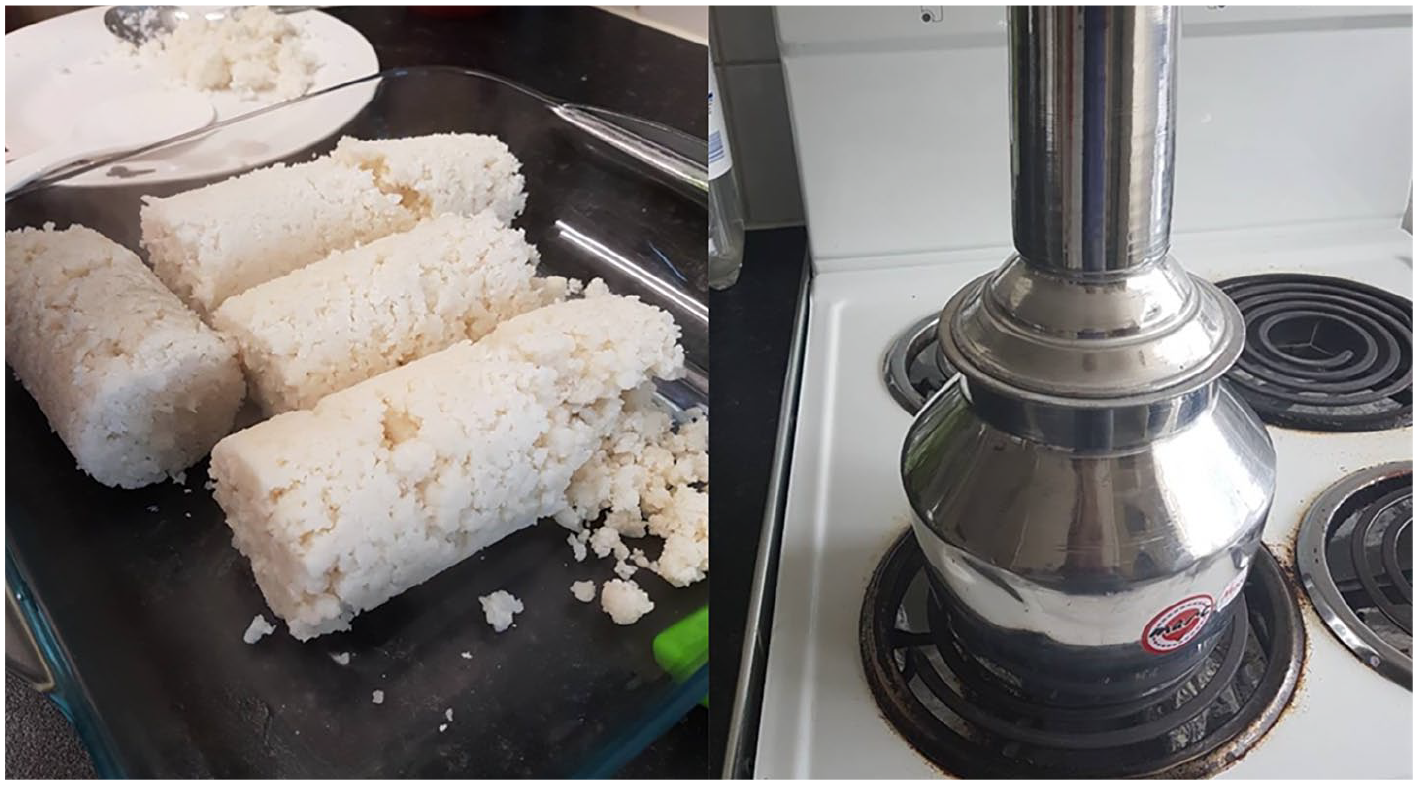
Sams’ pittu maker and the resulting pittu.
Reconfiguring meals in the new country involves discovering new spices and cooking equipment and learning how to practically interact with them. This practical intelligibility (Schatzki, 2002) is conditioned by general understandings of health, authenticity and familiarity. Thus, shared general understandings and affective structures, such as preparing healthy and familiar dishes, shape family meals and foster continuity and stability after migration through new meal material arrangements:
Many things about our food changed. First, it is about finding the things we need, then, even if you get some of those, it is about learning how you cook. You can’t otherwise get the right taste [. . .] I am very good, I think. I think about everything when I cook, taste is important, but I don’t like to compromise nutrients either. So we experiment [. . .] and I do talk about it to my friends [. . .]. I like when she says that I cooked things and our friends, especially the wives, are really surprised. I mean cooking was new to me, but it gives me a purpose and helps me to play my part too. (Duminda (M))
Duminda’s (M) engagement in preparing authentic meals, which presuppose the ‘right taste’ and ‘nutrients’, offers him terrain for learning. Recreating the authentic taste of familiar dishes is difficult upon migrating, due to the absence of ‘good’ ingredients, materials and necessary skills. As Duminda (M) and his wife explained, they used a process of trial and error that combined new ingredients, equipment and cultural knowledge available for them to develop new embodied competencies. As a result, a new method of preparing meals without a wood stove and clay pots was discovered, allowing Duminda to recreate dishes with a resemblance to the familiar taste and texture of their favourite dishes. In doing so, Duminda re-invented himself as a working father who is also deeply involved in the practice of feeding the family. Thus, the general understanding of meal authenticity not only encourages a process of trial and error – integrating new and traditional skills, material arrangements and acquired knowledge – but also fosters a sense of family continuity (as seen with Bodha (F) and Dumeda (M)) and re-orientates them within the family (as seen with Duminda (M)).
Reconfiguring Meal Rhythms: Localised Performances of Commensality and Gendered Hierarchies
Migration also disrupted family meal rhythms, which are essential to structuring family life (Morgan, 2011). New work and study schedules post-migration significantly altered the frequency and pace of everyday meals:
In Nepal, you eat a lunch type of food in the morning like chicken or mutton [. . .] by 8.30 you eat that heavy meal. And then when you are in the office around 1pm, you eat breakfast type of meal again. You come home at night and eat a heavy meal again [. . .] It is always the women who cooked [. . .] Here we both work and kids go to school and their training. There is no time [. . .] So we have to do our own thing here, figure out what we eat and when and who cooks [. . .] We eat cereal for breakfast and go to work. Usually in a rush [. . .] Then perhaps another meal at work. And a heavy meal at night [. . .] One thing we do is that make sure our meals are healthy, I think Nepalese meals are the healthiest in the word. (Bisham (M))
Bisham’s comparison between his meals in Nepal and in the UK shows the significant disruption to their family meal composition and rhythm upon migration. While customary family meal compositions, schedules and duties change with migration, the enduring influence of the Nepalese meals – described as ‘the healthiest in the world’ – guides the family’s reconfiguration of meals in the new country. While these changes were not always ideal for every family member, they represented practical solutions to the demands of everyday family life. Some of the families welcomed such changes:
The nice thing about living here is that we have freedom. We eat what we want. In Sri Lanka, they make what their father likes [. . .] Breakfast had a lot of food and we all had to eat together. And the food was very spicy and oily. For example, for breakfast, the servant makes it to her father’s taste. It didn’t always work for us [. . .] I did workout then and watched my food. I liked just eggs, yoghurt, oats and things. (Dumeda (M))
As Dumeda (M) highlights, shared family meals, the coming together of household individuals through commensality, were shaped by the general understanding of familial unity and membership. In this sense, the commensality of the meal both reproduces relationships and simultaneously derives its meaning from these relationships (Morgan, 2011). This operates on both the collective and individual levels, as relationships also find an expression and sense of order through commensality. For example, in Sri Lanka, family meals were organised to suit the preferences of the senior male members of the extended family. As Dumeda (M) explained, the meals were ‘very spicy and oily’ to accommodate his father-in-law’s taste, despite not meeting his own nutritional needs. In this context, commensality was reflected and was reproduced as respect, obligation and gratitude towards elderly family members. However, as both Bisham (M) and Dumeda (M) explain, while their family meals retained the teleoaffective goals of commensality and nutrition, their localised performances were adapted to fit their new context. Furthermore, as the family transitioned from an extended to a nuclear structure in the UK, commensality changed, gendered hierarchies reduced and it became more about the nuclear family’s health and well-being. This changed form of commensality intersected with material reconfigurations and adaptations and changed responsibilities after migration. Changes to meal temporality and rhythm also significantly changed its commensality:
Dinner we try to eat together. We can’t do it always. However, we try to wait. Like if he is coming home within an hour, I would wait to eat. But if I know he is not back till 11pm, we will eat and keep him his food. But then, when he is having the meal, I will also have a bite and talk. I think it is that social thing we learned from living in Sri Lanka. (Ithini (F))
Although meal timings and patterns change, meal commensality was increasingly conditioned by a general understanding of unity post-migration. For Ithini, the teleoaffectivity (e.g. not solely orientation towards an end, but also the motivation – Schatzki, 2015) of commensality is crucial for sustaining family unity and continuing in the role of a Sri Lankan wife, and as such is seen as orchestrating changed meal patterns. However, participants noted changes not only in meal rhythm and timing but also in spatial arrangements, especially when involving children:
First, we stressed the fact that we should sit for family meals together. But not anymore. Now only us (adults) are on the sofa. Kids have to sit at the table [. . .] We still talk about the importance of eating together but just don’t always sit together around the table. As long as we are all in the same room and eating together, we are ok. (Duminda (M))
Some time- and space-intensive practices like eating around the dining table were revised or discontinued. While extensive time and effort are devoted to preparing familiar meals, participants are less concerned about the temporal and spatial arrangements of their meal rhythms. As a limited number of studies have suggested, practices within bundles (as well as between them) may compete for resources (Scheurenbrand et al., 2024; Wertheim-Heck and Raneri, 2020). In this case, the resources necessary to continue commensality were diverted to other practices in the bundle, such as studying and helping with children’s homework. The practice of sitting around the table, steered by the general understanding of unity and togetherness, has been adapted due to its impracticality in the time- and space-restrained new family life (Maller and Strengers, 2013). Yet, it also restructures the teleology of the family meal (i.e. educating children about Sri Lankan meals) in the UK, therefore, decommissioning some of the practices (sitting around the table), while keeping the others intact (i.e. being in the same room for meals).
Reconfiguring Enrolment across Practice Bundles: Negotiating Family Membership and Identity
Reconfiguring everyday family life and maintaining continuity during migration involves reshaping the family meal beyond cooking and eating. It becomes a dynamic process intertwined with work, study and parenting, reinforcing the family identity (see Table 1). In this reconfiguration, novel enrolments – who does what, when and how – emerged through the integration of these various practices. Changes in participants’ enrolment were challenging, as individual engagements were intensified, activated or reduced, affecting the individual but also the continuity of family relationships. In some households, like Amali’s (F), a general understanding of a gendered familial hierarchy persisted, reinforcing the teleoaffective goal of prioritising the tastes of the male family member (Figure 3):
I always give priority to my husband’s desires [. . .] I knew I could not find things here, things that I needed to make some of his favourite meals. I knew that he would struggle here if I couldn’t make what he likes [. . .] Things like Watalappan he loves, and I didn’t know how to make it. I learned from my mother because I knew he would ask for it [. . .] My bag was all about his desires. (Amali (F))
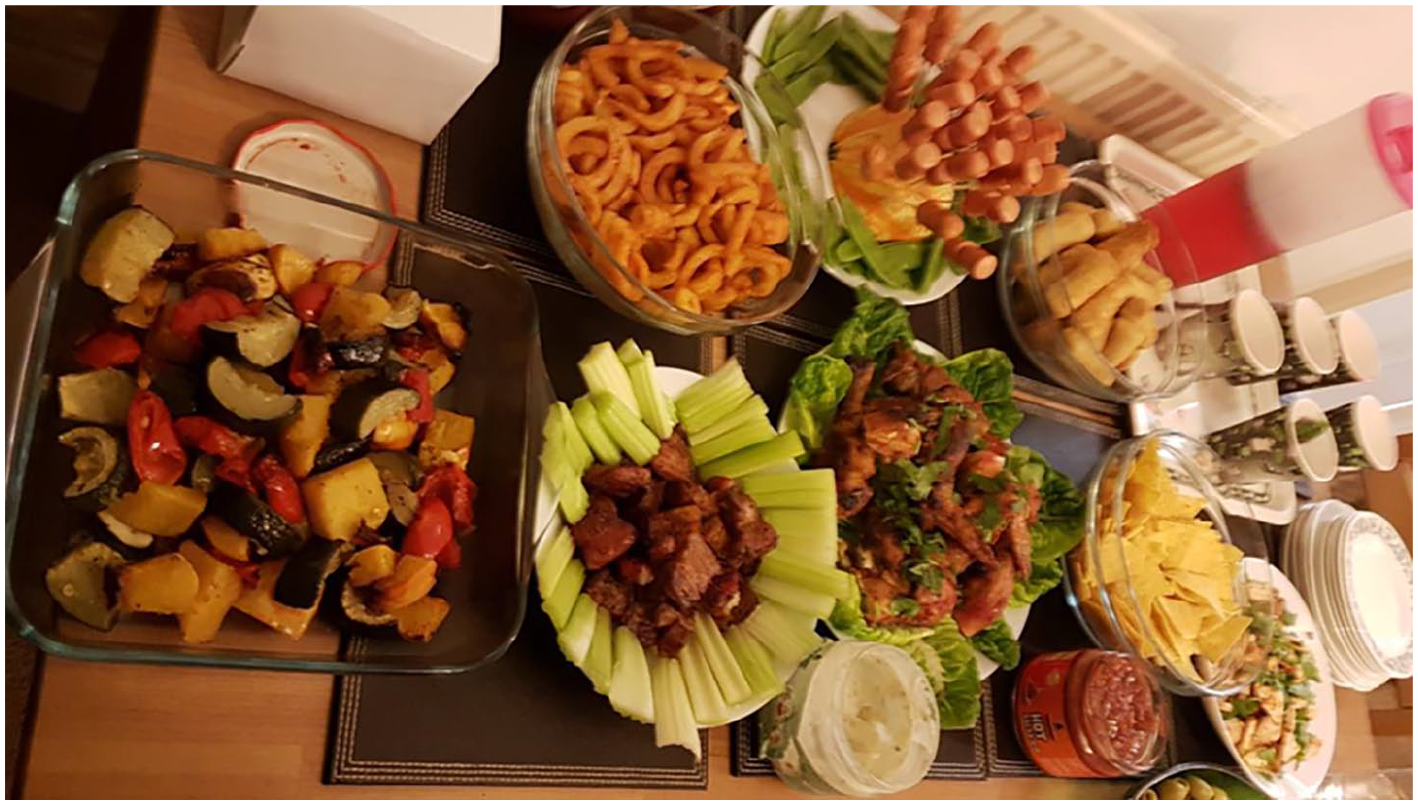
Her husband’s favourite dishes prepared at home by Amali.
As Amali (F) elaborated, her continued engagement in meal practices that reflect and reproduce a gendered familial hierarchy is guided by the need for familiarity, and ‘what she already knows’ in continuing her prior practical competence ‘as a Sri Lankan wife’. However, limited material resources and cooking expertise made it challenging for her. Prioritising her husband’s preferences is an important goal, which is guided by the general understandings of a gendered familial hierarchy intersecting masculinity and femininity. Enacting gender roles reinforces family responsibilities and roles by aligning with social norms tied to ideals of masculinity, femininity and family hierarchy (Bailey, 2017). As Amali (F) shows, engaging in meal practices such as cooking reflects understandings of, but also reproduces the ordering of familial relationships (Morgan, 2011). These understandings do not just emerge in the bundle of the meal; as the literature highlights, they are idealised ‘matters’ that cut across practices (Schatzki, 2013, 2015), shaping teleoaffective ends (prioritising male desires) and steering practical intelligibility. To achieve this, Amali (F) intensifies her enrolment in cooking, planning and acquiring, which she describes as a source of anxiety.
In other households, preserving past enrolments in shopping and cooking was difficult due to shifting engagements across other family practices, leading to instability. Consequently, as evidenced by Dumeda (M) and Bodha (F), parenting and meal practices once carried out by one family member became shared upon migration to sustain feeding the family (Figure 4):
She goes to university in the morning, and I have to do everything from taking kids to school, making their breakfast, feeding them after they come home, and sorting out the dinner [. . .] I didn’t know how to cook when I left Sri Lanka. When I had time, I learned. I looked at YouTube videos like Malini’s Kitchen and started to try those out. (Dumeda (M))
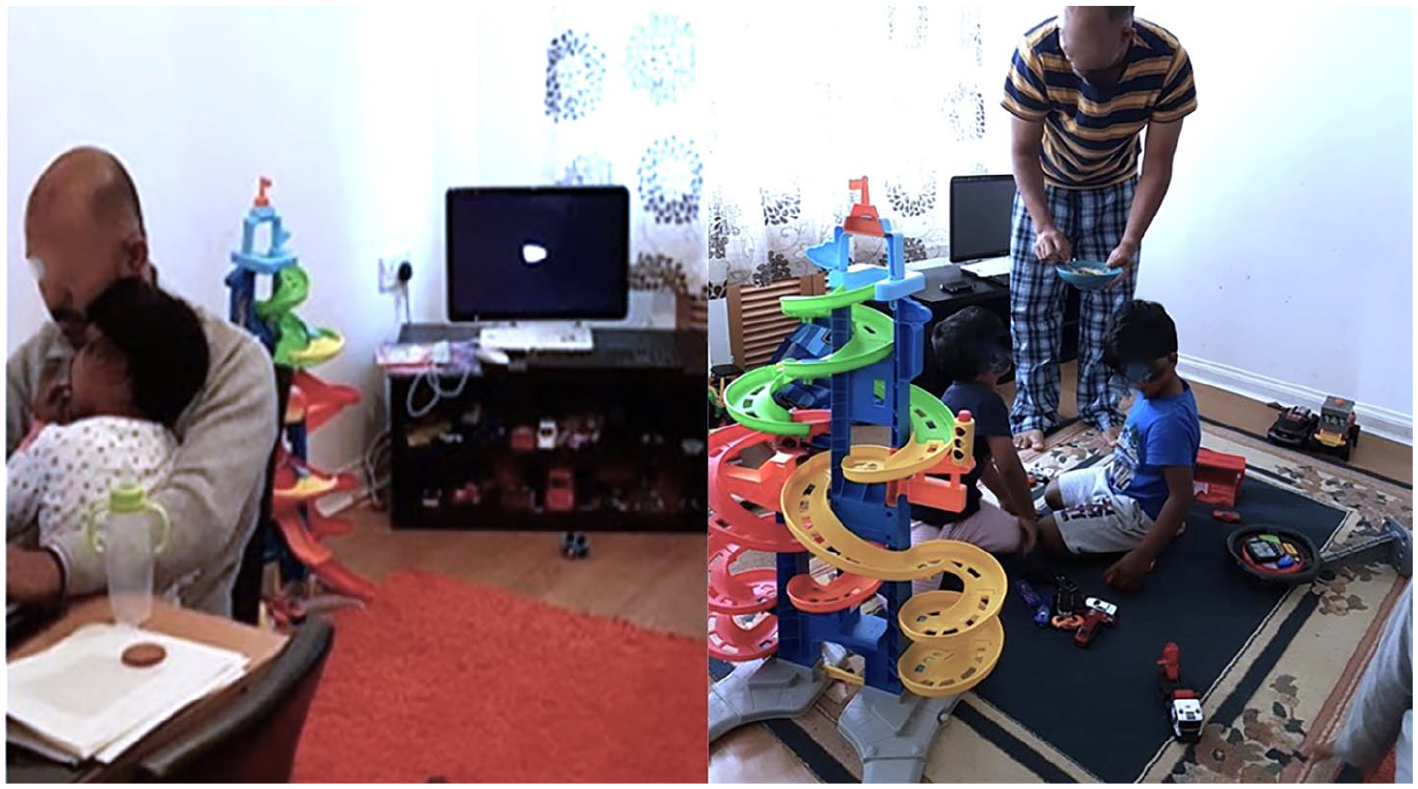
Dumeda coping with several family practices (feeding, pacifying and working).
In Sri Lanka, Dumeda (M) was not involved in meal practices as they were the sole preserve of the females in the household (his mother, mother-in-law, his wife and domestic workers). Post-migration, Bodha’s (F) studies limited her ability to be involved in childrearing and meal practices as often as she preferred. As a result, Dumeda (M) had to step in as there was nobody else in the household to fulfil those responsibilities of family care and support. Keeping meals familiar and healthy was a key teleoaffective goal that guided his engagement, despite its clash with the general understandings of masculine privilege in the gendered hierarchy of the Sri Lankan family. This affective dimension of Dumeda’s (M) cooking is also steered by a general understanding of providing, deeply tied to a strong sense of competence and care that extends beyond meal preparation and intersects with his parenting practice. Through this engagement, Dumeda (M) not only understood himself as a competent provider for other family members but also reproduced his orientation and role within the family as the provider. Through this, he experiences a revised sense of belonging and self-worth. Other males, such as Duminda, also enrolled children in cooking sessions:
My daughter is keen to mix things, wash and chop. So I let her [. . .] It is important they become part of it, even if it is annoying (annoying for adults). When they get it, it will naturally be part of their life. Otherwise, we are pushing them away and when they grow up they will have no interest. (Duminda (M))
The practice of meals in Duminda’s (M) household has become deeply entwined with family unity and care, guiding the teleoaffective structuring of their parenting practice. Encouraging children to engage in family meal activities, particularly cooking, stems from a sense of responsibility to pass down important family traditions, values and norms. While the practice of eating has been reshaped (commensality becomes more a matter of being in the same room rather than sitting around the family table), the practice of cooking is now open to children as it is seen as pivotal for appreciating familiar dishes and transmitting a more ‘sense of the regular’ (Morgan, 2011: 6) such as ‘educating children to Sri Lankan culture and instilling good values’, as Duminda (M) explains.
Discussion
The expression ‘our way’ is often used by our participants to describe the process of reconfiguring family meals after migration. We use this expression to highlight how participants experience a ‘sense of the regular’ (Morgan, 2011: 6) through changes and disruptions. It captures the flexible and evolving nature of the family meal for migrants, which emerges from the relationship between general understandings of ‘doing family’ and localised accomplishments. Some general understandings – which are ‘senses of general matter’ (Schatzki, 2013: 34) – that transcend the meal have been identified: authenticity, unity, membership and care.
Prior research suggests that authentic meals create a sense of home, reinforce emotional connections and foster a shared sense of belonging across cultural boundaries (Rabikowska, 2010; Rabikowska and Burrell, 2016). Authenticity guided our participants’ ingredient choices, meal preparation and use of equipment, along with the skills needed to combine them correctly, resulting in meals recognised as ‘our way’. Mundane materials, like spices, which were taken for granted before migration, become ‘affectively’ significant in the new context. This is particularly important in reflecting and reproducing family bonds, often navigating intergenerational tensions across previous generations (Bucher-Maluschke et al., 2017; Edirisingha et al., 2015), such as with extended family members now living at a distance. As Srinivas (2006) confirms, recreating authentic food brings a stabilising presence to families by reinforcing nostalgic ties to home and their idealised past. However, our findings show that meal authenticity is also linked to the sense of family continuity and identity. It also underscores the role of the familiar, not only in the taste and appearance of ingredients and dishes but also in the embodied interactions and practical use of cooking tools and equipment. As much as signalling continuity of older generations, commensality and appreciation of authentic food by the children was also encouraged by parents to ensure family continuities in the younger generation.
Family unity is expressed in shared meal practices and is essential to ‘doing family’, fostering stability and continuity while enabling family to cope with change (Warde, 2016). Unity and membership emerged as important, particularly as a guiding principle of meal rhythms, composition and timing. Commensality and togetherness through eating were prioritised post-migration. Pre-migration, commensality in some households was seen not only as a matter of family unity but also understood as reproducing respect for the senior family members. After migration, in the reduced nuclear family unit, it became more about informality and practicality. Although prior research clarifies the significance of family unity to sense of normalcy and stability (Pirani et al., 2022), fostering relationships (Warde, 2016) and continuity (Srinivas, 2006), our findings underscore the persistence of unity as a general understanding that steers family meals – but one that takes on different forms via localised accomplishments.
Care and providing emerged as a significant general understanding, which both reflected and reproduced gendered hierarchies in the household. Prior research highlights meal preparation and sharing as acts of care that strengthen family bonds and reinforce roles and responsibilities despite busy family lives (Pirani et al., 2022). Our findings additionally show how a redistribution of engagements in parenting and working practices is central to understanding how families change, reorder and evolve. Shifts in the distribution of practices and individual engagements in them both reflect and reproduce hierarchical structures and gendered family roles. In the case of one of our participant households, we found that individual (male) food preferences were replaced with more collective understandings of food choices and domestic responsibilities. We also found that a general understanding of providing found a more flexible expression than purely economic for our male participants when engaging in meal practices, reflecting care for others in the household.
These general understandings emerge as both a catalyst and a conduit of change that steers the reconfiguration of meanings, materials, competencies and affective components of the family meal practice, giving them practical intelligibility (what it makes sense to do at a particular point in time). They are also key to alignments across other family practices. As Schatzki (2002) argues, general understandings transcend these boundaries between co-existing integrated practices, and our findings reveal this is possible due to the sense-making capacity they bring to re-alignments between elements across practices. Through conditioning reconfigurations across family practices, general understandings allow migrant families to learn what aspects of prior collective family practices are most important, practical to continue and sustainable in their new cultural context; therefore, bringing an overall sense of continuity and stability for them. For example, pursuits of family meals are usually embedded among adaptations and localised accomplishments of other practices such as parenting, working and studying. Ensuring family unity and care are general understandings, which cut across these practices and drive the emergence of shared affective components that bind the practical cohesion of those co-existing practices in our families. Therefore, it is through general understandings that family members learn how to adapt their performances across practices, whether it is the preparation of meals, nurturing of the children or compromising professional work to achieve a consensual and meaningful resolution to their changed lives upon migration and lend stability in a time of significant disruption.
Also, the reconfiguration process has transformative potential for family identity, providing participants with an opportunity to navigate the evolving ‘sense of the regular’ (Morgan, 2011: 6) and re-orient themselves within newly restructured household units. The general understanding of family meals – encompassing authenticity, care and unity – takes on renewed significance for migrant family members. As families adapt to reconfigured meal arrangements, new skills, material compositions, meal goals and emotional investments emerge, allowing individuals to ‘find themselves’ within the migrant household. For example, finding authentic spices (as Bodha (F) and Dumeda (M) did) and cooking equipment (as Sams (F) and Duminda (M) did) helped families not only recreate familiar meal practices and ensure family continuity, but allowed them to find new ways to re-orient themselves as family members to ‘our way’ of doing family, affirming a new sense of belonging and sense of self-worth in the new context.
In addition, expectations of domestic care are often expressed through gendered performances of family meal preparation and eating, reinforcing family members’ responsibilities and shaping family identity (Darmon and Warde, 2019). A strong shared sense of family, perceived as unity, shapes how family members depend on and communicate with each other, while also influencing how they navigate changes in family life (Edirisingha et al., 2015). Particularly, family meals serve as a critical site fostering family unity as shared meals become moments for family members to connect and reinforce their sense of togetherness despite change (Pirani et al., 2022). As our participant families migrated, a general understanding of care and support guided subscribing in family practices, transcending traditional gendered roles. Such as for participants like Dumeda (M), Duminda (M) and Amali (F), existing enrolments in meal practices are intensified, while new enrolments emerge due to shifts in family dynamics, such as the absence of former household members (e.g. domestic helpers or grandparents) or the engagement of family members in other practices. Notably, the increasing involvement of male participants in meal practices marks a significant shift. This change disrupts the traditional teleoaffective end of prioritising male preferences, replacing it with a more collective understanding of food choices and domestic responsibility. As a result, familial unity and care gain new prominence, while rigid structures of hierarchy, masculinity and femininity become less defining. It is within these reconfigured material arrangements, localised performances and renewed enrolments in meal practices that migrant families make sense of their family identity. Through this process, they reaffirm key aspects of their familial bonds and create a sense of stability in the midst of change. Family relations – both immediate and extended – are not only reshaped but also reinterpreted, reinforcing the ongoing emergence of a new family identity.
Conclusions
In investigating how families recreated their meals after migration, this article reveals the reconfiguration process through which families negotiate identity, maintain stability amid change, and create a sense of ‘our way’. General understanding of family meals – rooted in care, unity, norms and tradition – serves as a guiding force that shapes new meal structures, influencing materials, spatial arrangements and participant enrolment. Thus, general understanding of family does not merely preserve tradition or family norms but actively shapes new meal structures, influencing materials, spatial arrangements and participation patterns within the household and leads to an evolving sense of doing family and family identity upon migration. The reconfiguration of meal practices with other practices, such as parenting and working, fosters a novel way of ‘doing family’, as it allows family members to adapt to new roles, practices and dynamics within the household. By re-aligning meal practices with general understanding of care, unity and authenticity, migrant families create a framework that supports both individual and collective family stability. This process offers family members the opportunity to rediscover and re-orient themselves in the context of their new environment, helping to establish a stable family identity amid the uncertainties of migration. Through these evolving meal practices, families navigate change while maintaining continuity, strengthening their sense of belonging and cohesion in the new household.
Footnotes
Funding
The authors received no financial support for the research, authorship and/or publication of this article.
