



Abstract
Epistemological justice, which exposes the role of colonialism in conceptualising contemporary society, particularly racial inequalities, has gained prominence within sociology. Yet, sociologists often ignore that the material conditions of professional sociology inhibit racial justice-oriented knowledge making. This article argues, to realise epistemological justice, sociology must travel to the margins, wherein certain sociological publics offer opportunities for reverse tutelage that can redirect the discipline towards racial-colonial literacy. This participatory qualitative study spotlights Muslim women as one such public whose lives and imagined future emancipation depend on critiquing intolerable social conditions and conceptualising alternatives. Through their enhanced racial-colonial literacy, they generate historically and geopolitically aware theories on intersectionality, dialectic self-identities and refusal as joy. We pinpoint reverse tutelage opportunities from their theorising that can re-orient professional sociology towards meaningful epistemological justice that can serve scholars and communities of resistance, anti-colonialism and anti-racism everywhere.
Keywords
Introduction
This article presents an alternative vision to advance sociology’s yet unrealised epistemological justice goals (Bhambra, 2021). By using the formidable ‘racial-colonial literacy’ of young Muslim women as a strategic case, we argue that knowledge at society’s margins offers radical possibilities for this agenda. Epistemological justice in sociology refers to the extent to which sociology’s meta-narratives – such as social theory – which structure the contexts within which understandings of modern society have been constituted represent different and competing knowledge claims. Since inception, social theory has limited its epistemological scope to imperialist views, omitting colonialism’s role in producing European modernity. This omission has profoundly influenced social theory to date as colonialism’s symbolic and material entanglements have not been allowed to exist, let alone conceptually frame contemporary social issues (Bhambra, 2021; Khan, 2024).
The push for epistemological justice has coalesced on reshaping social theory to connect colonial histories with the contemporary social world (Bhambra, 2021; Khan, 2024). We agree that ‘theoretical reparation’ (Khan, 2024) – conceptual compensation for sociology’s failure to acknowledge non-Eurocentric knowledge claims – is long overdue. However, we contend that epistemological justice cannot be achieved solely through theoretical amendments from the current material conditions of professional sociology in the UK for several reasons.
The university is a ‘neoliberal-imperial-institutionally-racist organisation’ with limited capacity for change (Joseph-Salisbury and Connelly, 2021: 21). Situated within this context, professional sociology is hostile to historically informed, racial justice-oriented theorising at all levels. At the undergraduate level, sociology degrees, when engaging with race, separate the study of racialisation and racisms from traditional theoretical canons (British Sociological Association (BSA), 2020). Therefore, students – future professional sociologists – remain unaware of the constitutive role of coloniality in contemporary racism, ensuring the intergenerational transmission of racial-colonial illiteracy. UK sociology is made up mostly of white scholars (BSA, 2020: 4), among whom there is a high degree of racial defensiveness (BSA, 2020: 5). Research and innovation are tied to grant capture, a process that systematically confers unearned advantage on white scholars, while excluding those of colonised heritage, particularly Black, Pakistani and Bangladeshi academics (UKRI, 2020; Wellcome Trust, 2024). Yet, it is these excluded groups who are most likely to be engaged in emancipatory race research, theorising and activism (BSA, 2020). Consequently, those with racial-colonial literacy and committed to material change are excluded from grant capture, and crucially, the time it affords for research, theorising and producing sociological knowledge. Meanwhile, those most likely to be racially illiterate – and racially defensive (BSA, 2020: 5) – monopolise research and the production of the majority of sociological knowledge, including on issues primarily strtaified by race.
To parse these conditions that inhibit epistemological justice in sociology, we take inspiration from Charles Mills to argue that they constitute a form of ‘white ignorance’ (Mills, 2007). Not merely a lack of knowledge, but an epistemology of ignorance – a purposeful construct produced and sustained by power-laden interpersonal relations and institutional practices. White ignorance in the form of racial-colonial illiteracy is the fundamental disciplinary reality. It is the epistemological terrain upon which we produce, disseminate, apply and value all sociological knowledge, including social theory.
To speak of epistemology in sociology is to speak of the discipline’s locus of power. To explicitly speak of the locus of racial-colonial power in sociology is to unflinchingly confront whiteness and professional sociology’s ‘collective, possessive investment’ in white sociology (Brunsma and Padilla Wyse, 2019: 1). This is the incentive for constituents and beneficiaries to invest in the creation and re-creation of whiteness (Lipsitz, 1998). In this framework, white sociologists have a collective and possessive investment in maintaining and reproducing the racial order within the discipline. Reproduction of whiteness in sociology is reproduction of epistemological injustice, and an example of the meta-social racial contract (Mills, 1997) of which ‘all whites are beneficiaries’, even if ‘some whites are not signatories to it’ (1997: 11).
Since professional sociology prevents epistemological justice, we propose an alternative vision. Rather than racially literate scholars fighting biased systems to capture grants, research and then contribute justice-oriented knowledge, researchers should travel to the margins. Therein, publics have heightened counter-hegemonic literacy that can potentially advance alternative understandings and interventions for the social issues of our time. We argue epistemological justice can be progressed by ‘sociological publics’ Meghji (2024: 1) who, as critical sociologists, form their own sociological theories, analyses and interpretations. Meghji (2024: 114) advocates for ‘reverse tutelage’, which challenges the traditional technocratic dynamic where professional sociologists are presumed to hold more expertise than the public.
We identify the young Muslim women who co-directed this study as one such public, whose racial-colonial literacy offers reverse tutelage opportunities for professional sociology. We present their ‘racial-colonial literacy’ as an intergenerational, transnational, non-Eurocentric, counter-hegemonic habitus (Akram, 2023) that enables a deep understanding of connections between imperial histories and contemporary Britain. Racial-colonial literacy, unless sought, exists on the margins – neglected and actively erased by dominant knowledge-making systems (Bhambra, 2021). It manifests as a psycho-social phenomenon of ‘two-ness’ (Du Bois, 2016): a tension between self-worth and enduring the degrading perceptions of the white-supremacist society in which young Muslims are born and belong (Du Bois, 2016; Meer, 2018; Yancy, 2008).
Young Muslim women are an insightful ‘sociological public’ (Meghji, 2024: 1), because surviving imperialist white supremacist patriarchy as a condition of existence produces radical theorising – as hooks (1989: 206) reflexively notes, ‘our living depends on our ability to conceptualise alternatives’. Positioning oneself at the margins via racial-colonial literacy is painful, yet also insurgent and joyful. Insurgent because it challenges dominant ideologies, and joyful because the exultation derived from refusing oppressors can only be felt by the oppressed (hooks, 1989). As the analysis will illuminate, participants do not wish to relinquish the margins to be tolerated at the centre; rather, they reject the centre because they seek entirely new worlds.
The authors are Mancunian Muslim women with 40 years’ combined experience in UK sociology as students and professionals. We have endured the corrosive effects of the discipline’s whiteness due to our disadvantaged positioning within it. Yet we consciously research and theorise from this standpoint as steadfast resistance deeply rooted in a profound love for our heritage. We draw inspiration from James Baldwin, bell hooks, Toni Morrison, Malcolm X, Frantz Fanon, WEB Du Bois and others who assert that self-love is essential to the survival and liberation of people of colour. Having stated our positionality and commitment to racial emancipation, we highlight our exceptionally rigorous participatory qualitative research design, investigation and analysis as defence against sociology’s tendency to dismiss race research by scholars of colour as biased (Zuberi and Bonilla-Silva, 2008).
To do justice to participants’ racial-colonial literacy, we first survey the field using a critical race approach that links their realities with socio-historical systems of white supremacy, colonialism and Islamophobia. Islamophobia is a classic racism (Khan, 2024), now a permanent feature of the 21st century in diverse local settings worldwide (Abbas, 2020; Bakali and Hafez, 2022). Next, we describe the meticulous participatory qualitative study that deploys collage as an arts-based method and embeds Lincoln and Guba’s (1989) four criteria for qualitative trustworthiness throughout the design. Finally, we present original empirical findings and new forms of expression for how participants use their racial-colonial literacy to conceptualise intersectionality, dialectic self-identities and refusal as joy. We explore how their theorising offers reverse tutelage for advancing epistemological justice in sociology. This work has significant implications for interdisciplinary scholars and non-academic audiences dedicated to racial justice and decolonisation, honours descendants of colonised peoples confronting colonial legacies everywhere and is relevant for global communities of resistance, anti-colonialism and anti-racism.
Living While Muslim: Permanent Islamophobia, Necropolitical Grief and the Joy of Refusal
Meer (2022) argues that understanding the pursuit of racial justice in the present requires reflecting on past gains and losses. Pointing to robust evidence of persistent inequalities, he demonstrates that racism is not incidental or exceptional but foundational to social life and invites us to countenance that the dissolution of white supremacy is unlikely. As such, the perseverance of hope for racial justice is a ‘cruel optimism’ (Meer, 2022) because it is held despite awareness of near-certain failure. Considering Meer’s diagnosis and to paraphrase Bell (1991: 79), Islamophobia is here to stay, now what? In response, this article focuses on the British case, and how young Muslim women navigate a justified pessimism for justice alongside joy and agency.
Demonstrating their considerable proficiency as a ‘sociological public’ (Meghji, 2024: 1), we turn to Critical Race Theory (CRT), which corroborates the young Muslim women’s testimonies and offers a lens through which to understand them. With roots in US legal and educational studies, CRT asks us to centre race and racism in our analysis, to recognise that racism is routine and ordinary rather than exceptional and plays a pivotal role in reproducing racial domination and inequality (Crenshaw, 1989; Delgado and Stefancic, 2000; Meghji, 2022). Echoing Bell (1991: 8), for whom racism is an ‘integral, permanent and indestructible’ feature of American life, racism is the effect not of individual prejudice, but structural power relations. While race may lack objective essence and has been debunked as a legitimate bio-genetic concept, racial categories are a potent social construction, the product of colonial epistemologies and relations that produce differential material outcomes. Always insidious, racism is purposive and extractive, rationalising while reproducing racial inequalities. Racialisation is forever intertwined with white supremacy, and it is historically and geographically contingent meaning that experiences of racism cannot be subsumed within a singular and universalising Black experience.
From the vantage point of this scholarship, we locate Islamophobia as a type of racism rooted in racial-colonial epistemologies that is a permanent and pervasive feature of the 21st century in numerous locales across the world – including the UK (Khan, 2024). The logics and relations of Islamophobia are reproduced across the global North and South (Bakali and Hafez, 2022). Consequently, and depending on the lottery of birthplace, Muslims endure endemic inequalities through racialised biopolitics (Abbas, 2020) and necropolitical exposure to premature death (Mbembe, 2019). In the global South, some Muslim populations bear necropolitical power. Power in this conception is not the control of life and peoples, it is the power to determine which peoples live and die (Mbembe, 2019). Under necropolitical conditions, many Muslim populations are considered disposable, subjected to living conditions that confer social and literal death, indeed the status of the living dead. As such, they exist in a ‘state of exception’ (Agamben, 2005: 5) whereby the usual legal and human rights protections are suspended for them such that they can be exposed to infrastructures of destruction without repercussions.
We are led by participants’ profound concern and grief for Palestine and the belief that, in this historical moment, any scholarship on necropolitics, or indeed racial and colonial justice must name and bear witness to Gaza and the Euro-US-backed, Islamophobia-fuelled Israeli genocide (Albanese, 2024; Amnesty International, 2024; United Nations, 2024. Beyond Gaza, hate directed at Muslims is variously related to questions of hyper ethno-nationalism, economic opportunism and state violence that border on population elimination in Myanmar, Israel (Abbas, 2020), India and China (Bakali and Hafez, 2022). Muslims fleeing the impacts of these persecutions are selectively denied protections under the 1951 UN Convention relating to the Status of Refugees, often in ways that expose them to inevitable premature death (Uddin, 2022), which is rapturously applauded by far-right parties, buoying them to government across Europe (Mondon and Winter, 2018).
In white majority global North states, Abbas (2020: 497) contends Muslims are subject to racialised biopolitical control to ensure ‘elimination, in reality, of members of the population regarded as a drain on resources’. We note the considerable literature showing how persistent racial injustices block Muslims from optimal participation in social life in the UK. For example, in health and wealth inequalities (ONS, 2021); in the labour market and workplace (Muslim Council of Britain, 2021); through biased criminal justice systems, hyperregulation and surveillance (Mythen et al., 2013); and exposure to everyday hate and hostilities (Harris and Karimshah, 2019; Khan, 2024).
If Islamophobia is permanent and inhibits Muslims’ lives in all conceivable ways, what prospect, if any, is there for agency, resistance and joy? We proceed with the recognition that the usual categories of political mobilisation may not apply to the young Muslim women of this study given that they often assume universalist categories of freedom and choice, while simultaneously evading CRT’s starting point that racism is permanent, routine and ordinary (Akram, 2019, Akram 2024). Instead, we turn to the participants’ chosen theorist, hooks’ (1989) ideas on the unique joys of refusal in the context of resistance to oppression. Joy in this context does not simply connotate the common understanding of joy – as a celebration of life – but is a defiance born from rejecting oppression. Joy is derived from being aware of inequitable distribution of power and oppressive systems yet consciously and categorically refusing to conform to them (hooks, 1989).
By drawing on hooks’ joy of refusal, we foreground a broader literature on the foundational role of emotions in politics (Gould, 2009; Jasper, 2011) as well as scholarship on racialized emotions (Bonilla-Silva, 2019: 2). Our study points to the productive tension between racial oppression and Black joy, and in a world where being Black is routinely co-terminous with experiencing negative racialised emotions such as anger, pain and suffering (Bonilla-Silva, 2019: 1), Black joy is a positive emotion that, in refusing oppression, is constructive and agentic. Rather than being mere emotions, we recognise that ‘racialised actors feel the emotional weight of their categorical location’ (Bonilla-Silva, 2019: 2), and that emotional states blend with material reality to produce tangible effects, which in turn ‘are a politics’ (Ahmed, 2014; Woodley, 2022: 7).
Against this background, the present study contributes to a long history of Black mobilisation at the individual and collective level (Newton, 1973/2009; Rembert, 2021) and we build on recent scholarship by Woodley (2022), who shows how Black joy drives collective counter-hegemonic mobilisation in the case of the Movement for Black Lives.
Black joy is a racialised emotion that is strategic, spaces for it must be protected as joy is an act of self-care for Black individuals who face racism as an everyday reality (Kinouani, 2021). Joy derived from the refusal of white supremacy is vital for racial emancipation, yet it has received little attention in the literature on Muslim women specifically and Islamophobia generally. This article addresses the gap by invoking Black joy as a prism through which to examine the role of joy as refusal in Muslim women’s political agency. Specifically, their rejection of ideologically driven geopolitics to stand in transnational solidarity with the Ummah (the global Muslim community) and their unwillingness to conform to binary East/West epistemologies in identity formation is the distillation of joy as refusal. They embody the radical possibilities of the margins, that is ‘the production of a counter-hegemonic discourse that is not just found in words but in habits of being and the way one lives’ (hooks, 1989: 206).
The Study
This article presents an arts-based participatory qualitative study that deployed collage-making and was co-directed with 22 Muslim women aged 16–24 residing in Greater Manchester. Participatory design recognises that knowledge is subjective and constructed, and that individuals are situated within social, historical and cultural contexts while also actively shaping their own lives (Freire, 1970). Our methodology is one of the major contributions of this paper. It emphasises co-production for context-specific knowledge making, addressing the real-world issues faced by young women racialised as Muslim. Moreover, the design is enhanced by the specific tool of collaging, which dovetails with our claims for advancing epistemological justice by decentreing professional sociologists and centring the margins for ‘reverse tutelage’ from particularly insightful ‘sociological publics’ (Meghji, 2024: 1).
Methodological rigour was ensured by adopting strategies that promoted Lincoln and Guba’s (1989) four criteria for qualitative trustworthiness: credibility, transferability, dependability and confirmability.
For credibility – that the study measures what is intended – we employed purposive sampling to prioritise subjective meaning and ensure the self-narration of Muslim women’s experiences. Long-standing and deep ties with Muslim communities and grassroots organisations in Greater Manchester ensured participants were recruited based on self-reported characteristics, including age, self-identification as a Muslim woman and a willingness and readiness to discuss the research focus. The study ‘piggy-backed’ on pre-existing groups associated with our networks; some participants were acquainted with each other, while others were not.
Researching sensitive topics presents ethical and methodological challenges. Although research only began after ethical approval, ethics and informed consent remained ongoing considerations. Arts-based elicitation allows exploration of complex experiences through playful techniques. Making, as an embodied practice, bypasses the articulation required in traditional questioning (Chadwick, 2016). Collage making extends beyond traditional qualitative methods, facilitating incremental and collaborative exploration of challenging topics without relying solely on logical thinking and verbal communication (Vacchelli, 2018).
Participants engaged in icebreaker sessions and socialised over snacks. The researcher provided one prompt: to use the collage materials to depict the most important aspects of being a Mancunian Muslim woman. All 22 participants then co-produced a 7-metre timeline over four hours. Participants divided the timeline into three sections to represent a collective past, present and imagined future. This approach unclenched inherent power dynamics between researcher and participants, transforming the collage into a ‘living prompt’ and enhancing confirmability (Lincoln and Guba, 1989). The collage elicited experiences, memories and emotions, fostering individual reflection, mutual observation and discussion. Participants freely contributed to each other’s creations, determining the scope and depth of their engagement. Visual representations based on multiple participants’ input validate collective experiences (Bagnoli, 2009).
Upon completion, participants who chose to take part in the focus groups selected images from the collage to discuss. Discussions began with image creators explaining their inspirations, followed by group members sharing reactions. This approach emphasised group reasoning in articulating collectively constructed positions (Litosseliti, 2003).
This ‘thick description’ (Geertz, 1973: 7) enhances transferability, allowing patterns to emerge (Lincoln and Guba, 1989). Discussions were recorded, transcribed, anonymised and co-analysed using Braun and Clarke’s (2021) six-stage thematic analysis. Co-analysis mobilises participant reflections to co-create knowledge (Foster-Fishman et al., 2005) and serves as triangulation to enhance credibility (Lincoln and Guba, 1989). Collaborative analysis enabled young women to cross-compare using inductive and deductive reasoning under researcher guidance. This process required prolonged engagement, reflection and negotiation, representing the messy reality of co-production in participatory research.
To advance conceptual adequacy – ensuring theoretical assumptions capture participants’ meanings (Popay et al., 1998) – a final researcher-led focus group discussed sociological concepts. Besides the Black feminist concept of intersectionality, which participants had depicted on the collage and applied to their social, political and historical positions, the researcher introduced bell hooks’ (1989) refusal as joy and Achille Mbembe’s (2019) necropolitics as frameworks for patterns identified in the co-analysis. The new concepts were introduced to participants, who then cross-checked them against the themes they had identified during the co-analysis. This final cross-checking contributes to conceptual adequacy (Popay et al., 1998) by allowing participants to validate or correct the researcher’s conceptual interpretations of their narratives.
The following three themes do not represent ontologically real findings that pre-exist the analysis; they are counter-stories identified through co-analysis that participants wanted to narrate about intersectionality, dialectical identities and Muslim joy. These themes offer reverse tutelage to advance epistemological justice in sociology.
Lived Intersectionality and the Immutable Status of Race
This section showcases participants as a sociological public whose theorising and lived application of intersectionality emphasises the immutable status of racial colonialism. This offers lessons for sociology’s epistemological justice agenda, which focuses on the need to reveal the legacies of colonialism in modern society but neglects the parallel necessity to protect radical ideas that already do this but have been whitened, and thus, stripped of their counter-hegemonic power (Bilge, 2013; Joseph-Salisbury and Connelly, 2021). Taking testimonies as tutelage, we call on professional sociologists, particularly gender scholars, to uphold the centrality of race in intersectional research and praxis.
Participants know themselves as relationally, and disadvantageously, placed within interlocking historical, social and cultural systems and use radical Black feminist concepts to make sense of their experiences. Their conceptual literacy was most notably encapsulated in the collaging of an abaya-clad hijabi captioned ‘Ain’t I a woman?’ (Figure 1). This collaborative self-portrait makes erudite reference to a line in the formerly enslaved, American abolitionist and activist Sojourner Truth’s 1851 speech as well as the title of hooks’ (1981) famous work. Noor initiated and captioned the drawing; in the subsequent conversations she explains how Truth’s words resonate for Muslim women over 170 years after her speech.
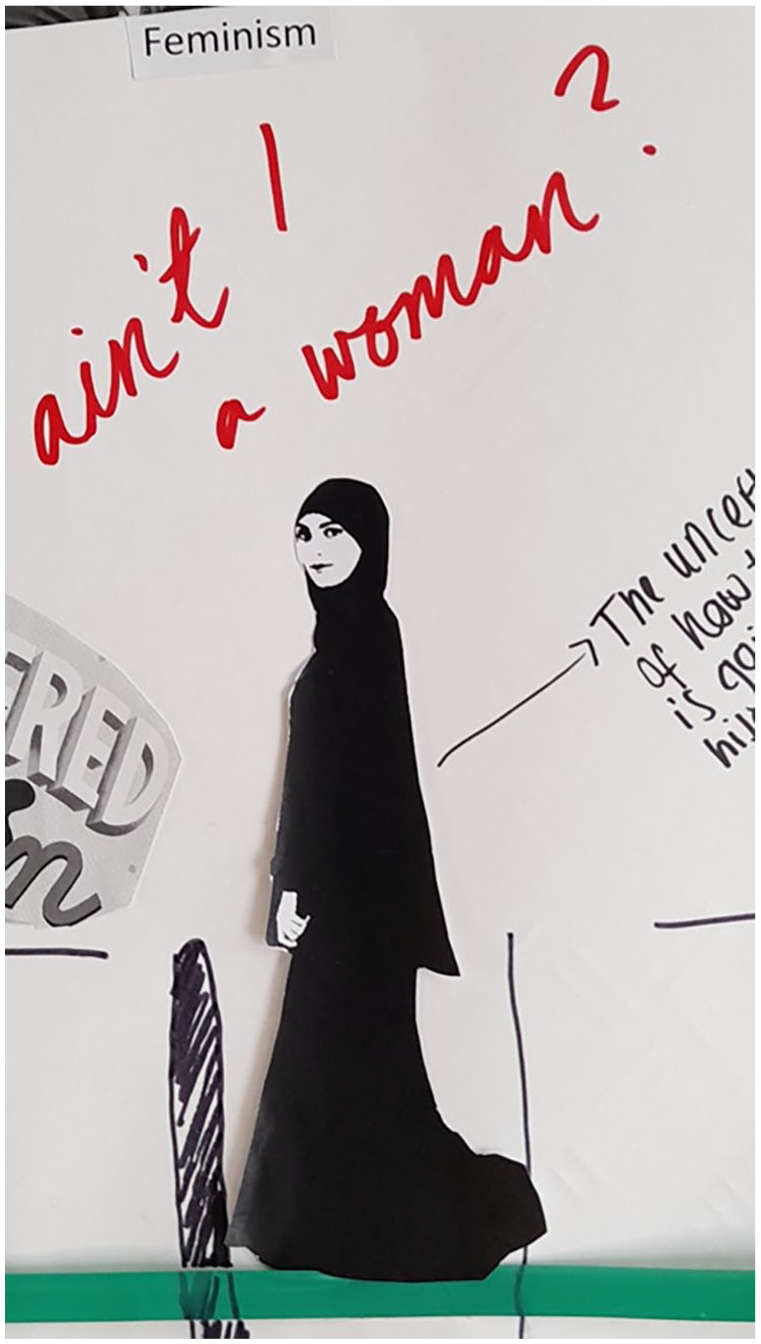
Ain’t I a woman?
Noor: She [Truth] was talking to white women who wanted equal rights with white men. She asked them ‘aint I a woman?’ She means why don’t my rights matter, the same as white women’s do? . . . I feel like that idea is still applicable for Muslim women because when feminists talk about women’s rights, they don’t talk about Muslim women not getting their full rights. . . white women don’t support the rights of Muslim women. Zahra: I love the picture, but the message is properly serious. Muslim women don’t have the same rights as white women. White women will never know racism and sexism at the same time.
For Noor, the collaborative drawing and caption position the young women counter to dominant iterations of feminism that exclusively serve the interests of white women who are disadvantaged in relation to one marker of inequality but privileged in terms of others. They insist that this neither accurately represents feminism nor the experiences of women of colour for whom patriarchy is not the primary oppression. Deploying their sociological imaginations and dispensing the need for facilitating theoretical adequacy (Popay et al., 1998), they direct researchers to intersectional theory by referencing Truth and hooks. Intersectionality is the Black feminist theory that focuses on multiple and interlocking oppressions endured by Black women and women of colour. Typically, it argues that women of colour experience social inequalities simultaneously, these are mutually constituting and produce cascading and complex alterities that cannot be accessed by single issue analysis (Collins, 1990; Collins and Bilge, 2016; Crenshaw, 1989). Intersectionality was also intended as racial resistance against a feminism that was, and arguably still is, led by the single-issue politics of white women (Bilge, 2013).
While the emergence of intersectionality is often related to CRT, hooks coined ‘imperialist white supremacist capitalist patriarchy’ (hooks, 1984: 46) to evoke interlocking political systems that are the foundations of social life. Admittedly unwieldly, hooks’ uncompromising list-like language was prescient. A defence against the misuse of a rebellious concept, hooks pre-emptively rebukes the elective adding on of identities that are not adversely situated in relation to oppressive systems. This precision is useful for the young women because they, like hooks, explicitly name those systems. They know themselves as disadvantageously positioned within imperialism and white supremacy. As Aliya notes: ‘it’s not just about racism. It’s got something to do with being from Pakistan. It’s skin colour and the Muslim stuff . . . and the empire thing, all of it rolled up.’ In reply, Ameena notes how imperial relations endure as mundane everyday oppressions, in this case, as a joke: I told my white friend I was going to Pakistan, and she made a joke saying I’ll have to wear a sheet and stay in a tent. . . This is the whole thing I said before about British Empire . . . The whole superiority thing. It’s racist but it’s also about the nokar–sahib stuff they can’t let go of. (Ameena)
Ameena recognises this as racism rooted in binary imperial oppressor/oppressed relations, which she very astutely characterises as the ‘nokar–sahib stuff’, 1 a point to which we return below.
Clearly, intersectionality is invaluable for participants’ self-narration. It makes sense of and refuses (hooks, 1989) everyday terrorisations of the imperialist white supremacist patriarchal society to which they belong and the ideologically embedded characteristics it imposes upon them. The primacy of imperialism and white supremacy in their accounts underscores intersectionality’s non-negotiable ties with critical race theorising.
Zahra: White feminists don’t care about brown and Black women . . . Sometimes it’s white women who stand in the way of us getting rights. How many women in my life – white women – have been racist to me? Being racist to me for wearing the hijab means you are taking my rights away as a Muslim and as a woman. Imaan: . . . we have to battle men being sexist to us and at the same time, battle white women and white men being racist to us. The only thing white women care about is misogyny, for us that’s just the starter.
Imaan’s declaration that misogyny is ‘just the starter’ for Muslim women serves as a rebuke against the whitening of intersectionality as it has travelled from the margins to the centre. Originally intended as rebellious knowledge rooted in Black feminist scholarship and activism, it has been whitened, consumed and disciplined – reduced to making gender equality work ‘more intersectional’ (Bilge, 2013). By co-opting intersectionality, gender falsely regains its status as the most important marker of inequality for all women, regressing to a feminism that exclusively serves the interests of white women, erases race and the political claims of racialised women (Bilge, 2013; Christoffersen, 2022). Zahra’s blunt ‘sometimes it’s white women who stand in the way of us getting rights’ forces us to confront the historical role of white womanhood in perpetuating, upholding and benefitting from the white supremacist oppression of women of colour (Collins, 1990; Collins and Bilge, 2016; Khan, 2022). It alerts us to the need to protect the original critical race function of intersectionality as a counter to the permanent positioning of gender – perpetuated by white privilege – over race within academia, policy and practice (Bilge, 2013; Christoffersen, 2022).
If we consider testimonies as tutelage for professional sociology, the lessons are clear. The central role of racial colonialism in these women’s lived experience of intersectionality shows that preserving critical race concepts is vital for achieving epistemological justice. More specifically, it emphasises that gender-focused sociologists must recognise the immutable status and politics of race and racialisation in intersectional scholarship, policy and practice.
Navigating Dialectics: Mancunian-Muslim, Nokar–Sahib, Deathworlds–Lifeworlds
Living in imperialist, white supremacist societies generates dialectic self-identities among non-white subjects (Du Bois, 1903/1999; Meer, 2019; Yancy, 2008). Participants’ advanced racial-colonial literacy empowers them to articulate this ‘two-ness’ and expose its historical and geopolitical dimensions. Their testimonies about inclusion and belonging, everyday racialisation and selective access to human rights are a lived theorising that disrupts Eurocentrism. This insurgent knowledge is essential for advancing epistemological justice in sociology yet remains largely absent from the discipline. Leveraging their lived theorising as learning for epistemological justice, we advocate for the inclusion of WEB Du Bois’ understanding of the shift to modernity through the lens of white supremacy, colonialism and global capitalism from the start of undergraduate study. DuBois’ analysis offers a fuller perspective than that of the purported forefathers of the discipline, whose theorising is limited by Eurocentrism.
On feelings of belonging, participants were adamant that their Mancunian identity and Muslimness coexist harmoniously, asserting that they are shaped by Manchester as much as they are forged by their Muslimness. Aliya responds to a section of the collage that depicts Manchester with the caption, ‘One Love, Manchester’: Just like we are part of the Ummah, we are part of Manchester. Manchester is home. As much as us being Muslims is important, being British is just as important. Us being Mancunian is as big a part of us as being Muslim. (Aliya)
Aliya is unequivocal that Mancunianess and Muslimness are equally important identifications, Ameena agrees and elaborates: Manchester is ours and we love it. We treat Manchester like good Muslims should. There’s that Hadith isn’t there? About being part of the community and being responsible for it and everyone in it. Manchester is our community. That’s the Prophet’s teachings, peace be upon him. (Ameena)
Ameena reflects on her love for Manchester through the lens of a Hadith, explaining that being a civically minded Mancunian is cohesive with core Islamic values. The self-reflexive dialogue between purportedly irreconcilable subject positions empowers the young women to refuse prevailing epistemologies at the individual level.
However, refusal is dialectical – always in tension with the racial order, refusal does not dissolve white supremacy or alter one’s position within its social, political and historical structure. The very fact that participants demand recognition as Muslim-Mancunian reflects the ‘two-ness’ of their subjectivities (Du Bois, 1903/1999) – as does Ameena’s own reflection on the colonial continuities of everyday racialisation: ‘It’s because the British went to what was India and basically stole everything. . . on top of that they lorded it over us, they became the sahibs, and we were the nokar. Everything is linked to that.’ This invocation of Britain’s brutal imperial history and the nokar–sahib dialectic demonstrates that while participants assert themselves as Muslim-Mancunian, they also have a painful awareness that the imperial, white supremacist society to which they belong views them otherwise. Ameena’s comments indicate a sense of ‘two-ness’ – a split in self-perception where Muslims must constantly navigate their own identity while contending with the oppressive lens of a dominant white gaze. Ameena perceives this two-ness as permanent and unchangeable: ‘they just can’t get that superiority out of their heads. . . that’s what they see when they look at us, we are still the nokar and they are sahibs’. In Ameena’s words, we see an alignment of Du Bois’ double consciousness paired with the master–slave dialectic, where the latter reflects the power differential between slaves and masters – and nokars and sahib – and the enslaved possess a subservient consciousness reliant on the master for recognition, while the master’s consciousness remains self-aware and independent (Meer, 2019). This tension manifests as a constant struggle for recognition and power, intensified for non-white people in the form of double consciousness – being aware of one’s self-worth while perpetually subjected to a demeaning white gaze.
Participants’ assertions of a cohesive Muslim-Mancunian identity, therefore, must be understood within the broader context of minority consciousness and the quest for recognition driven by a fear of invisibility (Meer, 2019). Echoing Yancy (2008), Ameena highlights the deep, pernicious and often invisible effects of everyday racism on non-white subjectivity and embodiment. Her experience underlines the need to understand and document the lived experience of racism under a white gaze – where the white gaze is a ‘transcendental norm’ that, while appearing race-less, results in the self-alienation of the Black – and Muslim – body.
The deathworlds–lifeworlds dialectic centres on the necropolitical power exercised by the geopolitical West, which exposes millions of Muslims to premature death (Watson Institute, 2023). These narratives oscillate on the failed promise of universality in access to human rights, particularly regarding who is granted the right to life and who is subjected to death: ‘Surat 5:32 from the Quran always comes up when there’s a terrorist attack, the one that says, “to kill one innocent life is like killing the whole of humanity”’ (Noor). This verse was quoted several times in discussions around ideologically driven extreme violence particularly in the women’s collage depictions and subsequent discussions about the Manchester Arena attack in 2015 and to Palestine.
Noor: Talking about the Surat, this is what Islam’s about. So, you can cry for Palestine and be gutted for Manchester. You can’t take the lives of innocent people anywhere, it’s against Islam. Aliya: For me, it’s the hypocrisy with Palestine. You can kill and torture and bomb Muslim countries for centuries and the world won’t even look in that direction. As soon as the victims are white, they care. That means you don’t care if brown and Black people die. That’s it. I’m not a hypocrite, Islam says that all innocent lives are equal.
For Noor, the Surat underpins participants’ solidarities with victims of ideological violence everywhere. It is the Islamic principle of the universality of human rights, rather than religious allegiance, that underpins her moral position regarding the right to life. This counters the widely disseminated colonial logic that commitment to human rights is an inherently European characteristic and the sole achievement of European modernity (Sayyid, 2003).
Referring to a section of the collage showing a Torn Balfour Declaration (Figure 2) and expressing grief over occupied Palestinian territories since 1967, Aliya emphasises ‘the hypocrisy with Palestine’, highlighting the racialised double standards of human rights. This connects to scholarship arguing that human rights under the Universal Declaration of Human Rights (UDHR) have never been universal (Sayyid, 2003). The UDHR, was conceived by the colonial order during its occupation of two-thirds of the world. It failed to condemn ongoing colonial abuses, instead reproducing epistemologies of white supremacy. These epistemologies consider only those who possess whiteness as fully human, denying the humanity, and therefore the right to human rights, of the colonised (Sayyid, 2003). At the time of writing, this racialised hierarchy of human rights is laid bare as the imperial machine conducts a live-streamed genocide with impunity under the so-called rules-based world order.
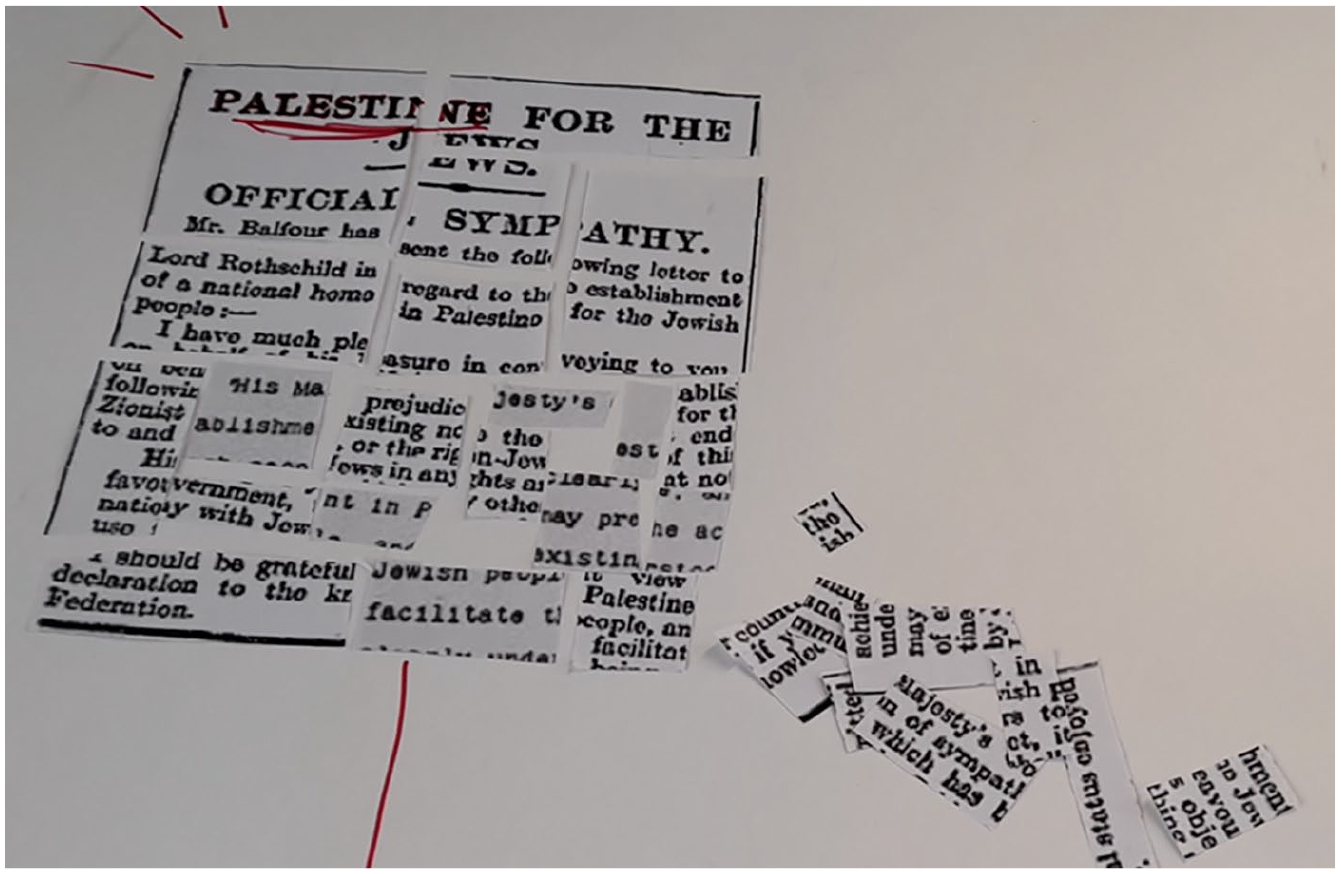
Torn Balfour Declaration.
This scholarship aligns with Aliya’s insistence that ‘you can kill and torture and bomb Muslim countries for centuries and the world won’t even look in that direction’. Aliya’s testimony was recorded before October 2023 yet chillingly foreshadows the UN Special Rapporteur’s conclusions in April 2024 that ‘Israel’s actions meet the threshold for genocide. [It] has destroyed Gaza. Over 30,000 Palestinians have been killed, including more than 13,000 children. Over 12,000 are presumed dead and 71,000 injured, many with life-changing mutilations’ (Albanese, 2024: 1). These vast, immeasurable Muslim losses failed to elicit demands for an immediate ceasefire from western powers (Albanese et al., 2023).
Participants’ concern for the human rights of the Ummah reverberate beyond Gaza and Palestine. They insist UK and US foreign policy in many Muslim countries is racialised necropolitics and that this is ‘normal now’ (Imaan).
Narjis: Name me one country that America and UK are bombing, that’s white. That’s not a coincidence. That’s deliberate. It was going on before we were born and it’s going to keep on going. That’s it. Can you really see real freedom for Palestine or Afghanistan or Iraq? Nope, the British have controlled Muslim countries for centuries. Imaan: All my life, I’m nearly 24 now, it’s been about the bombing in New York. All my life, the country I live in has been killing people like me, literally hundreds of thousands of people like me. I mean we just carry on like that’s normal, I suppose it is normal now.
Ruqaya, Imaan and Narjis believe it is normal for some Muslim populations to exist in a ‘state of exception’ (Agamben, 2005: 5); for them, human rights are suspended, they are disposable and live under conditions that confer social and literal death. Imaan points to the terrifying double standards faced by many descendants of colonised people in coloniser states: ‘all my life, the country I live in has been killing people like me’. Perceived hatred against one’s community produces a terrorising effect on all its members (Mellgren et al., 2021). Those who are not direct targets are symbolic targets, identified through a ‘message effect’ (Mellgren et al., 2021: NP1514) that indicates which categories of people can be subjected to mass premature death without repercussion: ‘If someone who looks like you and believes in what you believe in is getting killed because of those things. It’s as if they are killing you’ (Ruqaya). The young women must navigate the symbolic terror of knowing that the country to which they belong has imposed necropolitics on people with whom they have shared core aspects of personhood ‘for centuries’ (Narjis). Echoing this and as if versed in CRT (Bell, 1995) about the permanence and cyclical nature of a racism, Asma states: ‘I know from listening to my grandparents and parents that racism isn’t going away.’
The young women’s deep understanding of the dialectics shaping non-white consciousness in imperial, white supremacist societies is rooted in racial-colonial literacy. This literacy is essential for epistemological justice, and sociology can draw from these dialogues in two ways. First, it must equip students – its future professionals – with racial-colonial literacy by integrating white supremacy and colonialism into the core theoretical canon. Second, sociology must acknowledge that embracing epistemological justice means materially unsettling hegemonies and their beneficiaries, which cannot happen without discomfort.
Muslim Joy: A Bounded Refusal
The previous section reveals how racial-colonial literacy exposes the enduring nature of imperial white supremacy, causing profound distress for those marginalised within it. However, as counter-knowledge, it also nurtures a form of agency that allows Muslim joy to emerge, though bounded by intersecting oppressions. For these young women, refusal manifests as emotional agency – a resolute defiance that becomes an act of joy – joy that emerges because, as hooks (1989: 20) writes, ‘one transgresses’. We use their narratives as navigational tools to understand agency and resistance in a more nuanced way, resisting the tendency to conflate them with measurable positive change. A zero-sum perspective, focused on idealised outcomes (Abu-Lughod, 1990; Akram, 2019), overlooks the subtle manifestations of more complex forms of agency.
Responding to a collage featuring veiled women striking a combination of the raised fist power salute and the peace sign, surrounded by doves and captioned ‘All humans are born free and in equal dignity’ (Figure 3), participants expressed deep pride and defiance. Tahira stated, ‘I’m proud of my religion, I’m proud to wear the hijab.’ Kulsoom linked her pride to her participation in Black Lives Matter protests, saying, ‘I march because it makes me feel better, it’s about pride, it’s about standing up.’ The women’s expressions of pride, dignity and defiance in their Muslim identities reflect what we term Muslim joy – a positive emotion emerging from defiance where defiance signifies determined opposition to power and the refusal to kowtow (hooks, 1989). The collage image is a refusal of the ongoing racial-colonial order that denies human rights to some Muslim populations, thereby symbolically terrorising all Muslims (Mellgren et al., 2021). Muslim joy is driven by both defiance against oppression, an unwavering love for the oppressed Ummah and the symbolically terrorised self: ‘It is probably worse now than it’s ever been for Muslims. So, I love this image, it’s like, no matter how bad it is, we are honoured to be Muslim, we are proud’ (Asma).
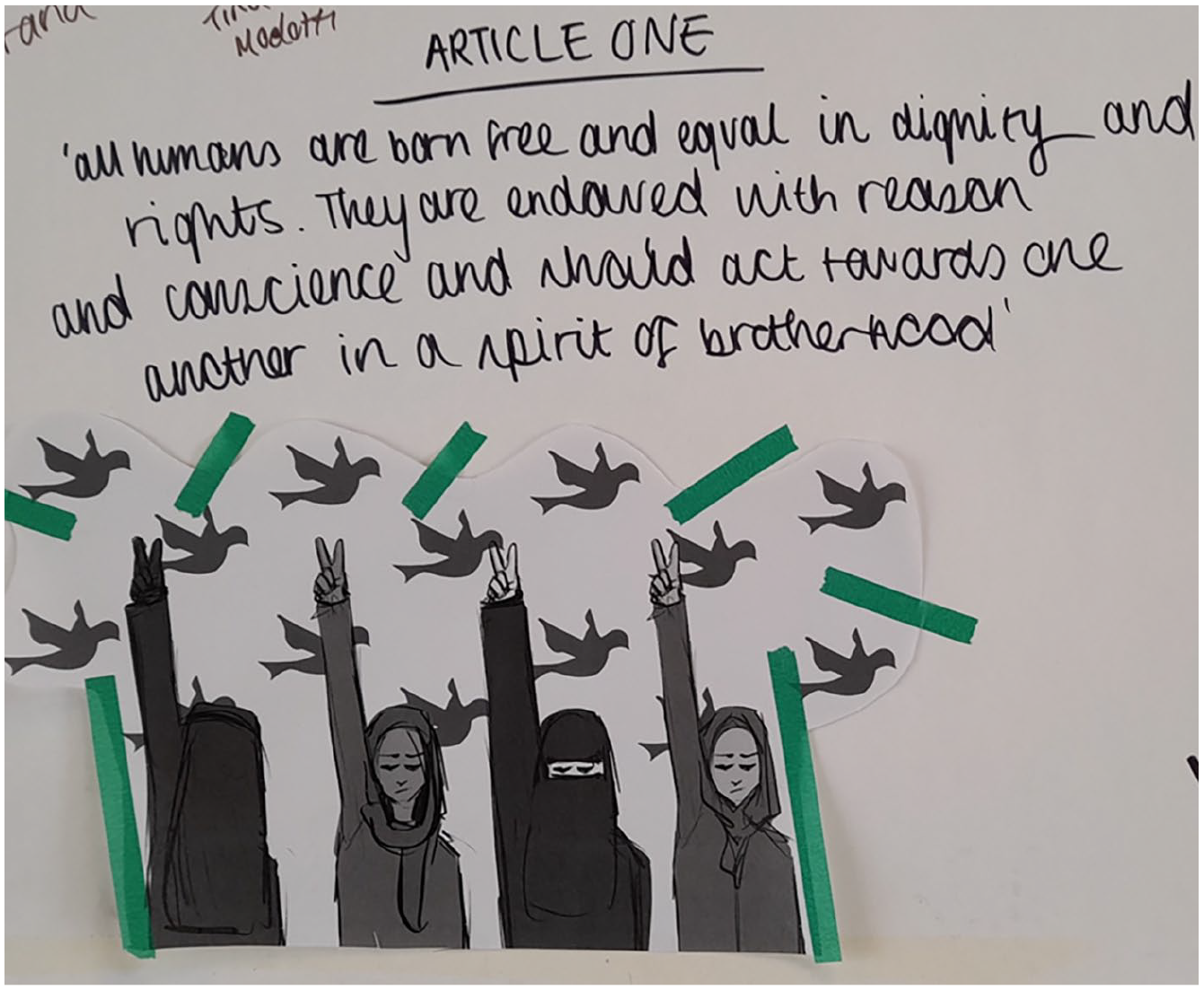
Raised fist peace sign.
Cohen’s (2004) analysis of Black criminality offers a useful framework for distinguishing between agency and resistance. For Cohen, resistance aimed at tangible change requires intentionality and often collective action, while agency involves acts of deviance, defiance or autonomy. In this context, participants’ defiance reflects Cohen’s notion of agency, yet their defiance is tempered by their awareness of entrenched racism, and it is attuned to backlash and thus, bounded by it. Our participants are keenly aware that expressions of Muslim refusal, such as the Muslim power salute depicted in the collage, carry consequences in an Islamophobic society, as expressed here: ‘Imagine if you went through life like that. Out and proud Muslim all the time. You’d get absolutely trashed by people’ (Tahira). In line with scholarship on the visual and contentious politics of the hijab (Khan, 2022), the women recognise that simply being hijab- or niqab-wearing Muslims incites Islamophobia, and celebrating their religion through gestures like the power salute garners hostility. Yasmin is eloquent on this point: ‘Dressing as a Muslim is my power salute – like that’s MY power salute. . . just being out looking like a Muslim is like going to war every day.’ The joy of transgressing oppression reverberates in this quote, and the awareness that dressing as a Muslim can be seen as a provocative act of agency and defiance. If wearing the hijab means ‘going to war every day’, one must tread carefully and pick battles wisely to mitigate emotional and material costs. The women spoke of their desire to call out Islamophobia, and how remaining silent is rarely an option, leaving one ‘feeling like they let themselves down, I let my community down’ (Rania). However, refusing the oppressor (hooks, 1989) is bounded by the negative repercussions of being racially defiant while visibly Muslim.
Rania: It hurts me to ignore stuff, but I can’t afford to be ‘the Muslim’ all the time. Cos sometimes that costs even more. Sarah: When there is no other choice that’s when you fight, otherwise, under the radar. That’s what I do when it becomes too much for me to bear. . . I stay quiet, it’s self-preservation for my own head.
Remaining ‘under the radar’ is a rejection of discrimination, but not where one explicitly refuses perpetrators, which is done in the interests of self-preservation. The women spoke about the negative consequences arising from challenging discrimination: ‘They will make you pay for it – it will change the atmosphere, so you feel uncomfortable and that’s literally the end of any friendship or whatever’ (Amal). This was corroborated by Sana: ‘They get offended, they feel like you are bullying them – they’ve never been told before don’t be a racist, so they actually feel like someone has hurt them.’ The women express agency, but it is a bounded agency, which functions in relation to an ever-present racialising Islamophobic society. Agency is not necessarily geared to transformative resistance, but it is concerned with negotiating space where they can exercise their Muslim identity while counter-balancing harm.
These testimonies provide guidance for scholars dedicated to epistemological justice, particularly non-white scholars, who unlike their white counterparts, are neither shielded by whiteness nor the racially inequitable distribution of institutional benefits. The young women exemplify how bounded agency – defiant and unyielding, yet aware of backlash and expecting minimal material transformation – can still bring profound joy, simply because one transgresses (hooks, 1989). For non-white scholars navigating a ‘neoliberal-imperial-institutionally-racist’ university with limited capacity for change (Joseph-Salisbury and Connelly, 2021: 2), pragmatic and nuanced understandings of agency and resistance are crucial for survival. The historical permanence of imperial white supremacy means non-white people must transcend idealised notions of resistance (Abu-Lughod, 1990; Akram, 2019) and derive joy from its subtle manifestations – and steadfast refusal.
Conclusion
Bhambra’s (2021) call for a historically grounded, connected sociology is confounded by the conditions of UK professional sociology that inhibit racial justice-oriented knowledge making. To have a fighting chance at creating a historically literate discipline, we must turn to ‘sociological publics’ (Meghji, 2024: 1). We present young Muslim women as one such public whose profound racial-colonial literacy generates historically and geopolitically aware theories about intersectionality, dialectic self-identities and refusal as joy.
As sociological interlocutors, our participants’ lived intersectionality reaffirms its original critical race purpose, rebuking the whitening of the concept, which regresses feminism to the political claims of white women above those of all women. Drawing on participants’ insights as instruction, justice-oriented scholars, while focusing on new battles, must also protect older, endangered concepts being stripped of their radical purpose.
Participants testify to Du Bois’ (1903/1999) ‘double consciousness’, the profound ‘two-ness’ that fragments the consciousness of non-white individuals within white supremacy. Consequently, their lived theorising is also dialectical – it identifies the binary colonial logics that underpin current social and geopolitical issues – including inclusion and belonging, everyday racialisations and racially stratified access to human rights. They remind us that while solutions for these issues lie in the present, their origins remain bound to centuries of imperial white supremacy. Yet, professional sociology’s ‘collective possessive whiteness’ (Brunsma and Padilla Wyse, 2019: 1) and ‘white ignorance’ as epistemology (Mills, 1997) does not allow it to acknowldege this, leaving it ill-equipped to adequately address any racially stratified social issues. To begin to alleviate these conditions, we argue it is long past time UK sociology gave WEB Du Bois his flowers – that is, his rightful place at the forefront of the canon.
Our work carries significant implications for sociology and presents a discipline-wide challenge. By critiquing professional sociology and urging serious engagement with the political will of ‘sociological publics’ (Meghji, 2024: 1), we offer a model for rebuilding the discipline from the margins. While this model guides future research across diverse disciplines, much work remains.
We need more empirical work that engages insightful publics on Muslim – and other forms of – joy derived from steadfast resistance to persistent oppression, thus honouring individuals facing white supremacy and global communities of resistance, anti-colonialism and anti-racism. Having demonstrated that critical publics produce vital counter-hegemonic sociological knowledge, it is now crucial that research focusing on race is led only by scholars with sufficient racial-colonial literacy to engage with situated knowledge meaningfully and to meet insightful communities where they are. Finally, we acknowledge that our focus on future epistemological justice does not eliminate the systemic barriers and corrosive conditions non-white sociologists face in building their careers in the UK today.
Footnotes
Ethics Statement
Ethical approval was successfully sought from the Arts and Humanities Ethics committee at Manchester Metropolitan University. Applicant: Fatima Khan. Reference number: 2019-0926-9325.
Funding
The authors received no financial support for the research, authorship and/or publication of this article.
