



Abstract
Over the past thirty years, intersectionality has become a nearly ubiquitous framework for understanding, critiquing, and intervening in complex social inequalities. Emerging from critical race and feminist studies, intersectionality has many shared analytic priorities with science and technology studies (STS), including an emphasis on co-emergent social forces, historical contingency, and interventions that challenge and enhance knowledge production. Despite these shared affinities, STS and intersectionality remain largely nonoverlapping scholarly discourses. Based on a systematic review of intersectionality in eight STS journals, we observe a slight increase in intersectionality’s usage over time but find that its relevance is contained largely to venues outside of the STS mainstream. Our study identifies some ways STS scholars have modeled intersectionality’s responsible use through citation practices, methodological integration, and normative claims about justice/injustice. We also consider what epistemic exclusion of intersectionality might foreclose. We argue that increased use of intersectionality would amplify engagement with justice in STS work, not only by introducing new questions and theoretical frames but also opening possibilities for new interdisciplinary formations. This is not simply an argument for greater inclusion of a term, but rather for transformation in epistemic accountability toward feminist studies and other social justice–oriented fields.
Introduction
Over the past thirty years, throughout the social sciences and humanities, intersectionality has become a nearly ubiquitous framework for understanding, critiquing, and intervening in complex social inequalities. Sociologist of science Kathy Davis (2008) reflected that intersectionality possessed a variety of qualities that made it a wildly successful form of critical social theory, including its flexibility, broad applicability, and appeal across domains of feminist inquiry. Indeed, in one of the most widely cited academic papers on intersectionality, sociologist Leslie McCall (2005) famously asserted that intersectionality is singularly the most important contribution of contemporary women’s studies. From its origins in US Black feminist thought and women of color intellectual activism throughout the late nineteenth and twentieth centuries (Collins 2019; May 2015), through its academic articulation in the 1980s and 1990s in critical race theory (Crenshaw 1989; Williams 1991), and up to its fantastically broad and hugely controversial applications in various disciplinary settings (Alexander-Floyd 2012; Bowleg 2012; Carbado and Harris 2019; Grzanka 2019; Nash 2019), intersectionality has become a touchstone for critical work that purports to take social inequalities and social justice seriously. In fields as epistemically and methodologically distinct as political science (Hancock 2007), philosophy (Berenstain 2016; Dotson 2011), and geography (Valentine 2007), intersectionality has since at least the 1990s become one of the most popular, if not the most commonly deployed, framework for studying social inequalities in critical social inquiry (Collins 2019). And yet intersectionality is, for the most part, apparently absent in the pages of mainstream science and technology studies (STS) journals and key publications.
Despite its stable status as a foundational concept in women’s, gender, and sexuality studies and critical legal studies, as well as its function as a boundary object across multiple disciplines, intersectionality has recently become vulnerable to attack in US culture wars. In response, scholar-activists have been compelled into a defensive stance. For example, founding intersectionality theorist Kimberlé Crenshaw co-organized an open letter action to protest attacks on intersectionality and core concepts stemming from Black feminism, critical race theory, and queer theory in response to the deletion of the term in proposed US secondary school educational curricula. The “Open Letter on Fighting ‘Anti-Woke’ Censorship of Intersectionality and Black Feminism” states, “In light of the multiple ways that intersectionality continues to matter across multiple boundaries, its foundations in Black women’s experiences, and the demands of today’s students to understand its contours, we find the College Board’s ‘politicized’ decision to remove it from the African American Studies curriculum to be disgraceful and dangerous” (Freedom to Learn 2023). This context speaks directly to our own preoccupation with the relative presence or absence of spaces where intersectionality is taught, learned, applied, and analyzed. Given that intersectionality is indeed under attack (i.e., as an academic concept and a political ambition undergirding transnational racial justice movements), and that STS has been a disciplinary space where justice is increasingly positioned as a matter of concern, we are motivated by intertwined concerns about the potential exclusion of intersectionality in published STS scholarship and the potential opportunity for STS to more explicitly engage intersectionality as a contested but potent concept for justice work—both in the United States, where its detractors are perhaps most ardent and beyond. We align with the efforts of the broader “Freedom to Learn” campaign protesting the censorship of the term in educational institutions and underline one of the campaign’s key demands for recognition that intersectionality (still) matters, including within critical studies of science, technology, and society, where engagement with the concept has been comparatively slow to catch on.
We suggest that “intersectionality”—an analytic disposition that views systems of oppression as co-constitutive rather than discrete—is well positioned to ground STS’ commitments in social justice in part because attempts to theorize intersectionality have always been politically invested in transforming institutions, not merely describing them (Collins 2019). Nonetheless, intersectionality and STS are largely parallel, nonoverlapping discourses, despite their many shared affinities, including an emphasis on co-emergent social forces, the historical contingency of all knowledge projects, and interventions that challenge and enhance knowledge production and practices. In this paper, we report the results of our systematic review of eight STS scholarly journals, which suggests intersectionality has a growing but nonetheless marginal presence in STS. We argue the epistemic exclusion (Settles et al. 2020) of intersectionality substantially hinders those efforts.
Unlike other disciplines where intersectionality functions as a boundary object, adapting to local norms and practices, its use in STS reflects for the most part insurgent applications by scholars who, like us, tend to engage STS on its margins. Following Cho, Crenshaw, and McCall (2013, 792), we are interested in “attending to the institutional and field-specific ways that intersectionality is articulated” (or not) in STS. Well over a decade ago, several authors began to echo our own perception of a relative dearth of intersectional analysis in STS. Kennedy (2005, 472) insisted that “feminist STS needs to acknowledge that techno-experiences cannot be understood by reference to only one aspect of identity, like gender, and to engage with debates about intersectionality, an engagement which is comparatively absent from studies of gender and technology.” Moser (2006, 537) concurred, stating “There is growing concern that we seem unable to address more than one difference at a time, thus failing to interrogate enactments of class, race, ethnicity, gender, and sexuality in science, technology, and medicine.” Similarly, Mellström (2009, 888) postulated, “if, in theory, gender and technology are co-produced so are ethnicity and technology, age and technology, sexuality and technology, and class and technology. Still, these latter dimensions of cross-cultural comparison and intersectional understanding are generally absent from STS research, and gender and technology studies particularly, with a few notable exceptions.” Kennedy and Mellström seem to direct their comments to “feminist STS” or those already pursuing an analysis of gender and technology. While such subspecialists have largely responded to their call, we aim to show that engagement with intersectionality in STS’ center remains sparse. We looked at the content of eight STS journals to quantify and evaluate the explicit use of intersectionality within STS scholarship and found a substantively low uptake of the term and framework. In this moment of transnational consciousness about pervasive social inequalities that threaten the survival of democratic societies (including targeted attacks on intersectionality), we contend it is imperative for STS scholars to consider why intersectionality has been absent in the academic mainstream of the discipline/field. We consider what is lost by failing to take up the epistemic and political challenges of intersectionality in STS inquiry and, in turn, what can be gained by embracing intersectional perspectives in the interdisciplinary study of sciences, technologies, and their mattering.
Intersectionality is not the exclusively appropriate way to study power and inequality in relation to science, technology, and society. But its relative absence in STS represents a curious site of silence (Clarke 2005) that we center in this article. Why has intersectionality remained largely absent in STS, given its useful critique of how multiple systems of difference collaborate in the production and maintenance of social stratification, its widely recognized value, and its consonance with STS’ analytic priorities (e.g., identifying and critiquing knowledge projects and technological innovations for their unanticipated consequences; Sismondo 2004; Hess 1997)?
To explore this question, we start by drawing upon foundational STS work by Harding (1986) and Haraway (1988) to begin pondering what we term the “justice question in STS” by assessing recent areas of progress and ongoing exclusions of intersectionality-oriented projects in STS. We then turn to the “science question in intersectionality” to demonstrate how and why intersectional applications within STS have the potential to resolve the long-standing tension between normative and descriptive/constructivist claims within STS. Finally, we empirically document the missing/marginal discourse of intersectionality in STS journals and end with a discussion that considers the prospect of an STS field that might consider intersectionality one of its valuable tools for critical inquiry.
The Justice Question in STS
The missing discourse on intersectionality in STS is particularly curious given the field’s recent high-profile and mainstream engagement with questions of social, environmental, and economic justice. A decade ago, Mamo and Fishman (2013, 160) wrote that “[STS] has engaged justice as a matter of concern, but must go further to examine justice frameworks more explicitly and to participate in efforts that seek justice in ways that are associated with, yet distinct from, the study of ethics.” Their special issue of Science, Technology, & Human Values (ST&HV) on the place of justice in STS was less the inauguration than the culmination of decades of relatively marginalized but nonetheless consequential and influential work, largely ushered by feminist, queer, and antiracist scholars who use STS theory and methods for social justice–focused research, policymaking, and activism (Cozzens 1993). Central to Mamo and Fishman’s argument was that while “justice” may not be an object of study for STS, justice may function as the product of STS work that is expressly critical of science and technology’s heterogeneous roles in the production of social inequalities (Harding 1986, 2008). They asserted that STS offers unique tools that may catalyze novel discourse and interventions into inequities produced and exacerbated by contemporary problems in science, technology, health, and medicine. Further, they signaled that justice may motivate some STS work, whereby research questions and methods are animated by a commitment to justice instead of an allegedly apolitical curiosity or agnostic orientation to the consequences of science and technology or the consequences of STS work (cf. Collins, Evans, and Wienel 2017).
Over the past decade, the discourse on justice and social inequality in STS has grown and, arguably, become less peripheral. Responding to and extending Mamo and Fishman’s (2013) argument, Benjamin (2016a) argued for more socially engaged and applied STS-type work; specifically, she suggested that scholars in STS and allied fields must learn not only to do work on race, for example, but against racism. Like Mamo and Fishman, Benjamin (2016a, 146) rearticulated a phrase made popular in STS by Latour (2006) but redirected these “matters of concern” with an explicitly abolitionist and anti-carceral itinerary: “STS is, after all, a field concerned with the construction of matter, whether physical matter, matters of fact, or matters of concern.” Echoing Benjamin, Vertesi (2016) suggested that the tools of STS (e.g., the sociology of scientific knowledge) should be used to understand new digital technologies and practices with the goal of undermining and reconstituting them for justice interventions. The editors of a 2017 volume on “queer feminist science studies” reflected the centrality of science, technology, and embodiment to decades of scholarship in feminist and queer studies, despite the relative marginality of feminist and queer studies to what they called “traditional STS” (Cipolla et al. 2017, 4). Molldrem and Thakor (2017, 3) contemporaneously posited “queer STS” as those trans- and cross-disciplinary STS projects that, following the legacy of critical feminist, materialist, and other radical traditions, “unpack how scientific power both exerts its homogenizing rule against the diversity of human experiences and generates new forms of life.”
Alongside these agenda-setting arguments, empirical investigations of inequality, resistance, and restitution/reparation are increasingly common in STS, even if they do not invoke intersectionality as a primary analytic frame or inspiration. Nelson (2016, 6) investigated the “social life of DNA” to uncover the role(s) of genomics in racial justice efforts, arguing that genetic knowledge is deployed by expert and lay actors in what she termed “reconciliation projects,” such as those social movements that “contribute to community cohesion, collective memory,” or other forms of social transformation. Nelson’s findings undermine the kind of expert/lay or laboratory/public juxtapositions that have preoccupied STS scholarship for decades (e.g., Wynne 1992) while also suggesting the capacity for STS work to uncover and cultivate pathways for racial justice. Hatch’s (2019) work on psychotropics in US prisons likewise positions the psychiatrization of incarcerated bodies and minds as inextricable from questions of criminal justice, prison abolition, and white supremacy. Bhatia (2018) took an evident double-standard as the starting point from which to interrogate the transnational flows of sex selection processes across West and non-West; her mixed-method, multisite fieldwork reveals how reproductive technologies co-emerged with reproductive politics to stratify sex selection based on entanglements of technological meanings with gender, race, and nation. Clune-Taylor’s (2020) work aims a critical STS lens on public health and medicine to chart the stakes of the medical transformation of multifarious intersex conditions (and their management) into the taxonomic “Disorders of Sex Development” (DSD) model. Their research is especially sensitive to the political and embodied consequences of DSD for people whose bodies are classified as falling under the DSD umbrella, rather than an exclusive focus on the upstream figures (e.g., scientists, leaders in medicine, public health agencies) whose power-brokering and classification-making remake the (medical) lives of those lacking influence on the decisions that govern their healthcare. Collectively, these and similar provocations 1 (e.g., Pollock 2015) represent a persistent call for debate about how STS should both describe and affect social worlds (Cozzens 1993), particularly social worlds and arenas at the nexus of science, technology, and social inequality (Clarke 2005). Of course, these debates have important implications for how STS scholars will chart the intertwined epistemic, methodological, and political futures of STS.
Whether or not one considers justice and inequality to be or have been central concerns of canonical STS (e.g., as codified in the Handbook of STS, ST&HV, journals like Social Studies of Science, the program at 4S and European Association for the Study of Science and Technology (EASST) meetings), it is harder to deny the relevance of justice concerns to the broader discourse on science and technology (and vice versa) in our global society, including what some STS scholars have called the crisis of expertise (Eyal 2019) or the emergence of “post-truth politics” (Sismondo 2017). The empirical consequences of environmental injustice, racist algorithms, persistently asymmetrical population-based health outcomes, and the fraught implications of postgenomic science, for example, all evince the urgency of tools to identify, explain, and intervene in systemic inequalities that reflect and are produced by technoscience. It is unsurprising then that some of the most celebrated scholarship in feminist, queer, disability, anticolonial, and critical race studies of the past twenty years has centered science and technology as matters of concern—even as this work may be subject to boundary-policing and even marginalization among mainstream STS practitioners.
This discrepancy or lack of mutual engagement between justice-oriented fields and STS has always been apparent to scholars, like ourselves, situated at the margins of STS. We have shared many anecdotes of how we have felt both drawn to STS but also a distinct sense of disidentification at particular moments (cf. Casper 2016). For example, at a 2018 STS NSF-sponsored workshop, a preeminent STS scholar described the work of Michel Foucault as relatively insignificant in the development of STS as a field. This characterization was challenged by a senior, transnational feminist science studies scholar who suggested that Foucault’s theory of biopower and poststructural critique were quite influential to some STS scholars—just not those typically afforded the opportunity to define what is and is not STS. This kind of fleeting interaction at a professional STS setting exemplifies how taken-for-granted assumptions about the intellectual core of STS are. These assumptions are often deployed in ways that position scholarship focusing on questions of power, justice, and inequality as less central to STS than work that considers the development of scientific knowledge and technology as distinct from—or at least superior to—questions of social justice. Moreover, although queer, feminist, and critical race scholars have proffered abundant qualifications to his work, Foucault’s contributions to the study of power as inextricable from the study of knowledge projects has influenced major strands of STS scholarship considered canonical (e.g., Clarke and Fujimura 1992). Thus, the elision of Foucault is just one instantiation of disciplinary boundary work but can be helpful for thinking through other consequences of constituting the inside and outside of STS, particularly when attending to the missing discourse on intersectionality in the field.
The Science Question in Intersectionality
Although routinely dismissed as trendy (King 2015) and a locus of various strands of critique that Nash (2019) has called the “intersectionality wars,” intersectionality is nevertheless a preeminent analytic framework for tackling questions of power, materiality, knowledge, and structure. Several meta-scientific analyses have recently documented the citation patterns of intersectionality scholarship since the term’s first academic publication by Crenshaw in 1989 and have documented the pronounced rise in intersectional work throughout the 1990s and intensifying particularly during the first decade of the twentieth century (Moradi et al. 2020; Mügge et al. 2018). A number of publications became particularly notable for their wide uptake (e.g., Bowleg 2008) and for the ways such influential papers operationalize intersectionality and determine its analytic capacities. McCall’s (2005) taxonomy of intersectional approaches, for example, treats intersectionality as a way of handling categories and offers anti-, intra-, and inter-categorical analyses as ways of grouping or sorting how scholars handle intersectionality. Cho, Crenshaw, and McCall (2013) characterized intersectionality as “an analytic disposition,” instead of a testable theory or set of methodological parameters (p. 795; see also Davis 2008). Collins (2019) has long asserted that intersectionality is a critical social theory, whereby “critical” denotes its relationship to power (i.e., antagonistic) and “social” distinguishes intersectionality from scientific theories that are testable. Hancock (2007) framed it thusly: intersectionality should be understood as both a normative and empirical paradigm that seeks to describe the material terrain of complex inequalities and redress such injustices through critique, policy, and social transformation.
We are interested in the relationship between STS and intersectionality for many reasons, not the least of which is that the empirical and normative dimensions of intersectionality mirror the descriptive and normative distinction (chasm, even?) that Mamo and Fishman (2013) suggested STS scholars must engage (cf. Lynch & Cole 2005) in order to clarify the field’s relationship to justice and that Benjamin (2016a) insisted were essential to actualizing an STS with the efficacy to materially address/redress racial injustice. In intersectionality studies (Cho, Crenshaw, and McCall. 2013), in contrast to STS, the normative and the empirical are inextricable. Intersectionality emerged as an academic framework from social movement politics, specifically US Black feminist activism and women of color’s multiracial feminist organizing against institutional, structural violence and advocacy efforts that framed such violence in single-axis terms of race or gender, or class or sexuality, and so on. The synthesis of the normative and the empirical has not been a primary or even secondary controversy among academic practitioners of intersectionality, at least in part because feminist standpoint theory is so thoroughly accepted as an epistemic maxim. The opposition to intersectionality’s political ambitions in other academic disciplines has largely emanated from positivists and traditionalists who consider feminist, antiracism, and other social justice movements to be nonacademic issues that have no place in serious intellectual inquiry, scientific or otherwise (e.g., “grievance studies” in Lagerspetz 2020). Although the political ambitions of intersectional scholarship are often enunciated, there is a widespread assumption—anchored in intersectionality’s origins in Black feminist thought (Collins 2019)—that an opposition to social injustice is not orthogonal to the pursuit of more accurate, valid, and indeed just accounts of the empirical universe (Haraway 1988; Harding 1986).
Intersectionality and STS
Mamo and Fishman (2013) based their call for STS to reflexively engage with “justice” in part on an analysis of three main STS journals: Science as Culture (SAC), Social Studies of Science (SSS), and ST&HV. The authors reflected on a lack of explicit engagement with these concepts, demonstrating that their search of the key word “justice” from 1992 to 2012 came up with only fifteen hits; “ethics,” on the other hand, returned sixty-one results. Having trained under Mamo in our graduate programs and inspired by this article, two of us in 2013 coincidentally took up a similar search of the term “intersectionality” in the same three journals and came up with only four hits (n = 0 in SAC, n = 2 in SSS, and n = 2 in ST&HV). Given that our primary disciplinary engagements in women’s, gender, and sexuality studies and psychology were steeped in an intensive reflexive engagement with the concept of intersectionality, the dearth of its use in STS seemed remarkable to us and likely not unrelated to the field’s lack of explicit engagement with “justice.” Indeed, the handful of articles that did engage intersectionality within STS tended to note that such contributions were rare in the field.
Much has changed in STS in the interim. Those three journals, each with publication histories dating back to the 1970s, have been joined by at least five new STS journals including East Asian Science, Technology and Society (from 2007), Science & Technology Studies (from 2012), Engaging Science, Technology, and Society (from 2015), Catalyst: Feminist, Theory, Technoscience (from 2015), and Tapuya: Latin American Science, Technology and Society (from 2018). These new publications mark a tendential shift in the field that Moore (2021, 58-59) calls “the new STS,” characterized by “reengaging capitalisms, reinforcing the importance of positionality/relationality as starting points for scholarship, and placing emphasis on generative projects.” Although the “new STS” began to develop on the field’s margins, their collective impact might shift the center. As Moore describes, “Intellectual networks that were developing and thriving away from the centers of STS, and indeed, perhaps have thrived because they were not being ‘disciplined’ through mainstream STS, are now remaking STS in important ways visible in new journals” (p. 66). As interdisciplinary scholars ourselves working on the periphery of STS, we have followed, if not actively contributed to, these shifts. We decided the time is right to take another look at how “intersectionality” has fared since that first impulsive search in 2013 prompted by Mamo and Fishman’s (2013) work.
Despite some deployments of intersectionality and calls for its increased use in feminist STS inquiry, there has been no systematic account of intersectionality’s uptake—or lack thereof—in STS, which is a critical step in establishing how intersectional approaches might inform future STS work on social inequalities (cf. Invernizzi et al. 2022). Accordingly, we conducted a systematic review of intersectionality in STS discourse to trace its citations in the field, identify patterns in its use, and to clarify shared affinities between STS and intersectionality. We detail our method, summarize our findings, 2 and discuss the theoretical and methodological implications of our results below.
Method
Following Preferred Reporting Items for Systematic Reviews and Meta-Analyses (PRISMA) guidelines (Page et al. 2021) for systematic literature reviews, we undertook a search in the three original and five new publications. Unlike Mamo and Fishman’s (2013) search of titles and abstracts in five-year increments starting in 1992 and ending in 2012, we searched all publication content archived online on publishers’ websites (i.e., full text, not just titles and abstracts). Among the older (“legacy”) journals stemming from the 1970s and 1980s, in two cases, the archived online content did not stretch back to the first issue (SAC from 1987 and ST&HV from 1976). This was inconsequential because intersectionality did not appear in academic print until the late 1980s (Crenshaw 1989), and we could very well have excluded any prior content. The periods searched were comprehensive of all online content available for each individual publication: 1987-2021 (SAC), 1971-2021 (SSS), 1976-2021 (ST&HV), 1988-2021 (Science Studies [SS], followed by Science & Technology Studies [S&TS]), 2015-2021 (Engaging STS), 2015-2021 (Catalyst), 2018-2021 (Tapuya), and 2007-2021 (East Asian STS). 3 S&TS presented a dilemma for our two-part division between “legacy” and “new” journals. While the journal’s official start date of 2012 categorized it as “new,” the journal’s precursor called Science Studies first appeared in 1988 and its articles were archived under the S&TS website. Thus, even though we conducted searches in eight journals, our categorical totals add to nine because we split the classification for S&TS into two: SS as “legacy” and S&TS as “new.” While our temporally based classification does not attempt to indicate the relative significance of any journal to the field, we suggest following Moore, that newer journals tended, albeit imperfectly, to emerge in the periphery of STS.
We searched for “intersectional*” (not in quotes) and eliminated book reviews, but we did include editorials and introductions to special issues. Since the word “intersection” yielded higher numbers of articles, many of which were unrelated to the concept “intersectionality” (such as references to working at the intersection of various disciplines, which is quite common in STS), we chose not to pursue this broader search. We then retrieved each article in the sample (N = 96), read the titles and abstracts, and located the searched words to view them in the context of the full article. We examined other sections as necessary to determine how the term was invoked. We then excluded articles (n = 18) where the term was not actually used by the authors (i.e., it appeared only in a title within the references or in an author’s bio) or when it was used but in a way not relevant to the conceptual meaning of co-constitutive systems of power and inequality. So long as the term reflected the concept’s meaning, even if invoked peripherally, we included the article in our final sample (N = 78). A research assistant helped build our corpus as an Excel spreadsheet, and we collectively made notes on all manuscripts. We created a set of questions (listed below) that we asked of each manuscript. Of course, the sample is limited because it does not include STS scholarship published outside these journals, such as in books or conference proceedings, or unpublished manuscripts in the proverbial “file drawer.”
Our decisions reflect our intention to highlight the most explicit mentions of the term intersectionality. In our view, the evident lack of intersectional approaches in the field of STS justifies focusing on explicit mentions of the term, even though some scholars of intersectionality have argued that an intersectional approach is better defined by what it does rather than what it is called (Cho, Crenshaw, and McCall 2013). However, others have observed that reluctance to invoke intersectionality specifically, as well as its intellectual genealogies, may cohere into a systematic elision of the Black and other women of color worldwide who have shaped its development (Alexander-Floyd 2012; May 2015). Accordingly, in this investigation, we were interested in documenting instances of the term as a crude indicator of the field’s epistemic investments. As Davis (2008, 27) argued, intersectionality as a “buzzword” functions as “a catchy and convenient way of expressing the author’s normative commitments.” Similarly, we suggest that the term’s presence signals a field’s intention to engage extant scholarship that has more readily taken up normative justice claims. Consistent with recent citation analyses (Moradi et al. 2020), our results underscore the presences (and absences) of intersectionality’s appearances in STS journals.
Results
Some quantitative figures helpfully contextualize the texts that constitute the corpus of our analysis. As illustrated in Figure 1, of the seventy-eight articles in our sample, fifty-seven (73 percent) came from “the new STS” (Moore 2021) publications and twenty-one (27 percent) from what we are calling “Legacy STS” 4 : SAC, SSS, SS, and ST&HV. Of the twenty-one from the Legacy STS, only eight (38 percent) were published prior to 2017, and thirteen (62 percent) were published within the past five years (2017-2021). Overall, a large majority of the sample (83 percent) were published in the last five years of the sampling period ending in 2021 (see Figure 2). The publication with most articles in our sample (n = 43) was Catalyst, the only expressly feminist STS journal. Accordingly, when we address the dozens of papers on intersectionality in STS that, to a greater or lesser extent, engage the topic or use it as an analytic frame, it is imperative to recognize that the vast majority of these manuscripts do not appear in the discipline’s most prestigious and mainstream publication venues. Below, we briefly document the results to each question we posed and then highlight articles that actually employ intersectionality as an analytic frame.
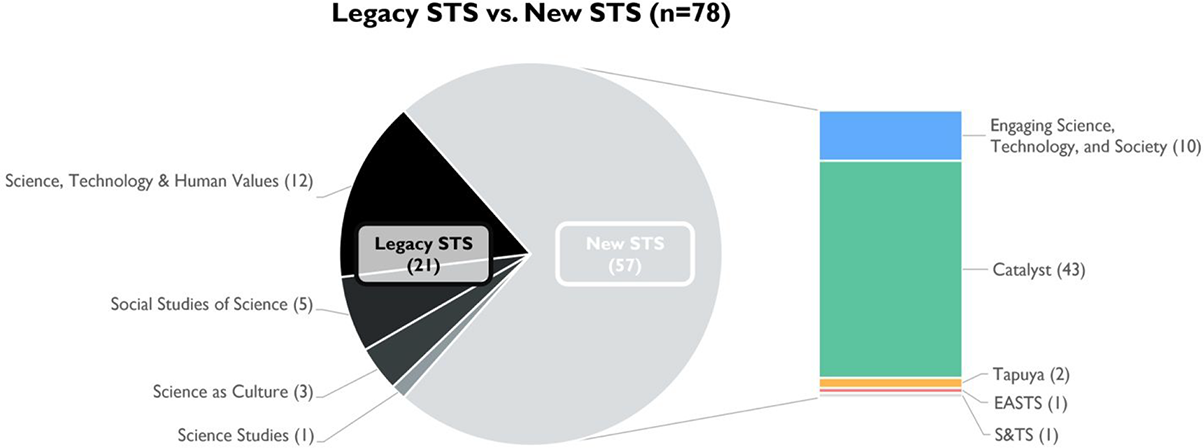
Intersectionality in science and technology studies journals (N = 78): “Legacy” journals and “New STS.” Science, Technology, & Human Values, 1976-2021; Science as Culture, 1987-2021; Social Studies of Science, 1971-2021; Science Studies, 1988-2011; Science, Technology, and Society, 2012-2021; Engaging STS, 2015-2021; Catalyst, 2015-2021; Tapuya, 2018-2021; and East Asian STS, 2007-2021.
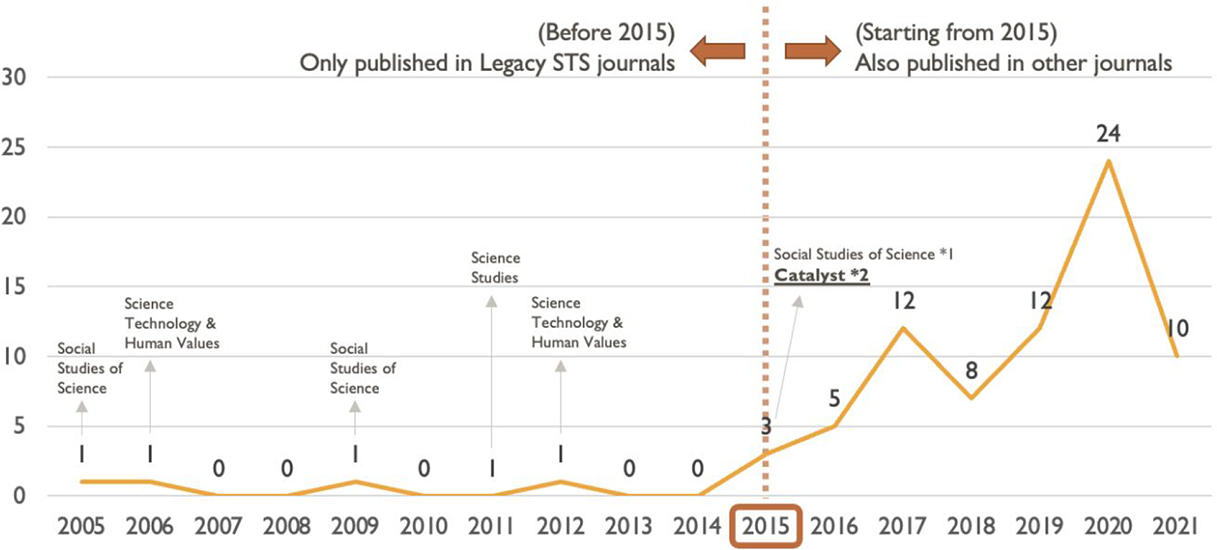
Intersectionality in science and technology studies journals, 2005-2021.
Is the Term Invoked Peripherally or Employed as Part of the Analytic Frame?
This question ultimately resulted in identifying three main categories: analytic frame, central, and peripheral. “Analytic frame” and “peripheral” roughly corresponded to “strong” and “weak” intersectional approaches identified by Dill and Kohlman (2012), wherein weak intersectionality simply acknowledges multiple dimensions of difference while strong intersectionality critically examines these dimensions of inequality in relation to one another. However, our system of categorization was not meant to be evaluative (as “strong” or “weak” might imply). Instead, we sought an agnostic understanding of where and how the concept was appearing in the literature.
Most manuscripts’ engagement with intersectionality were classified as “peripheral,” characterized by a single or tangential reference to intersectionality as a concept. Peripheral uses typically involved papers about social problems that only used intersectionality as a descriptor (e.g., “intersectional feminist”) as in Parvin and Pollock’s (2020) analysis of the concept “unintended consequences.” Many of these papers yielded important insights into social dimensions of science and technology and frequently offered critical perspectives on race (Hatch 2020), gender (Bianca 2021; Felt 2019), or disability (Forlano 2017; Hamraie 2019). Sometimes, intersectionality was suggested or implied as an area of future inquiry (Sariola 2018; Smith-Doerr, Alegria, and Sacco 2017; Götschel 2011), and other times as an area of the literature with minimal but noteworthy relevance (Scroggins and Pasquetto 2020).
Some manuscripts that we identified as “central” reported on projects in which intersectionality was integral or foundational to the discussion but not applied analytically. For example, in Catalyst, Molldrem and Thakor’s (2017) theoretical review essay positions queer STS as “intersectional work” that attends to multiple dimensions of difference. Likewise, Fitsch and colleagues’ (2020) roundtable dialogue focused on coalition politics and the incorporation of intersectionality in neurosciences and feminist STS. In that roundtable, Roy pointedly critiques feminist neuroscience scholarship for reproducing a “white norm” (quoting Ngubia Kuria [2014, 110]) and for failing to engage explicitly and directly with intersectionality, among other critical traditions.
Ultimately, we identified seventeen manuscripts, six in the “Legacy STS” (none in SAC and SS), and eleven in the “New STS” that used intersectionality as an analytic frame (again, most were in Catalyst). Making visible the relational impacts of asymmetries of power, these studies covered a diverse range of technologies and sciences. What they have in common is a high degree of specificity in laying out the stakes for as well as the explicit claims made toward social justice. Pitts-Taylor (2019), for example, highlights the extreme racialization of poverty by paying close attention to the location of identities (their historical and cultural contingency), critiquing the re/inscription of categories (“anti-categorical” analysis per McCall [2005]), and challenging claims of essentialism that emerge from centers of institutional power and authority in neuroscience. In another example, Olson and Labuski (2018, 550) use intersectionality to reveal the unmarked manifestation of gender and race as “prototypical white masculinity” in the “design and deployment” of civilian unmanned aircraft. The authors call for a “critical technological consciousness” (559) to prevent an enactment of dominant surveillance practices that target marginalized groups. Mellström’s (2009) article in SSS is one of few early STS publications to invoke an explicit and central intersectional framework, citing core texts by Crenshaw and Collins. His paper likewise serves as a model of “strong” intersectionality (Dill and Kohlman 2012) in considering the particular location of identities and the complex interrelationships of gender, class, age, and ethnicity. He draws into sharp focus what has been rendered invisible (women in IT) through dominant narratives.
Offering a genealogy of Black women in medical experimentation and practice in Catalyst, Bailey and Peoples (2017, 2) call for a Black Feminist Health Science Studies (BFHSS), defined as a “social justice science, which has as its focus the health and well-being of marginalized groups.” The authors identify as “critical feminist technoscientists” trained in gender studies and are openly critical of STS’ “whitewashing of women” and make several references to the “necessarily intersectional issues of Black women’s health.” They apply a central idea from a foundational text on intersectionality (the Combahee River Collective Statement) to claim, “if Black women as a whole were healthy, it would mean that many of the barriers to quality healthcare would necessarily be removed, creating a more ethical and just health culture for everyone” (Bailey and Peoples 2017, 4). The authors make a normative justice claim in the form of a call for BFHSS as integral to the intersectionality at the heart of their analysis, which is quintessentially focused on the simultaneously racialized and gendered subject.
STS’ proclivity for centering nonhuman actors in its assemblages of concern might interpolate intersectionality in ways that have remained largely unexplored in other disciplines. Liu (2021) applies an intersectional analytical frame in an account of “human-atmospheric relations” to posts made via self-tracking apps by people in China about their experience of jogging in smog. The study extends literature that has focused for the most part on individual self-tracking experiences and neoliberal subjectivity in the Global North. Liu’s intersectional approach interweaves class and nation to provide a more complex account of health that exceeds the individual body by accounting for its relation to environmental health and the “postsocialist” nation state. On the other hand, Weaver (2017, 12) terms “interspecies intersectionalities” to interrogate “how relationships between human and nonhuman animals reflect as well as shape experiences of gender, race, sexuality, class, nation, species, and breed.” Weaver’s study on the science of dog training accounts for complex discourses of dominance and machismo, as well as white savior complexes.
How Many Times Does the Term Appear?
For each manuscript included in the overall sample (seventy-eight), we recorded the number of times intersectionality (i.e., “intersectional*”) appeared in each manuscript, which resulted in a range of one to thirty-four. The manuscript with the most invocations of intersectionality (Weaver 2017) also used it as an analytic frame. However, greater numbers of references did not necessarily correspond with an intersectional analytic. For example, we designated Schiebinger (2021) as “central” for the question on how the term was invoked; their paper included the term twenty-seven times to designate race and ethnicity, alongside sex and gender, as “intersectional factors” used in a curriculum designed to teach natural scientists and engineers how to incorporate intersectionality in their research design. In other cases, intersectionality was used as a term only once but was the core analytic frame of the paper (e.g., Bhatia 2020). Accordingly, the number of uses of the term (or its derivations) did not correspond to manuscripts designated as “central” or “analytic,” though manuscripts designated as “peripheral” did tendentially correspond with numerically fewer uses of the term.
What Systems of Power and Inequality Are Intersected?
Of the seventeen articles we classified as using intersectionality as an analytic frame, the majority (fourteen) focused on the intersection between race or ethnicity and gender alone, or alongside other systems of power and inequality. Among their foci, nine manuscripts incorporated class, five nationality, three disability, and three sexuality. There was only one incorporation of indigeneity and one of species.
What or Who Is Being Studied?
We coded each of the articles for their objects of study, that is, the target of (intersectional) analysis. The majority of the articles in our sample centered humans, often as experts or those with skills-based knowledge, such as IT professionals, academic faculty in science, technology, engineering, and mathematics (STEM) fields, ethnographers, or physicians. Sometimes, the knowers were lay people, counter-experts, patients, or disabled women programmers/hackers. However, intersectional categories materialized in diverse nonhuman forms, as well, such as in digital infrastructures (Houston, Gabrys, and Pritchard 2019), brain morphology (Pitts-Taylor 2019), or in hygiene (Glabau 2019). In a few cases, manuscripts focused on a combination of humans and nonhuman such as disabled cyborg bodies (Forlano 2017) and humans and their “microbial partners” (Benezra 2020).
Importantly, we found that the articles in our sample were not just studies of science and technology but also about intersectionality as a way of doing STS. Topics and domains of study include computer science (Mellström 2009), aviation science (Olson and Labuski 2018), epidemiology (Shim 2005), scholarly productivity in STEM disciplines (Gaughan, Melkers, and Welch 2018), neuroscience (Pitts-Taylor 2019), digital technologies (Berkhout et al 2021); demography (Bhatia 2020), self-tracking technologies (Dolezal 2021), translational science (Jablonar and Lee 2020), animal science (Weaver 2017), environmental science (Liu 2021), biomedicine (Joyce, James, and Jeske 2020; Moser 2006; Bailey and Peoples 2017; Pollock et al. 2017), and food safety (Glabau 2019). Authors build the case for their own intersectional analysis by critiquing other approaches. For example, intersectionality is invoked to advance an argument that nonintersectional analyses (1) fail to understand the impacts and consequences of technologies, networks, or institutions, and (2) they also risk reproducing harmful norms and reinforcing colonial, racialized, and gendered hierarchies.
For example, Gaughan, Melkers, and Welch (2018) conducted a quantitative intersectional analysis of scholarly productivity in STEM fields in explicit contrast to other approaches that examine only authors’ race or gender. They note, however, that their analysis is hardly as nuanced or critical as the intra- and inter-categorical approaches advanced by some proponents of intersectionality (e.g., Bowleg 2008; McCall 2005), because of the limitations of their quantitative, category-based inquiry. Shim (2005) used intersectionality to expose dynamics in patient-provider and expert-lay epistemic divides that are actively obscured when investigating cardiovascular disease solely in terms of race or gender or social class. Shim illustrates how the construction of “culture” in cardiovascular disease treatment is fundamentally dependent upon intersectional dynamics. In her study of the ways, neuroplasticity is used as a tool to mark and potentially stigmatize the brains of members of certain social groups (e.g., people experiencing poverty), Pitts-Taylor (2019) states that an intersectional analysis is needed, particularly to grasp poverty’s “extreme racialization and to address the potential for essentializing poor people in the scientific reproduction of sociopolitical categories of personhood” (p. 663). In sum, intersectionality is used to study diverse topics, though its justification is consistent: it will reveal or yield insight into dynamics that others will not (at best).
How Does the Study Articulate a Normative Social Justice Dimension (If at All)?
The papers that use an analytic frame all articulate a normative social dimension. Many papers demonstrate that the processes under investigation risk reproducing and reinforcing harmful racialized hierarchies (e.g., Dolezal 2021; Bhatia 2020; Olson 2018). Some authors make specific calls for action, whether it be to urge a discipline to account for structural and relational processes that essentialize and harm particular groups (Shim 2005; Pitts-Taylor 2019), and others persuasively argue for the urgency of new analyses, examinations, and engagements (Mellström 2009; Moser 2006; Berkhout et al. 2021). Gaughan, Melkers, and Welch (2018); Pollock et al. (2017); Jablonar and Lee (2020); and a Catalyst editorial (2018) note the dangers of failing to meaningfully commit to equity, justice, and antiracism. As Pollock et al. (2017) argue, social inequality leads to scientific inequality. Proponents of intersectionality insist that STS scholars must understand a commitment to diversity as a commitment to changing who leads, to altering political agency, and thus fundamentally changing institutions (Jablonar and Lee 2020).
Finally, in terms of citation practices, which have been identified as one key component of intersectionality’s responsible use (Moradi & Grzanka 2017), we found that just over half (n = 9) of the seventeen articles that use intersectionality as an analytic frame cite Crenshaw and/or Collins, two of the Black feminist scholars most traditionally associated with inaugurating intersectional analysis in academic writing.
Discussion
The use of intersectionality is not just a matter of semantics. One might argue that STS has and does produce powerful work that takes an intersectional approach, even if it does not explicitly invoke the term “intersectionality.” Following Cho, Crenshaw, and McCall (2013), who suggest an intersectional approach is better defined by what it does rather than what it is called, we agree that intersectionality-type analyses are increasingly prevalent in STS (e.g., Benjamin 2016b; Vertommen, Parry, and Naham 2022; Fausto-Sterling 2008). However, if expressly intersectional work does not appear in the STS venues and STS scholars do not engage intersectional studies scholarship, then other justice-oriented scholars may not know to look to STS for major contributions to social justice scholarship. Citing Black feminists and other women of color and transnational feminists, anchoring the concept in its intellectual and activist genealogies, and clarifying intersectionality’s normative commitments is a value-laden practice; not doing these things is value-laden, too. Rather than just being a matter of word choice, the missing discourse on intersectionality in STS undermines efforts to (1) cultivate broad recognition for critical scholarship on science, technology, and inequality within STS that does critically engage justice, and (2) even more importantly, to collaborate and create multidisciplinary coalitions amid an urgent, timely, and socially relevant (i.e., outward-facing) discourse in which intersectionality and related frameworks are under sustained attack (Freedom to Learn 2023).
We return here to the question of why STS has not generally attended to issues of intersectionality. First, the findings of our systemic review of eight STS journals confirm essentially what we originally observed in 2013 about the mainstream of published STS work. But intersectionality’s uptake in papers increased substantially in the second half of the last decade and is most identifiable in the journals representing the vanguard of the field (i.e., “new STS”). Like Moore (2021), we suggest that intersectional scholarship may have developed in the margins of STS by being excluded from and evading the disciplining at the field’s center. In “new STS” publication venues, ideas from critical race, ethnic, Indigenous, queer, disability, and gender studies circulate as doxa, which may more readily facilitate intermingling between STS discourse and key concepts from intersectionality studies than in the “Legacy STS” journals, which adhere to a more traditional understanding of STS’ itineraries. Nevertheless, some key publications in our review did appear in this category, and there is a slight but observable upward trajectory in the number of publications that address intersectionality appearing in these legacy venues.
On the other hand, the relative dearth of intersectional scholarship in STS’ center may point to the consequences of epistemic exclusion (Settles et al. 2020), which is a form of racialized boundary work (Gieryn 1983), that may have functionally prevented greater STS engagement with intersectionality theory while intersectionality discourse exploded in other relatively conservative disciplines, such as psychology or political science (Moradi et al. 2020). Settles and colleagues (2020) define epistemic exclusion as the systemic devaluation of certain kinds of scholarship as illegitimate and certain kinds of scholars as lacking credibility. Given the abundance of evidence from other STEM fields about the material reality of epistemic and other forms of racial (and other forms of) exclusion, it is worth at least considering how the epistemic investments of STS may have contributed to the lack of intersectionality discourse in STS when compared to other fields where the concept has proliferated. For example, where it is now commonplace to see intersectionality addressed in even top venues of political science and psychology, the 2022 meeting of EASST featured no sessions on intersectionality and no published abstracts used the term. 5
We found that intersectionality is used in STS publications as an analytic frame in research studies, as a central concept in commentary and conceptual work, and as a peripheral concept in various kinds of papers. The use of intersectionality as an analytic frame provides models of how to conduct an intersectional STS analysis, which we do not find to be methodologically exceptional. In other words, STS scholars who are using intersectionality in their work ask research questions in ways that are only notable for their sensitivity and openness to observing multiple systems of power simultaneously and then consider how these systems overlap or co-constitute (Cole 2009). Intersectionality appears in these papers as an analytic lens and also as a key empirical concept for making sense of complex instantiations of inequality. Though some papers that invoke the concept peripherally do not take up justice as a primary concern, those that use the concept analytically or centrally are consistent in conducting critical studies of science and technology as a means for understanding and addressing structural, as opposed to circumstantial or idiosyncratic, inequality and, in turn, justice. In this sense, we can say with some confidence that at least in these STS journals, the uptake of intersectionality directly attends to established calls to consider the role of justice in critical STS inquiry. We also found that scholars routinely positioned intersectionality as a superior mode of analysis when compared to single-axis approaches and justified their deployment of an intersectional lens by suggesting it would expose or highlight dynamics otherwise obscured by STS analyses that fail to account for the relationships between systems of inequality.
There are other potential explanations for the lack of intersectionality in STS journals, including a lack of core concepts in which the normative pursuit of justice is inherent to their meaning. Ubiquitous STS concepts such as coproduction (Jasanoff 2004) and co-constitution (Clarke 2005) are not equivalent to intersectionality, even as they share an emphasis on the mutually productive nature of social systems and their (sociotechnical) interactions. Indeed, there is nothing immanent to either co-constitution or coproduction that necessitates attention to justice, whereas intersectionality is associated foremost with the pursuit of justice (Collins 2019). Intersectionality may also be more prevalent in STS books (e.g., Noble 2018; Noble and Tynes 2016), which we did not survey here, nor book reviews that may commend, elevate, or critique intersectional approaches. Future work in this area should probe if and how intersectionality appears in edited collections (e.g., Joyce 2021) and monographs across the field, as well as intersectional STS scholarship published in non-STS venues (e.g., Signs, Hypatia), which constitutes a more amorphous corpus beyond the scope of our study.
We have prioritized an assessment of where intersectionality is (and is not) in contemporary STS discourse so that we can begin to understand how and why intersectionality’s ubiquity in other social scientific and humanistic fields that are concerned with understanding power has not been replicated in STS journals. Indeed, the slow uptake of intersectional analyses in mainstream STS remains somewhat perplexing, given what we perceive as a strong potential for shared affinities between STS and intersectionality studies. For example, the understanding of social categories such as race, gender, nation, and social class as unnatural and deeply relational is shared by both fields. This framing conceives of categories not as distinct but as always permeated by other categories, fluid and changing, always in the process of creating and being created by dynamics of power. Unlike other social science and humanistic disciplines (e.g., political science, sociology, psychology, philosophy) in which challenging single-axis and additive approaches to the study of inequality was intersectionality’s primary contribution, STS is already arguably generally comfortable with managing how multiple discourses intersect in the production of knowledge-power relations. Critical strands of STS are already sensitized to many of the concerns of intersectionality theories: a focus on dynamic, co-emergent social forces; historically and culturally contingent situations in which technologies, knowledges, and identities are created, maintained, and transformed; and theory generation that not only critiques but intervenes to enhance, improve, or challenge a given system or problem, whatever the case may be. Rather than prescribe new or revised methods, we suggest that shared affinities—perhaps organized around concepts of co-constitution, radical empirical contingency, and boundaries/boundary work—are the foundation for productive, justice-oriented synergy between STS and intersectionality studies.
Responsible uses of intersectionality (Moradi and Grzanka 2017) will amplify STS work by introducing new questions and theoretical frames, as well as interdisciplinary entanglements, especially with justice-oriented fields (Fishman, Mamo, and Grzanka 2017). In addition, greater incorporation of intersectionality in STS will encourage exploration into emergent dimensions of difference/inequality, enriching empirical work in rapidly transforming sites of science, technology, and medicine. We began by situating our work amid attacks on intersectionality, the crisis of expertise (Eyal 2019), and “post-truth” politics (Sismondo 2017). These debates can sometimes fixate on questions of relativism and the perceived consequences of identity politics on knowledge production, as if a preoccupation with social inequalities inevitably pulls science away from valid, reproducible knowledge. Such a framing runs the risk of losing sight of the relationship between knowledge and justice that has historically been central to intersectional work (Collins 2019), whereby intersectionality’s stewards have insisted upon the veracity of knowledge claims to account for injustice that is actively obscured by more one-dimensional approaches to studying the empirical world. Much of STS has traditionally sought to embody an explicitly nonnormative position, despite its deep and substantive engagement with questions of power, expertise, and epistemology. That intersectionality is largely absent from STS journals—as our analysis has shown—matters. Intersectionality pushes us to think about how we can make social worlds less unequal and less violent—to put emancipatory social justice at the fore. Because science and technology are such consequential forces, we see an intersectional STS as holding significant promise and power.
Footnotes
Authors’ Note
The authors are listed in reverse-alphabetical order and contributed equally. Earlier versions of this paper were presented at the first international conference on intersectionality at Simon Fraser University in April 2014, the Science, Knowledge, and Technology (SKAT) pre-conference at the annual meeting of the American Sociological Association in 2015, and at the annual meeting of the Society for Social Studies of Science in 2013 and 2015.
Acknowledgment
The authors wish to acknowledge and thank Wei-Chia Samantha Chao and Deborah LaFond for their incredible editorial and methodological assistance throughout this project.
Declaration of Conflicting Interests
The authors declared no potential conflicts of interest with respect to the research, authorship, and/or publication of this article.
Funding
The authors received no financial support for the research, authorship, and/or publication of this article.