



Abstract
While some scholars suggest that awareness of income inequality is strongest when the actual level of inequality is high, others find that individuals’ awareness of income inequality is largely unresponsive to actual inequality. In this article, we argue that individuals in different social class positions often respond to the actual levels of income inequality distinctively, and therefore a class perspective is essential in understanding how actual inequality and people’s perceptions of it are associated. Using data from the social inequality modules of the International Social Survey Programme (ISSP, 1992, 1999, and 2009) as well as the World Income Inequality Database (https://www.wider.unu.edu/) and the World Inequality Database (https://wid.world/), we consider how actual inequality interacts with social class to shape people’s perceptions of income inequality across 64 country-years between 1992 and 2009. We find that overall, perceptions of inequality are higher among the working class and lower among salariats. However, cross-nationally and over time, as the actual level of inequality increases, working classes become less critical toward inequality, whereas salariats become more critical. The actual level of inequality itself has no impact on people’s discontent toward it. This creates a counterbalancing effect that obscures the aggregate relationship between rising inequality and people’s perceptions of it.
Introduction
Rising inequality is a well-documented empirical reality (Alvaredo et al. 2013; Atkinson, Piketty, and Saez 2011; Jerrim and Macmillan 2015; Piketty 2000, 2014). Subjectively, however, people often perceive the actual levels of inequality in varying degrees (Kenworthy and McCall 2008; McCall and Manza 2011; Osberg and Smeeding 2006). While policy designs in reducing social inequality should be based on the actual levels of inequality, previous research has shown that perceptions or misperceptions of inequality—but not actual levels of inequality—drive behavior and preferences for redistribution and influence how people see issues ranging from taxation to health care (Hauser and Norton 2017). For this reason, scholars have considered how the actual level of inequality and people’s subjective perceptions of it are related (Andersen and Curtis 2015; Curtis and Andersen 2015).
Nevertheless, in current literature, it remains in debate how actual income inequality shapes subjective perceptions of inequality. On one hand, some suggest that the actual level of income inequality can explain, at least partially, the differences in attitudes toward income inequality (Sealey and Andersen 2015). In this line of research, scholars find that awareness of inequality is strongest when the actual level of inequality is high. On the other hand, research suggests that individual perceptions of income inequality are largely unresponsive to actual inequality conditions (Bartels 2013; Brooks and Manza 2013; Cavaillé and Trump 2015; Jetten et al. 2017; Laurin, Gaucher, and Kay 2013; Trump 2017). These studies suggest that individuals are fragmented in their responses to the material realities of inequality. Indeed, the link between actual inequality and perceptions of inequality is often described as “broken” (Brooks and Manza 2013), “weak” (Kenworthy and Owens 2011), or “transient” (Margalit 2013).
In this article, we suggest that a class perspective is essential in understanding how actual inequality and people’s perception of it are associated. We argue that the effect of objective inequality on people’s inequality views is often not clear because people occupying different social classes are not uniformly sensitive to different levels of actual inequality. In particular, people of different classes may respond differently to inequality. For example, the economic vulnerability of the working classes means that they are continually exposed to the consequences of inequality in both high and low contexts. The working class may be increasingly disillusioned by economic precarity and instability, which may lead them to be blind to the effects of rampant inequality surrounding them. On the contrary, the more advantaged classes are largely sheltered from the negative consequences because of their more secure privileged class position, particularly in contexts of lower inequality. In these contexts, this class should be less critical of inequality. However, when inequality begins to increase, deteriorating economic conditions may envelop the upper classes leading them to become more critical of inequality.
To test this argument, we focus on how the actual level of inequality and social class together shape public opinions toward inequality cross-nationally and over time. Using data from the International Social Survey Programme (ISSP) social inequality modules (1992, 1999, and 2009), we find that various classes do indeed respond differently to shifting levels of inequality: The working classes become less critical of inequality as it increases while the opposite is true for the upper classes. Class cleavages in inequality views are in fact fewer in contexts where inequality is higher. This creates a counterbalancing effect that obscures the aggregate relationship between actual and rising inequality and people’s perceptions of it. Our study reveals how the complex interplay between objective realities of inequality and differences among the economic position of individuals together shapes public opinion toward inequality over time and place.
Background Review
Inequality and Perceptions of Inequality
Perceptions of inequality capture people’s views about how income and wealth are distributed across social members within a society relative to what characterizes a fair society. How people perceive income and wealth inequality often shape their value orientations and social behaviors (see also Knell and Stix 2020). In fact, people will demand government intervention to reduce inequality only when they see inequality in their society and hold critical inequality views. For example, preferences for redistributive policies largely rest on whether individuals think current levels of inequality are legitimate (Kenworthy and McCall 2008). Those who are more concerned about income differences are also more likely to support redistributive policies (McCall and Kenworthy 2009). In this way, public opinions toward income inequality tell us about the extent to which current income distributions in a society are regarded as legitimate by the populace and may determine normative judgments about what the distribution should be (Kelley and Zagorski 2004; Saar 2008). Individuals who maintain that current inequalities are fair may also hold negative views toward disadvantaged groups due to their conviction that these marginalized groups have not “tried hard enough” or “get what they deserve.”
We contend that being aware that inequalities exist in society represents the foundation people use to determine their preferences for redistributive policies. Preferences toward redistributive policies is also a more specific phenomenon in that these may take on different meanings depending on societal contexts (Im 2014). For instance, preferences for redistributive policies may mean something completely different for those in Sweden than they would in the United States simply because they do not perceive inequality to the same degree. To summarize, studying a fundamental aspect of perceptions of inequality is important for two reasons. First, if the public is unaware of growing inequality, it is unlikely that they will demand a state response to the issue. If public opinions toward inequality respond accordingly to rising material inequality, individuals may begin to demand redistributive measures to be put into place. It is difficult to justify any kind of government intervention to reduce inequality if most individuals do not recognize the importance of reducing it. Second, the values which influence public perceptions of income inequality have implications for the types of governmental policies people will contemplate to make economic outcomes more equitable (Franko 2017; Newman, Shah, and Lauterbach 2018).
Conclusions are mixed as to whether actual income inequality is an important determinant in how people perceive inequality (Curtis 2016; Kenworthy and McCall 2008). One conclusion drawn from recent studies is that individuals have a basic understanding of income inequality (McCall 2013; McCall and Manza 2011). Indeed, a strong majority of the public consistently agrees that differences in income inequality in their country are too large. The extent of material inequality in a particular society may shape these public opinions toward the income distribution. For instance, citizens in countries with higher levels of income inequality might be expected to express more negative attitudes toward inequality (Anderson and Singer 2008). This makes sense because if the level of income inequality is high, people are exposed to more of its negative effects, and this may increasingly register in their consciousness. However, research on the extent to which public opinions toward income inequality fluctuate by the material reality of inequality is mixed.
Some research shows that inequality views seem to be affected by the actual levels of inequality in the societies in which people live (Curtis 2016; Curtis and Andersen 2015; Niedzwiedz and Kandlik-Eltanani 2014). For example, previous research reveals that public support for redistribution and other social policies connected to equality increases with the increase in actual levels of inequality (Kulin and Svallfors 2013). This is because increasing income inequality may encourage people to be more critical of inequality and become aware of various issues related to wealth and redistribution. That is, people living in less equal societies may be more critical of inequalities in their society than those living in more equal societies.
Conversely, other scholars suggest that there has been little public reaction to these trends of increasing inequality and their consequences (McCall 2016; Osberg and Smeeding 2006). The reality of inequality and negative opinions toward it often do not match up. Research in the United States suggests that inequality has grown without any noticeable public resentment, which represents a challenge to the notion that increasing objective inequality is matched by a corresponding increase in critical views (Andersen and Fetner 2008; Brooks and Manza 2013). For example, Leslie McCall (2016) contends that in the United States, concern about inequality corresponds more to the perceptions of the consequences of inequality rather than with the actual level of inequality. Lane Kenworthy and Leslie McCall (2008) also demonstrate this variability by showing that objective inequality does have an influence on perceptions of inequality in some countries, including Sweden, Italy, Australia, and the United Kingdom, but not others such as Norway, Germany, and Canada.
These conflicting findings suggest that the connection between the actual level of income inequality and citizens’ perceptions of it is far from conclusive. A lack of clear relationship between objective inequality and attitudes toward inequality suggests that additional factors may shape the degree of resentment toward inequality. In the following section, we detail how employing a class perspective can help explain why actual income inequality on the surface seems to have nothing to do with people’s perceptions of income inequality.
Toward a Class Perspective
Research suggests that the consequences of economic contexts on attitudes toward income inequality are either strengthened or weakened depending on an individual’s placement within the class structure (Langsæther and Evans 2020). The fundamental argument is that the economic situation of the individual can either shield them from inequality or provide a glimpse of it. For instance, some learn about inequality during the course of their education, while others learn about it through their exposure in various life settings, workplaces for instance (Haddon 2019). Those occupying disadvantaged class positions may be more aware of existing inequalities in their society and view the unequal distribution of income as unjust regardless of the reality of inequality. The most disadvantaged segments of the population might be expected to perceive income inequality critically irrespective of the actual level of inequality. Because of their prolonged exposure to the negative consequences of income inequality, working-class displeasure with inequality may endure regardless of shifting patterns of inequality at the national level (Haddon 2021). For those who have not been exposed to the negative ramifications of income inequality (perhaps those residing in positions of privilege), macro-aspects, such as the actual level of inequality, may step into inform their views toward inequality. Increased awareness of the objective changes in the real economy may heavily condition the views the more advantaged classes have toward income inequality.
The relationship between class, income inequality, and critical views toward the income distribution suggests that inequality and class-related aspects interact to influence perceptions of inequality (Andersen and Fetner 2008; McCall and Manza 2011). The logic behind this is at those who are in more precarious class positions tend to have much more to gain from increasing redistribution (Kalleberg 2000), whereas those in the most secure and prosperous class positions tend to benefit from large income differences and thus are less supportive of equality.
In contrast, some studies have found that when income inequality is low, those in lower class positions are less likely than those in the upper classes to favor it being increased (Andersen and Curtis 2015; Curtis and Andersen 2015). However, when income inequality is high, the middle and upper classes are just as likely as the working classes to favor a reduction in inequality. That is, when inequality rises, more people across the class structure are critical of income inequalities, and attitudes for the different social classes may converge (Curtis and Andersen 2015). In this way, critical views toward income inequality may be more polarized along class lines in countries where income inequality is low; yet these may come together in class terms when inequality rises. The idea here is that as inequality rises, class divisions become clearer and so individuals, regardless of their class, are better able to see the extent of material inequalities produced by such divisions, which leads to a “rising tide” of critical perceptions toward inequality across the class spectrum. Rather than persistent class divisions in perceptions of income inequality, increasing levels of objective inequality may encourage all classes to be more critical and aware of various issues related to wealth and redistribution. Building on this research, this study explores how a more fundamental aspect of income inequality attitudes is patterned by class and we show how these are shaped by different realities of inequality. In doing so, we investigate how class position interacts with contextual income inequality to influence how people perceive the legitimacy of the income distribution in their society.
While a large body of research has suggested that attitudes toward inequality are also affected by an individual’s social class position, surprisingly few empirical studies have explored the interplay between class and actual inequality in determining preferences toward inequality. For decades, research looking at public opinions toward income differences and class analysis has existed in separate worlds. Much of the scholarly work has focused on general patterns in public opinions toward inequality (Brooks and Manza 2013; Kenworthy and Owens 2011, 2012). Less work has focused on whether the material realities of inequality provoke critical views toward inequality and how it differs across social classes (Andersen and Curtis 2015; Fernández and Jaime-Castillo 2018). Focusing on aggregate trends can mask group-based differences in responses to inequality. Individuals from different social classes, for example, may respond differently to inequality while country-level factors remain stable.
Variations across classes in their perceptions of inequalities may be connected to these actual realities of income inequality which exist in particular societies. This study extends previous research by merging individual-level data on attitudes toward income inequality with country-level data on material inequality, to analyze whether class differences in attitudes toward income inequality are susceptible to varying contexts of inequality. A benefit of this cross-national design is in its variation in these contextual factors at both the national and temporal levels. This variation is beneficial in terms of examining how increasing material inequality affects class politics, while also “controlling” for additional confounding sources of political attitudes.
We recognize that individuals form attitudes in variable environments and these environments can come in the form of differential economic, social, and political conditions that may shape individual interpretations and actions. People receive different types of information from the countries where they live, and this contextually supplied information shapes a plethora of political attitudes and behaviors (Larsen 2008; Wu 2021). In this way, citizens do not form opinions toward inequality in a vacuum. The various economic systems particular to each country may shelter or expose individuals to the deleterious effects of inequality, but a deeper discussion of this is beyond the scope of the article.
Data and Method
To explore how objective inequality interacts with class to shape a foundational element of attitudes toward inequality, we use individual-level data from the ISSP social inequality modules from 1992, 1999, and 2009, as well as national-level indicators, including GINI obtained from the World Income Inequality Database (https://www.wider.unu.edu/) and the Top 10% share of national income from the World Inequality Database (https://wid.world/). While there exist other sources pertaining to broader attitudes toward inequality, we elected to use the ISSP dataset as it is one of the few large-scale surveys that ask about what we argue is a foundational element of inequality attitudes. 1 The ISSP consists of nationally representative samples of adults aged 16 years and older administered over three waves in 27 countries over a 17-year period. To account for the diversity of national contexts, we include all countries for which data are available. Our analysis thus utilizes data collected on 27 countries (13 of which were measured in all three iterations) in 1992, 1999, and 2009. Table 1 shows the descriptive information of key variables at the country-year level.
Descriptive Statistics for Each Country and Year.
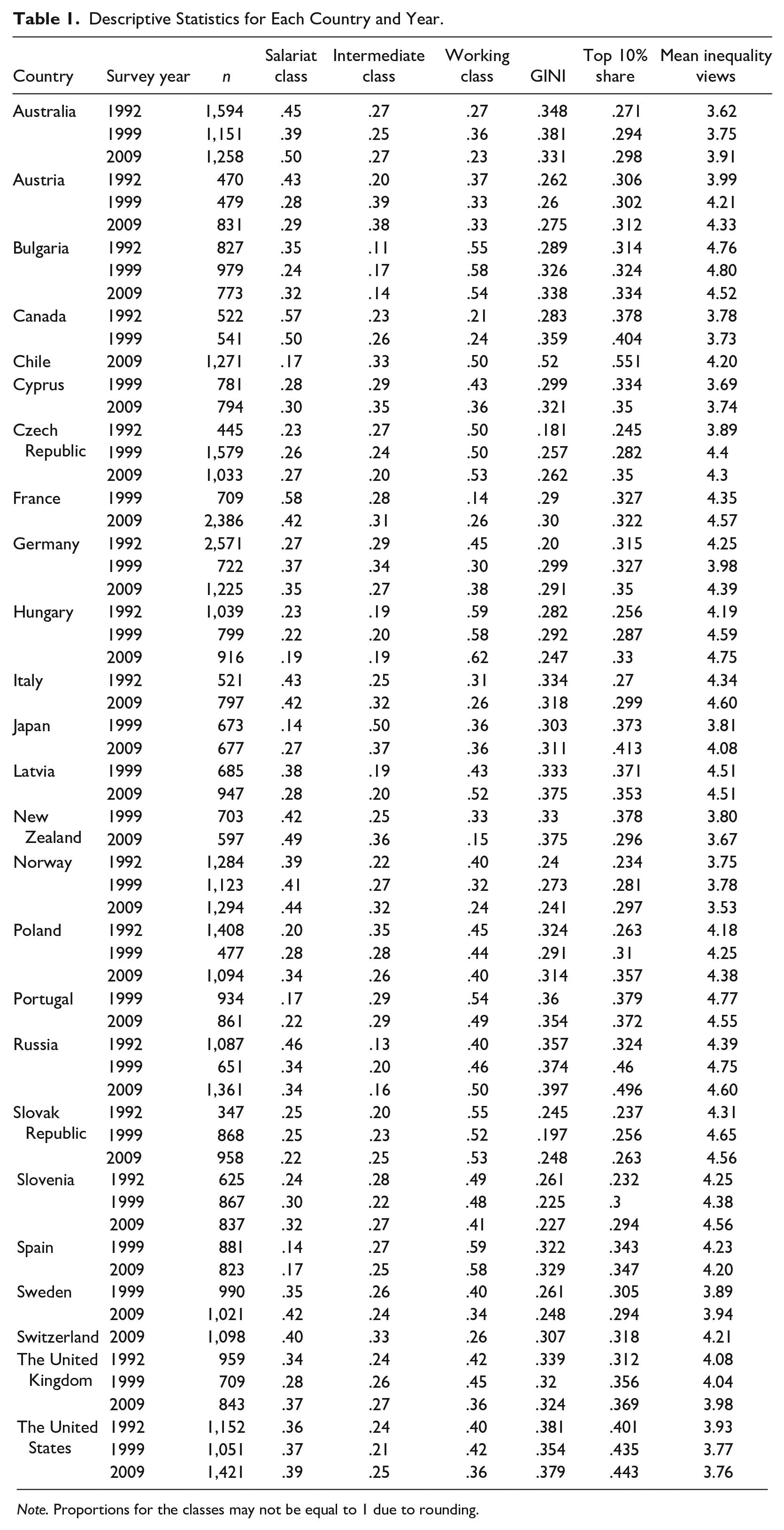
Note. Proportions for the classes may not be equal to 1 due to rounding.
Perceptions of Inequality
The dependent variable of this research is perceptions of income inequality. The ISSP provides a key item tapping into a central element of attitudes toward income differences utilized in the largest number of waves. The dependent variable comes from the following survey question: “How much do you agree or disagree with the statement ‘Differences in income in [respondent’s country] are too large?’” Response categories include strongly agree (1), agree (2), neither agree nor disagree (3), disagree (4), and strongly disagree (5). This survey item does not directly measure perceptions of how much inequality there is. What it does tap into is the awareness of the degree of income inequality and the associated degree of fairness about the perceived level of income inequality (Larsen 2016; Roex, Huijts, and Sieben 2019). It is a complex question because it combines two aspects: the perceptions of inequality and the opinions toward fairness of inequality. Following previous research, we treated the variable as an interval measurement recoded to the following values: 5 = “agreed strongly,” 4 = “agree,” 3 = “neither agree nor disagree,” 2 = “disagree,” and 1 = “disagree strongly” (M. Evans and Kelley 2018; Larsen 2016; Roex, Huijts, and Sieben 2019).
Social Class
The composite measurement of class employed in this analysis is inspired by the Weberian tradition. Developed by David Rose and Eric Harrison (2007, 2010) in conjunction with Eurostat, the European Socio-economic Classification (ESeC) represents a measure of class based conceptually on the EGP (Erikson-Goldthorpe-Portocarero) schema. The aim of the class schema is to differentiate social positions on the basis of labor markets and production units by way of the employment relations that these entail. The employment relationship is determined, first, by the distinction between employers, employees, and the self-employed; which is similar to the classes understood by both Marxists and Weberian interpretations of class (see also Wodtke 2016, 2017).
Within the category of employees, a further distinction is made between those involved in a service relationship with their employer, those regulated by a labor contract, and those with mixed combinations. Service relationships are characterized by a more varied exchange which includes not only compensation for work done through salary but also potentially important aspects which include salary increments following scales, employment security and pensions rights, and the possibility of career advancement. This is contrasted with the labor contract which involves a relatively short-term exchange of income for labor. Workers under the labor contract exert effort under the supervisions of employers or hired agents in return for wages that are calculated by piece or on a time basis. Mixed combinations are employment regulations that contain aspects of both the service relationship and labor contract. Mixed forms are often typical in lower supervisory and lower technical occupations.
The first step when creating the employment status component is to ascertain whether the respondent was employed or self-employed. The second step involves obtaining the supervisory status of the respondent. This differentiation is made because higher supervisory occupations have weaker forms of the service relationship in terms of skills, expertise, and knowledge, yet are regarded as having superior employment contracts compared with those who are supervised. Once employment status is known, the final step is to assign individuals to their respective classes depending on their occupation. Individual occupation is collected by asking respondents to list their occupation which, if it not done already, is then coded using the International Standard Classification of Occupations-88 three code classification. The schema contains both construct and criterion-related validity and provides a useful list of standardized class situations when one wishes to assess cross-national differences in attitudes toward inequality (G. Evans 1992; G. Evans and Mills 1998, 2000).
We employ an objective measure of class rather than a subjective measure as previous research has found that individuals’ actual class position and their subjective perceptions of these often do not match up (Haddon 2015, N.d.). Research points toward discrepancies between objective and subjective indicators of class (Hout 2008). For instance, people often misidentify with the “incorrect” class. It is well established that when people are asked which social class they belong to, particularly in countries where inequality is lower (see Curtis 2013), they tend to identify as middle class even though this often contradicts their “objective” class position.
We use the three-class version of the schema. This includes the salariat class, intermediate class, and working class. We elected to use the three-class version so as to enable an easier interpretation of the results of the interactions between class and the various indicators of income inequality. Collapsing the original eight-class model into a three-class version retains the basic divisions between the three forms of employment regulations (service relationship, labor contract, and mixed combinations). The self-employed are included in the intermediate class. 2 In the statistical models, the intermediate class is the reference group.
Previous research has also shown that demographics such as age, education, gender, and religion can shape people’s inequality views at the individual level (Dodson 2007; Edlund 2003; Hadler 2005; Jordan 2016; Koçer and van de Werfhorst 2012; McCall 2013; McCall and Manza 2011; Svallfors 2005). Therefore, in our models, we include these variables as controls.
Actual Income Inequality
We measure country-level inequality using two indicators: first is the GINI and second is the Top 10% share. The GINI measures income inequality on a scale from 0 to 1. A perfectly equal society would be one where the GINI coefficient is 0. Extreme inequality would be represented by a society where the level of inequality equates to 1. The main source for the GINI is from the World Income Inequality Database (https://www.wider.unu.edu/). The GINI is measured using disposable income, post taxes and transfers. Missing country values were obtained from the Standardized World Income Inequality Database (Solt 2009).
The GINI may not be the best measure of objective inequality. For example, it does not account for the wealthiest in societies, who are often excluded from household surveys. The GINI may also not adequately capture the income of the richest individuals in particular societies. For example, using the GINI coefficient as a measure of income inequality can be problematic, with national accounts often providing a greater understanding of the incomes of the elite (Milanovic 2013; Székely and Hilgert 2007). Indeed, Laurence Chandy and Brina Seidel (2018) have shown that when this is accounted for, the GINI rises by 9 percentage points. For this reason, we also incorporate a measure of country-level income inequality which overcomes this limitation by providing information on the wealth accruing to the top 10 percent of the population. Top 10% share is the concentration of cumulative taxable individual income split by couples among the top 10 percent of a country’s population at the current time point. These data were obtained from the World Inequality Database (https://wid.world/).
Plan of Analysis
We begin our analyses by providing a bar chart which includes the predicted values from a model including class alongside the control variables. We then offer scatterplots which visualize the relationship between actual inequality and perceptions of inequality, including how this relationship differs according to class. We then shift to our multilevel analyses where we show how inequality views of the various classes differ as actual inequality rises. We conclude by providing figures which plot the predictive margins of the classes at various values of actual inequality.
As we are interested in attitudes toward inequality within countries as well as between them, we employ a set of multilevel models. By employing mixed effects models, we are able to account for additional sources of confounding at the country level by controlling for the random effects at this level. All models also include year dummy variables to help control for potential trends over time. We use cross-level interaction terms to capture that individual citizens are nested in larger cross-national macro-environments that shape behavior, but that this impact is also moderated by citizens’ individual characteristics in terms of economic positioning. By employing a multilevel approach, we are able to include both individual- and country-level predictors of attitudes toward inequality. This is necessary as the substantive focus of this study is on how material inequality at the country level affects the class gradient in attitudes toward income inequality. The approach here pools the data, but rather than treating country effects as separate values to be estimated, these are modeled as random draws with a variance which is estimated (Bryan and Jenkins 2016). Under the random effects models, the unmeasured effects that can vary across countries but not across time are modeled with country-specific error terms.
Findings
To begin with, Figure 1 shows class differences in perceptions of inequality. The figure reveals that inequality views follow the class gradient. The working classes are the most critical, followed by intermediate and salariat classes. This pattern is largely consistent with previous research on the class gradient in attitudes toward income inequality (Andersen and Curtis 2015; Fernández and Jaime-Castillo 2018; Larsen 2016).
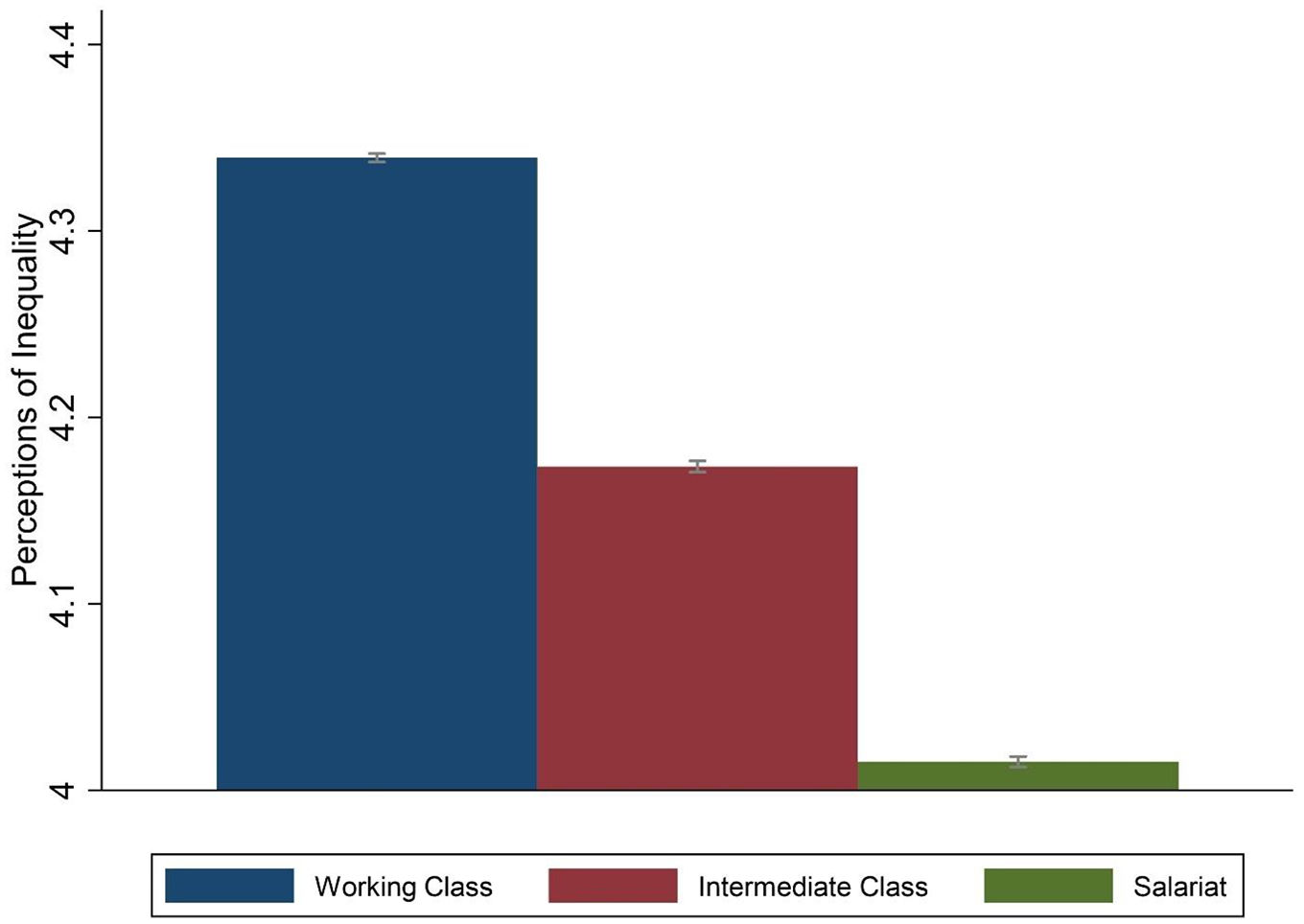
Class differences in perceptions of income inequality.
Figure 2 illustrates the link between the actual level of income inequality and public acceptance of inequality by country-years. The various measures of inequality, GINI and Top 10% share, are plotted on the x-axis, and the country-year mean scores of perceptions of income inequality are plotted on the y-axis. Higher scores indicate greater disapproval of income differences. The figure on the left shows a meager negative relationship between income inequality as measured by the GINI and citizens’ critical views toward it (r = −.0625); while the figure on the right shows a slight positive relationship between income inequality as measured by Top 10% share (r = .0617). As we can see, not only is the association weak, but the pattern is also in an opposite direction depending on which measure we use for the actual level inequality. Taken together, this appears to support national studies which show no clear link between the level of income inequality and discontent (Larsen 2016; McCall and Kenworthy 2009).
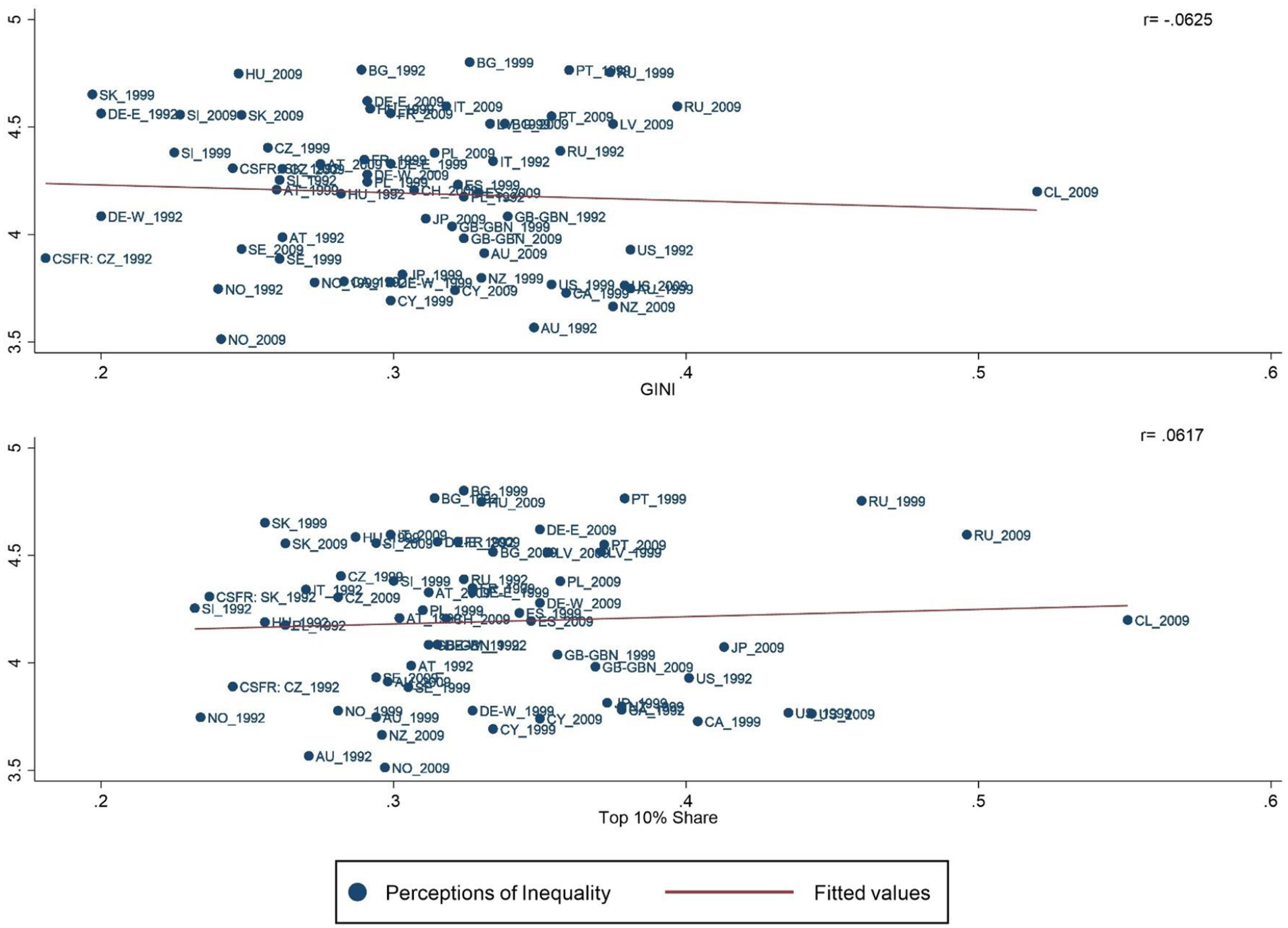
Country-year level scatterplot between actual income inequality and perceptions of inequality.
We expect that actual income inequality does have some impact on people’s perceptions of inequality. However, we suspect that it impacts people’s perceptions based on their class position. Hence, in what follows, we aim to show how the relationship between actual income inequality and perceptions of inequality is shaped by class. To begin, the left graph in Figure 3 shows perceptions of inequality by GINI just pertaining to the working class. The graph depicts country-year averages of perceptions of inequality for the working class on the y-axis plotted against country-year values of the GINI on the x-axis. The diagram on the left shows that the working class becomes less critical of inequality as the GINI rises (r = −.18). The graph in the middle shows the relationship between the GINI and perceptions of inequality for the intermediate class. We find a slight negative relationship between the intermediate class and GINI (r = −.08). The graph on the right shows a positive relationship among the salariats’ perceptions of inequality and the GINI (r = .08).
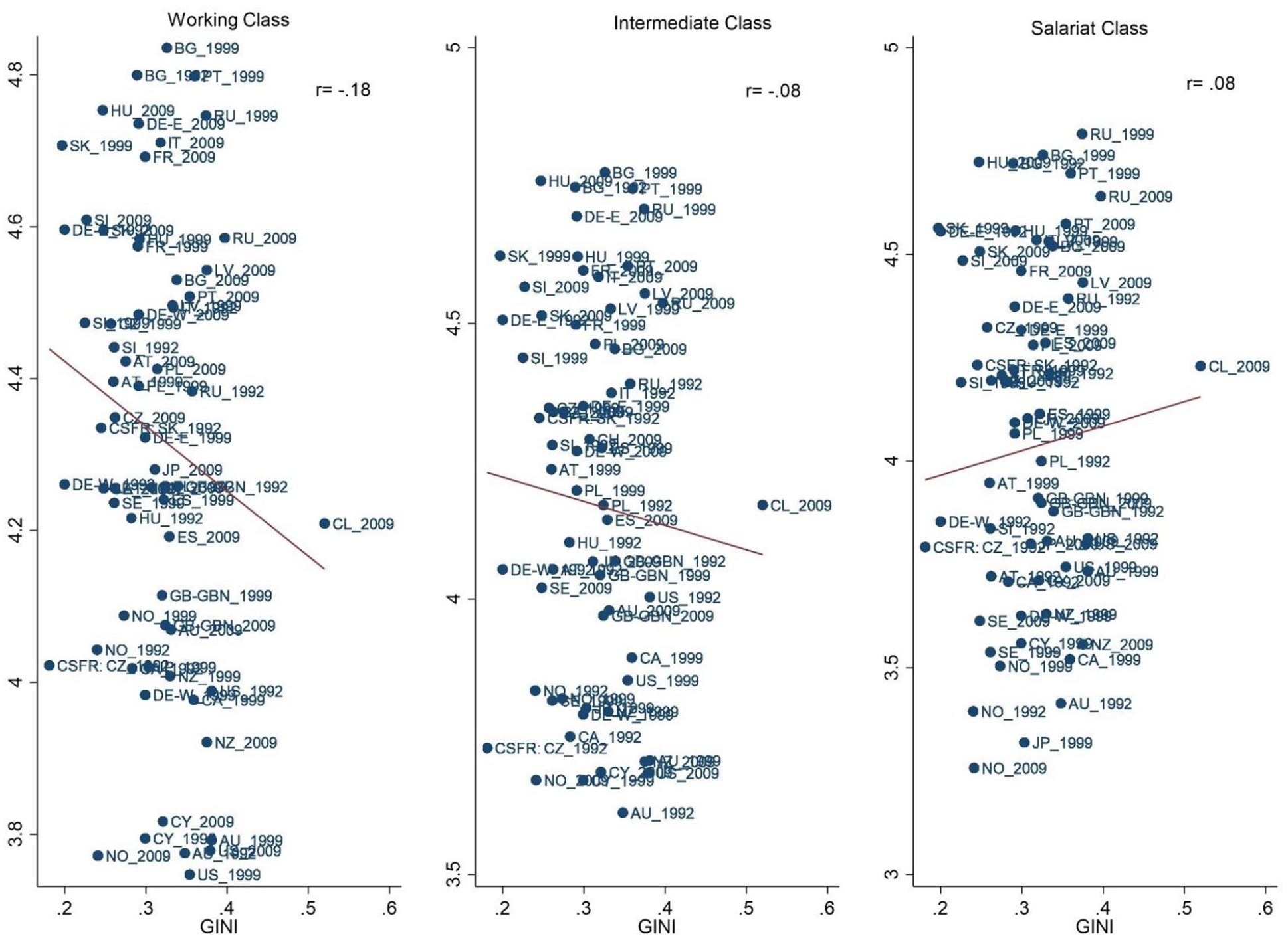
Country-year level scatterplot between GINI and perceptions of inequality by class.
Figure 4 shows the relationship between Top 10% share and perceptions of inequality across classes. The graph on the left shows a weak negative relationship between Top 10% share and perceptions of inequality among the working class (r = −.06). The graph in the middle shows no discernible relationship between Top 10% share and perceptions of inequality among the intermediate class (r = .02). The graph on the right shows a positive relationship between perceptions of inequality and Top 10% share among the salariat class (r = .20). Regardless of which measure of inequality is used, rising inequality can lead to a higher level of perceptions of inequality among the salariat class. That is, the salariat class is increasingly critical of inequality when actual inequality increases. These patterns show that rising income inequality can shape people’s perceptions of inequality in distinctive ways across classes.
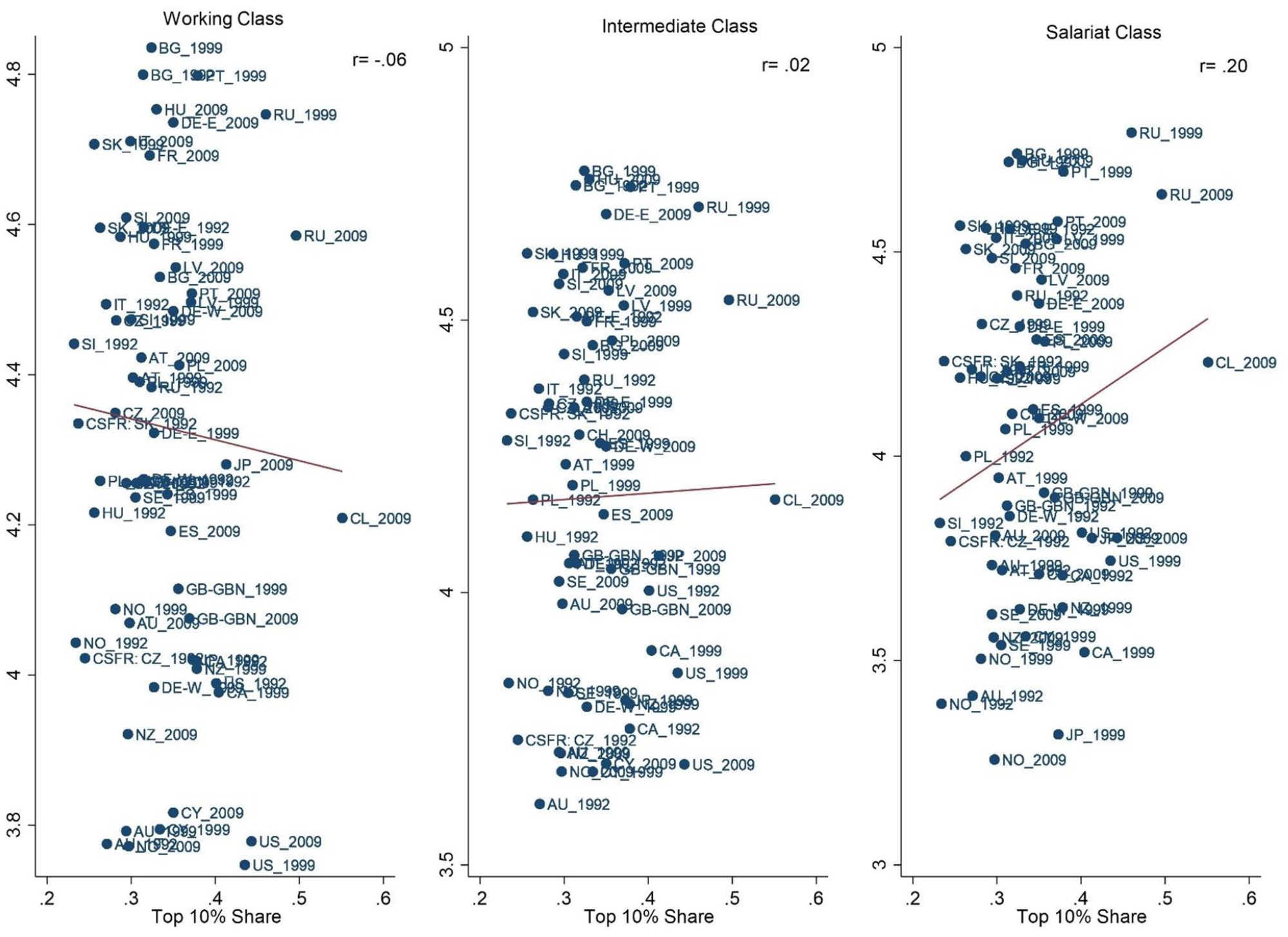
Country-year level scatterplot between Top 10% share and perceptions of inequality by class.
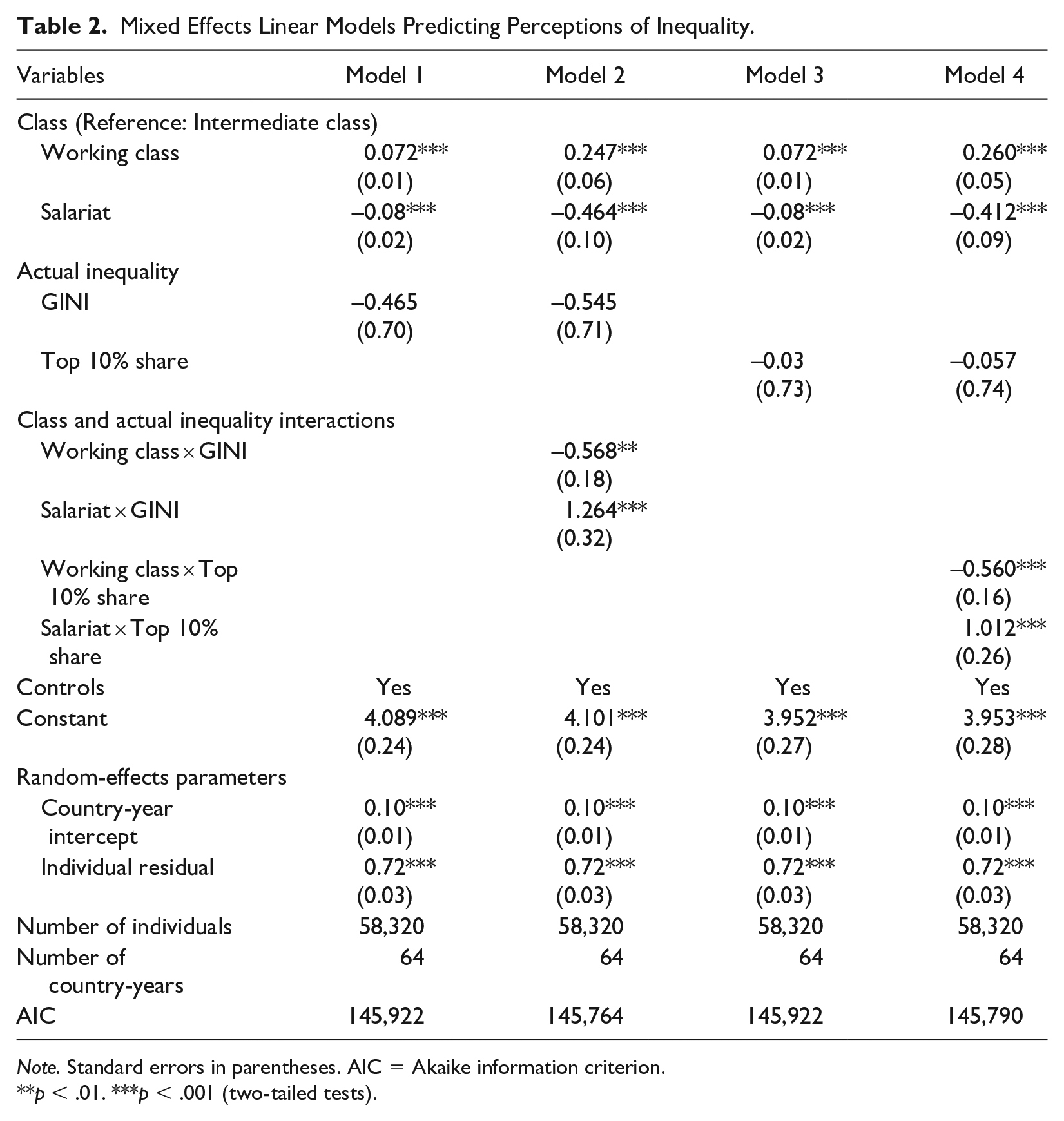
In Table 2, we begin our multilevel analyses by fitting a model which includes GINI alongside the class predictors. Model 2 includes the interaction between class and GINI to adjudicate between competing theories about the relationship between class, actual income inequality, and perceptions of inequality. Model 3 adds Top 10% share as a measure of income inequality. Model 4 adds the interaction between class and the Top 10% share. All models are approximated using full maximum likelihood and employ probability weights. A noted limitation is that probability weighting is applied at the individual level only, which means that we assume countries have equal probability of selection. Furthermore, all models employ an “identity” covariance structure, which assumes equal variance for the random effects, and all covariances are fixed to 0.
Mixed Effects Linear Models Predicting Perceptions of Inequality.
Note. Standard errors in parentheses. AIC = Akaike information criterion.
p < .01. ***p < .001 (two-tailed tests).
To begin, we look at Model 1. The results shows that net of the other variables, GINI is not significantly associated with perceptions of inequality. In terms of class, we see that the working classes are significantly more likely to view inequality critically relative to the salariat class. Model 2 includes an interaction between class and GINI to show how classed disapproval toward inequality fluctuates with the actual level of income inequality in societies. The significant values of the coefficients for class and GINI interactions reveal that the relationship between class and inequality views is partially determined by the objective reality of income inequality in a society. The positive interaction for the salariat means that they hold more critical views toward inequality as the GINI coefficient rises in comparison with the intermediate class, whereas the negative interaction for the working class means that they are less critical of inequality as it rises compared with the intermediate class. However, interaction terms do not reveal how the effects of class vary at different levels of the GINI. To further facilitate the readings of the interactions, we have derived the predictive margins of the classes in inequality views at various values of the GINI and plotted these on the left graph in Figures 5.
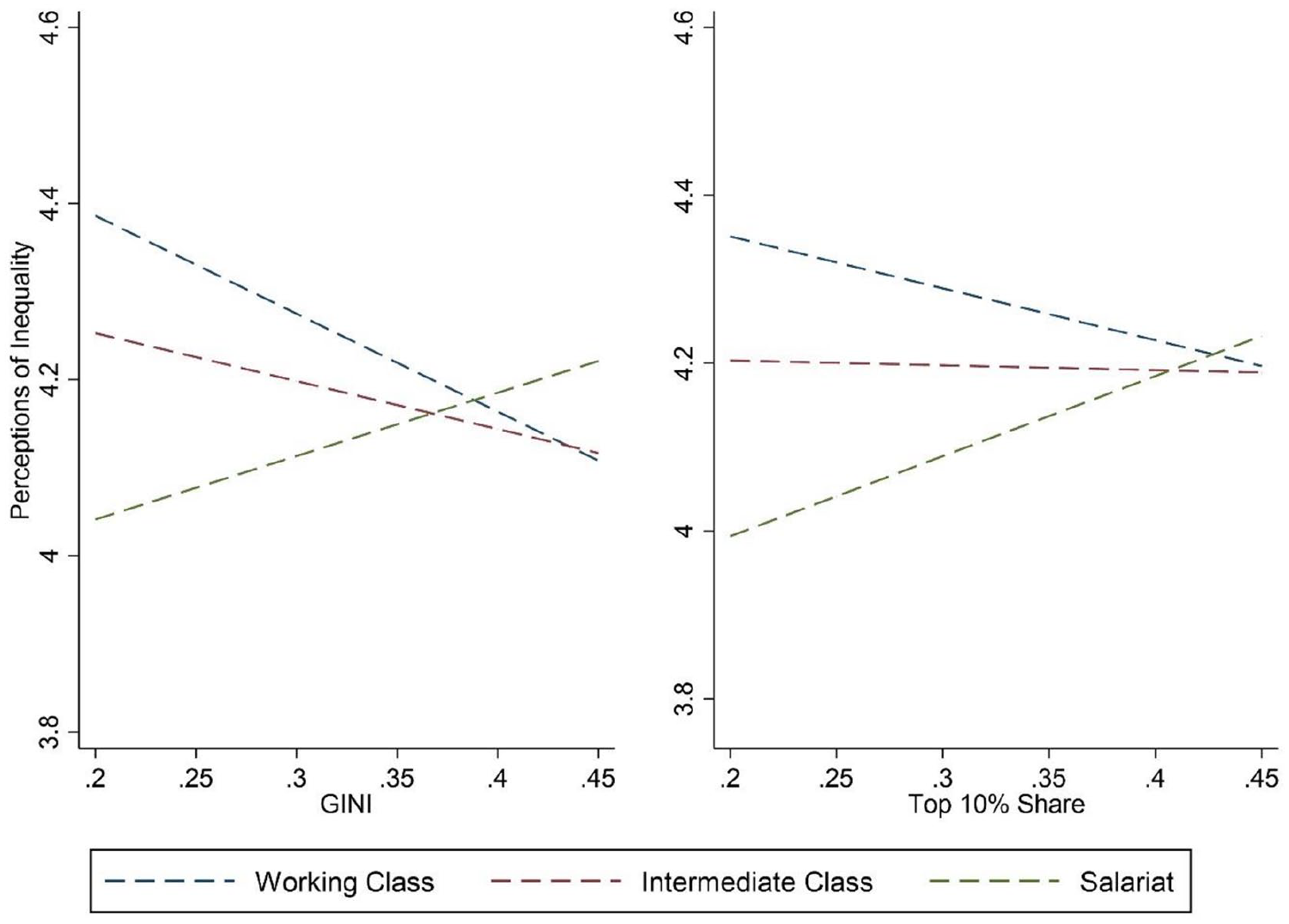
Perceptions of inequality by class and actual income inequality.
The left graph in Figure 5 reveals new insights on the relationship between social class, national-level inequality, and attitudes toward income inequality. For one, it shows that the most advantaged class is prone to disapprove of inequality when the GINI is high. Second, they show the opposite pattern for the two other classes. That is, attitudes toward inequality become less critical for the working and intermediate classes as GINI rises. Third, the graph depicts that inequality views of the classes are closer together in more unequal societies compared with more equal societies.
In Model 3, we add Top 10% share as the measure of inequality. Independently, Top 10% share is not a significant driver of inequality views. Moreover, the coefficients for class remain significant. In Model 4, we include an interaction between class and the Top 10% share. This reveals whether the classed displeasure with inequality is patterned by the extent of a country’s income concentrated in the top 10 percent of the population. All interaction effects are significant. The significant negative interactions between the classes and Top 10% share suggest that the relationship between class and inequality views is also affected by how income is distributed in particular societies.
To better understand what is taking place, we include the predictive margins from Model 4 in a graph. The right graph in Figure 5 reveals that the salariat class is more critical of income inequality in countries where income is more concentrated into the top 10 percent of the population. On the opposite end of the class spectrum, we find the inverse; attitudes toward inequality of the working class are less critical when a country’s share of income is concentrated in the top 10 percent. Furthermore, the graph depicts that inequality views of the classes are close to similar in contexts where a country’s income is concentrated more at the top.
Discussion and Conclusion
In this article, we have considered how the association between rising inequality and public perceptions of inequality differs across social classes. First, we show that aggregate country-level income inequality does not seem to have a significant impact on people’s inequality views. Second, perception of inequality is higher among the working class and lower among salariats. Third, we find that individuals tend to respond to rising inequality differently based on their social class position. Specifically, we find that working classes become less critical toward inequality as it increases, whereas the upper classes become more critical of inequality as the actual level of income inequality increases.
This study improves upon the conceptual and empirical research on how the objective reality of income inequality shapes a fundamental aspect of inequality views in an important way (Curtis 2016; Curtis and Andersen 2015; McCall 2013; McCall and Manza 2011; Sealey and Andersen 2015). While we concur with previous research that in the aggregate there is no discernible relationship between the actual level of inequality and people’s discontent toward it, our research reveals the importance of looking at inequality views through the lens of class (Bartels 2013; Brooks and Manza 2013; Cavaillé and Trump 2015; Jetten et al. 2017; Laurin et al. 2013; Trump 2017). Taken on face value, the economic reality of inequality does not affect economic evaluations. However, this is decidedly not the case when a class perspective is taken into consideration. We find that inequality attitudes do indeed fluctuate with the actual reality of income inequality in particular societies, but that researchers need to take a class perspective to show this. In particular, we find that inequality and class-related aspects interact to influence perceptions of inequality. What is interesting is the pattern that exists between the classes.
As inequality rises, it tends to be viewed as illegitimate across classes, but those who have the most to lose become increasingly critical, such that in contexts of high levels of income inequality, their condemnation approximates and indeed surpasses those who are the most affected by it. We speculate that in more equal societies, the advantaged classes are more likely to feel that inequality is justified as they may not see the consequences of inequality that surround them. In unequal societies, on the contrary, the advantaged class begin to be affected by inequality and increasingly come to view it negatively. Increased exposure to inequality may function to delegitimize acceptance of inequality. This may occur because in these contexts, the dominant fractions of society are increasingly exposed to the multitude of social issues which coincide with heightened levels of inequality such as health problems (Carpiano, Link, and Phelan 2008; Elgar 2010; Wilkinson and Pickett 2010), increasing rates of criminal violence (Blau and Blau 1982), civic disengagement (Lancee and Van de Werfhorst 2012; Uslaner 2002), and reduced social trust (Fairbrother and Martin 2013; Hamamura 2012; C. Larsen 2013; Rözer and Volker 2016).
At lower levels of inequality, the middle and upper classes are less likely to view inequality critically. Not surprisingly, in these contexts, the lower classes are the most critical of inequality. However, as inequality increases, the working classes become less critical of income differences and these begin to converge with the attitudes of the other classes. This may suggest that in more unequal societies, the lower classes are increasingly disillusioned by the ramifications of inequality which leads them to be less critical of inequality. This also suggests that individuals in higher social class positions may benefit from some increase in inequality, but the disadvantages of an increase in inequality could outweigh the benefits once inequality becomes too extreme.
As inequality increases, a greater proportion of the population feel the negative effects of inequality. Higher levels of objective inequality in many societies may bring the attitudes toward inequality of the various class fractions together. These shared attitudes toward inequality may lead to a greater desire for redistributive measures across classes which aim to reduce the unequal distribution of wealth. This may mean that, when inequality reaches a certain point, policy makers may feel the need to respond accordingly.
We conclude by elaborating on possible policy implication of these results. Although inequality has the greatest material impact on the working classes, its consequences are becoming more acute also among the advantaged classes. If only the working class is critical of income inequality and desire change, it is easier for policy makers to ignore. However, if inequality continues to increase and it begins to affect those who hold power and political sway—such as those residing in dominant economic positions—politicians may feel more compelled to take action and intervene. Social policies should be put into place which address rising inequality before it becomes too great. As we have shown, perceptions of inequality across classes begin to diverge once again when inequality becomes too extreme.
The connection between rising income inequality and critical views toward inequality represents a possible site with which politicians could bring together people across party lines by speaking to their shared interests. Rather than obfuscating class vernacular in public discourse, coalition builders should target those in advantaged and disadvantaged positions by speaking directly to the benefits of progressive politics in terms of class. Rising income inequality has ushered in concerns with inequality and this represents a site with which to create new alliances to bring together those class groups who possess divergent economic interests. A new political base premised on the social relations of production may rejuvenate social programs aimed at seriously reducing inequality and stimulating progressive politics which move beyond the neoliberal policies present in most Western democracies.
Footnotes
Appendix
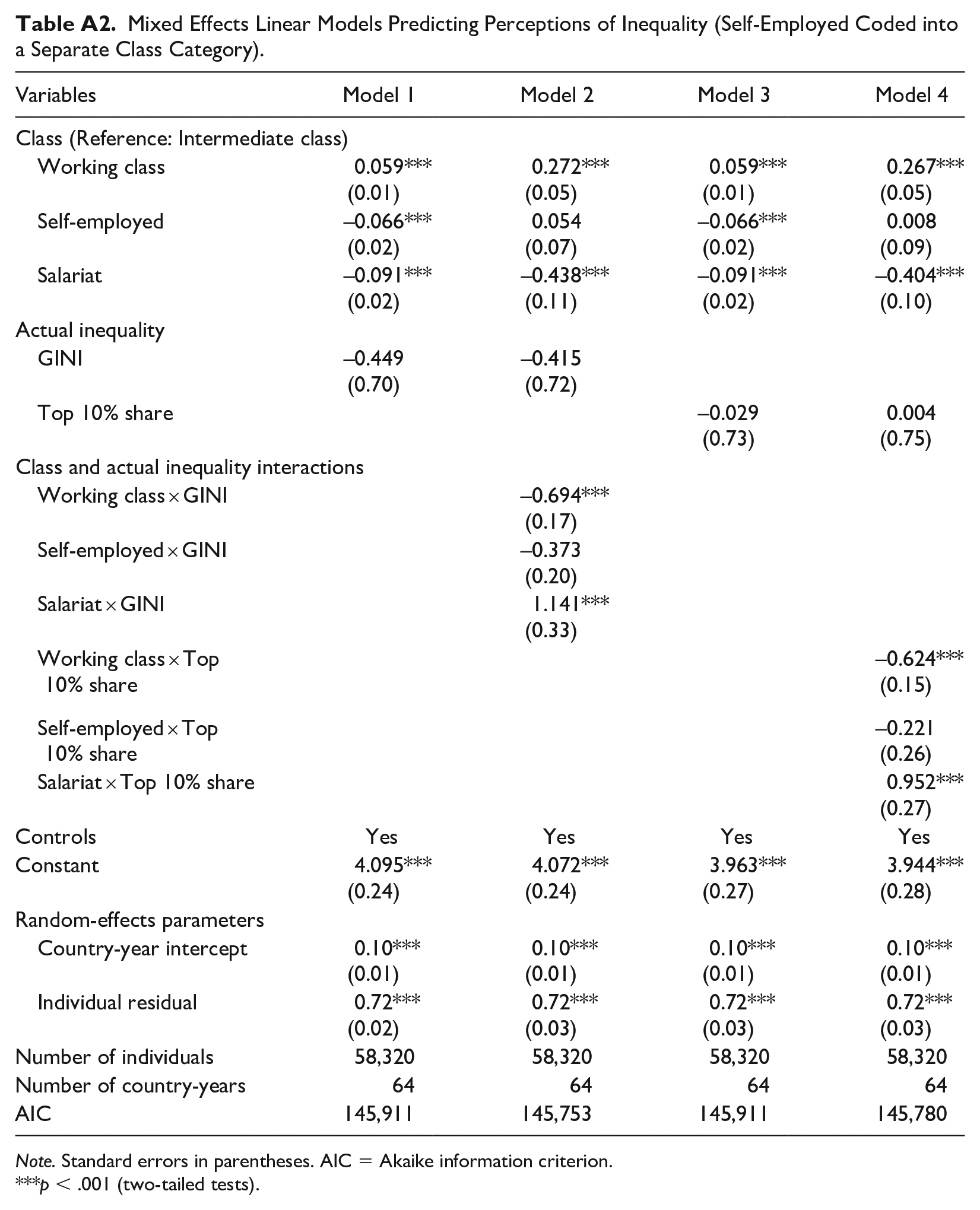
Mixed Effects Linear Models Predicting Perceptions of Inequality (Self-Employed Coded into a Separate Class Category).
| Variables | Model 1 | Model 2 | Model 3 | Model 4 |
|---|---|---|---|---|
| Class (Reference: Intermediate class) | ||||
| Working class | 0.059***
(0.01) |
0.272***
(0.05) |
0.059***
(0.01) |
0.267***
(0.05) |
| Self-employed | −0.066***
(0.02) |
0.054 (0.07) |
−0.066***
(0.02) |
0.008 (0.09) |
| Salariat | −0.091***
(0.02) |
−0.438***
(0.11) |
−0.091***
(0.02) |
−0.404***
(0.10) |
| Actual inequality | ||||
| GINI | −0.449 (0.70) |
−0.415 (0.72) |
||
| Top 10% share | −0.029 |
0.004 |
||
| Class and actual inequality interactions | ||||
| Working class × GINI | −0.694***
|
|||
| Self-employed × GINI | −0.373 |
|||
| Salariat × GINI | 1.141***
|
|||
| Working class × Top 10% share | −0.624***
|
|||
| Self-employed × Top 10% share | −0.221 |
|||
| Salariat × Top 10% share | 0.952***
|
|||
| Controls | Yes | Yes | Yes | Yes |
| Constant | 4.095***
|
4.072***
|
3.963***
|
3.944***
|
| Random-effects parameters | ||||
| Country-year intercept | 0.10***
|
0.10***
|
0.10***
|
0.10***
|
| Individual residual | 0.72***
|
0.72***
|
0.72***
|
0.72***
|
| Number of individuals | 58,320 | 58,320 | 58,320 | 58,320 |
| Number of country-years | 64 | 64 | 64 | 64 |
| AIC | 145,911 | 145,753 | 145,911 | 145,780 |
Note. Standard errors in parentheses. AIC = Akaike information criterion.
***p < .001 (two-tailed tests).
Declaration of Conflicting Interests
The author(s) declared no potential conflicts of interest with respect to the research, authorship, and/or publication of this article.
Funding
The author(s) received no financial support for the research, authorship, and/or publication of this article.