




Abstract
Having and being a sibling can be vital in shaping one’s identity. Using data from a qualitative study exploring experiences of sibling bereavement over the life course, this article questions how the death and subsequent loss of a brother or sister impacts upon the way that surviving siblings (continue to) construct their sense of self. It explores how people re-assess the established similarities and differences they shared with living siblings and re-negotiate their positioning within the chronological sibling birth order. In doing so, this article emphasises the sociological importance of lateral kinship ties with siblings, demonstrating that being and having a sibling can have lasting implications for the way that people perceive and present themselves, even after death. As such, the article concludes that the dead can continue to maintain an important and influential, albeit liminal, position in the webs of relationships in which people are embedded.
Introduction
Issues of identity and relationality reside at the core of sibling relationships, regardless of the quality or closeness of connection. Indeed, ‘being and having brothers or sisters can have a profound impact upon young people’s sense of self and the formation of their social identities’ (Davies, 2015: 680/681). This is due, in part, to the unique positioning of siblings as ‘simultaneously individual and one of a series’ (Edwards et al., 2006: 39, emphasis in original). While it is established that siblings can be a crucial part of the ongoing self-identification process, it is yet to be questioned if and how this continues following the death of a sibling. This is crucial, however, as for surviving siblings ‘the task of defining and stabilizing personal identity and concept of self must now happen in the absence of a principal agent – the dead brother or sister’ (Forward and Garlie, 2003: 26). Do those bereaved still establish a sense of self in relation to their siblings? If so, then how, and how long for? This article addresses these gaps in knowledge, highlighting ways that bereaved siblings navigate and negotiate continuing to integrate their brother or sister into their understandings of self over time. In doing so, it emphasises that deceased siblings (and the dead more generally) can maintain an important role in identity construction as they occupy an ongoing liminal space of simultaneous absence and presence within the relational webs of those still living.
Despite siblings carrying public fascination, there is a notable lack of sociological research concerning the sibling relationship. Though there is a ‘growing empirical interest in sibling relationships amongst some sociologists’ (Davies, 2015: 680), most of the available literature is offered by psychologists, with a particular focus on child development or sibling group composition (see Dunn, 2000[1982], for example). Within Sociology, focus has also typically centred on siblings in childhood (see Davies, 2015, 2019; Edwards et al., 2006). The few adult studies to be conducted are primarily concerned with the role of the sibling relationship in later life, particularly in support giving or caretaking behaviours (Riggio, 2000; Voorpostel et al., 2007). Such disregard for siblings is similarly found within death studies, leading to siblings being ascribed the label of ‘forgotten grievers’ (Rostila et al., 2012). By passing comment on the sibling relationship in both life and death, this article sheds some much-needed light in both areas.
It is vital that sociologists recognise and explore further the lateral ties between siblings as a lens through which to explore broader topics of interest, such as identity construction, as ‘thinking with siblings brings new and exciting ways of approaching key issues of sociological significance and invites sociologists to pose different questions about the world’ (Davies, 2023: 174). The sibling relationship has the capacity to be the longest and closest of all kinship ties (Gilligan et al., 2020). Though intimacy is not guaranteed, siblings are considered permanent members of each other’s relational webs (Halliwell and Franken, 2016), unlikely to be relegated to ‘ex’ or ‘used to be’ relations (Towers, 2022). This potential for intimacy and longevity means that siblings ‘tap into questions of who we are and who we can become, questions that are fundamental to the discipline of sociology’ (Davies, 2023: 176). It is essential therefore that sociologists pay more attention to the unique role of lateral kinship ties with siblings. Offering to this discussion, this article will demonstrate that the sibling relationship continues to be meaningful and influential in the ongoing self-identification process even after death. Moreover, as (sibling) bereavement is a lifelong status that continues to shape and mould people’s experiences over time (Towers, 2022), it will be shown that this influence can last a lifetime. In doing so, this article makes a broader point that ongoing connections with the dead (so-called continuing bonds (Klass et al., 1996)) are much more influential than currently considered in shaping the way that people (re)construct their identities over time.
The article begins with a review of the relevant background literature and conceptual framework, before offering details of the original study. It then progresses to the main discussion, which is divided into two parts. The opening section explores how people re-assess and re-negotiate previously established similarities and differences following their sibling’s death, emphasising the value of resemblances for asserting siblingship following the death of a brother or sister. The second section proceeds to consider how the passing of time and potential shifts within the chronological sibling birth order may impact upon the way that siblings see themselves, highlighting how a retention of the original birth order is central to the self-identification process. Davies (2019: 222) asserts that the sibling relationship is ‘sticky’ (Smart, 2007), as ‘the influence of siblings cannot easily be “shaken off”, remaining important regardless of the nature of the sibling relationship’. This article will demonstrate this claim, highlighting that the sibling relationship continues to be meaningful, here with regards to identity formation, even after the sibling has died. In doing so, this article makes two key contributions. First, it improves our knowledge of siblings and sibling bereavement, and demonstrates the importance of lateral kinship ties for self-identification processes. Second, it opens up a sociological discussion about how the dead can be pivotal in the way that the living see themselves, emphasising the longevity of this experience.
The Bereaved Self
Self-identification and categorisation are fundamentally relational (May, 2013). Indeed ‘identity is profoundly relational in that it is bound up with others’ identities and shaped by the meanings and ways of understanding them that are available to us’ (Edwards et al., 2006: 9). As such, death challenges the identities of those who are bereaved (Baddeley and Singer, 2009, 2010). This is because bereavement experiences are closely linked to our position as socially interactive beings; ‘our sense of self is dependent on our relationship with others, so that when a loved one dies, our sense of who we are as a person is under threat’ (Valentine, 2008: 93). The death of someone close signifies the loss of the part of ourselves that was constructed through our relationship with the deceased, in addition to the loss of that other person (Bradbury, 1999). Death can also cause family roles to shift and be reassigned (Towers, 2022). This affects family identity, as well as the identities of those members within the family (Shapiro, 1994). As such, people are permanently changed by the bereavement experience, as the ‘process does not end, but in different ways bereavement affects the mourner for the rest of his or her life’ (Silverman and Klass, 1996: 19). An understanding of what has been lost, as well as an adapted relationship with the deceased, must therefore be integrated into the bereaved self over time (Bradbury, 1999).
This idea of permanent change is echoed by Jakoby (2015), who asserts that the death of a family member can destabilise our sense of self and rupture the assumed security of our biography. Ellis (2013: 254) considers the implications of this ruptured thinking, noting that ‘the prospect of “losing” one’s identity is often thought to be a negative, deeply problematic experience, synonymous with a sense of unbecoming, losing direction and a distancing from who one once was and often from other people’. However, Ellis (2013) problematises this understanding by suggesting that the concept of rupture implies identity is a fixed entity prior to the event. Indeed, the ability to fracture identity suggests that it is both stable and reified prior to learning of a bereavement (Hockey, 2010). Yet, as Jenkins (2014: 18) argues, ‘identity can only be understood as a process of “being” or “becoming”’ and so one’s sense of self must constantly be re-negotiated over the life course through a process of self-identification that is both individual and interactional. Recognition that the process of self is an ongoing project thus challenges the rupture model, which conceptualises the self as something to be repaired, and instead proposes a more fluid and complex integration of relationality (Ellis, 2013). As such, individuals may experience a significant shift in their sense of self following the death of a family member (Hockey, 2010), as being human is ‘about learning to become someone who is different from the person we previously knew ourselves to be’ (Billington et al., 1998: 59), but it is necessary to acknowledge the fluidity of identity both before and after a bereavement (Ellis, 2013).
Siblings and Self
Central to the self-identification process is the ‘systematic establishment and signification . . . of relationships of similarity and difference’, emphasising that ‘similarity and difference are the dynamic principles of identification’, which must always be taken together (Jenkins, 2014: 19). These comparisons are a key aspect of the sibling relationship, with people frequently commenting on the similarities and differences between brothers and sisters (Edwards et al., 2006). Davies (2015) explores the significance of these comparisons in greater depth by questioning how intra-generational, lateral connections with siblings contribute towards processes of identity (how others see us – understood as a form of categorisation) and self-identification (how we see ourselves – formed in relation to others). Her analysis of interview data revealed that ‘young people can make sense of who they are in relation to how they are similar or different to their siblings and that others often understand them in this way too’ (Davies, 2015: 692). However, both Davies (2015) and Edwards et al. (2006) focus their attention on children and young people, leaving a gap in knowledge about adult sibling relationships.
More commonplace within discussions of sibling similarities and differences is the concept of birth order, particularly how people perceive themselves, their roles and responsibilities, in relation to their older or younger siblings. Indeed, age and birth order are highly significant in shaping the content and nature of sibling relationships across cultural contexts (see McIntosh and Punch, 2009; Wong et al., 2010). For example, older siblings have expressed an assumption that they should act as nurturer or protector over younger siblings, thereby suggesting that the responsibilities associated with birth order may have shaped their sense of self (Gillies and Lucey, 2006). Even a lack of siblings lends itself to an ‘only child’ identity; one that carries with it a set of cultural tropes and can be crucial to one’s perception of self and the roles held within family life and relationships (Davies, 2023).
As siblings can play an integral role in the self-identification process, the death of a sibling can have a profound impact upon constructions of identity (Riches and Dawson, 2000). Yet the ways in which siblings continue to establish the ‘self’ following the death of a sibling and/or in relation to a deceased sibling have yet to be fully explored through a sociological lens. Current literature indicates that aspects of identity can be maintained or redefined following the death of a significant other through the management of continuing bonds (see Bradbury, 2001; Gibson, 2008; Hockey et al., 2007). Yet, while there are studies that specifically explore the impact of child loss on parental identity, for example (see Hastings, 2000; Toller, 2008), there is a distinct lack of work that has looked at this topic from the perspective of siblings. Though some literature mentions the impact of sibling death on the identity of the living sibling (DeVita-Raeburn, 2004; Forward and Garlie, 2003; Riches and Dawson, 2000), largely this is a sub-finding, rather than the primary focus of the research. This article therefore contributes the first focused exploration of how adults (re)establish their identity following the death of their sibling/s.
The Study
This article is based upon a study that explored how the death of a brother and/or sister shapes and influences the lives of surviving siblings over their life course. Acknowledging that people are embedded in time and networks of relationships, the research conceptualises grief and bereavement as highly relational experiences, rather than individualised, purely psychological processes. Using this relational approach, it is possible to recognise the multitude of relationships that siblings are embedded within and examine the role of these ties within the bereavement experience. While set in the context of death, the project was mostly concerned with the living, considering the ways that bereaved siblings’ identities and relationships are managed and negotiated in the long term.
A total of 36 (mostly white British) participants (nine men, 27 women) took part in a semi-structured interview (conducted by the author) that lasted, on average, two to three hours each. Although all participants (see appendix A for an overview) were living in England at the time of interview, one was raised in Mexico, one in the USA, two grew up in Northern Ireland and was one born in Kuwait but moved around the Middle East as a child. All bar the latter experienced the death of their sibling in their home country. All sibling deaths occurred when participants were aged between eight and 34 years, while individuals were aged between 19 and 66 years at the time of participation. All participants were invited to bring to the interview any artefact/s of their choosing, which linked to their sibling in some way; the aim being to recognise and include the deceased sibling within the interview context (Dyregrov, 2004), and encourage relaxed and personable interactions by enabling participants to express greater control over the topics covered (Willig, 2017). The primary purpose of including the objects, therefore, was to put participants at ease, encourage the building of rapport and deepen the author’s understanding of the sibling relationship as context for the conversation. Overall, 14 of the 36 participants chose to bring an object or photograph with them; examples include a watch, newspaper clipping and book of poems.
The use of indirect methods helped to minimise any pressure to participate (Dyregrov, 2004), while a ‘self-defining’ approach to recruitment empowered individuals to interpret their own relationship, allowing for the inclusion of step, half and adopted siblings. As ‘the bereaved’ are a non-visible ‘group’, there were no straightforward or pre-defined methods for recruitment and so participants were recruited through a range of means including social media and university volunteer mailing list, as well as charities Child Bereavement UK, The Compassionate Friends and The Rotary Foundation. Influenced by the avenues used for recruitment, the vast majority of participants were university educated and employed in professional jobs. No restrictions were placed regarding the cause of death, but a minimum of five years had to have passed since their sibling’s death. Interviews took place in a location of the participant’s choosing across various sites in England, including cafes, their home, university campus and a small number by telephone or Skype.
Though not explicitly narrative interviews, an awareness of narrative was maintained throughout data collection and drawn out during the process of analysis. This is because narratives enable people to reflect on the value and meaning of their experiences, and so are a useful device for people when trying to make sense of their lives (Birch and Miller, 2000). Thematic analysis was used to identify themes across the transcripts (Braun and Clarke, 2006), though narratives within the individual transcripts were also recognised. As such, interview transcripts were coded and analysed using a narrative approach to thematic analysis (Riessman, 2008). A ‘hybrid’ approach to coding was applied, which required balancing both inductive and deductive coding (Fereday and Muir-Cochrane, 2006). These codes were organised into themes, which were then re-analysed so that narratives could be drawn out within particular topics, in addition to those found within individual interviews. Discussion regarding the objects was analysed as part of these transcripts and codes, as the aim was to prioritise the meaning and value given to these objects by the participant, rather than the materiality of the object itself.
All aspects of the research adhered to university ethical guidelines, and fieldwork was carried out following ethical approval. Several steps were taken to ensure participant welfare, including offering participants comfort breaks, reassuring them that they did not have to answer any questions they found distressing, reminding them of their right to withdraw should the experience prove emotionally stressful and signposting participants to bereavement support services should they seek further assistance. It is also acknowledged that conducting bereavement research can be emotionally challenging for the researcher as well as the researched (see Reed and Towers, 2023 for a fuller discussion of the author’s experience in this regard).
Bereaved Siblings and Self-Identification
For most participants, the impact of their sibling’s death was so significant that it caused a permanent and irrevocable change in their perception of self. Such an experience was most clearly articulated by Frances:
I’ve got two periods in my life, there’s the before she died and the after, it’s like there’s an invisible line and it’s like I’ve got two lives, the before and the after, there was a different me before and after.
One of the hardest questions for bereaved siblings to answer relates to the sibling question (DeVita-Raeburn, 2017): ‘I think that’s one of the hardest things about losing brothers and sisters is when someone asks you how many brother and sisters you have’ (Melissa). Many participants expressed great disdain for this question as something they found extremely difficult to answer. As part of a course at work, Poppy was asked to locate herself in the room depending on how many siblings she had:
The fact that it was sprung on me and I wasn’t prepared for it made me kind of go, how am I gonna do this? And I suddenly realised what a decision-making process it actually was to answer that question and in the end I just didn’t do it. I just left the room.
In moments like these, bereaved siblings are forced to confront their own identity and be categorised by those around them. For Poppy, the situation made her so uncomfortable that she chose to leave rather than have to assign herself a label or discuss the difficulty of that decision with others. Crucially, however, participants still very much identified as siblings following their sibling’s death, stating that the problem with that question is having to explain their situation to other people, rather than having to decide whether they still identify as a sibling:
if people ask me if I have any brothers or sisters I can’t say no because I do, he’s just not here. I literally, I feel like it almost causes me physical pain if I was to lie about it. (Becky) I wouldn’t ever say I don’t have a brother cause that’s not true is it? You’ll never change the fact that you have a brother will you even if he’s not physically here. (Martin)
A full discussion of the decision making linked to narrating and performing sibling bereavement is available elsewhere (Towers, 2019). Discussion here instead focuses on how the ongoing absent–presence of deceased siblings continues to shape the way that living siblings see themselves, thereby highlighting that lateral kinship ties continue to be important for the self-identification process, even after death.
The Value of Resemblances for Asserting Siblingship
Throughout the interviews, participants often spoke of their identity as being connected to that of their sibling. One of many examples, Kate notes that she was recognised in relation to her older brother, rather than as an individual: ‘I didn’t have an identity, I was just his little sis, that was my name.’ Participants commented on how they tried to establish themselves in separation from their brother or sister when they were alive: ‘my parents would go to parents evening and go well, she’s not like Gayle and I’d think no, she’s not, she’s a very different person’ (Gayle). Tony’s recollection was also seemingly common:
I was very much in her shadow all the way through school because we went to the same school and yes, constantly having comments like, you’re nothing like your sister and your sister’s so much, sort of, better than you at this.
Yet, after the death of their sibling, participants often expressed a newfound comfort in the similarities they shared with the deceased sibling and sought to emphasise these links instead:
He was always very academic, the smart one. As I’ve got older, obviously I don’t know this, but I feel like if he was still alive now we’d be a lot more similar because I feel like I’ve grown up a lot. (Amber)
Whereas Amber, aged 20, reflected that she and her brother would be more similar now had he lived, Martin was keen to assert that he and his older brother were already similar to one another, even though he was not aware of this at the time:
Me and my brother are similar, very similar . . . I’m so like him but never really knew . . . even now to this day, it’s 17 years after, if I’m in the pub and his friends are in they’ll just say to me ‘you’re just like your brother’.
Rather than continuing to assert their differences following their sibling’s death, participants instead often found great joy in people saying they were alike: ‘some of his friends would be like, oh you’re so like him in this way’, and that means a lot to me, whatever those traits are that people are commenting on, I try and hold onto them’ (Jane). These comments reflect the assertion that resemblances can be found beyond physical appearance, demonstrated instead through embodied and less tangible connections (Mason, 2008; Mason and Davies, 2009). Much like Jane, other participants talked about trying to incorporate aspects of their sibling’s identity into their own: ‘it sounds like something basic but it literally is doing well academically because he was so good at it. I feel like I want to try harder at doing that for his sake’ (Amber). It is suggested elsewhere that individuals take on their sibling’s characteristics after death as a way to comfort parents and attempt to relieve their grief (McGoldrick and Walsh, 2004). However, participants in this study did not speak in this way. Some surviving siblings adapted their behaviour and emotional responses to try and meet the needs of their parents but talk of personality traits and aligning their sense of self with that of their sibling was very much reserved as a personal endeavour, one designed to solely meet the needs of the surviving sibling. This reflects the work of Foster et al. (2012: 352), who found that bereaved siblings were motivated by ‘an internal desire to be more like their deceased brothers or sisters’.
As the only participant to report having a largely negative relationship with her sibling, Britney describes her older brother as ‘very different’ and ‘not very close’. Consequently, after he died aged 19, she noted: ‘I didn’t really lose a relationship, I lost what could have been a great relationship. I lost what could have been, rather than what was.’ This notion of grieving a lost future following the death of a sibling is explored in detail elsewhere (see Towers, 2022). Of all the participants, Britney’s change in attitude regarding the differences and similarities between her and her brother, following his death, demonstrates the most significant adjustment. Her account reflects Edwards et al.’s (2006: 38) observation that ‘while perceptions of sameness or difference are significant sites of identification for sisters and brothers, they are rarely straightforward’. She recalls:
When I was younger, I had such a negative thought of him, so I just assumed everyone didn’t like him. And so, she [brother’s friend] was like, you have his smile and I was like, that’s the nicest thing anyone has ever said to me about him. Because we do, we looked a lot alike. (Britney)
When pressed further on why this comment was so meaningful, she commented:
I hated it when people would compare us and I hated it when people would say, oh you look just like him. I hated that. So I think when she said that, it was two years later and I was like, oh I did look like him, so just accepting it’s okay to be happy that you looked like him. (Britney)
Pleasingly or problematically, when siblings look alike this can often lead to assumptions of similarity in other ways (Davies, 2023). For Britney, her dislike for her brother and desire to distance herself from his character meant that their physical resemblance was felt as a burden while her brother was alive. Yet after his death, she re-focused this connection in an alternative, more positive way, in order to re-establish their sibling relationship. Though not always, physical resemblances can be reassuring, as they are ‘highly charged with kinship’ (Mason, 2008: 31) and represent a way to emphasise connectedness (Nordqvist, 2010). This can be particularly meaningful following a bereavement as it indicates a form of ‘continuing bond’ (Klass et al., 1996), reassuring the living sibling that their relationship persists beyond death. Indeed, embracing physical resemblances can be a way for people to feel that they have an ongoing connection with a family member who has died (Mason, 2008). Yet the visibility of their resemblance also helps to ‘display’ (Finch, 2007) their ‘family’ status and thus outwardly reasserts their connection. As such, these resemblances serve to both publicly and privately reaffirm the categorisation of ‘sibling’, entitling those bereaved to retain the aspects of self that they associate with being and having a brother or sister, even after death. This is particularly important for bereaved siblings as cultural tropes regarding siblings emphasise rivalry and competition (Davies, 2023), and normative hierarchies of grief very rarely ever locate siblings as primary grievers (Robson and Walter, 2012). Embracing and highlighting the similarities they shared with their sibling thereby serves to emphasise the unique and inimitable value of that relationship, both to themselves and to society.
The Value of Retaining Chronological Birth Order for Siblings’ Sense of Self
Another significant contributing factor to people’s sense of self, in relation to their brother or sister, is the role of sibling birth order. Though sibling birth order can be experienced in a non-linear fashion according to individual circumstance (McIntosh and Punch, 2009; Punch, 2005), there remain normative expectations regarding birth order, which are emphasised in policy, practice and popular media (Davies, 2019). For example, the position of elder sibling is often assumed to be one of support, responsibility and protection (Gillies and Lucey, 2006), conceived of as a ‘taken-for-granted by-product of birth order position’ (Davies, 2019: 214). Yet the death of a brother or sister disrupts the chronological birth order, potentially challenging the roles and responsibilities associated with that positioning. This then must be navigated and negotiated by surviving siblings; particularly, though not exclusively, those not born the eldest.
This challenge to the ascribed birth order was something that participants reflected on regularly throughout the interviews, with many expressing discomfort at the way that the original birth order had been interrupted by their sibling’s death: ‘I remember being upset a lot yeah, so that was weird because I was never meant to be older than my brother’ (Ruth). By living to and beyond the age at which their sibling died, people were forced to reconsider their positioning, and the impact of this on the way that they saw themselves. This reflects how bereavement is a lifelong status, requiring people to continually re-address elements of their experience as they re-surface over the life course, with temporal markers, such as birthdays, acting as prompts to reflect on age and the passing of time (Franklin, 2017).
Despite the disruption, however, nearly all participants indicated that they had retained the original birth order, as the middle or youngest child:
I still think of him as being my older brother. (Bella) I’m still the middle one. It’s weird, maybe that’s weird, I don’t know, but that will never change, she’s always the older sister and she’s still there. (Frances)
Despite it commonly feeling ‘weird’, most people found it too problematic to re-conceptualise their birth order in a way that differed from the original chronological order: ‘I struggle with being older than him. I find it really odd. He’s still my big brother. He will always be my big brother’ (Samantha). This complexity can be seen in Andy’s musings:
She died aged nearly 13, few days before her 13th birthday, and so she’s always a little girl right and yet she’s always the eldest too right and so she’s not a little girl. I never see her as a little girl cause she was my older sister . . . I don’t think that will ever change.
This inability to rectify the disparity between ‘head’ and ‘heart’ occurred to the extent that some people’s understanding appeared to defy the material reality visible in photographs, which a few participants observed when discussing the photographs they brought to interview:
I was quite obsessed with the closer I got to 23, I think I almost breathed a sigh of relief once I got to 23 and now I’m 34, I’m older than she ever was although I still look at photos of her and think she looks older than I do. (Mary)
Similarly, Charlotte says: ‘I look at those photos, she still seems older than me. It’s really weird. It’s like, she’s a teenager and I’m 60, and I look at them and I’m looking up to her or something.’ In a bid to resolve these discrepancies, some people tried to age their siblings alongside them. Frances recalls a conversation with her husband:
I said to my partner, ‘she would be 53’ and he’s very down to earth and he’ll say, ‘yes but she isn’t is she?’ because she’s not here and I’ll say ‘yes but if she was here, she’d be 54’ and I carry it on.
Unable to perceive herself as older than her sister, Frances manages her experience by continuing to age her sister over the years. Yet this can also prove problematic for people’s perception of self, as Abi’s comment demonstrates: ‘my big brother would be 73 this year . . . I’m not old enough to have a brother who’d be 73.’ The inability to align experience with expectation makes the situation incredibly difficult to comprehend and articulate in a way that feels comfortable to those who have lived it.
Owing to the generational proximity of brothers and sisters (Milardo, 2010), it is often expected that siblings will experience core life course milestones, such as leaving school and having children, at similar times, regardless of how close that relationship is (Marshall and Winokuer, 2017). It is a normative assumption therefore that siblings will grow up and grow old alongside each other (Towers, 2022). Consequently, not having the other person there to experience those milestones together is destabilising for siblings as it challenges the normative temporal script (May, 2019), while adding to the feelings of confusion concerning age and birth order. Indeed, it was suggested by some participants that the significance of ageing was linked to the acquisition of life experience, rather than years:
When I turned 19 and became the same age, and then when I turned 20, I was like, weird. I still feel younger, even though I’ve lived. I got a college education that he never got and I did things he never did. But I definitely do in my head, I still feel younger. (Britney)
Like many of the other participants, Britney still identified herself as the youngest sibling, despite reaching these milestones ahead of her elder brother. Both of Brooke’s older brothers died when they were 18 (first when she was 11 and then 17) but she makes a similar point:
When I got to my 20s, it was like, oh right yes I’m the first one who’s not a teenager, so that was strange. I think it was not just age things but the different experiences, getting to uni, getting married . . . I think it’s been the experiences that have been ones where I’ve thought and wondered about them.
DeVita-Raeburn (2017: 70) suggests that this can be particularly bewildering for younger siblings due to ‘the disorientation of losing a leader, the person who showed [me] the way’. Davies (2019: 222) notes that ‘older siblings can provide a “route map” to adulthood, acting as a guide for younger siblings’. Yet this applies in reverse as bereaved elder siblings are denied the opportunity to potentially guide younger siblings through certain life events. Even though these shared life transitions may not have occurred had the sibling lived or the living birth order may have been subverted (due to illness, for example) it ties in with the notion of families we live by (Gillis, 1997), and normative life course assumptions (May, 2019) regarding traditional sibling relationships acting as stabilising influences.
The experience of a death ‘out of time’, one that defies normative temporal scripts regarding the age death should occur, as well as the linear temporality expected with sibling birth order, is bewildering for bereaved siblings. Participants’ sense of discomfort often appeared heightened by their inability to articulate why the situation was so ‘weird’ and incapacity to align the contradiction between how they felt and what they thought of as ‘reality’. Yet the persistent retention of the chronological birth order, and the implications for sense of self, suggests that those positions are deeply embedded in people’s identities. Despite their sibling’s death and subsequent absence, participants continued to self-identify in relation to their deceased sibling, highlighting the ongoing importance of this lateral kinship tie. There is sociological value, therefore, in recognising that the dead can continue to maintain an important and influential, albeit liminal, position in the webs of relationships in which people are embedded.
Conclusion
Siblings play a significant role in the self-identification process, irrespective of the quality of the relationship. As such, the death and subsequent physical absence of a sibling can have huge ramifications for any surviving siblings and their sense of self, requiring ongoing management and negotiation over the life course. Edwards et al. (2006) and Davies (2015, 2019) highlight how the comparative nature of sibling relationships makes them central to identity formation, but this work is limited to consideration of siblings as children and young adults. The contribution of this article, therefore, is to progress the discussion further by exploring how adults (continue to) establish their sense of self over time in relation to their siblings, and noting the ways that this occurs even when the person’s sibling is no longer alive.
The death of a sibling can prompt people to re-evaluate their perceptions of, and feelings towards, any perceived similarities and differences between themselves and their deceased sibling. Often trying to assert their differences in life, participants were more open and much keener to embrace similarities, both in appearance and personality, after their sibling’s death, demonstrating the value of incorporating these aspects into their sense of self. This re-negotiated understanding serves two purposes; first, it enables bereaved siblings to ‘continue bonds’ (Klass et al., 1996), and maintain a connection with their deceased sibling following their death. Second, by emphasising a sense of sameness and belonging, bereaved siblings are able to reassert their closeness and reify their sibling bond, drawing upon their resemblances in evidence of their relational tie. This is particularly important considering societal emphasis on sibling ambivalence and rivalry, in combination with a lack of recognition for the significance of sibling grief. Embracing and highlighting the similarities shared between siblings thereby serves to emphasise the unique and inimitable value of that relationship, both to themselves and to society, and enables bereaved siblings to retain aspects of their identity connected with being a sibling.
Though birth order roles can be negotiated and subverted (McIntosh and Punch, 2009), most participants readily identified with their sibling birth order and the socially ascribed roles associated with this. They therefore found it extremely disconcerting to reconsider their birth order identity if the death of their sibling challenged the original positions. Mostly affecting younger siblings, participants found that living beyond the age at which the sibling died highly disruptive and often described the situation as feeling ‘weird’ due to their inability to reconcile expectation with reality. Indeed, many found it extremely difficult to articulate this experience and struggled to re-conceptualise their birth order in a way that differed from the original chronological order. Such persistent retention of the chronological birth order, alongside the implications of this for the self-identification process, indicates that birth order roles are deeply embedded in the way that people see themselves. Overall, therefore, this article emphasises that deceased siblings (and the dead more generally) can maintain an important role in identity construction over time as they occupy an ongoing liminal space of simultaneous absence and presence within the relational webs of those still living. As such, this article seeks to invite further discussion within mainstream sociology regarding the importance of siblings as a lateral kinship tie, and the potential benefits of connecting with the sociologies of death, dying and bereavement.
It is acknowledged that widespread application of this article is limited by its focus on British norms and values, owing to the location in which the research was conducted and the backgrounds of the people who took part. Normative expectations of the sibling relationship vary between countries and cultures (see Edward, 2010), with Wu et al. (2018), for example, highlighting that South and Southeast Asian cultures encourage a notably high level of respect for the eldest sibling. Gender and class have also been found to influence narratives of sibling roles, particularly in relation to birth order, with the assumption, for example, that older brothers should protect younger sisters in an educational context (Davies, 2019). With this in mind, and an awareness that experiences of grief and bereavement are heavily shaped by culture, class and gender (Doka and Martin, 2002; Walter, 2017), it would be beneficial to explore these differences further. While there has not been space to fully explore these variations in any detail, the suggestion that mainstream sociology would benefit from connecting with the lesser drawn upon sociology of death, dying and bereavement remains intact. This article thereby contributes to a small but growing body of literature that seeks to connect the often-marginalised death studies with more mainstream sociologies (Almack, 2022; Ribbens McCarthy et al., 2023; Towers, 2022, 2024; Woodthorpe and Rumble, 2016).
Footnotes
Appendix
Overview of participants.
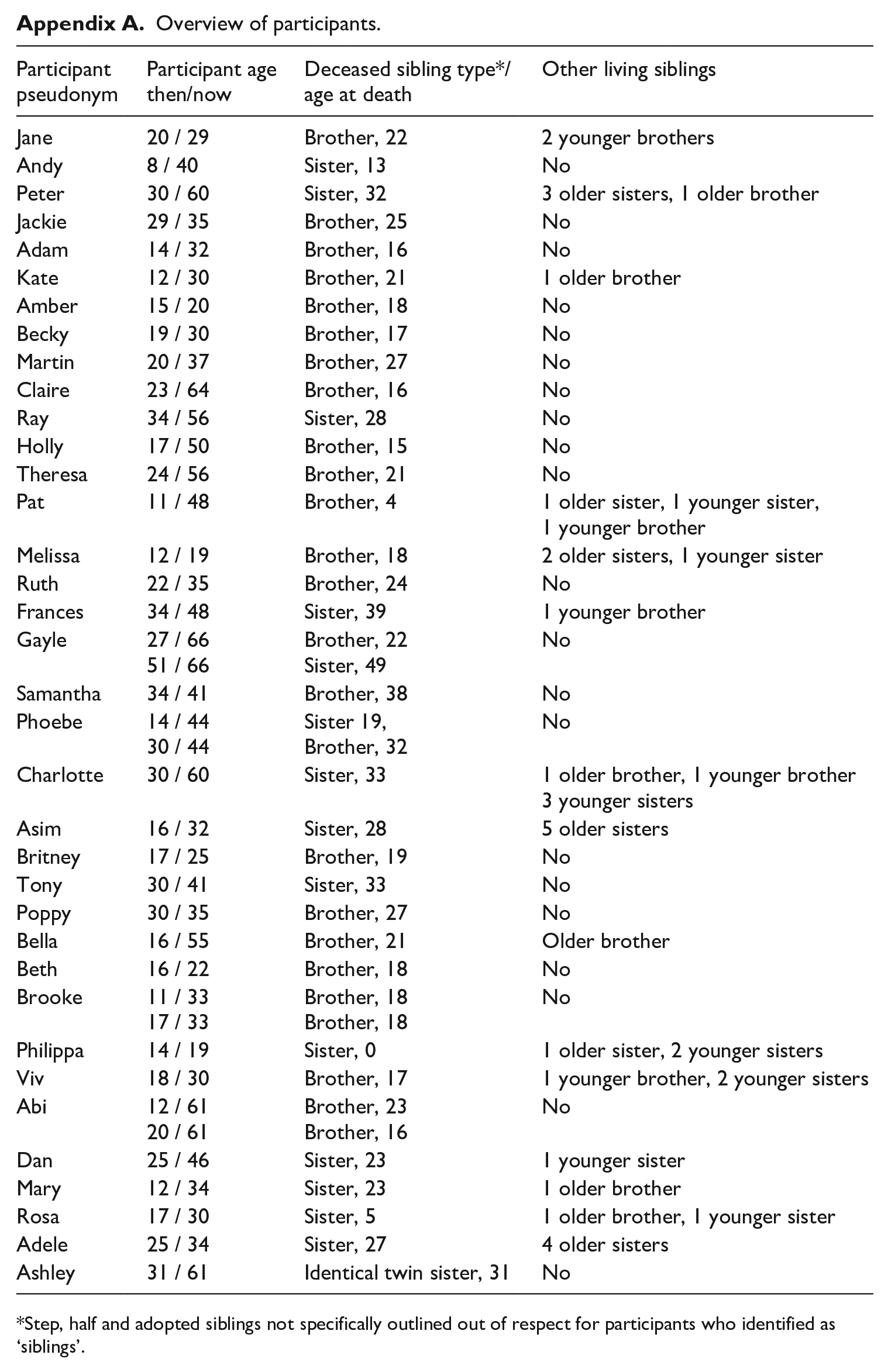
| Participant pseudonym | Participant age then/now | Deceased sibling type*/age at death | Other living siblings |
|---|---|---|---|
| Jane | 20 / 29 | Brother, 22 | 2 younger brothers |
| Andy | 8 / 40 | Sister, 13 | No |
| Peter | 30 / 60 | Sister, 32 | 3 older sisters, 1 older brother |
| Jackie | 29 / 35 | Brother, 25 | No |
| Adam | 14 / 32 | Brother, 16 | No |
| Kate | 12 / 30 | Brother, 21 | 1 older brother |
| Amber | 15 / 20 | Brother, 18 | No |
| Becky | 19 / 30 | Brother, 17 | No |
| Martin | 20 / 37 | Brother, 27 | No |
| Claire | 23 / 64 | Brother, 16 | No |
| Ray | 34 / 56 | Sister, 28 | No |
| Holly | 17 / 50 | Brother, 15 | No |
| Theresa | 24 / 56 | Brother, 21 | No |
| Pat | 11 / 48 | Brother, 4 | 1 older sister, 1 younger sister, 1 younger brother |
| Melissa | 12 / 19 | Brother, 18 | 2 older sisters, 1 younger sister |
| Ruth | 22 / 35 | Brother, 24 | No |
| Frances | 34 / 48 | Sister, 39 | 1 younger brother |
| Gayle | 27 / 66 51 / 66 |
Brother, 22 Sister, 49 |
No |
| Samantha | 34 / 41 | Brother, 38 | No |
| Phoebe | 14 / 44 30 / 44 |
Sister 19, Brother, 32 |
No |
| Charlotte | 30 / 60 | Sister, 33 | 1 older brother, 1 younger brother 3 younger sisters |
| Asim | 16 / 32 | Sister, 28 | 5 older sisters |
| Britney | 17 / 25 | Brother, 19 | No |
| Tony | 30 / 41 | Sister, 33 | No |
| Poppy | 30 / 35 | Brother, 27 | No |
| Bella | 16 / 55 | Brother, 21 | Older brother |
| Beth | 16 / 22 | Brother, 18 | No |
| Brooke | 11 / 33 17 / 33 |
Brother, 18 Brother, 18 |
No |
| Philippa | 14 / 19 | Sister, 0 | 1 older sister, 2 younger sisters |
| Viv | 18 / 30 | Brother, 17 | 1 younger brother, 2 younger sisters |
| Abi | 12 / 61 20 / 61 |
Brother, 23 Brother, 16 |
No |
| Dan | 25 / 46 | Sister, 23 | 1 younger sister |
| Mary | 12 / 34 | Sister, 23 | 1 older brother |
| Rosa | 17 / 30 | Sister, 5 | 1 older brother, 1 younger sister |
| Adele | 25 / 34 | Sister, 27 | 4 older sisters |
| Ashley | 31 / 61 | Identical twin sister, 31 | No |
Step, half and adopted siblings not specifically outlined out of respect for participants who identified as ‘siblings’.
Acknowledgements
Many thanks to Dr Katherine Davies for offering feedback on an early draft. Thanks also to the reviewers for their helpful comments and suggestions.
Funding
The author disclosed receipt of the following financial support for the research, authorship and/or publication of this article: the research was funded by an Economic and Social Research Council Studentship; award number ES/J500215/1.
