




Abstract
Although grief can have a profound effect on the workplace, the long-term lived experience of working after bereavement remains under researched. But how is grief experienced at work? And to what extent does this experience vary according to type of loss and form of work? Drawing on data collected through a qualitative online survey (n = 220), this article provides a sociological exploration of experiences of work after bereavement. The article will argue that while grief can be silenced in the workplace, work can also provide an important source of relational connection for bereaved individuals. It concludes by reflecting on the need to move beyond linear approaches to grief and work, highlighting the important intersection of social relations and place. By analysing experiences through a relational lens, this article seeks to offer an original contribution to the sociology of work, and to grief theory as applied in the workplace.
Introduction
Death, grief and work have each received significant attention within sociology and interdisciplinary fields such as social studies of death and dying. To date, however, analyses of the connections between them remain neglected (Hazen, 2008; Pitimson, 2021; Thompson and Bevan, 2015). What limited research does exist tends to show how grief is often disenfranchised in the workplace (Bauer and Murray, 2018; Bento, 1994: 35; Thompson and Bevan, 2015). Drawing on data from an in-depth qualitative social survey with bereaved individuals working across different employment sectors, this article seeks to explore experiences of grief and work. It will show how such experiences often vary according to form of loss experienced and type and location of work. The article also examines the ways in which the reorganisation of work practices that have taken place over recent decades (and have been exacerbated by the COVID pandemic) has impacted on the relationship between grief and work, noting how this is leading to a reconfiguration of public and private workspaces. By including participants from different employment sectors and uncovering hidden narratives around grief and work this article seeks to offer an original contribution to the sociology of work. It also seeks to extend the focus of existing research on bereavement thus contributing to the social study of death and dying.
In the UK, employees are entitled to ‘reasonable’ time off work after a bereavement (Employment Relations Act, 2004). Except for parental leave after the loss of a child, 1 however, there is no statutory requirement for employers to pay employees for time away from work. For many employees therefore compassionate leave is not a given but something that is discussed and negotiated at point of use (Peticca-Harris, 2019; Pitimson, 2021). Although various organisations have developed guidelines for employers on how to best support bereaved employees (e.g. Advisory, Conciliation and Arbitration Service (ACAS), 2022; Marie Curie, 2021), existing literature shows a mixed picture in practice. While some employers show sympathy and flexibility to bereaved employees, others are much less responsive (Flux et al., 2019). Bereavement support policies – when they do exist – tend to be based on a linear model of grief, often failing to account for the ongoing emotional trauma and long-term effect of bereavement on employee identity (Thompson and Bevan, 2015). Such policies also tend to homogenise bereavement, failing to recognise the role that other factors such as type of loss, ethnicity, gender and social class can have on individual experience of grief (Doka and Martin, 2011; Mayland et al., 2021). Workplace support, however, often plays a key role in well-being and recovery after bereavement (Flux et al., 2019). It is imperative, therefore, that workplace bereavement policies are exposed to further sociological scrutiny.
The article begins by providing some background context to the area of work and bereavement in the UK before moving on to outline the project’s conceptual focus and method. The main part of the article is concerned with a discussion of the findings of the study presented in three sections: the inadequacy of existing workplace bereavement policies, experiences of doing work after bereavement and finally the impact of work location on grief. As this article will show, official workplace bereavement policies rarely exist, and, when they do, often fail to account for the diverse and ongoing experiences of grief. Despite the limitations of official policies, however, the actual experience of work after bereavement is often mixed. Although work can provide an essential source of support for some individuals, it can also add additional layers of trauma to the grief of others. Work location also significantly informs an individual’s experience of grief, with recent shifts to home or hybrid forms of working often leading to greater social isolation. The article concludes by emphasising the pivotal role that social relationships play in mediating individual experiences of grief at work. In doing so the article aims to move beyond the view of grief as necessarily disenfranchised in the workplace. Instead, the article will emphasise the value of adopting a relational approach in this context, a sociological approach that highlights the importance of processes, action and interaction.
Mapping the Landscape of Grief and Work
The workplace can provide bereaved individuals with a welcome distraction from a dominant environment of emotion and grief at home (Charles-Edwards, 2005; Hochschild and Machung, 2012). Despite this potential, however, researchers have, traditionally focused their analysis on the ways in which grief and emotion are disenfranchised at work (Bento, 1994). Physical dividing practices between home and work appear to render what is personal (grief) nearly unspeakable in a public setting such as the workplace (Hazen, 2008; Walter, 2009). While grief can clearly be silenced within workplace settings, assertations made about how it manifests across a home/work divide are problematic for several reasons. First, because as Mallett (2004) points out, the boundary between the private and public realm has never been clear-cut. For example, women have frequently engaged in work (paid and unpaid) in the context of home. Second, home is not always a private haven where individuals can articulate emotions such as grief. It can also be a site of trauma and violence (Mallett, 2004). Third, some mobile workers (such as delivery drivers) occupy a space that deliberately blurs the boundary between ‘home’ and ‘work’.
Public facing workplaces can also have an emotional architecture, containing ‘front’ and ‘backstage’ spaces each governed by different feeling rules (Fineman, 1993). While grief may be stifled in certain public facing work contexts, therefore, it may be accepted and supported in others. Death and grief can directly affect certain public facing forms of professional practice (e.g. paramedic practice, pathology, etc.) (Reed and Ellis, 2020; Regehr et al., 2002), but they can also enter the workplace in collective form when colleagues, line managers – or even entire work teams – die (e.g. through individual illness, accidents or industrial incidents) (DeFraia, 2015; Hyde and Thomas, 2003; Peticca-Harris, 2019). Grief permeates the workplace, therefore, in direct and unanticipated ways, raising important sociological questions about the social and physical boundary between home and work.
Technological change has also repeatedly shaped and reshaped the relationship between work and home (Ammons and Markham, 2004). In recent decades, we have witnessed a digital revolution, which, combined with the ongoing impact of COVID-19, has led to a reorganisation of work practices with many of us now working across hybrid or multiply located workspaces (including organisational, domestic and cyber spaces) (Halford, 2005; Nagel, 2020; Symon et al., 2021). While scholars of work and organisation have started to explore what this means for labour market restructuring and the in/visibility of different work practices (Symon et al., 2021; van Barneveld et al., 2020), the implications of these changes for work experiences of grief remain unknown. This article seeks to address this gap, situating its analysis of grief and work in the wider UK employment context, illuminating different experiences of bereavement support across sectors, workplace locations and employment type.
Developing a Relational Approach
Sociologists have long talked about a relational turn in the discipline beginning with the publication of Emirbayer’s ‘manifesto for a relational sociology’ in 1997. The general aim of relational approaches is to move beyond the notion that one can posit pre-existing units (such as individual and society) as the starting point of sociological analysis (Emirbayer, 1997). Rather a transactional or relational approach is interested in the processes, action and interaction in which the participants in this process emerge (Emirbayer, 1997). This approach has been used most extensively in sociology to study areas such as intimacy, family and personal life (Roseneil and Ketokivi, 2016; Smart, 2007), highlighting the ways in which an individual’s sense of self is constructed in relationships with and to others and to social norms (May, 2011). Interdisciplinary scholars have also sought to explore death and dying as collective and relational processes (Broom and Kirby, 2013; Howarth, 2007; Kellehear, 2008). The death of a loved one can have significant effects on social relationships among the living, often transforming existing family dynamics (Gilbert and Gilbert, 2017). Social relationships with the deceased can also continue long after death through memory-making practices (Ellis, 2013). Such relationships are embedded within material and spatial aspects of everyday life and can be an important source of identity maintenance (Ellis, 2013, 2018; Hockey et al., 2010).
Although various relationships are considered through a relational lens, family and personal associations tend to dominate sociological analyses. This is regardless of the substantive area of application. For example, while recognising that grief is embedded in all relationships including work relationships (Towers, 2019), death studies scholars have tended to focus their attention on the ways in which individual biographies and family structures shape death, dying and end of life care (Broom and Kirby, 2013). While a relational lens is often used to examine family and personal relationships, the relationship between work and grief has tended to be explored through the notion of disenfranchised grief. Disenfranchised grief is one of the most enduring concepts in grief research (Albuquerque et al., 2021). It acknowledges that societies have certain norms and grieving rules that attempt to specify who, when, where and how long someone can grieve for (Hall, 2014). It has been used to explore the ways in which bereavement can be ignored or discounted at work (Bento, 1994; Stein and Winokuer, 1989). Although useful, the disenfranchised grief approach presents a binary view of grief (it is either disenfranchised or it is not) (Robson and Walter, 2013) and, in the context of work often fails to account for the ongoing and multifaceted experiences of, and ongoing responses to grief.
Social relations are central to the contemporary workplace (Methot et al., 2017; Schneider, 1987). Furthermore, as Bauer and Murray (2018) argue the workplace may facilitate relational connections that can be important for grieving individuals (Bauer and Murray, 2018). This article seeks, therefore, to move beyond the disfranchised grief approach to analyse the relationship between grief and work through a relational lens. It builds on existing sociological uses of the concept of relationality by acknowledging the intersection of family and work relationships. Social relationships with colleagues and line managers and the role that they can play in mediating individual experiences of grief, however, form the central focus of this article. In taking this approach, the article will pay attention to the ways in which proximity in social relationships can inform individual experiences of grief and govern wider social norms about bereavement at work (Robson and Walter, 2013). It will also examine the ways in which social relations intersect with work location to inform individual experiences of grief. By centring work relationships in this way, the article broadens existing sociological applications of relationality, thus highlighting its wider appeal and value as a conceptual tool.
The Survey
This article is based on data collected from an online social survey on bereavement and work between June and August 2021. Qualitative surveys enable researchers to capture a diversity of perspectives, experiences or sense-making (Braun et al., 2017; Toerien and Wilkinson, 2004). They are ideally suited to sensitive research (Braun et al., 2017) because they offer a high level of felt anonymity. As the researcher cannot see and does not know the respondent, this can facilitate participation and disclosure on sensitive topics (Braun et al., 2020). There were limitations to using a qualitative social survey in this context. For example, the ability of the researcher to gain good in-depth data in such a survey is often contingent on the literacy levels of participants. The survey did, however, enable me to access the perspectives of a range of participants experiencing different types of loss and working in a range of different sectors and localities, capturing broad patterns alongside in-depth qualitative accounts.
The research sought to recruit a diverse sample. As Denscombe (2010: 21) points out, bias through non-contact can be a problem in the context of online surveys as they rely on visitors to websites that do not automatically reflect a cross-section of society. To militate this issue, the survey was promoted through X (formerly known as Twitter). Most participants were recruited through bereavement support charities who circulated the survey link through their online networks. Table 1 shows some general characteristics of the study population.
Demographic details of survey respondents.
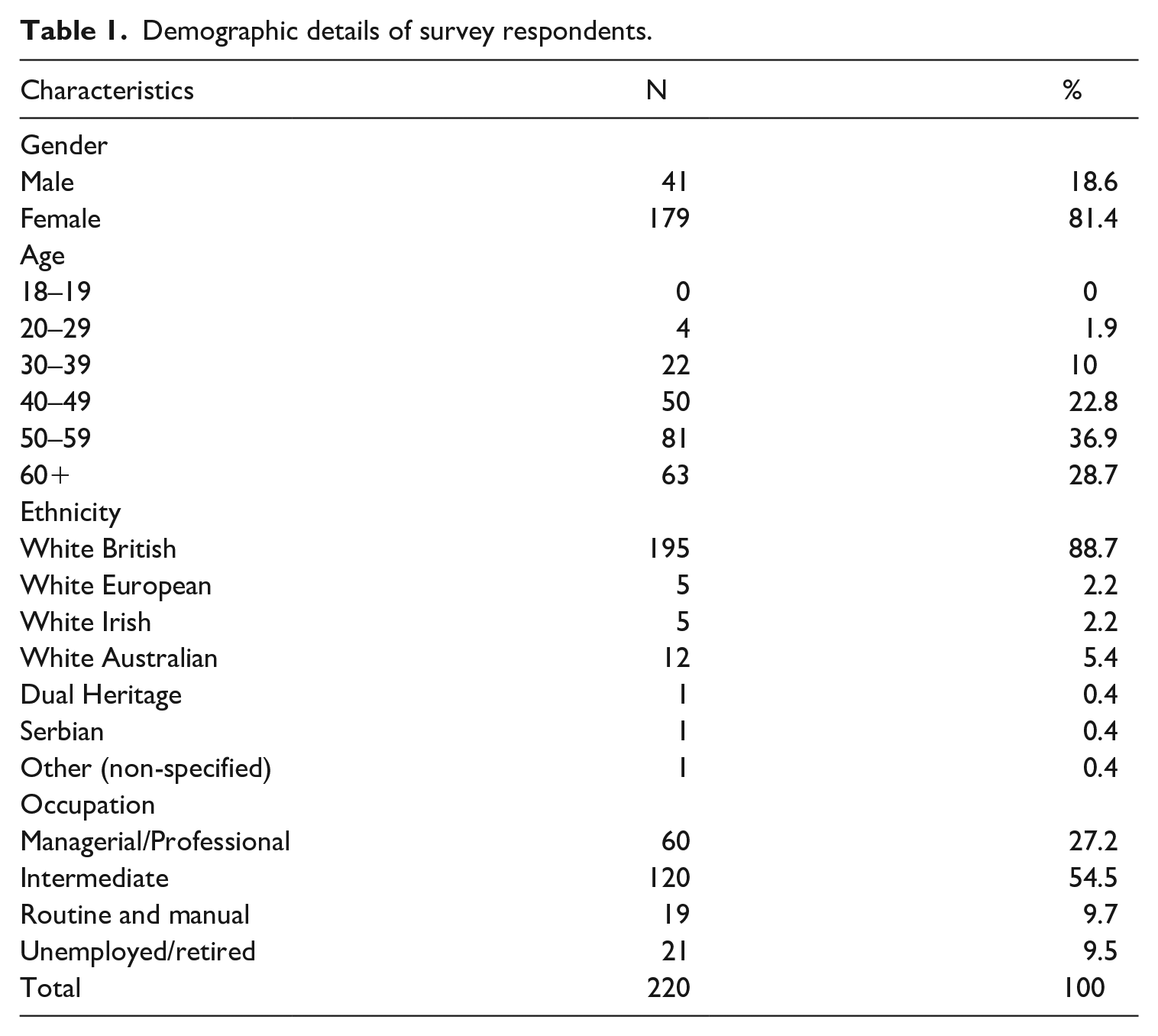
Experiences of different forms of bereavement (including family and friends) were well reflected in the study. The length of time since bereavement also varied across the sample. Sixty-eight per cent of participants had been bereaved for less than five years, 16% 6–10 years and 16% 11 or over. Participant ages ranged from 25–77. Experiences and access to bereavement support can be affected by occupation. The sample comprised, therefore, of individuals who self-identified as retired, unemployed and those currently not looking for employment. It included participants who were engaged in precarious forms of employment (gig economy/zero hours contract) right through to high-ranking professionals. 2 While diversity in occupations was well represented in the study, some differences were less well captured. For example, only women responded to initial postings of the survey. Furthermore, respondents self-identified as predominantly ethnically white. This could relate to cultural and gender differences in approaches to grief (Doka and Martin, 2011; Mayland et al., 2021). To encourage greater diversity the survey was also circulated via various men’s and culturally diverse internet forums and social media. Despite these attempts the sample remains skewered towards women and ethnically white participants. It is important that this article be viewed, therefore, as indicative, rather than representational of diverse groups.
Data Collection and Analysis
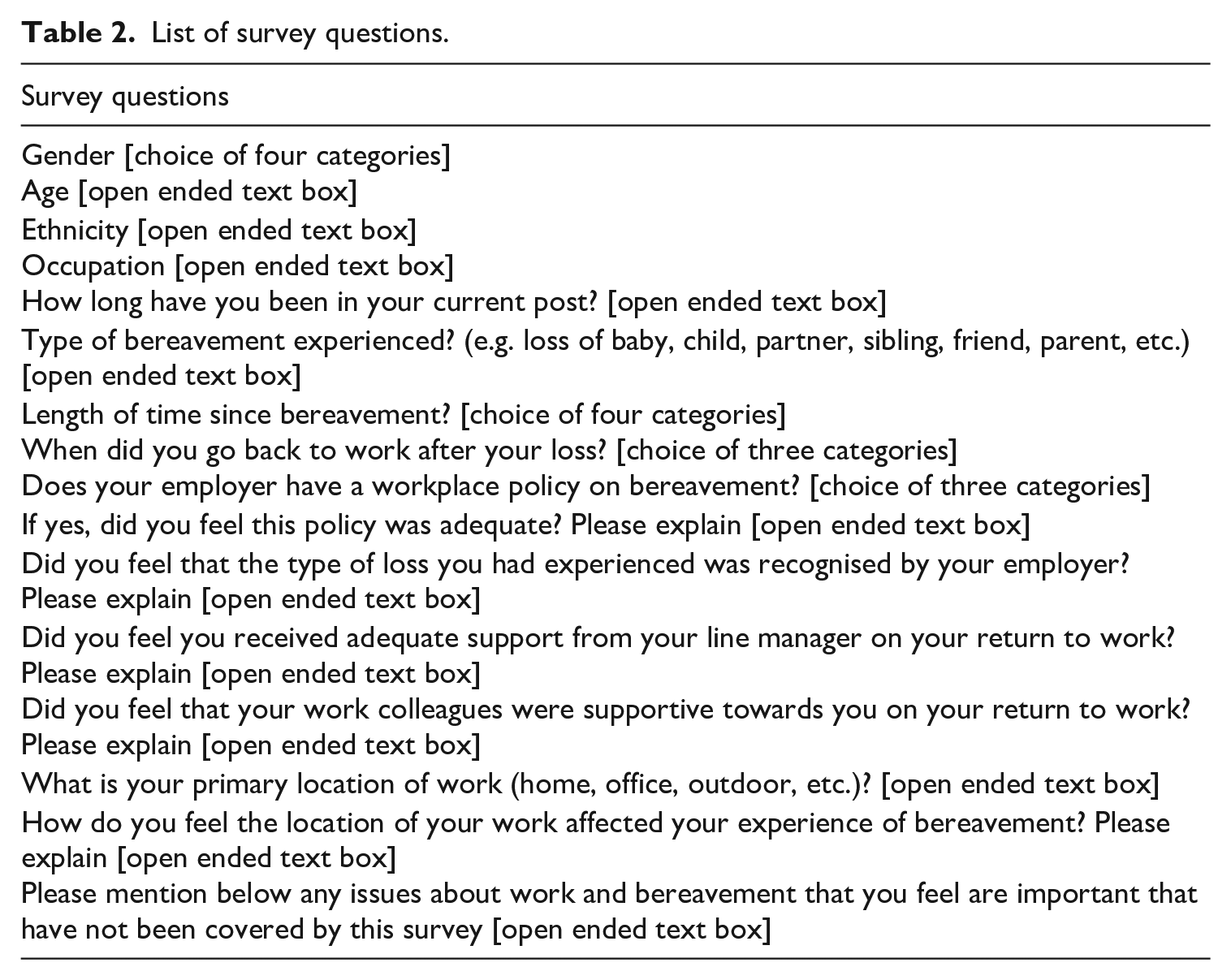
After university ethical approval was granted, the survey was circulated to potential participants via social media and through two bereavement charity networks (The Compassionate Friends and the National Bereavement Service). An informational letter about the research and consent form were embedded in the survey. As this was a qualitative survey, open ended questions were used to stimulate in-depth responses. Closed questions were used to elicit demographic information. The survey was divided into two main sections. The first section was focused on eliciting contextual background information (age, gender, ethnicity, occupation, type of bereavement, etc.). The second comprised of questions exploring experiences of bereavement and work. Participants were invited to elaborate in detail in the text box. Questions are listed in Table 2. The survey was left open until participants ceased to respond and was closed at 220. 3
List of survey questions.
Braun et al. (2020) argue that data analyses of qualitative surveys can go beyond description to provide richly theorised and interpretative accounts, socially located explorations of experiences and sense-making or interrogation of social norms. Once completed this survey on bereavement and work was analysed in two ways. Closed questions were imported onto spreadsheets and descriptive statistics were produced on background data (occupation, age, ethnicity, etc.). Open ended text responses were coded according to participant experiences of different aspects of bereavement and work. To enrich this process, I attempted to treat survey responses as one cohesive data set rather than falling into the trap of analysing the data by individual survey question (Braun et al., 2020). Coded data were then organised into general themes including experience of work after bereavement, impact of location, role of colleagues and line managers, and access to and effectiveness of short-term and long-term bereavement support. Identified themes were used to reflect on relevant social theories including disenfranchised grief and relationality. The article thus focuses on the following key themes: existence and effectiveness of bereavement policy, experiences of work after bereavement and impact of work location.
Findings
In the following three sections, data will be presented through a combination of anonymised textual accounts and basic statistical calculation. All participants have been given pseudonyms. The article begins in the next section by analysing workplace bereavement policy.
The Inadequacy of Workplace Bereavement Policies
Existing research on bereavement support tends to highlight the inadequacy of workplace policies. These policies are often limited, focusing mostly on the immediate effects of grief. As Thompson and Bevan (2015) argue, they tend to neglect the ongoing emotional trauma and long-term effect of bereavement on employee identity. Such policies also tend to operate at the discretion of employers and are negotiated at point of use (Peticca-Harris, 2019; Pitimson, 2021). As highlighted in Table 2, survey participants were invited to comment on what kind of support (if any) was provided by employers. While 42% of participants said their employer had a policy, 27% said their employer did not and 31% were unsure. This first section of the article maps the landscape of official policies, analysing the emotional and financial inadequacy of such policies, highlighting how they often impact negatively on social relationships.
Employers frequently do not have official workplace bereavement policies. Participants highlighted how this could have a detrimental impact on their well-being and social relationships at work. For example, 50-year-old nurse Pauline had experienced child loss over 10 years ago. At the time of her loss her employer had no formal bereavement policy. This led to conflict and a breakdown in Pauline’s relationship with her line manager, resulting in the end of her employment: ‘There was no policy. It ended in a conflict and me losing my (then) job.’ While several participants said their employer had no policy at all, many others emphasised the inadequacy of existing policies. Participants frequently felt that certain types of loss – such as perinatal loss – were not well represented in workplace policies and were often lumped in with sick leave entitlement. When compassionate leave policies were not available, participants frequently took annual leave to try and cope with their loss. This is articulated by Sarah, a 44-year-old female emergency services worker who had experienced bereavement due to the death of a parent: It forms a small section as part of a wider policy about absences from work. It’s very basic. It literally states the time off that you could be granted (at manager’s discretion). This amounts to five days pro rata (paid). After that, you’d either have to take leave (paid or unpaid) or go sick.
Death studies scholars have shown how grief, death and dying are relational processes, embedded within the family and other social relationships (Broom and Kirby, 2013; Ellis, 2013; Howarth, 2007; Kellehear, 2008; Towers, 2023). Compassionate leave policies are also relational. Survey data showed how closeness of social relationships played a key role in determining whether an employer would grant compassionate leave. This was articulated by Ceri, 63, a pharmacy technician whose nephew’s mother was murdered over 15 years ago. She talked about the impact of the murder on her wider family and her need to go home to support her family in Wales. Her employer would not, however, grant her compassionate leave: Although the death was by murder, my nephew’s mum was not deemed a close enough relative for me to have compassionate leave. I had to use my normal holiday allowance to go home to Wales from Cambridgeshire to support my family. The murderer had also threatened my family prior to the murder.
Research has shown how bereavement can lead to a reconfiguration of family and personal relationships (Ellis, 2013; Towers, 2023). As my survey data show, this can have significant financial and work implications. Lynne for example, a 51-year-old social media manager lost her partner over 11 years ago. As a result, she had to change jobs due to childcare commitments. This meant taking a pay cut, which put a huge strain on her financially: ‘I had to leave my job and take another as a waitress in a cafe. My career had to be put on hold as I was sole carer for two grieving children.’ Most participants – including Lynne – felt that employers should offer more comprehensive financial support and assistance to bereaved individuals. Participants also felt that employers needed to move away from universal policies and demonstrate a greater awareness of the effects of different types of loss on employees. As articulated by 48-year-old nurse, Julie, who had experienced child loss: ‘There should be more allowance for individual situations/type of bereavement rather than a blanket policy.’ Finally, participants felt that employers should acknowledge the longer-term effect of bereavement, recognising the impact of triggers (e.g. anniversaries, birthdays) on employees. As Suzie, a 43-year-old teacher whose brother had died articulates: ‘Bereavement is not linear, nor reaches an end completion goal. Some times, such as anniversaries, are difficult.’ This led Suzie to conclude: ‘It has felt at times that work and bereavement are not compatible and that is a shame as work has benefits aside from purely monetary ones.’
Survey data reinforce the findings of existing studies that demonstrate the inadequacy of workplace policies (Peticca-Harris, 2019; Pitimson, 2021). Data presented in this section also begin to highlight the centrality of relationships in mediating experiences of grief at work, thus highlighting the value of extending a relational approach for use in this context. It emphasises the direct impact that bereavement can have on the relationship between family and work. More than this, however, it shows how the lack of effective work policy can lead to a breakdown in social relationships at work. It also illuminates the ways in which proximity in social relationships can underpin wider social norms around loss (Robson and Walter, 2013), in this context through employer decision making about compassionate leave. The next section expands on this further, examining the ways in which social relationships and other organisational and structural factors influence the experience of doing work after bereavement.
‘Doing’ Work after Bereavement
Regardless of the limitations of formal workplace bereavement support, going back to work after bereavement can be a positive experience for many individuals. Pitimson (2021), for example, conducted a small-scale qualitative study on bereavement and work focusing specifically on professionals working in the private sector. She found that bereaved individuals often find comfort in the familiar routines and processes of the workplace. Data from my survey showed that constructive experiences of going back to work after bereavement were often mediated by strong social relationships and a comfortable work environment. This is articulated by Carol, a 35-year-old primary school teacher who had lost her ‘brave and brilliant younger brother’ 10 years ago. She felt that going to back to work two weeks after her brother’s death was constructive for her, offering an important diversion from her grief. She identified her relationships with the children and work environment to be particularly therapeutic: I think it helped to go to work and have a focus but it was also very hard to do at the same time. Teaching is a wonderful distraction, and the children are super for keeping my mind busy. My school is set in a village with fields around and that’s nice.
As Pitimson (2021) argues, interactions with colleagues, or lack, thereof, are often integral to an employee’s grieving experiences. Data from my survey indicated that productive experiences such as Carol’s, were often underpinned by strong social relationships. Many survey participants felt that going back to work and spending time with their colleagues had really helped them to deal with their grief. As Chrissie, a 40-year-old school teacher who had experienced sibling loss articulates: ‘Yes extremely. They (work colleagues) have been my rock. They listened, hugged and cared for me. They supported me from a place where I couldn’t function to where I am now. I would not have survived without them.’
Social relationships at work were often affected by type of loss. For example, participants felt that certain types of loss such as child loss and suicide were especially taboo subjects in the workplace. Work colleagues just did not know how to speak to bereaved individuals about these forms of loss. This is articulated by Jane, a 58-year-old branch manager who had experienced child loss: ‘Nobody knew how to approach or talk to me so they ignored it and avoided me.’
While social relationships clearly informed experiences of grief at work, type of work could also play an important role. Participants working in certain types of occupations (such as frontline healthcare work), for example, frequently articulated concerns over their ability to do their job safely after bereavement. As 39-year-old paramedic Pete who had lost one of his parents states: ‘It would be unsafe to expect me to do my job with the distraction of grief.’ Participant experience could also be mediated by gender, with certain workplace cultures perceived as being masculine environments whose physical architecture remains hostile to emotion (Fineman, 1993). This is articulated by Michael, a 64-year-old aircraft engineer who spoke about how there is no space for grief in the masculine environment of engineering: ‘Male environment, get on with it attitude.’ This is unsurprising perhaps because as Thurnell-Read and Parker (2008) argue, physical and psychological strength have traditionally been seen as key constituents of masculine occupational identity. Furthermore, as Doka and Martin (2011) have shown, gender can also inform an individual’s style and patterns of grief. Although they also caution against making assumptions and generalisations about the gendered nature of grief.
Data from the survey showed that concerns about the ability to do a job effectively combined with a lack of social support in the workplace could lead to feelings of extreme isolation. In some cases, this propelled participants to change careers after bereavement. This is articulated by Karen, a senior human resource manager aged 49 when she lost her 14-year-old daughter: ‘As a result of my own bereavement I am changing career direction and heading back to university. My first degree is sociology/psychology and I am off to do Career Guidance.’
Survey data showed how certain occupations and work contexts could be more conducive to supporting bereaved individuals, whereas in others grief remains stifled. This relates to a range of different factors, including in some cases, the potentially gendered nature of occupations and grief (Doka and Martin, 2011; Thurnell-Read and Parker, 2008). Experiences of work were, however, strongly mediated by social relationships and the ability of colleagues to feel comfortable speaking about certain forms of bereavement in the workplace. These experiences highlight the usefulness of taking a relational approach in this context. Data presented in this section, however, emphasise the value of foregrounding workplace relationships (in these instances school children and colleagues) instead of personal ones, thus extending the analytical focus of the relational approach further. The next section explores how place and environment intersect with social relations to underpin experiences of work and grief.
Going to Work: Grief and the Effect of Location
According to Mellor and Shilling (1993) death shifted from the public realm to the private world of individualised experience in contemporary society. Paid work, by contrast, has up until recently mostly been associated with the public world. The onset of the COVID pandemic, has, however, meant that death has entered the public realm in striking and unprecedented ways (Han et al., 2021), while work has increasingly taken place in domestic and digital spaces (Symon et al., 2021). The impact of COVID on bereavement and work is not the focus of this article, however, the survey was disseminated in the summer of 2021. At this time the UK was no longer in a sustained period of lockdown, but society was still not yet fully open. In the survey 46% of participants identified as working in an office, 15% at home, 3% said they worked outdoors with 36% identifying hybrid or other locations. This section explores the effect of work location on participants’ experiences of grief, examining the intersection of place, materiality and social relations. It begins with a focus on the physical journey to and from work.
According to Mallett (2004) home is both a place of origin as well as destination, journeys away from home establish the boundaries and thresholds to it. Travelling to and from work could, in some cases, be beneficial for survey participants because it gave them time to establish boundaries between home and work. For other people travelling to work was a reminder of how and where their loved one died. This is articulated by pharmacy advisor, Joan, aged 59 who lost her son in an accident. She talked about the daily trauma of her car journey to work: ‘Very difficult as I have to drive past the place where my son had his accident and lost his life.’
While some participants talked about the trauma of ‘going’ to work, others found the interaction of the physical and social environment of the workplace traumatic. This was particularly acute for Siobhan, a 53-year-old medical secretary who worked in a hospital pathology department and whose son had died less than five years ago: ‘Was very much affected (by the workplace), work within hospital setting in Pathology, my colleague carried out son’s postmortem.’ Certain material objects in the workplace could also reinforce work location as a source of trauma. This is articulated by 39-year-old Kate, for example, who currently worked at an animal shelter. Her brother had died (over five years ago) when she was working in a supermarket. The supermarket, and material objects within it, formed a key site of trauma for Kate as articulated below: I worked night shifts in a supermarket. As my brother loved food, there were many reminders of his favourite foods. It was difficult to see piles of the local newspaper with pictures of my brother on the front page. It was also difficult to return to the place where I was informed of my brother’s death.
Although negative experiences of work location such as Kate’s were not uncommon, some other participants found their working environment comforting. This was frequently expressed when participants worked outdoors, as articulated by Ricky, a 34-year-old general manager on the railway: ‘Being outdoors really helped me. It gave me the opportunity to process things at my own speed in an environment that at times was very quiet and peaceful.’
Research has often highlighted positive associations with homeworking employee well-being and a better work–life balance (Redman et al., 2009). Experiences of homeworking during or because of COVID appeared to be more mixed for my participants. It could be a source of comfort, affording participants the opportunity to articulate their emotions in the private arena of home. It could also lead to greater social isolation. This is articulated by Joanne, a 51-year-old volunteer coordinator whose son had died less than five years previously: It’s a double-edged sword to be honest. I only work from home because of COVID and I spend my days sat in my son’s room, I don’t even know if this is a major comfort or painful. Having said that I do feel working at home once bereaved has been more emotionally gentle than travelling to and working in the office. I don’t need to put on a brave face for strangers’ sake, if I need a moment to allow a wave of grief to pass over me I can just allow it, I don’t need to remove myself outside.
Although some participants found comfort in working at home, others missed the sociability of work and essential bereavement support provided by colleagues. Data showed that virtual work meetings and email were no substitute for the physical empathy participants received through face-to-face contact: As Dawn, a 42-year-old investment accountant who had experienced sibling bereavement less than five years ago articulates: ‘Working at home through the pandemic meant I couldn’t get the needed empathy and hugs from my work family.’
Data presented here again strongly reinforce the importance of social relationships in mediating experiences of grief. They indicate the need to move beyond existing understandings of the ways in which grief is articulated across the public and private realm to develop an approach that recognises both the limitations of homeworking along with the importance of sociability in the physically separate workplace. They also show how workplace interactions are embedded within material and spatial dimensions of everyday life (Ellis, 2018; Hockey et al., 2010), further illuminating the ways in which place is produced and reproduced through social interaction (Pollack, 2003). We will move on in the conclusion to reflect on the wider conceptual and practical implications of this in more detail.
Conclusion
This article has sought to contribute to sociology in two respects: first, by shedding light on the under researched area of grief and work, and second, by extending the concept of relationality and using it to analyse the relationship between work and grief. In doing so the article has sought to move beyond the specific focus in bereavement research on disenfranchised grief. Given the small-scale nature of the qualitative survey on which this article is based there are limitations as to what conclusions can be drawn. For example, owing to sample size, it is not possible to comment in detail on issues of gender or ethnicity. Despite these limitations, however, this article has sought to offer an original contribution to existing sociological work in the field by attempting to understand the various ways in which grief is articulated and managed across employment types and according to different forms of loss.
Data presented in this article emphasise the important and often mutually constitutive relationship between grief, family and work. Social relationships with colleagues and line managers, however, also played a central role in militating individual experiences of grief at work. Limited official workplace support often affected family and workplace relationships, sometimes leading to conflict at work. In addition, compassionate leave policies were often underpinned by social norms based on a hierarchy of loss (Robson and Walter, 2013). In such cases only certain types of close relationships between the bereaved employee and the deceased were deemed sufficient by employers to warrant paid leave. Social relationships with colleagues also strongly informed the actual experience of work after bereavement. While the inability to talk about grief with colleagues could reinforce the hidden nature of certain types of loss (e.g. suicide and child loss), workplace interactions often provided an important source of support and relational connection for bereaved individuals (Bauer and Murray, 2018). Such experience and relational connection were also informed by material and physical environment (Ellis, 2018; Hockey et al., 2010), thereby reinforcing our understanding of how a sense of (work)place is created through social interaction (Pollack, 2003). These examples all highlight the value of using a relational approach in this context because a relational approach foregrounds the importance of social interaction. By placing workplace relationships at the centre of its analysis, however, the article has sought to build on existing sociological applications of this approach, highlighting its potential applicability to other areas of social life.
Although social relationships played a crucial role in mediating experiences of grief, organisational and structural factors also informed experience (Thompson and Bevan, 2015). While it is impossible to make generalisations from this small-scale survey, data did show how certain work settings could be more conducive to supporting bereaved individuals. This relates to various factors, including the emotional infrastructure of work contexts and the potentially gendered nature of occupations and grief (Doka and Martin, 2011; Thurnell-Read and Parker, 2008). Furthermore, although survey participants did not discuss this issue at length, certain groups (e.g. the unemployed, self-employed, retired and those in precarious forms of employment) may have particularly limited access to formal bereavement resources and informal collegial support networks. Such wider structural influences, therefore, should be given greater emphasis in future research and policy.
The reorganisation of work that has taken place in the UK over the past two decades (and that has been exacerbated by COVID) has also affected the relationship between grief and work. The emotional boundaries across home and work are increasingly blurred due to an increase in homeworking. This has analytical implications for sociologists researching grief and work. Sociologists have often argued that the physically separate workplace can provide bereaved individuals with a welcome distraction from a dominant environment of emotion and grief at home (Charles-Edwards, 2005; Hochschild and Machung, 2012). This understanding assumes that home and work are physically separate entities, which can also be treated as analytically distinct categories. Data from this survey, however, suggest we need to update this analytical focus to develop a greater understanding of how emotions can be conceptualised across hybrid workspaces. In the context of work and grief, the role of online spaces in further troubling these boundaries is worthy of additional consideration in future sociological research.
Finally, while experiences of work after bereavement are varied, survey findings indicate that more needs to be done by employers to improve employee experiences of work after bereavement. This relates to several issues including: better financial support and leave time, greater understanding of the impact of different forms of loss (on employees and their colleagues) and a better acknowledgement of the ongoing effects of grief on work. Further thought must also be given by statutory bodies in the UK regarding support (emotional and financial) for those in precarious employment or who exist beyond the realms of both formal and informal support structures. Requests for more comprehensive approaches to bereavement have tended to be met with resistance by employers as they can run counter to the desire for organisational flexibility (Charles-Edwards, 2005; Hall et al., 2013). The lack of effective bereavement support in the workplace can and does however, have significant negative consequences for staff well-being and detrimental effects on long-term economic productivity (James et al., 2003; Paakkanen et al., 2021). It is crucial that work, grief and the social relations that underpin them are given greater attention in the future.
Footnotes
Acknowledgements
I would like to thank the research participants who completed the survey on which this article is based. I would also like to thank Laura Towers and the journal reviewers for their insightful comments.
Funding
The author received no financial support for the research, authorship and/or publication of this article.
Ethics statement
The survey used in this article received university ethical approval. All data have been anonymised.
