




Abstract
Building on studies looking into how professionals encounter stigma and negotiate their work lives, this article fills a gap in extant sociological literature on gender and professional work by providing original qualitative data on professional women’s supported re-entry-to-work experiences. Examining the development of returner programmes in the UK, we investigate the supportive factors in the mitigation of stigma threats associated with the returner status, including organisational support and individual stigma-management strategies. We examine how these social processes contribute to alleviating stigmatisation only partially, while maintaining persistent wage and career discrimination for women returners. To explain this mixed result, we explore the way in which women returners inhabit neoliberal feminist subjectivities.
Introduction
There is a wealth of sociological studies exploring women’s reasons for ‘opting out’ (Biese and Choroszewicz, 2019; Stone, 2007; Stone and Lovejoy, 2004, 2012, 2019) and barriers to opting back in (Cabrera, 2007; Hewlett and Luce, 2005; Stone and Lovejoy, 2004, 2012, 2019). However, while existing research insists on their value (Kossek et al., 2017; Stone and Lovejoy, 2019; Zimmerman and Clark, 2016), there has been limited investigation of return-to-work schemes (Herman and Webster, 2010; Panteli and Pen, 2009). Virtually non-existent in most European countries, returner programmes have developed rapidly in countries with neoliberal gender regimes (Walby, 2020), such as the USA and the UK. Funded by employers, they are aimed primarily at qualified professionals (mostly women) in sectors facing ‘leaky pipeline’ (Blickenstaff, 2005) and high gender pay gaps, although returner programmes have recently reached a wider audience in the UK thanks to the support of government campaigns.
In the UK, 1.5m women and 0.2m men are not in paid employment as they are looking after family and home (ONS, 2023). According to Women Returners and PwC, 1 550,000 professional women in the UK are on extended career breaks for caring reasons and 420,000 would like to return to work. Research has shown that around a third of women who try to re-enter the labour market without any support do not come back (Hewlett and Luce, 2005; Stone and Lovejoy, 2019); a finding that reflects the persistence of gendered practices of exclusion that operate within the labour market and penalise mothers in particular (Budig and England, 2001; Dent, 2020; Stone, 2007; Stone and Lovejoy, 2019), especially in male-dominated professions (Pringle et al., 2017; Ren, 2024).
Among the various opting-in strategies (Herman, 2015; Stone and Lovejoy, 2019; Zimmerman and Clark, 2016), making a comeback or ‘rebooting’ a career in the same profession seems the most challenging. This article examines professional women’s re-entry experiences through returner programmes founded by employers, mostly in male-dominated professions or industries. Extant literature suggests that these return-to-work experiences are likely to be compromised by the threat of different stigmas based on returners’ career break, maternal status and age (Atkinson et al., 2015; Cech and Blair-Loy, 2014; Dent, 2020; Stone and Hernandez, 2013; Williams et al., 2013). Women returners are indeed at risk of suffering from maternal stereotyping and gendered ageism, which refers to the negative stereotypes associated with mothers and older women that often result in a decrease in their perceived professional value (Atkinson et al., 2015; Dent, 2020; Jyrkinen and McKie, 2012; Moore, 2009). While returner programmes are usually framed as a diversity approach (open to all genders), their main target is women, which may expose them to the ‘stigma of incompetence’ linked to supposed preferential treatment (Heilman et al., 1992).
However, we posit that returner programmes can play a critical role in avoiding stigmatisation and making it possible for some women to resume their careers. First, their existence is indicative of an awareness on the part of organisations of the barriers faced by workers who have experienced extended career breaks (mostly mothers). Second, it suggests an aspiration to create a ‘positive diversity climate’ (Van Laar et al., 2019: 9). Third, the support provided in the form of mentoring and networking, as well as the backing from senior management, can be used as effective stigma-management strategies (Brewis and Godfrey, 2018; Goffman, 1963; Zhang et al., 2021). Fourth, as strategies for circumventing or ‘buffering’ stigma are also played out at the individual level (Doldor and Atewologun, 2021; Slay and Smith, 2011; Toyoki and Brown, 2014), we argue that the way women returners make use and sense of these programmes has an impact on the success of their returnship. However, since studies have shown that returners generally experience downward mobility in salary and status (Cahusac and Kanji, 2014; Doorewaard et al., 2004; Lovejoy and Stone, 2012; Malo and Muñoz-Bullón, 2008; Ronzio, 2012), our research has also investigated the limitations of returner programmes, particularly in terms of salary and career prospects. We therefore examined three aspects of returners’ experiences: (1) the role of organisational and societal factors in the mitigation of stigma threat; (2) individual stigma-management strategies; (3) the ‘hidden costs’ (Van Laar et al., 2019) of being a returner.
We first locate our theoretical interest within the sociological theory of stigma. Then, we present our qualitative methodology, and describe our findings, elaborating on experiences and responses to stigma. We finally consider how this research expands the understanding of professional women returners’ careers and experiences and contributes to sociological literature on gender and professional work. We underline the interplay of individual, organisation and society levels (Jones and King, 2014; Ozturk and Berber, 2022) in shaping (de)stigmatisation processes, but also the persistence of lasting forms of workplace discrimination for women returners. A gap that can be partly explained by the way in which women returners inhabit neoliberal feminist subjectivities.
Applying Stigma Theories to Women Returners’ Experiences
Stigma theory focuses on social identities, which are discredited and devalued, and seeks to explain the sources and consequences of stigmatisation (Goffman, 1963). In their comprehensive literature review, Zhang et al. (2021) identify various sources of stigma and list different stigma characteristics. Stigma can thus be concealable, controllable, central, disruptive and malleable. Based on this analytical framework and according to extant research on women’s careers, we argue that women are likely to experience highly disruptive stigma (Goffman, 1963) based on the negative assumptions associated with their returner status.
First, extant literature underlines the permanence of the stigmatisation faced by workers who have opted out of the labour market (Cabrera, 2007; Hewlett and Luce, 2005; Stone and Lovejoy, 2004, 2012, 2019), even for a relatively short time. While not defining themselves as unemployed, and despite normative expectations about gendered social roles that women should prioritise unpaid domestic caring roles, women returners are likely to face stigmatisation by association with the unemployed workers group (Garcia-Lorenzo et al., 2022). Moreover, motherhood, flexible working and career breaks have been identified as the main triggers of ‘flexibility stigma’, which arises from the perception of ‘work devotion schema’ (Blair-Loy, 2003) and the prevalence of a full-time uninterrupted career model that remains predominant within male-dominated professional occupations (Williams et al., 2013) such as STEM (Blair-Loy, 2003) and legal or financial services (Pringle et al., 2017). When it comes to women returners, employers are likely to be concerned that women will prioritise family over career when their children are still dependent, impacting perceptions of them as committed professionals. Furthermore, because of their (middle) age, many women returners are likely to suffer from ageism or age stigma (Atkinson et al., 2015), which equals a perception of decline in job skills and professional worth. Finally, receiving preferential treatment, such as via a returner programme, may trigger a stigma of incompetence (Heilman et al., 1992), the beneficiaries of positive action being perceived as less competent both by others and by themselves.
While most women returners are likely to be exposed to stigma-related threats, members of stigmatised groups are not passive recipients but active actors who deal with potential stigmatisation through different strategies. Extant literature has explored how stigmatisation defined as ‘the social process by which the mark affects the lives of all those touched by it’ (Pescosolido and Martin, 2015: 92) emerges, is maintained, transferred or disappears (Zhang et al., 2021). Scholars have examined the ongoing, reparative efforts through which stigmatised workers manage the everyday problems attached to their spoiled identities or status and engage with individual or collective stigma-management strategies (Brewis and Godfrey, 2018; Doldor and Atewologun, 2021; Garcia-Lorenzo et al., 2022; Toyoki and Brown, 2014; Zhang et al., 2021). While members of stigmatised groups may try to hide, conceal or minimise their ‘unfortunate difference’, they may instead find solace in strong group identities that they share with others, with the help of group and ingroup leaders’ support, role models and minority networks, which can help moderate threats of stigmatisation (Van Laar et al., 2019). Furthermore, organisations have a substantial influence on judgements and decision behaviour (Jones et al., 2016). According to previous research, the presence of a ‘positive diversity climate’ (Van Laar et al., 2019: 9) that accepts, respects and values (potentially) stigmatised groups helps reduce threat. Initiatives such as returner programmes may therefore send a sufficiently explicit message to returners and employees in general, signalling openness to and appreciation of different career models. That said, scholars have argued that stigmatisation treatment goes far beyond the issues of identity management and therefore they encourage consideration of how stigma is lived and resisted in dialogue with broader questions of power and structure (Garcia-Lorenzo et al., 2022; Tyler and Slater, 2018). External factors such as access to childcare, working time and family policies are likely to influence women’s re-entry experiences and the wider perception of career breaks. Finally, echoing research on the ‘motherhood wage penalty’ (Budig and England, 2001) and career breaks (Cahusac and Kanji, 2014; Doorewaard et al., 2004; Lovejoy and Stone, 2012; Malo and Muñoz-Bullón, 2008; Ronzio, 2012; Zimmerman and Clark, 2016), our study also investigates the ‘hidden costs’ (Van Laar et al., 2019) of being a returner and the relationships between (de)stigmatisation and discrimination (Dubet et al., 2013).
Returner Programmes in the UK
In the UK, policy concerns about women who leave the labour market date back to the 1980s, mainly economically driven and employment-led, and with little attention to highly qualified returners. Apart from the Science, Technology and Engineering field that led some successful but not sustained initiatives (Herman and Webster, 2010), it was not until 2014 that the returning professional internship concept pioneered by Goldman Sachs in 2008 in the USA, was imported to the UK by Julianne Miles, CEO of Women Returners, ‘a purpose-led consulting, coaching and network organisation with the mission of removing the “career break penalty” by making extended career breaks a normal part of a 40 to 50 year career’ (website). According to Women Returners, between 2014 and 2021, more than 200 advertised programmes were launched.
Most of these programmes are for experienced professionals/managers who have taken an extended career break (minimum one year). Although they are generally open to men, most participants are women. They generally run once per year and are open to small cohorts (three to 10 people). The typical returning scheme resembles a paid professional internship of three to six months supported by coaching and mentoring sessions, with a likelihood of a permanent role at the end. While initially adopted by financial services institutions, returner programmes have spread to the law, banking and telecoms sectors, allowing professionals, mostly women, to return to their former professions after an extended career break.
Methodology
The study draws on qualitative interviews with 21 mothers who had left professional or managerial occupations and returned to work (or have been trying to) thanks to returner programmes. The interviews were identified through purposive sampling using referral or snowball strategies in which participants were asked to refer other women returners with a view to diversifying the sample along key dimensions of age, length of break, type of industry and profession, and characteristics of the programme. Returners’ interviews included elements on: motivations and circumstances that led women to opt out; experience as stay-at-home mothers; motivations, circumstances and strategies for opting back in; barriers and challenges encountered; awareness and experience of returner programmes; impact of the pandemic; subjective assessment of the programmes and returning experience.
Additionally, to enrich our data, we transcribed eight podcasts posted on the open access Women Returners website, involving women who have successfully returned to work through programmes supported by Women Returners. Lasting 30 minutes, the podcasts explore women’s experiences before, during and after the returner programme. Focused on successful returners’ experiences, the podcasts are interesting for two reasons. They emphasise the individual and organisational stigma-management strategies that contribute to the success of women’s return to work, and they provide interesting information on the profile of returners, in terms of age and qualifications, as well as job level after return (Table 1).
Overview of interviewees.
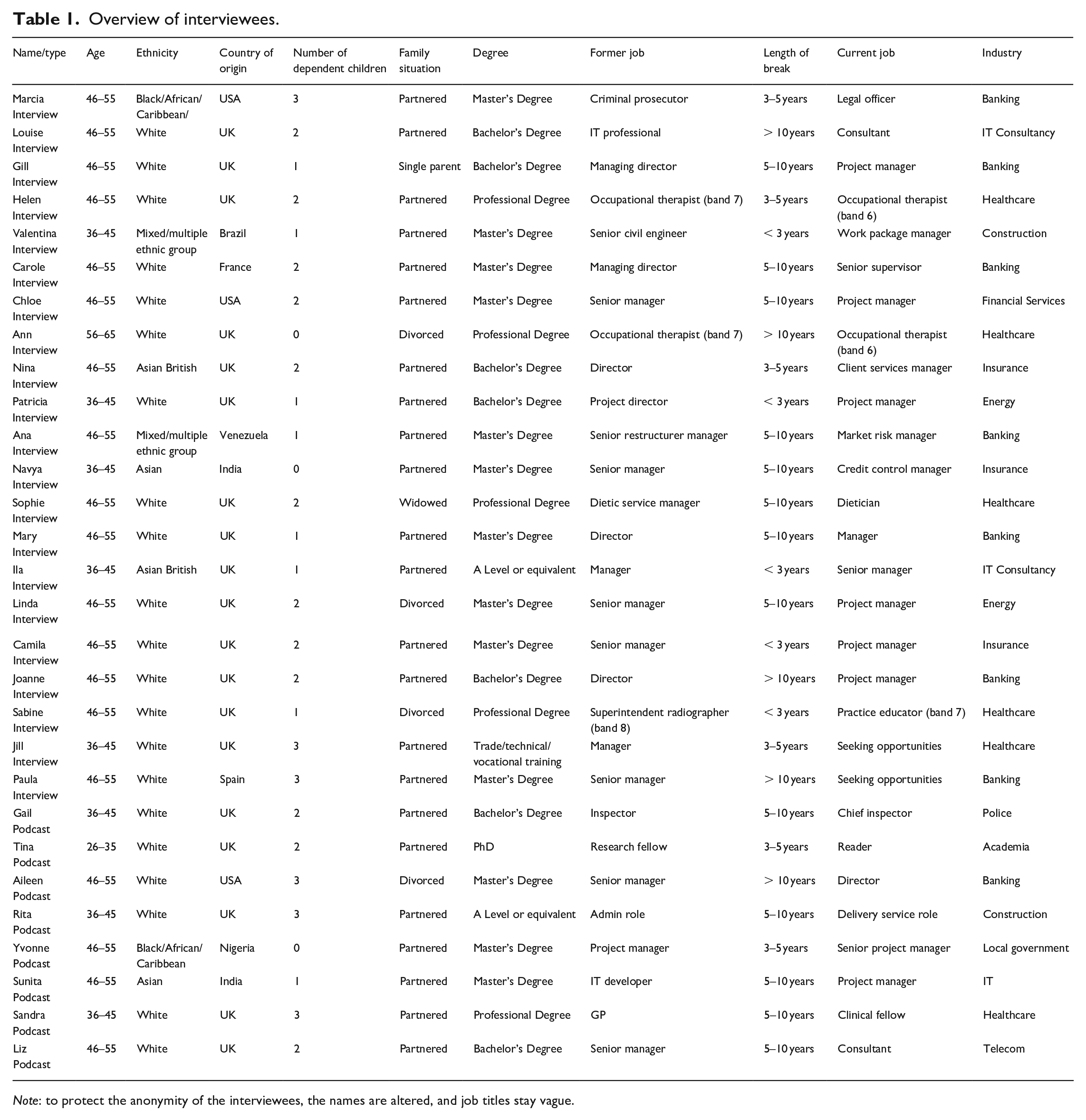
Note: to protect the anonymity of the interviewees, the names are altered, and job titles stay vague.
These combined data resulted in a sample consisting mainly of middle-aged British women including some Black and Asian, and minority ethnic women, with a few non-British participants. These women are socio-economically privileged, and most have a male partner and dependent children. Many stopped working for between five and 10 years; several younger women had shorter breaks (less than three years) and a few older women stopped working for more than 10 years. Most returners had worked in and returned to a wide range of professional or managerial jobs in the private sector and male-dominated professions such as IT, banking and financial services, but some were public service professionals (healthcare, academia, police, local government). Table 1 gives more details of the participants and those who recorded the podcasts, including key information about job level before and after the career break, and their participation in interviews or podcasts. All participants’ names and those of their employers have been changed to preserve anonymity.
Additionally, we interviewed 12 consultants/trainers/coaches (hereafter referred to as consultants) who worked with a range of employers in several sectors, variously on development, design and delivery of returner programmes. Interview topics relevant to this article covered: type of services/support offered to returners; challenges for returners.
All interviews took place online using Zoom between November 2020 and April 2021. On-line interviews lasted 45–60 minutes. All interviews were digitally recorded and professionally transcribed verbatim. Using NVivo 12, we carried out a thematic form of content analysis (Rubin and Rubin, 2005). Our approach involved a combination of theoretically driven and inductive analysis. We worked first within each interview to identify themes to which we assigned preliminary codes. After coding all the interviews, we then worked across interviews, comparing preliminary codes and noting similarities and differences. This inductive data-driven analysis allowed us to refine our coding with secondary sub-themes. Guided by literature on stigma, we finally reached four aggregated processes – sources of stigma; organisational and institutional supportive factors; individual stigma-management strategies; hidden costs of being a returner – that underline women returners’ experiences.
Findings
Returner Programmes as a Selective Gateway to Mitigate Career Break Stigma
Not surprisingly, most women interviewed experienced major difficulties in their return journey, even when their break was relatively short or when they had maintained a part-time job or engaged in intensive volunteering, which many did. As other studies show (Lovejoy and Stone, 2012: Stone and Lovejoy, 2019), returning to work involves various attempts that can lead women to re-route their careers (Herman, 2015). While some of the study participants had done consulting work, set up a business or retrained, most had retained the desire to return to their former profession or industry, but faced a ‘brick wall’ even when they were prepared to accept a lower position, for which they were sometimes perceived as overqualified or too old or both. Having a CV gap, even short, seemed to cause professionals to fall through the cracks of the algorithms used to sift applications, as Yvonne painfully experienced: I dusted off my CV, refreshed it with the skills that I had gained doing the food manufacturing and applied for jobs. I kept getting ‘your CV is not current’ and I didn’t quite understand that. So this was six months with no bite to my CV, it was really scary.
Moreover, our research confirms individual concerns regarding lack of confidence and skill obsolescence (Stone and Lovejoy, 2012, 2019). Despite retraining and obtaining new (UK) professional accreditations, many returners, like Sunita who had been an IT developer and stopped working for more than five years, feared skill obsolescence and anticipated difficulties linked both to the length of her break and her age: IT is everchanging field, everything moves on very quickly and the break was very big. So, I was really worried. I started doing the online free courses, reading blogs and everything to try to catch up with what’s changed in those years. But I was thinking that this is going to be a very difficult task for me because things have moved on and I won’t be able to catch up and nobody will recruit me because I’m not up to date.
The advent of women returner programmes, often discovered by accident through word-of-mouth or by listening to Woman’s Hour on BBC Radio 4, brought a little hope. Some non-British women, like Ana below who had a long break from the banking industry in Paris, decided to move to the UK to relaunch their careers with the support of these programmes: In 2014–15, I started to contact people in Paris. And I realised that there was no possibility. If the career path is not linear, it is very complicated. The first programme I heard about was not in the banking industry and I wasn’t mobile at the time. At one point I started to tell my husband that it might be an opportunity for me to move to a country where this kind of scheme exists.
However, returners soon discovered that these programmes are highly selective and open to a small number of applicants (three to 10). Ana, mentioned above, applied to a dozen of them, sometimes two or three times to the same one. After 2.5 years of unsuccessful attempts, she succeeded in being selected out of 900 applicants by a large bank that had run these programmes for some time. Despite their high level of selectivity, returner programmes were perceived as a blessing for professional middle-aged women who were facing career break stigma and had lost all confidence in their employability, such as Louise who stopped working for more than 10 years in an industry (IT) that has undergone major technological changes, and could not believe she had been selected: I was just searching, and I saw this returner programme and it said contact us. And I filled in the online form, and it took me about a quarter of an hour thinking shall I press or shall I not. And then I thought well, I’ve got nothing to lose. And they seemed to be really quite excited about having me. It was the strangest thing, like really? Are you sure you’re talking to the right person? They went yeah.
Another issue for returners was work–life balance (Stone and Lovejoy, 2012, 2019) as most remained the primary carer for their children, and other dependants, including their ageing parents/in-laws. Moreover, most had partners with a demanding career and had become even less available than before their break (Stone and Lovejoy, 2019), or they were divorced and sometimes lone parents. While a number of these women fell into the (very) privileged category studied by Stone and Lovejoy (2019), which enabled them to delegate all domestic responsibilities, others who had no partner or a partner in a less lucrative profession, feared that they would still have to face work–life balance issues and request part-time or flexible working, and risk being stigmatised by their colleagues and superiors.
However, some returner programmes integrated these time constraints and offered possibilities of flexible or remote working. Having suffered from the consequences of ‘flexibility stigma’ (Williams et al., 2013) in the past, sometimes resulting in redundancies and workplace discrimination, and often leading to a career break, some returners like Linda below, were impressed by the flexible options offered, including part-time work, particularly in the public sector but also in male-dominated industries, such as financial services, which have historically not been family-friendly: The reality for me was even more brilliant than the policy. Before I started, I had a call with my line manager where she said to me, right, how many days a week do you want to work? And what about picking the girls up from school? And I was literally on the phone to her open mouth going are you kidding me? You know, you are offering me far more than I’d ever envisaged, let alone probably need. They’ve gone so above and beyond. Which I never expected for a big corporate.
Organisational Normalisation and the Mitigation of Identity-Threats
That said, the fact that the study participants managed to join a programme, did not mean that they were not at risk of seeing their professional credibility called into question, especially in male-dominated settings ‘where women tend to be viewed as invaders, which can lead to greater gender stereotyping’ (Ren, 2024: 296). While mothers are often construed as less devoted and less competent, self-presentation (Goffman, 1959) and the ability to emphasise the ‘transferable skills’ – including project management, organisation and mediation skills – they had acquired during their break, was clearly identified as a necessity to avoid being undervalued and seen as alien to business needs, as one consultant explained: Another practical challenge is how do you introduce yourself? So that whole bit of the professional introduction is imperative to make you feel confident and to present yourself as a credible professional. So I created this thing that I call the career break sandwich where you talk about what you did before, then you talk about your career break, and if you did anything that’s really cool during your career break you mention that, and now you say what you’re doing now.
Line managers’ attitudes also played a critical role in whether women would be ‘labelled’ by their colleagues and suspected of incompetence because they were the recipient of special treatment. As one consultant explained: Some hiring managers announce them as the intern when they arrive amongst their team, they basically feel like they’re kind of labelled as a returner. It may take time for them to get their confidence back and realise that they are just as good as all these other people.
By contrast, many returners underlined the support of their woman line manager, who was often a former returner herself. As Camila explained below, these women who managed to stay in the organisation after their re-entry and develop their career became firm supporters of the returnship concept, frequently speaking at women returners’ conferences and sponsoring the programme in their organisation: My line manager, she was a returner seven years ago. She’s exceptionally energetic and go-getterish. She hired E who’s also joined two years ago so a year before I did on a returner programme. There is a commitment within our little bubble to the returner programme.
The fact that there were a few men in the returner cohorts also helped to avoid the stigma usually derived from women-targeted framing (Cundiff et al., 2018). However, some women expressed their fear that their legitimacy and competences could be tainted by the idea that they were ‘quota’ women, and in the case of Marcia below, from an ethnic minority. The fear of a hidden stigma that could resurface and undermine their position remained strong, even after finding a permanent position: It’s a two-edged sword, it’s bittersweet. You want people to treat you with kid gloves, but you don’t want them to treat you with kid gloves. I’m confident in my abilities and I’m not ashamed that I came in through a returner programme. But I am sensitive to that. My antennas go up when I feel anybody thinks oh, you’ve got a handout from the bank, they just brought you in because they’re trying to bring in more women, they’re trying to bring in more minorities. I’m very sensitive to that type of language.
Individual Stigma-Management Strategies: Ingroup Support and Proactive Behaviour
In this mixed context, made up of positive signals, but also potential difficulties coming from lingering stigma threats, returners mentioned boundary management strategies (Zhang et al., 2021) by which they supported each other. First, the coaching sessions, run by consultants, provided a safe space to ask ‘stupid’ questions without being judged, and having what Chloe described as a ‘really good therapy session and crying and tissue and all of that’. Some of these sessions were explicitly designed to address ‘imposter syndrome’ and ‘the feeling about not being good enough and drowning’ as Gail put it. Moreover, they were also helpful for normalising the overwhelming experience of stress and sometimes panic that could make returners want to leave the programme, as one consultant explained: Typically, four, six weeks in, at least half the returners want to leave, they’re like it’s too hard I’m not going to do it, I can’t do it. There’s a massive dip. We help them, our coaches say yeah, people, you’ve just got to get through this. And once you know and can normalise this sort of rollercoaster, you’re far more likely to get through it.
Additionally, returners really appreciated being part of a small cohort of fellow returners, often facing the same anxiety and lack of confidence issues, to get through this crucial stage of their return to work, as Marcia explained: So I found that to be an asset and especially the two other women that joined me in Legal because you had somebody built in instantly that wanted to have coffee with you because they had no other friends, so you had a similarly situated person who’d been on this career break, was a lawyer, had kids, for the two women that I’m with, but we were all together on the same floor. That made the six months tolerable.
Most programmes in the private sector last between four and six months, which may seem like a very short time to re-establish professional identity and to prove oneself. Apart from the rare organisations that gave returners the assurance of a permanent position, the others made it clear that the onus for securing a job was with the returner. Most of the returners interviewed therefore adopted individual accommodation strategies (Van Laer and Janssens, 2011) complying with the ‘ideal returner’ expectations – updating skills, building up an internal network and displaying proactive and enthusiastic attitudes. Some, like Camila, highlighted the degree of discomfort and stress, as well as overwork, that this double job involved for them while remaining the primary carer for their children and family: I think of those returner programmes that are 12 to 16 weeks, it’s just like nuts. The first four weeks you’re still so discomfited basically. It’s exhausting, those first few weeks are really, really tiring. It’s like an overload. So to expect someone to within 12 weeks adjust to being back at work, to an alien work environment, to network their way into a full-time position while delivering on a project. Never mind all the people you’ve left at home, who’ve been relying on you. It can be quite soul destroying.
Enduring the Hidden Costs of ‘Returner Stigma’
Eventually, interviewees also underlined the hidden costs of being a returner (Van Laar et al., 2019), particularly in the private sector. Most were hired at first-entry salary level, well below what they used to earn before they left the labour market. While most returners managed to showcase their experience and what they could bring to their often much younger colleagues, some who had had managerial roles in the past found their positioning tricky, having to report to young male managers who had more recent and up-to-date technical skills, but did not have their work experience. Moreover, having been recruited on a programme and not a specific job, some returners, like Joanne, struggled to find the type of position they liked after the end of their returnship: Some people have clearly ended up in an area they don’t really like being in, but they can’t move. I felt at that point of the six months you almost then needed a review of right, now you’ve done this, are you happy with the level you’re at, are you happy with the type of work you’re doing, are you happy with the department you’re in? Because going back to that you came in slightly blind about where you were going to end up.
Many also expressed some frustration with the limited opportunities for career progression once they managed to secure a permanent position. Except for public service professionals who were able after some time of (unpaid) retraining to return to a role equivalent to that which they had before their break, those working in the private sector were all in a position well below the one they previously had, as shown in Table 1. Additionally, because of the rigid structure of HR policies, some returners were trapped in a situation of prolonged occupational downgrading, as Mary described: In the bank you have to stay in a role for two years before you can progress, before you can apply for any other roles. I’ve been in my role for three years now, but I can only apply for a job one grade above the grade that I have. So even if I was promoted every two years for the next three or four rounds of recruitment, I’m not sure I’d be back to the same level of seniority that I had before.
Appreciation of these challenges was mixed, ranging from resignation to scepticism. Some returners saw their occupational downgrading as the price to pay for stopping work, especially those who had a long break. In her financial language, Ana drew a parallel with being a ‘distressed asset that is bought cheaply because it needs rescuing but may prove beneficial in the long run’. While recognising gender inequality, most returners endorsed a particular form of feminism, identified as neoliberal (Rottenberg, 2014), which led them to deny that socio-economic and cultural structures shape their lives. One way of mitigating the negative consequences of ‘returner stigma’ was to endorse the ‘trade-off’ triangle (fulfilling job – flexibility – salary) conceptualised and promoted by Women Returners coaches at the end of Sunita’s podcast: When we talk to returners about coming back to work, what we talk to them about is the trade-off triangle. So if you can imagine three corners of a triangle where one corner represents fulfilling work, that is work that is aligned to your strengths, your skills, your experiences and your interests. The second corner represents flexibility that you’d like. And the third corner represents the remuneration or the level that you’d like to see in your work.
Other interviewees were more critical, especially younger returners with short breaks, who could not really understand the loss of salary they had to face. Joanne was not afraid of alluding to gender discrimination: I love what I do. I’m very lucky. But I do sometimes think would they have honestly brought in a group of experienced guys at a certain level and then not let them move? Would the guys have accepted that?
Study participants also provided examples of returners who did not remain in the organisation after the end of the programme due to disappointment with the level of pay or type of job offered after the programme or remaining work–life balance issues. However, a shared sense of gratitude dominated participants’ discourse. In view of the barriers faced to return to work, most returners were grateful to have finally re-joined their beloved profession and resumed their career. Framing their returning experience as a ‘learning experience’ or ‘soft landing’ was a way for them to infuse positivity into their loss of professional status and salary, while regaining a professional identity to which they had remained profoundly attached (Herman, 2015).
Discussion
Building on stigma theory, our study makes several contributions to the growing sociological literature on gender and professional work. It extends previous research on ‘opting back in’ (Stone and Lovejoy, 2019) in three ways: (1) rather than focus on women’s individual career relaunch strategies, it fills a well-identified gap in extant literature by providing original qualitative data on re-entry via returner programmes (Zimmerman and Clark, 2016); (2) rather than investigating the barriers of the return-to-work process, it explores the individual and organisational stigma-management strategies associated with and facilitated by returner programmes; (3) finally, by examining the ‘hidden costs’ of being a returner and the persistence of prolonged forms of workplace discrimination for women who have managed to return to work in their former profession or industry, the article underlines the limits of these employer-led equality measures, because they are small in scale and highly contingent on the state of the labour market, but also because of the status legitimising ideologies and neoliberal feminist subjectivities displayed by the participant women neglecting the structural and cultural barriers they collectively face.
First, our findings show that the advent of returner programmes and their restriction to ‘voluntarily’ economically inactive professional women, and not to unemployed workers, is not only a gateway for women to overcome structural return-to-work barriers, but also serves as an organisational reconstruction strategy (Zhang et al., 2021) that cultivates an anti-stigma culture towards workers with career breaks. Our study also highlights the role of senior managers’ support (Van Laar et al., 2019) and the importance of ingroup ties and role models (Van Laar et al., 2019) as supportive factors that may help cope with lingering stigma threat. In particular, women line managers who were former returners often act as behavioural models and provide organisational support. Equally important is the existence of a group of returners, in the form of a cohort, which acts as a social buffer (Ashforth and Kreiner, 2002) used to insulate returners from the pejorative views of ‘outsiders’ (non-returner colleagues). These ‘safe spaces’ were not however described in ways suggestive of feminist awareness raising or empowerment. Rather, they were conceived as spaces for emotional support and sharing with the aim of resilience building, which is a notable difference from more radical uses of equality policies (Jewson and Mason, 1986) that can lead to collective action that aims at challenging social norms and institutional arrangements (Garcia-Lorenzo et al., 2022).
Second, our research underlines the significant hidden costs such as the financial investment many returners must make to access those programmes (CV editing, interview training, acquisition of professional certification accepted in the UK, English language courses), and more importantly the prospects of long-term occupational downgrading and lack of career development, particularly in the private sector. While individual and organisational stigma-management strategies help to reduce threats in everyday relationships, they do not prevent long-lasting forms of workplace discrimination, which may prompt some returners to ‘jump ship’. Our findings therefore suggest that returner programmes reduce the risk of stigmatisation in interpersonal interactions but often lead to blatant workplace discrimination.
We posit that one of the reasons for this disappointing outcome is due to the limited scope and ambition of these programmes, which are not intended to transform professional cultures and career models. The other reason is returners’ acceptance of their devalued professional status. This attitude can be interpreted in different ways. First, it can signal the internalisation of the societal negative attitudes associated with professionals who do not have the attributes of the ‘ideal worker’ (Stone and Lovejoy, 2004) and the expression of ‘self-stigma’ (Rüsch et al., 2005: 529) by which individuals who belong to a stigmatised group turn the negative attitudes against themselves and agree with damaging stereotypes and associated prejudice. Second, our research revealed little or no critique of returners’ challenges. Most women returners tended to rationalise their disappointing professional position as the result of their personal choice (Stephens and Levine, 2011). They adopted individual legitimisation or accommodation strategies (Van Laer and Janssens, 2011) complying with the ‘ideal returner’ expectations and distancing themselves from the returners who do not accept the ‘trade-offs’ associated with their status. Third, while some interviewees expressed frustration, most justified the hidden costs of their status by regaining professional identity and worth, sense of enjoyment from work (Stone and Lovejoy, 2019) and financial independence (Doorewaard et al., 2004).
By wrapping their decision making in the language of choice (Stephens and Levine, 2011) and framing it as a ‘learning experience’, women obscured the structural and cultural barriers they have faced as mothers (Stone and Lovejoy, 2019). They endorsed status-legitimising ideologies such as the ‘ideal worker’ and ideal mother that led them to leave their career in the first place (Stone and Lovejoy, 2004), while echoing the neoliberal ideology of individual responsibility, merit and choice in career development and gender equality (Stephens and Levine, 2011; Stone and Lovejoy, 2019). Overall, most returners displayed what has been characterised as ‘neoliberal feminism’ (Rottenberg, 2014), where the subject is feminist in the sense that she is aware of current inequalities between men and women but also neoliberal, because she disavows the social, cultural and economic forces producing this inequality, and regards work–life balance as a personal problem, while not questioning the competitive and individualistic culture of her profession (Mavin and Yusupova, 2023).
Conclusion
Considering the small scale of returner programmes put in place and the accommodating approach of most returners, we can only be circumspect about the transformative nature of these initiatives. In line with Stone and Lovejoy (2019) we argue that voluntary and limited employer-led actions cannot replace the need for public policies and greater involvement of men in the domestic sphere, through shared parental leave or part-time work, which offer more potential for narrowing gender inequalities in the labour market and revaluing parenthood.
Footnotes
Funding
The authors disclosed receipt of the following financial support for the research, authorship and/or publication of this article: we are grateful to have received a British Academy/Leverhulme small grant to carry out this research.

Ethics Approval
This project was conducted with institutional ethics clearance by the University of Roehampton Ethics Committee (project approval reference: BUS 20/ 070). All participants gave their informed consent.