




Abstract
As conventional class categories hide too much pertinent information, there is a growing body of work on lifestyles and consumption patterns of more detailed occupational groups that seeks to distinguish the underlying social structures. While research in Bourdieusian class analysis focuses on class practices, limited attention is paid to agents’ strategic interests. Using French household expenditure data, this article explores the structures of consumption, instrumental for professional advancement, within the ‘service class’. The article provides conclusive evidence of maintained distinctions between the identities of business, technical and educational professionals through the expenditure-based structures of consumption. The study illustrates the capacity of Bourdieu’s capital composition principle to reveal the social structures. The article argues that the instrumental, capital-signalling role of strategic investments in the markers of distinction resonates with the principles of Bourdieu’s logic, delineating not only the symbolic but also the social space, with implications for understanding inequality.
Keywords
Introduction
Since Bourdieu’s (1984) Distinction, there has been extensive work linking the system of class differences and the system of lifestyle differences. As conventional analytically defined class categories, or ‘big classes’ (Weeden and Grusky, 2012) rooted in the EGP-scheme hide too much pertinent information, there is a growing body of work on practices, attitudes, consumption patterns and cultural appropriation of more detailed occupational groups that seeks to distinguish the underlying social structures (Atkinson, 2009, 2017; Savage et al., 2013, 2015; Weeden and Grusky, 2005, 2012). Whereas life-choices of individuals, to some extent, emanate from their class positions (Warde and Martens, 2000), the hierarchical representations of the class structure as ‘a set of neat boxes piled on top of one another’ do not fully reflect the real lifeworlds or how class is perceived in everyday life (Atkinson, 2017: 3).
Exploring beyond the basic opposition between the tastes of luxury and the tastes of necessity, Bourdieu’s (1984) foundational work identifies the distinctions in the structures of consumption among the fractions of the ‘dominant class’, mapping the corresponding divisions both in the social and the symbolic spaces. Maintaining occupation as a central indicator of class position, research in Bourdieu-inspired cultural class analysis (CCA) finds evidence of systematic variation in lifestyles among groups with different compositions of capital (Atkinson, 2017; Savage et al., 2003, 2013). Studies across national contexts consistently report systematic patterns of cultural practices that structure the social space, and Bourdieu’s proponents provide evidence of links between occupational domains and consumption choices (Bennett et al., 2009; Flemmen et al., 2017, 2018; Goldberg et al., 2016; Koehrsen, 2018; Savage et al., 1992; Walker et al., 2022; Warde, 1997).
While differences in class practices are extensively employed as a structuring dimension in class analysis, limited attention is paid to another structuring element – the commonality in class strategies aimed at maintaining material interests. With occupation as a combination of multiple forms of capital – economic, social and cultural – being at the centre of Bourdieusian class analysis, one such interest, particularly important for the professional workforce, is the development, accumulation and display of capital forms, relevant, prized and prioritised in their professional field. Strategic investments in lifestyles, instrumental for developing and displaying professional identity, are a part of such interests. The divisions within the ‘service class’, having different balances of economic and cultural capital, translate into distinctions in consumption orientations – for instance, higher-level business executives and intellectuals have different orientations towards symbolic goods (Atkinson, 2017). Prior literature also highlights the high importance of networking (as part of social capital), appearance and cultural ‘fit’ for advancement in higher echelons of some professions, with implications for consumption (Friedman and Laurison, 2019; Rivera, 2012). Presuming that capital-based measures of distinction in the symbolic space reflect the social divisions, a granular exploration of consumption patterns related to the display of individuals’ capitals, has the potential to reflect these divisions. While the stable ‘vertical’ class distinctions in budget structures across the socio-occupational categories have been well established (Chauvel, 1999; Ginsburger, 2022), the perspective of Bourdieusian class analysis suggests substantial variation within the ‘service class’ – the professional-managerial group of occupations (Atkinson, 2017; Devine et al., 2005). Bourdieu’s (1984: 181) exploration of the ‘structures of consumption’ and more recent research (Lamont, 1992; Savage et al., 1992) identifies the systematic variation in consumption practices within the fractions of the professional-managerial group – business professionals, educational professionals and managers in public and private sectors. Despite the interest in class strategies (Savage et al., 2005), discussions around the capacity of consumption patterns to reveal the distinctions in class strategic interests are limited.
Whereas much of Distinction discusses capital-rich occupations, or the ‘service class’, there is limited research into distinctive lifestyle-related priorities that stem from different combinations of capitals and emphasise professional identity and competitive success in the professional field. Moreover, there is interest in the statistical significance of between-class distinctions in Distinction (Brisson and Bianchi, 2017). The ‘conceptual fuzziness’ (Oesch, 2016: 19) of Bourdieu’s approach and the lack of conclusive results – with limited account of other characteristics – raised concerns as to whether this approach reflects class ‘distinctions’ and whether consumption patterns can mirror the underlying social structures (Glevarec, 2023).
Focusing on the internal divisions within the professional-managerial group, this article examines the extent to which professional groups possess distinctive (in terms of statistical significance) structures of consumption and explores expenditure as potentially instrumental for professional advancement. Using data from the Harmonised European Household Budget Survey (Eurostat, 2017), the consumption patterns of occupational groups in France are explored. The study follows Bourdieu’s (1984: 121, 521–522) own approach to presentational and cultural expenditure aggregates employed in Distinction, which uses INSEE’s (Institut national de la statistique et des études économiques) regular survey on household living conditions and expenditure. In addition, the ‘visible expenditure’ aggregate (Heffetz, 2011) is analysed to explore conspicuous consumption capable of augmenting social capital (Bourdieu, 1984: 376). To explore the statistical significance within the structures of consumption – presentational, informational and conspicuous expenditure –among the fractions within the ‘service class’, regression models of expenditure are estimated, with the postestimation analysis of between-occupational contrasts.
The article emphasises the variation in class strategic interests within the professional-managerial group and provides conclusive evidence for the distinctive differences in the structures of consumption therein. Partly in response to the critique of Bourdieu’s approach, the article re-enforces the value of the capital composition principle and argues that class distinctions in consumption patterns instrumental for professional advancement have the capacity of revealing the underlying social structures, with implications for the understanding of inequality and its within-class dynamics.
The article is structured as follows: the outline of the theoretical foundations and the heterogeneous interests within the ‘service class’ is followed by the methodological approach. The findings precede the concluding discussion with the argument that the strategic utility of consumption choices allows envisioning the dynamic nature of the social space, where markers of distinction act as game-changing elements within the hierarchical structures. The strategic role of such markers of distinction, for professional advancement in the social milieus of the ‘service class’, closely resonates with Bourdieu’s capital composition principle that delineates not only the symbolic, but also the social space.
Lifestyles, Occupations and Social Structures
Relying on occupation as a central indicator of social position, approaches to social structures developed in the USA and Europe note that occupational groups may have very different consumption patterns and lifestyles. The analysis of ‘micro-classes’ proposed by Grusky and Weeden (2001; Weeden and Grusky, 2005, 2012) links the functional activities in the divisions of labour defined by occupations to lifestyles and consumption practices. While explaining class-based homogeneity in behaviours and interests by homogeneity of class environment, Weeden and Grusky (2012: 1728) refer to the ‘standard formulation, as expressed by Bourdieu (1984: 95)’ that ‘homogeneous conditions of existence impose homogeneous conditionings and produce homogeneous systems of dispositions capable of generating similar practices’. Not only does the ‘micro-classes’ perspective mark a shift away from conventional ‘big classes’, towards narrower occupation-based analytical categories with implications for understanding inequality, but it also allows some extent of predictability in lifestyles and consumption practices of distinctive professional groups (Weeden and Grusky, 2012: 1726).
Yet another approach – Bourdieusian class analysis and the CCA (Atkinson, 2015; Savage, 2003; Savage et al., 2005, 2013) – grounded in the conceptualisations of field, habitus and the multiple forms of capital (Bourdieu, 1984), suggests that differences between class fractions not only stem from the differences in life conditions, the divisions of power and the struggles for domination within fields, but also from the differences in capital composition. While not claiming occupations as exhaustive proxies for capitals, the capital composition principle allows further analytical depth in understanding the causal mechanisms driving the between-occupation differences and within-occupation similarities in dispositions, interests, lifestyles, identities and consumption practices of occupational groups. These differences stem from the different combinations of capital forms – the economic, social and the different types of cultural capital – prioritised, augmented and displayed by agents within their occupational domains (Bourdieu, 1984; Lamont, 1992; Savage et al., 1992, 2005).
Bourdieu’s (1984: 95) expression of [(habitus) (capital)] + field = practice explains the reasoning behind the distinctive patterns in consumption, lifestyles and cultural practices among class fractions. Habitus – a ‘practice-unifying and practice generating principle [,] . . . the internalised form of class condition and of conditionings it entails’ (Bourdieu, 1984: 95) – is inseparable from a system of classified and classifying practices. Behaviours of agents, whose identity is defined by habitus and the combination of different forms of capital, are thus partly defined by internal dispositions (past experiences and background-related dispositions) and, to a large extent, are conditioned by their position in the competitive field (Savage et al., 2005). Where a field represents ‘a network, or a configuration, of objective relations between positions [which are] objectively defined, in their existence and in the determinations, they impose upon their occupants, agents or institutions’ (Bourdieu and Wacquant, 1992: 97), practices that are internalised by agents under the influence of field forces constantly ‘updating’ their habitus.
Owing to the long-term nature of socialisation into a profession and field-specificity in the markers of distinction, the between-occupational differences in lifestyles, orientations and behaviours, are most notable at the professional level, and Bourdieu’s (1984) own analysis mainly focuses on the ‘service class’ (Devine et al., 2005). The social imperatives and organisational demands to project personal and organisational reputations to clients and peers are likely to motivate certain professional groups to invest more in appearance, presentation and socialisation (Pavlisa and Scott, 2023). Thus, the field of profession, as part of the social structure, can generate symbolic consumption-related behaviours instrumental for emphasising the professional identity and the competitive success within the professional domains.
Whereas class practices are viewed as taken-for-granted and defined by habitus, with the endogenous mechanism at their core, class interests are strategic and instrumental sets of behaviours aimed at maintaining and augmenting one’s position in the social structure. Agents are ‘conditioned in their strategic behaviour by their location in the competitive, game-playing character of the field’ (Savage et al., 2005: 39), and the similarity of the field’s competitive pressures shapes the commonality in agents’ strategic behaviours. The internal struggles within the fields, these arenas constituent of competitive positions and characterised by power relations (Bourdieu, 1992), suggest the strategic pursuit of distinction. Within the ‘universe of lifestyles’, as a totality of preferences, there are field-specific markers of distinction whose pursuit is instrumental for advancement.
In the context of internal symbolic struggles – for prestige, honour and symbolic power – within professional domains (Friedman and Laurison, 2019; Noordegraaf and Schinkel, 2011), the field of preferences – as manifestations of lifestyle and dispositions – offers possibilities for distinction and career advancement. Some expenditure types are instrumental for displaying and augmenting individuals’ social and cultural capitals as part of professional career strategies (Pavlisa and Scott, 2023). The social imperatives of organisations reliant on the professional workforce favour certain patterns of conduct and appearance and prioritise particular capabilities or forms of capital. For example, in accounting and consulting, individuals’ capabilities of developing durable networks are a source of organisational social capital (Friedman and Laurison, 2019; Rivera, 2012). The ‘right’ clothes and the ‘right’ hairstyle are discussed as strategic career investments (Barney and Lawrence, 1989), as also evidenced, for example, by UBS’s 44-page dress-code detailing the expected types of perfumes, haircuts and women’s make-up.
The substantial variation within the ‘service class’, with different balances of economic, social and cultural capital among its fractions, translates into differences in class interests and practices. For instance, the higher materialistic interests found among business professionals contrast with the more austere orientations of public sector occupations, particularly educational professionals (Lamont, 1992). The absence of pressures to project status in technical professions results in egalitarian values, lifestyle ordinariness and indifference to markers of status (Marks and Baldry, 2009), yet the approaches to capturing such interests and orientations differ.
Capturing the Structures of Consumption
In his empirical work with the French INSEE’s survey on household expenditure, Bourdieu (1984: 121, 521–522) links the combinations of capital endowments – captured as occupational groupings – with consumption orientations. Within the ‘dominant class’, Bourdieu (1984: 180) outlines the three ‘structures of consumption’ – expenditure on food, culture and presentation. His table ‘Table 17 Yearly spending by teachers, professionals and industrial and commercial employers, 1972’ (Table 1) distinguishes between industrial and commercial employers (corresponding to modern ‘managers’) and professionals, while treating educational professionals (‘teachers’) separately. Bourdieu (1984: 180) claims that their structures of consumption ‘take strictly opposite forms – like the structures of their capital’. The ‘managerial’ group leads in food expenditure, has low cultural costs and medium spending on presentation (clothes, shoes, repairs and cleaning, toiletries, hairdressing, domestic servants). Non-academic professionals have greater spending on presentation compared with educational professions, whereas the latter have the highest cultural expenditure – books, newspapers and magazines, stationery, records, sport, toys, music, entertainments.
Yearly spending by teachers, professionals and industrial and commercial employers, 1972, Table 17 from Distinction (Bourdieu, 1984).
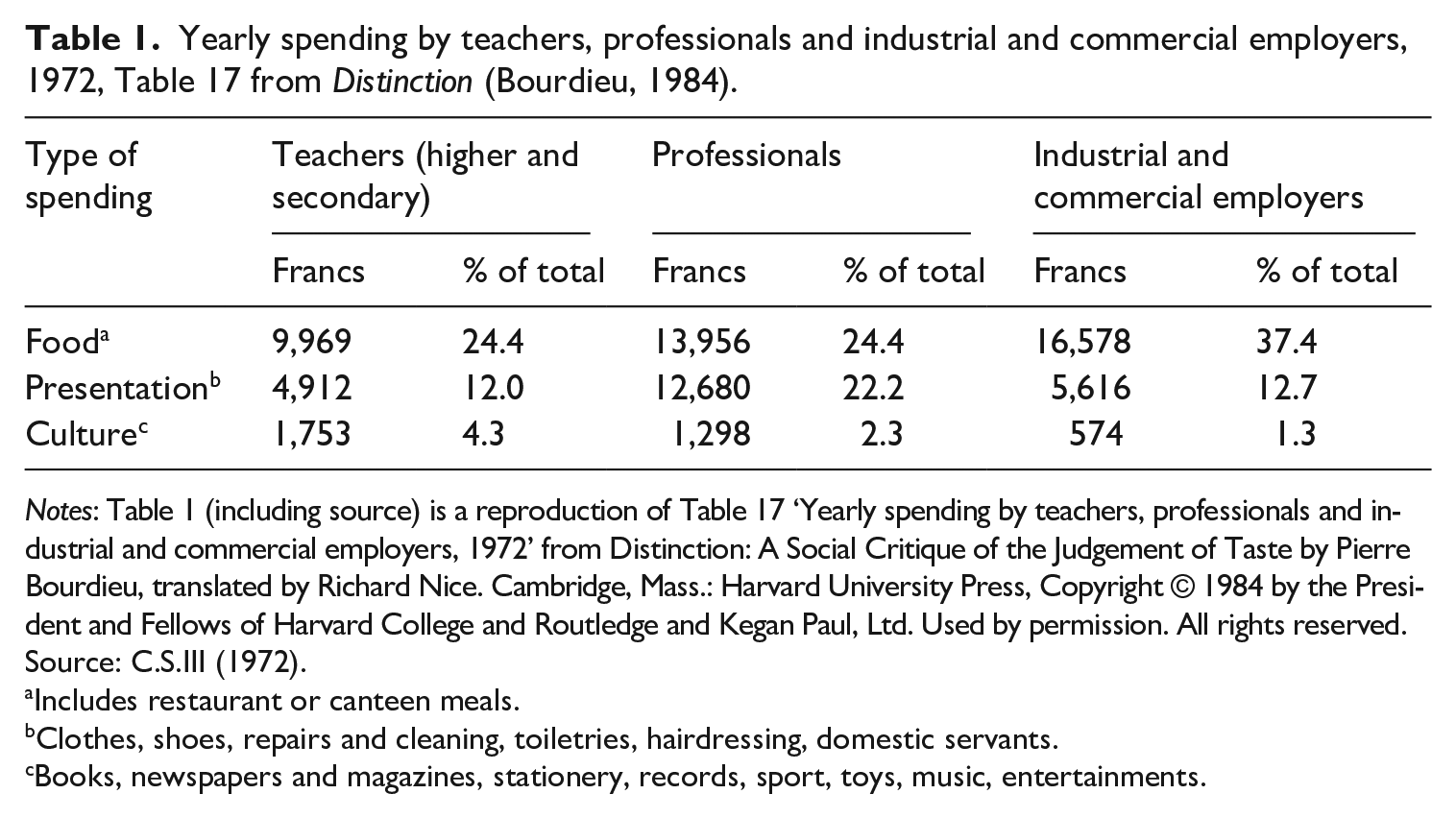
Notes: Table 1 (including source) is a reproduction of Table 17 ‘Yearly spending by teachers, professionals and industrial and commercial employers, 1972’ from Distinction: A Social Critique of the Judgement of Taste by Pierre Bourdieu, translated by Richard Nice. Cambridge, Mass.: Harvard University Press, Copyright © 1984 by the President and Fellows of Harvard College and Routledge and Kegan Paul, Ltd. Used by permission. All rights reserved.Source: C.S.III (1972).
Includes restaurant or canteen meals.
Clothes, shoes, repairs and cleaning, toiletries, hairdressing, domestic servants.
Books, newspapers and magazines, stationery, records, sport, toys, music, entertainments.
Alongside insights into the essence of class, as imbued with values and practices, Bourdieu (1984) empirically shows that members of different occupational groups devote different proportions of their budgets to certain bundles of commodities, and their spending patterns differ markedly by the virtue of importance that they assign to them. Thus, higher levels of presentational expenditure among business professionals or higher cultural consumption among academics signify the difference, or ‘distinction’, in their occupational identity defined by prioritised capital forms.
While Bourdieu’s descriptive statistics suggest differences between occupational groups, they have not been tested for statistical significance. The approach has been criticised for its conceptual vagueness, as Bourdieu sacrifices the rigour of systematic social stratification in favour of embracing a wider diversity of social relations and classifying human practices (Oesch, 2016). The lack of statistical testing for between-class distinctions in Distinction – and limited account for other variables – raised dissatisfaction with the explanatory power of the usual social class maps, and concerns about the extent to which lifestyles and consumption patterns reflect the social structures (Glevarec, 2023). While, further to Distinction, the structures of consumption are largely reliant on the multiple correspondence analysis (MCA) (Atkinson, 2017; Bennett et al., 2009; Campbell et al., 2019; Flemmen et al., 2018), there is growing use of regression in the analyses of cultural and consumption practices (Askin and Mauskapf, 2017; Campbell et al., 2019; Goldberg et al., 2016). Whereas the MCA facilitates the interpretation of associations and structures in the data, it does not show whether the associations are of comparable importance (Chan and Goldthorpe, 2007).
The use of regression is particularly relevant and intuitive in the view of a strategically orientated individual, an aspiring career agent in the field of profession, undertaking actions, making choices and relevant investments to ‘fit’ in and progress within their social space. She relies on the instrumentality of markers of distinction and takes advantage of the possibilities for augmenting one’s cultural and social capital through their use. Whereas acceptance into the upper echelons of a profession is subject to cultural ‘fit’ (Friedman and Laurison, 2019; Rivera, 2012), mentorship, training and socialisation possibilities of modern professional domains act to compensate for ‘lack of polish’ regarding cultural capital (Maclean et al., 2012: 393), which encourages individuals’ proactivity and strategic choices related to career advancement. In the context of professional careers, the relationship between occupational membership and consumption choices is directional. Through interactions within professional fields, individuals internalise field-specific social knowledge, which motivates them to seek ‘instruments’ that facilitate their progress. Prioritising consumption capable of conveying capitals is partly a result of one’s aspirations for advancement within one’s field, effectively making consumption and expenditure a dependent variable.
Engel curves, a regression-based method that describes how household expenditure on a particular group of goods varies with household income, net of other relevant observable variables, is a traditional method for modelling expenditure (Douglas and Isherwood, 1979). For example, signalling models, wherein individuals derive utility from signalling wealth or status, through their consumption of visible goods, regress conspicuous expenditure on individuals’ characteristics (Charles et al., 2009; Hicks and Hicks, 2014). By allowing the comparative tests between classes while partialling out the effects of other important variables, such as age, region, gender or the level of income, regression offers the possibility of establishing the distinctiveness of groups. Conclusive evidence thus can be drawn in a sense of statistically significant contrasts between the predictive margins of occupational groups net of other observable variables known to influence the outcome. By testing the statistical significance of between-class ‘distinctions’, these contrasts communicate the salience of categories within the ‘service class’.
Methodology
Data
Eurostat 2010 microdata on France from the Harmonised European Household Budget Survey’s scientific-use files (Eurostat, 2017) is employed to explore the consumption patterns of occupational groups. Household surveys are administered by EU countries’ national statistical offices that provide data on household characteristics and expenditure to Eurostat, using a common harmonised nomenclature of consumption expenditure (COICOP) to ensure compatibility between the national surveys (European Commission, 2003).
The data used in this study were initially collected via Enquȇte Budget de Famille in 2005–2006 by INSEE. The full number of observations is N = 41,285, and 15,797 of them are household reference persons (HRP). Observations with the non-specified values of occupational classification and observations, whose current activity status is student, fulfilling domestic tasks, permanently disabled, in military service or not specified, are omitted from the analysis. Only HRPs of 20–65 years old (working age) are kept in the sample. Keeping the bottom 95% sample observations, with the reasonable total expenditure to gross household income ratio (maximum 2.05), reduces the bias due to underreported income. The effective sample of 9314 HRPs is used for analysis.
Measures for the structures of consumption
This study partly relies on Bourdieu’s own empirical approach that uses several INSEE-based expenditure aggregates to capture the structures of consumption. Bourdieu’s expenditure aggregate for presentation is closely replicated and includes clothing, footwear, personal care and personal effects. Similar to Bourdieu’s measure, cultural expenditure covers spending on books, magazines, stationery, television and radio. Potentially instrumental for career advancement, presentation-related spending may convey positive reputation and reflect the socio-cultural imperatives in certain professional domains. In turn, cultural expenditure (informational goods) can support the ambition to enhance one’s cultural fit to ‘get on’ in the professional field. Admittedly, expenditure categories as aggregations of commodities in surveys can rely on informal intuitive principles (Brown and Deaton, 1972: 1165) and vary across national contexts, which presents a limitation in their capacity to fully reflect the structuring consumption-based dimensions capable of reflecting social divisions in a consistent manner.
‘Many of the expenditures that are called conspicuous are . . . being obligatory elements in a certain style of life, they are very often . . . an excellent investment in social capital’ (Bourdieu, 1984: 376), and this study also explores conspicuous expenditure. This is conducted in line with prior research in conspicuous consumption (Charles et al., 2009; Hicks and Hicks, 2014) that employs ‘visible’ expenditure aggregates based on an empirically established ‘visibility index’ (Heffetz, 2011), where visible expenditure is viewed as instrumental for displaying wealth and status. Appendix Table A1 provides the full list of expenditure categories and variables used in the analysis.
Method and Variables
Regression analysis is used to establish whether presentational, informational and ‘visible’ expenditures for different occupational groups are distinctively different, net of other observable characteristics. Expenditure is originally captured in surveys as numerical continuous data, and Engel curves – a widely used regression-based method for household expenditure analysis – are employed. Engel curves, which allow estimating the income elasticities (i.e. how household expenditure on a particular good or service varies with household income), is the most common approach in grouping goods (Douglas and Isherwood, 1979: 68) and, in the form of a multivariate regression, Engel curves account for relevant observable characteristics (such as age or household composition) in the relationship between expenditure and income. As the double-logarithmic form of Engel curves is the most popular and practical form (Brown and Deaton, 1972: 1155), we explore the log-transformed values of expenditures and household income to be able to interpret the results as percentage changes.
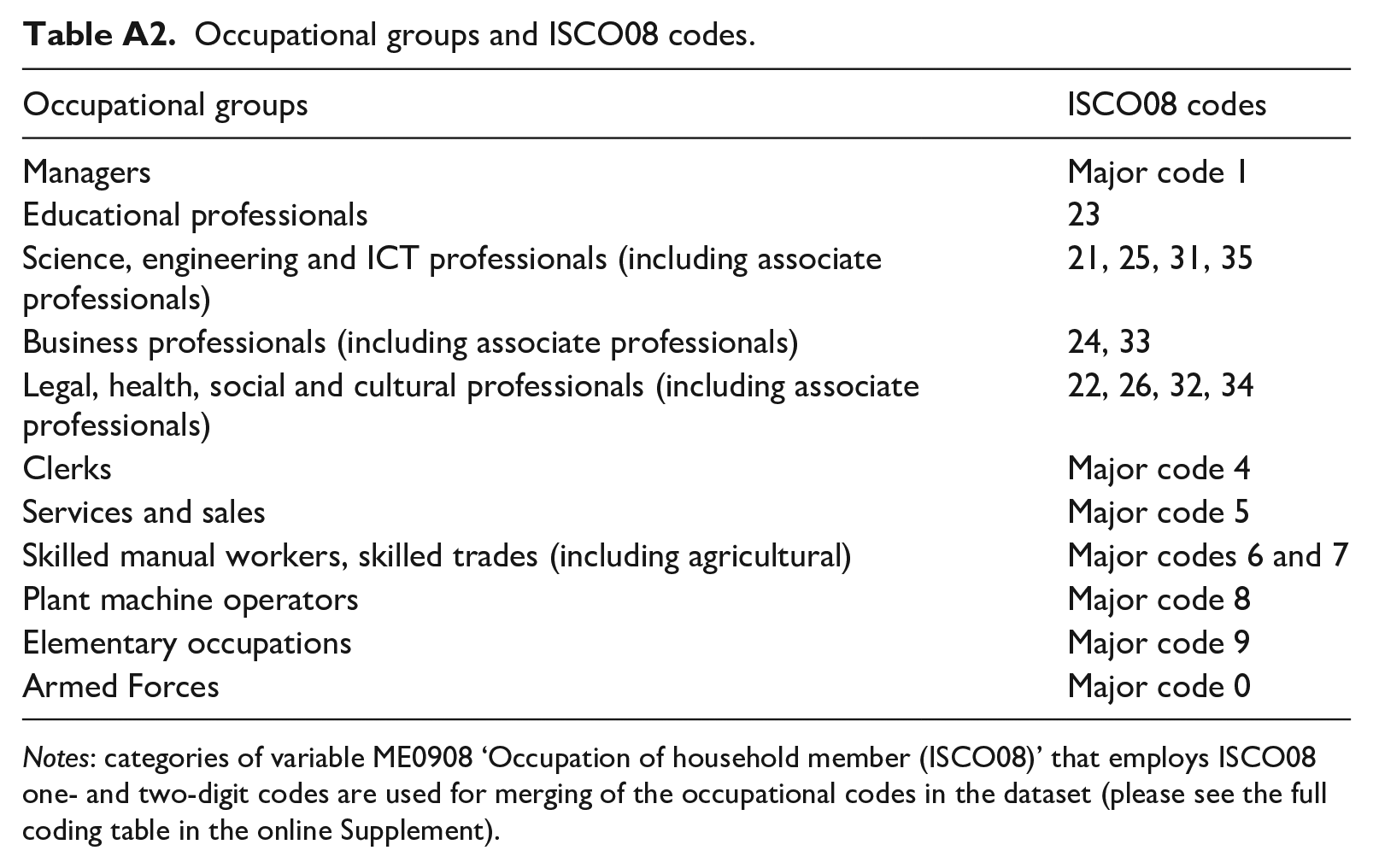
Occupational categories are included in the models. Often being employed as meaningful categories of consumers (Brown and Deaton, 1972), occupational groupings need to have substantial size in modelling expenditures. In his exploration of class fractions, Bourdieu (1984: 503) suggests obtaining samples ‘large enough to make it possible to analyse variations in practices . . . in relation to sufficiently homogeneous social units’. To estimate the effect of occupational class, the occupational codes based on the International Standard Classification of Occupations 2008 (ISCO08) are used to distinguish relatively homogeneous professional groups – managers, business professionals, technical professionals, educational professionals and a more heterogenous category of health, legal, social and cultural professionals. Professionals and associate professionals within the same domains are grouped together to maintain sufficiently large sample sizes for the purpose of regressions. The exact ISCO-codes for the professional groups are provided in Appendix Table A2. After estimating the regression models, and as part of the postestimation analysis, the contrasts between the occupational groups – net of other characteristics – are explored. The between-occupational contrasts are captured as differences between the predictive margins (coefficients) of occupational groups, estimated from the regression models.
Given the importance of accounting for other variables, such as age and gender (Flemmen et al., 2018; Longhurst and Savage, 1997), apart from household income (gross normal household weekly income), other observable characteristics are included in the models as independent variables. To arrive at the between-occupational contrasts net of the other characteristics that may explain variation in expenditure (Brown and Deaton, 1972), the following variables are included in the models – age category (five year), education, occupational group and the marital status of HRP, gender, family size, whether a household has children, and the regional controls. While the summary statistics for the independent variables in Table 2 show limited representation of female HRPs in some professional-managerial groups, large occupational subsamples still offer sufficient variation to estimate the gender effect.
Summary statistics on household characteristics.
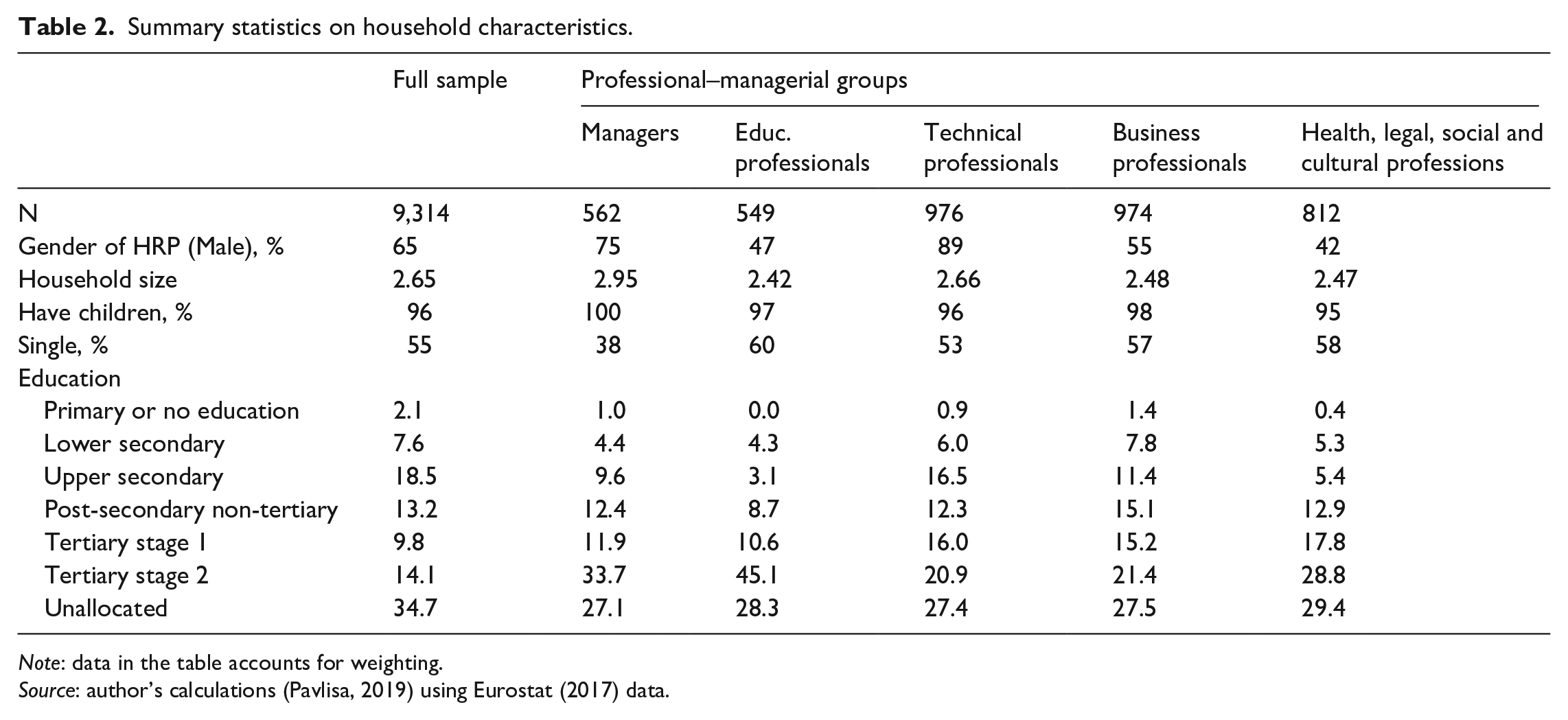
Note: data in the table accounts for weighting.
Source: author’s calculations (Pavlisa, 2019) using Eurostat (2017) data.
Generalised linear models (GLM), rather than the traditional ordinary least squares (OLS) regressions, are employed for two reasons. First, GLMs can estimate the predictions from the Engel curves on the raw scale (in pounds), which, in this study, not only allow the estimation of the statistical significance of between-occupational contrasts, but also the examination of the differences (contrasts) in absolute terms. Second, GLMs allow for better precision by addressing the issues of heteroscedasticity (heterogeneity of variance), a common issue in expenditure models, and, unlike OLS models, GLMs do not require the normality of distribution (McCullagh and Nelder, 1983). After estimating the regression model where the effects of other variables are accounted for, the postestimation analysis explores the pairwise contrasts between occupational groups and their statistical significance.
Results
Before estimating the between-occupational differences (contrasts) in the levels of expenditure, the effects of age, gender, education and other relevant socio-economic characteristics are partialled out – in other words, regression isolates the effects that each of the independent variables have on the dependent variables. Family income affects expenditures, and the regression results in Table 3 show that a 10 percentage point increase in household income is associated with 5.3, 6.0 and 7.9 percentage point increases in presentational, informational and visible expenditures, respectively. Younger people tend to spend more on appearance, and there is a statistically significant negative effect of age on presentational and, more generally, visible expenditure. Yet, the interest in culture-related goods grows with age. There is a gender-effect on presentational spending – when the head of household is a female, appearance-related expenditure is 12 percentage points higher, compared with households with a male head. There is no significant effect of gender on other expenditure groups. People with higher education spend less on visible expenditure compared with people with secondary education. This difference is less pronounced in presentational expenditure.
Regression results for presentation, informational goods and visible expenditure.
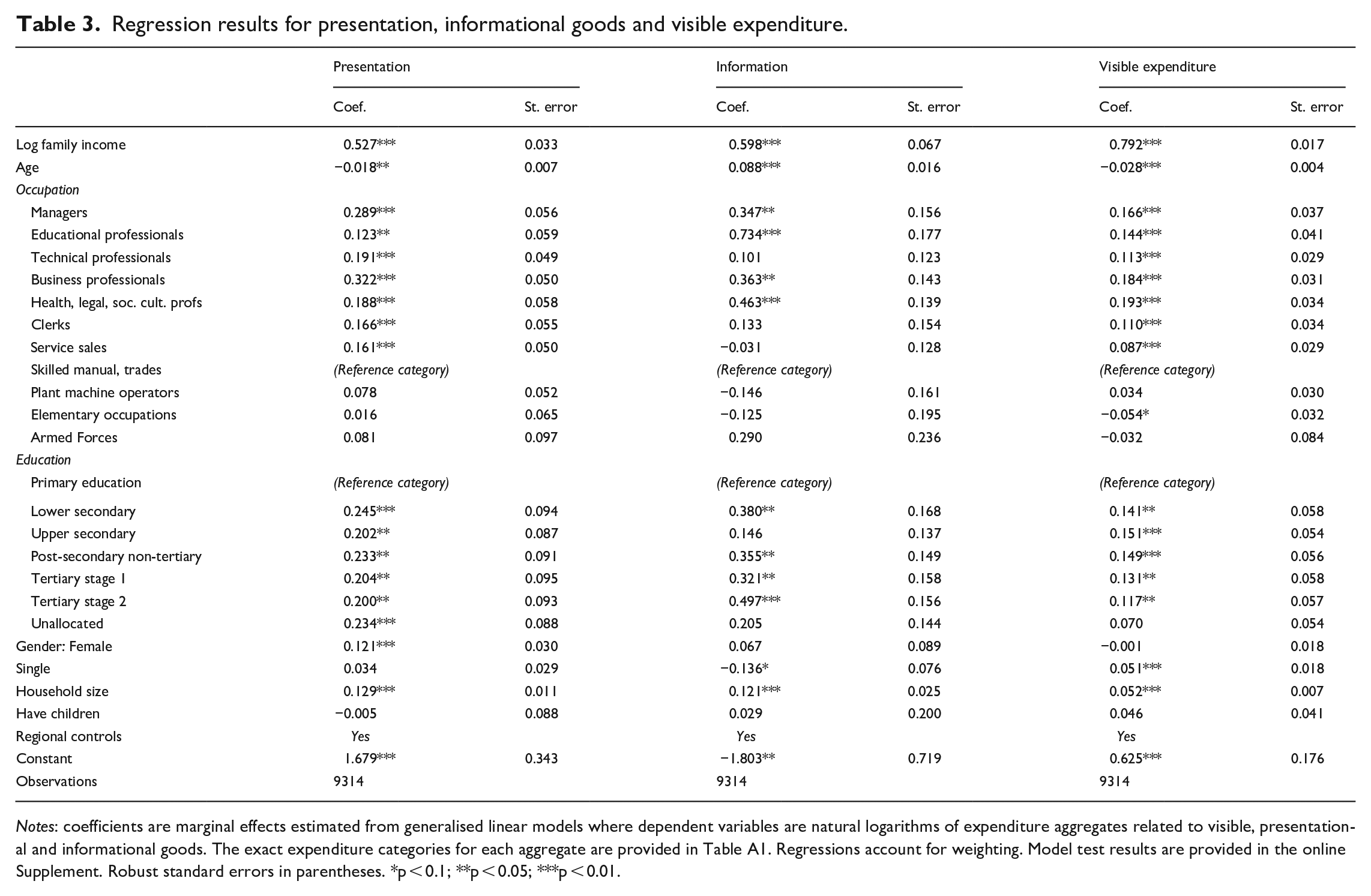
Notes: coefficients are marginal effects estimated from generalised linear models where dependent variables are natural logarithms of expenditure aggregates related to visible, presentational and informational goods. The exact expenditure categories for each aggregate are provided in Table A1. Regressions account for weighting. Model test results are provided in the online Supplement. Robust standard errors in parentheses.
p < 0.1; **p < 0.05; ***p < 0.01.
In regression models for the three expenditure aggregates, the occupational effects represent the levels of association between the occupation and expenditure increases. The category of skilled manual workers is employed as a reference category in the baseline models. As part of postestimation analysis (when the effects of other variables are partialled out), pairwise comparisons among occupational groups are drawn. The between-occupational contrasts in expenditures within the fractions of the professional-managerial group are provided in Table 4. Even at the same income level, educational professionals are distinctively (and statistically significantly) more modest in their presentational expenditure, spending 20 percentage points less than business professionals and 17 percentage points less than managers. Yet, their humble outlays on appearance do not translate into distinctively lower levels of visible expenditure overall. Technical professions are distinctively different from business professionals, with 7 percentage points and 13 percentage points lower visible and presentational spending respectively at p < 0.05 level.
Pairwise comparisons of professional-managerial groups based on regression models.
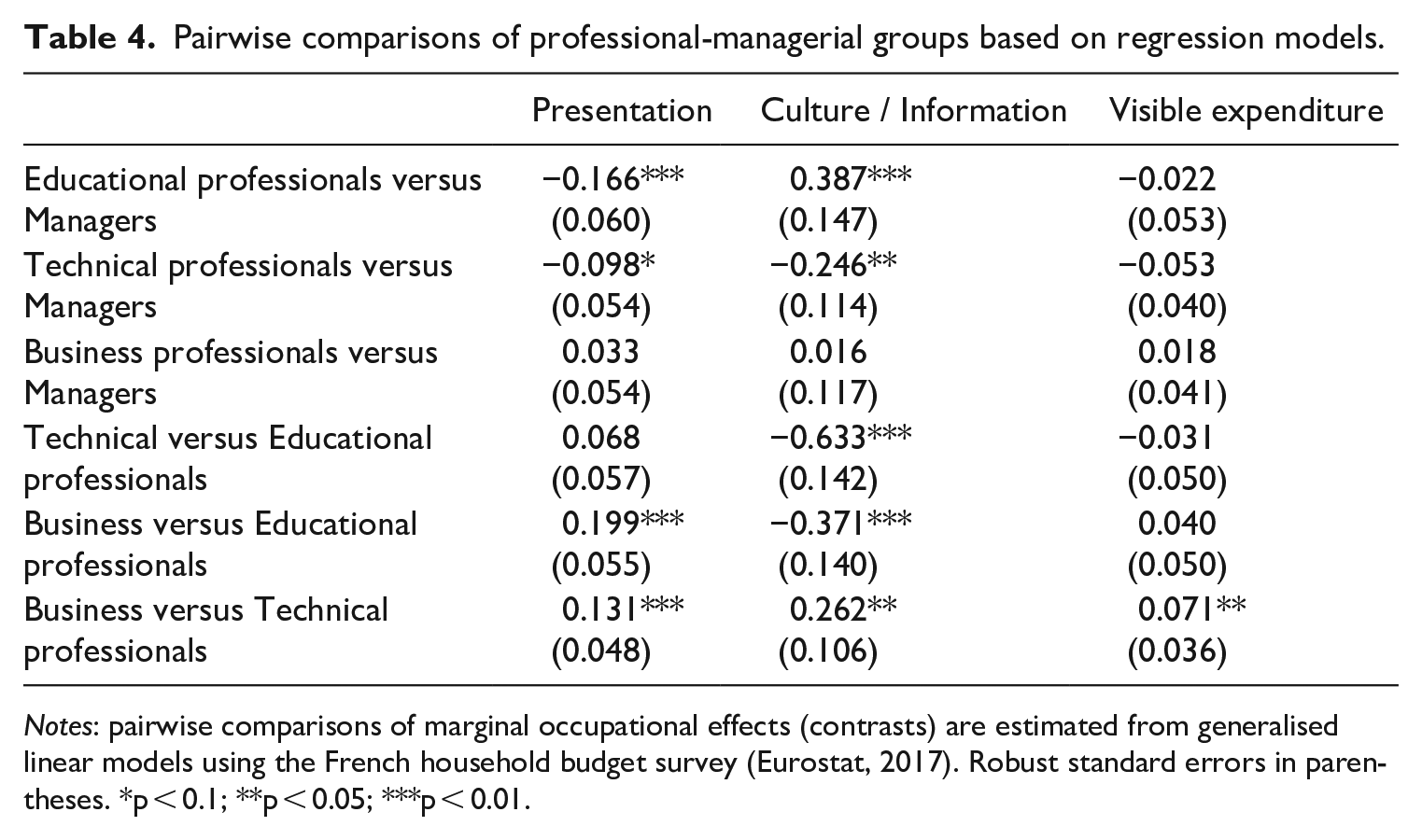
Notes: pairwise comparisons of marginal occupational effects (contrasts) are estimated from generalised linear models using the French household budget survey (Eurostat, 2017). Robust standard errors in parentheses.
p < 0.1; **p < 0.05; ***p < 0.01.
Notably, cultural expenditure acts as an effective structuring dimension as not only does it reveal the positive distinctiveness of educators, but also the ‘stacking’ of class fractions by the extent that they prioritise the types of expenditure thus revealing the relative differences in expectations among professional fields. It demonstrates, for instance, that business professionals are under a higher pressure to appropriate culture compared with technical professionals. Table 5 illustrates the differences in money terms. For example, a statistically significant difference of 13 percentage points in presentation expenditures between business professionals and technical professionals is effectively the difference between 88.19 and 100.55 Euro weekly, as predicted by GLM.
Predicted average expenditure levels of professional-managerial groups.
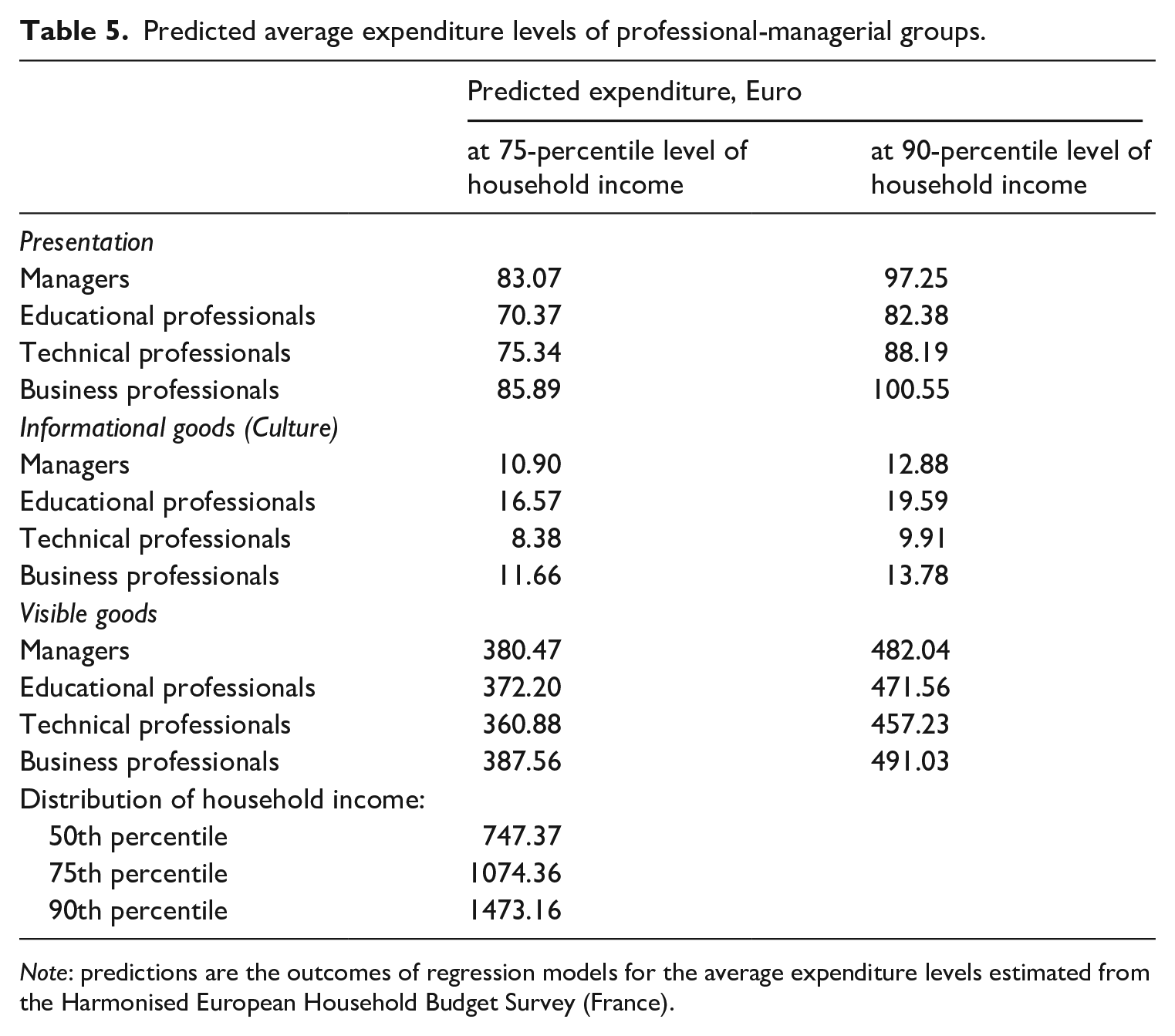
Note: predictions are the outcomes of regression models for the average expenditure levels estimated from the Harmonised European Household Budget Survey (France).
Explorations of the structures of consumption among the fractions of the professional-managerial group, viewed as constituent of subtly different combinations of capital forms, allow gaining insights about the social structures. A professional endowed with capital forms, by the virtue of their embeddedness in the professional network, experiences field-pressures. This motivates their engagement in behaviours and consumption instrumental for maintaining and augmenting their position in the social space.
As a robustness check, to examine whether the statistical significance of between-occupational contrasts established in the study is not a random result, 11 artificially generated classes were generated randomly in the French sample and compared with the findings. These experiments show that random allocation in artificial classes not only lacks theoretical value but also generates few parametric differences.
There is value in letting data speak for themselves, and the between-occupational differences in visible expenditure are visualised across the levels of income (Figure 1). Scatterplot smoothing based on univariate nonparametric regression is employed as a tool that does not make any preliminary assumptions about the functional form in estimating the expected values of the outcome variable (see, for example, Heffetz, 2011). Figure 1 shows that, for the full sample, the Engel curve is non-linear and characterised by heteroscedasticity, and variance increases towards the end of the income range, which also justifies the use of GLM. The nature of heteroscedasticity, however, differs by occupational group. Figure 2 shows that variance is relatively stable for the managerial group; the other groups follow the same pattern as the full sample – larger heterogeneity for wealthier households.
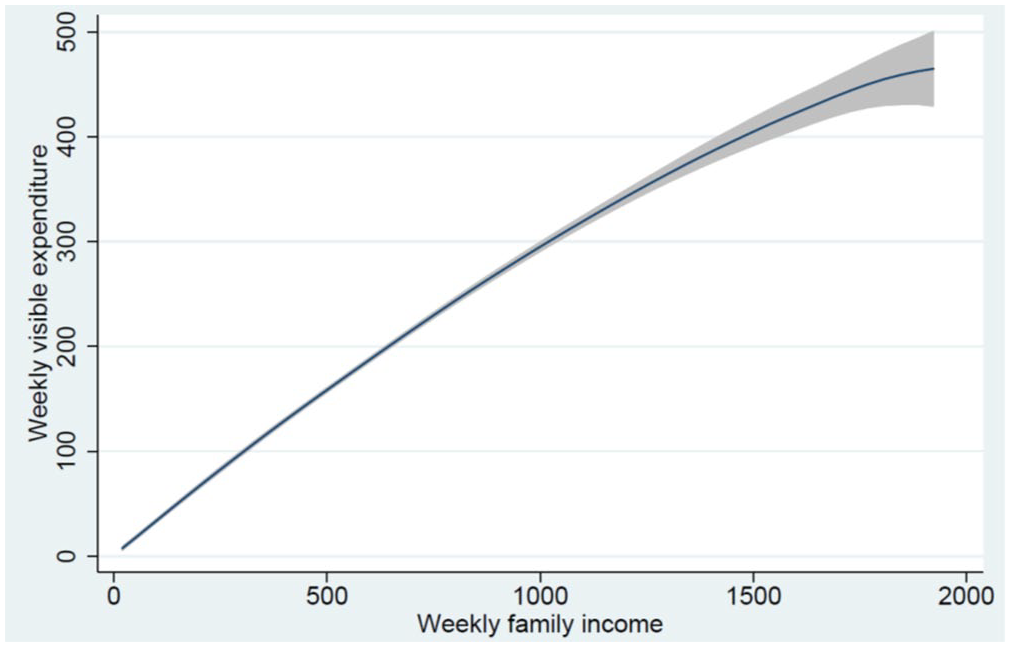
Income and visible expenditure.
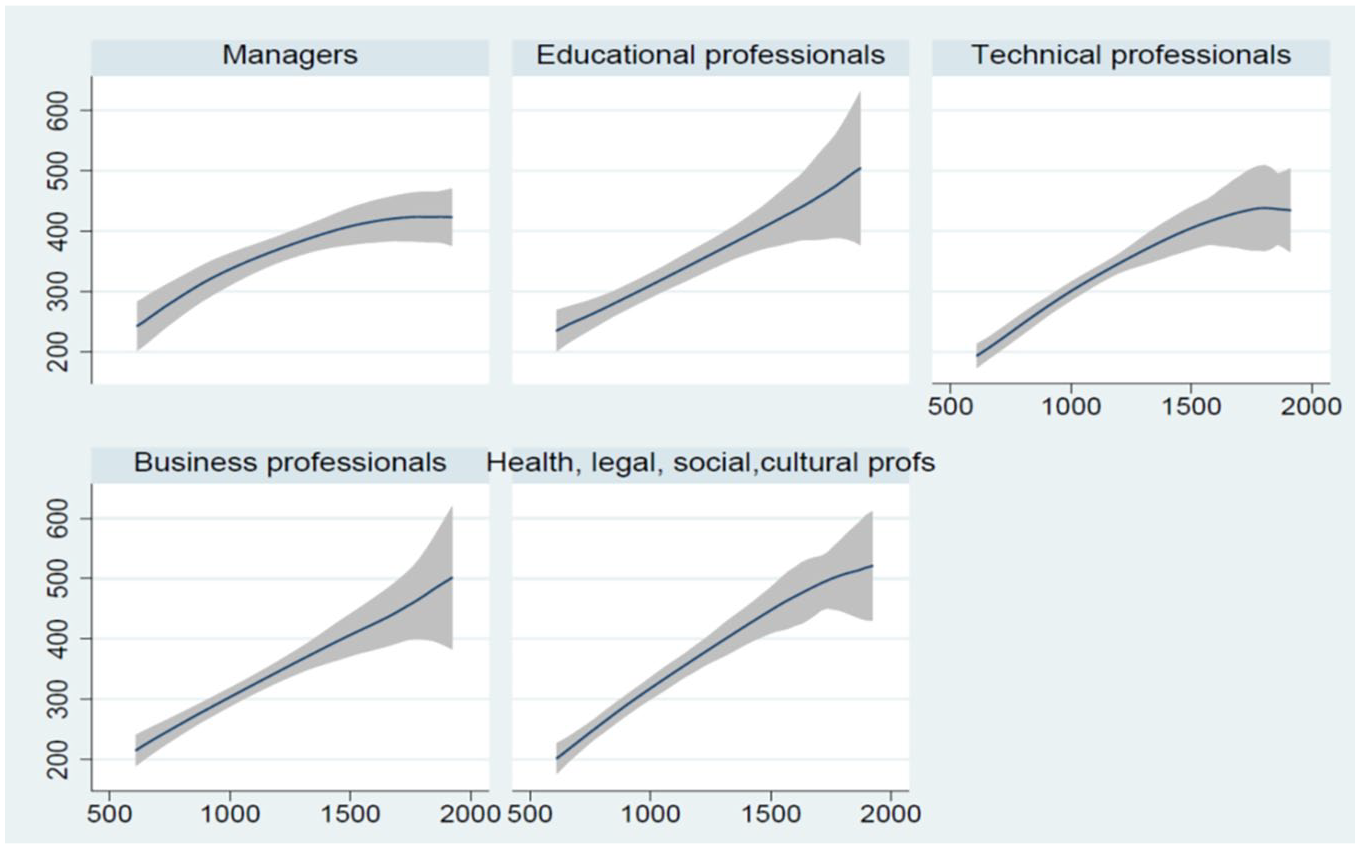
Income and visible expenditure of professional-managerial groups.
The shape of Engel curves across the professional groups illustrates the differences in conspicuous consumption in the upper strata of the professional domains. With an increase in income, the growth of visible expenditure for managers, technical professionals and the category of health, legal, social and cultural professionals substantially slows down at some point, as if reaching a ‘saturation point’, which is not the case for business and educational professionals. In Engel curves, a closer bend towards the X-axis characterises more luxurious goods, while a bend towards the Y-axis is characteristic for necessities. According to Figure 2, for example, for technical professionals, conspicuous consumption is less of a necessity than for business professionals – this is another distinctive pattern signifying the differences in the structures of consumption. This pattern characterises their working environment where the display of technical skills dominates over the need to display social capital, including the use of commodities that facilitate such display.
Concluding Discussion
Grounded in prior explorations of socio-cultural divisions that link occupation as a measure of social position with consumption-based representations of lifestyles, this study investigates the structures of consumption among class fractions within the professional-managerial group of occupations. The article reinforces the importance of sociological analytical approaches to professional clustering that not only reflect the functional activities and the homogeneous conditions of existence as a structuring principle, but also follow the capital composition principle (Atkinson, 2015, 2017; Bourdieu, 1984; Flemmen et al., 2017, 2018; Savage et al., 2005). Employing French household expenditure data, this study illustrates Bourdieu’s capital composition principle using his suggested measures for the structures of consumption that have not been tested before. Following this principle, the article contributes to the understanding of class divisions, professional identities and strategic interests of professional groups, with implications for understanding inequality.
Building on the premise that distinctive divisions in the social space produce distinctions in the symbolic structures (Atkinson, 2017), the study provides conclusive evidence about the maintained divisions within the ‘service class’, based on the structures of consumption (Bourdieu, 1984). Complementing Bourdieu’s (1984) approach, and in line with his proposition about the instrumental value of conspicuous expenditure as investment in social capital (Bourdieu, 1984: 376), expenditure aggregates related to presentation, culture (information acquisition) and ‘visible goods’ are investigated for the statistical significance of between-occupational contrasts, net of other observable characteristics. While the continuous nature of the social space unavoidably shows overlaps in consumption structures, some professional groups are distinct in the particular facets of spending – for example, business professionals spend more conspicuously than others, with significantly higher spending on appearance than technical or educational professionals. The findings emphasise the capacity of the representations of the symbolic space, namely the expenditures capable of augmenting and/or displaying the non-economic forms of capital (‘structures of consumption’), to convey the structural divisions within the social space. Shaped by capital composition, the internal and internalised dispositions (habitus) of occupational classes manifest themselves in the structured patterns of consumption and such observed patterns reveal the underlying social structures.
This analysis contributes to the understanding of professional identities and strategic interests. The early stages of professionalisation and the occupational environment shape occupation-specific lifestyles (Weeden and Grusky, 2012), and conformity to the dominant norms of conduct, appearance and behaviours contributes to the individual’s worth in their professional relations (Friedman and Laurison, 2019; Rivera, 2012). Thus, assuming that career agents’ dispositions are to accumulate the ‘right’ capitals in their aspired professional field, their appropriate response to the social pressures for developing, accumulating and signalling the ‘right’ field-specific capitals is instrumental for their professional growth and social mobility (Friedman and Laurison, 2019). The nature of the expenditures employed and suggested by Bourdieu (1984: 180, 376) is capable of informing, or ‘mirrors’, the relative differences in agents’ social and cultural capitals. Given the instrumental value of such investments, the different levels of expenditures reveal the differences in priorities about the structures of consumption across the occupational groups and, by implication, the prioritisation of capital combinations. Differences in the prioritisation of capitals – as in the symbolic, so in the social space (assuming the homology-principle) – suggest variation in strategic interests and professional identities across the professional groups. As the symbols of the ‘right’ field-specific capitals convey a career agent’s strategic advantage, so the symbols of capitals less relevant for the field are largely redundant in their pursuit of professional advancement. For instance, conspicuous consumption is less relevant in the egalitarian context of technical professions.
As particular forms of capital are more useful for certain professional groups in terms of their field-specific value, the implications for career agents are twofold. First, as upward movement within professional fields is subject to accumulation of the ‘right’ capitals, inequalities are created partly due to the differences in career agents’ understandings of what these capitals and their symbols are. Second, career agents’ sideways-movements across the professional domains (for instance, academics engaging in business consulting, or business or technical professionals moving to academia) entail re-configuration of prioritised capitals – both in the symbolic and the social space.
At the societal level, inequalities propel as particular professional domains have higher rates of accumulation of different capital forms. While class practices as part of ‘cultural games’ have implications for social closure and social mobility (Friedman and Laurison, 2019; Rivera, 2012), intentional, strategic pursuit of class interests through strategic investments in the markers of distinction may exacerbate inequalities, as they serve for further accumulation and display of capitals. Thus, higher investments in presentation or knowledge acquisition, partly an imperative of some professional fields, translate into perceptions about agents’ possession of higher levels of social and cultural capital, which is potentially convertible into economic gains.
The limitation of this study is that a comparative quantitative expenditure-based approach alone may not fully capture the professional identities or reflect the prioritisation of capitals in professional fields. Expenditure aggregates are not exhaustive measures of capital-signalling investments, especially given the field-specificity of prioritised capital forms and species (Bourdieu, 2011). Further research around the meaning of consumption-based measures of identity and implications for careers within professional fields would widen understandings of class strategic interests. Moreover, the pressures of occupational environments that direct career agents’ consumption strategies and impact their economic and financial behaviours and choices vary, and further research into how the structures of consumption are sensitised to finance and facilitated by credit (Evans and Gregson, 2023; Sparkes, 2019) would complement the understandings of strategic pursuits of professional groups. Admittedly, choices and priorities are also influenced by multiple factors including race, ethnicity, religion, sexuality and political beliefs (Skeggs, 2015).
This study shows that the granular analysis of professional clusters aligned with the capital composition principle (Flemmen et al., 2017, 2018; Savage et al., 2015) has implications for understanding not only social divisions but also the dynamics of inequality within occupational groups. The article argues that the idea of configurations and re-configurations of multiple capital forms and species at the core of the capital composition principle helps us understand and communicate the differences in strategic interests of individuals pursuing growth in their dynamic professional fields. This idea also paves the way to the heart of the mechanisms that underlie the reproduction of class inequalities.
Supplemental Material
sj-docx-1-soc-10.1177_00380385241254310 – Supplemental material for Structures of Consumption and Professional Identity: An Analysis of the French Household Budget Survey
Supplemental material, sj-docx-1-soc-10.1177_00380385241254310 for Structures of Consumption and Professional Identity: An Analysis of the French Household Budget Survey by Karina Pavlisa in Sociology
Footnotes
Appendix
Occupational groups and ISCO08 codes.
| Occupational groups | ISCO08 codes |
|---|---|
| Managers | Major code 1 |
| Educational professionals | 23 |
| Science, engineering and ICT professionals (including associate professionals) | 21, 25, 31, 35 |
| Business professionals (including associate professionals) | 24, 33 |
| Legal, health, social and cultural professionals (including associate professionals) | 22, 26, 32, 34 |
| Clerks | Major code 4 |
| Services and sales | Major code 5 |
| Skilled manual workers, skilled trades (including agricultural) | Major codes 6 and 7 |
| Plant machine operators | Major code 8 |
| Elementary occupations | Major code 9 |
| Armed Forces | Major code 0 |
Notes: categories of variable ME0908 ‘Occupation of household member (ISCO08)’ that employs ISCO08 one- and two-digit codes are used for merging of the occupational codes in the dataset (please see the full coding table in the online Supplement).
Acknowledgements
I am grateful to the editors of Sociology and the anonymous reviewers for detailed comments. I am particularly thankful to Will Atkinson, Will Harvey, Robin Holt and Alex Wood for feedback and encouragement.
Funding
The author received no financial support for the research, authorship and/or publication of this article.

Supplemental Material
Supplemental material for this article is available online.
References
Supplementary Material
Please find the following supplemental material available below.
For Open Access articles published under a Creative Commons License, all supplemental material carries the same license as the article it is associated with.
For non-Open Access articles published, all supplemental material carries a non-exclusive license, and permission requests for re-use of supplemental material or any part of supplemental material shall be sent directly to the copyright owner as specified in the copyright notice associated with the article.
