




Abstract
Relationships between occupational membership and personal consumption have long been an important area of social analysis. Occupational groups represent important contexts of consumption, where individuals’ advantages and resources are accumulated and often impose reproduction of field-specific practices and patterns of behaviour. Drawing on Bourdieu’s conceptualization of capitals and using the British family expenditure survey, we explore consumption of capital-signalling goods across particular occupational groups within the professional-managerial ‘class’, associated with different capital structures, and demonstrate distinct spending strategies geared to the pursuit of occupational advancement. We examine consumption behaviours for six managerial/professional groups – business professionals; technical professionals; educational professionals; higher, and lower, private sector management; and public sector management. We test whether distinct patterns of ‘capital-signalling’ consumption can be identified and find significant effects of capital composition on presentational, socialization-related and informational expenditure, consistent with our hypotheses. We argue that consumption is a part of the signalling strategy of career agents, and between-occupational contrasts in capital-signalling expenditures are important but overlooked measures of capitals in cultural class analysis. We conclude that granular analysis of consumption patterns is important for revealing differences in accumulation of non-economic capitals across occupational groups, with significant implications for understanding inequality and class divisions.
Introduction
Since the 1980s social analysis has shifted from a ‘macro’ emphasis on the division of labour towards a ‘micro’ perspective on inequality, in turn largely ‘individualized’, with households accumulating resources to gain advantages within their social contexts (Tyler, 2015). As an alternative to abstract ‘big classes’ and the National Socio-Economic Classification (NS-SEC), which has dominated British class analysis since the 1970s, cultural class analysis (CCA) emphasizes the role of social and cultural processes in generating class divisions and fragmentation within the middle layers of the class structure (Savage et al., 2005, 2013). Homogeneity of the managerial/professional class has also been extensively challenged, on both empirical and theoretical grounds (Oesch, 2016, pp. 51–54). Recent studies have approached class formation and division from the perspective of sociocultural collectivities based on occupational membership, using empirical evidence for between-group differences in lifestyles and cultural practices (Savage et al., 2013; Weeden & Grusky, 2005).
The key propositions of CCA, grounded in Pierre Bourdieu’s (2010) work, have been supported by the findings of Grusky and Weeden (2001, 2008; Weeden & Grusky, 2005, 2012), who suggested a ‘micro-classes’ approach to social class analysis, arguing that it is more analytically useful than large, aggregated, classes. They argue that occupations represent functional niches in the division of labour; are more recognizable to individuals than abstract large classes; and play a major role in developing and enforcing social closure mechanisms. A more granular approach to class, focusing on ‘real collectivities’, is also advocated by scholars who seek to develop cultural class analysis that reflects individuals’ ‘assets’, ‘capitals’, or ‘resources’ (Savage et al., 2005). This also involves a shift from a primary focus on economic capital to a broader approach, including social, cultural and symbolic capital. As noted by Flemmen et al. (2018, pp. 127–128), a central point in Distinction is that class-cultural divisions are not simply hierarchical but are also differentiated by the composition of capital – creating systematic variation in lifestyles among groups with similar levels of total capital, but different weightings of cultural and economic capital. Consumption preferences may thus represent quantifiable measures of between-group differences and distinctiveness in lifestyles and practices (Bourdieu, 2010; Flemmen et al., 2018; Savage et al., 1992; Warde, 1997), with broader implications for distinction, emulation, and individuals’ career strategies.
Bourdieu’s work implies social classes structured by economic and cultural capitals, and the integral role of culture (practices and tastes) in the structuring of class (Atkinson, 2015; Savage et al., 2005). Warde and Bennett (2008) found that cultural consumption plays a significant role in the social relations of power in Britain, with the managerial elite making heavy investments in ‘high culture’, owing to an implicit recognition that this enables them to signal their shared social distinction and acquisition and use of social capital. Both Bourdieu’s work and the Great British Class Survey (and, implicitly, work based on it, such as Savage et. al., 2013) have been criticized for defining culture on the basis of middle-class cultural tastes (Evans, 2017). However, Flemmen et al. (2018), using Bourdieu’s methodology, but operationalizing the concept of lifestyle and tastes more broadly, find that Bourdieu’s model holds for Norway.
As Oesch (2016, p. 3) has noted, while ‘the salaried middle class is made up of factions that occupy very different positions in the labour market, attempts . . . to account for this heterogeneity have been few and, to a large extent, focused on the sole difference between professionals and managers’. More granular occupational categories represent important contexts for developing and displaying capitals and distinction (Savage et al., 2015). Occupational membership demands particular volumes and structures of agents’ capitals; defines career trajectories; and often imposes reproduction of, and conformity to, field-specific practices (Bourdieu, 2010; Bourdieu & Wacquant, 1992; Friedman & Laurison, 2019). With culture being a site of struggle (Toscano & Woodcock, 2015), agents engage in competitive games in the social space to display their advantages (Savage et al., 2015). Such games may utilize consumption that facilitates capital-signalling – investments in appearance, socialization and cultural goods.
Tangible advantages from utilizing the currencies of social and cultural capital, however, are most distinctive in professional-managerial domains (Toscano & Woodcock, 2015), because membership requires higher levels of these capitals and the working-class is predisposed to an alternative set of values, more driven towards morality (Lamont, 1992), solidarity and supportive connectivities (Skeggs, 2011) rather than self-accumulation. In professional domains, under pressures to signal ‘asymmetry of expertise’ to clients and colleagues, dominance and autonomy become the hallmarks of professionalism rather than collegiality and trust (Abbott, 1988).
Drawing on the above perspectives, we seek evidence for class fractions within the professional/managerial ‘class’. We follow Bourdieu (2010) in conceptualizing occupation as a combination of capital forms and focusing on their social and cultural dimensions. ‘Getting in’ and ‘getting on’ in different professions entail distinctive pressures to augment and signal particular forms of capital. Profession-specific codes, including markers and symbols of professional identity (appearance, conduct, language, accent, etiquette), act to underpin agents’ symbolic power in their field (Friedman & Laurison, 2019). Fragmentation within the ‘service class’ is partly defined by such markers and symbols, reflecting differences in cultural practices and consumption (Savage et al., 1992). Relying on evidence of fragmentation within professional-managerial groups (Savage et al., 1992) in pressures to signify different capital forms as implied by research in the sociology of professions (Abbott, 1988; Noordegraaf & Schinkel, 2011a; Rivera, 2012; Spence et al., 2017), we hypothesize significant differences in capital-signalling consumption between class fractions.
Using the British Living Costs and Food (LCF) survey 2009–2016 (Office for National Statistics [ONS], 2017), we examine patterns of consumption behaviour among fractions of professional/managerial groups that previous studies identified as having distinctive capital combinations – business professionals, technical professionals, educational professionals, private sector higher, and lower, management, and public sector management (Bourdieu, 2010; Lamont, 1992; Noordegraaf, 2016; Savage et al., 1992). Using expenditure survey data is a well-established methodology in the sociology of consumption (e.g. Bourdieu, 2010; Charron-Chenier, 2018; Warde, 1997). We look ‘beneath’ the NS-SEC categories of ‘service class’ and focus on between-occupational differences in specific consumption categories that may act to augment particular capital forms – expenditure aggregates representing consumption of goods related to status-signalling, appearance, socialization and cultural goods.
Following a discussion of Bourdieu’s model, we outline the professional/managerial groups to be analysed and their expected consumption orientations. We then discuss our methodology and test several hypotheses, derived from the literature, to answer our research question: ‘Are there significant theory-justified differences in capital-signalling behaviours for narrowly-defined occupational groups within the British professional/managerial “class”?’ We find that capital composition (captured as occupational membership) has significant effects on consumption patterns, broadly consistent with our predictions. This has important implications for inequality (as capitals are often underpinned by parental financial and other capitals); household consumption; and other household behaviours, for example, savings – reduced by the need for ‘investment’ in career advancement, through appropriate capital displays. Career fields are thus found to be important generators of within-class differences in consumption, savings, ‘investment’ and social closure mechanisms.
Approaches to granular analysis of consumption
Since the dawn of social survey analysis, researchers have noted that different occupational groups can demonstrate very different lifestyles and household expenditure priorities, even with similar incomes (Booth, 1903). Studies (Bourdieu, 2010; Savage et al., 1992) explain this in terms of occupations reflecting different forms of individuals’ capitals, especially for class fractions within the ‘service class’, which is expected to be internally variegated (Atkinson, 2017). Wright (2006, p. 64) argues that pursuit of class interests implies strategic choices – ‘by virtue of their location within class relations . . . individuals have available different strategies for securing and improving their material interests’. Other scholars envision personal and household ‘micro’ strategies that involve consumption goals geared to signal intentions and social advantages (De Vries, 2008, p. 189). Analysis building on Bourdieu’s (2010) theory of practice emphasizes the importance of occupational identity in influencing lifestyles and the role of cultural consumption in gaining strategic advantages in career-related or other advancement of the agent’s social position.
Bourdieu’s framework and implications for consumption analysis
Bourdieu (2010) views taste, culture and dispositions as attributes of class. Objective class (Bourdieu 2010, pp. 95, 166) is a set of agents characterized by homogeneous conditions of existence and ‘systems of dispositions capable of generating similar practices’ that constitute systems of distinctive signs. His work maps the ‘universe of lifestyles’ on the social space, where agents’ positions are defined by the forms and volumes of capital – economic, social and cultural. Habitus – a ‘practice-unifying and practice generating principle[,] . . . the internalized form of class condition and of conditionings it entails’ (Bourdieu, 2010, p. 95) – is inseparable from systems of classified and classifying practices, and the strategic behaviour of agents. Identity is defined by habitus, is conditioned by their position in the ‘competitive, game-playing character of the field’ (Savage et al., 2005). For Bourdieu, fields denote ‘arenas of production, circulation, and appropriation and exchange of goods, services, knowledge, or status, and the competitive positions held by actors in their struggle to accumulate, exchange, and monopolize different kinds of power resources (capitals)’ (Swartz, 2019, pp. 178–179). Field represents ‘a network, or a configuration, of objective relations between positions [which are] objectively defined, in their existence and in the determinations they impose upon their occupants, agents or institutions’ (Bourdieu & Wacquant, 1992, p. 97). Thus, the ‘universe of lifestyles’, as a totality of the fields of preferences, implies extensive possibilities for the pursuit of distinction (Bourdieu, 2010, p. 223). However, internal struggles within fields – arenas of competitive positions characterized by domination and power relations – suggest the existence of field-specific markers of distinction (or own systems of distinctive signs).
Agents’ social space is thus defined by their composition and relative volumes of capitals (Bourdieu, 1986, 2010). Economic capital reflects material possessions in the form of inherited or earned wealth. Social capital is defined by the breadth of access to social connections and possession of durable networks. Cultural capital is not limited to educational qualifications and training (institutionalized form), but also exists in its objectified (cultural goods) and embodied states (style of presentation, mode of speech, beauty, etc.). Symbolic capital is the form other capitals take when they have been recognized as consecrated legitimate forms of culture within the field. Capitals are ‘underpinnings . . . of fields – where volume and trajectory of agents’ holdings of particular capitals is central to the dynamics of fields’ (Savage et al., 2005). Thus, individuals’ strategic behaviour, conditioned by the competitive nature of the field, involves augmenting (and displaying) the forms and species of capital (Bourdieu, 2011) vital for maintaining their competitive position. Therefore, systems of practices, including cultural consumption practices, are the attributes of class fractions, also influenced by field.
Bourdieu’s empirical work (analysis of French INSEE’s surveys of household living conditions and expenditure; Bourdieu, 2010, pp. 181, 522) links combinations of capital endowments (captured as occupational aggregates) with individuals’ and households’ consumption orientations and priorities. Admittedly, habitus is definitive for an individual’s social trajectory, but also defines as routine choices and decision-making in food, clothes, sports and music preferences, as evidenced by proponents of the Bourdieusian framework (Savage et al., 1992; Warde, 1997).
Understanding classes as sociocultural collectivities
Researchers have called for classification in terms of collectivities that share identities and practices, as broad socioeconomic classes disregard within-class variation and clustering and were not originally intended to capture actual sociocultural groupings (Atkinson, 2009; Savage et al., 2005; Wright, 2015). Work on the Great British Class Survey (Savage et al., 2013, 2015) has re-emphasized the need for deeper understanding of modern social class and the importance of social and cultural dimensions. A more fine-grained consumption analysis may reveal different pressures to manifest capital forms, lifestyles and differences in capital accumulation and conformity.
The importance and validity of the CCA approach have been strengthened by recent research on ‘micro-classes’ (Grusky & Weeden, 2001, 2008; Weeden & Grusky, 2005, 2012) that explains within-class homogeneity in lifestyles and practices by class situations, interests and learning from job realities. ‘Micro-classes’ focus on functional niches in the divisions of labour (‘occupations’). These are argued to be more meaningful than ‘big’ abstract classes, as the former represent real-life sociocultural collectivities, immediately recognizable to academics and laypeople alike, embedded in the fabric of society. Such groupings are argued to possess strong within-group homogeneity as they respond to real institutional forces, including similar job-specific training, work conditions, social closure, and collective action via professional and labour organizations. Similarly to the CCA, this approach suggests that specific occupational groups better explain individual-level behaviours, life chances, lifestyles and tastes, as homogeneity of experiences and other conditions are linked to homogeneity of outcomes (Weeden & Grusky, 2005; Wright, 2015).
Both the Bourdieusian and micro-classes approaches suggest that narrowly-defined occupational membership influences consumption patterns and related behaviour, both by reflecting distinctive priorities stemming from different combinations of capital forms, and by generating consumption-related behaviours emphasizing career, occupational identity and competitive success, in line with the expectations of employers, peers, clients and the wider public. As investments in particular commodities may facilitate augmentation and display of specific forms of capital, distinctive occupational trajectories stimulate accumulation of these capitals and promote particular spending patterns. A more systematic analysis of consumption patterns may pave further ways to think about CCA.
Professions, class fractions and implications for capital-signalling consumption practices
Despite professional categories being empirically explored in Distinction in terms of lifestyles and consumption, conceptual gaps have been identified between Bourdieu’s framework and the sociology of professions (Noordegraaf & Schinkel, 2011a, 2011b). While distinction regarding capital compositions is most strongly pronounced at the top of white-collar occupational career ladders, professionalization has not been addressed by Bourdieu.
Professional domains are characterized by both external pressures to signal ‘asymmetry of expertise’ to clients and colleagues (Abbott, 1988) and participation in internal struggles for symbolic power – to project dominance and autonomy. Bourdieu’s notion of fields allows understanding professions as social formations or ‘islands of cultural and social exchange that materialize social services, guard expertise and craftmanship, symbolize the “goodness” of service provision, and generate material awards for the workers concerned’ (Noordegraaf & Schinkel, 2011a, p. 98). While the Bourdieusian framework generally neglects conceptualization of ‘profession’, scholarly analysis of Bourdieu’s relational approaches allows viewing professionalism as symbolic capital and professional networks as ‘fields’. Particular professions follow common processes (professionalization), including acquisition of expert knowledge and ethics codes to assert their social utility and manner of service (Abbott, 1988, pp. 3–5). Relative homogeneity in organizational structures and industry domains results from isomorphic forces (DiMaggio & Powell, 1983). Professionalization (as a normative pressure of isomorphism) is not limited to formal education or legitimation in a cognitive base defined by university specialists, but is also enacted through filtering processes and anticipatory socialization to meet common expectations (organizational vocabularies, style of dress, jokes, etc.) (DiMaggio & Powell, 1983). This ensures internal homogeneity of professional networks and distinctive differences between professions. Similarity of conditions aligns practices of professional groups and distinguishes between systems of practices for different professional networks.
The phenomenon of managerialism (Kirkpatrick et al., 2005), in the light of the Bourdieusian perspective, reflects distinctions between professionals and managers that suggest differences in practices and standards to enact the ‘appearance of professionals’. Professionals’ expertise and practice become increasingly managed and scrutinized by outsiders (‘managers and controllers’) – the process which underpins the symbolic capital of the latter and may have implications for capital-signalling and consumption practices. Managerialism has been particularly pronounced in the public management field, with increasing demands on public sector management to adopt private sector management practices and further prioritize cost-effectiveness (Kirkpatrick et al., 2005). Differences in values and practices between private and public sector fields have long been discussed in terms of the dominance of public sector humanitarian goals as opposed to materialistic private sector values (i.e. values as field-specific forces) (Lamont, 1992; Savage et al., 1992), However, the pressures of managerialism within the public sector have created new imperatives for symbolic capital reassertions. Also, managers are a very heterogeneous category. Goldthorpe’s (1987) classification divides managers into higher and lower management (long version NS-SEC), based on job complexity, size of organization and sector, which partly addresses within-group heterogeneity and accounts for differences in levels of human capital (pressures to augment and demonstrate them, including via consumption practices).
Differences in capital combinations suggest further distinctions in capital-signalling behaviours. Academia, the career field of educational professionals, promotes cultural capital and less materialistic values than typical white-collar occupations, especially ‘people of business’ with its field’s demand for social capital (Bourdieu, 2010; Lamont, 1992). Warde and Bennett (2008), while identifying homogeneity in culture and taste among managerial elites, argue that cultural practices and cultural consumption express internal social divisions. They also remind us of notorious distinctions between ‘people of business and intellectuals’. As noted by Atkinson (2017, p. 37), class fractions within the service class ‘with different balances of economic and cultural capital – for example, higher-level business executives and intellectuals’, have different orientations toward symbolic goods (i.e. hedonistic versus ascetic orientations). Meanwhile, studies of ‘technical people’, like IT-professionals, note the dominance of technical skills, or ‘technical capital’ over abilities to boost their organization’s social capital (interpersonal skills). Moreover, this field was found to prize egalitarianism (Marks & Bauldry, 2009) and general indifference to common markers of symbolic capital, corroborating Bourdieu’s view that technical capital is generally associated with dominated classes (Friedman & Laurison, 2019). Thus, the need to signal symbolic, social and cultural capital may differ within the fractions of professional-managerial class. Such signals can be partly captured by capital-signalling patterns through consumption.
Quantitative analytical approaches in cultural consumption
Recent studies have been preoccupied by microsociology of consumption, focusing on individuals and demonstrating the role of consumption in identity formation and signalling self-identity, with substantial focus on cultural consumption (Warde, 2015). While distinctive practices of occupational groups have been identified in relation to food consumption (Warde, 1997) and lifestyles (Savage et al., 1992; Weeden & Grusky, 2005), this literature also discusses wider commodity categorization by social meaning, as well as levels of investment in these commodities.
Our commodity aggregates include presentational goods – an expenditure aggregate similar to Bourdieu’s (2010, p. 181) (clothes, shoes, repairs and cleaning, toiletries, hairdressing and other) – informational goods, and goods that facilitate socialization and social networks (leisure activities, such as sport, social events and dining out). Although socialization-related goods have not previously been consolidated into a single category, they possess similar characteristics and serve socialization goals. Thus, Longhurst and Savage (1997) refer to instrumentality of dining out and sports as socializing techniques that follow the logic of distinction. Such manifestation may act to underpin anticipatory socialization to meet the expectations of professional fields, where networking is essential for augmenting organizations’ social capital. For example, in accountancy, employers seek candidates who are not only competent but also culturally similar to themselves in terms of leisure pursuits, experiences and self-presentation (Rivera, 2012). Featherstone (2007) highlighted the social importance of informational goods – magazines, newspapers, books and television – as sources of knowledge about personal transformation, underpinning agents’ relevant cognitive base and linguistic capital. Bourdieu’s (2010, p. 181) own exploration of French household expenditure identifies commodity groups referred to as presentational goods and cultural (informational) goods, corresponding to social and cultural capitals (and their display). Levels of expenditure on presentational and cultural goods differ across the fractions of dominant class (industrialists, teachers and professionals).
Building on Bourdieu’s approach, we examine expenditure levels across the three groups of capital-signalling commodities and the six managerial/occupational groups discussed above, on account of their substantial within-group homogeneity, and distinctive capitals and professional field forces. These comprise business, technical and educational professionals (representing professions with distinctive combinations of capital forms) and three domains of management, distinguishing between public and private sector management on the basis of the need to signal symbolic capital (Noordegraaf & Schinkel, 2011b), while looking separately at private sector higher and lower management.
Between-occupational differences in consumption patterns (depending on variable types) have been explored by a number of methods. Geometric data analysis, and multiple correspondence analysis (MCA) in particular, is associated with the Bourdieusian analysis of cultural consumption. MCA, favoured by a number of scholars (e.g. Atkinson, 2017; Hjellbrekke, 2018), is a technique for the analysis of categorical data, which, in the context of cultural consumption, allows indicators of capital and categories of social space to be projected on the model. However, MCA can only report gross rather than net effects of particular variables associated with occupation-related cultural consumption (Campbell et al., 2019). MCA, while facilitating interpretation of structures and associations in the data, does not show whether the associations are of comparable importance (Chan & Goldthorpe, 2007). Moreover, as noted by Hjellbrekke (2018, p. 6), ‘in the geometric data analysis, the focus is on the relations between constellations of variables and categories, and not on the association between individual variables’.
In line with prior research (Campbell et al., 2019) we employ regression analysis, to identify whether expenditure levels for different occupational groups are distinctive, net of other observable characteristics known to affect the results. For expenditure analysis (numerical continuous data), we employ Engel curves, a widely-used method for household expenditure analysis, to explore the distinctiveness of different occupations’ cultural consumption more systematically. Double-logarithmic Engel curves (multivariate regression) are used to account for relevant observable characteristics (such as age and household composition). As part of the post-estimation analysis, we explore statistical significance of between-occupational differences in expenditure levels (net of other effects). This requires meaningful grouping of expenditures, based on types of ‘use-value’ and meaningful categorization of consumers (Brown & Deaton, 1972). We thus employ presentational, socialization-related and informational goods, as discussed above (please see online Appendix Table S1 for their constituents).
Hypotheses
We test whether fractions of the ‘service class’ display distinct consumption characteristics in relation to commodity clusters. The cultural turn for commercialized professionals (Carnegie & Napier, 2010) is expected to impact on consumption dispositions. For example, in accounting, the turn from rigorous professionals preoccupied with social responsibility to self-confident, well-paid multidisciplinary business consultants (Spence et al., 2017) is associated with greater emphasis on relationship-building and cultural fit, where conduct and appearance matter (Rivera, 2012). In line with Bourdieu’s (2010) framework, business professionals, whose environment requires augmenting the social capital of their organizations, are expected to view presentational and socialization-related goods as being more central to their careers than technical professionals, whose working environment places greater emphasis on technical knowledge (Spence et al., 2017). Therefore, we hypothesize:
Similarly, Bourdieu’s theory implies that business professionals are likely to prioritize presentational and socialization-related goods compared to educational professionals, whose career progression is less influenced by material display or socializing. Compared to other professional fields, in academia ascetic values, the centrality of knowledge creation and diffusion, and the dominance of cultural over economic capital (Bourdieu, 2010) are likely to constrain consumption strategies that demonstrate social, rather than cultural, capital. Therefore:
The growing influence of `new managerialism’ in the public sector (Noordegraaf, 2016) and the urge to scrutinize professionals’ expertise (Kirkpatrick et al., 2005) are likely to enhance pressures to augment and signal symbolic capital for managers, especially embodied cultural capital. Therefore:
While seeking to test our hypotheses, we are also interested in other empirical findings from the analysis.
Data, variables and method
This study uses data from the annual UK Living Costs and Food (LCF) 2009–2016 surveys (ONS, 2017). This is Britain’s largest family expenditure survey, constituting the main source of household-level consumption data. Approximately 5,000 households annually contribute data via diaries for regularly purchased items and interviews for less frequent expenditures, which are then produced as weekly consumption equivalents. Appreciating the key importance of the household’s main ‘bread-winner’s’ capitals, embodied in occupation, the study focuses on household reference persons (HRP), relying on large sample sizes and the tendency towards marital and intergenerational similarities in social status to reduce bias arising from using household-level expenditures. The data cleaning procedure is discussed in the online supplement.
Inspired by Bourdieu’s exploration of household expenditure in Distinction, we examine expenditure categories related to capital-signalling: presentational and socialization-related expenditure aggregates and spending on informational goods (full descriptions of expenditure categories are provided in the Appendix). These expenditure groups are used as dependent variables in a regression analysis that aims to partial out the effects of other relevant factors and distil between-occupational differences to explore their significance. We use the following regression model:

where log
Next, we explore between-occupational differences in consumption of expenditure aggregates in terms of differences in percentage changes, using the procedure detailed in the online Appendix. Given the logarithmic form of income and expenditure, ordinary least squares (OLS) results are interpreted as percentage changes and occupational effects are shifts in levels of expenditure associated with each professional group. Finally, we estimate levels of expenditure to illustrate the magnitude of between-occupational differences in money terms, using the generalized linear model (GLM), which the literature shows to be preferable to OLS for such analysis (see the online Appendix).
Descriptive statistics
Weekly expenditures on presentational, socialization-related and informational goods for each classified professional-managerial group (Figures 1–3) show consistent differences in comparable income ranges, especially distinctive among the professional groups. Income categories in Figures 1–3 are income deciles obtained using the values of equivalized income in the restricted sample (an OECD-modified equivalization scale is applied to account for differences in household composition). As our restricted sample omits some observations often found on the left-hand side of income distribution (e.g. the unemployed), the deciles may not correspond to income deciles, defined for the general population. The figures show observations between the 6th and 10th income deciles as most employees from the professional/managerial groups are found in this range (Table S13). Members of the ‘service class’ on relatively lower income are more likely to be part-timers or trainees.
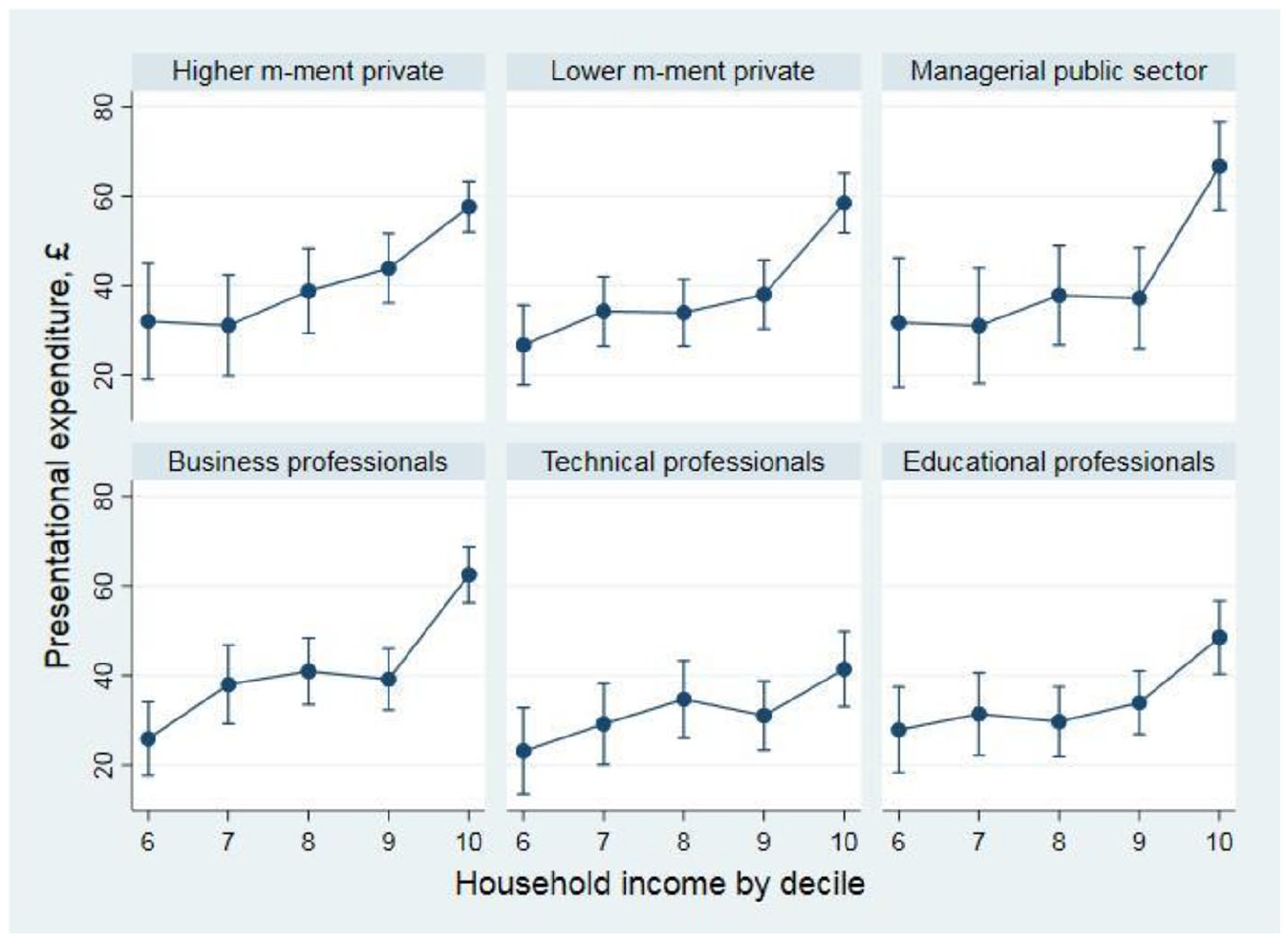
Equivalized weekly presentational expenditure by occupational group and income decile.
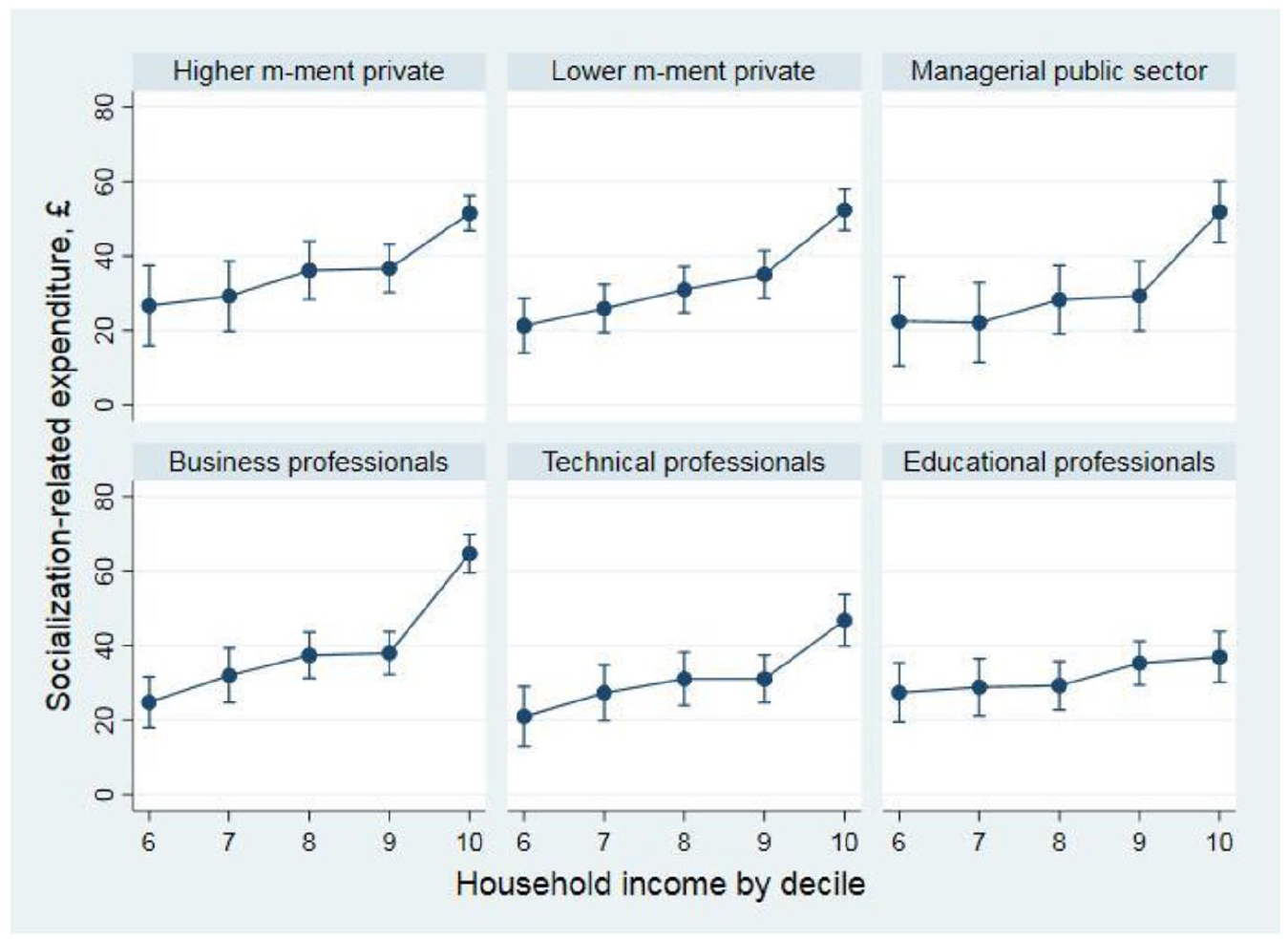
Equivalized weekly socialization-related expenditure by occupational group and income decile.
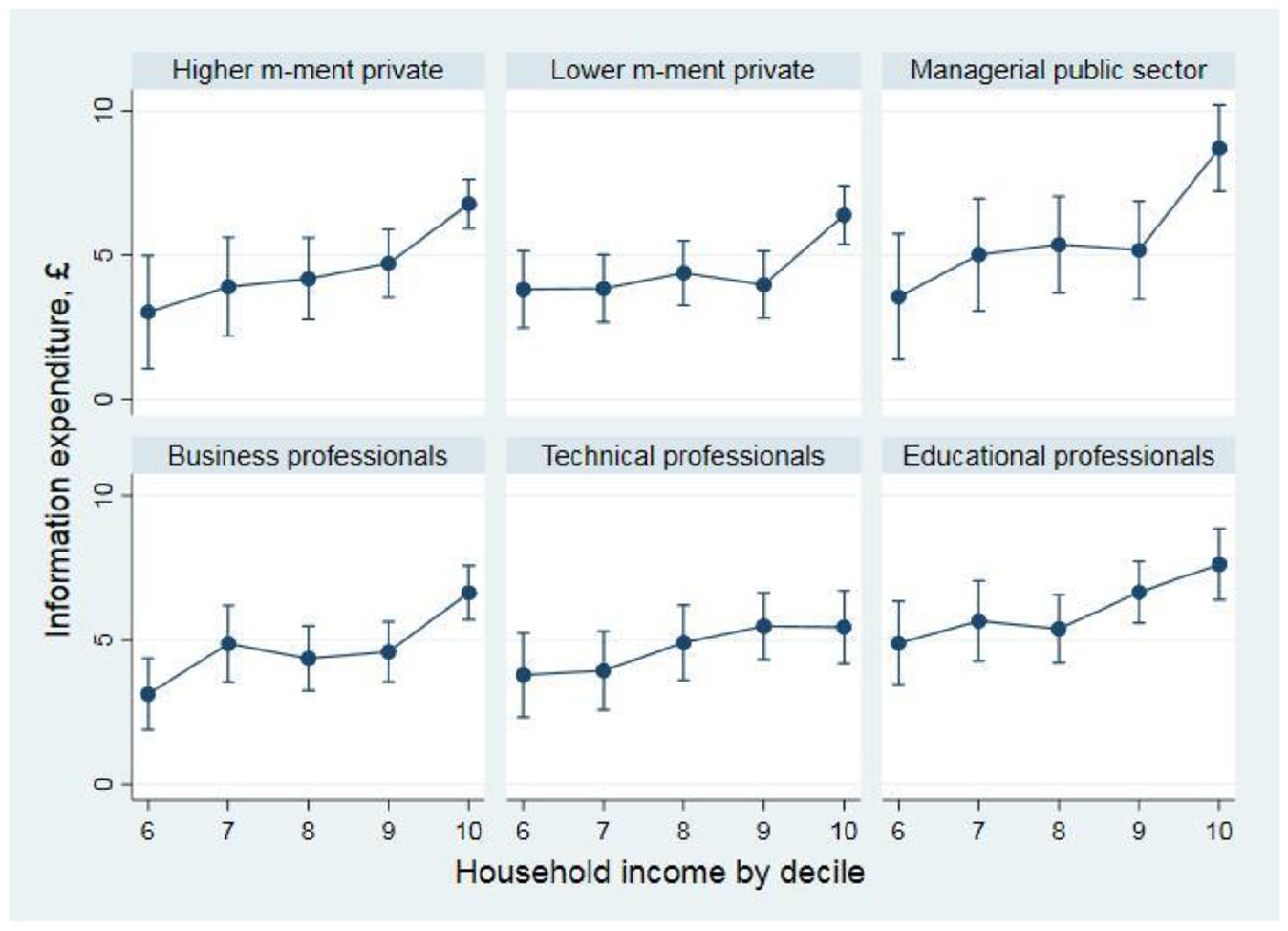
Equivalized weekly informational expenditure by occupational group and income decile.
To draw further comparisons, Table 1 pairs up deciles 6 and 7 into an intermediate income category, and deciles 8 and 9 into a higher income group. In both the intermediate and the higher income groups, business professionals have higher presentational and socialization expenditures than technical and educational professionals. Moreover, as income grows, business professionals intensify investment in commodities that boost their social capital more markedly than other professional groups. The increase of socialization- and presentation-related expenditures between the intermediate and the higher income groups is least pronounced for educational professionals (18% and 6% respectively) – compared with values for business professionals of 36% and 21% respectively. This suggests substantial differences in elasticity coefficients between the two groups. In line with expected pressures of new managerialism and the urge to signal status, public sector management outpaces the majority of groups, with a 24% increase on presentation-related spending between the two income groups. This suggests the importance of presentational investments for higher echelons of public sector management.
Equivalized weekly expenditure for presentational and socialization-related goods, by occupational group (£).
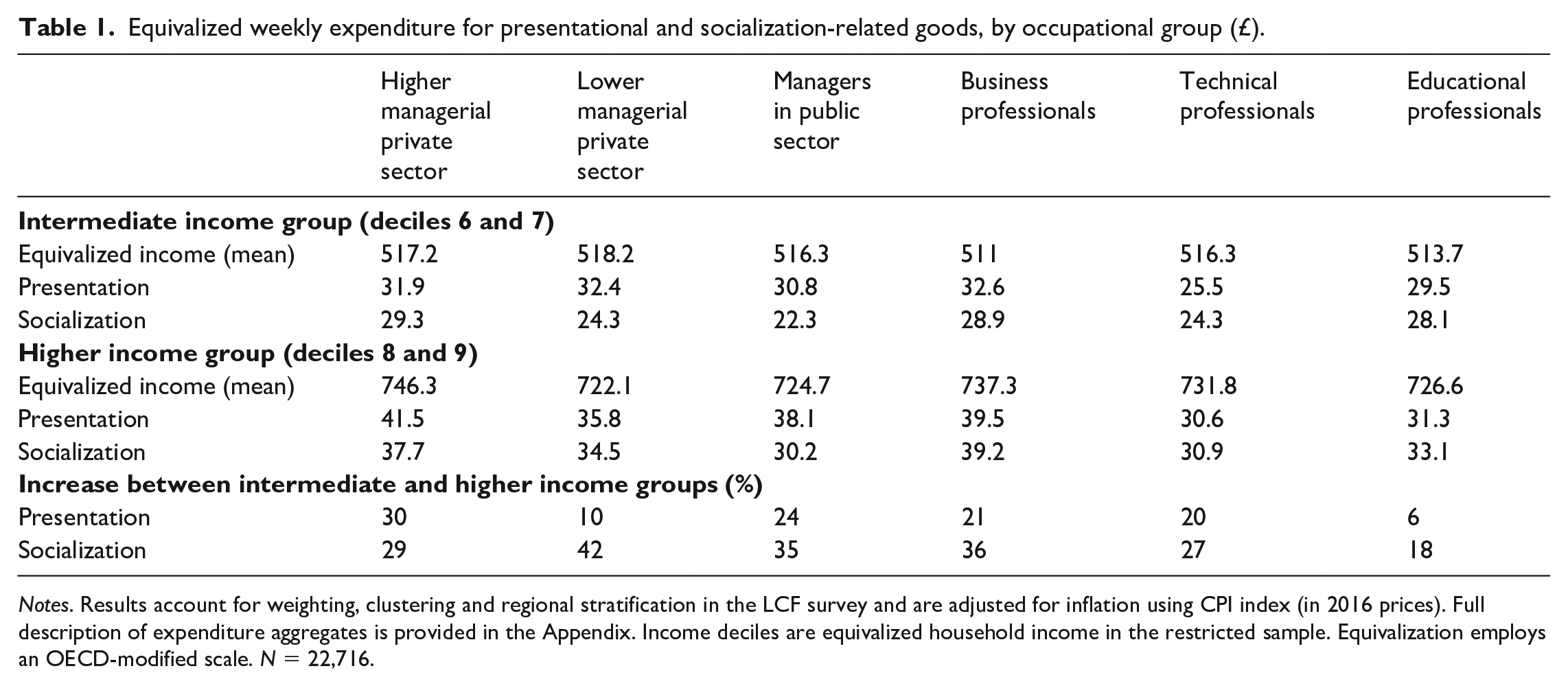
Notes. Results account for weighting, clustering and regional stratification in the LCF survey and are adjusted for inflation using CPI index (in 2016 prices). Full description of expenditure aggregates is provided in the Appendix. Income deciles are equivalized household income in the restricted sample. Equivalization employs an OECD-modified scale. N = 22,716.
Between-occupational contrasts in capital-signalling expenditures
The OLS models show that, as expected, several relevant factors (age, education of HRP, household size and other predictor variables) have significant effects on consumption levels and should be partialled out before any conclusions about between-occupational differences can be made. While no change in the coefficient of determination (R-squared) in the models can be expected due to disaggregation of ‘big classes’, the benefit of disaggregating NS-SEC is the opportunity to observe substantial differences within the professional/managerial class.
In OLS models for the three expenditure aggregates, occupational effects capture levels of association between the occupational groups and expenditure increases (i.e. differences in shifts of expenditure levels associated with occupational groups as household income increases). Pairwise comparisons of marginal occupational effects from the baseline model show differences in such association. Figures 4–6 illustrate the pairwise contrasts for the three expenditure groups.
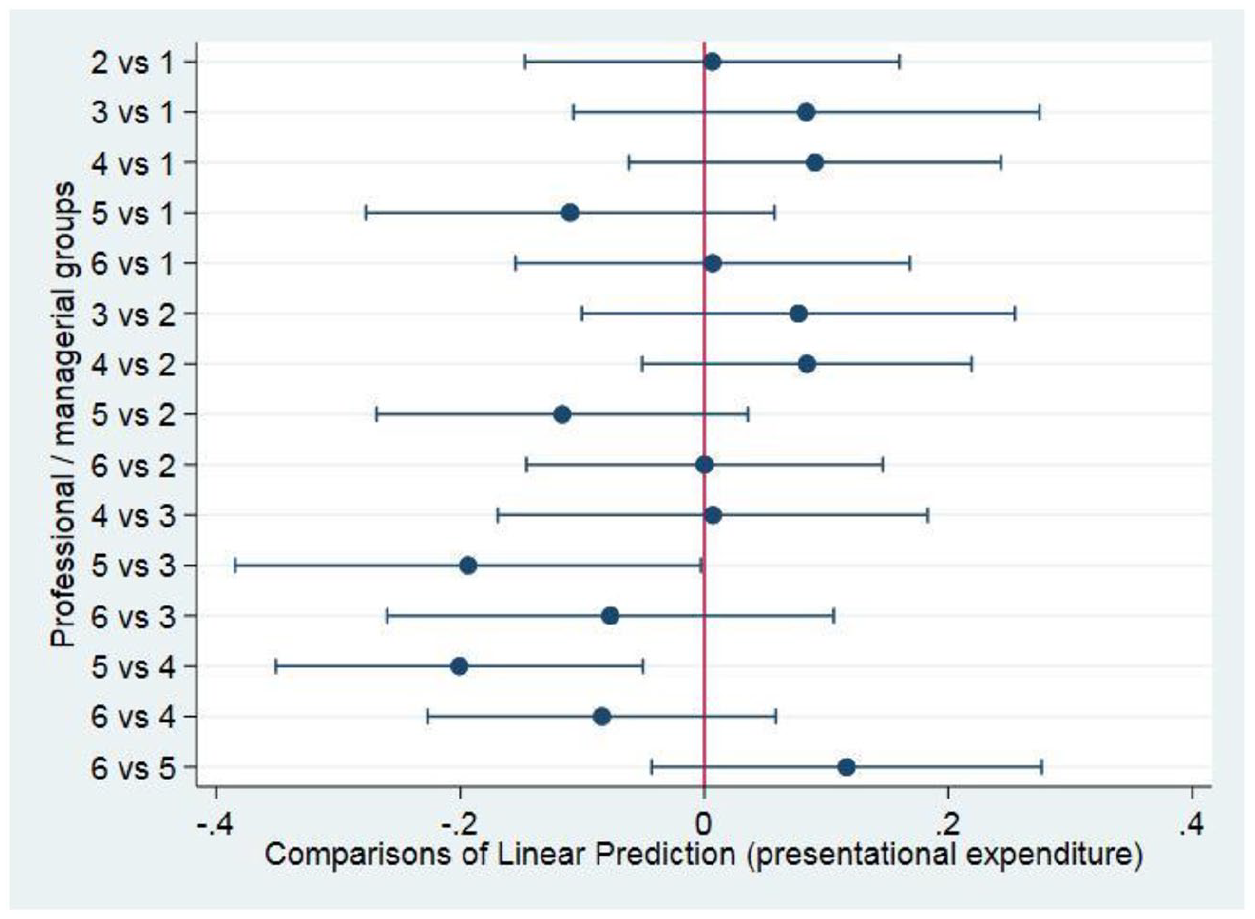
Between-occupational contrasts in presentational expenditure.
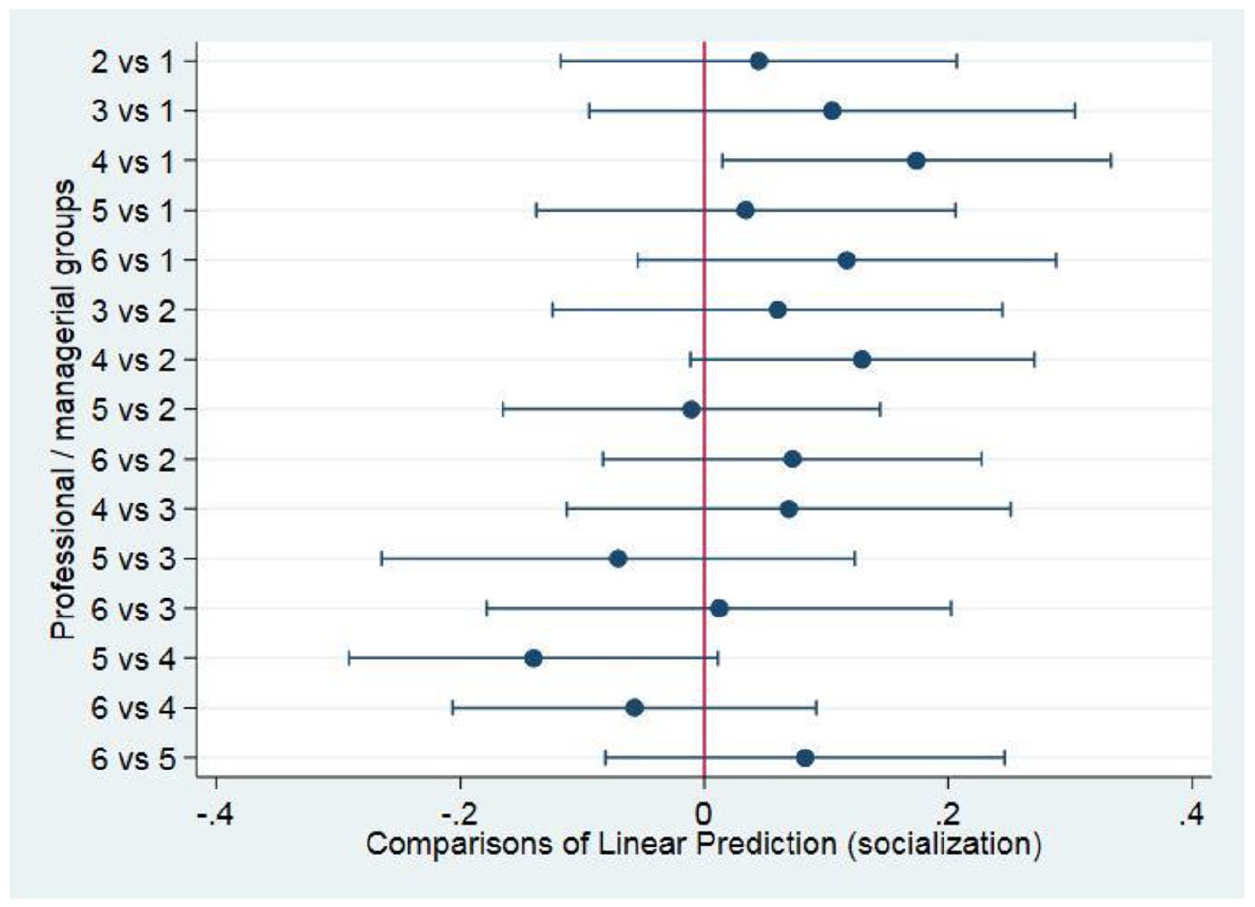
Between-occupational contrasts in socialization expenditure.
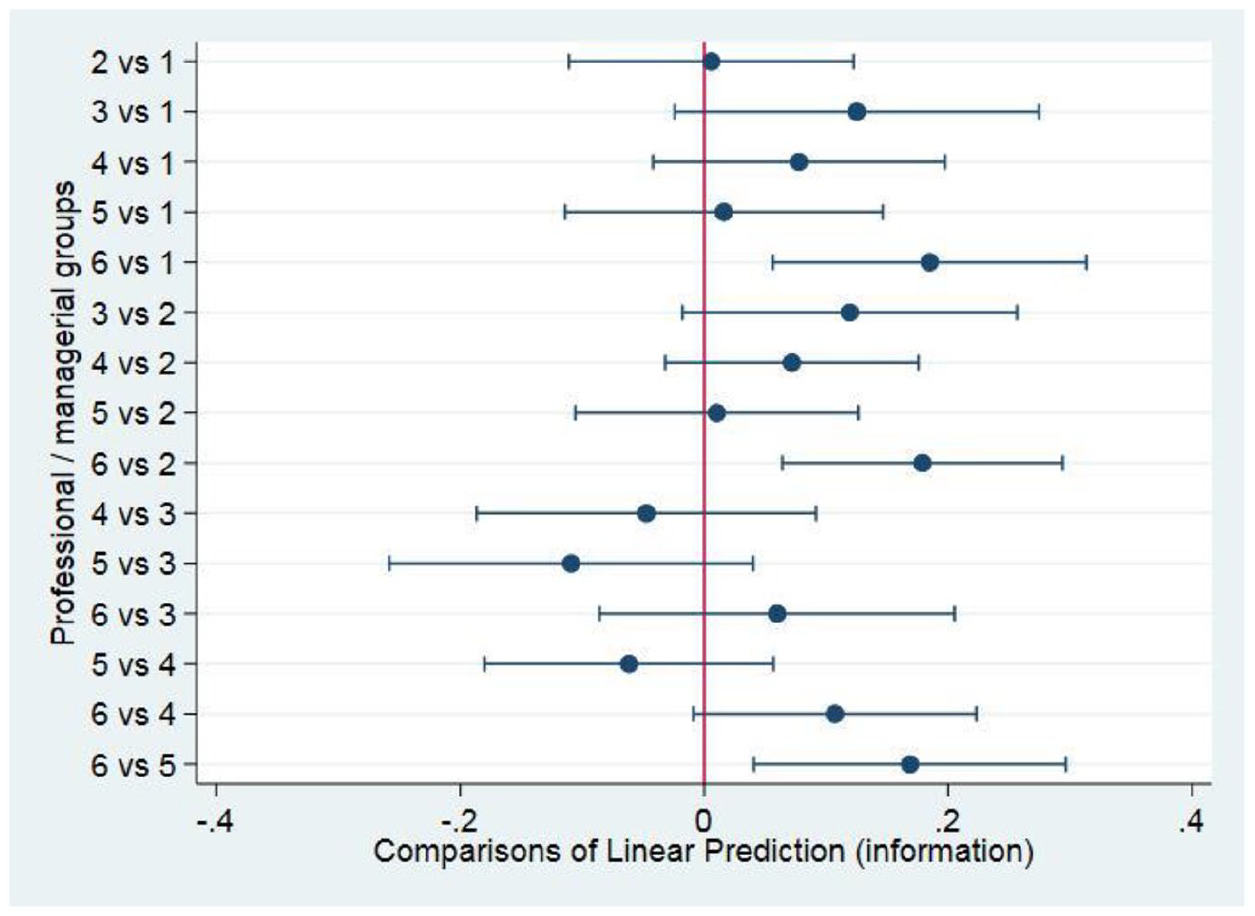
Between-occupational contrasts in informational expenditure.
As each occupational group is associated with a particular increase in presentational, socialization-related, or informational expenditure ceteris paribus, differences in levels of association show that business professionals, even on the same income, invest 23% more in presentational goods than technical professionals (Figure 4, group 5 versus 4). This is a statistically significant result (at p < 0.05) in support of our H1. These two groups also have salient differences in their socialization-related investments, with the former spending 16% more on socialization (H2) (Figure 5). The difference is partly driven by higher socialization-related spending at the top of the professional ladder. Educational professionals with the same set of characteristics (income, age, education and other factors accounted for in our baseline model) are associated with 11–18% higher spending on informational goods than business and technical professionals (H3, H4), and their spending on informational goods significantly exceeds other professionals (Figure 6). This signifies educational professionals’ higher investments in augmentation of objectified and institutionalized forms of cultural capital as part of professionalization.
In addition to testing our hypotheses, we identify other between-occupational differences in capital-signalling expenditure. Dispositions towards knowledge acquisition (informational goods, Figure 6) of public sector management are 11% higher than private sector management (H5). Business professions spend 8–9% more on socialization and presentation than educational professionals (at p < 0.1 level). The level of significance is expected to be higher in a larger sample.
Finally, using the same predictors as our OLS model, the GLM provides predictions for the outcome variables on a raw scale. Table 2 shows the expected values of presentational, socialization-related and informational expenditure for the six professional/managerial groups at different levels of household income. Technical and educational professionals spend less on presentational and socialization-related goods than business professionals. At lower household income levels this difference is not large, but by the 90th percentile (estimated at a £1645 weekly household income in the restricted sample), the difference in presentation is £40–50 per month. Expected levels of presentational expenditure are among the highest for public sector managers – the difference is likely to be driven by the upper part of the income distribution, in line with Table 1.
Predicted mean weekly expenditure at different levels of household income by occupational group (£).
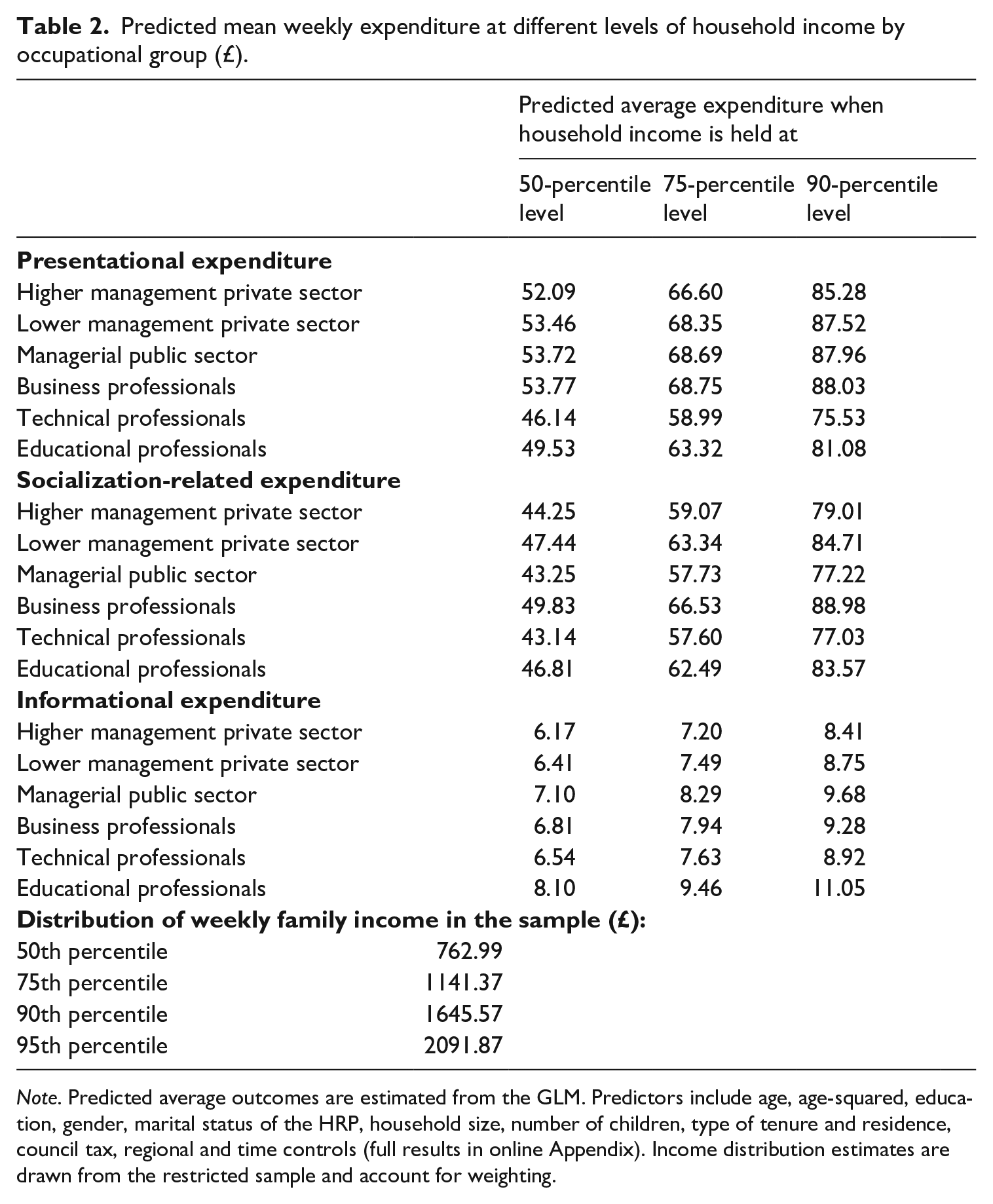
Note. Predicted average outcomes are estimated from the GLM. Predictors include age, age-squared, education, gender, marital status of the HRP, household size, number of children, type of tenure and residence, council tax, regional and time controls (full results in online Appendix). Income distribution estimates are drawn from the restricted sample and account for weighting.
Meanwhile the managerial groups’ presentational expenditures are more tightly clustered. Lower management spends more on socialization than other managerial occupations. At weekly household incomes over £2000, they would spend £7–9 weekly, or £35–40 monthly, more than their peers in other managerial groups. Admitting heterogeneity within the lower management group, this class fraction is characterized by lower demands on institutionalized cultural capital in the process of professionalization compared to top management. However, complexity and autonomy of the managerial role are likely to require substantial cultural capital, and socialization-related investment may thus act to augment social capital (networks) transforming it into embodied cultural capital. In relation to informational goods, educational professionals have statistically significantly higher expenditure compared to the other five groups; however, the actual monthly difference is only about £10.
Conclusions
Building on cultural class analysis based around Distinction, this article explores capital-signalling consumption patterns of class fractions within professional-managerial group of occupations. In line with prior literature (Atkinson, 2009; Bourdieu, 2010; Flemmen et al., 2018; Savage et al., 2013), our findings re-emphasize the need for greater granularity, to reflect the distinctive behaviours of occupational groups as well as the importance of new ways of capturing differences and similarities in lifestyles and practices which stem from working environments. We extend Bourdieu’s (2010) analytical approach to household expenditure on presentational and cultural goods to modelling and prediction of expenditure on capital-signalling commodities for particular occupational groups. Using British household expenditure data, we find occupational effects in investment intimately linked with displaying capital forms prioritized by the field.
As individuals competitively invest in resources and assets (including capital-signalling commodities) with high use-value in their occupational domains and reap returns on their investment, inequalities in capital (in the multiplicity of its forms) are created across the fields. Consumption choices of different occupational groups (even on equivalent incomes) differ in terms of their priorities to augment particular capital forms. Business professionals, as expected, demonstrate more ostentatious consumption and greater emphasis on appearance and socialization-related spending compared to technical and academic professionals. ‘The ascetic aristocratism’ in leisure activities typical of academic professionals (Lamont, 1992) finds consonance with the shift in consumption priorities from socialization-related spending towards higher emphasis on knowledge acquisition, as opposed to priorities revealed by business professionals and private sector lower management. We also identify ambition-driven consumption behaviours among public sector managers, whose ‘arena of competitive positions’ offers wider opportunities for social mobility (Friedman et al., 2017) and exerts pressures of new managerialism (Kirkpatrick et al, 2005; Noordegraaf, 2016), with high relative investments in appearance, socialization and knowledge acquisition.
Our analysis also contributes to understanding inequalities within the professional/managerial class and, intergenerationally, more widely. Following a certain occupational trajectory naturally builds particular species of capital, further accumulated by individuals and potentially transferrable to children/ partners, which, in turn, enhances inequalities and facilitates class reproduction and closure. For example, ‘social capital’ not only enhances professional competences in using symbols and codes and deciphering ‘cultural games’ (Friedman & Laurison, 2019; Rivera, 2012), but also represents a transferrable intergenerational ‘asset’. Similarly, technical capital and objectified cultural capital (e.g. IT software/hardware), while stemming from professional interests, are distributed within personal networks and may create strategic advantages for individuals or households.
While consumption practices are an important part of cultural games, with impacts on social mobility and social closure, differences in markers of identity across professional fields remain neglected. For example, in many technical careers, the rules of the game of ‘getting on’ change dramatically at a certain point in the career pyramid where the probability of getting into top positions becomes increasingly reliant on symbolic capital concerning socialization, networking and appropriate cultural tastes and competencies. Prized capitals for early-stage careers (typically technical capitals) become less relevant for higher-level posts, increasingly eclipsed by ‘polish, gravitas, and the demonstration of entrepreneurial flair’ (Friedman & Laurison, 2019, p. 206). When technical proficiency gives way to managerial and networking competencies, those less skilful in using symbols and codes – which are often mis-recognized as markers of objective talent and ability (Friedman & Laurison, 2019) – are likely to become increasingly disadvantaged, compared to their elite-background counterparts. At these higher levels, professional peers become increasingly dominated by people from elite schools and universities, while many who had hitherto enjoyed rapid promotion struggle to navigate the codes and ‘cultural games’, making them weaker players (Friedman & Laurison, 2019; Rivera, 2012) at the point where technical competence gives way to proficiencies in networking and socializing. Thus, measures of capital-signalling behaviours and their intensity at different stages of career may ‘quantify’ inequalities and pressures for ‘cultural games’ in professional fields. However, we recognize that household expenditure patterns and priorities are also influenced by a wide variety of factors, such as gender, race, ethnicity, religion, sexuality, political beliefs and environmental concerns (Skeggs, 2015).
We argue that consumption is a part of the signalling strategy of career agents, and between-occupational contrasts in capital-signalling expenditures are useful measures of capitals in cultural class analysis. Shifts of (relative) consumption and associated behaviours may serve as quantifiable measures of occupational cultures. Such links have the potential to illuminate underlying motivations, occupational identities and characteristics of career paths in granular occupational fields. This approach may prove valuable both in developing alternative socioeconomic segmentation variables for consumption models and further exploring occupational effects in consumption patterns.
Our results show that granular analysis of consumption patterns is important for revealing differences in accumulation of non-economic capitals across occupational fields, with implications for understanding inequality and class divisions, in line with theoretical (e.g. Savage, 2014; Savage et al., 2013, 2015) and methodological (Flemmen et al., 2018) research agendas. However, further work on markers and symbols of professional identities in the context of cultural fields and practices that secure strategic advantages across class fractions is needed to understand class identities and divisions, capture how compliant and competitive consumption facilitates professional growth, and explore the implications for such behaviours in reproducing class inequalities.
Supplemental Material
sj-pdf-1-sor-10.1177_00380261221093405 – Supplemental material for Capitals, occupational fields and consumption preferences: An analysis of the British family expenditure survey (2009–2016)
Supplemental material, sj-pdf-1-sor-10.1177_00380261221093405 for Capitals, occupational fields and consumption preferences: An analysis of the British family expenditure survey (2009–2016) by Karina Pavlisa and Peter M. Scott in The Sociological Review
Footnotes
Acknowledgements
We thank Peter Miskell, Thomas Thurnell-Read and James T. Walker for valuable comments and advice; the three anonymous reviewers for their careful engagement with this article; the participants of the mid-term conference of the European Sociological Association (2018) for valuable comments, and the UK Data Service for excellent service.
Funding
The authors received no financial support for the research, authorship, and/or publication of this article.
Supplemental material
Supplemental material for this article is available online.
References
Supplementary Material
Please find the following supplemental material available below.
For Open Access articles published under a Creative Commons License, all supplemental material carries the same license as the article it is associated with.
For non-Open Access articles published, all supplemental material carries a non-exclusive license, and permission requests for re-use of supplemental material or any part of supplemental material shall be sent directly to the copyright owner as specified in the copyright notice associated with the article.
