




Abstract
Based on a longitudinal and ethnographic study, this research examines how women experience the emotional aspects of their maternal foodwork in England across social classes. Maternal foodwork is linked to guilt and anxiety due to intense gendered and class-related ideals of proper feeding within the context of responsibilising discourses. This article contributes to the literature by introducing a temporal perspective, exploring how emotions beyond anxiety transform as caregiving arrangements evolve over time. It reveals that middle-class mothers adopt a downscaling strategy to counter maternal guilt when maintaining the standards set by intensive feeding ideology proves to be challenging with time. Working-class mothers adopt the same strategy to counteract feelings of inadequacy tied to persistent institutional surveillance and the challenge of embodying middle-class dispositions. The study underscores women’s capacity to cultivate agentic responses, albeit within the boundaries of their class habitus, crafting pockets of resistance against intensive feeding ideals.
Introduction
Feeding is central to the construction and lived experiences of maternal identities. While men are taking up foodwork in increasing numbers, feeding the children is still considered to be primarily the responsibility of mothers (Bianchi et al., 2000; Cairns and Johnston, 2015; Lachance-Grzela and Bouchard, 2010; Szabo, 2014). As discussed in DeVault’s (1994) seminal work, through feeding practices, mothers nurture their families and show affection to their loved ones. Since feeding is closely associated with care and maternal commitment, this work serves as an important marker of motherhood performances (Bugge and Almås, 2006). The ‘good mother’ is idealised as someone who provides nutritious and delicious meals, often sacrificing her own tastes, time and resources. Those who cannot execute ‘high-quality’ maternal foodwork are judged as lazy and uncaring, raising children with unhealthy eating habits (Cairns et al., 2018, Ladd-Taylor and Umansky, 1998). The standards and gendered pressures surrounding foodwork are so intense that even mothers who recognise the inequality embedded in such judgements cannot emotionally distance themselves from the process (Cairns and Johnston, 2015).
It is widely recognised in the literature that women experience such pressures in different ways and intensities according to their class positions, as measured by economic as well as cultural resources (Boero, 2010; Hernandez et al., 2012; Maher et al., 2010; Topham et al., 2010). Research drawing on Bourdieusian concepts and feminist food studies have shown how class intersects with gender and shapes the strategies women adopt to resolve tensions performing ‘emotion work’ (Hochschild, 1979), which involves monitoring, evoking and shaping emotions in particular ways (Cairns et al., 2013; MacKendrick and Pristavec, 2019; Oleschuk, 2020). Additionally, research drawing on Foucauldian frameworks has explored how women, especially low-income mothers, develop ‘rhetorical strategies’ (Banister et al. 2023), and draw on an ‘affective regime’ of optimism to make sense of the contradictory emotions they experience (Cappellini et al., 2019).
While developing invaluable insights into the affective aspects of foodwork in different social classes, such studies, due to their design and focus, do not fully capture women’s agentic responses in the face of various life transitions. As a result, we know very little about the dynamism embedded in women’s emotion work and how social class can shape women’s evolving strategies. Drawing on a longitudinal qualitative project conducted in South-East England, this study aims to bridge this gap and explore how middle-class and working-class mothers emotionally engage with feeding practices as their circumstances change over time.
The first section of this article explores how emotion work is conceptualised and applied by feminist food scholars while also advocating for the adoption of a broader perspective to encompass emotions beyond anxiety and guilt. The subsequent section delves into the connections between emotions arising from maternal foodwork and social class. The analysis section identifies a gradual development of a downscaling strategy in participants’ emotion work, which necessitate that women exercise agency, albeit constrained by their class habitus. The final section discusses the contributions this article makes to feminist food studies and social class research.
Emotional Landscape of Maternal Foodwork
The standard set for good motherhood has continued to increase dramatically since Hays (1996: 8) coined the term ‘intensive mothering’ to describe the emerging ‘child-centered, expert-guided, emotionally absorbing, labor-intensive, and financially expensive’ approach to childrearing. This ideology is based upon images of children as innocent individuals constantly at risk (Murphy, 2000) and parents as carrying the sole responsibility for managing them. In this context, parents, and especially mothers, are expected to pay careful attention to their children’s developing food preferences and intake. Expanding on Hay’s concept, Brenton (2017) coined the term ‘intensive feeding ideology’ to capture the cultural expectations of good mothering in relation to foodwork. Intensive feeding encompasses practices such as frequenting several supermarkets to acquire nutritious groceries, budgeting to afford organic items and managing professional feeding guidance. Such heightened standards for ‘ideal’ feeding, along with ever-present surveillance, amplify the affective components of maternal foodwork. As the gap between the idealised and the real becomes larger, foodwork begins to trigger signifi-cant emotional dilemmas, requiring women to develop effective coping mechanisms to resolve them.
There is growing interest in feminist food scholarship to unpack such emotional dilemmas by focusing on women’s lived experiences of feeding and maternal subjectivities. Hochschild’s (1979) ‘emotion work’ concept, which she defines as ‘the act of trying to change in degree or quality an emotion or feeling’ (1979: 561) is found useful to understand the conditions under which women ‘suppress’ or ‘evoke’ a feeling in relation to their existing foodwork (e.g. Fielding-Singh and Cooper, 2023). This emotion work stems from tacit acceptance of appropriate emotions in certain situations, which Hochschild (1979) defines as ‘feeling rules’. Linking emotional experiences more closely to the formation of maternal subjectivities, Cappellini et al. (2019: 473) use Foucault’s ‘ethical self-formation’ to illustrate how women create a way of living ‘that is embraced rather than being imposed in a Panoptical-like system’ as they strive to make ends meet. Providing a critical nuance to Hochschild’s ‘feeling rules’, Cappellini et al. (2019) draw on ‘affective regimes’ that structure women’s emotions. In this case, a regime of structural optimism (Berlant, 2011) allows women to make sense of their strategies, such as self-sacrifice. Reinforced by a neoliberal and intensified mothering ideology, this ‘cruel optimism’ enables women to fantasise about a future good life for the family and children, engage in self-surveillance and self-discipline, and suppress feelings of guilt for occasional deviations from a path of frugality. From a similar theoretical perspective, Banister et al. (2023: 1385) explore how women draw on their local maternal cultures and employ different rhetorical strategies, including resistance, to engage in ‘moral repair work’.
Since maternal foodwork is central to intensive mothering, and standards are high, ‘feeling rules’ or ‘affective regimes’ within which this ideology is embedded often generate guilt and anxiety in women (Cairns and Johnston, 2015; Cairns et al., 2013; DeVault, 1994; Fielding-Singh and Wang, 2017). While previous feminist food research has successfully linked these feelings to broader discourses on health, gender and class, its focus has risked obscuring emotions beyond maternal guilt and anxiety (Lewis, 2016). Oleschuk (2020) addressed this gap by considering food-related emotion work as operating along a pleasure–burden continuum. Drawing on Julier (2004), Oleschuk (2020: 4) acknowledged how foodwork can be a rewarding experience, serving as ‘a source of sensual pleasure, an expression of creativity, and a basis for pride, recognition, and power for women’. Similarly, Cappellini et al. (2019) identify several positive emotional responses alongside negative ones, such as pride and self-worth. Moving beyond guilt also opens more space for exploring the agency inherent in maternal foodwork. Deriving pleasure from foodwork can manifest agency, especially among low-income groups whose practices are often predominantly discussed in relation to restraint. This became evident in Banister et al.’s (2023) study in which they found that discourses are reshaped and reversed through deploying resistant rhetorical strategies, enabling low-income women to perform their agency and develop positive mothering identities. Similarly, Parsons et al. (2021: 12) suggest that what they call ‘foodcare’, an extended conceptualisation of foodwork that highlights the value of the ‘intimate knowledge of the needs of the family’, offers mothers an alternative to the logic of capital for demonstrating their self-worth. Understanding the individual navigation and experience of a diverse range of emotional strategies, constrained by unequal social conditions, requires adopting a social class perspective.
Social Class, Emotion Work and Feeding
Maternal foodwork, like most other parenting practices, shows great variation by social class (Fielding-Singh and Oleschuk, 2023). With Bourdieusian conceptual frameworks, a number of studies have contextualised feeding practices within individuals’ broader approaches towards eating (Karademir-Hazır, 2021; Oncini, 2019). Bourdieu (1984) suggested that the composition, trajectory and levels of different forms of capital locate individuals within positions in social space from which they embody a habitus. This habitus generates a parallel logic that operates across different domains, including food consumption, evidenced in patterns in dispositions, priorities, tastes and emotions. These dispositions are ingrained through a lengthy process of socialisation and shape adults’ feeding practices when they become parents. For instance, middle-class maternal foodwork tends to rely heavily on dominant nutritional discourses on healthiness and prioritises the cultivation of children’s independent sensory agency, fostering a cosmopolitan taste palette and sensitivity for both environmental sustainability and animal welfare (Beagan et al., 2015; Brenton, 2017; Cairns and Johnston, 2018; Fielding-Singh and Wang, 2017; Karademir-Hazır, 2021). Working-class maternal foodwork, on the other hand, tends to involve less scrutiny and control as long as nourishment is provided (Daniel, 2016; Wills et al., 2011). It is also characterised by appreciation for familiarity and ‘eating with your kind’ (Wills et al., 2011) and more inclusionary definitions of ‘homemade’ and cooking from scratch (Karademir-Hazır, 2021).
Affective responses to foodwork vary by social class, as practices reflect varying levels of legitimation. Embodying devalued or pathologised dispositions often results in a predilection for shame, fear and anxiety, whereas the internalisation of privilege can generate entitlement and superiority (Reay, 2015). However, due to the intensity of discourses that responsibilise mothers, the emotional landscape of maternal foodwork does not seem to overlap with such neat class distinctions. For instance, Wright et al. (2015) suggested that discourses on obesity as a consequence of modern life and time constraints implicitly place middle-class women under scrutiny for their increased engagement in paid work. Consequently, rather than entitlement, these mothers experience stress and strain as they try to balance temporal limitations while still providing ample choices to foster their children’s culinary independence. Fielding-Singh and Cooper (2023) showed that to manage maternal guilt, middle-class women tend to develop ‘upscaling’ strategies that involve setting ever higher standards for good feeding, intensifying control and actively comparing their foodwork with that of others. Working-class mothers, on the other hand, tend to encounter more intense external surveillance, such as judgements of their foodwork by health authorities, and must refute those judgements to defend their practices (Wright et al., 2015). Fielding-Singh and Cooper (2024) suggest that these women perform ‘downscaling’ by reflecting on harder times and redefining ‘good’ foodwork to limit the impact of negative emotions. Similarly, Elliott and Bowen (2018) argue that women with limited resources perform ‘defensive mothering’ as an emotional strategy, which involves rejecting negative assessments and using the ‘neglectful other’ as a benchmark. Inspiring an ideology of ‘balanced eating’ rather than intensive feeding, limited resources also seem to cultivate a ‘no-nonsense’ approach to children’s eating (Brenton, 2017).
Such findings suggest ideal or typical emotional responses to maternal foodwork by social class, albeit with considerable overlaps (e.g. anxiety) rather than clear-cut distinctions. However, as Crossley (2001) suggested, habitus schemas operate here as a foundational grammar, enabling a diverse range of creative modes of expression rather than reducing individuals to cultural dupes. In that sense, although maternal foodwork common to the working-class habitus may evoke anxiety and fear, women might also develop agentic responses, even though the impact and legitimacy of this response may be limited by their structural positions. Cairns et al. (2013) used the term ‘calibration’ to describe the complex emotion work women from all classes engage in to avoid the stigmas associated with the pathologised figures of the ‘McDonald’s mum’ or ‘organic mum’. While the former embodies perceived failure in maternal foodwork, the latter is depicted as excessively zealous, obsessively pursuing rigid standards at the expense of her mental well-being and social relationships. Women distinguish themselves from these typifications to suppress the vulnerability that comes from being potentially labelled as ‘lazy’ or ‘crazy’ (MacKendrick and Pristavec, 2019). Similarly, Banister et al. (2023) show how low-income mothers use ‘reframing’ as a rhetorical strategy and actively negotiate with the dominant discourses and their norms within their socio-cultural locations that underpin their practices as well as emotional responses. While ‘calibration’ or ‘reframing’ is a form of negotiation and thus an agentic response, the relative proximity of mothers to stigmatised figures, the uneven penalties attached to them and the resources available to them for calibration all invite us to carefully consider the impact of class habitus on women’s emotion work.
Data and Methods
As Fielding-Singh and Cooper (2023) described, mothers engage with emotion work constantly because achieving the status of ‘good mother’ is a never-ending struggle. To capture the temporal changes and fluidity of this process, the present analysis draws on a longitudinal ethnographic project conducted in the South-East of England. Funded by the British Academy, this project involved detailed exploration of feeding practices from a social class perspective. The study group comprised 12 families, all having at least one child aged between 1.5 and 4 years old. In the cohort of families, five were positioned closer to the working-class spectrum due to their occupational status and educational background. In these households, there was a single breadwinner in a blue-collar job role (see Appendix). The sample was homogeneous in terms of ethnic composition; all families had either British or other white European backgrounds. The sample was also homogeneous in terms of family composition – all 12 families were made up of heterosexual couples living together in the same household.
Over the course of the research, each family participated in three interview sessions with gaps of 6–8 months between them. In the initial interview, the primary focus was on the family’s food habits and mealtime routines. This interview included preparing and sharing a meal with the children. The second session involved shopping for food during the interview. The third session focused on how interviewees’ approaches to feeding and their experiences had changed over the course of two years. All interviews were recorded for later transcription. To ensure confidentiality, the identities of the interviewees were anonymised before the data analysis process. Families were recruited through established local networks and via posters in family centres located in neighbourhoods of varying socio-economic backgrounds. As a gesture of gratitude for their participation, parents were given supermarket vouchers worth £20 after each interview.
Trajectory analysis was employed as the chosen analytical approach in contrast to recurrent cross-sectional analysis (Grossoehme and Lipstein, 2016). Trajectory analysis focuses on unpacking how an experience changes over time and considers the factors surrounding the case rather than solely identifying differences between two time points. To accomplish this, the data collected from each stage were individually coded and then organised into time-ordered displays or sequential matrices. This approach enables an understanding of change or, essentially, ‘what led to what’. For example, by employing this method, it became possible to observe how a baby’s transition to nursery or the arrival of a new sibling affected maternal foodwork and related emotional responses. The matrices were then juxtaposed against the interviewees’ social class backgrounds, revealing patterns embedded in the data.
Middle-Class Strategies of Downscaling
Without exception, all middle-class interviewees in the sample drew heavily from intensive feeding ideology. Instilling healthy and varied eating habits in their children was seen as a parental responsibility, as expected, but these terms were defined in such fine detail that fulfilling the criteria became very laborious and time-consuming. Drawing on their cultural capital, mothers in this group were committed to researching feeding and were eager to share their knowledge during the interviews. While failure to meet the standards they set for themselves evoked feelings of anxiety at times, it was seen in the first round of interviews that mothers in this group embodied a noticeable degree of self-confidence. This further allowed them to develop a critical attitude towards institutional advice they received on healthy feeding from health visitors when they thought it was too simplistic, making them less susceptible to external surveillance. Interestingly, unlike the majority of respondents described by Fielding-Singh and Cooper (2023), when the standards proved to be unsustainable, these middle-class mothers downscaled to maintain the self-confidence and pride that they derived from their foodwork.
Kate’s case is a good example of how changing conditions force women to adopt new emotion-work strategies. At the time of the first interview, Kate, of Italian origin, was employed part-time as a librarian, writing her PhD thesis, and taking care of her one-year-old daughter. Kate was a keen chef even before having a child, always preparing home-cooked Italian dishes and taking pride in feeding friends and extended family. She was also very committed to consuming foods as organic and unpackaged as possible and offering a variety of options at each meal. Kate came across as highly self-confident in her culinary knowledge and took great pleasure and satisfaction from her foodwork. Her cultural and economic resources enabled her to act on her food priorities, which were clearly in line with middle-class dispositions (Oncini, 2019). However, by the time of our third interview, two years after the initial one, her daughter had been enrolled in a full-time nursery, which led to a change in Kate’s emotional state regarding feeding: Now she eats a lot more meat and a lot more cream fat. . . At the nursery, she has white sauces and béchamels and, pies with the – God knows what goes inside pies. . . I feel like I’ve lost a lot of control because she has more food out of my control than she has under my control. And I’m really upset about it. . . And they give them fairy cake and cupcakes and, things like that, so. . . Like, it’s sugary and disgusting and God knows what sort of hydrogenated fat is there. . . But we didn’t have a way to tell the school we don’t want her to eat crap. Because, how can you, how can you say it, I don’t want them to – it’s, it’s a, it’s a moral judgement.
Kate was actively trying to suppress her anxiety about her child’s changing eating repertoire by working to evoke a sense of pride for the habits she had instilled in her child while she was younger. She referred to how her child still preferred fresh vegetables and fruits, how she refused to eat pasta at the nursery and instead asked her mum to serve freshly made pasta at home, and how she still usually accepted her mum’s control over her snacks. Acknowledging the fact that she would no longer have the desired level of surveillance over her child’s food intake outside, Kate was beginning to soften her standards at home. For instance, she suggested that she was less anxious about sugar since our first interview and had begun serving shortbreads and rice puddings at home, albeit in small portions. Other middle-class mothers also embraced this downscaling approach. For example, in our third interview, Emma displayed a more relaxed attitude towards family meals as her son had begun attending nursery. Instead of striving to have the whole family eat together in the evenings, as she initially aimed at the time of our first interview, she adjusted her approach. To cope with her disappointment and prevent feelings of failure, she started considering weekend family breakfasts and dinners as the main family meals.
One factor that began to trigger anxiety around foodwork over time was changes in household dynamics. Anna’s case is a good example of this. In the first interview, Anna showed great enthusiasm about developing her son’s taste repertoire, introducing him to herbs, spices and recipes from different parts of the world ‘to raise him as a gourmet’. She was teaching him about the seasonal growth of vegetables and where our foods come from by spending time with him in their garden. She was not hesitant in judging mothers who offered their young children sweets or mothers who did not know what ‘organic’ or ‘healthy’ really meant. However, Anna had a second baby between the first and third interviews, before her younger child started nursery, and she returned to part-time work shortly thereafter, which dramatically limited her capacity to sustain intensive feeding. Her husband, who worked full-time, had very little time to support her and help from extended family was limited. Anna explicitly compared how things had changed, demonstrating her disappointment: There have been some things have changed. It does annoy me, because I used to, I used to make a lot of, like, homemade lunch types, healthy stuff, and I’ve got to a point now where I’m just, like, making, well, it is still healthy, but it is quicker. He still eats really balanced, gets all his veggies, but this is not the – as much love into the lunch preparations now, like I used to. . . I just feel so unadventurous, that’s the thing. . . I mean, I did, before [the second baby] was born. So, I’ve got a photograph of one of the dishes for lunch we had, oh my God, it is like in a restaurant, yeah. . . Now you just don’t go there anymore.
In Anna’s case, the gap between the ideal and the real began to expand as she found it impossible to maintain the standards she set initially or self-surveillance in the face of new household dynamics. As she tried to suppress her disappointment, her downscaled foodwork involved drawing more on the ‘balanced feeding ideology’. A similar shift in emphasis and downscaling was evident in Clare’s interviews. Clare, as the full-time carer of two boys under the age of three, was putting major effort into making family dinners ‘work’, which included introducing new recipes, encouraging the children to talk about the food and making sure everyone sat at the table with no distractions. However, the result, in her own words, was anxiety-inducing ‘chaos’. She coped with that stress by trying to evoke pride in her own efforts, but by the time of our third interview, she had lowered her expectations for commensality and her children’s food repertoire: I mean, well, that’s how we learned to not, the main thing is, the rule of, like, not talking about food. Because I’ve just tried everything, you know, and it’s so exhausting, trying everything. But it didn’t make any difference. So then we thought, it’s, like, just like that. . . maybe they will start eating a bit better soon.
Over time, Clare’s commitment to ethical food waned. Reflecting Cairns et al.’s (2013) research findings, Clare felt the individual responsibility of securing her children’s futures and raising idealised, organic children. Her emotional response to this agenda was mixed; she took pride in her commitment and found joy in meeting her standards occasionally. However, she also experienced anxiety about not doing enough and facing budget constraints that hindered her from fully realising her ideals.
After our initial interview, Clare transitioned her children to a vegetarian diet, eliminating all meat products and emphasising the importance of this dietary choice for their well-being. However, when we reconvened two years later, she had reintroduced meat into their meals, particularly after struggling to persuade them to eat pulses. Clare shared her new focus on evoking positive emotions and managing anxiety in this context: Partly because I also feel like, I trust myself. That’s why I’m not worried, if for, even when, you know, for – for those months they hardly ate any vegetables. They were perfectly fine, they were full of energy. They were healthy. . . Yeah, I think I’m more relaxed about it now.
Downscaling revealed itself in different ways in middle-class maternal work, sometimes with the relaxation of how ‘healthy’ food was defined and sometimes in being less strict about how food should be consumed. These changes took place because new caring arrangements had a knock-on effect on feeding practices or ‘things didn’t go as planned’. In response, interviewees drew on their agency and applied strategies to survive emotionally unsustainable standards that bring maternal guilt and anxiety. These strategies are inevitably shaped by resources; middle-class women could ‘downscale’ more confidently because their initial emotional responses to feeding were marked by self-confidence and social legitimisation of their feeding dispositions.
Working-Class Strategies of Downscaling
The feeding styles of the working-class interviewees, who did not feel specifically responsible for raising a ‘gourmet’, drew heavily on balanced feeding ideology rather than intensive feeding. Their understanding of ‘balanced’ was very inclusive and practical; for instance, strategies such as sprinkling sugar on top of fruits to increase their consumption or relying on the five-a-day rule as advertised on canned products were deemed acceptable. However, these strategies did not imbue self-confidence, as these mothers were aware of how their approaches were likely to be judged by others. Resonating with the findings of Wright et al. (2015), these interviewees felt the external surveillance more explicitly and were more vulnerable against the norms established by institutions. However, as events unfolded and conditions changed, they began to build resilience, as reformulated by Schafer et al. (2009: 232, as cited in Mu, 2020) as a ‘purposive response to the structural realities of social inequality’. Rather than being subsumed within an all-encompassing discourse and ideology triggering guilt, women in this group found ways to enhance their confidence as well as the pleasure they derived from their maternal foodwork. As the analysis will show, the downscaling performed within this group is not a response to the practices these women engaged in at the beginning of their food parenting journey, as in the case of middle-class interviewees, but more in terms of developing a resistance to the explicit standards of good feeding set and circulated by institutions, such as health visitors and media influencers.
A good example of this trajectory is Jess’s case. At our first interview, Jess was working part-time in different cleaning and waitressing jobs, helping her mother with cleaning and boarding language-school students in her home, all of which increased the pressures on the resources she could devote to her maternal foodwork. Her economic constraints were noticeable, but her narrative focused more on her pride in being able to provide budget-friendly homemade dinners rather than the limitations posed by her conditions. Also noticeable in the first interview were her feelings about the advice she received from health visitors. Jess was reminded several times that her baby was at the upper end of the weight percentile for her age. She was not explicitly anxious, but she constantly referred to the strategies she employed to instil healthy eating habits in her child, such as replacing fried foods with oven-baked versions when possible and asking adults not to consume high-calorie snacks in front of the child. The ‘McDonald’s mum’ arose several times in these interviews to exemplify the practices of the neglectful other. However, when we met two years later, Jess’s attitude was much more critical towards the obesity discourse and the external surveillance that she thought was applied to similar mothers. When asked if the advice she kept receiving caused her stress, she replied as follows: I don’t find it stressful, I find it annoying. . . I find it annoying, because no one will tell you what you can and can’t give your children, they are your children and you’re going to give them what you want to give them. At the end of the day, they’ll, they’re no one else’s kids. Yeah, I find it annoying when they say you cannot give them this, you cannot give them that, and. . . I know some families where social services are involved because their children are overweight, it’s stupid. It’s ridiculous. Because it’s classed as neglect now. It never used to be. It is now, though.
To evoke self-confidence in her competency, Jess discussed the changes that occurred over time in the advice given to families by health visitors, comparing her mother’s weaning experiences with her own. The constant evolution of advice and heightened expectations were perceived as indicators of the arbitrariness of the criteria used to define healthy feeding. Through continuous emotional effort and accumulated experience, she downscaled her commitment to the standards set by external actors and became much less anxious about her daughter’s eating habits. Abandoning the language of percentiles, she depicted her daughter as a ‘naturally big child with a hearty appetite’ but healthy eating habits. Between the interviews, she developed the strategy of ‘cheat days’, when the entire family was allowed to indulge in ‘junk’ food. This strategy seemed to help her distance herself with greater confidence from the stigmatised image of the ‘McDonald’s mum’.
Similar trajectories were apparent in other interviewees who demonstrated heightened awareness of external surveillance during their initial interviews. For instance, Becky grew frustrated with the health visitors’ persistent push for breastfeeding despite having clearly communicated her preferred feeding style from the outset. This prompted her to continually suppress maternal guilt, repeatedly emphasising how formula feeding allowed for the nurturing of a bond between her partner and the baby. After taking an extended break from her job as an assistant hairdresser, Becky assumed full-time responsibility for childcare as well as managing the baby’s food. She exhibited great enthusiasm in sharing her insights about providing healthy and balanced meals in a cost-effective manner, even citing the prices of individual ingredients from various shops.
Becky was also well versed in different feeding styles; for instance, she initially held high aspirations for baby-led weaning, a concept she discovered through social media. However, in our second interview, it became evident that this approach was not suitable for her. She found it messy, time-consuming and, most importantly, wasteful. Additionally, it did not contribute to her confidence in assessing her baby’s food intake, as she struggled to determine how much food was actually consumed. Nevertheless, she did not frame her experience as a failure or express regret for discontinuing baby-led weaning. Instead, she presented it as a conscious choice made after evaluating her circumstances and alternatives.
Between the first and third interviews, Becky had another baby. Having felt vulnerable due to the advice of health visitors in the previous round of interviews, she quickly developed a strategy of withholding full details of her practices from external authorities. Downscaling in her commitment to the standards set by health visitors and her growing self-confidence was evident in the way she discussed her weaning journey: They will tell you not to wean at four months, but it’s sort of when I decided to. . . So when we were eating and she showed interest and, like, looking and like, a, trying to put her arms out, like, I took that she was sort of ready to, try weaning, so. So. . . when I [go to a] check-up, and they say, ‘Oh, are you weaning?’, and I was like, ‘No’ [laughs]. Because then they’ll be like, ‘Oh no, you can’t wean. . .’ because they just think you should just follow by the text book.
Similar to Jess, Becky demonstrated increased self-confidence and felt comfortable challenging institutions of surveillance as they became more pronounced. In this process, akin to other working-class mothers, Becky compared herself with the neglectful other to evoke positive feelings about her maternal foodwork. For instance, at one point, she began explaining how certain nurseries and primary schools were inspecting children’s lunchboxes to determine whether healthy meals were provided. Becky conveyed her confidence that ‘there are going to be children that eat far worse’ than her daughter, with packed lunches filled with ‘crisps, chocolate, and who knows what’.
The trajectory of downscaling, culminating in the development of self-confidence, could not have been more pronounced than in Maisie’s case. Maisie, a care assistant who recently relocated from the Philippines to the UK, was raised in a large family with limited resources. She had not yet amassed enough capital to live comfortably and the effects of those economic constraints were evident. At the same time, her maternal foodwork was characterised by an overwhelming sense of maternal guilt. This guilt was triggered by her belief that she lacked culinary creativity and skills. In our first interview, she repeatedly expressed how she felt inadequate when comparing her food-related efforts with those of other mothers, especially social media influencers: I also join, there is one forum in UK, like, it’s a Facebook group, it’s all about babies’ food. But I feel very bad, because it’s like I’m the worst mum. They are baking so many things, they are putting some recipes and I’m trying to imitate, like, to bake something. . . one mom who was the admin of that group, she was posting every day. Different recipe, and you’ll see it’s like, she is the best mum. . . Sometimes I feel under pressure. Like, some, if we are going out with some friends, and I’ll tell ‘What are you making for your kid?’ and she’d said ‘I’m putting blueberries and these things and that thing, and I’m mixing together’. . . So many recipes there and you are not giving new [foods], you also feel pressure.
The emotional aspect of Maisie’s involvement in food preparation underwent a significant transformation over the course of two years. By the end of this period, she appeared to be less susceptible to external scrutiny and less inclined to compare her foodwork with that of other mothers whom she deemed ‘amazing’. She had disengaged from the Facebook group that previously triggered her maternal guilt but remained open to considering recommendations from friends and neighbours. She also developed her own strategies to enhance her foodwork. For example, she began saving pictures of new recipes she tried, particularly those her daughter enjoyed. This practice helped her circumvent the guilt associated with serving similar meals and nurtured a sense of pride in her efforts and skills.
In Maisie’s case, beyond gaining experience, her evolving perception appeared to be linked to shifting household dynamics. By the time of our third interview, Maisie had returned to full-time work, and she and her husband had started sharing their daughter’s care by coordinating their shifts. Consequently, Maisie’s husband became significantly involved in cooking and feeding, occasionally taking the initiative to explore new recipes on YouTube and consulting cookbooks to devise meals for the whole family. This aligns with the findings of Fielding-Singh and Cooper (2023), indicating that sharing food-related responsibilities with fathers could alleviate mothers’ anxiety and guilt by reducing the disproportionate emotional burden they often bear.
These narratives of working-class women concerning feeding demonstrate how they devised a downscaling strategy to navigate feelings of anxiety, guilt and stress arising from the awareness that their practices did not entirely conform to the standards prescribed by intensive feeding ideology. The analysis suggests the pivotal role of ‘experience’ in shaping these women’s proactive responses and their development of resilience, aligning with what Elliott and Bowen (2018) referred to as ‘defensive mothering’. This pragmatic approach, stemming from personal experience, is unlikely to be purely reflexive. Instead, it appears rooted in a tacit recognition that gaining full approval from authorities and keeping pace with evolving nutritional advice and curated feeding trends on social media is unattainable under real-life conditions. Furthermore, this gradually emerging self-confidence does not appear to shield women from surveillance or the expectations of it, as exemplified by Becky’s comments about lunchbox inspections. Nevertheless, it remains crucial for feminist food politics to acknowledge that working-class maternal foodwork is dynamic and open to downscaling, which can open room for pleasure and encompass liberating and creative elements. This recognition, instead of narrowing the focus to solely the impact of constraining discourses (Lewis, 2016), is vital.
Conclusion
Intensive feeding ideology continues to influence the formation of contemporary ideals for good maternal foodwork, compelling mothers to shoulder both the physical and emotional responsibilities of food parenting (e.g. Beagan et al., 2008; Brenton, 2017). The degree to which women act upon this ideology and navigate the emotional ‘consequences’ aligns with their class habitus (Bourdieu, 1984), shaping the realm of the affective. This shows the significance of exploring women’s emotion work intersectionally, as the affective impacts of gender ideology on feeding experiences are strongly crosscut by the psychosocial potency of class habitus.
That said, it is important to recognise the commonalities in the affective dimensions of foodwork across social classes. First, as underlined by Parson et al.’s (2021: 13) conceptualisation of ‘food care’, food is not only a functional source but is also linked to feelings and pleasures that emerge thanks to the creativity and competence needed to feed the family under changing circumstances. In other words, women from across the class spectrum are ‘actively creative in producing something new that is grounded in the familiar’. The familiar in this case indicates the dispositions embodied through long-class socialisation as well as available resources at the time, while ‘new’ refers to the constantly unfolding life events. Second, although the intensity of their engagement with it changes, women across the social classes implicitly accept the standards set by intensive feeding ideology as an ideal type, which, as Cappellini et al. (2019) argue, is underpinned by an ‘affective regime’ of neoliberalism. The contrasting and changing emotions revealed in the process of feeding, therefore, can be seen as a response to fabricated fantasies about the good life and optimism, which allows women from across social classes ‘to keep on’. While dissecting the role played by resources in women’s lived experiences, it is crucial to locate practices and emotions within the overarching structure in which they are embedded.
Studies emphasising the continuity and fluidity of emotion work suggest that motherhood is never a ‘done deal’ (Elvin-Nowak, 1999) but rather an ongoing practice of calibration (Cairns et al., 2018; Cappellini et al., 2018). Women respond to the emotional challenges, trying to suppress negative emotions and evoke positive ones while drawing on ‘feeling rules’ accordingly. Looking at women’s emotion work longitudinally allows us to unpack how exactly these experiences change and what roles resources play in this process. For instance, while the existing literature has recognised the affective impact of surveillance on women’s foodwork (e.g. Fielding-Singh and Oleschuk, 2023; Wright et al., 2015), how women find ways to cope with their anxiety over time has remained underexplored. Life transitions such as having another child, children starting nursery, or the end of maternity leave shift the temporal and organisational order of foodwork (Karademir-Hazır 2024). These transitions have significant impacts on how women feel about their own performances of feeding, showing the dynamism embedded in emotion work. The maintenance of self-confidence and pride, which emerges thanks to the available resources, can require downscaling when the high standards of intensive mothering prove to be unachievable for middle-class mothers in the long term. Similarly, downscaling can be performed when the standards cannot be internalised or embodied smoothly due to working-class sensibilities and conditions, leading to the replacement of feelings of inadequacy with empowerment. Such findings point to the potential that longitudinal designs offer in enhancing our understanding of women’s evolving experiences shaped by their conditions, which are in constant flux. They also demonstrate the nuances in women’s emotion work and how the same strategies can trigger different emotional responses. For instance, while Fielding-Singh and Cooper’s (2023, 2024) studies suggest a stark contrast between middle-class and working-class strategies in the form of upscaling vs downscaling, the findings in this study show that downscaling can take different shapes and be performed across social classes as a response to different classed sensibilities, positions and pressures.
The findings also offer insightful perspectives on the pleasure–burden continuum and women’s agency, a concept discussed in relation to food work (Julier, 2004). Food scholarship recognises the structural factors that shape individual practices, encompassing neoliberal ideology, the global capitalist industrial food system and disparities related to gender, ethnicity and class (Cairns and Johnston, 2015). This scholarship also emphasises how discourses lead to surveillance, exacerbating constraints on the manifestation of agency. While these studies provide valuable insights into the origins of maternal guilt and anxiety, there remains an underexplored aspect: how mothers from different social classes can find pleasure in foodwork and navigate constraints (Lewis, 2016). For instance, in this study, Kate found immense pleasure and pride in integrating elements of her national identity into her feeding practices. This allowed her to shield herself, to some extent, from the pressures of intensive feeding ideology. Similarly, Maisie actively cultivated self-confidence as she developed new culinary skills and supressed her aspirations for achieving the standards of ideal feeding. Overemphasising anxiety not only obstructs the understanding of women’s varied emotional landscapes but also risks reducing women to passive victims of intensive feeding ideology. A recent study by Oleschuk (2020), which explores how agency and empowerment are channelled through cooking pleasure for low-income mothers, offers an important avenue for future research. Similarly, Banister et al. (2023) showed how women demonstrate agency by reframing the discourses, developing self-confidence and claiming an identity as a good mother. The analysis presented in this article contributes in the same direction by illustrating how women from different social classes develop emotional resilience, albeit through adopting downscaling in different forms. However, it is important to underline that the empirical evidence presented in the article highlights the pervasive nature of intensive feeding ideology. It illustrates how attempts to re-position oneself against it often inadvertently reinforce its standards. For example, while Anna lowers her feeding standards to alleviate her anxiety in response to the disparity between the ideal and the reality, the underlying ideals perpetuated by intensive feeding ideology remain largely unchallenged. Consequently, the study characterises women’s emotional labour not as a means to fully escape the ideology, but rather as creating pockets of resistance within it. Future studies utilising diverse and larger samples have the potential to enhance our comprehension of the emotional trajectories of maternal foodwork, particularly as they intersect with various structural conditions that shape mothers’ navigation strategies.
Footnotes
Appendix
Interviewee details.
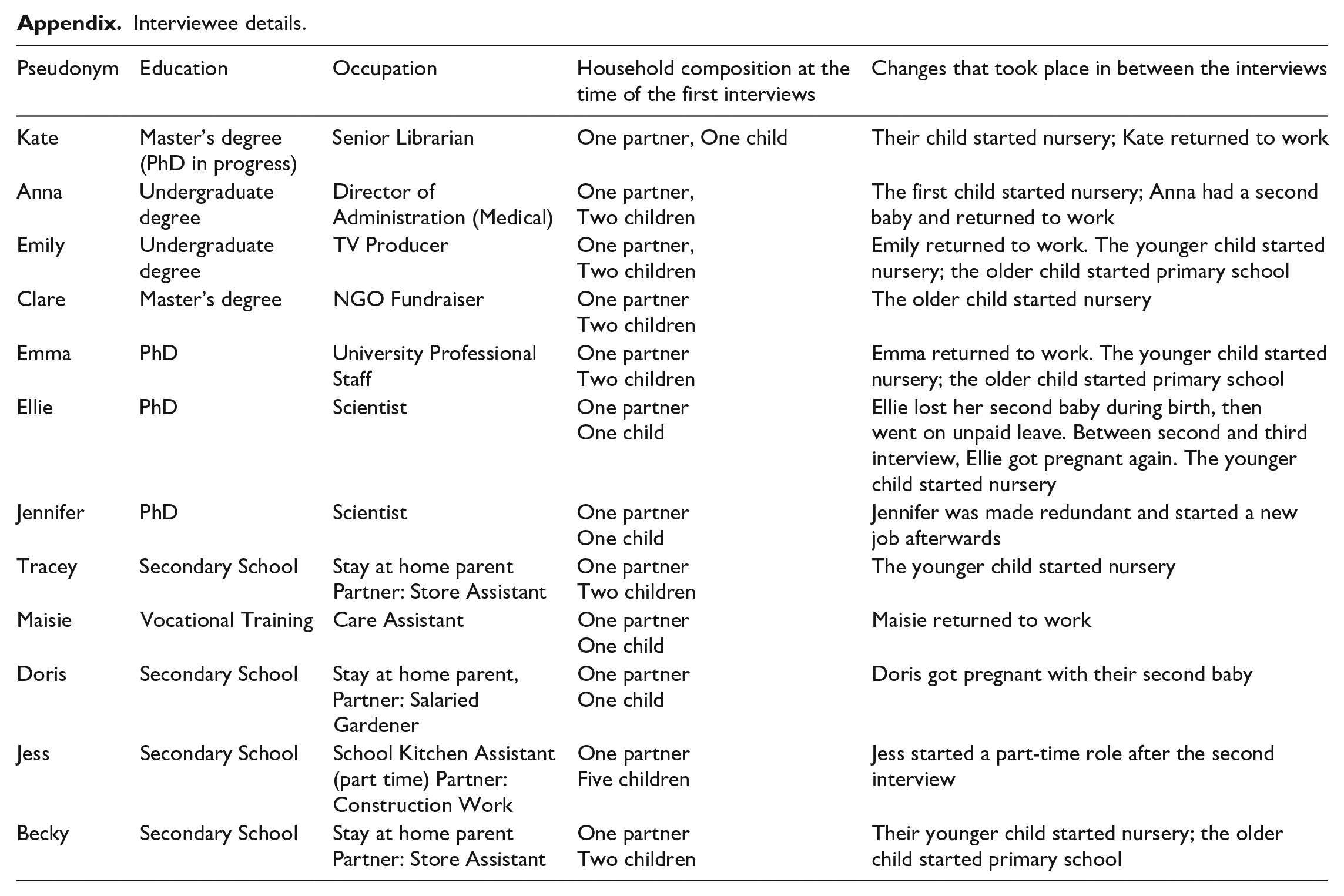
| Pseudonym | Education | Occupation | Household composition at the time of the first interviews | Changes that took place in between the interviews |
|---|---|---|---|---|
| Kate | Master’s degree (PhD in progress) |
Senior Librarian | One partner, One child | Their child started nursery; Kate returned to work |
| Anna | Undergraduate degree | Director of Administration (Medical) | One partner, Two children |
The first child started nursery; Anna had a second baby and returned to work |
| Emily | Undergraduate degree | TV Producer | One partner, Two children |
Emily returned to work. The younger child started nursery; the older child started primary school |
| Clare | Master’s degree | NGO Fundraiser | One partner Two children |
The older child started nursery |
| Emma | PhD | University Professional Staff | One partner Two children |
Emma returned to work. The younger child started nursery; the older child started primary school |
| Ellie | PhD | Scientist | One partner One child |
Ellie lost her second baby during birth, then went on unpaid leave. Between second and third interview, Ellie got pregnant again. The younger child started nursery |
| Jennifer | PhD | Scientist | One partner One child |
Jennifer was made redundant and started a new job afterwards |
| Tracey | Secondary School | Stay at home parent Partner: Store Assistant | One partner Two children |
The younger child started nursery |
| Maisie | Vocational Training | Care Assistant | One partner One child |
Maisie returned to work |
| Doris | Secondary School | Stay at home parent, Partner: Salaried Gardener | One partner One child |
Doris got pregnant with their second baby |
| Jess | Secondary School | School Kitchen Assistant (part time) Partner: Construction Work | One partner Five children |
Jess started a part-time role after the second interview |
| Becky | Secondary School | Stay at home parent Partner: Store Assistant | One partner Two children |
Their younger child started nursery; the older child started primary school |
Funding
The author disclosed receipt of the following financial support for the research, authorship and/or publication of this article: the work was supported by the British Academy [SG170135].
