




Abstract
The English workday lunch receives heavy criticism. Given this, why do people eat the way that they do? Using in-depth interview data, findings represent an ‘instruction manual’ to the meal detailing (1) variation in the organisation of the workday lunch and standards for competent performance; (2) shared understandings of the meal; and (3) the guiding principle or meaning of the practice. The workday lunch takes much of its meaning from the practice of work. In conclusion, the workday lunch does not simply reflect weakening rules for a ‘proper’ meal, but contradictory orders sustaining the practices of eating and working.
Introduction
Quite often after eating – but especially because I tend to work through it – I tend to think ‘Oh, who ate my sandwich?’ [laughter] And then I realise it was probably me 10 minutes ago. So, I think I eat without thinking a lot of lunchtimes. (Charlotte)
Most workers, most days, eat lunch at work. During the week, the workplace is the most common place to eat after meals at home (Mestdag, 2005: 70). However, the British workday lunch has a poor reputation: it is typically a very brief, lonely affair, with little culinary merit (Yates and Warde, 2015). English habits and proclivity for sandwiches are the subjects of ridicule and even disgust: Bruegel (2021: 303), a French food historian, exclaims: ‘A sandwich or salad gulped down in front of a computer screen does not pass as a proper meal.’ How we do the workday lunch is culturally situated, with different countries having different formally and informally regulated ways of organising meals (Corvo et al., 2020; Poulain, 2002a; Southerton et al., 2012). Broadly speaking, lack of time is often cited for poor eating habits (Southerton, 2020: 188); specifically referring to Brits’ lunch arrangements, Corvo et al. (2020: 1070) conclude, ‘British workers are constantly in a hurry’, compared with their European counterparts. The English do not hold an esteemed reputation for their cuisine or food habits, and the workday lunch is no exception. Despite its problematic status and prominence in the contemporary diet, the workday lunch has received little sociological attention. The English workday lunch is a valuable object of social inquiry, having relevance beyond the national context, as English food habits foreshadow patterns of consumption in other cultures. Thus, understanding why the English eat the way that they do for the workday lunch is significant to debates on poor eating habits and the direction of change (Warde et al., 2007).
The article is structured as follows: first, fragments are drawn together from across sociological and social scientific literature on the working day and eating at work to ground the present study; second, theories of practice are introduced as an approach to examining the workday lunch; third, in-depth interview data are described; and fourth, findings delineate the organisation, shared understandings and the meaning of the meal. The conclusion argues that it is critical to consider connected practices to understand eating, then sets out a research agenda to extend understanding of the workday lunch.
Meals, Breaks and Working Time
Conceptual clarity is required from the outset and is critical for focusing this contribution. The working day is said to be organised around meal breaks and tea breaks (Southerton et al., 2012). However, a lunch break comprises two components: lunch as a meal entailing the consumption of food, and a break as a period of relief from the demands of occupational duties (Altman and Baruch, 2010: 129; Zerubavel, 1981: 159). As indicated in the opening interview quote, the conceptual separability of lunch and break is important, as one need not take a break to eat lunch – instead, working through lunch. Equally, breaks may be used for myriad leisure or personal practices other than eating (e.g. exercising, walking, personal banking, shopping, etc). The focus of this article is not the break but the meal of the workday lunch.
Notwithstanding this conceptual separability, to understand the meal of workday lunch requires an appreciation, and brief discussion, of literature on the temporal organisation of work. Different forms of work differ in the degree of submission to the clock: workers on time-related contracts often have a clear distinction between work and non-work hours, while those on results-based contracts have a more obscured distinction between hours of work and personal time (Fagan, 2001). Flexibility and temporal autonomy over work schedules – shaping the timing of the start, end and breaks during the working day – are debated to be patterned by occupational class, sector and gender (Chung, 2019; Fagan, 2001).
Yet working time is regulated not only by formal contract agreements but by informal social norms, particularly when the demarcation between work time and personal time is flexible (Rosengren, 2019). Time norms are socially shared expectations relating to when and how fast it is appropriate to work (Epstein et al., 2014). For example, arriving ‘early’, staying ‘late’ and working ‘excessive’ hours is not simply about formal contractual agreement or workload but is an expression of dedication, commitment and social status (Epstein et al., 2014; Zerubavel, 1981). This also has implications for meal breaks: while employers are formally required to offer rest breaks during the workday, informal time norms shape whether or how long it is acceptable to take a break. Jarvis (2002) found that in organisations with long hours work culture and strong presenteeism, ‘lunch is for wimps’. Thus, for those with considerable flexibility, formal and informal regulation of work time has implications for the scheduling of breaks – when, how long or even whether to take a break to eat – and thus for how we do lunch on workdays.
Food and Eating at Work
Meals figure in everyday understandings and sociological analysis of food and eating (Douglas, 1972) and attract attention partly because of their ‘routine, regular and collective observance’ (Warde, 2016: 59). However, not all meals have captured the sociological imagination in equal measure with distinct neglect of the workday lunch. Within the sociology of food and eating, there is a well-established research agenda around ‘feeding the family’ (DeVault, 1991; O’Connell and Brannen, 2016). Domestic meals – most notably, the family dinner – have been popularly studied, given their relevance for establishing and reflecting intimacy and for revealing (changing) gendered divisions of domestic labour (Charles and Kerr, 1988; Warde, 2016: 59). Recent interest in breakfast among families (Pirani et al., 2022) and children’s school lunchboxes (Harman and Cappellini, 2015) remains firmly within the established agenda of food and the family. The workday lunch falls outside of this interest as it is consumed alone or among colleagues (Sobal and Nelson, 2003) and often away from the domestic setting. Second, sociological research on eating out principally focuses on the highly pleasurable leisure activity of restaurant dining; eating out is considered a more ‘special’ occasion than domestic meals, with considerable cultural and symbolic significance (Paddock et al., 2017; Warde et al., 2020). While the workday lunch is often consumed out-of-home, it does not feature prominently in the sociological literature on eating out nor does the meaning of eating out reflect the much more mundane experience of the workday lunch. Third, meal occasions are ‘ordered in scale of importance and grandeur through the week’ (Douglas, 1972: 67) and differentiated by complexity, copiousness and ceremoniousness (Douglas and Nicod, 1974). Some meals (e.g. restaurant, family and even children’s school meals) hold greater social and symbolic significance than others, attracting academic attention. Finally, besides Corvo et al. (2020) (see below), the sociology of work and employment has overlooked the workday lunch as – despite breaks being an integral part of institutional routine – eating is a decidedly non-productive activity being only of marginal interest. Thus, within Sociology, we have skipped lunch on workdays.
While meals at work have been neglected, food and eating at work are not absent in social scientific research. Beyond the disciplinary bounds of Sociology, Organisation Studies have an emerging interest in food and eating (signalled by a special issue in Human Relations: Briner and Sturdy, 2008). On the one hand, research examines extraordinary, celebratory and exceptional consumption including after-work drinks, birthdays with cake, Christmas parties (Plester, 2015) and executives’ business dinners (Sturdy et al., 2006). In contrast, research also examines more mundane, everyday consumption, including cakes in open workspaces (Shortt, 2018), ‘food altars’ and food stashes in desk drawers, virtuously countered by over-consumption of water (Thomas et al., 2016). Altman and Baruch (2010) examine lunch but, as with other research in Organisation Studies, interest in eating is in service to other agendas, such as (re)producing work culture (Altman and Baruch, 2010; Plester, 2015), maintaining productivity (von Dreden and Binnewies, 2017) and well-being (Corvo et al., 2020; Shortt, 2018). Interest is not in understanding eating per se.
There are a handful of social scientific publications explicitly examining lunch at work, notably using survey data. Cook and Wyndham (1953) provide an early account of lunching patterns in an Australian factory canteen, while Poulain (2002a) analyses the workday lunch in canteens in France. Corvo et al. (2020) present findings from a large European survey titled ‘Eating at Work’, examining what, with whom and where office workers eat, and the motivations underpinning arrangements. They find that British workers stay on-site for lunch, are most likely to report eating at their desks and are most likely to eat alone compared with their European counterparts. Corvo et al. (2020) identify the crux of consternation over British arrangements: eating while working and eating alone. While this research provides a strong account of patterns of behaviour, it does not provide insight into the understandings or meaning of lunch.
How Best to Eat
Eating habits are imbued with moral and social meanings. Understandings of properness underpin accounts of food and eating with some meal arrangements considered meritorious and others less acceptable (Charles and Kerr, 1988: 21; Poulain, 2002a). As implied, the English workday lunch appears to fall far short of ideal arrangements. Generally, standards of practice dictate that distractions while eating be reduced (e.g. watching TV or using a mobile at the table are frowned upon), with the suggestion that distraction leads to mindless eating, mentioned in the opening quote. Furthermore, there is an overarching distinction between meals eaten with others and eating alone, with moral undertones designating individualised eating as less favourable and indicative of a deterioration in ‘traditional’ eating practices (Poulain, 2002a; Sobal and Nelson, 2003; Yates and Warde, 2017). Eating while working and eating alone contravene a broad understanding of ‘proper’ ways of eating.
Importantly, Warde (2016) argues that how best to eat must take account of the time, location and companion coordinates of the meal as they relate to distinctive understandings, conventions and standards. Pirani et al. (2022: 213), for example, observe that, at breakfast, individualised consumption of convenience food was not accompanied by assumed judgement, arguing that it is ‘a “different” meal which does not follow the same standards which are applied to other meals’. Instead, eating alone was a distinctly pleasurable experience, providing an opportunity to indulge personal tastes (Pirani et al., 2022; Takeda and Melby, 2017). The companion coordinates of the workday lunch are invariably colleagues, a broad category of relationship about which little is known vis-a-vis eating together. Social relationships at work are composed of ‘formal systems of working relationship’ prescribed by management and informal personal relationships that ‘developed between workers on a day-to-day basis’ (Morgan, 2009: 35–36). Scant extant research suggests a range of experiences of eating together with colleagues. Sturdy et al. (2006) describe the discomfort experienced in having to navigate blurred boundaries between work and leisure, professional and friendly relations, when dining together during business dinners. Seniority imbalance between those eating together also shapes experience, with lunch with a supervisor demanding a degree of formality not required when eating with peers (von Dreden and Binnewies, 2017). Sociological research problematises the idealised notion that eating together is always necessarily ‘better’, recognising the diversity of experiences; instead, how best to eat must consider the temporal, spatial and social coordinates of the meal (Warde, 2016).
In summary, the workday lunch features prominently in the contemporary diet but has been neglected as the object of focused sociological enquiry. Grounding the current study, fragments of research on eating at work from across disciplinary fields provide insight into patterns of behaviour at lunch and experiences of sociability among colleagues. However, we are still left asking how to make sense of the moral feeling that one should not eat alone while working, with the apparent defiant practice of doing so among the British. The key question concerning the workday lunch is: why do people eat the way that they do?
Theoretical Framework
This research uses theories of practice as a broad sensitising device and is inspired by the work of Warde (2005) and Shove et al. (2012). A practice-theoretic approach takes practices rather than individuals as the unit of analysis. A practice is a way of doing some activity. The elements configuring a practice are variously conceptualised by different authors, ranging in complexity. Warde (2005) presents a concise framework, arguing procedures, understandings and engagement constitute a practice, while Shove et al. (2012) offer a framework of materials, competencies and meaning (see their original contributions for an extended exposition of theories of practice). This theoretical framing shifts focus away from deliberative choices of individuals to instead emphasise habit and routine, the influence of material artefacts and infrastructures, conventions and shared understandings, and standards of performance (Warde, 2014). A fundamental conceptual distinction is made between practices as entities and as performances, with ‘practice-as-entity’ describing the relatively stable pattern of components that make practices recognisable and ‘practice-as-performance’ describing the observable doing of practices (Shove et al., 2012: 8). This distinction allows for reconciliation of the fact that ‘performances are very varied with claims that they are instances of a common and recognised Practice’ (Warde, 2014: 291). In this research, the workday lunch is regarded as an ‘entity of daily institutional routine’, variously enacted (Altman and Baruch, 2010: 139).
While it is possible to identify a singular practice, practices do not operate in isolation, rather practices are interwoven and inherently connected (Schatzki, 2002). Warde (2014: 291) argues that understanding a practice becomes more complicated where ‘several related integrative practices bear upon the orchestration of competent performances’. To understand the workday lunch, the performance of one practice (eating) necessarily pivots into the consideration of another (working). This research aims to empirically evidence the nature of connections between eating and work to provoke theoretical development.
Method
Twenty-one in-depth interviews were conducted, between February and April 2016, to generate nuanced descriptions of the organisation and experience of situated eating events. Interview data emanated from a small satellite project in association with the much larger project, Eating Out Revisited, which examined continuity and change in the relationship between eating in and eating out in England from 1995 to 2015 (Warde et al., 2020). Eating Out Survey was administered to a quota sample of 1101 respondents (quotas based on age and working status, interlocked with gender) to reflect the demographic profile of three English cities: London, Bristol and Preston. Further details on the design of the main study are discussed elsewhere (Warde et al., 2020: 17–18). The final survey item asked respondents if they would be willing to participate in further research on eating, generating a pool of 731 willing respondents; in-depth interview participants were sampled from this pool. Consequently, considerable detail was known about participants before the interview. People were invited to interview if they lived in London or Bristol (ease of travel), were aged 25–50 and lived in a working household (i.e. they and/or their partner, if they had one, were employed).
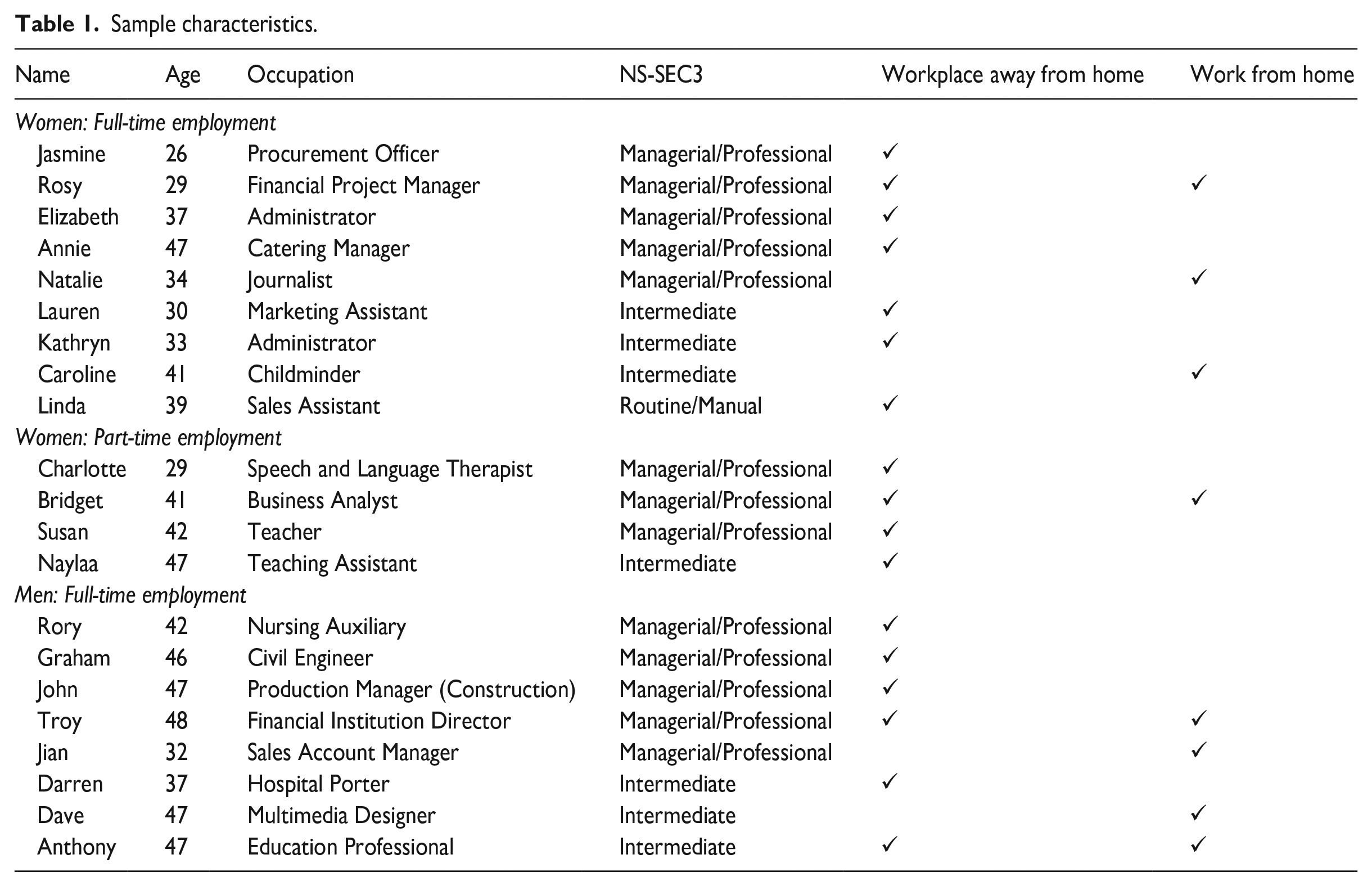
The final sample consisted of 13 women and eight men, aged 26–48, 10 lived in Preston and 11 in London. Eight interviewees were coupled with children, two were single parents, four lived as a couple and seven were single (living alone or with housemates). The majority were White British (n = 18) while one participant was Mixed or Multiple ethnicities (White and Black/African American) and two were Asian (one Chinese, one Iranian). Table 1 describes the employment and occupational status of participants. All eight men worked full-time, nine women worked full-time and four women worked part-time. Participants had a range of occupations, with 13 classified as managerial and professional, seven as intermediate and one as routine and manual (NS-SEC3 categories obtained from survey responses). Interviews lasted approximately one hour, with a small number being much shorter or much longer. Interviews were audio-recorded and transcribed verbatim. To protect anonymity, identifying information was removed at the point of transcription, and pseudonyms and genericised occupations (rather than job titles) were used. One participant (Naylaa) was excluded from this analysis as she worked in the mornings only and her account of lunch once home from work was altogether different from the other accounts.
Sample characteristics.
Workday lunches were not the exclusive focus of the interviews. Rather, the aim was to map the range of eating events in daily life; to understand the experiences and meanings of different types of eating events, and to explore the processes underpinning the organisation of and variation in differently provisioned eating events. Using NVivo11, a first set of codes was applied to transcripts, including mealtimes (breakfast, lunch, dinner) and sociability (eating alone or with others), with the assumption that these prosaic codes would ultimately be redundant. However, during preliminary analysis, it became apparent that sequences of consecutive practices surrounding eating events added to an understanding of why people eat the ways that they do. The workday lunch was identified as substantively novel and ideal for examining connections between practices. Thereafter, thematic coding proceeded inductively.
The findings represent an ‘instruction manual’ (Warde, 2014: 291) to the English workday lunch, which is structured into three sections: (1) variation in the organisation of the workday lunch, standards of acceptability and differentiation of performances; (2) shared understandings of the meal; and (3) the guiding principle or meaning of the practice.
The Social Organisation of the Workday Lunch
Variation in When, What, Where and with Whom People Ate
The temporal organisation of practices can be examined in terms of duration, periodicity, synchronisation, tempo and sequence (Southerton, 2006). Lunch was sequenced with – or literally ‘sandwiched’ between – episodes of work and eaten somewhere between 12 p.m. and 2 p.m. This time frame suggests a broad, relatively weak normative timing, yet there was a discernible collective rhythm. Troy (Financial Institution Director) described how ‘a cloud goes through the offices and suddenly there’s less commotion’, prompting him to leave his desk to purchase lunch. Lunch was brief (duration), but there was little to suggest it was consumed in haste (tempo). Lauren (Marketing Assistant) described the formal and informal normative regulation of the duration of lunch, saying, ‘Theoretically I get an hour, but who ever takes an hour?’ Eating was synchronised with socialising with colleagues, reading, listening to the radio, browsing social media, watching television and with working.
The workday lunch was primarily a practical undertaking: little enthusiasm or excitement was expressed about the food consumed. Troy’s partner Michael, described workday lunch as ‘my functional eating thing’ and ‘very samey to be perfectly honest’. Lunch menus ranged from snack assemblages to two-course meals, from conventional compositions to more eclectic amalgams. Unsurprisingly, sandwiches were popular, both shop-bought and homemade, and were accompanied by a snack (crisps, yoghurt and fruit). Other cold dishes included a ‘picky’ lunch (crackers, cheese, crudites, hummus, pitta), Anglicised sushi and salads. Substantial hot dishes were also consumed, including burgers, pasta, rice, stew, steamed fish and curry. Soup was a popular, less substantial hot dish. Food was often brought from home and involved varying degrees of preparation, from dinner leftovers to dishes prepared especially for lunch. Convenience food was occasionally brought in from home stocks, for example, plastic-wrapped snacks or ready meals purchased during a large household food shop. Alternatively, lunch was purchased during the workday from a supermarket, workplace canteen, fast-casual restaurant or supermarket cafe. Catered meetings provided an occasional lunch for senior professionals. Finally, when working from home, lunch tended to be prepared and eaten immediately rather than prepared ahead of time.
Rarely did people eat away from the workplace. Eating off-site was marginally more popular in metropolitan areas with restaurants and cafes nearby; on such occasions, fast-causal rather than full-service restaurants were visited. However, if buying lunch, it was more usual to purchase food and return to the workplace to eat. Workplaces often had communal spaces for eating, for example, staffrooms and canteens. Lauren described the canteen as a ‘convivial, friendly space . . . Sort of pleasantly bustling’, while Kathryn (Administrator) described the canteen as ‘horrible and cold’. Facilities and ambience of communal spaces varied considerably, from pleasant to unappealing. Spaces for private dining were frequently sought out (Shortt, 2018). Office workers often ate at their desks, largely considered a personal space. Desks were not expressly pleasant spaces to eat but innocuous to some and preferable to others. Homeworkers also reported eating at their desks, despite (one might expect) attractive alternatives. Finally, as a creative alternative location for private dining, Linda (Sales Assistant) occasionally retreated to her parked car to eat without disturbance.
Finally, there were a variety of social arrangements for the workday lunch. When work schedules were fixed, commensal partners were de facto colleagues with overlapping timetables (Morgan, 2009). Rory (Nursing Auxiliary) ate lunch with ‘just whoever happens to be there’, and the company was incidental. Conversely, flexible work schedules presented greater discretion over with whom to eat. Coordination between colleagues was largely the result of informal, impromptu invitations, for example, ‘Are you grabbing lunch today?’ (Jasmine, Procurement Officer), rather than fixed, regularised arrangements. Occasionally, tacit cues prompted commensality, like noticing a colleague had stopped to eat at their desk and following suit. Naturally, people who worked alone often ate lunch alone (e.g. Jian, a work-from-home Sales Account Manager). Yet when working with others, people sought out solitude, removing themselves from the company of colleagues, like Linda eating in her car. Eating alone in the presence of others was common and a recognised cue was used, such as using a mobile phone, to indicate to colleagues that you want to be left alone. Rory expressed the customariness of this arrangement saying, ‘About 60% of the staff just sit down with their phone.’
Standards of practice were observed but this was complex. A prolonged lunch was not considered appropriate on workdays. The range of foods incorporated into adequate performances was broad to include hot and cold dishes, homemade and purchased, fresh and completely processed. More accomplished performances were underpinned by ideals of health, freshness and being organised (e.g. batch-cooking for the week ahead, preparing meals specially to eat at work and even success in preparing sandwiches amid the morning rush). ‘Proper’ food was also revealed through rueful confessions or self-deprecating descriptions where participants fell short of normative ideals (Jackson and Meah, 2019). However, food deemed improper on other occasions was to an extent ‘acceptably convenient’ for the workday lunch (Halkier, 2017). Best practice was to eat away from the workstation, in a communal space or commercial establishment. While lunching at a desk was generally considered less desirable, the perception that ‘We all tend to do it’ (Bridget, Business Analyst) was an invocation to a normative standard. Mixed feelings or ambivalence were expressed about eating with colleagues. It was generally agreed that eating with others was a good thing to do, but eating alone was also acceptable with little assumed judgement or defence offered.
Predictability and Differentiation of Arrangements
There was considerable variation in workday lunch arrangements – in terms of menus, location and sociability – and standards of practice render many arrangements acceptable. Participants perceived lunch arrangements as ‘pretty variable’ (John, Production Manager) and dependent on one’s ‘mood’ (Annie, Catering Manager). Despite the variety, there was considerable predictability in the organisation of the workday lunch.
Susan (Teacher) had a highly structured, rigid work schedule and her lunch arrangements varied minimally: at the same time each day she ate in the school hall, seated at a table with the children and consumed a substantial hot meal, the only variation being the options on the menu. For some occupations – including teachers (Anthony and Susan), hospital workers (Darren and Rory), retail assistants (Linda) and public-facing administrators (Elizabeth) – day-to-day variability of lunch arrangements was constrained by the rigidity of work schedules, in terms of the timing and tight time frames of breaks, and often the requirement to leave the workstations to consume lunch. Most participants, however, had flexible work schedules and when, how long or even whether to stop work to eat lunch was discretionary. Troy (Financial Institution Director) had a highly flexible work schedule and correspondingly the organisation of the workday lunch varied considerably: he ate hot and cold foods; homemade and purchased; at home, in the office and in restaurants; alone and with clients. However, once the location of Troy’s workday was determined, degrees of freedom were much reduced as the location of eating coordinated sociability and food. When working from home, Troy ate alone at his desk, having made a sandwich or some pasta in his kitchen; when at the office, he bought lunch during the workday and consumed it at his desk; for lunchtime meetings, he hosted clients at fine-dining restaurants. Rather than a matter of purposive deliberation about what to do each day for lunch, habitual actions were developed for different situations and performances were largely repetitious of prior satisficing performances and, in this way, exhibited considerable predictability (Warde, 2014).
Workday lunch arrangements were unmistakably differentiated by occupation, despite the sample being largely professional, managerial and administrative occupations. Occupations were characterised by different organisational norms and formal and informal regulation of work time, which produced different lunch arrangements. While food provisioning and eating are known to be gendered and classed practices, the organisation of the workday lunch was not obviously differentiated along these lines although this observation is provisional, given the acknowledged limits of the data, and requires further research.
Understandings of the Workday Lunch
Despite variation and lines of differentiation in performances, there were overarching tendencies to understand the practice of the workday lunch in particular ways. Warde et al. (2020) argue that different meal occasions require distinctive demands, or ‘work’, for their performance, and it is this which often defines the meal. They clarify that: ‘These aspects of the event are not work in the sense of employment, and in some instances, they are treated as positive features, but they do produce obligations which define the experience [of the meal]’ (Warde et al., 2020: 121). For example, dining out eschews the demands of domestic food work but implies different obligations, including deciding where to go, booking a table, a change of clothes for an acceptable public appearance and travelling to the restaurant. This conceptualisation is usefully applied to the workday lunch to show that different meal arrangements produce distinctive demands and pleasures that guide understandings of the workday lunch.
First, there was a tendency to understand workday lunch as indulgent and comforting. Significant pleasure was derived from satiating personal food preferences in this meal. In shared domestic meals, food served is regulated by compromise and consensus of taste; workday lunch menus are not subject to the same constraint. There were several examples of disagreement between spouses over the desirability of their respective lunches, yet this was tolerated. Charlotte purchased ready meals for her husband to take to work during the weekly food shop, saying, ‘I think are terrible for you, but he doesn’t.’ Likewise, Michael purchased the same food items each day from the supermarket, which his partner, Troy, disparaged saying, ‘It’s so sad [. . .] He’s surrounded by good places to go, and he goes to the horrible [supermarket].’ Freedom from the demand of consensus of taste during the workday lunch allowed for the indulgence of personal preferences and proclivities such as unconventional food combinations, consumption of convenience foods or eating the same dish each lunchtime. Workday lunch was also opportune for pursuing personal projects, such as specialised diets. With some bemusement, Rory observed the ‘faddish’ diets of his colleagues, noting ‘half of the nurses will come in with a new-fangled thing that they’re all having for lunch’. Away from the presumed judgement of significant others and the requirement to share the same dish as those present, personal projects can be pursued unabated during the workday lunch, which was a distinctly positive feature of the meal. While workday lunch menus were unexciting, food was greatly anticipated. Lauren said, ‘When you’re having a busy or a particularly stressful day, food is like, I find food quite comforting [. . .] I like to have food to look forward to.’ Gastronomic experience may not be the focus of this meal, but food was nevertheless considered a reward or treat for a morning’s work, or pleasurable punctuation during the workday.
Second, notions of temporal efficiency permeate workday lunch arrangements. Formal and informal regulation of worktime meant time frames for the workday lunch were restricted and temporally efficient lunch arrangements were preferred. Natalie (Journalist) spent minimal time on lunch saying, ‘I feel that my time could be better spent, and I always feel like I’ve got a lot of other things I should be doing.’ Proximity and speed of service of commercial food establishments were often deciding factors in where and what to purchase for lunch, as travelling to buy food, queuing to be served and waiting for food were considered wasted time. Hence, John often ate at a Japanese fast-casual restaurant, describing it as ‘a place where you go, you eat, you leave’. While acquiring food was a demand to be minimised, it was simultaneously a positive feature providing a breather, leg stretch or screen break. Food brought from home eliminated travel and queuing time, with the cold packed lunch the efficient workday lunch par excellence – ‘I just grab it and it’s there!’ (Darren, Hospital Porter). Eating while working was common and was again rooted in temporal efficiency. When food was brought in from home, eating while working eliminated time away from work altogether. Often though, eating while working was the result of using a break to purchase food and returning to work immediately to maximise worktime. Justifying this arrangement, Bridget explained, ‘It’s all time management when it comes down to it.’ There was no overt mention that lunching alone was rooted in temporal efficiency, however, as showed by von Dreden and Binnewies (2017) socialising over lunch might be unwelcome as too long-lasting conversation can induce feelings of anxiety at the backlog of work, which is certainly consistent with understandings of temporal efficiency permeating arrangements. One might conclude that the workday lunch is considered a waste of time; however, the need to acquire and consume food was a demand to be met efficiently but, simultaneously, was a pleasure.
Third, the workday lunch was understood as emotion work, the demands of which were both a positive feature and an unwelcome obligation of the meal. Eating lunch with colleagues entailed social experiences that were largely pleasurable and presented opportunities for friendship where formal role demands were relaxed (Bolton and Boyd, 2003; Sturdy et al., 2006). Conversation while eating included ‘small talk and a chat’ (Rory), ‘what series we’ve been watching’ (Darren) and recounting the events of the weekend (Susan). Eating with colleagues could be relaxed and light-hearted. However, participants’ accounts of lunching with colleagues further problematise the idealised notion that eating together is necessarily better. Eating with colleagues demands complex emotion work to simultaneously negotiate tacit feeling rules regulating workplace relations and wider norms of socialising and eating to produce appropriate emotion for the situation (Bolton and Boyd, 2003; Hochschild, 1983; Sturdy et al., 2006). Consequently, company during lunch was often unwelcome and lunch alone offered relief from emotion work. Elizabeth (Administrator) regularly ate lunch alone, justifying: I have to deal with people all the time and I’d like to, if I’m having something to eat, I want to kind of go ‘Give me a minute’, I want a little bit of me time. [. . .] So, yeah, I like to have a little bit of downtime when I’m eating.
Elizabeth’s public-facing role demanded considerable emotional labour and so the continuation of emotion work of eating lunch with colleagues was undesirable. Elizabeth elaborated that conversation about colleagues’ ‘social lives or their family problems’ was onerous, thus providing personal, emotional support was an unwelcome demand of sociability. Others avoided sociability over lunch on particularly difficult days. Linda described lunch with colleagues as generally ‘a good laugh’ but occasionally ‘someone’s wound me up the wrong way that morning and I’ve thought, I just need some time out’. Good humour among colleagues had tipped into irritation and lunch alone eschewed the demands of navigating such social interactions. These were the most obvious avoidances of emotion work but there was a more general sense in which lunch with colleagues produced social obligations – being friendly, providing good conversation, navigating the blurred boundary of colleague and companion – that were unwanted. Lauren said, ‘Eating with other people interferes with that kind of pleasure of just looking after yourself.’ Eating alone eschewed the demands of giving to others, during what was considered a personal practice or private time. The workday lunch was understood as emotion work and while commensality was largely pleasurable the demands of doing so illuminate the mixed feelings or ambivalence towards eating with others.
The Meaning of the Workday Lunch
The first section in the ‘instruction manual’ to the English workday lunch described variations in the organisation of the workday lunch (in terms of menus, location and sociability), standards of practice and lines of differentiation (most notably by occupation). The second section argued that, despite variation, there is a tendency to understand workday lunch in particular ways (in terms of indulgence and comfort, temporal efficiency and emotion work), with varied arrangements producing different obligations and pleasures. In this final section, findings are brought together, and it is argued that the practice of the workday lunch is guided by the principle of recuperation.
The workday lunch is recuperative: that is, it is about ‘looking after yourself’ (Lauren). Recuperation is synonymous with recovery, rest and rejuvenation. The workday lunch is considered a personal or private practice (variously described as ‘me time’, ‘down time’, ‘time out’), distinctively concerned with care for oneself, rather than the meal being an expression of care towards others (Charles and Kerr, 1988). Thus, having given yourself to work during the morning, the principle of recuperation that guides the workday lunch implies alleviating further demand and enhancing gratifications in this meal occasion. As such, participants described some prima facie disreputable lunch arrangements with feelings of embarrassment, awkwardness or apology (Jackson and Meah, 2019) yet, simultaneously, felt vindicated or justified by drawing on the principle of recuperation. Pre-packaged sandwiches accompanied by a selection of plastic-wrapped snacks were acceptable as they saved time and indulged personal food preferences; ready meals – unacceptable on other meal occasions – were accepted, again, for their temporal efficiency and the comfort of a hot meal mid-day (Halkier, 2017); eating alone was an accepted eschewal of emotion work; returning to a desk to eat was accepted as it was temporally efficient use of one’s break. Returning to the initial question – Why do people eat the way that they do? – the heterogeneity of seemingly questionable lunch arrangements was reconciled as acceptable with recourse to the central meaning of workday lunch as recuperative, as both the alleviation of demand and enhancing of pleasure.
The principle of recuperation underpinning the workday lunch draws heavily from and is allowed to circulate by virtue of understandings of work and the temporal organisation of the workday, specifically, the formal institutionalisation of rest breaks. Breaks are considered private time during which workers are legitimately inaccessible vis-a-vis people and duties associated with the public time of one’s occupation (Zerubavel, 1981). Lunch as care for oneself relates to understandings of the individualised, privatised worker, ‘whose orientation to work is more in terms of the money it provided’ than a sense of social obligation to others (Morgan, 2009: 37). In other words, breaks are individualised and private and are about the absence or relief of demands. Irrespective of whether lunch is eaten during a break or while continuing to work, the argument here is that the practice of the workday lunch takes much of its meaning from the practice of work. Meaning transmigrates practice boundaries (Warde, 2014).
While the meaning of the workday lunch draws from the practice of work, there is another way in which the practices of the workday lunch and working are connected. Schatzki (2002) argues that the interwoven nature of practices implies that practices can overlap: ‘A particular doing, for instance, might belong to two or more practices by virtue of expressing components of these different practices’ organizations’ (Schatzki, 2002: 87). That is, while the workday lunch is a meal occasion, evaluated based on standards of acceptable eating performance, it is simultaneously an organisational practice and a constituent element in an acceptable performance of work (Rosengren, 2019). The workday lunch is both part of the practice of eating and an element in how we ‘do’ the practice of work. As also argued by Poulain (2002b: 60) ‘The situation in which modern eaters find themselves is not characterised by a lack of rules, but rather . . . to a proliferation of contradictory orders.’ The workday lunch does not straightforwardly reflect weakening, absence or disregard of standards of practice signifying ‘proper’ meals; rather, the meal is guided by contradictory orders sustaining the connected practices of eating and working.
Conclusion
The workday lunch has received limited sociological attention. The presented findings represent an ‘instruction manual’ to the English workday lunch. They reveal that the workday lunch has been seemingly stripped of the pleasures and qualities normally associated with mealtimes and is instead reduced to its simplest possible form for most people. Much of the meaning of the meal is derived from the practice of work suggesting that even a highly pleasurable practice such as eating is unable to withstand the march of neoliberal ideals. A rather sombre conclusion is that the pleasures of eating were properly subordinate to the real occupation of the day – that is, work. These findings, while novel, contribute to several ongoing sociological debates. First, findings speak to debates on poor eating habits and the demise of valorised, traditional food practices and the ascent of contemporary aberrations (alongside, for example, the decline of home-cooking and the family meal, and a rise in snacking and convenience food). Findings also speak to debates on work intensification and worker well-being. Many workers had considerable flexibility over worktime and the organisation of lunch, yet the burden of temporal efficiency and the eschewal of emotion work shaped lunch arrangements, revealing the increasingly individualised workers responding to the threat of overwork.
The proposition that English patterns foreshadow change in other cultures is not an ostentatious statement about the dominance of British food culture – far from it – but demonstrates the critical importance of appreciating connections between practices in understanding changes in the practice. In France, there was public outcry at the suspension of Article R4228-19 of the French Labour Code (requiring workers to leave their workstations for meals) during lockdown: employment deregulation was perceived as an attempt to individualise workers and a threat to valorised French eating habits (Bruegel, 2021). The concern, ultimately, was that the French would end up eating like the English (i.e. alone and at a desk). This research underscores the critical importance of considering connected practices in addressing poor eating habits.
This contribution reflects the configuration of the workday lunch before COVID-19, yet there is much from the study that can be used to make reasonable speculations about workday lunches in ‘the new normal’. The rise of hybrid and homeworking has relocated the workday lunch from the workplace to the domestic sphere, for many people. Yet not all jobs are amenable to homeworking, thus occupational differentiation in workday lunch is likely further pronounced. Simultaneously, hybrid working has likely led to changed social dynamics at work and raised concerns of social cohesion, with implications for the social experience of the meal. Recent changes, while notable, likely serve to further diversify performances of the workday lunch, with new arrangements sitting alongside enduring configurations. Future research would profitably explore occupational variation, both to tend to the emergent working arrangements and to redress the focus on the predominantly managerial and professional sample in this study.
As interviews were not exclusively about the workday lunch, many questions were raised by this research that cannot be addressed by returning to the data. These questions present valuable avenues for future research. Future research must, first, examine gender differentiation of the organisation and experience of the workday lunch (e.g. expectations of sociability and emotion work during workday lunch; standards of appropriate foods for consumption; the effect of different work schedules on ways of doing lunch); second, examine further connected practices, such as the relationship between workday lunch and domestic practices and arrangements (e.g. domestic division of food work, the influence of childcare demands or anticipation of the shared evening meal on lunch arrangements); third, to map change in the workday lunch over time (Shove et al., 2012) to reflectively examine its past (e.g. the rise in employment of women and the changed role of women in preparing the home-cooked midday meal or the provision of packed lunches). Understanding the past of the practice is useful for how we imagine its future (Strangleman, 2023), to avoid idealised or simple nostalgic calls for the ‘return’ of the ‘traditional’ workday lunch to address poor eating habits.
Footnotes
Acknowledgements
Special thanks to Dale Southerton and Luke Yates for their contributions in generating interview data, to Alan Warde and Jessica Paddock for their continued support and to the anonymous reviewers and Editors for their constructive comments.
Funding
The author disclosed receipt of the following financial support for the research, authorship and/or publication of this article: this research was co-funded by the British Academy Postdoctoral Fellowship Scheme (pf160058) and the Sustainable Consumption Research Institute at The University of Manchester.
